


ISO 24617-7:2020
(Main)Language resource management — Semantic annotation framework — Part 7: Spatial information
Language resource management — Semantic annotation framework — Part 7: Spatial information
This document provides a framework for encoding a broad range of spatial information and spatiotemporal information relating to motion as expressed in natural language texts. This document includes references to locations, general spatial entities, spatial relations (involving topological, orientational, and metric values), dimensional information, motion events, paths, and event-paths triggered by motions.
Gestion des ressources linguistiques — Cadre d'annotation sémantique — Partie 7: Information spatiale
Upravljanje jezikovnih virov - Ogrodje za semantično označevanje - 7. del: Prostorske informacije
General Information
- Status
- Published
- Publication Date
- 28-May-2020
- Technical Committee
- ISO/TC 37/SC 4 - Language resource management
- Drafting Committee
- ISO/TC 37/SC 4/WG 2 - Semantic annotation
- Current Stage
- 9093 - International Standard confirmed
- Start Date
- 09-Mar-2026
- Completion Date
- 14-Mar-2026
Relations
- Effective Date
- 14-Jul-2018
Overview
ISO 24617-7:2020 - part of the ISO Semantic Annotation Framework (SemAF) - defines a standardized framework for encoding spatial and spatiotemporal information expressed in natural language. The standard covers references to locations and spatial entities, spatial relations (topological, orientational, metric), dimensional information, motion events, paths, and event-paths that are triggered by motions. It specifies an abstract metamodel and an XML-based concrete syntax for representing spatial annotations in texts, enabling consistent annotation for downstream NLP and AI systems.
Key topics and technical requirements
- Scope and terminology: Precise definitions for terms such as location, place, path, event-path, figure, ground, motion, and measure.
- Abstract syntax and metamodel (Clause 7): Formal structures for annotation vs. representation; a metamodel that underpins consistent semantic annotation of spatial information.
- XML-based concrete syntax (Clause 8): A normative XML representation for spatial annotations (root tag
<spatial>), with basic entity tags and link tags for relations. - Entity tags and attributes: Standardized element types such as , , , , , , , and .
- Link types and relations: Structured links for expressing relations between entities - for example movement links (e.g.,
<moveLink>), measure links (<mLink>), and qualification links, each with required arguments (figure/ground) and optional attributes (e.g., @trigger, @bounds). - Conventions for tagging: Naming, inline tagging extents, and representation conventions to ensure interoperable corpora.
- Normative references: Integrates with ISO 24617-1 (time & events) and ISO 24617-6 (principles of semantic annotation).
Practical applications and users
ISO 24617-7 is designed for practitioners who need reliable, interoperable spatial annotations in language resources:
- NLP engineers and computational linguists building spatially aware models (named entity recognition, question answering, inference).
- Corpus linguists and annotators creating richly annotated text corpora with spatial/motion semantics.
- AI and robotics teams that require parsed natural-language descriptions of motion and location.
- Geospatial analysts and semantic web developers linking textual spatial descriptions to GIS or knowledge graphs.
- Language resource managers ensuring consistent metadata and annotation formats.
Adopting ISO 24617-7 supports reproducible research, tool interoperability, and improved spatial reasoning in language technologies.
Related standards
- ISO 24617-1: Semantic annotation framework - Part 1: Time and events (SemAF-Time / ISO-TimeML)
- ISO 24617-6: Semantic annotation framework - Part 6: Principles of semantic annotation (SemAF Principles)
Buy Documents







ISO 24617-7:2020 - Language resource management -- Semantic annotation framework


ISO 24617-7:2020 - Language resource management — Semantic annotation framework — Part 7: Spatial information/29/2020
Frequently Asked Questions
ISO 24617-7:2020 is a standard published by the International Organization for Standardization (ISO). Its full title is "Language resource management — Semantic annotation framework — Part 7: Spatial information". This standard covers: This document provides a framework for encoding a broad range of spatial information and spatiotemporal information relating to motion as expressed in natural language texts. This document includes references to locations, general spatial entities, spatial relations (involving topological, orientational, and metric values), dimensional information, motion events, paths, and event-paths triggered by motions.
This document provides a framework for encoding a broad range of spatial information and spatiotemporal information relating to motion as expressed in natural language texts. This document includes references to locations, general spatial entities, spatial relations (involving topological, orientational, and metric values), dimensional information, motion events, paths, and event-paths triggered by motions.
ISO 24617-7:2020 is classified under the following ICS (International Classification for Standards) categories: 01.020 - Terminology (principles and coordination). The ICS classification helps identify the subject area and facilitates finding related standards.
ISO 24617-7:2020 has the following relationships with other standards: It is inter standard links to ISO 24617-7:2014. Understanding these relationships helps ensure you are using the most current and applicable version of the standard.
ISO 24617-7:2020 is available in PDF format for immediate download after purchase. The document can be added to your cart and obtained through the secure checkout process. Digital delivery ensures instant access to the complete standard document.
Standards Content (Sample)
SLOVENSKI STANDARD
01-marec-2021
Nadomešča:
SIST ISO 24617-7:2018
Upravljanje jezikovnih virov - Ogrodje za semantično označevanje - 7. del:
Prostorske informacije
Language resource management -- Semantic annotation framework -- Part 7: Spatial
information
Gestion des ressources linguistiques -- Cadre d'annotation sémantique -- Partie 7:
Information spatiale
Ta slovenski standard je istoveten z: ISO 24617-7:2020
ICS:
01.020 Terminologija (načela in Terminology (principles and
koordinacija) coordination)
01.140.20 Informacijske vede Information sciences
35.240.30 Uporabniške rešitve IT v IT applications in information,
informatiki, dokumentiranju in documentation and
založništvu publishing
2003-01.Slovenski inštitut za standardizacijo. Razmnoževanje celote ali delov tega standarda ni dovoljeno.
INTERNATIONAL ISO
STANDARD 24617-7
Second edition
2020-05
Language resource management —
Semantic annotation framework —
Part 7:
Spatial information
Gestion des ressources linguistiques — Cadre d'annotation
sémantique —
Partie 7: Information spatiale
Reference number
©
ISO 2020
© ISO 2020
All rights reserved. Unless otherwise specified, or required in the context of its implementation, no part of this publication may
be reproduced or utilized otherwise in any form or by any means, electronic or mechanical, including photocopying, or posting
on the internet or an intranet, without prior written permission. Permission can be requested from either ISO at the address
below or ISO’s member body in the country of the requester.
ISO copyright office
CP 401 • Ch. de Blandonnet 8
CH-1214 Vernier, Geneva
Phone: +41 22 749 01 11
Fax: +41 22 749 09 47
Email: copyright@iso.org
Website: www.iso.org
Published in Switzerland
ii © ISO 2020 – All rights reserved
Contents Page
Foreword .iv
Introduction .vi
1 Scope . 1
2 Normative references . 1
3 Terms and definitions . 1
4 List of tags . 4
5 Overview . 5
6 Motivation and requirements . 6
7 Specification of the spatial annotation scheme . 7
7.1 Overview: annotation vs. representation. 7
7.2 Metamodel . 7
7.3 Abstract syntax . 9
8 Representation of spatial annotations .10
8.1 XML-based concrete syntax: outline .10
8.1.1 Overview .10
8.1.2 Basic element types .10
8.1.3 Links .11
8.1.4 Root element .11
8.2 Conventions for tagging .11
8.2.1 Naming conventions .11
8.2.2 Convention for inline tagging extents .12
8.3 Specification of attributes for basic entity tags .12
8.3.1 for no-locational spatial entities.12
8.3.2 .13
8.3.3 .16
8.3.4 for event-paths .17
8.3.5 .17
8.3.6 for non-motion eventualities .18
8.3.7 for various types of spatial relations .19
8.3.8 .20
8.4 Link tags .21
8.4.1 .21
8.4.2 .22
8.4.3 .23
8.4.4 .24
8.5 Root tag: .26
Annex A (informative) Quantification over spatial entities and eventualities .27
Bibliography .32
Foreword
ISO (the International Organization for Standardization) is a worldwide federation of national standards
bodies (ISO member bodies). The work of preparing International Standards is normally carried out
through ISO technical committees. Each member body interested in a subject for which a technical
committee has been established has the right to be represented on that committee. International
organizations, governmental and non-governmental, in liaison with ISO, also take part in the work.
ISO collaborates closely with the International Electrotechnical Commission (IEC) on all matters of
electrotechnical standardization.
The procedures used to develop this document and those intended for its further maintenance are
described in the ISO/IEC Directives, Part 1. In particular the different approval criteria needed for the
different types of ISO documents should be noted. This document was drafted in accordance with the
editorial rules of the ISO/IEC Directives, Part 2 (see www .iso .org/ directives).
Attention is drawn to the possibility that some of the elements of this document may be the subject of
patent rights. ISO shall not be held responsible for identifying any or all such patent rights. Details of
any patent rights identified during the development of the document will be in the Introduction and/or
on the ISO list of patent declarations received (see www .iso .org/ patents).
Any trade name used in this document is information given for the convenience of users and does not
constitute an endorsement.
For an explanation on the meaning of ISO specific terms and expressions related to conformity
assessment, as well as information about ISO's adherence to the WTO principles in the Technical
Barriers to Trade (TBT), see Foreword - Supplementary information.
This document was prepared by Technical Committee ISO/TC 37, Language and terminology,
Subcommittee SC 4, Language resource management.
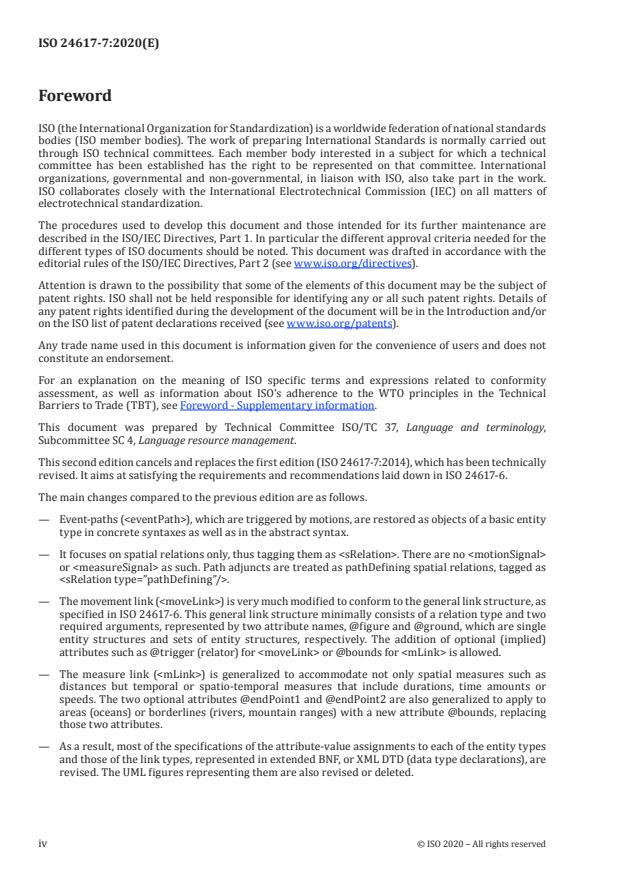
This second edition cancels and replaces the first edition (ISO 24617-7:2014), which has been technically
revised. It aims at satisfying the requirements and recommendations laid down in ISO 24617-6.
The main changes compared to the previous edition are as follows.
— Event-paths (), which are triggered by motions, are restored as objects of a basic entity
type in concrete syntaxes as well as in the abstract syntax.
— It focuses on spatial relations only, thus tagging them as . There are no
or as such. Path adjuncts are treated as pathDefining spatial relations, tagged as
.
— The movement link () is very much modified to conform to the general link structure, as
specified in ISO 24617-6. This general link structure minimally consists of a relation type and two
required arguments, represented by two attribute names, @figure and @ground, which are single
entity structures and sets of entity structures, respectively. The addition of optional (implied)
attributes such as @trigger (relator) for or @bounds for is allowed.
— The measure link () is generalized to accommodate not only spatial measures such as
distances but temporal or spatio-temporal measures that include durations, time amounts or
speeds. The two optional attributes @endPoint1 and @endPoint2 are also generalized to apply to
areas (oceans) or borderlines (rivers, mountain ranges) with a new attribute @bounds, replacing
those two attributes.
— As a result, most of the specifications of the attribute-value assignments to each of the entity types
and those of the link types, represented in extended BNF, or XML DTD (data type declarations), are
revised. The UML figures representing them are also revised or deleted.
iv © ISO 2020 – All rights reserved
— The list of tags associated with entity structures and link structures is presented in a tabular form
to make these structures more comparable in a visual way. This list has been given in Clause 4,
Table 1.
— To make the document more compact and less burdensome for the readers, Annex A, Guidelines, has
been deleted.
A list of all parts in the ISO 24617 series can be found on the ISO website.
Any feedback or questions on this document should be directed to the user’s national standards body. A
complete listing of these bodies can be found at www .iso .org/ members .html.
Introduction
The automatic recognition of spatial information in natural language is currently attracting considerable
attention in the fields of computational linguistics and artificial intelligence. The development of
algorithms that exhibit “spatial awareness” promises to add needed functionality to natural language
processing (NLP) systems, from named entity recognition to question-answering and text-based
inference. However, in order for such systems to reason spatially, they require the enrichment of textual
data with the annotation of spatial information in language. This involves a large range of linguistic
constructions, including spatially anchoring events, descriptions of objects in motion, viewer-relative
descriptions of scenes, absolute spatial descriptions of locations, and many other constructions.
This document provides normative specifications not only for spatial information, but also for
information content in motion and various other types of event in language.
In this document, Clause 8 treats the representation of static and dynamic spatial annotations
by introducing an XML-based concrete syntax for representing spatial-related or motion-related
annotations. This concrete syntax is based on the abstract syntax that is presented in Clause 7 with a
metamodel as a part of the specification of the spatial annotation structure. An informative Annex A is
provided with a brief introduction to the annotation and interpretation of quantified spatial entities
and eventualities including motions and event-paths.
A formal semantics, based on the abstract syntax, will be provided as part of a future new work item
within the semantic annotation framework. This will be coordinated with the temporal semantics
and specification of ISO 24617-1, thereby producing a rich semantics that will be directly useable by
practitioners in computational linguistics and other communities (see Clause 6).
vi © ISO 2020 – All rights reserved
INTERNATIONAL STANDARD ISO 24617-7:2020(E)
Language resource management — Semantic annotation
framework —
Part 7:
Spatial information
1 Scope
This document provides a framework for encoding a broad range of spatial information and
spatiotemporal information relating to motion as expressed in natural language texts. This document
includes references to locations, general spatial entities, spatial relations (involving topological,
orientational, and metric values), dimensional information, motion events, paths, and event-paths
triggered by motions.
2 Normative references
The following documents are referred to in the text in such a way that some or all of their content
constitutes requirements of this document. For dated references, only the edition cited applies. For
undated references, the latest edition of the referenced document (including any amendments) applies.
ISO 24617-1, Language resource management — Semantic annotation framework (SemAF) — Part 1: Time
and events (SemAF-Time, ISO-TimeML)
ISO 24617-6, Language resource management — Semantic annotation framework — Part 6: Principles of
semantic annotation (SemAF Principles)
3 Terms and definitions
For the purposes of this document, the terms and definitions given in ISO 24617-1 and ISO 24617-6, and
the following apply.
3.1
document creation location
dcl
unique place or set of places associated with a document that represents the location (3.7) in which the
document was created
1)
Note 1 to entry: Some collaboratively written documents, such as GoogleDoc documents and chat logs, might
refer not only to a single location but also to a set of locations spread out across the world. Besides, for example,
the creation place of the Hebrew bible or the creation place of each of the books in it is uncertain. The attribute @
dcl will, therefore, have the value "false", understood to mean "unspecified", while the value "true", is understood
to mean"specified".
1) GoogleDoc is an example of a suitable product available commercially. This information is given for the
convenience of users of this document and does not constitute an endorsement by ISO of this product.
3.2
event
eventuality
something that can be said to obtain or hold true, to happen or to occur
Note 1 to entry: This is a very broad notion of event that includes all kinds of actions, states, processes, etc. It
is not to be confused with the narrower notion of event (as opposed to the notion of "state") as something that
happens at a certain point in time (e.g. the clock striking two or waking up) or during a short period of time (e.g.
laughing). In TimeML, the term “event” is used in a broader sense and is equivalent to the term “eventuality”.
[SOURCE: ISO 24617-1:2012, 3.4, modified – The Note 1 to entry has been reworded.]
3.3
event-path
dynamic path
trajectory
dynamic route
directed path (3.15) followed by a mover (3.12) and coincident with a motion-event (3.10)
Note 1 to entry: Unlike (static) paths such as roads or circular tracks, event-paths are each triggered by a specific
motion-event, characterized as being finite directed paths each with a start and an end.
3.4
extent
textual segment that is a string of character segments in text to be annotated
EXAMPLE Tokens, words, and non-contiguous phrases (e.g. a complex verb like "look . up") are extents.
3.5
figure
entity that is considered the focal object, which is related to some reference object
3.6
ground
landmark
entity that acts as reference for a figure (3.5)
Note 1 to entry: “landmark” is often used by cognitive semanticists.
3.7
location
point or finite area that is positioned within a space (3.19) or a series of such points or areas
Note 1 to entry: places (3.16), paths (3.15), and event-paths (3.3) are subtypes of locations.
3.8
measure
magnitude of a spatial dimension or relation
EXAMPLE Distance is a spatial relation.
3.9
measure relation
link that relates a measure (3.8) to an object that is being measured
Note 1 to entry: The bounds of a measured object are sometimes specified for a measure relation. They can be
points or areas like a city, or lines like a river or mountain range.
2 © ISO 2020 – All rights reserved
3.10
motion
motion-event
action or process involving the translocation of a spatial object, transformation of some spatial property
of an object, or change in the conformation of an object
Note 1 to entry: A motion is a particular kind of eventuality (3.2).
3.11
movement relation
link that relates a mover (3.12) to an event-path (3.3) which the mover (3.12) traverses
Note 1 to entry: A movement link is triggered by a motion (3.10).
3.12
mover
moving object
entity that undergoes a change of its location
Note 1 to entry: A mover can either be the agent of a motion as one who walked to the station or one that is simply
caused to move like a stone thrown into a well, while the thrower is not considered to be the mover in the sense
of the term defined.
3.13
non-consuming tag
tag (3.19) that has no associated extent (3.4)
Note 1 to entry: The extent (3.4) of a non-consuming tag is a null string.
EXAMPLE In an example, John ate an apple but Mary a pear, there are at least two ways of marking up the
tag, one with its extent or target filled in with a nonnull string of characters, or audio or visual elements,
and the other with an empty string:
a) John ate an apple, but Mary ∅ a pear;
e1 e2
b) 1)
2) (non-consuming tag)
3.14
orientation relation
orientational relation
directional relation
link that relates one location as a figure (3.5) to another location as a ground (3.6) that expresses the
spatial disposition or direction of a spatial object within a frame of reference
3.15
path
static path
route
location (3.7) that consists of a series of locations
Note 1 to entry: A spatial object path is a location where the focus is on the potential for traversal or which
functions as a boundary. This includes common nouns like road, coastline, and river and proper names like Route
66 and Kangamangus Highway. Some nouns, such as valley, can be ambiguous. It can be understood as a path
(3.15) in we walked down the valley or as a place (3.16) in we live in the valley.
Note 2 to entry: A path might be represented as an undirected graph whose vertices are locations and whose
edges signify continuity; i.e., unlike an event-path (3.3), a path has no inherent directionality.
3.16
place
geographic or administrative entity that is situated at a location (3.7)
3.17
qualitative spatial relation
topological link
abstract static relation between regions (3.18) or spaces (3.19), expressing their connectedness or
continuity
3.18
region
connected, non-empty point-set defined by a domain and its boundary points
Note 1 to entry: The term "region" as defined does not refer to a political or administrative region such as "the
Canary Islands" or "Hong Kong, SAR", where SAR is the acronym of “Special Administrative Region”.
3.19
space
dimensional extent in which objects and events (3.2) have a relative position and direction
3.20
spatial entity, non-locational
non-locational spatial entity
object that is situated at a unique location (3.7) for some period of time, and typically has the potential
to undergo translocation
Note 1 to entry: A non-locational spatial entity, tagged , as defined, is distinct from genuine spatial
entities that consists of three types of locational entities, places, paths, and event-paths. It is an object that
participates in a spatial or motional relation. In John is sitting in a car, both John and car could be understood as
spatial entities or as being the figure (3.5) and the ground (3.6), respectively, of the sitting-in situation.
Note 2 to entry: In the first edition of this document, non-locational spatial entities were tagged .
They are now tagged to allow their use in both spatial and non-spatial contexts, as in: I left a purse in the
car (spatial context) that I had rented Ф (non-spatial context) last week.
3.21
spatial relation
segment or series of segments of a text that rebounds to qualitative spatial relations (3.17) or
orientational relations (3.14), or to movement relations (3.11) indirectly through the specification of the
bounds of paths (3.15) or event-paths (3.3)
3.22
tag
element name
name associated with textual segments for annotation or for a relation between these segments
Note 1 to entry: The following are three kinds of tag for annotation:
a) extent tag, which is associated with textual segments referring to basic entities or signals;
b) link tag, for representing spatial relations; and
c) root tag, for the closure of annotations.
4 List of tags
See Table 1, where each tag is braced with a pair of angled brackets for the name of an XML element. For
other representation formats, the tags have no such brackets. These tags, especially the event-path tag,
may be non-consuming tags (see 3.13) having an empty string of characters as @target value, called
"extent".
4 © ISO 2020 – All rights reserved
Table 1 — Tags with ID prefixes
Entities Tags ID prefixes Examples Comments
Basic entities: spatial entities, relations, and eventualities
place pl Osaka, city
path p Highway 1,
street, river
non-locational x (in a) car non-locational entities that are
spatial entity spatially involved
spatial relation sr in, on, north-east, type = “topological” | “directional” |
“topoDirectional” | “pathDefining” |
from, to, for, towards
“goal-defining”
motion m drive, travel translocational
non-motional e live, work inherited from ISO 24617-1 TimeML
eventuality
event-path ep empty extent non-consuming tag,
spatio-temorally definable
measure me 500 miles extendible to spatio-temporal
measures
100 km/h
Links: link structures <@figure, @ground, @relType>
qualitative spa- qsL Relates one location as a figure to
tial link another as a ground
orientational link oL Relates one location to another possi-
bly with some
point of reference
movement link mvL Relates a mover to an event-path
measure link meL Relates a measure to an object, possi-
bly with the
specification of its bounds
Root element
spatial annotation sp closure of spatial annotation
5 Overview
Human languages impose diverse linguistic constructions for expressing concepts of space, of spatially-
anchored events, and of spatial configurations that relate in complex ways to the situations in which
they are used. One area that deserves further development regarding the connection between natural
language and formal representations of space is the automatic enrichment of textual data with spatial
annotations. There is a growing demand for such annotated data, particularly in the context of the
semantic web. Moreover, textual data routinely make reference to objects moving through space over
time. Integrating such information derived from textual sources into a geosensor data system can
enhance the overall spatiotemporal representation in changing and evolving situations, such as when
tracking objects through space with limited image data. It follows that verbal subjective descriptions
of spatial relations need to be translated into metrically meaningful positional information. A central
research question currently hindering progress in interpreting textual data is the lack of a clear
separation of the information that can be derived directly from linguistic interpretation and further
information that requires contextual interpretation. In order to avoid building incorrect deductions
into the annotations themselves, mark-up schemes should avoid over-annotating the text. Solutions to
the language-space mapping problem and its grounding in geospatial data are urgently required for
this purpose.
There are many applications and tasks that would benefit from a robust spatial mark-up language, such
as the one specified in this document.
These applications and tasks include the following:
a) creating a visualization of objects from a verbal description of a scene;
b) identifying the spatial relations associated with a sequence of processes and events from a news
article;
c) determining an object location or tracking a moving object from a verbal description;
d) translating viewer-centric verbal descriptions into other relative descriptions or absolute
coordinate descriptions;
e) constructing a route given a route description;
f) constructing a spatial model of an interior or exterior space given a verbal description;
g) integrating spatial descriptions with information from other media.
The goal of this document is not to provide a formalism that fully represents the complexity of spatial
language, but rather to capture these complex constructions in text in order to provide an inventory
of how spatial information is presented in natural language. For example, many texts have no explicit
frame of spatio-temporal reference, thus making it impossible to annotate such an unspecified frame
of reference. The interpretation of spatial prepositions, such as on in a book on the desk vs a picture on
the wall requires a handbook of its own dealing with different senses or uses of spatial prepositions
beyond a set of annotation guidelines. Any detailed classification of motion verbs in English alone is
again beyond the scope of this document.
All of the examples in the current document have been taken from English datasets. The specification
language for spatial annotation proposed in this document can be seen as a version for English only and
its applicability to other languages is still pending.
6 Motivation and requirements
This document aims to formulate the requirements for static and dynamic spatial annotation standards.
It considers ISO 24612, which requires standoff annotation, and ISO 24617-6, which provides a set of
basic guidelines to formulate annotation structures for semantic interpretation, and builds on previous
work, including ISO 24617-1 and other spatial representations and calculi, especially Reference [10].
Natural language abounds with descriptions of motion. Our experience of our own motion, together
with our perception of motion in the world, have given human languages substantial means to verbally
express many different aspects of movement, including its temporal circumstances, spatial trajectory
and manner. In every natural language, verbalizations of motion can specify changes in the spatial
position of an object over time. In addition to when and where the motion takes place, languages
additionally characterize how the motion takes place (e.g., its path, its manner, and how it was caused).
In particular, the path of motion, called “event-path” in this document, involves conceptualizations of
the various spatial relationships that an object can have to other objects in the space in which it moves.
An understanding of such spatial information in natural language is necessary for many computational
linguistics and artificial intelligence applications.
Any specification language for spatial information in language needs to support the following
computational tasks:
— identification of the appropriate topological configuration between two regions or objects (e.g.
containment, identity, disjointedness, connectedness, overlap, and closure over these relations,
when possible);
— identification of directional and orientational relations between objects and regions, including the
distinction between frames of reference;
— identification of metric properties of objects and metric values between regions and objects, when
possible (e.g. distance, height and width);
6 © ISO 2020 – All rights reserved
— identification of the motion of objects through space and time and a characterization of the nature
of this movement;
— provision of clear interoperable interfaces to existing representations and geo-databases (e.g.
2)
GeoNames, ArcGIS, and Google Earth ).
NOTE 1 Texts are often completely unspecified for frames of reference (texts are, so to speak, "not situated")
and therefore it appears that the annotation of a frame of reference cannot be provided for many texts.
NOTE 2 Measure expressions, such as 20 miles, have two attributes, numeric @value "20" and @unit "miles",
but expressions like near and far have no unit specified. The annotation scheme proposed in this document can
only state that they are measure-related expressions only with its attribute @value specified, say with "near" or
"far". As will be seen, many of the annotation cases are left underspecified.
7 Specification of the spatial annotation scheme
7.1 Overview: annotation vs. representation
As with other areas of work on semantic annotation, each of the annotation schemes that are specified
in ISO 24617 draws a fundamental distinction between the concepts of annotation and representation,
as is required by ISO 24612. The term “annotation” is used to refer to the process of adding information
to segments of language data or to refer to that information itself. This notion is independent of the
format in which this information is represented. The term “representation” is used to refer to the format
in which an annotation is rendered (for instance, in XML) independent of its content. As is required by
ISO 24612, annotations are the proper level of standardization, not representations. This document,
therefore, defines a specification language for annotating documents with information about spatial
entities and spatial relations at the level of annotations and then for representing these annotations in a
specific way, either with XML or with a predicate-logic-like format.
Following ISO 24617-6:2016 principles, the spatial annotation scheme of this document is introduced in
two steps: (1) Construction of a metamodel and (2) Formulation of the abstract syntax. The metamodel
provides a UML-based conceptual frame of establishing the abstract syntax, which lays down a set-
theoretic basis of implementing concrete syntaxes as well as a formally definable semantics.
The semantic annotation scheme consists of an abstract syntax, a semantically equivalent set of
concrete syntaxes, which is structurally isomorphic to the abstract syntax, and a semantics. The
abstract syntax defines in set-theoretic terms annotation structures which consist of entity structures
and link structures. Each entity structure is anchored to a markable carrying some information. Entity
structures are also typed, each referring, for instance, to a place, path, event-path, eventuality, motion,
spatial entity or measure which is involved in spatial information. Link structures relate these entity
structures with each other.
7.2 Metamodel
The metamodel of the spatial annotation scheme depicted by Figure 1 represents the general conceptual
frame of spatial annotation. It consists of the following five components:
1) a collection of datasets, called “communicative segments”;
2) a nonempty set of markable expressions, called “markables”, the source of which is the
communicative segments;
3) a list of four entity types, each of which is anchored to a markable:
a) spatial entity with three locational subtypes: place, path, and trajectory (event-path),
2) GeoNames, ArcGIS, and Google Earth are examples of a suitable products available commercially. This
information is given for the convenience of users of this document and does not constitute an endorsement by ISO
of these products.
b) spatial relation of various types,
c) eventuality, with its subtype motion, and
d) measure;
4) a list of four link types, each of which relates a pair of entity structures, generated by the
abstract syntax:
a) qualitative spatial link, tagged or ,
b) orientation link, tagged or ,
c) movement link, tagged , and
d) measure link, tagged ;
5) a list of specifications of attribute-value assignments associated with each of the basic entity types
and the link types.
Figure 1 — Metamodel of the spatial annotation scheme
Figure 1 lists only the four components without specifying attribute-value assignments. Communicative
segments carry information in the form of text or visual images. Such information may also include
contextual or background information that is conveyed by various discourse situations. Each of the
entity structures associated with one of the major basic entity types and their subtypes is anchored to
a markable which is being annotated.
8 © ISO 2020 – All rights reserved
There are two subtypes of the qualitative spatial link and the orientation link. One type, tagged
or , relates at least two locational spatial entities with each other. The other, tagged
or , relates an eventuality-type entity structure to a locational spatial entity.
NOTE In concrete syntaxes, only the tags and are used, while the other tags,
and , are not used. They are differentiated in the way how their relations operate.
The movement link, tagged , relates a non-locational spatial entity which is caused to move
by a motion to a trajectory, called “event-path”. The measure link, tagged , relates a measure to
an entity in general and to a spatial entity in particular.
7.3 Abstract syntax
An abstract syntax provides a theoretical basis for deriving various versions of a concrete syntax.
In this document, the abstract syntax is schematically represented by the UML-based metamodel
(Figure 1), which specifies an annotation scheme for spatial information. It is then formulated in set-
theoretic terms.
Given a non-empty set C of communicative segments, the abstract syntax presented in this document
for the annotation of C can be formulated as a tuple , where
M is a set of markables,
B is a set of basic element types,
L is a set of links, and
@ is a list of specifications of possible attribute-value assignments to each member of B or L.
NOTE 1 The form of C can be either textual, spoken, visual, or multimodal in general such that even gestures
can be included in the set of communicative segments.
Each of the components of the abstract syntax is further specified or subclassified as below.
a) M is a set of subsets of C, each of which is delimited by B.
b) B is partitioned to S, R, E, and Q such that
1) S includes locational entities such as places, paths, and motional trajectories (event-paths) and
non-locational entities that are involved in spatial relations R or eventualities E,
2) R consists of spatial relations of various types, topological, directional, topo-directional, path-
defining or goal-defining,
3) E includes both motions and non-motions,
4) Q includes both quantitative measures and non-quantitative measures.
c) L consists of four types,
1) qualitative spatial link with the two subtypes, as listed in Figure 1,
2) orientational link with two subtypes, as listed in Figure 1,
3) movement link, and
4) measure link.
Each of these links is structured to be a triplet <η, E, ρ >,
where η is an entity structure,
E is a non-empty set of entity structures, and
ρ is a type of relation over them.
d) Each of the specification in @ can be formally represented by DTD or BNF but in general terms.
NOTE 2 An entity structure is a tuple , where m is a markable in M and a is the annotation of m as
specified by a specific assignment @ of attribute-values to m. For the semantic annotation of m, the annotation a
is semantic information.
8 Representation of spatial annotations
8.1 XML-based concrete syntax: outline
8.1.1 Overview
The abstract syntax proposed in 8.3 allows a variety of semantically equivalent concrete syntaxes for
the representation of spatial annotations. Each of these concrete syntaxes is structurally isomorphic to
the abstract syntax from which it is derived. An XML-based concrete syntax is the most conventionally
accepted one. It serializes spatial annotation structures in XML, consisting of basic element types (see
8.1.2) and links (see 8.1.3).
8.1.2 Basic element types
As introduced in the abstract syntax (7.3), there are four types of basic elements B:
1) spatial entity S with three locational subtypes, “place”, “path”, and “event-path”,
2) spatial relation R,
3) eventuality E, and
4) measure Q.
In the XML-based concrete syntax, they are tagged as:
1) with its three locational subtypes, , , ,
2) ,
3) with its subtype “motion”, tagged , and
4) , respectively.
NOTE 1 ISO 24617-7:2014 treated spatial relations as signals. In this second edition, there is no basic element
called “signal” or tagged .
NOTE 2 In ISO 24617-7:2014, non-locational spatial entities used to be tagged . It is now simply
tagged because its spatial involvement can be deduced by the context of its use.
The three subtypes are subsumed by spatial entities, tagged , meaning that they carry more
specific information than spatial entities in general. Hence, those entities that are tagged are
understood as referring to spatial entities other than those of the three subtypes, while carrying less
specific information than these subtypes.
The type of eventualities has a subtype called “motion”. This is tagged . Non-motion
eventualities are tagged .
10 © ISO 2020 – All rights reserved
The type of spatial relations, tagged , has several subtypes: topological, directional, topo-
directional, pathDefining, or goalDefining relations. These subtypes are differentiated with the
attribute @type with a different value being assigned to each of them.
EXAMPLE 1 topological: “in”, “at”;
directional: “in front of”, “north of”;
topodirectional: “on”;
pathDefining: “from”, “to”, “through”;
goalDefining: “for”, “towards”.
8.1.3 Links
The abstract syntax introduces four types of links: the qualitative spatial link, the orientation
link, the movement link, and the measure link. In the XML-based concrete syntax, they are tagged
respectively as: , , , and .
NOTE 1 In concrete syntaxes, and are merged into and , respectively.
Hence, and represent two types of relations: one relates a spatial entity to other spatial
entities, whereas the other relates an eventuality to one or more spatial entities.
8.1.4 Root element
Each bundle of XML elements forms a tree-like structure called an “XML document”. This XML document
has a single element called a “root element” that encloses all the other elements in the document.
For each collection of spatial annotation structures conformant to the specifications of this XML
document, its root element is tagged with its ID prefix “sp”.
EXAMPLE 1
where N in "spN" is a natural number.
8.2 Conventions for tagging
8.2.1 Naming conventions
Naming conventions can be quite complex. The following are four basic guidelines.
a) This document follows medial capit
...
INTERNATIONAL ISO
STANDARD 24617-7
Second edition
2020-05
Language resource management —
Semantic annotation framework —
Part 7:
Spatial information
Gestion des ressources linguistiques — Cadre d'annotation
sémantique —
Partie 7: Information spatiale
Reference number
©
ISO 2020
© ISO 2020
All rights reserved. Unless otherwise specified, or required in the context of its implementation, no part of this publication may
be reproduced or utilized otherwise in any form or by any means, electronic or mechanical, including photocopying, or posting
on the internet or an intranet, without prior written permission. Permission can be requested from either ISO at the address
below or ISO’s member body in the country of the requester.
ISO copyright office
CP 401 • Ch. de Blandonnet 8
CH-1214 Vernier, Geneva
Phone: +41 22 749 01 11
Fax: +41 22 749 09 47
Email: copyright@iso.org
Website: www.iso.org
Published in Switzerland
ii © ISO 2020 – All rights reserved
Contents Page
Foreword .iv
Introduction .vi
1 Scope . 1
2 Normative references . 1
3 Terms and definitions . 1
4 List of tags . 4
5 Overview . 5
6 Motivation and requirements . 6
7 Specification of the spatial annotation scheme . 7
7.1 Overview: annotation vs. representation. 7
7.2 Metamodel . 7
7.3 Abstract syntax . 9
8 Representation of spatial annotations .10
8.1 XML-based concrete syntax: outline .10
8.1.1 Overview .10
8.1.2 Basic element types .10
8.1.3 Links .11
8.1.4 Root element .11
8.2 Conventions for tagging .11
8.2.1 Naming conventions .11
8.2.2 Convention for inline tagging extents .12
8.3 Specification of attributes for basic entity tags .12
8.3.1 for no-locational spatial entities.12
8.3.2 .13
8.3.3 .16
8.3.4 for event-paths .17
8.3.5 .17
8.3.6 for non-motion eventualities .18
8.3.7 for various types of spatial relations .19
8.3.8 .20
8.4 Link tags .21
8.4.1 .21
8.4.2 .22
8.4.3 .23
8.4.4 .24
8.5 Root tag: .26
Annex A (informative) Quantification over spatial entities and eventualities .27
Bibliography .32
Foreword
ISO (the International Organization for Standardization) is a worldwide federation of national standards
bodies (ISO member bodies). The work of preparing International Standards is normally carried out
through ISO technical committees. Each member body interested in a subject for which a technical
committee has been established has the right to be represented on that committee. International
organizations, governmental and non-governmental, in liaison with ISO, also take part in the work.
ISO collaborates closely with the International Electrotechnical Commission (IEC) on all matters of
electrotechnical standardization.
The procedures used to develop this document and those intended for its further maintenance are
described in the ISO/IEC Directives, Part 1. In particular the different approval criteria needed for the
different types of ISO documents should be noted. This document was drafted in accordance with the
editorial rules of the ISO/IEC Directives, Part 2 (see www .iso .org/ directives).
Attention is drawn to the possibility that some of the elements of this document may be the subject of
patent rights. ISO shall not be held responsible for identifying any or all such patent rights. Details of
any patent rights identified during the development of the document will be in the Introduction and/or
on the ISO list of patent declarations received (see www .iso .org/ patents).
Any trade name used in this document is information given for the convenience of users and does not
constitute an endorsement.
For an explanation on the meaning of ISO specific terms and expressions related to conformity
assessment, as well as information about ISO's adherence to the WTO principles in the Technical
Barriers to Trade (TBT), see Foreword - Supplementary information.
This document was prepared by Technical Committee ISO/TC 37, Language and terminology,
Subcommittee SC 4, Language resource management.
This second edition cancels and replaces the first edition (ISO 24617-7:2014), which has been technically
revised. It aims at satisfying the requirements and recommendations laid down in ISO 24617-6.
The main changes compared to the previous edition are as follows.
— Event-paths (), which are triggered by motions, are restored as objects of a basic entity
type in concrete syntaxes as well as in the abstract syntax.
— It focuses on spatial relations only, thus tagging them as . There are no
or as such. Path adjuncts are treated as pathDefining spatial relations, tagged as
.
— The movement link () is very much modified to conform to the general link structure, as
specified in ISO 24617-6. This general link structure minimally consists of a relation type and two
required arguments, represented by two attribute names, @figure and @ground, which are single
entity structures and sets of entity structures, respectively. The addition of optional (implied)
attributes such as @trigger (relator) for or @bounds for is allowed.
— The measure link () is generalized to accommodate not only spatial measures such as
distances but temporal or spatio-temporal measures that include durations, time amounts or
speeds. The two optional attributes @endPoint1 and @endPoint2 are also generalized to apply to
areas (oceans) or borderlines (rivers, mountain ranges) with a new attribute @bounds, replacing
those two attributes.
— As a result, most of the specifications of the attribute-value assignments to each of the entity types
and those of the link types, represented in extended BNF, or XML DTD (data type declarations), are
revised. The UML figures representing them are also revised or deleted.
iv © ISO 2020 – All rights reserved
— The list of tags associated with entity structures and link structures is presented in a tabular form
to make these structures more comparable in a visual way. This list has been given in Clause 4,
Table 1.
— To make the document more compact and less burdensome for the readers, Annex A, Guidelines, has
been deleted.
A list of all parts in the ISO 24617 series can be found on the ISO website.
Any feedback or questions on this document should be directed to the user’s national standards body. A
complete listing of these bodies can be found at www .iso .org/ members .html.
Introduction
The automatic recognition of spatial information in natural language is currently attracting considerable
attention in the fields of computational linguistics and artificial intelligence. The development of
algorithms that exhibit “spatial awareness” promises to add needed functionality to natural language
processing (NLP) systems, from named entity recognition to question-answering and text-based
inference. However, in order for such systems to reason spatially, they require the enrichment of textual
data with the annotation of spatial information in language. This involves a large range of linguistic
constructions, including spatially anchoring events, descriptions of objects in motion, viewer-relative
descriptions of scenes, absolute spatial descriptions of locations, and many other constructions.
This document provides normative specifications not only for spatial information, but also for
information content in motion and various other types of event in language.
In this document, Clause 8 treats the representation of static and dynamic spatial annotations
by introducing an XML-based concrete syntax for representing spatial-related or motion-related
annotations. This concrete syntax is based on the abstract syntax that is presented in Clause 7 with a
metamodel as a part of the specification of the spatial annotation structure. An informative Annex A is
provided with a brief introduction to the annotation and interpretation of quantified spatial entities
and eventualities including motions and event-paths.
A formal semantics, based on the abstract syntax, will be provided as part of a future new work item
within the semantic annotation framework. This will be coordinated with the temporal semantics
and specification of ISO 24617-1, thereby producing a rich semantics that will be directly useable by
practitioners in computational linguistics and other communities (see Clause 6).
vi © ISO 2020 – All rights reserved
INTERNATIONAL STANDARD ISO 24617-7:2020(E)
Language resource management — Semantic annotation
framework —
Part 7:
Spatial information
1 Scope
This document provides a framework for encoding a broad range of spatial information and
spatiotemporal information relating to motion as expressed in natural language texts. This document
includes references to locations, general spatial entities, spatial relations (involving topological,
orientational, and metric values), dimensional information, motion events, paths, and event-paths
triggered by motions.
2 Normative references
The following documents are referred to in the text in such a way that some or all of their content
constitutes requirements of this document. For dated references, only the edition cited applies. For
undated references, the latest edition of the referenced document (including any amendments) applies.
ISO 24617-1, Language resource management — Semantic annotation framework (SemAF) — Part 1: Time
and events (SemAF-Time, ISO-TimeML)
ISO 24617-6, Language resource management — Semantic annotation framework — Part 6: Principles of
semantic annotation (SemAF Principles)
3 Terms and definitions
For the purposes of this document, the terms and definitions given in ISO 24617-1 and ISO 24617-6, and
the following apply.
3.1
document creation location
dcl
unique place or set of places associated with a document that represents the location (3.7) in which the
document was created
1)
Note 1 to entry: Some collaboratively written documents, such as GoogleDoc documents and chat logs, might
refer not only to a single location but also to a set of locations spread out across the world. Besides, for example,
the creation place of the Hebrew bible or the creation place of each of the books in it is uncertain. The attribute @
dcl will, therefore, have the value "false", understood to mean "unspecified", while the value "true", is understood
to mean"specified".
1) GoogleDoc is an example of a suitable product available commercially. This information is given for the
convenience of users of this document and does not constitute an endorsement by ISO of this product.
3.2
event
eventuality
something that can be said to obtain or hold true, to happen or to occur
Note 1 to entry: This is a very broad notion of event that includes all kinds of actions, states, processes, etc. It
is not to be confused with the narrower notion of event (as opposed to the notion of "state") as something that
happens at a certain point in time (e.g. the clock striking two or waking up) or during a short period of time (e.g.
laughing). In TimeML, the term “event” is used in a broader sense and is equivalent to the term “eventuality”.
[SOURCE: ISO 24617-1:2012, 3.4, modified – The Note 1 to entry has been reworded.]
3.3
event-path
dynamic path
trajectory
dynamic route
directed path (3.15) followed by a mover (3.12) and coincident with a motion-event (3.10)
Note 1 to entry: Unlike (static) paths such as roads or circular tracks, event-paths are each triggered by a specific
motion-event, characterized as being finite directed paths each with a start and an end.
3.4
extent
textual segment that is a string of character segments in text to be annotated
EXAMPLE Tokens, words, and non-contiguous phrases (e.g. a complex verb like "look . up") are extents.
3.5
figure
entity that is considered the focal object, which is related to some reference object
3.6
ground
landmark
entity that acts as reference for a figure (3.5)
Note 1 to entry: “landmark” is often used by cognitive semanticists.
3.7
location
point or finite area that is positioned within a space (3.19) or a series of such points or areas
Note 1 to entry: places (3.16), paths (3.15), and event-paths (3.3) are subtypes of locations.
3.8
measure
magnitude of a spatial dimension or relation
EXAMPLE Distance is a spatial relation.
3.9
measure relation
link that relates a measure (3.8) to an object that is being measured
Note 1 to entry: The bounds of a measured object are sometimes specified for a measure relation. They can be
points or areas like a city, or lines like a river or mountain range.
2 © ISO 2020 – All rights reserved
3.10
motion
motion-event
action or process involving the translocation of a spatial object, transformation of some spatial property
of an object, or change in the conformation of an object
Note 1 to entry: A motion is a particular kind of eventuality (3.2).
3.11
movement relation
link that relates a mover (3.12) to an event-path (3.3) which the mover (3.12) traverses
Note 1 to entry: A movement link is triggered by a motion (3.10).
3.12
mover
moving object
entity that undergoes a change of its location
Note 1 to entry: A mover can either be the agent of a motion as one who walked to the station or one that is simply
caused to move like a stone thrown into a well, while the thrower is not considered to be the mover in the sense
of the term defined.
3.13
non-consuming tag
tag (3.19) that has no associated extent (3.4)
Note 1 to entry: The extent (3.4) of a non-consuming tag is a null string.
EXAMPLE In an example, John ate an apple but Mary a pear, there are at least two ways of marking up the
tag, one with its extent or target filled in with a nonnull string of characters, or audio or visual elements,
and the other with an empty string:
a) John ate an apple, but Mary ∅ a pear;
e1 e2
b) 1)
2) (non-consuming tag)
3.14
orientation relation
orientational relation
directional relation
link that relates one location as a figure (3.5) to another location as a ground (3.6) that expresses the
spatial disposition or direction of a spatial object within a frame of reference
3.15
path
static path
route
location (3.7) that consists of a series of locations
Note 1 to entry: A spatial object path is a location where the focus is on the potential for traversal or which
functions as a boundary. This includes common nouns like road, coastline, and river and proper names like Route
66 and Kangamangus Highway. Some nouns, such as valley, can be ambiguous. It can be understood as a path
(3.15) in we walked down the valley or as a place (3.16) in we live in the valley.
Note 2 to entry: A path might be represented as an undirected graph whose vertices are locations and whose
edges signify continuity; i.e., unlike an event-path (3.3), a path has no inherent directionality.
3.16
place
geographic or administrative entity that is situated at a location (3.7)
3.17
qualitative spatial relation
topological link
abstract static relation between regions (3.18) or spaces (3.19), expressing their connectedness or
continuity
3.18
region
connected, non-empty point-set defined by a domain and its boundary points
Note 1 to entry: The term "region" as defined does not refer to a political or administrative region such as "the
Canary Islands" or "Hong Kong, SAR", where SAR is the acronym of “Special Administrative Region”.
3.19
space
dimensional extent in which objects and events (3.2) have a relative position and direction
3.20
spatial entity, non-locational
non-locational spatial entity
object that is situated at a unique location (3.7) for some period of time, and typically has the potential
to undergo translocation
Note 1 to entry: A non-locational spatial entity, tagged , as defined, is distinct from genuine spatial
entities that consists of three types of locational entities, places, paths, and event-paths. It is an object that
participates in a spatial or motional relation. In John is sitting in a car, both John and car could be understood as
spatial entities or as being the figure (3.5) and the ground (3.6), respectively, of the sitting-in situation.
Note 2 to entry: In the first edition of this document, non-locational spatial entities were tagged .
They are now tagged to allow their use in both spatial and non-spatial contexts, as in: I left a purse in the
car (spatial context) that I had rented Ф (non-spatial context) last week.
3.21
spatial relation
segment or series of segments of a text that rebounds to qualitative spatial relations (3.17) or
orientational relations (3.14), or to movement relations (3.11) indirectly through the specification of the
bounds of paths (3.15) or event-paths (3.3)
3.22
tag
element name
name associated with textual segments for annotation or for a relation between these segments
Note 1 to entry: The following are three kinds of tag for annotation:
a) extent tag, which is associated with textual segments referring to basic entities or signals;
b) link tag, for representing spatial relations; and
c) root tag, for the closure of annotations.
4 List of tags
See Table 1, where each tag is braced with a pair of angled brackets for the name of an XML element. For
other representation formats, the tags have no such brackets. These tags, especially the event-path tag,
may be non-consuming tags (see 3.13) having an empty string of characters as @target value, called
"extent".
4 © ISO 2020 – All rights reserved
Table 1 — Tags with ID prefixes
Entities Tags ID prefixes Examples Comments
Basic entities: spatial entities, relations, and eventualities
place pl Osaka, city
path p Highway 1,
street, river
non-locational x (in a) car non-locational entities that are
spatial entity spatially involved
spatial relation sr in, on, north-east, type = “topological” | “directional” |
“topoDirectional” | “pathDefining” |
from, to, for, towards
“goal-defining”
motion m drive, travel translocational
non-motional e live, work inherited from ISO 24617-1 TimeML
eventuality
event-path ep empty extent non-consuming tag,
spatio-temorally definable
measure me 500 miles extendible to spatio-temporal
measures
100 km/h
Links: link structures <@figure, @ground, @relType>
qualitative spa- qsL Relates one location as a figure to
tial link another as a ground
orientational link oL Relates one location to another possi-
bly with some
point of reference
movement link mvL Relates a mover to an event-path
measure link meL Relates a measure to an object, possi-
bly with the
specification of its bounds
Root element
spatial annotation sp closure of spatial annotation
5 Overview
Human languages impose diverse linguistic constructions for expressing concepts of space, of spatially-
anchored events, and of spatial configurations that relate in complex ways to the situations in which
they are used. One area that deserves further development regarding the connection between natural
language and formal representations of space is the automatic enrichment of textual data with spatial
annotations. There is a growing demand for such annotated data, particularly in the context of the
semantic web. Moreover, textual data routinely make reference to objects moving through space over
time. Integrating such information derived from textual sources into a geosensor data system can
enhance the overall spatiotemporal representation in changing and evolving situations, such as when
tracking objects through space with limited image data. It follows that verbal subjective descriptions
of spatial relations need to be translated into metrically meaningful positional information. A central
research question currently hindering progress in interpreting textual data is the lack of a clear
separation of the information that can be derived directly from linguistic interpretation and further
information that requires contextual interpretation. In order to avoid building incorrect deductions
into the annotations themselves, mark-up schemes should avoid over-annotating the text. Solutions to
the language-space mapping problem and its grounding in geospatial data are urgently required for
this purpose.
There are many applications and tasks that would benefit from a robust spatial mark-up language, such
as the one specified in this document.
These applications and tasks include the following:
a) creating a visualization of objects from a verbal description of a scene;
b) identifying the spatial relations associated with a sequence of processes and events from a news
article;
c) determining an object location or tracking a moving object from a verbal description;
d) translating viewer-centric verbal descriptions into other relative descriptions or absolute
coordinate descriptions;
e) constructing a route given a route description;
f) constructing a spatial model of an interior or exterior space given a verbal description;
g) integrating spatial descriptions with information from other media.
The goal of this document is not to provide a formalism that fully represents the complexity of spatial
language, but rather to capture these complex constructions in text in order to provide an inventory
of how spatial information is presented in natural language. For example, many texts have no explicit
frame of spatio-temporal reference, thus making it impossible to annotate such an unspecified frame
of reference. The interpretation of spatial prepositions, such as on in a book on the desk vs a picture on
the wall requires a handbook of its own dealing with different senses or uses of spatial prepositions
beyond a set of annotation guidelines. Any detailed classification of motion verbs in English alone is
again beyond the scope of this document.
All of the examples in the current document have been taken from English datasets. The specification
language for spatial annotation proposed in this document can be seen as a version for English only and
its applicability to other languages is still pending.
6 Motivation and requirements
This document aims to formulate the requirements for static and dynamic spatial annotation standards.
It considers ISO 24612, which requires standoff annotation, and ISO 24617-6, which provides a set of
basic guidelines to formulate annotation structures for semantic interpretation, and builds on previous
work, including ISO 24617-1 and other spatial representations and calculi, especially Reference [10].
Natural language abounds with descriptions of motion. Our experience of our own motion, together
with our perception of motion in the world, have given human languages substantial means to verbally
express many different aspects of movement, including its temporal circumstances, spatial trajectory
and manner. In every natural language, verbalizations of motion can specify changes in the spatial
position of an object over time. In addition to when and where the motion takes place, languages
additionally characterize how the motion takes place (e.g., its path, its manner, and how it was caused).
In particular, the path of motion, called “event-path” in this document, involves conceptualizations of
the various spatial relationships that an object can have to other objects in the space in which it moves.
An understanding of such spatial information in natural language is necessary for many computational
linguistics and artificial intelligence applications.
Any specification language for spatial information in language needs to support the following
computational tasks:
— identification of the appropriate topological configuration between two regions or objects (e.g.
containment, identity, disjointedness, connectedness, overlap, and closure over these relations,
when possible);
— identification of directional and orientational relations between objects and regions, including the
distinction between frames of reference;
— identification of metric properties of objects and metric values between regions and objects, when
possible (e.g. distance, height and width);
6 © ISO 2020 – All rights reserved
— identification of the motion of objects through space and time and a characterization of the nature
of this movement;
— provision of clear interoperable interfaces to existing representations and geo-databases (e.g.
2)
GeoNames, ArcGIS, and Google Earth ).
NOTE 1 Texts are often completely unspecified for frames of reference (texts are, so to speak, "not situated")
and therefore it appears that the annotation of a frame of reference cannot be provided for many texts.
NOTE 2 Measure expressions, such as 20 miles, have two attributes, numeric @value "20" and @unit "miles",
but expressions like near and far have no unit specified. The annotation scheme proposed in this document can
only state that they are measure-related expressions only with its attribute @value specified, say with "near" or
"far". As will be seen, many of the annotation cases are left underspecified.
7 Specification of the spatial annotation scheme
7.1 Overview: annotation vs. representation
As with other areas of work on semantic annotation, each of the annotation schemes that are specified
in ISO 24617 draws a fundamental distinction between the concepts of annotation and representation,
as is required by ISO 24612. The term “annotation” is used to refer to the process of adding information
to segments of language data or to refer to that information itself. This notion is independent of the
format in which this information is represented. The term “representation” is used to refer to the format
in which an annotation is rendered (for instance, in XML) independent of its content. As is required by
ISO 24612, annotations are the proper level of standardization, not representations. This document,
therefore, defines a specification language for annotating documents with information about spatial
entities and spatial relations at the level of annotations and then for representing these annotations in a
specific way, either with XML or with a predicate-logic-like format.
Following ISO 24617-6:2016 principles, the spatial annotation scheme of this document is introduced in
two steps: (1) Construction of a metamodel and (2) Formulation of the abstract syntax. The metamodel
provides a UML-based conceptual frame of establishing the abstract syntax, which lays down a set-
theoretic basis of implementing concrete syntaxes as well as a formally definable semantics.
The semantic annotation scheme consists of an abstract syntax, a semantically equivalent set of
concrete syntaxes, which is structurally isomorphic to the abstract syntax, and a semantics. The
abstract syntax defines in set-theoretic terms annotation structures which consist of entity structures
and link structures. Each entity structure is anchored to a markable carrying some information. Entity
structures are also typed, each referring, for instance, to a place, path, event-path, eventuality, motion,
spatial entity or measure which is involved in spatial information. Link structures relate these entity
structures with each other.
7.2 Metamodel
The metamodel of the spatial annotation scheme depicted by Figure 1 represents the general conceptual
frame of spatial annotation. It consists of the following five components:
1) a collection of datasets, called “communicative segments”;
2) a nonempty set of markable expressions, called “markables”, the source of which is the
communicative segments;
3) a list of four entity types, each of which is anchored to a markable:
a) spatial entity with three locational subtypes: place, path, and trajectory (event-path),
2) GeoNames, ArcGIS, and Google Earth are examples of a suitable products available commercially. This
information is given for the convenience of users of this document and does not constitute an endorsement by ISO
of these products.
b) spatial relation of various types,
c) eventuality, with its subtype motion, and
d) measure;
4) a list of four link types, each of which relates a pair of entity structures, generated by the
abstract syntax:
a) qualitative spatial link, tagged or ,
b) orientation link, tagged or ,
c) movement link, tagged , and
d) measure link, tagged ;
5) a list of specifications of attribute-value assignments associated with each of the basic entity types
and the link types.
Figure 1 — Metamodel of the spatial annotation scheme
Figure 1 lists only the four components without specifying attribute-value assignments. Communicative
segments carry information in the form of text or visual images. Such information may also include
contextual or background information that is conveyed by various discourse situations. Each of the
entity structures associated with one of the major basic entity types and their subtypes is anchored to
a markable which is being annotated.
8 © ISO 2020 – All rights reserved
There are two subtypes of the qualitative spatial link and the orientation link. One type, tagged
or , relates at least two locational spatial entities with each other. The other, tagged
or , relates an eventuality-type entity structure to a locational spatial entity.
NOTE In concrete syntaxes, only the tags and are used, while the other tags,
and , are not used. They are differentiated in the way how their relations operate.
The movement link, tagged , relates a non-locational spatial entity which is caused to move
by a motion to a trajectory, called “event-path”. The measure link, tagged , relates a measure to
an entity in general and to a spatial entity in particular.
7.3 Abstract syntax
An abstract syntax provides a theoretical basis for deriving various versions of a concrete syntax.
In this document, the abstract syntax is schematically represented by the UML-based metamodel
(Figure 1), which specifies an annotation scheme for spatial information. It is then formulated in set-
theoretic terms.
Given a non-empty set C of communicative segments, the abstract syntax presented in this document
for the annotation of C can be formulated as a tuple , where
M is a set of markables,
B is a set of basic element types,
L is a set of links, and
@ is a list of specifications of possible attribute-value assignments to each member of B or L.
NOTE 1 The form of C can be either textual, spoken, visual, or multimodal in general such that even gestures
can be included in the set of communicative segments.
Each of the components of the abstract syntax is further specified or subclassified as below.
a) M is a set of subsets of C, each of which is delimited by B.
b) B is partitioned to S, R, E, and Q such that
1) S includes locational entities such as places, paths, and motional trajectories (event-paths) and
non-locational entities that are involved in spatial relations R or eventualities E,
2) R consists of spatial relations of various types, topological, directional, topo-directional, path-
defining or goal-defining,
3) E includes both motions and non-motions,
4) Q includes both quantitative measures and non-quantitative measures.
c) L consists of four types,
1) qualitative spatial link with the two subtypes, as listed in Figure 1,
2) orientational link with two subtypes, as listed in Figure 1,
3) movement link, and
4) measure link.
Each of these links is structured to be a triplet <η, E, ρ >,
where η is an entity structure,
E is a non-empty set of entity structures, and
ρ is a type of relation over them.
d) Each of the specification in @ can be formally represented by DTD or BNF but in general terms.
NOTE 2 An entity structure is a tuple , where m is a markable in M and a is the annotation of m as
specified by a specific assignment @ of attribute-values to m. For the semantic annotation of m, the annotation a
is semantic information.
8 Representation of spatial annotations
8.1 XML-based concrete syntax: outline
8.1.1 Overview
The abstract syntax proposed in 8.3 allows a variety of semantically equivalent concrete syntaxes for
the representation of spatial annotations. Each of these concrete syntaxes is structurally isomorphic to
the abstract syntax from which it is derived. An XML-based concrete syntax is the most conventionally
accepted one. It serializes spatial annotation structures in XML, consisting of basic element types (see
8.1.2) and links (see 8.1.3).
8.1.2 Basic element types
As introduced in the abstract syntax (7.3), there are four types of basic elements B:
1) spatial entity S with three locational subtypes, “place”, “path”, and “event-path”,
2) spatial relation R,
3) eventuality E, and
4) measure Q.
In the XML-based concrete syntax, they are tagged as:
1) with its three locational subtypes, , , ,
2) ,
3) with its subtype “motion”, tagged , and
4) , respectively.
NOTE 1 ISO 24617-7:2014 treated spatial relations as signals. In this second edition, there is no basic element
called “signal” or tagged .
NOTE 2 In ISO 24617-7:2014, non-locational spatial entities used to be tagged . It is now simply
tagged because its spatial involvement can be deduced by the context of its use.
The three subtypes are subsumed by spatial entities, tagged , meaning that they carry more
specific information than spatial entities in general. Hence, those entities that are tagged are
understood as referring to spatial entities other than those of the three subtypes, while carrying less
specific information than these subtypes.
The type of eventualities has a subtype called “motion”. This is tagged . Non-motion
eventualities are tagged .
10 © ISO 2020 – All rights reserved
The type of spatial relations, tagged , has several subtypes: topological, directional, topo-
directional, pathDefining, or goalDefining relations. These subtypes are differentiated with the
attribute @type with a different value being assigned to each of them.
EXAMPLE 1 topological: “in”, “at”;
directional: “in front of”, “north of”;
topodirectional: “on”;
pathDefining: “from”, “to”, “through”;
goalDefining: “for”, “towards”.
8.1.3 Links
The abstract syntax introduces four types of links: the qualitative spatial link, the orientation
link, the movement link, and the measure link. In the XML-based concrete syntax, they are tagged
respectively as: , , , and .
NOTE 1 In concrete syntaxes, and are merged into and , respectively.
Hence, and represent two types of relations: one relates a spatial entity to other spatial
entities, whereas the other relates an eventuality to one or more spatial entities.
8.1.4 Root element
Each bundle of XML elements forms a tree-like structure called an “XML document”. This XML document
has a single element called a “root element” that encloses all the other elements in the document.
For each collection of spatial annotation structures conformant to the specifications of this XML
document, its root element is tagged with its ID prefix “sp”.
EXAMPLE 1
where N in "spN" is a natural number.
8.2 Conventions for tagging
8.2.1 Naming conventions
Naming conventions can be quite complex. The following are four basic guidelines.
a) This document follows medial capitalization, also called “CamelCase”, thus avoiding the use of the
hyphen "-" or the underscore “_” in concatenating more than two words.
EXAMPLE 1 or instead of or
b) This document also avoids the use of uppercase unless it is conventionally required (e.g. acronyms
such as “XML” and UML class names like “Entity” as a class).
EXAMPLE 2 or instead of or .
c) This document therefore allows both lowerCamelCase and UpperCamelCase, although the XML
serialization of the abstract syntax for spatial annotation presented adopts lowerCamelCase for the
representation of element names and tags.
d) The values of the various ID attributes are specified as beginning with one or more lowercase
alphabetical characters, followed by a positive integer. This scheme is mandated by the syntax of
XML.
EXAMPLE 3 ,
NOTE 1 "pl23'' is a valid XML ID, but "23'' without an alphabetical prefix is not. Each ID begins with some
alphabetical characters.
Names for elements, attributes, and their values might be mentioned or listed in the documents. Where
this occurs, the following mentioning conventions are followed:
— Element names are
...
INTERNATIONAL ISO
STANDARD 24617-7
Second edition
2020-05
Language resource management —
Semantic annotation framework —
Part 7:
Spatial information
Gestion des ressources linguistiques — Cadre d'annotation
sémantique —
Partie 7: Information spatiale
Reference number
©
ISO 2020
© ISO 2020
All rights reserved. Unless otherwise specified, or required in the context of its implementation, no part of this publication may
be reproduced or utilized otherwise in any form or by any means, electronic or mechanical, including photocopying, or posting
on the internet or an intranet, without prior written permission. Permission can be requested from either ISO at the address
below or ISO’s member body in the country of the requester.
ISO copyright office
CP 401 • Ch. de Blandonnet 8
CH-1214 Vernier, Geneva
Phone: +41 22 749 01 11
Fax: +41 22 749 09 47
Email: copyright@iso.org
Website: www.iso.org
Published in Switzerland
ii © ISO 2020 – All rights reserved
Contents Page
Foreword .iv
Introduction .vi
1 Scope . 1
2 Normative references . 1
3 Terms and definitions . 1
4 List of tags . 4
5 Overview . 5
6 Motivation and requirements . 6
7 Specification of the spatial annotation scheme . 7
7.1 Overview: annotation vs. representation. 7
7.2 Metamodel . 7
7.3 Abstract syntax . 9
8 Representation of spatial annotations .10
8.1 XML-based concrete syntax: outline .10
8.1.1 Overview .10
8.1.2 Basic element types .10
8.1.3 Links .11
8.1.4 Root element .11
8.2 Conventions for tagging .11
8.2.1 Naming conventions .11
8.2.2 Convention for inline tagging extents .12
8.3 Specification of attributes for basic entity tags .12
8.3.1 for no-locational spatial entities.12
8.3.2 .13
8.3.3 .16
8.3.4 for event-paths .17
8.3.5 .17
8.3.6 for non-motion eventualities .18
8.3.7 for various types of spatial relations .19
8.3.8 .20
8.4 Link tags .21
8.4.1 .21
8.4.2 .22
8.4.3 .23
8.4.4 .24
8.5 Root tag: .26
Annex A (informative) Quantification over spatial entities and eventualities .27
Bibliography .32
Foreword
ISO (the International Organization for Standardization) is a worldwide federation of national standards
bodies (ISO member bodies). The work of preparing International Standards is normally carried out
through ISO technical committees. Each member body interested in a subject for which a technical
committee has been established has the right to be represented on that committee. International
organizations, governmental and non-governmental, in liaison with ISO, also take part in the work.
ISO collaborates closely with the International Electrotechnical Commission (IEC) on all matters of
electrotechnical standardization.
The procedures used to develop this document and those intended for its further maintenance are
described in the ISO/IEC Directives, Part 1. In particular the different approval criteria needed for the
different types of ISO documents should be noted. This document was drafted in accordance with the
editorial rules of the ISO/IEC Directives, Part 2 (see www .iso .org/ directives).
Attention is drawn to the possibility that some of the elements of this document may be the subject of
patent rights. ISO shall not be held responsible for identifying any or all such patent rights. Details of
any patent rights identified during the development of the document will be in the Introduction and/or
on the ISO list of patent declarations received (see www .iso .org/ patents).
Any trade name used in this document is information given for the convenience of users and does not
constitute an endorsement.
For an explanation on the meaning of ISO specific terms and expressions related to conformity
assessment, as well as information about ISO's adherence to the WTO principles in the Technical
Barriers to Trade (TBT), see Foreword - Supplementary information.
This document was prepared by Technical Committee ISO/TC 37, Language and terminology,
Subcommittee SC 4, Language resource management.
This second edition cancels and replaces the first edition (ISO 24617-7:2014), which has been technically
revised. It aims at satisfying the requirements and recommendations laid down in ISO 24617-6.
The main changes compared to the previous edition are as follows.
— Event-paths (), which are triggered by motions, are restored as objects of a basic entity
type in concrete syntaxes as well as in the abstract syntax.
— It focuses on spatial relations only, thus tagging them as . There are no
or as such. Path adjuncts are treated as pathDefining spatial relations, tagged as
.
— The movement link () is very much modified to conform to the general link structure, as
specified in ISO 24617-6. This general link structure minimally consists of a relation type and two
required arguments, represented by two attribute names, @figure and @ground, which are single
entity structures and sets of entity structures, respectively. The addition of optional (implied)
attributes such as @trigger (relator) for or @bounds for is allowed.
— The measure link () is generalized to accommodate not only spatial measures such as
distances but temporal or spatio-temporal measures that include durations, time amounts or
speeds. The two optional attributes @endPoint1 and @endPoint2 are also generalized to apply to
areas (oceans) or borderlines (rivers, mountain ranges) with a new attribute @bounds, replacing
those two attributes.
— As a result, most of the specifications of the attribute-value assignments to each of the entity types
and those of the link types, represented in extended BNF, or XML DTD (data type declarations), are
revised. The UML figures representing them are also revised or deleted.
iv © ISO 2020 – All rights reserved
— The list of tags associated with entity structures and link structures is presented in a tabular form
to make these structures more comparable in a visual way. This list has been given in Clause 4,
Table 1.
— To make the document more compact and less burdensome for the readers, Annex A, Guidelines, has
been deleted.
A list of all parts in the ISO 24617 series can be found on the ISO website.
Any feedback or questions on this document should be directed to the user’s national standards body. A
complete listing of these bodies can be found at www .iso .org/ members .html.
Introduction
The automatic recognition of spatial information in natural language is currently attracting considerable
attention in the fields of computational linguistics and artificial intelligence. The development of
algorithms that exhibit “spatial awareness” promises to add needed functionality to natural language
processing (NLP) systems, from named entity recognition to question-answering and text-based
inference. However, in order for such systems to reason spatially, they require the enrichment of textual
data with the annotation of spatial information in language. This involves a large range of linguistic
constructions, including spatially anchoring events, descriptions of objects in motion, viewer-relative
descriptions of scenes, absolute spatial descriptions of locations, and many other constructions.
This document provides normative specifications not only for spatial information, but also for
information content in motion and various other types of event in language.
In this document, Clause 8 treats the representation of static and dynamic spatial annotations
by introducing an XML-based concrete syntax for representing spatial-related or motion-related
annotations. This concrete syntax is based on the abstract syntax that is presented in Clause 7 with a
metamodel as a part of the specification of the spatial annotation structure. An informative Annex A is
provided with a brief introduction to the annotation and interpretation of quantified spatial entities
and eventualities including motions and event-paths.
A formal semantics, based on the abstract syntax, will be provided as part of a future new work item
within the semantic annotation framework. This will be coordinated with the temporal semantics
and specification of ISO 24617-1, thereby producing a rich semantics that will be directly useable by
practitioners in computational linguistics and other communities (see Clause 6).
vi © ISO 2020 – All rights reserved
INTERNATIONAL STANDARD ISO 24617-7:2020(E)
Language resource management — Semantic annotation
framework —
Part 7:
Spatial information
1 Scope
This document provides a framework for encoding a broad range of spatial information and
spatiotemporal information relating to motion as expressed in natural language texts. This document
includes references to locations, general spatial entities, spatial relations (involving topological,
orientational, and metric values), dimensional information, motion events, paths, and event-paths
triggered by motions.
2 Normative references
The following documents are referred to in the text in such a way that some or all of their content
constitutes requirements of this document. For dated references, only the edition cited applies. For
undated references, the latest edition of the referenced document (including any amendments) applies.
ISO 24617-1, Language resource management — Semantic annotation framework (SemAF) — Part 1: Time
and events (SemAF-Time, ISO-TimeML)
ISO 24617-6, Language resource management — Semantic annotation framework — Part 6: Principles of
semantic annotation (SemAF Principles)
3 Terms and definitions
For the purposes of this document, the terms and definitions given in ISO 24617-1 and ISO 24617-6, and
the following apply.
3.1
document creation location
dcl
unique place or set of places associated with a document that represents the location (3.7) in which the
document was created
1)
Note 1 to entry: Some collaboratively written documents, such as GoogleDoc documents and chat logs, might
refer not only to a single location but also to a set of locations spread out across the world. Besides, for example,
the creation place of the Hebrew bible or the creation place of each of the books in it is uncertain. The attribute @
dcl will, therefore, have the value "false", understood to mean "unspecified", while the value "true", is understood
to mean"specified".
1) GoogleDoc is an example of a suitable product available commercially. This information is given for the
convenience of users of this document and does not constitute an endorsement by ISO of this product.
3.2
event
eventuality
something that can be said to obtain or hold true, to happen or to occur
Note 1 to entry: This is a very broad notion of event that includes all kinds of actions, states, processes, etc. It
is not to be confused with the narrower notion of event (as opposed to the notion of "state") as something that
happens at a certain point in time (e.g. the clock striking two or waking up) or during a short period of time (e.g.
laughing). In TimeML, the term “event” is used in a broader sense and is equivalent to the term “eventuality”.
[SOURCE: ISO 24617-1:2012, 3.4, modified – The Note 1 to entry has been reworded.]
3.3
event-path
dynamic path
trajectory
dynamic route
directed path (3.15) followed by a mover (3.12) and coincident with a motion-event (3.10)
Note 1 to entry: Unlike (static) paths such as roads or circular tracks, event-paths are each triggered by a specific
motion-event, characterized as being finite directed paths each with a start and an end.
3.4
extent
textual segment that is a string of character segments in text to be annotated
EXAMPLE Tokens, words, and non-contiguous phrases (e.g. a complex verb like "look . up") are extents.
3.5
figure
entity that is considered the focal object, which is related to some reference object
3.6
ground
landmark
entity that acts as reference for a figure (3.5)
Note 1 to entry: “landmark” is often used by cognitive semanticists.
3.7
location
point or finite area that is positioned within a space (3.19) or a series of such points or areas
Note 1 to entry: places (3.16), paths (3.15), and event-paths (3.3) are subtypes of locations.
3.8
measure
magnitude of a spatial dimension or relation
EXAMPLE Distance is a spatial relation.
3.9
measure relation
link that relates a measure (3.8) to an object that is being measured
Note 1 to entry: The bounds of a measured object are sometimes specified for a measure relation. They can be
points or areas like a city, or lines like a river or mountain range.
2 © ISO 2020 – All rights reserved
3.10
motion
motion-event
action or process involving the translocation of a spatial object, transformation of some spatial property
of an object, or change in the conformation of an object
Note 1 to entry: A motion is a particular kind of eventuality (3.2).
3.11
movement relation
link that relates a mover (3.12) to an event-path (3.3) which the mover (3.12) traverses
Note 1 to entry: A movement link is triggered by a motion (3.10).
3.12
mover
moving object
entity that undergoes a change of its location
Note 1 to entry: A mover can either be the agent of a motion as one who walked to the station or one that is simply
caused to move like a stone thrown into a well, while the thrower is not considered to be the mover in the sense
of the term defined.
3.13
non-consuming tag
tag (3.19) that has no associated extent (3.4)
Note 1 to entry: The extent (3.4) of a non-consuming tag is a null string.
EXAMPLE In an example, John ate an apple but Mary a pear, there are at least two ways of marking up the
tag, one with its extent or target filled in with a nonnull string of characters, or audio or visual elements,
and the other with an empty string:
a) John ate an apple, but Mary ∅ a pear;
e1 e2
b) 1)
2) (non-consuming tag)
3.14
orientation relation
orientational relation
directional relation
link that relates one location as a figure (3.5) to another location as a ground (3.6) that expresses the
spatial disposition or direction of a spatial object within a frame of reference
3.15
path
static path
route
location (3.7) that consists of a series of locations
Note 1 to entry: A spatial object path is a location where the focus is on the potential for traversal or which
functions as a boundary. This includes common nouns like road, coastline, and river and proper names like Route
66 and Kangamangus Highway. Some nouns, such as valley, can be ambiguous. It can be understood as a path
(3.15) in we walked down the valley or as a place (3.16) in we live in the valley.
Note 2 to entry: A path might be represented as an undirected graph whose vertices are locations and whose
edges signify continuity; i.e., unlike an event-path (3.3), a path has no inherent directionality.
3.16
place
geographic or administrative entity that is situated at a location (3.7)
3.17
qualitative spatial relation
topological link
abstract static relation between regions (3.18) or spaces (3.19), expressing their connectedness or
continuity
3.18
region
connected, non-empty point-set defined by a domain and its boundary points
Note 1 to entry: The term "region" as defined does not refer to a political or administrative region such as "the
Canary Islands" or "Hong Kong, SAR", where SAR is the acronym of “Special Administrative Region”.
3.19
space
dimensional extent in which objects and events (3.2) have a relative position and direction
3.20
spatial entity, non-locational
non-locational spatial entity
object that is situated at a unique location (3.7) for some period of time, and typically has the potential
to undergo translocation
Note 1 to entry: A non-locational spatial entity, tagged , as defined, is distinct from genuine spatial
entities that consists of three types of locational entities, places, paths, and event-paths. It is an object that
participates in a spatial or motional relation. In John is sitting in a car, both John and car could be understood as
spatial entities or as being the figure (3.5) and the ground (3.6), respectively, of the sitting-in situation.
Note 2 to entry: In the first edition of this document, non-locational spatial entities were tagged .
They are now tagged to allow their use in both spatial and non-spatial contexts, as in: I left a purse in the
car (spatial context) that I had rented Ф (non-spatial context) last week.
3.21
spatial relation
segment or series of segments of a text that rebounds to qualitative spatial relations (3.17) or
orientational relations (3.14), or to movement relations (3.11) indirectly through the specification of the
bounds of paths (3.15) or event-paths (3.3)
3.22
tag
element name
name associated with textual segments for annotation or for a relation between these segments
Note 1 to entry: The following are three kinds of tag for annotation:
a) extent tag, which is associated with textual segments referring to basic entities or signals;
b) link tag, for representing spatial relations; and
c) root tag, for the closure of annotations.
4 List of tags
See Table 1, where each tag is braced with a pair of angled brackets for the name of an XML element. For
other representation formats, the tags have no such brackets. These tags, especially the event-path tag,
may be non-consuming tags (see 3.13) having an empty string of characters as @target value, called
"extent".
4 © ISO 2020 – All rights reserved
Table 1 — Tags with ID prefixes
Entities Tags ID prefixes Examples Comments
Basic entities: spatial entities, relations, and eventualities
place pl Osaka, city
path p Highway 1,
street, river
non-locational x (in a) car non-locational entities that are
spatial entity spatially involved
spatial relation sr in, on, north-east, type = “topological” | “directional” |
“topoDirectional” | “pathDefining” |
from, to, for, towards
“goal-defining”
motion m drive, travel translocational
non-motional e live, work inherited from ISO 24617-1 TimeML
eventuality
event-path ep empty extent non-consuming tag,
spatio-temorally definable
measure me 500 miles extendible to spatio-temporal
measures
100 km/h
Links: link structures <@figure, @ground, @relType>
qualitative spa- qsL Relates one location as a figure to
tial link another as a ground
orientational link oL Relates one location to another possi-
bly with some
point of reference
movement link mvL Relates a mover to an event-path
measure link meL Relates a measure to an object, possi-
bly with the
specification of its bounds
Root element
spatial annotation sp closure of spatial annotation
5 Overview
Human languages impose diverse linguistic constructions for expressing concepts of space, of spatially-
anchored events, and of spatial configurations that relate in complex ways to the situations in which
they are used. One area that deserves further development regarding the connection between natural
language and formal representations of space is the automatic enrichment of textual data with spatial
annotations. There is a growing demand for such annotated data, particularly in the context of the
semantic web. Moreover, textual data routinely make reference to objects moving through space over
time. Integrating such information derived from textual sources into a geosensor data system can
enhance the overall spatiotemporal representation in changing and evolving situations, such as when
tracking objects through space with limited image data. It follows that verbal subjective descriptions
of spatial relations need to be translated into metrically meaningful positional information. A central
research question currently hindering progress in interpreting textual data is the lack of a clear
separation of the information that can be derived directly from linguistic interpretation and further
information that requires contextual interpretation. In order to avoid building incorrect deductions
into the annotations themselves, mark-up schemes should avoid over-annotating the text. Solutions to
the language-space mapping problem and its grounding in geospatial data are urgently required for
this purpose.
There are many applications and tasks that would benefit from a robust spatial mark-up language, such
as the one specified in this document.
These applications and tasks include the following:
a) creating a visualization of objects from a verbal description of a scene;
b) identifying the spatial relations associated with a sequence of processes and events from a news
article;
c) determining an object location or tracking a moving object from a verbal description;
d) translating viewer-centric verbal descriptions into other relative descriptions or absolute
coordinate descriptions;
e) constructing a route given a route description;
f) constructing a spatial model of an interior or exterior space given a verbal description;
g) integrating spatial descriptions with information from other media.
The goal of this document is not to provide a formalism that fully represents the complexity of spatial
language, but rather to capture these complex constructions in text in order to provide an inventory
of how spatial information is presented in natural language. For example, many texts have no explicit
frame of spatio-temporal reference, thus making it impossible to annotate such an unspecified frame
of reference. The interpretation of spatial prepositions, such as on in a book on the desk vs a picture on
the wall requires a handbook of its own dealing with different senses or uses of spatial prepositions
beyond a set of annotation guidelines. Any detailed classification of motion verbs in English alone is
again beyond the scope of this document.
All of the examples in the current document have been taken from English datasets. The specification
language for spatial annotation proposed in this document can be seen as a version for English only and
its applicability to other languages is still pending.
6 Motivation and requirements
This document aims to formulate the requirements for static and dynamic spatial annotation standards.
It considers ISO 24612, which requires standoff annotation, and ISO 24617-6, which provides a set of
basic guidelines to formulate annotation structures for semantic interpretation, and builds on previous
work, including ISO 24617-1 and other spatial representations and calculi, especially Reference [10].
Natural language abounds with descriptions of motion. Our experience of our own motion, together
with our perception of motion in the world, have given human languages substantial means to verbally
express many different aspects of movement, including its temporal circumstances, spatial trajectory
and manner. In every natural language, verbalizations of motion can specify changes in the spatial
position of an object over time. In addition to when and where the motion takes place, languages
additionally characterize how the motion takes place (e.g., its path, its manner, and how it was caused).
In particular, the path of motion, called “event-path” in this document, involves conceptualizations of
the various spatial relationships that an object can have to other objects in the space in which it moves.
An understanding of such spatial information in natural language is necessary for many computational
linguistics and artificial intelligence applications.
Any specification language for spatial information in language needs to support the following
computational tasks:
— identification of the appropriate topological configuration between two regions or objects (e.g.
containment, identity, disjointedness, connectedness, overlap, and closure over these relations,
when possible);
— identification of directional and orientational relations between objects and regions, including the
distinction between frames of reference;
— identification of metric properties of objects and metric values between regions and objects, when
possible (e.g. distance, height and width);
6 © ISO 2020 – All rights reserved
— identification of the motion of objects through space and time and a characterization of the nature
of this movement;
— provision of clear interoperable interfaces to existing representations and geo-databases (e.g.
2)
GeoNames, ArcGIS, and Google Earth ).
NOTE 1 Texts are often completely unspecified for frames of reference (texts are, so to speak, "not situated")
and therefore it appears that the annotation of a frame of reference cannot be provided for many texts.
NOTE 2 Measure expressions, such as 20 miles, have two attributes, numeric @value "20" and @unit "miles",
but expressions like near and far have no unit specified. The annotation scheme proposed in this document can
only state that they are measure-related expressions only with its attribute @value specified, say with "near" or
"far". As will be seen, many of the annotation cases are left underspecified.
7 Specification of the spatial annotation scheme
7.1 Overview: annotation vs. representation
As with other areas of work on semantic annotation, each of the annotation schemes that are specified
in ISO 24617 draws a fundamental distinction between the concepts of annotation and representation,
as is required by ISO 24612. The term “annotation” is used to refer to the process of adding information
to segments of language data or to refer to that information itself. This notion is independent of the
format in which this information is represented. The term “representation” is used to refer to the format
in which an annotation is rendered (for instance, in XML) independent of its content. As is required by
ISO 24612, annotations are the proper level of standardization, not representations. This document,
therefore, defines a specification language for annotating documents with information about spatial
entities and spatial relations at the level of annotations and then for representing these annotations in a
specific way, either with XML or with a predicate-logic-like format.
Following ISO 24617-6:2016 principles, the spatial annotation scheme of this document is introduced in
two steps: (1) Construction of a metamodel and (2) Formulation of the abstract syntax. The metamodel
provides a UML-based conceptual frame of establishing the abstract syntax, which lays down a set-
theoretic basis of implementing concrete syntaxes as well as a formally definable semantics.
The semantic annotation scheme consists of an abstract syntax, a semantically equivalent set of
concrete syntaxes, which is structurally isomorphic to the abstract syntax, and a semantics. The
abstract syntax defines in set-theoretic terms annotation structures which consist of entity structures
and link structures. Each entity structure is anchored to a markable carrying some information. Entity
structures are also typed, each referring, for instance, to a place, path, event-path, eventuality, motion,
spatial entity or measure which is involved in spatial information. Link structures relate these entity
structures with each other.
7.2 Metamodel
The metamodel of the spatial annotation scheme depicted by Figure 1 represents the general conceptual
frame of spatial annotation. It consists of the following five components:
1) a collection of datasets, called “communicative segments”;
2) a nonempty set of markable expressions, called “markables”, the source of which is the
communicative segments;
3) a list of four entity types, each of which is anchored to a markable:
a) spatial entity with three locational subtypes: place, path, and trajectory (event-path),
2) GeoNames, ArcGIS, and Google Earth are examples of a suitable products available commercially. This
information is given for the convenience of users of this document and does not constitute an endorsement by ISO
of these products.
b) spatial relation of various types,
c) eventuality, with its subtype motion, and
d) measure;
4) a list of four link types, each of which relates a pair of entity structures, generated by the
abstract syntax:
a) qualitative spatial link, tagged or ,
b) orientation link, tagged or ,
c) movement link, tagged , and
d) measure link, tagged ;
5) a list of specifications of attribute-value assignments associated with each of the basic entity types
and the link types.
Figure 1 — Metamodel of the spatial annotation scheme
Figure 1 lists only the four components without specifying attribute-value assignments. Communicative
segments carry information in the form of text or visual images. Such information may also include
contextual or background information that is conveyed by various discourse situations. Each of the
entity structures associated with one of the major basic entity types and their subtypes is anchored to
a markable which is being annotated.
8 © ISO 2020 – All rights reserved
There are two subtypes of the qualitative spatial link and the orientation link. One type, tagged
or , relates at least two locational spatial entities with each other. The other, tagged
or , relates an eventuality-type entity structure to a locational spatial entity.
NOTE In concrete syntaxes, only the tags and are used, while the other tags,
and , are not used. They are differentiated in the way how their relations operate.
The movement link, tagged , relates a non-locational spatial entity which is caused to move
by a motion to a trajectory, called “event-path”. The measure link, tagged , relates a measure to
an entity in general and to a spatial entity in particular.
7.3 Abstract syntax
An abstract syntax provides a theoretical basis for deriving various versions of a concrete syntax.
In this document, the abstract syntax is schematically represented by the UML-based metamodel
(Figure 1), which specifies an annotation scheme for spatial information. It is then formulated in set-
theoretic terms.
Given a non-empty set C of communicative segments, the abstract syntax presented in this document
for the annotation of C can be formulated as a tuple , where
M is a set of markables,
B is a set of basic element types,
L is a set of links, and
@ is a list of specifications of possible attribute-value assignments to each member of B or L.
NOTE 1 The form of C can be either textual, spoken, visual, or multimodal in general such that even gestures
can be included in the set of communicative segments.
Each of the components of the abstract syntax is further specified or subclassified as below.
a) M is a set of subsets of C, each of which is delimited by B.
b) B is partitioned to S, R, E, and Q such that
1) S includes locational entities such as places, paths, and motional trajectories (event-paths) and
non-locational entities that are involved in spatial relations R or eventualities E,
2) R consists of spatial relations of various types, topological, directional, topo-directional, path-
defining or goal-defining,
3) E includes both motions and non-motions,
4) Q includes both quantitative measures and non-quantitative measures.
c) L consists of four types,
1) qualitative spatial link with the two subtypes, as listed in Figure 1,
2) orientational link with two subtypes, as listed in Figure 1,
3) movement link, and
4) measure link.
Each of these links is structured to be a triplet <η, E, ρ >,
where η is an entity structure,
E is a non-empty set of entity structures, and
ρ is a type of relation over them.
d) Each of the specification in @ can be formally represented by DTD or BNF but in general terms.
NOTE 2 An entity structure is a tuple , where m is a markable in M and a is the annotation of m as
specified by a specific assignment @ of attribute-values to m. For the semantic annotation of m, the annotation a
is semantic information.
8 Representation of spatial annotations
8.1 XML-based concrete syntax: outline
8.1.1 Overview
The abstract syntax proposed in 8.3 allows a variety of semantically equivalent concrete syntaxes for
the representation of spatial annotations. Each of these concrete syntaxes is structurally isomorphic to
the abstract syntax from which it is derived. An XML-based concrete syntax is the most conventionally
accepted one. It serializes spatial annotation structures in XML, consisting of basic element types (see
8.1.2) and links (see 8.1.3).
8.1.2 Basic element types
As introduced in the abstract syntax (7.3), there are four types of basic elements B:
1) spatial entity S with three locational subtypes, “place”, “path”, and “event-path”,
2) spatial relation R,
3) eventuality E, and
4) measure Q.
In the XML-based concrete syntax, they are tagged as:
1) with its three locational subtypes, , , ,
2) ,
3) with its subtype “motion”, tagged , and
4) , respectively.
NOTE 1 ISO 24617-7:2014 treated spatial relations as signals. In this second edition, there is no basic element
called “signal” or tagged .
NOTE 2 In ISO 24617-7:2014, non-locational spatial entities used to be tagged . It is now simply
tagged because its spatial involvement can be deduced by the context of its use.
The three subtypes are subsumed by spatial entities, tagged , meaning that they carry more
specific information than spatial entities in general. Hence, those entities that are tagged are
understood as referring to spatial entities other than those of the three subtypes, while carrying less
specific information than these subtypes.
The type of eventualities has a subtype called “motion”. This is tagged . Non-motion
eventualities are tagged .
10 © ISO 2020 – All rights reserved
The type of spatial relations, tagged , has several subtypes: topological, directional, topo-
directional, pathDefining, or goalDefining relations. These subtypes are differentiated with the
attribute @type with a different value being assigned to each of them.
EXAMPLE 1 topological: “in”, “at”;
directional: “in front of”, “north of”;
topodirectional: “on”;
pathDefining: “from”, “to”, “through”;
goalDefining: “for”, “towards”.
8.1.3 Links
The abstract syntax introduces four types of links: the qualitative spatial link, the orientation
link, the movement link, and the measure link. In the XML-based concrete syntax, they are tagged
respectively as: , , , and .
NOTE 1 In concrete syntaxes, and are merged into and , respectively.
Hence, and represent two types of relations: one relates a spatial entity to other spatial
entities, whereas the other relates an eventuality to one or more spatial entities.
8.1.4 Root element
Each bundle of XML elements forms a tree-like structure called an “XML document”. This XML document
has a single element called a “root element” that encloses all the other elements in the document.
For each collection of spatial annotation structures conformant to the specifications of this XML
document, its root element is tagged with its ID prefix “sp”.
EXAMPLE 1
where N in "spN" is a natural number.
8.2 Conventions for tagging
8.2.1 Naming conventions
Naming conventions can be quite complex. The following are four basic guidelines.
a) This document follows medial capitalization, also called “CamelCase”, thus avoiding the use of the
hyphen "-" or the underscore “_” in concatenating more than two words.
EXAMPLE 1 or instead of or
b) This document also avoids the use of uppercase unless it is conventionally required (e.g. acronyms
such as “XML” and UML class names like “Entity” as a class).
EXAMPLE 2 or instead of or .
c) This document therefore allows both lowerCamelCase and UpperCamelCase, although the XML
serialization of the abstract syntax for spatial annotation presented adopts lowerCamelCase for the
representation of element names and tags.
d) The values of the various ID attributes are specified as beginning with one or more lowercase
alphabetical characters, followed by a positive integer. This scheme is mandated by the syntax of
XML.
EXAMPLE 3 ,
NOTE 1 "pl23'' is a valid XML ID, but "23'' without an alphabetical prefix is not. Each ID begins with some
alphabetical characters.
Names for elements, attributes, and their values might be mentioned or listed in the documents. Where
this occurs, the following mentioning conventions are followed:
— Element names are
...
Questions, Comments and Discussion
Ask us and Technical Secretary will try to provide an answer. You can facilitate discussion about the standard in here.
Loading comments...