


ISO/IEC 27036-3:2023
(Main)Cybersecurity — Supplier relationships — Part 3: Guidelines for hardware, software, and services supply chain security
Cybersecurity — Supplier relationships — Part 3: Guidelines for hardware, software, and services supply chain security
This document provides guidance for product and service acquirers, as well as suppliers of hardware, software and services, regarding: a) gaining visibility into and managing the information security risks caused by physically dispersed and multi-layered hardware, software, and services supply chains; b) responding to risks stemming from this physically dispersed and multi-layered hardware, software, and services supply chain that can have an information security impact on the organizations using these products and services; c) integrating information security processes and practices into the system and software life cycle processes, as described in ISO/IEC/IEEE 15288 and ISO/IEC/IEEE 12207, while supporting information security controls, as described in ISO/IEC 27002. This document does not include business continuity management/resiliency issues involved with the hardware, software, and services supply chain. ISO/IEC 27031 addresses information and communication technology readiness for business continuity.
Cybersécurité — Relations avec le fournisseur — Partie 3: Lignes directrices pour la sécurité de la chaîne de fourniture en matériel, logiciels et services
General Information
- Status
- Published
- Publication Date
- 12-Jun-2023
- Current Stage
- 6060 - International Standard published
- Start Date
- 13-Jun-2023
- Due Date
- 19-Apr-2024
- Completion Date
- 13-Jun-2023
Relations
- Effective Date
- 06-Jun-2022
Overview
ISO/IEC 27036-3:2023 - "Cybersecurity - Supplier relationships - Part 3" provides practical guidance for acquirers and suppliers of hardware, software, and services to manage information security risks in physically dispersed, multi‑layered supply chains. The standard explains how to increase visibility, traceability and accountability across supplier networks and how to integrate supply chain security into system and software life cycle processes. It is the second edition, aligned with the latest ISO/IEC/IEEE life cycle standards.
Key Topics
- Supply chain visibility and traceability: guidance to identify where components and services originate and who “touches” them.
- Risk identification and response: approaches for assessing and responding to information security risks introduced by multi‑tier suppliers.
- Integration with life cycle processes: embedding security practices into system/software life cycles as described in ISO/IEC/IEEE 15288 and ISO/IEC/IEEE 12207.
- Mapping to ISMS controls: aligning life cycle activities with information security controls in ISO/IEC 27002.
- Essential practices: lifecycle-oriented practices (acquisition, supply, configuration management, verification, integration, maintenance, disposal).
- Software Bill of Materials (SBoM): Annex B outlines essential elements of an SBoM to support component inventories and dependency management.
- Organizational capability and relationship types: defining acquirer/supplier roles, contractual expectations, and governance for supplier relationships.
- Scope exclusions: does not address business continuity/resiliency - see ISO/IEC 27031 for ICT readiness for continuity.
Applications
ISO/IEC 27036-3:2023 is practical for:
- Embedding supply chain security into procurement, contracting and vendor management processes.
- Defining supplier security requirements and acceptance criteria for hardware, firmware and software components.
- Building or enhancing a software bill of materials (SBoM) program to improve component traceability and incident response.
- Integrating security checkpoints into the software/system development life cycle (SDLC) and maintenance workflows.
- Conducting supplier risk assessments, onboarding third parties, and managing multi‑tier outsourcing risks.
- Supporting investigations and containment when a supply chain compromise is suspected by improving traceability.
Who Should Use It
- Procurement and vendor-risk teams
- Product and platform engineering managers
- Security architects and supply chain security specialists
- Third‑party management, compliance and audit functions
- Suppliers wishing to demonstrate secure supply practices to acquirers
Related Standards
- ISO/IEC 27001 / 27002 (ISMS and controls)
- ISO/IEC 27036-1 (overview and concepts for supplier relationships)
- ISO/IEC/IEEE 15288 and ISO/IEC/IEEE 12207 (system/software life cycle processes)
- ISO/IEC 27031 (ICT readiness for business continuity)
- ISO/IEC 27000 (vocabulary and overview)
Using ISO/IEC 27036-3:2023 helps organizations strengthen software supply chain security, improve contractual clarity with suppliers, and establish life cycle‑based controls that reduce exposure to software and hardware component risks.

Get Certified
Connect with accredited certification bodies for this standard

BSI Group
BSI (British Standards Institution) is the business standards company that helps organizations make excellence a habit.

Bureau Veritas
Bureau Veritas is a world leader in laboratory testing, inspection and certification services.

DNV
DNV is an independent assurance and risk management provider.
Sponsored listings
Frequently Asked Questions
ISO/IEC 27036-3:2023 is a standard published by the International Organization for Standardization (ISO). Its full title is "Cybersecurity — Supplier relationships — Part 3: Guidelines for hardware, software, and services supply chain security". This standard covers: This document provides guidance for product and service acquirers, as well as suppliers of hardware, software and services, regarding: a) gaining visibility into and managing the information security risks caused by physically dispersed and multi-layered hardware, software, and services supply chains; b) responding to risks stemming from this physically dispersed and multi-layered hardware, software, and services supply chain that can have an information security impact on the organizations using these products and services; c) integrating information security processes and practices into the system and software life cycle processes, as described in ISO/IEC/IEEE 15288 and ISO/IEC/IEEE 12207, while supporting information security controls, as described in ISO/IEC 27002. This document does not include business continuity management/resiliency issues involved with the hardware, software, and services supply chain. ISO/IEC 27031 addresses information and communication technology readiness for business continuity.
This document provides guidance for product and service acquirers, as well as suppliers of hardware, software and services, regarding: a) gaining visibility into and managing the information security risks caused by physically dispersed and multi-layered hardware, software, and services supply chains; b) responding to risks stemming from this physically dispersed and multi-layered hardware, software, and services supply chain that can have an information security impact on the organizations using these products and services; c) integrating information security processes and practices into the system and software life cycle processes, as described in ISO/IEC/IEEE 15288 and ISO/IEC/IEEE 12207, while supporting information security controls, as described in ISO/IEC 27002. This document does not include business continuity management/resiliency issues involved with the hardware, software, and services supply chain. ISO/IEC 27031 addresses information and communication technology readiness for business continuity.
ISO/IEC 27036-3:2023 is classified under the following ICS (International Classification for Standards) categories: 35.030 - IT Security. The ICS classification helps identify the subject area and facilitates finding related standards.
ISO/IEC 27036-3:2023 has the following relationships with other standards: It is inter standard links to ISO/IEC 27036-3:2013. Understanding these relationships helps ensure you are using the most current and applicable version of the standard.
ISO/IEC 27036-3:2023 is available in PDF format for immediate download after purchase. The document can be added to your cart and obtained through the secure checkout process. Digital delivery ensures instant access to the complete standard document.
Standards Content (Sample)
INTERNATIONAL ISO/IEC
STANDARD 27036-3
Second edition
2023-06
Cybersecurity — Supplier
relationships —
Part 3:
Guidelines for hardware, software,
and services supply chain security
Cybersécurité — Relations avec le fournisseur —
Partie 3: Lignes directrices pour la sécurité de la chaîne de fourniture
en matériel, logiciels et services
Reference number
© ISO/IEC 2023
© ISO/IEC 2023
All rights reserved. Unless otherwise specified, or required in the context of its implementation, no part of this publication may
be reproduced or utilized otherwise in any form or by any means, electronic or mechanical, including photocopying, or posting on
the internet or an intranet, without prior written permission. Permission can be requested from either ISO at the address below
or ISO’s member body in the country of the requester.
ISO copyright office
CP 401 • Ch. de Blandonnet 8
CH-1214 Vernier, Geneva
Phone: +41 22 749 01 11
Email: copyright@iso.org
Website: www.iso.org
Published in Switzerland
ii
© ISO/IEC 2023 – All rights reserved
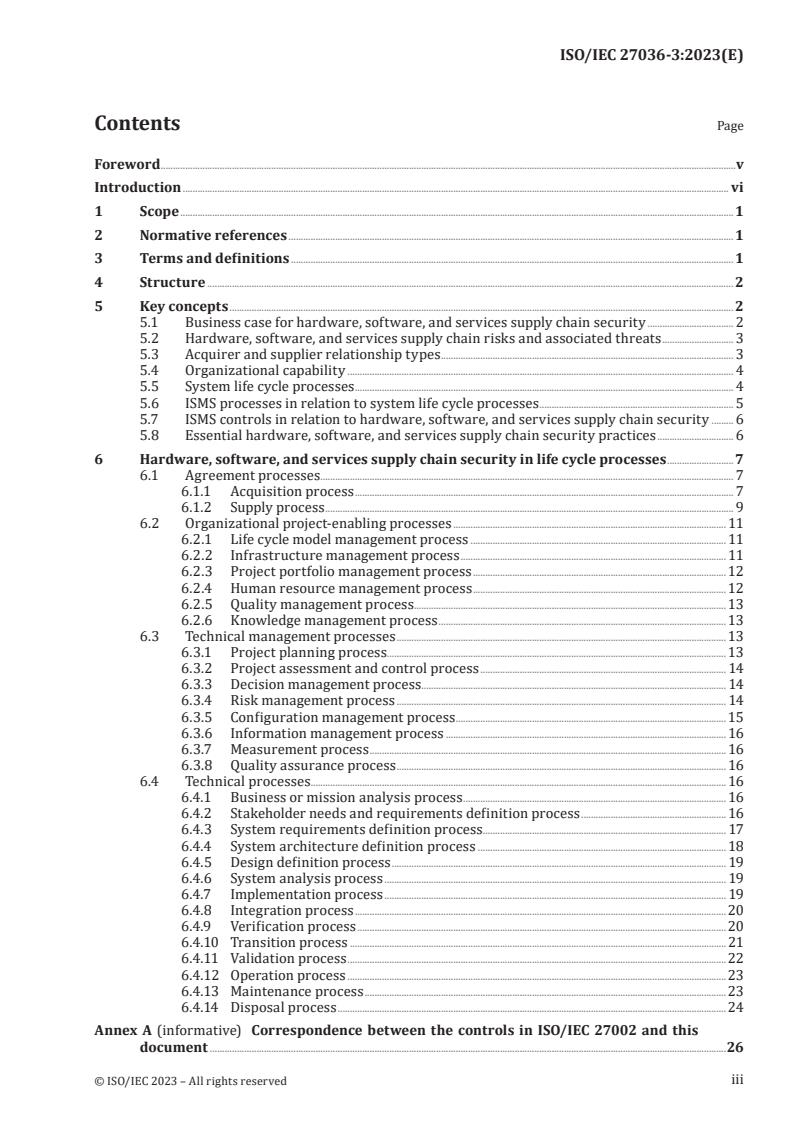
Contents Page
Foreword .v
Introduction . vi
1 Scope . 1
2 Normative references . 1
3 Terms and definitions . 1
4 Structure . 2
5 Key concepts . 2
5.1 Business case for hardware, software, and services supply chain security . 2
5.2 Hardware, software, and services supply chain risks and associated threats . 3
5.3 Acquirer and supplier relationship types . 3
5.4 Organizational capability . 4
5.5 System life cycle processes . 4
5.6 ISMS processes in relation to system life cycle processes . 5
5.7 ISMS controls in relation to hardware, software, and services supply chain security . 6
5.8 Essential hardware, software, and services supply chain security practices . 6
6 Hardware, software, and services supply chain security in life cycle processes .7
6.1 Agreement processes . 7
6.1.1 Acquisition process . 7
6.1.2 Supply process . 9
6.2 Organizational project-enabling processes . 11
6.2.1 Life cycle model management process . 11
6.2.2 Infrastructure management process . 11
6.2.3 Project portfolio management process .12
6.2.4 Human resource management process .12
6.2.5 Quality management process . 13
6.2.6 Knowledge management process . 13
6.3 Technical management processes . 13
6.3.1 Project planning process . . 13
6.3.2 Project assessment and control process . 14
6.3.3 Decision management process. 14
6.3.4 Risk management process . 14
6.3.5 Configuration management process . 15
6.3.6 Information management process . 16
6.3.7 Measurement process . 16
6.3.8 Quality assurance process . 16
6.4 Technical processes . . 16
6.4.1 Business or mission analysis process . 16
6.4.2 Stakeholder needs and requirements definition process . 16
6.4.3 System requirements definition process. 17
6.4.4 System architecture definition process . 18
6.4.5 Design definition process . 19
6.4.6 System analysis process . 19
6.4.7 Implementation process . 19
6.4.8 Integration process . 20
6.4.9 Verification process . 20
6.4.10 Transition process . 21
6.4.11 Validation process .22
6.4.12 Operation process .23
6.4.13 Maintenance process . 23
6.4.14 Disposal process . 24
Annex A (informative) Correspondence between the controls in ISO/IEC 27002 and this
document .26
iii
© ISO/IEC 2023 – All rights reserved
Annex B (informative) Essential elements of a software bill of materials .29
Bibliography .34
iv
© ISO/IEC 2023 – All rights reserved
Foreword
ISO (the International Organization for Standardization) and IEC (the International Electrotechnical
Commission) form the specialized system for worldwide standardization. National bodies that are
members of ISO or IEC participate in the development of International Standards through technical
committees established by the respective organization to deal with particular fields of technical
activity. ISO and IEC technical committees collaborate in fields of mutual interest. Other international
organizations, governmental and non-governmental, in liaison with ISO and IEC, also take part in the
work.
The procedures used to develop this document and those intended for its further maintenance
are described in the ISO/IEC Directives, Part 1. In particular, the different approval criteria
needed for the different types of document should be noted. This document was drafted in
accordance with the editorial rules of the ISO/IEC Directives, Part 2 (see www.iso.org/directives or
www.iec.ch/members_experts/refdocs).
ISO and IEC draw attention to the possibility that the implementation of this document may involve the
use of (a) patent(s). ISO and IEC take no position concerning the evidence, validity or applicability of
any claimed patent rights in respect thereof. As of the date of publication of this document, ISO and IEC
had not received notice of (a) patent(s) which may be required to implement this document. However,
implementers are cautioned that this may not represent the latest information, which may be obtained
from the patent database available at www.iso.org/patents and https://patents.iec.ch. ISO and IEC shall
not be held responsible for identifying any or all such patent rights.
Any trade name used in this document is information given for the convenience of users and does not
constitute an endorsement.
For an explanation of the voluntary nature of standards, the meaning of ISO specific terms and
expressions related to conformity assessment, as well as information about ISO's adherence to
the World Trade Organization (WTO) principles in the Technical Barriers to Trade (TBT) see
www.iso.org/iso/foreword.html. In the IEC, see www.iec.ch/understanding-standards.
This document was prepared by Joint Technical Committee ISO/IEC JTC 1, Information technology,
Subcommittee SC 27, Information security, cybersecurity, and privacy protection.
This second edition cancels and replaces the first edition (ISO/IEC 27036-3:2013), which has been
technically revised.
The main changes are as follows:
— the structure and content have been aligned with the most recent version of ISO/IEC/IEEE 15288;
— former Annex A has been removed;
— Annex B has been added.
A list of all parts in the ISO/IEC 27036 series can be found on the ISO and IEC websites.
Any feedback or questions on this document should be directed to the user’s national standards
body. A complete listing of these bodies can be found at www.iso.org/members.html and
www.iec.ch/national-committees.
v
© ISO/IEC 2023 – All rights reserved
Introduction
Hardware and software products and information technology services are developed, integrated, and
delivered globally through deep and physically dispersed supply chains. The supply chain can be a
point-to-point or a many-to-many structure and can also be referred to as a supply network. Hardware
and software are assembled from many components provided by many suppliers. Information
technology services throughout the entire supplier relationship are also delivered through multiple
tiers of outsourcing and supply chaining. Acquirers do not have visibility into the practices of hardware,
software, and service providers beyond first or possibly second link of the supply chain. With the
substantial increase in the number of organizations and people who “touch” a hardware, software,
or service, the visibility into the practices by which these products and services are put together
has decreased dramatically. This lack of visibility, transparency, and traceability into the hardware,
software and service supply chain poses risks to acquiring organizations.
This document provides guidance to hardware, software and service acquirers and suppliers to reduce
or manage information security risk. This document identifies the business case for hardware, software,
and service supply chain security, specific risks and relationship types, as well as how to develop an
organizational capability to manage information security aspects and incorporate a life cycle approach
to manage risks supported by specific controls and practices. Its application is expected to result in:
— increased hardware, software, and services supply chain visibility and traceability to enhance
information security capability;
— increased understanding by the acquirers of where their products or services are coming from, and
of the practices used to develop, integrate, or operate these products or services, to enhance the
implementation of information security requirements;
— in case of an information security compromise, the availability of information about what may have
been compromised and who the involved actors may be.
This document is intended to be used by all types of organizations that acquire or supply hardware,
software, and services. The guidance is primarily focused on the initial link of the first acquirer and
supplier, but the principal steps should be applied throughout the chain, starting when the first supplier
becomes an acquirer. This change of roles and applying the same steps for each new acquirer-supplier
link in the chain is the essential intention of this document. By following this document, information
security implications can be communicated among organizations in the chain. This helps identify
information security risks and their causes, and may enhance the transparency throughout the chain.
Information security concerns related to supplier relationships cover a broad range of scenarios.
Organizations desiring to improve trust within their hardware, software, and services supply chain
should define their trust boundaries. They should evaluate the risk associated with their supply chain
activities, and then define and implement appropriate risk identification and mitigation techniques
to reduce the vulnerabilities being introduced through their hardware, software and services supply
chain.
The framework and controls outlined in ISO/IEC 27001 and ISO/IEC 27002 provide a useful starting
point for identifying appropriate requirements for acquirers and suppliers. The ISO/IEC 27036 series
provides further detail on how to establish and monitor supplier relationships. This document has been
structured to be harmonized with ISO/IEC/IEEE 15288 and ISO/IEC/IEEE 12207.
vi
© ISO/IEC 2023 – All rights reserved
INTERNATIONAL STANDARD ISO/IEC 27036-3:2023(E)
Cybersecurity — Supplier relationships —
Part 3:
Guidelines for hardware, software, and services supply
chain security
1 Scope
This document provides guidance for product and service acquirers, as well as suppliers of hardware,
software and services, regarding:
a) gaining visibility into and managing the information security risks caused by physically dispersed
and multi-layered hardware, software, and services supply chains;
b) responding to risks stemming from this physically dispersed and multi-layered hardware, software,
and services supply chain that can have an information security impact on the organizations using
these products and services;
c) integrating information security processes and practices into the system and software life cycle
processes, as described in ISO/IEC/IEEE 15288 and ISO/IEC/IEEE 12207, while supporting
information security controls, as described in ISO/IEC 27002.
This document does not include business continuity management/resiliency issues involved with
the hardware, software, and services supply chain. ISO/IEC 27031 addresses information and
communication technology readiness for business continuity.
2 Normative references
The following documents are referred to in the text in such a way that some or all of their content
constitutes requirements of this document. For dated references, only the edition cited applies. For
undated references, the latest edition of the referenced document (including any amendments) applies.
ISO/IEC 27000, Information technology — Security techniques — Information security management
systems — Overview and vocabulary
ISO/IEC 27036-1, Cybersecurity — Supplier relationships — Part 1: Overview and concepts
3 Terms and definitions
For the purposes of this document, the terms and definitions given in ISO/IEC 27000, ISO/IEC 27036-1
and the following apply.
ISO and IEC maintain terminology databases for use in standardization at the following addresses:
— ISO Online browsing platform: available at https:// www .iso .org/ obp
— IEC Electropedia: available at https:// www .electropedia .org/
3.1
software bill of materials
SBoM
inventory of software components, sub-components and dependencies with associated information
© ISO/IEC 2023 – All rights reserved
3.2
system element
member of a set of elements that constitute a system
EXAMPLE Hardware, software, data, humans, processes (e.g. processes for providing service to users),
procedures (e.g. operator instructions), facilities, materials, and naturally occurring entities or any combination.
Note 1 to entry: A system element is a discrete part of a system that can be implemented to fulfil specified
requirements.
[SOURCE: ISO/IEC/IEEE 15288:2015, 4.1.47]
3.3
traceability
property that allows the tracking of the activity of an identity, process, or an element throughout the
supply chain
3.4
transparency
property of a system or process to imply openness and accountability
3.5
validation
confirmation, through the provision of objective evidence, that the requirements for a specific intended
use or application have been fulfilled
Note 1 to entry: A system is able to accomplish its intended use, goals and objectives (i.e. meet stakeholder
requirements) in the intended operational environment. The right system was built.
[SOURCE: ISO/IEC/IEEE 15288:2015, 4.1.53]
3.6
verification
confirmation, through the provision of objective evidence, that specified requirements have been
fulfilled
Note 1 to entry: Verification is a set of activities that compares a system or system element against the required
characteristics. This includes, but is not limited to, specified requirements, design description and the system
itself. The system was built right.
[SOURCE: ISO/IEC/IEEE 15288:2015, 4.1.54]
4 Structure
The structure of this document is harmonized with ISO/IEC/IEEE 15288 and ISO/IEC/IEEE 12207.
Clause 6 mirrors life cycle processes provided in those two standards. This document is also
harmonized with ISO/IEC 27002 and references relevant information security controls within the life
cycle processes with the mapping provided in Annex A.
5 Key concepts
5.1 Business case for hardware, software, and services supply chain security
Organizations acquire hardware, software, and services from numerous suppliers who can in turn
acquire components from other suppliers. The information security risks associated with these
dispersed and multi-layered hardware, software, and services supply chains can be managed through
the application of risk management practices and trusted relationships, thereby increasing visibility,
traceability and transparency in the hardware, software, and services supply chain.
© ISO/IEC 2023 – All rights reserved
For example, increased visibility into the hardware, software, and services supply chain is obtained by
defining adequate information security and quality requirements, and ongoing monitoring of suppliers
and their products and services once a supplier relationship is in operation. Identifying and tracking
supply chain entities accountable for quality and security for critical elements provides greater
traceability. Establishing contractual requirements and expectations, as well as reviewing processes
and practices provides much needed transparency.
Acquirers should establish an understanding within their organizations regarding the hardware,
software, and services supply chain risks and their possible impacts on businesses. Specifically, the
acquirer’s management should be aware that practices of suppliers throughout the supply chain can
have impacts on whether resulting products and services can be trusted to protect the acquirer’s
business, information, and information systems.
5.2 Hardware, software, and services supply chain risks and associated threats
In a supply chain, information security management of an individual organization (acquirer or supplier)
is not sufficient to maintain information security of hardware, software, and services throughout their
supply chain. The acquirer’s management of the sourcing of suppliers, products or services is essential
for information security.
Acquiring hardware, software, and services presents special information security risks to acquirers.
As supply chains get more complex and physically dispersed and traverse multiple international and
organizational boundaries, specific manufacturing and operation practices applied to individual
elements (hardware, software, services, and their components) become more difficult to trace, including
identifying the individuals who are accountable for the quality and security of those elements. This
creates a general lack of traceability throughout the supply chain which in turn results in higher risk of
compromise to the acquirers’ information security and therefore to business operations, from:
— intentional events such as malicious code insertion and presence of counterfeit products in the
supply chain;
— unintentional events, such as poor software development practices or software vulnerabilities.
Both intentional and unintentional events can result in a compromise to the acquirer’s data and
operations including intellectual property theft, data leakage, and reduced ability by acquirers to
perform their business functions. Any of these identified concerns, if they were to occur, can harm the
reputation of the organization, leading to further impacts such as loss of business.
5.3 Acquirer and supplier relationship types
Hardware, software, and services acquirers and suppliers can involve multiple entities in a variety of
supply chain-based relationships, including but not limited to:
a) information or operational system management support where systems are owned by the acquirer
and managed by the supplier;
b) information or operational systems or services providers where systems or resources are owned
and managed by the supplier;
c) product development, design, engineering, etc. where the supplier provides all or part of the service
associated with creating hardware and software;
d) commercial-off-the-shelf product suppliers;
e) open source product suppliers and distributors.
When acquirers grant suppliers access to acquirers' information and information systems, acquirers
assume greater dependency on the supplied hardware, software, and services. By doing so, they assume
more risk and therefore require greater trust from suppliers. For example, acquiring information or
operational system management support has sometimes higher risk than acquiring open source or
© ISO/IEC 2023 – All rights reserved
commercial off-the-shelf products. From the supplier’s perspective, any compromises to the acquirer’s
information can harm the supplier's reputation and trust with the specific acquirer whose information
and information systems have been compromised.
To help manage the uncertainty and risks associated with supplier relationships, acquirers and
suppliers should establish a dialogue and reach an understanding regarding mutual expectations about
protecting each other's information and information systems.
5.4 Organizational capability
To manage risks associated with the hardware, software, and services supply chain throughout
their life cycle, acquirers and suppliers should implement an organizational capability for managing
information security aspects of supplier relationships. This capability should establish and monitor
hardware, software, and services supply chain security objectives for the acquirer organization and
monitor achievement of these objectives, including at least the following:
a) Define, select, and implement the strategy for management of information security risks caused by
hardware, software, and services supply chain vulnerabilities:
1) Establish and maintain a plan for identifying potential hardware, software, and services supply
chain-related vulnerabilities before they are exploited; in addition, have a plan for mitigating
adverse impacts.
2) Identify and document information security risks associated with the supply chain-related
threats and vulnerabilities (see 6.3.4).
b) Establish and adhere to baseline information security controls as a prerequisite to robust supplier
relationships (see Annex A for a mapping of Clause 6 to ISO/IEC 27002).
c) Establish and adhere to baseline system and software life cycle processes and practices for
establishing robust supplier relationships in regard to hardware, software, and services supply
chain information security risk management concerns (see Clause 6).
d) Have a set of baseline information security requirements that apply to all supplier relationships
and tailor them for specific suppliers as needed.
e) Establish a repeatable and testable process for establishing information security requirements
associated with new supplier relationships, managing existing supplier relationships, verifying and
validating that suppliers are complying with acquirer’s information security requirements, and
ending supplier relationships.
f) Establish change management processes to ensure that changes which potentially affect
information security are approved and applied in a timely manner.
g) Define methods for identifying and managing incidents related to or caused by the supply chain
and for sharing information about the incidents with suppliers and acquirers.
5.5 System life cycle processes
Life cycle processes can help set expectations between acquirers and suppliers for rigor and
accountability with regards to information security. Acquirers can implement life cycle processes
internally, to increase the rigor with which they establish and manage supplier relationships. Suppliers
can implement life cycle processes to help demonstrate rigor that suppliers apply to system and
software processes with respect to supplier relationships. While having those processes in place is
helpful for both acquirers and suppliers to begin addressing supply chain risks, additional hardware,
software, and services supply chain security activities should be integrated into those processes.
Systems and software present many of the supply chain risks. Using a life cycle approach provided
in ISO/IEC/IEEE 15288 and ISO/IEC/IEEE 12207 offers an established way of managing those risks.
Both ISO/IEC/IEEE 15288 and ISO/IEC/IEEE 12207 provide a set of the same processes as they apply
© ISO/IEC 2023 – All rights reserved
to the specific context of systems or software. ISO/IEC/IEEE 12207 is a special case of applying
ISO/IEC/IEEE 15288. Both documents allow for the use of any life cycle or life cycle model and present
a set of processes that can be used within any life cycle or any life cycle phase, as appropriate. For
example, the Configuration Management process can be used both during system or software
development and in operations and maintenance life cycle phases. This document adopts the same
approach as ISO/IEC/IEEE 15288 and ISO/IEC/IEEE 12207, describing each process at a summary level
by a statement of purpose and then decomposing each process into practices.
Supplier relationships between acquirers and suppliers are achieved, documented, and enforced using
agreements. Organizations can act simultaneously or successively as both acquirers and suppliers of
hardware, software, and services. For those occasions when acquirer and supplier are within the same
organization, it is recommended to still use agreement processes but with less formality. Agreement
processes include the acquisition process and the supply process (see ISO/IEC/IEEE 15288).
The organizational project-enabling processes are concerned with ensuring adequate resources
so that the project meets the needs and expectations of the organization’s interested parties. The
organizational project-enabling processes establish the environment in which projects are conducted
(see ISO/IEC/IEEE 15288). Unless specifically stated, these processes are applicable to both acquirers
and suppliers.
Technical management processes are concerned with rigorous project management and project support
for system and software engineering projects, including those that span across hardware, software, and
services supply chain or multiple hardware, software, and services supply chains. Unless specifically
stated, these processes are applicable to both acquirers and suppliers.
The technical processes define the requirements, transform the requirements into products and
services, and address the use and sustainment of products and services until disposal. Unless
specifically stated, these processes are applicable to both acquirers and suppliers.
5.8 provides a summary of specific hardware, software, and services supply chain security practices.
Clause 6 provides a mapping of these hardware, software, and services supply chain security activities
for each life cycle process. Acquirers and suppliers should select those activities that are relevant to
their organization’s supplier relationship capabilities, as well as to individual supplier relationships,
based on the level of risk presented by suppliers or acquirers described in 5.1.
ISO/IEC 27002 provides additional specific guidance regarding setting expectations during the life
cycle processes described in Clause 6. The mapping of Clause 6 to ISO/IEC 27002 controls is provided in
Annex A.
5.6 ISMS processes in relation to system life cycle processes
ISO/IEC 27001 provides a risk-based process for implementing an information security management
system (ISMS) within a defined scope. Existence of an ISMS within both acquirer and supplier
organizations helps acquirers and suppliers to begin addressing hardware, software, and services
supply chain risks and realizing the need for specific information security controls and processes
needed to address these risks.
NOTE This assumes that the scope of the ISMS includes the specific part of the organization that establishes
and maintains acquirer and supplier relationships.
If an organization defines risks inherent in the hardware, software, and services supply chain, specific
controls that mitigate these risks should be selected, potentially with extended controls added to ensure
that the organization fully addresses these risks. 5.5 addresses use of information security controls.
Annex A maps specific information security controls to the individual life cycle processes in Clause 6.
Suppliers can demonstrate to acquirers that they have a certain level of rigor through demonstrating
ISO/IEC 27001 conformance.
© ISO/IEC 2023 – All rights reserved
When acquirers and suppliers establish ISMSs according to ISO/IEC 27001, the information generated
should be used to communicate the status of information security management between an acquirer
and a supplier. This can include:
a) scope of the ISMS;
b) statement of applicability;
c) risk assessment procedures,
d) audit plan;
e) awareness programmes;
f) incident management;
g) measurement programmes;
h) information classification scheme;
i) change management;
j) other relevant specific controls applied.
5.7 ISMS controls in relation to hardware, software, and services supply chain security
ISO/IEC 27002 includes a number of controls that specifically target external parties, including
suppliers. Specific guidance for supplier relationships can be found in ISO/IEC 27002:2022, 5.19 to 5.22.
These and additional extended controls can be used within the context of the life cycle processes to
help acquirers in validating specific supplier practices to ensure information security of acquirers’
information and information systems.
Annex A maps specific ISO/IEC 27002 controls to individual life cycle processes.
5.8 Essential hardware, software, and services supply chain security practices
Some of the hardware, software, and services supply chain risks can be addressed by applying the
standards providing life cycle processes (ISO/IEC/IEEE 15288 and ISO/IEC/IEEE 12207), requirements
for establishing ISMS (ISO/IEC 27001), and information security controls (ISO/IEC 27002). Specific
controls/treatments to address these practices include:
a) chain of custody: the acquirer and supplier have the confidence that each change and handoff made
during the element’s lifetime is authorized, transparent and verifiable;
b) least privilege access: personnel can access critical information and information systems with only
the privileges needed to do their jobs;
c) separation of duties: control the process of creation, modification, or deletion of data or the process
of development, operation, or removal of hardware and software by ensuring that no one person or
role alone can complete a high-risk task;
d) tamper resistance and evidence: attempts to tamper are obstructed, and when they occur they are
evident and reversible;
e) persistent protection: critical data and information are protected in ways that remain effective
even if the data or information are transferred from the location where it was created or modified;
f) compliance management: the success of the protections within the agreement can be continually
and independently confirmed;
g) code assessment and verification: methods for code inspection are applied and suspicious code is
detected;
© ISO/IEC 2023 – All rights reserved
h) software Bill of Materials (SBoM) that documents components of various software packages that
are part of the hardware, software, or service (more information about the essential elements of
SBoM can be found in Annex B);
i) hardware, software, and services supply chain security training: organization’s ability to effectively
train relevant personnel on information security practices. This should include secure development
practices, recognition of tampering, etc. as appropriate;
j) vulnerability assessment and response: a formal understanding by the acquirer of how well their
suppliers are equipped with the capability to collect input on vulnerabilities from researchers,
customers, or sources, and produce a meaningful impact analysis and appropriate remedies in the
short time frame involved. This should include an agreement between the acquirer and supplier on
systematic repeatable vulnerability response processes;
k) defined expectations: clear language regarding the requirements to be met by the element and
design/development environment is set forth in the agreement. This should include commitment to
provide information security testing, code fixes and warranties about the development, integration,
and delivery processes used;
l) ownership and responsibilities: the acquirer’s and supplier’s ownership of intellectual property
rights and the other party’s responsibilities for protecting the intellectual property rights are
identified in the agreement;
m) avoidance of unauthentic and unverified components: many hardware, software, and services
supply chain risks can be avoided by requiring verification of authenticity for system components;
n) anonymous acquisition: when appropriate and feasible, practice anonymous acquisition; when
acquirer identity is sensitive, obscure the connection between the hardware, software, and services
supply chain and the acquirer;
o) all-at-once acquisition: components for long-life systems (durable automatic controls) can become
obsolete and increase hardware, software, and services supply chain risk, acquiring all spare parts
within a specified time-frame reduces these risks;
p) recursive requirements for suppliers: contracts can establish that suppliers place and validate
hardware, software, and services supply chain requirements on their upstream suppliers.
6 Hardware, software, and services supply chain security in life cycle processes
6.1 Agreement processes
6.1.1 Acquisition process
The purpose of the acquisition process is to obtain a product or service in accordance with the
acquirer's requirements. See ISO/IEC/IEEE 15288 for guidance regarding implementing an acquisition
process. Acquirers should include the following as a part of the acquisition process, to ensure they are
appropriately managing hardware, software, and services supply chain risks:
a) Prepare for the acquisition
1) Establish a strategy for how the acquisition will be conducted;
— establish sourcing strategies based on information security risk tolerance regarding
hardware, software, and services supply chain risks,
— specify a set of baseline information security requirements that apply to all relationships
with suppliers.
© ISO/IEC 2023 – All rights reserved
2) Tailor the set of baseline information security requirements for specific relationships with
suppliers to prepare a request for the supply of a product or service that includes the following:
— establish information security requirements for suppliers including hardware, software,
and services-related regulatory (i.e. telecommunications or IT) requirements, technical
requirements, chain of custody, transparency and visibility (e.g. SBoM), sharing information
on information security incidents throughout the supply chain, rules for disposal or
retention of elements such as components, data, or intellectual property, and other relevant
requirements;
— establish requirements for the suppliers managing their suppliers in the hardware,
software, and services supply chain when appropriate;
— define requirements for suppliers in the hardware, software, and services supply chain to
provide credible evidence that they have fulfilled information security requirements;
— define requirements for suppliers of critical elements in the hardware, software, and
services supply chain to demonstrate a capability to remediate emerging vulnerabilities
based on information gathered from acquirers and other sources and to respond to
incidents and remediate the underlying vulnerabilities that led to the incident;
— identify requirements for intellectual property ownership and responsibilities of the
acquirer and suppliers for elements such as software code, data and information, the
manufacturing/development/integration environment, designs, and proprietary processes;
— define physical security requirements of the acquirer e.g. suppliers only utilizing data
centres that meet the acquirer’s expectations for security including availability;
— define requirements for suppliers to identify the expected life span of the element to help
the acquirer plan for any migration that can be required in support of continued system
and mission operations;
— define requirements for suppliers to demonstrate to the acquirer that the supplier has
robust software supply chain practices;
— define requirements for auditing of suppliers’ information systems where applicable;
— define requirements for monitoring suppliers’ work processes and work products where
applicable;
— to share the acquirer’s requirements throughout the supply chain, define requirements for
communicating to upstream suppliers what is expected of them.
b) Advertise the acquisition and select the supplier
1) Communicate the request for the supply of a product or service to identified suppliers;
— there should be no activity specific to hardware, software, and services supply chain.
2) Select one or more suppliers;
— select suppliers based on an evaluation of their ability to meet specified requirements
including those for hardware, software, and services supply chain,
— use established evaluation methods and results for hardware, software, and services,
components or their suppliers (e.g. ISO/IEC 15408 repositories for components or ISMS
certification for suppliers) as criteria to evaluate conformance to specified requirements,
— employ consideration of suppliers past performance regarding personnel policies,
procedures, and information security practices as part of source selection requirements
and processes.
© ISO/IEC 2023 – All rights reserved
c) Initiate an agreement
1) Negotiate an agreement with the supplier;
— negotiate an agreement with the selected supplier or suppliers and stipulate agreed
requirements applicable to hardware, software, and services supply chain in the agreement.
2) Commence the agreement with the supplier;
— establish and maintain a plan for ensuring the integrity of acquired software and hardware
products and components provided through hardware, software, and services supply
chain.
d) Monitor the agreement
1) Assess the execution of the agreement;
— establish and mainta
...
Questions, Comments and Discussion
Ask us and Technical Secretary will try to provide an answer. You can facilitate discussion about the standard in here.
Loading comments...