


ISO 1352:2011
(Main)Metallic materials — Torque-controlled fatigue testing
Metallic materials — Torque-controlled fatigue testing
ISO 1352:2011 specifies the conditions for performing torsional, constant-amplitude, nominally elastic stress fatigue tests on metallic specimens without deliberately introducing stress concentrations. The tests are carried out at ambient temperature (ideally at between 10 °C and 35 °C) in air by applying a pure couple to the specimen about its longitudinal axis. While the form, preparation and testing of specimens of circular cross-section and tubular cross-section are described in ISO 1352:2011, component and other specialized types of testing are not included. Similarly, low-cycle torsional fatigue tests carried out under constant-amplitude angular displacement control, which lead to failure in a few thousand cycles, are also excluded.
Matériaux métalliques — Essais de fatigue par couple de torsion commandé
General Information
- Status
- Withdrawn
- Publication Date
- 11-Apr-2011
- Withdrawal Date
- 11-Apr-2011
- Technical Committee
- ISO/TC 164/SC 4 - Fatigue, fracture and toughness testing
- Drafting Committee
- ISO/TC 164/SC 4 - Fatigue, fracture and toughness testing
- Current Stage
- 9599 - Withdrawal of International Standard
- Start Date
- 21-Dec-2021
- Completion Date
- 12-Feb-2026
Relations
- Effective Date
- 23-Apr-2020
- Effective Date
- 15-Apr-2008


Get Certified
Connect with accredited certification bodies for this standard

Element Materials Technology
Materials testing and product certification.

Inštitut za kovinske materiale in tehnologije
Institute of Metals and Technology. Materials testing, metallurgical analysis, NDT.
Sponsored listings
Frequently Asked Questions
ISO 1352:2011 is a standard published by the International Organization for Standardization (ISO). Its full title is "Metallic materials — Torque-controlled fatigue testing". This standard covers: ISO 1352:2011 specifies the conditions for performing torsional, constant-amplitude, nominally elastic stress fatigue tests on metallic specimens without deliberately introducing stress concentrations. The tests are carried out at ambient temperature (ideally at between 10 °C and 35 °C) in air by applying a pure couple to the specimen about its longitudinal axis. While the form, preparation and testing of specimens of circular cross-section and tubular cross-section are described in ISO 1352:2011, component and other specialized types of testing are not included. Similarly, low-cycle torsional fatigue tests carried out under constant-amplitude angular displacement control, which lead to failure in a few thousand cycles, are also excluded.
ISO 1352:2011 specifies the conditions for performing torsional, constant-amplitude, nominally elastic stress fatigue tests on metallic specimens without deliberately introducing stress concentrations. The tests are carried out at ambient temperature (ideally at between 10 °C and 35 °C) in air by applying a pure couple to the specimen about its longitudinal axis. While the form, preparation and testing of specimens of circular cross-section and tubular cross-section are described in ISO 1352:2011, component and other specialized types of testing are not included. Similarly, low-cycle torsional fatigue tests carried out under constant-amplitude angular displacement control, which lead to failure in a few thousand cycles, are also excluded.
ISO 1352:2011 is classified under the following ICS (International Classification for Standards) categories: 77.040.10 - Mechanical testing of metals. The ICS classification helps identify the subject area and facilitates finding related standards.
ISO 1352:2011 has the following relationships with other standards: It is inter standard links to ISO 1352:2021, ISO 1352:1977. Understanding these relationships helps ensure you are using the most current and applicable version of the standard.
ISO 1352:2011 is available in PDF format for immediate download after purchase. The document can be added to your cart and obtained through the secure checkout process. Digital delivery ensures instant access to the complete standard document.
Standards Content (Sample)
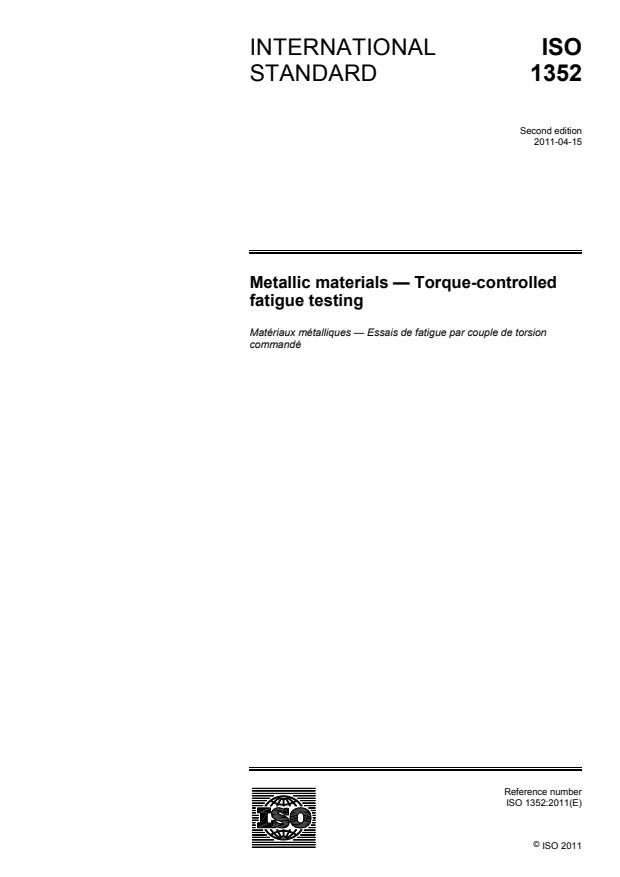
INTERNATIONAL ISO
STANDARD 1352
Second edition
2011-04-15
Metallic materials — Torque-controlled
fatigue testing
Matériaux métalliques — Essais de fatigue par couple de torsion
commandé
Reference number
©
ISO 2011
© ISO 2011
All rights reserved. Unless otherwise specified, no part of this publication may be reproduced or utilized in any form or by any means,
electronic or mechanical, including photocopying and microfilm, without permission in writing from either ISO at the address below or
ISO's member body in the country of the requester.
ISO copyright office
Case postale 56 • CH-1211 Geneva 20
Tel. + 41 22 749 01 11
Fax + 41 22 749 09 47
E-mail copyright@iso.org
Web www.iso.org
Published in Switzerland
ii © ISO 2011 – All rights reserved
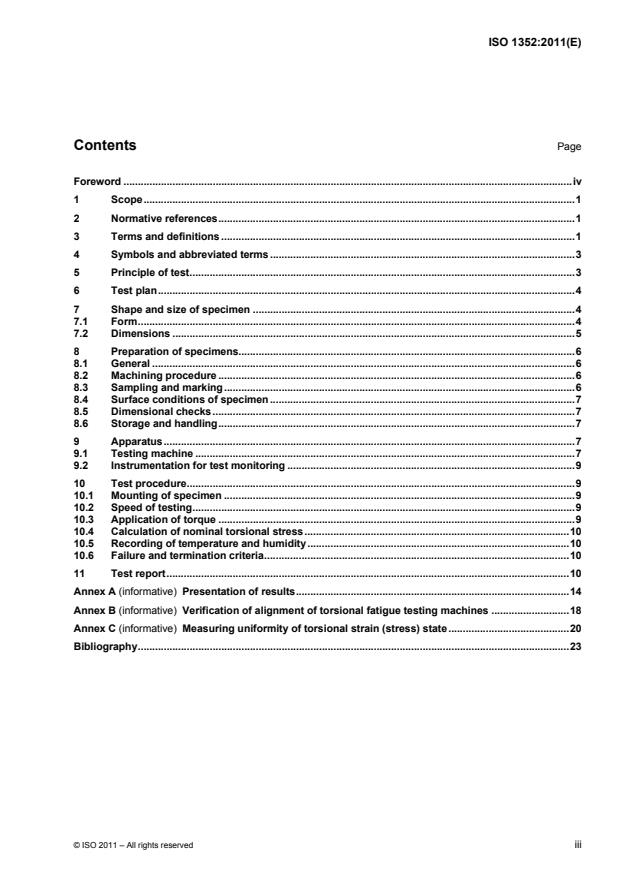
Contents Page
Foreword .iv
1 Scope.1
2 Normative references.1
3 Terms and definitions .1
4 Symbols and abbreviated terms .3
5 Principle of test.3
6 Test plan.4
7 Shape and size of specimen .4
7.1 Form.4
7.2 Dimensions .5
8 Preparation of specimens.6
8.1 General .6
8.2 Machining procedure .6
8.3 Sampling and marking.6
8.4 Surface conditions of specimen.7
8.5 Dimensional checks.7
8.6 Storage and handling.7
9 Apparatus.7
9.1 Testing machine .7
9.2 Instrumentation for test monitoring .9
10 Test procedure.9
10.1 Mounting of specimen .9
10.2 Speed of testing.9
10.3 Application of torque .9
10.4 Calculation of nominal torsional stress.10
10.5 Recording of temperature and humidity.10
10.6 Failure and termination criteria.10
11 Test report.10
Annex A (informative) Presentation of results.14
Annex B (informative) Verification of alignment of torsional fatigue testing machines .18
Annex C (informative) Measuring uniformity of torsional strain (stress) state.20
Bibliography.23
Foreword
ISO (the International Organization for Standardization) is a worldwide federation of national standards bodies
(ISO member bodies). The work of preparing International Standards is normally carried out through ISO
technical committees. Each member body interested in a subject for which a technical committee has been
established has the right to be represented on that committee. International organizations, governmental and
non-governmental, in liaison with ISO, also take part in the work. ISO collaborates closely with the
International Electrotechnical Commission (IEC) on all matters of electrotechnical standardization.
International Standards are drafted in accordance with the rules given in the ISO/IEC Directives, Part 2.
The main task of technical committees is to prepare International Standards. Draft International Standards
adopted by the technical committees are circulated to the member bodies for voting. Publication as an
International Standard requires approval by at least 75 % of the member bodies casting a vote.
Attention is drawn to the possibility that some of the elements of this document may be the subject of patent
rights. ISO shall not be held responsible for identifying any or all such patent rights.
ISO 1352 was prepared by Technical Committee ISO/TC 164, Mechanical testing of metals, Subcommittee
SC 5, Fatigue testing.
This second edition cancels and replaces the first edition (ISO 1352:1977), which has been technically revised.
iv © ISO 2011 – All rights reserved
INTERNATIONAL STANDARD ISO 1352:2011(E)
Metallic materials — Torque-controlled fatigue testing
1 Scope
This International Standard specifies the conditions for performing torsional, constant-amplitude, nominally
elastic stress fatigue tests on metallic specimens without deliberately introducing stress concentrations. The
tests are typically carried out at ambient temperature in air (ideally at between 10 °C and 35 °C) by applying a
pure couple to the specimen about its longitudinal axis.
While the form, preparation and testing of specimens of circular cross-section and tubular cross-section are
described in this International Standard, component and other specialized types of testing are not included.
Similarly, low-cycle torsional fatigue tests carried out under constant-amplitude angular displacement control,
which lead to failure in a few thousand cycles, are also excluded.
2 Normative references
The following referenced documents are indispensable for the application of this document. For dated
references, only the edition cited applies. For undated references, the latest edition of the referenced
document (including any amendments) applies.
ISO 554:1976, Standard atmospheres for conditioning and/or testing — Specifications
3 Terms and definitions
For the purposes of this document, the following terms and definitions apply.
3.1
maximum stress
τ
max
highest algebraic value of shear stress in the stress cycle
3.2
minimum stress
τ
min
lowest algebraic value of shear stress in the stress cycle
3.3
mean stress
τ
m
static component of the shear stress
NOTE It is one half of the algebraic sum of the maximum shear stress and the minimum shear stress:
ττ+
max min
τ =
m
3.4
stress amplitude
τ
a
variable component of stress
NOTE It is one half of the algebraic difference between the maximum shear stress and the minimum shear stress:
ττ−
max min
τ =
a
3.5
number of cycles
N
number of cycles applied at any stage during the test
3.6
stress ratio
R
algebraic ratio of the minimum shear stress to the maximum shear stress in one cycle
NOTE It is expressed as
τ
min
R=
τ
max
3.7
stress range
Δτ
range between the maximum and minimum shear stresses
NOTE It is expressed as
Δ=ττ −τ
max min
3.8
fatigue life at failure
N
f
number of stress cycles to failure in a specified condition
3.9
fatigue strength at N cycles
τ
N
value of the shear stress amplitude at a stated stress ratio under which the specimen would have a life of N
cycles
3.10
torque
T
twisting force producing shear stress or twisting deformation about the axis of the specimen
2 © ISO 2011 – All rights reserved
4 Symbols and abbreviated terms
D diameter or width across flats of the gripped ends of the specimen
NOTE The value of D may be different for each end of the specimen.
d diameter of specimen of circular cross-section, where stress is maximum
d outer diameter of test section of specimen of tubular cross-section, where stress is maximum
o
d inner diameter of test section of specimen of tubular cross-section
i
L length of test section
c
L parallel length of specimen's test section
p
L gauge length of the specimen's test section
g
r transition blending radius at ends of test section which starts the transition from d to D (see Figures 3
and 4)
NOTE This curve need not be a true arc of a circle over the whole of the distance between the end of the
test section and the start of the enlarged end for specimens of the types shown in Figure 3.
5 Principle of test
Nominally identical specimens are mounted on a torsional fatigue testing machine and subjected to the
loading condition required to introduce cycles of torsional stress. Any one of the types of cyclic stress
illustrated in Figure 1 may be used. The test waveform shall be constant-amplitude sinusoidal, unless
otherwise specified.
In an axially symmetrical specimen, change of mean torque does not introduce a different type of stress
system and mean stress in torsion may always be regarded as positive in sign.
The torque is applied to the specimen about the longitudinal axis passing through the centroid of the
cross-section.
The test is continued until the specimen fails or until a predetermined number of stress cycles has been
exceeded.
Cracks produced from torsional fatigue testing may be parallel to the longitudinal axis of the specimen,
perpendicular to the longitudinal axis or at any angle between these two.
Tests shall be conducted at ambient temperature (ideally between 10 °C and 35 °C) unless otherwise agreed
with the customer.
The results of fatigue testing can be affected by atmospheric conditions, and where controlled conditions are
required, ISO 554:1976, 2.1, applies.
6 Test plan
Before commencing testing, the following shall be agreed by the parties concerned and any modifications
shall be mutually agreed upon:
a) the form of specimen to be used (see Clause 7);
b) the stress ratio(s) to be used;
c) the objective of the tests, i.e. which of the following is to be determined:
⎯ the fatigue life at a specified stress amplitude;
⎯ the fatigue strength at a specified number of cycles;
⎯ a full Wöhler or S–N curve;
d) the number of specimens to be tested and the test sequence;
e) the number of cycles a specimen is subjected to before the test is terminated.
NOTE 1 Some methods of data presentation are given in Annex A. See ISO 12107 for details, including data analysis
procedure and statistical presentation.
NOTE 2 Commonly employed numbers of cycles for test termination are
⎯ 10 cycles for structural steels, and
⎯ 10 cycles for other steels and non-ferrous alloys.
7 Shape and size of specimen
7.1 Form
Generally, a specimen having a fully machined test section of one of the types shown in Figures 3 and 4
should be used.
The specimen may be of
⎯ circular cross-section, with tangentially blending fillets between the test section and the ends (see
Figure 3), or
⎯ tubular cross-section, with tangentially blending fillets between the test section and the ends in the outer
surface (see Figure 4).
For tubular specimens, the diameter of the inner surface at the ends may be greater than or equal to that at
the test section. For a specimen having a inner diameter at the ends greater than that at the test section,
crack initiation or failure outside the test section invalidates the test, which should be counted as a
discontinued (stopped) test at the number of cycles completed.
Fatigue test results determined using the specimen of tubular cross-section are not always comparable to
those obtained from the specimen of circular cross-section. Therefore, caution should be exercised when
comparing fatigue lives obtained on the same material from specimens having different cross-sections.
Typical specimen ends are shown in Figure 5. It is recommended that ends suitable for meeting the alignment
criterion be chosen.
4 © ISO 2011 – All rights reserved
7.2 Dimensions
7.2.1 Specimens of circular cross-section
It is recommended that the geometric dimensions given in Table 1 be used (see also Figure 3).
Table 1 — Dimensions for specimens of circular cross-section
5 u d u 12
Diameter of cylindrical gauge length, in millimetres
L u 5d
Length of test section
c
r W 3d
Transition radius (from parallel section to grip end)
D W 2d
External diameter (grip end)
The tolerance on d shall be ±0,05 mm.
To calculate the applied torque loading, the actual diameter of each specimen shall be measured to an
accuracy of 0,01 mm. Care should be taken not to damage the surface when measuring the specimen prior to
testing.
It is important that general tolerances of the specimen respect the two following properties:
⎯ parallelism: 0,005d or better
⎯ concentricity: 0,005d or better
These values are expressed in relation to the axis or reference plane.
7.2.2 Specimens with tubular cross-section
In general, the considerations applicable to specimens of circular cross-section also apply to tests on tubular
specimens.
The specimen wall thickness shall be large enough to avoid instabilities during cyclic loading without violating
the thin-walled tube criterion, i.e. a mean diameter-to-wall thickness ratio of 10:1 or greater is required.
It is recommended that the geometric dimensions given in Table 2 be used (see also Figure 4).
Table 2 — Dimensions for specimens of tubular cross-section
Wall thickness in test section, t 0,05d to 0,1d
o o
Outer diameter of test section d
o
Transition radius (from parallel section to grip end), r W 3d
o
Length of test section, L 1d to 3d
c o o
External diameter (grip end) D W 1,5d
o
Concentricity between the outer diameter, d , and the inner diameter, d ,
o i
should be maintained within 0,01t.
8 Preparation of specimens
8.1 General
In any fatigue test programme designed to characterize the intrinsic properties of a material, it is important to
observe the following recommendations in the preparation of specimens. Deviation from these
recommendations is permitted if the test program aims to determine the influence of a specific factor (surface
treatment, oxidation, etc.). In all cases, any deviations shall be noted in the test report. Specimens should be
machined from normally stress-free material unless otherwise agreed with the customer.
8.2 Machining procedure
Machining the specimens can induce residual stress on the specimen surface that could affect the test results.
These stresses can be induced by heat gradients at the machining stage — stresses associated with
deformation of the material or microstructural alterations. However, they can be reduced by using an
appropriate final machining procedure, especially prior to a final polishing stage. For harder materials, grinding
rather than tool operation (turning or milling) may be preferable.
⎯ Grinding: from 0,1 mm of the final dimension at a rate of no more than 0,005 mm/pass.
⎯ Polishing: remove the final 0,025 mm with papers of decreasing grit size. It is recommended that the final
direction of polishing be along the specimen axial direction.
⎯ For tubular specimens the bore should be fine-honed.
Failure to observe the above can result in alteration in the microstructure of the material. This phenomenon
can be caused by an increase in temperature and by the strain-hardening induced by machining; it can be a
matter of a change in phase or, more frequently, of surface recrystallization. This invalidates the test as the
material mechanical properties are changed.
Introduction of contaminants: the mechanical properties of some materials deteriorate when in the presence of
certain elements or compounds. An example is the effect of chlorine on steels and titanium alloys. These
elements should therefore be avoided in the products used during specimen preparation (cutting fluids, etc.).
Rinsing and degreasing of specimens prior to storage is also recommended.
8.3 Sampling and marking
The sampling of test materials from a semi-finished product or component can have a major influence on the
results obtained during the test. It is therefore necessary to clearly identify the location and orientation of each
specimen.
A sampling drawing, attached to the test report, shall indicate clearly
⎯ the position of each of the specimens,
⎯ the characteristic directions in which the semi-finished product has been worked (direction of rolling,
extrusion, etc., as appropriate), and
⎯ the marking of each of the specimens.
Specimens shall carry a unique identifying mark throughout their preparation. This may be applied using any
reliable method in an area not likely to disappear during machining or to adversely affect the quality of the test.
Identification shall be applied to each end of the specimen before testing.
6 © ISO 2011 – All rights reserved
8.4 Surface conditions of specimen
The surface conditions of the specimens can affect the test results. This is generally associated with one or
more of the following factors:
⎯ specimen surface roughness;
⎯ presence of residual stresses;
⎯ alteration in the microstructure of the material;
⎯ introduction of contaminants.
To minimize the impact of these factors, the following is recommended.
The impact of surface roughness on the results obtained depends largely on the test conditions and its effect
is reduced by surface corrosion of the specimen or inelastic deformation.
It is preferable, whatever the test conditions, to achieve a mean surface roughness of less than 0,2 µm Ra (or
equivalent) within the parallel section.
Another important parameter not covered by mean roughness is the presence of localized machining
scratches. Finishing operations should eliminate all circumferential scratches produced during turning. Final
grinding followed by mechanical polishing is highly recommended. A visual inspection at low magnification
(approximately ×20) should only show polishing marks appropriate to the grade of the final polishing medium.
It is preferable to carry out a final polishing operation after heat treatment. If this is not possible, the heat
treatment should be carried out in a vacuum or in inert gas to prevent oxidation of the specimen surface. This
treatment should not alter the microstructural characteristics of the material under study. The details of the
heat treatment and machining procedure shall be reported with the test results.
8.5 Dimensional checks
The dimensions should be measured on completion of the final machining stage using a method of metrology
which does not alter the surface condition.
8.6 Storage and handling
After preparation, the specimens should be stored so as to prevent any risk of damage (scratching by contact,
oxidation, etc.). If there is any damage on the surface of the specimen during storage, it should be removed by
repolishing the specimen. The use of individual boxes or tubes with end caps is recommended. In certain
cases, storage in a vacuum or in a desiccator is necessary.
Handling should be reduced to the minimum necessary. Particular attention shall be given to marking of the
specimen. Identification shall be applied to each end of the specimen before testing.
9 Apparatus
9.1 Testing machine
9.1.1 General
The tests shall be carried out on a testing machine having a clockwise/anticlockwise (counter-clockwise)
torsional loading capability, with smooth start and no backlash when passing through zero. The test start
settings shall allow the required level to be reached without any
...
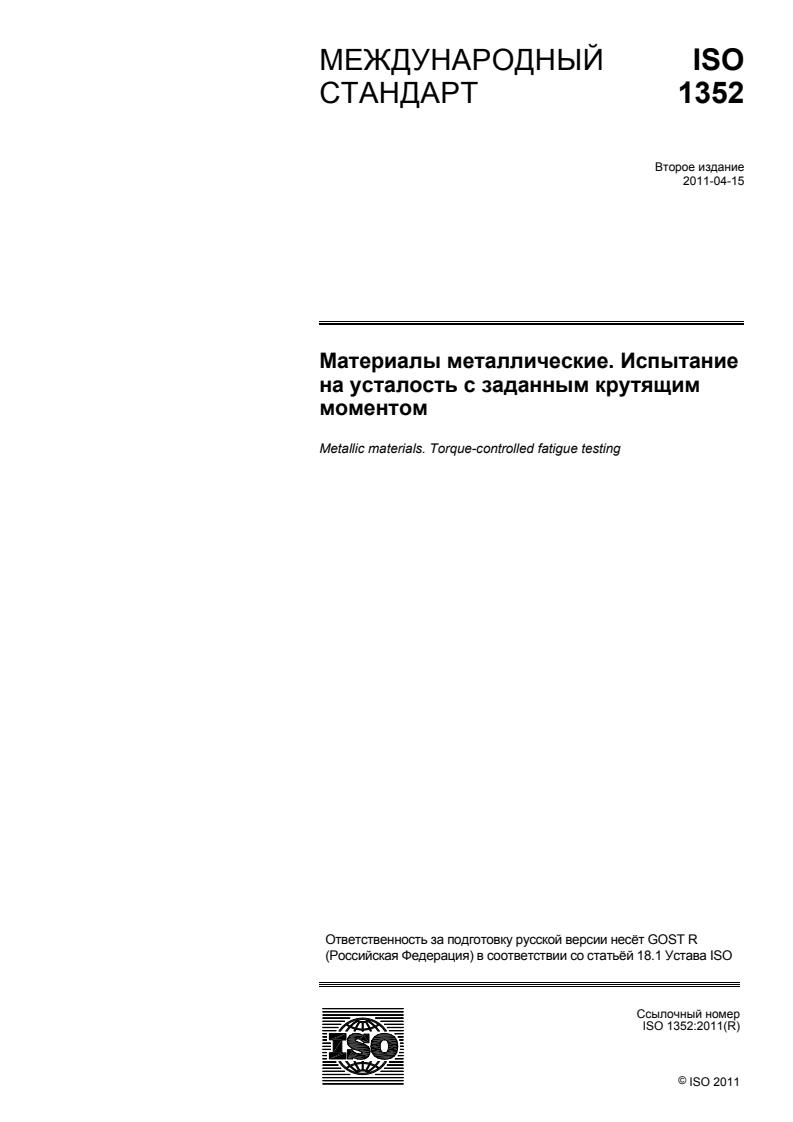
МЕЖДУНАРОДНЫЙ ISO
СТАНДАРТ 1352
Второе издание
2011-04-15
Материалы металлические. Испытание
на усталость с заданным крутящим
моментом
Metallic materials. Torque-controlled fatigue testing
Ответственность за подготовку русской версии несёт GOST R
(Российская Федерация) в соответствии со статьёй 18.1 Устава ISO
Ссылочный номер
©
ISO 2011
ДОКУМЕНТ ЗАЩИЩЕН АВТОРСКИМ ПРАВОМ
© ISO 2011
Все права сохраняются. Если не указано иное, никакую часть настоящей публикации нельзя копировать или использовать в
какой-либо форме или каким-либо электронным или механическим способом, включая фотокопии и микрофильмы, без
предварительного письменного согласия ISO, которое должно быть получено после запроса о разрешении, направленного по
адресу, приведенному ниже, или в комитет-член ISO в стране запрашивающей стороны.
ISO copyright office
Case postale 56 • CH-1211 Geneva 20
Tel. + 41 22 749 01 11
Fax + 41 22 749 09 47
E-mail copyright@iso.org
Web www.iso.org
Опубликовано в Швейцарии
ii © ISO 2011 - Все права сохраняются
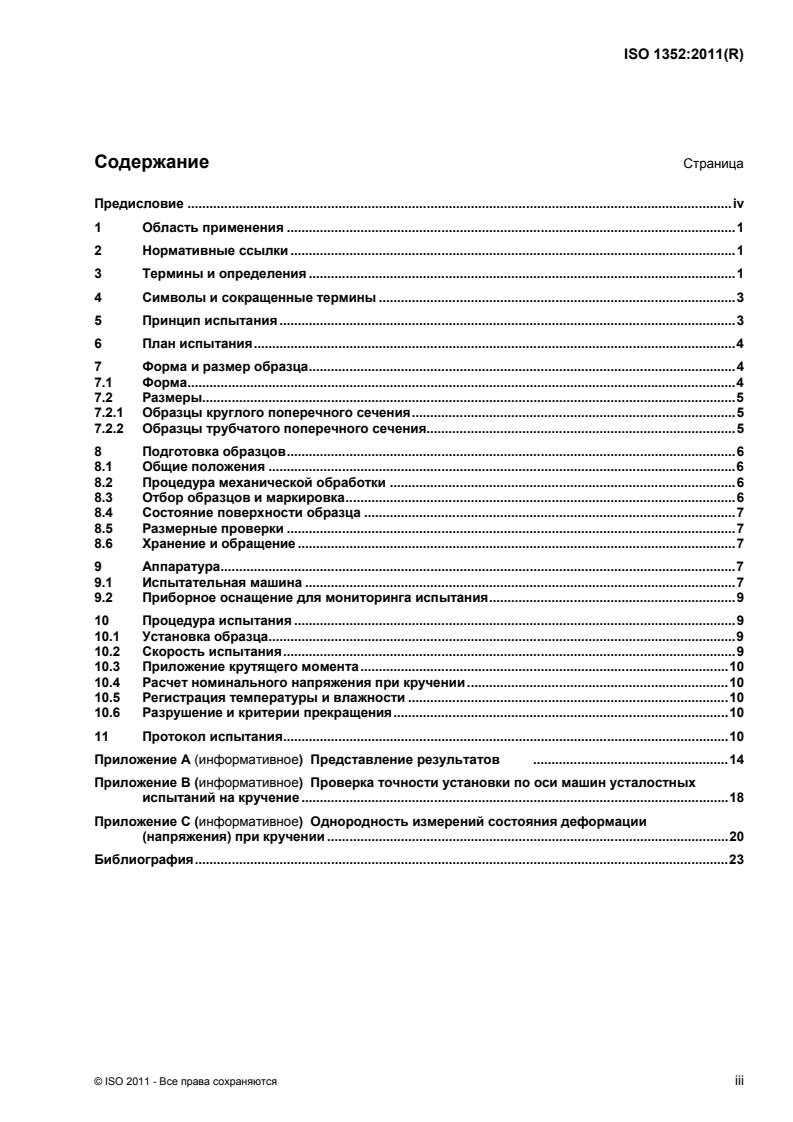
Содержание Страница
Предисловие .iv
1 Область применения .1
2 Нормативные ссылки .1
3 Термины и определения .1
4 Символы и сокращенные термины .3
5 Принцип испытания .3
6 План испытания.4
7 Форма и размер образца.4
7.1 Форма.4
7.2 Размеры.5
7.2.1 Образцы круглого поперечного сечения.5
7.2.2 Образцы трубчатого поперечного сечения.5
8 Подготовка образцов.6
8.1 Общие положения .6
8.2 Процедура механической обработки .6
8.3 Отбор образцов и маркировка.6
8.4 Состояние поверхности образца .7
8.5 Размерные проверки .7
8.6 Хранение и обращение .7
9 Аппаратура.7
9.1 Испытательная машина .7
9.2 Приборное оснащение для мониторинга испытания.9
10 Процедура испытания .9
10.1 Установка образца.9
10.2 Скорость испытания.9
10.3 Приложение крутящего момента.10
10.4 Расчет номинального напряжения при кручении.10
10.5 Регистрация температуры и влажности .10
10.6 Разрушение и критерии прекращения.10
11 Протокол испытания.10
Приложение A (информативное) Представление результатов .14
Приложение В (информативное) Проверка точности установки по оси машин усталостных
испытаний на кручение .18
Приложение C (информативное) Однородность измерений состояния деформации
(напряжения) при кручении .20
Библиография.23
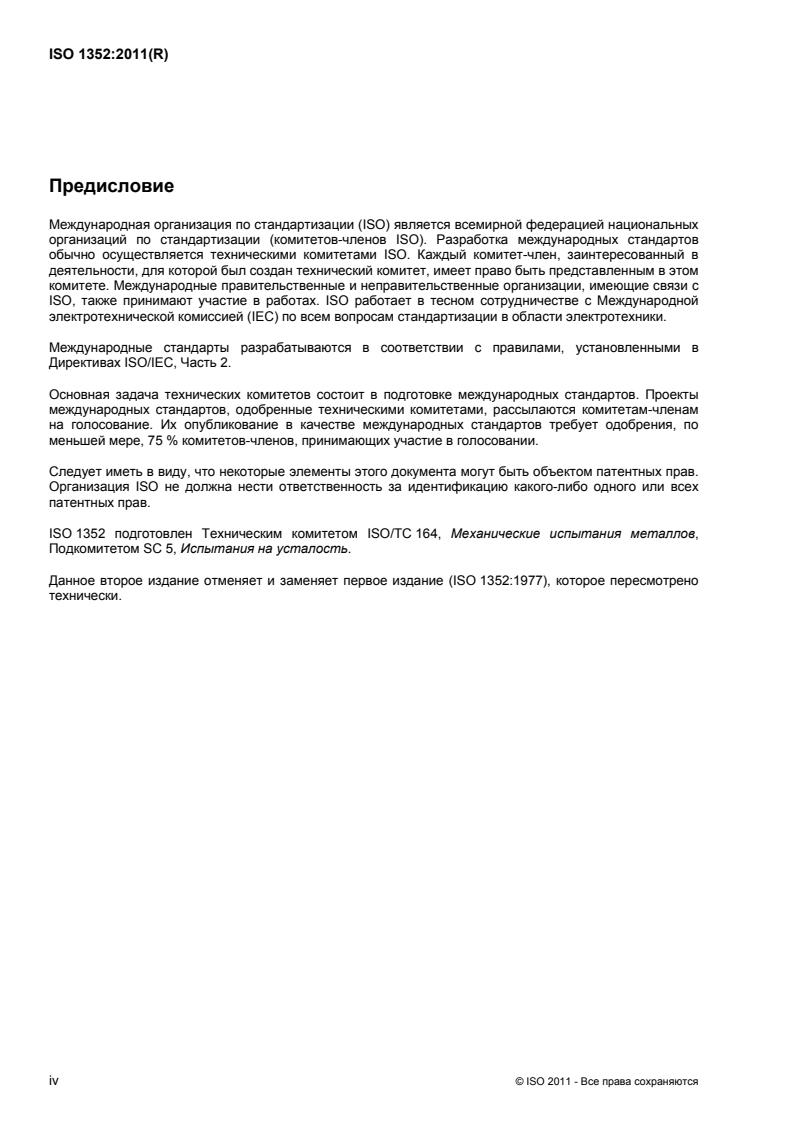
Предисловие
Международная организация по стандартизации (ISO) является всемирной федерацией национальных
организаций по стандартизации (комитетов-членов ISO). Разработка международных стандартов
обычно осуществляется техническими комитетами ISO. Каждый комитет-член, заинтересованный в
деятельности, для которой был создан технический комитет, имеет право быть представленным в этом
комитете. Международные правительственные и неправительственные организации, имеющие связи с
ISO, также принимают участие в работах. ISO работает в тесном сотрудничестве с Международной
электротехнической комиссией (IEC) по всем вопросам стандартизации в области электротехники.
Международные стандарты разрабатываются в соответствии с правилами, установленными в
Директивах ISO/IEC, Часть 2.
Основная задача технических комитетов состоит в подготовке международных стандартов. Проекты
международных стандартов, одобренные техническими комитетами, рассылаются комитетам-членам
на голосование. Их опубликование в качестве международных стандартов требует одобрения, по
меньшей мере, 75 % комитетов-членов, принимающих участие в голосовании.
Следует иметь в виду, что некоторые элементы этого документа могут быть объектом патентных прав.
Организация ISO не должна нести ответственность за идентификацию какого-либо одного или всех
патентных прав.
ISO 1352 подготовлен Техническим комитетом ISO/TC 164, Механические испытания металлов,
Подкомитетом SC 5, Испытания на усталость.
Данное второе издание отменяет и заменяет первое издание (ISO 1352:1977), которое пересмотрено
технически.
iv © ISO 2011 - Все права сохраняются
МЕЖДУНАРОДНЫЙ СТАНДАРТ ISO 1352:2011(R)
Материалы металлические. Испытание на усталость с
заданным крутящим моментом
1 Область применения
Настоящий международный стандарт определяет условия проведения испытаний на усталость
металлических образцов путем скручивания с постоянной амплитудой при номинально упругом
напряжении без намеренного введения концентраций напряжения. Испытания обычно проводятся при
температуре окружающей среды (идеально между 10 °C и 35 °C) путем приложения чистого крутящего
момента к образцу вокруг его продольной оси.
Хотя форма, подготовка и тестирование образцов круглого и трубчатого поперечного сечения описаны
в настоящем международном стандарте, в него не включены компоненты и прочие специальные типы
испытаний. Так же не включены, малоцикловые усталостные испытания на кручение, выполняемые с
контролем углового перемещения с постоянной амплитудой, ведущие к разрушению после нескольких
тысяч циклов.
2 Нормативные ссылки
Следующие ссылочные нормативные документы являются обязательными для применения
настоящего документа. Для жестких ссылок применяется только цитируемое издание документа. Для
плавающих ссылок необходимо использовать самое последнее издание нормативного ссылочного
документа (включая любые изменения).
ISO 554:1976, Стандартные атмосферы для кондиционирования и/или испытания. Технические
условия
3 Термины и определения
Для данного документа применяются следующие термины и определения.
3.1
максимальное напряжение
maximum stress
τ
max
самое высокое алгебраическое значение касательного напряжения в цикле напряжения
3.2
минимальное напряжение
minimum stress
τ
min
самое низкое алгебраическое значение касательного напряжения в цикле напряжения
3.3
среднее напряжение
mean stress
τ
m
статическая компонента тангенциального (касательного) напряжения
ПРИМЕЧАНИЕ Это половина алгебраической суммы максимального касательного напряжения и минимального
касательного напряжения:
ττ+
max min
τ =
m
3.4
амплитуда напряжения
stress amplitude
τ
a
переменная компонента напряжения
ПРИМЕЧАНИЕ Это половина алгебраической разности максимального касательного напряжения и
минимального касательного напряжения:
ττ−
max min
τ =
a
3.5
число циклов
number of cycles
N
количество циклов, проведенных на любом этапе во время испытания
3.6
коэффициент асимметрии цикла напряжений
stress ratio
R
алгебраическое отношение минимального касательного напряжения к максимальному касательному
напряжению за один цикл
ПРИМЕЧАНИЕ Оно выражается как
τ
min
R=
τ
max
3.7
размах напряжений
Δτ
Диапазон между максимальным и минимальным касательным напряжениями
ПРИМЕЧАНИЕ Оно выражается как
Δ=ττ −τ
max min
3.8
усталостная долговечность при разрушении
fatigue life at failure
N
f
число циклов нагружения до разрушения при определенном режиме
3.9
усталостная прочность при N циклах
fatigue strength at N cycles
τ
N
значение амплитуды касательного напряжения при заявленном коэффициенте асимметрии цикла
напряжений, при котором образец должен иметь долговечность из N циклов
2 © ISO 2011 - Все права сохраняются
3.10
крутящий момент
torque
T
скручивающее усилие, создающее касательное напряжение или деформацию скручивания
относительно оси образца
4 Символы и сокращенные термины
D диаметр или ширина между плоскостями концов захвата образца
ПРИМЕЧАНИЕ Значение D может отличаться для каждого конца образца.
d диаметр образца круглого поперечного сечения, где напряжение максимально
d наружный диаметр испытываемого сечения образца с трубчатым поперечным сечением, где
o
напряжение максимально
d внутренний диаметр испытываемого сечения образца с трубчатым поперечным сечением
i
L длина испытуемой секции
c
L параллельная длина испытуемой секции образца
p
L расчетная длина испытуемой секции образца
g
r радиус перехода на концах испытуемой секции, который сопрягает d с D (см. Рисунки 3 и 4)
ПРИМЕЧАНИЕ Эта кривая не обязательно должна быть правильной дугой круга на всем расстоянии
между концом испытуемой секции и началом расширенного конца для типов образцов, показанных на
Рисунке 3.
5 Принцип испытания
Номинально идентичные образцы устанавливаются на машину для испытания на усталость при
кручении и подвергаются нагрузке, необходимой для проведения циклов нагружения при кручении.
Типы таких циклических нагружений показаны на Рисунке 1. Форма волны должна быть
синусоидальной с постоянной амплитудой, если не установлено иначе.
В симметричном относительно оси образце, изменение среднего крутящего момента не вводит другой
тип напряжения и среднее напряжение при кручении всегда можно рассматривать с положительным
знаком.
Крутящий момент прикладывается к образцу относительно продольной оси, проходящей через центр
тяжести поперечного сечения.
Испытание продолжается до разрушения образца или пока не будет превышено предварительно
определенное количество циклов нагружения.
Трещины, образованные при усталостном испытании на кручение могут быть параллельны
продольной оси образца, перпендикулярны продольной оси или находится под любым углом к оси.
Испытания проводятся при температуре окружающей среды (идеально между 10 °C и 35 °C), если не
установлено иначе заказчиком.
На результаты усталостных испытаний могут влиять атмосферные условия и когда требуются
контролируемые условия, применяется ISO 554:1976, 2.1.
6 План испытания
Перед началом испытаний заинтересованные стороны должны взаимно согласовать следующее, как и
любые модификации:
a) форму используемого образца (см. Раздел 7);
b) используемый коэффициент асимметрии цикла напряжений;
c) цель испытаний, т. е, что из нижеследующего определяется;
⎯ усталостная долговечность при заданной амплитуде напряжения;
⎯ усталостная прочность при заданном количестве циклов;
⎯ полная кривая усталости Велера или кривая S–N;
d) количество образцов, подвергаемых испытанию и последовательность испытания;
e) число циклов, которому подвергается образец до прекращения испытания.
ПРИМЕЧАНИЕ 1 Некоторые методы представления данных приведены в Приложении A. Некоторые
подробности, включая методику анализа данных и статистическое представление данных, находятся в ISO 12107.
ПРИМЕЧАНИЕ 2 Обычно применяемое число циклов для прекращения испытания равно
⎯ 10 циклов для конструкционных сталей, и
⎯ 10 циклов для других сталей и не железных сплавов.
7 Форма и размер образца
7.1 Форма
Обычно используется образец с полностью обработанной секцией, подвергаемой испытанию, один из
типов которой показан на Рисунках 3 и 4.
Образец может иметь
⎯ круглое поперечное сечение с тангенциально сопрягаемыми галтелями между испытуемой
секцией и концами (см. Рисунок 3), или
⎯ трубчатое поперечное сечение с тангенциально сопрягаемыми галтелями между испытуемой
секцией и концами по наружной поверхности (см. Рисунок 4).
Для трубчатых образцов диаметр внутренней поверхности на концах может быть больше или равен
диаметру испытуемой секции. Для образца, имеющего внутренний диаметр на концах больше, чем
диаметр испытуемой секции, возникновение трещины или разрушение за пределами испытуемой
секции делает испытание недействительным, которое считается прерванным при совершенном
количестве циклов.
Результаты усталостных испытаний, полученные на образцах с трубчатым поперечным сечением не
всегда сравнимы с результатами образцов с круглым поперечным сечением. Поэтому с осторожностью
4 © ISO 2011 - Все права сохраняются
следует сравнивать усталостную долговечность одного и того же материала, но полученную на
образцах разных поперечных сечений.
Типичные концы образца показаны на Рисунке 5. Рекомендуется выбирать концы образцов
соответствующие критерию выравниванию по прямой линии.
7.2 Размеры
7.2.1 Образцы круглого поперечного сечения
Рекомендуется применять геометрические размеры, приведенные в Таблице 1 (см. также Рисунок 3).
Таблица 1 — Размеры образцов круглого поперечного сечения
Диаметр цилиндрической расчетной длины, в
5 u d u 12
миллиметрах
L u 5d
Длина испытуемой секции
c
r W 3d
Радиус перехода (от параллельной секции к концу захвата)
D W 2d
Наружный диаметр (конец захвата)
Допуск на d должен быть ±0,05 мм.
Для расчета нагрузки при прикладываемом крутящем моменте необходимо измерить реальный
диаметр каждого образца с точностью 0,01 мм. Следует соблюдать осторожность, чтобы не повредить
поверхность образца при измерении до испытания.
Важно, чтобы общие допуски на образец соответствовали двум следующим:
⎯ параллельность: 0,005d или лучше
⎯ концентричность: 0,005d или лучше
Эти значения выражены относительно оси или базовой плоскости начала отсчета.
7.2.2 Образцы трубчатого поперечного сечения
В общем, соображения, применяемые к образцам круглого поперечного сечения применимы также к
испытаниям трубчатых образцов.
Толщина стенки образца должна быть достаточно большой, позволяющей избежать неустойчивости во
время циклического нагружения без нарушения критерия тонкостенной трубы, т. е необходимого
отношения среднего диаметра к толщине стенки, равного 10:1 или больше.
Рекомендуется применять геометрические размеры, приведенные в Таблице 2 (см. также Рисунок 4).
Таблица 2 — Размеры образцов трубчатого поперечного сечения
Толщина стенки испытуемой секции, t 0,05d до 0,1d
o o
Наружный диаметр испытуемой секции d
o
Радиус перехода (от параллельной секции к концу захвата), r W3d
o
Длина испытуемой секции, L 1d до 3d
c o o
Наружный диаметр (конец захвата) D W 1,5d
o
Концентричность наружного диаметра d , и внутреннего диаметра, d , должна
o i
выдерживаться в пределах 0,01t.
8 Подготовка образцов
8.1 Общие положения
При любой программе усталостных испытаний, предназначенной для определения внутренних свойств
материала, рекомендуется соблюдать следующие рекомендации по подготовке образцов. Допускаются
отклонения от этих рекомендаций, если программа испытания нацелена на определение влияния
специфического фактора (поверхностная обработка, окисление и т.п.). Во всех случаях любое отклонение
должно указываться в протоколе испытаний. Образцы должны обрабатываться механически из обычного
материала свободного от напряжений, если не согласовано иначе с заказчиком.
8.2 Процедура механической обработки
Механическая обработка образцов может вводить остаточное напряжение на поверхности образца,
которое влияет на результаты испытания. Эти напряжения могут возникнуть в результате перепада
температур на этапе механической обработки — напряжения, связанные с деформацией материала или
микроструктурных изменений. Однако они могут быть сокращены при использовании соответствующей
окончательной механической обработки, особенно перед этапом финишной обработки. Для более твердых
металлов лучше использовать шлифование, а не токарную обработку или фрезерование.
⎯ Шлифование: от 0,1 мм от окончательного размера со скоростью не более 0,005 мм/проход.
⎯ Полирование: снимают последние 0,025 мм абразивной бумагой с уменьшающимся размером зерна.
Рекомендуется, чтобы окончательное направление полирования происходило вдоль оси образца.
⎯ Для трубчатых образцов отверстие должно быть окончательно хонинговано.
Не соблюдение вышеупомянутого могут быть вызваны изменением микроструктуры материала. Это
явление происходит в результате повышения температуры и механического упрочнения при обработке.
Это может быть случай фазового превращения или, что более часто, результат поверхностной
рекристаллизации. Это делает недействительным испытание, поскольку изменяются механические
свойства материала.
Введение загрязняющих примесей: механические свойства некоторых материалов ухудшаются в
присутствии некоторых элементов или соединений. Примером является действие хлора на стали и
титановые сплавы. Поэтому следует избегать применения продуктов, содержащих такие элементы,
при подготовке образцов (режущие жидкости, и т.п.). Также рекомендуется промывка и обезжиривание
образцов перед хранением.
8.3 Отбор образцов и маркировка
Отбор образцов испытуемых материалов из полуфабриката или детали может иметь основное
влияние на результаты, полученные при испытании. Поэтому необходимо четко указывать место
расположения и ориентацию каждого образца.
Чертеж отбора образца, прикрепленный к протоколу испытания, должен четко указывать
⎯ положение каждого образца,
⎯ характерные направлений, в которых работает полуфабрикат (направление прокатки, вытяжки и
т.п., по месту), и
⎯ маркировку каждого образца.
В процессе подготовке на образце должна находиться уникальная идентифицирующая метка. Она
должна быть нанесена любым надежным методом в зоне, недосягаемой при механической обработке,
и не должна вредить качеству испытания.
Метка идентификации должна наноситься на каждый конец образца перед испытанием.
6 © ISO 2011 - Все права сохраняются
8.4 Состояние поверхности образца
Состояние поверхности образцов может влиять на результаты испытания. Обычно это связано с
одним из следующих факторов:
⎯ шероховатостью поверхности образца;
⎯ наличием остаточных напряжений;
⎯ изменением микроструктуры материала;
⎯ введением загрязняющих примесей.
Чтобы свести к минимуму действие этих факторов, рекомендуется следующее.
Действие шероховатости поверхности на полученные результаты зависит в большой степени от
условий испытания, и это действие уменьшается в результате поверхностной коррозии образца или
неупругой (пластической) деформации.
Желательно, какие бы ни были условия испытания, получить среднюю шероховатость поверхности
менее чем 0,2 мкм Ra (или эквивалентную) в пределах параллельной секции.
Другим важным параметром, не перекрываемым средней шероховатостью, является наличие
локализованных следов механической обработки. Финишные операции должны удалить все
поверхностные следы токарной обработки. Очень рекомендуется финишное шлифование, а затем
механическое полирование. Визуальный контроль с низким увеличением (приблизительно ×20) должен
показывать только следы, соответствующие твердости среды окончательного полирования.
Желательно проводить операцию окончательного полирования после термической обработки. Если
это невозможно, термическую обработку проводят в вакууме или в инертном газе для предотвращения
окисления поверхности образца. Эта обработка не должна менять характеристик микроструктуры
исследуемого материала. Подробности процедуры термической и механической обработки должны
вноситься в протокол с результатами испытания.
8.5 Размерные проверки
Размеры измеряются после завершения последнего этапа механической обработки с помощью
метрологического метода, не изменяющего состояние поверхности.
8.6 Хранение и обращение
После подготовки образцы должны храниться так, чтобы избежать риска повреждения (царапин при
контакте, окисления и т. п.). Если во время хранения на поверхности образца обнаружено повреждение,
его следует удалить и повторно полировать. Рекомендуется применение индивидуальных ящиков или
труб с пробками. В некоторых случаях необходимо хранение в вакууме или в эксикаторе.
Обращение следует сократить до минимально необходимого. Особое внимание придается маркировке
образца. Идентификационный знак должен наноситься на каждый конец образца перед испытанием.
9 Аппаратура
9.1 Испытательная машина
9.1.1 Общие положения
Испытания должны проводиться на машине, имеющей возможность создавать крутящую нагрузку по
часовой и против часовой стрелки, с плавным пуском и без люфта при проходе через ноль. Стартовые
настройки испытания должны позволять достижения требуемого уровня без перегрузки. Временные
ISO 1
...
Questions, Comments and Discussion
Ask us and Technical Secretary will try to provide an answer. You can facilitate discussion about the standard in here.
Loading comments...