


ISO 18107
(Main)Variable refrigerant flow air-to-air conditioners and air-to-air heat pumps — Testing and calculating methods for seasonal performance factors and energy performance mapping approach
Variable refrigerant flow air-to-air conditioners and air-to-air heat pumps — Testing and calculating methods for seasonal performance factors and energy performance mapping approach
For factory made, residential, commercial and industrial, electrically operated compression, air-to-air air-conditioners and air-to-air heat pumps above 12kW, described as variable refrigerant flow systems, this document specifies: - performance testing, the standard conditions and the test methods for determining the capacity and efficiency ratings under heating and cooling, and - calculation methods for seasonal performance. This standard does not apply to a) Rating and testing of individual assemblies, such as condensing units or coils, for separate use b) Multi-split Systems where each Indoor Unit has dedicated piping connected directly to the Outdoor Unit. c) Single or variable speed water source heat–pump systems.
Climatiseurs et pompes à chaleur air/air à débit de fluide frigorigène variable — Méthodes d'essai et de calcul des facteurs de performance saisonnière et approche de la cartographie de la performance énergétique
General Information
- Status
- Not Published
- Technical Committee
- ISO/TC 86/SC 6 - Testing and rating of air-conditioners and heat pumps
- Drafting Committee
- ISO/TC 86/SC 6 - Testing and rating of air-conditioners and heat pumps
- Current Stage
- 6000 - International Standard under publication
- Start Date
- 11-Dec-2025
- Completion Date
- 12-Feb-2026
Overview
ISO 18107 is an international standard developed by ISO that specifies testing and calculation methods for variable refrigerant flow (VRF) air-to-air conditioners and air-to-air heat pumps with capacities above 12 kW. This standard applies to factory-made systems used in residential, commercial, and industrial settings. It outlines standardized procedures for assessing seasonal performance factors and energy efficiency, supporting accurate performance evaluation and comparison for VRF systems.
The scope of ISO 18107 focuses on electrically operated compression systems characterized by variable refrigerant flow operation. The standard excludes individual components like coils or condensing units, multi-split systems with dedicated piping per indoor unit, and water source heat pumps. By providing unified testing protocols and performance mapping methods, this standard enhances transparency, reliability, and energy performance benchmarking for VRF air-to-air systems worldwide.
Key Topics
Performance Testing: Defines test conditions and procedures for measuring heating and cooling capacities along with efficiency ratings under standardized conditions.
Seasonal Performance Calculations: Includes detailed methods for calculating seasonal performance factors such as Annual Performance Factor (APF), Cooling Seasonal Performance Factor (CSPF), Heating Seasonal Performance Factor (HSPF), and Integrated Energy Efficiency Ratio (IEER).
Energy Performance Mapping: Provides a methodology to create performance maps useful for building energy simulations and system design optimization.
Test Methods and Measurement Uncertainty: Specifies rigorous test methods with attention to measurement uncertainty and test tolerances to ensure data accuracy.
Reporting and Rating Publication: Establishes requirements for comprehensive test reports, recording essential data, and guidelines for publicizing performance ratings.
Controls Verification Procedures: Covers verification methods for critical system parameters like compressor speed, ensuring test consistency and replicability.
Refrigerant Piping Requirements: Details standard requirements for refrigerant piping relevant to VRF systems to ensure optimal performance and safety.
Climate Zone Adaptation: Includes climate bin distributions and calculation adjustments for diverse climate regions, supporting global applicability.
Applications
ISO 18107 serves as a critical reference for multiple stakeholders involved in VRF air-to-air systems, including:
Manufacturers and Designers: To standardize testing methods, optimize system design, and provide transparent efficiency ratings.
Certification Bodies and Regulators: To verify compliance with energy efficiency standards and enforce regulatory requirements.
Energy Consultants and Building Simulation Experts: For accurate modeling of VRF system energy use via performance mapping and climate-specific parameters.
End-users and Facility Managers: To make informed decisions based on reliable seasonal performance data, enhancing energy savings and operational efficiency.
This standard thereby supports the global market transition toward energy-efficient HVAC solutions that comply with environmental regulations and sustainability goals.
Related Standards
ISO 18107 complements and relates to other international standards for air conditioning and heat pump testing and ratings, such as:
ISO 13253 – Testing and rating methods for heat pumps and air conditioners.
ISO 16358 – Methods for outdoor unit testing of VRF systems (multi-split types excluded by ISO 18107 scope).
ISO 5151 – Performance testing for unitary air conditioners and heat pumps.
ISO 14825 – Seasonal efficiency calculation for heat pumps and air conditioners.
Integration of ISO 18107 with these standards ensures comprehensive coverage of various system types, capacities, and testing scopes, promoting harmonized efficiency evaluation for HVAC technologies globally.
Keywords: ISO 18107, VRF air conditioners, air-to-air heat pumps, seasonal performance factor, energy performance mapping, HVAC standards, performance testing, cooling seasonal performance factor, heating seasonal performance factor, energy efficiency rating.
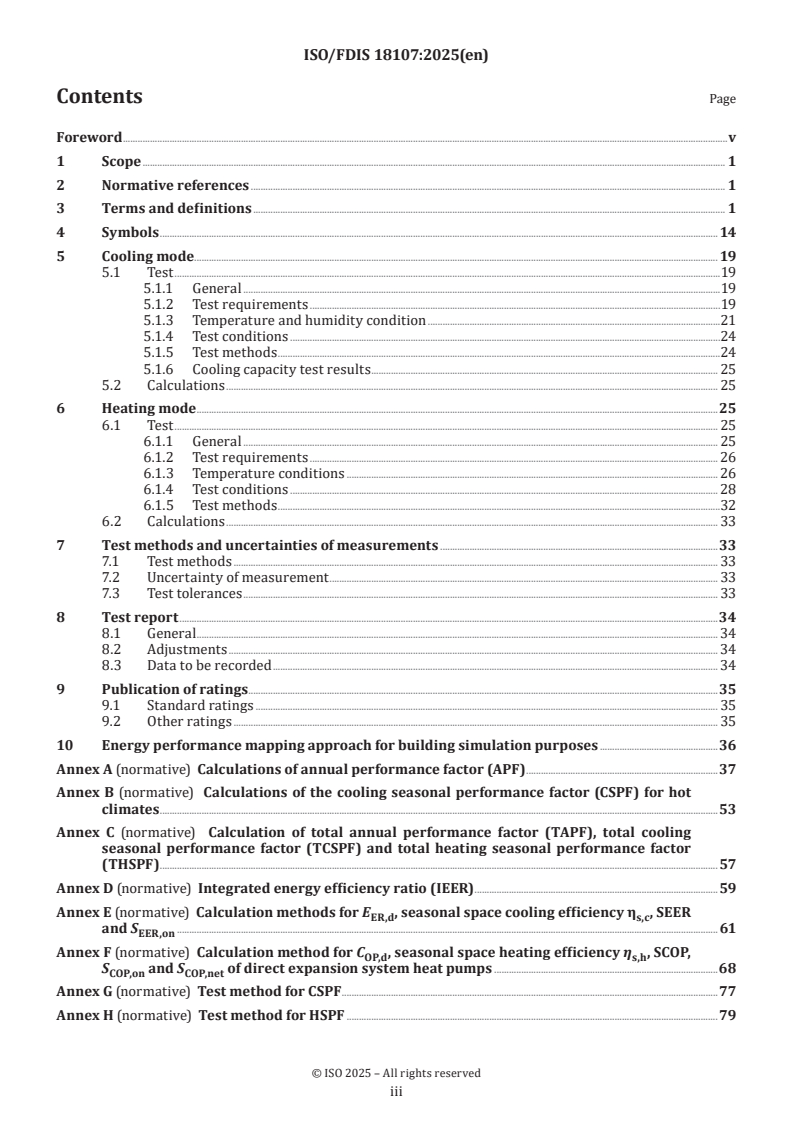
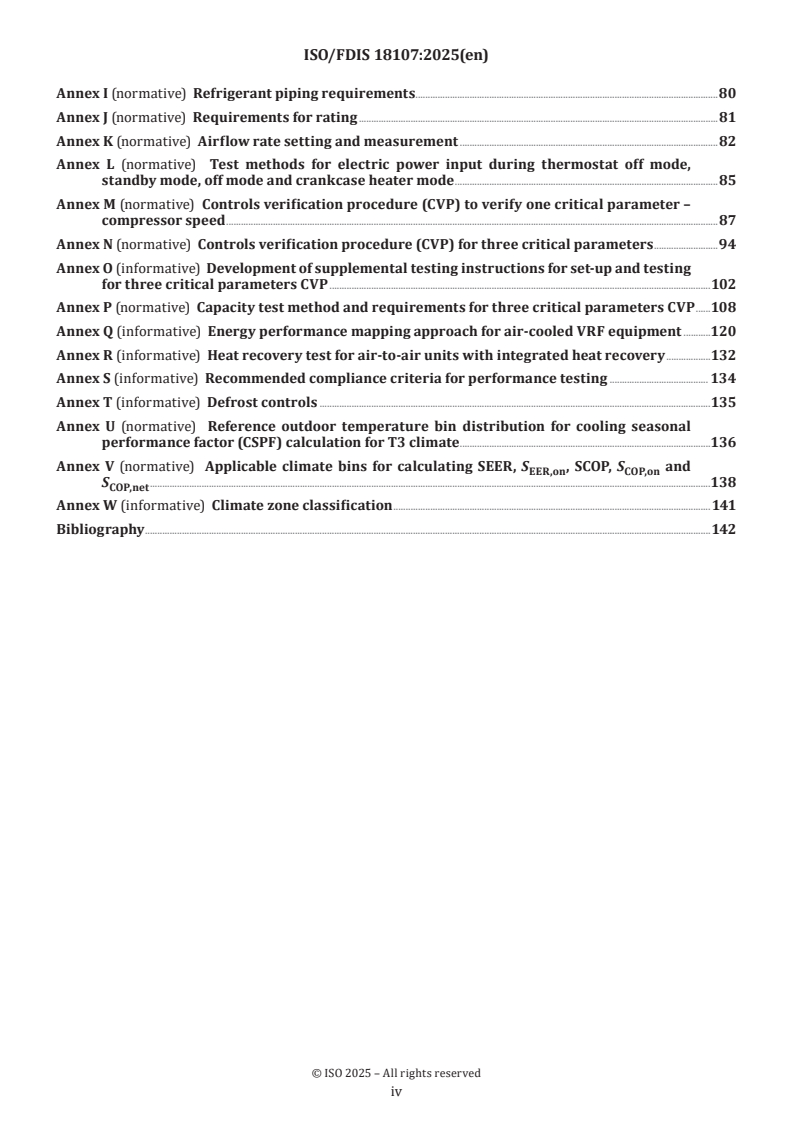
ISO/FDIS 18107 - Variable refrigerant flow air-to-air conditioners and air-to-air heat pumps — Testing and calculating methods for seasonal performance factors and energy performance mapping approach Released:10/1/2025
REDLINE ISO/FDIS 18107 - Variable refrigerant flow air-to-air conditioners and air-to-air heat pumps — Testing and calculating methods for seasonal performance factors and energy performance mapping approach Released:10/1/2025
Get Certified
Connect with accredited certification bodies for this standard

DNV
DNV is an independent assurance and risk management provider.

Lloyd's Register
Lloyd's Register is a global professional services organisation specialising in engineering and technology.
DNV Energy Systems
Energy and renewable energy certification.
Sponsored listings
Frequently Asked Questions
ISO 18107 is a draft published by the International Organization for Standardization (ISO). Its full title is "Variable refrigerant flow air-to-air conditioners and air-to-air heat pumps — Testing and calculating methods for seasonal performance factors and energy performance mapping approach". This standard covers: For factory made, residential, commercial and industrial, electrically operated compression, air-to-air air-conditioners and air-to-air heat pumps above 12kW, described as variable refrigerant flow systems, this document specifies: - performance testing, the standard conditions and the test methods for determining the capacity and efficiency ratings under heating and cooling, and - calculation methods for seasonal performance. This standard does not apply to a) Rating and testing of individual assemblies, such as condensing units or coils, for separate use b) Multi-split Systems where each Indoor Unit has dedicated piping connected directly to the Outdoor Unit. c) Single or variable speed water source heat–pump systems.
For factory made, residential, commercial and industrial, electrically operated compression, air-to-air air-conditioners and air-to-air heat pumps above 12kW, described as variable refrigerant flow systems, this document specifies: - performance testing, the standard conditions and the test methods for determining the capacity and efficiency ratings under heating and cooling, and - calculation methods for seasonal performance. This standard does not apply to a) Rating and testing of individual assemblies, such as condensing units or coils, for separate use b) Multi-split Systems where each Indoor Unit has dedicated piping connected directly to the Outdoor Unit. c) Single or variable speed water source heat–pump systems.
ISO 18107 is classified under the following ICS (International Classification for Standards) categories: 23.120 - Ventilators. Fans. Air-conditioners; 27.080 - Heat pumps. The ICS classification helps identify the subject area and facilitates finding related standards.
ISO 18107 is available in PDF format for immediate download after purchase. The document can be added to your cart and obtained through the secure checkout process. Digital delivery ensures instant access to the complete standard document.
Standards Content (Sample)
FINAL DRAFT
International
Standard
ISO/FDIS 18107
ISO/TC 86/SC 6
Variable refrigerant flow air-to-air
Secretariat: JISC
conditioners and air-to-air heat
Voting begins on:
pumps — Testing and calculating
2025-10-15
methods for seasonal performance
Voting terminates on:
factors and energy performance
2025-12-10
mapping approach
Climatiseurs et pompes à chaleur air/air à débit de fluide
frigorigène variable — Méthodes d'essai et de calcul des facteurs
de performance saisonnière et approche de la cartographie de la
performance énergétique
RECIPIENTS OF THIS DRAFT ARE INVITED TO SUBMIT,
WITH THEIR COMMENTS, NOTIFICATION OF ANY
RELEVANT PATENT RIGHTS OF WHICH THEY ARE AWARE
AND TO PROVIDE SUPPOR TING DOCUMENTATION.
IN ADDITION TO THEIR EVALUATION AS
BEING ACCEPTABLE FOR INDUSTRIAL, TECHNO
LOGICAL, COMMERCIAL AND USER PURPOSES, DRAFT
INTERNATIONAL STANDARDS MAY ON OCCASION HAVE
TO BE CONSIDERED IN THE LIGHT OF THEIR POTENTIAL
TO BECOME STAN DARDS TO WHICH REFERENCE MAY BE
MADE IN NATIONAL REGULATIONS.
Reference number
ISO/FDIS 18107:2025(en) © ISO 2025
FINAL DRAFT
ISO/FDIS 18107:2025(en)
International
Standard
ISO/FDIS 18107
ISO/TC 86/SC 6
Variable refrigerant flow air-to-air
Secretariat: JISC
conditioners and air-to-air heat
Voting begins on:
pumps — Testing and calculating
methods for seasonal performance
Voting terminates on:
factors and energy performance
mapping approach
Climatiseurs et pompes à chaleur air/air à débit de fluide
frigorigène variable — Méthodes d'essai et de calcul des facteurs
de performance saisonnière et approche de la cartographie de la
performance énergétique
RECIPIENTS OF THIS DRAFT ARE INVITED TO SUBMIT,
WITH THEIR COMMENTS, NOTIFICATION OF ANY
RELEVANT PATENT RIGHTS OF WHICH THEY ARE AWARE
AND TO PROVIDE SUPPOR TING DOCUMENTATION.
© ISO 2025
IN ADDITION TO THEIR EVALUATION AS
All rights reserved. Unless otherwise specified, or required in the context of its implementation, no part of this publication may
BEING ACCEPTABLE FOR INDUSTRIAL, TECHNO
LOGICAL, COMMERCIAL AND USER PURPOSES, DRAFT
be reproduced or utilized otherwise in any form or by any means, electronic or mechanical, including photocopying, or posting on
INTERNATIONAL STANDARDS MAY ON OCCASION HAVE
the internet or an intranet, without prior written permission. Permission can be requested from either ISO at the address below
TO BE CONSIDERED IN THE LIGHT OF THEIR POTENTIAL
or ISO’s member body in the country of the requester.
TO BECOME STAN DARDS TO WHICH REFERENCE MAY BE
MADE IN NATIONAL REGULATIONS.
ISO copyright office
CP 401 • Ch. de Blandonnet 8
CH-1214 Vernier, Geneva
Phone: +41 22 749 01 11
Email: copyright@iso.org
Website: www.iso.org
Published in Switzerland Reference number
ISO/FDIS 18107:2025(en) © ISO 2025
ii
ISO/FDIS 18107:2025(en)
Contents Page
Foreword .v
1 Scope . 1
2 Normative references . 1
3 Terms and definitions . 1
4 Symbols . 14
5 Cooling mode . 19
5.1 Test .19
5.1.1 General .19
5.1.2 Test requirements .19
5.1.3 Temperature and humidity condition .21
5.1.4 Test conditions .24
5.1.5 Test methods .24
5.1.6 Cooling capacity test results . 25
5.2 Calculations . 25
6 Heating mode .25
6.1 Test . 25
6.1.1 General . 25
6.1.2 Test requirements . 26
6.1.3 Temperature conditions . 26
6.1.4 Test conditions . 28
6.1.5 Test methods .32
6.2 Calculations . 33
7 Test methods and uncertainties of measurements .33
7.1 Test methods . 33
7.2 Uncertainty of measurement . 33
7.3 Test tolerances . 33
8 Test report .34
8.1 General . 34
8.2 Adjustments . 34
8.3 Data to be recorded . 34
9 Publication of ratings . .35
9.1 Standard ratings . 35
9.2 Other ratings . 35
10 Energy performance mapping approach for building simulation purposes .36
Annex A (normative) Calculations of annual performance factor (APF) .37
Annex B (normative) Calculations of the cooling seasonal performance factor (CSPF) for hot
climates .53
Annex C (normative) Calculation of total annual performance factor (TAPF), total cooling
seasonal performance factor (TCSPF) and total heating seasonal performance factor
(THSPF) .57
Annex D (normative) Integrated energy efficiency ratio (IEER) .59
Annex E (normative) Calculation methods for E , seasonal space cooling efficiency η , SEER
ER,d s,c
and S . 61
EER,on
Annex F (normative) Calculation method for C , seasonal space heating efficiency η , SCOP,
OP,d s,h
S and S of direct expansion system heat pumps .68
COP,on COP,net
Annex G (normative) Test method for CSPF .77
Annex H (normative) Test method for HSPF .79
iii
ISO/FDIS 18107:2025(en)
Annex I (normative) Refrigerant piping requirements .80
Annex J (normative) Requirements for rating .81
Annex K (normative) Airflow rate setting and measurement .82
Annex L (normative) Test methods for electric power input during thermostat off mode,
standby mode, off mode and crankcase heater mode .85
Annex M (normative) Controls verification procedure (CVP) to verify one critical parameter –
compressor speed .87
Annex N (normative) Controls verification procedure (CVP) for three critical parameters .94
Annex O (informative) Development of supplemental testing instructions for set-up and testing
for three critical parameters CVP .102
Annex P (normative) Capacity test method and requirements for three critical parameters CVP .108
Annex Q (informative) Energy performance mapping approach for air-cooled VRF equipment .120
Annex R (informative) Heat recovery test for air-to-air units with integrated heat recovery .132
Annex S (informative) Recommended compliance criteria for performance testing . 134
Annex T (informative) Defrost controls .135
Annex U (normative) Reference outdoor temperature bin distribution for cooling seasonal
performance factor (CSPF) calculation for T3 climate .136
Annex V (normative) Applicable climate bins for calculating SEER, S , SCOP, S and
EER,on COP,on
S .138
COP,net
Annex W (informative) Climate zone classification .141
Bibliography .142
iv
ISO/FDIS 18107:2025(en)
Foreword
ISO (the International Organization for Standardization) is a worldwide federation of national standards
bodies (ISO member bodies). The work of preparing International Standards is normally carried out through
ISO technical committees. Each member body interested in a subject for which a technical committee
has been established has the right to be represented on that committee. International organizations,
governmental and non-governmental, in liaison with ISO, also take part in the work. ISO collaborates closely
with the International Electrotechnical Commission (IEC) on all matters of electrotechnical standardization.
The procedures used to develop this document and those intended for its further maintenance are described
in the ISO/IEC Directives, Part 1. In particular, the different approval criteria needed for the different types
of ISO document should be noted. This document was drafted in accordance with the editorial rules of the
ISO/IEC Directives, Part 2 (see www.iso.org/directives).
ISO draws attention to the possibility that the implementation of this document may involve the use of (a)
patent(s). ISO takes no position concerning the evidence, validity or applicability of any claimed patent
rights in respect thereof. As of the date of publication of this document, ISO had not received notice of (a)
patent(s) which may be required to implement this document. However, implementers are cautioned that
this may not represent the latest information, which may be obtained from the patent database available at
www.iso.org/patents. ISO shall not be held responsible for identifying any or all such patent rights.
Any trade name used in this document is information given for the convenience of users and does not
constitute an endorsement.
For an explanation of the voluntary nature of standards, the meaning of ISO specific terms and expressions
related to conformity assessment, as well as information about ISO's adherence to the World Trade
Organization (WTO) principles in the Technical Barriers to Trade (TBT), see www.iso.org/iso/foreword.html.
This document was prepared by Technical Committee ISO/TC86, Refrigeration and air-conditioning,
Subcommittee SC 6, Testing and rating of air conditioners and heat pumps.
Any feedback or questions on this document should be directed to the user’s national standards body. A
complete listing of these bodies can be found at www.iso.org/members.html.
v
FINAL DRAFT International Standard ISO/FDIS 18107:2025(en)
Variable refrigerant flow air-to-air conditioners and air-to-air
heat pumps — Testing and calculating methods for seasonal
performance factors and energy performance mapping
approach
1 Scope
This document specifies:
— the test conditions and test methods for determining capacity and efficiency ratings;
— calculation methods for seasonal performance.
This applies to factory made, electric mains operated, variable refrigerant flow air-cooled air conditioners
and air-to-air heat pumps with a rated capacity above 12 kW for cooling or for heating if the product has no
cooling function.
In this document, “heat pumps” means “air-to-air heat pumps” and “air conditioners” means “air-cooled air
conditioners”.
This document establishes a method for determining global variable refrigerant flow (VRF) performance
with annexes addressing specific national or regional deviations, such as regionally specific power or testing
requirements.
This document does not apply to the testing and rating of:
a) water-source heat pumps or water-cooled air conditioners;
b) multi-split systems where each indoor unit has dedicated piping connected directly to the outdoor unit;
c) individual assemblies not constituting a complete refrigeration system.
2 Normative references
The following documents are referred to in the text in such a way that some or all of their content constitutes
requirements of this document. For dated references, only the edition cited applies. For undated references,
the latest edition of the referenced document (including any amendments) applies.
ISO 5151, Non-ducted air conditioners and heat pumps — Testing and rating for performance
ISO 13253, Ducted air-conditioners and air-to-air heat pumps — Testing and rating for performance
ISO 15042:2017, Multiple split-system air conditioners and air-to-air heat pumps — Testing and rating for
performance
3 Terms and definitions
For the purposes of this document, the terms and definitions given in ISO 5151, ISO 13253, ISO 15042 and
the following apply.
ISO and IEC maintain terminology databases for use in standardization at the following addresses:
— ISO Online browsing platform: available at https:// www .iso .org/ obp
ISO/FDIS 18107:2025(en)
— IEC Electropedia: available at https:// www .electropedia .org
3.1
active mode seasonal coefficient of performance
S
COP,on
average coefficient of performance of the unit in active mode for the designated heating season, determined
from the part load, supplementary heating capacity (where required) and bin-specific coefficients of
performance [C (t )] and weighted by the bin hours where the bin condition occurs
OP,bin j
Note 1 to entry: For calculation of S , the energy consumption during thermostat-off mode, standby mode, off
COP,on
mode and crankcase heater mode are excluded. The energy consumption of a supplementary heater is added for the
part load conditions where the declared capacity of the unit is lower than the heating load, regardless of whether this
supplementary heater is included in the unit or not included in the unit.
Note 2 to entry: Expressed in kWh/kWh.
3.2
active mode seasonal energy efficiency ratio
S
EER,on
average energy efficiency ratio of the unit in active mode for the space cooling function, determined from
part load and bin-specific energy efficiency ratios [E (t )] and weighted by the bin hours where the bin
ER,bin j
condition occurs
Note 1 to entry: For calculation of S , the energy consumption during thermostat-off mode, standby mode, off
EER,on
mode and that of the crankcase heater is excluded.
Note 2 to entry: Expressed in kWh/kWh.
3.3
air-cooled air conditioner
air conditioner
direct expansion system that utilizes an indoor conditioning coil, compressor and refrigerant-to-outdoor air
heat exchanger to provide air cooling and can also provide air dehumidifying, air humidifying, air circulating
and air cleaning
3.4
air-to-air heat pump
heat pump
direct expansion system that utilizes an indoor conditioning coil, compressor and refrigerant-to-outdoor air
heat exchanger to provide air heating and can also provide air cooling, air dehumidifying, air humidifying,
air circulating and air cleaning
3.5
annual energy consumption for heating
Q
HE
energy consumption required to meet the reference annual heating demand for a designated heating season
and calculated as the reference annual heating demand divided by the active mode seasonal coefficient of
performance (S ) and the energy consumption of the unit for thermostat-off-, standby-off- and crankcase
COP,on
heater mode during the heating season
Note 1 to entry: Expressed in kWh.
3.6
annual energy consumption for space cooling
Q
CE
energy consumption required to meet the reference annual space cooling demand and calculated as the
reference annual space cooling demand divided by the active mode seasonal energy efficiency ratio (S )
EER,on
and the energy consumption of the unit for thermostat-off-, standby-off- and crankcase heater mode during
the cooling season
Note 1 to entry: Expressed in kWh.
ISO/FDIS 18107:2025(en)
3.7
annual performance factor
APF
ratio of the total annual amount of heat that the equipment can remove from and add to the indoor air when
operated for cooling and heating, respectively, in active mode to the total amount of energy consumed by the
equipment during the same period
[SOURCE: ISO 16358-3:2013, 3.6]
3.8
approach temperature
refrigerant temperature at the outdoor liquid service port minus the outdoor ambient temperature
3.9
bin
outdoor temperature interval of 1 K
3.10
bin hours
n
j
hours per season for which an outdoor temperature occurs for each bin j
3.11
bin temperature
t
j
outdoor air dry bulb temperature at bin j
Note 1 to entry: Expressed in °C.
Note 2 to entry: The relative humidity can be indicated by a corresponding wet bulb temperature.
3.12
bin-specific coefficient of performance
C (t )
OP,bin j
coefficient of performance specific for every bin j with outdoor temperature t in a season
j
Note 1 to entry: Expressed in kW/kW.
3.13
bin-specific energy efficiency ratio
E (t )
ER,bin j
energy efficiency ratio specific for every bin j with outdoor temperature t in a season
j
Note 1 to entry: Expressed in kW/kW.
3.14
bivalent temperature
t
biv
lowest outdoor bin temperature at which the unit is declared to have a capacity able to meet 100 % of the
heating load without supplementary heater, whether it is integrated in the unit or not
Note 1 to entry: Below this point, the unit can still provide capacity, but additional supplementary heating is necessary
to fulfil the full heating load.
Note 2 to entry: Expressed in °C.
3.15
ceiling cassette
non-ducted indoor units intended to be installed flush mounted with the ceiling
Note 1 to entry: These indoor units can have configurations of indoor airflow coming from one, two, four or circular
direction(s). Each represents a separate indoor unit.
ISO/FDIS 18107:2025(en)
3.16
coefficient of performance at declared capacity
C
OP,d
declared heating capacity of the unit divided by the effective power input of the unit at specific temperature
conditions, A, B, C, D, E, F and G, where applicable
Note 1 to entry: Expressed in kW/kW.
3.17
coefficient of performance at high temperature
C
OPH
coefficient of performance not including supplementary resistance heat, obtained at the 8,3 °C temperature
rating condition
Note 1 to entry: Expressed in kW/kW.
3.18
coefficient of performance at low temperature
C
OPL
coefficient of performance obtained at the −8,3 °C temperature rating condition
Note 1 to entry: Expressed in kW/kW.
3.19
coefficient of performance at part load
C
OP,bin
coefficient of performance C corrected with the degradation coefficient where applicable
OP,d
Note 1 to entry: Expressed in kW/kW.
3.20
control setting
system configurations specified in the manufacturer’s installation instructions or supplemental testing
instructions
3.21
controls verification procedure
CVP
procedure intended to verify the control settings for critical parameters used during the test
3.22
crankcase heater mode
condition where the unit has activated a heating device to avoid the refrigerant migrating to the compressor
in order to limit the refrigerant concentration in oil at compressor start
3.23
crankcase heater mode operating hours
H
CK
annual number of hours the unit is considered to be in crankcase heater mode, the value of which depends
on the designated season and type of unit and operating mode(s)
Note 1 to entry: Expressed in h.
3.24
crankcase heater mode power input
P
CK
power input of the outdoor unit due to crankcase heater mode
Note 1 to entry: Expressed in W.
ISO/FDIS 18107:2025(en)
3.25
critical parameter
operating state or position for a component, either set manually or automatically by system controls, which
significantly impacts system performance
Note 1 to entry: Critical parameter is one (or more) key variable(s) affecting the measured result.
3.26
cycling interval capacity for cooling
ϕ
cyc,c
(time-weighted) average cooling capacity output over the cycling interval test
Note 1 to entry: Expressed in kW.
3.27
cycling interval capacity for heating
ϕ
cyc,h
(time-weighted) average heating capacity output over the cycling interval test
Note 1 to entry: Expressed in kW.
3.28
cycling interval efficiency for cooling
E
ER,cyc
average energy efficiency ratio over the cycling interval test (compressor switching on and off)
Note 1 to entry: The cycling interval efficiency for cooling is calculated as the integrated cooling capacity over the
interval divided by the integrated power input over that same interval.
Note 2 to entry: Expressed in kWh/kWh.
3.29
cycling interval efficiency for heating
C
OP,cyc
average coefficient of performance over the cycling interval test (compressor switching on and off)
Note 1 to entry: The cycling interval efficiency for heating calculated as the integrated heating capacity over the
interval divided by the integrated power input over that same interval.
Note 2 to entry: Expressed in kWh/kWh.
3.30
defrost control
capability defined by the manufacturer to monitor and manage a heat pumps operating conditions to initiate
and terminate defrost protection for the outdoor unit
3.31
defrost control system
system configurations specified in the manufacturer’s installation instructions or supplemental testing
instructions
3.32
degradation coefficient
C
d
measure of efficiency loss due to the cycling
Note 1 to entry: If C is not determined by measurement, then the default degradation coefficient for air-to-air units is
d
0,25 for both heating and cooling mode of operation.
3.33
direct expansion system
system that uses vapor-compression refrigeration cycle in which the inside and outside air is cooled or
heated by the heat exchange with a coil where the refrigerant evaporates or condenses respectively
ISO/FDIS 18107:2025(en)
3.34
ducted indoor unit
indoor unit designed to be permanently installed and deliver all conditioned air through ductwork
3.35
ducted system
system with only indoor units designed to be permanently installed and to deliver all conditioned air
through ductwork
3.36
electric supplementary heater capacity
e (t )
lbu j
heating capacity of a real or assumed electric supplementary heater supplementing the declared capacity
for heating when the capacity of the unit is lower than the heat load for a specific bin temperature t
j
Note 1 to entry: Expressed in kW.
3.37
energy efficiency ratio
EER
ratio of the cooling capacity in kW to the total power in kW at any given set of rating conditions
Note 1 to entry: Expressed in kW/kW.
3.38
energy efficiency ratio at declared capacity
E
ER,d
declared cooling capacity of the unit divided by the effective power input of a unit at specific temperature
conditions A, B, C, D
Note 1 to entry: Expressed in kW/kW.
3.39
energy efficiency ratio at part load
E
ER,bin
energy efficiency ratio E corrected with the degradation coefficient, where applicable
ER,d
Note 1 to entry: Expressed in kW/kW.
3.40
equivalent active mode hours for cooling
H
CE
assumed annual number of hours the unit provides the design load for space cooling (L ) in order to
design,c
satisfy the reference annual space cooling demand
Note 1 to entry: Expressed in h.
3.41
equivalent active mode hours for heating
H
HE
assumed annual number of hours the unit provides the design load for heating (L ) in order to satisfy
design,h
the reference annual heating demand
Note 1 to entry: Expressed in h.
3.42
heat recovery capacity ratio
ratio of capacity during simultaneous cooling and heating operation between indoor units in cooling mode
over indoor units in heating mode
Note 1 to entry: Expressed in kW/kW.
ISO/FDIS 18107:2025(en)
3.43
heat recovery control unit
device that controls refrigerant flow between indoor units, allowing for simultaneous cooling and heating
operation
3.44
heating capacity
rate of heat that the equipment adds to the conditioned space in a defined interval of time
Note 1 to entry: Expressed in kW.
3.45
heating season
months of the year that require heating
3.46
heating seasonal performance factor
HSPF
the total space heating required during the space heating season, kWh, divided by the total electrical energy,
kWh, consumed by the heat pump system during the same season
Note 1 to entry: Expressed in kWh/kWh.
Note 2 to entry: HSPF varies depending on the region and design heating requirement.
3.47
indoor unit
separate assembly of a split system that is individually controlled and includes the following basic features:
— arrangement of refrigerant-to-air heat transfer coil(s) for transfer of heat between the refrigerant and
the indoor air;
— integrated indoor blower (i.e. a device to move air including its associated motor)
3.48
integrated energy efficiency ratio
IEER
weighted calculation of mechanical cooling efficiencies at full load and part load standard rating conditions
as defined by regional requirements
3.49
load ratio
ratio of the actual heat power output divided by the maximum power output of the heat pump at the same
source and sink temperature conditions
3.50
manufacturer’s installation instructions
MII
manufacturer’s documents that come packaged with or appear on the labels applied to the unit(s)
Note 1 to entry: Online manuals are acceptable if referenced on the unit label or in the documents that come packaged
with the unit.
Note 2 to entry: All references to “manufacturer’s instructions,” “manufacturer's published instructions,”
“manufacturer’s installation instructions,” “manufacturer’s published recommendations,” “manufacturer installation
and operation manuals,” “installation instructions”, “manufacturer-specified”, and other similar references means
manufacturer’s installation instructions.
ISO/FDIS 18107:2025(en)
3.51
net seasonal coefficient of performance
S
COP,net
seasonal coefficient of performance of a unit in active heating mode without supplementary heaters which is
determined from mandatory conditions given in this document
Note 1 to entry: For calculation of S , the energy consumption during active mode is used. This excludes the
COP,net
energy consumption during thermostat-off mode, standby mode, off mode or that of the crankcase heater. For the part
load conditions where the declared capacity of the unit is lower than the heating load, the energy consumption of a
supplementary heater is not included.
Note 2 to entry: Expressed in kWh/kWh.
3.52
nominal cooling capacity
cooling capacity tested at standard rating conditions, as published in product literature
Note 1 to entry: Expressed in kW.
3.53
nominal point value
value corresponding to a 1 % variation in the given critical parameter as given in this document
3.54
non-ducted indoor unit
indoor unit designed to operate at 0 ESP, to be permanently installed, mounted on room walls, floors and/or
ceilings, which directly heats or cools air within the conditioned space
Note 1 to entry: Non-ducted indoor units can consist of the following types: wall-mounted, floor-mounted, ceiling-
suspended and ceiling cassette (standard and compact).
3.55
off mode
mode wherein the unit is completely switched off and cannot be reactivated by control device, external
signal or by a timer
Note 1 to entry: Off mode means a condition in which the equipment is connected to the mains and is not providing any
function. The following is also considered as off mode: conditions providing only an indication of off mode condition;
conditions providing only functionalities intended to ensure electromagnetic compatibility.
3.56
off mode operating hours
H
OFF
annual number of hours the unit is considered to be in off mode, the value of which depends on the designated
season, type of unit and operating mode(s)
Note 1 to entry: Expressed in h.
3.57
off mode power input
P
OFF
power input of the outdoor unit while in off mode
Note 1 to entry: Expressed in W.
3.58
oil recovery mode
automatic system operation that returns oil to the compressor crankcase when the control system
determines that the oil level in the outdoor unit is low
ISO/FDIS 18107:2025(en)
3.59
operation limit temperature
TOL
outdoor temperature below which the unit cannot deliver any capacity, and the declared capacity is equal to zero
Note 1 to entry: Expressed in °C.
3.60
outdoor coefficient of performance
C
OP,outdoor
ratio of the outdoor heating capacity to the outdoor effective power input
Note 1 to entry: Expressed in kW/kW.
3.61
outdoor cooling capacity
ϕ
C,outdoor
cooling capacity of the outdoor unit measured as the cooling capacity of all indoor units
Note 1 to entry: Expressed in kW.
3.62
outdoor energy efficiency ratio
E
ER,outdoor
ratio of the outdoor cooling capacity to the outdoor effective power input
Note 1 to entry: Expressed in kW/kW.
3.63
outdoor heating capacity
ϕ
H,outdoor
heating capacity of the outdoor unit measured as the heating capacity of all indoor units
Note 1 to entry: Expressed in kW.
3.64
outdoor power input
P
E,outdoor
effective power input measured on the outdoor unit
Note 1 to entry: Expressed in kW.
3.65
outdoor unit
separate assembly of a split system that transfers heat between the refrigerant and the outdoor ai, and
consists of an outdoor heat exchanger, compressor(s), an air moving device and, for heat pumps, can include
a heating mode expansion device, reversing valve and/or defrost controls
Note 1 to entry: An outdoor unit can be either single module or combined modules.
Note 2 to entry: A single module consists of a single outdoor unit that is assembled with multiple indoor units and
controls to form a system.
Note 3 to entry: Combined modules consist of two or more single modules that are mechanically and electronically
joined together to operate as a single outdoor unit that is assembled with multiple indoor units to form a system.
When such equipment is provided in more than one assembly, the separated assemblies shall be designed to be used
together, and the requirements of rating outlined in this document are based on the use of matched assemblies.
ISO/FDIS 18107:2025(en)
3.66
published rating
statement of the assigned values of those performance characteristics, under stated rating conditions,
by which a unit can be chosen to fit its application and apply to all units of like nominal size and type
(identification) produced by the same manufacturer
Note 1 to entry: As used in this document, the term published rating includes the rating of all performance
characteristics shown on the unit or published in specifications, advertising or other literature controlled by the
manufacturer, at stated rating conditions.
3.67
rated capacity
capacity achieved at the standard rating conditions
Note 1 to entry: Expressed in kW.
3.68
rating conditions
set of operating conditions under which a single level of performance results and which causes only that
level of performance to occur
3.69
reference annual cooling demand
Q
C
reference cooling demand to be used as basis for calculation of SEER and calculated as the product of the
design load for cooling (L ) and the equivalent active mode hours for cooling (H )
design,c CE
Note 1 to entry: Expressed in kWh.
3.70
reference annual heating demand(s)
Q
H
reference heating demand for a designated heating season, to be used as basis for calculation of SCOP and
calculated as the product of the design load for heating (L ) and the equivalent active mode hours for
design,h
heating (H )
HE
Note 1 to entry: There are three reference heating demands: “A” average, “C” colder and “W” warmer, corresponding to
the three reference heating seasons.
Note 2 to entry: Expressed in kWh.
3.71
root-sum-square point total
RSS point total
instantaneous measure of critical parameter variation, the root-sum-square of the points accrued by all
overridden critical parameters and applied under controls verification procedure
3.72
simultaneous cooling and heating efficiency
SCHE
ratio of the total capacity of the system (heating and cooling capacity) to the total power when operating in
the heat recovery mode
3.73
seasonal coefficient of performance
SCOP
overall coefficient of performance of the unit, representative for the whole designated heating season
Note 1 to entry: The value of SCOP pertains to a designated heating season. SCOP is calculated as the reference annual
heating demand, Q , divided by the annual energy consumption for heating, Q .
H HE
Note 2 to entry: Expressed in kWh/kWh.
ISO/FDIS 18107:2025(en)
3.74
seasonal energy efficiency ratio
SEER
overall energy efficiency ratio of the unit, representative for the whole cooling season
Note 1 to entry: The seasonal energy efficiency ratio is calculated as the reference annual cooling demand Q divided
C
by the annual energy consumption for cooling Q .
CE
Note 2 to entry: Expressed in kWh/kWh.
3.75
seasonal space cooling energy efficiency
η
s,c
energy efficiency of a space cooling unit while meeting the space cooling demand for the cooling season
Note 1 to entry: Expressed in %.
3.76
seasonal space heating energy efficiency
η
s,h
energy efficiency of a space heater while meeting the space heating demand for a designated heating season
Note 1 to entry: Expressed in %.
3.77
service tool
manufacturer’s service tool for checking system hardware/software, typically available for download from
manufacturer’s certified installer website or from an authorized representative
3.78
set point bias
difference between desired temperature and the nominal thermostat set point required for the thermostat
to control for desired sensed temperature at the sensed location
3.79
set point offset
difference between the temperature indicated by a thermostat’s temperature sensor and the actual
temperature at the sensor’s location
3.80
split system
split system air conditioner
split system heat pump
refrigerating system, air conditioner or heat pump incorporating one or more refrigerant circuits, comprising
one or more factory-built indoor units providing cooling or heating to the space and one or more factory-
built outdoor units
[SOURCE: ISO 5149-1:2014, 3.1.14, modified — Preferred terms "split sytem air conditioner" and "split
system heat pump" have been added.]
3.80.1
multi-split system
multi-split air conditioner
multi-split heat pump
split system with at least more than one indoor unit
[SOURCE: ISO 5149-1:2014, 3.1.15, modified — Preferred terms "multi-split air conditioner" and "multi-split
heat pump" have been added.]
ISO/FDIS 18107:2025(en)
3.81
stable conditions
balanced operating conditions in the indoor and outdoor section of the test chamber where the test unit
is maintaining steady-state conditions and the test chamber is maintaining test room conditions within
prescribed tolerances
3.82
standard rating
rating based on tests performed at standard rating conditions
3.83
standard rating conditions
rating conditions used as the basis of comparison for performance characteristics
3.84
standard rating cooling capacity
capacity of the system when all indoor units and outdoor units are operated in the same mode, in the
standard rating cooling test conditions
Note 1 to entry: Expressed in kW.
3.85
standard rating heating capacity
capacity of the system when all indoor units and outdoor units are operated in the same mode, in the standard
rating conditions (high temperature steady state heating and low temperature steady state heating)
Note 1 to entry: Expressed in kW.
3.86
standard rating test
test performed at standard rating conditions
3.87
standby mode
mode wherein the unit is switched off partially and can be reactivated by a control device (such as a remote
control), an external signal or a timer
Note 1 to entry: The unit is connected to the mains, depends on signal input to work as intended and provides only the
following functions, which can persist for an indefinite time: reactivation function or reactivation function and only
an indication of enabled reactivation function, and/or information or status display.
3.88
standby mode operating hours
H
SB
annual number of hours the unit is considered to be in standby mode, the value of which depends on the
designated season and type of unit and operating mode(s)
Note 1 to entry: Expressed in h.
3.89
standby mode power input
P
SB
power input of the outdoor unit due to standby mode operation
Note 1 to entry: Expressed in W.
3.90
steady-state test
test where the controlled test parameters are regulated to remain within the specified tolerances while the
unit operates continuously in the same mode
ISO/FDIS 1
...
ISO/DISFDIS 18107:2024(en)
ISO /TC 86/SC 6/WG 1
Secretariat: JISC
Date: 2025-07-11
Variable refrigerant flow air-to-air conditioners and air-to-air heat
pumps - — Testing and calculating methods for seasonal
performance factors and energy performance mapping approach
Climatiseurs et pompes à chaleur air/air à débit de fluide frigorigène variable — Méthodes d'essai et de calcul
des facteurs de performance saisonnière et approche de la cartographie de la performance énergétique
FDIS stage
Formatted: Font: 11 pt
Formatted: Footer, Left, Space Before: 0 pt, After: 0 pt,
Line spacing: single
ISO/DISFDIS 18107:2024(E2025(en) Formatted: Font: 11 pt, Bold
Formatted: Font: 11 pt, Bold
Formatted: Font: 11 pt, Bold
spacing: single, Tab stops: Not at 0.71 cm
All rights reserved. Unless otherwise specified, or required in the context of its implementation, no part of this publication
may be reproduced or utilized otherwise in any form or by any means, electronic or mechanical, including photocopying,
or posting on the internet or an intranet, without prior written permission. Permission can be requested from either ISO
at the address below or ISO’s member body in the country of the requester.
ISO copyright office
CP 401 • Ch. de Blandonnet 8
CH-1214 Vernier, Geneva
Phone: + 41 22 749 01 11
EmailE-mail: copyright@iso.org
Website: www.iso.org
Published in Switzerland
Formatted: Font: 10 pt
Formatted: Font: 10 pt
Formatted: Font: 11 pt
Formatted: FooterPageRomanNumber, Space After: 0
pt, Line spacing: single, Tab stops: Not at 17.2 cm
ii © ISO 2024 2025 – All rights reserved
ii
ISO/DISFDIS 18107:20242025(en) Formatted: Font: 11 pt, Bold
Formatted: Font: 11 pt, Bold
Formatted: Font: 11 pt, Bold
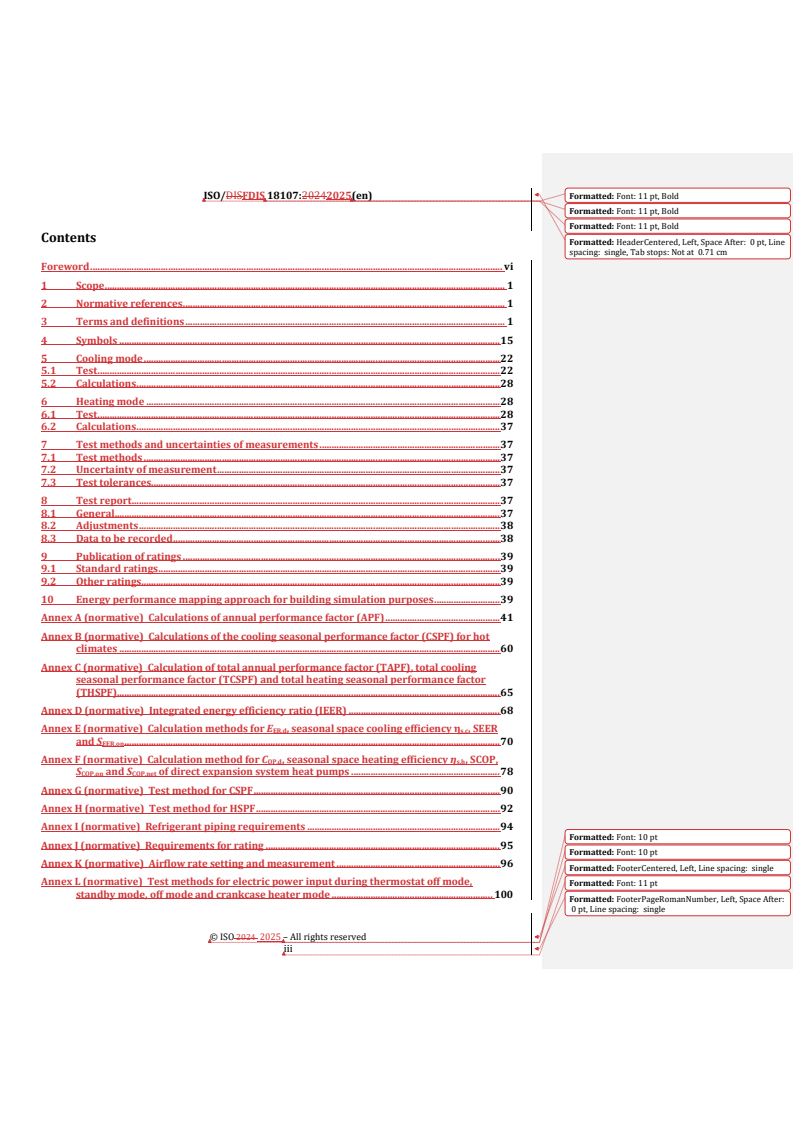
Contents
Formatted: HeaderCentered, Left, Space After: 0 pt, Line
spacing: single, Tab stops: Not at 0.71 cm
Foreword . vi
1 Scope . 1
2 Normative references . 1
3 Terms and definitions . 1
4 Symbols . 15
5 Cooling mode . 22
5.1 Test . 22
5.2 Calculations . 28
6 Heating mode . 28
6.1 Test . 28
6.2 Calculations . 37
7 Test methods and uncertainties of measurements . 37
7.1 Test methods . 37
7.2 Uncertainty of measurement . 37
7.3 Test tolerances . 37
8 Test report . 37
8.1 General. 37
8.2 Adjustments . 38
8.3 Data to be recorded . 38
9 Publication of ratings . 39
9.1 Standard ratings . 39
9.2 Other ratings . 39
10 Energy performance mapping approach for building simulation purposes . 39
Annex A (normative) Calculations of annual performance factor (APF) . 41
Annex B (normative) Calculations of the cooling seasonal performance factor (CSPF) for hot
climates . 60
Annex C (normative) Calculation of total annual performance factor (TAPF), total cooling
seasonal performance factor (TCSPF) and total heating seasonal performance factor
(THSPF). 65
Annex D (normative) Integrated energy efficiency ratio (IEER) . 68
Annex E (normative) Calculation methods for E , seasonal space cooling efficiency η , SEER
ER,d s,c
and S . 70
EER,on
Annex F (normative) Calculation method for C , seasonal space heating efficiency η , SCOP,
OP,d s,h
S and S of direct expansion system heat pumps . 78
COP,on COP,net
Annex G (normative) Test method for CSPF . 90
Annex H (normative) Test method for HSPF . 92
Annex I (normative) Refrigerant piping requirements . 94
Formatted: Font: 10 pt
Annex J (normative) Requirements for rating . 95
Formatted: Font: 10 pt
Annex K (normative) Airflow rate setting and measurement . 96
Formatted: FooterCentered, Left, Line spacing: single
Annex L (normative) Test methods for electric power input during thermostat off mode,
Formatted: Font: 11 pt
standby mode, off mode and crankcase heater mode . 100
Formatted: FooterPageRomanNumber, Left, Space After:
0 pt, Line spacing: single
iii
ISO/DISFDIS 18107:2024(E2025(en) Formatted: Font: 11 pt, Bold
Formatted: Font: 11 pt, Bold
Formatted: Font: 11 pt, Bold
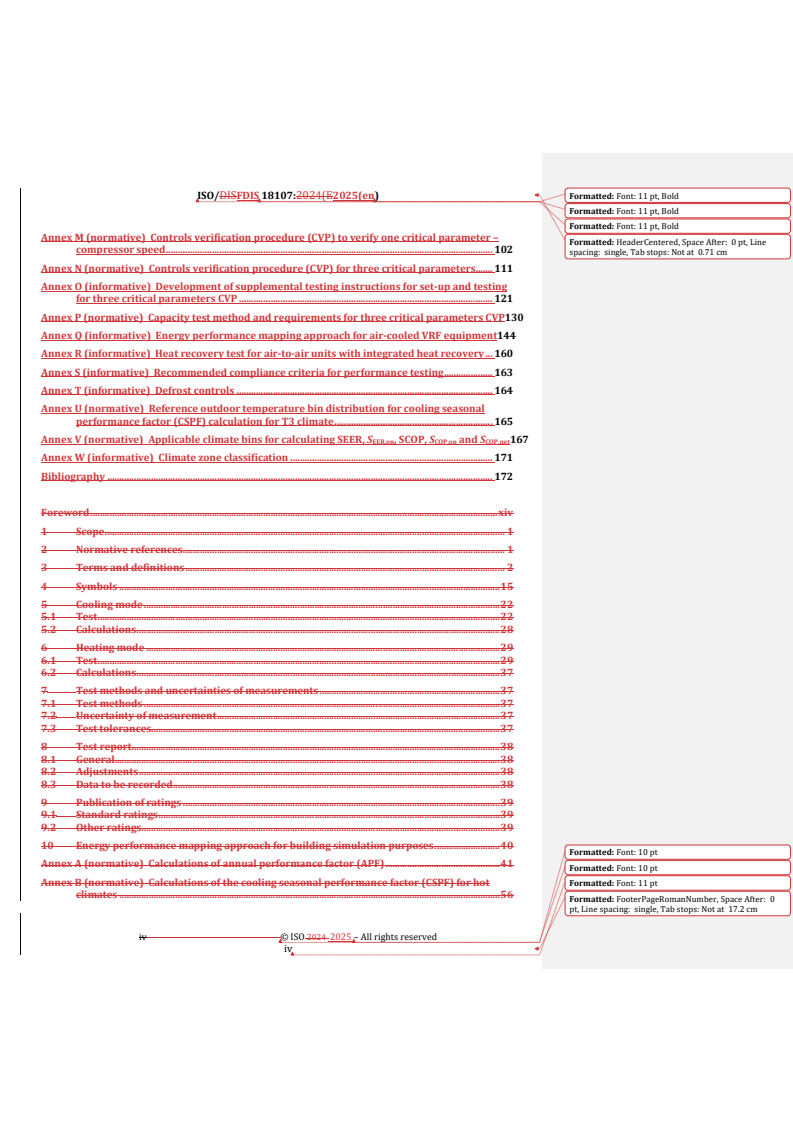
Annex M (normative) Controls verification procedure (CVP) to verify one critical parameter –
Formatted: HeaderCentered, Space After: 0 pt, Line
compressor speed . 102
spacing: single, Tab stops: Not at 0.71 cm
Annex N (normative) Controls verification procedure (CVP) for three critical parameters . 111
Annex O (informative) Development of supplemental testing instructions for set-up and testing
for three critical parameters CVP . 121
Annex P (normative) Capacity test method and requirements for three critical parameters CVP130
Annex Q (informative) Energy performance mapping approach for air-cooled VRF equipment144
Annex R (informative) Heat recovery test for air-to-air units with integrated heat recovery . 160
Annex S (informative) Recommended compliance criteria for performance testing . 163
Annex T (informative) Defrost controls . 164
Annex U (normative) Reference outdoor temperature bin distribution for cooling seasonal
performance factor (CSPF) calculation for T3 climate . 165
Annex V (normative) Applicable climate bins for calculating SEER, S , SCOP, S and S 167
EER,on COP,on COP,net
Annex W (informative) Climate zone classification . 171
Bibliography . 172
Foreword . xiv
1 Scope . 1
2 Normative references . 1
3 Terms and definitions . 2
4 Symbols . 15
5 Cooling mode . 22
5.1 Test . 22
5.2 Calculations . 28
6 Heating mode . 29
6.1 Test . 29
6.2 Calculations . 37
7 Test methods and uncertainties of measurements . 37
7.1 Test methods . 37
7.2 Uncertainty of measurement . 37
7.3 Test tolerances . 37
8 Test report . 38
8.1 General. 38
8.2 Adjustments . 38
8.3 Data to be recorded . 38
9 Publication of ratings . 39
9.1 Standard ratings . 39
9.2 Other ratings . 39
10 Energy performance mapping approach for building simulation purposes . 40
Formatted: Font: 10 pt
Annex A (normative) Calculations of annual performance factor (APF) . 41
Formatted: Font: 10 pt
Annex B (normative) Calculations of the cooling seasonal performance factor (CSPF) for hot
Formatted: Font: 11 pt
climates . 56
Formatted: FooterPageRomanNumber, Space After: 0
pt, Line spacing: single, Tab stops: Not at 17.2 cm
iv © ISO 2024 2025 – All rights reserved
iv
ISO/DISFDIS 18107:20242025(en) Formatted: Font: 11 pt, Bold
Formatted: Font: 11 pt, Bold
Formatted: Font: 11 pt, Bold
Annex C (normative) Calculation of total annual performance factor (TAPF), total cooling
Formatted: HeaderCentered, Left, Space After: 0 pt, Line
seasonal performance factor (TCSPF) and total heating seasonal performance factor
spacing: single, Tab stops: Not at 0.71 cm
(THSPF). 60
Annex D (normative) Integrated energy efficiency ratio (IEER) . 63
Annex E (normative) Calculation methods for E , seasonal space cooling efficiency η , SEER
ER,d s,c
and SEER,on . 65
Annex F (normative) Calculation method for C , seasonal space heating efficiency η , SCOP,
OP,d s,h
SCOP,on and SCOP,net of direct expansion system heat pumps . 72
Annex G (normative) Test method for CSPF . 82
Annex H (normative) Test method for HSPF . 84
Annex I (normative) Refrigerant piping requirements . 86
Annex J (normative) Requirements for rating . 87
Annex K (normative) Airflow rate setting and measurement . 88
Annex L (normative) Test methods for electric power input during thermostat off mode,
standby mode, off mode and crankcase heater mode . 91
Annex M (normative) Controls verification procedure (CVP) to verify one critical parameter –
compressor speed . 93
Annex N (normative) Controls verification procedure (CVP) for three critical parameters . 100
Annex O (normative) Development of supplemental testing instructions for set-up and testing
for three critical parameters CVP . 108
Annex P (normative) Capacity test method and requirements for three critical parameters CVP115
Annex Q (normative) Energy performance mapping approach for air-cooled VRF equipment 128
Annex R (informative) Heat recovery test for air-to-air units with integrated heat recovery . 141
Annex S (informative) Recommended compliance criteria for performance testing . 144
Annex T (informative) Defrost controls . 145
Annex U (informative) Reference outdoor temperature bin distribution for CSPF calculation for
T3 climate . 146
Annex V (informative) Applicable climate bins for calculating SEER, S , SCOP, S and
EER,on COP,on
S . 148
COP,net
Annex W (informative) Climate zone classification . 152
Bibliography . 153
Formatted: Font: 10 pt
Formatted: Font: 10 pt
Formatted: FooterCentered, Left, Line spacing: single
Formatted: Font: 11 pt
Formatted: FooterPageRomanNumber, Left, Space After:
0 pt, Line spacing: single
v
ISO/DISFDIS 18107:2024(E2025(en) Formatted: Font: 11 pt, Bold
Formatted: Font: 11 pt, Bold
Formatted: Font: 11 pt, Bold
Foreword
Formatted: HeaderCentered, Space After: 0 pt, Line
spacing: single, Tab stops: Not at 0.71 cm
ISO (the International Organization for Standardization) is a worldwide federation of national standards
Formatted: Adjust space between Latin and Asian text,
bodies (ISO member bodies). The work of preparing International Standards is normally carried out through Adjust space between Asian text and numbers
ISO technical committees. Each member body interested in a subject for which a technical committee has been
established has the right to be represented on that committee. International organizations, governmental and
non-governmental, in liaison with ISO, also take part in the work. ISO collaborates closely with the
International Electrotechnical Commission (IEC) on all matters of electrotechnical standardization.
The procedures used to develop this document and those intended for its further maintenance are described
in the ISO/IEC Directives, Part 1. In particular, the different approval criteria needed for the different types of
ISO document should be noted. This document was drafted in accordance with the editorial rules of the
ISO/IEC Directives, Part 2 (see www.iso.org/directives). Formatted: English (United Kingdom)
ISO draws attention to the possibility that the implementation of this document may involve the use of (a)
patent(s). ISO takes no position concerning the evidence, validity or applicability of any claimed patent rights
in respect thereof. As of the date of publication of this document, ISO had not received notice of (a) patent(s)
which may be required to implement this document. However, implementers are cautioned that this may not
represent the latest information, which may be obtained from the patent database available at
www.iso.org/patents.www.iso.org/patents. ISO shall not be held responsible for identifying any or all such
patent rights.
Any trade name used in this document is information given for the convenience of users and does not
constitute an endorsement.
For an explanation of the voluntary nature of standards, the meaning of ISO specific terms and expressions
related to conformity assessment, as well as information about ISO's adherence to the World Trade
Organization (WTO) principles in the Technical Barriers to Trade (TBT), see
www.iso.org/iso/foreword.htmlwww.iso.org/iso/foreword.html.
Formatted: English (United Kingdom)
This document was prepared by Technical Committee ISO/TC86TC 86, Refrigeration and air-conditioning,
Formatted: Adjust space between Latin and Asian text,
Adjust space between Asian text and numbers
Subcommittee SC 6, Testing and rating of air conditioners and heat pumps.
Any feedback or questions on this document should be directed to the user’s national standards body. A
complete listing of these bodies can be found at www.iso.org/members.htmlwww.iso.org/members.html.
Formatted: Font: 10 pt
Formatted: Font: 10 pt
Formatted: Font: 11 pt
Formatted: FooterPageRomanNumber, Space After: 0
pt, Line spacing: single, Tab stops: Not at 17.2 cm
vi © ISO 2024 2025 – All rights reserved
vi
DRAFT International Standard ISO/DIS 18107:2024(en)
Formatted: Font: 11 pt
Formatted: Left, Space After: 30 pt, Line spacing: single,
Tab stops: Not at 0.71 cm
Formatted: Main Title 1, Adjust space between Latin and
Variable refrigerant flow air-cooled to-air conditioners and air-to-air
Asian text, Adjust space between Asian text and numbers
heat pumps -- — Testing and calculating methods for seasonal
performance factors and energy performance mapping approach
Formatted: Adjust space between Latin and Asian text,
1 Scope
Adjust space between Asian text and numbers, Tab stops:
Not at 0.7 cm + 1.4 cm + 2.1 cm + 2.8 cm + 3.5 cm + 4.2
This document specifies: cm + 4.9 cm + 5.6 cm + 6.3 cm + 7 cm
Formatted: Adjust space between Latin and Asian text,
— — the test conditions and test methods for determining capacity and efficiency ratings;
Adjust space between Asian text and numbers
Formatted: Numbered + Level: 1 + Numbering Style: a, b,
— — calculation methods for seasonal performance.
c, … + Start at: 1 + Alignment: Left + Aligned at: 0 cm +
Indent at: 0 cm, Adjust space between Latin and Asian
text, Adjust space between Asian text and numbers, Tab
This applies to factory made, electric mains operated, variable refrigerant flow air-cooled air conditioners and
stops: Not at 0.7 cm + 1.4 cm + 2.1 cm + 2.8 cm + 3.5
air-to-air heat pumps with a rated capacity above 12 kW for cooling or for heating if the product has no cooling
cm + 4.2 cm + 4.9 cm + 5.6 cm + 6.3 cm + 7 cm
function.
Formatted: Adjust space between Latin and Asian text,
Adjust space between Asian text and numbers
In this document, “heat pumps” means “air-to-air heat pumps” and “air conditioners” means “air-cooled air
Formatted: Default Paragraph Font
conditioners”.
Formatted: Default Paragraph Font
This document establishes a method for determining global variable refrigerant flow (VRF) performance with
Formatted: Default Paragraph Font, Font: Italic
annexes addressing specific national or regional deviations, such as regionally specific power or testing
Formatted: Adjust space between Latin and Asian text,
requirements.
Adjust space between Asian text and numbers, Tab stops:
Not at 0.7 cm + 1.4 cm + 2.1 cm + 2.8 cm + 3.5 cm + 4.2
This document does not apply to the testing and rating of:
cm + 4.9 cm + 5.6 cm + 6.3 cm + 7 cm
Formatted: Default Paragraph Font
a) a) water-source heat pumps or water-cooled air conditioners;
Formatted: Default Paragraph Font
Formatted: Default Paragraph Font, Font: Italic
b) b) multi-split systems where each indoor unit has dedicated piping connected directly to the
outdoor unit;
Formatted: Default Paragraph Font, Font: Italic
Formatted: Default Paragraph Font, Font: Italic
c) c) individual assemblies not constituting a complete refrigeration system.
Formatted: Default Paragraph Font
Formatted: Default Paragraph Font
2 Normative references
Formatted: Default Paragraph Font
The following documents are referred to in the text in such a way that some or all of their content constitutes
Formatted: Default Paragraph Font, Font: Italic
requirements of this document. For dated references, only the edition cited applies. For undated references,
Formatted: Default Paragraph Font, Font: Italic
the latest edition of the referenced document (including any amendments) applies.
Formatted: Adjust space between Latin and Asian text,
Adjust space between Asian text and numbers
ISO 5151:2017, Non-ducted air conditioners and heat pumps — Testing and rating for performance
Formatted: Default Paragraph Font
ISO 13253, Ducted air -conditioners and air-to-air heat pumps — Testing and rating for performance
Formatted: Default Paragraph Font
Formatted: Default Paragraph Font
ISO 15042:2017, Multiple split-system air conditioners and air-to-air heat pumps — Testing and rating for
Formatted: Default Paragraph Font
performance
Formatted: Default Paragraph Font
3 Terms and definitions
Formatted: Default Paragraph Font
Formatted: Font: 11 pt
For the purposes of this document, the terms and definitions given in ISO 5151, ISO 13253, ISO 15042 and the
Formatted: Justified, Space After: 6 pt, Line spacing:
following apply.
single
ISO/DISFDIS 18107:2024(E2025(en) Formatted: Font: 11 pt, Bold
Formatted: Font: 11 pt, Bold
Formatted: Font: 11 pt, Bold
ISO and IEC maintain terminology databases for use in standardization at the following addresses:
Formatted: HeaderCentered, Space After: 0 pt, Line
spacing: single, Tab stops: Not at 0.71 cm
— — ISO Online browsing platform: available at https://www.iso.org/obphttps://www.iso.org/obp
Formatted: Adjust space between Latin and Asian text,
Adjust space between Asian text and numbers, Tab stops:
— — IEC Electropedia: available at https://www.electropedia.orghttps://www.electropedia.org
Not at 0.7 cm + 1.4 cm + 2.1 cm + 2.8 cm + 3.5 cm + 4.2
cm + 4.9 cm + 5.6 cm + 6.3 cm + 7 cm
3.1 3.1
Formatted: English (United States)
active mode seasonal coefficient of performance
Formatted: TermNum2, Adjust space between Latin and
S
COP,on
Asian text, Adjust space between Asian text and numbers
average coefficient of performance of the unit in active mode for the designated heating season, determined
from the part load, supplementary heating capacity (where required) and bin-specific coefficients of
performance ([C (t )))] and weighted by the bin hours where the bin condition occurs
OP,bin j
Note 1 to entry: For calculation of SCOP,on, the energy consumption during thermostat-off mode, standby
Formatted: Adjust space between Latin and Asian text,
mode, off mode and crankcase heater mode are excluded. The energy consumption of a supplementary heater is added Adjust space between Asian text and numbers, Tab stops:
Not at 0.7 cm + 1.4 cm + 2.1 cm + 2.8 cm + 3.5 cm + 4.2
for the part load conditions where the declared capacity of the unit is lower than the heating load, regardless of whether
cm + 4.9 cm + 5.6 cm + 6.3 cm + 7 cm
this supplementary heater is included in the unit or not included in the unit.
Note 2 to entry: Expressed in kWh/kWh.
3.2 3.2
Formatted: English (United States)
active mode seasonal energy efficiency ratio
Formatted: TermNum2, Adjust space between Latin and
SEER,on
Asian text, Adjust space between Asian text and numbers
average energy efficiency ratio of the unit in active mode for the space cooling function, determined from part
load and bin-specific energy efficiency ratios ([EER,bin(tj)))] and weighted by the bin hours where the bin
condition occurs
Note 1 to entry: For calculation of S , the energy consumption during thermostat-off mode, standby
EER,on Formatted: Adjust space between Latin and Asian text,
mode, off mode and that of the crankcase heater is excluded. Adjust space between Asian text and numbers, Tab stops:
Not at 0.7 cm + 1.4 cm + 2.1 cm + 2.8 cm + 3.5 cm + 4.2
cm + 4.9 cm + 5.6 cm + 6.3 cm + 7 cm
Note 2 to entry: Expressed in kWh/kWh.
3.3 3.3 Formatted: English (United States)
air-cooled air conditioner
Formatted: TermNum2, Adjust space between Latin and
air conditioner
Asian text, Adjust space between Asian text and numbers
direct expansion system that utilizes an indoor conditioning coil, compressor and refrigerant-to-outdoor air
heat exchanger to provide air cooling and can also provide air dehumidifying, air humidifying, air circulating
and air cleaning
3.4 3.4
Formatted: English (United States)
air-to-air heat pump
heat pump
direct expansion system that utilizes an indoor conditioning coil, compressor and refrigerant-to-outdoor air
heat exchanger to provide air heating and can also provide air cooling, air dehumidifying, air humidifying, air
circulating and air cleaning
3.5 3.5
Formatted: English (United States)
annual energy consumption for heating
QHE
Formatted: Adjust space between Latin and Asian text,
energy consumption required to meet the reference annual heating demand for a designated heating season
Adjust space between Asian text and numbers, Tab stops:
and calculated as the reference annual heating demand divided by the active mode seasonal coefficient of Not at 0.7 cm + 1.4 cm + 2.1 cm + 2.8 cm + 3.5 cm + 4.2
cm + 4.9 cm + 5.6 cm + 6.3 cm + 7 cm
performance (S ) and the energy consumption of the unit for thermostat-off-, standby-off- and crankcase
COP,on
heater mode during the heating season
Formatted: Font: 10 pt
Formatted: Font: 10 pt
Note 1 to entry: Expressed in kWh.
Formatted: FooterPageNumber, Space After: 0 pt, Line
spacing: single, Tab stops: Not at 17.2 cm
2 © ISO 2024 2025 – All rights reserved
ISO/DISFDIS 18107:20242025(en) Formatted: Font: 11 pt, Bold
Formatted: Font: 11 pt, Bold
Formatted: Font: 11 pt, Bold
3.6 3.6
Formatted: HeaderCentered, Left, Space After: 0 pt, Line
annual energy consumption for space cooling
spacing: single, Tab stops: Not at 0.71 cm
Q
CE
Formatted: English (United States)
energy consumption required to meet the reference annual space cooling demand and calculated as the
Formatted: TermNum2, Adjust space between Latin and
reference annual space cooling demand divided by the active mode seasonal energy efficiency ratio (S )
EER,on
Asian text, Adjust space between Asian text and numbers
and the energy consumption of the unit for thermostat-off-, standby-off- and crankcase heater mode during
the cooling season
Note 1 to entry: Expressed in kWh.
3.7 3.7 Formatted: English (United States)
annual performance factor
Formatted: TermNum2, Adjust space between Latin and
APF
Asian text, Adjust space between Asian text and numbers
ratio of the total annual amount of heat that the equipment can remove from and add to the indoor air when
operated for cooling and heating, respectively, in active mode to the total amount of energy consumed by the
equipment during the same period
Formatted: Default Paragraph Font
[SOURCE: ISO 16358-3:2013, 3. 6]
Formatted: Default Paragraph Font
Formatted: Default Paragraph Font
3.8 3.8
Formatted: Default Paragraph Font
approach temperature
refrigerant temperature at the outdoor liquid service port minus the outdoor ambient temperature
Formatted: English (United States)
Formatted: Font: Not Italic
3.9 3.9
Formatted: Font: Not Italic
bin
Formatted: English (United States)
outdoor temperature interval of 1 K
Formatted: Font: Not Italic
3.10 3.10
Formatted: Font: Not Italic
bin hours
Formatted: Adjust space between Latin and Asian text,
nj
Adjust space between Asian text and numbers, Tab stops:
hours per season for which an outdoor temperature occurs for each bin j
Not at 0.7 cm + 1.4 cm + 2.1 cm + 2.8 cm + 3.5 cm + 4.2
cm + 4.9 cm + 5.6 cm + 6.3 cm + 7 cm
3.11 3.11
Formatted: English (United States)
bin temperature
Formatted: TermNum2, Adjust space between Latin and
t
j
Asian text, Adjust space between Asian text and numbers
outdoor air dry bulb temperature at bin j
Formatted: Font: Not Italic
Note 1 to entry: Expressed in °C.
Formatted: Adjust space between Latin and Asian text,
Adjust space between Asian text and numbers, Tab stops:
Not at 0.7 cm + 1.4 cm + 2.1 cm + 2.8 cm + 3.5 cm + 4.2
Note 2 to entry: The relative humidity can be indicated by a corresponding wet bulb temperature.
cm + 4.9 cm + 5.6 cm + 6.3 cm + 7 cm
3.12 3.12 Formatted: English (United States)
bin-specific coefficient of performance
Formatted: TermNum2, Adjust space between Latin and
C (t ) Asian text, Adjust space between Asian text and numbers
OP,bin j
coefficient of performance specific for every bin j with outdoor temperature t in a season
j
Formatted: Font: Not Italic
Formatted: Adjust space between Latin and Asian text,
Note 1 to entry: Expressed in kW/kW.
Adjust space between Asian text and numbers, Tab stops:
Not at 0.7 cm + 1.4 cm + 2.1 cm + 2.8 cm + 3.5 cm + 4.2
3.13 3.13
cm + 4.9 cm + 5.6 cm + 6.3 cm + 7 cm
bin-specific energy efficiency ratio
Formatted: Font: 10 pt
E (t )
ER,bin j
Formatted: Font: 10 pt
energy efficiency ratio specific for every bin j with outdoor temperature t in a season
j
Formatted: FooterCentered, Left, Line spacing: single
Note 1 to entry: Expressed in kW/kW.
Formatted: Font: 11 pt
Formatted: FooterPageNumber, Left, Space After: 0 pt,
Line spacing: single
ISO/DISFDIS 18107:2024(E2025(en) Formatted: Font: 11 pt, Bold
Formatted: Font: 11 pt, Bold
Formatted: Font: 11 pt, Bold
3.14 3.14
Formatted: HeaderCentered, Space After: 0 pt, Line
bivalent temperature
spacing: single, Tab stops: Not at 0.71 cm
tbiv
Formatted: English (United States)
lowest outdoor bin temperature at which the unit is declared to have a capacity able to meet 100 % of the
Formatted: TermNum2, Adjust space between Latin and
heating load without supplementary heater, whether it is integrated in the unit or not
Asian text, Adjust space between Asian text and numbers
Note 1 to entry: Below this point, the unit can still provide capacity, but additional supplementary heating is necessary
Formatted: Adjust space between Latin and Asian text,
to fulfil the full heating load.
Adjust space between Asian text and numbers, Tab stops:
Not at 0.7 cm + 1.4 cm + 2.1 cm + 2.8 cm + 3.5 cm + 4.2
cm + 4.9 cm + 5.6 cm + 6.3 cm + 7 cm
Note 2 to entry: Expressed in °C.
3.15 3.15
Formatted: English (United States)
ceiling cassette
Formatted: TermNum2, Adjust space between Latin and
non-ducted indoor units intended to be installed flush mounted with the ceiling
Asian text, Adjust space between Asian text and numbers
Note 1 to entry: These indoor units can have configurations of indoor airflow coming from one, two,
Formatted: Adjust space between Latin and Asian text,
four or circular direction(s). Each represents a separate indoor unit. Adjust space between Asian text and numbers, Tab stops:
Not at 0.7 cm + 1.4 cm + 2.1 cm + 2.8 cm + 3.5 cm + 4.2
cm + 4.9 cm + 5.6 cm + 6.3 cm + 7 cm
3.16 3.16
coefficient of performance at declared capacity Formatted: TermNum2, Adjust space between Latin and
Asian text, Adjust space between Asian text and numbers
C
OP,d
declared heating capacity of the unit divided by the effective power input of the unit at specific temperature
conditions, A, B, C, D, E, F and G, where applicable
Formatted: Adjust space between Latin and Asian text,
Note 1 to entry: Expressed in kW/kW.
Adjust space between Asian text and numbers, Tab stops:
Not at 0.7 cm + 1.4 cm + 2.1 cm + 2.8 cm + 3.5 cm + 4.2
3.17 3.17
cm + 4.9 cm + 5.6 cm + 6.3 cm + 7 cm
coefficient of performance at high temperature
Formatted: English (United States)
C
OPH
Formatted: TermNum2, Adjust space between Latin and
coefficient of performance not including supplementary resistance heat, obtained at the 8,3 °C temperature
Asian text, Adjust space between Asian text and numbers
rating condition
Formatted: Adjust space between Latin and Asian text,
Adjust space between Asian text and numbers, Tab stops:
Note 1 to entry: Expressed in kW/kW.
Not at 0.7 cm + 1.4 cm + 2.1 cm + 2.8 cm + 3.5 cm + 4.2
cm + 4.9 cm + 5.6 cm + 6.3 cm + 7 cm
3.18 3.18
Formatted: English (United States)
coefficient of performance at low temperature
C Formatted: TermNum2, Adjust space between Latin and
OPL
Asian text, Adjust space between Asian text and numbers
coefficient of performance obtained at the −8,3 °C temperature rating condition
Formatted: Adjust space between Latin and Asian text,
Adjust space between Asian text and numbers, Tab stops:
Note 1 to entry: Expressed in kW/kW.
Not at 0.7 cm + 1.4 cm + 2.1 cm + 2.8 cm + 3.5 cm + 4.2
cm + 4.9 cm + 5.6 cm + 6.3 cm + 7 cm
3.19 3.19
Formatted: English (United States)
coefficient of performance at part load
COP,bin
Formatted: TermNum2, Adjust space between Latin and
Asian text, Adjust space between Asian text and numbers
coefficient of performance C corrected with the degradation coefficient where applicable
OP,d
Formatted: Adjust space between Latin and Asian text,
Note 1 to entry: Expressed in kW/kW.
Adjust space between Asian text and numbers, Tab stops:
Not at 0.7 cm + 1.4 cm + 2.1 cm + 2.8 cm + 3.5 cm + 4.2
cm + 4.9 cm + 5.6 cm + 6.3 cm + 7 cm
3.20 3.20
control setting
Formatted: English (United States)
system configurations specified in the manufacturer’s installation instructions or supplemental testing
Formatted: TermNum2, Adjust space between Latin and
instructions
Asian text, Adjust space between Asian text and numbers
Formatted: Font: 10 pt
Formatted: Font: 10 pt
Formatted: FooterPageNumber, Space After: 0 pt, Line
spacing: single, Tab stops: Not at 17.2 cm
4 © ISO 2024 2025 – All rights reserved
ISO/DISFDIS 18107:20242025(en) Formatted: Font: 11 pt, Bold
Formatted: Font: 11 pt, Bold
Formatted: Font: 11 pt, Bold
3.21 3.21
Formatted: HeaderCentered, Left, Space After: 0 pt, Line
controls verification procedure
spacing: single, Tab stops: Not at 0.71 cm
CVP
Formatted: English (United States)
procedure intended to verify the control settings for critical parameters used during the test
3.22 3.22
Formatted: English (United States)
crankcase heater mode
condition where the unit has activated a heating device to avoid the refrigerant migrating to the compressor
in order to limit the refrigerant concentration in oil at compressor start
Formatted: English (United States)
Formatted: Adjust space between Latin and Asian text,
3.23 3.23
Adjust space between Asian text and numbers, Tab stops:
crankcase heater mode operating hours
Not at 0.7 cm + 1.4 cm + 2.1 cm + 2.8 cm + 3.5 cm + 4.2
H
CK
cm + 4.9 cm + 5.6 cm + 6.3 cm + 7 cm
annual number of hours the unit is considered to be in crankcase heater mode, the value of which depends on
Formatted: English (United States)
the designated season and type of unit and operating mode(s)
Formatted: TermNum2, Adjust space between Latin and
Asian text, Adjust space between Asian text and numbers
Note 1 to entry: Expressed in h.
Formatted: Adjust space between Latin and Asian text,
Adjust space between Asian text and numbers, Tab stops:
3.24 3.24
Not at 0.7 cm + 1.4 cm + 2.1 cm + 2.8 cm + 3.5 cm + 4.2
crankcase heater mode power input
cm + 4.9 cm + 5.6 cm + 6.3 cm + 7 cm
PCK
Formatted: English (United States)
power input of the outdoor unit due to crankcase heater mode
Formatted: TermNum2, Adjust space between Latin and
Asian text, Adjust space between Asian text and numbers
Note 1 to entry: Expressed in W.
Formatted: Adjust space between Latin and Asian text,
3.25 3.25
Adjust space between Asian text and numbers, Tab stops:
Not at 0.7 cm + 1.4 cm + 2.1 cm + 2.8 cm + 3.5 cm + 4.2
critical parameter
cm + 4.9 cm + 5.6 cm + 6.3 cm + 7 cm
operating state or position for a component, either set manually or automatically by system controls, which
significantly impacts system performance Formatted: English (United States)
Formatted: TermNum2, Adjust space between Latin and
Note 1 to entry: Critical parameter is one (or more) key variable(s) affecting the measured result.
Asian text, Adjust space between Asian text and numbers
Formatted: Adjust space between Latin and Asian text,
3.26 3.26
Adjust space between Asian text and numbers, Tab stops:
cycling interval capacity for cooling
Not at 0.7 cm + 1.4 cm + 2.1 cm + 2.8 cm + 3.5 cm + 4.2
cm + 4.9 cm + 5.6 cm + 6.3 cm + 7 cm
ϕ
cyc,c
(time-weighted) average cooling capacity output over the cycling interval test
Formatted: English (United States)
Formatted: TermNum2, Adjust space between Latin and
Note 1 to entry: Expressed in kW.
Asian text, Adjust space between Asian text and numbers
Formatted: Adjust space between Latin and Asian text,
3.27 3.27
Adjust space between Asian text and numbers, Tab stops:
cycling interval capacity for heating
Not at 0.7 cm + 1.4 cm + 2.1 cm + 2.8 cm + 3.5 cm + 4.2
ϕ
cyc,h cm + 4.9 cm + 5.6 cm + 6.3 cm + 7 cm
(time-weighted) average heating capacity output over the cycling interval test
Formatted: English (United States)
Formatted: TermNum2, Adjust space between Latin and
Note 1 to entry: Expressed in kW.
Asian text, Adjust space between Asian text and numbers
Formatted: Adjust space between Latin and Asian text,
3.28 3.28
Adjust space between Asian text and numbers, Tab stops:
cycling interval efficiency for cooling
Not at 0.7 cm + 1.4 cm + 2.1 cm + 2.8 cm + 3.5 cm + 4.2
E
ER,cyc
cm + 4.9 cm + 5.6 cm + 6.3 cm + 7 cm
average energy efficiency ratio over the cycling interval test (compressor switching on and off)
Formatted: Font: 10 pt
Formatted: Font: 10 pt
Note 1 to entry: The cycling interval efficiency for cooling is calculated as the integrated cooling
capacity over the interval divided by the integrated power input over that same interval.
Formatted: FooterCentered, Left, Line spacing: single
Formatted: Font: 11 pt
Note 2 to entry: Expressed in kWh/kWh.
Formatted: FooterPageNumber, Left, Space After: 0 pt,
Line spacing: single
ISO/DISFDIS 18107:2024(E2025(en) Formatted: Font: 11 pt, Bold
Formatted: Font: 11 pt, Bold
Formatted: Font: 11 pt, Bold
3.29 3.29
Formatted: HeaderCentered, Space After: 0 pt, Line
cycling interval efficiency for heating
spacing: single, Tab stops: Not at 0.71 cm
COP,cyc
Formatted: English (United States)
average coefficient of performance over the cycling interval test (compressor switching on and off)
Formatted: TermNum2, Adjust space between Latin and
Asian text, Adjust space between Asian text and numbers
Note 1 to entry: The cycling interval efficiency for heating calculated as the integrated heating capacity
Formatted: Adjust space between Latin and Asian text,
over the interval divided by the integrated power input over that same interval.
Adjust space between Asian text and numbers, Tab stops:
Not at 0.7 cm + 1.4 cm + 2.1 cm + 2.8 cm + 3.5 cm + 4.2
Note 2 to entry: Expressed in kWh/kWh.
cm + 4.9 c
...
Questions, Comments and Discussion
Ask us and Technical Secretary will try to provide an answer. You can facilitate discussion about the standard in here.
Loading comments...