

ISO 18326:2018
(Main)Non-ducted portable air-cooled air conditioners and air-to-air heat pumps having a single exhaust duct — Testing and rating for performance
General Information
- Abstract
This document specifies the standard conditions for capacity and efficiency ratings of non-ducted portable air-cooled air conditioners having a single exhaust duct and non-ducted portable air-cooled heat pumps having a single exhaust duct. Such air conditioners and heat pumps may include an evaporatively cooled condenser cooled by air and the evaporation of: a) condensate collected from the evaporator; b) external supplementary water stored in a supplementary water tank; or c) both a) and b). This document also specifies the test methods for determining the capacity and efficiency ratings. This document applies to equipment that is factory-made, electrically driven and uses mechanical compression. This document is applicable to equipment utilizing one or more refrigeration systems. This document is not applicable to the rating and testing of the following: i) Water-source heat pumps or water-cooled air conditioners; ii) Multi-split-system air conditioners and air-to-air heat pumps (see ISO 15042:2017 for the testing of such equipment); iii) Individual assemblies not constituting a complete refrigeration system; iv) Equipment using the absorption refrigeration cycle; v) Ducted equipment (see ISO 13253:2017 for the testing of such equipment); vi) Evaporative coolers or any other cooling systems that are not of the vapour compression type; vii) Dehumidifiers; viii) Spot coolers.
- Status
- Published
- Publication Date
- 04-Sep-2018
- Technical Committee
- ISO/TC 86/SC 6 - Testing and rating of air-conditioners and heat pumps
- Drafting Committee
- ISO/TC 86/SC 6/WG 1 - Air-source air-conditioners and heat pumps
- Current Stage
- 9093 - International Standard confirmed
- Start Date
- 22-Mar-2024
- Completion Date
- 29-Aug-2026
Buy Documents


ISO 18326:2018 - Non-ducted portable air-cooled air conditioners and air-to-air heat pumps having a single exhaust duct -- Testing and rating for performance
ISO 18326:2018 - Non-ducted portable air-cooled air conditioners and air-to-air heat pumps having a single exhaust duct — Testing and rating for performance/5/2018
Overview
ISO 18326:2018 - “Non‑ducted portable air‑cooled air conditioners and air‑to‑air heat pumps having a single exhaust duct - Testing and rating for performance” - establishes standard test conditions and rating methods for single‑duct portable air conditioners and air‑to‑air heat pumps. It applies to factory‑made, electrically driven, mechanically compressed equipment (including units with one or more refrigeration circuits) and covers capacity and efficiency ratings, plus the test methods to determine them. The standard also addresses units that use an evaporatively cooled condenser (evaporation of collected condensate and/or supplementary water).
Key Topics
- Scope & exclusions: Applies to single‑duct non‑ducted portable units; excludes water‑cooled or water‑source equipment, multi‑split systems, ducted equipment, absorption cycle appliances, evaporative coolers (non‑vapour compression), dehumidifiers and spot coolers.
- Cooling and heating tests: Procedures for steady‑state cooling capacity, heating capacity, and maximum performance tests.
- Condensate control & enclosure sweat: Tests and performance requirements for condensate management and enclosure behavior.
- Airflow & air quantity: Measurement and specification of airflow conditions required during testing.
- Test methods & uncertainty: Calorimeter and other acceptable test methods, measurement uncertainty, tolerances and sampling requirements.
- Capacity calculations & reporting: How to calculate cooling/heating capacity, adjust results, record required data and compile a test report.
- Marking & publication of ratings: Nameplate requirements, standard rating units, EER/COP definitions and publication guidance.
- Normative/Informative annexes: Detailed normative test requirements, procedures for supplementary water‑tank duration, airflow measurement, calorimeter test method and condensate measurement examples.
Applications / Who Should Use It
- Manufacturers - to validate product performance, ensure consistent rating declarations and design verification for single‑duct portable ACs and heat pumps.
- Test laboratories & certification bodies - for standardized test procedures, measurement uncertainty and reporting formats.
- Regulators & energy labeling programs - to assess compliance and publish comparable energy performance data (EER/COP).
- Procurement specialists & facility managers - to compare single‑duct portable units based on standardized performance metrics.
- R&D and product development teams - to benchmark prototypes and assess the impact of features like evaporative condenser cooling or supplementary water tanks.
Related Standards
- ISO 5151 - general testing for non‑ducted air conditioners (contextually related)
- ISO 15042:2017 - testing of multi‑split air conditioners and heat pumps (excluded from ISO 18326)
- ISO 13253:2017 - testing of ducted equipment (excluded)
Keywords: ISO 18326:2018, portable air conditioners, single exhaust duct, testing and rating, performance testing, cooling capacity, heat pump, evaporatively cooled condenser, calorimeter test.
Relations
- Effective Date
- 21-Aug-2021
Buy Documents
ISO 18326:2018 - Non-ducted portable air-cooled air conditioners and air-to-air heat pumps having a single exhaust duct -- Testing and rating for performance
ISO 18326:2018 - Non-ducted portable air-cooled air conditioners and air-to-air heat pumps having a single exhaust duct — Testing and rating for performance/5/2018
Get Certified
Connect with accredited certification bodies for this standard

DNV
DNV is an independent assurance and risk management provider.

Lloyd's Register
Lloyd's Register is a global professional services organisation specialising in engineering and technology.
DNV Energy Systems
Energy and renewable energy certification.
Sponsored listings
Frequently Asked Questions
ISO 18326:2018 is a standard published by the International Organization for Standardization (ISO). Its full title is "Non-ducted portable air-cooled air conditioners and air-to-air heat pumps having a single exhaust duct — Testing and rating for performance". This standard covers: This document specifies the standard conditions for capacity and efficiency ratings of non-ducted portable air-cooled air conditioners having a single exhaust duct and non-ducted portable air-cooled heat pumps having a single exhaust duct. Such air conditioners and heat pumps may include an evaporatively cooled condenser cooled by air and the evaporation of: a) condensate collected from the evaporator; b) external supplementary water stored in a supplementary water tank; or c) both a) and b). This document also specifies the test methods for determining the capacity and efficiency ratings. This document applies to equipment that is factory-made, electrically driven and uses mechanical compression. This document is applicable to equipment utilizing one or more refrigeration systems. This document is not applicable to the rating and testing of the following: i) Water-source heat pumps or water-cooled air conditioners; ii) Multi-split-system air conditioners and air-to-air heat pumps (see ISO 15042:2017 for the testing of such equipment); iii) Individual assemblies not constituting a complete refrigeration system; iv) Equipment using the absorption refrigeration cycle; v) Ducted equipment (see ISO 13253:2017 for the testing of such equipment); vi) Evaporative coolers or any other cooling systems that are not of the vapour compression type; vii) Dehumidifiers; viii) Spot coolers.
This document specifies the standard conditions for capacity and efficiency ratings of non-ducted portable air-cooled air conditioners having a single exhaust duct and non-ducted portable air-cooled heat pumps having a single exhaust duct. Such air conditioners and heat pumps may include an evaporatively cooled condenser cooled by air and the evaporation of: a) condensate collected from the evaporator; b) external supplementary water stored in a supplementary water tank; or c) both a) and b). This document also specifies the test methods for determining the capacity and efficiency ratings. This document applies to equipment that is factory-made, electrically driven and uses mechanical compression. This document is applicable to equipment utilizing one or more refrigeration systems. This document is not applicable to the rating and testing of the following: i) Water-source heat pumps or water-cooled air conditioners; ii) Multi-split-system air conditioners and air-to-air heat pumps (see ISO 15042:2017 for the testing of such equipment); iii) Individual assemblies not constituting a complete refrigeration system; iv) Equipment using the absorption refrigeration cycle; v) Ducted equipment (see ISO 13253:2017 for the testing of such equipment); vi) Evaporative coolers or any other cooling systems that are not of the vapour compression type; vii) Dehumidifiers; viii) Spot coolers.
ISO 18326:2018 is classified under the following ICS (International Classification for Standards) categories: 23.120 - Ventilators. Fans. Air-conditioners; 27.080 - Heat pumps. The ICS classification helps identify the subject area and facilitates finding related standards.
ISO 18326:2018 has the following relationships with other standards: It is inter standard links to ISO 18326:2018/Amd 1:2021. Understanding these relationships helps ensure you are using the most current and applicable version of the standard.
ISO 18326:2018 is available in PDF format for immediate download after purchase. The document can be added to your cart and obtained through the secure checkout process. Digital delivery ensures instant access to the complete standard document.
Standards Content (Sample)
INTERNATIONAL ISO
STANDARD 18326
First edition
2018-09
Non-ducted portable air-cooled air
conditioners and air-to-air heat
pumps having a single exhaust duct —
Testing and rating for performance
Climatiseurs refroidis par air et pompes à chaleur portables
non raccordés à simple conduit — Essais et détermination des
caractéristiques des performances
Reference number
©
ISO 2018
© ISO 2018
All rights reserved. Unless otherwise specified, or required in the context of its implementation, no part of this publication may
be reproduced or utilized otherwise in any form or by any means, electronic or mechanical, including photocopying, or posting
on the internet or an intranet, without prior written permission. Permission can be requested from either ISO at the address
below or ISO’s member body in the country of the requester.
ISO copyright office
CP 401 • Ch. de Blandonnet 8
CH-1214 Vernier, Geneva
Phone: +41 22 749 01 11
Fax: +41 22 749 09 47
Email: copyright@iso.org
Website: www.iso.org
Published in Switzerland
ii © ISO 2018 – All rights reserved
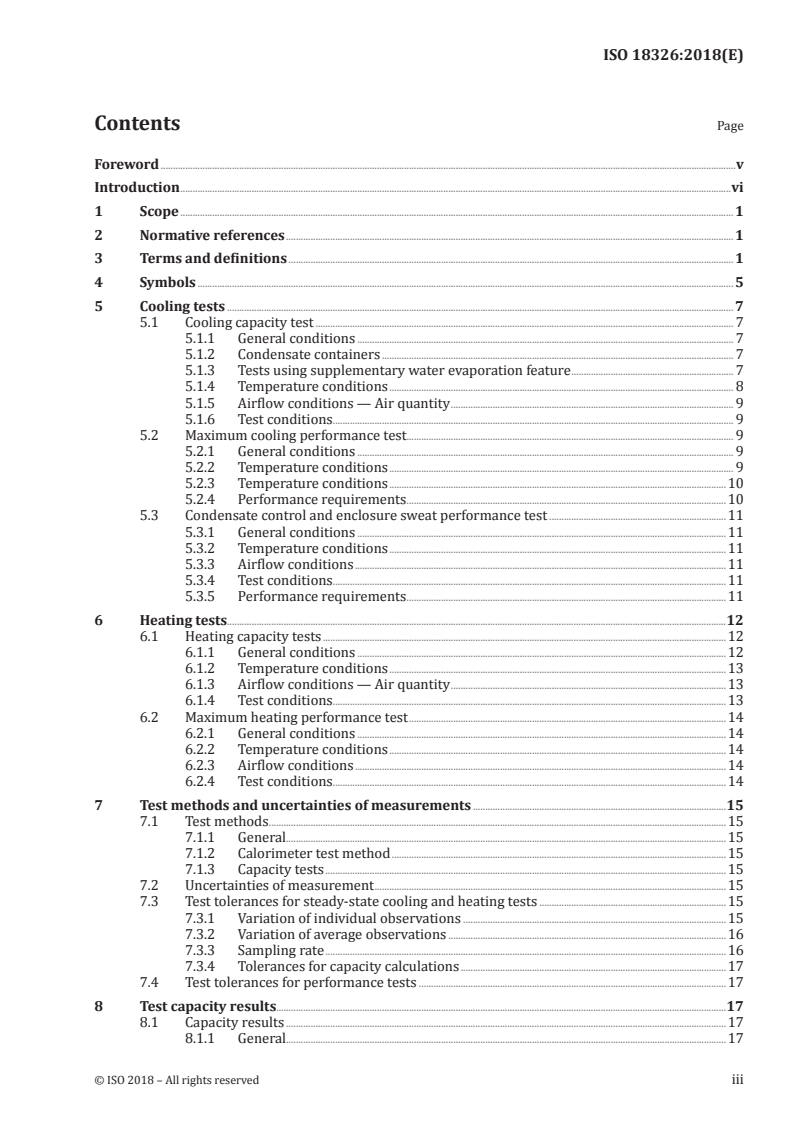
Contents Page
Foreword .v
Introduction .vi
1 Scope . 1
2 Normative references . 1
3 Terms and definitions . 1
4 Symbols . 5
5 Cooling tests . 7
5.1 Cooling capacity test . 7
5.1.1 General conditions . 7
5.1.2 Condensate containers . 7
5.1.3 Tests using supplementary water evaporation feature . 7
5.1.4 Temperature conditions . 8
5.1.5 Airflow conditions — Air quantity . 9
5.1.6 Test conditions. 9
5.2 Maximum cooling performance test. 9
5.2.1 General conditions . 9
5.2.2 Temperature conditions . 9
5.2.3 Temperature conditions .10
5.2.4 Performance requirements .10
5.3 Condensate control and enclosure sweat performance test .11
5.3.1 General conditions .11
5.3.2 Temperature conditions .11
5.3.3 Airflow conditions .11
5.3.4 Test conditions.11
5.3.5 Performance requirements .11
6 Heating tests.12
6.1 Heating capacity tests .12
6.1.1 General conditions .12
6.1.2 Temperature conditions .13
6.1.3 Airflow conditions — Air quantity .13
6.1.4 Test conditions.13
6.2 Maximum heating performance test .14
6.2.1 General conditions .14
6.2.2 Temperature conditions .14
6.2.3 Airflow conditions .14
6.2.4 Test conditions.14
7 Test methods and uncertainties of measurements .15
7.1 Test methods .15
7.1.1 General.15
7.1.2 Calorimeter test method .15
7.1.3 Capacity tests .15
7.2 Uncertainties of measurement .15
7.3 Test tolerances for steady-state cooling and heating tests .15
7.3.1 Variation of individual observations .15
7.3.2 Variation of average observations .16
7.3.3 Sampling rate .16
7.3.4 Tolerances for capacity calculations .17
7.4 Test tolerances for performance tests .17
8 Test capacity results.17
8.1 Capacity results .17
8.1.1 General.17
8.1.2 Adjustments .17
8.1.3 Cooling capacity calculations .18
8.1.4 Heating capacity calculations .18
8.2 Data to be recorded .18
8.3 Test report .18
8.3.1 General information .18
8.3.2 Capacity tests .20
9 Marking provisions .20
9.1 Nameplate requirements .20
9.2 Nameplate information .20
10 Publication of ratings .21
10.1 Standard ratings .21
10.1.1 General.21
10.1.2 Units .21
10.1.3 EER and COP .21
10.1.4 Capacity rating and test voltage .21
10.2 Other ratings .21
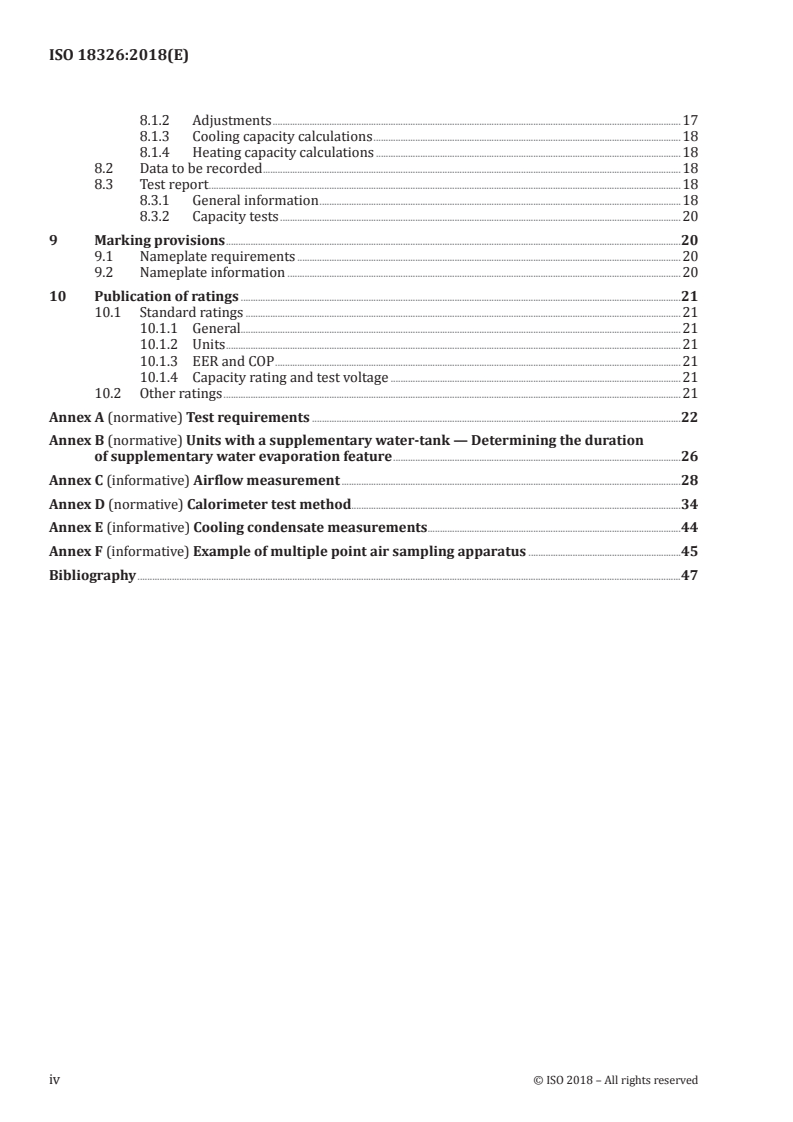
Annex A (normative) Test requirements .22
Annex B (normative) Units with a supplementary water-tank — Determining the duration
of supplementary water evaporation feature .26
Annex C (informative) Airflow measurement .28
Annex D (normative) Calorimeter test method .34
Annex E (informative) Cooling condensate measurements .44
Annex F (informative) Example of multiple point air sampling apparatus .45
Bibliography .47
iv © ISO 2018 – All rights reserved
Foreword
ISO (the International Organization for Standardization) is a worldwide federation of national standards
bodies (ISO member bodies). The work of preparing International Standards is normally carried out
through ISO technical committees. Each member body interested in a subject for which a technical
committee has been established has the right to be represented on that committee. International
organizations, governmental and non-governmental, in liaison with ISO, also take part in the work.
ISO collaborates closely with the International Electrotechnical Commission (IEC) on all matters of
electrotechnical standardization.
The procedures used to develop this document and those intended for its further maintenance are
described in the ISO/IEC Directives, Part 1. In particular the different approval criteria needed for the
different types of ISO documents should be noted. This document was drafted in accordance with the
editorial rules of the ISO/IEC Directives, Part 2 (see www .iso .org/directives).
Attention is drawn to the possibility that some of the elements of this document may be the subject of
patent rights. ISO shall not be held responsible for identifying any or all such patent rights. Details of
any patent rights identified during the development of the document will be in the Introduction and/or
on the ISO list of patent declarations received (see www .iso .org/patents).
Any trade name used in this document is information given for the convenience of users and does not
constitute an endorsement.
For an explanation on the voluntary nature of standards, the meaning of ISO specific terms and
expressions related to conformity assessment, as well as information about ISO's adherence to the
World Trade Organization (WTO) principles in the Technical Barriers to Trade (TBT) see the following
URL: www .iso .org/iso/foreword .html.
This document was prepared by Technical Committee ISO/TC 86, Refrigeration and air-conditioning,
Subcommittee SC 6, Testing and rating of air-conditioners and heat pumps.
Introduction
Single duct portable air conditioners and heat pumps can be selected for their ease and rapidity of
use, handling and installation, in particular when the use of other categories of air conditioners is not
convenient or forbidden, for example in rented or holiday houses or in historical buildings where an
external unit cannot be placed outdoors.
The operational mode and features of such appliances are quite different from those of the well-known
non-ducted air conditioners and heat pumps largely diffused worldwide and covered by ISO 5151.
There are presently no internationally recognized standards for single duct portable air conditioners
and heat pumps. The economic operators involved in the production and distribution of such products
face significant problems in verifying and declaring performance and energy consumption data in an
objective and internationally recognized way.
This being considered, ISO/TC 86/SC 6 decided to prepare a specific standard for single duct portable
air conditioners and heat pumps.
During the discussion of its contents it was acknowledged that it is necessary to provide the users with
information on the specific characteristics of single duct portable air conditioners and heat pumps, on
their correct installation and on their use. This will be covered by a future Amendment to this document
which is currently under discussion.
vi © ISO 2018 – All rights reserved
INTERNATIONAL STANDARD ISO 18326:2018(E)
Non-ducted portable air-cooled air conditioners and air-to-
air heat pumps having a single exhaust duct — Testing and
rating for performance
1 Scope
This document specifies the standard conditions for capacity and efficiency ratings of non-ducted
portable air-cooled air conditioners having a single exhaust duct and non-ducted portable air-cooled
heat pumps having a single exhaust duct. Such air conditioners and heat pumps may include an
evaporatively cooled condenser cooled by air and the evaporation of:
a) condensate collected from the evaporator;
b) external supplementary water stored in a supplementary water tank; or
c) both a) and b).
This document also specifies the test methods for determining the capacity and efficiency ratings.
This document applies to equipment that is factory-made, electrically driven and uses mechanical
compression. This document is applicable to equipment utilizing one or more refrigeration systems.
This document is not applicable to the rating and testing of the following:
i) Water-source heat pumps or water-cooled air conditioners;
ii) Multi-split-system air conditioners and air-to-air heat pumps (see ISO 15042:2017 for the testing of
such equipment);
iii) Individual assemblies not constituting a complete refrigeration system;
iv) Equipment using the absorption refrigeration cycle;
v) Ducted equipment (see ISO 13253:2017 for the testing of such equipment);
vi) Evaporative coolers or any other cooling systems that are not of the vapour compression type;
vii) Dehumidifiers;
v iii) Spot coolers.
2 Normative references
The following documents are referred to in the text in such a way that some or all of their content
constitutes requirements of this document. For dated references, only the edition cited applies. For
undated references, the latest edition of the referenced document (including any amendments) applies.
ISO 817, Refrigerants — Designation and safety classification
3 Terms and definitions
For the purposes of this document, the following terms and definitions apply.
ISO and IEC maintain terminological databases for use in standardization at the following addresses:
— IEC Electropedia: available at http: //www .electropedia .org/
— ISO Online browsing platform: available at https: //www .iso .org/obp
3.1
bypassed indoor airflow
rate of flow of conditioned air directly from the indoor-side outlet to the indoor-side inlet of the
equipment
Note 1 to entry: See Figure 1.
3.2
coefficient of performance
COP
ratio of the heating capacity to the total power input to the device at any given set of rating conditions
Note 1 to entry: Where the COP is stated without an indication of units, it is understood that it is derived from
watts/watt.
3.3
conditioned space
enclosed space, room or zone to which conditioned air is delivered
3.4
dehumidifer
encased assembly designed to remove moisture from its surrounding atmosphere using either an
electrically operated refrigeration system or a desiccant type of material including a means to circulate
air and a drain arrangement for collecting and storing and/or disposing of the condensate
3.5
total power input
P
t
average electrical power input to the equipment as measured during the test
Note 1 to entry: Total power input is expressed in units of watts.
3.6
ventilation airflow
rate of flow of air introduced to the conditioned space through the equipment
3.7
equalizer opening airflow
rate of flow of air from the outdoor side through the equalizer opening in the partition wall of a
calorimeter to the indoor side
Note 1 to entry: See Figure 1.
3.8
evaporatively cooled condenser
heat exchanger that condenses refrigerant vapour by rejecting heat to a water and air mixture causing
the water to evaporate and increase the enthalpy of air
Note 1 to entry: Desuperheating and sub-cooling of the refrigerant may also occur.
3.9
exhaust airflow
rate of flow of air from the indoor side through the equipment to the outdoor side
Note 1 to entry: See Figure 1.
3.10
full-load operation
operation with the equipment and controls configured for the maximum continuous duty refrigeration
capacity specified by the manufacturer and allowed by the unit controls
2 © ISO 2018 – All rights reserved
3.11
heating capacity
amount of heat that the equipment can add to the conditioned space (but not including supplementary
heat) in a defined interval of time
Note 1 to entry: Heating capacity is expressed in units of watts. Manually selectable supplementary heaters are
disabled during capacity tests, but any automatic supplementary heaters are permitted to operate.
3.12
indoor compartment
indoor-side compartment
testing room simulating the conditioned space (and containing the tested appliance)
Note 1 to entry: See Figure 1.
3.13
indoor discharge airflow
rate of flow of air from the outlet of the equipment into the conditioned space
Note 1 to entry: See Figure 1.
3.14
indoor heat exchanger
heat exchanger which is designed to remove heat from the indoor part of the building or to transfer
heat to it
Note 1 to entry: In the case of an air conditioner or heat pump operating in the cooling mode, this is the evaporator.
In the case of an air conditioner or heat pump operating in the heating mode, this is the condenser.
3.15
indoor intake airflow
rate of flow of air into the equipment from the conditioned space
Note 1 to entry: See Figure 1.
3.16
latent cooling capacity
amount of latent heat that the equipment can remove from the conditioned space in a defined
interval of time
Note 1 to entry: Latent cooling capacity is expressed in units of watts.
Note 2 to entry: “Latent cooling capacity” is also known as “room dehumidifying capacity”.
3.17
leakage airflow
rate of flow of air interchanged between the indoor side and outdoor side through the equipment as a
result of its construction features and sealing techniques
Note 1 to entry: See Figure 1.
3.18
non-ducted portable air-cooled air conditioner having a single exhaust duct
encased assembly, designed primarily to provide free delivery of conditioned air to an enclosed space,
room or zone which takes its source of air for cooling the condenser from the conditioned space, and
discharges this air through a duct to the outdoor space
Note 1 to entry: Such air conditioners comprise a primary source of refrigeration for cooling and dehumidification.
They can also include means for heating other than a heat pump, as well as means for circulating, cleaning,
humidifying, ventilating or exhausting air.
3.19
non-ducted portable air-cooled heat pump having a single exhaust duct
encased assembly designed primarily to provide free delivery of conditioned air to an enclosed space,
room or zone and includes a prime source of refrigeration for heating and which takes its source of air for
the evaporator from the conditioned space, and discharges this air through a duct to the outdoor space
Note 1 to entry: Such heat pumps can be constructed to remove heat from the conditioned space and discharge it
to a heat sink if cooling and dehumidification are desired from the same equipment. They can also include means
for circulating, cleaning, humidifying, ventilating or exhausting air.
3.20
outdoor compartment
compartment where the exhaust air is rejected through the duct of single duct air conditioner
3.21
outdoor exhaust airflow
discharge rate of flow of air from the equipment through the exhaust duct
Note 1 to entry: See Figure 1.
3.22
outdoor heat exchanger
heat exchanger that is designed to transfer heat to the outdoor ambient environment or to remove
heat from it
Note 1 to entry: In the case of an air conditioner or heat pump operating in the cooling mode, this is the condenser.
In the case of an air conditioner or heat pump operating in the heating mode, this is the evaporator.
3.23
rated frequency
frequency shown on the nameplate of the equipment
3.24
rated voltage
voltage shown on the nameplate of the equipment
3.25
sensible cooling capacity
amount of sensible heat that the equipment can remove from the conditioned space in a defined
interval of time
Note 1 to entry: Sensible cooling capacity is expressed in units of watts.
3.26
sensible heat ratio
SHR
ratio of the sensible cooling capacity to the total cooling capacity
3.27
spot cooler
encased assembly air conditioner that lies wholly within a conditioned space and that draws air for
both the evaporator and condenser from the conditioned space and expels both of these back into the
conditioned space
Note 1 to entry: A spot cooler is usually portable.
3.28
standard air
dry air at 20 °C and at a standard barometric pressure of 101,325 kPa, having a mass density of
1,204 kg/m
4 © ISO 2018 – All rights reserved
3.29
supplementary water tank
tank designed as an integral part of the unit to contain external supplementary water which is fed to
the evaporatively cooled condenser
3.30
total cooling capacity
amount of sensible and latent heat that the equipment can remove from the conditioned space in a
defined interval of time
Note 1 to entry: Total cooling capacity is expressed in units of watts.
Key
1 outdoor compartment (3.20)
2 outdoor exhaust airflow (3.21)
3 exhaust airflow (3.9)
4 leakage airflow (3.17)
5 equalizer opening airflow (3.7)
6 indoor intake airflow (3.15)
7 bypassed indoor airflow (3.1)
8 indoor discharge airflow (3.13)
9 indoor compartment (3.12)
Figure 1 — Airflow diagram illustrating the airflow definitions
4 Symbols
Symbol Description Unit
A coefficient, heat leakage J/(s·K)
l
A area, nozzle m
n
a
C nozzle discharge coefficient
d
c specific heat of air, moist air J/(kg·K)
pa
c specific heat of water J/(kg·K)
pw
D nozzle throat diameter m
n
D outside diameter of refrigerant tube m
t
f factor, dependent on temperature, for R —
e
h specific enthalpy of water or steam supplied to indoor side compartment J/kg
w1
h specific enthalpy of condensed moisture leaving indoor side compartment J/kg
w2
Symbol Description Unit
h specific enthalpy of condensed moisture leaving outdoor-side comportment J/kg
w3
h specific enthalpy of the water supplied to the outdoor side test chamber J/kg
w4
h specific enthalpy of the condensed water (in the case of H1 test condition) and the J/kg
w5
frost, respectively (in the case of H2 or H3 test conditions) in the test unit
K latent heat of vaporization of water (2 460 × 10 J/kg at 15 °C) J/kg
R Reynolds number —
e
p barometric pressure kPa
a
p test chamber equalization pressure Pa
c
p absolute pressure at nozzle throat Pa
n
p velocity pressure at nozzle throat or static pressure difference across nozzle Pa
v
ϕ heat removed from indoor-side compartment W
ci
ϕ heat removed by cooling coil in outdoor-side compartment W
c
ϕ heat leakage into indoor-side compartment through partition separating indoor W
lp
side from outdoor side
ϕ heat leakage into indoor-side compartment through walls, floor and ceiling W
li
ϕ latent cooling capacity (indoor-side data) W
lci
ϕ sensible cooling capacity W
sc
ϕ sensible cooling capacity (indoor-side data) W
sci
ϕ heating capacity, outdoor-side compartment W
ho
ϕ total cooling capacity (indoor-side data) W
tci
ϕ total cooling capacity (outdoor-side data) W
tco
ϕ total heating capacity (indoor-side data) W
thi
ϕ total heating capacity (outdoor-side data) W
tho
Σ P other power input to the indoor-side compartment (e.g. illumination, electrical and W
ic
thermal power input to the compensating device, heat balance of the humidifica-
tion device)
ΣP sum of all total power input to the outdoor-side compartment, not including power W
oc
to the equipment under test
P total power input to equipment W
t
q air-mass flow rate kg/s
m
q airflow, outdoor, measured m /s
mo
q air-volume flow rate m /s
v
q water mass flow supplied to the outside compartment for maintaining the test kg/s
wo
conditions
q rate at which water vapour is condensed by the equipment g/s
wc
t temperature, ambient °C
a
v velocity of air, at nozzle m/s
a
v specific volume of dry air portion of mixture at nozzle m /kg
n
specific volume of air-water vapour mixture at nozzle m /kg
ν ′
n
μ kinematic viscosity of air kg/m·s
b b
W specific humidity of air entering indoor side kg/kg
i1
b b
W specific humidity of air leaving indoor side kg/kg
i2
6 © ISO 2018 – All rights reserved
Symbol Description Unit
b b
W specific humidity at nozzle inlet kg/kg
n
W water vapour (rate) condensed by the equipment kg/s
r
a
Dimensionless value.
b
The mass of dry air. The mass, kg, of the denominator in this unit is based on dry air (DA). For units practi-
cally used in the air conditioning field, gkg, (DA)h is very often used for the denominator. Example J/kg(DA),
m /kg (DA), kg/kg(DA).
NOTE All parameters are in relation to the unit being tested unless specified otherwise.
5 Cooling tests
5.1 Cooling capacity test
5.1.1 General conditions
5.1.1.1 All equipment within the scope of this document shall have the cooling capacities and energy
efficiency ratios determined in accordance with the provisions of this document and rated at the cooling
test conditions specified in Table 1. All tests shall be carried out in accordance with the requirements
of Annex A and the test methods specified in Clause 7. All tests shall be conducted with the equipment
functioning at full-load operation, as defined in 3.10. The electrical input values used for rating purposes
shall be measured during the cooling capacity test.
Units that evaporate condensate collected from the evaporator shall be allowed to do so during the
capacity test (see 5.1.2). Units that have a supplementary water tank intended to contain supplementary
water that is fed to the evaporatively cooled condenser shall have capacity tests performed with and
without this feature operating, subject to the requirements of 5.1.3 and Annex B. If a unit automatically
turns off once the supplementary water tank becomes empty, a capacity test with this feature operating
is the only capacity test required. See Table B.1 for a summary of these requirements.
If the manufacturer of equipment having a variable-speed compressor does not provide information on
the full-load frequency and on how to achieve it during the cooling capacity test, the equipment shall be
operated with its thermostat or controller set to its minimum allowable temperature setting.
5.1.2 Condensate containers
5.1.2.1 The duration of the cooling capacity test shall not be interrupted by a full condensate container
triggering a cut-off switch. If necessary, condensate containers shall be modified to drain away excess
condensate into a larger container in the test chamber before the volume that activates the cut-off switch
is reached.
NOTE Many units have an in-built drain hose to facilitate this.
5.1.3 Tests using supplementary water evaporation feature
5.1.3.1 Performance and cooling capacity tests shall be performed using the supplementary water
evaporation feature as per the manufacturer’s instructions, if applicable. Water added to a unit’s
supplementary water tank shall be 35 °C ± 1 °C. All performance parameters for the standard rating
test shall also be recorded for any cooling capacity tests that use the supplementary water evaporation
feature. The test procedure includes determining the duration of time that the supplementary water tank
can operate at standard cooling rating conditions. These procedures are specified in Annex B.
NOTE Some units are fitted with a supplementary water evaporation feature designed to provide additional
water for the evaporatively cooled condenser and/or compressor. They generally require the user to fill a
supplementary water tank and manually select an operational mode via the unit’s control panel or remote
control that turns this supplementary water evaporation feature on. This operational mode can override other
thermostat and fan settings and is designed to achieve higher cooling capacities and greater energy efficiency
while this feature is active. When these units deactivate their supplementary water evaporation feature
(for instance, when they detect that there is insufficient water in the supplementary water tank), they can
automatically revert to cooling without the aid of the supplementary water evaporation feature, or they can
switch themselves off.
5.1.4 Temperature conditions
The temperature conditions stated in Table 1 shall be considered standard rating conditions for the
determination of cooling capacity.
If the unit is rated for operation at two frequencies or, in some cases, if the equipment has a dual-rated
voltage, then the cooling capacity test shall be conducted at each frequency and voltage in accordance
with the conditions of Tables 1 and 2.
Table 1 — Cooling capacity rating conditions
Parameter Standard rating conditions
Temperature of air entering indoor-side:
— dry-bulb 35 °C
— wet-bulb 24 °C
Temperature of air entering outdoor-side:
— dry-bulb 35 °C
— wet-bulb 24 °C
a
Test frequency Rated frequency
Test voltage See Table 2
a
Equipment with dual-rated frequencies shall be tested at each frequency.
NOTE The measured performance of single duct, portable air conditioners and heat pumps is sensitive to
even a small difference in the enthalpy of the air entering the indoor chamber from the outdoor chamber.
Therefore, it is desirable to have the indoor and outdoor chamber temperatures as close as possible during
the tests.
Table 2 — Voltages for capacity and performance tests
a
Rated (nameplate) voltage Test voltage
V V
90 to 109 100
110 to 127 115
180 to 207 200
208 to 253 230
254 to 341 265
342 to 420 400
421 to 506 460
507 to 633 575
a
For equipment with dual-rated voltages such as 115/230 and 220/440, the test voltages would be 115 V and 230 V
in the first example, and 230 V and 460 V in the second example. For equipment with an extended voltage range, such as
110 V to 120 V or 220 V to 240 V, the test voltage would be 115 V or 230 V, respectively. Where the extended voltage range
spans two or more of the rated voltage ranges, the mean of the rated voltages shall be used to determine the test voltage
from the table.
EXAMPLE For equipment with an extended voltage range of 200 V to 220 V, the test voltage would be 230 V, based on the
mean voltage of 210 V.
8 © ISO 2018 – All rights reserved
5.1.5 Airflow conditions — Air quantity
Tests shall be conducted at standard rating conditions (see Table 1) with 0 Pa static pressure maintained
at the air discharge of the equipment and with the refrigeration means in operation if required. All air
quantities shall be expressed as litres per second (L/s) of standard air, as defined in 3.28.
Airflow measurements should be made in accordance with the provisions specified in Annex C, as
appropriate, as well as the provisions established in other appropriate appendices of this document.
NOTE Additional guidance for making airflow measurements can be found in ISO 3966 and ISO 5167-1.
5.1.6 Test conditions
5.1.6.1 General
Tests shall be conducted under the rating conditions with no changes made in fan speed or system
resistance to correct for variations from the standard barometric pressure (see 3.28).
5.1.6.2 Preconditions
The test room reconditioning apparatus and the equipment under test shall be operated until
equilibrium conditions, as required by 7.3, are attained. Equilibrium conditions shall be maintained for
not less than 1 h before capacity test data are recorded.
5.1.6.3 Testing requirements
The test shall provide for the determination of the sensible, latent and total cooling capacities as
determined in the indoor-side compartment. See 5.1.1, 5.1.3 and Annex B for additional requirements
associated with units that have a supplementary water tank.
5.1.6.4 Duration of test
The data shall be recorded at equal intervals as required by 7.3.3. The recording of the data shall
continue for at least a 30 min period during which the tolerances specified in 7.3 shall be met. Many
units exhibit pronounced cyclic behaviour in cooling mode. If a unit exhibits this type of cyclic behaviour,
data shall be recorded and averaged over at least 120 min.
5.2 Maximum cooling performance test
5.2.1 General conditions
The test shall be conducted with the equipment functioning at full-load operation, as defined in 3.10. If
the unit includes an in-built condensate collection and evaporation process, it shall be allowed to function
(see 5.1.2). Units with a supplementary water tank may require two tests, subject to the requirements
of Annex B. This feature shall be operated in accordance with manufacturer’s instructions, if applicable.
The test voltages in Table 2 shall be maintained at the specified percentages under running conditions.
In addition, the test voltage shall be adjusted so that it is not less than 86 % of the rated voltage at
the moment of restarting the equipment after the shutdown required by 5.2.4.2. The determination of
cooling capacity and electrical power input is not required for this performance test. The unit shall be
set up as specified in Annex A.
5.2.2 Temperature conditions
The conditions, which shall be used during the maximum cooling test, are given in Table 3. If applicable,
water added to a supplementary water tank shall be at 35 °C ± 1 °C.
Table 3 — Maximum cooling performance test conditions
Parameter Standard rating conditions
Temperature of air entering indoor-side:
— dry-bulb 43 °C
— wet-bulb 26 °C
Temperature of air entering outdoor-side:
— dry-bulb 43 °C
— wet-bulb 26 °C
a
Test frequency Rated
frequency
Test voltage See Table 2
a
Equipment with dual-rated frequencies shall be tested at each frequency.
5.2.3 Temperature conditions
5.2.3.1 Preconditions
The controls of the equipment shall be set for maximum cooling. In-built condensate containers shall be
emptied at the commencement of this test (see 5.1.2).
5.2.3.2 Duration of test
The equipment shall be operated continuously for 1 h after the specified air temperatures in Table 3 have
been established in accordance with the tolerances in Table 9 Thereafter, all power to the equipment
shall be cut off for 3 min and then restored. The operation of the equipment may be restarted either
automatically or through the use of a remote controller or similar device. The test shall continue for
60 min after the equipment restarts.
5.2.4 Performance requirements
5.2.4.1 General
Air conditioners and heat pumps shall meet the following requirements when operating at the
conditions specified in Table 3.
a) During one entire test, the equipment shall operate without any indication of damage.
b) The motors of the equipment shall operate continuously for the first hour of the test without
tripping any protective device.
c) After the interruption of power, the equipment shall resume operation within 30 min and run
continuously for 1 h, except as specified in 5.2.4.2 and 5.2.4.3.
5.2.4.2 Protective device
A protective device may trip only during the first 5 min of operation after the shutdown period of 3 min.
During the remainder of that 1 h test period, no protective device shall trip.
5.2.4.3 Exception
For those models so designed that resumption of operation does not occur after the initial trip within
the first 5 min, the equipment may remain out of operation for not longer than 30 min. It shall then
operate continuously for 1 h.
10 © ISO 2018 – All rights reserved
5.3 Condensate control and enclosure sweat performance test
5.3.1 General conditions
Any modifications to the condensate collection system made in accordance with 5.1.2 shall be removed.
The conditions which shall be used during the condensate control and enclosure sweat performance
test are given in Table 4. The test shall be conducted with the equipment functioning at full-load
operation, as defined in 3.10, except as required in 5.3.3. The determination of cooling capacity and
electrical power input is not required for this performance test.
5.3.2 Temperature conditions
The temperature conditions that shall be used during this test are given in Table 4.
Table 4 — Condensate control and enclosure sweat performance test conditions
Parameter Standard rating conditions
Temperature of air entering indoor-side:
— dry-bulb 27 °C
— wet-bulb 24 °C
Temperature of air entering outdoor-side:
— dry-bulb 27 °C
— wet-bulb 24 °C
a
Test frequency Rated frequency
Test voltage See Table 2
a
Equipment with dual-rated frequencies shall be tested at each frequency
5.3.3 Airflow conditions
The controls, fans, dampers and grilles of the equipment shall be set to produce the maximum tendency
to sweat, provided such settings are not contrary to the manufacturer’s operating instructions.
5.3.4 Test conditions
5.3.4.1 Preconditions
After establishment of the specified temperature conditions, the equipment shall be run until the
condensate flow has become uniform.
5.3.4.2 Dura
...
INTERNATIONAL ISO
STANDARD 18326
First edition
2018-09
Non-ducted portable air-cooled air
conditioners and air-to-air heat
pumps having a single exhaust duct —
Testing and rating for performance
Climatiseurs refroidis par air et pompes à chaleur portables
non raccordés à simple conduit — Essais et détermination des
caractéristiques des performances
Reference number
©
ISO 2018
© ISO 2018
All rights reserved. Unless otherwise specified, or required in the context of its implementation, no part of this publication may
be reproduced or utilized otherwise in any form or by any means, electronic or mechanical, including photocopying, or posting
on the internet or an intranet, without prior written permission. Permission can be requested from either ISO at the address
below or ISO’s member body in the country of the requester.
ISO copyright office
CP 401 • Ch. de Blandonnet 8
CH-1214 Vernier, Geneva
Phone: +41 22 749 01 11
Fax: +41 22 749 09 47
Email: copyright@iso.org
Website: www.iso.org
Published in Switzerland
ii © ISO 2018 – All rights reserved
Contents Page
Foreword .v
Introduction .vi
1 Scope . 1
2 Normative references . 1
3 Terms and definitions . 1
4 Symbols . 5
5 Cooling tests . 7
5.1 Cooling capacity test . 7
5.1.1 General conditions . 7
5.1.2 Condensate containers . 7
5.1.3 Tests using supplementary water evaporation feature . 7
5.1.4 Temperature conditions . 8
5.1.5 Airflow conditions — Air quantity . 9
5.1.6 Test conditions. 9
5.2 Maximum cooling performance test. 9
5.2.1 General conditions . 9
5.2.2 Temperature conditions . 9
5.2.3 Temperature conditions .10
5.2.4 Performance requirements .10
5.3 Condensate control and enclosure sweat performance test .11
5.3.1 General conditions .11
5.3.2 Temperature conditions .11
5.3.3 Airflow conditions .11
5.3.4 Test conditions.11
5.3.5 Performance requirements .11
6 Heating tests.12
6.1 Heating capacity tests .12
6.1.1 General conditions .12
6.1.2 Temperature conditions .13
6.1.3 Airflow conditions — Air quantity .13
6.1.4 Test conditions.13
6.2 Maximum heating performance test .14
6.2.1 General conditions .14
6.2.2 Temperature conditions .14
6.2.3 Airflow conditions .14
6.2.4 Test conditions.14
7 Test methods and uncertainties of measurements .15
7.1 Test methods .15
7.1.1 General.15
7.1.2 Calorimeter test method .15
7.1.3 Capacity tests .15
7.2 Uncertainties of measurement .15
7.3 Test tolerances for steady-state cooling and heating tests .15
7.3.1 Variation of individual observations .15
7.3.2 Variation of average observations .16
7.3.3 Sampling rate .16
7.3.4 Tolerances for capacity calculations .17
7.4 Test tolerances for performance tests .17
8 Test capacity results.17
8.1 Capacity results .17
8.1.1 General.17
8.1.2 Adjustments .17
8.1.3 Cooling capacity calculations .18
8.1.4 Heating capacity calculations .18
8.2 Data to be recorded .18
8.3 Test report .18
8.3.1 General information .18
8.3.2 Capacity tests .20
9 Marking provisions .20
9.1 Nameplate requirements .20
9.2 Nameplate information .20
10 Publication of ratings .21
10.1 Standard ratings .21
10.1.1 General.21
10.1.2 Units .21
10.1.3 EER and COP .21
10.1.4 Capacity rating and test voltage .21
10.2 Other ratings .21
Annex A (normative) Test requirements .22
Annex B (normative) Units with a supplementary water-tank — Determining the duration
of supplementary water evaporation feature .26
Annex C (informative) Airflow measurement .28
Annex D (normative) Calorimeter test method .34
Annex E (informative) Cooling condensate measurements .44
Annex F (informative) Example of multiple point air sampling apparatus .45
Bibliography .47
iv © ISO 2018 – All rights reserved
Foreword
ISO (the International Organization for Standardization) is a worldwide federation of national standards
bodies (ISO member bodies). The work of preparing International Standards is normally carried out
through ISO technical committees. Each member body interested in a subject for which a technical
committee has been established has the right to be represented on that committee. International
organizations, governmental and non-governmental, in liaison with ISO, also take part in the work.
ISO collaborates closely with the International Electrotechnical Commission (IEC) on all matters of
electrotechnical standardization.
The procedures used to develop this document and those intended for its further maintenance are
described in the ISO/IEC Directives, Part 1. In particular the different approval criteria needed for the
different types of ISO documents should be noted. This document was drafted in accordance with the
editorial rules of the ISO/IEC Directives, Part 2 (see www .iso .org/directives).
Attention is drawn to the possibility that some of the elements of this document may be the subject of
patent rights. ISO shall not be held responsible for identifying any or all such patent rights. Details of
any patent rights identified during the development of the document will be in the Introduction and/or
on the ISO list of patent declarations received (see www .iso .org/patents).
Any trade name used in this document is information given for the convenience of users and does not
constitute an endorsement.
For an explanation on the voluntary nature of standards, the meaning of ISO specific terms and
expressions related to conformity assessment, as well as information about ISO's adherence to the
World Trade Organization (WTO) principles in the Technical Barriers to Trade (TBT) see the following
URL: www .iso .org/iso/foreword .html.
This document was prepared by Technical Committee ISO/TC 86, Refrigeration and air-conditioning,
Subcommittee SC 6, Testing and rating of air-conditioners and heat pumps.
Introduction
Single duct portable air conditioners and heat pumps can be selected for their ease and rapidity of
use, handling and installation, in particular when the use of other categories of air conditioners is not
convenient or forbidden, for example in rented or holiday houses or in historical buildings where an
external unit cannot be placed outdoors.
The operational mode and features of such appliances are quite different from those of the well-known
non-ducted air conditioners and heat pumps largely diffused worldwide and covered by ISO 5151.
There are presently no internationally recognized standards for single duct portable air conditioners
and heat pumps. The economic operators involved in the production and distribution of such products
face significant problems in verifying and declaring performance and energy consumption data in an
objective and internationally recognized way.
This being considered, ISO/TC 86/SC 6 decided to prepare a specific standard for single duct portable
air conditioners and heat pumps.
During the discussion of its contents it was acknowledged that it is necessary to provide the users with
information on the specific characteristics of single duct portable air conditioners and heat pumps, on
their correct installation and on their use. This will be covered by a future Amendment to this document
which is currently under discussion.
vi © ISO 2018 – All rights reserved
INTERNATIONAL STANDARD ISO 18326:2018(E)
Non-ducted portable air-cooled air conditioners and air-to-
air heat pumps having a single exhaust duct — Testing and
rating for performance
1 Scope
This document specifies the standard conditions for capacity and efficiency ratings of non-ducted
portable air-cooled air conditioners having a single exhaust duct and non-ducted portable air-cooled
heat pumps having a single exhaust duct. Such air conditioners and heat pumps may include an
evaporatively cooled condenser cooled by air and the evaporation of:
a) condensate collected from the evaporator;
b) external supplementary water stored in a supplementary water tank; or
c) both a) and b).
This document also specifies the test methods for determining the capacity and efficiency ratings.
This document applies to equipment that is factory-made, electrically driven and uses mechanical
compression. This document is applicable to equipment utilizing one or more refrigeration systems.
This document is not applicable to the rating and testing of the following:
i) Water-source heat pumps or water-cooled air conditioners;
ii) Multi-split-system air conditioners and air-to-air heat pumps (see ISO 15042:2017 for the testing of
such equipment);
iii) Individual assemblies not constituting a complete refrigeration system;
iv) Equipment using the absorption refrigeration cycle;
v) Ducted equipment (see ISO 13253:2017 for the testing of such equipment);
vi) Evaporative coolers or any other cooling systems that are not of the vapour compression type;
vii) Dehumidifiers;
v iii) Spot coolers.
2 Normative references
The following documents are referred to in the text in such a way that some or all of their content
constitutes requirements of this document. For dated references, only the edition cited applies. For
undated references, the latest edition of the referenced document (including any amendments) applies.
ISO 817, Refrigerants — Designation and safety classification
3 Terms and definitions
For the purposes of this document, the following terms and definitions apply.
ISO and IEC maintain terminological databases for use in standardization at the following addresses:
— IEC Electropedia: available at http: //www .electropedia .org/
— ISO Online browsing platform: available at https: //www .iso .org/obp
3.1
bypassed indoor airflow
rate of flow of conditioned air directly from the indoor-side outlet to the indoor-side inlet of the
equipment
Note 1 to entry: See Figure 1.
3.2
coefficient of performance
COP
ratio of the heating capacity to the total power input to the device at any given set of rating conditions
Note 1 to entry: Where the COP is stated without an indication of units, it is understood that it is derived from
watts/watt.
3.3
conditioned space
enclosed space, room or zone to which conditioned air is delivered
3.4
dehumidifer
encased assembly designed to remove moisture from its surrounding atmosphere using either an
electrically operated refrigeration system or a desiccant type of material including a means to circulate
air and a drain arrangement for collecting and storing and/or disposing of the condensate
3.5
total power input
P
t
average electrical power input to the equipment as measured during the test
Note 1 to entry: Total power input is expressed in units of watts.
3.6
ventilation airflow
rate of flow of air introduced to the conditioned space through the equipment
3.7
equalizer opening airflow
rate of flow of air from the outdoor side through the equalizer opening in the partition wall of a
calorimeter to the indoor side
Note 1 to entry: See Figure 1.
3.8
evaporatively cooled condenser
heat exchanger that condenses refrigerant vapour by rejecting heat to a water and air mixture causing
the water to evaporate and increase the enthalpy of air
Note 1 to entry: Desuperheating and sub-cooling of the refrigerant may also occur.
3.9
exhaust airflow
rate of flow of air from the indoor side through the equipment to the outdoor side
Note 1 to entry: See Figure 1.
3.10
full-load operation
operation with the equipment and controls configured for the maximum continuous duty refrigeration
capacity specified by the manufacturer and allowed by the unit controls
2 © ISO 2018 – All rights reserved
3.11
heating capacity
amount of heat that the equipment can add to the conditioned space (but not including supplementary
heat) in a defined interval of time
Note 1 to entry: Heating capacity is expressed in units of watts. Manually selectable supplementary heaters are
disabled during capacity tests, but any automatic supplementary heaters are permitted to operate.
3.12
indoor compartment
indoor-side compartment
testing room simulating the conditioned space (and containing the tested appliance)
Note 1 to entry: See Figure 1.
3.13
indoor discharge airflow
rate of flow of air from the outlet of the equipment into the conditioned space
Note 1 to entry: See Figure 1.
3.14
indoor heat exchanger
heat exchanger which is designed to remove heat from the indoor part of the building or to transfer
heat to it
Note 1 to entry: In the case of an air conditioner or heat pump operating in the cooling mode, this is the evaporator.
In the case of an air conditioner or heat pump operating in the heating mode, this is the condenser.
3.15
indoor intake airflow
rate of flow of air into the equipment from the conditioned space
Note 1 to entry: See Figure 1.
3.16
latent cooling capacity
amount of latent heat that the equipment can remove from the conditioned space in a defined
interval of time
Note 1 to entry: Latent cooling capacity is expressed in units of watts.
Note 2 to entry: “Latent cooling capacity” is also known as “room dehumidifying capacity”.
3.17
leakage airflow
rate of flow of air interchanged between the indoor side and outdoor side through the equipment as a
result of its construction features and sealing techniques
Note 1 to entry: See Figure 1.
3.18
non-ducted portable air-cooled air conditioner having a single exhaust duct
encased assembly, designed primarily to provide free delivery of conditioned air to an enclosed space,
room or zone which takes its source of air for cooling the condenser from the conditioned space, and
discharges this air through a duct to the outdoor space
Note 1 to entry: Such air conditioners comprise a primary source of refrigeration for cooling and dehumidification.
They can also include means for heating other than a heat pump, as well as means for circulating, cleaning,
humidifying, ventilating or exhausting air.
3.19
non-ducted portable air-cooled heat pump having a single exhaust duct
encased assembly designed primarily to provide free delivery of conditioned air to an enclosed space,
room or zone and includes a prime source of refrigeration for heating and which takes its source of air for
the evaporator from the conditioned space, and discharges this air through a duct to the outdoor space
Note 1 to entry: Such heat pumps can be constructed to remove heat from the conditioned space and discharge it
to a heat sink if cooling and dehumidification are desired from the same equipment. They can also include means
for circulating, cleaning, humidifying, ventilating or exhausting air.
3.20
outdoor compartment
compartment where the exhaust air is rejected through the duct of single duct air conditioner
3.21
outdoor exhaust airflow
discharge rate of flow of air from the equipment through the exhaust duct
Note 1 to entry: See Figure 1.
3.22
outdoor heat exchanger
heat exchanger that is designed to transfer heat to the outdoor ambient environment or to remove
heat from it
Note 1 to entry: In the case of an air conditioner or heat pump operating in the cooling mode, this is the condenser.
In the case of an air conditioner or heat pump operating in the heating mode, this is the evaporator.
3.23
rated frequency
frequency shown on the nameplate of the equipment
3.24
rated voltage
voltage shown on the nameplate of the equipment
3.25
sensible cooling capacity
amount of sensible heat that the equipment can remove from the conditioned space in a defined
interval of time
Note 1 to entry: Sensible cooling capacity is expressed in units of watts.
3.26
sensible heat ratio
SHR
ratio of the sensible cooling capacity to the total cooling capacity
3.27
spot cooler
encased assembly air conditioner that lies wholly within a conditioned space and that draws air for
both the evaporator and condenser from the conditioned space and expels both of these back into the
conditioned space
Note 1 to entry: A spot cooler is usually portable.
3.28
standard air
dry air at 20 °C and at a standard barometric pressure of 101,325 kPa, having a mass density of
1,204 kg/m
4 © ISO 2018 – All rights reserved
3.29
supplementary water tank
tank designed as an integral part of the unit to contain external supplementary water which is fed to
the evaporatively cooled condenser
3.30
total cooling capacity
amount of sensible and latent heat that the equipment can remove from the conditioned space in a
defined interval of time
Note 1 to entry: Total cooling capacity is expressed in units of watts.
Key
1 outdoor compartment (3.20)
2 outdoor exhaust airflow (3.21)
3 exhaust airflow (3.9)
4 leakage airflow (3.17)
5 equalizer opening airflow (3.7)
6 indoor intake airflow (3.15)
7 bypassed indoor airflow (3.1)
8 indoor discharge airflow (3.13)
9 indoor compartment (3.12)
Figure 1 — Airflow diagram illustrating the airflow definitions
4 Symbols
Symbol Description Unit
A coefficient, heat leakage J/(s·K)
l
A area, nozzle m
n
a
C nozzle discharge coefficient
d
c specific heat of air, moist air J/(kg·K)
pa
c specific heat of water J/(kg·K)
pw
D nozzle throat diameter m
n
D outside diameter of refrigerant tube m
t
f factor, dependent on temperature, for R —
e
h specific enthalpy of water or steam supplied to indoor side compartment J/kg
w1
h specific enthalpy of condensed moisture leaving indoor side compartment J/kg
w2
Symbol Description Unit
h specific enthalpy of condensed moisture leaving outdoor-side comportment J/kg
w3
h specific enthalpy of the water supplied to the outdoor side test chamber J/kg
w4
h specific enthalpy of the condensed water (in the case of H1 test condition) and the J/kg
w5
frost, respectively (in the case of H2 or H3 test conditions) in the test unit
K latent heat of vaporization of water (2 460 × 10 J/kg at 15 °C) J/kg
R Reynolds number —
e
p barometric pressure kPa
a
p test chamber equalization pressure Pa
c
p absolute pressure at nozzle throat Pa
n
p velocity pressure at nozzle throat or static pressure difference across nozzle Pa
v
ϕ heat removed from indoor-side compartment W
ci
ϕ heat removed by cooling coil in outdoor-side compartment W
c
ϕ heat leakage into indoor-side compartment through partition separating indoor W
lp
side from outdoor side
ϕ heat leakage into indoor-side compartment through walls, floor and ceiling W
li
ϕ latent cooling capacity (indoor-side data) W
lci
ϕ sensible cooling capacity W
sc
ϕ sensible cooling capacity (indoor-side data) W
sci
ϕ heating capacity, outdoor-side compartment W
ho
ϕ total cooling capacity (indoor-side data) W
tci
ϕ total cooling capacity (outdoor-side data) W
tco
ϕ total heating capacity (indoor-side data) W
thi
ϕ total heating capacity (outdoor-side data) W
tho
Σ P other power input to the indoor-side compartment (e.g. illumination, electrical and W
ic
thermal power input to the compensating device, heat balance of the humidifica-
tion device)
ΣP sum of all total power input to the outdoor-side compartment, not including power W
oc
to the equipment under test
P total power input to equipment W
t
q air-mass flow rate kg/s
m
q airflow, outdoor, measured m /s
mo
q air-volume flow rate m /s
v
q water mass flow supplied to the outside compartment for maintaining the test kg/s
wo
conditions
q rate at which water vapour is condensed by the equipment g/s
wc
t temperature, ambient °C
a
v velocity of air, at nozzle m/s
a
v specific volume of dry air portion of mixture at nozzle m /kg
n
specific volume of air-water vapour mixture at nozzle m /kg
ν ′
n
μ kinematic viscosity of air kg/m·s
b b
W specific humidity of air entering indoor side kg/kg
i1
b b
W specific humidity of air leaving indoor side kg/kg
i2
6 © ISO 2018 – All rights reserved
Symbol Description Unit
b b
W specific humidity at nozzle inlet kg/kg
n
W water vapour (rate) condensed by the equipment kg/s
r
a
Dimensionless value.
b
The mass of dry air. The mass, kg, of the denominator in this unit is based on dry air (DA). For units practi-
cally used in the air conditioning field, gkg, (DA)h is very often used for the denominator. Example J/kg(DA),
m /kg (DA), kg/kg(DA).
NOTE All parameters are in relation to the unit being tested unless specified otherwise.
5 Cooling tests
5.1 Cooling capacity test
5.1.1 General conditions
5.1.1.1 All equipment within the scope of this document shall have the cooling capacities and energy
efficiency ratios determined in accordance with the provisions of this document and rated at the cooling
test conditions specified in Table 1. All tests shall be carried out in accordance with the requirements
of Annex A and the test methods specified in Clause 7. All tests shall be conducted with the equipment
functioning at full-load operation, as defined in 3.10. The electrical input values used for rating purposes
shall be measured during the cooling capacity test.
Units that evaporate condensate collected from the evaporator shall be allowed to do so during the
capacity test (see 5.1.2). Units that have a supplementary water tank intended to contain supplementary
water that is fed to the evaporatively cooled condenser shall have capacity tests performed with and
without this feature operating, subject to the requirements of 5.1.3 and Annex B. If a unit automatically
turns off once the supplementary water tank becomes empty, a capacity test with this feature operating
is the only capacity test required. See Table B.1 for a summary of these requirements.
If the manufacturer of equipment having a variable-speed compressor does not provide information on
the full-load frequency and on how to achieve it during the cooling capacity test, the equipment shall be
operated with its thermostat or controller set to its minimum allowable temperature setting.
5.1.2 Condensate containers
5.1.2.1 The duration of the cooling capacity test shall not be interrupted by a full condensate container
triggering a cut-off switch. If necessary, condensate containers shall be modified to drain away excess
condensate into a larger container in the test chamber before the volume that activates the cut-off switch
is reached.
NOTE Many units have an in-built drain hose to facilitate this.
5.1.3 Tests using supplementary water evaporation feature
5.1.3.1 Performance and cooling capacity tests shall be performed using the supplementary water
evaporation feature as per the manufacturer’s instructions, if applicable. Water added to a unit’s
supplementary water tank shall be 35 °C ± 1 °C. All performance parameters for the standard rating
test shall also be recorded for any cooling capacity tests that use the supplementary water evaporation
feature. The test procedure includes determining the duration of time that the supplementary water tank
can operate at standard cooling rating conditions. These procedures are specified in Annex B.
NOTE Some units are fitted with a supplementary water evaporation feature designed to provide additional
water for the evaporatively cooled condenser and/or compressor. They generally require the user to fill a
supplementary water tank and manually select an operational mode via the unit’s control panel or remote
control that turns this supplementary water evaporation feature on. This operational mode can override other
thermostat and fan settings and is designed to achieve higher cooling capacities and greater energy efficiency
while this feature is active. When these units deactivate their supplementary water evaporation feature
(for instance, when they detect that there is insufficient water in the supplementary water tank), they can
automatically revert to cooling without the aid of the supplementary water evaporation feature, or they can
switch themselves off.
5.1.4 Temperature conditions
The temperature conditions stated in Table 1 shall be considered standard rating conditions for the
determination of cooling capacity.
If the unit is rated for operation at two frequencies or, in some cases, if the equipment has a dual-rated
voltage, then the cooling capacity test shall be conducted at each frequency and voltage in accordance
with the conditions of Tables 1 and 2.
Table 1 — Cooling capacity rating conditions
Parameter Standard rating conditions
Temperature of air entering indoor-side:
— dry-bulb 35 °C
— wet-bulb 24 °C
Temperature of air entering outdoor-side:
— dry-bulb 35 °C
— wet-bulb 24 °C
a
Test frequency Rated frequency
Test voltage See Table 2
a
Equipment with dual-rated frequencies shall be tested at each frequency.
NOTE The measured performance of single duct, portable air conditioners and heat pumps is sensitive to
even a small difference in the enthalpy of the air entering the indoor chamber from the outdoor chamber.
Therefore, it is desirable to have the indoor and outdoor chamber temperatures as close as possible during
the tests.
Table 2 — Voltages for capacity and performance tests
a
Rated (nameplate) voltage Test voltage
V V
90 to 109 100
110 to 127 115
180 to 207 200
208 to 253 230
254 to 341 265
342 to 420 400
421 to 506 460
507 to 633 575
a
For equipment with dual-rated voltages such as 115/230 and 220/440, the test voltages would be 115 V and 230 V
in the first example, and 230 V and 460 V in the second example. For equipment with an extended voltage range, such as
110 V to 120 V or 220 V to 240 V, the test voltage would be 115 V or 230 V, respectively. Where the extended voltage range
spans two or more of the rated voltage ranges, the mean of the rated voltages shall be used to determine the test voltage
from the table.
EXAMPLE For equipment with an extended voltage range of 200 V to 220 V, the test voltage would be 230 V, based on the
mean voltage of 210 V.
8 © ISO 2018 – All rights reserved
5.1.5 Airflow conditions — Air quantity
Tests shall be conducted at standard rating conditions (see Table 1) with 0 Pa static pressure maintained
at the air discharge of the equipment and with the refrigeration means in operation if required. All air
quantities shall be expressed as litres per second (L/s) of standard air, as defined in 3.28.
Airflow measurements should be made in accordance with the provisions specified in Annex C, as
appropriate, as well as the provisions established in other appropriate appendices of this document.
NOTE Additional guidance for making airflow measurements can be found in ISO 3966 and ISO 5167-1.
5.1.6 Test conditions
5.1.6.1 General
Tests shall be conducted under the rating conditions with no changes made in fan speed or system
resistance to correct for variations from the standard barometric pressure (see 3.28).
5.1.6.2 Preconditions
The test room reconditioning apparatus and the equipment under test shall be operated until
equilibrium conditions, as required by 7.3, are attained. Equilibrium conditions shall be maintained for
not less than 1 h before capacity test data are recorded.
5.1.6.3 Testing requirements
The test shall provide for the determination of the sensible, latent and total cooling capacities as
determined in the indoor-side compartment. See 5.1.1, 5.1.3 and Annex B for additional requirements
associated with units that have a supplementary water tank.
5.1.6.4 Duration of test
The data shall be recorded at equal intervals as required by 7.3.3. The recording of the data shall
continue for at least a 30 min period during which the tolerances specified in 7.3 shall be met. Many
units exhibit pronounced cyclic behaviour in cooling mode. If a unit exhibits this type of cyclic behaviour,
data shall be recorded and averaged over at least 120 min.
5.2 Maximum cooling performance test
5.2.1 General conditions
The test shall be conducted with the equipment functioning at full-load operation, as defined in 3.10. If
the unit includes an in-built condensate collection and evaporation process, it shall be allowed to function
(see 5.1.2). Units with a supplementary water tank may require two tests, subject to the requirements
of Annex B. This feature shall be operated in accordance with manufacturer’s instructions, if applicable.
The test voltages in Table 2 shall be maintained at the specified percentages under running conditions.
In addition, the test voltage shall be adjusted so that it is not less than 86 % of the rated voltage at
the moment of restarting the equipment after the shutdown required by 5.2.4.2. The determination of
cooling capacity and electrical power input is not required for this performance test. The unit shall be
set up as specified in Annex A.
5.2.2 Temperature conditions
The conditions, which shall be used during the maximum cooling test, are given in Table 3. If applicable,
water added to a supplementary water tank shall be at 35 °C ± 1 °C.
Table 3 — Maximum cooling performance test conditions
Parameter Standard rating conditions
Temperature of air entering indoor-side:
— dry-bulb 43 °C
— wet-bulb 26 °C
Temperature of air entering outdoor-side:
— dry-bulb 43 °C
— wet-bulb 26 °C
a
Test frequency Rated
frequency
Test voltage See Table 2
a
Equipment with dual-rated frequencies shall be tested at each frequency.
5.2.3 Temperature conditions
5.2.3.1 Preconditions
The controls of the equipment shall be set for maximum cooling. In-built condensate containers shall be
emptied at the commencement of this test (see 5.1.2).
5.2.3.2 Duration of test
The equipment shall be operated continuously for 1 h after the specified air temperatures in Table 3 have
been established in accordance with the tolerances in Table 9 Thereafter, all power to the equipment
shall be cut off for 3 min and then restored. The operation of the equipment may be restarted either
automatically or through the use of a remote controller or similar device. The test shall continue for
60 min after the equipment restarts.
5.2.4 Performance requirements
5.2.4.1 General
Air conditioners and heat pumps shall meet the following requirements when operating at the
conditions specified in Table 3.
a) During one entire test, the equipment shall operate without any indication of damage.
b) The motors of the equipment shall operate continuously for the first hour of the test without
tripping any protective device.
c) After the interruption of power, the equipment shall resume operation within 30 min and run
continuously for 1 h, except as specified in 5.2.4.2 and 5.2.4.3.
5.2.4.2 Protective device
A protective device may trip only during the first 5 min of operation after the shutdown period of 3 min.
During the remainder of that 1 h test period, no protective device shall trip.
5.2.4.3 Exception
For those models so designed that resumption of operation does not occur after the initial trip within
the first 5 min, the equipment may remain out of operation for not longer than 30 min. It shall then
operate continuously for 1 h.
10 © ISO 2018 – All rights reserved
5.3 Condensate control and enclosure sweat performance test
5.3.1 General conditions
Any modifications to the condensate collection system made in accordance with 5.1.2 shall be removed.
The conditions which shall be used during the condensate control and enclosure sweat performance
test are given in Table 4. The test shall be conducted with the equipment functioning at full-load
operation, as defined in 3.10, except as required in 5.3.3. The determination of cooling capacity and
electrical power input is not required for this performance test.
5.3.2 Temperature conditions
The temperature conditions that shall be used during this test are given in Table 4.
Table 4 — Condensate control and enclosure sweat performance test conditions
Parameter Standard rating conditions
Temperature of air entering indoor-side:
— dry-bulb 27 °C
— wet-bulb 24 °C
Temperature of air entering outdoor-side:
— dry-bulb 27 °C
— wet-bulb 24 °C
a
Test frequency Rated frequency
Test voltage See Table 2
a
Equipment with dual-rated frequencies shall be tested at each frequency
5.3.3 Airflow conditions
The controls, fans, dampers and grilles of the equipment shall be set to produce the maximum tendency
to sweat, provided such settings are not contrary to the manufacturer’s operating instructions.
5.3.4 Test conditions
5.3.4.1 Preconditions
After establishment of the specified temperature conditions, the equipment shall be run until the
condensate flow has become uniform.
5.3.4.2 Dura
...