

ISO 21188:2018
(Main)Public key infrastructure for financial services — Practices and policy framework
General Information
- Abstract
ISO 21188:2018 sets out a framework of requirements to manage a PKI through certificate policies and certification practice statements and to enable the use of public key certificates in the financial services industry. It also defines control objectives and supporting procedures to manage risks. While this document addresses the generation of public key certificates that might be used for digital signatures or key establishment, it does not address authentication methods, non-repudiation requirements or key management protocols. ISO 21188:2018 draws a distinction between PKI systems used in closed, open and contractual environments. It further defines the operational practices relative to financial-services-industry-accepted information systems control objectives. This document is intended to help implementers to define PKI practices that can support multiple certificate policies that include the use of digital signature, remote authentication, key exchange and data encryption. ISO 21188:2018 facilitates the implementation of operational, baseline PKI control practices that satisfy the requirements for the financial services industry in a contractual environment. While the focus of this document is on the contractual environment, application of this document to other environments is not specifically precluded. For the purposes of this document, the term "certificate" refers to public key certificates. Attribute certificates are outside the scope of this document ISO 21188:2018 is targeted for several audiences with different needs and therefore the use of this document will have a different focus for each. Business managers and analysts are those who require information regarding using PKI technology in their evolving businesses (e.g. electronic commerce); see Clauses 1 to 6. Technical designers and implementers are those who are writing their certificate policies and certification practice statement(s); see Clauses 6 to 7 and Annexes A to G. Operational management and auditors are those who are responsible for day-to-day operations of the PKI and validating compliance to this document; see Clauses 6 to 7.
- Status
- Published
- Publication Date
- 08-Apr-2018
- Technical Committee
- ISO/TC 68/SC 2 - Financial Services, security
- Current Stage
- 9092 - International Standard to be revised
- Start Date
- 06-Aug-2024
- Completion Date
- 29-Aug-2026
Buy Documents

ISO 21188:2018 - Public key infrastructure for financial services -- Practices and policy framework

ISO 21188:2018 - Public key infrastructure for financial services — Practices and policy framework/9/2018
Overview
ISO 21188:2018 - "Public key infrastructure for financial services - Practices and policy framework" provides a practical, risk‑based framework for managing Public Key Infrastructure (PKI) in the financial services sector. The standard defines certificate policy (CP) and certification practice statement (CPS) requirements, CA control objectives, and operational procedures to support the use of public key certificates for digital signatures, key exchange, remote authentication and data encryption. It focuses on the contractual environment but is applicable to closed and open PKI deployments as well. Note: attribute certificates, authentication methods, non‑repudiation rules and specific key management protocols are outside its scope.
Key topics and requirements
ISO 21188:2018 organizes PKI practice and policy into actionable technical and operational areas, including:
- Certificate Policy (CP) and Certification Practice Statement (CPS) requirements - structure, usage and management of multiple certificate policies to support diverse certificate uses.
- Trust models and environments - distinctions and operational practices for closed, open and contractual PKI models.
- CA controls and lifecycle management - CA environmental controls, key generation ceremonies, key storage, backup, recovery, archival and controlled termination.
- Subject key and certificate lifecycle - registration, issuance, renewal, rekey, distribution, revocation, suspension and validation services.
- Operational controls - personnel security, physical/environmental security, systems access, operations management and business continuity.
- Audit, monitoring and logging - audit journal contents and use, compliance validation and evidence for auditors.
- Time‑stamping and interoperability - operational considerations for time‑stamping and cross‑domain certificate use.
- Annexes and mappings - guidance elements for CPS content, OIDs, CA key ceremony, RFC 2527→RFC 3647 mapping and alternative trust models.
Applications and practical value
ISO 21188:2018 is intended to help organizations implement baseline PKI controls that meet financial industry expectations and contractual requirements. Practical uses include:
- Designing and documenting CA operations and CPS to support electronic banking, secure messaging, payment systems and digital onboarding.
- Defining certificate policies that enable interoperable digital signatures, encryption and key exchange across counterparties.
- Establishing audit and compliance evidence for regulators and auditors using clearly defined control objectives.
- Managing CA and subject key lifecycle processes to reduce operational and cryptographic risks.
Who should use it
- Business managers and analysts evaluating PKI for e‑commerce and financial services.
- Technical architects and implementers writing CPs and CPSs.
- Operational managers and auditors responsible for day‑to‑day PKI operations and compliance checks.
Related standards
- ISO 15782 series (incorporated into this edition)
- RFC 3647 (certificate policy/CPS framework) - see Annex E mapping
Keywords: ISO 21188:2018, PKI, public key infrastructure, financial services, certificate policy, certification practice statement, CA controls, certificate lifecycle, digital signature, key exchange, certificate revocation, audit logging.
Relations
- Revises
ISO 15782-1:2009 - Certificate management for financial services — Part 1: Public key certificates - Effective Date
- 05-Nov-2015
- Effective Date
- 04-Nov-2015
- Revises
ISO 21188:2006 - Public key infrastructure for financial services — Practices and policy framework - Effective Date
- 24-Nov-2012
Buy Documents
ISO 21188:2018 - Public key infrastructure for financial services -- Practices and policy framework
ISO 21188:2018 - Public key infrastructure for financial services — Practices and policy framework/9/2018
Get Certified
Connect with accredited certification bodies for this standard

BSI Group
BSI (British Standards Institution) is the business standards company that helps organizations make excellence a habit.

NYCE
Mexican standards and certification body.
Sponsored listings
Frequently Asked Questions
ISO 21188:2018 is a standard published by the International Organization for Standardization (ISO). Its full title is "Public key infrastructure for financial services — Practices and policy framework". This standard covers: ISO 21188:2018 sets out a framework of requirements to manage a PKI through certificate policies and certification practice statements and to enable the use of public key certificates in the financial services industry. It also defines control objectives and supporting procedures to manage risks. While this document addresses the generation of public key certificates that might be used for digital signatures or key establishment, it does not address authentication methods, non-repudiation requirements or key management protocols. ISO 21188:2018 draws a distinction between PKI systems used in closed, open and contractual environments. It further defines the operational practices relative to financial-services-industry-accepted information systems control objectives. This document is intended to help implementers to define PKI practices that can support multiple certificate policies that include the use of digital signature, remote authentication, key exchange and data encryption. ISO 21188:2018 facilitates the implementation of operational, baseline PKI control practices that satisfy the requirements for the financial services industry in a contractual environment. While the focus of this document is on the contractual environment, application of this document to other environments is not specifically precluded. For the purposes of this document, the term "certificate" refers to public key certificates. Attribute certificates are outside the scope of this document ISO 21188:2018 is targeted for several audiences with different needs and therefore the use of this document will have a different focus for each. Business managers and analysts are those who require information regarding using PKI technology in their evolving businesses (e.g. electronic commerce); see Clauses 1 to 6. Technical designers and implementers are those who are writing their certificate policies and certification practice statement(s); see Clauses 6 to 7 and Annexes A to G. Operational management and auditors are those who are responsible for day-to-day operations of the PKI and validating compliance to this document; see Clauses 6 to 7.
ISO 21188:2018 sets out a framework of requirements to manage a PKI through certificate policies and certification practice statements and to enable the use of public key certificates in the financial services industry. It also defines control objectives and supporting procedures to manage risks. While this document addresses the generation of public key certificates that might be used for digital signatures or key establishment, it does not address authentication methods, non-repudiation requirements or key management protocols. ISO 21188:2018 draws a distinction between PKI systems used in closed, open and contractual environments. It further defines the operational practices relative to financial-services-industry-accepted information systems control objectives. This document is intended to help implementers to define PKI practices that can support multiple certificate policies that include the use of digital signature, remote authentication, key exchange and data encryption. ISO 21188:2018 facilitates the implementation of operational, baseline PKI control practices that satisfy the requirements for the financial services industry in a contractual environment. While the focus of this document is on the contractual environment, application of this document to other environments is not specifically precluded. For the purposes of this document, the term "certificate" refers to public key certificates. Attribute certificates are outside the scope of this document ISO 21188:2018 is targeted for several audiences with different needs and therefore the use of this document will have a different focus for each. Business managers and analysts are those who require information regarding using PKI technology in their evolving businesses (e.g. electronic commerce); see Clauses 1 to 6. Technical designers and implementers are those who are writing their certificate policies and certification practice statement(s); see Clauses 6 to 7 and Annexes A to G. Operational management and auditors are those who are responsible for day-to-day operations of the PKI and validating compliance to this document; see Clauses 6 to 7.
ISO 21188:2018 is classified under the following ICS (International Classification for Standards) categories: 35.240.40 - IT applications in banking. The ICS classification helps identify the subject area and facilitates finding related standards.
ISO 21188:2018 has the following relationships with other standards: It is inter standard links to ISO 15782-1:2009, ISO 15782-2:2001, ISO 21188:2006. Understanding these relationships helps ensure you are using the most current and applicable version of the standard.
ISO 21188:2018 is available in PDF format for immediate download after purchase. The document can be added to your cart and obtained through the secure checkout process. Digital delivery ensures instant access to the complete standard document.
Standards Content (Sample)
INTERNATIONAL ISO
STANDARD 21188
Second edition
2018-04
Public key infrastructure for financial
services — Practices and policy
framework
Infrastructure de clé publique pour services financiers — Pratique et
cadre politique
Reference number
©
ISO 2018
© ISO 2018
All rights reserved. Unless otherwise specified, or required in the context of its implementation, no part of this publication may
be reproduced or utilized otherwise in any form or by any means, electronic or mechanical, including photocopying, or posting
on the internet or an intranet, without prior written permission. Permission can be requested from either ISO at the address
below or ISO’s member body in the country of the requester.
ISO copyright office
CP 401 • Ch. de Blandonnet 8
CH-1214 Vernier, Geneva
Phone: +41 22 749 01 11
Fax: +41 22 749 09 47
Email: copyright@iso.org
Website: www.iso.org
Published in Switzerland
ii © ISO 2018 – All rights reserved
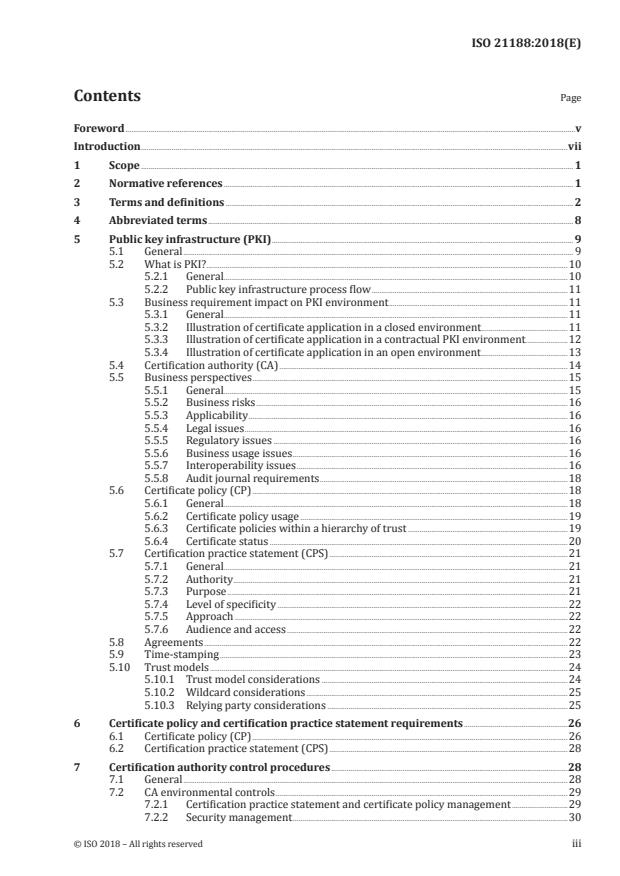
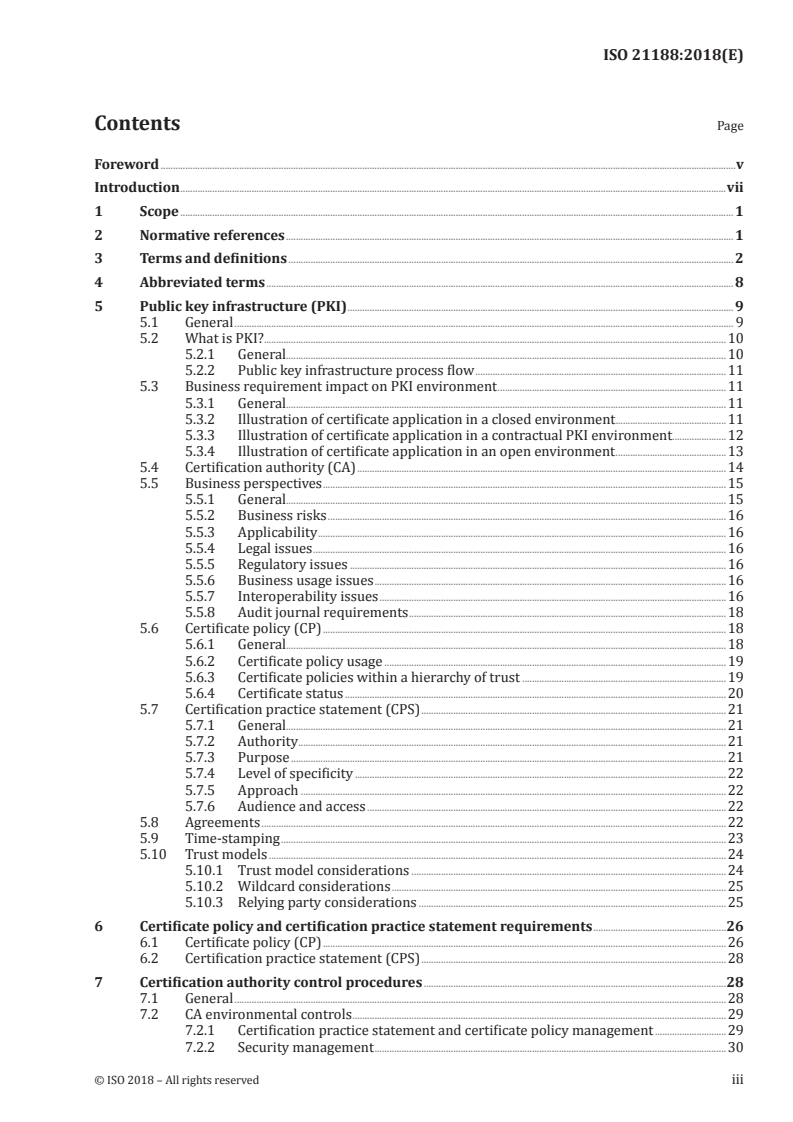
Contents Page
Foreword .v
Introduction .vii
1 Scope . 1
2 Normative references . 1
3 Terms and definitions . 2
4 Abbreviated terms . 8
5 Public key infrastructure (PKI) . 9
5.1 General . 9
5.2 What is PKI? . .10
5.2.1 General.10
5.2.2 Public key infrastructure process flow .11
5.3 Business requirement impact on PKI environment .11
5.3.1 General.11
5.3.2 Illustration of certificate application in a closed environment .11
5.3.3 Illustration of certificate application in a contractual PKI environment.12
5.3.4 Illustration of certificate application in an open environment .13
5.4 Certification authority (CA) .14
5.5 Business perspectives .15
5.5.1 General.15
5.5.2 Business risks .16
5.5.3 Applicability .16
5.5.4 Legal issues .16
5.5.5 Regulatory issues .16
5.5.6 Business usage issues .16
5.5.7 Interoperability issues .16
5.5.8 Audit journal requirements .18
5.6 Certificate policy (CP) .18
5.6.1 General.18
5.6.2 Certificate policy usage .19
5.6.3 Certificate policies within a hierarchy of trust .19
5.6.4 Certificate status .20
5.7 Certification practice statement (CPS) .21
5.7.1 General.21
5.7.2 Authority .21
5.7.3 Purpose .21
5.7.4 Level of specificity .22
5.7.5 Approach .22
5.7.6 Audience and access .22
5.8 Agreements .22
5.9 Time-stamping .23
5.10 Trust models .24
5.10.1 Trust model considerations .24
5.10.2 Wildcard considerations .25
5.10.3 Relying party considerations .25
6 Certificate policy and certification practice statement requirements .26
6.1 Certificate policy (CP) .26
6.2 Certification practice statement (CPS) .28
7 Certification authority control procedures .28
7.1 General .28
7.2 CA environmental controls .29
7.2.1 Certification practice statement and certificate policy management .29
7.2.2 Security management .30
7.2.3 Asset classification and management .31
7.2.4 Personnel security .31
7.2.5 Physical and environmental security .33
7.2.6 Operations management .34
7.2.7 System access management .35
7.2.8 Systems development and maintenance .37
7.2.9 Business continuity management .37
7.2.10 Monitoring and compliance .38
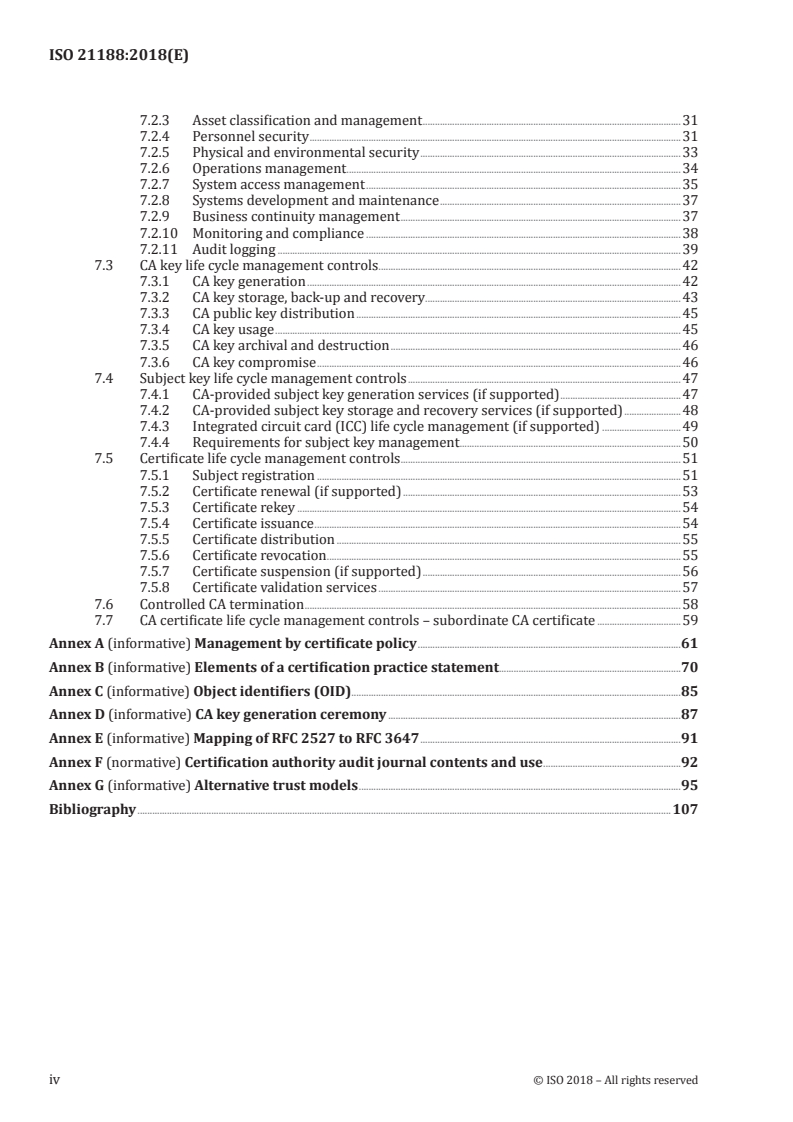
7.2.11 Audit logging .39
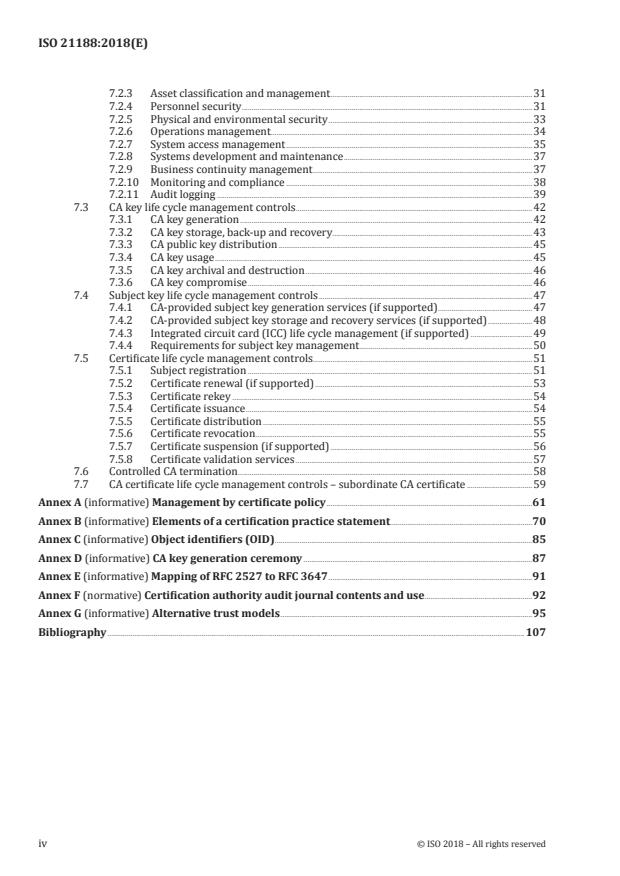
7.3 CA key life cycle management controls .42
7.3.1 CA key generation .42
7.3.2 CA key storage, back-up and recovery . .43
7.3.3 CA public key distribution .45
7.3.4 CA key usage .45
7.3.5 CA key archival and destruction .46
7.3.6 CA key compromise .46
7.4 Subject key life cycle management controls .47
7.4.1 CA-provided subject key generation services (if supported) .47
7.4.2 CA-provided subject key storage and recovery services (if supported) .48
7.4.3 Integrated circuit card (ICC) life cycle management (if supported) .49
7.4.4 Requirements for subject key management.50
7.5 Certificate life cycle management controls .51
7.5.1 Subject registration .51
7.5.2 Certificate renewal (if supported) .53
7.5.3 Certificate rekey .54
7.5.4 Certificate issuance .54
7.5.5 Certificate distribution .55
7.5.6 Certificate revocation . .55
7.5.7 Certificate suspension (if supported) .56
7.5.8 Certificate validation services .57
7.6 Controlled CA termination .58
7.7 CA certificate life cycle management controls – subordinate CA certificate .59
Annex A (informative) Management by certificate policy .61
Annex B (informative) Elements of a certification practice statement.70
Annex C (informative) Object identifiers (OID) .85
Annex D (informative) CA key generation ceremony .87
Annex E (informative) Mapping of RFC 2527 to RFC 3647 .91
Annex F (normative) Certification authority audit journal contents and use .92
Annex G (informative) Alternative trust models .95
Bibliography .107
iv © ISO 2018 – All rights reserved
Foreword
ISO (the International Organization for Standardization) is a worldwide federation of national standards
bodies (ISO member bodies). The work of preparing International Standards is normally carried out
through ISO technical committees. Each member body interested in a subject for which a technical
committee has been established has the right to be represented on that committee. International
organizations, governmental and non-governmental, in liaison with ISO, also take part in the work.
ISO collaborates closely with the International Electrotechnical Commission (IEC) on all matters of
electrotechnical standardization.
The procedures used to develop this document and those intended for its further maintenance are
described in the ISO/IEC Directives, Part 1. In particular the different approval criteria needed for the
different types of ISO documents should be noted. This document was drafted in accordance with the
editorial rules of the ISO/IEC Directives, Part 2 (see www .iso .org/directives).
Attention is drawn to the possibility that some of the elements of this document may be the subject of
patent rights. ISO shall not be held responsible for identifying any or all such patent rights. Details of
any patent rights identified during the development of the document will be in the Introduction and/or
on the ISO list of patent declarations received (see www .iso .org/patents).
Any trade name used in this document is information given for the convenience of users and does not
constitute an endorsement.
For an explanation on the voluntary nature of standards, the meaning of ISO specific terms and
expressions related to conformity assessment, as well as information about ISO's adherence to the
World Trade Organization (WTO) principles in the Technical Barriers to Trade (TBT) see the following
URL: www .iso .org/iso/foreword .html.
This document was prepared by Technical Committee ISO/TC 68, Financial services, Subcommittee
SC 2, Security.
This second edition cancels and replaces the first edition, ISO 21188:2006, which has been technically
revised, and incorporates ISO 15782-1:2009 and ISO 15782-2:2001.
The main changes to the previous edition are:
— Clause 2, ISO/IEC 7811 removed as it is a standard for magnetic stripes;
— 3.21, ‘hold’ removed from definition of ‘certification authority’;
— 7.3.6 and D.4, references to ISO 15782-1, Annex J removed;
— 7.4.1, “be performed by authorized personnel” changed to “be performed in a process initiated by
authorized personnel”;
— all instances of ‘shall’, ‘should’ and ‘may’ checked and updated if necessary;
— paragraph added to 5.4:
‘Two or more CAs can join a common scheme for mutual recognition, e.g. implemented by a trust
list. Certificates issued by one CA can then be validated by relying parties who are customers of
another CA belonging to the scheme.’;
— control added to 7.2.2:
‘Responsible management of the CA should be able to demonstrate that the information security
policy is implemented and adhered to.’;
— proposal added to 7.2.2:
‘Procedures should exist to carry out a risk assessment to identify, analyse and evaluate trust
service risks, taking into account business and technical issues. The results of the risk assessment
shall be communicated to a management group or committee responsible to information security
and risk management.’;
— general editorial changes.
vi © ISO 2018 – All rights reserved
Introduction
Institutions and intermediaries are building infrastructures to provide new electronic financial
transaction capabilities for consumers, corporations and government entities. As the volume of
electronic financial transactions continues to grow, advanced security technology using digital
signatures and trust services can become part of the financial transaction process. Financial
transaction systems incorporating advanced security technology have requirements to ensure the
privacy, authenticity and integrity of financial transactions conducted over communications networks.
The financial services industry relies on several time-honoured methods of electronically identifying,
authorizing and authenticating entities and protecting financial transactions. These methods include,
but are not limited to, personal identification numbers (PINs) and message authentication codes
(MACs) for retail and wholesale financial transactions, user IDs and passwords for network and
computer access, and key management for network connectivity. Over the past 30 years the financial
services industry has developed risk management processes and policies to support the use of these
technologies in financial applications.
The ubiquitous use of online services in public networks by the financial industry and the needs of the
industry in general to provide safe, private and reliable financial transaction and computing systems
have given rise to advanced security technology incorporating public key cryptography. Public key
cryptography requires a business-optimized infrastructure of technology, management and policy
(a public key infrastructure or PKI, as defined in this document) to satisfy requirements of electronic
identification, authentication, message integrity protection and authorization in financial application
systems. The use of standard practices for electronic identification, authentication and authorization in
a PKI ensures more consistent and predictable security in these systems and confidence in electronic
communications. Confidence (e.g. trust) can be achieved when compliance to standard practices can be
ascertained.
Applications serving the financial services industry can be developed with digital signature and PKI
capabilities. The safety and the soundness of these applications are based, in part, on implementations
and practices designed to ensure the overall integrity of the infrastructure. Users of authority-based
systems that electronically bind the identity of individuals and other entities to cryptographic materials
(e.g. cryptographic keys) benefit from standard risk management systems and the base of auditable
practices defined in this document.
Members of ISO/TC 68 have made a commitment to public key technology by developing technical
standards and guidelines for digital signatures, key management, certificate management and data
encryption. This document provides a framework for managing a PKI through certificate policies,
certification practice statements, control objectives and supporting procedures. For implementers of
this document, the degree to which any entity in a financial transaction can rely on the implementation
of public key infrastructure standards and the extent of interoperability between PKI-based systems
using this document will depend partly on factors relative to policy and practices defined in this
document.
INTERNATIONAL STANDARD ISO 21188:2018(E)
Public key infrastructure for financial services — Practices
and policy framework
1 Scope
This document sets out a framework of requirements to manage a PKI through certificate policies and
certification practice statements and to enable the use of public key certificates in the financial services
industry. It also defines control objectives and supporting procedures to manage risks. While this
document addresses the generation of public key certificates that might be used for digital signatures
or key establishment, it does not address authentication methods, non-repudiation requirements or key
management protocols.
This document draws a distinction between PKI systems used in closed, open and contractual
environments. It further defines the operational practices relative to financial-services-industry-
accepted information systems control objectives. This document is intended to help implementers
to define PKI practices that can support multiple certificate policies that include the use of digital
signature, remote authentication, key exchange and data encryption.
This document facilitates the implementation of operational, baseline PKI control practices that satisfy
the requirements for the financial services industry in a contractual environment. While the focus of
this document is on the contractual environment, application of this document to other environments
is not specifically precluded. For the purposes of this document, the term “certificate” refers to public
key certificates. Attribute certificates are outside the scope of this document
This document is targeted for several audiences with different needs and therefore the use of this
document will have a different focus for each.
Business managers and analysts are those who require information regarding using PKI technology
in their evolving businesses (e.g. electronic commerce); see Clauses 1 to 6.
Technical designers and implementers are those who are writing their certificate policies and
certification practice statement(s); see Clauses 6 to 7 and Annexes A to G.
Operational management and auditors are those who are responsible for day-to-day operations of
the PKI and validating compliance to this document; see Clauses 6 to 7.
2 Normative references
The following documents are referred to in the text in such a way that some or all of their content
constitutes requirements of this document. For dated references, only the edition cited applies. For
undated references, the latest edition of the referenced document (including any amendments) applies.
ISO/IEC 9594-8, Information technology — Open Systems Interconnection — The Directory — Part 8:
Public-key and attribute certificate frameworks
ISO 13491-1, Financial Services — Secure cryptographic devices (retail) — Part 1: Concepts, requirements
and evaluation methods
ISO/IEC 19790, Information technology — Security techniques — Security requirements for
cryptographic modules
ISO/IEC 18032, Information technology — Security techniques — Prime number generation
ISO/IEC 18033-1, Information technology — Security techniques — Encryption algorithms — Part 1: General
ISO/IEC 18033-2, Information technology — Security techniques — Encryption algorithms — Part 2:
Asymmetric ciphers
ISO/IEC 18033-3, Information technology — Security techniques — Encryption algorithms — Part 3:
Block ciphers
ISO/IEC 18033-4, Information technology — Security techniques — Encryption algorithms — Part 4:
Stream ciphers
3 Terms and definitions
For the purposes of this document, the following terms and definitions apply.
ISO and IEC maintain terminological databases for use in standardization at the following addresses:
— ISO Online browsing platform: available at https: //www .iso .org/obp/3 .1
— IEC Electropedia: available at http: //www .electropedia .org/
3.1
access point
point at which the user may connect to the network or facility
3.2
activation data
data values, other than keys, which are required to operate cryptographic modules
Note 1 to entry: These data values should be protected.
EXAMPLE A PIN, a pass phrase, a biometric or a manually held key share.
3.3
authentication
provision of assurance that a claimed identity of an entity is correct
Note 1 to entry: a) at registration, the act of evaluating an end entity’s (i.e. subscriber’s) identity and verifying
that it is correct for issuing of a certificate; b) during use, the act of comparing electronically submitted identity
and credentials (i.e. user ID and password) with stored values to prove identity.
3.4
authentication data
information used to verify the claimed identity of an entity, such as an individual, defined role,
corporation or institution
3.5
CA certificate
public key certificate whose subject is a CA (3.21) and whose associated private key is used to sign
certificates and other CA related information (e.g. CRL, OCSP responses)
3.6
card bureau
agent of the CA (3.21) or RA (3.49) that personalizes an ICC (3.35) containing the subscriber’s private
key (as a minimum)
3.7
cardholder
subject to whom the integrated circuit card containing private and public key pair and certificates (3.8)
has been issued
2 © ISO 2018 – All rights reserved
3.8
certificate
public key and identity of an entity (authentication data (3.4)), together with some other information,
rendered unforgeable by signing the certificate information with the private key of the certifying
authority that issued that public key certificate
3.9
certificate suspension
certificate hold
suspension of the validity of a certificate (3.8)
3.10
certificate issuer
organization whose name appears in the issuer field of a certificate (3.8)
3.11
certificate management
management of public key certificates covering the complete life cycle from the initialization phase to
the issuing phase to the cancellation phase
3.12
certificate manufacturer
agent who performs the tasks of applying a digital signature to a certificate signing request on behalf of
the certificate issuer (3.10)
3.13
certificate policy
CP
named set of rules that indicates the applicability of a certificate to a particular community and/or
class of application with common security requirements
3.14
certificate profile
specification of the required format (including requirements for the usage of standard fields and
extensions) for a particular type of certificate (3.8)
3.15
certificate rekey
process whereby an entity with an existing key pair and certificate (3.8) receives a new certificate for a
new public key, following the generation of a new key pair
3.16
certificate renewal
rollover
issuing an entity with a new version of an existing certificate with a new validity period
3.17
certificate revocation list
CRL
list of revoked certificates (3.8)
3.18
certificate validation service
service provided by the CA (3.21) or its agent which performs the task of confirming the validity of a
certificate (3.8) to a relying party (3.52)
3.19
certificate validation service provider
CVSP
entity (3.32) that provides certificate validation services to its relying party customers
3.20
certification
creation of a public key certificate for a subject (3.58)
3.21
certification authority
CA
entity (3.32) trusted by one or more entities to create, assign and revoke public key certificates
3.22
certification path
ordered sequence of certificates of entities which, together with the public key of the initial entity in the
path, can be processed to obtain the public key of the final entity in the path
3.23
certification practice statement
CPS
statement of the practices which a certification authority (3.21) employs in issuing, managing, revoking
and renewing certificates and which defines the equipment, policies and procedures the CA uses to
satisfy the requirements specified in the certificate policies that are supported by it
3.24
certification request
submission of a validated registration request by an RA (3.49), its agent or a subject to a CA (3.21) to
register a subject's public key to be placed in a certificate (3.8)
3.25
certification response
message sent, following certification, from a CA (3.21) in response to a certificate request
3.26
certificate validity
validity
applicability (fitness for intended use) and status (valid, unknown, revoked or expired) of a
certificate (3.8)
3.27
compromise
violation of the security of a system such that an unauthorized disclosure modification or falsification
of sensitive information can have occurred
3.28
cross certification
mutual certification of each other’s public keys by two CAs (3.21)
Note 1 to entry: This process may or may not be automated.
3.29
cryptographic hardware
cryptographic device
hardware security module
hardware cryptographic module
hardware which provides a set of secure cryptographic services, e.g. key generation, cryptogram
creation, PIN translation and certificate signing
3.30
digital signature
cryptographic transformation that, when associated with a data unit, provides the services of origin
authenticity data integrity and signer non-repudiation
4 © ISO 2018 – All rights reserved
3.31
end entity
certificate subject that uses its private key for purposes other than signing certificates
3.32
entity
person, partnership, organization or business that has a legal and separately identifiable existence
EXAMPLE A legal entity or an individual or end entity (3.31), such as certification authority (3.21), registration
authority (3.49) or end entity (3.31).
3.33
audit journal
audit log
event journal
chronological record of system activities which is sufficient to enable the reconstruction, review and
examination of the sequence of environments and activities surrounding or leading to each event in the
path of a transaction from its inception to the output of the final results
3.34
functional testing
portion of security testing in which the advertised features of a system are tested for correct operation
3.35
integrated circuit card
ICC
card into which has been inserted one or more electronic components in the form of microcircuits to
perform processing and memory functions
3.36
issuing CA
CA (3.21) that issued the certificate in the context of a particular certificate (3.8)
3.37
key escrow
management function that allows access by an authorized party to a replicated private encipherment key
3.38
key recovery
ability to restore an entity’s private key or a symmetric encipherment key from secure storage in the
event that such keys are lost, corrupted or otherwise become unavailable
3.39
multiple control
condition under which two (dual) or more parties separately and confidentially have custody of
components of a single key that, individually, convey no knowledge of the resultant cryptographic key
3.40
object identifier
OID
unique series of integers that unambiguously identifies an information object
3.41
online certificate status mechanism
mechanism that allows relying parties (3.52) to request and obtain certificate status information
without requiring the use of CRLs (3.17)
3.42
online certificate status protocol
OCSP
protocol for determining the current status of a certificate in lieu of or as a supplement to checking
against a periodic CRL (3.17) and which specifies the data that need to be exchanged between an
application checking the status of a certificate and the server providing that status
3.43
operating period
period of a certificate beginning on the date and time it is issued by a CA (3.21) (or on a later date and
time, if stated in the certificate), and ending on the date and time it expires or is revoked
3.44
PKI disclosure statement
document that supplements a CP (3.13) or CPS (3.23) by disclosing critical information about the policies
and practices of a CA (3.21)/PKI (3.48)
Note 1 to entry: A PKI disclosure statement is a vehicle for disclosing and emphasizing information normally
covered in detail by associated CP and/or CPS documents. Consequently, it is not intended to replace a CP or CPS.
3.45
policy authority
PA
party or body with final authority and responsibility for specifying certificate policies (3.13) and
ensuring CA (3.21) practices and controls as defined by the CPS (3.23) fully support the specified
certificate policies
3.46
policy mapping
recognition that when a CA (3.21) in one domain certifies a CA in another domain, a particular certificate
policy (3.13) in the second domain can be considered by the authority of the first domain to be equivalent
(but not necessarily identical in all respects) to a particular certificate policy in the first domain
Note 1 to entry: See cross certification (3.28).
3.47
policy qualifier
policy-dependent information that accompanies a certificate policy (3.13) identifier in an X.509
certificate
3.48
public key infrastructure
PKI
structure of hardware, software, people, processes and policies that employs digital signature
technology to facilitate a verifiable association between the public component of an asymmetric public
key pair with a specific subscriber that possesses the corresponding private key
Note 1 to entry: The public key may be provided for digital signature verification, authentication of the subject in
communication dialogues, and/or for message encryption key exchange or negotiation
3.49
registration authority
RA
entity whose primary functional role and responsibilities include identity validation of the subject for
approving certificate requests (3.24) submitted to a CA (3.21)
Note 1 to entry: An RA can assist in the certificate application process, the revocation process or both. The RA
does not need to be a separate body, but can be part of the CA.
6 © ISO 2018 – All rights reserved
3.50
registration request
submission by an entity to an RA (3.49) (or CA (3.21)) to register the entity’s public key in a certificate
3.51
registration response
message sent by an RA (3.49) (or CA (3.21)) to an entity in response to a registration request
3.52
relying party
RP
recipient of a certificate who acts in reliance on that certificate, digital signatures verified using that
certificate, or both
3.53
relying party agreement
RPA
legally binding statement provided by the CA (3.21) of the expected responsibilities between the relying
party, the subject and the CA
Note 1 to entry: The RPA might be included in the CPS (3.23) or provided as one or more external documents.
3.54
repository
system for storage and distribution of certificates and related information
EXAMPLE Certificate storage, certificate distribution, certificate policy (3.13) storage and retrieval,
certificate status.
3.55
root CA
trust anchor
CA (3.21) at the apex of the CA hierarchy
3.56
signature validation
verification and confirmation that a digital signature is valid
Note 1 to entry: See also certificate validity (3.26).
3.57
signature verification
check of the cryptographic value of a signature using data
3.58
subject
entity that owns the asymmetric key pair and may also be a relying party (3.52)
3.59
subject CA
CA (3.21) that is certified by the issuing CA (3.36) and hence complies with the certificate policy (3.13) of
the issuing CA
3.60
subordinate CA
sub-CA
intermediate CA
CA (3.21) that is lower relative to another CA in the CA hierarchy
3.61
subscriber
entity subscribing with a certification authority (3.21) on behalf of one or more subjects
3.62
superior CA
CA (3.21) that is higher relative to another subordinate CA (3.60) in the CA hierarchy, but is not a root
CA (3.55)
3.63
tamper-evident
provides evidence that an attack has been attempted
3.64
tamper-resistant
provides passive physical protection against an attack
3.65
trusted role
job function that performs critical functions which, if performed unsatisfactorily, can have an adverse
impact upon the degree of trust provided by the CA (3.21)
3.66
trust services provider
TSP
approved organization (as determined by the contractual participants) providing trust services,
through a number of certification authorities (3.21), to their customers who may act as subscribers or
relying parties (3.52)
Note 1 to entry: A trust services provider can also provide certificate validation services.
3.67
validation service request
enquiry by the relying party (3.52) to a validation service to check the validity of a certificate (3.8)
4 Abbreviated terms
ASN.1 Abstract Syntax Notation One
CA certification authority
CM certificate manufacturer
CP certificate policy
CPS certification practice statement
CRL certificate revocation list
CVSP certificate validation service provider
EMV Eurocard MasterCard Visa
CPS certification practice statement
FI financial institution
FIPS Federal Information Processing Standard
FQDN fully qualified domain name
FTP file transfer protocol
HSM hardware security module
8 © ISO 2018 – All rights reserved
HTTP hypertext transfer protocol
ICC integrated circuit card
ID identifier
IEC International Electrotechnical Commission
IETF Internet Engineering Task Force
ISO International Organization for Standardization
ITU International Telecommunications Union
MAC message authentication code
MITM man-in-the-middle attack
OCSP online certificate status protocol
OID object identifier
PA policy authority
PIN personal identification number
PKI public key infrastructure
PKIX Public Key Infrastructure (X.509) (IETF Working Group)
RA registration authority
RFC request for comment
RP relying party
SAN storage area network
TLS transport layer security
TSA time stamping authority
TSP trust services provider
URL uniform resource locator
UTC universal time coordinated (zulu or Greenwich Mean Time, Time GMT)
5 Public key infrastructure (PKI)
5.1 General
Before addressing the details of PKI policy and practices requirements, this document provides some
background information in order for the reader to better understand the context in which these policies
and practices are used within a PKI.
5.2 What is PKI?
5.2.1 General
This subclause describes the components of a PKI and illustrates the roles with responsibilities
undertaken by the various entities within the PKI. The rapid growth of electronic commerce has
brought with it the desire to conduct business-to-business, business-to-consumer, and government-
to-consumer transactions across open networks such as the Internet. The design of the network
transmission protocols creates problems for financial institutions and their customers conducting
business transactions, who require the electronic identification and authentication of the transacting
parties, proof of origin, message integrity protection and confidentiality services. Electronic
authentication also raises significant issues with respect to evidence and contract, liability, privacy,
consumer protection and trade.
PKIs are a practical technical solution to the problems posed by open networks. Financial institutions
are becoming trust services providers (TSPs), to take advantage of the growing market for security
and authentication in online communications. Relying parties, as recipients of information, use TSPs
to validate certificates used to authenticate online communications. A TSP can be an entity providing
one or more trusted services, e.g. a certification authority or a validation service. A TSP is a recognized
authority trusted by one or more relying parties to create and sign certificates. A TSP can also revoke
certificates it has created and issued. A TSP operates one or more certification authorities (CAs) whose
core functions are certificate issuing, certificate distribution and certifi
...
INTERNATIONAL ISO
STANDARD 21188
Second edition
2018-04
Public key infrastructure for financial
services — Practices and policy
framework
Infrastructure de clé publique pour services financiers — Pratique et
cadre politique
Reference number
©
ISO 2018
© ISO 2018
All rights reserved. Unless otherwise specified, or required in the context of its implementation, no part of this publication may
be reproduced or utilized otherwise in any form or by any means, electronic or mechanical, including photocopying, or posting
on the internet or an intranet, without prior written permission. Permission can be requested from either ISO at the address
below or ISO’s member body in the country of the requester.
ISO copyright office
CP 401 • Ch. de Blandonnet 8
CH-1214 Vernier, Geneva
Phone: +41 22 749 01 11
Fax: +41 22 749 09 47
Email: copyright@iso.org
Website: www.iso.org
Published in Switzerland
ii © ISO 2018 – All rights reserved
Contents Page
Foreword .v
Introduction .vii
1 Scope . 1
2 Normative references . 1
3 Terms and definitions . 2
4 Abbreviated terms . 8
5 Public key infrastructure (PKI) . 9
5.1 General . 9
5.2 What is PKI? . .10
5.2.1 General.10
5.2.2 Public key infrastructure process flow .11
5.3 Business requirement impact on PKI environment .11
5.3.1 General.11
5.3.2 Illustration of certificate application in a closed environment .11
5.3.3 Illustration of certificate application in a contractual PKI environment.12
5.3.4 Illustration of certificate application in an open environment .13
5.4 Certification authority (CA) .14
5.5 Business perspectives .15
5.5.1 General.15
5.5.2 Business risks .16
5.5.3 Applicability .16
5.5.4 Legal issues .16
5.5.5 Regulatory issues .16
5.5.6 Business usage issues .16
5.5.7 Interoperability issues .16
5.5.8 Audit journal requirements .18
5.6 Certificate policy (CP) .18
5.6.1 General.18
5.6.2 Certificate policy usage .19
5.6.3 Certificate policies within a hierarchy of trust .19
5.6.4 Certificate status .20
5.7 Certification practice statement (CPS) .21
5.7.1 General.21
5.7.2 Authority .21
5.7.3 Purpose .21
5.7.4 Level of specificity .22
5.7.5 Approach .22
5.7.6 Audience and access .22
5.8 Agreements .22
5.9 Time-stamping .23
5.10 Trust models .24
5.10.1 Trust model considerations .24
5.10.2 Wildcard considerations .25
5.10.3 Relying party considerations .25
6 Certificate policy and certification practice statement requirements .26
6.1 Certificate policy (CP) .26
6.2 Certification practice statement (CPS) .28
7 Certification authority control procedures .28
7.1 General .28
7.2 CA environmental controls .29
7.2.1 Certification practice statement and certificate policy management .29
7.2.2 Security management .30
7.2.3 Asset classification and management .31
7.2.4 Personnel security .31
7.2.5 Physical and environmental security .33
7.2.6 Operations management .34
7.2.7 System access management .35
7.2.8 Systems development and maintenance .37
7.2.9 Business continuity management .37
7.2.10 Monitoring and compliance .38
7.2.11 Audit logging .39
7.3 CA key life cycle management controls .42
7.3.1 CA key generation .42
7.3.2 CA key storage, back-up and recovery . .43
7.3.3 CA public key distribution .45
7.3.4 CA key usage .45
7.3.5 CA key archival and destruction .46
7.3.6 CA key compromise .46
7.4 Subject key life cycle management controls .47
7.4.1 CA-provided subject key generation services (if supported) .47
7.4.2 CA-provided subject key storage and recovery services (if supported) .48
7.4.3 Integrated circuit card (ICC) life cycle management (if supported) .49
7.4.4 Requirements for subject key management.50
7.5 Certificate life cycle management controls .51
7.5.1 Subject registration .51
7.5.2 Certificate renewal (if supported) .53
7.5.3 Certificate rekey .54
7.5.4 Certificate issuance .54
7.5.5 Certificate distribution .55
7.5.6 Certificate revocation . .55
7.5.7 Certificate suspension (if supported) .56
7.5.8 Certificate validation services .57
7.6 Controlled CA termination .58
7.7 CA certificate life cycle management controls – subordinate CA certificate .59
Annex A (informative) Management by certificate policy .61
Annex B (informative) Elements of a certification practice statement.70
Annex C (informative) Object identifiers (OID) .85
Annex D (informative) CA key generation ceremony .87
Annex E (informative) Mapping of RFC 2527 to RFC 3647 .91
Annex F (normative) Certification authority audit journal contents and use .92
Annex G (informative) Alternative trust models .95
Bibliography .107
iv © ISO 2018 – All rights reserved
Foreword
ISO (the International Organization for Standardization) is a worldwide federation of national standards
bodies (ISO member bodies). The work of preparing International Standards is normally carried out
through ISO technical committees. Each member body interested in a subject for which a technical
committee has been established has the right to be represented on that committee. International
organizations, governmental and non-governmental, in liaison with ISO, also take part in the work.
ISO collaborates closely with the International Electrotechnical Commission (IEC) on all matters of
electrotechnical standardization.
The procedures used to develop this document and those intended for its further maintenance are
described in the ISO/IEC Directives, Part 1. In particular the different approval criteria needed for the
different types of ISO documents should be noted. This document was drafted in accordance with the
editorial rules of the ISO/IEC Directives, Part 2 (see www .iso .org/directives).
Attention is drawn to the possibility that some of the elements of this document may be the subject of
patent rights. ISO shall not be held responsible for identifying any or all such patent rights. Details of
any patent rights identified during the development of the document will be in the Introduction and/or
on the ISO list of patent declarations received (see www .iso .org/patents).
Any trade name used in this document is information given for the convenience of users and does not
constitute an endorsement.
For an explanation on the voluntary nature of standards, the meaning of ISO specific terms and
expressions related to conformity assessment, as well as information about ISO's adherence to the
World Trade Organization (WTO) principles in the Technical Barriers to Trade (TBT) see the following
URL: www .iso .org/iso/foreword .html.
This document was prepared by Technical Committee ISO/TC 68, Financial services, Subcommittee
SC 2, Security.
This second edition cancels and replaces the first edition, ISO 21188:2006, which has been technically
revised, and incorporates ISO 15782-1:2009 and ISO 15782-2:2001.
The main changes to the previous edition are:
— Clause 2, ISO/IEC 7811 removed as it is a standard for magnetic stripes;
— 3.21, ‘hold’ removed from definition of ‘certification authority’;
— 7.3.6 and D.4, references to ISO 15782-1, Annex J removed;
— 7.4.1, “be performed by authorized personnel” changed to “be performed in a process initiated by
authorized personnel”;
— all instances of ‘shall’, ‘should’ and ‘may’ checked and updated if necessary;
— paragraph added to 5.4:
‘Two or more CAs can join a common scheme for mutual recognition, e.g. implemented by a trust
list. Certificates issued by one CA can then be validated by relying parties who are customers of
another CA belonging to the scheme.’;
— control added to 7.2.2:
‘Responsible management of the CA should be able to demonstrate that the information security
policy is implemented and adhered to.’;
— proposal added to 7.2.2:
‘Procedures should exist to carry out a risk assessment to identify, analyse and evaluate trust
service risks, taking into account business and technical issues. The results of the risk assessment
shall be communicated to a management group or committee responsible to information security
and risk management.’;
— general editorial changes.
vi © ISO 2018 – All rights reserved
Introduction
Institutions and intermediaries are building infrastructures to provide new electronic financial
transaction capabilities for consumers, corporations and government entities. As the volume of
electronic financial transactions continues to grow, advanced security technology using digital
signatures and trust services can become part of the financial transaction process. Financial
transaction systems incorporating advanced security technology have requirements to ensure the
privacy, authenticity and integrity of financial transactions conducted over communications networks.
The financial services industry relies on several time-honoured methods of electronically identifying,
authorizing and authenticating entities and protecting financial transactions. These methods include,
but are not limited to, personal identification numbers (PINs) and message authentication codes
(MACs) for retail and wholesale financial transactions, user IDs and passwords for network and
computer access, and key management for network connectivity. Over the past 30 years the financial
services industry has developed risk management processes and policies to support the use of these
technologies in financial applications.
The ubiquitous use of online services in public networks by the financial industry and the needs of the
industry in general to provide safe, private and reliable financial transaction and computing systems
have given rise to advanced security technology incorporating public key cryptography. Public key
cryptography requires a business-optimized infrastructure of technology, management and policy
(a public key infrastructure or PKI, as defined in this document) to satisfy requirements of electronic
identification, authentication, message integrity protection and authorization in financial application
systems. The use of standard practices for electronic identification, authentication and authorization in
a PKI ensures more consistent and predictable security in these systems and confidence in electronic
communications. Confidence (e.g. trust) can be achieved when compliance to standard practices can be
ascertained.
Applications serving the financial services industry can be developed with digital signature and PKI
capabilities. The safety and the soundness of these applications are based, in part, on implementations
and practices designed to ensure the overall integrity of the infrastructure. Users of authority-based
systems that electronically bind the identity of individuals and other entities to cryptographic materials
(e.g. cryptographic keys) benefit from standard risk management systems and the base of auditable
practices defined in this document.
Members of ISO/TC 68 have made a commitment to public key technology by developing technical
standards and guidelines for digital signatures, key management, certificate management and data
encryption. This document provides a framework for managing a PKI through certificate policies,
certification practice statements, control objectives and supporting procedures. For implementers of
this document, the degree to which any entity in a financial transaction can rely on the implementation
of public key infrastructure standards and the extent of interoperability between PKI-based systems
using this document will depend partly on factors relative to policy and practices defined in this
document.
INTERNATIONAL STANDARD ISO 21188:2018(E)
Public key infrastructure for financial services — Practices
and policy framework
1 Scope
This document sets out a framework of requirements to manage a PKI through certificate policies and
certification practice statements and to enable the use of public key certificates in the financial services
industry. It also defines control objectives and supporting procedures to manage risks. While this
document addresses the generation of public key certificates that might be used for digital signatures
or key establishment, it does not address authentication methods, non-repudiation requirements or key
management protocols.
This document draws a distinction between PKI systems used in closed, open and contractual
environments. It further defines the operational practices relative to financial-services-industry-
accepted information systems control objectives. This document is intended to help implementers
to define PKI practices that can support multiple certificate policies that include the use of digital
signature, remote authentication, key exchange and data encryption.
This document facilitates the implementation of operational, baseline PKI control practices that satisfy
the requirements for the financial services industry in a contractual environment. While the focus of
this document is on the contractual environment, application of this document to other environments
is not specifically precluded. For the purposes of this document, the term “certificate” refers to public
key certificates. Attribute certificates are outside the scope of this document
This document is targeted for several audiences with different needs and therefore the use of this
document will have a different focus for each.
Business managers and analysts are those who require information regarding using PKI technology
in their evolving businesses (e.g. electronic commerce); see Clauses 1 to 6.
Technical designers and implementers are those who are writing their certificate policies and
certification practice statement(s); see Clauses 6 to 7 and Annexes A to G.
Operational management and auditors are those who are responsible for day-to-day operations of
the PKI and validating compliance to this document; see Clauses 6 to 7.
2 Normative references
The following documents are referred to in the text in such a way that some or all of their content
constitutes requirements of this document. For dated references, only the edition cited applies. For
undated references, the latest edition of the referenced document (including any amendments) applies.
ISO/IEC 9594-8, Information technology — Open Systems Interconnection — The Directory — Part 8:
Public-key and attribute certificate frameworks
ISO 13491-1, Financial Services — Secure cryptographic devices (retail) — Part 1: Concepts, requirements
and evaluation methods
ISO/IEC 19790, Information technology — Security techniques — Security requirements for
cryptographic modules
ISO/IEC 18032, Information technology — Security techniques — Prime number generation
ISO/IEC 18033-1, Information technology — Security techniques — Encryption algorithms — Part 1: General
ISO/IEC 18033-2, Information technology — Security techniques — Encryption algorithms — Part 2:
Asymmetric ciphers
ISO/IEC 18033-3, Information technology — Security techniques — Encryption algorithms — Part 3:
Block ciphers
ISO/IEC 18033-4, Information technology — Security techniques — Encryption algorithms — Part 4:
Stream ciphers
3 Terms and definitions
For the purposes of this document, the following terms and definitions apply.
ISO and IEC maintain terminological databases for use in standardization at the following addresses:
— ISO Online browsing platform: available at https: //www .iso .org/obp/3 .1
— IEC Electropedia: available at http: //www .electropedia .org/
3.1
access point
point at which the user may connect to the network or facility
3.2
activation data
data values, other than keys, which are required to operate cryptographic modules
Note 1 to entry: These data values should be protected.
EXAMPLE A PIN, a pass phrase, a biometric or a manually held key share.
3.3
authentication
provision of assurance that a claimed identity of an entity is correct
Note 1 to entry: a) at registration, the act of evaluating an end entity’s (i.e. subscriber’s) identity and verifying
that it is correct for issuing of a certificate; b) during use, the act of comparing electronically submitted identity
and credentials (i.e. user ID and password) with stored values to prove identity.
3.4
authentication data
information used to verify the claimed identity of an entity, such as an individual, defined role,
corporation or institution
3.5
CA certificate
public key certificate whose subject is a CA (3.21) and whose associated private key is used to sign
certificates and other CA related information (e.g. CRL, OCSP responses)
3.6
card bureau
agent of the CA (3.21) or RA (3.49) that personalizes an ICC (3.35) containing the subscriber’s private
key (as a minimum)
3.7
cardholder
subject to whom the integrated circuit card containing private and public key pair and certificates (3.8)
has been issued
2 © ISO 2018 – All rights reserved
3.8
certificate
public key and identity of an entity (authentication data (3.4)), together with some other information,
rendered unforgeable by signing the certificate information with the private key of the certifying
authority that issued that public key certificate
3.9
certificate suspension
certificate hold
suspension of the validity of a certificate (3.8)
3.10
certificate issuer
organization whose name appears in the issuer field of a certificate (3.8)
3.11
certificate management
management of public key certificates covering the complete life cycle from the initialization phase to
the issuing phase to the cancellation phase
3.12
certificate manufacturer
agent who performs the tasks of applying a digital signature to a certificate signing request on behalf of
the certificate issuer (3.10)
3.13
certificate policy
CP
named set of rules that indicates the applicability of a certificate to a particular community and/or
class of application with common security requirements
3.14
certificate profile
specification of the required format (including requirements for the usage of standard fields and
extensions) for a particular type of certificate (3.8)
3.15
certificate rekey
process whereby an entity with an existing key pair and certificate (3.8) receives a new certificate for a
new public key, following the generation of a new key pair
3.16
certificate renewal
rollover
issuing an entity with a new version of an existing certificate with a new validity period
3.17
certificate revocation list
CRL
list of revoked certificates (3.8)
3.18
certificate validation service
service provided by the CA (3.21) or its agent which performs the task of confirming the validity of a
certificate (3.8) to a relying party (3.52)
3.19
certificate validation service provider
CVSP
entity (3.32) that provides certificate validation services to its relying party customers
3.20
certification
creation of a public key certificate for a subject (3.58)
3.21
certification authority
CA
entity (3.32) trusted by one or more entities to create, assign and revoke public key certificates
3.22
certification path
ordered sequence of certificates of entities which, together with the public key of the initial entity in the
path, can be processed to obtain the public key of the final entity in the path
3.23
certification practice statement
CPS
statement of the practices which a certification authority (3.21) employs in issuing, managing, revoking
and renewing certificates and which defines the equipment, policies and procedures the CA uses to
satisfy the requirements specified in the certificate policies that are supported by it
3.24
certification request
submission of a validated registration request by an RA (3.49), its agent or a subject to a CA (3.21) to
register a subject's public key to be placed in a certificate (3.8)
3.25
certification response
message sent, following certification, from a CA (3.21) in response to a certificate request
3.26
certificate validity
validity
applicability (fitness for intended use) and status (valid, unknown, revoked or expired) of a
certificate (3.8)
3.27
compromise
violation of the security of a system such that an unauthorized disclosure modification or falsification
of sensitive information can have occurred
3.28
cross certification
mutual certification of each other’s public keys by two CAs (3.21)
Note 1 to entry: This process may or may not be automated.
3.29
cryptographic hardware
cryptographic device
hardware security module
hardware cryptographic module
hardware which provides a set of secure cryptographic services, e.g. key generation, cryptogram
creation, PIN translation and certificate signing
3.30
digital signature
cryptographic transformation that, when associated with a data unit, provides the services of origin
authenticity data integrity and signer non-repudiation
4 © ISO 2018 – All rights reserved
3.31
end entity
certificate subject that uses its private key for purposes other than signing certificates
3.32
entity
person, partnership, organization or business that has a legal and separately identifiable existence
EXAMPLE A legal entity or an individual or end entity (3.31), such as certification authority (3.21), registration
authority (3.49) or end entity (3.31).
3.33
audit journal
audit log
event journal
chronological record of system activities which is sufficient to enable the reconstruction, review and
examination of the sequence of environments and activities surrounding or leading to each event in the
path of a transaction from its inception to the output of the final results
3.34
functional testing
portion of security testing in which the advertised features of a system are tested for correct operation
3.35
integrated circuit card
ICC
card into which has been inserted one or more electronic components in the form of microcircuits to
perform processing and memory functions
3.36
issuing CA
CA (3.21) that issued the certificate in the context of a particular certificate (3.8)
3.37
key escrow
management function that allows access by an authorized party to a replicated private encipherment key
3.38
key recovery
ability to restore an entity’s private key or a symmetric encipherment key from secure storage in the
event that such keys are lost, corrupted or otherwise become unavailable
3.39
multiple control
condition under which two (dual) or more parties separately and confidentially have custody of
components of a single key that, individually, convey no knowledge of the resultant cryptographic key
3.40
object identifier
OID
unique series of integers that unambiguously identifies an information object
3.41
online certificate status mechanism
mechanism that allows relying parties (3.52) to request and obtain certificate status information
without requiring the use of CRLs (3.17)
3.42
online certificate status protocol
OCSP
protocol for determining the current status of a certificate in lieu of or as a supplement to checking
against a periodic CRL (3.17) and which specifies the data that need to be exchanged between an
application checking the status of a certificate and the server providing that status
3.43
operating period
period of a certificate beginning on the date and time it is issued by a CA (3.21) (or on a later date and
time, if stated in the certificate), and ending on the date and time it expires or is revoked
3.44
PKI disclosure statement
document that supplements a CP (3.13) or CPS (3.23) by disclosing critical information about the policies
and practices of a CA (3.21)/PKI (3.48)
Note 1 to entry: A PKI disclosure statement is a vehicle for disclosing and emphasizing information normally
covered in detail by associated CP and/or CPS documents. Consequently, it is not intended to replace a CP or CPS.
3.45
policy authority
PA
party or body with final authority and responsibility for specifying certificate policies (3.13) and
ensuring CA (3.21) practices and controls as defined by the CPS (3.23) fully support the specified
certificate policies
3.46
policy mapping
recognition that when a CA (3.21) in one domain certifies a CA in another domain, a particular certificate
policy (3.13) in the second domain can be considered by the authority of the first domain to be equivalent
(but not necessarily identical in all respects) to a particular certificate policy in the first domain
Note 1 to entry: See cross certification (3.28).
3.47
policy qualifier
policy-dependent information that accompanies a certificate policy (3.13) identifier in an X.509
certificate
3.48
public key infrastructure
PKI
structure of hardware, software, people, processes and policies that employs digital signature
technology to facilitate a verifiable association between the public component of an asymmetric public
key pair with a specific subscriber that possesses the corresponding private key
Note 1 to entry: The public key may be provided for digital signature verification, authentication of the subject in
communication dialogues, and/or for message encryption key exchange or negotiation
3.49
registration authority
RA
entity whose primary functional role and responsibilities include identity validation of the subject for
approving certificate requests (3.24) submitted to a CA (3.21)
Note 1 to entry: An RA can assist in the certificate application process, the revocation process or both. The RA
does not need to be a separate body, but can be part of the CA.
6 © ISO 2018 – All rights reserved
3.50
registration request
submission by an entity to an RA (3.49) (or CA (3.21)) to register the entity’s public key in a certificate
3.51
registration response
message sent by an RA (3.49) (or CA (3.21)) to an entity in response to a registration request
3.52
relying party
RP
recipient of a certificate who acts in reliance on that certificate, digital signatures verified using that
certificate, or both
3.53
relying party agreement
RPA
legally binding statement provided by the CA (3.21) of the expected responsibilities between the relying
party, the subject and the CA
Note 1 to entry: The RPA might be included in the CPS (3.23) or provided as one or more external documents.
3.54
repository
system for storage and distribution of certificates and related information
EXAMPLE Certificate storage, certificate distribution, certificate policy (3.13) storage and retrieval,
certificate status.
3.55
root CA
trust anchor
CA (3.21) at the apex of the CA hierarchy
3.56
signature validation
verification and confirmation that a digital signature is valid
Note 1 to entry: See also certificate validity (3.26).
3.57
signature verification
check of the cryptographic value of a signature using data
3.58
subject
entity that owns the asymmetric key pair and may also be a relying party (3.52)
3.59
subject CA
CA (3.21) that is certified by the issuing CA (3.36) and hence complies with the certificate policy (3.13) of
the issuing CA
3.60
subordinate CA
sub-CA
intermediate CA
CA (3.21) that is lower relative to another CA in the CA hierarchy
3.61
subscriber
entity subscribing with a certification authority (3.21) on behalf of one or more subjects
3.62
superior CA
CA (3.21) that is higher relative to another subordinate CA (3.60) in the CA hierarchy, but is not a root
CA (3.55)
3.63
tamper-evident
provides evidence that an attack has been attempted
3.64
tamper-resistant
provides passive physical protection against an attack
3.65
trusted role
job function that performs critical functions which, if performed unsatisfactorily, can have an adverse
impact upon the degree of trust provided by the CA (3.21)
3.66
trust services provider
TSP
approved organization (as determined by the contractual participants) providing trust services,
through a number of certification authorities (3.21), to their customers who may act as subscribers or
relying parties (3.52)
Note 1 to entry: A trust services provider can also provide certificate validation services.
3.67
validation service request
enquiry by the relying party (3.52) to a validation service to check the validity of a certificate (3.8)
4 Abbreviated terms
ASN.1 Abstract Syntax Notation One
CA certification authority
CM certificate manufacturer
CP certificate policy
CPS certification practice statement
CRL certificate revocation list
CVSP certificate validation service provider
EMV Eurocard MasterCard Visa
CPS certification practice statement
FI financial institution
FIPS Federal Information Processing Standard
FQDN fully qualified domain name
FTP file transfer protocol
HSM hardware security module
8 © ISO 2018 – All rights reserved
HTTP hypertext transfer protocol
ICC integrated circuit card
ID identifier
IEC International Electrotechnical Commission
IETF Internet Engineering Task Force
ISO International Organization for Standardization
ITU International Telecommunications Union
MAC message authentication code
MITM man-in-the-middle attack
OCSP online certificate status protocol
OID object identifier
PA policy authority
PIN personal identification number
PKI public key infrastructure
PKIX Public Key Infrastructure (X.509) (IETF Working Group)
RA registration authority
RFC request for comment
RP relying party
SAN storage area network
TLS transport layer security
TSA time stamping authority
TSP trust services provider
URL uniform resource locator
UTC universal time coordinated (zulu or Greenwich Mean Time, Time GMT)
5 Public key infrastructure (PKI)
5.1 General
Before addressing the details of PKI policy and practices requirements, this document provides some
background information in order for the reader to better understand the context in which these policies
and practices are used within a PKI.
5.2 What is PKI?
5.2.1 General
This subclause describes the components of a PKI and illustrates the roles with responsibilities
undertaken by the various entities within the PKI. The rapid growth of electronic commerce has
brought with it the desire to conduct business-to-business, business-to-consumer, and government-
to-consumer transactions across open networks such as the Internet. The design of the network
transmission protocols creates problems for financial institutions and their customers conducting
business transactions, who require the electronic identification and authentication of the transacting
parties, proof of origin, message integrity protection and confidentiality services. Electronic
authentication also raises significant issues with respect to evidence and contract, liability, privacy,
consumer protection and trade.
PKIs are a practical technical solution to the problems posed by open networks. Financial institutions
are becoming trust services providers (TSPs), to take advantage of the growing market for security
and authentication in online communications. Relying parties, as recipients of information, use TSPs
to validate certificates used to authenticate online communications. A TSP can be an entity providing
one or more trusted services, e.g. a certification authority or a validation service. A TSP is a recognized
authority trusted by one or more relying parties to create and sign certificates. A TSP can also revoke
certificates it has created and issued. A TSP operates one or more certification authorities (CAs) whose
core functions are certificate issuing, certificate distribution and certifi
...