

ISO/TR 16066:2003
(Main)Graphic technology — Standard object colour spectra database for colour reproduction evaluation (SOCS)
General Information
- Abstract
ISO/TR 16066:2003 provides a database of typical and difference sets of existing object colour spectral data that are suitable for evaluating the colour reproduction of image input devices. It also includes the spectral reflectance and transmittance source data from which these data sets have been derived.
- Status
- Published
- Publication Date
- 30-Mar-2003
- Technical Committee
- ISO/TC 130 - Graphic technology
- Drafting Committee
- ISO/TC 130 - Graphic technology
- Current Stage
- 9093 - International Standard confirmed
- Start Date
- 18-Sep-2020
- Completion Date
- 29-Aug-2026
Buy Documents



ISO/TR 16066:2003 - Graphic technology — Standard object colour spectra database for colour reproduction evaluation (SOCS) Released:3/31/2003


Readme-Calib - ISO/TR 16066:2003 - Graphic technology — Standard object colour spectra database for colour reproduction evaluation (SOCS)/31/2003
Readme-face - ISO/TR 16066:2003 - Graphic technology — Standard object colour spectra database for colour reproduction evaluation (SOCS)/31/2003



Readme-Flowers - ISO/TR 16066:2003 - Graphic technology — Standard object colour spectra database for colour reproduction evaluation (SOCS)/31/2003

Readme-Graphic - ISO/TR 16066:2003 - Graphic technology — Standard object colour spectra database for colour reproduction evaluation (SOCS)/31/2003

Readme-INT - ISO/TR 16066:2003 - Graphic technology — Standard object colour spectra database for colour reproduction evaluation (SOCS)/31/2003
Readme-Krinov - ISO/TR 16066:2003 - Graphic technology — Standard object colour spectra database for colour reproduction evaluation (SOCS)/31/2003



Readme-Leaves - ISO/TR 16066:2003 - Graphic technology — Standard object colour spectra database for colour reproduction evaluation (SOCS)/31/2003


Readme-Paint - ISO/TR 16066:2003 - Graphic technology — Standard object colour spectra database for colour reproduction evaluation (SOCS)/31/2003
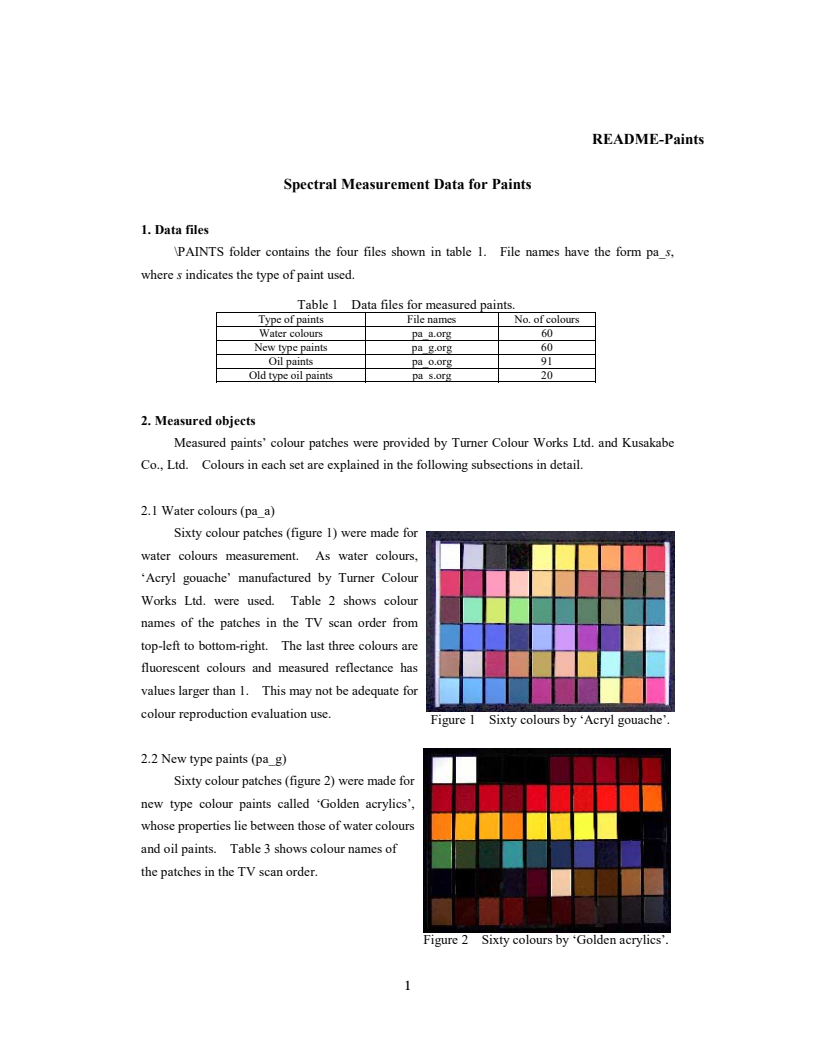
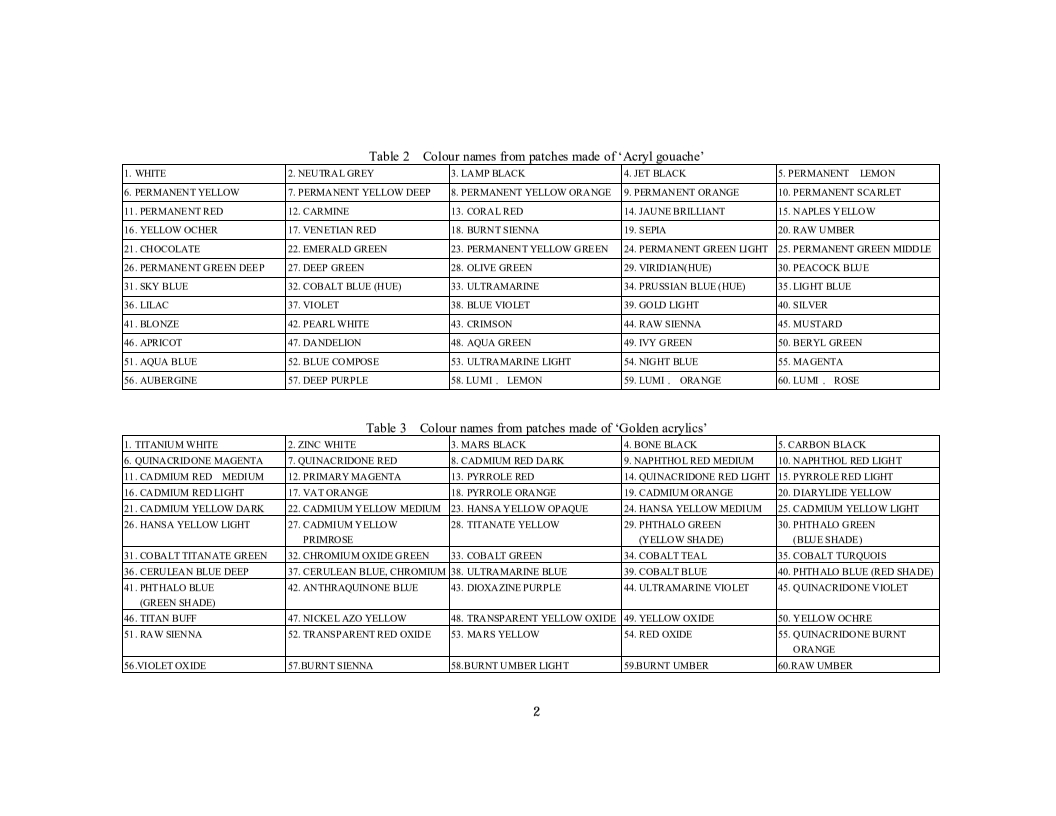
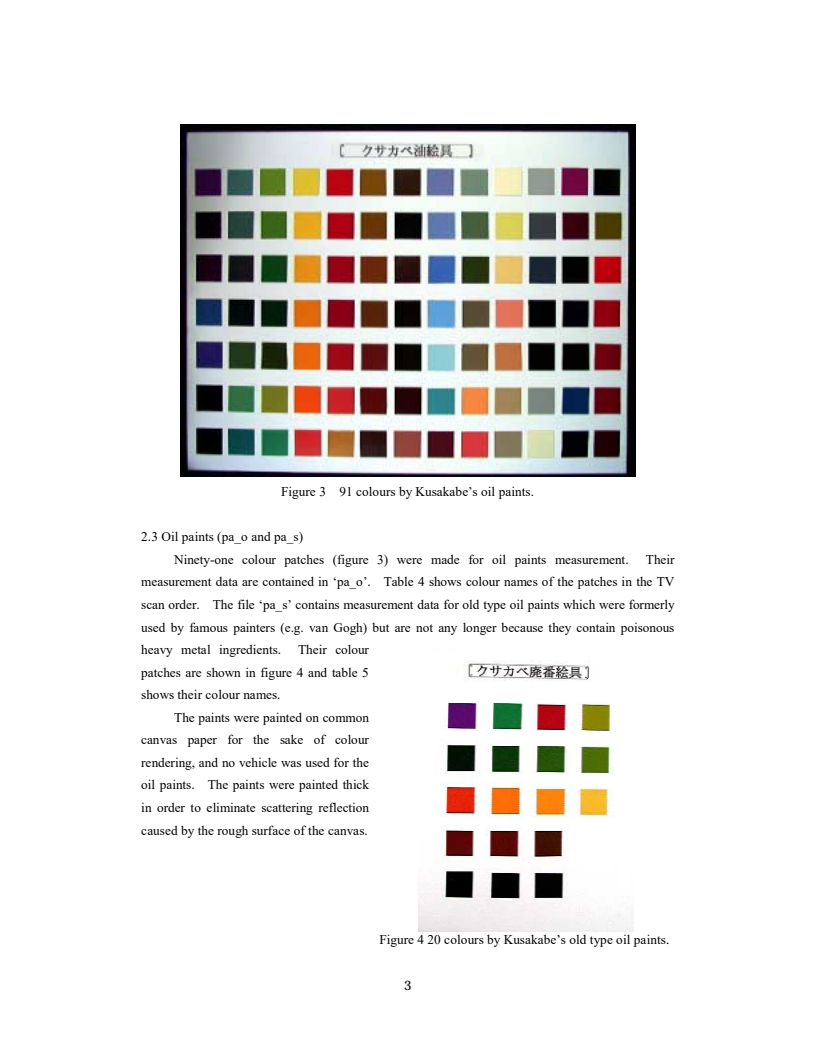
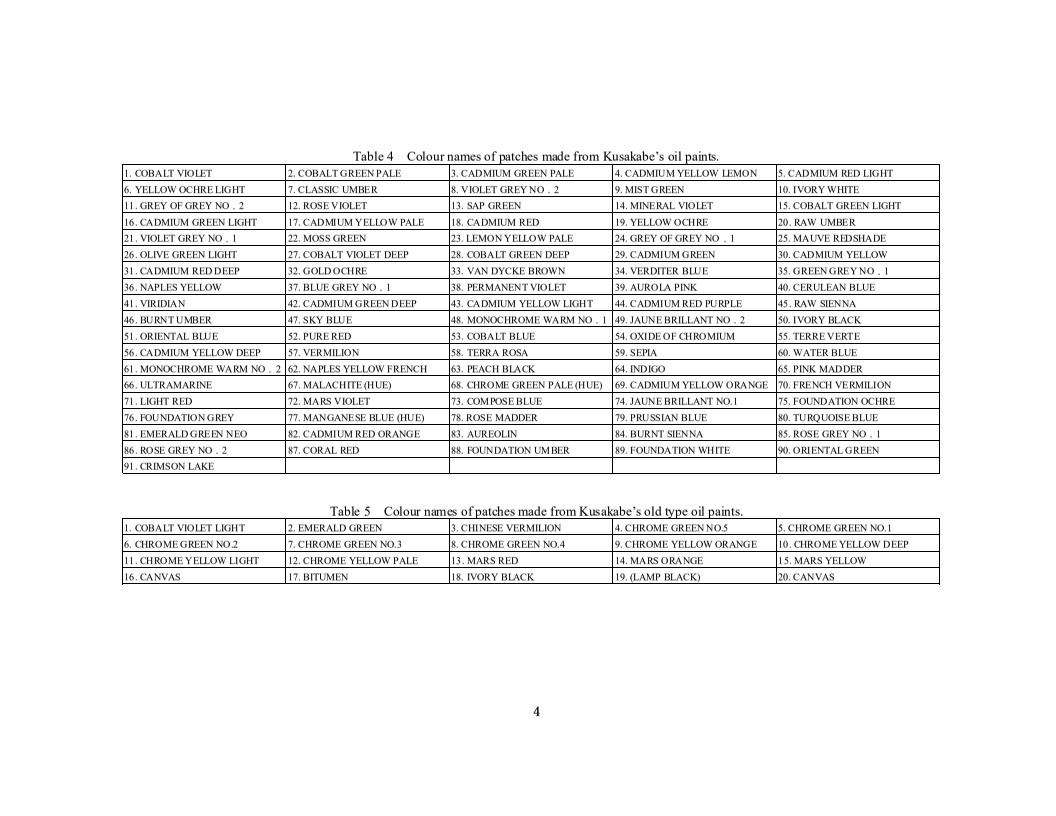
Readme-Paints - ISO/TR 16066:2003 - Graphic technology — Standard object colour spectra database for colour reproduction evaluation (SOCS)/31/2003


Readme-Photo - ISO/TR 16066:2003 - Graphic technology — Standard object colour spectra database for colour reproduction evaluation (SOCS)/31/2003
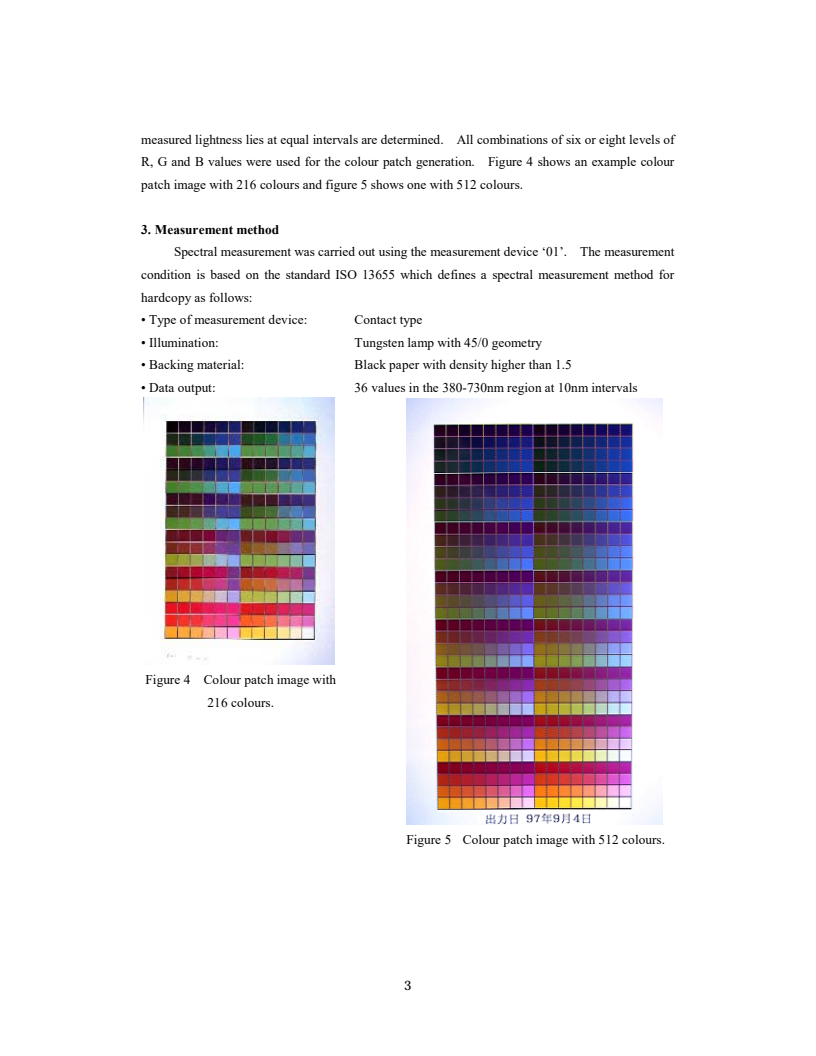

Readme-Printer - ISO/TR 16066:2003 - Graphic technology — Standard object colour spectra database for colour reproduction evaluation (SOCS)/31/2003
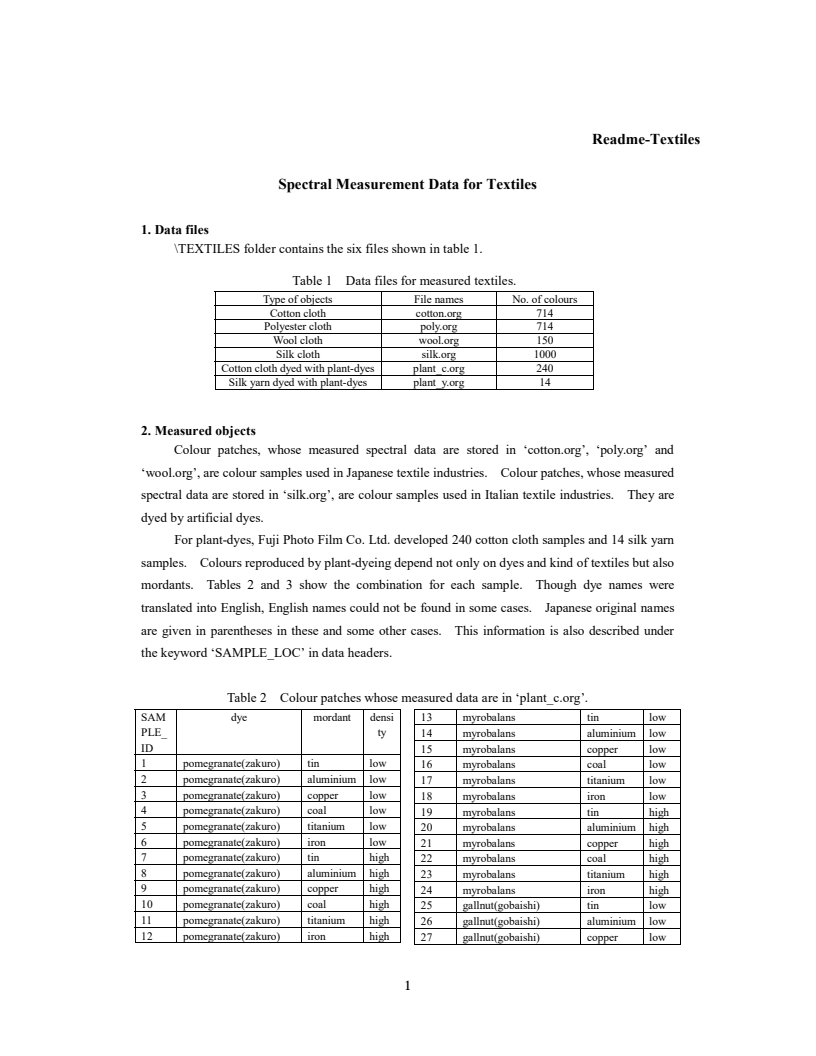
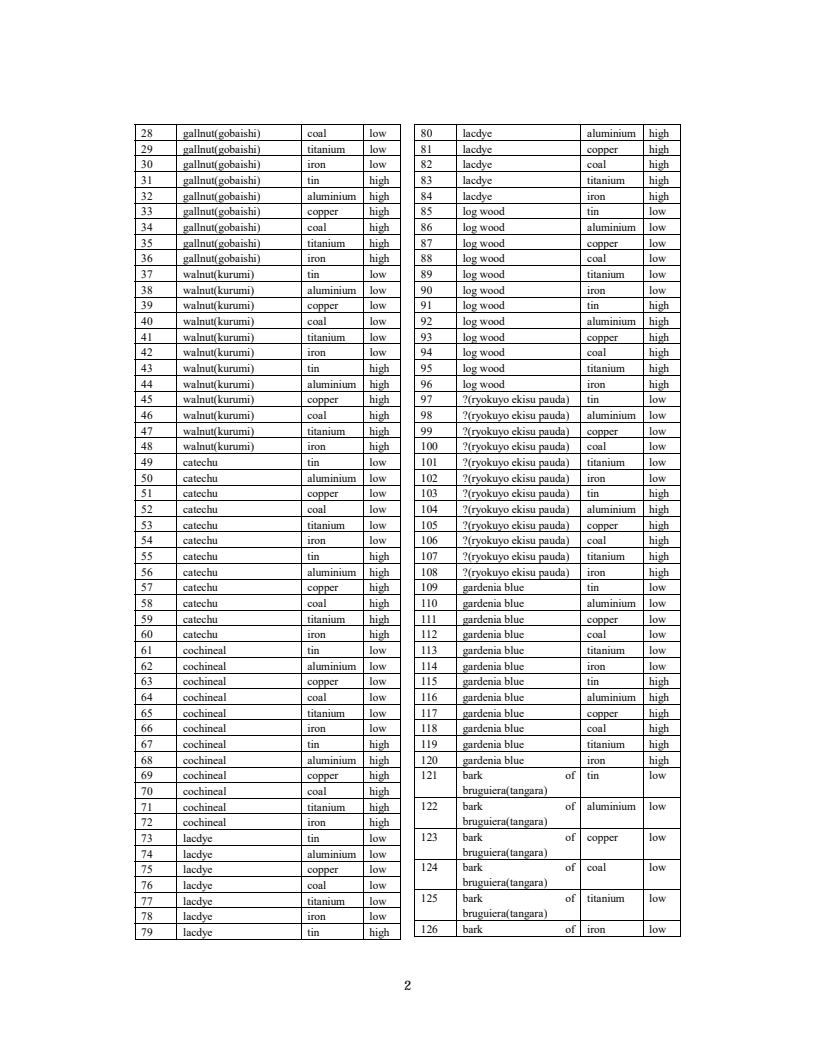
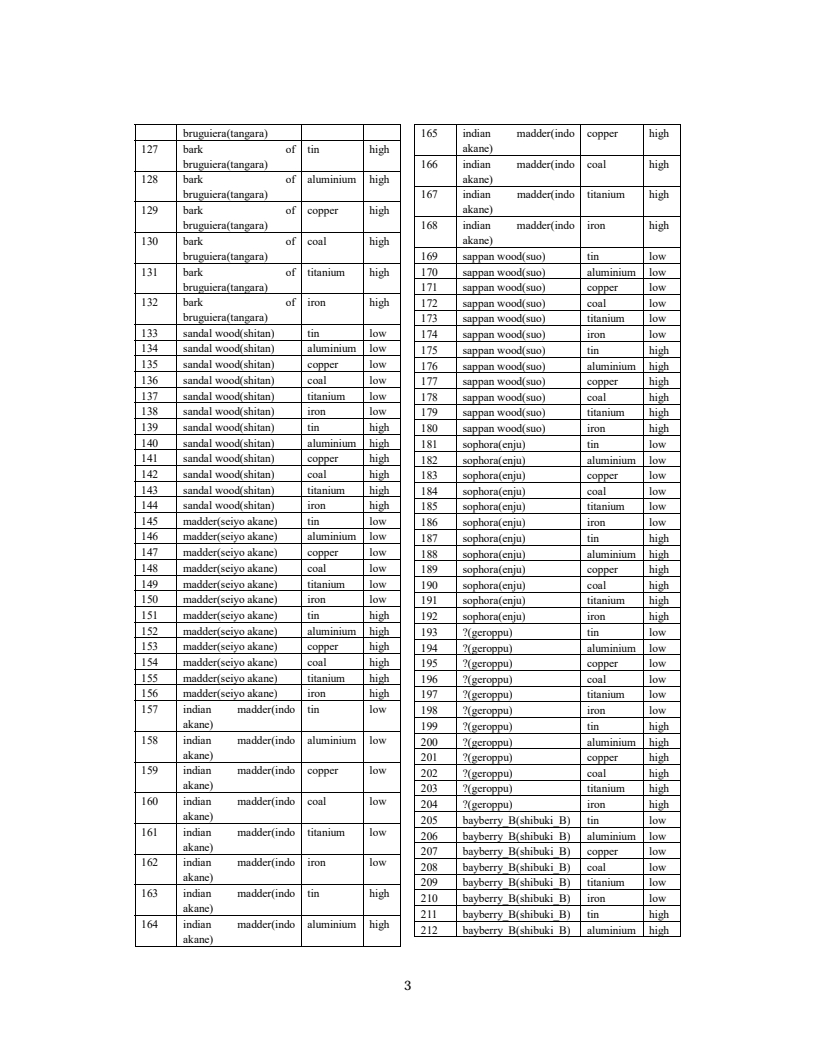
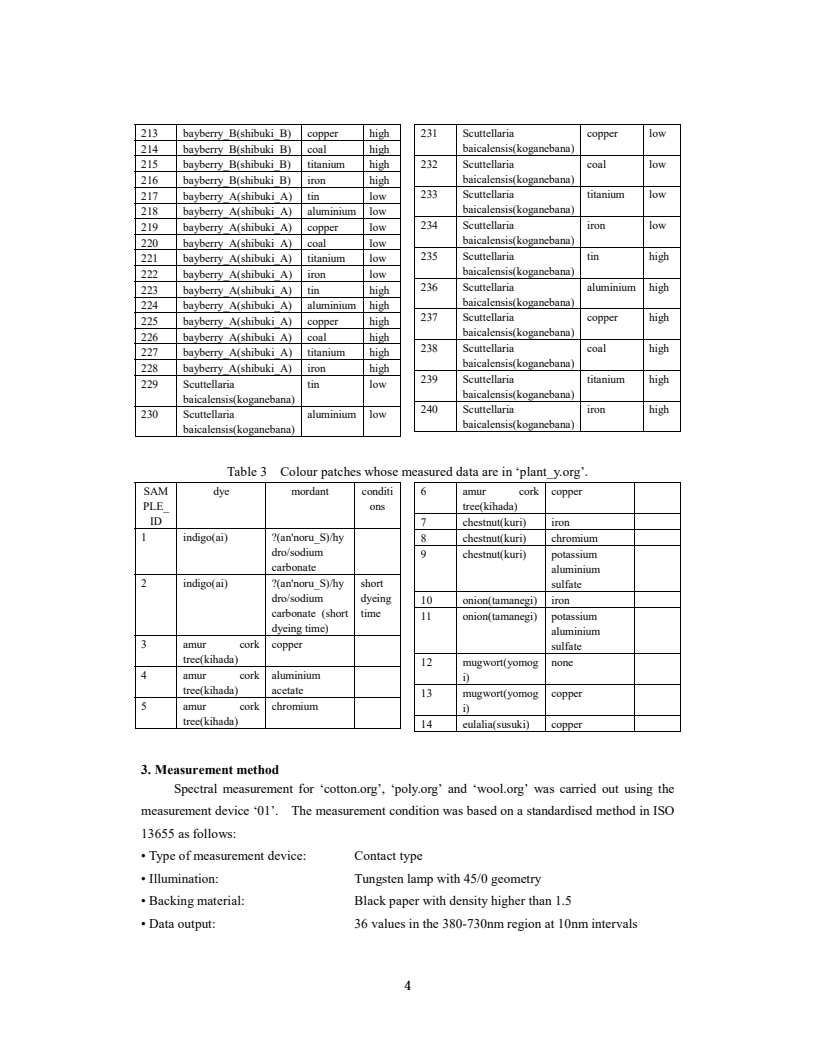
Readme-Textiles - ISO/TR 16066:2003 - Graphic technology — Standard object colour spectra database for colour reproduction evaluation (SOCS)/31/2003
Overview
ISO/TR 16066:2003 - Graphic technology: Standard object colour spectra database for colour reproduction evaluation (SOCS) - provides a curated spectral database and guidance to evaluate colour reproduction of image input devices (scanners, digital cameras). The Technical Report contains 365 typical and difference spectral samples derived from a source collection of over 50 000 measured object spectra, plus the original spectral reflectance and transmittance source data. All spectral data are 31-dimensional (400–700 nm at 10 nm intervals) and are supplied as percent reflectance or transmittance.
Key topics
- Scope and purpose: database intended for objective assessment of colour reproduction and metamerism effects in image capture systems.
- Object categories: photographic materials (transparencies, reflection prints), offset and computer prints (dye-sublimation, electrostatic, ink-jet), paints, textiles (synthetic and plant dyes), flowers/leaves/outdoor scenes, and human skin (multiple ethnic groups and foundation-applied skin).
- Typical sets vs difference sets:
- Typical sets - representative spectral samples for each category (selected by colour or spectral-distribution methods).
- Difference sets - metameric pairs whose tristimulus values under D65 are similar to typical samples but are spectrally different; useful to test metamerism sensitivity.
- Selection methods: statistical averaging for artificial colours, principal component analysis (PCA) and lattice sampling for natural colours, and specific algorithms for skin groups and difference-set selection (normative annexes describe methods).
- Data format and access: spectral files organized in directories (typical, difference, SourceData); correspondence with original measurements provided in annexes.
Applications and users
ISO/TR 16066 is practical for:
- Colour scientists and researchers evaluating sensor metamerism and illuminant effects.
- Camera and scanner manufacturers validating colour-capture fidelity and designing spectral sensitivities.
- Printer and imaging system developers testing end-to-end reproduction performance.
- Quality assurance teams in graphic arts, photography, textiles and paint industries performing device profiling and acceptance tests.
- Lighting engineers and colourimetric labs assessing metameric indices and non-standard illumination effects on real object colours.
Practical uses include device calibration, metamerism testing, profiling workflows, validation of colour-management chains, and targeted skin-tone reproduction assessment.
Related standards
- ISO 12641 - Colour targets for input scanner calibration (prepress)
- CIE 15.2, CIE 51.2, CIE 80 - publications on colorimetry and metamerism indices
Keywords: ISO/TR 16066:2003, SOCS, standard object colour spectra, colour reproduction evaluation, spectral reflectance, transmittance, metamerism, image input devices, spectral database.
Relations
- Consolidated By
ISO 6142-1:2015 - Gas analysis — Preparation of calibration gas mixtures — Part 1: Gravimetric method for Class I mixtures - Effective Date
- 27-Jan-2024
Buy Documents
ISO/TR 16066:2003 - Graphic technology — Standard object colour spectra database for colour reproduction evaluation (SOCS) Released:3/31/2003
Readme-Calib - ISO/TR 16066:2003 - Graphic technology — Standard object colour spectra database for colour reproduction evaluation (SOCS)/31/2003
Readme-face - ISO/TR 16066:2003 - Graphic technology — Standard object colour spectra database for colour reproduction evaluation (SOCS)/31/2003
Readme-Flowers - ISO/TR 16066:2003 - Graphic technology — Standard object colour spectra database for colour reproduction evaluation (SOCS)/31/2003
Readme-Graphic - ISO/TR 16066:2003 - Graphic technology — Standard object colour spectra database for colour reproduction evaluation (SOCS)/31/2003
Readme-INT - ISO/TR 16066:2003 - Graphic technology — Standard object colour spectra database for colour reproduction evaluation (SOCS)/31/2003
Readme-Krinov - ISO/TR 16066:2003 - Graphic technology — Standard object colour spectra database for colour reproduction evaluation (SOCS)/31/2003
Readme-Leaves - ISO/TR 16066:2003 - Graphic technology — Standard object colour spectra database for colour reproduction evaluation (SOCS)/31/2003
Readme-Paint - ISO/TR 16066:2003 - Graphic technology — Standard object colour spectra database for colour reproduction evaluation (SOCS)/31/2003
Readme-Paints - ISO/TR 16066:2003 - Graphic technology — Standard object colour spectra database for colour reproduction evaluation (SOCS)/31/2003
Readme-Photo - ISO/TR 16066:2003 - Graphic technology — Standard object colour spectra database for colour reproduction evaluation (SOCS)/31/2003
Readme-Printer - ISO/TR 16066:2003 - Graphic technology — Standard object colour spectra database for colour reproduction evaluation (SOCS)/31/2003
Readme-Textiles - ISO/TR 16066:2003 - Graphic technology — Standard object colour spectra database for colour reproduction evaluation (SOCS)/31/2003
Frequently Asked Questions
ISO/TR 16066:2003 is a technical report published by the International Organization for Standardization (ISO). Its full title is "Graphic technology — Standard object colour spectra database for colour reproduction evaluation (SOCS)". This standard covers: ISO/TR 16066:2003 provides a database of typical and difference sets of existing object colour spectral data that are suitable for evaluating the colour reproduction of image input devices. It also includes the spectral reflectance and transmittance source data from which these data sets have been derived.
ISO/TR 16066:2003 provides a database of typical and difference sets of existing object colour spectral data that are suitable for evaluating the colour reproduction of image input devices. It also includes the spectral reflectance and transmittance source data from which these data sets have been derived.
ISO/TR 16066:2003 is classified under the following ICS (International Classification for Standards) categories: 37.100.01 - Graphic technology in general. The ICS classification helps identify the subject area and facilitates finding related standards.
ISO/TR 16066:2003 has the following relationships with other standards: It is inter standard links to ISO 6142-1:2015. Understanding these relationships helps ensure you are using the most current and applicable version of the standard.
ISO/TR 16066:2003 is available in PDF format for immediate download after purchase. The document can be added to your cart and obtained through the secure checkout process. Digital delivery ensures instant access to the complete standard document.
Standards Content (Sample)
TECHNICAL ISO/TR
REPORT 16066
First edition
2003-03-15
Graphic technology — Standard object
colour spectra database for colour
reproduction evaluation (SOCS)
Technologie graphique — Base de données de spectres de couleurs
d'objets normalisée pour l'évaluation de la reproduction des couleurs
(SOCS)
Reference number
©
ISO 2003
PDF disclaimer
This PDF file may contain embedded typefaces. In accordance with Adobe's licensing policy, this file may be printed or viewed but
shall not be edited unless the typefaces which are embedded are licensed to and installed on the computer performing the editing. In
downloading this file, parties accept therein the responsibility of not infringing Adobe's licensing policy. The ISO Central Secretariat
accepts no liability in this area.
Adobe is a trademark of Adobe Systems Incorporated.
Details of the software products used to create this PDF file can be found in the General Info relative to the file; the PDF-creation
parameters were optimized for printing. Every care has been taken to ensure that the file is suitable for use by ISO member bodies. In
the unlikely event that a problem relating to it is found, please inform the Central Secretariat at the address given below.
© ISO 2003
All rights reserved. Unless otherwise specified, no part of this publication may be reproduced or utilized in any form or by any means,
electronic or mechanical, including photocopying and microfilm, without permission in writing from either ISO at the address below or
ISO's member body in the country of the requester.
ISO copyright office
Case postale 56 • CH-1211 Geneva 20
Tel. + 41 22 749 01 11
Fax + 41 22 749 09 47
E-mail copyright@iso.org
Web www.iso.org
Published in Switzerland
ii © ISO 2003 — All rights reserved
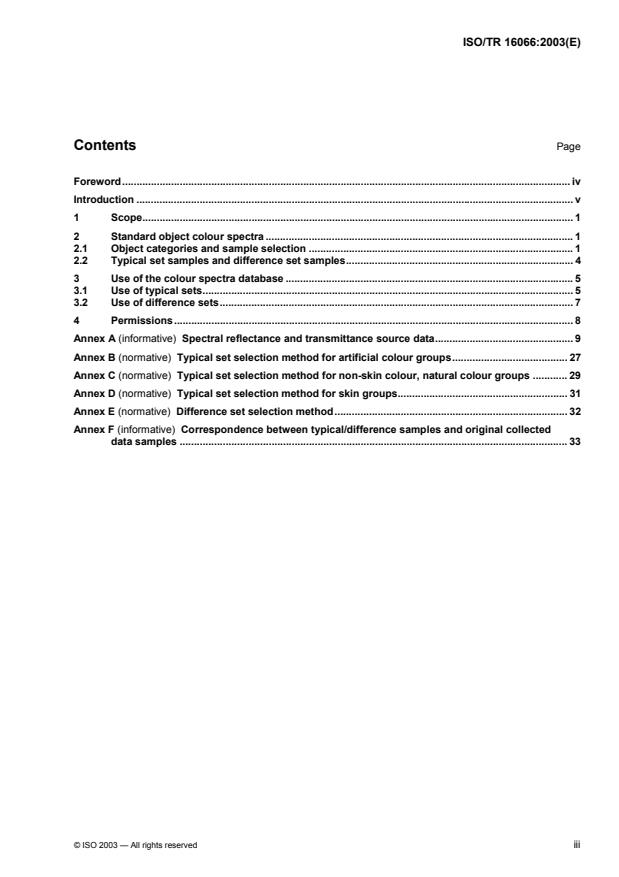
Contents Page
Foreword. iv
Introduction . v
1 Scope. 1
2 Standard object colour spectra . 1
2.1 Object categories and sample selection . 1
2.2 Typical set samples and difference set samples. 4
3 Use of the colour spectra database . 5
3.1 Use of typical sets. 5
3.2 Use of difference sets. 7
4 Permissions. 8
Annex A (informative) Spectral reflectance and transmittance source data. 9
Annex B (normative) Typical set selection method for artificial colour groups. 27
Annex C (normative) Typical set selection method for non-skin colour, natural colour groups . 29
Annex D (normative) Typical set selection method for skin groups. 31
Annex E (normative) Difference set selection method. 32
Annex F (informative) Correspondence between typical/difference samples and original collected
data samples . 33
Foreword
ISO (the International Organization for Standardization) is a worldwide federation of national standards bodies
(ISO member bodies). The work of preparing International Standards is normally carried out through ISO
technical committees. Each member body interested in a subject for which a technical committee has been
established has the right to be represented on that committee. International organizations, governmental and
non-governmental, in liaison with ISO, also take part in the work. ISO collaborates closely with the
International Electrotechnical Commission (IEC) on all matters of electrotechnical standardization.
International Standards are drafted in accordance with the rules given in the ISO/IEC Directives, Part 2.
The main task of technical committees is to prepare International Standards. Draft International Standards
adopted by the technical committees are circulated to the member bodies for voting. Publication as an
International Standard requires approval by at least 75 % of the member bodies casting a vote.
In exceptional circumstances, when a technical committee has collected data of a different kind from that
which is normally published as an International Standard (“state of the art”, for example), it may decide by a
simple majority vote of its participating members to publish a Technical Report. A Technical Report is entirely
informative in nature and does not have to be reviewed until the data it provides are considered to be no
longer valid or useful.
Attention is drawn to the possibility that some of the elements of this document may be the subject of patent
rights. ISO shall not be held responsible for identifying any or all such patent rights.
ISO/TR 16066 was prepared by Technical Committee ISO/TC 130, Graphic technology.
The TC 130 Japanese National Committee prepared this database, and their efforts have made this Technical
Report possible. The original form of this report was published as a technical report TR X 0012 by the
Japanese Standards Association in Japanese in December 1998.
iv © ISO 2003 — All rights reserved
Introduction
The simplest way to evaluate the colour reproduction of colour image input devices is to input images of objects
whose colours are exactly known and then to compare the pixel values to exact ones. For that purpose, input
colour target standards have been already established in ISO 12641:1997, Graphic technology — Prepress
digital data exchange — Colour targets for input scanner calibration. Evaluation becomes more complicated,
however, when we consider metamers.
The perceived colours of a pair of objects are referred to as metamers if, under a particular illumination, they
have the same tristimulus values even though they are spectrally different. The spectral pairs of such objects
may be used to advantage in the assessment of differences among lighting conditions. If, for instance, a pair
of spectra yield the same tristimulus values X, Y, Z under CIE illuminant D50, the difference between the two
perceived colours of the pair of spectra as measured in the field under a different illumination is referred to as
a metameric index, which can be used as a measure of the non-conformance of that illumination to D50.
While it may be sometimes preferable, e.g. for standards purposes, to use artificial pairs of perceived colours,
i.e. those not coming from natural objects, natural metameric pairs have the advantage that one can assess
the effect of non-standard lighting for a particular lighting condition. One may find, for instance, that a
particular light source leads to unacceptably large deviations in skin tones, whereas the same source is quite
acceptable for furniture colours.
Definitions with respect to metameric indices and the procedures for their evaluation are described in the
following CIE publications:
CIE 15.2, Colorimetry, 2nd ed. (1986) (Contains Special Metamerism Index: Change in Illuminant)
CIE 51.2, A method for assessing the quality of daylight simulators for colorimetry (1999)
CIE 80, Special metamerism index: Change in observer (1989)
It can also be useful to consider metamers in the evaluation of such colour image input devices as colour
scanners and digital cameras, which, though designed to capture images in a way similar to that of the human
visual system (HVS), nonetheless deviate enough from HVS sensitivity so that colour reproduction of sensed
colours in display devices or print outputs are significantly different from that desired, even when the
illumination conditions of the original human observation of an object have been recreated for the observation
of the output image.
To evaluate deviations due to variations in light sources and/or sensor sensitivities under actual conditions, it
is useful to know the range of spectral differences in existing objects. Committee members have created an
exhaustive collection of colours of existing objects, a database containing more than 50 000 items. This report
details the extraction from the data of 365 colour samples and their classification into sets, of which there are
two types, “typical sets” and “difference sets”. “Typical sets” refers to sets of typical spectral reflectances and
transmittances of objects as classified into a number of different categories. “Difference sets” refers to sets of
metamers whose tristimulus values are roughly typical but whose spectral values are significantly non-typical.
The entire original collection of more than 50 000 spectral data items is included, in electronic form, as part of
this Technical Report in the data directory SourceData as described in Annex A.
TECHNICAL REPORT ISO/TR 16066:2003(E)
Graphic technology — Standard object colour spectra database
for colour reproduction evaluation (SOCS)
1 Scope
This Technical Report provides a database of typical and difference sets of existing object colour spectral data
that are suitable for evaluating the colour reproduction of image input devices. It also includes the spectral
reflectance and transmittance source data from which these data sets have been derived.
2 Standard object colour spectra
2.1 Object categories and sample selection
2.1.1 Categories and groups
The following categories and subcategories were first established:
(1) Photographic materials
a. Transparencies
b. Reflection prints
(2) Offset prints
(3) Computer colour prints
a. Dye sublimation printer
b. Electrostatic printer
c. Ink-jet printer
(4) Paint (not for art)
(5) Paints (for art)
a. Oil paints
b. Water colours
(6) Textiles
a. Synthetic dyes
b. Plant dyes
(7) Flowers and leaves
(8) Outdoor scenes (Krinov data except for flowers and leaves)
(9) Human skin
a. Bare North Asian skin
b. Foundation-applied North Asian skin
c. Bare South Asian skin
d. Foundation-applied South Asian skin
e. Bare Caucasian skin
f. Bare Negroid skin
Spectral reflectance/transmittance data were then collected for more than 50 000 items falling into these
categories/subcategories.
Categories (1) to (5) and subcategory (6)a are for artificial colours, while subcategory (6)b and categories (7)
to (9) are for natural colours. Typical sets and difference sets were established from 365 samples in this
database. A typical set is a set of representative spectral data of colour objects, while a difference set is a set
of metamers whose colour under D65 illuminant is similar to typical set samples but differs significantly from
them spectrally. Samples for the typical and difference sets were selected as shown in Table 1. The manner
of selecting typical samples depended on whether colours were artificial or natural. In most artificial colour
groups, all colours are synthesized by mixing three or four colorants, and distributed almost uniformly in their
colour gamut. Colours in the paint (not for art) and paints (for art) categories, however, are synthesized by
mixing more than four colorants, and these categories were dealt with in the same manner as with natural
colours. Selection strategies are described in following subsections.
Table 1 — Numbers of selected typical/difference set colour samples
Group Typical sets Difference sets
Photo (transparency) 15 15
Photo (reflection print) 15 15
Offset prints 15 15
Dye sublimation printer 15 15
Electrostatic printer 15 15
Ink-jet printer 15 15
Textiles (synthetic dyes) 15 15
Flowers/grasses/leaves (includes 25 25
Krinov’s grasses and leaves)
Paint (not for art) 15 —
Oil paints 15 —
Water colours 15 —
Textiles (plant) 15 —
Non-grass/leaf Krinov 15 —
Bare North Asian skin 5 —
FD-applied North Asian skin 5 —
Bare South Asian skin 5 —
FD-applied South Asian skin 5 —
Bare Caucasian skin 5 —
Bare Negroid skin 5 —
Total 365
2 © ISO 2003 — All rights reserved
NOTE ‘Foundation’ is a cosmetic used as a base for facial make-up. However, in this Technical Report, ‘foundation
applied skin’ means skin that is not bare, but covered with foundation and/or face powder.
2.1.2 Typical set selection for artificial colour groups
There are seven artificial colour groups in Table 1: photographic transparency, photographic reflection prints,
offset prints, dye sublimation printer, electrostatic printer, ink-jet printer, and textiles (synthetic dyes). Colour
samples can be obtained for every hue in these groups.
Colorants can be expected to vary within any one group, as, for example, among the many products of
different photographic prints material manufacturers. Spectral reflectance measurements were carried out for
several representative products among them. Statistical analysis was carried out on the measurement data,
and the product whose characteristics most closely approximated the statistical average for the products as a
whole was determined to be a typical colour product. A mathematical explanation for this is found in Annex B.
From a large number of colour samples for a typical product, fifteen samples were selected whose colours are
nearest to pre-determined basic colours, which consist of three achromatic colours and twelve chromatic
colours that are homogeneously distributed in twelve hues. Lightness and chromaticity of each chromatic
colour was such that the colour gamut of each artificial colour group contained all the chromatic colours.
Table 2 shows the achromatic colours (1-3) and the chromatic colours (4-15). The colour for each spectral
data is calculated under D65 illuminant.
Table 2 — Basic colours for artificial colour groups
L* H* C* a* b*
1 20 — 0 0,0 0,0
2 50 — 0 0,0 0,0
3 80 — 0 0,0 0,0
4 40 0 30 30,0 0,0
5 45 30 35 30,3 17,5
6 50 60 37 18,5 32,0
7 60 90 45 0,0 45,0
8 60 120 30 −15,0 26,0
9 45 150 30 −26,0 15,0
10 45 180 23 −23,0 0,0
11 45 210 22 −19,1 −11,0
12 45 240 20 −10,0 −17,3
13 40 270 20 0,0 −20,0
14 35 300 27 13,5 −23,4
15 40 330 30 26,0 −15,0
2.1.3 Typical set selection for non-skin colour, natural colour groups
There are six natural colour groups in Table 1 for non-skin colours: flowers/grasses/leaves (including Krinov’s
grasses/leaves), paint (not for art), oil paints, watercolours, textiles (plant), and non-grass/leaf Krinov.
Samples in natural colour groups are not distributed in whole hues, and typical samples cannot be selected on
the basis of their colours. To select typical set samples for natural colour groups, an algorithm based on
spectral distribution was developed. When principal component analysis was applied to all samples in a group,
it became possible to express the data distribution in a low dimensional subspace. An equi-distanced lattice
was set in the subspace, and a representative sample was selected from each lattice point. A mathematical
explanation for this is found in Annex C. Twenty-five typical samples were selected from the
‘flowers/grasses/leaves’ group, while 15 typical samples were selected from each of the other groups.
2.1.4 Typical set selection for skin groups
There are six skin colour groups in Table 1: Bare North Asian skin, FD (foundation)-applied North Asian skin,
Bare South Asian skin, FD-applied South Asian skin, Bare Caucasian skin, and Bare Negroid skin. Skin
colours are not distributed over a wide range, and only five samples were selected from each group. These
colours correspond to average and extreme colours over their distribution in CIELAB space. The mathematical
explanation for this is found in Annex D.
2.1.5 Difference set selection
Difference set samples were selected for typical samples in the artificial colour groups and in the
flowers/grasses/leaves group. Colour samples in difference sets have colours that, while similar to typical set
sample colours under D65 illuminant, are significantly different spectrally. Samples whose colour was least
different from a typical set were selected first. The most spectrally different colours among these were then
selected to create the difference set. The mathematical explanation for this is found in Annex E.
2.2 Typical set samples and difference set samples
Typical set spectral data and difference set spectral data are stored in electronic form as files in the
subdirectories designated ‘typical’ and ‘difference’ described in the directory TRDatabase that is part of this
Technical Report. All spectral data are 31 dimensional, from 400 nm to 700 nm at 10 nm interval. The spectral
data are presented as percent reflectance factor or percent transmittance factor. File names corresponding to
the above groups are summarized in Table 3. The originally collected data can also be accessed from the
data directory SourceData which is described in Annex A. Correspondence with original sample identification
numbers (IDs) is summarized in Annex F.
The files ‘photo_t’, ‘photo_r’, ‘offset’, ‘print_ds’, ‘print_es’, ‘print_ij’, and ‘textiles_s’ in ‘typical’ directory include
typical set samples from artificial colour groups, each sample with a number from 1 to 15 has a colour similar
to its corresponding basic colour. The same holds for the difference set colours in the files ‘photo_t-d’,
‘photo_r-d’, ‘offset-d’, ‘print_ds-d’, ‘print_es-d’, ‘print_ij-d’, and ‘textiles_s-d’ in the ‘difference’ directory, since
they are samples in artificial colour groups. For the other typical set samples and for the other difference set
samples, which belong to natural colour groups, there is no such relation to basic colours. Nevertheless, the
order of colour samples in ‘flowers_leaves’ file in the ‘typical’ directory corresponds to the order of colour
samples in the ‘flowers_leaves-d’ file in the ‘difference’ directory. Such correspondences can be confirmed by
comparing the L*, a* and b* values of the samples in Annex F.
4 © ISO 2003 — All rights reserved
Table 3 — File names that contain typical set samples and difference set samples for each group
Kind of set Group Directory\File name
Typical set Photo (transparency) typical\photo_t.txt
Typical set Photo (reflection print) typical\photo_r.txt
Typical set Offset prints typical\offset.txt
Typical set Dye sublimation printer typical\print_ds.txt
Typical set Electrostatic printer typical\print_es.txt
Typical set Ink-jet printer typical\print_ij.txt
Typical set Textiles (synthetic dyes) typical\textiles_s.txt
Typical set Flowers/grasses/leaves (incl. Krinov’s grasses and leaves) typical\flowers_leaves.txt
Typical set Paint (not for art) typical\paint.txt
Typical set Oil paints typical\oil.txt
Typical set Water colours typical\water.txt
Typical set Textiles (plant) typical\textiles_p.txt
Typical set Non-grass/leaf Krinov typical\n_krinov.txt
Typical set Bare North Asian skin typical\n_asian_b.txt
Typical set FD-applied North Asian skin typical\n_asian_f.txt
Typical set Bare South Asian skin typical\s_asian_b.txt
Typical set FD-applied South Asian skin typical\s_asian_f.txt
Typical set Bare Caucasian skin typical\caucasian_b.txt
Typical set Bare Negroid skin typical\negroid_b.txt
Difference set Photo (transparency) difference\photo_t-d.txt
Difference set Photo (reflection print) difference\photo_r-d.txt
Difference set Offset prints difference\offset-d.txt
Difference set Dye sublimation printer difference\print_ds-d.txt
Difference set Electrostatic printer difference\print_es-d.txt
Difference set Ink-jet printer difference\print_ij-d.txt
Difference set Textiles (synthetic dyes) difference\textiles_s-d.txt
Difference set Flowers/grasses/leaves (incl. Krinov’s grasses and leaves) difference\flowers_leaves-d.txt
3 Use of the colour spectra database
3.1 Use of typical sets
In this section examples of how the database may be used to evaluate the colour reproduction accuracy of a
device are given. The usual colour reproduction evaluation scheme is as follows:
Object colour is calculated using colour matching functions where xx= 400 ,x 410 , .,
(xy, ,z) () ( )
tt t
xy700 , =y 400 ,y 410 , .,y 700 , zz= 400 ,z 410 , .,z 700 recommended by CIE 15.2.
() ()() () ()() ()
t
If the i-th object’s spectral reflectance is ββ= 400 ,β 410 , . ,β 700 and illumination intensity is
() () ( )
ii i i
t
SS= 400 ,S 410 , . ,S 700 , the CIE-1931 XYZ values for the i-th object may be expressed as in
()( ) ( )
equation (1):
Xk= S()λβλ()x()λ
0ii
∑
λ= 400
Yk= S λβλyλ
() ()()
0ii
∑
λ= 400
700 (1)
Zk= S λβλzλ
() ()()
0ii
∑
λ= 400
where k=
Syλλ
()()
∑
λ= 400
NOTE CIE 15.2 recommends that calculation shall be carried out from 380 nm to 780 nm at an interval of 5 nm.
However, in the practical cases for which this data is used (with a data range of 400 nm to 700 nm at an interval of 10 nm)
it is recommended that weighting functions such as those defined in ASTM E-308 be used.
Colour image input devices usually have sensors with three different spectral sensitivities. If actual sensor
t
t
sensitivities are s,,ss ss= ()400 ,s()410 , . ,s()700 , ss= ()400 ,s()410 , . ,s()700 ,
()
rg b rr r r gg g g
t
ss= ()400 ,s()410 , . ,s()700 output signals (R , G , B ) for the i-th object may be expressed as in
bb b b
i i i
equation (2):
700
RS= λβλs λ
() () ()
ii∑ r
λ= 400
GS= λβλs λ (2)
() () ()
ii∑ g
λ= 400
BS= λβλs λ
() () ()
ii∑ b
λ= 400
The (R , G , B ) is converted to colour values in the CIE-1931 XYZ colour space. Equation (3) is often used for
i i i
the conversion — though a higher order function may sometimes be desirable.
Xa a a R
ii11 12 13
Ya= a a G (3)
ii21 22 23
Z aa a B
ii 31 22 23
Matrix elements a can be determined using the least square method, where the sum of squared colour
{}
ij
differences for typical set colours are minimized in some colour space. The sum cannot be zero in practical
cases. This residual colour difference is evaluated in a uniform colour space (e.g. CIELAB space). The
conversion from the XYZ space to the CIELAB space is also described in CIE 15.2. Letting the converted
** * ** *
values from (XY,,Z ) and (XY,,Z ) be La00ii,,b0i and Laii,,bi, respectively, the
00ii 0i ii i ( ) ( )
average colour difference for n typical set object colours may be expressed as in equation (4):
n
22 2
** * * **
LL−+a−a +b−b
()ii00(i i)(i0i)
∑
i= 1
*
∆E = (4)
ab
n
6 © ISO 2003 — All rights reserved
*
The smaller the ∆E , the better the colour reproduction. That is, in the event that sensor spectral sensitivities
ab
of colour image input devices can somehow be measured, it is possible to evaluate their colour reproducibility
using actual object colours. It is also possible to estimate colour reproducibility using this database when
designing the spectral sensitivities of image input devices.
Usually, a single image input apparatus does not need to input all the object colours in the world. Film
scanners, for example, need only to scan colour films; it is not necessary for scanners to reproduce the
colours of natural objects or scenery, and the colour reproduction of colour scanners only needs to be
evaluated for colour films. That is why data here have been classified into object groups. For a scanner,
therefore, only the typical set samples identified as “photo” in Table 3 (i.e. photo_t.txt and photo_r.txt) would
be used for evaluation.
On the other hand, for evaluating digital cameras, human faces, flowers, leaves and outdoor objects always
have high importance, and typical sets for these object groups would be used.
3.2 Use of difference sets
Difference sets contain samples whose appearance is similar to the appearance of typical sets samples under
the standard illuminant D65, but whose spectral reflectance/transmittance is significantly different from that of
typical set samples. That is, difference sets contain metamers. Let us first assume that β represents the
j
spectral reflectance of a given difference set sample, a reflectance that corresponds to β , the spectral
i
reflectance of a typical set sample. In this case, two sensor outputs will be calculated using two light sources
S and S . Four sets of R, G, and B values can then be obtained, as expressed in equations (5) through (8).
1 2
700
RS= λβλs λ
() () ()
ii11∑ r
λ= 400
GS= λβλs λ (5)
() () ()
ii11∑ g
λ= 400
BS λβλs λ
= () () ()
ii11∑ b
λ= 400
700
RS= λβλs λ
() () ()
ii22∑ r
λ= 400
GS= λβλs λ (6)
() () ()
ii22∑ g
λ= 400
BS= λβλs λ
() () ()
ii22∑ b
λ= 400
700
RS= λβλsλ
() () ()
jj11∑ r
λ= 400
GS= λβλs λ (7)
() () ()
jj11∑ g
λ= 400
BS= λβλs λ
() () ()
jj11∑ b
λ= 400
RS= λβλs λ
() () ()
jj22
∑
r
λ= 400
GS= λβλs λ (8)
() () ()
jj22 g
∑
λ= 400
BS= λβλs λ
() () ()
jj22 b
∑
λ= 400
To compare colour differences, CIELAB values for these four colour values can be calculated as
** * ** * ** * ** *
La,,b , La,,b , La,,b and La,,b through CIE-1931 XYZ values
ii11 i1 ii22 i2 jj11j jj22 j2
()()() ( )
*
as described in 3.1. The colour difference between β and β under light source 1 will then be equal to ∆E
i j ab1
*
in equation (9), and the colour difference between β and β under light source 2 will be equal to ∆E in
i j ab2
equation (10). By comparing the differences with those for the human visual system, it becomes possible to
evaluate a sensor’s resemblance to human eyes.
22 2
** * * * * *
∆EL=−L +a−a +b−b (9)
ab11()i j1( i1 j1)( i1 j1)
22 2
** * * * * *
∆EL=−L +a−a +b−b (10)
ab22()i j2( i2 j2)( i2 j2)
4 Permissions
The primary intent of this Technical Report is to provide data in digital form for the use of individuals and
organizations evaluating imaging systems. Therefore, the following is permitted:
a) The data files included as part of the Technical Report may be freely copied and used within the
organization purchasing a copy of this Technical Report from ISO, or an authorized reseller of ISO
documents. The data files (in either their original or any reformatted version) may not be distributed to any
other individual or organization.
b) Where this database is used for research, development, or evaluation, any publication reporting such
work shall identify this Technical Report as the source.
8 © ISO 2003 — All rights reserved
Annex A
(informative)
Spectral reflectance and transmittance source data
A.1 General
The spectral reflectance and transmittance source data collected as part of this project, and used to create the
typical and difference set samples, are included as electronic attachments to this Technical Report. These
data are classified into two groups, original data and interpolated data. The directory structure that contains
these files is shown in Figure A.1.
Figure A.1 — Directory structure of source data
A.1.1 \ORG files
ORG is an abbreviation of ‘ORIGINAL DATA’. The \ORG directory includes original spectral reflectance and
transmittance data measured by a spectral measurement apparatus. The data are classified in ten categories
so that users can select data appropriate for their use, depending on the types of colour image input devices
or the situations in which the data are used. The ten categories are shown below with names of directories
where the data are stored.
(1) Photographic materials (\PHOTO)
(2) Graphic prints (\GRAPHIC)
(3) Computer colour prints (\PRINTER)
(4) Paint (not for art) (\PAINT)
(5) Paints (for art) (\PAINTS)
(6) Textiles (\TEXTILES)
(7) Flowers (\FLOWERS)
(8) Leaves (\LEAVES)
(9) Human skin (\FACE)
(10) Krinov data (\KRINOV)
Sixteen spectral measurement devices were used to collect data in categories from (1) to (9). [Collection of
data in category (10) is explained later.] These devices are reliable but do not output the same values, even if
they measure the same object colours. To calibrate measured data, eight colour patches were produced and
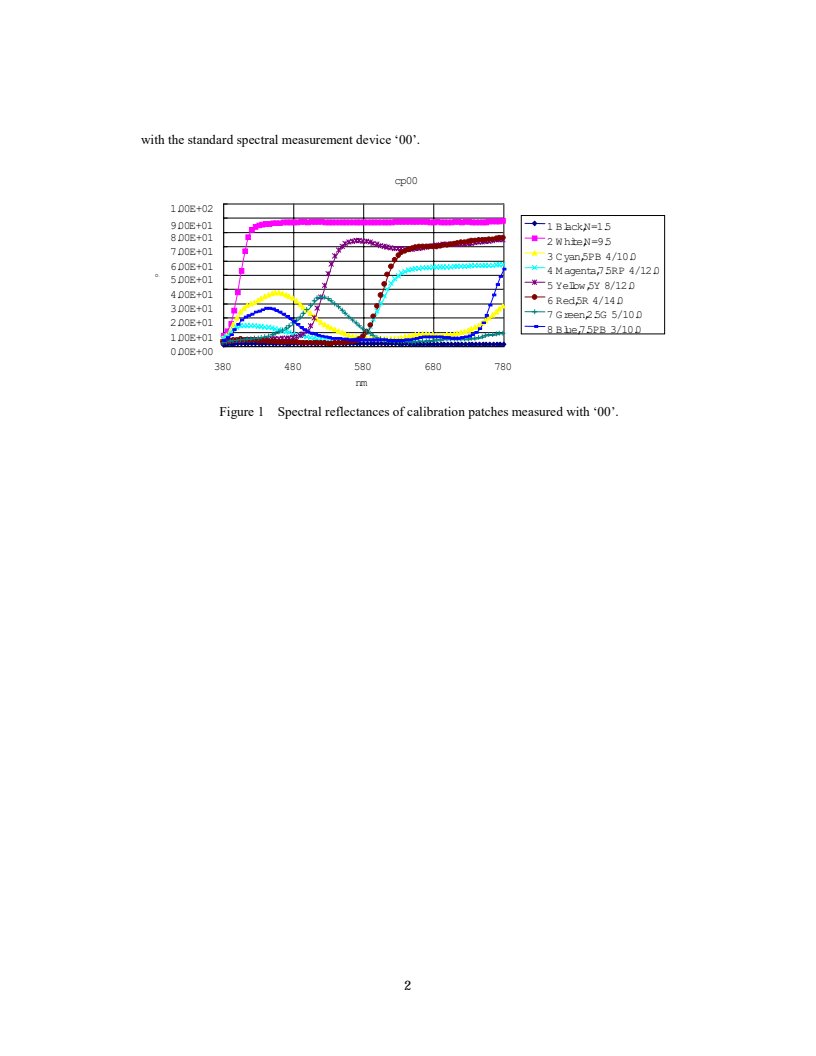
measured by the sixteen measurement devices under the same conditions as were in effect when they
measured the object colours in categories from (1) to (9).
A detailed explanation file "README" for data in each category is included in each directory.
A.1.1.1 Photographic materials (\PHOTO)
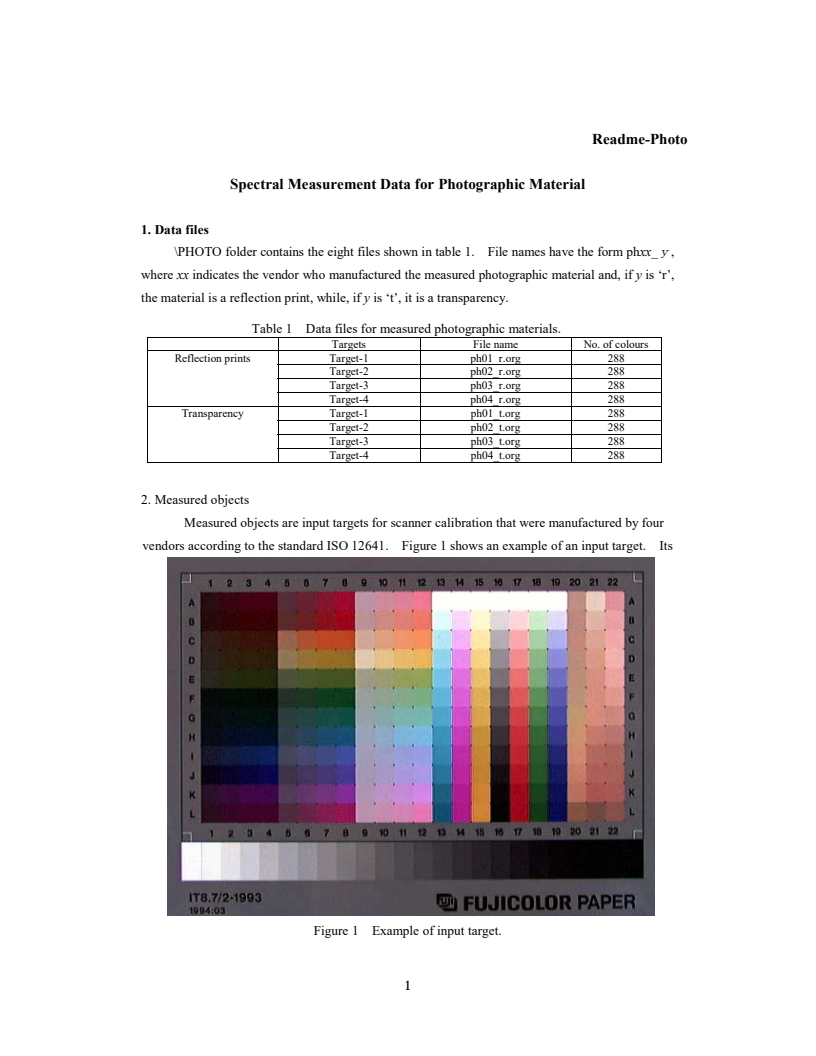
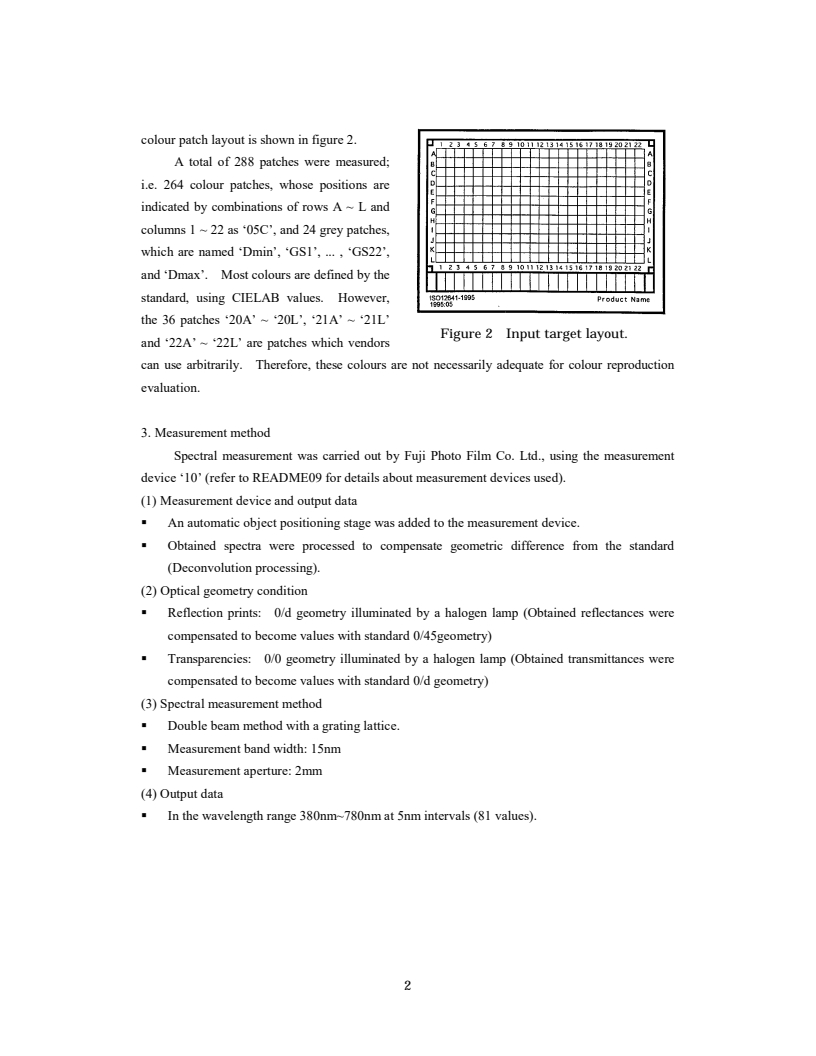
Eight files are stored in the \PHOTO directory. They are shown in Table A.1. Transparent and reflection input
targets standardized by ISO 12641:1997 were produced by four major vendors. Spectral transmittance or
spectral reflectance for all colour patches in each target (288 colours) is recorded in each file.
Table A.1 — Files stored in \PHOTO directory
Target File name No. of Colours
Transparency Target-1 ph01_t.org 288
Target-2 ph02_t.org 288
Target-3 ph03_t.org 288
Target-4 ph04_t.org 288
Reflection print Target-1 ph01_r.org 288
Target-2 ph02_r.org 288
Target-3 ph03_r.org 288
Target-4 ph04_r.org 288
10 © ISO 2003 — All rights reserved
A.1.1.2 Graphic prints (\GRAPHIC)
The \GRAPHIC directory is divided into two subdirectories, \OFFSET and \GRAVURE. The \OFFSET directory
includes thirty files for colour patches printed by offset printing. They are summarised in Table A.2.
The colour patches are those standardized by C, M, Y and K ink quantities shown in ISO 12642:1996, Graphic
technology — Prepress digital data exchange — Input data for characterization of 4-colour process printing,
and as colour patch images in ISO 12640:1997, Graphic technology — Prepress digital data exchange —
CMYK standard colour image data (CMYK/SCID). The images were printed using ten kinds of ink and three
kinds of paper. Spectral reflectances of all 928 colour patches in the images are stored in each file.
Table A.2 — Files stored in \OFFSET directory
Printing method Ink Paper File name No. of colours
Offset printing Ink-1 Uncoated paper of01_u.org 928
Dull-coated paper of01_d.org 928
Gloss-coated paper of01_g.org 928
Ink-2 Uncoated paper of02_u.org 928
Dull-coated paper of02_d.org 928
Gloss-coated paper of02_g.org 928
Ink-3 Uncoated paper of03_u.org 928
Dull-coated paper of03_d.org 928
Gloss-coated paper of03_g.org 928
Ink-4 Uncoated paper of04_u.org 928
Dull-coated paper of04_d.org 928
Gloss-coated paper of04_g.org 928
Ink-5 Uncoated paper of05_u.org 928
Dull-coated paper of05_d.org 928
Gloss-coated paper of05_g.org 928
Ink-6 Uncoated paper of06_u.org 928
Dull-coated paper of06_d.org 928
Gloss-coated paper of06_g.org 928
Ink-7 Uncoated paper of07_u.org 928
Dull-coated paper of07_d.org 928
Gloss-coated paper of07_g.org 928
Ink-8 Uncoated paper of08_u.org 928
Dull-coated paper of08_d.org 928
Gloss-coated paper of08_g.org 928
Ink-9 Uncoated paper of09_u.org 928
Dull-coated paper of09_d.org 928
Gloss-coated paper of09_g.org 928
Ink-10 Uncoated paper of10_u.org 928
Dull-coated paper of10_d.org 928
Gloss-coated paper of10_g.org 928
The \GRAVURE directory includes three files of colour patches printed by gravure printing. The files are
shown in Table A.3. The colour patch images were printed using one type of paper under three different sets
of conditions. The colour patch images were the same as those for the offset printing.
Table A.3 — Files stored in \GRAVURE directory
Printing method Ink / Paper Printing condition File name No. of colours
Gravure printing Ink-1 / Gloss- Standard gr_s.org 928
coated paper
Minus gr_m.org 928
Plus gr_p.org 928
A.1.1.3 Computer colour prints (\PRINTER)
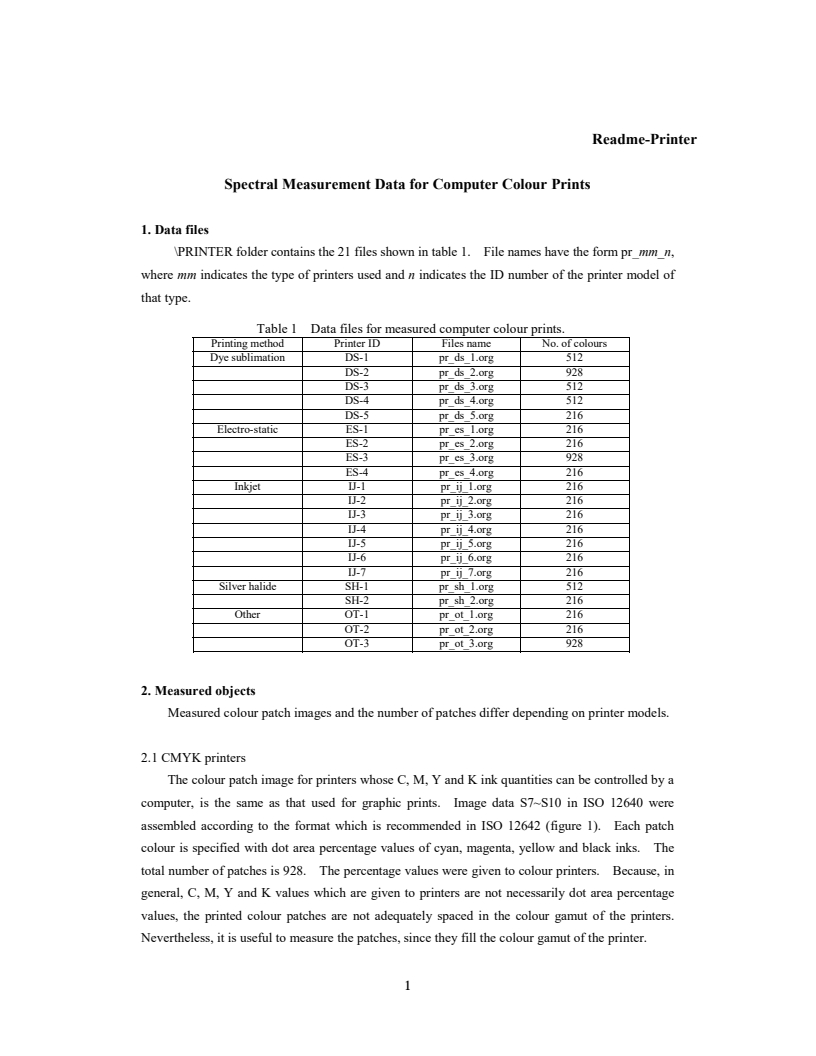
The \PRINTER directory contains the 21 files shown in Table A.4. Three kinds of colour patch images were
measured: 928-colour images, 512-colour images and 216-colour images. The 928-colour images, which are
the same as those used for graphic prints colour patch measurement, were printed by printers whose C, M, Y
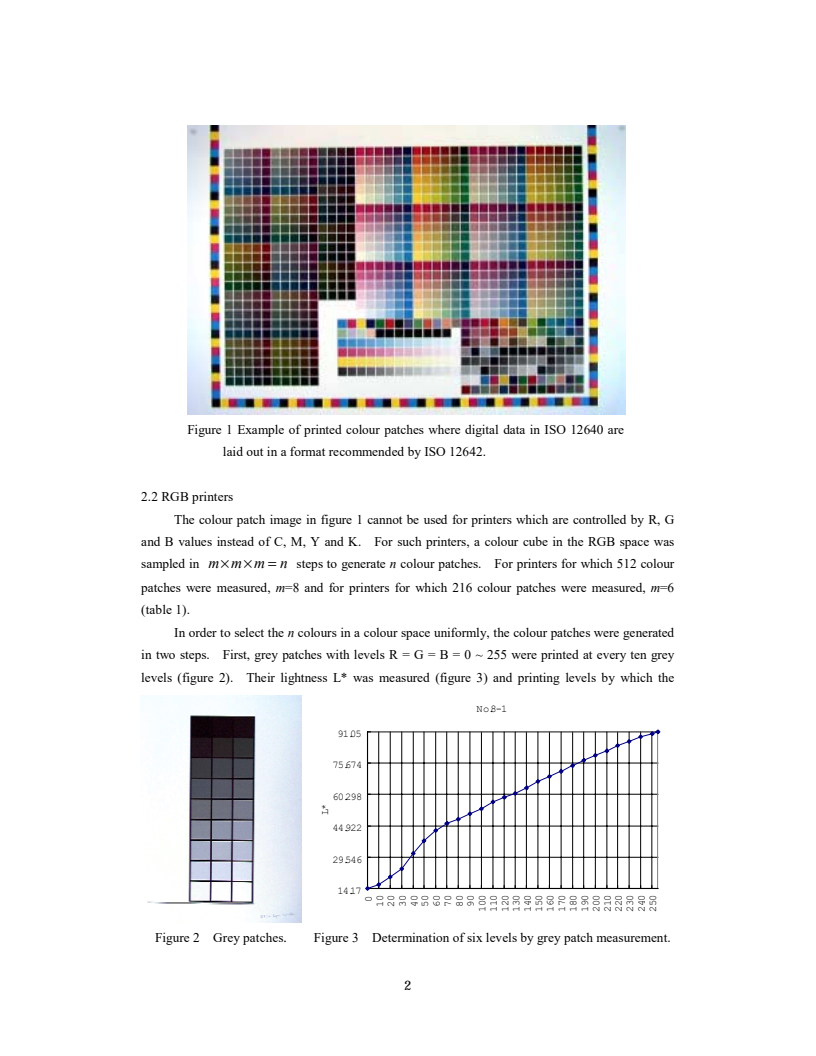
and K components can be controlled from a computer program. The 512- and 216-colour images were
employed for printers whose only computer-controllable components are R, G and B. For printers each of
whose colour components was controlled in eight steps, 512 colours were printed and measured, while for
printers each of whose colour components was controlled in six steps, 216 colours were printed and
measured.
Table A.4 — Files stored in \PRINTER directory
Printing method Printer ID Files name No. of colours
Dye sublimation DS-1 pr_ds_1.org 512
DS-2 pr_ds_2.org 928
DS-3 pr_ds_3.org 512
DS-4 pr_ds_4.org 512
DS-5 pr_ds_5.org 216
Electrostatic ES-1 pr_es_1.org 216
ES-2 pr_es_2.org 216
ES-3 pr_es_3.org 928
ES-4 pr_es_4.org 216
Inkjet IJ-1 pr_ij_1.org 216
IJ-2 pr_ij_2.org 216
IJ-3 pr_ij_3.org 216
IJ-4 pr_ij_4.org 216
IJ-5 pr_ij_5.org 216
IJ-6 pr_ij_6.org 216
IJ-7 pr_ij_7.org 216
Silver halide SH-1 pr_sh_1.org 512
SH-2 pr_sh_2.org 216
Other OT-1 pr_ot_1.org 216
OT-2 pr_ot_2.org 216
OT-3 pr_ot_3.org 928
12 © ISO 2003 — All rights reserved
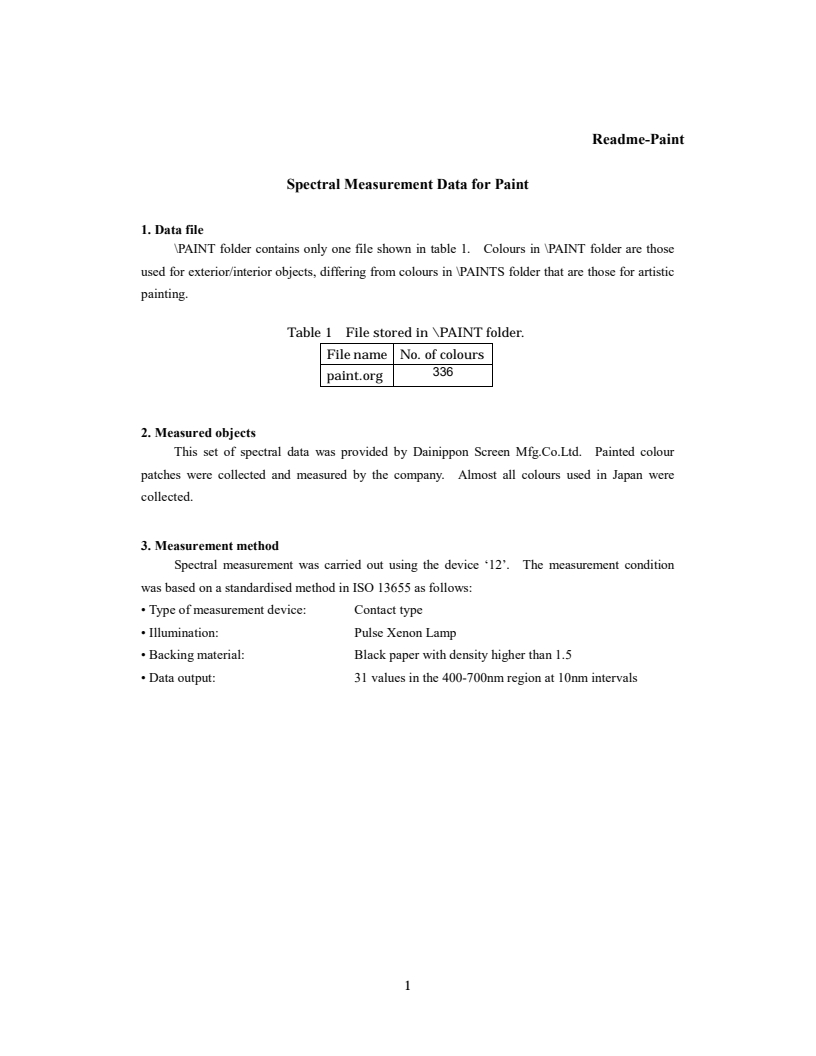
A.1.1.4 Paint (not for art) (\PAINT)
There is only one file in the \PAINT directory as shown in Table A.5. The file contains spectral reflectances of
painted objects. The colours are used for exterior/interior objects, and are not for artistic painting.
Table A.5 — File stored in \PAINT directory
File name Number of colours
paint.org 336
A.1.1.5 Paints (for art) (\PAINTS)
The \PAINTS directory contains the four files shown in Table A.6. Each file contains colour patch spectral
reflectances of oil paints, old type oil paints, watercolours, or new type watercolours whose properties lie
between those of water colours and oil paints. The old type oil paints are paints that were formerly used but
are not any longer because they contain poisonous heavy metal ingredients. Watercolour patches were
provided by Turner Colour Works Ltd., and oil paints patches were provided by Kusakabe Co. Ltd.
Table A.6 — Files stored in \PAINTS directory
Kind of paint Files name No. of colours
Water colour pa_a.org 60
New type paints pa_g.org 60
Oil paints pa_o.org 91
Old type oil paints pa_s.org 20
A.1.1.6 Textiles (\TEXTILES)
The \TEXTILES directory contains the six files shown in Table A.7. Colours on cotton, polyester, wool and silk
clothes are produced by synthetic dyes, while others are produced by plant dyes. The data for silk cloth were
provided by Consiglio Nazionale delle Ricerche, Italy, and the data for plant dyes were provided by Fuji Photo
Film Co., Ltd.
Table A.7 — Data files for measured textiles
Type of objects File names No. of colours
Cotton cloth cotton.org 714
Polyester cloth poly.org 714
Wool cloth wool.org 150
Silk cloth silk.org 1000
Cotton cloth dyed with plant-dyes plant_c.org 240
Silk yarn dyed with plant-dyes plant_y.org 14
A.1.1.7 Flowers (\FLOWERS)
There is only one file in the \FLOWERS directory as shown in Table A.8. The data were provided by Japan
Color Research Institute.
Table A.8 — File stored in \FLOWERS directory
File name Number of colours
flower.org 148
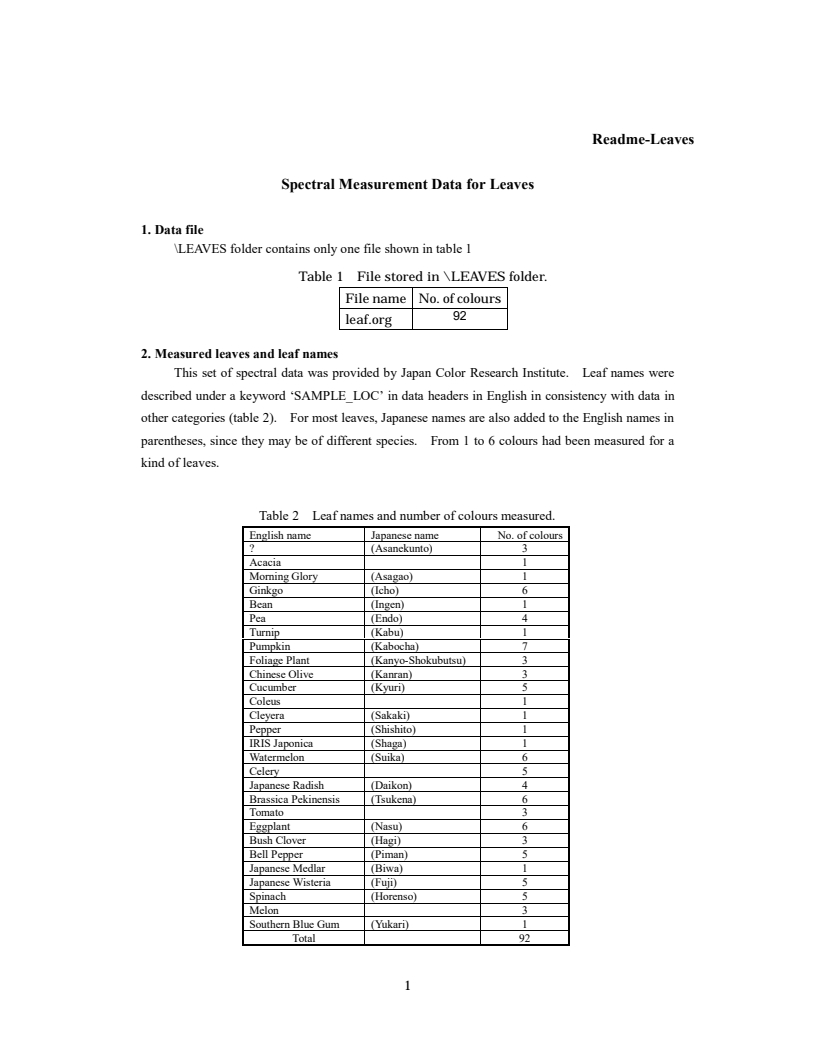
A.1.1.8 Leaves (\LEAVES)
There is only one file in the \LEAVES directory, as shown in Table A.9. The data were provided by Japan
Color Research Institute.
Table A.9 — File stored in \LEAVES directory
File name Number of colours
leaf.org 92
A.1.1.9 Human skin (\FACE)
The \FACE directory is divided into six subdirectories: \SHISEIDO, \KAO, \OOKA, \KAWASAKI, \OULU and
\SUN. Data file names were assigned according to the following rule: File names take the form of ‘ttgcppss’,
where
tt represents the name of the data set,
g represents gender (f: female, m: male),
c represents skin condition (b: bare skin, f: foundation-applied skin),
pp represents position (ch: cheek, fh: forehead, nk: neck, zy: zygomatic region, am: arm, ha: hand), and
ss represents the measurement device used.
The \SHISEIDO directory stores spectral reflectance data collected by Shiseido Co., Ltd. and contains the
27 files shown in Table A.10. All data are for females and represent measured spectral reflectances for
various skin positions and conditions. For any given locale, the order of individual subjects within each file is
the same.
14 © ISO 2003 — All rights reserved
Table A.10 — Files stored in \SHISEIDO directory
Subject set (locale, nationality) Skin condition Position File name No. of colours
Bangkok Foundation-applied skin Cheek baffchc1.org 62
Bare skin Forehead bafbfhc1.org 62
Bare skin Cheek bafbchc1.org 62
Bare skin Neck bafbnkc1.org 62
Kualalumpur (Chinese family) Foundation-applied skin Cheek kcffchc1.org 30
Bare skin Forehead kcfbfhc1.org 30
Bare skin Cheek kcfbchc1.org 30
Bare skin Neck kcfbnkc1.org 30
Kualalumpur (India family) Foundation-applied skin Cheek kiffchc1.org 30
Bare skin Forehead kifbfhc1.org 30
Bare skin Cheek kifbchc1.org 30
Bare skin Neck kifbnkc1.org 30
Kualalumpur (Malay family) Foundation-applied skin Cheek kmffchc1.org 30
Bare skin Forehead kmfbfhc1.org 30
Bare skin Cheek kmfbchc1.org 30
Bare skin Neck kmfbnkc1.org 30
Taipei Foundation-applied skin Cheek taffchc1.org 60
Bare skin Forehead tafbfhc1.org 60
Bare skin Cheek tafbchc1.org 60
Bare skin Neck tafbnkc1.org 60
Tokyo-1 Bare skin Neck t1fbnkc1.org 976
Bare skin Cheek t1fbchc1.org 976
Bare skin Zygomatic region t1fbzyc1.org 976
Tokyo-2 Bare skin Forehead t2fbfhc1.org 123
Bare skin Cheek t2fbchc1.org 123
Foundation-applied skin Forehead t2fffhc1.org 123
Foundation-applied skin Cheek t2ffchc1.org 123
The \KAO directory contains spectral reflectance data collected by the Kao Corporation. All data in this
directory are for Japanese females and were collected in Tokyo. It contains the eight files shown in Table A.11.
The order of individual subjects within each file is not the same.
Table A.11 — Files stored in \KAO directory
Subject set (place, nationality) Skin condition Position File name No. of colours
Tokyo (Japanese) Bare skin Forehead tofbfhc2.org 271
Foundation-applied skin Forehead tofffhc2.org 266
Bare skin Zygomatic region tofbzyc2.org 461
Foundation-applied skin Zygomatic region toffzyc2.org 325
Bare skin Cheek tofbchc2.org 460
Foundation-applied skin Cheek toffchc2.org 325
Bare skin Arm tofbamc2.org 37
Bare skin Neck tofbnkc2.org 313
The data in the \SHISEIDO and \KAO directories were all obtained with contact-type spectral measuring
devices. In contrast, the data in the \OOKA and \KAWASAKI directories were obtained with both contact-type
and remote-type measuring devices. Most subjects were males and a small portion of them were non-
Japanese. Table A.12 shows the composition by sex and nationality. Measured positions were forehead,
zygomatic region, and cheek. The data in \OOKA are stored in the 27 files shown in Table A.13 and organized
with respect to sex, skin condition, position, and measuring device, as in \SHISEIDO and \KAO. The same is
true for the data in \KAWASAKI (27 files; Table A.14).
Table A.12 — Composition of subjects in \OOKA and \KAWASAKI
OOKA KAWASAKI
Male FemaleMaleFemaleTotal
Japan 43 7 66 14 130
China 3 3 1 0 7
Korea 1 0 0 0 1
Taiwan 0 0 1 0 1
Singapore 1 0 0 0 1
Egypt 2 0 0 0 2
Bangladeshi 1 0 0 0 1
Turkey 1 0 0 0 1
France 1 0 0 0 1
Canada 0 0 1 0 1
Finland 0 0 1 0 1
Total 53 10 70 14 147
16 © ISO 2003 — All rights reserved
Table A.13 — Files stored in \OOKA directory
Subject set Type of measurement
Position Files name No. of colours
(sex / skin condition) device
Male / Bare skin Forehead Contact-1 oombfhc1.org 53
Zygomatic region Contact-1 oombzyc1.org 53
Cheek Contact-1 oombchc1.org 53
Forehead Contact-2 oombfhc2.org 53
Zygomatic region Contact-2 oombzyc2.org 53
Cheek Contact-2 oombchc2.org 53
Forehead Remote oombfhr.org 53
Zygomatic region Remote oombzyr.org 53
Cheek Remote oombchr.org 53
Female / Bare skin Forehead Contact-1 oofbfhc1.org 5
Zygomatic region Contact-1 oofbzyc1.org 5
Cheek Contact-1 oofbchc1.org 5
Forehead Contact-2 oofbfhc2.org 5
Zygomatic region Contact-2 oofbzyc2.org 5
Cheek Contact-2 oofbchc2.org 5
Forehead Remote oofbfhr.org 5
Zygomatic region Remote oofbzyr.org 5
Cheek Remote oofbchr.org 5
Female / Foundation-
Forehead Contact-1 oofffhc1.org 5
applied skin
Zygomatic region Contact-1 ooffzyc1.org 5
Cheek Contact-1 ooffchc1.org 5
Forehead Contact-2 oofffhc2.org 5
Zygomatic region Contact-2 ooffzyc2.org 5
Cheek Contact-2 ooffchc2.org 5
Forehead Remote oofffhr.org 5
Zygomatic region Remote ooffzyr.org 5
Cheek Remote ooffchr.org 5
Table A.14 — Files stored in \KAWASAKI directory
Subject set Type of measurement
Position Files name No. of colours
(sex / skin condition) device
Male / Bare skin Forehead Contact-1 kambfhc1.org 70
Zygomatic region Contact-1 kambzyc1.org 70
Cheek Contact-1 kambchc1.org 70
Forehead Contact-2 kambfhc2.org 70
Zygomatic region Contact-2 kambzyc2.org 70
Cheek Contact-2 kambchc2.org 70
Forehead Remote kambfhr.org 70
Zygomatic region Remote kambzyr.org 70
Cheek Remote kambchr.org 70
Female / Bare skin Forehead Contact-1 kafbfhc1.org 2
Zygomatic region Contact-1 kafbzyc1.org 2
Cheek Contact-1 kafbchc1.org 2
Forehead Contact-2 kafbfhc2.org 2
Zygomatic region Contact-2 kafbzyc2.org 2
Cheek Contact-2 kafbchc2.org 2
Forehead Remote kafbfhr.org 2
Zygomatic region Remote kafbzyr.org 2
Cheek Remote kafbchr.org 2
Female / Foundation-
Forehead Contact-1 kafffhc1.org 12
applied skin
Zygomatic region Contact-1 kaffzyc1.org 12
Cheek Contact-1 kaffchc1.org 12
Forehead Contact-2 kafffhc2.org 12
Zygomatic region Contact-2 kaffzyc2.org 12
Cheek Contact-2 kaffchc2.org 12
Forehead Remot
...
Readme-Calib
Spectral Measurement Data for Calibration Patches
Data files
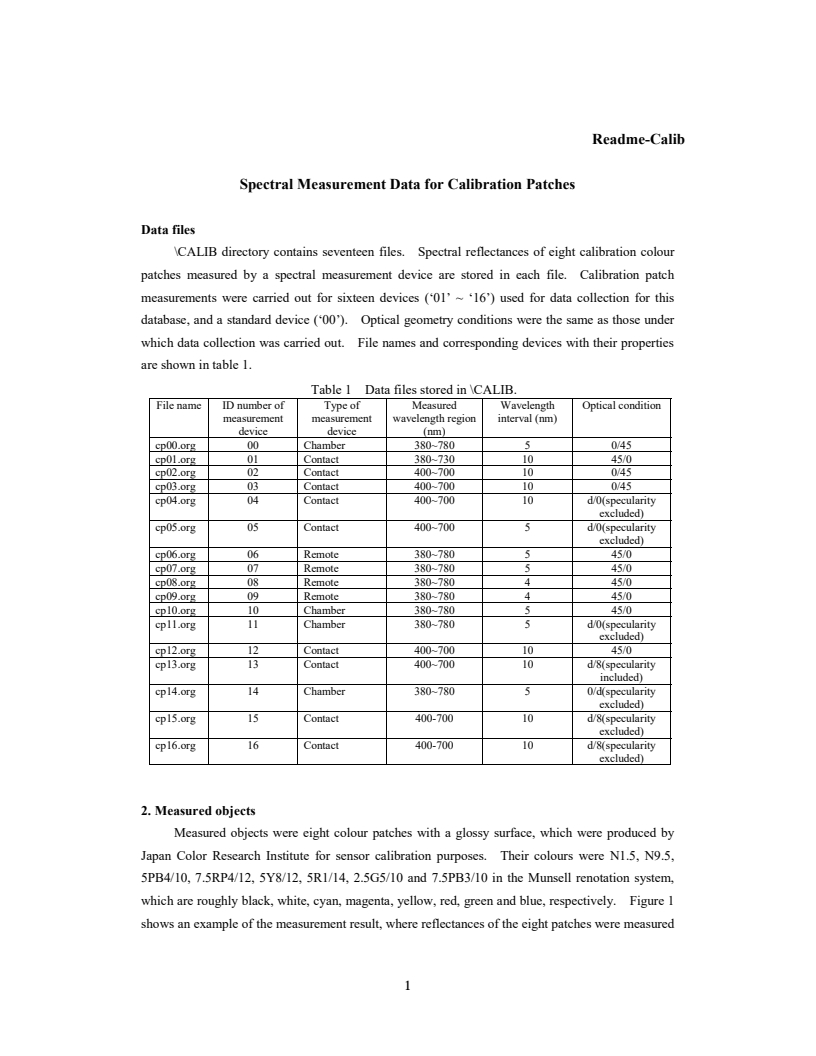
\CALIB directory contains seventeen files. Spectral reflectances of eight calibration colour
patches measured by a spectral measurement device are stored in each file. Calibration patch
measurements were carried out for sixteen devices (‘01’ ~ ‘16’) used for data collection for this
database, and a standard device (‘00’). Optical geometry conditions were the same as those under
which data collection was carried out. File names and corresponding devices with their properties
are shown in table 1.
Table 1 Data files stored in \CALIB.
File name ID number of Type of Measured Wavelength Optical condition
measurement measurement wavelength region interval (nm)
device device (nm)
cp00.org 00 Chamber 380~780 5 0/45
cp01.org 01 Contact 380~730 10 45/0
cp02.org 02 Contact 400~700 10 0/45
cp03.org 03 Contact 400~700 10 0/45
cp04.org 04 Contact 400~700 10 d/0(specularity
excluded)
cp05.org 05 Contact 400~700 5 d/0(specularity
excluded)
cp06.org 06 Remote 380~780 5 45/0
cp07.org 07 Remote 380~780 5 45/0
cp08.org 08 Remote 380~780 4 45/0
cp09.org 09 Remote 380~780 4 45/0
cp10.org 10 Chamber 380~780 5 45/0
cp11.org 11 Chamber 380~780 5 d/0(specularity
excluded)
cp12.org 12 C
...
Readme-Face
Spectral Measurement Data for Human Skin
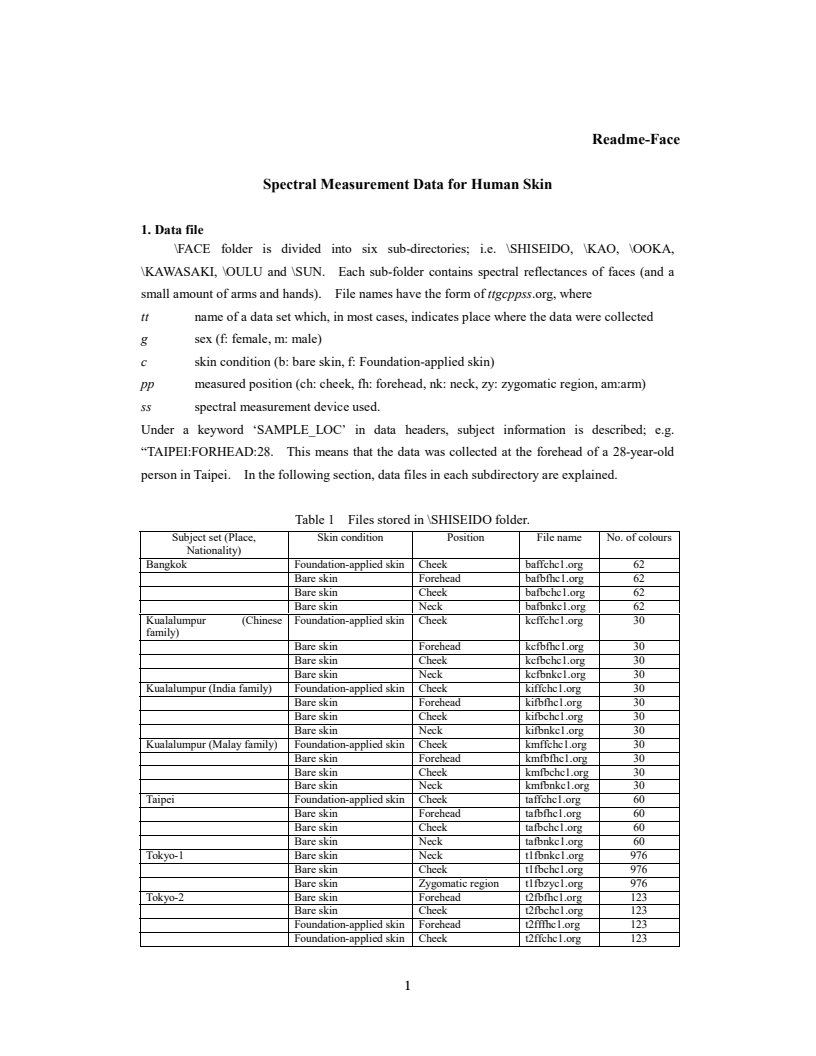
1. Data file
\FACE folder is divided into six sub-directories; i.e. \SHISEIDO, \KAO, \OOKA,
\KAWASAKI, \OULU and \SUN. Each sub-folder contains spectral reflectances of faces (and a
small amount of arms and hands). File names have the form of ttgcppss.org, where
tt name of a data set which, in most cases, indicates place where the data were collected
g sex (f: female, m: male)
c skin condition (b: bare skin, f: Foundation-applied skin)
pp measured position (ch: cheek, fh: forehead, nk: neck, zy: zygomatic region, am:arm)
ss spectral measurement device used.
Under a keyword ‘SAMPLE_LOC’ in data headers, subject information is described; e.g.
“TAIPEI:FORHEAD:28. This means that the data was collected at the forehead of a 28-year-old
person in Taipei. In the following section, data files in each subdirectory are explained.
Table 1 Files stored in \SHISEIDO folder.
Subject set (Place, Skin condition Position File name No. of colours
Nationality)
Bangkok Foundation-applied skin Cheek baffchc1.org 62
Bare skin Forehead bafbfhc1.org 62
Bare skin Cheek bafbchc1.org 62
Bare skin Neck bafbnkc1.org 62
Kualalumpur (Chinese Foundation-applied skin Cheek kcffchc1.org 30
family)
Bare skin Forehead kcfbfhc1.org 30
Bare skin Cheek kcfbchc1.org 30
Bare skin Neck kcfbnkc1.org 30
Kualalumpur (India family) Foundation-applied skin Cheek kiffchc1.org 30
Bare skin Forehead kifbfhc1.org 30
Bare skin Cheek kifbchc1.org 30
Bare skin Neck kifbnkc1.org 30
Kualalumpur (Malay family) Foundation-applied skin Cheek kmffchc1.org 30
Bare skin Forehead kmfbfhc1.org 30
Bare skin Cheek kmfbchc1.org 30
Bare skin Neck kmfbnkc1.org 30
Taipei Foundation-applied skin Cheek taffchc1.org 60
Bare skin Forehead tafbfhc1.org 60
Bare skin Cheek tafbchc1.org 60
Bare skin Neck tafbnkc1.org 60
Tokyo-1 Bare skin Neck t1fbnkc1.org 976
Bare skin Cheek t1fbchc1.org 976
Bare skin Zygomatic region t1fbzyc1.org 976
Tokyo-2 Bare skin Forehead t2fbfhc1.org 123
Bare skin Cheek t2fbchc1.org 123
Foundation-applied skin Forehead t2fffhc1.org 123
Foundation-applied skin Cheek t2ffchc1.org 123
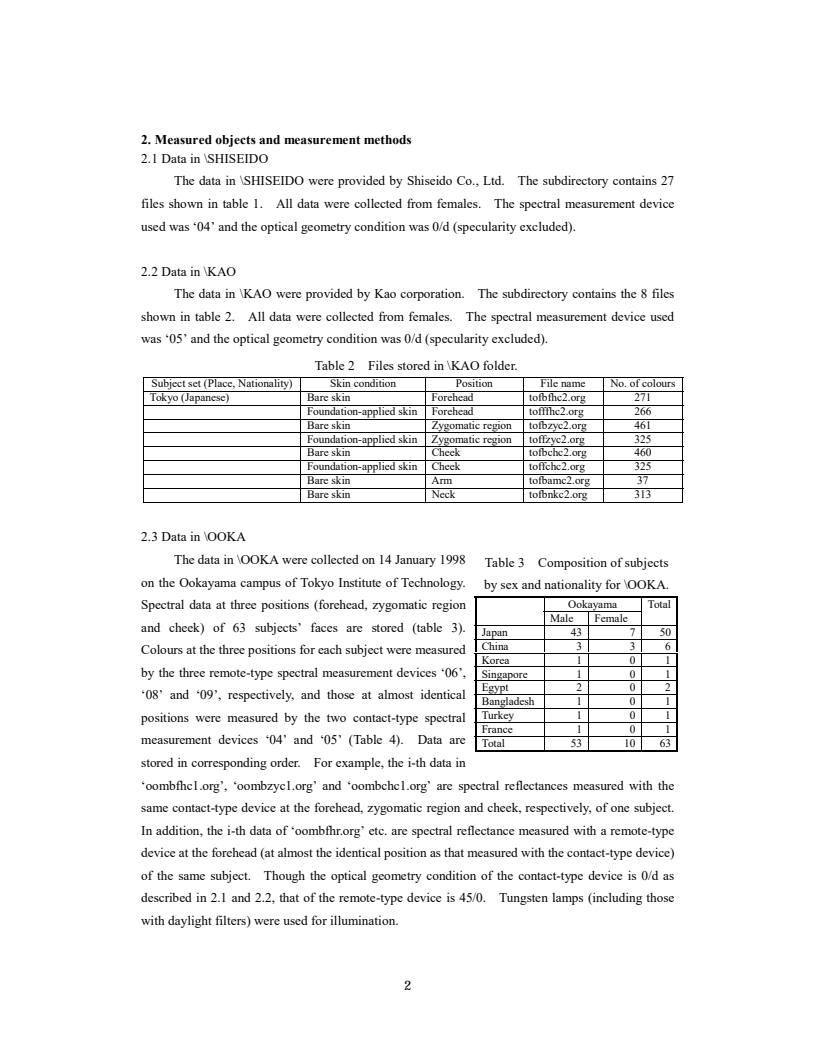
2. Measured objects and measurement methods
2.1 Data in \SHISEIDO
The data in \SHISEIDO were provided by Shiseido Co., Ltd. The subdirectory contains 27
files shown in table 1. All data were collected from females. The spectral measurement device
used was ‘04’ and the optical geometry condition was 0/d (specularity excluded).
2.2 Data in \KAO
The data in \KAO were provided by Kao corporation. The subdirectory contains the 8 files
shown in table 2. All data were collected from females. The spectral measurement device used
was ‘05’ and the optical geometry condition was 0/d (specularity excluded).
Table 2 Files stored in \KAO folder.
Subject set (Place, Nationality) Skin condition Position File name No. of colours
Tokyo (Japanese) Bare skin Forehead tofbfhc2.org 271
Foundation-applied skin Forehead tofffhc2.org 266
Bare skin Zygomatic region tofbzyc2.org 461
Foundation-applied skin Zygomatic region toffzyc2.org 325
Bare skin Cheek tofbchc2.org 460
Foundation-applied skin Cheek toffchc2.org 325
Bare skin Arm tofbamc2.org 37
Bare skin Neck tofbnkc2.org 313
2.3 Data in \OOKA
The data in \OOKA were collected on 14 January 1998
Table 3 Composition of subjects
on the Ookayama campus of Tokyo Institute of Technology.
by sex and nationality for \OOKA.
Spectral data at three positions (forehead, zygomatic region Ookayama Total
Male Female
and cheek) of 63 subjects’ faces are stored (table 3).
Japan 43 7 50
China 3 3 6
Colours at the three positions for each subject were measured
Korea 1 0 1
by the three remote-type spectral measurement devices ‘06’,
Singapore 1 0 1
Egypt 2 0 2
‘08’ and ‘09’, respectively, and those at almost identical
Bangladesh 1 0 1
Turkey 1 0 1
positions were measured by the two contact-type spectral
France 1 0 1
measurement devices ‘04’ and ‘05’ (Table 4). Data are
Total 53 10 63
stored in corresponding order. For example, the i-th data in
‘oombfhc1.org’, ‘oombzyc1.org’ and ‘oombchc1.org’ are spectral reflectances measured with the
same contact-type device at the forehead, zygomatic region and cheek, respectively, of one subject.
In addition, the i-th data of ‘oombfhr.org’ etc. are spectral reflectance measured with a remote-type
device at the forehead (at almost the identical position as that measured with the contact-type device)
of the same subject. Though the optical geometry condition of the contact-type device is 0/d as
described in 2.1 and 2.2, that of the remote-type device is 45/0. Tungsten lamps (including those
with daylight filters) were used for illumination.
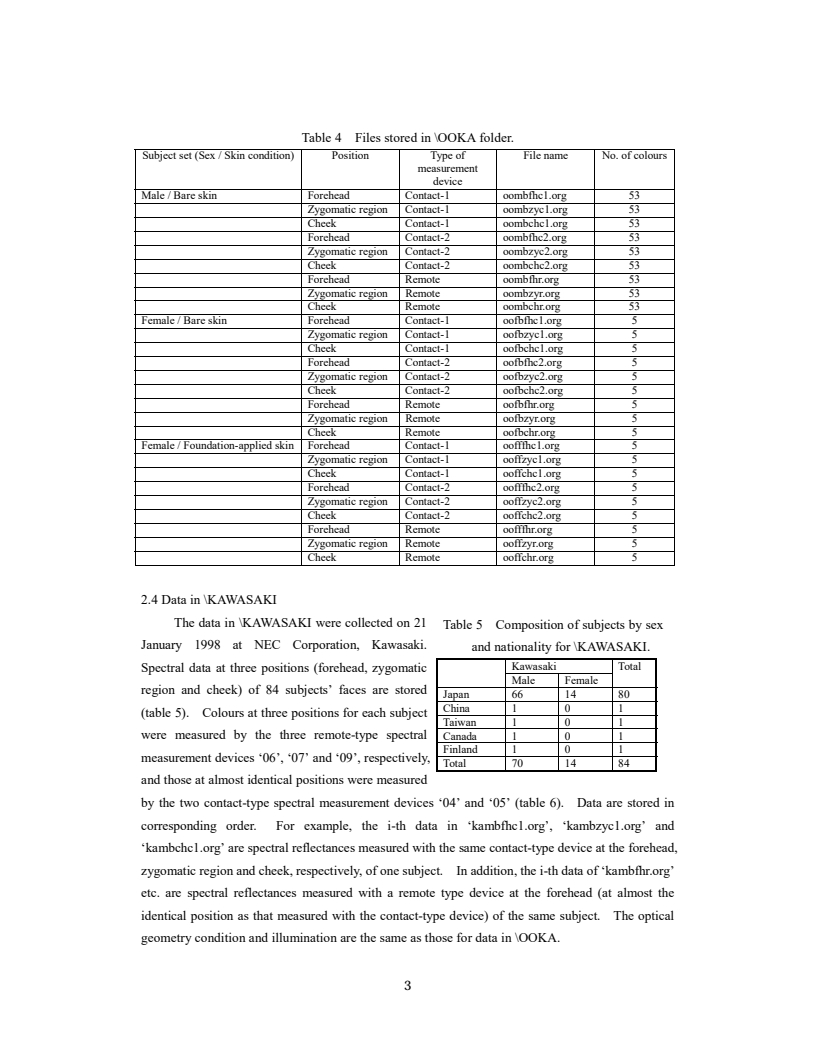
Table 4 Files stored in \OOKA folder.
Subject set (Sex / Skin condition) Position Type of File name No. of colours
measurement
device
Male / Bare skin Forehead Contact-1 oombfhc1.org 53
Zygomatic region Contact-1 oombzyc1.org 53
Cheek Contact-1 oombchc1.org 53
Forehead Contact-2 oombfhc2.org 53
Zygomatic region Contact-2 oombzyc2.org 53
Cheek Contact-2 oombchc2.org 53
Forehead Remote oombfhr.org 53
Zygomatic region Remote oombzyr.org 53
Cheek Remote oombchr.org 53
Female / Bare skin Forehead Contact-1 oofbfhc1.org 5
Zygomatic region Contact-1 oofbzyc1.org 5
Cheek Contact-1 oofbchc1.org 5
Forehead Contact-2 oofbfhc2.org 5
Zygomatic region Contact-2 oofbzyc2.org 5
Cheek Contact-2 oofbchc2.org 5
Forehead Remote oofbfhr.org 5
Zygomatic region Remote oofbzyr.org 5
Cheek Remote oofbchr.org 5
Female / Foundation-applied skin Forehead Contact-1 oofffhc1.org 5
Zygomatic region Contact-1 ooffzyc1.org 5
Cheek Contact-1 ooffchc1.org 5
Forehead Contact-2 oofffhc2.org 5
Zygomatic region Contact-2 ooffzyc2.org 5
Cheek Contact-2 ooffchc2.org 5
Forehead Remote oofffhr.org 5
Zygomatic region Remote ooffzyr.org 5
Cheek Remote o
...
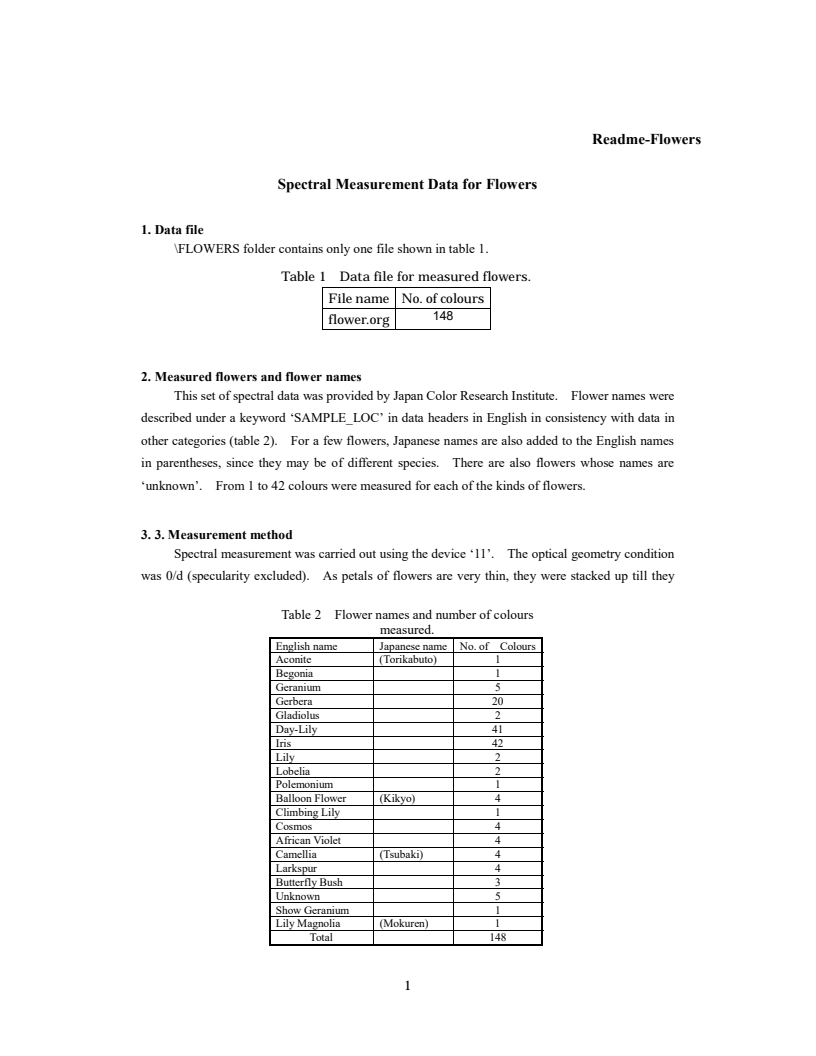
Readme-Flowers
Spectral Measurement Data for Flowers
1. Data file
\FLOWERS folder contains only one file shown in table 1.
Table 1 Data file for measured flowers.
File name No. of colours
flower.org
2. Measured flowers and flower names
This set of spectral data was provided by Japan Color Research Institute. Flower names were
described under a keyword ‘SAMPLE_LOC’ in data headers in English in consistency with data in
other categories (table 2). For a few flowers, Japanese names are also added to the English names
in parentheses, since they may be of different species. There are also flowers whose names are
‘unknown’. From 1 to 42 colours were measured for each of the kinds of flowers.
3. 3. Measurement method
Spectral measurement was carried out using the device ‘11’. The optical geometr
...
Readme-Graphic
Spectral Measurement Data for Graphic Prints
1. Data files
\GRAPHIC folder is divided into two subdirectories; i.e. \OFFSET and \GRAVURE.
\OFFSET contains thirty files, output through offset printing measurement as shown in table 1, and
\GRAVURE contains three files, output through gravure printing measurement as shown in table 2.
File names in \OFFSET have the form of ii_p, where ii indicates the ID number of the ink used and p
indicates the type of paper used. If p is ‘u’, ‘d’ or ‘g’, the paper is uncoated paper, dull-coated
paper or gloss-coated paper, respectively.
Table 1 Data files for measured offset prints.
Type of printing Ink Paper File name Number of colours
Offset printing Ink-1 Uncoated of01_u.org 928
(OFFSET) Dull-coated of01_d.org 928
Gloss-coated of01_g.org 928
Ink-2 Uncoated of02_u.org 928
Dull-coated of02_d.org 928
Gloss-coated of02_g.org 928
Ink-3 Uncoated of03_u.org 928
Dull-coated of03_d.org 928
Gloss-coated of03_g.org 928
Ink-4 Uncoated of04_u.org 928
Dull-coated of04_d.org 928
Gloss-coated of04_g.org 928
Ink-5 Uncoated of05_u.org 928
Dull-coated of05_d.org 928
Gloss-coated of05_g.org 928
Ink-6 Uncoated of06_u.org 928
Dull-coated of06_d.org 928
Gloss-coated of06_g.org 928
Ink-7 Uncoated of07_u.org 928
Dull-coated of07_d.org 928
Gloss-coated of07_g.org 928
Ink-8 Uncoated of08_u.org 928
Dull-coated of08_d.org 928
Gloss-coated of08_g.org 928
Ink-9 Uncoated of09_u.org 928
Dull-coated of09_d.org 928
Gloss-coated of09_g.org 928
Ink-10 Uncoated of10_u.org 928
Dull-coated of10_d.org 928
Gloss-coated of10_g.org 928
Gravure printing was carried out using one type of ink and normal gloss-coated paper. File
names in \GRAVURE have the form of gr_c, where c indicates the printing condition. If c is ‘s’,
‘m’ or ‘p’, the condition is standard, minus or plus, respectively.
Table 2 Data files for measured gravure prints.
Type of printing Ink / Paper Printing condition File name No. of colours
Gravure printing Ink-1 / Gloss-coated Standard gr_s.org 928
(GRAVURE) paper Minus gr_m.org 928
Plus gr_p.org 928
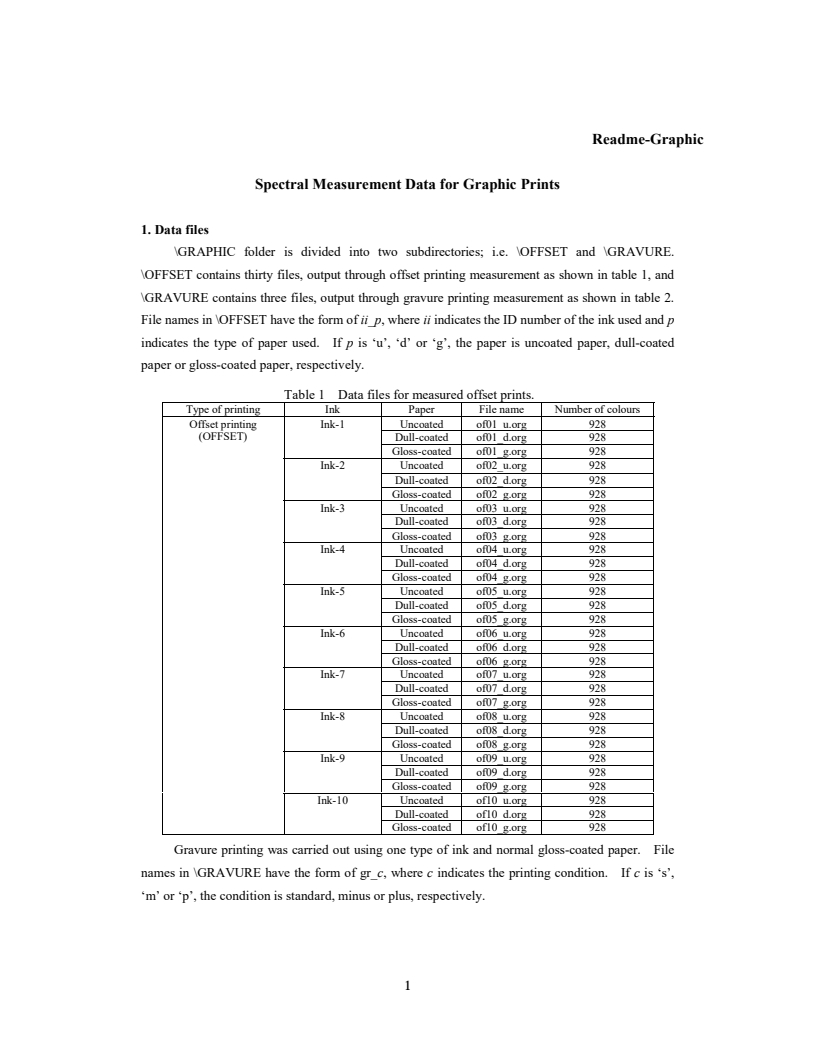
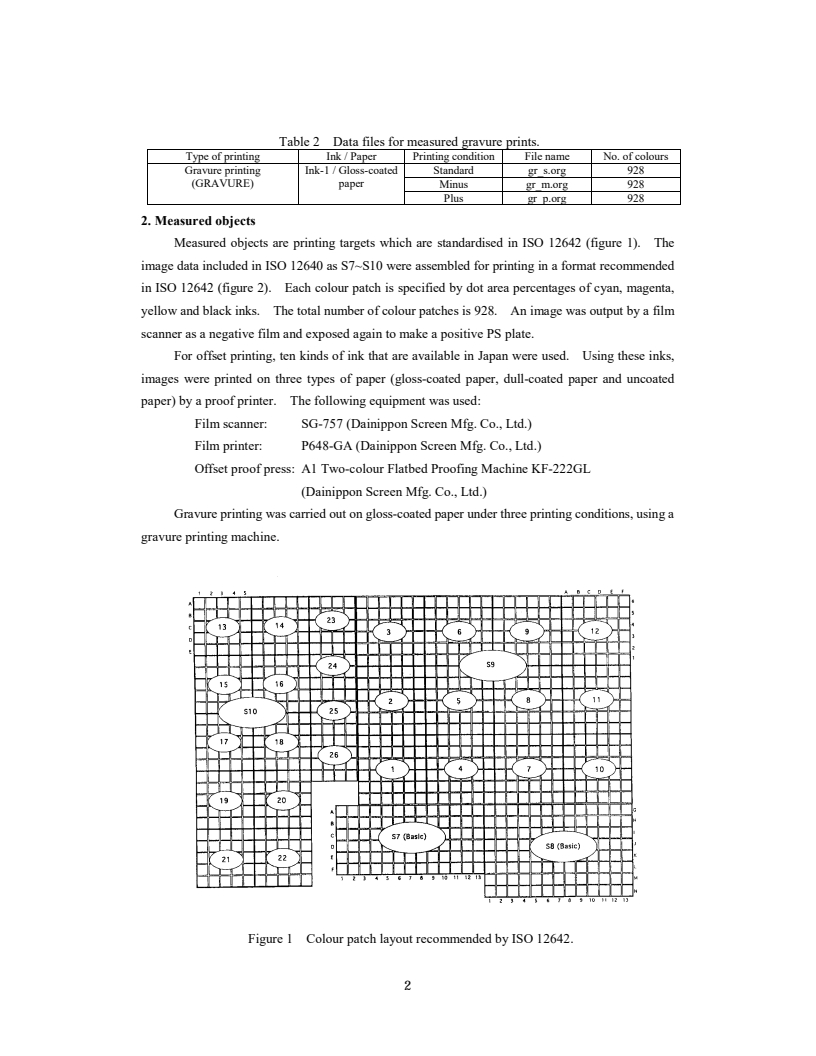
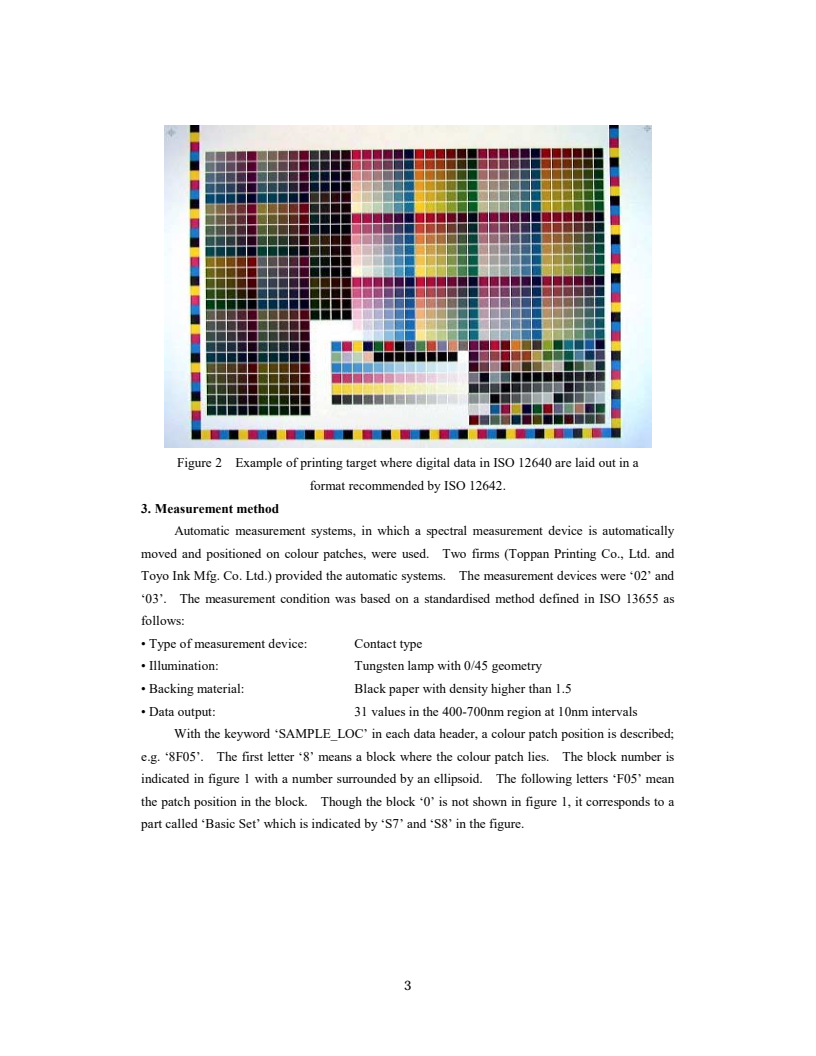
2. Measured objects
Measured objects are printing targets which are standardised in ISO 12642 (figure 1). The
image data included in ISO 12640 as S7~S10 w
...
Readme-INT
Normalisation and Interpolation Processing
1. Difference between \ORG files and \INT files
The data stored in \ORG folder, which are only the results of spectral reflectance measurement,
comprise outputs from sixteen spectral measurement devices. Though all the devices were highly
reputable, they output slightly different data, when measuring certain. In addition, their wavelength
ranges or sampling intervals for measurement do not always coincide. These factors make it
inconvenient to compare the data across the object categories.
The database also stores other data whose reflectances are normalised to standard data and
whose wavelength range and sampling interval are unified by interpolation. The data stored in
\INT folder are that after such processing has been done.
The normalisation and interpolation processing was not applied to the data stored in \KRINOV
folder. The processing applied to them is explained in Section 4 in detail.
2. Normalisation processing
\ORG\CALIB folder stores spectral reflectances for eight calibration colour patches, measured
by sixteen spectral measurement devices that were used for database creation. From the data for
calibration, a part of the ‘white’ patch reflectance was used for normalisation. The reflectance is
almost flat between 500nm and 700nm. Therefore, average reflectance in that wavelength region
was calculated for each device ‘01’~’16’ and a ratio of that reflectance to that for the standard device
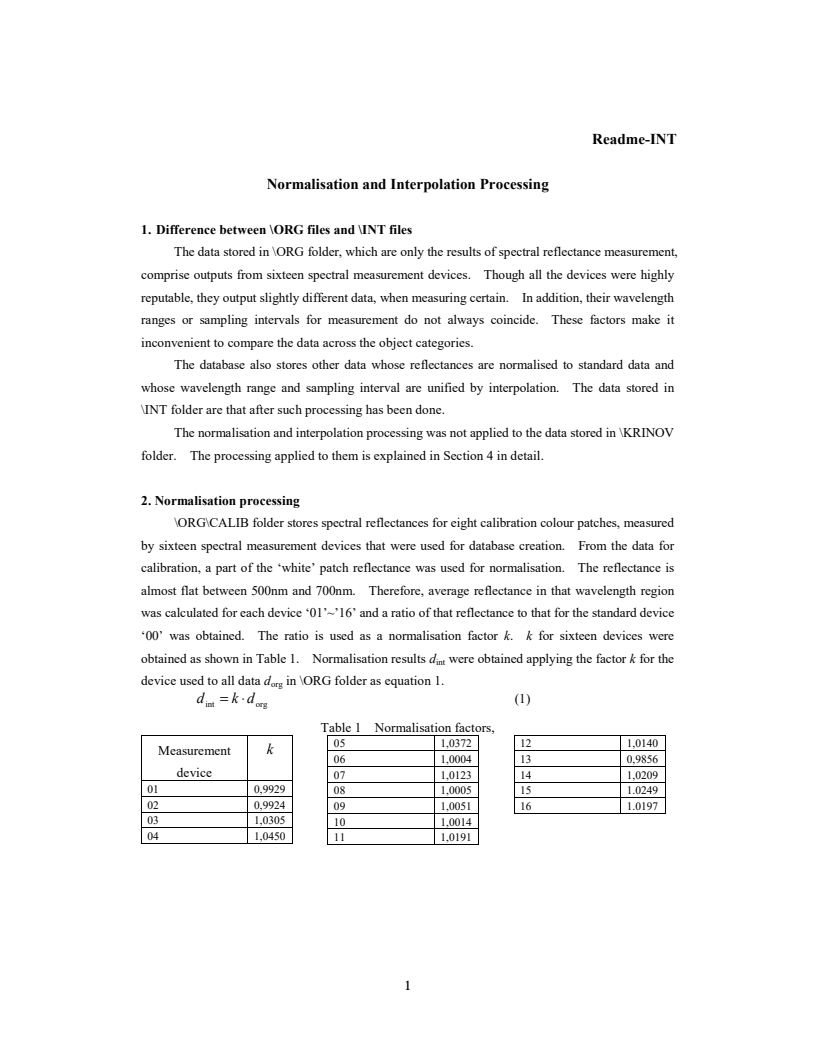
‘00’ was obtained. The ratio is used as a normalisation factor k. k for sixteen devices were
obtained as shown in Table 1. Normalisation results d were obtained applying the factor k for the
int
device used to all data d in \ORG folder as equation 1.
org
d =k ⋅d (1)
int org
Table 1 Normalisation factors,
05 1,0372 12 1,0140
k
Measurement
06 1,0004 13 0,9856
device
07 1,0123 14 1,0209
01 0,9929
08 1,0005 15 1.0249
02 0,9924
09 1,0051 16 1.0197
03 1,0305
10 1,0014
04 1,0450 11 1,0191
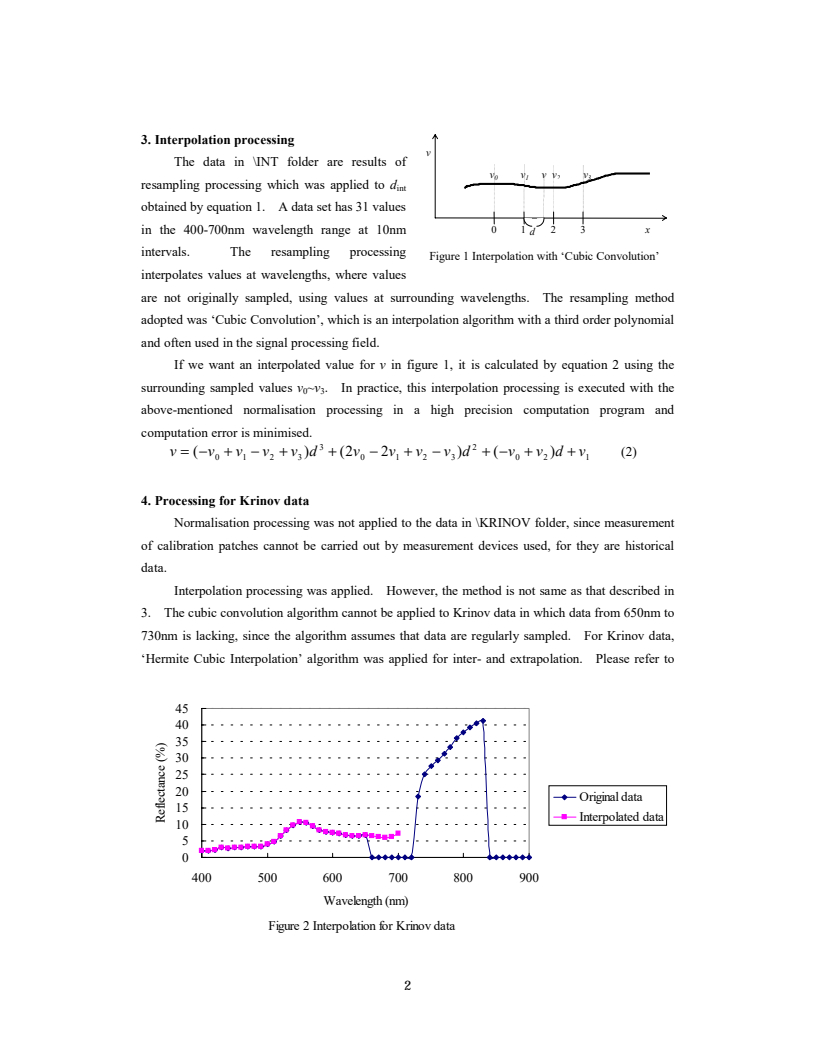
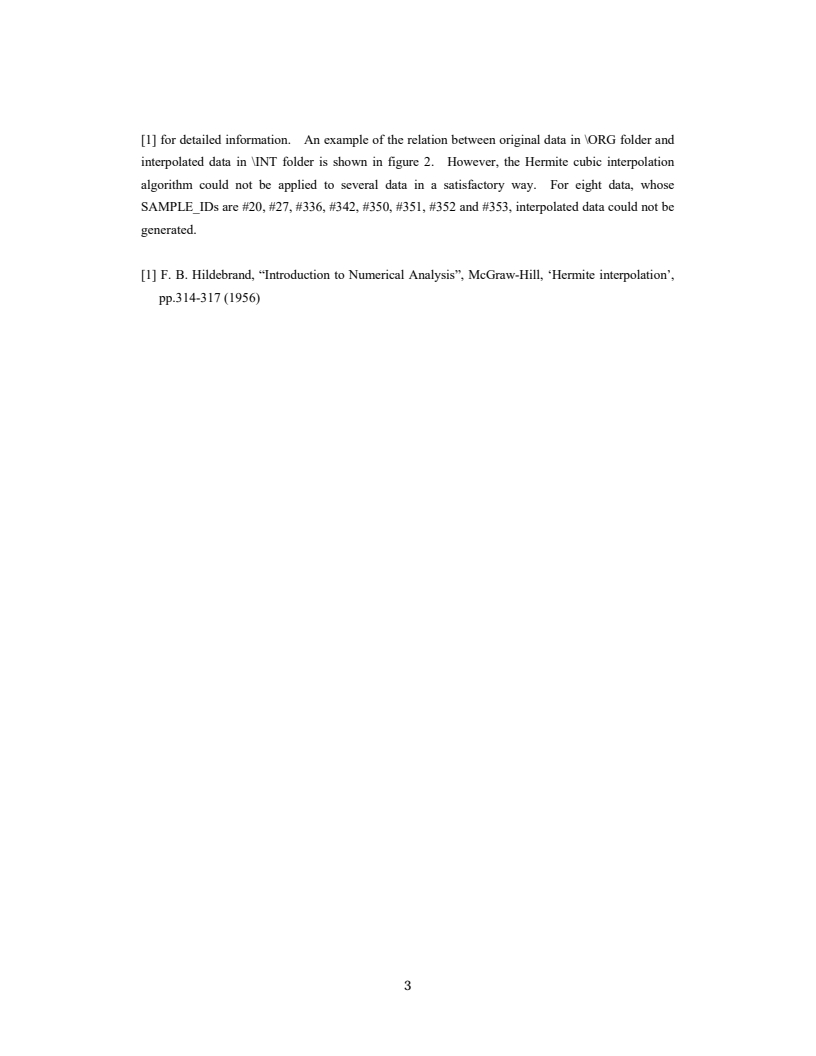
3. Interpolation processing
v
The data in \INT folder are results of
v v v v v
0 1 2 3
resampling processing which was applied to d
int
obtained by equation 1. A dat
...
Readme-Krinov
Krinov Data
1. Data files
\KRINOV folder contains the eight files in table 1, each of which corresponds to a category of
outdoor objects in Krinov’s original report.
Table 1 Files stored in \KRINOV folder.
Classification File name No. of colours
Forests and shrubs krinov1.org 49
Grass krinov2.org 119
Mosses and lichens krinov3.org 7
Field and garden crops krinov4.org 54
Bare areas and soils krinov5.org 89
Roads krinov6.org 14
Water surfaces and snow krinov7.org 22
Buildings and building materials krinov8.org 16
2. Measured objects
Measured objects are described under a keyword ‘SAMPLE_LOC’ in data headers. They are
summarised in table 2 according to the original report. The table is divided according to the object
categories.
Table 2-1 Objects whose reflectances are stored in \krinov1.org [Forests and shrubs (49 colours)]
SAMPLE_ID SAMPLE_LOC
1 Birch: Shoots, full leaf:A=45deg;<=45deg:n.f.b.
2 Birch: Young forest; Winter stage:A=225deg:n.f.b.
3 Birch: Young forest; Young leaf:A=225deg:n.f.b.
4 Birch: Young forest; Full leaf:A=225deg:n.f.b.
5 Birch: Young forest; Late summer:A=225deg:n.f.b.
6 Birch: Mature forest; Winter stage:A=225deg:n.f.b.
7 Birch: Mature forest; Young leaf:A=25deg:n.f.b.
8 Birch: Mature forest; Full leaf:A=225deg:n.f.b.
9 Birch: Mature forest; Late summer:A=225deg:n.f.b.
10 Birch: Dwarf; Full leaf: A normal: tundra
11 Birch: Dwarf; Fresh back on a mature tree:A=225deg:n.f.b.
12 Elm: Mature forest; Young leaf:A=225deg:n.f.b.
13 Elm: Mature forest; Full leaf:A=225deg:n.f.b.
14 Oak: Young forest; Winter stage:A=225deg:n.f.b.
15 Oak: Mature forest; Full leaf:A=225deg:n.f.b.
16 Oak: Mature forest; Autumn colour:A=225deg:n.f.b.
17 Fir: Young forest; Winter stage:A=225deg:n.f.b.
18 Fir: Young forest; Young leaf:A=225deg:n.f.b.
19 Fir: Young forest; Full leaf:A=225deg:n.f.b.
20 Fir: Young forest; Late summer:A=225deg:n.f.b.
21 Fir: Mature forest; Winter stage:A=225deg:n.f.b.
22 Fir: Mature forest; Young leaf:A=225deg:n.f.b.
23 Fir: Mature forest; Full leaf:A=225deg:n.f.b.
24 Fir: Mature forest; Late summer:A=225deg:n.f.b.
25 Fir: Mature forest; Late summer: from the air alt.=300m.:n.f.b.
26 Willow: Shrubs; Late summer:A=45deg,at about 1.5km.:steppe
27 Black elm: Mature forest; Late summer, heavily coated with
dust:A=225deg:desert
28 Linden: Mature forest; Winter stage:A=225deg:n.f.b.
29 Linden: Mature forest; Full leaf:A=225deg:n.f.b.
30 Linden: Mature forest; Autumn colour:A=225deg:n.f.b.
31 Larch: Young forest; Winter stage:A=225deg:n.f.b.
32 Larch: Young forest; Young leaf:A=225deg:n.f.b.
33 Larch: Young forest; Full leaf:A=225deg:n.f.b.
34 Juniper: Mature forest; Full leaf: A normal: tundra
35 Alder: Young forest; Young leaf:A=225deg:n.f.b.
36 Aspen: Young forest; Winter stage:A=225deg:n.f.b.
37 Aspen: Young forest; Young leaf:A=225deg:n.f.b.
38 Aspen: Young forest; Full leaf:A=225deg:n.f.b.
39 Aspen: Mature forest; Young leaf:A=225deg:n.f.b.
40 Aspen: Mature forest; Full leaf:A=225deg:n.f.b.
41 Aspen: Mature forest; Late summer:A=225deg:n.f.b.
42 Aspen: Mature forest; Autumn colour:A=225deg:n.f.b.
43 Haloxylon: Mature trees; Late summer green: A=45deg; <=45deg:
desert
44 Haloxylon: Mature trees; Dry:A=45deg; <=45deg:desert
45 Pine: Young forest; Young leaf:A=135deg:n.f.b.
46 Pine: Young forest; Full leaf:A=135deg:n.f.b.
47 Pine: Mature forest; Winter stage:A=225deg:n.f.b.
48 Pine: Mature forest; Young leaf:A=225deg:n.f.b.
49 Pine: Mature forest; Full leaf:A=225deg:n.f.b.
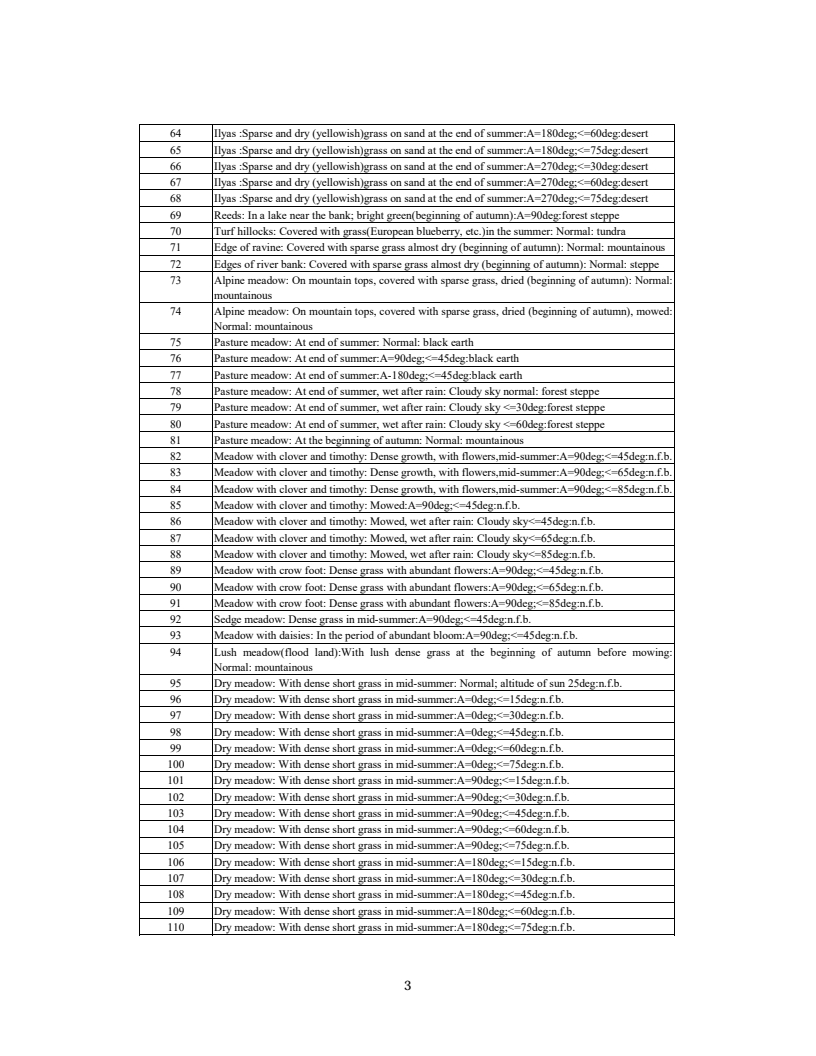
Table 2-2 Objects whose reflectances are stored in \krinov2.org [Grass (119 colours)]
SAMPLE_ID SAMPLE_LOC
50 Weeds: Dense growth, drying and brownish (beginning of autumn):Cloudy sky. Normal: forest
steppe
51 Weeds: Dense growth, drying and brownish (beginning of autumn): Cloudy sky. Normal <=30deg:
forest steppe
52 Weeds: Dense growth, drying and brownish (beginning of autumn): A=90deg; <=45deg: steppe
53 Heather: Dense growth, before flowering: Normal: tundra
54 River valley with meadows: General view from a distance of about 3 km.; covered with trees and
meadows, end of summer:A=90deg:mountainous
55 Willow herb: Dense growth, in the flowering period:A=90deg;<=45deg:tundra
56 Ilyas :Sparse and dry (yellowish)grass on sand at the end of summer: Normal: desert
57 Ilyas :Sparse and dry (yellowish)grass on sand at the end of summer:A=0deg;<=30deg:desert
58 Ilyas :Sparse and dry (yellowish)grass on sand at the end of summer:A=0deg;<=60deg:desert
59 Ilyas :Sparse and dry (yellowish)grass on sand at the end of summer:A=0deg;<=75deg:desert
60 Ilyas :Sparse and dry (yellowish)grass on sand at the end of summer:A=90deg;<=30deg:desert
61 Ilyas :Sparse and dry (yellowish)grass on sand at the end of summer:A=90deg;<=60deg:desert
62 Ilyas :Sparse and dry (yellowish)grass on sand at the end of summer:A=90deg;<=75deg:desert
63 Ilyas :Sparse and dry (yellowish)grass on sand at the end of summer:A=180deg;<=30deg:desert
64 Ilyas :Sparse and dry (yellowish)grass on sand at the end of summer:A=180deg;<=60deg:desert
65 Ilyas :Sparse and dry (yellowish)grass on sand at the end of summer:A=180deg;<=75deg:desert
66 Ilyas :Sparse and dry (yellowish)grass on sand at the end of summer:A=270deg;<=30deg:desert
67 Ilyas :Sparse and dry (yellowish)grass on sand at the end of summer:A=270deg;<=60deg:desert
68 Ilyas :Sparse and dry (yellowish)grass on sand at the end of summer:A=270deg;<=75deg:desert
69 Reeds: In a lake near the bank; bright green(beginning of autumn):A=90deg:forest steppe
70 Turf hillocks: Covered with grass(European blueberry, etc.)in the summer: Normal: tundra
71 Edge of ravine: Covered with sparse grass almost dry (beginning of autumn): Normal: mountainous
72 Edges of river bank: Covered with sparse grass almost dry (beginning of autumn): Normal: steppe
73 Alpine meadow: On mountain tops, covered with sparse grass, dried (beginning of autumn): Normal:
mountainous
74 Alpine meadow: On mountain tops, covered with sparse grass, dried (beginning of autumn), mowed:
Normal: mountainous
75 Pasture meadow: At end of summer: Normal: black earth
76 Pasture meadow: At end of summer:A=90deg;<=45deg:black earth
77 Pasture meadow: At end of summer:A-180deg;<=45deg:black earth
78 Pasture meadow: At end of summer, wet after rain: Cloudy sky normal: forest steppe
79 Pasture meadow: At end of summer, wet after rain: Cloudy sky <=30deg:forest steppe
80 Pasture meadow: At end of summer, wet after rain: Cloudy sky <=60deg:forest steppe
81 Pasture meadow: At the beginning of autumn: Normal: mountainous
82 Meadow with clover and timothy: Dense growth, with flowers,mid-summer:A=90deg;<=45deg:n.f.b.
83 Meadow with clover and timothy: Dense growth, with flowers,mid-summer:A=90deg;<=65deg:n.f.b.
84 Meadow with clover and timothy: Dense growth, with flowers,mid-summer:A=90deg;<=85deg:n.f.b.
85 Meadow with clover and timothy: Mowed:A=90deg;<=45deg:n.f.b.
86 Meadow with clover and timothy: Mowed, wet after rain: Cloudy sky<=45deg:n.f.b.
87 Meadow with clover and timothy: Mowed, wet after rain: Cloudy sky<=65deg:n.f.b.
88 Meadow with clover and timothy: Mowed, wet after rain: Cloudy sky<=85deg:n.f.b.
89 Meadow with crow foot: Dense grass with abundant flowers:A=90deg;<=45deg:n.f.b.
90 Meadow with crow foot: Dense grass with abundant flowers:A=90deg;<=65deg:n.f.b.
91 Meadow with crow foot: Dense grass with abundant flowers:A=90deg;<=85deg:n.f.b.
92 Sedge meadow: Dense grass in mid-summer:A=90deg;<=45deg:n.f.b.
93 Meadow with daisies: In the period of abundant bloom:A=90deg;<=45deg:n.f.b.
94 Lush meadow(flood land):With lush dense grass at the beginning of autumn before mowing:
Normal: mountainous
95 Dry meadow: With dense short grass in mid-summer: Normal; altitude of sun 25deg:n.f.b.
96 Dry meadow: With dense short grass in mid-summer:A=0deg;<=15deg:n.f.b.
97 Dry meadow: With dense short grass in mid-summer:A=0deg;<=30deg:n.f.b.
98 Dry meadow: With dense short grass in mid-summer:A=0deg;<=45deg:n.f.b.
99 Dry meadow: With dense short grass in mid-summer:A=0deg;<=60deg:n.f.b.
100 Dry meadow: With dense short grass in mid-summer:A=0deg;<=75deg:n.f.b.
101 Dry meadow: With dense short grass in mid-summer:A=90deg;<=15deg:n.f.b.
102 Dry meadow: With dense short grass in mid-summer:A=90deg;<=30deg:n.f.b.
103 Dry meadow: With dense short grass in mid-summer:A=90deg;<=45deg:n.f.b.
104 Dry meadow: With dense short grass in mid-summer:A=90deg;<=60deg:n.f.b.
105 Dry meadow: With dense short grass in mid-summer:A=90deg;<=75deg:n.f.b.
106 Dry meadow: With dense short grass in mid-summer:A=180deg;<=15deg:n.f.b.
107 Dry meadow: With dense short grass in mid-summer:A=180deg;<=30deg:n.f.b.
108 Dry meadow: With dense short grass in mid-summer:A=180deg;<=45deg:n.f.b.
109 Dry meadow: With dense short grass in mid-summer:A=180deg;<=60deg:n.f.b.
110 Dry meadow: With dense short grass in mid-summer:A=180deg;<=75deg:n.f.b.
111 Dry meadow: With dense short grass in mid-summer:A=270deg;<=45deg:n.f.b.
112 Dry meadow: With dense short grass in mid-summer:A=270deg;<=60deg:n.f.b.
113 Dry meadow: With dense short grass in mid-summer:A=270deg;<=75deg:n.f.b.
114 Dry meadow: With dense short grass in mid-summer: Normal; alt. of sun=45deg:n.f.b.
115 Dry meadow: With dense short grass in mid-summer:A=0deg;<=15deg:n.f.b.
116 Dry meadow: With dense short grass in mid-summer:A=0deg;<=30deg:n.f.b.
117 Dry meadow: With dense short grass in mid-summer:A=0deg;<=45deg:n.f.b.
118 Dry meadow: With dense short grass in mid-summer:A=0deg;<=60deg:n.f.b.
119 Dry meadow: With dense short grass in mid-summer:A=0deg;<=75deg:n.f.b.
120 Dry meadow: With dense short grass in mid-summer:A=90deg;<=15deg:n.f.b.
121 Dry meadow: With dense short grass in mid-summer:A=90deg;<=30deg:n.f.b.
122 Dry meadow: With dense short grass in mid-summer:A=90deg;<=45deg:n.f.b.
123 Dry meadow: With dense short grass in mid-summer:A=90deg;<=60deg:n.f.b.
124 Dry meadow: With dense short grass in mid-summer:A=90deg;<=75deg:n.f.b.
125 Dry meadow: With dense short grass in mid-summer:A=180deg;<=15deg:n.f.b.
126 Dry meadow: With dense short grass in mid-summer:A=180deg;<=30deg:n.f.b.
127 Dry meadow: With dense short grass in mid-summer:A=180deg;<=45deg:n.f.b.
128 Dry meadow: With dense short grass in mid-summer:A=180deg;<=60deg:n.f.b.
129 Dry meadow: With dense short grass in mid-summer:A=180deg;<=75deg:n.f.b.
130 Dry meadow: With dense short grass in mid-summer:A=270deg;<=15deg:n.f.b.
131 Dry meadow: With dense short grass in mid-summer:A=270deg;<=30deg:n.f.b.
132 Dry meadow: With dense short grass in mid-summer:A=270deg;<=45deg:n.f.b.
133 Dry meadow: With dense short grass in mid-summer:A=270deg;<=60deg:n.f.b.
134 Dry meadow: With dense short grass in mid-summer:A=270deg;<=75deg:n.f.b.
135 Dry meadow: With sparse low grass: Normal: n.f.b.
136 Dry meadow: With sparse low grass:A=90deg;<=45deg:n.f.b.
137 Dry meadow: With sparse low grass:A=90deg;<=75deg:n.f.b.
138 Dry meadow: With more dense low grass: Normal: n.f.b.
139 Dry meadow: With more dense low grass:A=90deg;<=45deg:n.f.b.
140 Dry meadow: With more dense low grass:A=180deg;<=45deg:n.f.b.
141 Dry meadow: With sparse dry grass on hills beginning of autumn: Normal: mountainous
142 Dry meadow: With dense but low grass beginning of autumn: From aircraft alt.300m.:n.f.b.
143 Dry meadow: With more sparse grass , grazed: From aircraft alt.300m.:n.f.b.
144 Lake partially covered with vegetation: Surface of water is almost completely covered with
vegetation (duckweed, sedge and others):A=90deg;<=60deg:forest steppe
145 Sedge: Dense near lake shore:A=90deg;<=45deg:forest steppe
146 Shallows of river(in high water):Covered with grass: Almost plumb: steppe
147 Plantain: Individual leaf (top surface): Normal: n.f.b.
148 Wormwood: Dense growth, flowering, at end of summer: Cloudy sky Normal: steppe and forest
steppe
149 Wormwood: Dense growth, flowering, at end of summer: Cloudy sky Normal;<=30deg:steppe and
forest steppe
150 Wormwood: Dense growth, flowering, at end of summer: Cloudy sky Normal;<=60deg:steppe and
forest steppe
151 Stream: Surface covered with water weeds and sedge:A=90deg;<=45deg:n.f.b.
152 Duckweed: Dense bunched growth, light green, beginning of summer:A=90deg;<=45deg:n.f.b.
153 Selin: Individual clumps dried and yellowish on sand dunes at the end of summer: Normal: desert
154 Mountain side: With low sparse grass at the beginning of autumn: Normal: mountainous
155 Virgin steppe: With low grass burnt by the sun, beginning of autumn: Cloudy sky Normal: forest
steppe
156 Virgin steppe: With low grass burnt by the sun, beginning of autumn: Cloudy sky Normal; <=30deg:
forest steppe
157 Virgin steppe: With low grass burnt by the sun, beginning of autumn: Cloudy sky
Normal;<=60deg:forest steppe
158 Virgin steppe: With low grass burnt by the sun, beginning of autumn, but fresher and wetter after
rain :Cloudy sky Normal; Normal: forest steppe
159 Virgin steppe: With low grass burnt by the sun, beginning of autumn, but fresher and wetter after
rain :Cloudy sky Normal;<=30deg:forest steppe
160 Virgin steppe: With low grass burnt by the sun, beginning of autumn, but fresher and wetter after
rain :Cloudy sky Normal;<=60deg:forest steppe
161 Grass: Near road, dusty: Normal: steppe
162 Grass: Young, green:A=90deg;<=45deg:n.f.b.
163 Grass: Last year's(dry),spring:A=90deg;<=45deg:n.f.b.
164 Grass: summer green:A=90deg;<=45deg:n.f.b.
165 Yantak (camel grass):Road side, heavily dusted: Normal: desert
166 Fallow, green: Flowering: Normal: steppe
167 Hillside: Short grass: Normal: steppe
168 Hay: In stack,dry: A=110deg: mountainous
Table 2-3 Objects whose reflectances are stored in \krinov3.org [Mosses and lichens (7 colours)]
SAMPLE_ID SAMPLE_LOC
169 Lichens: Greenish brown, on roadsides and foot paths over turf, dry: Normal: tundra
170 Moss: Reddish brown, wet: Normal: tundra
171 Sphagnum moss: In marshy lowland, wet: Normal: tundra
172 Sphagnum moss: In marshy lowland, wet, on bank of bog, dry : Normal: tundra
173 Moss on rocks: Dark green on mountain outcrops, dry: Normal: tundra
174 Moss on turf: Reddish brown, dry: Normal: tundra
175 Reindeer moss: On turf, dry Normal: tundra
Table 2-4 Ob
...
Readme-Leaves
Spectral Measurement Data for Leaves
1. Data file
\LEAVES folder contains only one file shown in table 1
Table 1 File stored in \LEAVES folder.
File name No. of colours
leaf.org
2. Measured leaves and leaf names
This set of spectral data was provided by Japan Color Research Institute. Leaf names were
described under a keyword ‘SAMPLE_LOC’ in data headers in English in consistency with data in
other categories (table 2). For most leaves, Japanese names are also added to the English names in
parentheses, since they may be of different species. From 1 to 6 colours had been measured for a
kind of leaves.
Table 2 Leaf names and number of colours measured.
English name Japanese name No. of colours
? (Asanekunto) 3
Acacia 1
Morning Glory (Asagao) 1
Ginkgo (Icho) 6
Bean (Ingen) 1
Pea (Endo) 4
Turnip (Kabu) 1
Pumpkin (Kabocha) 7
Foliage Plant (Kanyo-Shokubutsu) 3
Chine
...
Readme-Paint
Spectral Measurement Data for Paint
1. Data file
\PAINT folder contains only one file shown in table 1. Colours in \PAINT folder are those
used for exterior/interior objects, differing from colours in \PAINTS folder that are those for artistic
painting.
Table 1 File stored in \PAINT folder.
File name No. of colours
paint.org
2. Measured objects
This set of spectral data was provided by Dainippon Screen Mfg.Co.Ltd. Painted colour
patches were collected and measured by
...
README-Paints
Spectral Measurement Data for Paints
1. Data files
\PAINTS folder contains the four files shown in table 1. File names have the form pa_s,
where s indicates the type of paint used.
Table 1 Data files for measured paints.
Type of paints File names No. of colours
Water colours pa_a.org 60
New type paints pa_g.org 60
Oil paints pa_o.org 91
Old type oil paints pa_s.org 20
2. Measured objects
Measured paints’ colour patches were provided by Turner Colour Works Ltd. and Kusakabe
Co., Ltd. Colours in each set are explained in the following subsections in detail.
2.1 Water colours (pa_a)
Sixty colour patches (figure 1) were made for
water colours measurement. As water colours,
‘Acryl gouache’ manufactured by Turner Colour
Works Ltd. were used. Table 2 shows colour
names of the patches in the TV scan order from
top-left to bottom-right. The last three colours are
fluorescent colours and measured reflectance has
values larger than 1. This may not be adequate for
colour reproduction evaluation use.
Figure 1 Sixty colours by ‘Acryl gouache’.
2.2 New type paints (pa_g)
Sixty colour patches (figure 2) were made for
new type colour paints called ‘Golden acrylics’,
whose properties lie between those of water colours
and oil paints. Table 3 shows colour names of
the patches in the TV scan order.
Figure 2 Sixty colours by ‘Golden acrylics’.
Table 2 Colour names from patches made of ‘Acryl gouache’
1. WHITE 2. NEUTRAL GREY 3. LAMP BLACK 4. JET BLACK 5. PERMANENT LEMON
6. PERMANENT YELLOW 7. PERMANENT YELLOW DEEP 8. PERMANENT YELLOW ORANGE 9. PERMANENT ORANGE 10. PERMANENT SCARLET
11. PERMANENT RED 12. CARMINE 13. CORAL RED 14. JAUNE BRILLIANT 15. NAPLES YELLOW
16. YELLOW OCHER 17. VENETIAN RED 18. BURNT SIENNA 19. SEPIA 20. RAW UMBER
21. CHOCOLATE 22. EMERALD GREEN 23. PERMANENT YELLOW GREEN 24. PERMANENT GREEN LIGHT 25. PERMANENT GREEN MIDDLE
26. PERMANENT GREEN DEEP 27. DEEP GREEN 28. OLIVE GREEN 29. VIRIDIAN(HUE) 30. PEACOCK BLUE
31. SKY BLUE 32. COBALT BLUE (HUE) 33. ULTRAMARINE 34. PRUSSIAN BLUE (HUE) 35. LIGHT BLUE
36. LILAC 37. VIOLET 38. BLUE VIOLET 39. GOLD LIGHT 40. SILVER
41. BLONZE 42. PEARL WHITE 43. CRIMSON 44. RAW SIENNA 45. MUSTARD
46. APRICOT 47. DANDELION 48. AQUA GREEN 49. IVY GREEN 50. BERYL GREEN
51. AQUA BLUE 52. BLUE COMPOSE 53. ULTRAMARINE LIGHT 54. NIGHT BLUE 55. MAGENTA
56. AUBERGINE 57. DEEP PURPLE 58. LUMI. LEMON 59. LUMI. ORANGE 60. LUMI. ROSE
Table 3 Colour names from patches made of ‘Golden acrylics’
1. TITANIUM WHITE 2. ZINC WHITE 3. MARS BLACK 4. BONE BLACK 5. CARBON BLACK
6. QUINACRIDONE MAGENTA 7. QUINACRIDONE RED 8. CADMIUM RED DARK 9. NAPHTHOL RED MEDIUM 10. NAPHTHOL RED LIGHT
11. CADMIUM RED MEDIUM 12. PRIMARY MAGENTA 13. PYRROLE RED 14. QUINACRIDONE RED LIGHT 15. PYRROLE RED LIGHT
16. CADMIUM RED LIGHT 17. VAT ORANGE 18. PYRROLE ORANGE 19. CADMIUM ORANGE 20. DIARYLIDE YELLOW
21. CADMIUM YELLOW DARK 22. CADMIUM YELLOW MEDIUM 23. HANSA YELLOW OPAQUE 24. HANSA YELLOW MEDIUM 25. CADMIUM YELLOW LIGHT
26. HANSA YELLOW LIGHT 27. CADMIUM YELLOW 28. TITANATE YELLOW 29. PHTHALO GREEN 30. PHTHALO GREEN
PRIMROSE (YELLOW SHADE) (BLUE SHADE)
31. COBALT TITANATE GREEN 32. CHROMIUM OXIDE GREEN 33. COBALT GREEN 34. COBALT TEAL 35. COBALT TURQUOIS
36. CERULEAN BLUE DEEP 37. CERULEAN BLUE, CHROMIUM 38. ULTRAMARINE BLUE 39. COBALT BLUE 40. PHTHALO BLUE (RED SHADE)
41. PHTHALO BLUE 42. ANTHRAQUINONE BLUE 43. DIOXAZINE PURPLE 44. ULTRAMARINE VIOLET 45. QUINACRIDONE VIOLET
(GREEN SHADE)
46. TITAN BUFF 47. NICKEL AZO YELLOW 48. TRANSPARENT YELLOW OXIDE 49. YELLOW OXIDE 50. YELLOW OCHRE
51. RAW SIENNA 52. TRANSPARENT RED OXIDE 53. MARS YELLOW 54. RED OXIDE 55. QUINACRIDONE BURNT
ORANGE
56.VIOLET OXIDE 57.BURNT SIENNA 58.BURNT UMBER LIGHT 59.BURNT
...
Readme-Photo
Spectral Measurement Data for Photographic Material
1. Data files
\PHOTO folder contains the eight files shown in table 1. File names have the form phxx_y,
where xx indicates the vendor who manufactured the measured photographic material and, if y is ‘r’,
the material is a reflection print, while, if y is ‘t’, it is a transparency.
Table 1 Data files for measured photographic materials.
Targets File name No. of colours
Reflection prints Target-1 ph01_r.org 288
Target-2 ph02_r.org 288
Target-3 ph03_r.org 288
Target-4 ph04_r.org 288
Transparency Target-1 ph01_t.org 288
Target-2 ph02_t.org 288
Target-3 ph03_t.org 288
Target-4 ph04_t.org 288
2. Measured objects
Measured objects are input targets for scanner calibration that were manufactured by four
vendors according to the standard ISO 12641. Figure 1 shows an example of an input target. Its
Figure 1 Example of input target.
colour patch layout is shown in figure 2.
A total of 288 patches were measured;
i.e. 264 colour patches, whose positions are
indicated by combinations of rows A ~ L and
columns 1 ~ 22 as ‘05C’, and 24 grey patches,
which are named ‘Dmin’, ‘GS1’, . , ‘GS22’,
and ‘Dmax’. Most colours are defined by the
standard
...
Readme-Printer
Spectral Measurement Data for Computer Colour Prints
1. Data files
\PRINTER folder contains the 21 files shown in table 1. File names have the form pr_mm_n,
where mm indicates the type of printers used and n indicates the ID number of the printer model of
that type.
Table 1 Data files for measured computer colour prints.
Printing method Printer ID Files name No. of colours
Dye sublimation DS-1 pr_ds_1.org 512
DS-2 pr_ds_2.org 928
DS-3 pr_ds_3.org 512
DS-4 pr_ds_4.org 512
DS-5 pr_ds_5.org 216
Electro-static ES-1 pr_es_1.org 216
ES-2 pr_es_2.org 216
ES-3 pr_es_3.org 928
ES-4 pr_es_4.org 216
Inkjet IJ-1 pr_ij_1.org 216
IJ-2 pr_ij_2.org 216
IJ-3 pr_ij_3.org 216
IJ-4 pr_ij_4.org 216
IJ-5 pr_ij_5.org 216
IJ-6 pr_ij_6.org 216
IJ-7 pr_ij_7.org 216
Silver halide SH-1 pr_sh_1.org 512
SH-2 pr_sh_2.org 216
Other OT-1 pr_ot_1.org 216
OT-2 pr_ot_2.org 216
OT-3 pr_ot_3.org 928
2. Measured objects
Measured colour patch images and the number of patches differ depending on printer models.
2.1 CMYK printers
The colour patch image for printers whose C, M, Y and K ink quantities can be controlled by a
computer, is the same as that used for graphic prints. Image data S7~S10 in ISO 12640 were
assembled according to the format which is recommended in ISO 12642 (figure 1). Each patch
colour is specified with dot area percentage values of cyan, magenta, yellow and black inks. The
total number of patches is 928. The percentage values were given to colour printers. Because, in
general, C, M, Y and K values which are given to printers are not necessarily dot area percentage
values, the printed colour patches are not adequately spaced in the colour gamut of the printers.
Nevertheless, it is useful to measure the patches, since they fill the colour gamut of the printer.
Figure 1 Example of printed colour patches where d
...
Readme-Textiles
Spectral Measurement Data for Textiles
1. Data files
\TEXTILES folder contains the six files shown in table 1.
Table 1 Data files for measured textiles.
Type of objects File names No. of colours
Cotton cloth cotton.org 714
Polyester cloth poly.org 714
Wool cloth wool.org 150
Silk cloth silk.org 1000
Cotton cloth dyed with plant-dyes plant_c.org 240
Silk yarn dyed with plant-dyes plant_y.org 14
2. Measured objects
Colour patches, whose measured spectral data are stored in ‘cotton.org’, ‘poly.org’ and
‘wool.org’, are colour samples used in Japanese textile industries. Colour patches, whose measured
spectral data are stored in ‘silk.org’, are colour samples used in Italian textile industries. They are
dyed by artificial dyes.
For plant-dyes, Fuji Photo Film Co. Ltd. developed 240 cotton cloth samples and 14 silk yarn
samples. Colours reproduced by plant-dyeing depend not only on dyes and kind of textiles but also
mordants. Tables 2 and 3 show the combination for each sample. Though dye names were
translated into English, English names could not be found in some cases. Japanese original names
are given in parentheses in these and some other cases. This information is also described under
the keyword ‘SAMPLE_LOC’ in data headers.
Table 2 Colour patches whose measured data are in ‘plant_c.org’.
SAM dye mordant densi 13 myrobalans tin low
PLE_ ty 14 myrobalans aluminium low
ID
15 myrobalans copper low
1 pomegranate(zakuro) tin low
16 myrobalans coal low
2 pomegranate(zakuro) aluminium low
17 myrobalans titanium low
3 pomegranate(zakuro) copper low
18 myrobalans iron low
4 pomegranate(zakuro) coal low
19 myrobalans tin high
5 pomegranate(zakuro) titanium low
20 myrobalans aluminium high
6 pomegranate(zakuro) iron low
21 myrobalans copper high
7 pomegranate(zakuro) tin high
22 myrobalans coal high
8 pomegranate(zakuro) aluminium high
23 myrobalans titanium high
9 pomegranate(zakuro) copper high
24 myrobalans iron high
10 pomegranate(zakuro) coal high
25 gallnut(gobaishi) tin low
11 pomegranate(zakuro) titanium high
26 gallnut(gobaishi) aluminium low
12 pomegranate(zakuro) iron high
27 gallnut(gobaishi) copper low
28 gallnut(gobaishi) coal low 80 lacdye aluminium high
29 gallnut(gobaishi) titanium low 81 lacdye copper high
30 gallnut(gobaishi) iron low 82 lacdye coal high
31 gallnut(gobaishi) tin high 83 lacdye titanium high
32 gallnut(gobaishi) aluminium high 84 lacdye iron high
33 gallnut(gobaishi) copper high 85 log wood tin low
34 gallnut(gobaishi) coal high 86 log wood aluminium low
35 gallnut(gobaishi) titanium high 87 log wood copper low
36 gallnut(gobaishi) iron high 88 log wood coal low
37 walnut(kurumi) tin low 89 log wood titanium low
38 walnut(kurumi) aluminium low 90 log wood iron low
39 walnut(kurumi) copper low 91 log wood tin high
40 walnut(kurumi) coal low 92 log wood aluminium high
41 walnut(kurumi) titanium low 93 log wood copper high
42 walnut(kurumi) iron low 94 log wood coal high
43 walnut(kurumi) tin high 95 log wood titanium high
44 walnut(kurumi) aluminium high 96 log wood iron high
45 walnut(kurumi) copper high 97 ?(ryokuyo ekisu pauda) tin low
46 walnut(kurumi) coal high 98 ?(ryokuyo ekisu pauda) aluminium low
47 walnut(kurumi) titanium high 99 ?(ryokuyo ekisu pauda) copper low
48 walnut(kurumi) iron high 100 ?(ryokuyo ekisu pauda) coal low
49 catechu tin low 101 ?(ryokuyo ekisu pauda) titanium low
50 catechu aluminium low 102 ?(ryokuyo ekisu pauda) iron low
51 catechu copper low 103 ?(ryokuyo ekisu pauda) tin high
52 catechu coal low 104 ?(ryokuyo ekisu pauda) aluminium high
53 catechu titanium low 105 ?(ryokuyo ekisu pauda) copper high
54 catechu iron low 106 ?(ryokuyo ekisu pauda) coal high
55 catechu tin high 107 ?(ryokuyo ekisu pauda) titanium high
56 catechu aluminium high 108 ?(ryokuyo ekisu pauda) iron high
57 catechu copper high 109 gardenia blue tin low
58 catechu coal high 110 gardenia blue aluminium low
59 catechu titanium high 111 gardenia blue copper low
60 catechu iron high 112 gardenia blue coal low
61 cochineal tin low 113 gardenia blue titanium low
62 cochineal aluminium low 114 gardenia blue iron low
63 cochineal copper low 115 gardenia blue tin high
64 cochineal coal low 116 gardenia blue aluminium high
65 cochineal titanium low 117 gardenia blue copper high
66 cochineal iron low 118 gardenia blue coal high
67 cochineal tin high 119 gardenia blue titanium high
68 cochineal aluminium high 120 gardenia blue iron high
69 cochineal copper high 121 bark of tin low
bruguiera(tangara)
70 cochineal coal high
122 bark of aluminium low
71 cochineal titanium high
bruguiera(tangara)
72 cochineal iron high
123 bark of copper low
73 lacdye tin low
bruguiera(tangara)
74 lacdye aluminium low
124 bark of coal low
75 lacdye copper low
bruguiera(tangara)
76 lacdye coal low
125 bark of titanium low
77 lacdye titanium low
bruguiera(tangara)
78 lacdye iron low
126 bark of iron low
79 lacdye tin high
bruguiera(tangara) 165 indian madder(indo copper high
akane)
127 bark of tin high
bruguiera(tangara) 166 indian madder(indo coal high
128 bark of aluminium high akane)
bruguiera(tangara) 167 indian madder(indo titanium high
129 bark of copper high akane)
bruguiera(tangara) 168 indian madder(indo iron high
130 bark of coal high akane)
bruguiera(tangara) 169 sappan wood(suo) tin low
131 bark of titanium high 170 sappan wood(suo) aluminium low
bruguiera(tangara)
171 sappan wood(suo) copper low
132 bark of iron high
172 sappan wood(suo) coal low
bruguiera(tangara)
173 sappan wood(suo) titanium low
133 sandal wood(shitan) tin low
174 sappan wood(suo) iron low
134 sandal wood(shitan) aluminium low
175 sappan wood(suo) tin high
135 sandal wood(shitan) copper low
176 sappan wood(suo) aluminium high
136 sandal wood(shitan) coal low
...