

ISO 7206-6:2013
(Main)Implants for surgery — Partial and total hip joint prostheses — Part 6: Endurance properties testing and performance requirements of neck region of stemmed femoral components
General Information
- Abstract
ISO 7206-6:2013 specifies test methods and the fatigue performance for the endurance properties, under specified laboratory conditions, of the neck region of stemmed femoral components of total hip joint prostheses and stemmed femoral components used alone in partial hip joint replacement. It is applicable to modular and non-modular designs made of metallic or non-metallic materials. It also specifies the test conditions so that the important parameters that affect the hip femoral components are taken into account and describes how the specimen is set up for testing.
- Status
- Published
- Publication Date
- 03-Nov-2013
- Technical Committee
- ISO/TC 150/SC 4 - Bone and joint replacements
- Drafting Committee
- ISO/TC 150/SC 4 - Bone and joint replacements
- Current Stage
- 9092 - International Standard to be revised
- Start Date
- 15-Sep-2023
- Completion Date
- 29-Aug-2026
Buy Documents
ISO 7206-6:2013 - Implants for surgery — Partial and total hip joint prostheses — Part 6: Endurance properties testing and performance requirements of neck region of stemmed femoral components Released:11/4/2013
ISO 7206-6:2013 - Implants chirurgicaux — Protheses partielles et totales de l'articulation de la hanche — Partie 6: Exigences de performance et essais des propriétés d'endurance de la région du col des tiges fémorales Released:11/4/2013
ISO 7206-6:2013 - Implants for surgery — Partial and total hip joint prostheses — Part 6: Endurance properties testing and performance requirements of neck region of stemmed femoral components Released:9/17/2015
Overview
ISO 7206-6:2013 - Implants for surgery: Partial and total hip joint prostheses - Part 6 specifies laboratory test methods and fatigue/performance requirements for the neck region of stemmed femoral components. The standard applies to modular and non‑modular designs made of metallic or non‑metallic materials and describes specimen setup, loading, environmental conditions and acceptance reporting for endurance (fatigue) testing of the femoral neck region.
Key topics and technical requirements
- Scope and purpose: Verifies endurance properties of the neck region for total and partial hip stems under specified laboratory conditions representing a correctly and firmly fixed prosthesis. It does not cover head or neck–head junction investigations.
- Specimen selection: Six technically equivalent specimens are required; combinations (stem, head, other components) should represent a “worst‑case” for neck stress.
- Specimen positioning and geometry: Defines how to measure CT (centre of head to most distal stem point), the distal and proximal stem axes, and required orientation during embedding and testing. Specimen orientation angles are specified (α ≈ 10° ±1°, β ≈ 9° ±1°).
- Embedding and materials: Embedding media should be reproducible and stable under load (examples include acrylic bone cement per ISO 5833, filled epoxy casting resins, and amorphous liquid metal alloys). Fluid test medium for modular stems is a 9.0 g/l NaCl solution in grade‑3 water (ISO 3696), maintained at 37 °C ± 2 °C where applicable.
- Testing apparatus and loading: Testing machines must apply sinusoidal cyclic loads with load tolerance ≤ ±2% and monitor vertical deflection with uncertainty ≤ ±0.4 mm. Fixtures, gripping devices and a low‑friction load application through the head centre are specified.
- Procedure and reporting: The standard specifies embedding depth (resection level), hardening, test frequency, end criteria, complementary analyses and detailed test reporting requirements.
Practical applications and users
ISO 7206-6 is used by:
- Orthopedic implant manufacturers for design verification and fatigue validation of femoral stems
- Test laboratories and QA/validation teams performing pre‑market endurance testing
- Regulatory bodies and notified/competent authorities reviewing conformity evidence
- R&D and mechanical engineers optimizing neck geometry and material selection
- Standards and compliance engineers referencing the ISO 7206 series
Adoption of ISO 7206-6 helps demonstrate reliable fatigue performance of hip implant neck regions and supports regulatory submissions and product risk management.
Related standards
- ISO 7206-1 (classification/dimensions)
- ISO 7206-2 (articulating surfaces)
- ISO 7206-4 (endurance testing of complete stemmed femoral components)
- ISO 7206-10 (resistance to static load of modular femoral heads)
- ISO 3696 (water for analytical use) and ISO 5833 (bone cement) referenced for materials and media
Keywords: ISO 7206-6:2013, hip joint prostheses, stemmed femoral components, neck endurance testing, implant fatigue testing, modular stems, embedding medium, orthopedic implant standards.
Relations
- Effective Date
- 09-Feb-2026
- Effective Date
- 09-Feb-2026
- Effective Date
- 09-Feb-2026
- Effective Date
- 15-Apr-2008
Buy Documents
ISO 7206-6:2013 - Implants for surgery — Partial and total hip joint prostheses — Part 6: Endurance properties testing and performance requirements of neck region of stemmed femoral components Released:11/4/2013
ISO 7206-6:2013 - Implants chirurgicaux — Protheses partielles et totales de l'articulation de la hanche — Partie 6: Exigences de performance et essais des propriétés d'endurance de la région du col des tiges fémorales Released:11/4/2013
ISO 7206-6:2013 - Implants for surgery — Partial and total hip joint prostheses — Part 6: Endurance properties testing and performance requirements of neck region of stemmed femoral components Released:9/17/2015
Get Certified
Connect with accredited certification bodies for this standard

BSI Group
BSI (British Standards Institution) is the business standards company that helps organizations make excellence a habit.

TÜV Rheinland
TÜV Rheinland is a leading international provider of technical services.

TÜV SÜD
TÜV SÜD is a trusted partner of choice for safety, security and sustainability solutions.
Sponsored listings
Frequently Asked Questions
ISO 7206-6:2013 is a standard published by the International Organization for Standardization (ISO). Its full title is "Implants for surgery — Partial and total hip joint prostheses — Part 6: Endurance properties testing and performance requirements of neck region of stemmed femoral components". This standard covers: ISO 7206-6:2013 specifies test methods and the fatigue performance for the endurance properties, under specified laboratory conditions, of the neck region of stemmed femoral components of total hip joint prostheses and stemmed femoral components used alone in partial hip joint replacement. It is applicable to modular and non-modular designs made of metallic or non-metallic materials. It also specifies the test conditions so that the important parameters that affect the hip femoral components are taken into account and describes how the specimen is set up for testing.
ISO 7206-6:2013 specifies test methods and the fatigue performance for the endurance properties, under specified laboratory conditions, of the neck region of stemmed femoral components of total hip joint prostheses and stemmed femoral components used alone in partial hip joint replacement. It is applicable to modular and non-modular designs made of metallic or non-metallic materials. It also specifies the test conditions so that the important parameters that affect the hip femoral components are taken into account and describes how the specimen is set up for testing.
ISO 7206-6:2013 is classified under the following ICS (International Classification for Standards) categories: 11.040.40 - Implants for surgery, prosthetics and orthotics. The ICS classification helps identify the subject area and facilitates finding related standards.
ISO 7206-6:2013 has the following relationships with other standards: It is inter standard links to EN ISO 21535:2009, EN ISO 21535:2024, EN ISO 21535:2009/A1:2016, ISO 7206-6:1992. Understanding these relationships helps ensure you are using the most current and applicable version of the standard.
ISO 7206-6:2013 is available in PDF format for immediate download after purchase. The document can be added to your cart and obtained through the secure checkout process. Digital delivery ensures instant access to the complete standard document.
Standards Content (Sample)
INTERNATIONAL ISO
STANDARD 7206-6
Second edition
2013-11-15
Implants for surgery — Partial and
total hip joint prostheses —
Part 6:
Endurance properties testing and
performance requirements of neck
region of stemmed femoral components
Implants chirurgicaux — Prothèses partielles et totales de
l’articulation de la hanche —
Partie 6: Exigences de performance et essais des propriétés
d’endurance de la région du col des tiges fémorales
Reference number
©
ISO 2013
© ISO 2013
All rights reserved. Unless otherwise specified, no part of this publication may be reproduced or utilized otherwise in any form
or by any means, electronic or mechanical, including photocopying, or posting on the internet or an intranet, without prior
written permission. Permission can be requested from either ISO at the address below or ISO’s member body in the country of
the requester.
ISO copyright office
Case postale 56 • CH-1211 Geneva 20
Tel. + 41 22 749 01 11
Fax + 41 22 749 09 47
E-mail copyright@iso.org
Web www.iso.org
Published in Switzerland
ii © ISO 2013 – All rights reserved
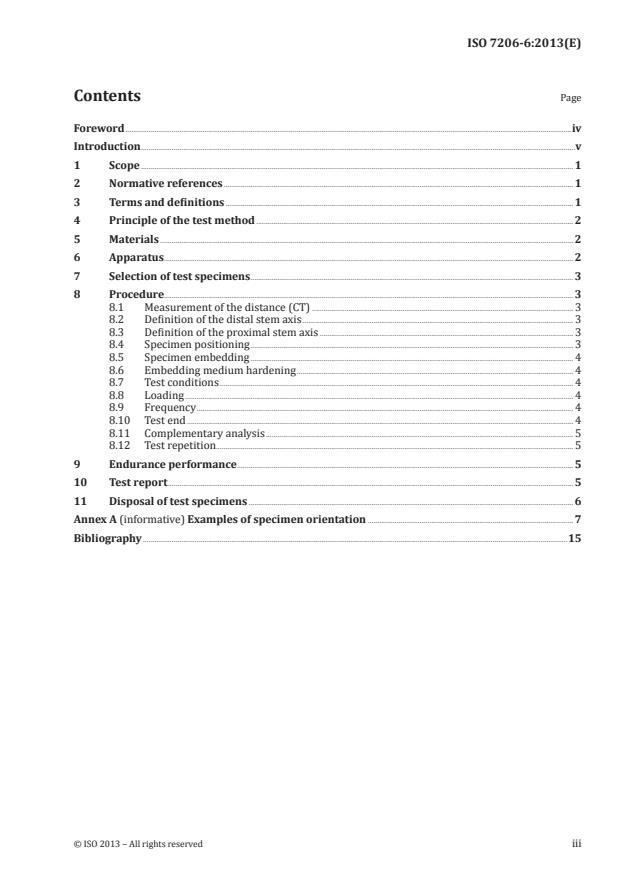
Contents Page
Foreword .iv
Introduction .v
1 Scope . 1
2 Normative references . 1
3 Terms and definitions . 1
4 Principle of the test method . 2
5 Materials . 2
6 Apparatus . 2
7 Selection of test specimens . 3
8 Procedure. 3
8.1 Measurement of the distance (CT) . 3
8.2 Definition of the distal stem axis . 3
8.3 Definition of the proximal stem axis . 3
8.4 Specimen positioning . 3
8.5 Specimen embedding . 4
8.6 Embedding medium hardening . 4
8.7 Test conditions . 4
8.8 Loading . 4
8.9 Frequency . 4
8.10 Test end . 4
8.11 Complementary analysis . 5
8.12 Test repetition. 5
9 Endurance performance . 5
10 Test report . 5
11 Disposal of test specimens . 6
Annex A (informative) Examples of specimen orientation . 7
Bibliography .15
Foreword
ISO (the International Organization for Standardization) is a worldwide federation of national standards
bodies (ISO member bodies). The work of preparing International Standards is normally carried out
through ISO technical committees. Each member body interested in a subject for which a technical
committee has been established has the right to be represented on that committee. International
organizations, governmental and non-governmental, in liaison with ISO, also take part in the work.
ISO collaborates closely with the International Electrotechnical Commission (IEC) on all matters of
electrotechnical standardization.
The procedures used to develop this document and those intended for its further maintenance are
described in the ISO/IEC Directives, Part 1. In particular the different approval criteria needed for the
different types of ISO documents should be noted. This document was drafted in accordance with the
editorial rules of the ISO/IEC Directives, Part 2. www.iso.org/directives
Attention is drawn to the possibility that some of the elements of this document may be the subject of
patent rights. ISO shall not be held responsible for identifying any or all such patent rights. Details of any
patent rights identified during the development of the document will be in the Introduction and/or on
the ISO list of patent declarations received. www.iso.org/patents
Any trade name used in this document is information given for the convenience of users and does not
constitute an endorsement.
The committee responsible for this document is ISO/TC 150, Implants for surgery, Subcommittee SC 4,
Bone and joint replacements.
This second edition cancels and replaces the first edition (ISO 7206-6:1992), of which it constitutes a
minor revision.
ISO 7206 consists of the following parts, under the general title Implants for surgery — Partial and total
hip joint prostheses:
— Part 1: Classification and designation of dimensions
— Part 2: Articulating surfaces made of metallic, ceramic and plastics materials
— Part 4: Determination of endurance properties and performance of stemmed femoral components
— Part 6: Endurance properties testing and performance requirements of neck region of stemmed
femoral components
— Part 10: Determination of resistance to static load of modular femoral heads
iv © ISO 2013 – All rights reserved
Introduction
The test method described in this part of ISO 7206 is intended for the verification of the endurance
properties of the neck region of stemmed femoral components of hip joint prostheses. This method is
based extensively on that given in ISO 7206-4, which verifies the endurance properties of the complete
femoral component under loading conditions that include a torsional component. The test conditions
in ISO 7206-4, especially the height of the specimen embedding, are intended to represent the clinical
situation where the prosthesis has become loosened in the femur, whereas the test conditions in this
part of ISO 7206 are intended to represent a correctly and firmly fixed prosthesis. Therefore, it should
be noted that the tests in this part of ISO 7206 may not be representative of the most unfavourable
clinical conditions.
INTERNATIONAL STANDARD ISO 7206-6:2013(E)
Implants for surgery — Partial and total hip joint
prostheses —
Part 6:
Endurance properties testing and performance requirements
of neck region of stemmed femoral components
1 Scope
This part of ISO 7206 specifies test methods and the fatigue performance for the endurance properties,
under specified laboratory conditions, of neck region of stemmed femoral components of total hip joint
prostheses and stemmed femoral components used alone in partial hip joint replacement. This part of
ISO 7206 does not cover the investigation of the performance of the head or the neck-head junction. It is
applicable to modular and non-modular designs made of metallic or non-metallic materials.
It also specifies the test conditions so that the important parameters that affect the hip femoral
components are taken into account and describes how the specimen is set up for testing.
2 Normative references
The following documents, in whole or in part, are normatively referenced in this document and are
indispensable for its application. For dated references, only the edition cited applies. For undated
references, the latest edition of the referenced document (including any amendments) applies.
ISO 3696:1987, Water for analytical laboratory use — Specification and test methods
ISO 4965-1:2012, Metallic materials — Dynamic force calibration for uniaxial fatigue testing — Part 1:
Testing systems
ISO 4965-2:2012, Metallic materials — Dynamic force calibration for uniaxial fatigue testing — Part 2:
Dynamic calibration device (DCD) instrumentation
ISO 7206-1, Implants for surgery — Partial and total hip joint prostheses — Part 1: Classification and
designation of dimensions
3 Terms and definitions
For the purposes of this document, the terms and definitions given in ISO 7206-1 and the following apply.
3.1
implantable
condition of a test sample which has received all the machining processes, cleaning, degreasing, and
sterilization procedures required prior to implantation
3.2
resection line/level
level prescribed by the manufacturer which, in clinical use of the femoral hip stem, corresponds to the
proximal cut of the bone shaft
4 Principle of the test method
The test specimen is embedded in a solid medium. For modular stems, the protruding part of the test
specimen is immersed in a fluid test medium. A cyclic load is applied to the head of the test specimen
until one of the conditions mentioned in 8.10 occurs.
5 Materials
5.1 Embedding medium, i.e., a casting medium, which shall:
a) not crack or break under the load applied during testing;
b) not exhibit excessive deformation or creep;
c) be reproducible in strength and other characteristics.
The media that appear satisfactory are acrylic bone cement (see ISO 5833), filled epoxy casting resin,
and liquid metal as an amorphous metal alloy. The media should have a modulus of elasticity between
2 2
2 000 N/mm and 6 000 N/mm .
5.2 Flu
...
NORME ISO
INTERNATIONALE 7206-6
Deuxième édition
2013-11-15
Implants chirurgicaux — Prothèses
partielles et totales de l’articulation
de la hanche —
Partie 6:
Exigences de performance et essais
des propriétés d’endurance de la
région du col des tiges fémorales
Implants for surgery — Partial and total hip joint prostheses —
Part 6: Endurance properties testing and performance requirements
of neck region of stemmed femoral components
Numéro de référence
©
ISO 2013
DOCUMENT PROTÉGÉ PAR COPYRIGHT
© ISO 2013
Droits de reproduction réservés. Sauf indication contraire, aucune partie de cette publication ne peut être reproduite ni utilisée
sous quelque forme que ce soit et par aucun procédé, électronique ou mécanique, y compris la photocopie, l’affichage sur
l’internet ou sur un Intranet, sans autorisation écrite préalable. Les demandes d’autorisation peuvent être adressées à l’ISO à
l’adresse ci-après ou au comité membre de l’ISO dans le pays du demandeur.
ISO copyright office
Case postale 56 • CH-1211 Geneva 20
Tel. + 41 22 749 01 11
Fax + 41 22 749 09 47
E-mail copyright@iso.org
Web www.iso.org
Publié en Suisse
ii © ISO 2013 – Tous droits réservés
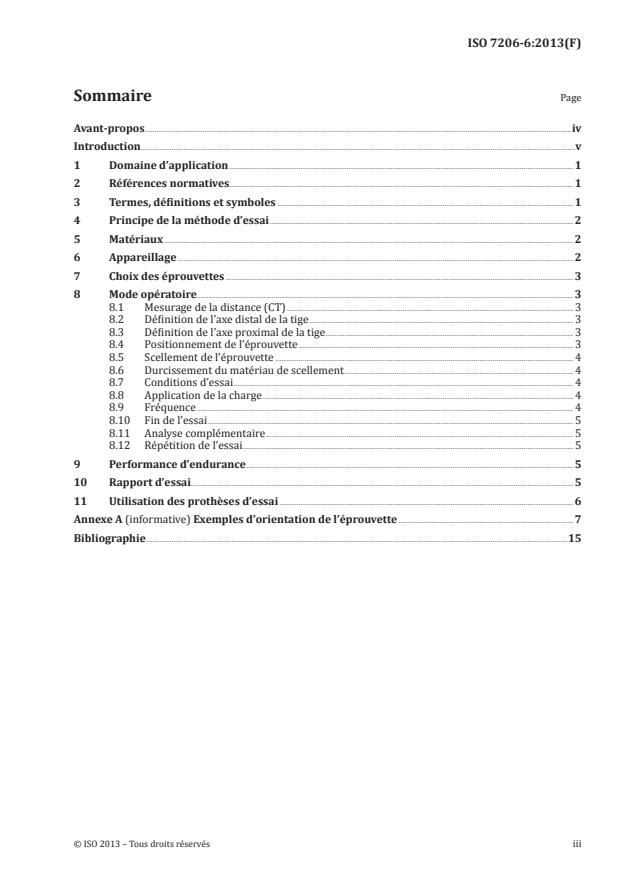
Sommaire Page
Avant-propos .iv
Introduction .v
1 Domaine d’application . 1
2 Références normatives . 1
3 Termes, définitions et symboles . 1
4 Principe de la méthode d’essai . 2
5 Matériaux . 2
6 Appareillage . 2
7 Choix des éprouvettes . 3
8 Mode opératoire. 3
8.1 Mesurage de la distance (CT) . 3
8.2 Définition de l’axe distal de la tige . 3
8.3 Définition de l’axe proximal de la tige . 3
8.4 Positionnement de l’éprouvette . 3
8.5 Scellement de l’éprouvette . 4
8.6 Durcissement du matériau de scellement . 4
8.7 Conditions d’essai . 4
8.8 Application de la charge . 4
8.9 Fréquence . 4
8.10 Fin de l’essai . 5
8.11 Analyse complémentaire . 5
8.12 Répétition de l’essai . 5
9 Performance d’endurance . 5
10 Rapport d’essai . 5
11 Utilisation des prothèses d’essai . 6
Annexe A (informative) Exemples d’orientation de l’éprouvette . 7
Bibliographie .15
Avant-propos
L’ISO (Organisation internationale de normalisation) est une fédération mondiale d’organismes
nationaux de normalisation (comités membres de l’ISO). L’élaboration des Normes internationales est
en général confiée aux comités techniques de l’ISO. Chaque comité membre intéressé par une étude
a le droit de faire partie du comité technique créé à cet effet. Les organisations internationales,
gouvernementales et non gouvernementales, en liaison avec l’ISO participent également aux travaux.
L’ISO collabore étroitement avec la Commission électrotechnique internationale (CEI) en ce qui concerne
la normalisation électrotechnique.
Les procédures utilisées pour élaborer le présent document et celles destinées à sa mise à jour sont
décrites dans les Directives ISO/CEI, Partie 1. Il convient, en particulier de prendre note des différents
critères d’approbation requis pour les différents types de documents ISO. Le présent document a été
rédigé conformément aux règles de rédaction données dans les Directives ISO/CEI, Partie 2, www.iso.
org/directives.
L’attention est appelée sur le fait que certains des éléments du présent document peuvent faire l’objet de
droits de propriété intellectuelle ou de droits analogues. L’ISO ne saurait être tenue pour responsable
de ne pas avoir identifié de tels droits de propriété et averti de leur existence. Les détails concernant les
références aux droits de propriété intellectuelle ou autres droits analogues identifiés lors de l’élaboration
du document sont indiqués dans l’Introduction et/ou sur la liste ISO des déclarations de brevets reçues,
www.iso.org/patents.
Les éventuelles appellations commerciales utilisées dans le présent document sont données pour
information à l’intention des utilisateurs et ne constituent pas une approbation ou une recommandation.
Le comité chargé de l’élaboration du présent document est l’ISO/TC 150, Implants chirurgicaux, sous-
comité SC 4, Prothèses des os et des articulations.
Cette deuxième édition annule et remplace la première édition (ISO 7206-6:1992), dont elle constitue
une révision mineure.
L’ISO 7206 comprend les parties suivantes, présentées sous le titre général Implants chirurgicaux —
Prothèses partielles et totales de l’articulation de la hanche:
— Partie 1: Classification et désignation des dimensions
— Partie 2: Surfaces articulaires constituées de matériaux métalliques, céramiques et plastiques
— Partie 4: Détermination des propriétés d’endurance et des performances des tiges fémorales
— Partie 6: Exigences de performance et essais des propriétés d’endurance des têtes et cols des tiges fémorales
— Partie 10: Détermination de la résistance à la charge statique de têtes fémorales modulaires
iv © ISO 2013 – Tous droits réservés
Introduction
La méthode d’essai décrite dans la présente partie de l’ISO 7206 est destinée à la vérification des
propriétés d’endurance de la région du col des tiges fémorales des prothèses de l’articulation de la
hanche. Cette méthode est en grande partie fondée sur celle qui est donnée dans l’ISO 7206-4, laquelle
vérifie les propriétés d’endurance de la tige fémorale complète, dans des conditions de mise en charge
incluant une composante en torsion. Tandis que les conditions d’essai décrites dans l’ISO 7206-4, en
particulier le niveau de scellement de l’éprouvette, visent à représenter le cas clinique où la prothèse s’est
descellée du fémur, les conditions d’essai exposées dans la présente partie de l’ISO 7206 sont destinées à
représenter une prothèse correctement et solidement fixée. De ce fait, il est à noter que les essais décrits
dans la présente partie de l’ISO 7206 peuvent ne pas être représentatifs des conditions cliniques les plus
défavorables.
NORME INTERNATIONALE ISO 7206-6:2013(F)
Implants chirurgicaux — Prothèses partielles et totales de
l’articulation de la hanche —
Partie 6:
Exigences de performance et essais des propriétés
d’endurance de la région du col des tiges fémorales
1 Domaine d’application
La présente partie de l’ISO 7206 spécifie des méthodes d’essai et les performances en matière de fatigue
pour la détermination des propriétés d’endurance, dans des conditions expérimentales spécifiées, de
la région du col des tiges fémorales des prothèses totales de l’articulation de la hanche et des tiges
fémorales utilisées seules pour le remplacement partiel de cette articulation. La présente partie de
l’ISO 7206 ne couvre pas l’étude des performances de la tête ni de la jonction tête-col. Elle est applicable
aux conceptions modulaires et non modulaires constituées de matériaux métalliques ou non métalliques.
Elle spécifie également les conditions d’essai, pour prendre en compte les paramètres importants qui
influent sur les tiges fémorales, et décrit le positionnement de l’éprouvette en vue de l’essai.
2 Références normatives
Les documents suivants, en totalité ou en partie, sont référencés de manière normative dans le présent
document et sont indispensables pour son application. Pour les références datées, seule l’édition citée
s’applique. Pour les références non datées, la dernière édition du document de référence s’applique (y
compris les éventuels amendements).
ISO 3696, Eau pour laboratoire à usage analytique — Spécification et méthodes d’essai
ISO 4965-1, Matériaux métalliques — Étalonnage de la force dynamique uniaxiale pour les essais de
fatigue — Partie 1: Systèmes d’essai
ISO 4965-2, Matériaux métalliques — Étalonnage de la force dynamique uniaxiale pour les essais de
fatigue — Partie 2: Instrumentation pour équipement d’étalonnage dynamique
ISO 7206-1, Implants chirurgicaux — Prothèses partielles et totales de l’articulation de la hanche — Partie 1:
Classification et désignation des dimensions
3 Termes, définitions et symboles
Pour les besoins du présent document, les termes et définitions donnés dans l’ISO 7206-1 ainsi que les
suivants s’appliquent.
3.1
implantable
état d’un échantillon pour essai ayant subi tous les processus d’usinage, de nettoyage, de dégraissage et
de stérilisation nécessaires avant l’implantation
3.2
niveau de résection
droite
niveau spécifié par le fabricant qui, dans le cas d’une utilisation clinique de la tige fémorale, correspond
à la coupe proximale de la diaphyse
4 Principe de la méthode d’essai
L’éprouvette est scellée dans un matériau solide. Pour les tiges modulaires, la partie de l’éprouvette
qui dépasse est immergée dans un milieu d’essai liquide. Un effort cyclique est appliqué sur la tête de
l’éprouvette jusqu’à l’obtention de l’une des conditions mentionnées en 8.10.
5 Matériaux
5.1 Matériau de scellement, c’est-à-dire un matériau de coulée, qui
a) ne doit pas se fissurer ou se casser lors de l’application de la charge pendant l’essai,
b) ne doit pas présenter de déformation excessive ou de fluage, et
c) doit avoir une résistance reproductible, de même que ses autres caractéristiques.
NOTE Les matériaux qui semblent donner satisfaction sont le ciment chirurgical de résine acrylique (voir
l’ISO 5833), la résine époxyde coulée et du métal fondu, tel qu’un alliage métallique amorphe. Il convient que les
2 2
matériaux aient un module d’élasticité compris entre 2 000 N/mm et 6 000 N/mm .
5.2 Milieu d’essai liquide, solution de 9,0 g/l de chlorure de sodium de qualité analytique (NaCl) dans
de l’eau distillée ou désionisée de qualité 3 conformément à l’ISO 3696.
6 Appareillage
6.1 Machine d’essai, ayant les caractéristiques suivantes:
a) une capacité d’appliquer un effort cyclique conformément à l’Article 8 à la fréquence choisie;
b) une tolérance sur l’effort appliqué n’excédant pas ± 2 % sous l’effort maximal appliqué, tel que
spéci
...
МЕЖДУНАРОДНЫЙ ISO
СТАНДАРТ 7206-6
Второе издание
2013-11-15
Имплантаты хирургические. Полные и
частичные протезы тазобедренных
суставов.
Часть 6.
Испытания усталостных свойств и
требования к рабочим
характеристикам области шейки
стержневых бедренных компонентов
Implants for surgery — Partial and total hip joint prostheses —
Part 6: Endurance properties testing and performance requirements of
neck region of stemmed femoral components
Ответственность за подготовку русской версии несёт GOST R
(Российская Федерация) в соответствии со статьёй 18.1 Устава ISO
Ссылочный номер
©
ISO 2013
Отказ от ответственности при работе в PDF
Настоящий файл PDF может содержать интегрированные шрифты. В соответствии с условиями лицензирования, принятыми
фирмой Adobe, этот файл можно распечатать или смотреть на экране, но его нельзя изменить, пока не будет получена
лицензия на интегрированные шрифты и они не будут установлены на компьютере, на котором ведется редактирование. В
случае загрузки настоящего файла заинтересованные стороны принимают на себя ответственность за соблюдение
лицензионных условий фирмы Adobe. Центральный секретариат ISO не несет никакой ответственности в этом отношении.
Adobe - торговый знак фирмы Adobe Systems Incorporated.
Подробности, относящиеся к программным продуктам, использованные для создания настоящего файла PDF, можно найти в
рубрике General Info файла; параметры создания PDF были оптимизированы для печати. Были приняты во внимание все
меры предосторожности с тем, чтобы обеспечить пригодность настоящего файла для использования комитетами-членами
ISO. В редких случаях возникновения проблемы, связанной со сказанным выше, просьба проинформировать Центральный
секретариат по адресу, приведенному ниже.
ДОКУМЕНТ ЗАЩИЩЕН АВТОРСКИМ ПРАВОМ
Все права сохраняются. Если не указано иное, никакую часть настоящей публикации нельзя копировать или использовать в
какой-либо форме или каким-либо электронным или механическим способом, включая фотокопии и микрофильмы, без
предварительного письменного согласия ISO по адресу ниже или представительства ISO в соответствующей стране.
Бюро авторского права ISO
Почтовый ящик 56 • CH-1211 Женева 20
Тел. + 41 22 749 01 11
Факс + 41 22 749 09 47
E-mail copyright@iso.org
Web www.iso.org
Опубликовано в Швейцарии
ii © ISO 2013 – Все права сохраняются
Содержание Страница
Предисловие .iv
Введение .v
1 Область применения .1
2 Нормативные ссылки .1
3 Термины и определения .1
4 Принцип метода испытаний.2
5 Материалы .2
6 Аппаратура.2
7 Выбор испытываемых образцов.3
8 Процедура.3
8.1 Измерение расстояния (СТ).3
8.2 Определением дистальной оси стержня.3
8.3 Определением проксимальной оси стержня.4
8.4 Расположение образцов .4
8.5 Заделка образца .4
8.6 Затвердевание фиксирующей среды .4
8.7 Условия испытаний.4
8.8 Нагружение.4
8.9 Частота .5
8.10 Окончание испытания.5
8.11 Дополнительный анализ .5
8.12 Повторение испытаний.5
9 Усталостные рабочие характеристики.5
10 Протокол испытания.6
11 Утилизация испытываемого образца.6
Приложение A (информативное) Примеры ориентации образца.7
Библиография.15
Предисловие
Международная организация по стандартизации (ISO) является всемирной федерацией национальных
организаций по стандартизации (комитетов-членов ISO). Разработка международных стандартов
обычно осуществляется техническими комитетами ISO. Каждый комитет-член, заинтересованный в
деятельности, для которой был создан технический комитет, имеет право быть представленным в этом
комитете. Международные правительственные и неправительственные организации, имеющие связи с
ISO, также принимают участие в работах. Что касается стандартизации в области электротехники, то
ISO работает в тесном сотрудничестве с Международной электротехнической комиссией (IEC).
Процедуры, используемые для разработки данного документа и предназначенные для его
дальнейшего обслуживания описаны в Директивах ISO/IEC, Часть 1. В частности, следует отметить
различные критерии приемки, необходимые для разных типов ISO документов. Данный документ был
разработан в соответствии с правилами Директив ISO/IEC, Часть 2. www.iso.org/directives
Следует иметь в виду, что некоторые элементы настоящего международного стандарта могут быть
объектом патентных прав. ISO не может нести ответственность за идентификацию какого-либо одного
или всех патентных прав. Детали любых патентных прав, определенных во время разработки
документа, будут включены во Введение и/или ISO список полученных заявок на патент.
www.iso.org/patents
Любые торговые наименования, используемые в данном документе, даны для информации для
удобства пользователей и не являются рекомендуемыми.
За данный документ ответственен комитет ISO/TC 150, Имплантаты хирургические, Подкомитет SC 4,
Протезы костей и суставов.
Настоящее второе издание отменяет и заменяет первое издание (ISO 7206-6:1992), от которого
отличается незначительными правками.
ISO 7206 состоит из следующих частей под общим заголовком Имплантаты хирургические. Полные и
частичные протезы тазобедренных суставов:
⎯ Часть 1. Классификация и обозначение размеров
⎯ Часть 2. Соединительная поверхность, сделанная из металлических, керамических и
пластиковых материалов
⎯ Часть 4. Определение усталостных свойств и рабочих характеристик стержневых бедренных
компонентов
⎯ Часть 6. Испытания усталостных свойств и требования к рабочим характеристикам области
шейки стержневых бедренных компонентов
⎯ Часть 10. Определение сопротивления статичной нагрузке модульной бедренной головки
iv © ISO 2013 – Все права сохраняются
Введение
Метод испытания, описанный в данной части ISO 7206 предназначен для проверки усталостных
свойств области шейки стержневых бедренных компонентов протезов тазобедренных суставов.
Данный метол преимущественно основан на методе, приведенном в ISO 7206-4, который проверяет
усталостные свойства всего бедренного компонента в условиях нагружения, которые включают
крутящий момент. Условия испытаний в ISO 7206-4, особенно высота заделки образца, предназначены
для моделирования клинической ситуации, когда протез отделяется от бедренной кости, в кто время
как условия испытания в данной части ISO 7206 предназначены для моделирования условий корректно
и надежно зафиксированного протеза. Следовательно, необходимо отметить, что испытания данной
части ISO 7206 могут не представлять наиболее нежелательные клинические условия.
МЕЖДУНАРОДНЫЙ СТАНДАРТ ISO 7206-6:2013(R)
Имплантаты хирургические. Полные и частичные протезы
тазобедренных суставов.
Часть 6.
Испытания усталостных свойств и требования к рабочим
характеристикам области шейки стержневых бедренных
компонентов
1 Область применения
Настоящая часть ISO 7206 определяет методы испытаний и усталостные характеристики для
усталостных свойств области шейки стержневых бедренных компонентов полных протезов
тазобедренного сустава и стержневых бедренных компонентов, используемых отдельно при частичной
замене тазобедренного сустава при определенных лабораторных условиях. Данная часть ISO 7206 не
распространяется на методы исследования рабочих характеристик головки или сопряжения головки и
шейки. Она применима с модульным и немодульным конструкциям, выполненным из металлических и
неметаллических материалов.
Кроме того, в ней определены условия испытаний, так чтобы учитывались важные параметры, которые
могут повлиять на тазобедренные компоненты, и описано, как отбирается образец для испытаний.
2 Нормативные ссылки
Ссылка на следующие документы обязательна при использовании данного документа. Для жестких
ссылок применяются только указанное по тексту издание. Для плавающих ссылок необходимо
использовать самое последнее издание нормативного ссылочного документа (включая любые
изменения).
ISO 3696:1987, Вода для лабораторного анализа. Технические требования и методы испытаний
ISO 4965-1:2012, Металлические материалы. Калибровка динамической нагрузки при одноосных
испытаниях на усталость. Часть 1. Испытательные системы
ISO 4965-2:2012, Металлические материалы. Калибровка динамической нагрузки при одноосных
испытаниях на усталость. Часть 2. Использование устройств для динамической калибровки
ISO 7206-1, Имплантаты хирургические. Полные и частичные протезы тазобедренных суставов.
Часть 1. Классификация и обозначение размеров
3 Термины и определения
В рамках настоящего документа применяются термины и определения, данные в ISO 7206-1 и
следующие.
3.1
имплантируемый
implantable
состояние испытываемого образца, который был подвергнут все процессам механической обработки,
процедурам чистки, обезжиривания и стерилизации, необходимым перед имплантацией
3.2
уровень/линия среза
resection line/level
уровень, заданный производителем, который при клиническом использовании бедренного стержня
соответствует проксимальному разрезу на диафизе кости
4 Принцип метода испытаний
Испытываемый образец зафиксирован в твердой среде. Для модульных стержней выступающая части
испытываемого образца погружена в жидкую испытательную среду. К головке испытываемого образца
прикладываются циклические нагрузки пока не возникнет одно из условий, упомянутых в 8.10.
5 Материалы
5.1 Фиксирующая среда, т.е. среда для заливки, которая должна:
a) не трескаться или разрушаться под нагрузкой, прикладываемой во время испытаний;
b) не показывать чрезмерной деформации или ползучести;
c) быть воспроизводимой по прочности и другим характеристикам.
Среды, удовлетворяющие требованиям: полиакрилатный цемент (см. ISO 5833), эпоксидная смола для
заливки и жидкий метал как аморфный металлический сплав. Среда должна иметь модуль упругости
от 2000 Н/мм2 до 6 000 Н/мм2.
5.2 Жидкая испытательная среда, раствор 9,0 г/л химически чистого хлорида натрия (NaCl) в
дистиллированной или деионизированной воде 3 сорта, согласно ISO 3696.
6 Аппаратура
6.1 Испытательная машина, обладающая следующими характеристиками:
a) способность прикладывать циклические нагрузки в соответствии с Разделом 9 с выбранной частотой;
b) отклонение приложенной нагрузки: не более ± 2% от максимальной прикладываемой нагрузки,
согласно ISO 4965;
c)
...