

ISO/IEC 24713-2:2008
(Main)Information technology — Biometric profiles for interoperability and data interchange — Part 2: Physical access control for employees at airports
General Information
- Abstract
ISO/IEC 24713-2:2008 specifies the application profile including necessary parameters and interfaces between function modules (i.e. BioAPI based modules and an external interface) in support of token-based biometric identification and verification of employees, at local access points (i.e. doors or other controlled entrances) and across local boundaries within the defined area of control in an airport. The token is expected to contain one or more reference biometrics, one or more operational biometrics, or both.
- Status
- Withdrawn
- Publication Date
- 21-May-2008
- Technical Committee
- ISO/IEC JTC 1/SC 37 - Biometrics
- Drafting Committee
- ISO/IEC JTC 1/SC 37/WG 4 - Technical Implementation of Biometric Systems
- Current Stage
- 9599 - Withdrawal of International Standard
- Start Date
- 14-Sep-2026
- Completion Date
- 19-Sep-2026


Overview
ISO/IEC 24713-2:2008 defines a biometric profile for interoperability and data interchange specifically for physical access control for employees at airports. The standard specifies the application profile, required parameters, and interfaces between function modules (notably BioAPI-based modules and external interfaces) to support token-based biometric identification and verification at local access points (doors and controlled entrances) and across local boundaries within an airport’s defined area of control. It assumes an existing access control system and focuses on adding an interoperable biometric component rather than prescribing a complete access control solution.
Key Topics and Requirements
- Token-based biometric model: Tokens (smartcards or similar) are expected to contain one or more reference and/or operational biometrics for employee identification and verification.
- Inter-module interfaces: Defines interfaces between BioAPI modules and external systems to enable consistent biometric operations.
- Enrollment and lifecycle: Recommended practices for enrolment, proofing, registration, issuance, activation, and ongoing usage of biometric tokens.
- Operational safeguards: Guidance on watch-list checking, duplicate issuance prevention, and secure token management.
- Conformance & ICS: Systems must implement mandatory capabilities in the Requirements List and provide a profile-specific Implementation Conformance Statement (ICS) (Annex A).
- Security considerations: The standard includes security approaches and threat considerations (Annex C) and recommends safeguarding confidentiality, integrity, and availability of biometric data in line with local policy.
- Interchange formats: References and aligns with biometric data interchange formats for multiple modalities (fingerprint, face, iris, signature, vascular, hand geometry) and interface frameworks (CBEFF, BioAPI).
Applications and Who Uses It
- Airport operators and security teams: Implement interoperable biometric additions to existing access control for employee movement within secure zones.
- Access control system integrators: Integrate BioAPI-compliant biometric modules and ensure token compatibility across local boundaries.
- Biometric vendors and device manufacturers: Build modules and tokens that conform to the profile for interchange and interoperability.
- IT/security architects and consultants: Design token management, issuance workflows, and risk mitigation strategies consistent with the profile.
- Regulators and procurement teams: Specify interoperable biometric requirements when procuring airport access control solutions.
Related Standards
Key referenced standards for implementation include:
- ISO/IEC 19784-1 (BioAPI)
- ISO/IEC 19785 (CBEFF)
- ISO/IEC 19794 series (biometric data interchange formats for fingers, face, iris, etc.)
- ISO/IEC 19795 series (performance testing)
This profile is intended to enable secure, interoperable biometric access control deployments in airport employee environments while leaving system-wide access control policies and broader privacy regulations to local authorities.
Get Certified
Connect with accredited certification bodies for this standard

BSI Group
BSI (British Standards Institution) is the business standards company that helps organizations make excellence a habit.

NYCE
Mexican standards and certification body.
Sponsored listings
Frequently Asked Questions
ISO/IEC 24713-2:2008 is a standard published by the International Organization for Standardization (ISO). Its full title is "Information technology — Biometric profiles for interoperability and data interchange — Part 2: Physical access control for employees at airports". This standard covers: ISO/IEC 24713-2:2008 specifies the application profile including necessary parameters and interfaces between function modules (i.e. BioAPI based modules and an external interface) in support of token-based biometric identification and verification of employees, at local access points (i.e. doors or other controlled entrances) and across local boundaries within the defined area of control in an airport. The token is expected to contain one or more reference biometrics, one or more operational biometrics, or both.
ISO/IEC 24713-2:2008 specifies the application profile including necessary parameters and interfaces between function modules (i.e. BioAPI based modules and an external interface) in support of token-based biometric identification and verification of employees, at local access points (i.e. doors or other controlled entrances) and across local boundaries within the defined area of control in an airport. The token is expected to contain one or more reference biometrics, one or more operational biometrics, or both.
ISO/IEC 24713-2:2008 is classified under the following ICS (International Classification for Standards) categories: 35.040 - Information coding; 35.240.15 - Identification cards. Chip cards. Biometrics. The ICS classification helps identify the subject area and facilitates finding related standards.
ISO/IEC 24713-2:2008 is available in PDF format for immediate download after purchase. The document can be added to your cart and obtained through the secure checkout process. Digital delivery ensures instant access to the complete standard document.
Standards Content (Sample)
INTERNATIONAL ISO/IEC
STANDARD 24713-2
First edition
2008-06-01
Information technology — Biometric
profiles for interoperability and data
interchange —
Part 2:
Physical access control for employees
at airports
Technologies de l'information — Profils biométriques pour
interopérabilité et échange de données —
Partie 2: Contrôle d'accès physique pour les employés aux aéroports
Reference number
©
ISO/IEC 2008
PDF disclaimer
This PDF file may contain embedded typefaces. In accordance with Adobe's licensing policy, this file may be printed or viewed but
shall not be edited unless the typefaces which are embedded are licensed to and installed on the computer performing the editing. In
downloading this file, parties accept therein the responsibility of not infringing Adobe's licensing policy. The ISO Central Secretariat
accepts no liability in this area.
Adobe is a trademark of Adobe Systems Incorporated.
Details of the software products used to create this PDF file can be found in the General Info relative to the file; the PDF-creation
parameters were optimized for printing. Every care has been taken to ensure that the file is suitable for use by ISO member bodies. In
the unlikely event that a problem relating to it is found, please inform the Central Secretariat at the address given below.
© ISO/IEC 2008
All rights reserved. Unless otherwise specified, no part of this publication may be reproduced or utilized in any form or by any means,
electronic or mechanical, including photocopying and microfilm, without permission in writing from either ISO at the address below or
ISO's member body in the country of the requester.
ISO copyright office
Case postale 56 • CH-1211 Geneva 20
Tel. + 41 22 749 01 11
Fax + 41 22 749 09 47
E-mail copyright@iso.org
Web www.iso.org
Published in Switzerland
ii © ISO/IEC 2008 – All rights reserved
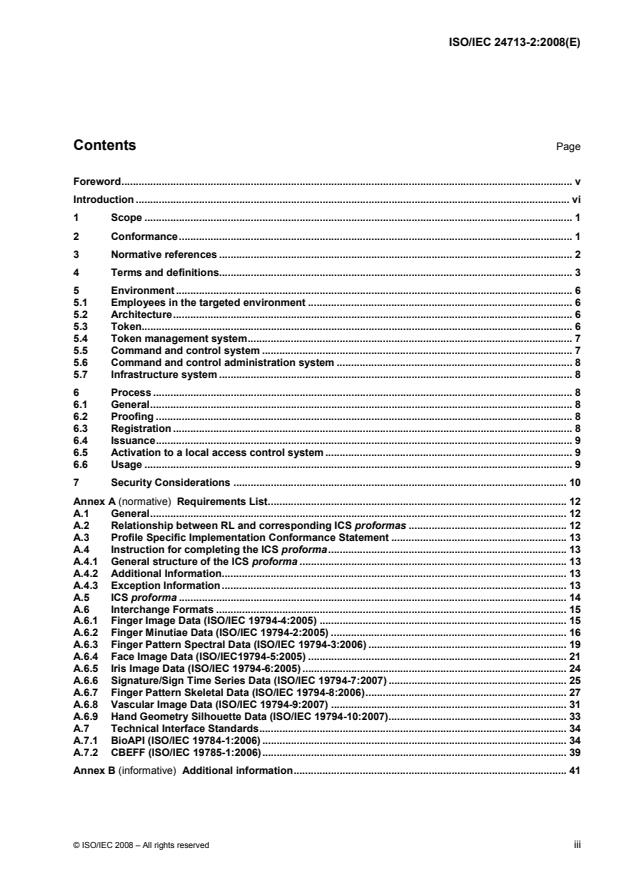
Contents Page
Foreword. v
Introduction . vi
1 Scope. 1
2 Conformance. 1
3 Normative references. 2
4 Terms and definitions. 3
5 Environment. 6
5.1 Employees in the targeted environment . 6
5.2 Architecture. 6
5.3 Token. 6
5.4 Token management system. 7
5.5 Command and control system . 7
5.6 Command and control administration system . 8
5.7 Infrastructure system . 8
6 Process. 8
6.1 General. 8
6.2 Proofing. 8
6.3 Registration. 8
6.4 Issuance. 9
6.5 Activation to a local access control system . 9
6.6 Usage. 9
7 Security Considerations . 10
Annex A (normative) Requirements List. 12
A.1 General. 12
A.2 Relationship between RL and corresponding ICS proformas . 12
A.3 Profile Specific Implementation Conformance Statement . 13
A.4 Instruction for completing the ICS proforma. 13
A.4.1 General structure of the ICS proforma . 13
A.4.2 Additional Information. 13
A.4.3 Exception Information. 13
A.5 ICS proforma . 14
A.6 Interchange Formats . 15
A.6.1 Finger Image Data (ISO/IEC 19794-4:2005) . 15
A.6.2 Finger Minutiae Data (ISO/IEC 19794-2:2005) . 16
A.6.3 Finger Pattern Spectral Data (ISO/IEC 19794-3:2006) . 19
A.6.4 Face Image Data (ISO/IEC19794-5:2005) . 21
A.6.5 Iris Image Data (ISO/IEC 19794-6:2005) . 24
A.6.6 Signature/Sign Time Series Data (ISO/IEC 19794-7:2007) . 25
A.6.7 Finger Pattern Skeletal Data (ISO/IEC 19794-8:2006).27
A.6.8 Vascular Image Data (ISO/IEC 19794-9:2007) . 31
A.6.9 Hand Geometry Silhouette Data (ISO/IEC 19794-10:2007). 33
A.7 Technical Interface Standards. 34
A.7.1 BioAPI (ISO/IEC 19784-1:2006) . 34
A.7.2 CBEFF (ISO/IEC 19785-1:2006). 39
Annex B (informative) Additional information. 41
© ISO/IEC 2008 – All rights reserved iii
Annex C (informative) Security Considerations . 44
C.1 Approaches. 44
C.2 Representative threat list . 44
Bibliography . 46
iv © ISO/IEC 2008 – All rights reserved
Foreword
ISO (the International Organization for Standardization) and IEC (the International Electrotechnical
Commission) form the specialized system for worldwide standardization. National bodies that are members of
ISO or IEC participate in the development of International Standards through technical committees
established by the respective organization to deal with particular fields of technical activity. ISO and IEC
technical committees collaborate in fields of mutual interest. Other international organizations, governmental
and non-governmental, in liaison with ISO and IEC, also take part in the work. In the field of information
technology, ISO and IEC have established a joint technical committee, ISO/IEC JTC 1.
International Standards are drafted in accordance with the rules given in the ISO/IEC Directives, Part 2.
The main task of the joint technical committee is to prepare International Standards. Draft International
Standards adopted by the joint technical committee are circulated to national bodies for voting. Publication as
an International Standard requires approval by at least 75 % of the national bodies casting a vote.
Attention is drawn to the possibility that some of the elements of this document may be the subject of patent
rights. ISO shall not be held responsible for identifying any or all such patent rights.
ISO/IEC 24713-2 was prepared by Joint Technical Committee ISO/IEC JTC 1, Information technology,
Subcommittee SC 37, Biometrics.
ISO/IEC 24713 consists of the following parts, under the general title Information technology — Biometric
profiles for interoperability and data interchange:
⎯ Part 1: Overview of biometric systems and biometric profiles
⎯ Part 2: Physical access control for employees at airports
⎯ Part 3: Biometrics-based verification and identification of seafarers
© ISO/IEC 2008 – All rights reserved v
Introduction
This part of ISO/IEC 24713 is one of a family of International Standards being developed by ISO/IEC
1)
JTC 1/SC 37 that support interoperability and data interchange among biometrics applications and systems.
This family of standards specifies requirements that solve the complexities of applying biometrics to a wide
variety of personal recognition applications, whether such applications operate in an open systems
environment or consist of a single, closed system.
Biometric data interchange format standards and biometric interface standards are both necessary to achieve
full data interchange and interoperability for biometric recognition in an open systems environment. The
ISO/IEC JTC 1/SC 37 biometric standards family includes a layered set of standards consisting of biometric
data interchange formats and biometric interfaces, as well as biometric profiles that describe the use of these
standards in specific application areas.
⎯ The biometric data interchange format standards specify biometric data interchange records for different
biometric modalities. Parties that agree in advance to exchange biometric data interchange records as
specified in a subset of the ISO/IEC JTC 1/SC 37 biometric data interchange format standards should be
able to perform biometric recognition with each other’s data. Parties should also be able to perform
biometric recognition even without advance agreement on the specific biometric data interchange format
standards to be used, provided they have built their systems on the layered ISO/IEC JTC 1/SC 37 family
of biometric standards.
⎯ The biometric interface standards include ISO/IEC 19785, the Common Biometric Exchange Formats
Framework (CBEFF) and ISO/IEC 19784, the Biometric Application Programming Interface (BioAPI).
These standards support exchange of biometric data within a system or among systems. ISO/IEC 19785
specifies the basic structure of a standardized Biometric Information Record (BIR) which includes the
biometric data interchange record with added metadata, such as when it was captured, its expiry date,
whether it is encrypted, etc. ISO/IEC 19784 specifies an open system API that supports communications
between software applications and underlying biometric technology services. BioAPI also specifies a
CBEFF BIR format for the storage and transmission of BioAPI-produced data.
The biometric profile standards facilitate implementations of the base standards (e.g. the ISO/IEC
JTC 1/SC 37 biometric data interchange format and biometric interface standards, and possibly non-biometric
standards) for defined applications. These profile standards define the functions of an application
(e.g. physical access control for employees at airports) and then specify use of options in the base standards
to ensure biometric interoperability.
1) Open systems are built on standards-based, publicly defined data formats, interfaces, and protocols to facilitate data
interchange and interoperability with other systems, which may include components of different design or manufacture. A
closed system may also be built on publicly defined standards, and may include components of different design or
manufacture, but inherently has no requirement for data interchange and interoperability with any other system.
vi © ISO/IEC 2008 – All rights reserved
INTERNATIONAL STANDARD ISO/IEC 24713-2:2008(E)
Information technology — Biometric profiles for interoperability
and data interchange —
Part 2:
Physical access control for employees at airports
1 Scope
This part of ISO/IEC 24713 specifies the biometric profile including necessary parameters and interfaces
between function modules (i.e. BioAPI based modules and an external interface) in support of token-based
biometric identification and verification of employees, at local access points (i.e. doors or other controlled
entrances) and across local boundaries within the defined area of control in an airport. The token is expected
to contain one or more biometric references.
This part of ISO/IEC 24713 does not specify a complete Access Control System for deployment at access
points within the secure area of an airport. It is assumed that such systems exist and that a biometric
component that is the subject of this part of ISO/IEC 24713 is being added to an existing system. It therefore
excludes such things as device features, and exception and incident reporting and handling. This information
is contained in Annex C for information only.
This part of ISO/IEC 24713 includes recommended practices for enrolment, watch list checking, duplicate
issuance prevention, and verification of the identity of employees at airports. It also describes architectures
and business processes appropriate to the support of token-based identity management in the secure
environment of an airport.
It is recommended that the confidentiality, integrity, and availability of biometric data be safeguarded in
accordance with local, regional, or national policy considerations.
This part of ISO/IEC 24713 does not preclude users building applications based on this part of ISO/IEC 24713
from being able to meet such privacy/data protection requirements as may apply to their application. The
specification of privacy/data protection requirements that may apply is outside the scope of this part of
ISO/IEC 24713.
2 Conformance
A system conforms to this part of ISO/IEC 24713 if it correctly performs all the mandatory capabilities defined
in the requirements list and supplies the profile specific Implementation Conformance Statement (ICS) in
Annex A. Note that more capabilities may be required than in the base standards.
© ISO/IEC 2008 – All rights reserved 1
3 Normative references
The following referenced documents are indispensable for the application of this document. For dated
references, only the edition cited applies. For undated references, the latest edition of the referenced
document (including any amendments) applies.
ISO/IEC 19784-1:2006, Information technology — Biometric application programming interface — Part 1:
BioAPI specification
ISO/IEC 19785-1:2006, Information technology — Common Biometric Exchange Formats Framework —
Part 1: Data element specification
ISO/IEC 19785-3:2007, Information technology — Common Biometric Exchange Formats Framework —
Part 3: Patron format specifications
ISO/IEC 19794-2:2005, Information technology — Biometric data interchange formats — Part 2: Finger
minutiae data
ISO/IEC 19794-3:2006, Information technology — Biometric data interchange formats — Part 3: Finger
pattern spectral data
ISO/IEC 19794-4:2005, Information technology — Biometric data interchange formats — Part 4: Finger image
data
ISO/IEC 19794-5:2005, Information technology — Biometric data interchange formats — Part 5: Face image
data
ISO/IEC 19794-6:2005, Information technology — Biometric data interchange formats — Part 6: Iris image
data
ISO/IEC 19794-7:2007, Information technology — Biometric data interchange formats — Part 7:
Signature/sign time series data
ISO/IEC 19794-8:2006, Information technology — Biometric data interchange formats — Part 8: Finger
pattern skeletal data
ISO/IEC 19794-9:2007, Information technology — Biometric data interchange formats — Part 9: Vascular
image data
ISO/IEC 19794-10:2007, Information technology — Biometric data interchange formats — Part 10: Hand
geometry silhouette data
ISO/IEC 19795-1:2006, Information technology — Biometric performance testing and reporting — Part 1:
Principles and framework
ISO/IEC 19795-2;2007, Information technology — Biometric performance testing and reporting — Part 2:
Testing methodologies for technology and scenario evaluation
ISO/IEC 24713-1:2008, Information technology — Biometric profiles for interoperability and data interchange —
Part 1: Overview of biometric systems and biometric profiles
2 © ISO/IEC 2008 – All rights reserved
4 Terms and definitions
For the purposes of this document, the following terms and definitions apply.
4.1
application
program or piece of software designed to fulfil a particular purpose
4.2
base standard
standard that is part of a profile and from which options, subsets, and parameter values are selected if these
choices are left open in the standard
4.3
biometric
pertaining to biometrics
4.4
biometrics
automated recognition of individuals based on their behavioural and biological characteristics
4.5
biometric characteristic
measurable, physical characteristic or personal behavioural trait used to recognize the identity, or verify the
claimed identity, of an enrolee
4.6
biometric feature
concise representation of information extracted from an acquired or intermediate biometric sample by applying
a mathematical transformation
4.7
biometric profile
conforming subsets or combinations of base standards used to provide specific functions
NOTE Biometric profiles identify the use of particular options available in base standards, and provide a basis for the
interchange of data between applications and interoperability of systems.
4.8
biometric reference
one or more stored biometric samples, biometric templates or biometric models attributed to an individual and
used for comparison
4.9
biometric sample
raw data representing a biometric characteristic of an end-user as captured by a biometric system (for
example, the image of a fingerprint)
4.10
biometric system
automated system capable of:
⎯ capturing a biometric sample from an end-user;
⎯ extracting biometric data from that sample;
⎯ comparing the biometric data with that contained in one or more reference templates;
⎯ deciding how well they match, and indicating whether or not an identification or verification of identity has
been achieved
© ISO/IEC 2008 – All rights reserved 3
4.11
biometric template
data that represents the biometric measurement of an enrolee
NOTE Used by a biometric system for comparison against submitted biometric samples.
4.12
capture
method of taking a biometric sample from an end-user
4.13
comparison
process of comparing a biometric sample with a previously stored reference template or templates
cf. identification and verification
4.14
claimant
person submitting a biometric sample for verification or identification whilst claiming a legitimate or false
identity
4.15
database
structured set of data held in a computer
4.16
end-user
person (employee) who interacts with a biometric system to enrol or have his/her identity checked
4.17
enrolee
person who has a biometric reference template on file
4.18
enrolment
process of collecting biometric samples from a person and the subsequent preparation and storage of
biometric reference templates representing that person's identity
4.19
extraction
process of converting a captured biometric sample into biometric data
4.20
false acceptance
〈biometric system〉 incorrect identification of an individual or incorrect verification of an impostor against a
claimed identity
4.21
false acceptance rate
FAR
proportion of verification transactions with wrongful claims of identity that are incorrectly confirmed
NOTE The false acceptance rate is estimated as the proportion of recorded zero-effort impostor transactions that
were incorrectly accepted (or weighted proportion, in case the number of recorded zero-effort impostor transactions is
different for individual crew members).
4.22
false rejection
when a biometric system fails to identify an enrolee or fails to verify the legitimate claimed identity of an
enrolee
4 © ISO/IEC 2008 – All rights reserved
4.23
false rejection rate
FRR
proportion of verification transactions with truthful claims of identity that are incorrectly denied
NOTE The false rejection rate is estimated as the proportion of recorded genuine transactions that were incorrectly
denied (or weighted proportion, in case the number of recorded genuine transactions is different for individual test crew
members).
4.24
identifier
unique data string used as a key in the biometric system to associate a person’s biometric with a person’s
identity attributes
4.25
identification
identify
biometric system function that performs a one-to-many search of a submitted sample against all or part of the
enrolled database, and outputs a candidate list of zero, one or more identifiers for the stored templates found
to be similar to the submitted sample
4.26
match
matching
process of comparing (a) biometric sample(s) against (a) previously stored template(s) and scoring the level of
similarity
4.27
multiple biometric
biometric system that includes more than one biometric modality
4.28
population
set of end-users for the application
4.29
record
template and other information about the end-user
EXAMPLE Access permissions.
4.30
registration
process of making a person’s identity known to a biometric system, associating a unique identifier with that
identity, and collecting and recording the person’s relevant attributes into the system
4.31
token
physical device that contains information specific to the bearer (end-user) or issuer (user)
4.32
transaction
an attempt by an end-user to validate a claim of identity or non-identity by consecutively submitting one or
more samples, as allowed by the system decision policy
4.33
verification
verify
biometric system function that performs a one-to-one comparison of a submitted sample against a specified
stored template, and returns the matching score or matching decision
© ISO/IEC 2008 – All rights reserved 5
5 Environment
5.1 Employees in the targeted environment
The physical Access Control deployment requests that groups of employees shall be identified. Employees
are sets of people involved in airport activities with common characteristics.
Employees are targeted by this part of ISO/IEC 24713. Characteristics are:
⎯ individuals that access different restricted areas covered by the airport authorities;
⎯ individuals that have access to the restricted areas only under condition of professional objectives;
⎯ individuals subject to labour regulation.
For example, employees are receptionists, refuelling staff, maintenance staff, carrier, temporal road workers.
Employers maintain contractual links with employees. The contractual links are either employment contract or
commercial contract. Employers are responsible for requesting physical access control for employees to the
airport authorities. Employers shall be in charge of collecting all information requested by the airport
authorities, except biometric information.
For example, employers are the airport company, any sub-contractor companies, or airport authorities.
Airport authority is the unique legal authority in charge of granting access rights to restricted areas. This
shall include enrolment activities. The airport authority is solely responsible for proofing (see ISO/IEC 24713-1,
6.2.1). Registration and issuance (see ISO/IEC 24713-1, 6.2) could be either directly managed by airport
authority or only supervised by airport authority.
Privacy authority is an authority, strictly independent from airport authority, employers and also any
employees lobbying association. Privacy authority is responsible for the supervision of biometric data
protection in respect of the applicable laws or regulation. It should be noted that in some configurations,
privacy officers are employees with a dedicated mission from the privacy authority.
NOTE Privacy/data protection requirements are outside the scope of this part of ISO/IEC 24713. However, in some
jurisdictions a privacy authority may be put in place, dependent on local laws and regulations.
5.2 Architecture
The architecture of this specific employee profile can be broken down into four subsystems. The first is the
token, which is the physical component, used by the individual worker to gain physical access to secure areas
of the place of employment. The specification of the token is outside the scope of this part of ISO/IEC 24713.
The second is a Token Management System (TMS) to manage the inventory, distribution, and revocation of
the token. The third is the Command and Control System, which is the central database and security umbrella
for the employee system. The fourth is the Command and Control Administration System, which is used for
the administration of the operations. The infrastructure system to support the application binds the four
elements above.
NOTE There may be other architectures with a different structure of subsystems, i.e. one where the token contains
the biometric reference data and/or performs the verification (see ISO/IEC 7816-11).
5.3 Token
The token is the physical component that, in the possession of the Employee, shall provide authorized
physical access within the airport restricted area. The token may also support multiple memory technologies
including integrated circuit chip (ICC) memory, magnetic stripe, optical stripe and barcodes, as well as
processing capabilities as provided within an ICC microprocessor. The token shall contain a unique token ID
number. The biometric reference is typically stored in the token.
6 © ISO/IEC 2008 – All rights reserved
Depending on the command and control system design, the token is an element of security containing a
biometric. Appropriate security evaluation of the token shall be considered. Security requirements for the
token are out of the scope of this part of ISO/IEC 24713.
5.4 Token management system
The Token Management System is a system that handles the shipping, storage, printing, personalization,
loading, processing, and revoking of the token. Processing within the Token Management System may
include the following functions:
Applet loading
Manage requests
Handle volume printing
Track inventory
Test tokens
Biometric quality
Exception handling
Handle returns
Produce images
Handle encryption
Photograph capture that works with digital video capture device
Digital camera compatibility
Database maintenance including photograph storage
Magnetic stripe encoding
Barcode printing
Built-in token design capability
Token locking/unlocking
PKI encoding
Biometric encoding and storage
Open application program interface (API) for applet development
Smart-chip encoding
NOTE This list is not exhaustive, and some entries on this list are outside the scope of this part of ISO/IEC 24713.
5.5 Command and control system
The command and control system is the central database and security umbrella for the employee system. As
a minimum, the central database shall contain the list of the valid and revoked token id numbers. It may also
have several components including directory services, central communication, token information, and other
information as deemed necessary by security requirements (as determined by the specific application). The
biometric data may be stored in the central database, and linked to the token ID. The command and control
system should also support claimed identity checks and other background check material. The command and
control system shall provide the “watch list” function for tokens and should provide this function for individuals.
The final component of the command and control system shall be a passive/active secure messaging system.
© ISO/IEC 2008 – All rights reserved 7
5.6 Command and control administration system
The command and control administration system monitors data integrity issues, actively monitors for
attempted attacks on the system, enables or disables administrative control of the system and
policy management, i.e., control over authentication policies, based on alert level. Further, this part of the
system includes an override control in case of a terrorist or other attack.
5.7 Infrastructure system
The infrastructure incorporates biometric token terminals, wiring, door controls, wire status sensors, and
access control products and services. Those elements of the system that are software oriented (i.e. can be
changed in the field) should incorporate digital security technology to protect against system compromise.
6 Process
6.1 General
Clause 6 of ISO/IEC 24713-1 describes in detail the relationship between the biometric system and the
application. The application defined by this part of ISO/IEC 24713 is access control for employees at airports.
The process described below is the instantiation of the reference architecture. See also annex C for additional
information. Indeed, as mentioned in the scope of this part of ISO/IEC 24713, this clause addresses business
process for the support of token-based identity management.
An airport contains public areas, airport offices and restricted areas. Restricted area access is restricted to
employees only. Restricted areas are delimited by security mechanisms, such as walls, gates, barriers, etc.
Entry Gates to the access area shall be equipped with access control mechanisms, including biometric
facilities for employees. Each area requires a level of privileges. For example, if a restricted area A is included
in the restricted area B, then the privilege of A is higher than the privilege of B. If restricted area A and B have
no “relation”, then privilege A and B have no access dependencies.
6.2 Proofing
When an employee applies or re-applies for a token, the process begins at a proofing and issuance station.
Here, the worker will first produce a request for a token from his/her employer using the employer’s
procedures. Claimed identity verification is then completed through a review of the documentation presented
by the employee (photograph identity card, birth certificate, link to community, link to employer, etc).
This process is the first stage of the ID life-cycle (see ISO/IEC 24713-1). This process concerns only
Employees (see description in clause 5.0). Physical identity can be claimed by documents. Documents are
provided either by the Employee or by the Employer. Only the Airport Authority has the privilege to process
the identity verification. The Privacy authority should be involved in this stage. As indicated in Part 1,
biometrics may be used for background check.
NOTE The Employee may have a token, issued previously. This is due to managing identities throughout their
lifetime.
6.3 Registration
Once claimed identity is proven, the biometric reference(s) and personal information is collected to initiate the
background check process. As indicated in ISO/IEC 24713-1, biometrics may be used to perform a
background check. Other screening measures, if required by the local facility, would also be administered at
this time.
The data required by the token system is then entered into the enrolment record along with a digital
photograph and biometric reference template. The biometric reference(s) will be selected from the list of
reference technologies deemed suitable for identification (one-to-many) and verification (one-to-one) and
specified in annex A. In the event of a lost token, see 6.5. The enrolment team should be trained to operate
the biometric system efficiently to collect the biometric samples from the employees. The enrolment area and
token storage area shall be secure area(s), with access control managed only by the airport authority.
8 © ISO/IEC 2008 – All rights reserved
The biometric sample may be encrypted and signed by the application (see A.7.2, item 2). The keys that are
used to encrypt the biometric sample should be managed within the context of a suitable key management
system, and a suitable certificate management system and private key management system should be used
for effective biometric authentication.
In addition to a background check process, the system may provide a duplication check function to examine
the biometric templates against previously enrolled biometric templates using biometric identification (1:N) to
reduce the threat of alias identities in the system.
6.4 Issuance
The issuance stage, as described in ISO/IEC 24713-1, is the process of granting privilege and giving a
credential. This stage is the next stage after registration (enrolment). If the previous stages are successfully
completed, the enrolment information and a request are sent to a printing and personalization centre, where
the token is prepared and printed, and the final personalization is completed. The token is then locked
electronically and shipped to the appropriate enrolment and issuance centre. Notifications are then made to
both the central administration and the individual, informing them that the token is ready for issuance.
The individual then returns to the Airport Authority, where the token is electronically unlocked; the biometric
reference(s) is verified (1:1 check) to ensure the token is being issued to the same individual who applied; the
data is validated; and the token is issued and the central administration is notified. The token issuance shall
have a validity period. The validity period shall be determined by the Airport Authority.
6.5 Activation to a local access control system
Activation of the token takes place at each facility, where the individual requires access. Any transmission of
the biometric shall be protected with encrypted and signed templates. When the individual arrives at the
facility or the appropriate enrolment and issuance station, the employee presents the token and the reason for
requesting access.
The worker's identity and background clearance status, if appropriate, are verified by the use of the biometric
reference. This process is a validation as well as a security check. The access privilege decision is then made
and the appropriate access to the facility is granted. The access privilege given to an individual is determined
by the facility based on the established local security plan and the information verified by the token. If the local
access control system is compatible with the token, the token is ready for use throughout the facility. If the
systems are incompatible, the employee shall restart at the proofing stage to obtain a compatible token. Upon
granting access to an employee, the facility notifies the central administration of the access privilege assigned
and the individual’s record is updated.
6.6 Usage
An employee uses the issued token to gain access to one or more restricted areas within a local airport. The
token must have been activated for the local airport and the employee granted authorization to enter the
restricted area. The sequence of events during usage will be implementation dependent. A sample usage
scenario is now presented (noting that this is one of a number of alternative ways of implementing the
system):
At the access point to a restricted area, the employee presents the token to a biometric token terminal, for
authentication. The employee identifier or token identifier is read from the token. The reference biometric(s) is
read from the token or the central database. The system should ensure the validity and integrity of the data
read from the token, through use of security techniques such as digital signatures, certificates or other
cryptographic techniques and/or encryption. The employee is requested to present one or more biometric
samples to a biometric capture device. Through these actions the employee is making a claim that they are a
valid authorized user of the restricted area at that specific point in time.
The biometric reference(s) are compared against the biometric(s) submitted by the claimant. An authorization
check is performed to confirm that the employee is allowed to access the restricted area and under the current
conditions (e.g. time of day, employee work schedule, threat level, movement history). The biometric
© ISO/IEC 2008 – All rights reserved 9
verification and employee authorization check may take place in part or in full on the token, in the biometric
token terminal, in an access control device or other attached processing device, or in a command and control
system or other networked central location. The preferred locations for these operations will be
implementation dependent.
If the system decides that the biometrics successfully matched and the employee is authorized for the area,
then access will be granted. This may involve opening a door, gate, or other entrance.
There are several possible reasons why the token would no longer be valid. These include, but are not limited
to, the following.
⎯ The Employee declares to the Airport Authority or to the Employers that the token is lost.
⎯ The Employee declares to the Airport Authority or to the Employers that the token is stolen.
⎯ The Employer declares to the Airport Authority that contractual link with an Employee is cancelled.
⎯ The Airport Authority has decided to revoke a token.
Any of the above events will result in the decision to revoke the token. Such decision will be taken based on
the mandatory unique ID number of the token and will be invoked automatically upon expiration of the token,
expiration or cancellation of the relationship that exists between the Airport Authority and the Employer. The
actual procedure for revoking a token, independent of the reason, should take careful consideration to protect
the privacy of those involved. The specific procedures for revocation, and the privacy considerations
associated with such action, are out of scope of this part of ISO/IEC 24713.
When a token is revoked, the privileges associated with that token are locked. Additionally, the unique ID
number of the token shall also be locked and shall not be re-used in the future. Denied attempts to an access
area with a revoked token should be monitored by the Airport Authority. The unique ID of the token should be
used to establish statistics on denied attempts. The biometric sample captured during a denied attempt may
be transmitted and stored for further investigation.
The Employee who declares lost or stolen his/her token, would request and be issued with a new token in
accordance with the procedures of the Airport Authority.
The Airport Authority can replace a valid token by a new valid token at any time and for any reason. On
request of Employers or the Airport Authority, the validity period of a token may be updated. In this case, the
unique ID number of the token would be maintained. The biometric reference may be replaced when the
validity period is updated. Biometric data is managed as described in the enrolment stage (see 6.2). The
procedure for updating the validity period is out of scope of this part of ISO/IEC 24713.
The Airport Authority should establish a procedure in the case where a genuine Employee applies his/her
valid token to request his/her privileges and the access privileges are not granted due to any failure (for
example, due to False Rejection). The content of such a procedure is outside the scope of this part of
ISO/IEC 24713.
The keys provisioned on the reader should be managed within the context of a suitable key management
system, and a suitable certificate management system and private key management system should be used
for effective biometric authentication.
7 Security Considerations
This section describes general concepts of security applied for a Biometric authentication system, including
approaches and profiles. See also annex D for a concrete example.
When an access control system for employees at an airport is deployed, then sensors and associated
equipment should be certified in accordance with local regulations, taking into account environmental testing
in the case of outdoor applications.
10 © ISO/IEC 2008 – All rights reserved
Annex D describes general concepts of security that could be applied for a Biometric authentication system,
including approaches and profiles. Annex D is an example that is not inclusive but intended as a starting point
for security considerations.
Liveness detection in a biometric system ensures that only fingerprints, facial images, irises, and other
characteristics directly derived from the person requesting verification of such a characteristic are capable of
generating valid biometric templates. For further information on liveness detection, see Annex
...