


ISO/FDIS 80601-2-74
(Main)Medical electrical equipment — Part 2-74: Particular requirements for basic safety and essential performance of respiratory humidifying equipment
Medical electrical equipment — Part 2-74: Particular requirements for basic safety and essential performance of respiratory humidifying equipment
This document applies to the basic safety and essential performance of a humidifier, also hereafter referred to as ME equipment, in combination with its accessories, the combination also hereafter referred to as ME system. This document is also applicable to those accessories intended by their manufacturer to be connected to a humidifier where the characteristics of those accessories can affect the basic safety or essential performance of the humidifier. EXAMPLE 1 Heated breathing tubes (heated-wire breathing tubes) or ME equipment intended to control these heated breathing tubes (heated breathing tube controllers). NOTE 1 Heated breathing tubes and their controllers are ME equipment and are subject to the requirements of IEC 60601‑1. NOTE 2 ISO 5367 specifies other safety and performance requirements for breathing tubes. This document includes requirements for the different medical uses of humidification, such as invasive ventilation, non-invasive ventilation, nasal high-flow therapy, and obstructive sleep apnoea therapy, as well as humidification therapy for tracheostomy patients. NOTE 3 A humidifier can be integrated into other equipment. When this is the case, the requirements of the other equipment also apply to the humidifier. EXAMPLE 2 Heated humidifier incorporated into a critical care ventilator where ISO 80601‑2-12[10] also applies. EXAMPLE 3 Heated humidifier incorporated into a homecare ventilator for dependent patients where ISO 80601‑2-72[12] also applies. EXAMPLE 4 Heated humidifier incorporated into sleep apnoea therapy equipment where ISO 80601‑2‑70[11] also applies. EXAMPLE 5 Heated humidifier incorporated into ventilatory support equipment where either ISO 80601-2-79[13] or ISO 80601-2-80[14] also apply. EXAMPLE 6 Heated humidifier incorporated into respiratory high-flow therapy equipment where ISO 80601‑2‑90[15] also applies. This document also includes requirements for an active HME (heat and moisture exchanger), ME equipment which actively adds heat and moisture to increase the humidity level of the gas delivered from the HME to the patient. This document is not applicable to a passive HME, which returns a portion of the expired moisture and heat of the patient to the respiratory tract during inspiration without adding heat or moisture. NOTE 4 ISO 9360‑1 and ISO 9360‑2[4] specify safety and performance requirements for a passive HME. NOTE 5 If a clause or subclause is specifically intended to be applicable to ME equipment only, or to ME systems only, the title and content of that clause or subclause will say so. If that is not the case, the clause or subclause applies both to ME equipment and to ME systems, as relevant. Hazards inherent in the intended physiological function of ME equipment or ME systems within the scope of this document are not covered by specific requirements in this document except in IEC 60601‑1:2005+AMD1:2012+AMD2:2020, 7.2.13 and 8.4.1. NOTE 6 Additional information can be found in IEC 60601‑1:2005+AMD1:2012+AMD2:2020, 4.2. This document does not specify the requirements for cold pass-over or cold bubble-through humidification devices, the requirements for which are given in ISO 20789[6]. This document is not applicable to equipment commonly referred to as “room humidifiers” or humidifiers used in heating, ventilation and air conditioning systems, or humidifiers incorporated into infant incubators. This document is not applicable to nebulizers used for the delivery of a drug to patients. NOTE 7 ISO 27427[7] specifies the safety and performance requirements for nebulizers.
Appareils électromédicaux — Partie 2-74: Exigences particulières pour la sécurité de base et les performances essentielles des équipements d'humidification respiratoire
Le présent document s'applique à la sécurité de base et aux performances essentielles d'un humidificateur, ci-après également désigné par appareil EM, associé à ses accessoires, dont la combinaison est ci-après désignée par système EM. Le présent document s'applique également aux accessoires conçus par leur fabricant pour être raccordés à un humidificateur, du fait que les caractéristiques de ces accessoires peuvent avoir un impact sur la sécurité de base ou sur les performances essentielles de l'humidificateur. EXEMPLE 1 Tuyaux respiratoires chauffés (tuyaux respiratoires avec résistance chauffante) ou les appareils EM destinés à commander ces tuyaux respiratoires chauffés (commandes de tuyaux respiratoires chauffés). NOTE 1 Les tuyaux respiratoires chauffés et leurs commandes sont des appareils EM et sont soumis aux exigences de l'IEC 60601‑1. NOTE 2 L'ISO 5367 spécifie d'autres exigences de sécurité et de performance pour les tuyaux respiratoires. Le présent document contient des exigences pour les différentes utilisations médicales de l'humidification, telles que la ventilation invasive, la ventilation non invasive, l'oxygénothérapie nasale à haut débit et le traitement de l'apnée obstructive du sommeil, ainsi que l'humidification pour les patients trachéotomisés. NOTE 3 Un humidificateur peut être intégré dans un autre appareil. Dans ce cas, les exigences de l'autre appareil s'appliquent aussi à l'humidificateur. EXEMPLE 2 Humidificateur chauffé intégré dans un ventilateur pulmonaire pour utilisation en soins intensifs où l'ISO 80601‑2-12[10] s'applique aussi. EXEMPLE 3 Humidificateur chauffé intégré dans un ventilateur utilisé dans l'environnement des soins à domicile pour les patients dépendants où l'ISO 80601‑2-72[12] s'applique aussi. EXEMPLE 4 Humidificateur chauffé intégré dans du matériel de traitement respiratoire de l'apnée du sommeil où l'ISO 80601‑2‑70[11] s'applique aussi. EXEMPLE 5 Humidificateur chauffé intégré dans l’équipement d’assistance ventilatoire où l’ISO 80601-2-79[13] ou l’ISO 80601-2-80[14] s’applique aussi. EXEMPLE 6 Humidificateur chauffé intégré dans du matériel d'oxygénothérapie à haut débit où l'ISO 80601‑2‑90[15] s'applique aussi. Le présent document contient également des exigences pour les ECH actifs (échangeurs de chaleur et d'humidité), appareils EM qui ajoutent activement de la chaleur et de l'humidité afin d'augmenter le niveau d'humidité du gaz administré au patient par l'ECH. Le présent document ne s'applique pas aux ECH passifs qui renvoient une partie de l'humidité et de la chaleur de l'air expiré par le patient aux voies respiratoires lors de l'inspiration, sans ajout de chaleur ou d'humidité. NOTE 4 L’ISO 9360‑1 et l’ISO 9360‑2[4] spécifient les exigences de sécurité et de performances pour un ECH passif. NOTE 5 Si un article ou un paragraphe est spécifiquement destiné à être applicable uniquement aux appareils EM ou uniquement aux systèmes EM, le titre et le contenu de cet article ou de ce paragraphe l'indiquent. Dans le cas contraire, l'article ou le paragraphe s'applique à la fois aux appareils EM et aux systèmes EM, selon le cas. Les dangers inhérents à la fonction physiologique prévue des appareils EM ou des systèmes EM dans le cadre du domaine d'application du présent document ne sont pas couverts par des exigences spécifiques contenues dans le présent document, à l'exception de l'IEC 60601‑1:2005+AMD1:2012+AMD2:2020, 7.2.13 et 8.4.1. NOTE 6 Des informations supplémentaires peuvent être trouvées dans l'IEC 60601‑1:2005+AMD1:2012+AMD2:2020, 4.2. Le présent document ne spécifie pas les exigences pour les dispositifs d'humidification à froid par léchage («pass-over») ou à barbotage, dont les exigences sont données dans l'ISO 20789[6]. Le présent document ne s'applique pas aux appareils servant à humidifier des locaux et les humidificateurs utilisés pour le chauffage, la ventilation ou la climatisation ni aux humidificateurs utilisés dans les couveuses. Le pr
General Information
Relations


Standards Content (Sample)
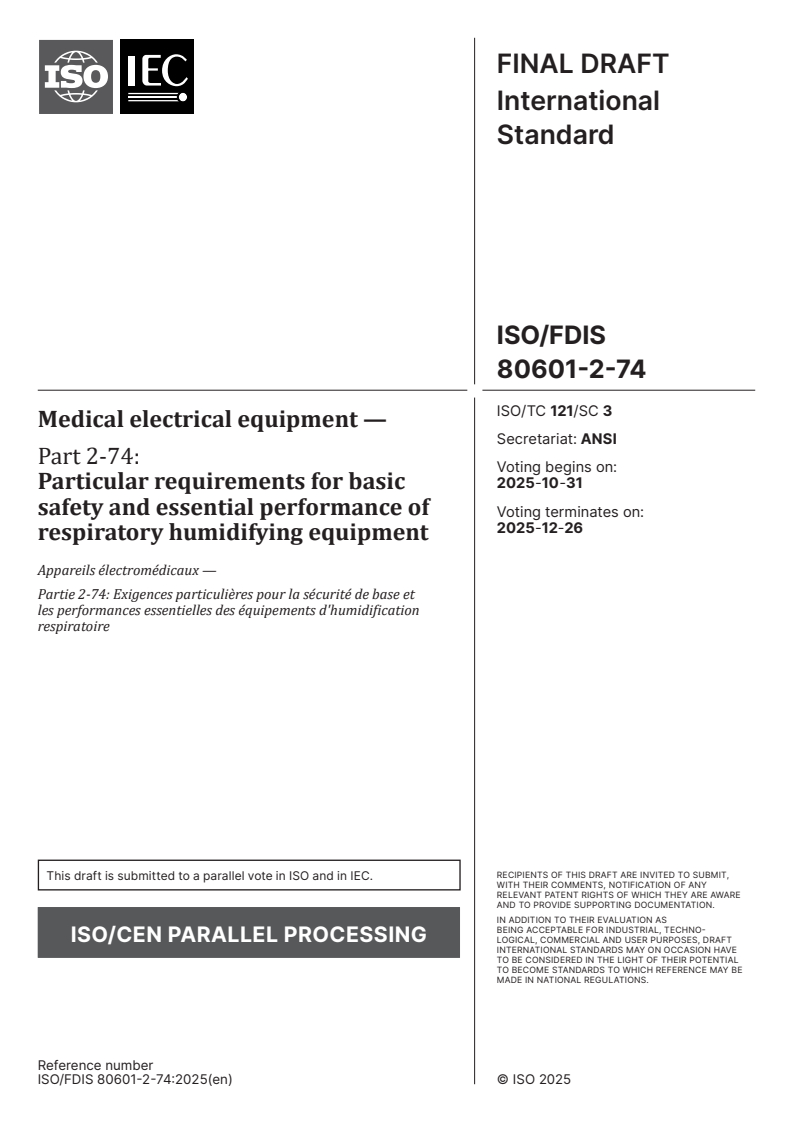
FINAL DRAFT
International
Standard
ISO/FDIS
80601-2-74
ISO/TC 121/SC 3
Medical electrical equipment —
Secretariat: ANSI
Part 2-74:
Voting begins on:
2025-10-31
Particular requirements for basic
safety and essential performance of
Voting terminates on:
2025-12-26
respiratory humidifying equipment
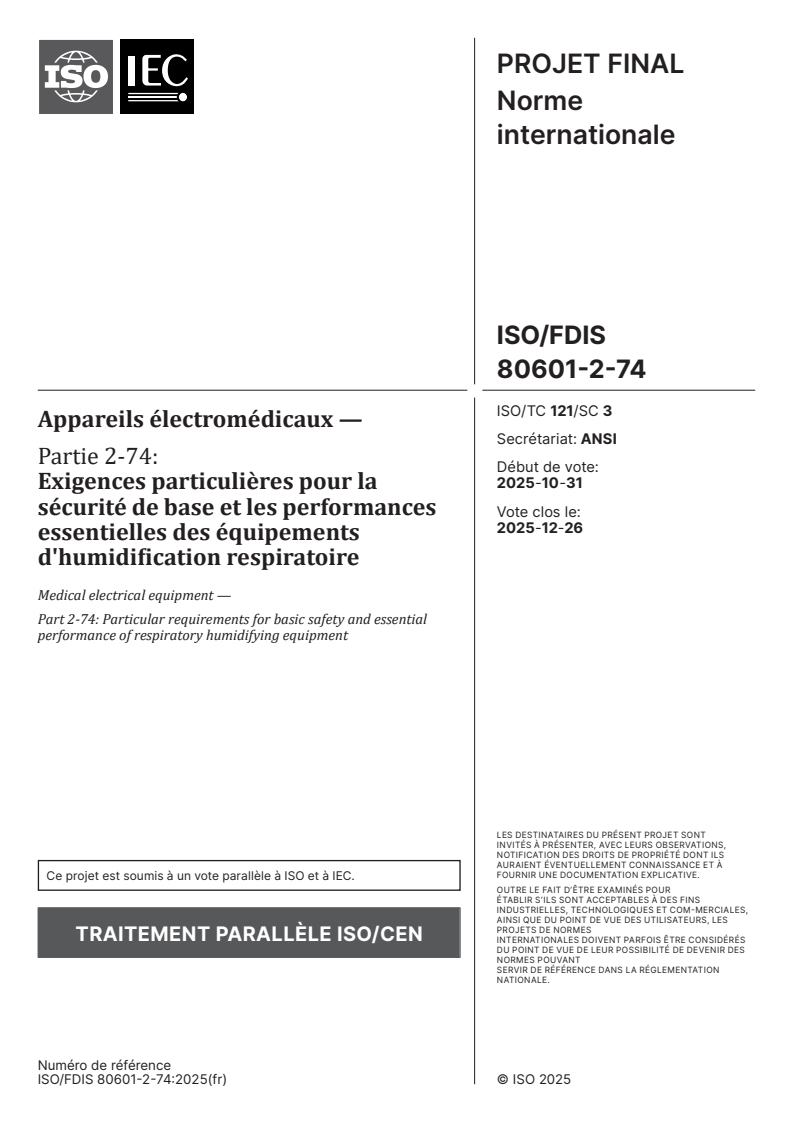
Appareils électromédicaux —
Partie 2-74: Exigences particulières pour la sécurité de base et
les performances essentielles des équipements d'humidification
respiratoire
RECIPIENTS OF THIS DRAFT ARE INVITED TO SUBMIT,
This draft is submitted to a parallel vote in ISO and in IEC.
WITH THEIR COMMENTS, NOTIFICATION OF ANY
RELEVANT PATENT RIGHTS OF WHICH THEY ARE AWARE
AND TO PROVIDE SUPPOR TING DOCUMENTATION.
IN ADDITION TO THEIR EVALUATION AS
BEING ACCEPTABLE FOR INDUSTRIAL, TECHNO-
ISO/CEN PARALLEL PROCESSING LOGICAL, COMMERCIAL AND USER PURPOSES, DRAFT
INTERNATIONAL STANDARDS MAY ON OCCASION HAVE
TO BE CONSIDERED IN THE LIGHT OF THEIR POTENTIAL
TO BECOME STAN DARDS TO WHICH REFERENCE MAY BE
MADE IN NATIONAL REGULATIONS.
Reference number
FINAL DRAFT
International
Standard
ISO/FDIS
80601-2-74
ISO/TC 121/SC 3
Medical electrical equipment —
Secretariat: ANSI
Part 2-74:
Voting begins on:
Particular requirements for basic
safety and essential performance of
Voting terminates on:
respiratory humidifying equipment
Appareils électromédicaux —
Partie 2-74: Exigences particulières pour la sécurité de base et
les performances essentielles des équipements d'humidification
respiratoire
RECIPIENTS OF THIS DRAFT ARE INVITED TO SUBMIT,
This draft is submitted to a parallel vote in ISO and in IEC.
WITH THEIR COMMENTS, NOTIFICATION OF ANY
RELEVANT PATENT RIGHTS OF WHICH THEY ARE AWARE
AND TO PROVIDE SUPPOR TING DOCUMENTATION.
© ISO 2025
IN ADDITION TO THEIR EVALUATION AS
All rights reserved. Unless otherwise specified, or required in the context of its implementation, no part of this publication may
BEING ACCEPTABLE FOR INDUSTRIAL, TECHNO-
ISO/CEN PARALLEL PROCESSING
LOGICAL, COMMERCIAL AND USER PURPOSES, DRAFT
be reproduced or utilized otherwise in any form or by any means, electronic or mechanical, including photocopying, or posting on
INTERNATIONAL STANDARDS MAY ON OCCASION HAVE
the internet or an intranet, without prior written permission. Permission can be requested from either ISO at the address below
TO BE CONSIDERED IN THE LIGHT OF THEIR POTENTIAL
or ISO’s member body in the country of the requester.
TO BECOME STAN DARDS TO WHICH REFERENCE MAY BE
MADE IN NATIONAL REGULATIONS.
ISO copyright office
CP 401 • Ch. de Blandonnet 8
CH-1214 Vernier, Geneva
Phone: +41 22 749 01 11
Email: copyright@iso.org
Website: www.iso.org
Published in Switzerland Reference number
ii
Contents Page
Foreword . v
Introduction . vi
201.1 Scope, object and related standards . 1
201.2 Normative references . 3
201.3 Terms and definitions . 5
201.4 General requirements . 21
201.5 General requirements for testing of ME equipment . 24
201.6 Classification of ME equipment and ME systems . 25
201.7 ME equipment identification, marking and documents . 26
201.8 Protection against electrical hazards form ME equipment . 34
201.9 Protection against mechanical hazards of ME equipment and ME systems . 34
201.10 Protection against unwanted and excessive radiation hazards . 35
201.11 Protection against excessive temperatures and other hazards . 35
201.12 Accuracy of controls and instruments and protection against hazardous
outputs . 39
201.13 Hazardous situations and fault conditions for ME Equipment . 44
201.14 Programmable electrical medical systems (PEMS) . 45
201.15 Construction of ME equipment . 46
201.16 ME systems . 46
201.16.2 Accompanying documents of an ME system . 47
201.17 Electromagnetic compatibility of ME equipment and ME systems . 47
201.101 Breathing system connectors and ports . 47
201.102 Requirements for the breathing system and accessories . 50
201.103 Liquid container . 51
201.104 Functional connection. 51
202 Electromagnetic disturbances — Requirements and tests . 52
206 Usability . 53
208 General requirements, tests and guidance for alarm systems in medical
electrical equipment and medical electrical systems . 54
211 Requirements for medical electrical equipment and medical electrical
systems used in the home healthcare environment . 54
Annex C (informative) Guide to marking and labelling requirements for
ME equipment and ME systems . 56
Annex D (informative) Symbols on marking. 62
Annex AA (informative) Particular guidance and rationale . 64
Annex BB (normative) Determination of the accuracy of the displayed measured gas
temperature . 84
Annex CC (normative) Determination of the humidification output . 86
Annex DD (normative) Specific enthalpy calculations . 92
iii
Annex EE (normative) Removable temperature sensors and mating ports . 94
Annex FF (normative) Reference temperature sensor. 98
Annex GG (informative) Saturation vapour pressure . 101
Annex HH (informative) Liquid fill port . 102
Annex II (informative) Reference to the IMDRF essential principles and l abelling
guidances . 105
Annex JJ (informative) Terminology — Alphabetized index of defined terms . 109
Bibliography . 115
iv
Foreword
ISO (the International Organization for Standardization) is a worldwide federation of national standards
bodies (ISO member bodies). The work of preparing International Standards is normally carried out through
ISO technical committees. Each member body interested in a subject for which a technical committee has been
established has the right to be represented on that committee. International organizations, governmental and
non-governmental, in liaison with ISO, also take part in the work. ISO collaborates closely with the
International Electrotechnical Commission (IEC) on all matters of electrotechnical standardization.
The procedures used to develop this document and those intended for its further maintenance are described
in the ISO/IEC Directives, Part 1. In particular, the different approval criteria needed for the different types of
ISO document should be noted. This document was drafted in accordance with the editorial rules of the
ISO/IEC Directives, Part 2 (see www.iso.org/directives).
ISO draws attention to the possibility that the implementation of this document may involve the use of (a)
patent(s). ISO takes no position concerning the evidence, validity or applicability of any claimed patent rights
in respect thereof. As of the date of publication of this document, ISO [had/had not] received notice of (a)
patent(s) which may be required to implement this document. However, implementers are cautioned that this
may not represent the latest information, which may be obtained from the patent database available at
www.iso.org/patents. ISO shall not be held responsible for identifying any or all such patent rights.
Any trade name used in this document is information given for the convenience of users and does not
constitute an endorsement.
For an explanation of the voluntary nature of standards, the meaning of ISO specific terms and expressions
related to conformity assessment, as well as information about ISO's adherence to the World Trade
Organization (WTO) principles in the Technical Barriers to Trade (TBT), see www.iso.org/iso/foreword.html.
This document was prepared jointly by Technical Committee ISO/TC 121, Anaesthetic and respiratory
equipment, Subcommittee SC 3, Respiratory devices and related equipment used for patient care, and Technical
Committee IEC/TC 62, Medical equipment, software, and systems, Subcommittee SC 62D, Particular medical
equipment, software, and systems, in collaboration with the European Committee for Standardization (CEN)
Technical Committee CEN/TC 215, Respiratory and anaesthetic equipment, in accordance with the Agreement
on technical cooperation between ISO and CEN (Vienna Agreement).
This third edition cancels and replaces the second edition (ISO 80601-2-74:2021), which has been technically
revised.
The main changes compared to the previous edition are as follows:
— updated normative references;
— added requirements for the fill connector; and
— clarified system recovery requirements.
A list of all parts in the ISO 80601 series and the IEC 80601 series can be found on the ISO and IEC websites.
Any feedback or questions on this document should be directed to the user’s national standards body. A
complete listing of these bodies can be found at www.iso.org/members.html.
v
Introduction
This document specifies requirements for respiratory humidifying equipment intended for use on patients in
home healthcare environment and in professional healthcare environment. Humidifiers are used to raise the
water content of gases delivered to patients. Gases available for medical use do not contain sufficient moisture
and can damage or irritate the respiratory tract or desiccate secretions of patients whose upper airways have
been bypassed. Inadequate humidity in the inspired gas can cause drying of the upper airway, or desiccation
of tracheo-bronchial secretions in the tracheal or tracheostomy tube, which can cause narrowing or even
[27] [37]
obstruction of the airway . Heat is employed to increase the water output of the humidifier.
In addition, many humidifiers utilize heated breathing tubes in order to increase operating efficiency and
reduce water loss (condensate) as well as heat loss in the breathing tube. Some ventilator and anaesthesia
breathing tubes in common use cannot withstand the heat generated by humidifiers and breathing tube heating
mechanisms.
Many humidifier manufacturers use off-the-shelf electrical connectors for their electrically heated breathing
tubes. However, since different manufacturers have used the same electrical connector for different power
outputs, electrically heated breathing tubes can be physically, but not electrically, interchangeable. Use of
improper electrically heated breathing tubes has caused overheating, circuit melting, patient and operator
burns and fires. It was not found practical to specify the interface requirements for electrical connectors to
ensure compatibility between humidifiers and breathing tubes produced by different manufacturers.
Since the safe use of a humidifier depends on the interaction of the humidifier with its many accessories, this
document sets total system performance requirements up to the patient-connection port. These requirements
are applicable to accessories such as breathing tubes (both heated and non-heated), temperature sensors and
equipment intended to control the environment within these breathing tubes.
Humidification can also be used by respiratory support ME equipment to increase patient comfort and
compliance with the therapy. Examples are obstructive sleep apnoea and nasal high-flow therapy equipment.
The humidification output requirements of such ME equipment is less demanding as the patient’s upper airway
is not bypassed.
Humidifiers are commonly used with air and air-oxygen mixtures and any humidifier should be able to operate
with these gases. Care should be taken if using other gas mixes such as helium-oxygen mixtures, as the
different physical and thermal properties of these gases may disturb the operation of the humidifier.
In this document, the following print types are used:
— Requirements and definitions: roman type;
— Test specifications and terms defined in Clause 3 of the general standard, in this document or as noted: italic
type;
— Informative material appearing outside of tables, such as notes, examples and references: in smaller type. Normative
text of tables is also in a smaller type;
In referring to the structure of this document, the term
— “clause” means one of the five numbered divisions within the table of contents, inclusive of all subdivisions
(e.g. Clause 201 includes subclauses 201.7, 201.8, etc.);
— “subclause” means a numbered subdivision of a clause (e.g. 201.7, 201.8 and 201.9 are all subclauses of
Clause 201).
vi
References to clauses within this document are preceded by the term “Clause” followed by the clause number.
References to subclauses within this document are by number only.
In this document, the conjunctive “or” is used as an “inclusive or” so a statement is true if any combination of
the conditions is true.
For the purposes of this document, the auxiliary verb:
— “shall” indicates a requirement;
— “should” indicates a recommendation;
— “may” indicates a permission;
— "can" is used to describe a possibility or capability; and;
— "must" is used to express an external constraint.
Annex C contains a guide to the marking and labelling requirements in this document.
Annex D contains a summary of the symbols referenced in this document.
vii
FINAL DRAFT International Standard ISO/FDIS 80601-2-74:2025(en)
Medical electrical equipment —
Part 2-74:
Particular requirements for basic safety and essential
performance of respiratory humidifying equipment
201.1 Scope, object and related standards
Clause 1 of IEC 60601-1:2005+AMD1:2012+AMD2:2020 applies, except as follows.
NOTE The general standard is IEC 60601-1:2005+AMD1:2012+AMD2:2020.
201.1.1 Scope
Replacement:
NOTE 1 There is guidance or rationale for this subclause contained in AA.2.1.
This document applies to the basic safety and essential performance of a humidifier, also hereafter referred to
as ME equipment, in combination with its accessories, the combination also hereafter referred to as ME system.
This document is also applicable to those accessories intended by their manufacturer to be connected to a
humidifier where the characteristics of those accessories can affect the basic safety or essential performance of
the humidifier.
EXAMPLE 1 Heated breathing tubes (heated-wire breathing tubes) or ME equipment intended to control these heated
breathing tubes (heated breathing tube controllers).
NOTE 2 Heated breathing tubes and their controllers are ME equipment and are subject to the requirements of
IEC 60601-1.
NOTE 3 ISO 5367 specifies other safety and performance requirements for breathing tubes.
This document includes requirements for the different medical uses of humidification, such as invasive
ventilation, non-invasive ventilation, nasal high-flow therapy, and obstructive sleep apnoea therapy, as well
as humidification therapy for tracheostomy patients.
NOTE 4 A humidifier can be integrated into other equipment. When this is the case, the requirements of the other
equipment also apply to the humidifier.
EXAMPLE 2 Heated humidifier incorporated into a critical care ventilator where ISO 80601-2-12 also applies.
EXAMPLE 3 Heated humidifier incorporated into a homecare ventilator for dependent patients where ISO 80601-2-72
also applies.
EXAMPLE 4 Heated humidifier incorporated into sleep apnoea therapy equipment where ISO 80601-2-70 also applies.
EXAMPLE 5 Heated humidifier incorporated into ventilatory support equipment where either ISO 80601-2-79 or
ISO 80601-2-80 also apply.
EXAMPLE 6 Heated humidifier incorporated into respiratory high-flow therapy equipment where ISO 80601-2-90 also
applies.
This document also includes requirements for an active HME (heat and moisture exchanger), ME equipment
which actively adds heat and moisture to increase the humidity level of the gas delivered from the HME to the
patient. This document is not applicable to a passive HME, which returns a portion of the expired moisture
and heat of the patient to the respiratory tract during inspiration without adding heat or moisture.
NOTE 5 ISO 9360-1 and ISO 9360-2 specify safety and performance requirements for a passive HME.
NOTE 6 If a clause or subclause is specifically intended to be applicable to ME equipment only, or to ME systems only,
the title and content of that clause or subclause will say so. If that is not the case, the clause or subclause applies both to
ME equipment and to ME systems, as relevant.
Hazards inherent in the intended physiological function of ME equipment or ME systems within the scope of
this document are not covered by specific requirements in this document except in
IEC 60601-1:2005+AMD1:2012+AMD2:2020, 7.2.13 and 8.4.1.
NOTE 7 Additional information can be found in IEC 60601-1:2005+AMD1:2012+AMD2:2020, 4.2.
This document does not specify the requirements for cold pass-over or cold bubble-through humidification
devices, the requirements for which are given in ISO 20789.
This document is not applicable to equipment commonly referred to as “room humidifiers” or humidifiers
used in heating, ventilation and air conditioning systems, or humidifiers incorporated into infant incubators to
humidify the chamber air (i.e., are not directly connected to the patient).
This document is not applicable to nebulizers used for the delivery of a drug to patients.
NOTE 8 ISO 27427 specifies the safety and performance requirements for nebulizers and ISO 80601-2-94 for
inhalational therapy nebulizer equipment.
201.1.2 Object
Replacement:
The object of this document is to establish particular basic safety and essential performance requirements for
a humidifier, as defined in 201.3.240, and its accessories.
Accessories are included because the combination of the humidifier and the accessories needs to be adequately
safe. Accessories can have a significant impact on the basic safety or essential performance of a humidifier.
NOTE 1 This document has been prepared to address the relevant essential principles and labelling guidances of the
International Medical Devices Regulators Forum (IMDRF) as indicated in Annex II.
NOTE 2 This document has been prepared to address the relevant general safety and performance requirements of
[19]
European regulation (EU) 2017/745 .
201.1.3 Collateral standards
Addition (add after existing text):
This document refers to those applicable collateral standards that are listed in Clause 2 of the general standard
and in 201.2 of this document.
IEC 60601-1-2:2014+AMD1:2020, IEC 60601-1-6:2010+AMD1:2013+AMD2:2020,
IEC 60601-1-8:2006+AMD1:2012+AMD2:2020 and IEC 60601-1-11:2015+AMD1:2020 apply as modified in
Clauses 202, 206, 208 and 211, respectively. IEC 60601-1-3:2008+AMD1:2013+AMD2:2021 and IEC 60601-
1-9:2007+AMD1:2013+AMD2:2020 do not apply. All other published collateral standards in the IEC 60601-1
series apply as published.
201.1.4 Particular standards
Replacement:
In the IEC 60601 series, particular standards define basic safety and essential performance requirements, and
may modify, replace or delete requirements contained in the general standard and collateral standards as
appropriate for the particular ME equipment under consideration.
A requirement of a particular standard takes priority over the general standard.
For brevity, IEC 60601-1:2005+AMD1:2012+AMD2:2020 is referred to in this document as the general
standard. Collateral standards are referred to by their document number.
The numbering of clauses and subclauses of this document corresponds to that of the general standard with
the prefix “201” (e.g. 201.1 in this document addresses the content of Clause 1 of the general standard) or
applicable collateral standard with the prefix “20x”, where x is the final digit(s) of the collateral standard
document number (e.g. 202.4 in this document addresses the content of Clause 4 of the IEC 60601-1-2
collateral standard, 208.6 in this document addresses the content of Clause 6 of the IEC 60601-1-8 collateral
standard, etc.). The changes to the text of the general standard are specified by the use of the following words:
“Replacement” means that the clause or subclause of the general standard or applicable collateral standard is
replaced completely by the text of this document.
“Addition” means that the text of this document is additional to the requirements of the general standard or
applicable collateral standard.
“Amendment” means that the clause or subclause of the general standard or applicable collateral standard is
amended as indicated by the text of this document.
Clauses, subclauses, figures or tables which are additional to those of the general standard are numbered
starting from 201.101. However, due to the fact that definitions in the general standard are numbered 3.1
through 3.154, additional definitions in this document are numbered beginning from 201.3.201. Additional
annexes are lettered AA, BB, etc., and additional items aa), bb), etc.
Subclauses, figures or tables which are additional to those of a collateral standard are numbered starting from
20x, where “x” is the number of the collateral standard, e.g. 202 for IEC 60601-1-2, 211 for IEC 60601-1-11,
etc.
The term “this document” is used to make reference to the general standard, any applicable collateral
standards and this particular document taken together.
Where there is no corresponding clause or subclause in this document, the clause or subclause of the general
standard or applicable collateral standard, although possibly not relevant, applies without modification;
where it is intended that any part of the general standard or applicable collateral standard, although possibly
relevant, is not to be applied, a statement to that effect is given in this document.
201.2 Normative references
The following documents are referred to in the text in such a way that some or all of their content constitutes
requirements of this document. For dated references, only the edition cited applies. For undated references,
the latest edition of the referenced document (including any amendments) applies.
Clause 2 of IEC 60601-1:2005+AMD1:2012+AMD2:2020 applies, except as follows.
Replacement:
Addition:
ISO 3744:2010, Acoustics — Determination of sound power levels and sound energy levels of noise sources using
sound pressure — Engineering methods for an essentially free field over a reflecting plane
ISO 5356-1:2015, Anaesthetic and respiratory equipment — Conical connectors — Part 1: Cones and sockets
ISO 5359:2014+AMD1:2017, Anaesthetic and respiratory equipment — Low-pressure hose assemblies for use
with medical gases
ISO 5367:2023, Anaesthetic and respiratory equipment — Breathing sets and connectors
ISO 7396-1:2016+AMD1:2017, Medical gas pipeline systems — Part 1: Pipeline systems for compressed medical
gases and vacuum
ISO 14937:2009, Sterilization of health care products — General requirements for characterization of a
sterilizing agent and the development, validation and routine control of a sterilization process for medical devices
ISO 17664-1:2021, Processing of health care products — Information to be provided by the medical device
manufacturer for the processing of medical devices — Part 1: Critical and semi-critical medical devices
ISO 17664-2:2021, Processing of health care products — Information to be provided by the medical device
manufacturer for the processing of medical devices — Part 2: Non-critical medical devices
ISO 18562-1:2024, Biocompatibility evaluation of breathing gas pathways in healthcare applications — Part 1:
Evaluation and testing within a risk management process
ISO 20417:— , Medical devices — Information to be supplied by the manufacturer
ISO 80369-1:— , Small-bore connectors for liquids and gases in healthcare applications — Part 1: General
requirements
ISO 80369-2:2024, Small-bore connectors for liquids and gases in healthcare applications — Part 2: Connectors
for respiratory applications
ISO 80369-20:2024, Small-bore connectors for liquids and gases in healthcare applications Part 20: Common
test methods
IEC 60601-1:2005+AMD1:2012+AMD2:2020, Medical electrical equipment — Part 1: General requirements for
basic safety and essential performance
IEC 60601-2-19:2020, Medical electrical equipment — Part 2-19: Particular requirements for the basic safety
and essential performance of infant incubators
IEC 62570:2014, Standard practice for marking medical devices and other items for safety in the magnetic
resonance environment
Under preparation. Stage at the time of publication: ISO/FDIS 20417:2025.
Under preparation. Stage at the time of publication: ISO/FDIS 80369-1:2025.
IEC 81001-5-1:2021, Health software and health IT systems safety, effectiveness and security — Part 5-1:
Security — Activities in the product life cycle
IEC Guide 115:2023, Application of uncertainty of measurement to conformity assessment activities in the
electrotechnical sector
201.3 Terms and definitions
For the purposes of this document, the terms and definitions given in
IEC 60601-1-8:2006+AMD1:2012+AMD2:2020 and the following apply.
ISO and IEC maintain terminology databases for use in standardization at the following addresses:
— ISO Online browsing platform: available at https://www.iso.org/obp
— IEC Electropedia: available at https://www.electropedia.org/
NOTE An alphabetized index of defined terms is found in Annex JJ.
201.3.201
absolute humidity
mass of water vapour present in a unit volume of gas
Note 1 to entry: In respiratory applications absolute humidity is commonly represented in units of milligrams per litre or
grams per cubic metre, with volume expressed at BTPS condition.
Note 2 to entry: See also relative humidity.
[SOURCE: ISO 4135:2022, 3.1.1.1]
201.3.202
accompanying information
information supplied by the manufacturer with or marked on a medical device or accessory for the user or
responsible organization, particularly regarding safe use
Note 1 to entry: The accompanying information is regarded as part of the medical device or accessory.
Note 2 to entry: The accompanying information can consist of the label, marking, instructions for use, technical description,
information shown on the packaging or graphical user interface (GUI), installation manual, quick reference guide, etc. and
can address the installation, use, processing, maintenance and disposal of the medical device or accessory
Note 3 to entry: Accompanying information is not necessarily a written or printed document but can involve auditory,
visual, or tactile materials and multiple media types (e.g. CD-ROM, DVD-ROM, USB stick, website).
[SOURCE: ISO 20417:—, 3.2, modified — deleted note 4.]
201.3.203
active HME
humidifier where water, water vapour or heat is actively added to the HME to increase the humidity level of
the gas delivered from the HME to the patient
[SOURCE: ISO 4135:2022, 3.7.2.3, modified —replaced 'device' with 'humidifier'.]
201.3.204
aerosol
suspension of liquid or solid particles in a gas
[SOURCE: ISO 4135:2022, 3.1.1.3]
201.3.205
airway device
device intended to provide a gas pathway to and from the patient’s airway
[SOURCE: ISO 4135:2022, 3.8.1.2]
201.3.206
airway pressure
p
aw
pressure at the patient-connection port or at the distal outlet of the equipment where there is no patient-
connection port
Note 1 to entry: The airway pressure can be derived from pressure measurements made anywhere within the equipment.
[SOURCE: ISO 4135:2022, 3.1.4.41.1, — modified, added letter symbol.]
201.3.207
alarm limit
threshold used by an alarm system to determine an alarm condition
[SOURCE: IEC 60601-1-8:2006+AMD1:2012+AMD2:2020, 3.3]
201.3.208
alarm paused
state of limited duration in which the alarm system or part of the alarm system does not generate alarm signals
[SOURCE: IEC 60601-1-8:2006+AMD1:2012+AMD2:2020, 3.5]
201.3.209
alarm setting
alarm system configuration, including but not limited to:
– alarm limits;
– the characteristics of any alarm signal inactivation states; and
– the values of variables or parameters that determine the function of the alarm system
Note 1 to entry: Some algorithmically-determined alarm settings can require time to be determined or re-determined.
[SOURCE: IEC 60601-1-8:2006+AMD1:2012+AMD2:2020, 3.8]
201.3.210
artificial ventilation
intermittent elevation of the pressure in the patient's airway relative to that in the lungs by external means
with the intention of augmenting, or totally controlling, the ventilation of a patient
EXAMPLE Means used to provide artificial ventilation are manual resuscitation; mouth-to-mouth resuscitation;
automatic ventilation; mechanical ventilation.
Note 1 to entry: Common classifications of areas of application of artificial ventilation are: emergency; transport; home-
care; anaesthesia; critical care; rehabilitation.
Note 2 to entry: Classifications used to denote means used for artificial ventilation include: positive-pressure; negative-
pressure; gas-powered; operator-powered; electrically-powered.
Note 3 to entry: Negative-pressure ventilation elevates the relative pressure in the airway by intermittently lowering the
pressure in the lungs.
[SOURCE: ISO 19223:2019, 3.1.10]
201.3.211
attack
attempt to destroy, expose, alter, disable, steal or gain unauthorized access to or make unauthorized use of an
asset
[SOURCE: IEC 81001-5-1:2021, 3.5]
201.3.212
audio paused
state of limited duration in which the alarm system or part of the alarm system does not generate an auditory
alarm signal
[SOURCE: IEC 60601-1-8:2006+AMD1:2012+AMD2:2020, 3.13]
201.3.213
BAP
quantity by which the baseline airway pressure is set to be positively offset from the ambient pressure
[SOURCE: ISO 19223:2019, 3.10.2, modified — deleted admitted terms and notes.]
201.3.214
biocompatibility
ability of a medical device, accessory or material to perform with an appropriate host response in a specific
application
Note 1 to entry: A medical device or accessory may produce some level of adverse effect, but that level may be
determined to be acceptable when considering the benefit provided.
[SOURCE: ISO 18562-1:2024, 3.6]
201.3.215
body temperature and pressure, saturated
BTPS
ambient atmospheric pressure, at a temperature of 37 °C, and at a relative humidity of 100 %
[SOURCE: ISO 4135:2022, 3.1.1.7]
201.3.216
breathing system
pathways through which gas flows to or from the patient at respiratory pressures and continuously or
intermittently in fluid communication with the patient’s respiratory tract during any form of artificial
ventilation or respiratory therapy
[SOURCE: ISO 4135:2022, 3.6.1.1, modified —deleted the notes to entry.]
201.3.217
breathing system filter
BSF
device intended to reduce transmission of particulates, including microorganisms, in a breathing system
[SOURCE: ISO 4135:2022, 3.6.1.5]
201.3.218
breathing tube
non-rigid tube used to convey gases or vapours within the operator-detachable section of a breathing system
[SOURCE: ISO 4135:2022, 3.1.4.4, modified —replaced “user” with “operator” deleted note.]
201.3.219
cleaning
removal of contaminants to the extent necessary for further processing or for intended use
Note 1 to entry: Cleaning consists of the removal of adherent soil (e.g. blood, protein substances, and other debris) from
the surfaces, crevices, serrations, joints, and lumens of a medical device by a manual or automated process that prepares
the items for safe handling or further processing.
[SOURCE: ISO 17664-2:2021, 3.1, modified — replaced 'and/or' with 'or'.]
201.3.220
connector
fitting to join two or more components
EXAMPLE Connectors for low-pressure hose assembly are any of a range of mating components intended to maintain gas
specificity by the allocation of a set of different diameters to the mating connectors for each particular gas.
[SOURCE: ISO 4135:2022, 3.1.4.5]
201.3.221
CPAP
continuous positive airway pressure
ventilation-mode or sleep-apnoea breathing-therapy mode in which the patient breathes continuously at a set
airway-pressure level, above ambient pressure
[SOURCE: ISO 19223:2019, 3.11.15, modified — deleted notes.]
201.3.222
cybersecurity
state where information and systems are protected from unauthorized activities, such as access, use,
disclosure, disruption, modification, or destruction to a degree that the related risks to violation of
confidentiality, integrity, and availability are maintained at an acceptable level throughout the life cycle
[SOURCE: IEC 81001-5-1:2021, 3.30, modified — deleted the term “security”.]
201.3.223
delivered gas temperature
temperature of the gas, or aerosol, or both, being delivered to a patient, referenced to the patient-connection
port
[SOURCE: ISO 4135:2022, 3.1.1.13]
201.3.224
disinfection
process to reduce the number of viable microorganisms to a level previously specified as being appropriate
for a defined purpose
[SOURCE: ISO 17664-1:2021, 3.3]
201.3.225
distributed alarm system
DAS
alarm system that involves more than one item of equipment of a ME system intended for delivery of alarm
conditions with technical confirmation
Note 1 to entry: The parts of a distributed alarm system can be widely separated in distance.
Note 2 to entry: A distributed alarm system is intended to notify operators of the existence of an alarm condition.
Note 3 to entry: Technical confirmation means that each element of a distributed alarm system confirms or guarantees
the successful delivery of the alarm condition to the next element or appropriate technical alarm conditions are created.
[SOURCE: IEC 60601-1-8:2006+AMD1:2012+AMD2:2020, 3.17, modified — deleted “For the purposes of this
document, “ and “ as described in 6.11.2.2.1”.]
201.3.226
emergency medical services environment
EMS environment
actual conditions and settings, in which operators interact with the ME equipment or ME system, in and around
the scene of an emergency outside of a professional healthcare facility where a patient can be given medical
care, basic or advanced life support as well as during professional transport to a professional healthcare
facility or between professional healthcare facilities
EXAMPLE 1 Responding to and providing life support at the scene of an emergency to a patient reported as experiencing
injury or illness in a pre-hospital setting, and transporting the patient, while continuing such life support care, to an
appropriate professional healthcare facility for further care.
EXAMPLE 2 Providing monitoring, treatment or diagnosis during transport between professional healthcare facilities.
Note 1 to entry: The EMS environment is not considered to be part of the professional healthcare environment.
Note 2 to entry: Use of equipment intended for the EMS environment and temporarily used in the home healthcare
environment by emergency medical personnel is considered use in the EMS environment.
Note 3 to entry: The operators of equipment intended for the EMS environment are presumed to be healthcare professional
operators.
Note 4 to entry: Emergency medical services are known by various names in different countries and regions.
Note 5 to entry: Transport includes road, rotary and fixed-wing ambulances.
[SOURCE: IEC 60601-1-12:2014+AMD1:2020, 3.1, modified —replaced “professional medical personnel or
personnel with relevant specialized training” with “healthcare professional operators”, replaced original note
3 with new note 1 and deleted “For the purposes of this standard, ”.]
201.3.227
essential function
function or capability that is required to maintain basic safety, essential performance, a minimum of clinical
functionality as specified by the manufacturer, and operational availability for the medical device
Note 1 to entry: Essential functions include, but are not limited to, the safety instrumented function (basic safety and
essential performance), the control function and the availability of urgently needed functions and such allowing the
operator to view and manipulate the medical device safely with the most urgently needed performance (operational
availability). The loss of essential function is commonly termed loss of protection, loss of control and loss of view
respectively.
Note 2 to entry: The term is derived from IEC 62443-4-2:2019, 3.1.20, and has been refined for the purpose and scope
of this document.
[SOURCE: IEC/TR 60601-4-5:2021, 3.10, modified —deleted term “core function“.]
201.3.228
essential principles
essential principles of safety and performance
fundamental high-level requirements that when complied with ensure a medical device is safe and performs
as intended
[SOURCE: ISO 16142-1:2016, 3.3]
201.3.229
expiratory phase
interval from the start of expiratory flow to the start of inspiratory flow within a respiratory cycle
[SOURCE: ISO 19223:2019, 3.4.2, modified — deleted notes.]
201.3.230
firecall
method established to provide emergency access to a secure medical device
Note 1 to entry: In an emergency situation, unprivileged users can gain access to key systems to correct the problem.
When a firecall is used, there is usually a review process to ensure that the access was used properly to correct a problem.
These methods generally either provide a one-time use user identifier (ID) or one-time password or other suitable
measures.
Note 2 to entry: Also referred to as "break glass" feature.
[SOURCE: IEC/TR 60601-4-5:2021, 3.11]
201.3.231
flow-direction-sensitive component
component or accessory through which gas flow has to be in one direction only for proper functioning or
patient safety
[SOURCE: ISO 4135:2022, 3.1.4.15]
201.3.232
gas pathway
interior surfaces, over which gases or liquids pass that can be inspired
EXAMPLE 1 The breathing system, inlet filter, gas mixer, blower and internal piping.
EXAMPLE 2 Enclosed chamber of an incubator including the mattress or the inner surface of an oxygen hood.
EXAMPLE 3 The inner surfaces of breathing tubes, tracheal tubes or masks and mouthpieces.
Note 1 to entry: The gas pathway is bounded by the fluid ports through which gases or liquids enter the medical device
or accessory. This can include the patient interface or the interior surfaces of enclosures that are in contact with gases or
liquids that can be inspired.
Note 2 to entry: The gas pathway can include some surfaces in the expiratory pathway.
Note 3 to entry: Patient contact surfaces such as the outer surfaces of a tracheal tube or the cushion of a mask are
evaluated according to the ISO 10993 series.
[SOURCE: ISO 18562-1:2024, 3.11, modified — replaced “ports” with “fluid ports” and “ventilator breathing
system” with “breathing system”.]
201.3.233
healthcare professional
appropriately trained, knowledgeable, and skilled, providing systematic preventive, curative,
promotional or rehabilitative healthcare services
EXAMPLE Healthcare professional operator, healthcare professional responsible organization.
Note 1 to entry: The healthcare professional operator is the supervising clinician or the healthcare professional
responsible for the treatment of a patient on respiratory high-flow therapy equipment.
201.3.234
heat and moisture exchanger
HME
device intended to retain a portion of the patient's expired moisture and heat, and return it to the patient’s
respiratory tract during inspiration
[SOURCE: ISO 4135:2022:2002, 3.7.4.1]
201.3.235
heated breathing tube controller
ME equipment which controls the temperature or the heating of a breathing tube
Note 1 to entry: A heated breathing tube controller can be either stand-alone or part of the humidifier.
201.3.236
high-pressure inlet
inlet to which gas is supplied at a pressure exceeding 100 kPa above ambient
Note 1 to
...
IEC/62D-ISO/TC 121/SC 3/
ISO /FDIS 80601--2--74:2024 (Ed32025(en)
IEC/62D-ISO/TC 121/SC 3/JWG 12
2025-08-0610-01
Secretariat: ANSI
Medical electrical equipment — Part 2-74: Particular requirements for basic safety and
essential performance of respiratory humidifying equipment
Appareils électromédicaux — Partie 2-74: Exigences particulières pour la sécurité de base et les performances
essentielles des équipements d'humidification respiratoire
FDIS stage
Warning for WDs and CDs
This document is not an ISO International Standard. It is distributed for review and comment. It is subject to
change without notice and may not be referred to as an International Standard.
Recipients of this draft are invited to submit, with their comments, notification of any relevant patent rights
of which they are aware and to provide supporting documentation.
ISO 80601-2-74:2025(E)
All rights reserved. Unless otherwise specified, no part of this publication may be reproduced or utilized
otherwise in any form or by any means, electronic or mechanical, including photocopying, or posting on
the internet or an intranet, without prior written permission. Permission can be requested from either
ISO at the address below or ISO's member body in the country of the requester.
ISO copyright office
Case postale 56 • CH-1211 Geneva 20
Tel. + 41 22 749 01 11
Fax + 41 22 749 09 47
E-mail copyright@iso.org
Web www.iso.org
Published in Switzerland.
ii
ISO 80601-2-74:2025(E)
Contents Page
Foreword . iv
Introduction . v
201.1 Scope, object and related standards . 1
201.2 Normative references . 3
201.3 Terms and definitions . 5
201.4 General requirements . 20
201.5 General requirements for testing of ME equipment . 24
201.6 Classification of ME equipment and ME systems . 25
201.7 ME equipment identification, marking and documents . 26
201.8 Protection against electrical hazards form ME equipment . 33
201.9 Protection against mechanical hazards of ME equipment and ME systems . 34
201.10 Protection against unwanted and excessive radiation hazards . 35
201.11 Protection against excessive temperatures and other hazards . 35
201.12 Accuracy of controls and instruments and protection against
hazardous outputs . 38
201.13 Hazardous situations and fault conditions for ME Equipment . 43
201.14 Programmable electrical medical systems (PEMS) . 44
201.15 Construction of ME equipment . 45
201.16 ME systems . 45
201.16.2 Accompanying documents of an ME system . 46
201.17 Electromagnetic compatibility of ME equipment and ME systems . 46
201.101 Breathing system connectors and ports . 46
201.102 Requirements for the breathing system and accessories . 49
201.103 Liquid container . 50
201.104 Functional connection. 50
202 Electromagnetic disturbances — Requirements and tests . 50
206 Usability . 52
208 General requirements, tests and guidance for alarm systems in medical
electrical equipment and medical electrical systems . 53
211 Requirements for medical electrical equipment and medical electrical
systems used in the home healthcare environment . 53
Annex C (informative) Guide to marking and labelling requirements for
ME equipment and ME systems . 54
Annex D (informative) Symbols on marking. 60
Annex AA (informative) Particular guidance and rationale . 62
Annex BB (normative) Determination of the accuracy of the displayed measured gas
temperature . 82
ii
Annex CC (normative) Determination of the humidification output . 84
Annex DD (normative) Specific enthalpy calculations . 89
Annex EE (normative) Removable temperature sensors and mating ports . 91
Annex FF (normative) Reference temperature sensor. 95
Annex GG (informative) Saturation vapour pressure . 98
Annex HH (informative) Liquid fill port . 99
Annex II (informative) Reference to the IMDRF essential principles and l
abelling guidances . 102
Annex JJ (informative) Terminology — Alphabetized index of defined terms . 106
Bibliography . 111
iii
ISO 80601-2-74:2025(E)
Foreword
ISO (the International Organization for Standardization) is a worldwide federation of national standards
bodies (ISO member bodies). The work of preparing International Standards is normally carried out through
ISO technical committees. Each member body interested in a subject for which a technical committee has been
established has the right to be represented on that committee. International organizations, governmental and
non-governmental, in liaison with ISO, also take part in the work. ISO collaborates closely with the
International Electrotechnical Commission (IEC) on all matters of electrotechnical standardization.
The procedures used to develop this document and those intended for its further maintenance are described
in the ISO/IEC Directives, Part 1. In particular, the different approval criteria needed for the different types of
ISO document should be noted. This document was drafted in accordance with the editorial rules of the
ISO/IEC Directives, Part 2 (see www.iso.org/directives).
ISO draws attention to the possibility that the implementation of this document may involve the use of (a)
patent(s). ISO takes no position concerning the evidence, validity or applicability of any claimed patent rights
in respect thereof. As of the date of publication of this document, ISO [had/had not] received notice of (a)
patent(s) which may be required to implement this document. However, implementers are cautioned that this
may not represent the latest information, which may be obtained from the patent database available at
www.iso.org/patents. ISO shall not be held responsible for identifying any or all such patent rights.
Any trade name used in this document is information given for the convenience of users and does not
constitute an endorsement.
For an explanation of the voluntary nature of standards, the meaning of ISO specific terms and expressions
related to conformity assessment, as well as information about ISO's adherence to the World Trade
Organization (WTO) principles in the Technical Barriers to Trade (TBT), see www.iso.org/iso/foreword.html.
This document was prepared jointly by Technical Committee ISO/TC 121, Anaesthetic and respiratory
equipment, Subcommittee SC 3, Respiratory devices and related equipment used for patient care, and Technical
Committee IEC/TC 62, Medical equipment, software, and systems, Subcommittee SC 62D, Particular medical
equipment, software, and systems, in collaboration with the European Committee for Standardization (CEN)
Technical Committee CEN/TC 215, Respiratory and anaesthetic equipment, in accordance with the Agreement
on technical cooperation between ISO and CEN (Vienna Agreement).
This third edition cancels and replaces the second edition (ISO 80601-2-74:2021), which has been technically
revised.
The main changes compared to the previous edition are as follows:
— updated normative references;
— added requirements for the fill connector; and
— clarified system recovery requirements.
A list of all parts in the ISO 80601 series and the IEC 80601 series can be found on the ISO and IEC websites.
Any feedback or questions on this document should be directed to the user’s national standards body. A
complete listing of these bodies can be found at www.iso.org/members.html.
iv
Introduction
This document specifies requirements for respiratory humidifying equipment intended for use on patients in
home healthcare environment and in professional healthcare environment. Humidifiers are used to raise the
water content of gases delivered to patients. Gases available for medical use do not contain sufficient moisture
and can damage or irritate the respiratory tract or desiccate secretions of patients whose upper airways have
been bypassed. Inadequate humidity in the inspired gas can cause drying of the upper airway, or desiccation
of tracheo-bronchial secretions in the tracheal or tracheostomy tube, which can cause narrowing or even
[27] [37]
obstruction of the airway . Heat is employed to increase the water output of the humidifier.
In addition, many humidifiers utilize heated breathing tubes in order to increase operating efficiency and
reduce water loss (condensate) as well as heat loss in the breathing tube. Some ventilator and anaesthesia
breathing tubes in common use cannot withstand the heat generated by humidifiers and breathing tube heating
mechanisms.
Many humidifier manufacturers use off-the-shelf electrical connectors for their electrically heated breathing
tubes. However, since different manufacturers have used the same electrical connector for different power
outputs, electrically heated breathing tubes can be physically, but not electrically, interchangeable. Use of
improper electrically heated breathing tubes has caused overheating, circuit melting, patient and operator
burns and fires. It was not found practical to specify the interface requirements for electrical connectors to
ensure compatibility between humidifiers and breathing tubes produced by different manufacturers.
Since the safe use of a humidifier depends on the interaction of the humidifier with its many accessories, this
document sets total system performance requirements up to the patient-connection port. These requirements
are applicable to accessories such as breathing tubes (both heated and non-heated), temperature sensors and
equipment intended to control the environment within these breathing tubes.
Humidification can also be used by respiratory support ME equipment to increase patient comfort and
compliance with the therapy. Examples are obstructive sleep apnoea and nasal high-flow therapy equipment.
The humidification output requirements of such ME equipment is less demanding as the patient’s upper airway
is not bypassed.
Humidifiers are commonly used with air and air-oxygen mixtures and any humidifier should be able to operate
with these gases. Care should be taken if using other gas mixes such as helium-oxygen mixtures, as the
different physical and thermal properties of these gases may disturb the operation of the humidifier.
In this document, the following print types are used:
— Requirements and definitions: roman type;
— Test specifications and terms defined in Clause 3 of the general standard, in this document or as noted: italic
type;
— Informative material appearing outside of tables, such as notes, examples and references: in smaller type. Normative
text of tables is also in a smaller type;
In referring to the structure of this document, the term
— “clause” means one of the five numbered divisions within the table of contents, inclusive of all subdivisions
(e.g. Clause 201 includes subclauses 201.7, 201.8, etc.);
— “subclause” means a numbered subdivision of a clause (e.g. 201.7, 201.8 and 201.9 are all subclauses of
Clause 201).
v
ISO 80601-2-74:2025(E)
References to clauses within this document are preceded by the term “Clause” followed by the clause number.
References to subclauses within this document are by number only.
In this document, the conjunctive “or” is used as an “inclusive or” so a statement is true if any combination of
the conditions is true.
For the purposes of this document, the auxiliary verb:
— “shall” indicates a requirement;
— “should” indicates a recommendation;
— “may” indicates a permission;
— "can" is used to describe a possibility or capability; and;
— "must" is used to express an external constraint.
Annex C contains a guide to the marking and labelling requirements in this document.
Annex D contains a summary of the symbols referenced in this document.
vi
FINAL DRAFT INTERNATIONAL ISO /FDIS 80601-2-74:2025(Een)
STANDARDInternational Standard
Medical electrical equipment —
Part 2-74:
Particular requirements for basic safety and essential
performance of respiratory humidifying equipment
201.1 Scope, object and related standards
Clause 1 of IEC 60601-1:2005+AMD1:2012+AMD2:2020 applies, except as follows.
NOTE The general standard is IEC 60601-1:2005+AMD1:2012+AMD2:2020.
201.1.1 Scope
Replacement:
NOTE 1 There is guidance or rationale for this subclause contained in AA.2.1.
This document applies to the basic safety and essential performance of a humidifier, also hereafter referred to
as ME equipment, in combination with its accessories, the combination also hereafter referred to as ME system.
This document is also applicable to those accessories intended by their manufacturer to be connected to a
humidifier where the characteristics of those accessories can affect the basic safety or essential performance of
the humidifier.
EXAMPLE 1 Heated breathing tubes (heated-wire breathing tubes) or ME equipment intended to control these heated
breathing tubes (heated breathing tube controllers).
NOTE 2 Heated breathing tubes and their controllers are ME equipment and are subject to the requirements of
IEC 60601-1.
NOTE 3 ISO 5367 specifies other safety and performance requirements for breathing tubes.
This document includes requirements for the different medical uses of humidification, such as invasive
ventilation, non-invasive ventilation, nasal high-flow therapy, and obstructive sleep apnoea therapy, as well
as humidification therapy for tracheostomy patients.
NOTE 4 A humidifier can be integrated into other equipment. When this is the case, the requirements of the other
equipment also apply to the humidifier.
EXAMPLE 2 Heated humidifier incorporated into a critical care ventilator where ISO 80601-2-12 also applies.
EXAMPLE 3 Heated humidifier incorporated into a homecare ventilator for dependent patients where ISO 80601-2-72
also applies.
EXAMPLE 4 Heated humidifier incorporated into sleep apnoea therapy equipment where ISO 80601-2-70 also applies.
ISO 80601-2-74:2025(E)
EXAMPLE 5 Heated humidifier incorporated into ventilatory support equipment where either ISO 80601-2-79 or
ISO 80601-2-80 also apply.
EXAMPLE 6 Heated humidifier incorporated into respiratory high-flow therapy equipment where ISO 80601-2-90 also
applies.
This document also includes requirements for an active HME (heat and moisture exchanger), ME equipment
which actively adds heat and moisture to increase the humidity level of the gas delivered from the HME to the
patient. This document is not applicable to a passive HME, which returns a portion of the expired moisture
and heat of the patient to the respiratory tract during inspiration without adding heat or moisture.
NOTE 5 ISO 9360-1 and ISO 9360-2 specify safety and performance requirements for a passive HME.
NOTE 6 If a clause or subclause is specifically intended to be applicable to ME equipment only, or to ME systems only,
the title and content of that clause or subclause will say so. If that is not the case, the clause or subclause applies both to
ME equipment and to ME systems, as relevant.
Hazards inherent in the intended physiological function of ME equipment or ME systems within the scope of
this document are not covered by specific requirements in this document except in
IEC 60601-1:2005+AMD1:2012+AMD2:2020, 7.2.13 and 8.4.1.
NOTE 7 Additional information can be found in IEC 60601-1:2005+AMD1:2012+AMD2:2020, 4.2.
This document does not specify the requirements for cold pass-over or cold bubble-through humidification
devices, the requirements for which are given in ISO 20789.
This document is not applicable to equipment commonly referred to as “room humidifiers” or humidifiers
used in heating, ventilation and air conditioning systems, or humidifiers incorporated into infant incubators to
humidify the chamber air (i.e., are not directly connected to the patient).
This document is not applicable to nebulizers used for the delivery of a drug to patients.
NOTE 8 ISO 27427 specifies the safety and performance requirements for nebulizers and ISO 80601-2-94 for
inhalational therapy nebulizer equipment.
201.1.2 Object
Replacement:
The object of this document is to establish particular basic safety and essential performance requirements for
a humidifier, as defined in 201.3.240, and its accessories.
Accessories are included because the combination of the humidifier and the accessories needs to be adequately
safe. Accessories can have a significant impact on the basic safety or essential performance of a humidifier.
NOTE 1 This document has been prepared to address the relevant essential principles and labelling guidances of the
International Medical Devices Regulators Forum (IMDRF) as indicated in Annex II.
NOTE 2 This document has been prepared to address the relevant general safety and performance requirements of
[19]
European regulation (EU) 2017/745 .
201.1.3 Collateral standards
Addition (add after existing text):
This document refers to those applicable collateral standards that are listed in Clause 2 of the general standard
and in 201.2 of this document.
IEC 60601-1-2:2014+AMD1:2020, IEC 60601-1-6:2010+AMD1:2013+AMD2:2020,
IEC 60601-1-8:2006+AMD1:2012+AMD2:2020 and IEC 60601-1-11:2015+AMD1:2020 apply as modified in
2 © ISO 2025 – All rights reserved
ISO 80601-2-74:2025(E)
Clauses 202, 206, 208 and 211, respectively. IEC 60601-1-3:2008+AMD1:2013+AMD2:2021 and IEC 60601-
1-9:2007+AMD1:2013+AMD2:2020 do not apply. All other published collateral standards in the IEC 60601-1
series apply as published.
201.1.4 Particular standards
Replacement:
In the IEC 60601 series, particular standards define basic safety and essential performance requirements, and
may modify, replace or delete requirements contained in the general standard and collateral standards as
appropriate for the particular ME equipment under consideration.
A requirement of a particular standard takes priority over the general standard.
For brevity, IEC 60601-1:2005+AMD1:2012+AMD2:2020 is referred to in this document as the general
standard. Collateral standards are referred to by their document number.
The numbering of clauses and subclauses of this document corresponds to that of the general standard with
the prefix “201” (e.g. 201.1 in this document addresses the content of Clause 1 of the general standard) or
applicable collateral standard with the prefix “20x”, where x is the final digit(s) of the collateral standard
document number (e.g. 202.4 in this document addresses the content of Clause 4 of the IEC 60601-1-2
collateral standard, 208.6 in this document addresses the content of Clause 6 of the IEC 60601-1-8 collateral
standard, etc.). The changes to the text of the general standard are specified by the use of the following words:
“Replacement” means that the clause or subclause of the general standard or applicable collateral standard is
replaced completely by the text of this document.
“Addition” means that the text of this document is additional to the requirements of the general standard or
applicable collateral standard.
“Amendment” means that the clause or subclause of the general standard or applicable collateral standard is
amended as indicated by the text of this document.
Clauses, subclauses, figures or tables which are additional to those of the general standard are numbered
starting from 201.101. However, due to the fact that definitions in the general standard are numbered 3.1
through 3.154, additional definitions in this document are numbered beginning from 201.3.201. Additional
annexes are lettered AA, BB, etc., and additional items aa), bb), etc.
Subclauses, figures or tables which are additional to those of a collateral standard are numbered starting from
20x, where “x” is the number of the collateral standard, e.g. 202 for IEC 60601-1-2, 211 for IEC 60601-1-11,
etc.
The term “this document” is used to make reference to the general standard, any applicable collateral
standards and this particular document taken together.
Where there is no corresponding clause or subclause in this document, the clause or subclause of the general
standard or applicable collateral standard, although possibly not relevant, applies without modification;
where it is intended that any part of the general standard or applicable collateral standard, although possibly
relevant, is not to be applied, a statement to that effect is given in this document.
201.2 Normative references
The following documents are referred to in the text in such a way that some or all of their content constitutes
requirements of this document. For dated references, only the edition cited applies. For undated references,
the latest edition of the referenced document (including any amendments) applies.
Clause 2 of IEC 60601-1:2005+AMD1:2012+AMD2:2020 applies, except as follows.
Replacement:
ISO 80601-2-74:2025(E)
Addition:
ISO 3744:2010, Acoustics — Determination of sound power levels and sound energy levels of noise sources using
sound pressure — Engineering methods for an essentially free field over a reflecting plane
ISO 5356-1:2015, Anaesthetic and respiratory equipment — Conical connectors — Part 1: Cones and sockets
ISO 5359:2014+AMD1:2017, Anaesthetic and respiratory equipment — Low-pressure hose assemblies for use
with medical gases
ISO 5367:2023, Anaesthetic and respiratory equipment — Breathing sets and connectors
ISO 7396-1:2016+AMD1:2017, Medical gas pipeline systems — Part 1: Pipeline systems for compressed medical
gases and vacuum
ISO 14937:2009, Sterilization of health care products — General requirements for characterization of a
sterilizing agent and the development, validation and routine control of a sterilization process for medical devices
ISO 17664-1:2021, Processing of health care products — Information to be provided by the medical device
manufacturer for the processing of medical devices — Part 1: Critical and semi-critical medical devices
ISO 17664-2:2021, Processing of health care products — Information to be provided by the medical device
manufacturer for the processing of medical devices — Part 2: Non-critical medical devices
ISO 18562-1:2024, Biocompatibility evaluation of breathing gas pathways in healthcare applications — Part 1:
Evaluation and testing within a risk management process
ISO 20417:— , Medical devices — Information to be supplied by the manufacturer
ISO 80369-1:— , Small-bore connectors for liquids and gases in healthcare applications — Part 1: General
requirements
ISO 80369-2:2024, Small-bore connectors for liquids and gases in healthcare applications — Part 2: Connectors
for respiratory applications
ISO 80369-20:2024, Small-bore connectors for liquids and gases in healthcare applications Part 20: Common
test methods
IEC 60601-1:2005+AMD1:2012+AMD2:2020, Medical electrical equipment — Part 1: General requirements for
basic safety and essential performance
IEC 60601-2-19:2020, Medical electrical equipment — Part 2-19: Particular requirements for the basic safety
and essential performance of infant incubators
IEC 62570:2014, Standard practice for marking medical devices and other items for safety in the magnetic
resonance environment
IEC 81001-5-1:2021, Health software and health IT systems safety, effectiveness and security — Part 5-1:
Security — Activities in the product life cycle
Under preparation. Stage at the time of publication: ISO/FDIS 20417:2025.
Under preparation. Stage at the time of publication: ISO/FDIS 80369-1:2025.
4 © ISO 2025 – All rights reserved
ISO 80601-2-74:2025(E)
IEC Guide 115:2023, Application of uncertainty of measurement to conformity assessment activities in the
electrotechnical sector
201.3 Terms and definitions
For the purposes of this document, the terms and definitions given in
IEC 60601-1-8:2006+AMD1:2012+AMD2:2020 and the following apply.
ISO and IEC maintain terminology databases for use in standardization at the following addresses:
— ISO Online browsing platform: available at https://www.iso.org/obp
— IEC Electropedia: available at https://www.electropedia.org/
NOTE An alphabetized index of defined terms is found in Annex JJ.
201.3.201
absolute humidity
mass of water vapour present in a unit volume of gas
Note 1 to entry: In respiratory applications absolute humidity is commonly represented in units of milligrams per litre or
grams per cubic metre, with volume expressed at BTPS condition.
Note 2 to entry: See also relative humidity.
[SOURCE: ISO 4135:2022, 3.1.1.1]
201.3.202
accompanying information
information supplied by the manufacturer with or marked on a medical device or accessory for the user or
responsible organization, particularly regarding safe use
Note 1 to entry: The accompanying information is regarded as part of the medical device or accessory.
Note 2 to entry: The accompanying information can consist of the label, marking, instructions for use, technical description,
information shown on the packaging or graphical user interface (GUI), installation manual, quick reference guide, etc. and
can address the installation, use, processing, maintenance and disposal of the medical device or accessory
Note 3 to entry: Accompanying information is not necessarily a written or printed document but can involve auditory,
visual, or tactile materials and multiple media types (e.g. CD-ROM, DVD-ROM, USB stick, website).
[SOURCE: ISO 20417:—, 3.2, modified — deleted note 4.]
201.3.203
active HME
humidifier where water, water vapour or heat is actively added to the HME to increase the humidity level of
the gas delivered from the HME to the patient
[SOURCE: ISO 4135:2022, 3.7.2.3, modified —replaced 'device' with 'humidifier'.]
201.3.204
aerosol
suspension of liquid or solid particles in a gas
[SOURCE: ISO 4135:2022, 3.1.1.3]
ISO 80601-2-74:2025(E)
201.3.205
airway device
device intended to provide a gas pathway to and from the patient’s airway
[SOURCE: ISO 4135:2022, 3.8.1.2]
201.3.206
airway pressure
p
aw
pressure at the patient-connection port or at the distal outlet of the equipment where there is no patient-
connection port
Note 1 to entry: The airway pressure can be derived from pressure measurements made anywhere within the equipment.
[SOURCE: ISO 4135:2022, 3.1.4.41.1, — modified, added letter symbol.]
201.3.207
alarm limit
threshold used by an alarm system to determine an alarm condition
[SOURCE: IEC 60601-1-8:2006+AMD1:2012+AMD2:2020, 3.3]
201.3.208
alarm paused
state of limited duration in which the alarm system or part of the alarm system does not generate alarm signals
[SOURCE: IEC 60601-1-8:2006+AMD1:2012+AMD2:2020, 3.5]
201.3.209
alarm setting
alarm system configuration, including but not limited to:
– alarm limits;
– the characteristics of any alarm signal inactivation states; and
– the values of variables or parameters that determine the function of the alarm system
Note 1 to entry: Some algorithmically-determined alarm settings can require time to be determined or re-determined.
[SOURCE: IEC 60601-1-8:2006+AMD1:2012+AMD2:2020, 3.8]
201.3.210
artificial ventilation
intermittent elevation of the pressure in the patient's airway relative to that in the lungs by external means
with the intention of augmenting, or totally controlling, the ventilation of a patient
EXAMPLE Means used to provide artificial ventilation are manual resuscitation; mouth-to-mouth resuscitation;
automatic ventilation; mechanical ventilation.
Note 1 to entry: Common classifications of areas of application of artificial ventilation are: emergency; transport; home-
care; anaesthesia; critical care; rehabilitation.
Note 2 to entry: Classifications used to denote means used for artificial ventilation include: positive-pressure; negative-
pressure; gas-powered; operator-powered; electrically-powered.
Note 3 to entry: Negative-pressure ventilation elevates the relative pressure in the airway by intermittently lowering the
pressure in the lungs.
6 © ISO 2025 – All rights reserved
ISO 80601-2-74:2025(E)
[SOURCE: ISO 19223:2019, 3.1.10]
201.3.211
attack
attempt to destroy, expose, alter, disable, steal or gain unauthorized access to or make unauthorized use of an
asset
[SOURCE: IEC 81001-5-1:2021, 3.5]
201.3.212
audio paused
state of limited duration in which the alarm system or part of the alarm system does not generate an auditory
alarm signal
[SOURCE: IEC 60601-1-8:2006+AMD1:2012+AMD2:2020, 3.13]
201.3.213
BAP
quantity by which the baseline airway pressure is set to be positively offset from the ambient pressure
[SOURCE: ISO 19223:2019, 3.10.2, modified — deleted admitted terms and notes.]
201.3.214
biocompatibility
ability of a medical device, accessory or material to perform with an appropriate host response in a specific
application
Note 1 to entry: A medical device or accessory may produce some level of adverse effect, but that level may be
determined to be acceptable when considering the benefit provided.
[SOURCE: ISO 18562-1:2024, 3.6]
201.3.215
body temperature and pressure, saturated
BTPS
ambient atmospheric pressure, at a temperature of 37 °C, and at a relative humidity of 100 %
[SOURCE: ISO 4135:2022, 3.1.1.7]
201.3.216
breathing system
pathways through which gas flows to or from the patient at respiratory pressures and continuously or
intermittently in fluid communication with the patient’s respiratory tract during any form of artificial
ventilation or respiratory therapy
[SOURCE: ISO 4135:2022, 3.6.1.1, modified —deleted the notes to entry.]
201.3.217
breathing system filter
BSF
device intended to reduce transmission of particulates, including microorganisms, in a breathing system
[SOURCE: ISO 4135:2022, 3.6.1.5]
ISO 80601-2-74:2025(E)
201.3.218
breathing tube
non-rigid tube used to convey gases or vapours within the operator-detachable section of a breathing system
[SOURCE: ISO 4135:2022, 3.1.4.4, modified —replaced “user” with “operator” deleted note.]
201.3.219
cleaning
removal of contaminants to the extent necessary for further processing or for intended use
Note 1 to entry: Cleaning consists of the removal of adherent soil (e.g. blood, protein substances, and other debris) from
the surfaces, crevices, serrations, joints, and lumens of a medical device by a manual or automated process that prepares
the items for safe handling or further processing.
[SOURCE: ISO 17664-2:2021, 3.1, modified — replaced 'and/or' with 'or'.]
201.3.220
connector
fitting to join two or more components
EXAMPLE Connectors for low-pressure hose assembly are any of a range of mating components intended to maintain gas
specificity by the allocation of a set of different diameters to the mating connectors for each particular gas.
[SOURCE: ISO 4135:2022, 3.1.4.5]
201.3.221
CPAP
continuous positive airway pressure
ventilation-mode or sleep-apnoea breathing-therapy mode in which the patient breathes continuously at a set
airway-pressure level, above ambient pressure
[SOURCE: ISO 19223:2019, 3.11.15, modified — deleted notes.]
201.3.222
cybersecurity
state where information and systems are protected from unauthorized activities, such as access, use,
disclosure, disruption, modification, or destruction to a degree that the related risks to violation of
confidentiality, integrity, and availability are maintained at an acceptable level throughout the life cycle
[SOURCE: IEC 81001-5-1:2021, 3.30, modified — deleted the term “security”.]
201.3.223
delivered gas temperature
temperature of the gas, or aerosol, or both, being delivered to a patient, referenced to the patient-connection
port
[SOURCE: ISO 4135:2022, 3.1.1.13]
201.3.224
disinfection
process to reduce the number of viable microorganisms to a level previously specified as being appropriate
for a defined purpose
[SOURCE: ISO 17664-1:2021, 3.3]
8 © ISO 2025 – All rights reserved
ISO 80601-2-74:2025(E)
201.3.225
distributed alarm system
DAS
alarm system that involves more than one item of equipment of a ME system intended for delivery of alarm
conditions with technical confirmation
Note 1 to entry: The parts of a distributed alarm system can be widely separated in distance.
Note 2 to entry: A distributed alarm system is intended to notify operators of the existence of an alarm condition.
Note 3 to entry: Technical confirmation means that each element of a distributed alarm system confirms or guarantees
the successful delivery of the alarm condition to the next element or appropriate technical alarm conditions are created.
[SOURCE: IEC 60601-1-8:2006+AMD1:2012+AMD2:2020, 3.17, modified — deleted “For the purposes of this
document, “ and “ as described in 6.11.2.2.1”.]
201.3.226
emergency medical services environment
EMS environment
actual conditions and settings, in which operators interact with the ME equipment or ME system, in and around
the scene of an emergency outside of a professional healthcare facility where a patient can be given medical
care, basic or advanced life support as well as during professional transport to a professional healthcare
facility or between professional healthcare facilities
EXAMPLE 1 Responding to and providing life support at the scene of an emergency to a patient reported as experiencing
injury or illness in a pre-hospital setting, and transporting the patient, while continuing such life support care, to an
appropriate professional healthcare facility for further care.
EXAMPLE 2 Providing monitoring, treatment or diagnosis during transport between professional healthcare facilities.
Note 1 to entry: The EMS environment is not considered to be part of the professional healthcare environment.
Note 2 to entry: Use of equipment intended for the EMS environment and temporarily used in the home healthcare
environment by emergency medical personnel is considered use in the EMS environment.
Note 3 to entry: The operators of equipment intended for the EMS environment are presumed to be healthcare professional
operators.
Note 4 to entry: Emergency medical services are known by various names in different countries and regions.
Note 5 to entry: Transport includes road, rotary and fixed-wing ambulances.
[SOURCE: IEC 60601-1-12:2014+AMD1:2020, 3.1, modified —replaced “professional medical personnel or
personnel with relevant specialized training” with “healthcare professional operators”, replaced original note
3 with new note 1 and deleted “For the purposes of this standard, ”.]
201.3.227
essential function
function or capability that is required to maintain basic safety, essential performance, a minimum of clinical
functionality as specified by the manufacturer, and operational availability for the medical device
Note 1 to entry: Essential functions include, but are not limited to, the safety instrumented function (basic safety and
essential performance), the control function and the availability of urgently needed functions and such allowing the
operator to view and manipulate the medical device safely with the most urgently needed performance (operational
ISO 80601-2-74:2025(E)
availability). The loss of essential function is commonly termed loss of protection, loss of control and loss of view
respectively.
Note 2 to entry: The term is derived from IEC 62443-4-2:2019, 3.1.20, and has been refined for the purpose and scope
of this document.
[SOURCE: IEC/TR 60601-4-5:2021, 3.10, modified —deleted term “core function“.]
201.3.228
essential principles
essential principles of safety and performance
fundamental high-level requirements that when complied with ensure a medical device is safe and performs
as intended
[SOURCE: ISO 16142-1:2016, 3.3]
201.3.229
expiratory phase
interval from the start of expiratory flow to the start of inspiratory flow within a respiratory cycle
[SOURCE: ISO 19223:2019, 3.4.2, modified — deleted notes.]
201.3.230
firecall
method established to provide emergency access to a secure medical device
Note 1 to entry: In an emergency situation, unprivileged users can gain access to key systems to correct the problem.
When a firecall is used, there is usually a review process to ensure that the access was used properly to correct a problem.
These methods generally either provide a one-time use user identifier (ID) or one-time password or other suitable
measures.
Note 2 to entry: Also referred to as "break glass" feature.
[SOURCE: IEC/TR 60601-4-5:2021, 3.11]
201.3.231
flow-direction-sensitive component
component or accessory through which gas flow has to be in one direction only for proper functioning or
patient safety
[SOURCE: ISO 4135:2022, 3.1.4.15]
201.3.232
gas pathway
interior surfaces, over which gases or liquids pass that can be inspired
EXAMPLE 1 The breathing system, inlet filter, gas mixer, blower and internal piping.
EXAMPLE 2 Enclosed chamber of an incubator including the mattress or the inner surface of an oxygen hood.
EXAMPLE 3 The inner surfaces of breathing tubes, tracheal tubes or masks and mouthpieces.
Note 1 to entry: The gas pathway is bounded by the fluid ports through which gases or liquids enter the medical device
or accessory. This can include the patient interface or the interior surfaces of enclosures that are in contact with gases or
liquids that can be inspired.
10 © ISO 2025 – All rights reserved
ISO 80601-2-74:2025(E)
Note 2 to entry: The gas pathway can include some surfaces in the expiratory pathway.
Note 3 to entry: Patient contact surfaces such as the outer surfaces of a tracheal tube or the cushion of a mask are
evaluated according to the ISO 10993 series.
[SOURCE: ISO 18562-1:2024, 3.11, modified — replaced “ports” with “fluid ports” and “ventilator breathing
system” with “breathing system”.]
201.3.233
healthcare professional
appropriately trained, knowledgeable, and skilled, providing systematic preventive, curative,
promotional or rehabilitative healthcare services
EXAMPLE Healthcare professional operator, healthcare professional responsible organization.
Note 1 to entry: The healthcare professional operator is the supervising clinician or the healthcare professional
responsible for the treatment of a patient on respiratory high-flow therapy equipment.
201.3.234
heat and moisture exchanger
HME
device intended to retain a portion of the patient's expired moisture and heat, and return it to the patient’s
respiratory tract during inspiration
[SOURCE: ISO 4135:2022:2002, 3.7.4.1]
201.3.235
heated breathing tube controller
ME equipment which controls the temperature or the heating of a breathing tube
Note 1 to entry: A heated breathing tube controller can be either stand-alone or part of the humidifier.
201.3.236
high-pressure inlet
inlet to which gas is supplied at a pressure exceeding 100 kPa above ambient
Note 1 to entry: The phrases ‘low-pressure’ and ‘high-pressure’ are used differently in various contexts, including
breathing system pressures (typically less than 10 kPa), terminal outlet pressures (less than 600 kPa), manifold pressures
(typically up to 3 000 kPa) and cylinder pressures (typically less than 30 000 kPa).
[SOURCE: ISO 4135:2022, 3.1.4.24, modified — deleted deprecated term.]
201.3.237
home healthcare environment
dwelling place in which a patient lives or other places where patients are present, excluding the professional
healthcare environment and the EMS environment
EXAMPLE Other places include in a car, bus, train, boat or plane, in a wheelchair or walking outdoors.
Note 1 to entry: Nursing homes are considered home healthcare environments.
Note 2 to entry: In some countries, nursing homes are considered professional healthcare facilities.
[SOURCE: IEC 60601-1-11:2015+AMD1:2020, 3.1, modified — replaced “professional healthcare facility
environments where operators with medical training are continually available when patients are present”
ISO 80601-2-74:2025(E)
with ”the professional healthcare environment and the EMS environment”, deleted notes 1 and 3, modified
note 2 as new note 1, added note 2 and added to the example “Other places include”.]
201.3.238
humidification chamber
part of the humidifier in which vaporization or nebulization takes place
[SOURCE: ISO 4135:2022, 3.7.2.5]
201.3.239
humidification output
to
...
PROJET FINAL
Norme
internationale
ISO/FDIS
80601-2-74
ISO/TC 121/SC 3
Appareils électromédicaux —
Secrétariat: ANSI
Partie 2-74:
Début de vote:
2025-10-31
Exigences particulières pour la
sécurité de base et les performances
Vote clos le:
2025-12-26
essentielles des équipements
d'humidification respiratoire
Medical electrical equipment —
Part 2-74: Particular requirements for basic safety and essential
performance of respiratory humidifying equipment
LES DESTINATAIRES DU PRÉSENT PROJET SONT
INVITÉS À PRÉSENTER, AVEC LEURS OBSERVATIONS,
NOTIFICATION DES DROITS DE PROPRIÉTÉ DONT ILS
AURAIENT ÉVENTUELLEMENT CONNAISSANCE ET À
FOURNIR UNE DOCUMENTATION EXPLICATIVE.
Ce projet est soumis à un vote parallèle à ISO et à IEC.
OUTRE LE FAIT D’ÊTRE EXAMINÉS POUR
ÉTABLIR S’ILS SONT ACCEPTABLES À DES FINS
INDUSTRIELLES, TECHNOLOGIQUES ET COM-MERCIALES,
AINSI QUE DU POINT DE VUE DES UTILISATEURS, LES
PROJETS DE NORMES
TRAITEMENT PARALLÈLE ISO/CEN
INTERNATIONALES DOIVENT PARFOIS ÊTRE CONSIDÉRÉS
DU POINT DE VUE DE LEUR POSSI BILITÉ DE DEVENIR DES
NORMES POUVANT
SERVIR DE RÉFÉRENCE DANS LA RÉGLEMENTATION
NATIONALE.
Numéro de référence
PROJET FINAL
Norme
internationale
ISO/FDIS
80601-2-74
ISO/TC 121/SC 3
Appareils électromédicaux —
Secrétariat: ANSI
Partie 2-74:
Début de vote:
Exigences particulières pour la 2025-10-31
sécurité de base et les performances
Vote clos le:
2025-12-26
essentielles des équipements
d'humidification respiratoire
Medical electrical equipment —
Part 2-74: Particular requirements for basic safety and essential
performance of respiratory humidifying equipment
LES DESTINATAIRES DU PRÉSENT PROJET SONT
INVITÉS À PRÉSENTER, AVEC LEURS OBSERVATIONS,
NOTIFICATION DES DROITS DE PROPRIÉTÉ DONT ILS
AURAIENT ÉVENTUELLEMENT CONNAISSANCE ET À
FOURNIR UNE DOCUMENTATION EXPLICATIVE.
Ce projet est soumis à un vote parallèle à ISO et à IEC.
DOCUMENT PROTÉGÉ PAR COPYRIGHT
OUTRE LE FAIT D’ÊTRE EXAMINÉS POUR
ÉTABLIR S’ILS SONT ACCEPTABLES À DES FINS
© ISO 2025 INDUSTRIELLES, TECHNOLOGIQUES ET COM-MERCIALES,
AINSI QUE DU POINT DE VUE DES UTILISATEURS, LES
Tous droits réservés. Sauf prescription différente ou nécessité dans le contexte de sa mise en œuvre, aucune partie de cette
PROJETS DE NORMES
TRAITEMENT PARALLÈLE ISO/CEN
INTERNATIONALES DOIVENT PARFOIS ÊTRE CONSIDÉRÉS
publication ne peut être reproduite ni utilisée sous quelque forme que ce soit et par aucun procédé, électronique ou mécanique,
DU POINT DE VUE DE LEUR POSSI BILITÉ DE DEVENIR DES
y compris la photocopie, ou la diffusion sur l’internet ou sur un intranet, sans autorisation écrite préalable. Une autorisation peut
NORMES POUVANT
être demandée à l’ISO à l’adresse ci-après ou au comité membre de l’ISO dans le pays du demandeur.
SERVIR DE RÉFÉRENCE DANS LA RÉGLEMENTATION
NATIONALE.
ISO copyright office
Case postale 401 • Ch. de Blandonnet 8
CH-1214 Vernier, Genève
Tél.: +41 22 749 01 11
E-mail: copyright@iso.org
Web: www.iso.org
Publié en Suisse Numéro de référence
ii
Sommaire Page
Avant-propos . v
Introduction . vii
201.1 Domaine d'application, objet et normes connexes . 1
201.2 Références normatives . 4
201.3 Termes et définitions . 5
201.4 Exigences générales . 23
201.5 Exigences générales relatives aux essais des appareils EM . 26
201.6 Classification des appareils EM et des systèmes EM . 28
201.7 Identification, marquage et documentation des appareils EM . 29
201.8 Protection contre les dangers d'origine électrique provenant des appareils EM37
201.9 Protection contre les dangers mécaniques des appareils EM et systèmes EM . 38
201.10 Protection contre les dangers dus aux rayonnements involontaires ou excessifs39
201.11 Protection contre les températures excessives et autres dangers . 39
201.12 Précision des commandes et des instruments et protection contre les
caractéristiques de sortie présentant des risques . 43
201.13 Situations dangereuses et conditions de défaut pour les appareils EM . 48
201.14 Systèmes électromédicaux programmables (SEMP) . 49
201.15 Construction de l'appareil EM . 50
201.16 Systèmes EM . 50
201. 16.2 Documents d'accompagnement d'un système EM . 51
201.17 Compatibilité électromagnétique des appareils EM et des systèmes EM . 51
201.101 Raccords et orifices des systèmes respiratoires . 51
201.102 Exigences pour le système respiratoire et ses accessoires . 54
201.103 Conteneur de liquide . 55
201.104 Connexion fonctionnelle . 56
202 Perturbations électromagnétiques — Exigences et essais . 56
206 Aptitude à l'utilisation . 57
208 Exigences générales, essais et recommandations pour les systèmes d'alarme des
appareils et des systèmes électromédicaux . 59
211 Exigences pour les appareils électromédicaux et les systèmes électromédicaux
utilisés dans l'environnement des soins à domicile . 59
Annexe C (informative) Guide des exigences de marquage et d'étiquetage pour les
appareils EM et les systèmes EM. 60
Annexe D (informative) Symboles des marquages . 66
Annexe AA (informative) Recommandations particulières et justifications . 68
Annexe BB (normative) Détermination de l'exactitude de la température mesurée du gaz
affichée . 91
Annexe CC (normative) Détermination de la quantité d'humidification délivrée. 93
Annexe DD (normative) Calculs de l'enthalpie spécifique . 99
Annexe EE (normative) Capteurs de température amovibles et orifices de raccordement101
Annexe FF (normative) Capteur de température de référence . 104
iii
Annexe GG (informative) Pression de vapeur saturante . 107
Annexe HH (informative) Orifice de remplissage de liquide . 108
Annexe II (informative) Référence aux principes essentiels et aux recommandations
d'étiquetage de l'IMDRF . 111
Annexe JJ (informative) Terminologie — Index alphabétique des termes définis . 116
Bibliographie . 121
iv
Avant-propos
L'ISO (Organisation internationale de normalisation) est une fédération mondiale d'organismes nationaux
de normalisation (comités membres de l'ISO). L'élaboration des Normes internationales est en général
confiée aux comités techniques de l'ISO. Chaque comité membre intéressé par une étude a le droit de faire
partie du comité technique créé à cet effet. Les organisations internationales, gouvernementales et non
gouvernementales, en liaison avec l'ISO participent également aux travaux. L'ISO collabore étroitement avec
la Commission électrotechnique internationale (IEC) en ce qui concerne la normalisation électrotechnique.
Les procédures utilisées pour élaborer le présent document et celles destinées à sa mise à jour sont décrites
dans les Directives ISO/IEC, Partie 1. Il convient, en particulier, de prendre note des différents critères
d'approbation requis pour les différents types de documents ISO. Le présent document a été rédigé
conformément aux règles de rédaction données dans les Directives ISO/IEC, Partie 2
(voir www.iso.org/directives).
L'ISO attire l'attention sur le fait que la mise en application du présent document peut entraîner l'utilisation
d'un ou de plusieurs brevets. L'ISO ne prend pas position quant à la preuve, à la validité et à l'applicabilité
de tout droit de propriété revendiqué à cet égard. À la date de publication du présent document, l'ISO
[avait/n'avait pas] reçu notification qu'un ou plusieurs brevets pouvaient être nécessaires à sa mise en
application. Toutefois, il y a lieu d'avertir les responsables de la mise en application du présent document
que des informations plus récentes sont susceptibles de figurer dans la base de données de brevets,
disponible à l'adresse www.iso.org/brevets. L’ISO ne saurait être tenue pour responsable de ne pas avoir
identifié tout ou partie de tels droits de brevet.
Les appellations commerciales éventuellement mentionnées dans le présent document sont données pour
information, par souci de commodité, à l'intention des utilisateurs et ne sauraient constituer un engagement.
Pour une explication de la nature volontaire des normes, la signification des termes et expressions
spécifiques de l'ISO liés à l'évaluation de la conformité, ou pour toute information au sujet de l'adhésion de
l'ISO aux principes de l'Organisation mondiale du commerce (OMC) concernant les obstacles techniques au
commerce (OTC), voir www.iso.org/avant-propos.
Le présent document a été élaboré conjointement par le comité technique ISO/TC 121, Matériel d'anesthésie
et de réanimation respiratoire, sous-comité SC 3, Appareils respiratoires et équipements connexes utilisés pour
les soins aux patients, et le comité technique IEC/TC 62, Appareils, logiciels et systèmes médicaux,
sous-comité SC 62D, Appareils, logiciels et systèmes médicaux particuliers, en collaboration avec le comité
technique CEN/TC 215 du Comité européen de normalisation (CEN), Équipement respiratoire et
anesthésique, conformément à l'Accord de coopération technique entre l'ISO et le CEN (Accord de Vienne).
Cette troisième édition annule et remplace la deuxième édition (ISO 80601-2-74:2021), qui a fait l'objet
d'une révision technique.
Les principales modifications par rapport à l'édition précédente sont les suivantes :
— mise à jour des références normatives ;
— ajout d'exigences pour le raccord de remplissage ; et
— clarification des exigences de récupération du système.
Une liste de toutes les parties de la série ISO 80601 et de la série IEC 80601 se trouve sur le site web de l'ISO
et de l'IEC.
v
Il convient que l'utilisateur adresse tout retour d'information ou toute question concernant le présent
document à l'organisme national de normalisation de son pays. Une liste exhaustive desdits organismes se
trouve à l'adresse www.iso.org/fr/members.html.
vi
Introduction
Le présent document spécifie des exigences pour les équipements d'humidification respiratoire destinés à
être utilisés sur des patients dans l'environnement des soins à domicile et dans l'environnement des soins
professionnels. Les humidificateurs sont employés pour augmenter la teneur en eau des gaz administrés aux
patients. Les gaz disponibles pour usage médical ne sont pas suffisamment humides et peuvent
endommager, irriter les voies respiratoires ou dessécher les sécrétions des patients dont les voies aériennes
supérieures ont été dérivées. Une humidité inadéquate dans le gaz inspiré peut provoquer une sécheresse
des voies aériennes supérieures, ou un dessèchement des sécrétions trachéo-bronchiques dans la sonde
trachéale ou le tube de trachéotomie, et ultérieurement un rétrécissement ou même une obstruction de la
[27][37]
voie respiratoire . La chaleur est utilisée pour augmenter la production d'eau de l'humidificateur.
En outre, de nombreux humidificateurs utilisent des tuyaux respiratoires chauffés afin d'augmenter
l'efficacité de fonctionnement et de réduire les pertes d'eau (condensat) et de chaleur dans le tuyau
respiratoire. Certains ventilateurs et tuyaux respiratoires d'anesthésie couramment employés ne peuvent pas
résister à la chaleur produite par les humidificateurs et les mécanismes de chauffage des tuyaux respiratoires.
De nombreux fabricants d'humidificateurs utilisent des raccords électriques du commerce pour leurs tuyaux
respiratoires chauffés électriquement. Cependant, comme les différents fabricants ont utilisé le même
raccord électrique pour différentes sorties d'alimentation, les tuyaux respiratoires chauffés électriquement
peuvent être interchangeables physiquement sans l'être électriquement. Un usage impropre de tuyaux
respiratoires chauffés électriquement a été à l'origine de problèmes de surchauffe, de fusion du circuit, de
brûlures du patient et de l'opérateur, et d'incendies. Il n'a pas été jugé pratique de spécifier les exigences
d'interface applicables aux raccords électriques pour assurer la compatibilité entre les humidificateurs et les
tuyaux respiratoires produits par différents fabricants.
Comme l'utilisation sans risque d'un humidificateur dépend de l'interaction entre l'humidificateur et ses
nombreux accessoires, le présent document établit des exigences de performance s'appliquant à l'ensemble
du système jusqu'à l'orifice de raccordement côté patient. Ces exigences sont applicables aux accessoires tels
que les tuyaux respiratoires (chauffés et non chauffés), les capteurs de température et les dispositifs destinés
à maîtriser l'environnement à l'intérieur de ces tuyaux respiratoires.
L'humidification peut également être utilisée par les appareils EM d'assistance respiratoire pour améliorer
le confort du patient et son observance du traitement ; notamment avec le matériel de traitement
respiratoire de l'apnée obstructive du sommeil et d'oxygénothérapie nasale à haut débit. Les exigences
relatives à la quantité d'humidification délivrée de ces appareils EM sont moins élevées, étant donné que les
voies aériennes supérieures du patient ne sont pas dérivées.
Les humidificateurs sont souvent utilisés avec de l'air et des mélanges d'air et d'oxygène et il convient que
tout humidificateur puisse fonctionner avec ces gaz. Il convient de prendre des précautions si d'autres
mélanges de gaz sont utilisés tels que des mélanges d'hélium et d'oxygène, car les différentes propriétés
physiques et thermiques de ces gaz peuvent perturber le fonctionnement de l'humidificateur.
Dans le présent document, les polices et caractères suivants sont employés :
— exigences et définitions : caractères romains ;
— modalités d'essais et termes définis à l'Article 3 de la norme générale, dans le présent document ou en note :
caractères italiques ;
— indications de nature informative apparaissant hors des tableaux, telles que les notes, exemples et références :
petits caractères. Le texte normatif des tableaux est également en petits caractères.
vii
Concernant la structure du présent document, le terme :
— « article » désigne l'une des cinq sections numérotées dans la table des matières, avec toutes ses
subdivisions (par exemple, l'Article 201 comprend les paragraphes 201.7, 201.8, etc.) ;
— « paragraphe » désigne l'une des subdivisions numérotées d'un article (par exemple, 201.7, 201.8 et
201.9 sont tous des paragraphes de l'Article 201).
Dans le présent document, les références aux articles sont précédées par le terme « Article » suivi du numéro
de l'article. Dans le présent document, les références aux paragraphes utilisent uniquement le numéro du
paragraphe concerné.
Dans le présent document, la conjonction « ou » est utilisée comme un « ou inclusif » ; une affirmation est
donc vraie si une combinaison quelconque des conditions est vraie.
Pour les besoins du présent document :
— « doit » (« shall ») exprime une exigence ;
— « il convient de » (« should ») exprime une recommandation ;
— « peut » (« may ») exprime une permission ;
— « peut » (« can ») est utilisé pour décrire une possibilité ou une capacité ; et
— « doit » (« must ») est utilisé pour exprimer une contrainte externe.
L'Annexe C contient un guide pour le marquage et les exigences d'étiquetage dans le présent document.
L'Annexe D contient un résumé des symboles référencés dans le présent document.
viii
PROJET FINAL de Norme internationale ISO/FDIS 80601-2-74:2025(fr)
Appareils électromédicaux — Partie 2-74 : Exigences particulières
pour la sécurité de base et les performances essentielles des
équipements d'humidification respiratoire
201.1 Domaine d'application, objet et normes connexes
L'Article 1 de l'IEC 60601-1:2005+AMD1:2012+AMD2:2020 s'applique, avec les exceptions suivantes.
NOTE La norme générale est l'IEC 60601-1:2005+AMD1:2012+AMD2:2020.
201.1.1 Domaine d'application
Remplacement :
NOTE 1 L' AA.2.1 contient des recommandations ou justifications concernant le présent paragraphe.
Le présent document s'applique à la sécurité de base et aux performances essentielles d'un humidificateur,
ci-après également désigné par appareil EM, associé à ses accessoires, dont la combinaison est ci-après
désignée par système EM.
Le présent document s'applique également aux accessoires conçus par leur fabricant pour être raccordés
à un humidificateur, du fait que les caractéristiques de ces accessoires peuvent avoir un impact sur la
sécurité de base ou sur les performances essentielles de l'humidificateur.
EXEMPLE 1 Tuyaux respiratoires chauffés (tuyaux respiratoires avec résistance chauffante) ou les appareils EM
destinés à commander ces tuyaux respiratoires chauffés (commandes de tuyaux respiratoires chauffés).
NOTE 2 Les tuyaux respiratoires chauffés et leurs commandes sont des appareils EM et sont soumis aux exigences
de l'IEC 60601-1.
NOTE 3 L'ISO 5367 spécifie d'autres exigences de sécurité et de performance pour les tuyaux respiratoires.
Le présent document contient des exigences pour les différentes utilisations médicales de
l'humidification, telles que la ventilation invasive, la ventilation non invasive, l'oxygénothérapie nasale à
haut débit et le traitement de l'apnée obstructive du sommeil, ainsi que l'humidification pour les patients
trachéotomisés.
NOTE 4 Un humidificateur peut être intégré dans un autre appareil. Dans ce cas, les exigences de l'autre appareil
s'appliquent aussi à l'humidificateur.
EXEMPLE 2 Humidificateur chauffé intégré dans un ventilateur pulmonaire pour utilisation en soins intensifs où
l'ISO 80601-2-12 s’applique aussi.
EXEMPLE 3 Humidificateur chauffé intégré dans un ventilateur utilisé dans l'environnement des soins à domicile
pour les patients dépendants où l'ISO 80601-2-72 s’applique aussi.
EXEMPLE 4 Humidificateur chauffé intégré dans du matériel de traitement respiratoire de l’apnée du sommeil où
l’ISO 80601-2-70 s’applique aussi.
EXEMPLE 5 Humidificateur chauffé intégré dans l’équipement d’assistance ventilatoire où l’ISO 80601-2-79 ou
l’ISO 80601-2-80 s’applique aussi.
EXEMPLE 6 Humidificateur chauffé intégré dans du matériel d'oxygénothérapie à haut débit où l’ISO 80601-2-90
s’applique aussi.
Le présent document contient également des exigences pour les ECH actifs (échangeurs de chaleur et
d'humidité), appareils EM qui ajoutent activement de la chaleur et de l'humidité afin d'augmenter le
niveau d'humidité du gaz administré au patient par l'ECH. Le présent document ne s'applique pas aux ECH
passifs qui renvoient une partie de l'humidité et de la chaleur de l'air expiré par le patient aux voies
respiratoires lors de l'inspiration, sans ajout de chaleur ou d'humidité.
NOTE 5 L’ISO 9360-1 et l’ISO 9360-2 spécifient les exigences de sécurité et de performances pour un ECH passif.
NOTE 6 Si un article ou un paragraphe est spécifiquement destiné à être applicable uniquement aux appareils EM
ou uniquement aux systèmes EM, le titre et le contenu de cet article ou de ce paragraphe l'indiquent. Si cela n'est pas
le cas, l'article ou le paragraphe s'applique à la fois aux appareils EM et aux systèmes EM, selon le cas.
Les dangers inhérents à la fonction physiologique prévue des appareils EM ou des systèmes EM dans le
cadre du domaine d'application du présent document ne sont pas couverts par des exigences spécifiques
contenues dans le présent document, à l'exception de l'IEC 60601-1:2005+AMD1:2012+AMD2:2020,
7.2.13 et 8.4.1.
NOTE 7 Des informations supplémentaires peuvent être trouvées dans
l'IEC 60601-1:2005+AMD1:2012+AMD2:2020, 4.2.
Le présent document ne spécifie pas les exigences pour les dispositifs d'humidification à froid par léchage
(« pass-over ») ou à barbotage, dont les exigences sont données dans l'ISO 20789.
Le présent document ne s’applique pas aux appareils communément appelés « humidificateurs de pièce »
ou aux humidificateurs utilisés dans les systèmes de chauffage, de ventilation et de climatisation, ni aux
humidificateurs intégrés aux incubateurs pour nourrissons pour humidifier l’air de la chambre
(c’est-à-dire qui ne sont pas directement connectés au patient).
Le présent document ne s'applique pas aux nébuliseurs utilisés pour administrer un médicament aux
patients.
NOTE 8 L’ISO 27427 spécifie les exigences de sécurité et de performance pour les nébuliseurs et
l’ISO 80601-2-94 pour les appareils de nébulisation pour thérapie par inhalation.
201.1.2 Objet
Remplacement :
Le présent document a pour objet d'établir les exigences particulières de sécurité de base et de
performances essentielles d'un humidificateur, tel que défini en 201.3.240, et de ses accessoires.
Les accessoires sont inclus, car il est nécessaire que la combinaison de l'humidificateur et des accessoires
soit suffisamment sûre. Les accessoires peuvent avoir un impact significatif sur la sécurité de base et les
performances essentielles d'un humidificateur.
NOTE 1 Le présent document a été élaboré pour satisfaire aux principes essentiels pertinents et aux
recommandations d'étiquetage de l'International Medical Devices Regulators Forum (IMDRF), comme indiqué à
l'Annexe II.
NOTE 2 Le présent document a été élaboré pour satisfaire aux exigences générales en matière de sécurité et de
[19]
performances pertinentes du Règlement de l'Union européenne (UE) 2017/745 .
201.1.3 Normes collatérales
Ajout (ajouter après le texte existant) :
Le présent document fait référence aux normes collatérales applicables figurant dans l'Article 2 de la
norme générale et en 201.2 du présent document.
Les normes IEC 60601-1-2:2014+AMD1:2020, IEC 60601-1-6:2010+AMD1:2013+AMD2:2020,
IEC 60601-1-8:2006+AMD1:2012+AMD2:2020 et IEC 60601-1-11:2015+AMD1:2020 s'appliquent telles
que modifiées dans les Articles 202, 206, 208 et 211, respectivement. Les normes
IEC 60601-1-3:2008+AMD1:2013+AMD2:2021 et IEC 60601-1-9:2007+AMD1:2013+AMD2:2020 ne
s'appliquent pas. Toutes les autres normes collatérales publiées dans la série de normes IEC 60601-1
s’appliquent telles quelles.
201.1.4 Normes particulières
Remplacement :
Dans la série IEC 60601, des normes particulières définissent les exigences relatives à la sécurité de base
et aux performances essentielles, et peuvent modifier, remplacer ou supprimer des exigences contenues
dans la norme générale et les normes collatérales, selon ce qui est approprié pour l'appareil EM
particulier considéré.
Une exigence d'une norme particulière prévaut sur l'exigence correspondante de la norme générale.
Par souci de concision, le présent document fait référence à
l’IEC 60601-1:2005+AMD1:2012+AMD2:2020 comme norme générale. Les normes collatérales sont
désignées par leur numéro de document.
La numérotation des articles et des paragraphes du présent document correspond à celle de la norme
générale avec le préfixe « 201 » (par exemple dans le présent document, 201.1 reprend le contenu de
l’Article 1 de la norme générale) ou de la norme collatérale applicable avec le préfixe « 20x », où x
correspond aux derniers chiffres du numéro de document de la norme collatérale (par exemple dans le
présent document, 202.4 reprend le contenu de l’Article 4 de la norme collatérale IEC 60601-1-2, 208.6
reprend le contenu de l’Article 6 de la norme collatérale IEC 60601-1-8,etc.). Les changements apportés
au texte de la norme générale sont spécifiés en utilisant les termes suivants.
« Remplacement » signifie que l'article ou le paragraphe de la norme générale ou de la norme collatérale
applicable est intégralement remplacé par le texte du présent document.
« Ajout » signifie que le texte du présent document est ajouté aux exigences de la norme générale ou de
la norme collatérale applicable.
« Amendement » signifie que l'article ou le paragraphe de la norme générale ou de la norme collatérale
applicable est amendé comme indiqué par le texte du présent document.
Les articles, paragraphes, figures ou tableaux qui s'ajoutent à ceux de la norme générale sont numérotés
à partir de 201.101. Toutefois, compte tenu du fait que les définitions de la norme générale sont
numérotées de 3.1 à 3.154, les définitions qui s'ajoutent dans le présent document sont numérotées à
partir de 201.3.201. Les lettres AA, BB, etc. et aa), bb), etc., sont respectivement attribuées aux annexes
et aux éléments supplémentaires.
Les paragraphes, figures ou tableaux qui s’ajoutent à ceux d’une norme collatérale sont numérotés à
partir de 20x, où « x » est le numéro de la norme collatérale, par exemple 202 pour l’IEC 60601-1-2, 211
pour l'IEC 60601-1-11, etc.
L'expression « le présent document » permet de faire référence en même temps à la norme générale, aux
normes collatérales applicables et au présent document.
Lorsqu'il n'existe aucun article ni aucun paragraphe correspondant dans le présent document, l'article
ou le paragraphe de la norme générale ou de la norme collatérale applicable, même éventuellement sans
intérêt, s'applique sans modification. Lorsqu'il est envisagé que toute partie de la norme générale ou de
la norme collatérale applicable, bien qu'éventuellement intéressante, ne doit pas être appliquée, une
indication est donnée à cet effet dans le présent document.
201.2 Références normatives
Les documents suivants sont cités dans le texte de sorte qu'ils constituent, pour tout ou partie de leur
contenu, des exigences du présent document. Pour les références datées, seule l'édition citée s'applique.
Pour les références non datées, la dernière édition du document de référence s'applique (y compris les
éventuels amendements).
L'Article 2 de l'IEC 60601-1:2005+AMD1:2012+AMD2:2020 s'applique, avec les exceptions suivantes.
Remplacement :
Ajout :
ISO 3744:2010, Acoustique — Détermination des niveaux de puissance acoustique et des niveaux d'énergie
acoustique émis par les sources de bruit à partir de la pression acoustique — Méthodes d'expertise pour des
conditions approchant celles du champ libre sur plan réfléchissant
ISO 5356-1:2015, Matériel d’anesthésie et de réanimation respiratoire — Raccords coniques —
Partie 1 : Raccords mâles et femelles
ISO 5359:2014+AMD1:2017, Matériel d'anesthésie et de réanimation respiratoire — Flexibles de
raccordement à basse pression pour utilisation avec les gaz médicaux
ISO 5367:2023, Matériel d'anesthésie et de réanimation respiratoire — Systèmes respiratoires et raccords
ISO 7396-1:2016+AMD1:2017, Systèmes de distribution de gaz médicaux — Partie 1 : Systèmes de
distribution de gaz médicaux comprimés et de vide
ISO 14937:2009, Stérilisation des produits de santé — Exigences générales pour la caractérisation d'un
agent stérilisant et pour la mise au point, la validation et la vérification de routine d'un processus de
stérilisation pour dispositifs médicaux
ISO 17664-1:2021, Traitement de produits de soins de santé — Informations relatives au traitement des
dispositifs médicaux à fournir par le fabricant du dispositif — Partie 1 : Dispositifs médicaux critiques et
semi-critiques
ISO 17664-2:2021, Traitement de produits de soins de santé — Informations relatives au traitement des
dispositifs médicaux à fournir par le fabricant du dispositif — Partie 2 : Dispositifs médicaux non critiques
ISO 18562-1:2024, Évaluation de la biocompatibilité des chemins de gaz respiratoires dans le domaine de
la santé — Partie 1 : Évaluation et essais au sein d'un processus de gestion du risque
ISO 20417:— , Dispositifs médicaux — Informations à fournir par le fabricant
ISO 80369-1:— , Raccords de petite taille pour liquides et gaz utilisés dans le domaine de la santé —
Partie 1 : Exigences générales
ISO 80369-2:2024, Raccords de petite taille pour liquides et gaz utilisés dans le domaine de la santé —
Partie 2 : Raccords destinés à des applications respiratoires
En cours d'élaboration. Stade à la date de publication : ISO/FDIS 20417:20245.
En cours d'élaboration. Stade à la date de publication : ISO/FDIS 80369-1:20245.
ISO 80369-20:2024, Raccords de petite taille pour liquides et gaz utilisés dans le domaine de la santé —
Partie 20 : Méthodes d'essai communes
IEC 60601-1:2005+AMD1:2012+AMD2:2020, Appareils électromédicaux — Partie 1 : Exigences générales
pour la sécurité de base et les performances essentielles
IEC 60601-2-19:2020, Appareils électromédicaux — Partie 2-19 : Exigences particulières pour la sécurité
de base et les performances essentielles des incubateurs pour nouveau-nés
IEC 62570:2014, Pratiques normalisées relatives au marquage des appareils médicaux et des éléments de
sûreté divers dédiés aux environnements de résonance magnétique
IEC 81001-5-1:2021, Logiciels de santé et sécurité, efficacité et sûreté des systèmes TI de santé —
Partie 5-1 : Sûreté — Activités du cycle de vie du produit
IEC Guide 115:2023, Application de l'incertitude de mesure aux activités d'évaluation de la conformité dans
le secteur électrotechnique
201.3 Termes et définitions
Pour les besoins du présent document, les termes et les définitions de
l’IEC 60601-1-8:2006+AMD1:2012+AMD2:2020 ainsi que les suivants s'appliquent.
L'ISO et l'IEC tiennent à jour des bases de données terminologiques destinées à être utilisées en
normalisation, consultables aux adresses suivantes :
— ISO Online browsing platform : disponible à l'adresse https://www.iso.org/obp
— IEC Electropedia : disponible à l'adresse https://www.electropedia.org/
NOTE Un index alphabétique des termes définis est disponible à l'Annexe JJ.
201.3.201
humidité absolue
masse de vapeur d'eau présente par unité de volume de gaz
Note 1 à l'article : Dans les applications de réanimation respiratoire, l'humidité absolue est généralement exprimée
en milligrammes par litre ou en grammes par mètre cube, avec volume exprimé aux conditions BTPS.
Note 2 à l'article : Voir aussi humidité relative.
[SOURCE : ISO 4135:2022, 3.1.1.1]
201.3.202
informations d'accompagnement
informations fournies par le fabricant accompagnant ou marquées sur un dispositif médical ou un
accessoire à destination de l'utilisateur ou de l'organisme responsable, en particulier concernant une
utilisation sûre
Note 1 à l'article : Les informations d'accompagnement sont considérées comme faisant partie intégrante du
dispositif médical ou de l'accessoire.
Note 2 à l'article : Les informations d'accompagnement peuvent consister en une étiquette, un marquage, des
instructions d'utilisation, une description technique, des informations indiquées sur l'emballage ou l'interface
utilisateur graphique (GUI), un manuel d'installation, un guide de référence rapide, etc., et peuvent traiter de
l'installation, de l'utilisation, du traitement, de la maintenance et de la mise au rebut du dispositif médical ou de
l'accessoire
Note 3 à l'article : Les informations d'accompagnement ne sont pas nécessairement écrites ou imprimées, mais
peuvent comprendre des supports sonores, visuels ou tactiles et des médias multiples (par exemple : CD-ROM,
DVD-ROM, clé USB, site Internet).
[SOURCE : ISO 20417:—, 3.2, modifié — Note 4 supprimée.]
201.3.203
ECH actif
humidificateur qui ajoute activement de l'eau, de la vapeur ou de la chaleur à l'échangeur de chaleur et
d’humidité (ECH) afin d'augmenter le taux d'humidité du gaz administré au patient par l'ECH
[SOURCE : ISO 4135:2022, 3.7.2.3, modifié — « dispositif » remplacé par « humidificateur ».]
201.3.204
aérosol
suspension de particules solides ou liquides dans un gaz
[SOURCE : ISO 4135:2022, 3.1.1.3]
201.3.205
dispositif de voie aérienne
dispositif destiné à fournir un chemin de gaz vers et depuis la voie aérienne du patient
[SOURCE : ISO 4135:2022, 3.8.1.2]
201.3.206
pression des voies aériennes
P
aw
pression au niveau de l'orifice de raccordement côté patient ou au niveau de l'orifice de sortie distal de
l'équipement lorsqu'il n'existe pas d'orifice de raccordement côté patient
Note 1 à l'article : La pression des voies aériennes peut être déduite à partir de mesurages de pression effectués
n'importe où au sein de l'équipement.
[SOURCE : ISO 4135:2022, 3.1.4.41.1, — modifié, lettre ayant valeur de symbole ajoutée.]
201.3.207
limite d'alarme
seuil utilisé par un système d'alarme pour déterminer une condition d'alarme
[SOURCE : IEC 60601-1-8:2006+AMD1:2012+AMD2:2020, 3.3]
201.3.208
pause de l'alarme
état de durée limitée dans lequel un système d'alarme ou une partie d'un système d'alarme ne génère pas
de signaux d'alarme
[SOURCE : IEC 60601-1-8:2006+AMD1:2012+AMD2:2020, 3.5]
201.3.209
réglages de l'alarme
configuration du système d'alarme, incluant au moins :– les limites d'alarme ; – les caractéristiques de tout
état de désactivation de signal d'alarme ; et – les valeurs des variables ou des paramètres qui déterminent
la fonction du système d'alarme
Note 1 à l'article : Certains réglages de l'alarme déterminés par des algorithmes peuvent exiger un délai pour être
déterminés ou re-déterminés.
[SOURCE : IEC 60601-1-8:2006+AMD1:2012+AMD2:2020, 3.8]
201.3.210
ventilation artificielle
élévation intermittente de la pression dans les voies aériennes du patient par rapport à celle des poumons
par des moyens extérieurs dans le but d'augmenter, ou de contrôler totalement, la ventilation d'un patient
EXEMPLE La réanimation manuelle, le bouche-à-bouche, la ventilation automatique et la ventilation mécanique
sont des moyens utilisés pour assurer une ventilation artificielle.
Note 1 à l'article : Les classifications suivantes sont des classifications courantes des domaines d'application de la
ventilation artificielle : urgences ; transport ; soins à domicile ; anesthésie ; soins intensifs ; rééducation.
Note 2 à l'article : Les classifications employées pour désigner les moyens utilisés pour la ventilation artificielle
comprennent : la ventilation en pression positive ; la ventilation en pression négative ; la ventilation pneumatique ;
la ventilation à puissance motrice manuelle ; la ventilation électrique.
Note 3 à l'article : La ventilation en pression négative élève la pression relative dans les voies aériennes en abaissant
de façon intermittente la pression dans les poumons.
[SOURCE : ISO 19223:2019, 3.1.10]
201.3.211
attaque
tentative de détruire, de rendre public, de modifier, d'invalider, de voler ou d'utiliser sans autorisation
un actif, ou de faire un usage non autorisé de celui-ci
[SOURCE : IEC 81001-5-1:2021, 3.5]
201.3.212
pause de l'alarme sonore
état de durée limitée dans lequel un système d'alarme ou une partie d'un système d'alarme ne génère pas
de signaux d'alarme sonores
[SOURCE : IEC 60601-1-8:2006+AMD1:2012+AMD2:2020, 3.13]
201.3.213
BAP
grandeur par laquelle la pression de base des voies aériennes est réglée pour être compensée positivement
par rapport à la pression ambiante
[SOURCE : ISO 19223:2019, 3.10.2, modifié — termes et notes admis supprimés.]
201.3.214
biocompatibilité
capacité d'un dispositif médical, d'un accessoire ou d'un matériau à produire une réponse hôte appropriée
dans une application spécifique
Note 1 à l'article : Un dispositif médical ou un accessoire peut produire un certain niveau d'effet indésirable, mais ce
niveau peut être considéré comme acceptable au vu des bénéfices fournis.
[SOURCE : ISO 18562-1:2024, 3.6]
201.3.215
température corporelle et pression, saturées
BTPS
pression atmosphérique ambiante, à une température de 37 °C et à une humidité relative de 100 %
[SOURCE : ISO 4135:2022, 3.1.1.7]
201.3.216
système respiratoire
chemins par lesquels le gaz circule vers ou depuis le patient aux pressions respiratoires et en
communication fluidique continue ou intermittente avec les voies respiratoires du patient pendant toute
forme de ventilation artificielle ou de thérapie respiratoire
[SOURCE : ISO 4135:2022, 3.6.1.1, modifié — suppression des notes à l'article.]
201.3.217
filtre pour système respiratoire
BSF
dispositif destiné à réduire la transmission de particules, y compris des micro-organismes, dans un
système respiratoire
[SOURCE : ISO 4135:2022, 3.6.1.5]
201.3.218
tuyau respiratoire
tuyau souple utilisé pour diriger les gaz ou les vapeurs dans la section amovible de l'opérateur d'un
système respiratoire
[SOURCE : ISO 4135:2022, 3.1.4.4, modifié — « utilisateur » remplacé par « opérateur ».]
201.3.219
nettoyage
élimination des contaminants jusqu'à obtention de l'état nécessaire à la poursuite du traitement ou
jusqu'à obtention de l'état désiré
Note 1 à l'article : Le nettoyage consiste à éliminer les souillures adhérentes (par exemple, sang, substances
protéiques et autres débris) des surfaces, fentes, cannelures, joints et lumières d'un dispositif médical, par le biais
d'un procédé manuel ou automatique qui prépare les articles à une manipulation en toute sécurité ou à la poursuite
du traitement.
[SOURCE : ISO 17664-2:2021, 3.1, modifié — « et/ou » remplacé par « ou ».]
201.3.220
connecteur
pièce destinée à établir une liaison de continuité entre deux ou plusieurs composants
EXEMPLE Les raccords destinés aux flexibles de raccordement à basse pression sont tout élément d'une gamme
d'éléments d'accouplement destinés à maintenir la spécificité du gaz par l'attribution d'un ensemble de diamètres
différents aux raccords d'accouplement pour chaque gaz particulier.
[SOURCE : ISO 4135:2022, 3.1.4.5]
201.3.221
PPC
pression positive continue des voies aériennes
mode de ventilation ou mode de thérapie respiratoire de l'apnée du sommeil dans lequel le patient respire
en continu à un niveau de pression des voies aériennes réglé, supérieur à la pression ambiante
[SOURCE : ISO 19223:2019, 3.11.15, modifié — Notes supprimées.]
201.3.222
cybersécurité
état de protection des informations et des systèmes contre les activités non autorisées telles que l'accès,
l'utilisation, la divulgation, l'interruption, la modification ou la destruction à un degré auquel les risques
liés à la violation de la confidentialité, de l'intégrité et de la disponibilité sont maintenus à un niveau
acceptable tout au long du cycle de vie
[SOURCE : IEC 81001-5-1:2021, 3.30, modifié — terme « sécurité » supprimé.]
201.3.223
température du gaz administré
température du gaz, ou de l'aérosol, ou des deux, administré au patient, mesurée à l’orifice de
raccordement côté patient
[SOURCE : ISO 4135:2022, 3.1.1.13]
201.3.224
désinfection
procédé visant à réduire le nombre de micro-organismes viables à un niveau préalablement spécifié
comme approprié pour son utilisation définie
[SOURCE : ISO 17664-1:2021, 3.3]
201.3.225
système d'alarme réparti
DAS
système d'alarme qui implique plus d'un élément d'équipement d'un système EM destiné à fournir des
conditions d'alarme accompagnées d'une confirmation technique
Note 1 à l'article : Les parties d'un système d'alarme réparti peuvent être situées à très grande distance les unes des
autres.
Note 2 à l’article : Un système d'alarme réparti est destiné à informer les opérateurs de l'existence d'une condition
d'alarme.
Note 3 à l’article : La confirmation technique signifie que chaque élément d'un système d'alarme réparti confirme ou
garantit la transmission réussie de la condition d'alarme au prochain élément ou que des conditions d'alarmes
techniques appropriées sont créées.
[SOURCE : IEC 60601-1-8:2006+AMD1:2012+AMD2:2020, 3.17, modifié — « Pour les besoins du présent
document, » et « tel que décrit en 6.11.2.2.1 » supprimés.]
201.3.226
environnement des services médicaux d'urgence
environnement SMU
conditions et contextes réels dans lesquels des opérateurs interagissent avec les appareils EM ou les
systèmes EM dans et à proximité des lieux d'une intervention d'urgence hors d'un établissement de soins
professionnel où un patient peut recevoir des soins médicaux, une réanimation de base ou avancée, ainsi
que pendant le transport professionnel vers un établissement de soins professionnel ou entre des
établissements de soins professionnels
EXEMPLE 1 Réaction à une situation d'urgence et prestation d'un maintien de la vie sur les lieux d'une intervention
d'urgence à un patient réputé blessé ou malade dans un contexte préhospitalier, transport du patient vers un
établissement de soins professionnel approprié en vue d'un soin supplémentaire, et ce, tout en poursuivant les soins
de maintien de la vie.
EXEMPLE 2 Pres
...
Questions, Comments and Discussion
Ask us and Technical Secretary will try to provide an answer. You can facilitate discussion about the standard in here.
Loading comments...