

ISO 11999-1:2015
(Main)PPE for firefighters — Test methods and requirements for PPE used by firefighters who are at risk of exposure to high levels of heat and/or flame while fighting fires occurring in structures — Part 1: General
General Information
- Abstract
ISO 11999 specifies minimum design and performance requirements for personal protective equipment (PPE) to be used by firefighters, primarily but not solely to protect against exposure to flame and high thermal loads. To assist with choice based on user risk assessment, types and performance levels for different categories of protection are included. The scope of ISO 11999-1:2015 does not include PPE for use in high-risk fire exposures where, for example, protective clothing with reflective surface according to ISO 15538 might be more appropriate, or for use in long-term firefighting operations in high ambient temperature (for example, bush, wildland, or forest firefighting) where equipment according to ISO 16073 might be more appropriate. Similarly, ISO 11999 does not include PPE to protect against chemical and biological hazards, other than against short-term and accidental exposure while engaged in firefighting and associated activities when fighting fires occurring in structures. ISO 11999-1:2015 describes the general structure of this International Standard, sets design and performance requirements for PPE, and includes requirements for marking and manufacturer's instructions.
- Status
- Withdrawn
- Publication Date
- 03-Jun-2015
- Technical Committee
- ISO/TC 94/SC 14 - Firefighters' personal equipment
- Drafting Committee
- ISO/TC 94/SC 14 - Firefighters' personal equipment
- Current Stage
- 9599 - Withdrawal of International Standard
- Start Date
- 01-Nov-2024
- Completion Date
- 29-Aug-2026
Buy Documents

ISO 11999-1:2015 - PPE for firefighters — Test methods and requirements for PPE used by firefighters who are at risk of exposure to high levels of heat and/or flame while fighting fires occurring in structures — Part 1: General/4/2015

ISO 11999-1:2015 - PPE for firefighters -- Test methods and requirements for PPE used by firefighters who are at risk of exposure to high levels of heat and/or flame while fighting fires occurring in structures
Overview
ISO 11999-1:2015 - "PPE for firefighters - Part 1: General" defines the general structure, design and minimum performance requirements for personal protective equipment (PPE) used by firefighters who face high levels of heat and/or flame during structural firefighting. The standard covers classification of protection types and performance levels, requirements for marking and manufacturer’s instructions, and guidance to support informed PPE selection based on a user risk assessment.
Key topics and requirements
- Scope and exclusions: Focuses on PPE for structural firefighting heat/flame exposure. Does not cover specialized reflective suits (see ISO 15538), long‑duration wildland firefighting equipment (see ISO 16073), or primary chemical/biological protective ensembles beyond short-term accidental exposure.
- Design & performance: Establishes minimum performance criteria for individual PPE items and ensembles to reduce injury and support safe escape and task performance.
- Types, classes and levels: Defines categories and performance levels so purchasers can choose PPE appropriate to identified risks.
- Ensemble compatibility: Emphasizes testing and assessment of how different PPE items work together when worn as a complete ensemble (see ISO 11999‑2 for compatibility).
- Marking & labelling: Specifies durability and legibility requirements for labels and compliance markings on items (clothing, gloves, footwear, helmets, etc.).
- Manufacturer’s instructions: Requires clear user instructions covering selection, use, care, maintenance and limitations; additional item-specific information is mandated in later parts of the series.
- Risk assessment guidance: Annex A provides information to help determine the correct PPE type/level for particular workplace hazards; Annex B covers testing and classification methods.
Practical applications - who uses it
- Fire service procurement officers and safety managers selecting structural firefighting PPE
- PPE manufacturers designing and certifying garments, gloves, helmets, footwear, hoods, and related items
- Test laboratories and conformity assessment bodies performing performance and ensemble testing
- Regulators and workplace safety professionals referencing minimum requirements for firefighter protection
- Training officers and maintainers using manufacturer instructions and selection guidance to ensure safe, effective PPE use
Related standards
- ISO 11999 series (Part 2: Compatibility; Part 3: Clothing; Part 4: Gloves; Parts 5–10 under preparation for helmets, footwear, face/eye, hearing, hoods, respiratory)
- ISO 15538 (reflective protective clothing)
- ISO 16073 (wildland/bush firefighting equipment)
- ISO/TR 21808 (selection, use, care and maintenance guidance)
Keywords: ISO 11999-1, PPE for firefighters, firefighter protective equipment, structural firefighting, test methods, performance requirements, ensemble compatibility, risk assessment.
Relations
- Consolidated By
ISO 8560:2019 - Technical drawings — Construction drawings — Representation of modular sizes, lines and grids - Effective Date
- 06-Jun-2022
- Effective Date
- 06-Jun-2022
- Effective Date
- 01-Jun-2013
Buy Documents
ISO 11999-1:2015 - PPE for firefighters — Test methods and requirements for PPE used by firefighters who are at risk of exposure to high levels of heat and/or flame while fighting fires occurring in structures — Part 1: General/4/2015
ISO 11999-1:2015 - PPE for firefighters -- Test methods and requirements for PPE used by firefighters who are at risk of exposure to high levels of heat and/or flame while fighting fires occurring in structures
Get Certified
Connect with accredited certification bodies for this standard

CIS Institut d.o.o.
Personal Protective Equipment (PPE) certification body. Notified Body NB-2890 for EU Regulation 2016/425 PPE.

Kiwa BDA Testing
Building and construction product certification.
Kmetijski inštitut Slovenije
Agricultural Institute of Slovenia. Soil testing, plant health, agricultural product analysis.
Sponsored listings
Frequently Asked Questions
ISO 11999-1:2015 is a standard published by the International Organization for Standardization (ISO). Its full title is "PPE for firefighters — Test methods and requirements for PPE used by firefighters who are at risk of exposure to high levels of heat and/or flame while fighting fires occurring in structures — Part 1: General". This standard covers: ISO 11999 specifies minimum design and performance requirements for personal protective equipment (PPE) to be used by firefighters, primarily but not solely to protect against exposure to flame and high thermal loads. To assist with choice based on user risk assessment, types and performance levels for different categories of protection are included. The scope of ISO 11999-1:2015 does not include PPE for use in high-risk fire exposures where, for example, protective clothing with reflective surface according to ISO 15538 might be more appropriate, or for use in long-term firefighting operations in high ambient temperature (for example, bush, wildland, or forest firefighting) where equipment according to ISO 16073 might be more appropriate. Similarly, ISO 11999 does not include PPE to protect against chemical and biological hazards, other than against short-term and accidental exposure while engaged in firefighting and associated activities when fighting fires occurring in structures. ISO 11999-1:2015 describes the general structure of this International Standard, sets design and performance requirements for PPE, and includes requirements for marking and manufacturer's instructions.
ISO 11999 specifies minimum design and performance requirements for personal protective equipment (PPE) to be used by firefighters, primarily but not solely to protect against exposure to flame and high thermal loads. To assist with choice based on user risk assessment, types and performance levels for different categories of protection are included. The scope of ISO 11999-1:2015 does not include PPE for use in high-risk fire exposures where, for example, protective clothing with reflective surface according to ISO 15538 might be more appropriate, or for use in long-term firefighting operations in high ambient temperature (for example, bush, wildland, or forest firefighting) where equipment according to ISO 16073 might be more appropriate. Similarly, ISO 11999 does not include PPE to protect against chemical and biological hazards, other than against short-term and accidental exposure while engaged in firefighting and associated activities when fighting fires occurring in structures. ISO 11999-1:2015 describes the general structure of this International Standard, sets design and performance requirements for PPE, and includes requirements for marking and manufacturer's instructions.
ISO 11999-1:2015 is classified under the following ICS (International Classification for Standards) categories: 13.340.10 - Protective clothing. The ICS classification helps identify the subject area and facilitates finding related standards.
ISO 11999-1:2015 has the following relationships with other standards: It is inter standard links to ISO 8560:2019, ISO 11999-1:2024, ISO 11613:1999. Understanding these relationships helps ensure you are using the most current and applicable version of the standard.
ISO 11999-1:2015 is available in PDF format for immediate download after purchase. The document can be added to your cart and obtained through the secure checkout process. Digital delivery ensures instant access to the complete standard document.
Standards Content (Sample)
INTERNATIONAL ISO
STANDARD 11999-1
First edition
2015-06-01
PPE for firefighters — Test methods
and requirements for PPE used
by firefighters who are at risk of
exposure to high levels of heat and/or
flame while fighting fires occurring in
structures —
Part 1:
General
Équipement de protection personnelle pour pompiers — Méthodes
d’essai et exigences pour les équipements de protection personnelle
utilisés par les pompiers qui sont à risque d’une exposition à des
niveaux élevés de chaleur et/ou de flamme quand la lutte contre les
incendies survient dans les structures —
Partie 1: Généralités
Reference number
©
ISO 2015
© ISO 2015, Published in Switzerland
All rights reserved. Unless otherwise specified, no part of this publication may be reproduced or utilized otherwise in any form
or by any means, electronic or mechanical, including photocopying, or posting on the internet or an intranet, without prior
written permission. Permission can be requested from either ISO at the address below or ISO’s member body in the country of
the requester.
ISO copyright office
Ch. de Blandonnet 8 • CP 401
CH-1214 Vernier, Geneva, Switzerland
Tel. +41 22 749 01 11
Fax +41 22 749 09 47
copyright@iso.org
www.iso.org
ii © ISO 2015 – All rights reserved
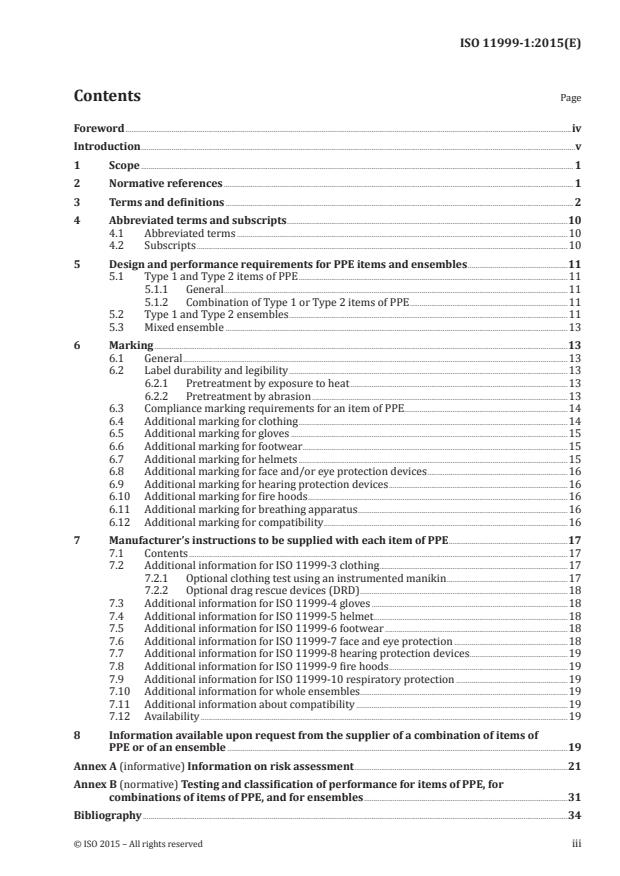
Contents Page
Foreword .iv
Introduction .v
1 Scope . 1
2 Normative references . 1
3 Terms and definitions . 2
4 Abbreviated terms and subscripts .10
4.1 Abbreviated terms .10
4.2 Subscripts .10
5 Design and performance requirements for PPE items and ensembles .11
5.1 Type 1 and Type 2 items of PPE .11
5.1.1 General.11
5.1.2 Combination of Type 1 or Type 2 items of PPE .11
5.2 Type 1 and Type 2 ensembles .11
5.3 Mixed ensemble .13
6 Marking .13
6.1 General .13
6.2 Label durability and legibility .13
6.2.1 Pretreatment by exposure to heat .13
6.2.2 Pretreatment by abrasion .13
6.3 Compliance marking requirements for an item of PPE.14
6.4 Additional marking for clothing .14
6.5 Additional marking for gloves .15
6.6 Additional marking for footwear.15
6.7 Additional marking for helmets .15
6.8 Additional marking for face and/or eye protection devices .16
6.9 Additional marking for hearing protection devices .16
6.10 Additional marking for fire hoods .16
6.11 Additional marking for breathing apparatus .16
6.12 Additional marking for compatibility . .16
7 Manufacturer’s instructions to be supplied with each item of PPE .17
7.1 Contents .17
7.2 Additional information for ISO 11999-3 clothing .17
7.2.1 Optional clothing test using an instrumented manikin .17
7.2.2 Optional drag rescue devices (DRD) .18
7.3 Additional information for ISO 11999-4 gloves .18
7.4 Additional information for ISO 11999-5 helmet.18
7.5 Additional information for ISO 11999-6 footwear .18
7.6 Additional information for ISO 11999‑7 face and eye protection .18
7.7 Additional information for ISO 11999-8 hearing protection devices .19
7.8 Additional information for ISO 11999‑9 fire hoods .19
7.9 Additional information for ISO 11999‑10 respiratory protection .19
7.10 Additional information for whole ensembles.19
7.11 Additional information about compatibility .19
7.12 Availability .19
8 Information available upon request from the supplier of a combination of items of
PPE or of an ensemble .19
Annex A (informative) Information on risk assessment .21
Annex B (normative) Testing and classification of performance for items of PPE, for
combinations of items of PPE, and for ensembles .31
Bibliography .34
Foreword
ISO (the International Organization for Standardization) is a worldwide federation of national standards
bodies (ISO member bodies). The work of preparing International Standards is normally carried out
through ISO technical committees. Each member body interested in a subject for which a technical
committee has been established has the right to be represented on that committee. International
organizations, governmental and non-governmental, in liaison with ISO, also take part in the work.
ISO collaborates closely with the International Electrotechnical Commission (IEC) on all matters of
electrotechnical standardization.
The procedures used to develop this document and those intended for its further maintenance are
described in the ISO/IEC Directives, Part 1. In particular the different approval criteria needed for the
different types of ISO documents should be noted. This document was drafted in accordance with the
editorial rules of the ISO/IEC Directives, Part 2 (see www.iso.org/directives).
Attention is drawn to the possibility that some of the elements of this document may be the subject of
patent rights. ISO shall not be held responsible for identifying any or all such patent rights. Details of
any patent rights identified during the development of the document will be in the Introduction and/or
on the ISO list of patent declarations received (see www.iso.org/patents).
Any trade name used in this document is information given for the convenience of users and does not
constitute an endorsement.
For an explanation on the meaning of ISO specific terms and expressions related to conformity
assessment, as well as information about ISO’s adherence to the WTO principles in the Technical Barriers
to Trade (TBT) see the following URL: Foreword ‑ Supplementary information
The committee responsible for this document is ISO/TC 94, Personal safety — Protective clothing and
equipment, Subcommittee SC 14, Fire-fighters’ personal equipment.
ISO 11999 consists of the following parts, under the general title PPE for firefighters — Test methods and
requirements for PPE used by firefighters who are at risk of exposure to high levels of heat and/or flame
while fighting fires occurring in structures:
— Part 1: General
— Part 2: Compatibility
— Part 3: Clothing
— Part 4: Gloves
The following parts are under preparation:
— Part 5: Helmets
— Part 6: Footwear
— Part 7: Face and eye protection
— Part 8: Hearing
— Part 9: Firehoods
— Part 10: Respiratory protection
NOTE The number of this draft has been changed from ISO/DIS 11613-1 to ISO 11999-1. The Committee
agreed a new number for this project was appropriate given the scope of the publication of the ISO 11999 series
was to cover ensemble standards. It was further agreed that ISO 11613:1999 would remain current.
iv © ISO 2015 – All rights reserved
Introduction
This International Standard provides minimum design and performance requirements for personal
protective equipment (PPE) worn by firefighters to reduce injury and/or the loss of life. Amongst other
hazards faced by firefighters is exposure to high thermal loads and to flames.
This International Standard details the design and performance requirements for the various items of
PPE covered in all parts and for the compatibility of items of PPE when worn together.
This International Standard specifies, in ISO 11999‑2, design and performance requirements for
the compatibility of ISO 11999‑3, ISO 11999‑4, ISO 11999‑5, ISO 11999‑6, ISO 11999‑7, ISO 11999‑8,
ISO 11999-9, and ISO 11999-10 when all items covered in this International Standard are worn together,
thereby creating an ensemble standard. All items have to meet the general requirements for marking and
manufacturer’s instructions (this part of ISO 11999), as well as the specific marking and manufacturer’s
instructions of the respective parts of ISO 11999.
Under best practice for health and safety procedures, prior to choosing any PPE, a risk assessment of
the workplace is carried out. Where hazards are identified and cannot be removed from a workplace,
the items of PPE chosen to protect the personnel need to be fit for their intended use while allowing the
personnel to carry out the work required of them. In environments where firefighters may be required
to work, not only must the PPE protect the firefighters while enabling them to achieve their objectives
at an incident, but it must also safeguard them and allow a safe escape. The PPE chosen must also allow
firefighters to carry out their duties without undue stress being caused by the PPE.
Some PPE, particularly PPE to protect against mortal danger, can have failure levels far above the limit of
exposures of human beings. On sites where such PPE is being used, it is important to ensure that proper
and suitable safety procedures are in place which can identify when personnel should be withdrawn
from dangerous or potentially dangerous situations and which can ensure that the relevant medical
support is available for firefighters.
Since the decision on which PPE ensemble to use following risk assessment will dictate the parameters
for protection of the persons who have to wear it, it is critical that decision-makers have knowledge of
the risks against which the PPE is supposed to protect and its limitations. It is recommended that those
who make the decision on the choice of PPE for particular workplaces should be competent in their
knowledge and understanding of both the workplace hazards and the PPE from which to choose, prior
to making these decisions, to ensure that informed decisions are taken.
Further detail on carrying out risk assessment to ascertain the type of PPE required to protect personnel
working in specific areas is included in Annex A of this part of ISO 11999.
Hazards in the workplaces of firefighters are varied but can be common from workplace to workplace;
therefore, some uses of PPE for firefighters can be multipurpose. Because this International Standard has
been developed on a risk assessment approach, a number of different types, levels, or classes are given for
certain performance requirements of various parts of a PPE ensemble. Based on their risk assessment,
users of this International Standard can make a choice of which levels or classes are required for the
particular workplace where their personnel are expected to work. This can include fires in domestic and
commercial buildings, fires in industry, including aviation, petrochemical, chemical, pharmaceutical,
land-based marine incidents, rescue, etc.
This International Standard includes separate parts for each item of a firefighter’s ensemble. As PPE to
protect each part of the body can be complex, this International Standard draws from the expertise of
other Technical Committees in ISO which specialize in such protection.
The results of the user risk assessment for certain workplaces can require the use of PPE with higher
and/or different levels or classes of performance than those in this International Standard. PPE covered
in this part of ISO 11999 will not protect from all possible exposures. Nothing in this International
Standard is intended to restrict any jurisdiction, purchaser, or manufacturer from exceeding the
minimum performance requirements specified in this International Standard.
Another objective in the Business Plan of ISO/TC 94/SC 14 is to provide guidance on the selection, use,
care, and maintenance for firefighters’ PPE. Such activities are critical to the lifespan and continuing
protective ability of any PPE and policies covering these aspects should be implemented as soon as
the PPE is introduced into use. ISO/TC 94/SC 14 has developed a Technical Report on this subject,
ISO/TR 21808. Firefighters should be trained in the selection, use, care, and maintenance of their PPE.
Firefighters should also be trained in the performance and limitation of their PPE.
vi © ISO 2015 – All rights reserved
INTERNATIONAL STANDARD ISO 11999-1:2015(E)
PPE for firefighters — Test methods and requirements for
PPE used by firefighters who are at risk of exposure to high
levels of heat and/or flame while fighting fires occurring in
structures —
Part 1:
General
1 Scope
This International Standard specifies minimum design and performance requirements for personal
protective equipment (PPE) to be used by firefighters, primarily but not solely to protect against
exposure to flame and high thermal loads.
To assist with choice based on user risk assessment, types and performance levels for different categories
of protection are included.
The scope of this International Standard does not include PPE for use in high‑risk fire exposures where, for
example, protective clothing with reflective surface according to ISO 15538 might be more appropriate,
or for use in long‑term firefighting operations in high ambient temperature (for example, bush, wildland,
or forest firefighting) where equipment according to ISO 16073 might be more appropriate.
Similarly, this International Standard does not include PPE to protect against chemical and biological
hazards, other than against short‑term and accidental exposure while engaged in firefighting and
associated activities when fighting fires occurring in structures.
This part of ISO 11999 describes the general structure of this International Standard, sets design
and performance requirements for PPE, and includes requirements for marking and manufacturer’s
instructions.
2 Normative references
The following documents, in whole or in part, are normatively referenced in this document and are
indispensable for its application. For dated references, only the edition cited applies. For undated
references, the latest edition of the referenced document (including any amendments) applies.
ISO/TR 11610, Protective clothing — Vocabulary
ISO 11999-3:2013, PPE for firefighters — Test methods and requirements for PPE used by firefighters who
are at risk of exposure to high levels of heat and/or flame while fighting fires occurring in structures — Part
3: Clothing
ISO 12947-2, Textiles — Determination of the abrasion resistance of fabrics by the Martindale method —
Part 2: Determination of specimen breakdown
ISO 13688, Protective clothing — General requirements
ISO 17493, Clothing and equipment for protection against heat — Test method for convective heat resistance
using a hot air circulating oven
EN 469, Protective clothing for firefighters — Performance requirement clothing for firefighting
EN 960:2006, Headforms for use in the testing of protective helmets
EN 1149-1, Protective clothing — Electrostatic properties — Part 1. Surface resistivity(test methods and
requirements)
EN 1149-3:2004, Protective clothing — Electrostatic properties — Part 3.Test methods for measurement
of charge decay
EN 1149-5, Protective clothing — Electrostatic properties — Part 5. Performance requirements
NFPA 1971, Standard on protective ensembles for structural fire fighting and proximity fire fighting
3 Terms and definitions
For the purposes of this document, the terms and definitions in ISO/TR 11610 and the following apply.
3.1
accessory
additional part that is approved by the manufacturer and can be attached to an item of PPE but is not
necessary to fulfil the requirements of this International Standard
EXAMPLE Cable clips, lamp brackets, etc.
3.2
basic plane of the head
plane at the level of the opening of the external auditory meatus and the lower edge of the eye sockets
3.3
basic plane of the headform
plane which corresponds to the basic plane of the human head
3.4
basic shape
outer shape which the helmet would have without comb, brim or any of the fairings or radii associated
with these
3.5
brim
ridge protruding outwards from the basic shape of the helmet shell, forming the lower edge of the shell
and including its associated fairings and radii
3.6
cellular outsole
cellular outsole having a density of 0,9 g/ml or less with a cell structure visible under 10x magnification
3.7
central vertical axis
construction plane parallel to the basic plane of the headform at a distance from it, which is a function
of the size of the headform
3.8
char
formation of a brittle residue when material is exposed to thermal energy
3.9
chinstrap
part of a retention system, including a strap which passes under or on the wearer’s chin and which helps
to ensure that the helmet is correctly maintained in place
3.10
cleaning cycle
washing/drying cycle or a dry cleaning cycle
2 © ISO 2015 – All rights reserved
3.11
closure system
method of fastening/unfastening the openings in the garment, including combinations of more than one
method of achieving a secure closure
3.12
collar lining
part of the collar fabric composite which is next to the skin when the collar is closed in the raised position
3.13
combination of PPE
two or more items of PPE fulfilling the requirements of this International Standard
3.14
comfort system
material in a helmet which serves to improve comfort for the wearer
3.15
component assembly
combination of all materials of a multilayer item presented exactly as in the finished item’s construction
Note 1 to entry: This item does not cover reinforced materials.
3.16
cuff
finished edge of the coat sleeve opening
3.17
cuff
circular, flared, or otherwise expanded part of the glove that extends beyond the opening of the
glove body to cover the wrist area
3.18
cuff
finished edge of the trousers’ leg opening
3.19
drag rescue device
device incorporated into the upper torso garment that allows the incapacitated wearer to be moved by
dragging
Note 1 to entry: It is not a lifting device.
3.20
drip
to run or fall in drops
3.21
dripping
softening with material movement and consequent detachment
3.22
ear covers
part(s) or accessory of the helmet which protect at least the ears of the wearer
3.23
energy absorption system
material and/or system in a helmet which serves to dampen impact energy
3.24
ensemble
combination or assembly of multiple items that are individually compliant with the respective parts of
this International Standard that provide protection to the head, upper torso together with arms and
hands, the lower torso together with feet, and respiratory protection, and that together fulfil all the
requirements of ISO 11999-2
3.25
exterior pocket
pocket located on the exterior of the protective garment
3.26
face shield
form of face and eye protection that can be placed in front of the eyes and which cover a large part of the
face, sometimes a part or accessory to a helmet
3.27
facial opening
opening at the front of the fire hood interfacing with the eye and face protectors/breathing apparatus
face mask
3.28
fighting fires occurring in structures
activity of rescue, fire suppression, and property conservation in buildings, enclosed structures, vehicles,
marine vessels, or similar properties that are involved in a fire or emergency situation
3.29
fire hood
item worn directly in contact with the head to protect exposed parts of the head and neck where the
protective coat/helmet/respiratory protective device (RPD) facepiece interface
3.30
firefighter’s protective clothing
specialized garments providing protection for the firefighter’s torso, neck, arms, and legs, but excluding
the head, hands, and feet
3.31
firefighter’s protective gloves
specialized gloves for protection for the firefighter’s hands and wrists
3.32
fitting device
item on a helmet that enables it to be adjusted to a user’s head or neck, with the aim to correctly position
it for maximum protection and comfort
Note 1 to entry: These features can be incorporated directly into the helmet, the helmet retention system, or the
helmet shock absorption system.
3.33
fitting/interface compatibility
physical compatibility between adjacent PPE items
3.34
fluorescence
process by which radiant flux of certain wavelengths is absorbed and re‑radiated non‑thermally in
other, usually longer wavelengths
3.35
fuel oil
aliphatic hydrocarbon constituent of petroleum
4 © ISO 2015 – All rights reserved
3.36
full face mask
facepiece which covers the eyes, nose, mouth, and chin and provides adequate sealing on the face of the
wearer of a respiratory protective device against the ambient atmosphere
3.37
function/performance compatibility
type performance compatibility between two or more PPE items
3.38
garment
single item of clothing which can consist of single or multiple layers
3.39
glove body
part of the glove that extends from the tip of the fingers to 25 mm beyond the wrist crease
3.40
goggles
form of face and eye protection that encloses the orbital area and fits tightly against the face, sometimes
a part or accessory to a helmet
3.41
hardware
non-fabric items used in protective clothing, including those made of metal or plastic
EXAMPLE Buttons, zippers, fasteners, and rank markings.
3.42
headform
shape replacing the head which is used for testing
Note 1 to entry: A headform designed to meet EN 960:2006 may be used when testing helmets, face and/or eye
protection devices and fire hoods.
3.43
helmet assembly
helmet, together with any optional or mandatory attached protective components such as ear covers,
neck protector, face shield, or goggles.
3.44
helmet
headgear intended to ensure protection of the wearer’s head (and optionally, the wearer’s neck) against
hazards which might occur during operations of firefighting in buildings and other structures
Note 1 to entry: This term refers specifically to helmets for structural firefighting.
3.45
helmet shell
component which gives the helmet its general shape and on which could be fixed various helmet
accessories
3.46
high-visibility material, trim
retroreflective, fluorescent, or a combination of retroreflective and fluorescent material attached to the
outer material for visibility enhancement
3.47
innermost lining
lining on the innermost face of a component assembly of a garment closest to the wearer’s skin
Note 1 to entry: Where the innermost lining forms part of a material combination, the material combination shall
be regarded as the innermost lining.
3.48
integral additional protective function
part of the helmet, intended by the helmet manufacturer not to be removed by the user, except for
maintenance and fitting purposes, and which provide protection to the wearer, other than as provided
for by this International Standard
3.49
interface area
area of the body not specifically protected by a protective garment, helmet, face and/or eye protection
device, gloves, footwear, or breathing apparatus facepiece or the area such as the neck, wrists, and
ankles where items of PPE meet or overlap
EXAMPLE The protective coat/helmet/breathing apparatus, facepiece area, the protective coat/glove area,
and the protective trousers/footwear area.
3.50
interface component
item designed to provide limited protection to interface areas
EXAMPLE Fire hood and protective wristlets.
3.51
interior attack
activity of rescue, fire suppression, and property conservation generally performed in the interior or
immediate vicinity of the exterior of involved structures, for the purpose of an attack on a fire to directly
control or extinguish the fire
3.52
interlining
layer between the outermost layer and the innermost lining in a multilayer garment
3.53
leather
hide or skin tanned to be imputrescible
3.54
longitudinal vertical median plane
vertical plane of symmetry of the headform
3.55
material combination
material produced from a series of separate layers, intimately combined prior to the item’s manufacturing
stage
EXAMPLE A quilted fabric.
3.56
means of fixing
means by which the ocular of the visor is supported and interfaced with the designated helmet(s)
Note 1 to entry: This means could be an integral part of the helmet, could be fixed permanently or temporarily, or
it could be worn separately, but at the same time as the helmet.
6 © ISO 2015 – All rights reserved
3.57
melt
liquefy a material usually by exposure to heat resulting in a non‑reversible change to its state
Note 1 to entry: For the purposes of this International Standard, melting is observed as the response to heat as
evidenced by flowing or dripping.
3.58
mixed ensemble
ensemble of PPE in which mixed items fulfil heat and flame requirements of Type1 or Type2
3.59
moisture barrier
part of the component assembly of garments which impedes the transfer of liquids
Note 1 to entry: Moisture barriers may not prevent the passage of some chemical (except incidentally), biological,
or radiological agents. Appropriate PPE should be provided to protect the wearer in such incidents.
3.60
multilayer clothing assembly
series of garments arranged in the order as worn
Note 1 to entry: It could contain multilayer materials, material combinations, or a series of separate garments in
single layers.
3.61
neck protector
integral part or accessory which protects the back of the neck from water and/or other liquids, from hot
materials, radiant heat, and flames
Note 1 to entry: In this International Standard, neck protectors are only addressed in association with helmets.
3.62
orbital area
area around and including the eye sockets
3.63
outer material
outermost material of which the protective clothing is made
3.64
performance level
performance gradation of the following four categories of performance measures: a) the flame and
thermal properties, b) the strength and physical properties, c) the water and liquid resistance properties,
and d) the thermal comfort properties
Note 1 to entry: See Table 1.
Note 2 to entry: The performance level for the flame and thermal performance category determines the item’s
type (3.84). The other three performance categories are reported.
Note 3 to entry: Currently, performance levels are available only for clothing and gloves.
3.65
polymeric materials
high molecular weight organic compounds made by attaching repeated smaller compound units, called
monomers, into a long chain‑type molecule
EXAMPLE Polyurethane or polyvinylchloride and synthetic fibres such as nylon, polyester, and aramid.
3.66
protective coat
protective garment designed and configured to provide protection to upper torso, neck, and arms,
excluding the hands and head
3.67
protective coverall
protective garment designed and configured to provide protection to the torso, neck, arms, and legs,
excluding the head, hands, and feet
3.68
protective garment
single item of clothing which can consist of single or multiple layers
EXAMPLE Protective coat, protective trouser, or protective coverall.
3.69
protective trousers
protective garment designed and configured to provide protection to lower torso and legs excluding the
feet
3.70
protective wristlet
interface component that provides limited protection to the protective garment/glove interface area
3.71
reference plane
construction plane parallel to the basic plane of the headform at a distance from it which is a function
of the size of the headform
3.72
removable inner liner
winter liner
inner garment designed to be attached to, or to be worn separately, under an outer garment in order to
provide thermal insulation in cold environment
3.73
retention system
parts which are responsible for securing the helmet in position on the head, including items which
enable adjustment or improved comfort
3.74
retroreflection
reflection of light in which the reflected rays are preferentially returned in the direction close to the
opposite of the direction of the incident rays, with this property being maintained over wide variations
of the direction of the incident rays
3.75
rubber
vulcanized elastomers
3.76
sagittal plane of the helmet
plane corresponding with the longitudinal vertical median plane of the headform when the helmet is
adjusted on it according to the manufacturer’s instructions
3.77
seam
permanent junction between two or more pieces of textile material created by sewing, welding, or other
methods
8 © ISO 2015 – All rights reserved
3.78
major A seam
outer layer or outer shell seam assembly where rupture could reduce the protection of the garment by
exposing the moisture barrier, thermal barrier, undergarment, other clothing, or skin
3.79
major B seam
moisture barrier or thermal barrier seam assemby where rupture could reduce the protection of the
garment by exposing the next layer of the garment, undergarment, other clothing, or skin
3.80
minor seam
remaining seam assembly that is not classified as major A or major B seam
3.81
seam sealing material
material applied to a seam to prevent the transfer of liquids through the seam
EXAMPLE Adhesive tape.
3.82
shikoro
standard accessory of a helmet to protect the whole face, ear, and neck parts which are not covered by
respirator and helmet from water and/or other liquids, hot materials, radiant heat, and flames, without
impediment of vision and installation of respirator
Note 1 to entry: When a shikoro is used with a helmet complying with ISO 11999‑2, a fire hood need to be used.
3.83
thermal barrier
component of an element or item that principally provides thermal protection
3.84
type
designation of a protective item in this International Standard based on its level of flame and heat
protection
EXAMPLE Type 1 and Type 2.
Note 1 to entry: All items of the same type will have the same level of performance in flame and thermal protection
and can be used together to make a Type 1 or Type 2 ensemble.
Note 2 to entry: See 5.2.
3.85
type ensemble
ensemble of PPE in which all single items fulfil heat and flame requirements of the same type
3.86
undergarment
garment which is worn under an outer garment
EXAMPLE Station wear.
3.87
vertical axis of the helmet
axis corresponding with the central vertical axis of the headform when the helmet is adjusted on it
according to the manufacturer’s instructions
3.88
wristlet
circular, close‑fitting part of the glove or coat, usually made of knitted material, that extends beyond the
opening of the glove body or coat sleeve
Note 1 to entry: Can be contained within a cuff.
3.89
yoke
area of the fire hood interfacing with the coat
4 Abbreviated terms and subscripts
4.1 Abbreviated terms
CCHR conductive compressive heat resistance
DRD drag rescue device
HTI heat transmission index (12 °C temperature rise)
HTI heat transmission index (24 °C temperature rise)
TTI thermal threshold index
m mass
PPE personal protective equipment
R’ coefficient of retroreflection
RHTI radiant heat transmission index (12 °C temperature rise)
RHTI radiant heat transmission index (24 °C temperature rise)
RPD respiratory protective device
SCBA self-contained breathing apparatus
tt conductive heat transfer index
w mass fraction of water absorbed
w
4.2 Subscripts
12 at 12 °C temperature rise
24 at 24 °C temperature rise
w water
10 © ISO 2015 – All rights reserved
5 Design and performance requirements for PPE items and ensembles
5.1 Type 1 and Type 2 items of PPE
5.1.1 General
An item of PPE, which is conforming to the requirements of one of ISO 11999-3 to ISO 11999-10, can
individually be designated and marked as design and performance requirements for a Type 1 or Type
2 itemsof PPE conforming to the relevant part of this International Standard. Items shall be marked
as a Type 1 or Type 2 item determined by the numerical letter code for heat and flame performance
requirements. As an example for clothing items according to ISO 11999-3, the numerical letter code A
“heat and flame resistance and additional properties” rating, i.e. A1 or A2 shall be used.
Type 1 and Type 2 items of PPE have differing performance characteristics. For example, Type 1 clothing
provides a lower thermal resistance. Selection of type should be determined via a risk assessment
process that includes consideration of operational practices, environmental conditions, and local
building standards.
5.1.2 Combination of Type 1 or Type 2 items of PPE
A combination of two or more items of PPE, of which each item individually is meeting the requirements
of the relevant part of this International Standard, shall
a) meet all the relevant fitting/interface compatibility requirements of ISO 11999‑2 in case adjacent,
and
b) have the same numerical rating for the heat and flame performance category (e.g. both A1 or A2 in
the case of clothing and gloves).
NOTE A combination is more than a single item of PPE but is less than an ensemble, i.e. it is not offering
protection for the whole firefighter.
5.2 Type 1 and Type 2 ensembles
A combination of items of PPE which individually meets the requirements of the relevant part of this
International Standard, and which, as an ensemble, provides protection to the whole body of a firefighter,
shall be designated and marked as a “Type 1 Ensemble according to ISO 11999” or “Type 2 Ensemble
according to ISO 11999”.
An ensemble is classified as Type 1 or Type 2 if every item in the ensemble meets the appropriate
requirements for heat and flame performance in each part of this International Standard as described
in 5.1.1, i.e. all items meet the Type 1 requirements or all items meet the Type 2 requirements.
For example, the item or items of PPE of a Type 1 or Type 2 ensemble, which are intended to provide
protection for the firefighter’s upper and lower torso, neck, arms, and/or legs, shall conform to the
requirements of ISO 11999-3, and thus consist of
a) either an outer garment which could be, for example, a one-piece protective coverall or a protective
coat and a compatible pair of protective trousers, or
b) a series of outer and undergarments compatible to be worn together.
NOTE 1 Requirements for items of PPE according to parts of this International Standard other than ISO 11999-2,
ISO 11999‑3, and ISO 11999‑4 are not yet specified and shall be added in next editions of this part of ISO 11999 as
soon as further parts will be published.
NOTE 2 See Annex B.
Table 1 — Performance requirements for Type 1 and Type 2 ensembles
Performance requirements Type 1 ensemble Type 2 ensemble
for
Compatibility between items of PPE according to ISO 11999-2
Fitting/interface compatibility Items of PPE intended to be compatible when worn together shall meet all the rel-
evant fitting/interface compatibility requirements.
Functional/performance com- Items of PPE intended to be compatible when worn together, and those have a
patibility numerical rating for a specific letter code, shall have the same numerical rating for
the capital letter code.
Clothing according to ISO 11999-3 for protection of upper and lower torso, neck, arms, and legs
Letter code A (heat and flame The outer garment, or a series of pro- The outer garment, or a series of protective
resistance) tective garments, which shall always be garments, which shall always be worn one
worn one on top of the other, shall have on top of the other, shall have a letter code
a letter code A, performance level A1. A, performance level A2.
Letter code b (strength and The outer material and seams of the outer garment shall have a letter code b, per-
physical hazard resistance) formance level b or b .
1 2
Letter code c (water and liquid The outer material and, if present, the moisture barrier and its seams of the outer
penetration resistance) garment shall have a letter code c, performance level c or c .
1 2
Letter code d (thermal com- The outer garment, or a series of protective garments, which shall always be worn
fort) one on top of the other, shall have a letter code d, performance level d or d .
1 2
Gloves according to ISO 11999-4 for protection of hands (and possible wrists and lower arms)
Letter code G (heat and flame The gloves shall have a letter code G, The gloves shall have a letter code A, per-
performance) performance level G1. formance G2.
Letter code b (mechanical The gloves shall have a letter code b, performance level b ,b , or b .
1 2 3
performance)
Letter code c (barrier per- The gloves shall have a letter code c, performance level c , or c .
1 2
formance)
Letter code d (ergonomic per- The gloves shall have a letter code d, performance level d , or d .
1 2
formance)
Helmets according to ISO 11999-5 for head protection
Requirements for helmets for Type 1 Requirements for helmets for Type 2 ensem-
ensembles are not yet specified. bles are not yet specified.
Footwear according to ISO 11999-6 for protection of feet (and possibly ankles and lower legs)
Requirements for footwear for Type 1 Requirements for footwear for Type 2 ensem-
ensembles are not yet specified. bles are not yet specified.
Items of PPE according to ISO 11999-7 for protection of face and eyes
Requirements for face and eye protec- Requirements for face and eye protection
tion for Type 1 ensembles are not yet for Type 2 ensembles are not yet specified.
specified.
Items of PPE according to ISO 11999-8 for hearing protection
Requirements for hearing protection for Requirements for hearing protection for Type
Type 1 ensembles are not yet specified. 2 ensembles are not yet specified.
Fire hoods according to ISO 11999-9 for head protection
Requirements for fire hoods for Type 1 Requirements for fire hoods for Type 2
ensembles are not yet specified. ensembles are not yet specified.
Items of PPE according to ISO 11999-10 for respiratory protective devices
NOTE The capital letter code indicating the heat and flame performance for each ensembles item is give
...
INTERNATIONAL ISO
STANDARD 11999-1
First edition
2015-06-01
PPE for firefighters — Test methods
and requirements for PPE used
by firefighters who are at risk of
exposure to high levels of heat and/or
flame while fighting fires occurring in
structures —
Part 1:
General
Équipement de protection personnelle pour pompiers — Méthodes
d’essai et exigences pour les équipements de protection personnelle
utilisés par les pompiers qui sont à risque d’une exposition à des
niveaux élevés de chaleur et/ou de flamme quand la lutte contre les
incendies survient dans les structures —
Partie 1: Généralités
Reference number
©
ISO 2015
© ISO 2015, Published in Switzerland
All rights reserved. Unless otherwise specified, no part of this publication may be reproduced or utilized otherwise in any form
or by any means, electronic or mechanical, including photocopying, or posting on the internet or an intranet, without prior
written permission. Permission can be requested from either ISO at the address below or ISO’s member body in the country of
the requester.
ISO copyright office
Ch. de Blandonnet 8 • CP 401
CH-1214 Vernier, Geneva, Switzerland
Tel. +41 22 749 01 11
Fax +41 22 749 09 47
copyright@iso.org
www.iso.org
ii © ISO 2015 – All rights reserved
Contents Page
Foreword .iv
Introduction .v
1 Scope . 1
2 Normative references . 1
3 Terms and definitions . 2
4 Abbreviated terms and subscripts .10
4.1 Abbreviated terms .10
4.2 Subscripts .10
5 Design and performance requirements for PPE items and ensembles .11
5.1 Type 1 and Type 2 items of PPE .11
5.1.1 General.11
5.1.2 Combination of Type 1 or Type 2 items of PPE .11
5.2 Type 1 and Type 2 ensembles .11
5.3 Mixed ensemble .13
6 Marking .13
6.1 General .13
6.2 Label durability and legibility .13
6.2.1 Pretreatment by exposure to heat .13
6.2.2 Pretreatment by abrasion .13
6.3 Compliance marking requirements for an item of PPE.14
6.4 Additional marking for clothing .14
6.5 Additional marking for gloves .15
6.6 Additional marking for footwear.15
6.7 Additional marking for helmets .15
6.8 Additional marking for face and/or eye protection devices .16
6.9 Additional marking for hearing protection devices .16
6.10 Additional marking for fire hoods .16
6.11 Additional marking for breathing apparatus .16
6.12 Additional marking for compatibility . .16
7 Manufacturer’s instructions to be supplied with each item of PPE .17
7.1 Contents .17
7.2 Additional information for ISO 11999-3 clothing .17
7.2.1 Optional clothing test using an instrumented manikin .17
7.2.2 Optional drag rescue devices (DRD) .18
7.3 Additional information for ISO 11999-4 gloves .18
7.4 Additional information for ISO 11999-5 helmet.18
7.5 Additional information for ISO 11999-6 footwear .18
7.6 Additional information for ISO 11999‑7 face and eye protection .18
7.7 Additional information for ISO 11999-8 hearing protection devices .19
7.8 Additional information for ISO 11999‑9 fire hoods .19
7.9 Additional information for ISO 11999‑10 respiratory protection .19
7.10 Additional information for whole ensembles.19
7.11 Additional information about compatibility .19
7.12 Availability .19
8 Information available upon request from the supplier of a combination of items of
PPE or of an ensemble .19
Annex A (informative) Information on risk assessment .21
Annex B (normative) Testing and classification of performance for items of PPE, for
combinations of items of PPE, and for ensembles .31
Bibliography .34
Foreword
ISO (the International Organization for Standardization) is a worldwide federation of national standards
bodies (ISO member bodies). The work of preparing International Standards is normally carried out
through ISO technical committees. Each member body interested in a subject for which a technical
committee has been established has the right to be represented on that committee. International
organizations, governmental and non-governmental, in liaison with ISO, also take part in the work.
ISO collaborates closely with the International Electrotechnical Commission (IEC) on all matters of
electrotechnical standardization.
The procedures used to develop this document and those intended for its further maintenance are
described in the ISO/IEC Directives, Part 1. In particular the different approval criteria needed for the
different types of ISO documents should be noted. This document was drafted in accordance with the
editorial rules of the ISO/IEC Directives, Part 2 (see www.iso.org/directives).
Attention is drawn to the possibility that some of the elements of this document may be the subject of
patent rights. ISO shall not be held responsible for identifying any or all such patent rights. Details of
any patent rights identified during the development of the document will be in the Introduction and/or
on the ISO list of patent declarations received (see www.iso.org/patents).
Any trade name used in this document is information given for the convenience of users and does not
constitute an endorsement.
For an explanation on the meaning of ISO specific terms and expressions related to conformity
assessment, as well as information about ISO’s adherence to the WTO principles in the Technical Barriers
to Trade (TBT) see the following URL: Foreword ‑ Supplementary information
The committee responsible for this document is ISO/TC 94, Personal safety — Protective clothing and
equipment, Subcommittee SC 14, Fire-fighters’ personal equipment.
ISO 11999 consists of the following parts, under the general title PPE for firefighters — Test methods and
requirements for PPE used by firefighters who are at risk of exposure to high levels of heat and/or flame
while fighting fires occurring in structures:
— Part 1: General
— Part 2: Compatibility
— Part 3: Clothing
— Part 4: Gloves
The following parts are under preparation:
— Part 5: Helmets
— Part 6: Footwear
— Part 7: Face and eye protection
— Part 8: Hearing
— Part 9: Firehoods
— Part 10: Respiratory protection
NOTE The number of this draft has been changed from ISO/DIS 11613-1 to ISO 11999-1. The Committee
agreed a new number for this project was appropriate given the scope of the publication of the ISO 11999 series
was to cover ensemble standards. It was further agreed that ISO 11613:1999 would remain current.
iv © ISO 2015 – All rights reserved
Introduction
This International Standard provides minimum design and performance requirements for personal
protective equipment (PPE) worn by firefighters to reduce injury and/or the loss of life. Amongst other
hazards faced by firefighters is exposure to high thermal loads and to flames.
This International Standard details the design and performance requirements for the various items of
PPE covered in all parts and for the compatibility of items of PPE when worn together.
This International Standard specifies, in ISO 11999‑2, design and performance requirements for
the compatibility of ISO 11999‑3, ISO 11999‑4, ISO 11999‑5, ISO 11999‑6, ISO 11999‑7, ISO 11999‑8,
ISO 11999-9, and ISO 11999-10 when all items covered in this International Standard are worn together,
thereby creating an ensemble standard. All items have to meet the general requirements for marking and
manufacturer’s instructions (this part of ISO 11999), as well as the specific marking and manufacturer’s
instructions of the respective parts of ISO 11999.
Under best practice for health and safety procedures, prior to choosing any PPE, a risk assessment of
the workplace is carried out. Where hazards are identified and cannot be removed from a workplace,
the items of PPE chosen to protect the personnel need to be fit for their intended use while allowing the
personnel to carry out the work required of them. In environments where firefighters may be required
to work, not only must the PPE protect the firefighters while enabling them to achieve their objectives
at an incident, but it must also safeguard them and allow a safe escape. The PPE chosen must also allow
firefighters to carry out their duties without undue stress being caused by the PPE.
Some PPE, particularly PPE to protect against mortal danger, can have failure levels far above the limit of
exposures of human beings. On sites where such PPE is being used, it is important to ensure that proper
and suitable safety procedures are in place which can identify when personnel should be withdrawn
from dangerous or potentially dangerous situations and which can ensure that the relevant medical
support is available for firefighters.
Since the decision on which PPE ensemble to use following risk assessment will dictate the parameters
for protection of the persons who have to wear it, it is critical that decision-makers have knowledge of
the risks against which the PPE is supposed to protect and its limitations. It is recommended that those
who make the decision on the choice of PPE for particular workplaces should be competent in their
knowledge and understanding of both the workplace hazards and the PPE from which to choose, prior
to making these decisions, to ensure that informed decisions are taken.
Further detail on carrying out risk assessment to ascertain the type of PPE required to protect personnel
working in specific areas is included in Annex A of this part of ISO 11999.
Hazards in the workplaces of firefighters are varied but can be common from workplace to workplace;
therefore, some uses of PPE for firefighters can be multipurpose. Because this International Standard has
been developed on a risk assessment approach, a number of different types, levels, or classes are given for
certain performance requirements of various parts of a PPE ensemble. Based on their risk assessment,
users of this International Standard can make a choice of which levels or classes are required for the
particular workplace where their personnel are expected to work. This can include fires in domestic and
commercial buildings, fires in industry, including aviation, petrochemical, chemical, pharmaceutical,
land-based marine incidents, rescue, etc.
This International Standard includes separate parts for each item of a firefighter’s ensemble. As PPE to
protect each part of the body can be complex, this International Standard draws from the expertise of
other Technical Committees in ISO which specialize in such protection.
The results of the user risk assessment for certain workplaces can require the use of PPE with higher
and/or different levels or classes of performance than those in this International Standard. PPE covered
in this part of ISO 11999 will not protect from all possible exposures. Nothing in this International
Standard is intended to restrict any jurisdiction, purchaser, or manufacturer from exceeding the
minimum performance requirements specified in this International Standard.
Another objective in the Business Plan of ISO/TC 94/SC 14 is to provide guidance on the selection, use,
care, and maintenance for firefighters’ PPE. Such activities are critical to the lifespan and continuing
protective ability of any PPE and policies covering these aspects should be implemented as soon as
the PPE is introduced into use. ISO/TC 94/SC 14 has developed a Technical Report on this subject,
ISO/TR 21808. Firefighters should be trained in the selection, use, care, and maintenance of their PPE.
Firefighters should also be trained in the performance and limitation of their PPE.
vi © ISO 2015 – All rights reserved
INTERNATIONAL STANDARD ISO 11999-1:2015(E)
PPE for firefighters — Test methods and requirements for
PPE used by firefighters who are at risk of exposure to high
levels of heat and/or flame while fighting fires occurring in
structures —
Part 1:
General
1 Scope
This International Standard specifies minimum design and performance requirements for personal
protective equipment (PPE) to be used by firefighters, primarily but not solely to protect against
exposure to flame and high thermal loads.
To assist with choice based on user risk assessment, types and performance levels for different categories
of protection are included.
The scope of this International Standard does not include PPE for use in high‑risk fire exposures where, for
example, protective clothing with reflective surface according to ISO 15538 might be more appropriate,
or for use in long‑term firefighting operations in high ambient temperature (for example, bush, wildland,
or forest firefighting) where equipment according to ISO 16073 might be more appropriate.
Similarly, this International Standard does not include PPE to protect against chemical and biological
hazards, other than against short‑term and accidental exposure while engaged in firefighting and
associated activities when fighting fires occurring in structures.
This part of ISO 11999 describes the general structure of this International Standard, sets design
and performance requirements for PPE, and includes requirements for marking and manufacturer’s
instructions.
2 Normative references
The following documents, in whole or in part, are normatively referenced in this document and are
indispensable for its application. For dated references, only the edition cited applies. For undated
references, the latest edition of the referenced document (including any amendments) applies.
ISO/TR 11610, Protective clothing — Vocabulary
ISO 11999-3:2013, PPE for firefighters — Test methods and requirements for PPE used by firefighters who
are at risk of exposure to high levels of heat and/or flame while fighting fires occurring in structures — Part
3: Clothing
ISO 12947-2, Textiles — Determination of the abrasion resistance of fabrics by the Martindale method —
Part 2: Determination of specimen breakdown
ISO 13688, Protective clothing — General requirements
ISO 17493, Clothing and equipment for protection against heat — Test method for convective heat resistance
using a hot air circulating oven
EN 469, Protective clothing for firefighters — Performance requirement clothing for firefighting
EN 960:2006, Headforms for use in the testing of protective helmets
EN 1149-1, Protective clothing — Electrostatic properties — Part 1. Surface resistivity(test methods and
requirements)
EN 1149-3:2004, Protective clothing — Electrostatic properties — Part 3.Test methods for measurement
of charge decay
EN 1149-5, Protective clothing — Electrostatic properties — Part 5. Performance requirements
NFPA 1971, Standard on protective ensembles for structural fire fighting and proximity fire fighting
3 Terms and definitions
For the purposes of this document, the terms and definitions in ISO/TR 11610 and the following apply.
3.1
accessory
additional part that is approved by the manufacturer and can be attached to an item of PPE but is not
necessary to fulfil the requirements of this International Standard
EXAMPLE Cable clips, lamp brackets, etc.
3.2
basic plane of the head
plane at the level of the opening of the external auditory meatus and the lower edge of the eye sockets
3.3
basic plane of the headform
plane which corresponds to the basic plane of the human head
3.4
basic shape
outer shape which the helmet would have without comb, brim or any of the fairings or radii associated
with these
3.5
brim
ridge protruding outwards from the basic shape of the helmet shell, forming the lower edge of the shell
and including its associated fairings and radii
3.6
cellular outsole
cellular outsole having a density of 0,9 g/ml or less with a cell structure visible under 10x magnification
3.7
central vertical axis
construction plane parallel to the basic plane of the headform at a distance from it, which is a function
of the size of the headform
3.8
char
formation of a brittle residue when material is exposed to thermal energy
3.9
chinstrap
part of a retention system, including a strap which passes under or on the wearer’s chin and which helps
to ensure that the helmet is correctly maintained in place
3.10
cleaning cycle
washing/drying cycle or a dry cleaning cycle
2 © ISO 2015 – All rights reserved
3.11
closure system
method of fastening/unfastening the openings in the garment, including combinations of more than one
method of achieving a secure closure
3.12
collar lining
part of the collar fabric composite which is next to the skin when the collar is closed in the raised position
3.13
combination of PPE
two or more items of PPE fulfilling the requirements of this International Standard
3.14
comfort system
material in a helmet which serves to improve comfort for the wearer
3.15
component assembly
combination of all materials of a multilayer item presented exactly as in the finished item’s construction
Note 1 to entry: This item does not cover reinforced materials.
3.16
cuff
finished edge of the coat sleeve opening
3.17
cuff
circular, flared, or otherwise expanded part of the glove that extends beyond the opening of the
glove body to cover the wrist area
3.18
cuff
finished edge of the trousers’ leg opening
3.19
drag rescue device
device incorporated into the upper torso garment that allows the incapacitated wearer to be moved by
dragging
Note 1 to entry: It is not a lifting device.
3.20
drip
to run or fall in drops
3.21
dripping
softening with material movement and consequent detachment
3.22
ear covers
part(s) or accessory of the helmet which protect at least the ears of the wearer
3.23
energy absorption system
material and/or system in a helmet which serves to dampen impact energy
3.24
ensemble
combination or assembly of multiple items that are individually compliant with the respective parts of
this International Standard that provide protection to the head, upper torso together with arms and
hands, the lower torso together with feet, and respiratory protection, and that together fulfil all the
requirements of ISO 11999-2
3.25
exterior pocket
pocket located on the exterior of the protective garment
3.26
face shield
form of face and eye protection that can be placed in front of the eyes and which cover a large part of the
face, sometimes a part or accessory to a helmet
3.27
facial opening
opening at the front of the fire hood interfacing with the eye and face protectors/breathing apparatus
face mask
3.28
fighting fires occurring in structures
activity of rescue, fire suppression, and property conservation in buildings, enclosed structures, vehicles,
marine vessels, or similar properties that are involved in a fire or emergency situation
3.29
fire hood
item worn directly in contact with the head to protect exposed parts of the head and neck where the
protective coat/helmet/respiratory protective device (RPD) facepiece interface
3.30
firefighter’s protective clothing
specialized garments providing protection for the firefighter’s torso, neck, arms, and legs, but excluding
the head, hands, and feet
3.31
firefighter’s protective gloves
specialized gloves for protection for the firefighter’s hands and wrists
3.32
fitting device
item on a helmet that enables it to be adjusted to a user’s head or neck, with the aim to correctly position
it for maximum protection and comfort
Note 1 to entry: These features can be incorporated directly into the helmet, the helmet retention system, or the
helmet shock absorption system.
3.33
fitting/interface compatibility
physical compatibility between adjacent PPE items
3.34
fluorescence
process by which radiant flux of certain wavelengths is absorbed and re‑radiated non‑thermally in
other, usually longer wavelengths
3.35
fuel oil
aliphatic hydrocarbon constituent of petroleum
4 © ISO 2015 – All rights reserved
3.36
full face mask
facepiece which covers the eyes, nose, mouth, and chin and provides adequate sealing on the face of the
wearer of a respiratory protective device against the ambient atmosphere
3.37
function/performance compatibility
type performance compatibility between two or more PPE items
3.38
garment
single item of clothing which can consist of single or multiple layers
3.39
glove body
part of the glove that extends from the tip of the fingers to 25 mm beyond the wrist crease
3.40
goggles
form of face and eye protection that encloses the orbital area and fits tightly against the face, sometimes
a part or accessory to a helmet
3.41
hardware
non-fabric items used in protective clothing, including those made of metal or plastic
EXAMPLE Buttons, zippers, fasteners, and rank markings.
3.42
headform
shape replacing the head which is used for testing
Note 1 to entry: A headform designed to meet EN 960:2006 may be used when testing helmets, face and/or eye
protection devices and fire hoods.
3.43
helmet assembly
helmet, together with any optional or mandatory attached protective components such as ear covers,
neck protector, face shield, or goggles.
3.44
helmet
headgear intended to ensure protection of the wearer’s head (and optionally, the wearer’s neck) against
hazards which might occur during operations of firefighting in buildings and other structures
Note 1 to entry: This term refers specifically to helmets for structural firefighting.
3.45
helmet shell
component which gives the helmet its general shape and on which could be fixed various helmet
accessories
3.46
high-visibility material, trim
retroreflective, fluorescent, or a combination of retroreflective and fluorescent material attached to the
outer material for visibility enhancement
3.47
innermost lining
lining on the innermost face of a component assembly of a garment closest to the wearer’s skin
Note 1 to entry: Where the innermost lining forms part of a material combination, the material combination shall
be regarded as the innermost lining.
3.48
integral additional protective function
part of the helmet, intended by the helmet manufacturer not to be removed by the user, except for
maintenance and fitting purposes, and which provide protection to the wearer, other than as provided
for by this International Standard
3.49
interface area
area of the body not specifically protected by a protective garment, helmet, face and/or eye protection
device, gloves, footwear, or breathing apparatus facepiece or the area such as the neck, wrists, and
ankles where items of PPE meet or overlap
EXAMPLE The protective coat/helmet/breathing apparatus, facepiece area, the protective coat/glove area,
and the protective trousers/footwear area.
3.50
interface component
item designed to provide limited protection to interface areas
EXAMPLE Fire hood and protective wristlets.
3.51
interior attack
activity of rescue, fire suppression, and property conservation generally performed in the interior or
immediate vicinity of the exterior of involved structures, for the purpose of an attack on a fire to directly
control or extinguish the fire
3.52
interlining
layer between the outermost layer and the innermost lining in a multilayer garment
3.53
leather
hide or skin tanned to be imputrescible
3.54
longitudinal vertical median plane
vertical plane of symmetry of the headform
3.55
material combination
material produced from a series of separate layers, intimately combined prior to the item’s manufacturing
stage
EXAMPLE A quilted fabric.
3.56
means of fixing
means by which the ocular of the visor is supported and interfaced with the designated helmet(s)
Note 1 to entry: This means could be an integral part of the helmet, could be fixed permanently or temporarily, or
it could be worn separately, but at the same time as the helmet.
6 © ISO 2015 – All rights reserved
3.57
melt
liquefy a material usually by exposure to heat resulting in a non‑reversible change to its state
Note 1 to entry: For the purposes of this International Standard, melting is observed as the response to heat as
evidenced by flowing or dripping.
3.58
mixed ensemble
ensemble of PPE in which mixed items fulfil heat and flame requirements of Type1 or Type2
3.59
moisture barrier
part of the component assembly of garments which impedes the transfer of liquids
Note 1 to entry: Moisture barriers may not prevent the passage of some chemical (except incidentally), biological,
or radiological agents. Appropriate PPE should be provided to protect the wearer in such incidents.
3.60
multilayer clothing assembly
series of garments arranged in the order as worn
Note 1 to entry: It could contain multilayer materials, material combinations, or a series of separate garments in
single layers.
3.61
neck protector
integral part or accessory which protects the back of the neck from water and/or other liquids, from hot
materials, radiant heat, and flames
Note 1 to entry: In this International Standard, neck protectors are only addressed in association with helmets.
3.62
orbital area
area around and including the eye sockets
3.63
outer material
outermost material of which the protective clothing is made
3.64
performance level
performance gradation of the following four categories of performance measures: a) the flame and
thermal properties, b) the strength and physical properties, c) the water and liquid resistance properties,
and d) the thermal comfort properties
Note 1 to entry: See Table 1.
Note 2 to entry: The performance level for the flame and thermal performance category determines the item’s
type (3.84). The other three performance categories are reported.
Note 3 to entry: Currently, performance levels are available only for clothing and gloves.
3.65
polymeric materials
high molecular weight organic compounds made by attaching repeated smaller compound units, called
monomers, into a long chain‑type molecule
EXAMPLE Polyurethane or polyvinylchloride and synthetic fibres such as nylon, polyester, and aramid.
3.66
protective coat
protective garment designed and configured to provide protection to upper torso, neck, and arms,
excluding the hands and head
3.67
protective coverall
protective garment designed and configured to provide protection to the torso, neck, arms, and legs,
excluding the head, hands, and feet
3.68
protective garment
single item of clothing which can consist of single or multiple layers
EXAMPLE Protective coat, protective trouser, or protective coverall.
3.69
protective trousers
protective garment designed and configured to provide protection to lower torso and legs excluding the
feet
3.70
protective wristlet
interface component that provides limited protection to the protective garment/glove interface area
3.71
reference plane
construction plane parallel to the basic plane of the headform at a distance from it which is a function
of the size of the headform
3.72
removable inner liner
winter liner
inner garment designed to be attached to, or to be worn separately, under an outer garment in order to
provide thermal insulation in cold environment
3.73
retention system
parts which are responsible for securing the helmet in position on the head, including items which
enable adjustment or improved comfort
3.74
retroreflection
reflection of light in which the reflected rays are preferentially returned in the direction close to the
opposite of the direction of the incident rays, with this property being maintained over wide variations
of the direction of the incident rays
3.75
rubber
vulcanized elastomers
3.76
sagittal plane of the helmet
plane corresponding with the longitudinal vertical median plane of the headform when the helmet is
adjusted on it according to the manufacturer’s instructions
3.77
seam
permanent junction between two or more pieces of textile material created by sewing, welding, or other
methods
8 © ISO 2015 – All rights reserved
3.78
major A seam
outer layer or outer shell seam assembly where rupture could reduce the protection of the garment by
exposing the moisture barrier, thermal barrier, undergarment, other clothing, or skin
3.79
major B seam
moisture barrier or thermal barrier seam assemby where rupture could reduce the protection of the
garment by exposing the next layer of the garment, undergarment, other clothing, or skin
3.80
minor seam
remaining seam assembly that is not classified as major A or major B seam
3.81
seam sealing material
material applied to a seam to prevent the transfer of liquids through the seam
EXAMPLE Adhesive tape.
3.82
shikoro
standard accessory of a helmet to protect the whole face, ear, and neck parts which are not covered by
respirator and helmet from water and/or other liquids, hot materials, radiant heat, and flames, without
impediment of vision and installation of respirator
Note 1 to entry: When a shikoro is used with a helmet complying with ISO 11999‑2, a fire hood need to be used.
3.83
thermal barrier
component of an element or item that principally provides thermal protection
3.84
type
designation of a protective item in this International Standard based on its level of flame and heat
protection
EXAMPLE Type 1 and Type 2.
Note 1 to entry: All items of the same type will have the same level of performance in flame and thermal protection
and can be used together to make a Type 1 or Type 2 ensemble.
Note 2 to entry: See 5.2.
3.85
type ensemble
ensemble of PPE in which all single items fulfil heat and flame requirements of the same type
3.86
undergarment
garment which is worn under an outer garment
EXAMPLE Station wear.
3.87
vertical axis of the helmet
axis corresponding with the central vertical axis of the headform when the helmet is adjusted on it
according to the manufacturer’s instructions
3.88
wristlet
circular, close‑fitting part of the glove or coat, usually made of knitted material, that extends beyond the
opening of the glove body or coat sleeve
Note 1 to entry: Can be contained within a cuff.
3.89
yoke
area of the fire hood interfacing with the coat
4 Abbreviated terms and subscripts
4.1 Abbreviated terms
CCHR conductive compressive heat resistance
DRD drag rescue device
HTI heat transmission index (12 °C temperature rise)
HTI heat transmission index (24 °C temperature rise)
TTI thermal threshold index
m mass
PPE personal protective equipment
R’ coefficient of retroreflection
RHTI radiant heat transmission index (12 °C temperature rise)
RHTI radiant heat transmission index (24 °C temperature rise)
RPD respiratory protective device
SCBA self-contained breathing apparatus
tt conductive heat transfer index
w mass fraction of water absorbed
w
4.2 Subscripts
12 at 12 °C temperature rise
24 at 24 °C temperature rise
w water
10 © ISO 2015 – All rights reserved
5 Design and performance requirements for PPE items and ensembles
5.1 Type 1 and Type 2 items of PPE
5.1.1 General
An item of PPE, which is conforming to the requirements of one of ISO 11999-3 to ISO 11999-10, can
individually be designated and marked as design and performance requirements for a Type 1 or Type
2 itemsof PPE conforming to the relevant part of this International Standard. Items shall be marked
as a Type 1 or Type 2 item determined by the numerical letter code for heat and flame performance
requirements. As an example for clothing items according to ISO 11999-3, the numerical letter code A
“heat and flame resistance and additional properties” rating, i.e. A1 or A2 shall be used.
Type 1 and Type 2 items of PPE have differing performance characteristics. For example, Type 1 clothing
provides a lower thermal resistance. Selection of type should be determined via a risk assessment
process that includes consideration of operational practices, environmental conditions, and local
building standards.
5.1.2 Combination of Type 1 or Type 2 items of PPE
A combination of two or more items of PPE, of which each item individually is meeting the requirements
of the relevant part of this International Standard, shall
a) meet all the relevant fitting/interface compatibility requirements of ISO 11999‑2 in case adjacent,
and
b) have the same numerical rating for the heat and flame performance category (e.g. both A1 or A2 in
the case of clothing and gloves).
NOTE A combination is more than a single item of PPE but is less than an ensemble, i.e. it is not offering
protection for the whole firefighter.
5.2 Type 1 and Type 2 ensembles
A combination of items of PPE which individually meets the requirements of the relevant part of this
International Standard, and which, as an ensemble, provides protection to the whole body of a firefighter,
shall be designated and marked as a “Type 1 Ensemble according to ISO 11999” or “Type 2 Ensemble
according to ISO 11999”.
An ensemble is classified as Type 1 or Type 2 if every item in the ensemble meets the appropriate
requirements for heat and flame performance in each part of this International Standard as described
in 5.1.1, i.e. all items meet the Type 1 requirements or all items meet the Type 2 requirements.
For example, the item or items of PPE of a Type 1 or Type 2 ensemble, which are intended to provide
protection for the firefighter’s upper and lower torso, neck, arms, and/or legs, shall conform to the
requirements of ISO 11999-3, and thus consist of
a) either an outer garment which could be, for example, a one-piece protective coverall or a protective
coat and a compatible pair of protective trousers, or
b) a series of outer and undergarments compatible to be worn together.
NOTE 1 Requirements for items of PPE according to parts of this International Standard other than ISO 11999-2,
ISO 11999‑3, and ISO 11999‑4 are not yet specified and shall be added in next editions of this part of ISO 11999 as
soon as further parts will be published.
NOTE 2 See Annex B.
Table 1 — Performance requirements for Type 1 and Type 2 ensembles
Performance requirements Type 1 ensemble Type 2 ensemble
for
Compatibility between items of PPE according to ISO 11999-2
Fitting/interface compatibility Items of PPE intended to be compatible when worn together shall meet all the rel-
evant fitting/interface compatibility requirements.
Functional/performance com- Items of PPE intended to be compatible when worn together, and those have a
patibility numerical rating for a specific letter code, shall have the same numerical rating for
the capital letter code.
Clothing according to ISO 11999-3 for protection of upper and lower torso, neck, arms, and legs
Letter code A (heat and flame The outer garment, or a series of pro- The outer garment, or a series of protective
resistance) tective garments, which shall always be garments, which shall always be worn one
worn one on top of the other, shall have on top of the other, shall have a letter code
a letter code A, performance level A1. A, performance level A2.
Letter code b (strength and The outer material and seams of the outer garment shall have a letter code b, per-
physical hazard resistance) formance level b or b .
1 2
Letter code c (water and liquid The outer material and, if present, the moisture barrier and its seams of the outer
penetration resistance) garment shall have a letter code c, performance level c or c .
1 2
Letter code d (thermal com- The outer garment, or a series of protective garments, which shall always be worn
fort) one on top of the other, shall have a letter code d, performance level d or d .
1 2
Gloves according to ISO 11999-4 for protection of hands (and possible wrists and lower arms)
Letter code G (heat and flame The gloves shall have a letter code G, The gloves shall have a letter code A, per-
performance) performance level G1. formance G2.
Letter code b (mechanical The gloves shall have a letter code b, performance level b ,b , or b .
1 2 3
performance)
Letter code c (barrier per- The gloves shall have a letter code c, performance level c , or c .
1 2
formance)
Letter code d (ergonomic per- The gloves shall have a letter code d, performance level d , or d .
1 2
formance)
Helmets according to ISO 11999-5 for head protection
Requirements for helmets for Type 1 Requirements for helmets for Type 2 ensem-
ensembles are not yet specified. bles are not yet specified.
Footwear according to ISO 11999-6 for protection of feet (and possibly ankles and lower legs)
Requirements for footwear for Type 1 Requirements for footwear for Type 2 ensem-
ensembles are not yet specified. bles are not yet specified.
Items of PPE according to ISO 11999-7 for protection of face and eyes
Requirements for face and eye protec- Requirements for face and eye protection
tion for Type 1 ensembles are not yet for Type 2 ensembles are not yet specified.
specified.
Items of PPE according to ISO 11999-8 for hearing protection
Requirements for hearing protection for Requirements for hearing protection for Type
Type 1 ensembles are not yet specified. 2 ensembles are not yet specified.
Fire hoods according to ISO 11999-9 for head protection
Requirements for fire hoods for Type 1 Requirements for fire hoods for Type 2
ensembles are not yet specified. ensembles are not yet specified.
Items of PPE according to ISO 11999-10 for respiratory protective devices
NOTE The capital letter code indicating the heat and flame performance for each ensembles item is give
...