


ISO 6461-2:1986
(Main)Water quality — Detection and enumeration of the spores of sulfite-reducing anaerobes (clostridia) — Part 2: Method by membrane filtration
Water quality — Detection and enumeration of the spores of sulfite-reducing anaerobes (clostridia) — Part 2: Method by membrane filtration
The procedure is applicable to all types of water, except when a large amount of particulate material is liable to be retained by the membrane. The principle covers several steps from selection by applying heat to destroy vegetative bacteria to filtration of the water sample through a membrane filter having a suitable pore size (0,2 µm) to retain the spores in or on it. The filter is placed on a selective culture medium, followed by incubation and counting of black colonies.
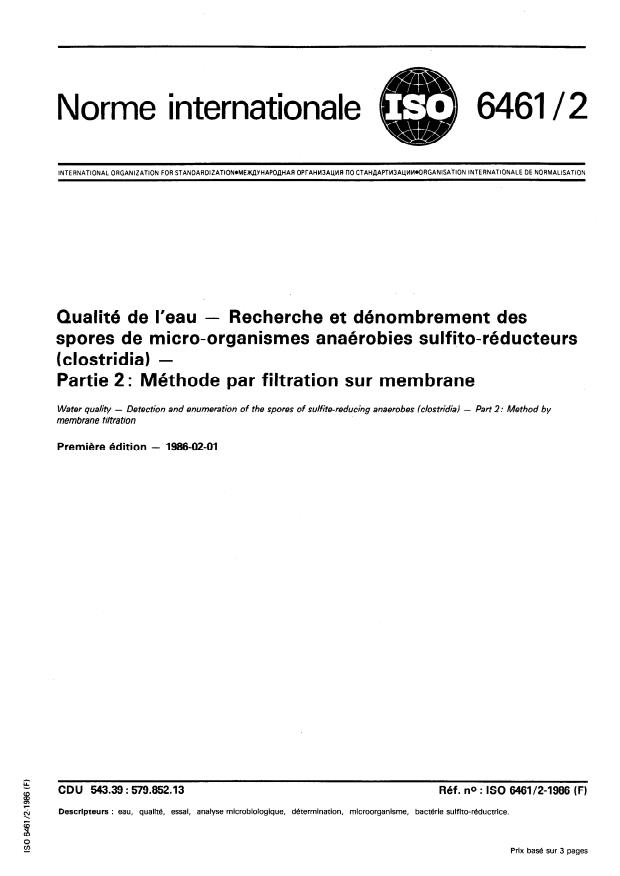
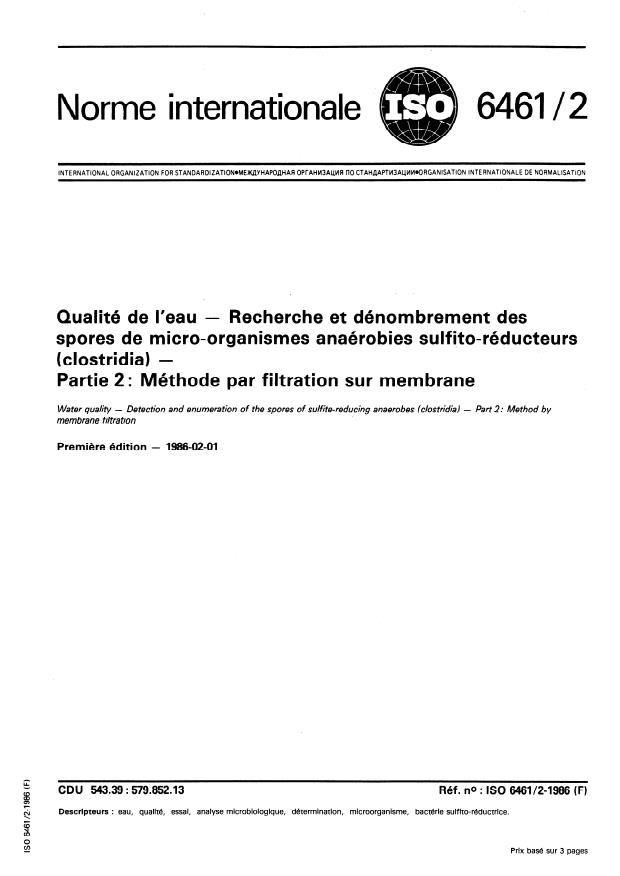
Qualité de l'eau — Recherche et dénombrement des spores de micro-organismes anaérobies sulfito-réducteurs (clostridia) — Partie 2: Méthode par filtration sur membrane
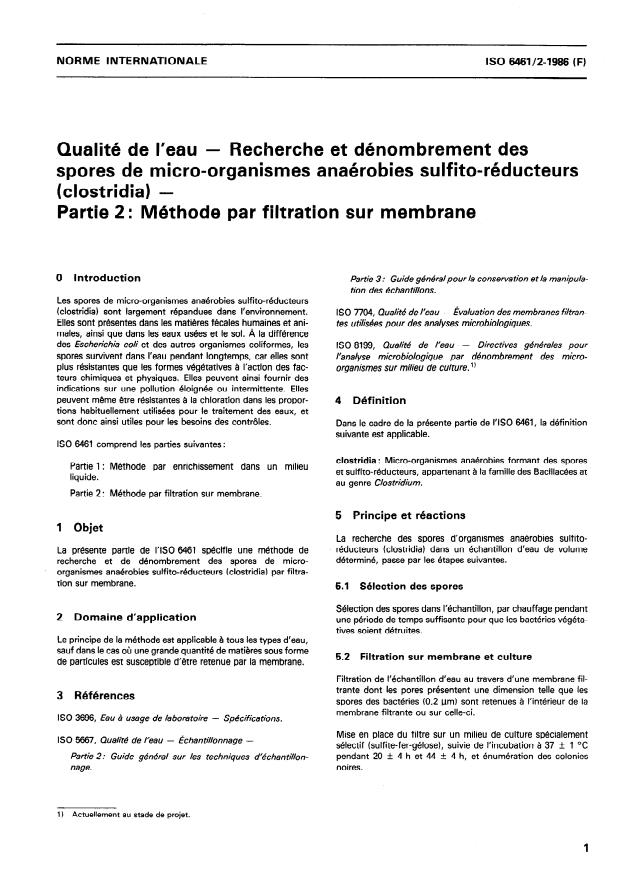
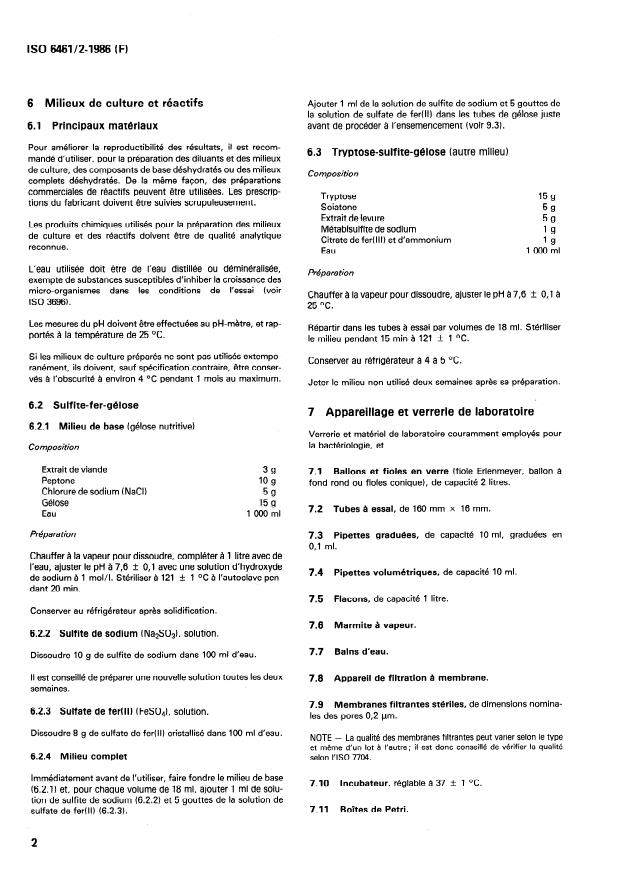
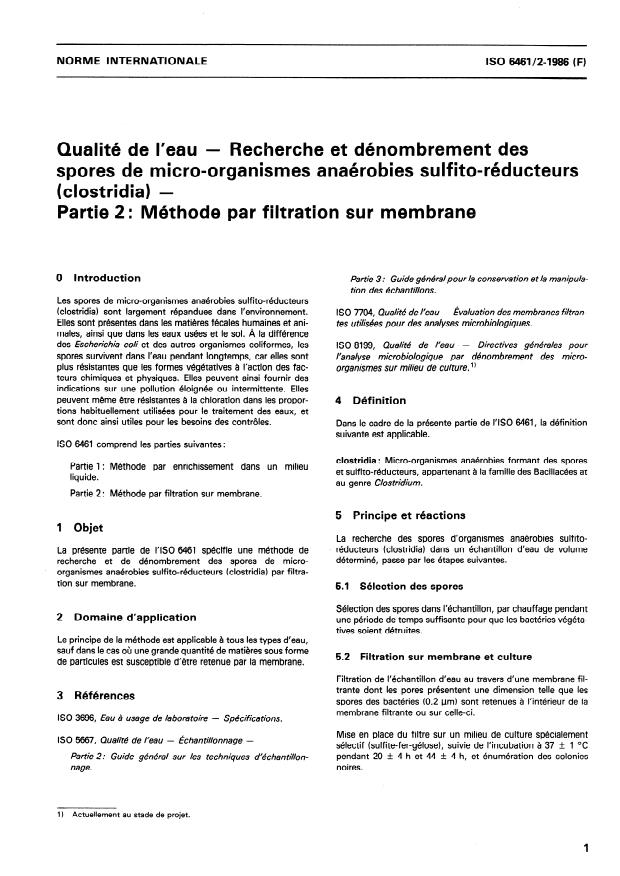
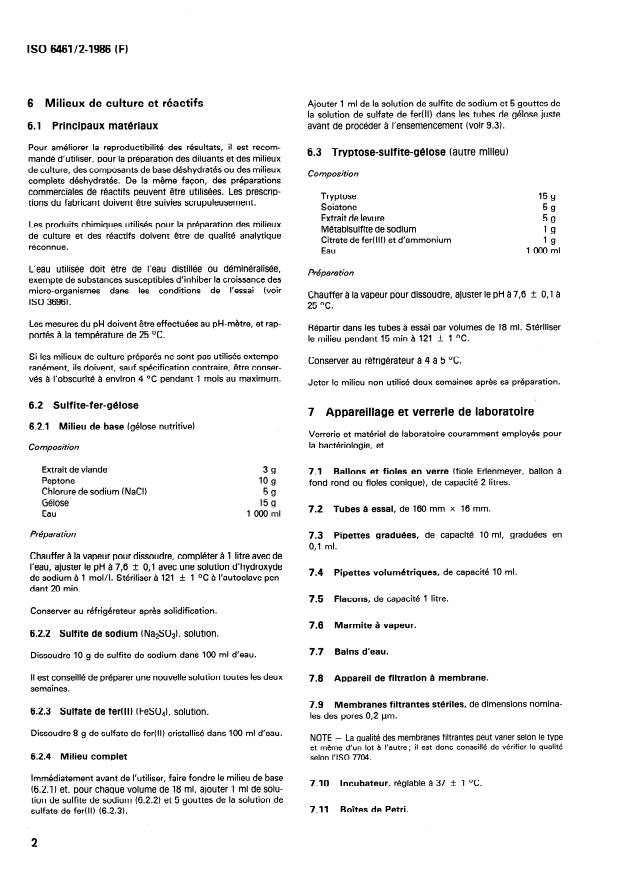
La présente partie de l'ISO 6461 spécifie une méthode de recherche et de dénombrement des spores de microorganismes anaérobies sulfito-réducteurs (clostridia) par filtration sur membrane. Le principe de la méthode est applicable à tous les types d'eau, sauf dans le cas où une grande quantité de matières sous forme de particules est susceptible d'être retenue par la membrane.
General Information
- Status
- Published
- Publication Date
- 05-Feb-1986
- Technical Committee
- ISO/TC 147/SC 4 - Microbiological methods
- Drafting Committee
- ISO/TC 147/SC 4 - Microbiological methods
- Current Stage
- 9092 - International Standard to be revised
- Start Date
- 28-May-2025
- Completion Date
- 14-Feb-2026
Overview
ISO 6461-2:1986 is an international standard developed by the International Organization for Standardization (ISO) that specifies a membrane filtration method for detecting and enumerating spores of sulfite-reducing anaerobes (clostridia) in water. These spores are key microbiological indicators due to their resistance to environmental stress and common water treatment procedures, making them valuable in assessing water quality and possible fecal contamination. The standard applies broadly to various types of water except when excessive particulate material would clog the membrane filter.
This method is designed to provide reliable and reproducible detection of clostridial spores, offering essential support for water quality monitoring and safety assurance.
Key Topics
Scope of Application
Suitable for examining all types of water, including drinking water, surface water, well water, and mineral waters. It excludes samples with high particulate content that could obstruct membrane filtration.Method Principle
- Heat Selection: Samples undergo heat treatment at 75 ± 5°C for 15 minutes to eliminate vegetative bacteria, selecting for heat-resistant spores.
- Membrane Filtration: The heat-treated water is filtered through a membrane with 0.2 µm pore size to retain spores.
- Culturing: The membrane is placed on a selective sulfite-iron agar medium. This medium includes nutrient agar enhanced with sodium sulfite and iron sulfate, promoting growth and visualization of sulfite-reducing clostridia.
- Incubation: Plates are incubated anaerobically at 37 ± 1°C for 20 ± 4 hours and again for 44 ± 4 hours.
- Enumeration: Spores are identified by counting characteristic black colonies formed on the selective medium.
Culture Media and Reagents
- Nutrient agar enriched with sodium sulfite and iron(III) sulfate.
- Alternative media such as tryptose-sulfite-agar may be used.
- Preparation and quality control of media and reagents are critical for consistent results.
Sampling and Reporting
- Sample volumes vary depending on water contamination level, typically 100 ml for low contamination and less for highly polluted water.
- Results are expressed as the number of spores per volume of water, typically referring to the 44-hour incubation count.
- The test report must include method details, sample identification, and any deviations or incidents affecting results.
Applications
Water Quality Monitoring
Detection of spores of sulfite-reducing anaerobes is essential for monitoring microbial contamination, especially in drinking water, groundwater, surface water, and treated wastewater.Public Health and Safety
Clostridial spores serve as indicators of fecal pollution and can help detect remote or intermittent pollution events due to their persistence in the environment.Treatment Efficiency Evaluation
This method assists in evaluating the efficacy of water treatment processes, including chlorination and other disinfection methods, as clostridial spores often resist standard treatments.Environmental Studies
Useful in microbiological studies of aquatic environments to track contamination sources and assess ecosystem health.
Related Standards
ISO 8199: General guidance for microbiological examination of water and enumeration methods for microorganisms on culture media, supporting the interpretation of results from ISO 6461-2.
ISO 5667 series: Guidelines for water sampling techniques (Part 2 and Part 3) ensuring representative sample collection and preservation for microbiological analysis.
ISO 3696: Specifications for water used in laboratory testing, ensuring reagent and medium preparation does not interfere with microbial growth.
ISO 7704: Evaluation and quality control of membrane filters used for microbiological analysis, crucial for reliable spore retention.
This standardized membrane filtration method facilitates accurate, reproducible detection and quantification of sulfite-reducing anaerobe spores in water, supporting comprehensive water quality control programs worldwide. It integrates rigorous sampling, heat treatment, selective culturing, and incubation techniques tailored for microbial water analysis professionals, environmental labs, and regulatory authorities focused on microbiological safety of water resources.
Buy Documents
ISO 6461-2:1986 - Water quality -- Detection and enumeration of the spores of sulfite-reducing anaerobes (clostridia)
ISO 6461-2:1986 - Qualité de l'eau -- Recherche et dénombrement des spores de micro-organismes anaérobies sulfito-réducteurs (clostridia)
ISO 6461-2:1986 - Qualité de l'eau -- Recherche et dénombrement des spores de micro-organismes anaérobies sulfito-réducteurs (clostridia)
Frequently Asked Questions
ISO 6461-2:1986 is a standard published by the International Organization for Standardization (ISO). Its full title is "Water quality — Detection and enumeration of the spores of sulfite-reducing anaerobes (clostridia) — Part 2: Method by membrane filtration". This standard covers: The procedure is applicable to all types of water, except when a large amount of particulate material is liable to be retained by the membrane. The principle covers several steps from selection by applying heat to destroy vegetative bacteria to filtration of the water sample through a membrane filter having a suitable pore size (0,2 µm) to retain the spores in or on it. The filter is placed on a selective culture medium, followed by incubation and counting of black colonies.
The procedure is applicable to all types of water, except when a large amount of particulate material is liable to be retained by the membrane. The principle covers several steps from selection by applying heat to destroy vegetative bacteria to filtration of the water sample through a membrane filter having a suitable pore size (0,2 µm) to retain the spores in or on it. The filter is placed on a selective culture medium, followed by incubation and counting of black colonies.
ISO 6461-2:1986 is classified under the following ICS (International Classification for Standards) categories: 07.100.20 - Microbiology of water. The ICS classification helps identify the subject area and facilitates finding related standards.
ISO 6461-2:1986 is available in PDF format for immediate download after purchase. The document can be added to your cart and obtained through the secure checkout process. Digital delivery ensures instant access to the complete standard document.
Standards Content (Sample)
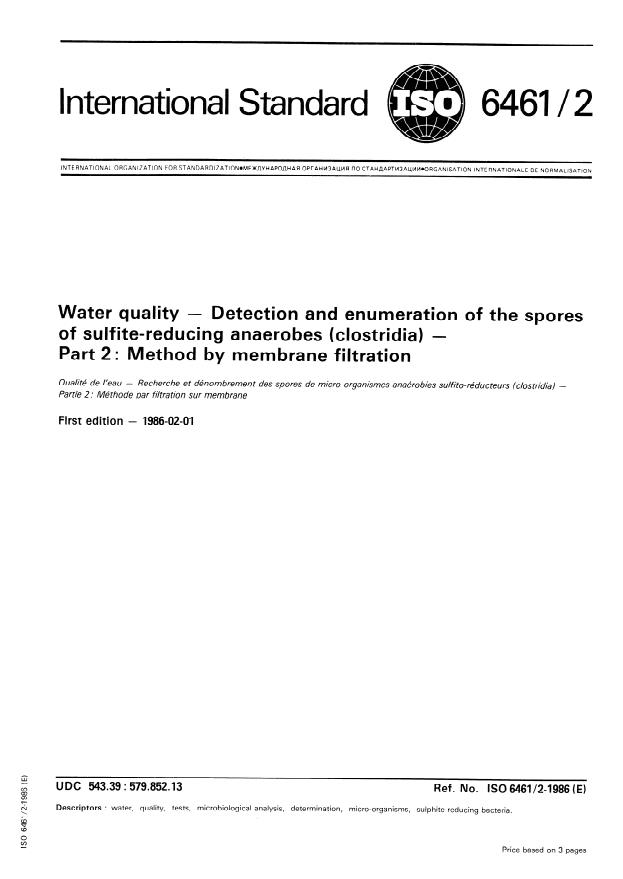
International Standard 646112
INTERNATIONAL ORGANIZATION FOR STANDARDIZATlON.MEX~YHAPO~HAR OPrAHkl3At.&lR l-l0 CTAHAAPTM3AlJklt4~0RGANISATION INTERNATIONALE DE NORMALISATION
Water quality - Detection and enumeration of the spores
of sulfite-reducing anaerobes (clostridia) -
Part 2: Method by membrane filtration
Qua&@ de l’eau - Recherche et dhombrement des spores de micro-organismes anaerobies sulfito-rgducteurs (clostridia) _
Partie 2 : tI& thode par filtra tion sur membrane
First edition - 1986-02-01
UDC 543.39 : 579.852.13
Ref. No. ISO 6461/2-1986 (E)
Descriptors : water, quality, tests, microbiological analysis, determination, micro-organisms, sulphite reducing bacteria.
Price based on 3 pages
Foreword
ISO (the International Organkation for Standardization) is a worldwide federation of
national Standards bodies (ISO member bedies). The work of preparing International
Standards is normally carried out through ISO technical committees. Esch member
body interested in a subject for which a technical committee has been established has
the right to be represented on that committee. International organizations, govern-
mental and non-governmental, in liaison with ISO, also take part in the work.
Draft International Standards adopted by the technical committees are circulated to
the member bodies for approval before their acceptance as International Standards by
the ISO Council. They are approved in accordance with ISO procedures requiring at
least 75 % approval by the member bodies voting.
International Standard ISO 6461/2 was prepared by Technical Committee
ISO/TC 147, Water quality.
Users should note that all International Standards undergo revision from time to time
and that any reference made herein to any other International Standard implies its
latest edition, unless otherwise stated.
International Organkation for Standardkation, 1986
Printed in Switzerland
ISO 6461/2-1986 (EI
INTERNATIONAL STANDARD
Detection and enumeration of the spores
Water quality -
of sulfite-reducing anaerobes (clostridia) -
Part 2: Method by membrane filtration
Water quality - General guidance for
ISO 8199,
0 Introduction
by enumeration of micro-
microbiological examina tion
organisms on culture media. ’ )
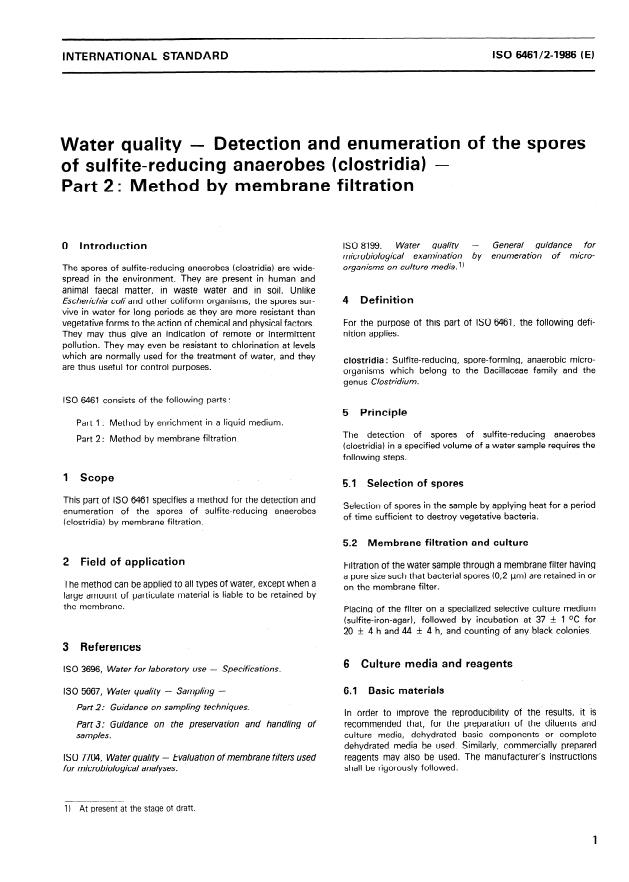
The spores of sulfite-reducing anaerobes (clostridia) are wide-
spread in the environment. They are present in human and
animal faecal matter, in waste water and in soil. Unlike
Escherichia col; and other coliform organisms, the spores sur- 4 Definition
vive in water for long periods as they are more resistant than
For the purpose of this part of ISO 6461, the following defi-
vegetative forms to the action of Chemical and physical factors.
They may thus give an indication of remote OF intermittent nition applies.
pollution. They may even be resistant to chlorination at levels
which are normally used for the treatment sf water, and they
clostridia : Sulfite-reducing, Spore-forming, anaerobic micro-
are thus useful for control purposes.
organisms which belong to the Bacillaceae family and the
genus Clostridium.
ISO 6461 consists of the following Parts:
5 Principle
Part 1 : Method by enrichment in a liquid medium.
anaerobes
The detection of spores of sulfite-reducing
Part 2: Method by membrane filtration.
requires the
(clostridia) in a specified volume of a water Sample
following Steps.
1 Scope
5.1 Selection of spores
This part of ISO 6461 specifies a method for the detection and
Selection of spores in the Sample by applying heat for a period
enumeration of the spores of sulfite-reducing anaerobes
of time sufficient to destroy vegetative ba’cteria.
(clostridia) by membrane filtration.
5.2 Membrane filtration and culture
2 Field of application
Filtration of the water Sample through a membrane filter having
a pore size such that bacterial spores (0,2 Pm) are retained in or
The method tan be applied to all types of water, except when a
on the membrane filter.
large amount of particulate material is liable to be retained by
the membrane.
Placing of the filter on a specialized selective culture medium
(sulfite-iron-agar), followed by incubation at 37 + 1 OC for
20 + 4 h and 44 r_t 4 h, and counting of any black colonies.
3 References
6 Culture media and reagents
ISO 3696, Water for laboratory use - Specifications.
ISO 5667, Water quality - Sampling - 6.1 Basic materials
Part 2: Guidance on sampling techniques.
In Order to improve the reproducibility of the results, it is
recommended that, for the preparation of the diluents and
Part 3: Guidance on the preservation and handling of
samples. culture media, dehydrated basic components or complete
dehydrated media be used. Similarly, commercially prepared
IS 0 7704, Water quality - Evaluation of membrane filters used reagents may also be used. The manufacturer’s instructions
for microbiological analyses. shall be rigorously followed.
~~~
1) At present at the Stage of draft.
ISO 6461/2-1986 (EI
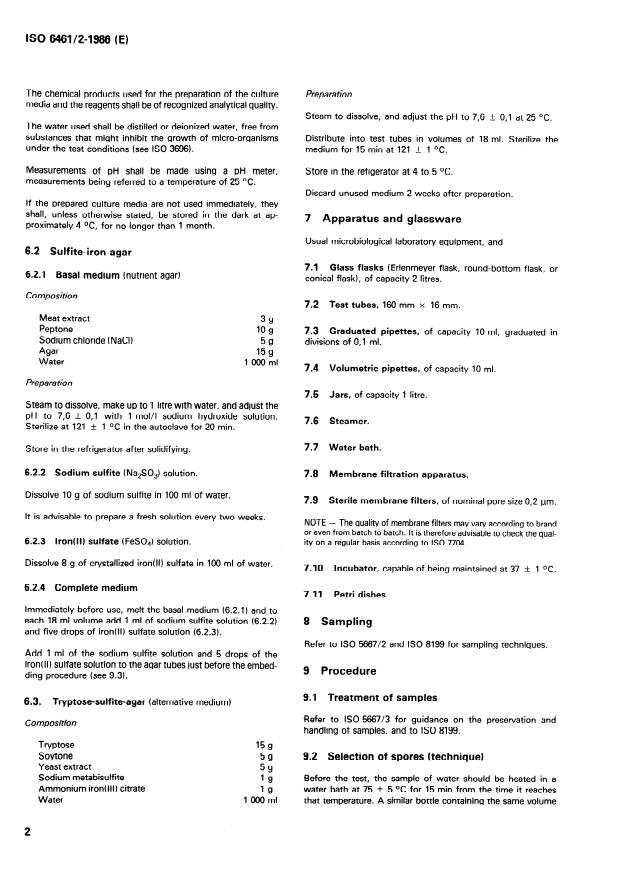
The Chemical culture Prepara tion
products used for the preparation of the
quality.
media and the reagents shall be of recognized analytical
Steam to dissolve, and adjust the pH to 7,6 rt: 0,l at 25 OC.
The water used shall be distilled or deionized water, free from
Distribute into test tubes in volumes of 18 ml. Sterilize the
substances that might
...
Norme internationale 646112
INTERNATIONAL ORGANIZATION FOR STANDARDIZATIONWVlE))(L1YHAPO~HAR OPfAHM3Al.lMFl Il0 CTAH~APTI43AL&lM.ORGANISA?ION INTERNATIONALE DE NORMALISATION
Qualité de l’eau - Recherche et dénombrement des
spores de micro-organismes anaérobies sulfito-réducteurs
(clostridia) -
Partie 2: Méthode par filtration sur membrane
Water quality - Detection and enumeration of tbe spores of sulfite-reducing anaerobes (clostridia) - Part 2: Method b y
membrane filtration
Première édition - 1986-02-01
Réf. no : ISO 6461/2-1986 (F)
CDU 543.39 : 579.852.13
Descripteurs : eau, qualité, essai, analyse microbiologique, détermination, microorganisme, bactérie sulfito-réductrice.
Prix basé sur 3 pages
Avant-propos
L’ISO (Organisation internationale de normalisation) est une fédération mondiale
d’organismes nationaux de normalisation (comités membres de I’ISO). L’élaboration
des Normes internationales est confiée aux comités techniques de I’ISO. Chaque
comité membre intéressé par une étude a le droit de faire partie du comité technique
créé à cet effet. Les organisations internationales, gouvernementales et non gouverne-
mentales, en liaison avec I’ISO participent également aux travaux.
Les projets de Normes internationales adoptés par les comités techniques sont soumis
aux comités membres pour approbation, avant leur acceptation comme Normes inter-
nationales par le Conseil de I’ISO. Les Normes internationales sont approuvées confor-
mément aux procédures de I’ISO qui requièrent l’approbation de 75 % au moins des
comités membres votants.
La Norme internationale ISO 6461/2 a été élaborée par le comité technique
ISO/TC 147, Qualité de l’eau. ’
L’attention des utilisateurs est attirée sur le fait que toutes les Normes internationales
sont de temps en temps soumises à révision et que toute référence faite à une autre
Norme internationale dans le présent document implique qu’il s’agit, sauf indication
contraire, de la dernière édition.
0 Organisation internationale de normalisation, 1986
Imprimé en Suisse
NORME INTERNATIONALE ISO 6461/2-1986 (F)
Recherche et dénombrement des
Qualité de l’eau -
spores de micro-organismes anaérobies sulfito-réducteurs
(clostridia) -
Partie 2: Méthode par filtration sur membrane
0 Introduction Partie 3 : Guide général pour la conservation et la manipula-
tion des échantillons.
Les spores de micro-organismes ana’érobies sulfito-réducteurs
(clostridia) sont largement répandues dans l’environnement. Évaluation des membranes filtran-
ISO 7794, @alite de l’eau -
Elles sont présentes dans les matiéres fécales humaines et ani- tes utilisees pour des analyses microbiologiques.
males, ainsi que dans les eaux usées et le sol. À la différence
des Escherichia coli et des autres organismes coliformes, les ISO 8199, Qualité de l’eau - Directives générales pour
spores survivent dans l’eau pendant longtemps, car elles sont l’analyse microbiologique par dénombrement des micro-
plus résistantes que les formes végétatives à l’action des fac-
organismes sur milieu de culture. ‘)
teurs chimiques et physiques. Elles peuvent ainsi fournir des
indications sur une pollution éloignée ou intermittente. Elles
peuvent même être résistantes à la chloration dans les propor-
4 Définition
tions habituellement utilisées pour le traitement des eaux, et
sont donc ainsi utiles pour les besoins des contrôles.
Dans le cadre de la présente partie de I’ISO 6461, la définition
suivante est applicable.
ISO 6461 comprend les parties suivantes:
clostridia : Micro-organismes anaérobies formant des spores
Partie 1 : Méthode par enrichissement dans un milieu
et sulfito-réducteurs, appartenant à la famille des Bacillacées at
liquide.
au genre Clostridium.
Partie 2: Méthode par filtration sur membrane.
5 Principe et réactions
1 Objet
La recherche des spores d’organismes anaérobies sulfito-
réducteurs (clostridia) dans un échantillon d’eau de volume
La présente partie de I’ISO 6461 spécifie une méthode de
déterminé, passe par les étapes suivantes.
recherche et de dénombrement des spores de micro-
organismes anaérobies sulfito-réducteurs klostridia) par filtra-
tion sur membrane.
5.1 Sélection des spores
Sélection des spores dans l’échantillon, par chauffage pendant
2 Domaine d’application
une période de temps suffisante pour que les bactéries végéta-
tives soient détruites.
Le principe de la méthode est applicable à tous les types d’eau,
sauf dans le cas où une grande quantité de matières sous forme
5.2 Filtration sur membrane et culture
de particules est susceptible d’être retenue par la membrane.
Filtration de l’échantillon d’eau au travers d’une membrane fil-
trante dont les pores présentent une dimension telle que les
3 Références
spores des bactéries (0,2 prn) sont retenues à l’intérieur de la
membrane filtrante ou sur celle-ci.
ISO 3696, Eau à usage de laboratoire - Spécifications.
Mise en place du filtre sur un milieu de culture spécialement
ISO 5667, Qualite de l’eau - icbantillonnage -
sélectif (sulfite-fer-gélose), suivie de l’incubation à 37 + 1 OC
Partie 2: Guide général sur les techniques d’échantillon- pendant 20 -t 4 h et 44 + 4 h, et énumération des colonies
noires.
nage.
1) Actuellement au stade de projet.
ISO 6461/2-1986 (FI
6 Milieux de culture et réactifs Ajouter 1 ml de la solution de sulfite de sodium et 5 gouttes de
la solution de sulfate de fer(ll) dans les tubes de gélose juste
6.1 Principaux matériaux avant de procéder à l’ensemencement (voir 9.3).
Pour améliorer la reproductibilité des résultats, il est recom-
6.3 Tryptose-sulfite-gélose (autre milieu)
mandé d’utiliser, pour la préparation des diluants et des milieux
de culture, des composants de base déshydratés ou des milieux
Composition
complets déshydratés. De la même facon, des préparations
commerciales de réactifs peuvent être utilisées. Les prescrip-
Tryptose
15g
tions du fabricant doivent être suivies scrupuleusement.
Soiatone
QI
Extrait de levure
5g
Les produits chimiques utilisés pour la préparation des milieux
Métabisulfite de sodium
lg
de culture et des réactifs doivent être de qualit
...
Norme internationale 646112
INTERNATIONAL ORGANIZATION FOR STANDARDIZATIONWVlE))(L1YHAPO~HAR OPfAHM3Al.lMFl Il0 CTAH~APTI43AL&lM.ORGANISA?ION INTERNATIONALE DE NORMALISATION
Qualité de l’eau - Recherche et dénombrement des
spores de micro-organismes anaérobies sulfito-réducteurs
(clostridia) -
Partie 2: Méthode par filtration sur membrane
Water quality - Detection and enumeration of tbe spores of sulfite-reducing anaerobes (clostridia) - Part 2: Method b y
membrane filtration
Première édition - 1986-02-01
Réf. no : ISO 6461/2-1986 (F)
CDU 543.39 : 579.852.13
Descripteurs : eau, qualité, essai, analyse microbiologique, détermination, microorganisme, bactérie sulfito-réductrice.
Prix basé sur 3 pages
Avant-propos
L’ISO (Organisation internationale de normalisation) est une fédération mondiale
d’organismes nationaux de normalisation (comités membres de I’ISO). L’élaboration
des Normes internationales est confiée aux comités techniques de I’ISO. Chaque
comité membre intéressé par une étude a le droit de faire partie du comité technique
créé à cet effet. Les organisations internationales, gouvernementales et non gouverne-
mentales, en liaison avec I’ISO participent également aux travaux.
Les projets de Normes internationales adoptés par les comités techniques sont soumis
aux comités membres pour approbation, avant leur acceptation comme Normes inter-
nationales par le Conseil de I’ISO. Les Normes internationales sont approuvées confor-
mément aux procédures de I’ISO qui requièrent l’approbation de 75 % au moins des
comités membres votants.
La Norme internationale ISO 6461/2 a été élaborée par le comité technique
ISO/TC 147, Qualité de l’eau. ’
L’attention des utilisateurs est attirée sur le fait que toutes les Normes internationales
sont de temps en temps soumises à révision et que toute référence faite à une autre
Norme internationale dans le présent document implique qu’il s’agit, sauf indication
contraire, de la dernière édition.
0 Organisation internationale de normalisation, 1986
Imprimé en Suisse
NORME INTERNATIONALE ISO 6461/2-1986 (F)
Recherche et dénombrement des
Qualité de l’eau -
spores de micro-organismes anaérobies sulfito-réducteurs
(clostridia) -
Partie 2: Méthode par filtration sur membrane
0 Introduction Partie 3 : Guide général pour la conservation et la manipula-
tion des échantillons.
Les spores de micro-organismes ana’érobies sulfito-réducteurs
(clostridia) sont largement répandues dans l’environnement. Évaluation des membranes filtran-
ISO 7794, @alite de l’eau -
Elles sont présentes dans les matiéres fécales humaines et ani- tes utilisees pour des analyses microbiologiques.
males, ainsi que dans les eaux usées et le sol. À la différence
des Escherichia coli et des autres organismes coliformes, les ISO 8199, Qualité de l’eau - Directives générales pour
spores survivent dans l’eau pendant longtemps, car elles sont l’analyse microbiologique par dénombrement des micro-
plus résistantes que les formes végétatives à l’action des fac-
organismes sur milieu de culture. ‘)
teurs chimiques et physiques. Elles peuvent ainsi fournir des
indications sur une pollution éloignée ou intermittente. Elles
peuvent même être résistantes à la chloration dans les propor-
4 Définition
tions habituellement utilisées pour le traitement des eaux, et
sont donc ainsi utiles pour les besoins des contrôles.
Dans le cadre de la présente partie de I’ISO 6461, la définition
suivante est applicable.
ISO 6461 comprend les parties suivantes:
clostridia : Micro-organismes anaérobies formant des spores
Partie 1 : Méthode par enrichissement dans un milieu
et sulfito-réducteurs, appartenant à la famille des Bacillacées at
liquide.
au genre Clostridium.
Partie 2: Méthode par filtration sur membrane.
5 Principe et réactions
1 Objet
La recherche des spores d’organismes anaérobies sulfito-
réducteurs (clostridia) dans un échantillon d’eau de volume
La présente partie de I’ISO 6461 spécifie une méthode de
déterminé, passe par les étapes suivantes.
recherche et de dénombrement des spores de micro-
organismes anaérobies sulfito-réducteurs klostridia) par filtra-
tion sur membrane.
5.1 Sélection des spores
Sélection des spores dans l’échantillon, par chauffage pendant
2 Domaine d’application
une période de temps suffisante pour que les bactéries végéta-
tives soient détruites.
Le principe de la méthode est applicable à tous les types d’eau,
sauf dans le cas où une grande quantité de matières sous forme
5.2 Filtration sur membrane et culture
de particules est susceptible d’être retenue par la membrane.
Filtration de l’échantillon d’eau au travers d’une membrane fil-
trante dont les pores présentent une dimension telle que les
3 Références
spores des bactéries (0,2 prn) sont retenues à l’intérieur de la
membrane filtrante ou sur celle-ci.
ISO 3696, Eau à usage de laboratoire - Spécifications.
Mise en place du filtre sur un milieu de culture spécialement
ISO 5667, Qualite de l’eau - icbantillonnage -
sélectif (sulfite-fer-gélose), suivie de l’incubation à 37 + 1 OC
Partie 2: Guide général sur les techniques d’échantillon- pendant 20 -t 4 h et 44 + 4 h, et énumération des colonies
noires.
nage.
1) Actuellement au stade de projet.
ISO 6461/2-1986 (FI
6 Milieux de culture et réactifs Ajouter 1 ml de la solution de sulfite de sodium et 5 gouttes de
la solution de sulfate de fer(ll) dans les tubes de gélose juste
6.1 Principaux matériaux avant de procéder à l’ensemencement (voir 9.3).
Pour améliorer la reproductibilité des résultats, il est recom-
6.3 Tryptose-sulfite-gélose (autre milieu)
mandé d’utiliser, pour la préparation des diluants et des milieux
de culture, des composants de base déshydratés ou des milieux
Composition
complets déshydratés. De la même facon, des préparations
commerciales de réactifs peuvent être utilisées. Les prescrip-
Tryptose
15g
tions du fabricant doivent être suivies scrupuleusement.
Soiatone
QI
Extrait de levure
5g
Les produits chimiques utilisés pour la préparation des milieux
Métabisulfite de sodium
lg
de culture et des réactifs doivent être de qualit
...
Questions, Comments and Discussion
Ask us and Technical Secretary will try to provide an answer. You can facilitate discussion about the standard in here.
Loading comments...