


ISO 1780:1975
(Main)Cinematography — Motion-picture camera cartridge, 8 mm Type S, Model I — Aperture opening, pressure pad and film load — Positions and dimensions
Cinematography — Motion-picture camera cartridge, 8 mm Type S, Model I — Aperture opening, pressure pad and film load — Positions and dimensions
Cinématographie — Chargeur modèle I pour caméra 8 mm type S — Fenêtre, presseur et chargement du film — Positions et dimensions
General Information
- Status
- Withdrawn
- Publication Date
- 30-Nov-1975
- Withdrawal Date
- 30-Nov-1975
- Technical Committee
- ISO/TC 36 - Cinematography
- Drafting Committee
- ISO/TC 36 - Cinematography
- Current Stage
- 9599 - Withdrawal of International Standard
- Start Date
- 01-Nov-1984
- Completion Date
- 14-Feb-2026
Relations
- Effective Date
- 15-Apr-2008
Buy Documents
ISO 1780:1975 - Cinematography -- Motion-picture camera cartridge, 8 mm Type S, Model I -- Aperture opening, pressure pad and film load -- Positions and dimensions
ISO 1780:1975 - Cinematography — Motion-picture camera cartridge, 8 mm Type S, Model I — Aperture opening, pressure pad and film load — Positions and dimensions Released:12/1/1975
Frequently Asked Questions
ISO 1780:1975 is a standard published by the International Organization for Standardization (ISO). Its full title is "Cinematography — Motion-picture camera cartridge, 8 mm Type S, Model I — Aperture opening, pressure pad and film load — Positions and dimensions". This standard covers: Cinematography — Motion-picture camera cartridge, 8 mm Type S, Model I — Aperture opening, pressure pad and film load — Positions and dimensions
Cinematography — Motion-picture camera cartridge, 8 mm Type S, Model I — Aperture opening, pressure pad and film load — Positions and dimensions
ISO 1780:1975 is classified under the following ICS (International Classification for Standards) categories: 37.060.20 - Motion picture films. Cartridges. The ICS classification helps identify the subject area and facilitates finding related standards.
ISO 1780:1975 has the following relationships with other standards: It is inter standard links to ISO 1780:1984. Understanding these relationships helps ensure you are using the most current and applicable version of the standard.
ISO 1780:1975 is available in PDF format for immediate download after purchase. The document can be added to your cart and obtained through the secure checkout process. Digital delivery ensures instant access to the complete standard document.
Standards Content (Sample)
-\
INTERNATIONAL STANDARD @ 1780
'*=e
INTERNATIONAL ORGANIZATION FOR SlANDARDIZAlION .\ll A 1) tI.IPOIti".I( OPr 4HI134UMR 110 CTAH3APTb13AUWU .ORGANISATION INTERNATIONALE DE NORMALISATION
Cinematography - Motion-picture camera cartridge,
v
8 mm Type S, Model I - Aperture opening, pressure
pad and film load - Positions and dimensions
Cinématographie -- Chargeur modèle I pour caméra 8 mm type S - Fenêtre, presseur et chargement
du film - Positions et dimensions
First edition - 1975-12-01
w
I
UDC 771.531.352 : 778.533.4 Ref. No. IS0 1780-1975 (E)
U)
-
t-
z
Descriptors : cinematography, motion-picture cameras, motion-picture film 8 mm, packs, aperture (optics), specifications, layout, position
O
(location), dimensions, loading.
m
b
F
Price based on 5 pages
FOREWORD
IS0 (the International Organization for Standardization) is a worldwide federation
of national standards institutes (IS0 Member Bodies). The work of developing
International Standards is carried out through IS0 Technical Committees. Every
Member Body interested in a subject for which a Technical Committee has been set
up has the right to be represented on that Committee. International organizations,
governmental and non-governmental, in liaison with ISO, also take part in the work.
Draft International Standards adopted by the Technical Committees are circulated
to the Member Bodies for approval before their acceptance as International
Standards by the IS0 Council.
International Standard IS0 1780 was drawn up by Technical Committee
ISO/TC 36, Cinematography, and circulated to the Member Bodies in
February 1975.
It has been approved by the Member Bodies of the following countries :
Austria Italy Turkey
Belgium Japan United Kingdom
Canada Romania U.S.A.
Czechoslovakia South Africa, Rep. of U.S.S.R.
Denmark Spain Yugoslavia
France Sweden
Germany Switzerland
No Member Body expressed disapproval of the document.
O International Organization for Standardization, 1975
Printed in Switzerland
IS0 1780-1975(E)
INTERNATIONAL STANDARD
Cinematography - Motion-picture camera cartridge,
8 mm Type S, Model I - Aperture opening, pressure
pad and film load - Positions and dimensions
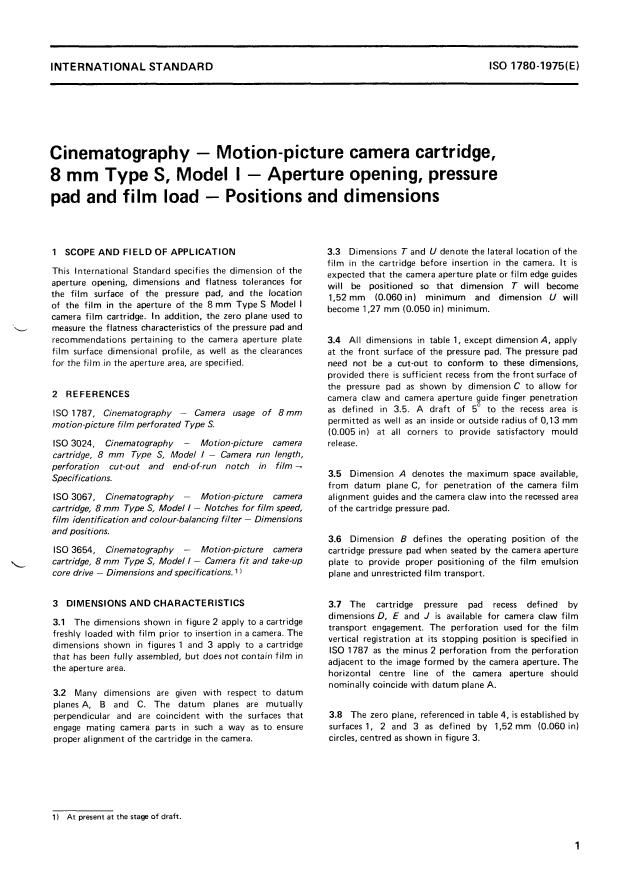
1 3.3 Dimensions T and U denote the lateral location of the
SCOPE AND FIELD OF APPLICATION
film in the cartridge before insertion in the camera. It is
This International Standard specifies the dimension of the
expected that the camera aperture plate or film edge guides
aperture opening, dimensions and flatness tolerances for
will be positioned so that dimension T will become
the film surface of the pressure pad, and the location
1.52 mm (0.060 in) minimum and dimension U will
of the film in the aperture of the 8mm Types Model I
become 1.27 mm (0.050 in) minimum.
camera film cartridge. In addition, the zero plane used to
'L measure the flatness characteristics of the pressure pad and
recommendations pertaining to the camera aperture plate
3.4 All dimensions in table 1, except dimension A, apply
film surface dimensional profile, as well as the clearances at the front surface of the pressure pad. The pressure pad
for the film in the aperture area, are specified. need not be a cut-out to conform to these dimensions,
provided there is sufficient recess from the front surface of
as shown by dimension C to allow for
the pressure pad
2 REFERENCES
camera claw and camera aperture guide finger penetration
as defined in 3.5. A draft of 5" to the recess area is
IS0 1787, Cinematography - Camera usage of 8mm
permitted as well as an inside or outside radius of 0,13 mm
motion-picture film perforated Type S.
(0.005 in) at all corners to provide satisfactory mould
IS0 3024, Cinematography - Motion-picture camera release.
cartridge, 8 mm Type S, Model I - Camera run length,
perforation cut-out and end-of-run notch in film -
3.5 Dimension A denotes the maximum space available,
Specifications.
from datum plane C, for penetration of the camera film
IS0 3067, Cinematography - Motion-picture camera
alignment guides and the camera claw into the recessed area
cartridge, 8 mm Type S, Model I - Notches for film speed, of the cartridge pressure pad.
film identification and colour-balancing filter - Dimensions
and positions.
3.6 Dimension B defines the operating position of the
I SO 3654, Cinematograph y - Motion-picture camera
cartridge pressure pad when seated by the camera aperture
cartridge, 8 mm Type S, Model I - Camera fit and take-up
plate to provide proper positioning of the film emulsion
core drive - Dimensions and specifications. 1
plane and unrestricted film transport.
3 DIMENSIONS AND CHARACTERISTICS
3.7 The cartridge pressure pad recess defined by
dimensions D, E and J is available for camera claw film
3.1 The dimensions shown in figure 2 apply to a cartridge
transport engagement. The perforation used for the film
freshly loaded with film prior to insertion in a camera. The
vertical registration at its stopping position is specified in
dimensions shown in figures 1 and 3 apply to a cartridge
IS0 1787 as the minus 2 perforation from the perforation
that has been fully assembled, but does not contain film in
adjacent to the image formed by the camera aperture. The
the aperture area.
horizontal centre line of the camera aperture should
nominally coincide with datum plane A.
3.2 Many dimensions are given with respect to datum
planes A, B and C. The datum planes are mutually
3.8 The zero plane, referenced in table 4, is established by
perpendicular and are coincident with the surfaces that
engage
...
36 r
@ 1780
NORME INTERNATIONALE
kg!!
INTERNATIONAL ORGANIZATION FOR STANDARDIZATION .ML A,7k H4POLIHAII <>PI AHl13AUIII Il0
Cinématographie - Chargeur modèle I pour caméra
L
8 mm type S - Fenêtre, presseur et chargement du
- Positions et dimensions
film
Cinematography - Motion-picture camera cartridge, 8 rnm Type S, Model I - Aperture opening,
pressure pad and film load - Positions and dimensions
Première édition - 1975-12-01
~~
CDU 771.531.352 : 778.533.4 Réf. no : IS0 1780-1975 (F)
Descripteurs : cinématographie, caméra cinématographique, film cinématographique 8 mm, chargeur, ouverture (optique), spécification,
disposition, position (emplacement), dimension, chargement.
Prix basé sur 5 pages
AVANT-PROPOS
LIS0 (Organisation Internationale de Normalisation) est une fédération mondiale
ISO). L'élaboration de
d'organismes nationaux de normalisation (Comités Membres
Normes Internationales est confiée aux Comités Techniques ISO. Chaque Comité
Membre intéressé par une étude a le droit de faire partie du Comité Technique
correspondant. Les organisations internationales, gouvernementales et non
gouvernementales, en liaison avec I'ISO, participent également aux travaux.
Les Projets de Normes Internationales adoptés par les Comités Techniques sont
soumis aux Comités Membres pour approbation, avant leur acceptation comme
Normes Internationales par le Conseil de I'ISO.
La Norme Internationale IS0 1780 a été établie par le Comité Technique
ISO/TC 36, Cinématographie, et soumise aux Comités Membres en février 1975.
Elle a été approuvée par les Comités Membres des pays suivants :
Afrique du Sud, Rép. d' France Tchécoslovaquie
Allemagne Italie Turquie
Autriche Japon U. R .S .S.
Belgique Roumanie U.S.A.
Canada Royaume-Uni Yougoslavie
Danemark Suède
Espagne Suisse
Aucun Comité Membre n'a désapprouvé le document.
O Organisation Internationale de Normalisation, 1975 0
Imprimé en Suisse
~
IS0 1780-1975( F)
NORME INTERNATIONALE
Cinématographie - Chargeur modèle I pour caméra
8 mm type S - Fenêtre, presseur et chargement du
film - Positions et dimensions
1 OBJET ET DOMAINE D'APPLICATION 3.3 Les cotes Tet U définissent la position latérale du film
dans le chargeur avant son introduction dans la caméra. La
La présente Norme Internationale spécifie, pour le chargeur
platine de la fenêtre de caméra ou les guides latéraux sont
modèle I pour caméra 8 mm type S, les dimensions de la
supposés être dans des positions telles que la cote T mesure
fenêtre, les dimensions et les tolérances de planéité de la
1,52 mm (0,060 in) minimum et la cote U, 1.27 mm
surface du presseur en contact avec le film et la position du
(0,050 in) minimum.
film dans la fenêtre. De plus, y sont indiqués le plan de
référence utilisé pour mesurer la planéité du presseur et des
L
3.4 Toutes les dimensions du tableau 1, sauf la cote A,
recommandations concernant le profil et les dimensions de
s'appliquent à la surface frontale du presseur. Le presseur
la platine de la fenêtre de caméra, ainsi que l'espace libre
n'a pas besoin d'être échancré pour tenir compte de ces
réservé au film dans ce couloir.
dimensions si sa surface présente un retrait suffisant,
indiqué par la cote C, pour permettre à la pénétration de la
griffe d'entraînement de la caméra et de son doigt guide, tel
2 RÉFÉRENCES
que défini en 3.5. Afin de faciliter le démoulage, on
autorise une pente de 5" vers la partie en retrait, ainsi qu'un
IS0 1787, Cinématographie - Position du film 8 mm
rayon de 0,13 mm (0,005 in) externe ou interne pour tous
S, dans le couloir de la caméra.
perforé type
les angles.
IS0 3024, Cinématographie - Chargeur, modèle I, pour
caméra 8mm type S- Longueur de film entraînée,
3.5 La cote A définit l'espace disponible maximal, mesuré
encoche d'élimination de perforations et encoche de fin de
à partir du plan de référence C, pour la pénétration des
prises de vues - Spécifications.
guides latéraux de centrage du film et de la griffe
d'entraînement de la caméra dans la zone en retrait du
IS0 3067, Cinématographie - Chargeur, modèle I, pour
presseur du chargeur.
caméra 8mm types- Encoches de sensibilité et
d'identification du film, et filtres de compensation de
3.6 La cote B définit la position de fonctionnement du
couleur - Dimensions et positions.
presseur du chargeur lorsqu'il est mis en place par appui sur
IS0 3654, Cinématographie - Chargeur, modèle I, pour
la platine de la fenêtre de caméra afin d'assurer une position
caméra 8mm types- Ajustement du chargeur et
L correcte du plan de l'émulsion du film et de ne pas entraver
entraînement du noyau récepteur - Dimensions et
le défilement du film.
spécifications. 1
3.7 L'encoche latérale du presseur du chargeur, définie par
les cotes D, E et J, est prévue pour la pénétration de la
3 SPÉCI FICATIONS
griffe d'entraînement dans la perforation du film. La
perforation utilisée pour assurer la fixité verticale du film à
3.1 Les dimensions indiquées sur la figure 2 s'appliquent à
sa position d'arrêt est déterminée dans I'ISO 1787 comme
un chargeur qui a été récemment garni de film avant son
devant être la deuxième au-dessus de la perforation
introduction dans la caméra. Les dimensions indiquées sur
les figures 1 et 3 s'appliquent à un chargeur qui est com- adjacente à l'image formée par la fenêtre de la caméra.
plètement monté, mais sans film dans le couloir. L'axe horizontal de la fenêtre de la caméra doit
nominalement coïncider avec le plan de référence A.
3.2 De nombreuses dimensions sont données par rapport
aux plans de référence A, B et C. Les plans de référence
3.8 Le plan de référence zéro mentionné au tableau 4 est
sont perpendiculaires entre eux et coïncident avec les
déterminé par les surfaces 1, 2 et 3, qui sont des cercles de
surfaces de contact chargeur-caméra de manière à assurer 1.52 mm (0,060 in)
...
Questions, Comments and Discussion
Ask us and Technical Secretary will try to provide an answer. You can facilitate discussion about the standard in here.
Loading comments...