


ISO 20038:2026
(Main)Banking and related financial services — Key wrap using advanced encryption standard (AES)
General Information
- Abstract
This document defines a method for packaging cryptographic keys for transport. This method can also be used for the storage of keys under an advanced encryption standard (AES) key. The method uses the block cipher AES as the wrapping cipher algorithm. Other methods for wrapping keys are outside the scope of this document but can use the authenticated encryption algorithms specified in ISO/IEC 19772.
- Status
- Published
- Publication Date
- 06-Aug-2026
- Technical Committee
- ISO/TC 68/SC 2 - Financial Services, security
- Drafting Committee
- ISO/TC 68/SC 2 - Financial Services, security
- Current Stage
- 6060 - International Standard published
- Start Date
- 07-Aug-2026
- Due Date
- 20-Dec-2026
- Completion Date
- 07-Aug-2026


Overview
ISO 20038:2026 is an international standard developed by the International Organization for Standardization (ISO) for the secure packaging of cryptographic keys using the Advanced Encryption Standard (AES). This standard applies specifically to the banking and related financial services sector, where protecting the confidentiality and integrity of cryptographic keys during transport and storage is critical. ISO 20038:2026 outlines a robust method for wrapping keys, ensuring secure key lifecycle management and supporting regulatory and industry compliance requirements.
Key Topics
- Advanced Encryption Standard (AES) Key Wrap: The core of ISO 20038:2026 is a method of wrapping (encrypting) and unwrapping (decrypting) cryptographic keys using AES as the block cipher. This process helps safeguard keys against exposure and unauthorized modification.
- Key Block Structure: The standard defines a secure key block format consisting of:
- Key Block Header (KBH): Contains non-sensitive metadata about the key, such as key usage, algorithm, mode of use, version, exportability, and context.
- Confidential Data: The actual key material and sensitive attributes, encrypted to provide confidentiality.
- Authentication Value: A message authentication code (MAC) that ensures data integrity and validates the entire key block.
- Padding and Obfuscation: For AES and TDEA keys, the standard prescribes padding to the maximum key length, which provides key length obfuscation and enhances security.
- Key Management Integration: The wrapped key blocks are compatible with secure cryptographic devices (SCDs) such as hardware security modules (HSMs), enabling secure key export, import, storage, and exchange.
Applications
ISO 20038:2026 has practical value for organizations that handle sensitive payment data, including:
- Secure Key Exchange: Enables secure interoperability between financial institutions, processors, and service providers by ensuring keys are safely transmitted across networks.
- Key Storage Protection: Allows for secure storage of cryptographic keys under an AES wrapping key, mitigating the risk of internal or external breaches.
- Regulatory Compliance: Assists organizations in meeting strict security requirements imposed by payment networks, regulators, and industry frameworks.
- Flexibility Across Cryptographic Systems: By specifying a clear and interoperable wrapping mechanism, the standard supports various cryptographic use cases, such as PIN encryption, MAC generation, and payment card data protection.
- Support for Legacy and Modern Infrastructure: The format accommodates optional attributes and is compatible with both legacy systems and modernized payment architectures.
Related Standards
ISO 20038:2026 references and complements a range of standards for cryptographic key management and secure financial transactions, including:
- ISO/IEC 19772: Authenticated encryption algorithms for alternative key wrapping methods.
- ANSI X9.143: Interoperable secure key block specification in the financial industry.
- ISO 11568: Key management guidance for retail financial services.
- ISO 9564: PIN management and security.
- ANSI X9.24: Symmetric and asymmetric techniques for retail financial services key management.
- NIST FIPS 197: Definition and specification of AES.
- NIST SP 800-57, SP 800-108: Recommendations for key management and derivation.
These related standards provide additional context and technical recommendations for implementing secure key management practices.
By deploying ISO 20038:2026-compliant key wrap processes, financial institutions and fintech providers can fortify their cryptographic architecture, protect sensitive operations, and maintain trust and compliance in rapidly evolving digital environments. This standard is essential for any entity managing or transporting cryptographic keys in the financial sector.
Relations
- Effective Date
- 25-Mar-2023
Get Certified
Connect with accredited certification bodies for this standard

BSI Group
BSI (British Standards Institution) is the business standards company that helps organizations make excellence a habit.

NYCE
Mexican standards and certification body.
Sponsored listings
Frequently Asked Questions
ISO 20038:2026 is a standard published by the International Organization for Standardization (ISO). Its full title is "Banking and related financial services — Key wrap using advanced encryption standard (AES)". This standard covers: This document defines a method for packaging cryptographic keys for transport. This method can also be used for the storage of keys under an advanced encryption standard (AES) key. The method uses the block cipher AES as the wrapping cipher algorithm. Other methods for wrapping keys are outside the scope of this document but can use the authenticated encryption algorithms specified in ISO/IEC 19772.
This document defines a method for packaging cryptographic keys for transport. This method can also be used for the storage of keys under an advanced encryption standard (AES) key. The method uses the block cipher AES as the wrapping cipher algorithm. Other methods for wrapping keys are outside the scope of this document but can use the authenticated encryption algorithms specified in ISO/IEC 19772.
ISO 20038:2026 is classified under the following ICS (International Classification for Standards) categories: 35.240.40 - IT applications in banking. The ICS classification helps identify the subject area and facilitates finding related standards.
ISO 20038:2026 has the following relationships with other standards: It is inter standard links to ISO 20038:2017. Understanding these relationships helps ensure you are using the most current and applicable version of the standard.
ISO 20038:2026 is available in PDF format for immediate download after purchase. The document can be added to your cart and obtained through the secure checkout process. Digital delivery ensures instant access to the complete standard document.
Standards Content (Sample)
International
Standard
ISO 20038
Second edition
Banking and related financial
2026-08
services — Key wrap using
advanced encryption standard
(AES)
Banque et autres services financiers — Enveloppe de clé utilisant
AES (norme de chiffrement avancé)
Reference number
© ISO 2026
All rights reserved. Unless otherwise specified, or required in the context of its implementation, no part of this publication may
be reproduced or utilized otherwise in any form or by any means, electronic or mechanical, including photocopying, or posting on
the internet or an intranet, without prior written permission. Permission can be requested from either ISO at the address below
or ISO’s member body in the country of the requester.
ISO copyright office
CP 401 • Ch. de Blandonnet 8
CH-1214 Vernier, Geneva
Phone: +41 22 749 01 11
Email: copyright@iso.org
Website: www.iso.org
Published in Switzerland
ii
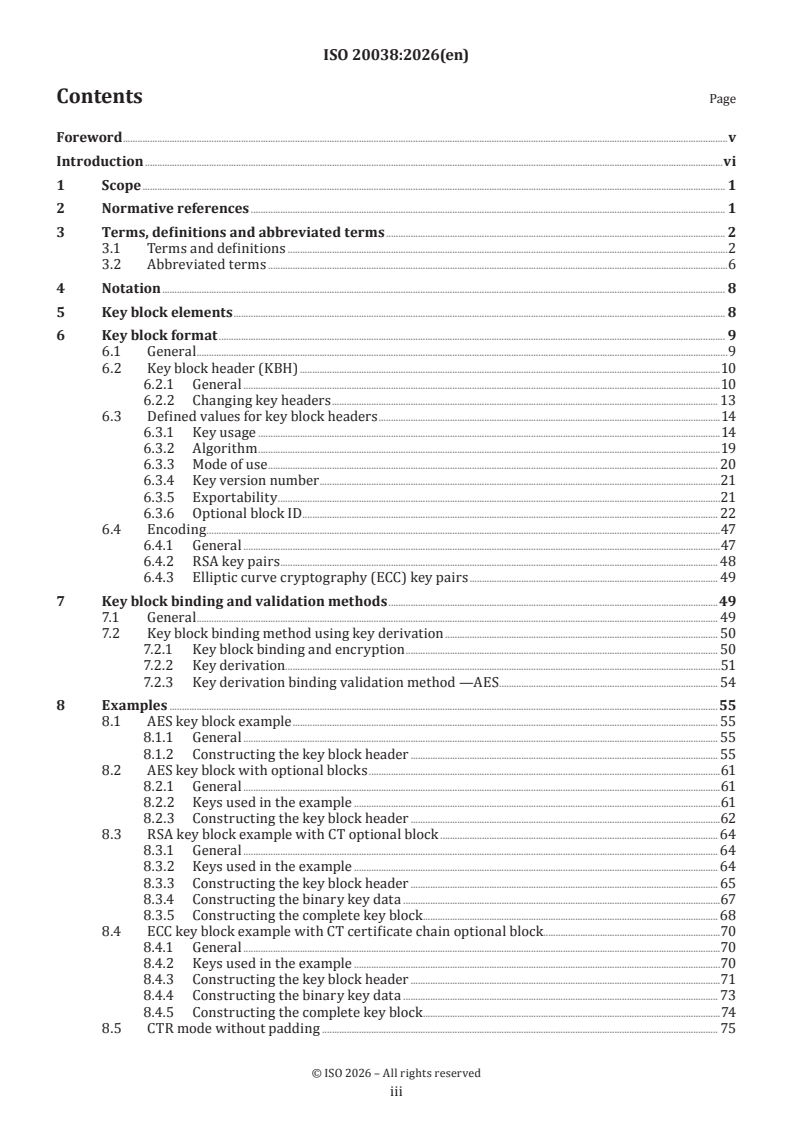
Contents Page
Foreword .v
Introduction .vi
1 Scope . 1
2 Normative references . 1
3 Terms, definitions and abbreviated terms . 2
3.1 Terms and definitions .2
3.2 Abbreviated terms .6
4 Notation . 8
5 Key block elements . 8
6 Key block format . 9
6.1 General .9
6.2 Key block header (KBH) .10
6.2.1 General .10
6.2.2 Changing key headers . 13
6.3 Defined values for key block headers .14
6.3.1 Key usage .14
6.3.2 Algorithm .19
6.3.3 Mode of use . 20
6.3.4 Key version number .21
6.3.5 Exportability .21
6.3.6 Optional block ID . 22
6.4 Encoding .47
6.4.1 General .47
6.4.2 RSA key pairs . 48
6.4.3 Elliptic curve cryptography (ECC) key pairs . 49
7 Key block binding and validation methods .49
7.1 General . 49
7.2 Key block binding method using key derivation . 50
7.2.1 Key block binding and encryption . 50
7.2.2 Key derivation . . .51
7.2.3 Key derivation binding validation method —AES . 54
8 Examples .55
8.1 AES key block example . 55
8.1.1 General . 55
8.1.2 Constructing the key block header . 55
8.2 AES key block with optional blocks .61
8.2.1 General .61
8.2.2 Keys used in the example .61
8.2.3 Constructing the key block header .62
8.3 RSA key block example with CT optional block . 64
8.3.1 General . 64
8.3.2 Keys used in the example . 64
8.3.3 Constructing the key block header . 65
8.3.4 Constructing the binary key data .67
8.3.5 Constructing the complete key block . 68
8.4 ECC key block example with CT certificate chain optional block .70
8.4.1 General .70
8.4.2 Keys used in the example .70
8.4.3 Constructing the key block header .71
8.4.4 Constructing the binary key data . 73
8.4.5 Constructing the complete key block .74
8.5 CTR mode without padding . 75
iii
Annex A (informative) GBIC scheme for directed key diversification . 76
Annex B (informative) Operational challenges and examples with exportability .83
Bibliography .92
iv
Foreword
ISO (the International Organization for Standardization) is a worldwide federation of national standards
bodies (ISO member bodies). The work of preparing International Standards is normally carried out through
ISO technical committees. Each member body interested in a subject for which a technical committee
has been established has the right to be represented on that committee. International organizations,
governmental and non-governmental, in liaison with ISO, also take part in the work. ISO collaborates closely
with the International Electrotechnical Commission (IEC) on all matters of electrotechnical standardization.
The procedures used to develop this document and those intended for its further maintenance are described
in the ISO/IEC Directives, Part 1. In particular, the different approval criteria needed for the different types
of ISO documents should be noted. This document was drafted in accordance with the editorial rules of the
ISO/IEC Directives, Part 2 (see www.iso.org/directives).
ISO draws attention to the possibility that the implementation of this document may involve the use of (a)
patent(s). ISO takes no position concerning the evidence, validity or applicability of any claimed patent
rights in respect thereof. As of the date of publication of this document, ISO had not received notice of (a)
patent(s) which may be required to implement this document. However, implementers are cautioned that
this may not represent the latest information, which may be obtained from the patent database available at
www.iso.org/patents. ISO shall not be held responsible for identifying any or all such patent rights.
Any trade name used in this document is information given for the convenience of users and does not
constitute an endorsement.
For an explanation of the voluntary nature of standards, the meaning of ISO specific terms and expressions
related to conformity assessment, as well as information about ISO's adherence to the World Trade
Organization (WTO) principles in the Technical Barriers to Trade (TBT), see www.iso.org/iso/foreword.html.
This document was prepared by Technical Committee ISO/TC 68, Financial services, Subcommittee SC 2,
Financial services, security.
This second edition cancels and replaces the first edition (ISO 20038:2017), which has been technically
revised.
The main changes are as follows:
— updated for compatibility with ANSI X9.143-2022.
Any feedback or questions on this document should be directed to the user’s national standards body. A
complete listing of these bodies can be found at www.iso.org/members.html.
v
Introduction
The secure management of cryptographic keys requires that their values and usage constraints be protected
for both confidentiality and integrity.
This document provides a method of wrapping cryptographic keys in order to provide confidentiality and
integrity protection for the keys when being transmitted or stored. The mechanism is designed to use
advanced encryption standard (AES) specified in FIPS 197 as the wrapping cipher.
vi
International Standard ISO 20038:2026(en)
Banking and related financial services — Key wrap using
advanced encryption standard (AES)
1 Scope
This document defines a method for packaging cryptographic keys for transport. This method can also be
used for the storage of keys under an advanced encryption standard (AES) key. The method uses the block
cipher AES as the wrapping cipher algorithm.
Other methods for wrapping keys are outside the scope of this document but can use the authenticated
encryption algorithms specified in ISO/IEC 19772.
2 Normative references
The following documents are referred to in the text in such a way that some or all of their content constitutes
requirements of this document. For dated references, only the edition cited applies. For undated references,
the latest edition of the referenced document (including any amendments) applies.
ISO 8601-1, Date and time — Representations for information interchange — Part 1: Basic rules
ISO 9564-5, Financial services — Personal identification number (PIN) management and security — Part 5:
Methods for the generation, change, and verification of PINs
ISO 11568, Financial services — Key management (retail)
ANSI X9.24-1-2017, Retail Financial Services Symmetric Key Management Part 1: Using Symmetric Techniques
ANSI X9.24-2-2021, Retail Financial Services Symmetric Key Management - Part 2: Using Asymmetric Techniques
for the Distribution of Symmetric Keys
ANSI X9.24-3-2017, Retail Financial Services Symmetric Key Management Part 3: Derived Unique Key Per
Transaction
ANSI X9.102-2020, Symmetric Key Cryptography For the Financial Services Industry – Wrapping of Keys and
Associated Data
ANSI X9.132-xxx, Issuer PIN Generation, Verification, and Storage Methodologies Using AES
ANSI X9.143-2022, Retail Financial Services Interoperable Secure Key Block Specification
ANSI X9.139, Retail Financial Services Interoperable Secure Key Block using Asymmetric Techniques
ANS X9 TR-31, Interoperable Secure Key Exchange Key Block Specification for Symmetric Algorithms
ANS X9 TR-34, Interoperable Method for Distribution of Symmetric Keys using Asymmetric Techniques: Part 1 –
Using Factoring-Based Public Key Cryptography Unilateral Key Transport
IETF RFC 4648, The Base16, Base32, and Base64 Data Encodings, October 2006
NIST SP 800-57, Recommendation for Key Management: Part 1 – General
NIST SP 800-108, Recommendation for Key Derivation Using Pseudorandom Functions
PKCS #1 v2.1:2023, RSA Cryptography Standard
3 Terms, definitions and abbreviated terms
3.1 Terms and definitions
For the purposes of this document, the following terms, definitions and abbreviated terms apply.
ISO and IEC maintain terminology databases for use in standardization at the following addresses:
— ISO Online browsing platform: available at https:// www .iso .org/ obp
— IEC Electropedia: available at https:// www .electropedia .org/
3.1.1
active
attribute setting for a directed key (3.1.9) that allows starting a cryptographic interaction
EXAMPLE MAC generate, cipher encrypt, PIN encryption, key encryption (key export).
3.1.2
advanced encryption standard
AES
16-byte block cipher
Note 1 to entry: This is defined in ISO/IEC 18033-3.
[SOURCE: ISO 11568:2023, 3.2]
3.1.3
ASCII
American Standard Code for Information Interchange
binary encoding of 7-bit characters defined by ISO/IEC 646
[SOURCE: ISO/IEC 18477-4:2017, 3.1.2, modified — The term “American Standard Code for Information
Interchange”, has been added as an admitted term.]
3.1.4
authentication value
cryptographically generated value message authentication code (3.1.29) derived from the key block header
and confidential data that can be used to validate the integrity of the data contained in the key block
3.1.5
CBC
cipher block chaining
confidentiality mode whose encryption process features the combining (i.e. “chaining”) of the plaintext
blocks with the previous ciphertext blocks
[SOURCE: NIST SP 800-38A:2001]
3.1.6
cryptographic domain
set of one or more secure cryptographic devices (SCDs) (3.1.32) that contain or can use the same set of keys
Note 1 to entry: All SCDs (3.1.32) in the domain are considered to be “equivalent” in that a key that can be used in one
SCD (3.1.32) in the domain is also available for use by any other SCD (3.1.32) in the domain.
Note 2 to entry: A cryptographic domain is often defined for host processing to provide load balancing of hardware
security modules (HSMs).
Note 3 to entry: The keys are typically structured in a hierarchy where higher-level keys are used to provide protection
for lower-level keys.
3.1.7
CTR
counter mode of encryption
confidentiality mode that features the application of the forward cipher to a set of input blocks, called
counters, to produce a sequence of output blocks that are exclusive-ORed with the plaintext to produce the
ciphertext, and vice versa
[SOURCE: NIST SP 800-38A:2001, modified — The admitted term “counter mode” has been changed to
“counter mode of encryption”.]
3.1.8
DEA
data encryption algorithm
cryptographic algorithm, previously specified in FIPS 46 which became effective July 1977, now withdrawn.
[SOURCE: NIST SP 800-67 Rev. 2]
3.1.9
directed key
key K in a cryptographically bilateral protocol between two parties A and B for direction A to B, if and only
if, there exist keys K , with key value of K and key attributes for active (3.1.1) on the cryptographic system
A
of an entity A and K , with key value of K and the corresponding key attribute for passive (3.1.29) on the
B
cryptographic system of an entity B
3.1.10
diversification data
derivation data for key diversification (3.1.20), containing information on the key attributes to be assigned to
the derived key by the HSM
3.1.11
diversification scheme
cryptographic scheme implemented in an HSM that specifies how diversification data (3.1.10) is processed
during key diversification (3.1.20), ensuring that different key attributes lead to cryptographically
independent key values
3.1.12
diversification scheme for directed keys
diversification scheme (3.1.11) to obtain directed keys (3.1.9) for a cryptographically bilateral protocol
between two parties identified as A and B, based on a common key diversification key (KDK) (3.1.21), which
differs for the parties in the party identifier key attribute and on a tag in the diversification data (3.1.10),
indicating the direction of the directed key (3.1.9) that determines whether the key derived from KDK party
identifier type A has the active (3.1.1) role and the key derived from KDK party identifier type B has the
passive (3.1.29) role or vice versa
3.1.13
hex-ASCII
number in base 16 expressed as American Standard Code for Information Interchange (ASCII) (3.1.3)
characters
EXAMPLE The 32-bit message authentication code (3.1.28) result 0x12345678 (4 binary bytes) is encoded as eight
hex-ASCII characters that reads “12345678” but is stored or transmitted as 0x3132333435363738.
3.1.14
initialization vector
IV
binary value used as a starting point for the encryption of a data sequence to increase security by introducing
additional cryptographic variance and to synchronize cryptographic equipment
3.1.15
key block
result of performing a cryptographic process over a key and its associated data to produce a key block
header, ciphertext and authentication value (3.1.4) – the message authentication code (3.1.28)
[SOURCE: ANSI X9.143:2022, 3.15]
3.1.16
key block encryption key
KBEK
key that is derived from the key block protection key (3.1.18) and that is used solely for enciphering the key
block (3.1.15)
[SOURCE: ANSI X9.143:2022, 3.16]
3.1.17
key block authentication key
KBAK
key that is derived from the key block protection key (3.1.18) and that is used solely for calculating the
message authentication code (3.1.28) over the key block (3.1.15)
[SOURCE: ANSI X9.143:2022, 3.17]
3.1.18
key block protection key
KBPK
key wrapping key (KWK) (3.1.26) that is used as a derivation key from which the key block encryption key
(3.1.16) and the key block authentication key (3.1.17) are derived
Note 1 to entry: This key is used for no other purpose.
[SOURCE: ANSI X9.143:2022, 3.18]
3.1.19
key derivation function
KDF
function to derive a key from a key generation key (KGK) using a pseudorandom function (3.1.31) with the
KGK as seed and derivation or diversification data as input
3.1.20
key diversification
key derivation function (3.1.19) using diversification data (3.1.10) in a diversification scheme (3.1.11)
3.1.21
key diversification key
KDK
key used in a hardware security module (HSM) function implementing a diversification scheme for key
diversification (3.1.20)
3.1.22
key encrypting key
KEK
key used exclusively to encrypt and decrypt other keys
[SOURCE: ANSI X9.143:2022, 3.19]
3.1.23
key export
secure cryptographic device (SCD) (3.1.32) operation that
a) unwraps a key and its attributes from a storage key encrypting key (3.1.22) or the master file key (MFK)
(3.1.27) and re-encrypts that key under a key wrapping key (3.1.26) shared with another entity or
internal system; or
b) wraps a clear key and its attributes that is stored within an SCD (3.1.32) using a key wrapping key
(3.1.26) shared with another entity or internal system
[SOURCE: ANSI X9.143:2022, 3.20]
3.1.24
key import
secure cryptographic device (SCD) (3.1.32) operation that unwraps a key and its attributes using a key
wrapping key (3.1.26) shared with another entity or system and then stores the key and its attributes from
the key block within one or more related SCDs (3.1.32) or re-wraps the key and its attributes using a storage
key encrypting key (3.1.22) or the master file key (MFK) (3.1.27)
[SOURCE: ANSI X9.143:2022, 3.21]
3.1.25
key type vector
KTV
set of attributes formatted according to the diversification scheme (3.1.11) used in the diversification data
(3.1.10) for defining the attributes of a key derived from a key diversification key (KDK) (3.1.21)
3.1.26
key wrapping key
KWK
symmetric key that determines the wrapping (3.1.36) and unwrapping (3.1.35) functions of a symmetric key
authenticated encryption mechanism that is intended for the protection of cryptographic keys and other
specialized data
[SOURCE: ANSI X9.143:2022, 3.22]
3.1.27
master file key
MFK
key used to encrypt other keys for storage
Note 1 to entry: Storage can be internal to the secure cryptographic device (SCD) (3.1.32) housing the MFK or can
pertain to external storage (e.g. on a host system).
[SOURCE: ANSI X9.143:2022, 3.24]
3.1.28
message authentication code
MAC
cryptographic value, which is the result of passing a financial message through the message authentication
algorithm using a specific key
[SOURCE: ANSI X9.143:2022, 3.25]
3.1.29
passive
attribute setting for a directed key that allows only reacting on a cryptographic interaction
EXAMPLE MAC verify only, cipher decrypt, PIN verify, key decryption (key import)
3.1.30
PIN
personal identification number
numeric code used to authenticate an identity or to verify access authorization
[SOURCE: ISO/IEC 19790:2025, modified — added “or to verify access authorization” to the definition.]
3.1.31
pseudorandom function
PRF
function that can be used to generate output from a random seed and a data variable such that the output is
computationally indistinguishable from truly random output
Note 1 to entry: The PRF is specified in the NIST SP 800–108r1-upd1.
3.1.32
secure cryptographic device
SCD
device that provides physically and logically protected cryptographic services and storage (e.g. personal
identification number (PIN) (3.1.30) entry device or hardware security module (HSM)), and which can be
integrated into a larger system, such as an automated teller machine (ATM) or point of sale terminal
[SOURCE: ISO 13491-1:2024, 3.18, modified — the example “(e.g. PIN entry device or HSM)” has been merged
with the definition.]
3.1.33
subkey
cryptographic key that is used internally in a cryptographic algorithm, such as cipher-based message
authentication code (CMAC), and not chosen by or exposed to the user of the algorithm
3.1.34
TDEA
triple data encryption algorithm
symmetric algorithm
Note 1 to entry: The TDEA is specified in the ISO/IEC 18033 series.
[SOURCE: ISO 11568:2023, 3.87, modified — the term “triple data encryption algorithm” has been changed
to an admitted term, and the abbreviated term “TDEA” has been changed to the preferred term.]
3.1.35
unwrapping
function in a key wrap mechanism that either produces the key data from the ciphertext or indicates that
either the ciphertext or the associated data is invalid
[SOURCE: ANSI X9.143:2022, 3.32]
3.1.36
wrapping
function in a key wrap mechanism that produces the ciphertext from and creates a validity check for the key
and associated data
[SOURCE: ANSI X9.143:2022, 3.33]
3.2 Abbreviated terms
AAC application authentication cryptogram
ARQC authorization request cryptogram
BDK base derivation key
CMAC cipher-based message authentication code
DAC data authentication code
DD derivation data
DER distinguished encoding rules
ECC elliptic curve cryptography
ECDSA elliptic curve digital signature algorithm
ECIES elliptic curve integrated encryption scheme
EMV Europay, Mastercard, Visa
GBIC German banking industry committee
HMAC keyed-hash message authentication code
HSM hardware security module
ID identifier
IKID initial key identifier
KBH key block header
KCV key check value
KDH key distribution host
KLD key loading device
KRD key receiving device
KEK key encryption key
KMS key management system
KSI key set identifier
KWK key wrapping key
MFK master file key
PAN personal account number
PED PIN encryption device
PVK PIN verification key
PVV PIN verification value
SHA secure hash algorithm
RD random data
RSA Rivest, Shamir and Adleman
TC transaction certificate
TLS transport layer security
4 Notation
The following are used to indicate field encoding in the key block:
a) nA: n-digits of alphabetic (“A” to “Z”, “a” to “z”), e.g. 6A means exactly six alphabetic characters in ASCII;
b) nAN: alphanumeric (“A” to “Z”, “a” to “z”, “0” to “9”), e.g. 6AN means exactly six alphanumeric characters
in ASCII;
c) nH: hex-ASCII (“0” to “9”, “A” to “F”), e.g. 6H means exactly six hex-ASCII characters;
d) nN: numeric-ASCII (“0”-”9”), e.g. 6N means exactly six decimal characters in ASCII;
e) nB: binary bytes (0x00 to 0xFF), e.g. 6B means exactly six bytes of binary data;
f) nPA: n printable ASCII characters. Printable ASCII characters are those with hexadecimal values in the
range 20 to 7E, inclusive. 6PA means exactly six printable ASCII characters;
g) ||: used for concatenation of bitstrings, 30A4F || 0C1 is equal to 30A4F0C1;
h) ⊕: xor. Bit-wise, xor is defined as 0⊕0 = 0, 0⊕1 = 1, 1⊕0 = 1 and 1⊕1 = 0. ⊕ applied to longer strings is
performed bitwise, e.g. 0x3FC4 ⊕ 0xED27 = 0xD2E3;
i) < < : left-shift. If M is a bit string, then M < < 1 means M shifted one bit to the left, e.g. the bit string
0101010 < < 1 is 1010100 and 1010100 < < 1 is 0101000. The length of M < < 1 is the same as the length
of M. Left-shift can also be described as multiplying by 2, without carry;
j) 0x: notation indicating a hexadecimal number follows, e.g. 0x31 indicates 31-hexadecimal (49-decimal).
5 Key block elements
The key block shall contain three parts:
a) the key block header (KBH), which contains non-sensitive attribute information about the key and the
key block;
b) the confidential data that is being exchanged or stored (i.e. the key and attributes formatted according
to the key data format);
c) the authentication value, which consists of a MAC that binds the key block header and confidential data.
This general format of a key block is illustrated in Figure 1.
Figure 1 — Key block
For TDEA and AES keys, the confidential data should be padded to the maximum key length to hide its true
length (key length obfuscation padding) from an external observer. When the confidential data are padded
for key length obfuscation:
— TDEA keys less than 192 bits shall be padded to 192 bits.
— AES keys less than 256 bits shall be padded to 256 bits.
The key length obfuscation padding is determined by the size of the key being wrapped, but the block
padding is determined by the algorithm being used to encrypt the confidential data. Because of the existence
of the key length field in the information that is encrypted, additional padding is required to make the block
consistent with the size of block the algorithm requires. For example, AES operates on 128 bits, so if the key
is padded out to 256 bits, additional block padding characters are required because of the key length field.
For operational and compliance reasons (e.g. regulatory, contractual, industry and ecosystem standard), an
entity may have SCD mechanisms to:
a) verify key length against the policies of an organization and the requirements of industry;
b) obtain key length information of stored keys.
Such SCD mechanisms should be managed with SCD administrative controls requiring dual-control
execution.
6 Key block format
6.1 General
This clause defines a secure key block that uses the methods described in Clause 7.
Key blocks constructed according to this document shall conform to the relevant key wrapping requirements
in ANSI X9.102.
The key block is a variable-length structure with a maximum length of 9999 bytes. The key block is
composed of three sub-structures: a variable-length header, a variable-length confidential data field and an
authentication value. The header may include optional fields.
The key block shall consist of three parts:
a) The KBH, which contains attribute information about the key and the key block and is not encrypted;
1) The first section is 16 bytes with a fixed format defined in Table 1;
2) The second section is of variable length and optional.
b) The confidential data, which will be encrypted;
1) two bytes, indicating the key length (in bits) and excluding padding;
2) the secret key and any confidential attributes;
3) random padding to obfuscate the key length, if required;
4) random cipher-block padding, if required.
c) The authentication value. The length of the authentication value shall be as follows:
1) 128 bits, because the AES key derivation method is used (see 7.2.2).
TDEA and AES symmetric keys should be padded with random key length obfuscation padding to the
maximum length for the algorithm, 192 bits for TDEA or 256 bits for AES. Other key types are not padded for
key length obfuscation but are padded up to the cipher block of the wrapping method (e.g. HMAC, RSA and
ECC keys). This format is illustrated in Figure 2.
Figure 2 — Key Block
6.2 Key block header (KBH)
6.2.1 General
The header shall contain attribute information about the key as defined in Table 1. The specific encoding and
acceptable characters are defined individually for each field, e.g. in the “Encoding” column of Table 1. When
the term “numeric” is used to describe an ASCII header byte, it means an ASCII character in the range “0” to
“9” (0x31 to 0x39). A multi-byte header field is considered numeric only when all bytes of the field contain
numeric values.
Table 1 shows the format of the KBH. See 6.3 for defined key attributes.
Table 1 — Key block header
Byte # Field name Description Encoding Encrypted
This field identifies the version of the key block, which
defines the method by which it is cryptographically pro-
tected, as well as the layout of the block:
“D” (0x44): Key block protected using the AES key
derivation binding method for CBC mode (see
subclause 7.2).
“E” (0x45): Key block protected using the AES key
derivation binding method for CTR mode (see
Key block version
subclause 7.2).
0 1AN No
ID (identifier)
Numeric key block version IDs are reserved for propri-
etary key block definitions. Multiple key block versions
may be in use at any time.
The key block version ID should not be used as a proxy for
determining which optional block elements are support-
ed. Applications should predetermine which optional
block elements are supported.
The values “A”, “B” and “C” are not covered in this docu-
ment.
ASCII numeric digits providing key block length after
encoding. Length includes the entire block (header +
1–4 Key block length encrypted confidential data + MAC) in decimal, e.g. a 112- 4N No
byte key block contains “0” (0x30) in byte #0; “1” (0x31) in
byte #1; “1” (0x31) in byte #2; and “2” (0x32) in byte #3.
TTaabblle 1 e 1 ((ccoonnttiinnueuedd))
Byte # Field name Description Encoding Encrypted
This field provides information about the intended
function of the protected key or sensitive data. Common
functions include encrypting data, encrypting PINs and
5–6 Key usage 2AN No
calculating a MAC.
See Table 2 for defined values.
The approved algorithm for which the protected key may
be used.
7 Algorithm 1AN No
See Table 3 for defined values.
This field defines the operation the protected key can per-
form. For key blocks being transmitted, the mode of use
is in the context of the recipient SCD. For key blocks being
stored, the mode of use is in the context of the SCD using
8 Mode of use 1AN No
the key. For example, an authentication key can be limited
to verify-only.
See Table 4 for defined values.
Two-digit ASCII character version number, optionally used
to indicate that the content of the key block is a compo-
Key version
9–10 2AN No
nent, or to prevent re-injection of old keys.
number
See Table 5 for defined values.
This field defines whether the protected key may be
transferred outside the cryptographic domain in which
11 Exportability 1AN No
the key is found.
See Table 6 for defined values.
This field defines the number of optional blocks included
in the key block. The minimum value is zero and the max-
Number of op- imum is 99, but it is also limited by the maximum number
12–13 2N No
tional blocks of bytes in the entire key block. For example, five optional
blocks can be represented by “0” (0x30) in byte 12 and “5”
(0x35) in byte 13.
This field indicates whether the key block is in a key
exchange context (wrapped by a transport key) or in a
storage context (e.g. wrapped by the MFK).
The values are:
“0” (0x30): Either storage or key exchange context. This
allows interoperability with legacy key blocks. This
does not imply that the wrapping key for a key block
Key context can be used for both storage and key exchange, merely
14 – storage or that the storage or exchange of this key block is 1N No
exchange determined by the properties of the wrapping key.
“1” (0x31): Storage context only. The key block is not
wrapped by a transport key for exchange between a
communicating pair.
“2” (0x32): Key exchange context only. The key block is
wrapped by a transport key for exchange between a
communicating pair.
Reserved for This field is reserved for future use and is filled with an
15 1N No
future use ASCII zero (0x30) characters.
Fields after byte 15 are only present if bytes 12–13 contain a value other than “00” (0x3030).
ID field for the first optional block, if one is present as in-
First optional
16–17 dicated by a value other than “00” in bytes 12 and 13. The 2AN No
block ID
possible ID values are defined in 6.3.6.
TTaabblle 1 e 1 ((ccoonnttiinnueuedd))
Byte # Field name Description Encoding Encrypted
If the first optional block is present, indicated by a value
other than “00” in bytes 12 and 13, then this field contains
the length of that optional block in bytes, including the
field’s ID, length and data. Byte 18 contains the high-or-
der byte of the length and byte 19 contains the low-order
byte, both in hex-ASCII form. For example, for a 24-byte
optional block (0x18 in hexadecimal notation), byte 18
Optional block 1
18–19 2H No
contains a “1” (0x31) and byte 19 contains an “8” (0x38).
length
Optional block data can be omitted, in which case the
optional block length is “04”.
If the length of the optional block exceeds 255, this field
is set to “00” and the actual length is encoded in the next
two fields. The actual length is limited by the maximum
number of bytes in the key block length.
This field contains the length of the field named “Extend-
ed optional block 1 length”. Valid values are “01” – “FF”.
Optional block 1
For this document this value is always “04”.
20–21 2H No
length of length
This field is only present if the optional block 1 length is
“00”.
The actual length of the block, expressed as a hexadecimal
number. For example, if the optional block length is 400
Extended option-
bytes (190 ), this field is “0190”.
22–25 4H No
al block 1 length
This field is only present if the optional block 1 length is
“00”.
If the first optional block is present, indicated by a value
Optional block 1 other than “00” in bytes 12–13, then this field contains
n…m PA No
data the data for that optional block. It contains only printable
ASCII characters.
A variable number of optional blocks can follow the first
Additional op- optional block, as indicated by the count in bytes 12–13.
m+1…p tional blocks, if Each optional block contains a 2-byte ID, 2-byte length No
present and variable-length data field following the same format
described for optional block 1.
Before a key in the key block format is used in a SCD, the contents of the header block shall be validated to
ensure the correct usage is enforced. First, the SCD makes sure that the length of the key block matches the
contents of bytes 1 to 4. If the lengths do not match, the SCD returns an error and stops processing the block.
The “key usage” byte is typically checked next followed by the “algorithm” byte. The processing of the other
header bytes depends on the key usage and the algorithm used.
From 0 to 99, optional blocks can be included in the key block. The total length of the key block shall not
exceed the maximum length that can be represented by the key block length field in bytes 1-4. The total
number of optional blocks is indicated by a count in bytes 12-13. Each optional block consists of three
fields: a 2-byte identifier that indicates the content of the optional block; a 2-byte length that indicates the
total number of bytes in all of the optional block’s fields – possibly extended to a variable length field if the
optional block length of length fields are used; and the variable-length data carried in the optional block. See
Table 7 for a list of valid identifiers.
For example, consider an optional block that contains a key set identifier. A sample block can contain the
following data:
— Identifier: “KS”
— Length: “18”
— Data: “00604B120F9292800000”
NOTE The length value equals 2+2+20 (24). The length value is encoded in Hex-ASCII; 18 hexadecimal equals 24
decimal.
If more than one optional block is present, each one shall immediately follow the previous one in the key
block structure.
The total length of all optional blocks in the key block shall be a multiple of the encryption block size. This
can require padding. If padding is required, it shall be included in a special final optional block that is filled
with an appropriate number of padding characters. For example, if the total length of all optional blocks
before padding is 90, six additional bytes are required in order to bring the total to the next multiple of the
encryption block size, 96. A padding block is added as the last optional block, containing the 2-byte identifier
“PB”, a 2-byte length field “06” and two characters of padding.
6.2.2 Changing key headers
A single key under two different headers with different attributes creates the potential for attacks.
Therefore, the SCD shall not generate a key with multiple headers or change the value of a key header except
as described in the list in this subclause (6.2.2). This includes changing the header when changing the
wrapping key. Similarly, there shall be a policy that users shall not manually load the same key bound to
different attributes except under the same rules. Checking manual loading rules is generally not technically
enforceable within the HSM since these are distributed systems. SCDs that translate
...