

ISO/IEC 23837-1:2023
(Main)Information security — Security requirements, test and evaluation methods for quantum key distribution — Part 1: Requirements
General Information
- Abstract
This document specifies a general framework for the security evaluation of quantum key distribution (QKD) according to the ISO/IEC 15408 series. Specifically, it specifies a baseline set of common security functional requirements (SFRs) for QKD modules, including SFRs on the conventional network components and the quantum optical components, and the entire implementation of QKD protocols. To facilitate the analysis of SFRs, security problems that QKD modules can face in their operational environment are analysed based on a structural analysis of the security functionality of QKD modules and the classification of QKD protocols. The SFRs on conventional network components of QKD modules are mainly characterized under the framework of the ISO/IEC 15408 series and also refer to the methodology of ISO/IEC 19790 and relevant standards on testing of cryptographic modules and network devices.
- Status
- Published
- Publication Date
- 28-Aug-2023
- Current Stage
- 6060 - International Standard published
- Start Date
- 29-Aug-2023
- Due Date
- 24-Apr-2023
- Completion Date
- 29-Aug-2023

Overview
ISO/IEC 23837-1:2023 - "Information security - Security requirements, test and evaluation methods for quantum key distribution - Part 1: Requirements" defines a baseline framework for the security evaluation of quantum key distribution (QKD) modules. Published in 2023, this first-part standard aligns QKD security requirements with the ISO/IEC 15408 (Common Criteria) evaluation framework and specifies common security functional requirements (SFRs) covering both conventional network components and quantum optical elements, plus the end-to-end implementation of QKD protocols.
Key topics and technical requirements
- Scope and structure of QKD implementations: defines external interfaces (quantum channel, control/management, key management), internal components for transmitter and receiver modules, and TOE/TSF definitions.
- Theoretical and protocol analysis: overview of QKD principles, protocol classification and architecture to support SFR mapping.
- Security problem analysis: identification of assumptions, asset analysis, and threats to both classical network components and quantum optical components (including side-channel and implementation vulnerabilities).
- Baseline Security Functional Requirements (SFRs): a common set of SFRs mapped to QKD use - examples include audit data generation (FAU_GEN.1), cryptographic operations and RNG (FCS_COP.1, FCS_RNG.1), access and information-retention controls (FDP_*), TSF management (FMT_*), and inter-TSF confidentiality/integrity (FPT_ITC.1, FPT_ITI.1).
- QKD-specific extensions: new or extended functional components such as FTP_QKD for protocol/raw data generation and post-processing, plus requirements for quantum emanation and physical resistance of optical components.
- Conformance and evaluation guidance: conformance statement templates and an informative annex offering guidance for developing protection profiles for QKD modules.
Applications and intended users
This standard is practical for:
- QKD manufacturers and system integrators designing secure QKD hardware and software to meet internationally recognized SFRs.
- Security evaluators and testing laboratories performing Common Criteria–based assessments of QKD modules.
- Security architects and product assurance teams who need to translate QKD protocol models into testable requirements and mitigate implementation vulnerabilities (e.g., side-channel risks).
- Purchasing organizations, regulators, and certification bodies requiring verifiable security claims for QKD deployments in sectors such as finance, government, telecom and critical infrastructure.
Related standards
- ISO/IEC 15408 series (Common Criteria) - evaluation framework used throughout this document.
- ISO/IEC 19790 and relevant standards on testing cryptographic modules and network devices - referenced for methodology on conventional components.
- Other parts of the ISO/IEC 23837 series - for test and evaluation methods beyond the requirements specified in Part 1.
Keywords: ISO/IEC 23837-1:2023, quantum key distribution, QKD security, security functional requirements, Common Criteria, quantum optical components, security evaluation, cryptographic modules.
Relations
- Consolidated By
ISO 24194:2022/Amd 1:2024 - Solar energy — Collector fields — Check of performance — Amendment 1 - Effective Date
- 17-Dec-2022
Get Certified
Connect with accredited certification bodies for this standard

BSI Group
BSI (British Standards Institution) is the business standards company that helps organizations make excellence a habit.

Bureau Veritas
Bureau Veritas is a world leader in laboratory testing, inspection and certification services.

DNV
DNV is an independent assurance and risk management provider.
Sponsored listings
Frequently Asked Questions
ISO/IEC 23837-1:2023 is a standard published by the International Organization for Standardization (ISO). Its full title is "Information security — Security requirements, test and evaluation methods for quantum key distribution — Part 1: Requirements". This standard covers: This document specifies a general framework for the security evaluation of quantum key distribution (QKD) according to the ISO/IEC 15408 series. Specifically, it specifies a baseline set of common security functional requirements (SFRs) for QKD modules, including SFRs on the conventional network components and the quantum optical components, and the entire implementation of QKD protocols. To facilitate the analysis of SFRs, security problems that QKD modules can face in their operational environment are analysed based on a structural analysis of the security functionality of QKD modules and the classification of QKD protocols. The SFRs on conventional network components of QKD modules are mainly characterized under the framework of the ISO/IEC 15408 series and also refer to the methodology of ISO/IEC 19790 and relevant standards on testing of cryptographic modules and network devices.
This document specifies a general framework for the security evaluation of quantum key distribution (QKD) according to the ISO/IEC 15408 series. Specifically, it specifies a baseline set of common security functional requirements (SFRs) for QKD modules, including SFRs on the conventional network components and the quantum optical components, and the entire implementation of QKD protocols. To facilitate the analysis of SFRs, security problems that QKD modules can face in their operational environment are analysed based on a structural analysis of the security functionality of QKD modules and the classification of QKD protocols. The SFRs on conventional network components of QKD modules are mainly characterized under the framework of the ISO/IEC 15408 series and also refer to the methodology of ISO/IEC 19790 and relevant standards on testing of cryptographic modules and network devices.
ISO/IEC 23837-1:2023 is classified under the following ICS (International Classification for Standards) categories: 35.030 - IT Security. The ICS classification helps identify the subject area and facilitates finding related standards.
ISO/IEC 23837-1:2023 has the following relationships with other standards: It is inter standard links to ISO 24194:2022/Amd 1:2024. Understanding these relationships helps ensure you are using the most current and applicable version of the standard.
ISO/IEC 23837-1:2023 is available in PDF format for immediate download after purchase. The document can be added to your cart and obtained through the secure checkout process. Digital delivery ensures instant access to the complete standard document.
Standards Content (Sample)
INTERNATIONAL ISO/IEC
STANDARD 23837-1
First edition
2023-08
Information security — Security
requirements, test and evaluation
methods for quantum key
distribution —
Part 1:
Requirements
Technologies de l'information — Exigences de sécurité, méthodes
d'essais et d'évaluation relatives à la distribution quantique de clés —
Partie 1: Exigences
Reference number
© ISO/IEC 2023
© ISO/IEC 2023
All rights reserved. Unless otherwise specified, or required in the context of its implementation, no part of this publication may
be reproduced or utilized otherwise in any form or by any means, electronic or mechanical, including photocopying, or posting on
the internet or an intranet, without prior written permission. Permission can be requested from either ISO at the address below
or ISO’s member body in the country of the requester.
ISO copyright office
CP 401 • Ch. de Blandonnet 8
CH-1214 Vernier, Geneva
Phone: +41 22 749 01 11
Email: copyright@iso.org
Website: www.iso.org
Published in Switzerland
ii
© ISO/IEC 2023 – All rights reserved
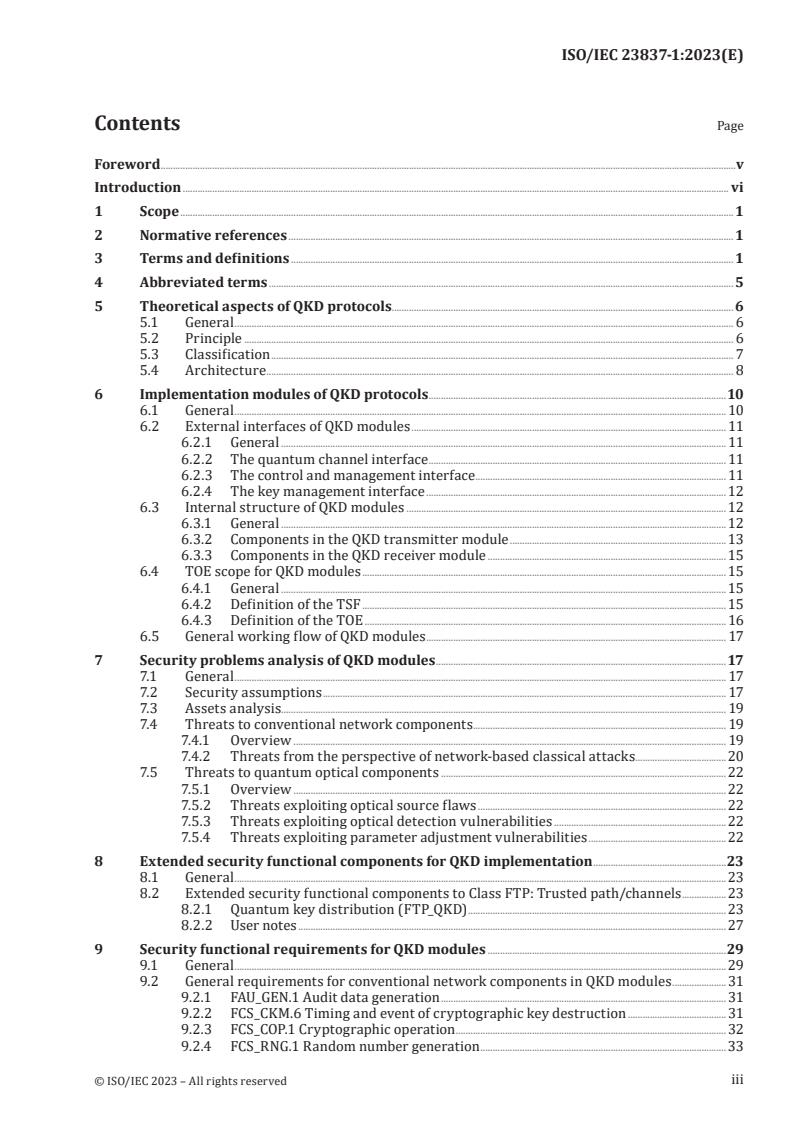
Contents Page
Foreword .v
Introduction . vi
1 Scope . 1
2 Normative references . 1
3 Terms and definitions . 1
4 Abbreviated terms . 5
5 Theoretical aspects of QKD protocols . 6
5.1 General . 6
5.2 Principle . 6
5.3 Classification . 7
5.4 Architecture . 8
6 Implementation modules of QKD protocols .10
6.1 General . 10
6.2 External interfaces of QKD modules . 11
6.2.1 General . 11
6.2.2 The quantum channel interface . 11
6.2.3 The control and management interface . 11
6.2.4 The key management interface .12
6.3 Internal structure of QKD modules .12
6.3.1 General .12
6.3.2 Components in the QKD transmitter module .13
6.3.3 Components in the QKD receiver module . 15
6.4 TOE scope for QKD modules . 15
6.4.1 General .15
6.4.2 Definition of the TSF . 15
6.4.3 Definition of the TOE . 16
6.5 General working flow of QKD modules . 17
7 Security problems analysis of QKD modules .17
7.1 General . 17
7.2 Security assumptions . 17
7.3 Assets analysis. 19
7.4 Threats to conventional network components . 19
7.4.1 Overview . 19
7.4.2 Threats from the perspective of network-based classical attacks . .20
7.5 Threats to quantum optical components . 22
7.5.1 Overview . 22
7.5.2 Threats exploiting optical source flaws .22
7.5.3 Threats exploiting optical detection vulnerabilities .22
7.5.4 Threats exploiting parameter adjustment vulnerabilities .22
8 Extended security functional components for QKD implementation .23
8.1 General .23
8.2 Extended security functional components to Class FTP: Trusted path/channels .23
8.2.1 Quantum key distribution (FTP_QKD) . 23
8.2.2 User notes . 27
9 Security functional requirements for QKD modules .29
9.1 General .29
9.2 General requirements for conventional network components in QKD modules . 31
9.2.1 FAU_GEN.1 Audit data generation . 31
9.2.2 FCS_CKM.6 Timing and event of cryptographic key destruction . 31
9.2.3 FCS_COP.1 Cryptographic operation . 32
9.2.4 FCS_RNG.1 Random number generation . 33
iii
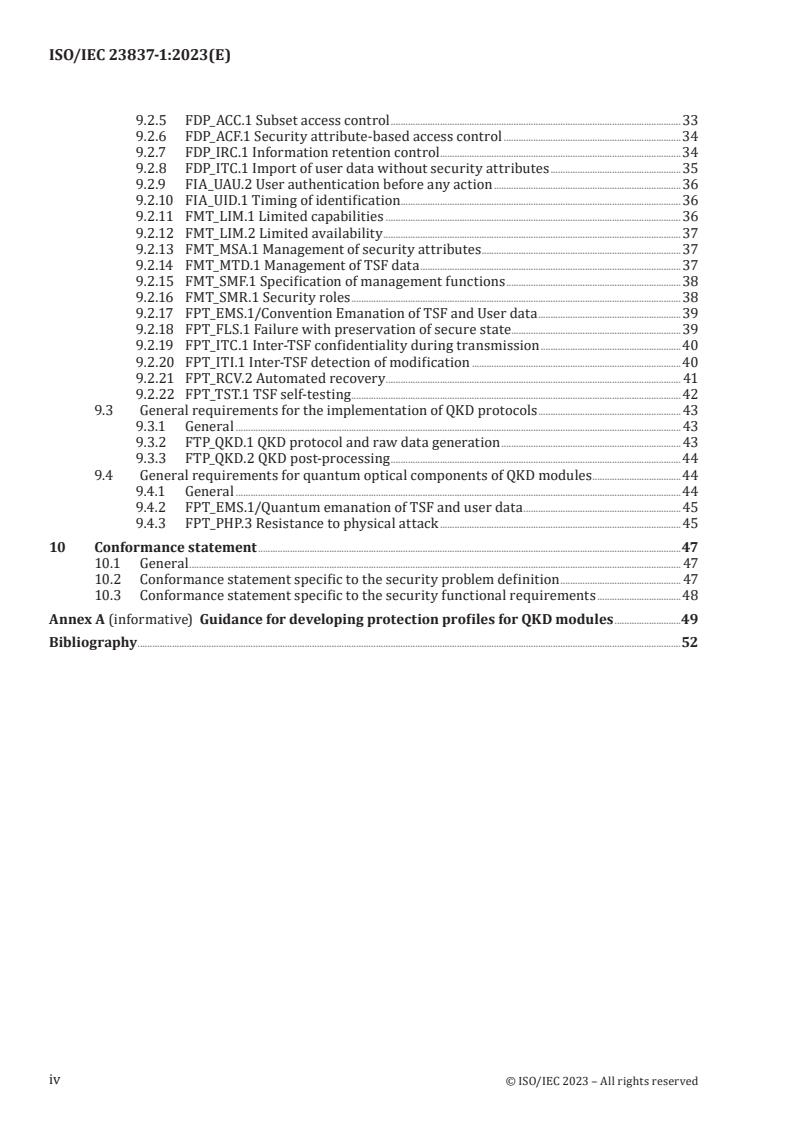
© ISO/IEC 2023 – All rights reserved
9.2.5 FDP_ACC.1 Subset access control . 33
9.2.6 FDP_ACF.1 Security attribute-based access control .34
9.2.7 FDP_IRC.1 Information retention control .34
9.2.8 FDP_ITC.1 Import of user data without security attributes . 35
9.2.9 FIA_UAU.2 User authentication before any action .36
9.2.10 FIA_UID.1 Timing of identification . .36
9.2.11 FMT_LIM.1 Limited capabilities .36
9.2.12 FMT_LIM.2 Limited availability . 37
9.2.13 FMT_MSA.1 Management of security attributes . 37
9.2.14 FMT_MTD.1 Management of TSF data . 37
9.2.15 FMT_SMF.1 Specification of management functions .38
9.2.16 FMT_SMR.1 Security roles .38
9.2.17 FPT_EMS.1/Convention Emanation of TSF and User data .39
9.2.18 FPT_FLS.1 Failure with preservation of secure state.39
9.2.19 FPT_ITC.1 Inter-TSF confidentiality during transmission .40
9.2.20 FPT_ITI.1 Inter-TSF detection of modification .40
9.2.21 FPT_RCV.2 Automated recovery . 41
9.2.22 FPT_TST.1 TSF self-testing . 42
9.3 General requirements for the implementation of QKD protocols . 43
9.3.1 General . 43
9.3.2 FTP_QKD.1 QKD protocol and raw data generation . 43
9.3.3 FTP_QKD.2 QKD post-processing .44
9.4 General requirements for quantum optical components of QKD modules .44
9.4.1 General .44
9.4.2 FPT_EMS.1/Quantum emanation of TSF and user data . 45
9.4.3 FPT_PHP.3 Resistance to physical attack . 45
10 Conformance statement .47
10.1 General . 47
10.2 Conformance statement specific to the security problem definition . 47
10.3 Conformance statement specific to the security functional requirements .48
Annex A (informative) Guidance for developing protection profiles for QKD modules .49
Bibliography .52
iv
© ISO/IEC 2023 – All rights reserved
Foreword
ISO (the International Organization for Standardization) and IEC (the International Electrotechnical
Commission) form the specialized system for worldwide standardization. National bodies that are
members of ISO or IEC participate in the development of International Standards through technical
committees established by the respective organization to deal with particular fields of technical
activity. ISO and IEC technical committees collaborate in fields of mutual interest. Other international
organizations, governmental and non-governmental, in liaison with ISO and IEC, also take part in the
work.
The procedures used to develop this document and those intended for its further maintenance
are described in the ISO/IEC Directives, Part 1. In particular, the different approval criteria
needed for the different types of document should be noted. This document was drafted in
accordance with the editorial rules of the ISO/IEC Directives, Part 2 (see www.iso.org/directives or
www.iec.ch/members_experts/refdocs).
ISO and IEC draw attention to the possibility that the implementation of this document may involve the
use of (a) patent(s). ISO and IEC take no position concerning the evidence, validity or applicability of
any claimed patent rights in respect thereof. As of the date of publication of this document, ISO and IEC
had not received notice of (a) patent(s) which may be required to implement this document. However,
implementers are cautioned that this may not represent the latest information, which may be obtained
from the patent database available at www.iso.org/patents and https://patents.iec.ch. ISO and IEC shall
not be held responsible for identifying any or all such patent rights.
Any trade name used in this document is information given for the convenience of users and does not
constitute an endorsement.
For an explanation of the voluntary nature of standards, the meaning of ISO specific terms and
expressions related to conformity assessment, as well as information about ISO's adherence to
the World Trade Organization (WTO) principles in the Technical Barriers to Trade (TBT) see
www.iso.org/iso/foreword.html. In the IEC, see www.iec.ch/understanding-standards.
This document was prepared by Joint Technical Committee ISO/IEC JTC 1, Information technology,
Subcommittee SC 27, Information security, cybersecurity and privacy protection.
A list of all parts in the ISO/IEC 23837 series can be found on the ISO and IEC websites.
Any feedback or questions on this document should be directed to the user’s national standards
body. A complete listing of these bodies can be found at www.iso.org/members.html and
www.iec.ch/national-committees.
v
© ISO/IEC 2023 – All rights reserved
Introduction
The ISO/IEC 23837 series specifies the security requirements, test and evaluation methods for quantum
key distribution (QKD) under the framework of the ISO/IEC 15408 series. This document focuses on
specifying the common baseline set of security functional requirements (SFRs) of QKD modules.
Theoretically, QKD provides a method to use a pre-shared key to establish a longer symmetric key
with security that does not depend upon the computational power of an adversary; the established key
can then be used for cryptographic purposes, such as for an encryption mechanism to create a secure
communication channel.
Although the security of QKD protocols is proven through rigorous security models that assume the two
communicating parties share a secret key beforehand, discrepancies between the models and practical
implementations frequently occur during the life cycle phases of QKD modules. These imperfections
or deviations from the security models can result in vulnerabilities that compromise the security
of practical QKD systems. Among them, severe side channel attacks have been proposed and there
have been some proof-of-principle demonstrations in QKD hacking experiments. Like conventional
cryptographic modules or network devices, QKD modules are expected to have strict security testing
and evaluation to avoid security attacks and then leakage of information before being deployed into
real applications. Intensive and strict evaluation is an essential step before QKD is widely accepted by
the industry.
For this purpose, the ISO/IEC 23837 series defines a set of rigorous and common security specifications
for QKD modules manufacturers, so that manufacturers can follow the standard procedure to design
and implement IT products that use QKD, and evaluators can follow the standard procedure to test
and evaluate the security of QKD modules, reducing the risk of a failure of security in operation. This
document uses the standardized model and language of the ISO/IEC 15408 series to define a common
baseline set of SFRs for QKD modules. The entire implementation of QKD protocols is included, from
conventional network components to quantum optical components. Annex A provides information
to facilitate the development of protection profiles for QKD modules. ISO/IEC 23837-2 is intended
to specify evaluation activities that are necessary for the security evaluation of QKD modules at the
expected evaluation assurance levels.
NOTE In this document, the description of extended security functional components in 8.2 and
SFRs in Clause 9 corresponds to the style of the description of security functional components in
ISO/IEC 15408-2. This includes not only the structure of the security functional family and components,
but also the font styles (i.e. bold and italics) of the text, which are described by following the convention
of ISO/IEC 15408-2 to distinguish some terms from the rest of the text. In this case, users with a
background in using the ISO/IEC 15408 series can easily apply the extended security functional
components and the SFRs to write documents for the evaluation of QKD modules.
vi
© ISO/IEC 2023 – All rights reserved
INTERNATIONAL STANDARD ISO/IEC 23837-1:2023(E)
Information security — Security requirements, test and
evaluation methods for quantum key distribution —
Part 1:
Requirements
1 Scope
This document specifies a general framework for the security evaluation of quantum key distribution
(QKD) according to the ISO/IEC 15408 series. Specifically, it specifies a baseline set of common
security functional requirements (SFRs) for QKD modules, including SFRs on the conventional network
components and the quantum optical components, and the entire implementation of QKD protocols.
To facilitate the analysis of SFRs, security problems that QKD modules can face in their operational
environment are analysed based on a structural analysis of the security functionality of QKD modules
and the classification of QKD protocols.
The SFRs on conventional network components of QKD modules are mainly characterized under the
framework of the ISO/IEC 15408 series and also refer to the methodology of ISO/IEC 19790 and relevant
standards on testing of cryptographic modules and network devices.
2 Normative references
The following documents are referred to in the text in such a way that some or all of their content
constitutes requirements of this document. For dated references, only the edition cited applies. For
undated references, the latest edition of the referenced document (including any amendments) applies.
ISO/IEC 15408-1:2022, Information security, cybersecurity and privacy protection — Evaluation criteria
for IT security — Part 1: Introduction and general model
ISO/IEC 15408-2:2022, Information security, cybersecurity and privacy protection — Evaluation criteria
for IT security — Part 2: Security functional components
3 Terms and definitions
For the purposes of this document, the terms and definitions given in ISO/IEC 15408-1 and the following
apply.
ISO and IEC maintain terminology databases for use in standardization at the following addresses:
— ISO Online browsing platform: available at https:// www .iso .org/ obp
— IEC Electropedia: available at https:// www .electropedia .org/
3.1
adversary
attacker
entity seeking to exploit potential vulnerabilities of a quantum key distribution system (3.28)
[SOURCE: ISO/IEC 19792:2009, 4.1.2, modified — “adversary” has been added as an admitted term; in
the definition, “person” has been replaced by “entity”, and “biometric system” has been replaced by
“quantum key distribution system”.]
© ISO/IEC 2023 – All rights reserved
3.2
authentication
provision of assurance of the claimed identity of an entity
[SOURCE: ISO/IEC 10181-2:1996, 3.3]
3.3
classical channel
communication channel that is used by two communicating parties for exchanging data encoded in a
form which may be non-destructively read and fully reproduced
[SOURCE: ETSI GR QKD 003 V2.1.1:2018]
3.4
component
constituent part of a quantum key distribution (QKD) module (3.23)
EXAMPLE Conventional network components, quantum optical components in a QKD module.
Note 1 to entry: A term with the same name of component is defined in ISO/IEC 15408-1 for a security requirement
element group. The user of this document can distinguish which term is referenced from the context.
3.5
cryptographic module
set of hardware, software, and/or firmware that implements security functions and are contained
within the cryptographic boundary
[SOURCE: ISO/IEC 19790:2012, 3.25]
3.6
decoding
procedure of converting quantum signals (3.32) into classical information
3.7
detection efficiency
probability that a photon, of a specific energy (spectral frequency) or wavelength, incident at the optical
input is detected within a detection gate, and produces an output signal
[SOURCE: ETSI GR QKD 007 V1.1.1:2018]
3.8
double-click event
event indicating simultaneous detection of two single-photon detectors (3.37)
3.9
encoding
procedure of converting classical information into quantum signals (3.32)
3.10
error corrected data
keying material obtained after correcting the bit errors in the sifted data (3.36)
3.11
error correction
process of correcting errors in data that may have been corrupted due to errors during transmission or
in storage
[SOURCE: ETSI GR QKD 007 V1.1.1:2018]
3.12
final key
key generated by a complete run of a quantum key distribution session (3.27)
© ISO/IEC 2023 – All rights reserved
3.13
homodyne detection
method to detect quadrature of a weak signal through interfering the weak signal with a strong phase
reference
3.14
keying material
data necessary to establish and maintain cryptographic keying relationships
[SOURCE: ISO/IEC 11770-1:2010, 2.27]
3.15
non-deterministic random bit generator
NRBG
random bit generator whose security depends upon sampling one or more entropy sources
[SOURCE: ISO/IEC 18031:2011, 3.23, modified — “an” has been replaced by “one or more”, note 1 to
entry has been removed.]
3.16
parameter adjustment procedure
procedure or function aiming to adjust specific parameter(s) of a system
3.17
post-processing
quantum key distribution protocol (3.24) procedure for converting raw data (3.33) into a final key (3.12)
3.18
pre-shared key
key pre-established in secure ways between the legitimate parties before initiating a quantum key
distribution (QKD) session (3.27)
Note 1 to entry: A pre-shared key is used to authenticate messages sent over the classical channel (3.3) during the
first QKD session.
3.19
privacy amplification
process of extracting keys from partially compromised data
[SOURCE: ETSI GR QKD 007 V1.1.1:2018, modified — “distilling secret keys” has been replaced by
“extracting keys”.]
3.20
quantum channel
communication channel for transmitting quantum signals (3.32)
[SOURCE: ETSI GR QKD 007 V1.1.1:2018]
3.21
quantum key distribution
QKD
procedure or method for two legitimate parties to agree on symmetric keys using a pre-shared key
(3.18), whose security is based on quantum information theory
Note 1 to entry: In some QKD protocols (3.24), establishment of keys occurs jointly involving both legitimate
parties, while in others one party generates keys that are eventually transported to the other party.
3.22
quantum key distribution authentication key
QKD authentication key
cryptographic key used to authenticate messages over the classical channel (3.3) of a quantum key
distribution system (3.28)
© ISO/IEC 2023 – All rights reserved
3.23
quantum key distribution module
QKD module
set of hardware, software and/or firmware components (3.4) that implements the functions of a
quantum key distribution transmitter party (3.30) or receiver party (3.26)
3.24
quantum key distribution protocol
QKD protocol
protocol that implements the function of quantum key distribution (3.21)
3.25
quantum key distribution receiver module
QKD receiver module
functional module in a quantum key distribution (QKD) system (3.28) corresponding to the QKD receiver
party (3.26) of the implemented QKD protocol (3.24)
3.26
quantum key distribution receiver party
QKD receiver party
quantum signal (3.32) receiver in a quantum key distribution (QKD) protocol (3.24)
[SOURCE: ETSI GR QKD 007 V1.1.1:2018, modified — the term has been changed from "Bob" to "quantum
key distribution receiver party"; in the definition, “information” has been replaced by “signal”.]
3.27
quantum key distribution session
QKD session
session comprising a series of operations defined in a quantum key distribution protocol (3.24) to
generate a final key (3.12), which generally includes the stages of raw data generation (3.34) and post-
processing (3.17)
3.28
quantum key distribution system
QKD system
system that implements quantum key distribution (QKD) protocols (3.24), including at least two QKD
modules (3.23) as well as the interconnecting quantum (3.20) and classical channels (3.3)
3.29
quantum key distribution transmitter module
QKD transmitter module
functional module in a quantum key distribution (QKD) system (3.28) corresponding to the QKD
transmitter party (3.30) of the implemented QKD protocol (3.24)
3.30
quantum key distribution transmitter party
QKD transmitter party
quantum signal (3.32) sender in a quantum key distribution protocol (3.24)
[SOURCE: ETSI GR QKD 007 V1.1.1:2018, modified — the term has been changed from "Alice" to
"quantum key distribution transmitter party"; in the definition, “information” has been replaced by
“signal”, "system" has been replaced with "protocol", and “transmitter” has been removed.]
3.31
quantum random bit generator
QRBG
random bit generator that generates random bits based on principles of quantum mechanics
© ISO/IEC 2023 – All rights reserved
3.32
quantum signal
signal described by a quantum mechanical state
[SOURCE: ETSI GR QKD 007 V1.1.1:2018]
3.33
raw data
keying material (3.14) generated by measuring quantum states of the signal pulse
3.34
raw data generation
quantum key distribution protocol (3.24) procedure of generating raw data (3.33) by transmitting and
detecting quantum signals (3.32)
Note 1 to entry: This term is also known as “raw key exchange” in the quantum key distribution community.
3.35
sifting
procedure in the post-processing (3.17) of a quantum key distribution protocol (3.24) to generate sifted
data (3.36) by processing raw data (3.33)
3.36
sifted data
data obtained by the legitimate users from sifting raw data (3.33) according to an agreed strategy
3.37
single-photon detector
device that transforms a single-photon into a detectable signal with non-zero probability
[SOURCE: ETSI GR QKD 007 V1.1.1:2018, modified — “finite probability” has been replaced by “non-
zero probability”.]
4 Abbreviated terms
APD avalanche photodiode
CV-QKD continuous-variable quantum key distribution
DV-QKD discrete-variable quantum key distribution
EB-QKD entanglement-based quantum key distribution
FTP trusted path/channels
FUN_QKD quantum key distribution function
FUN_SCM system control and management function
FUN_SP self-protection function
IT information technology
KM key manager
MDI-QKD measurement-device-independent quantum key distribution
NRBG non-deterministic random bit generator
PM-QKD prepare-and-measure quantum key distribution
© ISO/IEC 2023 – All rights reserved
PP protection profile
QBER quantum bit error rate
QKD quantum key distribution
QRBG quantum random bit generator
RBG random bit generator
SFR security functional requirement
ST security target
TOE target of evaluation
TSF target of evaluation security functionality
5 Theoretical aspects of QKD protocols
5.1 General
This clause describes the idea of QKD in a theoretical model. The theoretical model is limited to
discussion on the theoretical aspects of QKD protocols, without considering the implementation
vulnerabilities that can be potentially introduced in reality. In other words, in the theoretical model
all parts of the QKD implementation are assumed to conform to this model, and there is no possibility
of attack by means of any implementation vulnerabilities. The attacks allowed in the theoretical model
are restricted to those that are already considered in the security model of the protocols.
The basic concepts and principles of QKD protocols are discussed in 5.2. Then in 5.3 and 5.4 the
classification of QKD protocols and their architectures are presented to facilitate the later analysis of
QKD implementations.
5.2 Principle
Roughly speaking, a QKD protocol can be used to expand an existing pre-shared key between two
parties into a longer secret key that is qualified for cryptographic use. Specifically, in a generic model
of QKD protocols, two parties are connected by two communication channels. One of the channels
is called the quantum channel, which is used for quantum signal transmission. The other channel is
called the classical channel, which is used to transmit classical signals. In order to generate an arbitrary
number of secret keys (up to the demand of specific applications), the two parties are expected to run
a number of QKD sessions to exchange and process information according to a QKD protocol. Data sent
over the classical channel is typically required to be authenticated. The key used for data authentication
of the classical channel is called the QKD authentication key. For the first QKD session, the two parties
require a pre-shared symmetric key to be used in QKD authentication keys. Since the consumed QKD
authentication keys for each QKD session are typically much shorter than the key generated by that
session, later QKD sessions can start to use QKD authentication keys from dedicated parts of the keys
that were generated in prior QKD sessions. From this point of view, QKD functions as a two-party key
expansion protocol, which ideally allows the two parties to expand a short pre-shared key to a longer
shared secret key of near-arbitrary length (according to the demand of specific applications).
NOTE 1 The pre-shared key can be manually entered (or downloaded from an external key manager) to a QKD
module during the development, pre-operation and maintenance phases of the module. In practice, a sequence
of symmetric keys, rather than a single key only sufficient to derive QKD authentication keys for the first QKD
session, is usually pre-shared before operating the QKD system.
© ISO/IEC 2023 – All rights reserved
Generally, a QKD protocol comprises two procedures.
a) Procedure one: raw data generation, in which quantum signals are transmitted over the quantum
channel and detected by the legitimate parties to generate raw data. To aid the classification of
QKD protocols, the parties are differentiated in QKD protocols by their role in this procedure.
Specifically, a party who transmits quantum signals in a QKD protocol is called a QKD transmitter
party (or transmitter party for short), and a party who detects quantum signals in the protocol is
called a QKD receiver party (or receiver party for short).
b) Procedure two: post-processing. In this procedure, a post-processing protocol is implemented on
the raw data to derive a symmetric key, which is (generally shorter than the raw data and) called
the final key. The post-processing procedure generally includes four sub-procedures:
— sifting: derive the sifted data from the raw data;
— parameter estimation: estimate the parameters to be used in the error correction and privacy
amplification;
— error correction: correct the errors in the sifted data;
— privacy amplification: generate a final key from the sifted data.
NOTE 2 A practical QKD system can include other auxiliary procedures to realize its functionality, such as the
initialization procedure described in 6.5.
NOTE 3 In some cases, the procedures of QKD protocol cannot be clearly separated. For example, the QBER
estimation for error correction can be executed during the error correction procedure rather than during the
parameter estimation procedure.
5.3 Classification
The functionality of QKD can be realized via different types of protocols, which may be more complicated
than the generic protocol discussed in 5.2. These protocols can be classified from different perspectives.
The ISO/IEC 23837 series considers two different classification methods of QKD protocols. The first
classification is based on the methods used to measure the quantum states, including discrete-variable
QKD (DV-QKD) and continuous-variable QKD (CV-QKD) protocols, as shown in Table 1. For DV-QKD
protocols, the receiver party typically measures optical pulses with single-photon detectors, while
for CV-QKD protocols, the receiver party typically measures optical pulses with coherent detection
techniques.
The second classification is based on the architecture of QKD protocols, as shown in Table 2. In prepare-
and-measure QKD (PM-QKD) protocols, a transmitter party encodes information on quantum states
and sends them through the quantum channel to an intended receiver party, who measures these
quantum states to obtain raw data (see Figure 1). In measurement-device-independent QKD (MDI-
QKD) protocols, there are two transmitter parties and one receiver party. Each transmitter party is
connected to the receiver party with a quantum channel. The transmitter parties prepare and send
quantum states to the receiver party, which performs a joint measurement on these quantum states
(see Figure 2). In entanglement-based QKD (EB-QKD) protocols, there are two receiver parties and one
transmitter party. Each receiver party is connected to the transmitter party with a quantum channel.
The transmitter party prepares a bipartite entangled quantum state, and sends different parts of
the state to the two receiver parties, respectively. The two receiver parties individually measure the
quantum states to generate raw data (see Figure 3).
NOTE DV-QKD and CV-QKD can both include PM-QKD, MDI-QKD and EB-QKD protocols.
© ISO/IEC 2023 – All rights reserved
Table 1 — Classification of QKD protocols by the decoding method of quantum states
Type DV-QKD CV-QKD
The transmitter party typically encodes The transmitter party typically encodes in-
information with discrete variables of fi- formation using conjugate variables (quadra-
nite dimension such as phase, polarization tures) of a quantized electromagnetic field in
or time-bin. To decode information, the an infinite dimensional Hilbert space. An ex-
Description receiver party typically uses single-photon ample is coherent optical states. The receiver
detectors. party typically uses a coherent detection
technique, such as homodyne or heterodyne
detection, to perform quadrature measure-
ments on the quantum states.
Table 2 — Classification of QKD protocols by the architecture of the protocols
Type PM-QKD MDI-QKD EB-QKD
This protocol includes a This protocol includes two This protocol includes a QKD
QKD transmitter party and QKD transmitter parties and transmitter party and two
a QKD receiver party. The a QKD receiver party. The QKD receiver parties. The
transmitter party pre- transmitter parties prepare transmitter party prepares a
pares and sends quantum and send quantum states to bipartite entangled quan-
states to the receiver party the receiver party through tum state and sends the two
through a quantum channel. a quantum channel. The re- parts to the two receiver
Description The receiver party meas- ceiver party performs a joint parties, respectively. The two
ures the quantum states. measurement on the quan- receiver parties individually
The result (after post-pro- tum states received from the measure the quantum states.
cessing) is a common two transmitter parties. The The result (after post-pro-
final key available to the result (after post-processing) cessing) is a common final
transmitter party and the is a common final key avail- key available to the two
receiver party. able to the two transmitter receiver parties.
parties.
5.4 Architecture
5.3 discussed three different architectures of QKD protocols, which are illustrated in Figure 1,
Figure 2 and Figure 3 respectively. Generally, the scope of security evaluation is tightly related to the
architecture of the implemented QKD protocol.
Figure 1 — Prepare-and-measure QKD protocol
The architecture corresponding to the PM-QKD protocol, illustrated in Figure 1, consists of a
transmitter party and a receiver party connected by quantum and classical channels. The security of
the practical QKD systems relies on the secure implementation of the functions of both parties, thus
both of the implementation modules are required to be in the scope of security evaluation.
© ISO/IEC 2023 – All rights reserved
Figure 2 — MDI-QKD protocol
In the MDI-QKD protocol, a middle party assumes the role of receiver party who connects with the two
transmitter parties through a quantum channel and a classical channel; the two transmitter parties
are also connected via a classical channel (see Figure 2). After a successful QKD session, only the two
transmitter parties know the final key. According to the characteristics of MDI-QKD protocols, the QKD
receiver party in this case is only expected to follow the protocol specification for keys to be established
correctly. However, no security assumptions are made on the receiver party when proving the security
of MDI-QKD protocols. Therefore, the implementation module of the QKD receiver party is excluded
from the scope of security evaluation, as described in 6.4.3.
NOTE There are two types of classical channels in MDI-QKD. One is the classical channel connecting the
two QKD transmitter parties, where data over the channel are authenticated depending on the specific QKD
protocols. The other type includes the two classical channels connecting each QKD transmitter party with the
QKD receiver party. The latter type is used to transmit the measurement results of the QKD receiver party, but
message authentication is not expected. In other words, it is assumed that the attacker can tamper with the
measurement results sent from the QKD receiver party (via these classical channels) to the transmitter parties.
Figure 3 — EB-QKD protocol
In the EB-QKD protocol, a middle party assumes the role of QKD transmitter party, who connects with
each of the two receiver parties via a quantum channel, and the two receiver parties are again connected
via a classical channel (see Figure 3). After a successful QKD session, only the two QKD receiver parties
know the final key. According to the characteristics of EB-QKD protocols, the transmitter party in this
case is only expected to follow the protocol specification for keys to be established correctly. However,
no security assumptions are made on the transmitter party when proving the security of EB-QKD
protocols. Therefore, the implementation module of the transmitter party is excluded from the scope of
security evaluation, as detailed in 6.4.3.
Moreover, in some implementations, the role of the middle party and one of the other two parties may
be merged into a single party. In this case, the author of a PP or an ST shall take into account the level of
integration to ensure that the overall security is ensured. Specially, where a component that requires
© ISO/IEC 2023 – All rights reserved
evaluation is combined into a module with a component that does not normally require evaluation, the
method of segregation shall be made clear and distinct in the PP or ST and TOE definition.
EXAMPLE For EB-QKD, the QKD transmitter party and one of the two QKD receiver parties can be
implemented in the same module.
6 Implementation modules of QKD protocols
6.1 General
In this document, realizations of the modules of a QKD transmitter party and a QKD receiver party in
a QKD protocol are hereinafter referred to as a QKD transmitter module (or transmitter module for
short) and a QKD receiver mo
...