

ISO/TS 23029:2020
(Main)Web-service-based application programming interface (WAPI) in financial services
General Information
- Abstract
This document defines the framework, function and protocols for an API ecosystem that will enable online synchronised interaction. Specifically, the document: — defines a logical and technical layered approach for developing APIs, including transformational rules. Specific logical models (such as ISO 20022 models) are not included, but they will be referenced in the context of specific scenarios for guidance purposes; — will primarily be thought about from a RESTful design point of view, but will consider alternative architectural styles (such as WebSocket and Webhook) where other blueprints or scenarios are offered; — defines for the API ecosystem design principles of an API, rules of a Web-service-based API, the data payload and version control; — sets out considerations relevant to security, identity and registration of an API ecosystem. Specific technical solutions will not be defined, but they will be referenced in the context of specific scenarios for guidance purposes; — defines architectural usage beyond query/response asynchronous messaging towards publish/subscribe to support advanced and existing business models. This document does not include: — a specific technical specification of an API implementation in financial services; — the development of JSON APIs based on the ISO 20022 specific message formats, such as PAIN, CAMT and PACS; — a technical specification that is defined or determined by specific legal frameworks.
- Status
- Published
- Publication Date
- 25-Feb-2020
- Technical Committee
- ISO/TC 68/SC 9 - Information exchange for financial services
- Drafting Committee
- ISO/TC 68/SC 9 - Information exchange for financial services
- Current Stage
- 9093 - International Standard confirmed
- Start Date
- 04-Mar-2024
- Completion Date
- 29-Aug-2026
Buy Documents

ISO/TS 23029:2020 - Web-service-based application programming interface (WAPI) in financial services Released:2/26/2020

ISO/TS 23029:2020 - Web-service-based application programming interface (WAPI) in financial services/26/2020
Overview
ISO/TS 23029:2020 - Web-service-based application programming interface (WAPI) in financial services - defines a framework, functional model and protocol-level guidance for an API ecosystem that enables online synchronized interaction in financial services. The document adopts a logical and technical layered approach for API development, is primarily oriented to RESTful design while addressing alternative styles (WebSocket, Webhook), and covers design principles, payload rules, version control, and security/identity considerations. It focuses on guidance and patterns rather than prescribing a single technical implementation or specific ISO 20022 JSON message formats.
Key topics and technical requirements
- Design principles: standards compatibility, extensibility, non-repudiation, unique web resource identifiers, idempotency and resource states.
- Architectural styles: guidance for REST, plus considerations for SOAP, WebSocket, and Webhook for bidirectional or event-driven use cases.
- Resource modeling: naming conventions, resource paths, single-resource vs collection semantics, URI composition and parameter usage.
- RESTful practices: uniform interface, correct HTTP method usage, stateless sessions, idempotency patterns, POST semantics and response handling.
- Asynchronous messaging & server push: publish/subscribe models, message subscription and publish workflows to support real-time and event-driven business models.
- Data payload syntax: JSON and XML syntax/structure and data type guidance, content negotiation and schema mapping (including guidance on mapping ISO 20022 models).
- Security & authentication: TLS for transport, certificate considerations, application-layer profiles (e.g., OAuth 2.0 referenced), message integrity, signing of requests/responses and payload-level encryption concepts.
- Version control: recommendations for managing API versions within the ecosystem.
- Use cases & mapping rules: practical scenarios (e.g., ISO 20022 web services guidance) and transformation approaches without mandating a single format.
Applications - who uses it and why
ISO/TS 23029:2020 is practical for:
- Banks, payment service providers and fintechs designing interoperable APIs for account services, payments, market data and trade processing.
- API architects and developers implementing RESTful and event-driven financial services APIs using best-practice URI, payload and security patterns.
- Security, identity and compliance teams planning TLS, OAuth and message-signing approaches suitable for financial-grade APIs.
- System integrators and vendors building middleware, gateways and API management layers that must interoperate across institutions.
The standard provides a common reference to improve interoperability, reduce integration risk and support both synchronous query/response and asynchronous publish/subscribe models.
Related standards and technologies
- ISO 20022 (referenced for logical models and mapping guidance)
- REST, SOAP, WebSocket, Webhook architectures
- TLS (transport security) and OAuth 2.0 (access delegation/profile)
ISO/TS 23029:2020 is a technical specification offering normative patterns and practical guidance rather than a prescriptive API spec, making it a useful baseline for standardized, secure API ecosystems in financial services.
Relations
- Consolidated By
ISO 16122-1:2024 - Agricultural and forestry machinery — Inspection of sprayers in use — Part 1: General - Effective Date
- 06-Jun-2022
Buy Documents
ISO/TS 23029:2020 - Web-service-based application programming interface (WAPI) in financial services Released:2/26/2020
ISO/TS 23029:2020 - Web-service-based application programming interface (WAPI) in financial services/26/2020
Get Certified
Connect with accredited certification bodies for this standard

BSI Group
BSI (British Standards Institution) is the business standards company that helps organizations make excellence a habit.

NYCE
Mexican standards and certification body.
Sponsored listings
Frequently Asked Questions
ISO/TS 23029:2020 is a technical specification published by the International Organization for Standardization (ISO). Its full title is "Web-service-based application programming interface (WAPI) in financial services". This standard covers: This document defines the framework, function and protocols for an API ecosystem that will enable online synchronised interaction. Specifically, the document: — defines a logical and technical layered approach for developing APIs, including transformational rules. Specific logical models (such as ISO 20022 models) are not included, but they will be referenced in the context of specific scenarios for guidance purposes; — will primarily be thought about from a RESTful design point of view, but will consider alternative architectural styles (such as WebSocket and Webhook) where other blueprints or scenarios are offered; — defines for the API ecosystem design principles of an API, rules of a Web-service-based API, the data payload and version control; — sets out considerations relevant to security, identity and registration of an API ecosystem. Specific technical solutions will not be defined, but they will be referenced in the context of specific scenarios for guidance purposes; — defines architectural usage beyond query/response asynchronous messaging towards publish/subscribe to support advanced and existing business models. This document does not include: — a specific technical specification of an API implementation in financial services; — the development of JSON APIs based on the ISO 20022 specific message formats, such as PAIN, CAMT and PACS; — a technical specification that is defined or determined by specific legal frameworks.
This document defines the framework, function and protocols for an API ecosystem that will enable online synchronised interaction. Specifically, the document: — defines a logical and technical layered approach for developing APIs, including transformational rules. Specific logical models (such as ISO 20022 models) are not included, but they will be referenced in the context of specific scenarios for guidance purposes; — will primarily be thought about from a RESTful design point of view, but will consider alternative architectural styles (such as WebSocket and Webhook) where other blueprints or scenarios are offered; — defines for the API ecosystem design principles of an API, rules of a Web-service-based API, the data payload and version control; — sets out considerations relevant to security, identity and registration of an API ecosystem. Specific technical solutions will not be defined, but they will be referenced in the context of specific scenarios for guidance purposes; — defines architectural usage beyond query/response asynchronous messaging towards publish/subscribe to support advanced and existing business models. This document does not include: — a specific technical specification of an API implementation in financial services; — the development of JSON APIs based on the ISO 20022 specific message formats, such as PAIN, CAMT and PACS; — a technical specification that is defined or determined by specific legal frameworks.
ISO/TS 23029:2020 is classified under the following ICS (International Classification for Standards) categories: 35.240.40 - IT applications in banking. The ICS classification helps identify the subject area and facilitates finding related standards.
ISO/TS 23029:2020 has the following relationships with other standards: It is inter standard links to ISO 16122-1:2024. Understanding these relationships helps ensure you are using the most current and applicable version of the standard.
ISO/TS 23029:2020 is available in PDF format for immediate download after purchase. The document can be added to your cart and obtained through the secure checkout process. Digital delivery ensures instant access to the complete standard document.
Standards Content (Sample)
TECHNICAL ISO/TS
SPECIFICATION 23029
First edition
2020-02
Web-service-based application
programming interface (WAPI) in
financial services
Reference number
©
ISO 2020
© ISO 2020
All rights reserved. Unless otherwise specified, or required in the context of its implementation, no part of this publication may
be reproduced or utilized otherwise in any form or by any means, electronic or mechanical, including photocopying, or posting
on the internet or an intranet, without prior written permission. Permission can be requested from either ISO at the address
below or ISO’s member body in the country of the requester.
ISO copyright office
CP 401 • Ch. de Blandonnet 8
CH-1214 Vernier, Geneva
Phone: +41 22 749 01 11
Fax: +41 22 749 09 47
Email: copyright@iso.org
Website: www.iso.org
Published in Switzerland
ii © ISO 2020 – All rights reserved
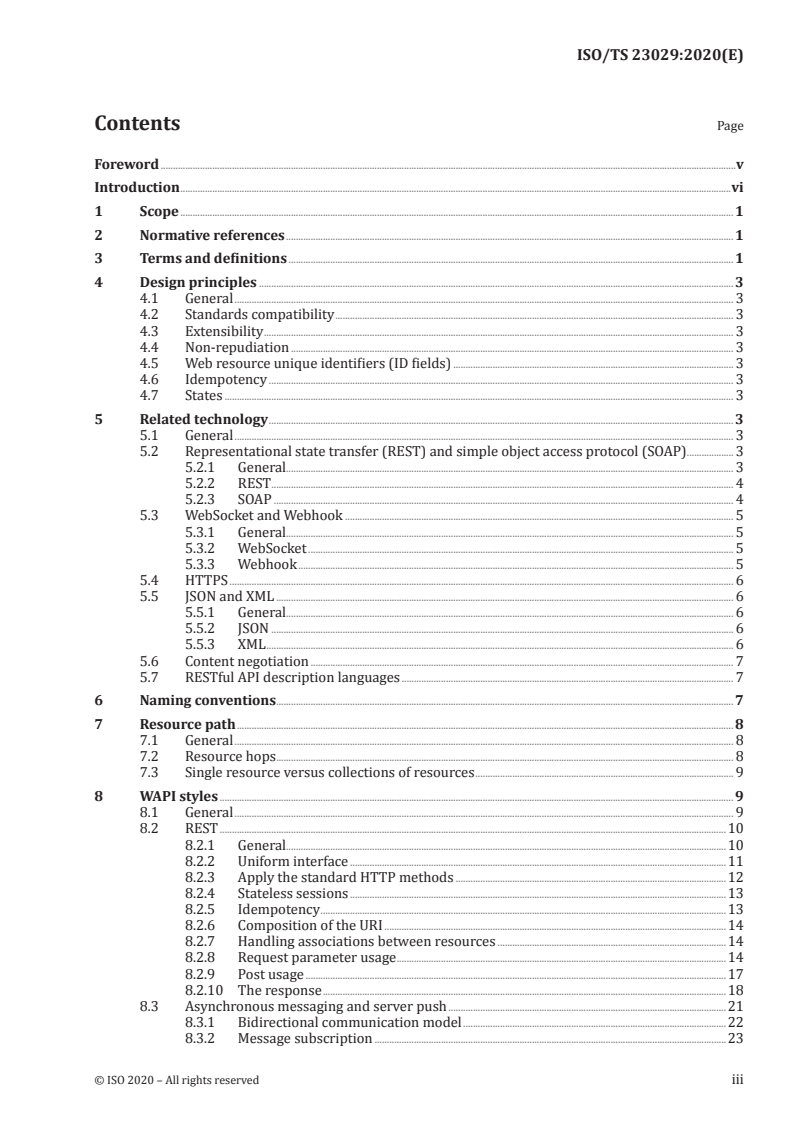
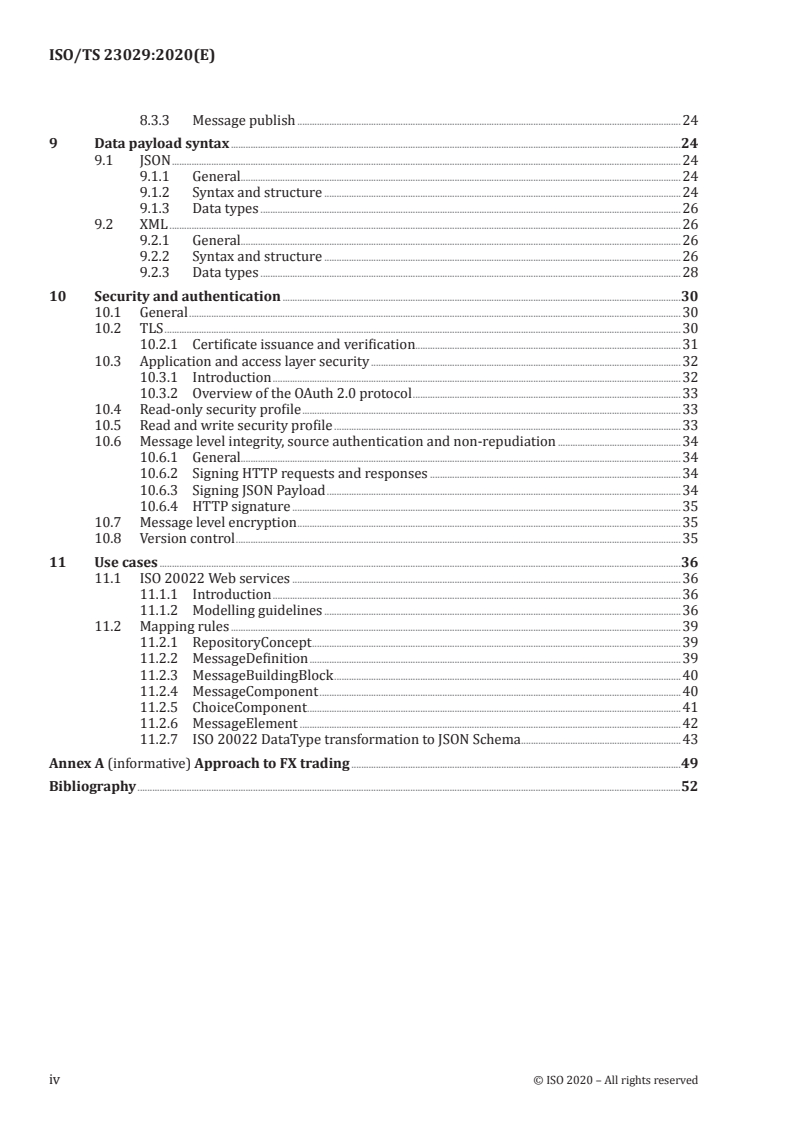
Contents Page
Foreword .v
Introduction .vi
1 Scope . 1
2 Normative references . 1
3 Terms and definitions . 1
4 Design principles . 3
4.1 General . 3
4.2 Standards compatibility . 3
4.3 Extensibility . 3
4.4 Non-repudiation . 3
4.5 Web resource unique identifiers (ID fields) . 3
4.6 Idempotency . 3
4.7 States . 3
5 Related technology . 3
5.1 General . 3
5.2 Representational state transfer (REST) and simple object access protocol (SOAP) . 3
5.2.1 General. 3
5.2.2 REST . 4
5.2.3 SOAP . 4
5.3 WebSocket and Webhook . 5
5.3.1 General. 5
5.3.2 WebSocket . 5
5.3.3 Webhook . 5
5.4 HTTPS . 6
5.5 JSON and XML . 6
5.5.1 General. 6
5.5.2 JSON . 6
5.5.3 XML . 6
5.6 Content negotiation . 7
5.7 RESTful API description languages . 7
6 Naming conventions . 7
7 Resource path . 8
7.1 General . 8
7.2 Resource hops . 8
7.3 Single resource versus collections of resources . 9
8 WAPI styles . 9
8.1 General . 9
8.2 REST .10
8.2.1 General.10
8.2.2 Uniform interface .11
8.2.3 Apply the standard HTTP methods .12
8.2.4 Stateless sessions .13
8.2.5 Idempotency .13
8.2.6 Composition of the URI .14
8.2.7 Handling associations between resources .14
8.2.8 Request parameter usage .14
8.2.9 Post usage .17
8.2.10 The response .18
8.3 Asynchronous messaging and server push .21
8.3.1 Bidirectional communication model .22
8.3.2 Message subscription .23
8.3.3 Message publish .24
9 Data payload syntax .24
9.1 JSON .24
9.1.1 General.24
9.1.2 Syntax and structure .24
9.1.3 Data types .26
9.2 XML .26
9.2.1 General.26
9.2.2 Syntax and structure .26
9.2.3 Data types .28
10 Security and authentication .30
10.1 General .30
10.2 TLS .30
10.2.1 Certificate issuance and verification.31
10.3 Application and access layer security .32
10.3.1 Introduction .32
10.3.2 Overview of the OAuth 2.0 protocol .33
10.4 Read-only security profile .33
10.5 Read and write security profile .33
10.6 Message level integrity, source authentication and non-repudiation .34
10.6.1 General.34
10.6.2 Signing HTTP requests and responses .34
10.6.3 Signing JSON Payload .34
10.6.4 HTTP signature .35
10.7 Message level encryption .35
10.8 Version control .35
11 Use cases .36
11.1 ISO 20022 Web services .36
11.1.1 Introduction .36
11.1.2 Modelling guidelines .36
11.2 Mapping rules .39
11.2.1 RepositoryConcept .39
11.2.2 MessageDefinition .39
11.2.3 MessageBuildingBlock .40
11.2.4 MessageComponent .40
11.2.5 ChoiceComponent .41
11.2.6 MessageElement .42
11.2.7 ISO 20022 DataType transformation to JSON Schema . .43
Annex A (informative) Approach to FX trading .49
Bibliography .52
iv © ISO 2020 – All rights reserved
Foreword
ISO (the International Organization for Standardization) is a worldwide federation of national standards
bodies (ISO member bodies). The work of preparing International Standards is normally carried out
through ISO technical committees. Each member body interested in a subject for which a technical
committee has been established has the right to be represented on that committee. International
organizations, governmental and non-governmental, in liaison with ISO, also take part in the work.
ISO collaborates closely with the International Electrotechnical Commission (IEC) on all matters of
electrotechnical standardization.
The procedures used to develop this document and those intended for its further maintenance are
described in the ISO/IEC Directives, Part 1. In particular, the different approval criteria needed for the
different types of ISO documents should be noted. This document was drafted in accordance with the
editorial rules of the ISO/IEC Directives, Part 2 (see www .iso .org/ directives).
Attention is drawn to the possibility that some of the elements of this document may be the subject of
patent rights. ISO shall not be held responsible for identifying any or all such patent rights. Details of
any patent rights identified during the development of the document will be in the Introduction and/or
on the ISO list of patent declarations received (see www .iso .org/ patents).
Any trade name used in this document is information given for the convenience of users and does not
constitute an endorsement.
For an explanation of the voluntary nature of standards, the meaning of ISO specific terms and
expressions related to conformity assessment, as well as information about ISO's adherence to the
World Trade Organization (WTO) principles in the Technical Barriers to Trade (TBT), see www .iso .org/
iso/ foreword .html.
This document was prepared by Technical Committee ISO/TC 68, Financial services, Subcommittee SC 9,
Information exchange for financial services.
Any feedback or questions on this document should be directed to the user’s national standards body. A
complete listing of these bodies can be found at www .iso .org/ members .html.
Introduction
0.1 Opening comments
The purpose of this document is to help implementers in the financial services industry define the
framework, function and protocols for an application programming interface (API) ecosystem, enabling
online synchronised interactions. It documents an international view of an API ecosystem in response
to an urgent and significant world-wide demand for guidance and standardisation of APIs in financial
services.
This has been driven by a number of emerging requirements – market-, corporate- and regulatory-
driven – from different communities and jurisdictions for financial institutions to share data and
enable functionality, such as between third parties acting on behalf of the customer, client or end user;
between business to business processes; and within internal processes. It has been widely agreed
that standardised APIs provide the most secure, developer-friendly, efficient, technically proven way
of meeting many of these requirements. Moreover, it is understood that a standardised approach
would unlock benefits conducive to promoting interoperability, enhancing security and supporting
innovation. The sharing of data, and the subsequent use of APIs, is not limited to exchanges referenced
in this document.
Despite these emerging requirements, there is currently no standardised approach at an international
level. Moreover, there is no informative documentation covering the various considerations for
developing APIs in financial services, especially given the maturity of some of its components (e.g.
some are in draft). This document has been developed in response to meet these current and foreseen
requirements that exist in the market. This document does not specify implementations of APIs, but
instead takes an international view and references, as appropriate, specific implementation scenarios
for illustrative purposes for guidance.
0.2 How to approach this document
This document should be approached as a best-practice framework for developing APIs in financial
services. In this sense, some aspects of the document are more mature than others. The document is
prescriptive where there is room to be. Where areas are less mature, commentary on best practice has
been provided and the considerations set out.
Broadly speaking, this document adopts the following logic and order:
— Clause 3: terms and definitions used in the document;
— Clause 4: the initial considerations for the design of the API;
— Clause 5: overview and commentary on the different technology options;
— Clause 8: specific guidance on APIs under WAPI technical specification.
In Annex A, we set out an example of how to approach the document depending on a specific business
area/desired API functionality.
vi © ISO 2020 – All rights reserved
TECHNICAL SPECIFICATION ISO/TS 23029:2020(E)
Web-service-based application programming interface
(WAPI) in financial services
1 Scope
This document defines the framework, function and protocols for an API ecosystem that will enable
online synchronised interaction. Specifically, the document:
— defines a logical and technical layered approach for developing APIs, including transformational
rules. Specific logical models (such as ISO 20022 models) are not included, but they will be referenced
in the context of specific scenarios for guidance purposes;
— will primarily be thought about from a RESTful design point of view, but will consider alternative
architectural styles (such as WebSocket and Webhook) where other blueprints or scenarios are
offered;
— defines for the API ecosystem design principles of an API, rules of a Web-service-based API, the data
payload and version control;
— sets out considerations relevant to security, identity and registration of an API ecosystem. Specific
technical solutions will not be defined, but they will be referenced in the context of specific scenarios
for guidance purposes;
— defines architectural usage beyond query/response asynchronous messaging towards publish/
subscribe to support advanced and existing business models.
This document does not include:
— a specific technical specification of an API implementation in financial services;
— the development of JSON APIs based on the ISO 20022 specific message formats, such as PAIN, CAMT
and PACS;
— a technical specification that is defined or determined by specific legal frameworks.
2 Normative references
There are no normative references in this document.
3 Terms and definitions
For the purposes of this document, the following terms and definitions apply.
ISO and IEC maintain terminological databases for use in standardization at the following addresses:
— ISO Online browsing platform: available at https:// www .iso .org/ obp
— IEC Electropedia: available at http:// www .electropedia .org/
3.1
application programming interface
API
set of well-defined methods, functions, protocols, routines or commands which application software
uses with facilities of programming languages to invoke services
Note 1 to entry: An API is available for different types of software, including Web-based system/ecosystem.
3.2
idempotency
idempotence
operation feature which means there is no additional effect if the operation is called more than once
Note 1 to entry: Idempotent operations are often used to design a Web-based system since it is hard to restrict
redundancy access.
3.3
JavaScript object notation
JSON
open and text-based exchange format
Note 1 to entry: Data transmitted in JSON formats make it easy to read and write (for humans), parse and
generate (for computers).
3.4
representational state transfer
REST
RESTful
software architectural style for distributed hypermedia systems Note 1 to entry: It was introduced and
defined in 2000 by Roy Fielding in his doctoral dissertation.
3.5
resource hop
resource locator built on resource type and identifier, mandatory except for the last resource
Note 1 to entry: A resource path is a chain of one or more resource hops.
3.6
RESTful API description language
language designed to provide a structured description of a RESTful Web API that is useful both to
humans and for automated machine processing
3.7
simple object access protocol
SOAP
messaging protocol specification for exchanging structured information in the implementation of Web
services in computer networks
3.8
WebSocket
protocol which enables two-way communication between a client running untrusted code in a
controlled environment to a remote host that has opted-in to communications from that code
3.9
Webhook
user-defined HTTP call-backs triggered by an event such as pushing code to a repository or a comment
being posted to a blog
3.10
XML
eXtensible Markup Language, a data format standard created by W3C
2 © ISO 2020 – All rights reserved
4 Design principles
4.1 General
This clause covers absolute principles for developing a Web API. It covers both standalone design
principles that shall be considered upfront when developing an API in financial services and principles
that apply to specific types of API and are discussed in more detail in Clause 8.
4.2 Standards compatibility
The WAPI advocates the use of ISO data standards wherever possible and practical as a best practice in
order to facilitate interoperability.
4.3 Extensibility
Where possible, design decisions for the API ecosystem should be designed to be as extensible as
possible. Data standards may change, but the API does not. This is to ensure that their use is able to
adapt to future use cases or scenarios.
4.4 Non-repudiation
Non-repudiation is important for the validity of data of exchange in Web APIs and will enforce the
confidence in the data to be exchanged. Digital signatures could be used in the context of an API.
4.5 Web resource unique identifiers (ID fields)
A Web resource should have a unique identifier (e.g. a primary key) that can be used to identify the
resource. These unique identifiers are used to construct URLs/URIs to identify and address specific
resources.
4.6 Idempotency
Idempotency shall be considered upfront for a Web API. This is covered in Clause 8.
4.7 States
There is a need to consider upfront what state will be required.
5 Related technology
5.1 General
This clause talks through related technology and provides some context on its use on APIs in financial
services. It does not include terms and definitions, as these are defined in Clause 3, and does not provide
specific guidance on how to approach the technology, as this is covered in Clause 8.
5.2 Representational state transfer (REST) and simple object access protocol (SOAP)
5.2.1 General
REST and SOAP provide ways to access Web services, and there are considerations for using both.
5.2.2 REST
REST or RESTful Web services provide the way to transfer the representational state of a resource and
to specify the action to be processed on this resource (see Clause 3). REST is the most popular to build a
Web service or define Web APIs due to its simplicity and compatibility with existing Internet standards
such as HTTP.
APIs typically use REST as it is more efficient (can use smaller message formats) and requires less
extensive processing. In most financial scenarios using RESTful APIs, the end user sends a message to
the server, which replies shortly after. For example, placing an order in a trade system or requesting the
balance on an account.
REST architecture can be exploited to implement these request-response communications. The REST
1)
architecture style is described by six constraints :
— Uniform interface: the uniform interface constraint defines the interface between clients and servers.
It simplifies and decouples the architecture, which enables each part to evolve independently.
— Stateless: one client can send multiple requests to the server; however, each of them shall be
independent, that is, every request shall contain all the necessary information so that the server
can understand it and process it accordingly. In this case, the server shall not hold any information
about the client state. Any information status shall stay on client – such as sessions.
— Cacheable: because many clients access the same server, and often request the same resources, it
is necessary for these responses to be cached, avoiding unnecessary processing and significantly
increasing performance.
— Client-server: the uniform interface separates clients from servers. This separation of concerns
means that, for example, clients are not concerned with data storage, which remains internal to
each server, so that the portability of client code is improved. Servers are not concerned with the
user interface or user state, so that servers can be simpler and more scalable. Servers and clients
may also be replaced and developed independently, as long as the interface is not altered.
— Layered system: a client cannot ordinarily tell whether they are connected directly to the end server,
or to an intermediary along the way. Intermediary servers may improve system scalability by
enabling load-balancing and by providing shared caches. Layers may also enforce security policies.
— Code-on-demand (optional): this condition allows the customer to run some code on demand,
that is, extend part of server logic to the client, either through an applet or scripts. Thus, different
customers may behave in specific ways even when using exactly the same services provided by the
server. As this item is not part of the architecture itself, it is considered optional. It can be used when
performing some of the client-side service which is faster or more efficient.
5.2.3 SOAP
SOAP is a messaging protocol specification for exchanging structured information in the
implementation of Web services in computer networks. Its purpose is to induce extensibility, neutrality
and independence. It uses XML information set for its message format, and relies on application layer
protocols, most often Hypertext Transfer Protocol (HTTP) or Simple Mail Transfer Protocol (SMTP), for
message negotiation and transmission.
SOAP allows processes running on disparate operating systems (such as Windows and Linux) to
communicate using XML. Since Web protocols like HTTP are installed and running on all operating
systems, SOAP allows clients to invoke Web services and receive responses independent of language
and platforms.
1) R.T. Fielding, Architectural Styles and the Design of Network-based Software Architectures. University of California,
Irvine, 2000.
4 © ISO 2020 – All rights reserved
5.3 WebSocket and Webhook
5.3.1 General
WebSocket and Webhook protocols exist for scenarios that REST cannot cater for, such as supporting
unsolicited responses, specifically:
— client-to-client architectures (Webhook may be used);
— client-to-server architectures (WebSocket may be used);
— any kind of publish/subscribe implementation.
5.3.2 WebSocket
2)
As detailed in RFC6455 , the WebSocket protocol enables two-way communication between a
client running untrusted code in a controlled environment to a remote host that has opted in to
communications from that code. The security model used for this is the origin-based security model
commonly used by Web browsers.
The goal of this technology is to provide a mechanism for browser-based applications that need two-
way communication with servers that does not rely on opening multiple HTTP connections (e.g. using
XMLHttpRequest or s and long polling). In the case of massive data transporting or events</br>
driven by the server, WebSocket performs better than HTTP, for example market data distribution and</br>
market announcement publishing.</br>
Features:</br>
— The WebSocket protocol (IETF RFC 6455) is supported by most browsers, but a client may be any</br>
software agent.</br>
— A session is initiated by an HTTP request for protocol upgrade. Transport Layer Security (TLS)</br>
handshake is supported for authentication, and cipher suites may be negotiated for privacy and</br>
non-repudiation.</br>
— After initial handshake, a session becomes a bidirectional, asynchronous messaging protocol. There</br>
is no need for a polling mechanism as either side may push unsolicited messages.</br>
— Two subprotocols are defined: text messages, such as JavaScript object notation (JSON) or XML, and</br>
binary messages, such as simple binary encoding. More than one subprotocol may be supported by a</br>
peer, if desired. Other subprotocols may be registered with IANA, for example ISO 20022 messages.</br>
— WebSocket is layered over TCP. It inherits its reliability and flow control features. However,</br>
WebSocket frames messages over a TCP stream. Therefore, applications need not be concerned with</br>
framing.</br>
— No session protocol headers are imposed on application messages. Messages are self-contained and</br>
therefore can be serialized or forwarded as a unit (in contrast to HTTP where semantic information</br>
is dispersed over payload, URI and headers).</br>
— The session protocol provides no mechanism to correlate requests with responses because it is an</br>
event-driven protocol rather than a request/response protocol. Correlation of events is performed</br>
at the application layer with transaction IDs and the like.</br>
5.3.3 Webhook</br>
Webhook are sometimes referred to as reverse APIs. Webhook are user-defined HTTP call-backs. They</br>
are usually triggered by some event, such as pushing code to a repository or a comment being posted</br>
to a blog. When that event occurs, the source site makes an HTTP request to the URL configured for the</br>
2) https:// tools .ietf .org/ html/ rfc6455</br>
Webhook. Users can configure them to cause events on one site to invoke behaviour on another. The</br>
action taken may be anything. Common uses are to trigger builds with continuous integration systems</br>
or to notify bug-tracking systems. Since they use HTTP, they can be integrated into Web services</br>
without adding new infrastructure.</br>
5.4 HTTPS</br>
HTTP is widely used for distributed, collaborative and information systems. Hypertext is structured</br>
text that uses logical links (hyperlinks) between nodes containing text. HTTP is the most used protocol</br>
to exchange or transfer hypertext.</br>
A later version, the successor, was standardized in 2015, and is now supported by major Web servers</br>
and browsers over TLS using the Application-Layer Protocol Negotiation extension where TLS 1.2 or</br>
newer is required. In this specification, HTTP/1.1[RFC7230-RFC7235] and HTTP/2.0 are recommended.</br>
Although HTTP 1.1 used to be the mainstream of the market, due to the advantages of HTTP 2.0, most</br>
browsers have begun to support HTTP 2.0. It is believed that HTTP 2.0 will become popular in the next</br>
few years.</br>
HTTPS (HTTP over SSL or HTTP Secure) is the use of Secure Socket Layer (SSL) or TLS as a sublayer</br>
under regular HTTP application layering. HTTPS encrypts and decrypts user page requests as well as</br>
the pages that are returned by the Web server. The use of HTTPS protects against eavesdropping and</br>
man-in-the-middle attacks.</br>
5.5 JSON and XML</br>
5.5.1 General</br>
In Web communication scenarios, the two most used structured data formats for data exchanging are</br>
3) 4)</br>
JSON [RFC8259] and XML .</br>
5.5.2 JSON</br>
JSON is a lightweight, text-based data format widely used in Web-based communication, including as a</br>
replacement for XML.</br>
Compared with XML format, JSON has several advantages:</br>
— less verbose than XML, as XML necessitates opening and closing tags, and JSON has concise syntax</br>
like using name/value pairs and separated with "{" and "}";</br>
— allows for direct mapping onto the corresponding data structures in the host language, corresponding</br>
directly to the object of JavaScript.</br>
JSON is simple, since it supports a variety of server-side languages and native new data. JSON format</br>
can be directly used for server-side code, which greatly simplifies the server-side and client-side code</br>
development, reducing the consumption of network bandwidth and making it easy to maintain.</br>
5.5.3 XML</br>
XML is a data format standard created by W3C. There are several advantages that XML has over JSON:</br>
— can put metadata into the tags in the form of attributes;</br>
— most browsers render XML in a highly readable and organized way;</br>
— has the concept of schema, supporting strong typing and user-defined types and allowing validation;</br>
3) https:// tools .ietf .org/ html/ rfc8259</br>
4) https:// www .w3 .org/ standards/ xml/ core</br>
6 © ISO 2020 – All rights reserved</br>
</br>
— supports comments.</br>
In summary, JSON is a lightweight solution, easier for a programmer to use; XML is a heavier solution</br>
and, while more functional, is restrictive. Each solution applies to a specific financial Web service.</br>
5.6 Content negotiation</br>
Content negotiation refers to the mechanism in which a client and server negotiate the style of content</br>
that is returned from the server. The client can request a certain style of document using the following</br>
HTTP headers: Accept, Accept-Language, Accept-Charset. These refer to the format of the document,</br>
language of the document and the character set of the document, respectively.</br>
On receipt of the HTTP request, a server shall look at the Accept header to determine whether or not</br>
it is acceptable. If it is not acceptable then the server shall return an HTTP 406 Not Acceptable status</br>
code. If the request is acceptable, the server shall attach the correct MIME type for the request in</br>
the Content-Type response header. The server may choose to respect the language and character set</br>
preferences of the browser to also format the response. If the server chooses to obey the Accept-Language</br>
and Accept-Charset headers, the response headers used should be Content-Language for the Accept-</br>
Language header and the Content-Type should be appended with the character set information.</br>
5.7 RESTful API description languages</br>
RESTful API description languages are formal languages designed to provide a structured description</br>
of a RESTful Web API that is useful both to a human and for automated machine processing. The</br>
structured description might be used to generate documentation for human programmers; such</br>
documentation may be easier to read than free-form documentation, since all documentation generated</br>
follows the same rules and formatting conventions. Additionally, the description language is usually</br>
precise enough to allow automated generation of various software artifacts, like libraries, to access the</br>
API from various programming languages, which takes the burden of manually creating them off the</br>
programmers.</br>
The RESTful API description language is usually neutral, language-agnostic and industry-agnostic.</br>
It does not define API itself, but is useful for designers, programmers and users of an API ecosystem,</br>
especially in building up large-scale APIs. In essence, RESTful API description language is a software</br>
engineering methodology but a computer architectural or communication technology. The community</br>
around RESTful API description languages is active and the landscape is still changing. Up to now, the</br>
most active projects in this area have been OpenAPI Specification, RAML and API Blueprint.</br>
— OpenAPI Specification: originally known as the Swagger Specification, this is a specification for</br>
machine-readable interface files for describing, producing, consuming and visualizing RESTful Web</br>
services. It became an open source collaborative project of the Linux Foundation in 2016. The latest</br>
version is 3.0. https:// swagger .io/ specification/</br>
— RAML: a YAML-based language for describing RESTful APIs. It provides all the information</br>
necessary to describe RESTful or practically RESTful APIs. Although designed with RESTful APIs</br>
in mind, RAML is capable of describing APIs that do not obey all the constraints of REST (hence the</br>
description "practically RESTful"). It encourages reuse, enables discovery and pattern-sharing and</br>
aims for merit-based emergence of best practices. https:// raml .org/</br>
— API Blueprint: a documentation-oriented Web API description language. The API Blueprint is</br>
essentially a set of semantic assumptions laid on top of the Markdown syntax used to describe a</br>
Web API. https:// apiblueprint .org/</br>
6 Naming conventions</br>
Table 1 lists the applicable character case conventions that WAPIs should follow.</br>
Table 1 — Applicable character case conventions that WAPIs should follow</br>
API element Rules Example</br>
HTTP headers Although RFC 2616 specifies that Train-case is the most widely Accept-Charset</br>
HTTP headers are case insensitive, used formalism. Words are</br>
it should be best practice to adopt, capitalised and separated with</br>
within an API specification, the hyphens (-)</br>
same character case for all header</br>
Acronyms should be capitalised WWW-Authenticate</br>
definitions</br>
[RFC 6648] Custom proprietary</br>
"X-"type headers should be avoided</br>
Query The most used formalisms are snake_case: Words are in lower currency_code</br>
parameters case and separated with</br>
underscores (_)</br>
lowerCamelCase: spaces and currencyCode</br>
punctuation are removed and</br>
the first letter of each word,</br>
except the first one, is</br>
capitalised</br>
Resource_path See below</br>
Request The most used formalisms are snake_case: Words are in lower currency_code</br>
body case</br>
<b>...</b>
TECHNICAL ISO/TS
SPECIFICATION 23029
First edition
2020-02
Web-service-based application
programming interface (WAPI) in
financial services
Reference number
©
ISO 2020
© ISO 2020
All rights reserved. Unless otherwise specified, or required in the context of its implementation, no part of this publication may
be reproduced or utilized otherwise in any form or by any means, electronic or mechanical, including photocopying, or posting
on the internet or an intranet, without prior written permission. Permission can be requested from either ISO at the address
below or ISO’s member body in the country of the requester.
ISO copyright office
CP 401 • Ch. de Blandonnet 8
CH-1214 Vernier, Geneva
Phone: +41 22 749 01 11
Fax: +41 22 749 09 47
Email: copyright@iso.org
Website: www.iso.org
Published in Switzerland
ii © ISO 2020 – All rights reserved
Contents Page
Foreword .v
Introduction .vi
1 Scope . 1
2 Normative references . 1
3 Terms and definitions . 1
4 Design principles . 3
4.1 General . 3
4.2 Standards compatibility . 3
4.3 Extensibility . 3
4.4 Non-repudiation . 3
4.5 Web resource unique identifiers (ID fields) . 3
4.6 Idempotency . 3
4.7 States . 3
5 Related technology . 3
5.1 General . 3
5.2 Representational state transfer (REST) and simple object access protocol (SOAP) . 3
5.2.1 General. 3
5.2.2 REST . 4
5.2.3 SOAP . 4
5.3 WebSocket and Webhook . 5
5.3.1 General. 5
5.3.2 WebSocket . 5
5.3.3 Webhook . 5
5.4 HTTPS . 6
5.5 JSON and XML . 6
5.5.1 General. 6
5.5.2 JSON . 6
5.5.3 XML . 6
5.6 Content negotiation . 7
5.7 RESTful API description languages . 7
6 Naming conventions . 7
7 Resource path . 8
7.1 General . 8
7.2 Resource hops . 8
7.3 Single resource versus collections of resources . 9
8 WAPI styles . 9
8.1 General . 9
8.2 REST .10
8.2.1 General.10
8.2.2 Uniform interface .11
8.2.3 Apply the standard HTTP methods .12
8.2.4 Stateless sessions .13
8.2.5 Idempotency .13
8.2.6 Composition of the URI .14
8.2.7 Handling associations between resources .14
8.2.8 Request parameter usage .14
8.2.9 Post usage .17
8.2.10 The response .18
8.3 Asynchronous messaging and server push .21
8.3.1 Bidirectional communication model .22
8.3.2 Message subscription .23
8.3.3 Message publish .24
9 Data payload syntax .24
9.1 JSON .24
9.1.1 General.24
9.1.2 Syntax and structure .24
9.1.3 Data types .26
9.2 XML .26
9.2.1 General.26
9.2.2 Syntax and structure .26
9.2.3 Data types .28
10 Security and authentication .30
10.1 General .30
10.2 TLS .30
10.2.1 Certificate issuance and verification.31
10.3 Application and access layer security .32
10.3.1 Introduction .32
10.3.2 Overview of the OAuth 2.0 protocol .33
10.4 Read-only security profile .33
10.5 Read and write security profile .33
10.6 Message level integrity, source authentication and non-repudiation .34
10.6.1 General.34
10.6.2 Signing HTTP requests and responses .34
10.6.3 Signing JSON Payload .34
10.6.4 HTTP signature .35
10.7 Message level encryption .35
10.8 Version control .35
11 Use cases .36
11.1 ISO 20022 Web services .36
11.1.1 Introduction .36
11.1.2 Modelling guidelines .36
11.2 Mapping rules .39
11.2.1 RepositoryConcept .39
11.2.2 MessageDefinition .39
11.2.3 MessageBuildingBlock .40
11.2.4 MessageComponent .40
11.2.5 ChoiceComponent .41
11.2.6 MessageElement .42
11.2.7 ISO 20022 DataType transformation to JSON Schema . .43
Annex A (informative) Approach to FX trading .49
Bibliography .52
iv © ISO 2020 – All rights reserved
Foreword
ISO (the International Organization for Standardization) is a worldwide federation of national standards
bodies (ISO member bodies). The work of preparing International Standards is normally carried out
through ISO technical committees. Each member body interested in a subject for which a technical
committee has been established has the right to be represented on that committee. International
organizations, governmental and non-governmental, in liaison with ISO, also take part in the work.
ISO collaborates closely with the International Electrotechnical Commission (IEC) on all matters of
electrotechnical standardization.
The procedures used to develop this document and those intended for its further maintenance are
described in the ISO/IEC Directives, Part 1. In particular, the different approval criteria needed for the
different types of ISO documents should be noted. This document was drafted in accordance with the
editorial rules of the ISO/IEC Directives, Part 2 (see www .iso .org/ directives).
Attention is drawn to the possibility that some of the elements of this document may be the subject of
patent rights. ISO shall not be held responsible for identifying any or all such patent rights. Details of
any patent rights identified during the development of the document will be in the Introduction and/or
on the ISO list of patent declarations received (see www .iso .org/ patents).
Any trade name used in this document is information given for the convenience of users and does not
constitute an endorsement.
For an explanation of the voluntary nature of standards, the meaning of ISO specific terms and
expressions related to conformity assessment, as well as information about ISO's adherence to the
World Trade Organization (WTO) principles in the Technical Barriers to Trade (TBT), see www .iso .org/
iso/ foreword .html.
This document was prepared by Technical Committee ISO/TC 68, Financial services, Subcommittee SC 9,
Information exchange for financial services.
Any feedback or questions on this document should be directed to the user’s national standards body. A
complete listing of these bodies can be found at www .iso .org/ members .html.
Introduction
0.1 Opening comments
The purpose of this document is to help implementers in the financial services industry define the
framework, function and protocols for an application programming interface (API) ecosystem, enabling
online synchronised interactions. It documents an international view of an API ecosystem in response
to an urgent and significant world-wide demand for guidance and standardisation of APIs in financial
services.
This has been driven by a number of emerging requirements – market-, corporate- and regulatory-
driven – from different communities and jurisdictions for financial institutions to share data and
enable functionality, such as between third parties acting on behalf of the customer, client or end user;
between business to business processes; and within internal processes. It has been widely agreed
that standardised APIs provide the most secure, developer-friendly, efficient, technically proven way
of meeting many of these requirements. Moreover, it is understood that a standardised approach
would unlock benefits conducive to promoting interoperability, enhancing security and supporting
innovation. The sharing of data, and the subsequent use of APIs, is not limited to exchanges referenced
in this document.
Despite these emerging requirements, there is currently no standardised approach at an international
level. Moreover, there is no informative documentation covering the various considerations for
developing APIs in financial services, especially given the maturity of some of its components (e.g.
some are in draft). This document has been developed in response to meet these current and foreseen
requirements that exist in the market. This document does not specify implementations of APIs, but
instead takes an international view and references, as appropriate, specific implementation scenarios
for illustrative purposes for guidance.
0.2 How to approach this document
This document should be approached as a best-practice framework for developing APIs in financial
services. In this sense, some aspects of the document are more mature than others. The document is
prescriptive where there is room to be. Where areas are less mature, commentary on best practice has
been provided and the considerations set out.
Broadly speaking, this document adopts the following logic and order:
— Clause 3: terms and definitions used in the document;
— Clause 4: the initial considerations for the design of the API;
— Clause 5: overview and commentary on the different technology options;
— Clause 8: specific guidance on APIs under WAPI technical specification.
In Annex A, we set out an example of how to approach the document depending on a specific business
area/desired API functionality.
vi © ISO 2020 – All rights reserved
TECHNICAL SPECIFICATION ISO/TS 23029:2020(E)
Web-service-based application programming interface
(WAPI) in financial services
1 Scope
This document defines the framework, function and protocols for an API ecosystem that will enable
online synchronised interaction. Specifically, the document:
— defines a logical and technical layered approach for developing APIs, including transformational
rules. Specific logical models (such as ISO 20022 models) are not included, but they will be referenced
in the context of specific scenarios for guidance purposes;
— will primarily be thought about from a RESTful design point of view, but will consider alternative
architectural styles (such as WebSocket and Webhook) where other blueprints or scenarios are
offered;
— defines for the API ecosystem design principles of an API, rules of a Web-service-based API, the data
payload and version control;
— sets out considerations relevant to security, identity and registration of an API ecosystem. Specific
technical solutions will not be defined, but they will be referenced in the context of specific scenarios
for guidance purposes;
— defines architectural usage beyond query/response asynchronous messaging towards publish/
subscribe to support advanced and existing business models.
This document does not include:
— a specific technical specification of an API implementation in financial services;
— the development of JSON APIs based on the ISO 20022 specific message formats, such as PAIN, CAMT
and PACS;
— a technical specification that is defined or determined by specific legal frameworks.
2 Normative references
There are no normative references in this document.
3 Terms and definitions
For the purposes of this document, the following terms and definitions apply.
ISO and IEC maintain terminological databases for use in standardization at the following addresses:
— ISO Online browsing platform: available at https:// www .iso .org/ obp
— IEC Electropedia: available at http:// www .electropedia .org/
3.1
application programming interface
API
set of well-defined methods, functions, protocols, routines or commands which application software
uses with facilities of programming languages to invoke services
Note 1 to entry: An API is available for different types of software, including Web-based system/ecosystem.
3.2
idempotency
idempotence
operation feature which means there is no additional effect if the operation is called more than once
Note 1 to entry: Idempotent operations are often used to design a Web-based system since it is hard to restrict
redundancy access.
3.3
JavaScript object notation
JSON
open and text-based exchange format
Note 1 to entry: Data transmitted in JSON formats make it easy to read and write (for humans), parse and
generate (for computers).
3.4
representational state transfer
REST
RESTful
software architectural style for distributed hypermedia systems Note 1 to entry: It was introduced and
defined in 2000 by Roy Fielding in his doctoral dissertation.
3.5
resource hop
resource locator built on resource type and identifier, mandatory except for the last resource
Note 1 to entry: A resource path is a chain of one or more resource hops.
3.6
RESTful API description language
language designed to provide a structured description of a RESTful Web API that is useful both to
humans and for automated machine processing
3.7
simple object access protocol
SOAP
messaging protocol specification for exchanging structured information in the implementation of Web
services in computer networks
3.8
WebSocket
protocol which enables two-way communication between a client running untrusted code in a
controlled environment to a remote host that has opted-in to communications from that code
3.9
Webhook
user-defined HTTP call-backs triggered by an event such as pushing code to a repository or a comment
being posted to a blog
3.10
XML
eXtensible Markup Language, a data format standard created by W3C
2 © ISO 2020 – All rights reserved
4 Design principles
4.1 General
This clause covers absolute principles for developing a Web API. It covers both standalone design
principles that shall be considered upfront when developing an API in financial services and principles
that apply to specific types of API and are discussed in more detail in Clause 8.
4.2 Standards compatibility
The WAPI advocates the use of ISO data standards wherever possible and practical as a best practice in
order to facilitate interoperability.
4.3 Extensibility
Where possible, design decisions for the API ecosystem should be designed to be as extensible as
possible. Data standards may change, but the API does not. This is to ensure that their use is able to
adapt to future use cases or scenarios.
4.4 Non-repudiation
Non-repudiation is important for the validity of data of exchange in Web APIs and will enforce the
confidence in the data to be exchanged. Digital signatures could be used in the context of an API.
4.5 Web resource unique identifiers (ID fields)
A Web resource should have a unique identifier (e.g. a primary key) that can be used to identify the
resource. These unique identifiers are used to construct URLs/URIs to identify and address specific
resources.
4.6 Idempotency
Idempotency shall be considered upfront for a Web API. This is covered in Clause 8.
4.7 States
There is a need to consider upfront what state will be required.
5 Related technology
5.1 General
This clause talks through related technology and provides some context on its use on APIs in financial
services. It does not include terms and definitions, as these are defined in Clause 3, and does not provide
specific guidance on how to approach the technology, as this is covered in Clause 8.
5.2 Representational state transfer (REST) and simple object access protocol (SOAP)
5.2.1 General
REST and SOAP provide ways to access Web services, and there are considerations for using both.
5.2.2 REST
REST or RESTful Web services provide the way to transfer the representational state of a resource and
to specify the action to be processed on this resource (see Clause 3). REST is the most popular to build a
Web service or define Web APIs due to its simplicity and compatibility with existing Internet standards
such as HTTP.
APIs typically use REST as it is more efficient (can use smaller message formats) and requires less
extensive processing. In most financial scenarios using RESTful APIs, the end user sends a message to
the server, which replies shortly after. For example, placing an order in a trade system or requesting the
balance on an account.
REST architecture can be exploited to implement these request-response communications. The REST
1)
architecture style is described by six constraints :
— Uniform interface: the uniform interface constraint defines the interface between clients and servers.
It simplifies and decouples the architecture, which enables each part to evolve independently.
— Stateless: one client can send multiple requests to the server; however, each of them shall be
independent, that is, every request shall contain all the necessary information so that the server
can understand it and process it accordingly. In this case, the server shall not hold any information
about the client state. Any information status shall stay on client – such as sessions.
— Cacheable: because many clients access the same server, and often request the same resources, it
is necessary for these responses to be cached, avoiding unnecessary processing and significantly
increasing performance.
— Client-server: the uniform interface separates clients from servers. This separation of concerns
means that, for example, clients are not concerned with data storage, which remains internal to
each server, so that the portability of client code is improved. Servers are not concerned with the
user interface or user state, so that servers can be simpler and more scalable. Servers and clients
may also be replaced and developed independently, as long as the interface is not altered.
— Layered system: a client cannot ordinarily tell whether they are connected directly to the end server,
or to an intermediary along the way. Intermediary servers may improve system scalability by
enabling load-balancing and by providing shared caches. Layers may also enforce security policies.
— Code-on-demand (optional): this condition allows the customer to run some code on demand,
that is, extend part of server logic to the client, either through an applet or scripts. Thus, different
customers may behave in specific ways even when using exactly the same services provided by the
server. As this item is not part of the architecture itself, it is considered optional. It can be used when
performing some of the client-side service which is faster or more efficient.
5.2.3 SOAP
SOAP is a messaging protocol specification for exchanging structured information in the
implementation of Web services in computer networks. Its purpose is to induce extensibility, neutrality
and independence. It uses XML information set for its message format, and relies on application layer
protocols, most often Hypertext Transfer Protocol (HTTP) or Simple Mail Transfer Protocol (SMTP), for
message negotiation and transmission.
SOAP allows processes running on disparate operating systems (such as Windows and Linux) to
communicate using XML. Since Web protocols like HTTP are installed and running on all operating
systems, SOAP allows clients to invoke Web services and receive responses independent of language
and platforms.
1) R.T. Fielding, Architectural Styles and the Design of Network-based Software Architectures. University of California,
Irvine, 2000.
4 © ISO 2020 – All rights reserved
5.3 WebSocket and Webhook
5.3.1 General
WebSocket and Webhook protocols exist for scenarios that REST cannot cater for, such as supporting
unsolicited responses, specifically:
— client-to-client architectures (Webhook may be used);
— client-to-server architectures (WebSocket may be used);
— any kind of publish/subscribe implementation.
5.3.2 WebSocket
2)
As detailed in RFC6455 , the WebSocket protocol enables two-way communication between a
client running untrusted code in a controlled environment to a remote host that has opted in to
communications from that code. The security model used for this is the origin-based security model
commonly used by Web browsers.
The goal of this technology is to provide a mechanism for browser-based applications that need two-
way communication with servers that does not rely on opening multiple HTTP connections (e.g. using
XMLHttpRequest or s and long polling). In the case of massive data transporting or events</br>
driven by the server, WebSocket performs better than HTTP, for example market data distribution and</br>
market announcement publishing.</br>
Features:</br>
— The WebSocket protocol (IETF RFC 6455) is supported by most browsers, but a client may be any</br>
software agent.</br>
— A session is initiated by an HTTP request for protocol upgrade. Transport Layer Security (TLS)</br>
handshake is supported for authentication, and cipher suites may be negotiated for privacy and</br>
non-repudiation.</br>
— After initial handshake, a session becomes a bidirectional, asynchronous messaging protocol. There</br>
is no need for a polling mechanism as either side may push unsolicited messages.</br>
— Two subprotocols are defined: text messages, such as JavaScript object notation (JSON) or XML, and</br>
binary messages, such as simple binary encoding. More than one subprotocol may be supported by a</br>
peer, if desired. Other subprotocols may be registered with IANA, for example ISO 20022 messages.</br>
— WebSocket is layered over TCP. It inherits its reliability and flow control features. However,</br>
WebSocket frames messages over a TCP stream. Therefore, applications need not be concerned with</br>
framing.</br>
— No session protocol headers are imposed on application messages. Messages are self-contained and</br>
therefore can be serialized or forwarded as a unit (in contrast to HTTP where semantic information</br>
is dispersed over payload, URI and headers).</br>
— The session protocol provides no mechanism to correlate requests with responses because it is an</br>
event-driven protocol rather than a request/response protocol. Correlation of events is performed</br>
at the application layer with transaction IDs and the like.</br>
5.3.3 Webhook</br>
Webhook are sometimes referred to as reverse APIs. Webhook are user-defined HTTP call-backs. They</br>
are usually triggered by some event, such as pushing code to a repository or a comment being posted</br>
to a blog. When that event occurs, the source site makes an HTTP request to the URL configured for the</br>
2) https:// tools .ietf .org/ html/ rfc6455</br>
Webhook. Users can configure them to cause events on one site to invoke behaviour on another. The</br>
action taken may be anything. Common uses are to trigger builds with continuous integration systems</br>
or to notify bug-tracking systems. Since they use HTTP, they can be integrated into Web services</br>
without adding new infrastructure.</br>
5.4 HTTPS</br>
HTTP is widely used for distributed, collaborative and information systems. Hypertext is structured</br>
text that uses logical links (hyperlinks) between nodes containing text. HTTP is the most used protocol</br>
to exchange or transfer hypertext.</br>
A later version, the successor, was standardized in 2015, and is now supported by major Web servers</br>
and browsers over TLS using the Application-Layer Protocol Negotiation extension where TLS 1.2 or</br>
newer is required. In this specification, HTTP/1.1[RFC7230-RFC7235] and HTTP/2.0 are recommended.</br>
Although HTTP 1.1 used to be the mainstream of the market, due to the advantages of HTTP 2.0, most</br>
browsers have begun to support HTTP 2.0. It is believed that HTTP 2.0 will become popular in the next</br>
few years.</br>
HTTPS (HTTP over SSL or HTTP Secure) is the use of Secure Socket Layer (SSL) or TLS as a sublayer</br>
under regular HTTP application layering. HTTPS encrypts and decrypts user page requests as well as</br>
the pages that are returned by the Web server. The use of HTTPS protects against eavesdropping and</br>
man-in-the-middle attacks.</br>
5.5 JSON and XML</br>
5.5.1 General</br>
In Web communication scenarios, the two most used structured data formats for data exchanging are</br>
3) 4)</br>
JSON [RFC8259] and XML .</br>
5.5.2 JSON</br>
JSON is a lightweight, text-based data format widely used in Web-based communication, including as a</br>
replacement for XML.</br>
Compared with XML format, JSON has several advantages:</br>
— less verbose than XML, as XML necessitates opening and closing tags, and JSON has concise syntax</br>
like using name/value pairs and separated with "{" and "}";</br>
— allows for direct mapping onto the corresponding data structures in the host language, corresponding</br>
directly to the object of JavaScript.</br>
JSON is simple, since it supports a variety of server-side languages and native new data. JSON format</br>
can be directly used for server-side code, which greatly simplifies the server-side and client-side code</br>
development, reducing the consumption of network bandwidth and making it easy to maintain.</br>
5.5.3 XML</br>
XML is a data format standard created by W3C. There are several advantages that XML has over JSON:</br>
— can put metadata into the tags in the form of attributes;</br>
— most browsers render XML in a highly readable and organized way;</br>
— has the concept of schema, supporting strong typing and user-defined types and allowing validation;</br>
3) https:// tools .ietf .org/ html/ rfc8259</br>
4) https:// www .w3 .org/ standards/ xml/ core</br>
6 © ISO 2020 – All rights reserved</br>
</br>
— supports comments.</br>
In summary, JSON is a lightweight solution, easier for a programmer to use; XML is a heavier solution</br>
and, while more functional, is restrictive. Each solution applies to a specific financial Web service.</br>
5.6 Content negotiation</br>
Content negotiation refers to the mechanism in which a client and server negotiate the style of content</br>
that is returned from the server. The client can request a certain style of document using the following</br>
HTTP headers: Accept, Accept-Language, Accept-Charset. These refer to the format of the document,</br>
language of the document and the character set of the document, respectively.</br>
On receipt of the HTTP request, a server shall look at the Accept header to determine whether or not</br>
it is acceptable. If it is not acceptable then the server shall return an HTTP 406 Not Acceptable status</br>
code. If the request is acceptable, the server shall attach the correct MIME type for the request in</br>
the Content-Type response header. The server may choose to respect the language and character set</br>
preferences of the browser to also format the response. If the server chooses to obey the Accept-Language</br>
and Accept-Charset headers, the response headers used should be Content-Language for the Accept-</br>
Language header and the Content-Type should be appended with the character set information.</br>
5.7 RESTful API description languages</br>
RESTful API description languages are formal languages designed to provide a structured description</br>
of a RESTful Web API that is useful both to a human and for automated machine processing. The</br>
structured description might be used to generate documentation for human programmers; such</br>
documentation may be easier to read than free-form documentation, since all documentation generated</br>
follows the same rules and formatting conventions. Additionally, the description language is usually</br>
precise enough to allow automated generation of various software artifacts, like libraries, to access the</br>
API from various programming languages, which takes the burden of manually creating them off the</br>
programmers.</br>
The RESTful API description language is usually neutral, language-agnostic and industry-agnostic.</br>
It does not define API itself, but is useful for designers, programmers and users of an API ecosystem,</br>
especially in building up large-scale APIs. In essence, RESTful API description language is a software</br>
engineering methodology but a computer architectural or communication technology. The community</br>
around RESTful API description languages is active and the landscape is still changing. Up to now, the</br>
most active projects in this area have been OpenAPI Specification, RAML and API Blueprint.</br>
— OpenAPI Specification: originally known as the Swagger Specification, this is a specification for</br>
machine-readable interface files for describing, producing, consuming and visualizing RESTful Web</br>
services. It became an open source collaborative project of the Linux Foundation in 2016. The latest</br>
version is 3.0. https:// swagger .io/ specification/</br>
— RAML: a YAML-based language for describing RESTful APIs. It provides all the information</br>
necessary to describe RESTful or practically RESTful APIs. Although designed with RESTful APIs</br>
in mind, RAML is capable of describing APIs that do not obey all the constraints of REST (hence the</br>
description "practically RESTful"). It encourages reuse, enables discovery and pattern-sharing and</br>
aims for merit-based emergence of best practices. https:// raml .org/</br>
— API Blueprint: a documentation-oriented Web API description language. The API Blueprint is</br>
essentially a set of semantic assumptions laid on top of the Markdown syntax used to describe a</br>
Web API. https:// apiblueprint .org/</br>
6 Naming conventions</br>
Table 1 lists the applicable character case conventions that WAPIs should follow.</br>
Table 1 — Applicable character case conventions that WAPIs should follow</br>
API element Rules Example</br>
HTTP headers Although RFC 2616 specifies that Train-case is the most widely Accept-Charset</br>
HTTP headers are case insensitive, used formalism. Words are</br>
it should be best practice to adopt, capitalised and separated with</br>
within an API specification, the hyphens (-)</br>
same character case for all header</br>
Acronyms should be capitalised WWW-Authenticate</br>
definitions</br>
[RFC 6648] Custom proprietary</br>
"X-"type headers should be avoided</br>
Query The most used formalisms are snake_case: Words are in lower currency_code</br>
parameters case and separated with</br>
underscores (_)</br>
lowerCamelCase: spaces and currencyCode</br>
punctuation are removed and</br>
the first letter of each word,</br>
except the first one, is</br>
capitalised</br>
Resource_path See below</br>
Request The most used formalisms are snake_case: Words are in lower currency_code</br>
body case</br>
<b>...</b>