


ISO 6182-1:1993
(Main)Fire protection — Automatic sprinkler systems — Part 1: Requirements and test methods for sprinklers
Fire protection — Automatic sprinkler systems — Part 1: Requirements and test methods for sprinklers
Specifies performance requirements, test methods and marking requirements for fusible element and glass bulb sprinklers. For special sprinklers, special tests are necessary, which are in preparation.
Protection contre l'incendie — Systèmes d'extinction automatiques du type sprinkler — Partie 1: Prescriptions et méthodes d'essai des sprinklers
Požarna zaščita - Avtomatski sprinkler sistemi - 1. del: Zahteve in preskusne metode za sprinklerje
General Information
- Status
- Withdrawn
- Publication Date
- 16-Jun-1993
- Withdrawal Date
- 16-Jun-1993
- Technical Committee
- ISO/TC 21/SC 5 - Fixed firefighting systems using water
- Drafting Committee
- ISO/TC 21/SC 5 - Fixed firefighting systems using water
- Current Stage
- 9599 - Withdrawal of International Standard
- Start Date
- 20-Jan-2004
- Completion Date
- 14-Feb-2026
Relations
- Effective Date
- 15-Apr-2008
Buy Documents

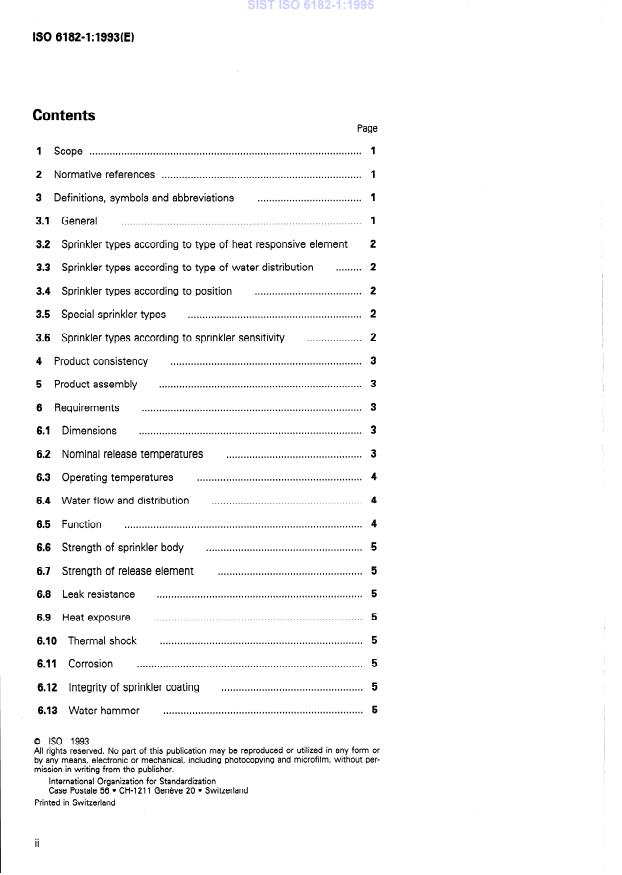

ISO 6182-1:1993 - Fire protection -- Automatic sprinkler systems

ISO 6182-1:1993 - Protection contre l'incendie -- Systemes d'extinction automatiques du type sprinkler
Get Certified
Connect with accredited certification bodies for this standard

NSF International
Global independent organization facilitating standards development and certification.

CIS Institut d.o.o.
Personal Protective Equipment (PPE) certification body. Notified Body NB-2890 for EU Regulation 2016/425 PPE.

Kiwa BDA Testing
Building and construction product certification.
Sponsored listings
Frequently Asked Questions
ISO 6182-1:1993 is a standard published by the International Organization for Standardization (ISO). Its full title is "Fire protection — Automatic sprinkler systems — Part 1: Requirements and test methods for sprinklers". This standard covers: Specifies performance requirements, test methods and marking requirements for fusible element and glass bulb sprinklers. For special sprinklers, special tests are necessary, which are in preparation.
Specifies performance requirements, test methods and marking requirements for fusible element and glass bulb sprinklers. For special sprinklers, special tests are necessary, which are in preparation.
ISO 6182-1:1993 is classified under the following ICS (International Classification for Standards) categories: 13.220.20 - Fire protection. The ICS classification helps identify the subject area and facilitates finding related standards.
ISO 6182-1:1993 has the following relationships with other standards: It is inter standard links to ISO 6182-1:2004. Understanding these relationships helps ensure you are using the most current and applicable version of the standard.
ISO 6182-1:1993 is available in PDF format for immediate download after purchase. The document can be added to your cart and obtained through the secure checkout process. Digital delivery ensures instant access to the complete standard document.
Standards Content (Sample)
2003-01.Slovenski inštitut za standardizacijo. Razmnoževanje celote ali delov tega standarda ni dovoljeno.Protection contre l'incendie -- Systèmes d'extinction automatiques du type sprinkler -- Partie 1: Prescriptions et méthodes d'essai des sprinklersFire protection -- Automatic sprinkler systems -- Part 1: Requirements and test methods for sprinklers13.220.20Fire protectionICS:Ta slovenski standard je istoveten z:ISO 6182-1:1993SIST ISO 6182-1:1995en01-december-1995SIST ISO 6182-1:1995SLOVENSKI
STANDARD
INTERNATIONAL STANDARD ISO 6182-1 First edition 1993-07-01 Fire protection - Automatic Sprinkler Systems - Part 1: - Requirements and test methods for Sprinklers Protection contre I’incendie - SystGmes d’extinction automatiques du type Sprinkler - Partie 1: Prescriptions et m&hodes d’essai des Sprinklers Reference number ISO 6182-1 :1993(E) SIST ISO 6182-1:1995
ISO 6182=1:1993(E) Contents Page 1 Scope . . . . . . . . . . . . . . . . . . . . . . . . . . . . . . . . . . . . . . . . . . . . . . . . . . . . . . . . . . . . . . . . . . . . . . . . . . . . . . . . . . . . . . . . . . . . . . 1 2 Normative references . . . . . . . . . . . . . . . . . . . . . . . . . . . . . . . . . . . . . . . . . . . . . . . . . . . . . . . . . . . . . . . . . . . . . 1 3 Definitions, Symbols and abbreviations . 1 3.1 General . 1 3.2 Sprinkler types according to type of heat responsive element 2 3.3 Sprinkler types according to type of water distribution . 2 3.4 Sprinkler types according to Position . 2 3.5 Special Sprinkler types . 2 3.6 Sprinkler types according to Sprinkler sensitivity . . . . . . . . . . . . . . . . . . . 2 4 Product consistency . . . . . . . . . . . . . . . . . . . . . . . . . . . . . . . . . . . . . . . . . . . . . . . . . . . . . . . . . . . . . . . . . . 3 5 Product assembly . . . . . . . . . . . . . . . . . . . . . . . . . . . . . . . . . . . . . . . . . . . . . . . . . . . . . . . . . . . . . . . . . . . . . . 3 6 Requirements . . . . . . . . . . . . . . . . . . . . . . . . . . . . . . . . . . . . . . . . . . . . . . . . . . . . . . . . . . . . . . . . . . . . . . . . . . . . 3 6.1 Dimensions . . . . . . . . . . . . . . . . . . . . . . . . . . . . . . . . . . . . . . . . . . . . . . . . . . . . . . . . . . . . . . . . . . . . . . . . . . . . . 3 6.2 Nominal release temperatures . . . . . . . . . . . . . . . . . . . . . . . . . . . . . . . . . . . . . . . . . . . . . . . 3 6.3 Operating temperatures .*.*.*.,.,. 4 6.4 Water flow and distribution . . . . . . . . . . . . . . . . . . . . . . . . . . . . . . . . . . . . . . . . . . . . . . . . . . . . 4 6.5 Function . . . . . . . . . . . . . . . . . . . . . . . . . . . . . . . . . . . . . . . . . . . . . . . . . . . . . . . . . . . . . . . . . . . . . . . . . . . . . . . . . . 4 6.6 Strength of Sprinkler body ,.,,,. 5 6.7 Strength of release element . . . . . . . . . . . . . . . . . . . . . . . . . . . . . . . . . . . . . . .*. 5 6.8 Lea k resistance I.,,,,.,.,,.,.,.,.,,. 5 6.9 Heat exposure . . . . . . . . . . . . . . . . . . . . . . . . . . . . . . . . . . . . . . . . . . . . . . . . . . . . . . . . . . . . . . . . . . . . . . . . 5 6.10 Thermal shock . . . . . . . . . . . . . . . . . . . . . . . . . . . . . . . . . . . . . . . . . . . . . . . .*. 5 6.11 Corrosion . . . . . . . . . . . . . . . . . . . . . . . . . . . . . . . . . . . . . . . . . . . . . . . . .*. 5 6.12 Integrity of Sprinkler coating .,.,. 5 6.13 Water hammer .,,.,.,.,. 5 0 ISO 1993 All rights reserved. No part of this publication may be reproduced or utilized in any form or by any means, electronie or mechanical, including photocopying and microfilm, without per- mission in writing from the publisher. International Organization for Standardization Case Postale 56 l CH-l 211 Geneve 20 l Switzerland Printed in Switzerland ii SIST ISO 6182-1:1995
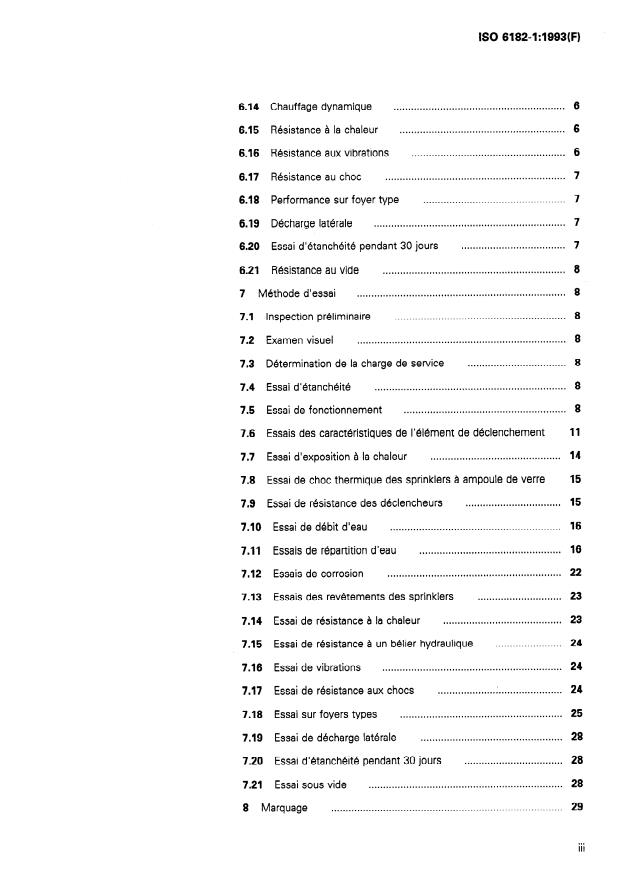
ISO 6182=1:1993(E) 6.14 Dynamit heating . 6 6.15 Resistance to heat . 6 6.16 Resistance to Vibration . 7 6.17 Resistance to impact . 7 6.18 Crib fire Performance . 7 6.19 Lateral discharge . 7 6.20 30 day leakage resistance . 7 6.21 Vacuum resistance . 7 7 Test methods . 7 7.1 Preliminary examination . 7 7.2 Visual examination . 7 7.3 Determination of Service load . 7 7.4 Leak-resistance test . 9 7.5 Functional test . 9 7.6 Testing the characteristics of the heat responsive element . . 9 7.7 Heat exposure test . 14 7.8 Thermal shock test for glass bulb Sprinklers . 14 7.9 Strength test for release elements . 14 7.10 7.11 7.12 7.13 7.14 7.15 7.16 7.17 7.18 7.19 7.20 7.21 Water flow test . Water distribution test . Corrosion test . Tests for Sprinkler coatings . Heat-resistance test . Water-hammer test . Vibration test . Impact test , . Crib fire test . Lateral discharge test . 15 15 21 22 22 22 22 23 25 27 30 day leakage test . . . . . . . . . . . . . . . . . . . . . . . . . . . . . . . . . . . . . . . . . . . . . . . . . . . . . . . . . . . . 28 Vacuum test .,.,.,.*.,.,.,. 28 8 Marking . . . . . . . . . . . . . . . . . . . . . . . . . . . . . . . . . . . . . . . . . . . . . . . . . . . . . . . . . . . . . . . . . . . . . . . . . . . . . . . . . . . . 28 . . . Ill SIST ISO 6182-1:1995
ISO 6182=1:1993(E) 8.1 Sprinklers . 28 8.2 Sprinkler housings . 28 Annexes A Notes on the strength test for release elements . . . . . . . . . . . .*. 29 I B Bibliography . . . . . . . . . . . . . . . . . . . . . . . . . . . . . . . . . . . . . . . . . . . . . . . . . . . . . . . . . . . . . . . . . . . . . . .*. 30 iv SIST ISO 6182-1:1995
ISO 6182=1:1993(E) Foreword ISO (the International Organization for Standardization) is a worldwide federation of national Standards bodies (ISO member bodies). The work of preparing International Standards is normally carried out through ISO technical committees. Esch member body interested in a subject for which a technical committee has been established has the right to be represented on that committee. International organizations, governmental and non-governmental, in liaison with ISO, also take part in the work. ISO collaborates closely with the International Electrotechnical Commission (IEC) on all matters of electrotechnical standardization. Draft International Standards adopted by the technical committees are circulated to the member bodies for voting. Publication as an International Standard requires approval by at least 75 % of the member bodies casting a vote. International Standard ISO 6182-1 was prepared by Technic lSO/TC 21, Equipment for fire protection and fire fighting, S SC 5, fixed fire extinguishing Systems. ISO 6182 consists of the following Parts, under the genera I tection - Automatic Sprinkler Systems: - Part 1: Requirements and test methods for Sprinklers al Committee 1bCommittee title Fire pro- - Part 2: ßequirements and test methods for wet alarm valves, retard chambers and water motor alarms - Part 3: ßequirements and test methods for dry pipe valves - Part 4: ßequirements and test methods for quick-opening devices - Part 5: Requirements and test methods for deluge valves Annexes A and B of this patt of ISO 6182 are for information only. SIST ISO 6182-1:1995
ISO 6182=1:1993(E) Introduction ISO 6182 comprises several Parts prepared by ISO/TC 21 covering com- ponents for automatic Sprinkler Systems. ISO 6182 is included in a series of International Standards planned to cover: - carbon dioxide Systems (ISO 6183); - explosion suppression Systems (ISO 6184); - foam Systems (ISO 7076). SIST ISO 6182-1:1995
INTERNATIONAL STANDARD ISO 6182=1:1993(E] Fire protection - Automatic Sprinkler Systems - Part 1: Requirements and test methods for Sprinklers 1 Scope This patt of ISO 6182 specifies Performance require- ments, test methods and marking requirements for fusible element and glass bulb Sprinklers. Special Sprinklers as defined in 3.5, are not covered by this part of ISO 6182. All pressure data in this part of ISO 6182 are given as gauge pressure in bar? 2 Normative references The following Standards contain provisions which, through reference in this text, constitute provisions of this part of ISO 6182. At the time of publication, the editions indicated were valid. All Standards are subject to revision, and Parties to agreements based on this patt of ISO 6182 are encouraged to investigate the possibility of applying the most recent editions of the Standards indicated below. Members of IEC and ISO maintain registers of currently valid International Standards. ISO 7-l :1982, Pipe threads where pressure-tight joints are made on the threads - Part 1: Designa tion, dimensions and tolerantes. ISO 49: 1983, Malleable cast iron fittings threaded to ISO 7/1. ISO 65:1981, Carbon steel tubes suitable for screwing in accordance with ISO 7-l. 3 Definitions, Symbols and abbreviations For the purposes of this part of ISO 6182, the follow- ing definitions apply. 3.1 General 3.1 .I Sprinkler: Thermosensitive device designed to react at a predetermined temperature by automati- cally releasing a stream of water and distributing it in a specified Pattern and quantity over a designated area. 3.1.2 conductivity factor, C: Measure of the con- ductance between the Sprinklers heat responsive el- ement and the fitting, expressed in (m/s)‘/ . 3.1.3 response time index, RTI: Measure of Sprinkler sensitivity expressed as RTI = zu”,5 where z is the time constant of the heat responsive element, expressed in seconds; and u is the gas velocity, expressed in metres per second. RTI tan be used in combination with the conductivity factor (C) to predict the response of a Sprinkler in fire environments defined in terms of gas temperature and velocity versus time. RTI is expressed in (ms)‘/2. 1) 1 bar=105Pa=0,1 MPa 1 SIST ISO 6182-1:1995
ISO 6182=1:1993(E) 3.1.4 Standard orientation: In the case of sym- metrical heat responsive elements, Standard orien- tation is with the air flow perpendicular to both the axis of the waterway and the plane of the frame arms. In the case of non-symmetrical heat responsive ele- ments, Standard orientation is with the air flow per- pendicular to both the waterway axis and the plane of the frame arms and which produces the shortest response time. , 3.1.5 worst-case orientation: Orientation which produces the longest response time with the axis of the Sprinkler waterway perpendicular to the air flow. 3.2 Sprinkler types according to type of heat responsive element 3.2.1 fusible-element Sprinkler: Sprinkler that opens under the influence of heat by the melting of a component. 3.2.2 glass bulb sprinkler-: Sprinkler that opens under the influence of heat by the bursting sf a glass bulb through pressure resulting from expansion of a fluid enclosed therein. 3.3 Sprinkler types according to type o water distribution 3.3.1 conventional Sprinkler, C: Sprinkler giving spherical water distribution directed downward and at the ceiling for a definite protection area. A conventional Sprinkler directs from 40 % to 60 % of the total water flow initially in a downward direc- tion. 3.3.2 Spray Sprinkler, S: Sprinkler giving parab- oloidal water distribution directed downward for a definite protection area. A Spray Sprinkler directs from 80 % to 100 % of the total water flow initially in a downward direction. 3.3.3 flat Spray Sprinkler, F: Sprinkler giving parab- oloidal water distribution directed downward for a definite protection area, while some of the water Sprays the ceiling. A flat Spray Sprinkler directs from 60 % to 80 % of the total water flow in a downward direction. 3.3.4 sidewall Sprinkler, W: Sprinkler giving a one- sided (half-paraboloidal) water distribution directed outward for a definite protection area. 3.4 Sprinkler types according to Position 3.4.1 upright Sprinkler, U: Sprinkler that is arranged in such a way that the water stream is directed up- wards against the distribution plate. 3.4.2 pendent Sprinkler, P: Sprinkler that is ar- ranged in such a wag that the water stream is di- rected downwards against the distribution plate. 3.4.3 horizontal Sprinkler, H: Sprinkler that is ar- ranged in such a way that the water stream is di- rected horizontally against the distribution plate. 3.5 Special Sprinkler types NOTE 1 For these sprinklers, special tests, which are in preparation, are necessary. 3.5.1 dry upright sprinkkler, DU: Sprinkler that is installed upright on a special rise pipe which is kept free from water. 3.5.2 dry pendent Sprinkler, DP: Sprinkler that is installed pendent on a special drop pipe which is kept free from water. fl! rinkler, h: Sprinkler of which all or part sf the body, including the shank thread, is mounted above the lower plane sf the ceiling, but of which part or all 0% the heat responsive element is below the lower plane of the ceiling. 3.5.4 recessed Sprinkler, R: Sprinkler of which all or part of the body, other than the shank thread, is mounted within a recessed housing. 3.5.5 concealed Sprinkler, CC: Recessed sprin kler having a cover plate. 3.5.6 on/off Sprinkler, 00: Sprinkler which com- bines the Performance characteristics of a Standard Sprinkler with the additional feature of automatic closure at a predetermined temperature. 3.5.7 multiple-orifice pendent Sprinkler, MO: Sprinkler having two or more outlet orifices arranged to distribute the water discharge downward in a specified Pattern and quantity for a definite protection area. 3.5.8 coated Sprinkler: Sprinkler which has a fac- tory applied coating for corrosion protection. 3.6 Sprinkler types according to Sprinkler sensitivity 3.6.1 fast-response Sprinkler: Sprinkler having a response time index (RTI) less than 50 (ms)“* and a conductivity factor (C) less than 1,O (ms)“* as shown in figure 1. 3.6.2 special-response Sprinkler: Sprinkler having an avera e 50 (ms)’ j response time index (RTI) between and 80 (msj’/* and a conductivity factor (C) less than 1,O (ms)” as shown in figure 1. 2 P SIST ISO 6182-1:1995
ISO 6182=1:1993(E) 3.6.3 Standard response Sprinkler: Sprinkler having a response time index (RTI) between 80 (ms)“* and 350 (ms)“* and a conductivity (C) factor not exceed- ing 2,0 (ms)‘/* as shown in figure 1. 4 Product consistency lt shall be the responsibility of the manufacturer to implement a quality control Programme to ensure that production continuously meets the requirements of this part of ISO 6182 in the same manner as the ori- ginally tested samples. Every manufactured Sprinkler shall pass a leak resist- ante test equivalent to a hydrostatic pressure of at least 30 bar (3 MPa) for a duration of at least 2 s. 5 Product assembly All Sprinklers shall be designed and manufactured in such a way that they cannot be readily adjusted, dis- mantled or reassembled. 6 Requirements 6.1 Dimensions Sprinklers shall comply with the dimensional require- ments given in table 1. Table 1 - Dimensional requirements Nominal diameter of orifice Nominal thread size I mm l in Glass bulb Sprinkler I Fusible element Sprinkler 10 318 15 112 20 314 All Sprinklers shall be constructed so that a sphere of diameter 8 mm tan pass through each water passage in the Sprinkler. NOTES 2 Requirements for water passages used for control of Sprinkler function are in preparation. 3 Nominal thread sizes should be suitable for fittings threaded in accordance with ISO 7-l. 4 In some countries, Sprinklers having orifices of nominal diameters 6 mm, 8 mm and 9 mm are acceptable at the present time. 5 In some countries, the use of 1/2 in threads for sprink- lers having orifices of nominal diameters 6 mm, 8 mm 9 mm, 10 mm and 20 mm is acceptable at the present time. 6 In countries where 6 mm, 8 mm and 9 mm orifice automatic Sprinklers are presently acceptable, if the sprink- lers are used together with a strainer in the System or in each Sprinkler, a 5 mm sphere may be used for checking the size of each water passage. 7 Certain special Sprinklers may have larger thread sizes. 8 In countries where Sprinklers having multiple water passages are acceptable on the bases of national regulation, if the Sprinklers are used together with a strainer in the System or in each Sprinkler, a 3 mm sphere may be used for checking the size of each water passage. Sprinklers having 1/2 in threads with a nominal orifice size other than 15 mm shall be fitted with a metal rod extension, (10 & 2) mm long and having a diameter of (5 & 2) mm, above the deflector. 6.2 Nominal release temperatures The nominal release temperatures of glass bulb Sprinklers shall be as indicated in table2 and the op- erating temperatures shall be within the ranges specified in table 3. The nominal release temperatures of fusible-element Sprinklers shall be specified in advance by the manu- facturer and verified in accordance with 6.3. They shall be determined as a result of the nominal release temperature test (see 7.6). Nominal release tempera- tures shall be within the ranges specified in table2. Table 2 - Nominal release temperatures Temperatures in degrees Celsius Nominal Liquid Nominal release colour release temperature code temperature Yoke arm colour code 57 Orange 68 Red 79 Yellow 93 Green 100 Green 121 Blue 141 Blue 163 Mauve 182 Mauve 204 Black 227 Black 260 Black 343 Black 57to 77 Uncoloured 80 to 107 White 121to 149 Blue 163 to 191 Red 204 to 246 Green 260 to 362 Orange 320 to 343 Black 3 SIST ISO 6182-1:1995
ISO 6182=1:1993(E) The nominal release temperature that is to be marked on the Sprinkler shall be that determined when the Sprinkler is tested in accordance with 7.6, taking into account the specifications of 6.3. 6.3 Operating temperatures 6.3.1 Fusible-element Sprinklers shall open within a temperature range of x + (0,035~ + 0,62) “C To demonstrate the required coverage of the pro- tected area allotted to it, the Sprinkler shall pass the test specified in 7.11. where x is the nominal release temperature. 6.5 Function 6.3.2 All glass bulb Sprinklers shall open within the temperature range specified in table3 (according to the nominal release temperature). 6.4 Water flow and distribution 6.4.1 Flow constant The flow constant, K, for Sprinklers is given by the formula where P is the pressure, in bar; qv is the flow rate, in litres per minute. K shall have the values given in table4 when deter- mined by the test method of 7.10. 6.4.2 Water distribution 6.5.1 When tested in accordance with 7.5, the Sprinkler shall open and, not more than 5 s after the release of the heat responsive element, shall operate satisfactorily by complying with the requirements of 6.4.1. Any lodgement of released Parts shall either be cleared within 60 s of the release of the heat respon- sive element or the Sprinkler shall then comply with the requirement of 6.4.2. 6.5.2 The deflector and its supporting Parts shall not sustain significant darnage as a result of the functional test specified in 7.5.6 and shall meet the require- ments of 6.4.2. NOTE 9 In most instances, visual examination of the equipment will be sufficient to establish conformity with the requirements of 6.5.1 and 6.5.2. Table 3 - Glass bulb temperature ranges Temperatures in degrees Celsius Glass bulb nominal release temperature Lowest operating 50 of the 50 100 97 108 113 120 121 118 129 134 141 141 138 149 155 163 163 160 171 177 186 182 179 190 196 206 204 201 212 218 228 227 224 235 242 252 260 257 268 275 286 343 340 351 359 372 4 SIST ISO 6182-1:1995
ISO 6182=1:1993(E) Table 4 - Flow constant Nominal diameter of orifice mm K K for dry sprin klers 10 57 * 3 57 * 5 15 80 f 4 80 f 6 20 11556 115f9 6.6 Strength of Sprinkler body The Sprinkler body shall not show permanent elon- gation of more than 0,2 % between the load-bearing Points after being subjected to twice the average Service load as defined in 7.3. 6.7 Strength of release element 6.7.1 The average strength of glass bulb elements shall be at least six times the average Service load of the Sprinkler when tested in accordance with 7.9.1. 6.7.2 Fusible heat-responsive elements in the ordi- nary temperature range shall be designed to - sustain a load of 15 times its design load corre- sponding to the maximum Service load measured Sprinklers shall be sufficiently resistant to moist air in 7.3 for a period of 100 h; or exposure and shall satisfy the requirements of 6.14.2 after being tested in accordance with 7.12.4. - demonstrate the ability to sustain the design load when tested in accordance with 7.9.2. 6.8 Leak resistance A Sprinkler shall not show any sign of leakage when tested in accordance with 7.4. 6.9 Heat exposure 6.9.1 Glass bulb Sprinklers There shall be no darnage to the glass bulb element when Sprinklers are tested in accordance with 7.7.1. 6.9.2 Uncoated Sprinklers Sprinklers shall withstand exposure to increased am- bient temperature without evidente of weakness or failure, when tested in accordance with 7.7.2. 6.9.3 Coated Sprinklers In addition to meeting the requirement of 6.9.2 in an uncoated Version, coated Sprinklers shall withstand exposure to increased ambient temperatures without evidente of weakness or failure of the coating, when tested in accordance with 7.7.3. 6.10 Thermal shock Glass bulb Sprinklers shall not be damaged when tested in accordance with 7.8. Proper Operation is not considered as darnage. 6.11 Corrosion 6.11 .l Stress corrosion When tested in accordance with 7.12.1, Sprinklers shall not show fractures which could affect their abil- ity to satisfy other requirements. 6.11.2 Sulfur dioxide corrosion Sprinklers shall be sufficiently resistant to Sulfur diox- ide saturated with water vapour when conditioned in accordance with 7.12.2. Following exposure, the Sprinklers shall operate when functionally tested at 0,35 bar (0,035 MPa) (see 6.5.1 and 7.5.2). 6.11.3 Salt Spray corrosion Sprinklers shall be sufficiently resistant to salt Spray and shall satisfy the requirements of 7.12.3. 6.11.4 Moist air exposure 6.12 Integrity of Sprinkler coating 6.12.1 Evaporation of wax and bitumen Waxes and bitumens used for coated Sprinklers shall not contain volatile matter in sufficient quantities to Cause shrinkage, hardening, cracking or flaking of the applied coating. The loss in mass shall not exceed 5 % of that of the original Sample when tested in ac- cordante with 7.13.1. 6.12.2 Resistance to low temperatures Coatings used for Sprinklers shall not Crack or flake when subjected to low temperatures in accordance with 7.13.2. 6.12.3 Resistance to high temperatures Coated Sprinklers shall meet the requirements of 6.9.3. 6.13 Water hammer Sprinklers shall not leak when subjected to pressure surges from 4 bar to 25 bar. They shall not show signs of mechanical darnage when tested in accord- 5 SIST ISO 6182-1:1995
ISO 6182=1:1993(E) ante with 7.15 and shall operate within the par- ameters of the functional test at a pressure of 0,35 bar (0,035 MPa) (see 6.5.1). 6.14 Dynamit heating See also the references in annex B. 6.14.1 Standard, special and fast response Sprinklers shall meet the RTI and C limits shown in figure 1, when tested in the Standard orientation in accordance with 7.6.2. Maximum and minimum RTI values for all data Points calculated using C for the fast and stan- dard response Sprinklers shall fall within the appropri- ate category shown in figure 1. Special response Sprinklers shall have a mean RTI value, calculated us- ing C, of between 50 and 80 with no individual value less than 40 or more than 100. When tested in the worst case orientation in accordance with 7.6.2, the RTI shall not exceed 600 (ms)“* or 250 % of the 350 80 value of RTI in the Standard orientation, whichever of the two values is less. 6.14.2 After exposure to the corrosion test specified in 6.11.2 to 6.11.4, Sprinklers shall be tested in the Standard orientation in accordance with 7.6.2.1 to de- termine the post-exposure RTI. Post-exposure RTI values shall not exceed the limits shown in figure 1 for the appropriate category. In ad- dition, the mean RTI value shall not exceed 130 % of the pre-exposure average value. Post-exposure RTI values shall be calculated in accordance with 7.6.2.3 using the pre-exposure conductivity factor (C). 6.15 Resistance to heat Open Sprinklers shall be sufficiently resistant to high temperatures when tested in accordance with 7.14. After exposure, the Sprinkler shall not show significant deformation or breakage. Standard response Sprinklers I I I I 1 I I 1 t i i i i i i i i i i i i i i i i i i l i i i i i i i i i i i i i i i i i i i il I i i i i i i i i i i i i i i i i i i i il t i i i i i i i i i i i i i i i i i i i il t i i i i i i i i i i i i i i i i i i 1-i Fast response Sprinklers tw 0 0,s 1 1,s 2 C (m/s)“* Figure 1 - Standard orientation RTI and C limits 6 SIST ISO 6182-1:1995
ISO 6182=1:1993(E) 6.16 Resistance to Vibration Sprinklers shall be tested with all the components re- quired by their design and installation. Assembled Sprinklers shall be able to withstand the effects of Vibration without deterioration of their per- formante characteristics when tested in accordance with 7.16. After the Vibration test of 7.16, assembled Sprinklers shall not show visible deterioration and shall meet the requirements of 6.5 and 6.8. 7.1 Preliminary examination Examine the construction to ensure that it camplies with the requirements of clauses 4 and 5. 7.2 Visual examination 6.17 Resistance to impact Conventional and Spray Sprinklers shall have adequate strength to withstand impacts associated with hand- ling, transport and installation without deterioration of their Performance or reliability. Resistance to impact shall be determined in accordance with 7.17. Before testing, examine the Sprinklers visually with respect to the following Points: a) b) marking; NOTE 10 Requirements for other Sprinklers are in prepa- ration. conformity of the Sprinklers with the manufac- turer’s drawings and specifications; Cl obvious defects. 6.18 Crib fire Performance 7.3 Determination of Service load Pendent and upright Sprinklers having nominal orifice diameters of 15 mm shall control crib fires when tested in accordance with 7.18. See 6.7. NOTE 11 Requirements and test methods for other Sprinklers are in the course of preparation. 6.19 Lateral discharge Sprinklers shall not prevent the Operation of adjacent Sprinklers when tested in accordance with 7.19. 7.3.1 Measure the Service load by securely installing the Sprinkler, at room temperature, in a tensile/compression test machine and applying an equivalent of a hydraulic pressure of 12 bar (1,2 MPa) at the inlet. 6.20 30 day leakage resistance Use an indicator capable of reading deflection to an accuracy of 0,Ol mm to measure any Change in length of the Sprinkler between its Ioad bearing Points. Movement of the Sprinkler shank thread in the threaded bush of the test machine shall be avoided or taken into account. Sprinklers shall not leak, sustain distortion or other mechanical darnage when subjected to 20 bar (2 MPa) water pressure for 30 d. Following exposure, the Sprinklers shall satisfy the test requirements of 7.20. Release hydraulic pressure and remove the heat re- sponsive element of the Sprinkler by a suitable method. When the Sprinkler is at room temperature, make a second measurement using the indicator. 6.21 Vacuum resistance Sprinklers shall not exhibit distortion, mechanical darnage or .leakage after testing in accordance with 7.21. Apply an increasing mechanical load to the Sprinkler, at a rate not exceeding 500 N/min, until the indicator reading at the deflector end of the Sprinkler returns to the initial value achieved under hydrostatic load. Re- cord the mechanical load necessary to achieve this which is defined as the Service load. 7 Test methods The following tests shall be carried out for each type of sprinkler-. Before testing, precise drawings of Parts and the assembly shall be submitted together with the appropriate specifications (using SI units). Tests shall be carried out at an ambient temperature of (20 ‘0) “C, unless other temperatures are indicated. A suggested test Programme is illustrated in figure 2 for guidance. Repeat the test on another four specimens and take the mean of the results which is defined as the aver- age Service load 7.3.2 Increase the applied load progressively at a rate not exceeding 500 N/min on each of the five specimens until twice the average Service load has been applied. Maintain this load for (15 & 5) s. Remove the load and record any permanent elon- gation as defined in 6.6. 7 SIST ISO 6182-1:1995
ISO 6182=1:1993(E) 1 2 3 4 5 6 7 8 9 10 11 12 13 14 15 16 17 18 19 20 21 22 23 24 25 26 Entrance a technicat --Pt ------121 documents 0 Number ofsprinklersrequired q Test method number @- 20 I 11 1241 @- 14 r @ 25 -0-4 @- 18 @- 27. o-1-I iLLJ 0+29f 3 {6 Preliminary examination (see 7.1) Visual examination (see 7.2) Markinglldentification of Sprinkler (see 7.2) Functional test (see 7.5) Corrosion test in Sulfur dioxide (see 7.12.2) Leak-resistance test (see 7.4) Water-hammer test (see 7.15) Vibration test (see 7.16) Heat exposure test (see 7.7) Thermal shock test (see 7.8) Water flow test (sec 7.10) Water distribution test (see 7.11) Low-temperature test (see 7.13.2) Nominal release temperature of Sprinkler (see 7.6) Nominal release temperature of glass bulbs (see 7.6) Stress corrosion test in aqueous ammonia Solution (see 7.12.1) Strength test for release elements (see 7.9) Dynamit heating test (see 7.6.2) Moist air test (see 7.12.4) Service load (see 7.3) Heat exposure test [glass bulb Sprinklers (see 7.7.1)] Salt Spray corrosion test (see 7.12.3) Evaporation test (see 7.13.1) Heat-resistance test (see 7.14) Crib fire test (see 7.18) Deflector strength (see 7.5.6) Impact test (see 7.17) 30 day leakage test (see 7.20) Vacuum test (see 7.21) 27 28 29 NOTE - At least 113 Sprinklers are required. Figure 2 - Test Programme 8 SIST ISO 6182-1:1995
ISO 6182=1:1993(E) 7.4 Leak-resistance test See 6.8. Increase the pressure at the Sprinkler inlet from 0 bar to 30 bar (3 MPa) at a rate of (1 & 0,25) bar/s, maintain the pressure at 30 bar (3 MPa) for a period of 3 min and then allow it to fall to 0 bar. After the pressure has dropped to 0 bar, increase it to 0,5 bar (0,05 MPa) in less than 5 s. Maintain this pressure for 15 s and then increase it to 10 bar (1 MPa), at a rate of (1 & 0,25) bar/s, and maintain it for 15 s. 7.5 Functional test See 6.5.1. 7.5.1 For Sprinklers having nominal release tem- peratures less than 78 “C, including dry Sprinklers that tan be accommodated in the test equipment, heat the Sprinkler in the oven (see figure3) to a temperature of (400 * 20) “C local to the Sprinkler in 3 min. 7.5.2 For Sprinklers having higher nominal release temperatures and other dry Sprinklers, heat the Sprinkler using a suitable heat Source. Continue heat- ing until the Sprinkler has operated. 7.5.3 Test eight Sprinklers in each normal mounting Position and, during heating, apply the pressures listed below at the inlet: a) 0,35 bar (0,035 MPa); b) 3,5 bar (0,35 MPa); c) 12,0 bar (1,2 MPa). These pressures are known as following pressures and shall be at least 75 % of the initial operating pressure. 7.5.4 If lodgement occurs in the release mechanism at any pressure Ievel and mounting Position, test a further 24 Sprinklers in that mounting Position and at that pressure. The total number of Sprinklers in which lodgement occurs shall not exceed 1 out of the 32 Sprinklers tested at that pressure and in that mounting Position. 7.5.5 Lodgement is considered to have occurred when one or more of the released Parts lodge in the deflector frame assembly in such a way as to Cause the water distribution to be significantly impeded for a period of more than 1 min. 7.5.6 In Order to check the strength of the deflector, carry out the functional test on three Sprinklers in each normal mounting Position at a pressure of 12 bar (1,2 MPa). Allow the water to flow at a running pressure of 12 bar (1,2 MPa) for a period of 15 min. 7.6 Testing the characteristics of the heat responsive element 7.6.1 Test of static Operation behaviour Heat the Sprinkler or separate glass bulb from room temperature to (20 ‘$ “C below the nominal release temperature. The rate of temperature increase shall not exceed 20 “C/min. Maintain the temperature for 10 min. Then increase the temperature at a rate of between 0,4 “C/min and 0,7 “C/min until the Sprinkler opens or the glass bulb bursts. The nominal release tempera- ture shall be ascertained with equipment having an accuracy of * 1,5 %. The test shall be carried out in a water bath (prefer- ably distilled water) for Sprinklers or separate glass bulbs having nominal release temperatures less than or equal to 80 “C. A suitable oil shall be used for hig her-rated release elements. The liquid bath shall be constructed in such a way that the temperature deviation within the test Zone does not exceed 0,5 %, or 0,5 “C, whichever is the greater. Ten Sprinklers are required for the test and, in the case of glass bulb Sprinklers, 40 additional glass bulbs are required. The test shall be conducted on assembled Sprinklers where significant differentes in Performance of loose bulbs and assembled Sprinklers are observed. Opera- tion of bulb Sprinklers in this test includes any form of rupture of the bulb envelope. 7.6.2 Dynamit heating test For bibliographic references, see annex B. 7.6.2.1 Plunge test Conduct tests to determine the Standard and worst case orientations as defined in 3.1.4 and 3.1.5. Per- form ten additional plunge tests at each of the identi- fied orientations. Calculate the RTI as described in 7.6.2.3 and 7.6.2.4 for the Standard and worst case orientations, respec- tively. SIST ISO 6182-1:1995
ISO 6182=1:1993(E) The plunge tests shall be conducted using a brass Sprinkler mount designed so that the mount or water temperature rise (as measured by a thermocouple heat sinked and embedded in the mount not more than 8 mm radially outward from the root diameter of the internal thread or by a thermocouple located in the water at the centre of the Sprinkler inlet) does not exceed 2 OC for the duration of an individual plunge test up to a response time of 55 s. If the response time is greater than 55 s, then the mount or water temperature in degrees Celsius shall not increase more than 0,036 times the response time in seconds for the duration of an individual plunge test. Dimensions in millimetres r Vents Sliding or Vent -7 r Threaded connection for sprin klers Gauge pipe 7/ n Detachable pipe for @ upright Sprinklers 1 Heat Door t I 1 - Water discharge I / //////////////////////////“‘//‘~”/ 620 520 w d- e NOTE - Vent area should be such as to enable the required rate of rise of temperature to be achieved. Figure 3 - Functional test Nest oven) 10 SIST ISO 6182-1:1995
Apply 1 to 1,5 wraps of PTFE sealant tape to the Sprinkler threads of the Sprinkler under test. Screw the Sprinkler into a mount to a torque of (15 & 3) Nmm. Mount each Sprinkler on a tunnel test section cover and maintain in a conditioning chamber for a period of not less than 30 min to allow the Sprinkler and cover to resch ambient temperature. In- troduce at least 25 ml of water, conditioned to ambi- ent temperature, into the Sprinkler inlet Prior to testing. A timer accurate to Öl. 0,Ol s with suitable measuring devices to determine the time between the moment when the Sprinkler is plunged into the tunnel and the moment when it operates shall be utilized to obtain the response time. A tunnel shall be utilized with air flow and tempera- ture conditions at the test section (Sprinkler location) selected from the appropriate range of conditions shown in table5. Tunnel conditions shall be selected to limit maximum anticipated equipment error to 3 % (see Heskestad and Smith[21). To minimize radiation exchange between the sensing element and the boundaries confining the flow, the test section of the apparatus shall be designed to limit radiation effects to within & 3 % of calculated RTI vaIues*). The range of permissible tunnel operating conditions is shown in table 5. The selected operating condition shall be maintained for the duration of the test with the tolerantes as specified by the footnotes 1 and 2 in table 5. 7.6.2.2 Determination of conductivity factor, C The conductivity factor, C, shall be determined using the prolonged plunge test (see 7.6.2.2.1) or the pro- longed exposure ramp test (see 7.6.2.2.2). 7.6.2.2.1 Prolonged plunge test The prolonged plunge test is an iterative process to determine C and tan require up to twenty Sprinkler samples. A new Sprinkler Sample shall be used for each test even if the Sample does not operate during the test. Apply 1 to 1,5 wraps of PTFE sealant tape to the Sprinkler threads of the Sprinkler under test. Screw the Sprinkler into a mount to a torque of (15 + 3) Nmm. Mount each Sprinkler on a tunnel test section cover and maintain in a conditioning chamber for a period of not less than 30 min to allow the Sprinkler and cover to resch ambient temperature. In- troduce at least 25 ml of water, conditioned to ambi- ent temperature, into the Sprinkler inlet Prior to testing. Table 5 - Range of plunge test conditions at test section (Sprinkler location) Air temperature ranges’) Velocity ranges2) Nominal Sprinkler Standard Special temperatures response response Fast response Standard Special Fast response Sprinklers Sprinklers Sprinklers response response Sprinklers Sprinklers Sprinklers 0 C “C 0 C 0 C Ws Ws Ws 57 to 77 191 to 203 129 to 141 129 to 141 2,4 to 2,6 2,4 to 2,6 1,65 to 1,85 79 to 107 282 to 300 191 to 203 191 to 203 2,4 to 2,6 2,4 to 2,6 1,65 to 1,135 121 to 149 382 to 432 282 to 300 282 to 300 2,4 to 2,6 2,4 to 2,6 1,65 to 1,85 163 to 191 382 to 432 382 to 432 382 to 432 3,4 to 3,6 2,4 to 2,6 1,65 to 1,85 1) The selected air temperature shall be known and maintained constant, within the test section throughout the test, to an accuracy of f 1 OC for the air temperature range of 129 OC to 141 OC within the test section and within f 2 “C for all , other air temperatures. 2) The selected air velocity shall be known and maintained constant throughout the test to an accuracy of f 0,03 m/s for velocities of 1,65 m/s to 1,85 m/s and 2,4 m/s to 2,6 m/s and f 0,04 m/s for velocities of 3,4 m/s to 3,6 m/s. 2) A suggested method for determining radiation effects is by conducting comparative plunge tests on a blackened (high emissivity) metallic test specimen and a polished (low emissivity) metallic test specimen. 11 SIST ISO 6182-1:1995
ISO 6182=1:1993(E) A timer accurate to & 0,Ol s with suitable measuring devices to determine the time between the moment when the Sprinkler is plunged into the tunnel and the moment when it operates shall be utilized to obtain the response time. The mount temperature shall be maintained at (20 & 0,5) “C for the duration of each test. The air velocity in the tunnel test section at the Sprinkler lo- cation shall be maintained within & 2 % of the selec- ted velocity. Air temperature shall be selected and maintained during the test as specified in table6. Table 6 - Range of test conditions for conductivity factor (C) determination at test section (Sprinkler location) Temperatures in degrees Celsius The range of permissible tunnel operating conditions is shown in table6. The selected operating condition shall be maintained for the duration of the test with the tolerantes as specified in table6. To determine C, the Sprinkler is immersed in the test stream at various air velocities for a maximum of 15 min. If the Sprinkler does not operate at the high- est velocity, select an air temperature from table6 for the next higher temperature rating. If C is determined .to be less than 0,5 (m/s)“*, a value of C of 0,25 (m/s)“* shall be assumed for calculating RTI val- ues. Velocities are Chosen such that actuation is bracketed between two successive test velocities. That is, two velocities shall be established such that at the lower velocity (UL) actuation does not occur in the 15 min test interval. At the next higher velocity (u,,) actuation shall occur within the 15 min time limit. The following inequality shall hold for the selected test velocities: (UHbL) “* < 1,l The test C is the arithmetic mean of the two values of C calculated at the two velocities using the follow- ing equation: C = (AT,IbT,, - l)u"* where ATg is the actual gas (air) temperature minus the mount temperature (Tm), expressed in de- grees Celsius; ATea is the mean liquid bath operating tempera- ture minus the mount temperature (Tm), expressed in degrees Celsius; U is the actual air velocity in the test section, expressed in metres per second. The Sprinkler C is determined by repeating the brack- eting procedure three times and calculating the arith- metic mean of the three test C values obtained. This Sprinkler C value is used to calculate all Standard orientation RTI values for determining compliance with 6.14. EXAMPLE The mean Sprinkler operating temperature obtained from tests described in 7.6.1 was 72 OC. Sequential tests were conducted as described above. In the first test, uL = 0,288 m/s and Tm = 20,3 “C. The actual air temperature was 125 “C. Actuation did not occur in 15 min. In the second test, UH = 0,342 m/s and Tm = 20 “C and the actual air temperature was 127 “C. Actuation occurred at 350 s. NOTE 12 &&4)“* = (0,342/0,288)“* < IJ Therefore CL = [(125 - 20,3)/(72 - 20,3) - 1](0,288)“* CL = ,55 (mls>‘/* CH = [(“127 - 20)/(72 - 20) - l]( CH = 0,62 (m/s)“* C = 0,5(0,55 + 0,62) = 0,59 (m/s)“* 7.6.2.2.2 Prolonged exposure ramp test The prolonged exposure ramp test for the determi- nation of the Parameter C shall be carried out in the test section of a Windtunnel and with the require- ments for the temperature in the Sprinkler mount as described for the dynamic heating test. Precondition- ing of the Sprinklers is not necessary. Test ten samples of each Sprinkler type, all Sprinklers positioned in Standard orientation. Plunge the sprink- lers into an air stream of a constant velocity of 1 m/s & 10 % and an air temperature at the nominal temperature of the Sprinkler at the beginning of the test. 12 SIST ISO 6182-1:1995
ISO 6182=1:1993(E) Increase the air temperature at a rate of (1 & 0,25) “C/min until the Sprinkler operates. Control the air temperature, velocity and mount temperature from the initiation of this increase and measure and record these temperatures at Sprinkler Operation. The C value is then the arithmetic mean of the ten test C values determined using the same equation as in 7.6.2.2.1: C = (AT,/AT,, - l)u”* This method is suitable for Sprinklers of all nominal temperatures. 7.6.2.3 RTI value calculation The equation used to determine the RT
...
INTERNATIONAL
ISO
STANDARD
6182-1
First edition
1993-07-01
Fire protection - Automatic Sprinkler
Systems -
Part 1:
- Requirements and test methods for Sprinklers
Protection contre I’incendie - SystGmes d’extinction automatiques du
type Sprinkler -
Partie 1: Prescriptions et m&hodes d’essai des Sprinklers
Reference number
ISO 6182-1 :1993(E)
ISO 6182=1:1993(E)
Contents
Page
1 Scope . . . . . . . . . . . . . . . . . . . . . . . . . . . . . . . . . . . . . . . . . . . . . . . . . . . . . . . . . . . . . . . . . . . . . . . . . . . . . . . . . . . . . . . . . . . . . .
. . . . . . . . . . . . . . . . . . . . . . . . . . . . . . . . . . . . . . . . . . . . . . . . . . . . . . . . . . . . . . . . . . . . .
2 Normative references
....................................
3 Definitions, Symbols and abbreviations
3.1 General .
3.2 Sprinkler types according to type of heat responsive element
.........
3.3 Sprinkler types according to type of water distribution
..................................... 2
Sprinkler types according to Position
3.4
............................................................
3.5 Special Sprinkler types
. . . . . . . . . . . . . . . . . . . 2
3.6 Sprinkler types according to Sprinkler sensitivity
. . . . . . . . . . . . . . . . . . . . . . . . . . . . . . . . . . . . . . . . . . . . . . . . . . . . . . . . . . . . . . . . . .
4 Product consistency
5 Product assembly . . . . . . . . . . . . . . . . . . . . . . . . . . . . . . . . . . . . . . . . . . . . . . . . . . . . . . . . . . . . . . . . . . . . . .
6 Requirements . . . . . . . . . . . . . . . . . . . . . . . . . . . . . . . . . . . . . . . . . . . . . . . . . . . . . . . . . . . . . . . . . . . . . . . . . . . .
. . . . . . . . . . . . . . . . . . . . . . . . . . . . . . . . . . . . . . . . . . . . . . . . . . . . . . . . . . . . . . . . . . . . . . . . . . . . .
6.1 Dimensions
. . . . . . . . . . . . . . . . . . . . . . . . . . . . . . . . . . . . . . . . . . . . . . .
6.2 Nominal release temperatures
.*.*.*.,.,.
6.3 Operating temperatures
. . . . . . . . . . . . . . . . . . . . . . . . . . . . . . . . . . . . . . . . . . . . . . . . . . . .
6.4 Water flow and distribution
. . . . . . . . . . . . . . . . . . . . . . . . . . . . . . . . . . . . . . . . . . . . . . . . . . . . . . . . . . . . . . . . . . . . . . . . . . . . . . . . . .
6.5 Function
,.,,,.
6.6 Strength of Sprinkler body
. . . . . . . . . . . . . . . . . . . . . . . . . . . . . . . . . . . . . . .*.
6.7 Strength of release element
I.,,,,.,.,,.,.,.,.,,.
6.8 Lea k resistance
. . . . . . . . . . . . . . . . . . . . . . . . . . . . . . . . . . . . . . . . . . . . . . . . . . . . . . . . . . . . . . . . . . . . . . . .
6.9 Heat exposure
. . . . . . . . . . . . . . . . . . . . . . . . . . . . . . . . . . . . . . . . . . . . . . . .*.
6.10 Thermal shock
6.11 Corrosion . . . . . . . . . . . . . . . . . . . . . . . . . . . . . . . . . . . . . . . . . . . . . . . . .*.
..,........................,.....................
6.12 Integrity of Sprinkler coating
..,,....,......................................,........,............
6.13 Water hammer
0 ISO 1993
All rights reserved. No part of this publication may be reproduced or utilized in any form or
by any means, electronie or mechanical, including photocopying and microfilm, without per-
mission in writing from the publisher.
International Organization for Standardization
Case Postale 56 l CH-l 211 Geneve 20 l Switzerland
Printed in Switzerland
ii
ISO 6182=1:1993(E)
...................................................................
6.14 Dynamit heating
................................................................ 6
6.15 Resistance to heat
.........................................................
6.16 Resistance to Vibration
............................................................
6.17 Resistance to impact
...........................................................
6.18 Crib fire Performance
.................................................................. 7
6.19 Lateral discharge
.................................................... 7
6.20 30 day leakage resistance
...............................................................
6.21 Vacuum resistance
............................................................................
7 Test methods
......................................................... 7
7.1 Preliminary examination
..................................................................
7.2 Visual examination
................................................
7.3 Determination of Service load
...............................................................
7.4 Leak-resistance test
........................................................................
7.5 Functional test
. . 9
7.6 Testing the characteristics of the heat responsive element
...............................................................
7.7 Heat exposure test
....................... 14
7.8 Thermal shock test for glass bulb Sprinklers
......................................
7.9 Strength test for release elements
..................................................................
7.10 Water flow test
........................................................ 15
7.11 Water distribution test
.....................................................................
7.12 Corrosion test
................................................ 22
7.13 Tests for Sprinkler coatings
...........................................................
7.14 Heat-resistance test
............................................................ 22
7.15 Water-hammer test
......................................................................
7.16 Vibration test
,
......................................................................... 23
7.17 Impact test
Crib fire test .
7.18
Lateral discharge test .
7.19
30 day leakage test . . . . . . . . . . . . . . . . . . . . . . . . . . . . . . . . . . . . . . . . . . . . . . . . . . . . . . . . . . . . 28
7.20
.,.,.,.*.,.,.,. 28
7.21 Vacuum test
8 Marking . . . . . . . . . . . . . . . . . . . . . . . . . . . . . . . . . . . . . . . . . . . . . . . . . . . . . . . . . . . . . . . . . . . . . . . . . . . . . . . . . . . .
. . .
Ill
ISO 6182=1:1993(E)
.............................................................................. 28
8.1 Sprinklers
................................................................ 28
8.2 Sprinkler housings
Annexes
. . . . . . . . . . . .*. 29
A Notes on the strength test for release elements
I
B Bibliography . . . . . . . . . . . . . . . . . . . . . . . . . . . . . . . . . . . . . . . . . . . . . . . . . . . . . . . . . . . . . . . . . . . . . . .*.
iv
ISO 6182=1:1993(E)
Foreword
ISO (the International Organization for Standardization) is a worldwide
federation of national Standards bodies (ISO member bodies). The work
of preparing International Standards is normally carried out through ISO
technical committees. Esch member body interested in a subject for
which a technical committee has been established has the right to be
represented on that committee. International organizations, governmental
and non-governmental, in liaison with ISO, also take part in the work. ISO
collaborates closely with the International Electrotechnical Commission
(IEC) on all matters of electrotechnical standardization.
Draft International Standards adopted by the technical committees are
circulated to the member bodies for voting. Publication as an International
Standard requires approval by at least 75 % of the member bodies casting
a vote.
International Standard ISO 6182-1 was prepared by Technic al Committee
lSO/TC 21, Equipment for fire protection and fire fighting, S 1bCommittee
SC 5, fixed fire extinguishing Systems.
I title Fire pro-
ISO 6182 consists of the following Parts, under the genera
tection - Automatic Sprinkler Systems:
- Part 1: Requirements and test methods for Sprinklers
- Part 2: ßequirements and test methods for wet alarm valves, retard
chambers and water motor alarms
- Part 3: ßequirements and test methods for dry pipe valves
- Part 4: ßequirements and test methods for quick-opening devices
- Part 5: Requirements and test methods for deluge valves
Annexes A and B of this patt of ISO 6182 are for information only.
ISO 6182=1:1993(E)
Introduction
ISO 6182 comprises several Parts prepared by ISO/TC 21 covering com-
ponents for automatic Sprinkler Systems.
ISO 6182 is included in a series of International Standards planned to
cover:
- carbon dioxide Systems (ISO 6183);
- explosion suppression Systems (ISO 6184);
- foam Systems (ISO 7076).
INTERNATIONAL STANDARD ISO 6182=1:1993(E]
Fire protection - Automatic Sprinkler Systems -
Part 1:
Requirements and test methods for Sprinklers
3 Definitions, Symbols and
1 Scope
abbreviations
This patt of ISO 6182 specifies Performance require-
ments, test methods and marking requirements for
For the purposes of this part of ISO 6182, the follow-
fusible element and glass bulb Sprinklers.
ing definitions apply.
Special Sprinklers as defined in 3.5, are not covered
by this part of ISO 6182.
3.1 General
All pressure data in this part of ISO 6182 are given as
3.1 .I Sprinkler: Thermosensitive device designed to
gauge pressure in bar?
react at a predetermined temperature by automati-
cally releasing a stream of water and distributing it in
a specified Pattern and quantity over a designated
area.
2 Normative references
3.1.2 conductivity factor, C: Measure of the con-
ductance between the Sprinklers heat responsive el-
The following Standards contain provisions which,
ement and the fitting, expressed in (m/s)‘/ .
through reference in this text, constitute provisions
of this part of ISO 6182. At the time of publication, the
3.1.3 response time index, RTI: Measure of
editions indicated were valid. All Standards are subject
Sprinkler sensitivity expressed as
to revision, and Parties to agreements based on this
patt of ISO 6182 are encouraged to investigate the
= zu”,5
RTI
possibility of applying the most recent editions of the
Standards indicated below. Members of IEC and ISO
where
maintain registers of currently valid International
Standards.
z is the time constant of the heat responsive
element, expressed in seconds; and
ISO 7-l :1982, Pipe threads where pressure-tight
joints are made on the threads - Part 1: Designa tion,
u is the gas velocity, expressed in metres per
dimensions and tolerantes.
second.
RTI tan be used in combination with the conductivity
ISO 49: 1983, Malleable cast iron fittings threaded to
factor (C) to predict the response of a Sprinkler in fire
ISO 7/1.
environments defined in terms of gas temperature
and velocity versus time. RTI is expressed in
ISO 65:1981, Carbon steel tubes suitable for screwing
(ms)‘/2.
in accordance with ISO 7-l.
1) 1 bar=105Pa=0,1 MPa
ISO 6182=1:1993(E)
3.1.4 Standard orientation: In the case of sym- 3.4.2 pendent Sprinkler, P: Sprinkler that is ar-
metrical heat responsive elements, Standard orien- ranged in such a wag that the water stream is di-
tation is with the air flow perpendicular to both the rected downwards against the distribution plate.
axis of the waterway and the plane of the frame arms.
In the case of non-symmetrical heat responsive ele-
3.4.3 horizontal Sprinkler, H: Sprinkler that is ar-
ments, Standard orientation is with the air flow per-
ranged in such a way that the water stream is di-
pendicular to both the waterway axis and the plane
rected horizontally against the distribution plate.
of the frame arms and which produces the shortest
response time. ,
3.5 Special Sprinkler types
3.1.5 worst-case orientation: Orientation which
NOTE 1 For these sprinklers, special tests, which are in
produces the longest response time with the axis of
preparation, are necessary.
the Sprinkler waterway perpendicular to the air flow.
DU: Sprinkler that is
3.5.1 dry upright sprinkkler,
3.2 Sprinkler types according to type of heat
installed upright on a special rise pipe which is kept
responsive element
free from water.
3.2.1 fusible-element Sprinkler: Sprinkler that
3.5.2 dry pendent Sprinkler, DP: Sprinkler that is
opens under the influence of heat by the melting of
installed pendent on a special drop pipe which is kept
a component.
free from water.
3.2.2 glass bulb sprinkler-: Sprinkler that opens
fl! rinkler, h: Sprinkler of which all or part
under the influence of heat by the bursting sf a glass
sf the body, including the shank thread, is mounted
bulb through pressure resulting from expansion of a
above the lower plane sf the ceiling, but of which part
fluid enclosed therein.
or all 0% the heat responsive element is below the
lower plane of the ceiling.
3.3 Sprinkler types according to type o
3.5.4 recessed Sprinkler, R: Sprinkler of which all
water distribution
or part of the body, other than the shank thread, is
mounted within a recessed housing.
3.3.1 conventional Sprinkler, C: Sprinkler giving
spherical water distribution directed downward and
3.5.5 concealed Sprinkler, CC: Recessed sprin kler
at the ceiling for a definite protection area.
having a cover plate.
A conventional Sprinkler directs from 40 % to 60 %
of the total water flow initially in a downward direc- 3.5.6 on/off Sprinkler, 00: Sprinkler which com-
tion. bines the Performance characteristics of a Standard
Sprinkler with the additional feature of automatic
closure at a predetermined temperature.
3.3.2 Spray Sprinkler, S: Sprinkler giving parab-
oloidal water distribution directed downward for a
definite protection area.
3.5.7 multiple-orifice pendent Sprinkler, MO:
Sprinkler having two or more outlet orifices arranged
A Spray Sprinkler directs from 80 % to 100 % of the
to distribute the water discharge downward in a
total water flow initially in a downward direction.
specified Pattern and quantity for a definite protection
area.
3.3.3 flat Spray Sprinkler, F: Sprinkler giving parab-
oloidal water distribution directed downward for a
3.5.8 coated Sprinkler: Sprinkler which has a fac-
definite protection area, while some of the water
tory applied coating for corrosion protection.
Sprays the ceiling.
A flat Spray Sprinkler directs from 60 % to 80 % of the
3.6 Sprinkler types according to Sprinkler
total water flow in a downward direction.
sensitivity
3.3.4 sidewall Sprinkler, W: Sprinkler giving a one-
3.6.1 fast-response Sprinkler: Sprinkler having a
sided (half-paraboloidal) water distribution directed
response time index (RTI) less than 50 (ms)“* and a
outward for a definite protection area.
conductivity factor (C) less than 1,O (ms)“* as shown
in figure 1.
3.4 Sprinkler types according to Position
3.6.2 special-response Sprinkler: Sprinkler having
response time index (RTI) between
3.4.1 upright Sprinkler, U: Sprinkler that is arranged an avera e
j
in such a way that the water stream is directed up- 50 (ms)’ and 80 (msj’/* and a conductivity factor
wards against the distribution plate. (C) less than 1,O (ms)” as shown in figure 1.
P
ISO 6182=1:1993(E)
9 mm, 10 mm and 20 mm is acceptable at the present
3.6.3 Standard response Sprinkler: Sprinkler having
time.
a response time index (RTI) between 80 (ms)“* and
350 (ms)“* and a conductivity (C) factor not exceed-
6 In countries where 6 mm, 8 mm and 9 mm orifice
ing 2,0 (ms)‘/* as shown in figure 1.
automatic Sprinklers are presently acceptable, if the sprink-
lers are used together with a strainer in the System or in
each Sprinkler, a 5 mm sphere may be used for checking
4 Product consistency
the size of each water passage.
lt shall be the responsibility of the manufacturer to
7 Certain special Sprinklers may have larger thread sizes.
implement a quality control Programme to ensure that
8 In countries where Sprinklers having multiple water
production continuously meets the requirements of
passages are acceptable on the bases of national regulation,
this part of ISO 6182 in the same manner as the ori-
if the Sprinklers are used together with a strainer in the
ginally tested samples.
System or in each Sprinkler, a 3 mm sphere may be used
for checking the size of each water passage.
Every manufactured Sprinkler shall pass a leak resist-
ante test equivalent to a hydrostatic pressure of at
Sprinklers having 1/2 in threads with a nominal orifice
least 30 bar (3 MPa) for a duration of at least 2 s.
size other than 15 mm shall be fitted with a metal rod
extension, (10 & 2) mm long and having a diameter
of (5 & 2) mm, above the deflector.
5 Product assembly
All Sprinklers shall be designed and manufactured in
such a way that they cannot be readily adjusted, dis-
6.2 Nominal release temperatures
mantled or reassembled.
The nominal release temperatures of glass bulb
Sprinklers shall be as indicated in table2 and the op-
6 Requirements
erating temperatures shall be within the ranges
specified in table 3.
6.1 Dimensions
The nominal release temperatures of fusible-element
Sprinklers shall be specified in advance by the manu-
Sprinklers shall comply with the dimensional require-
facturer and verified in accordance with 6.3. They shall
ments given in table 1.
be determined as a result of the nominal release
temperature test (see 7.6). Nominal release tempera-
tures shall be within the ranges specified in table2.
Table 1 - Dimensional requirements
Nominal diameter of
Nominal thread size
Table 2 - Nominal release temperatures
orifice
Temperatures in degrees Celsius
mm in
Fusible element Sprinkler
Glass bulb Sprinkler
I l I
Nominal
Nominal Liquid
Yoke arm
release colour release
colour code
temperature code temperature
57 Orange 57to 77 Uncoloured
68 Red 80 to 107 White
All Sprinklers shall be constructed so that a sphere of
diameter 8 mm tan pass through each water passage 79 Yellow 121to 149 Blue
in the Sprinkler.
93 Green 163 to 191 Red
100 Green 204 to 246 Green
NOTES
121 Blue 260 to 362 Orange
2 Requirements for water passages used for control of
141 Blue 320 to 343 Black
Sprinkler function are in preparation.
163 Mauve
3 Nominal thread sizes should be suitable for fittings
182 Mauve
threaded in accordance with ISO 7-l.
204 Black
4 In some countries, Sprinklers having orifices of nominal
227 Black
diameters 6 mm, 8 mm and 9 mm are acceptable at the
260 Black
present time.
343 Black
5 In some countries, the use of 1/2 in threads for sprink-
lers having orifices of nominal diameters 6 mm, 8 mm
ISO 6182=1:1993(E)
The nominal release temperature that is to be marked where
on the Sprinkler shall be that determined when the
is the pressure, in bar;
Sprinkler is tested in accordance with 7.6, taking into P
account the specifications of 6.3.
qv is the flow rate, in litres per minute.
K shall have the values given in table4 when deter-
mined by the test method of 7.10.
6.3 Operating temperatures
6.4.2 Water distribution
6.3.1 Fusible-element Sprinklers shall open within a
To demonstrate the required coverage of the pro-
temperature range of
tected area allotted to it, the Sprinkler shall pass the
x + (0,035~ + 0,62) “C test specified in 7.11.
where x is the nominal release temperature.
6.5 Function
6.5.1 When tested in accordance with 7.5, the
6.3.2 All glass bulb Sprinklers shall open within the
Sprinkler shall open and, not more than 5 s after the
temperature range specified in table3 (according to
release of the heat responsive element, shall operate
the nominal release temperature).
satisfactorily by complying with the requirements of
6.4.1. Any lodgement of released Parts shall either be
cleared within 60 s of the release of the heat respon-
sive element or the Sprinkler shall then comply with
6.4 Water flow and distribution
the requirement of 6.4.2.
6.5.2 The deflector and its supporting Parts shall not
6.4.1 Flow constant
sustain significant darnage as a result of the functional
test specified in 7.5.6 and shall meet the require-
The flow constant, K, for Sprinklers is given by the
ments of 6.4.2.
formula
NOTE 9 In most instances, visual examination of the
equipment will be sufficient to establish conformity with the
requirements of 6.5.1 and 6.5.2.
Table 3 - Glass bulb temperature ranges
Temperatures in degrees Celsius
Glass bulb nominal Lowest operating
release temperature 50 of the 50
100 97 108 113 120
121 118 129 134 141
141 138 149 155 163
163 160 171 177 186
182 179 190 196 206
204 201 212 218 228
227 224 235 242 252
260 257 268 275 286
343 340 351 359 372
ISO 6182=1:1993(E)
6.10 Thermal shock
Table 4 - Flow constant
Glass bulb Sprinklers shall not be damaged when
tested in accordance with 7.8. Proper Operation is not
Nominal diameter
K for dry
considered as darnage.
of orifice
K
sprin klers
mm
6.11 Corrosion
10 57 * 3 57 * 5
6.11 .l Stress corrosion
15 80 f 4 80 f 6
20 11556 115f9
When tested in accordance with 7.12.1, Sprinklers
shall not show fractures which could affect their abil-
ity to satisfy other requirements.
6.6 Strength of Sprinkler body
6.11.2 Sulfur dioxide corrosion
The Sprinkler body shall not show permanent elon-
gation of more than 0,2 % between the load-bearing
Sprinklers shall be sufficiently resistant to Sulfur diox-
Points after being subjected to twice the average
ide saturated with water vapour when conditioned in
Service load as defined in 7.3.
accordance with 7.12.2. Following exposure, the
Sprinklers shall operate when functionally tested at
6.7 Strength of release element
0,35 bar (0,035 MPa) (see 6.5.1 and 7.5.2).
6.7.1 The average strength of glass bulb elements
6.11.3 Salt Spray corrosion
shall be at least six times the average Service load of
the Sprinkler when tested in accordance with 7.9.1.
Sprinklers shall be sufficiently resistant to salt Spray
and shall satisfy the requirements of 7.12.3.
6.7.2 Fusible heat-responsive elements in the ordi-
nary temperature range shall be designed to
6.11.4 Moist air exposure
- sustain a load of 15 times its design load corre-
Sprinklers shall be sufficiently resistant to moist air
sponding to the maximum Service load measured
exposure and shall satisfy the requirements of 6.14.2
in 7.3 for a period of 100 h; or
after being tested in accordance with 7.12.4.
- demonstrate the ability to sustain the design load
6.12 Integrity of Sprinkler coating
when tested in accordance with 7.9.2.
6.12.1 Evaporation of wax and bitumen
6.8 Leak resistance
Waxes and bitumens used for coated Sprinklers shall
A Sprinkler shall not show any sign of leakage when
not contain volatile matter in sufficient quantities to
tested in accordance with 7.4.
Cause shrinkage, hardening, cracking or flaking of the
applied coating. The loss in mass shall not exceed
6.9 Heat exposure
5 % of that of the original Sample when tested in ac-
cordante with 7.13.1.
6.9.1 Glass bulb Sprinklers
6.12.2 Resistance to low temperatures
There shall be no darnage to the glass bulb element
when Sprinklers are tested in accordance with 7.7.1.
Coatings used for Sprinklers shall not Crack or flake
when subjected to low temperatures in accordance
6.9.2 Uncoated Sprinklers
with 7.13.2.
Sprinklers shall withstand exposure to increased am-
6.12.3 Resistance to high temperatures
bient temperature without evidente of weakness or
failure, when tested in accordance with 7.7.2.
Coated Sprinklers shall meet the requirements of
6.9.3.
6.9.3 Coated Sprinklers
6.13 Water hammer
In addition to meeting the requirement of 6.9.2 in an
uncoated Version, coated Sprinklers shall withstand
Sprinklers shall not leak when subjected to pressure
exposure to increased ambient temperatures without
surges from 4 bar to 25 bar. They shall not show
evidente of weakness or failure of the coating, when
signs of mechanical darnage when tested in accord-
tested in accordance with 7.7.3.
ISO 6182=1:1993(E)
ante with 7.15 and shall operate within the par- value of RTI in the Standard orientation, whichever of
ameters of the functional test at a pressure of the two values is less.
0,35 bar (0,035 MPa) (see 6.5.1).
6.14.2 After exposure to the corrosion test specified
in 6.11.2 to 6.11.4, Sprinklers shall be tested in the
6.14 Dynamit heating
Standard orientation in accordance with 7.6.2.1 to de-
termine the post-exposure RTI.
See also the references in annex B.
Post-exposure RTI values shall not exceed the limits
shown in figure 1 for the appropriate category. In ad-
6.14.1 Standard, special and fast response Sprinklers
dition, the mean RTI value shall not exceed 130 % of
shall meet the RTI and C limits shown in figure 1,
the pre-exposure average value. Post-exposure RTI
when tested in the Standard orientation in accordance
values shall be calculated in accordance with 7.6.2.3
with 7.6.2. Maximum and minimum RTI values for all
using the pre-exposure conductivity factor (C).
data Points calculated using C for the fast and stan-
dard response Sprinklers shall fall within the appropri-
ate category shown in figure 1. Special response 6.15 Resistance to heat
Sprinklers shall have a mean RTI value, calculated us-
ing C, of between 50 and 80 with no individual value Open Sprinklers shall be sufficiently resistant to high
less than 40 or more than 100. When tested in the temperatures when tested in accordance with 7.14.
worst case orientation in accordance with 7.6.2, the After exposure, the Sprinkler shall not show significant
RTI shall not exceed 600 (ms)“* or 250 % of the deformation or breakage.
Standard response Sprinklers
I I I I 1 I I 1
t i i i i i i i i i i i i i i i i i i
l i i i i i i i i i i i i i i i i i i i il
I i i i i i i i i i i i i i i i i i i i il
t i i i i i i i i i i i i i i i i i i i il
t i i i i i i i i i i i i i i i i i i
1-i Fast response Sprinklers tw
0 1 1,s 2
0,s
C (m/s)“*
Figure 1 - Standard orientation RTI and C limits
ISO 6182=1:1993(E)
Sprinklers shall be tested with all the components re-
6.16 Resistance to Vibration
quired by their design and installation.
Assembled Sprinklers shall be able to withstand the
effects of Vibration without deterioration of their per-
7.1 Preliminary examination
formante characteristics when tested in accordance
with 7.16. After the Vibration test of 7.16, assembled
Examine the construction to ensure that it camplies
Sprinklers shall not show visible deterioration and shall
with the requirements of clauses 4 and 5.
meet the requirements of 6.5 and 6.8.
7.2 Visual examination
6.17 Resistance to impact
Before testing, examine the Sprinklers visually with
Conventional and Spray Sprinklers shall have adequate
respect to the following Points:
strength to withstand impacts associated with hand-
ling, transport and installation without deterioration of
marking;
a)
their Performance or reliability. Resistance to impact
shall be determined in accordance with 7.17.
conformity of the Sprinklers with the manufac-
b)
turer’s drawings and specifications;
NOTE 10 Requirements for other Sprinklers are in prepa-
ration.
obvious defects.
Cl
6.18 Crib fire Performance
7.3 Determination of Service load
Pendent and upright Sprinklers having nominal orifice
See 6.7.
diameters of 15 mm shall control crib fires when
tested in accordance with 7.18.
7.3.1 Measure the Service load by securely installing
temperature, in a
the Sprinkler, at room
NOTE 11 Requirements and test methods for other
tensile/compression test machine and applying an
Sprinklers are in the course of preparation.
equivalent of a hydraulic pressure of 12 bar
(1,2 MPa) at the inlet.
6.19 Lateral discharge
Use an indicator capable of reading deflection to an
Sprinklers shall not prevent the Operation of adjacent accuracy of 0,Ol mm to measure any Change in length
Sprinklers when tested in accordance with 7.19. of the Sprinkler between its Ioad bearing Points.
Movement of the Sprinkler shank thread in the
threaded bush of the test machine shall be avoided
6.20 30 day leakage resistance
or taken into account.
Sprinklers shall not leak, sustain distortion or other
Release hydraulic pressure and remove the heat re-
mechanical darnage when subjected to 20 bar
sponsive element of the Sprinkler by a suitable
(2 MPa) water pressure for 30 d. Following exposure,
method. When the Sprinkler is at room temperature,
the Sprinklers shall satisfy the test requirements of
make a second measurement using the indicator.
7.20.
Apply an increasing mechanical load to the Sprinkler,
at a rate not exceeding 500 N/min, until the indicator
6.21 Vacuum resistance
reading at the deflector end of the Sprinkler returns to
the initial value achieved under hydrostatic load. Re-
Sprinklers shall not exhibit distortion, mechanical
cord the mechanical load necessary to achieve this
darnage or .leakage after testing in accordance with
which is defined as the Service load.
7.21.
Repeat the test on another four specimens and take
7 Test methods
the mean of the results which is defined as the aver-
age Service load
The following tests shall be carried out for each type
of sprinkler-. Before testing, precise drawings of Parts
7.3.2 Increase the applied load progressively at a
and the assembly shall be submitted together with
rate not exceeding 500 N/min on each of the five
the appropriate specifications (using SI units). Tests
specimens until twice the average Service load has
shall be carried out at an ambient temperature
been applied. Maintain this load for (15 & 5) s.
of (20 ‘0) “C, unless other temperatures are indicated.
Remove the load and record any permanent elon-
A suggested test Programme is illustrated in figure 2
gation as defined in 6.6.
for guidance.
ISO 6182=1:1993(E)
I
@- 20
@- 14 r @ 25
Entrance a
technicat
--Pt ------121
documents
0 Number ofsprinklersrequired
Test method number
q
-0-4
@- 18
@- 27.
o-1-I iLLJ
0+29f 3 {6
1 Preliminary examination (see 7.1)
2 Visual examination (see 7.2)
3 Markinglldentification of Sprinkler (see 7.2)
Functional test (see 7.5)
5 Corrosion test in Sulfur dioxide (see 7.12.2)
6 Leak-resistance test (see 7.4)
7 Water-hammer test (see 7.15)
8 Vibration test (see 7.16)
9 Heat exposure test (see 7.7)
10 Thermal shock test (see 7.8)
Water flow test (sec 7.10)
12 Water distribution test (see 7.11)
13 Low-temperature test (see 7.13.2)
14 Nominal release temperature of Sprinkler (see 7.6)
15 Nominal release temperature of glass bulbs (see 7.6)
Stress corrosion test in aqueous ammonia Solution (see 7.12.1)
17 Strength test for release elements (see 7.9)
18 Dynamit heating test (see 7.6.2)
19 Moist air test (see 7.12.4)
20 Service load (see 7.3)
21 Heat exposure test [glass bulb Sprinklers (see 7.7.1)]
22 Salt Spray corrosion test (see 7.12.3)
23 Evaporation test (see 7.13.1)
24 Heat-resistance test (see 7.14)
25 Crib fire test (see 7.18)
26 Deflector strength (see 7.5.6)
Impact test (see 7.17)
28 30 day leakage test (see 7.20)
29 Vacuum test (see 7.21)
NOTE - At least 113 Sprinklers are required.
- Test Programme
Figure 2
ISO 6182=1:1993(E)
7.5.6 In Order to check the strength of the deflector,
7.4 Leak-resistance test
carry out the functional test on three Sprinklers in
See 6.8. each normal mounting Position at a pressure of
12 bar (1,2 MPa). Allow the water to flow at a running
Increase the pressure at the Sprinkler inlet from
pressure of 12 bar (1,2 MPa) for a period of 15 min.
0 bar to 30 bar (3 MPa) at a rate of (1 & 0,25) bar/s,
maintain the pressure at 30 bar (3 MPa) for a period
of 3 min and then allow it to fall to 0 bar. After the
7.6 Testing the characteristics of the heat
pressure has dropped to 0 bar, increase it to 0,5 bar
responsive element
(0,05 MPa) in less than 5 s. Maintain this pressure for
15 s and then increase it to 10 bar (1 MPa), at a rate
7.6.1 Test of static Operation behaviour
of (1 & 0,25) bar/s, and maintain it for 15 s.
Heat the Sprinkler or separate glass bulb from room
temperature to (20 ‘$ “C below the nominal release
7.5 Functional test
temperature.
See 6.5.1.
The rate of temperature increase shall not exceed
20 “C/min. Maintain the temperature for 10 min. Then
7.5.1 For Sprinklers having nominal release tem- increase the temperature at a rate of between
0,4 “C/min and 0,7 “C/min until the Sprinkler opens or
peratures less than 78 “C, including dry Sprinklers that
the glass bulb bursts. The nominal release tempera-
tan be accommodated in the test equipment, heat the
ture shall be ascertained with equipment having an
Sprinkler in the oven (see figure3) to a temperature
accuracy of * 1,5 %.
of (400 * 20) “C local to the Sprinkler in 3 min.
The test shall be carried out in a water bath (prefer-
ably distilled water) for Sprinklers or separate glass
7.5.2 For Sprinklers having higher nominal release
bulbs having nominal release temperatures less than
temperatures and other dry Sprinklers, heat the
or equal to 80 “C. A suitable oil shall be used for
Sprinkler using a suitable heat Source. Continue heat-
hig her-rated release elements.
ing until the Sprinkler has operated.
The liquid bath shall be constructed in such a way that
the temperature deviation within the test Zone does
7.5.3 Test eight Sprinklers in each normal mounting
not exceed 0,5 %, or 0,5 “C, whichever is the greater.
Position and, during heating, apply the pressures
listed below at the inlet:
Ten Sprinklers are required for the test and, in the
case of glass bulb Sprinklers, 40 additional glass bulbs
a) 0,35 bar (0,035 MPa);
are required.
b) 3,5 bar (0,35 MPa);
The test shall be conducted on assembled Sprinklers
where significant differentes in Performance of loose
c) 12,0 bar (1,2 MPa).
bulbs and assembled Sprinklers are observed. Opera-
tion of bulb Sprinklers in this test includes any form
These pressures are known as following pressures
of rupture of the bulb envelope.
and shall be at least 75 % of the initial operating
pressure.
7.6.2 Dynamit heating test
7.5.4 If lodgement occurs in the release mechanism
For bibliographic references, see annex B.
at any pressure Ievel and mounting Position, test a
further 24 Sprinklers in that mounting Position and at
that pressure. The total number of Sprinklers in which
lodgement occurs shall not exceed 1 out of the 32
7.6.2.1 Plunge test
Sprinklers tested at that pressure and in that mounting
Position.
Conduct tests to determine the Standard and worst
case orientations as defined in 3.1.4 and 3.1.5. Per-
form ten additional plunge tests at each of the identi-
7.5.5 Lodgement is considered to have occurred
fied orientations.
when one or more of the released Parts lodge in the
Calculate the RTI as described in 7.6.2.3 and 7.6.2.4
deflector frame assembly in such a way as to Cause
for the Standard and worst case orientations, respec-
the water distribution to be significantly impeded for
tively.
a period of more than 1 min.
ISO 6182=1:1993(E)
exceed 2 OC for the duration of an individual plunge
The plunge tests shall be conducted using a brass
test up to a response time of 55 s. If the response
Sprinkler mount designed so that the mount or water
time is greater than 55 s, then the mount or water
temperature rise (as measured by a thermocouple
temperature in degrees Celsius shall not increase
heat sinked and embedded in the mount not more
more than 0,036 times the response time in seconds
than 8 mm radially outward from the root diameter
for the duration of an individual plunge test.
of the internal thread or by a thermocouple located in
the water at the centre of the Sprinkler inlet) does not
Dimensions in millimetres
Vents
r
Vent
-7
Sliding or
r Threaded connection for sprin klers
Gauge pipe
7/ n
@
Detachable pipe for
upright Sprinklers
Heat
Door
t
I
- Water discharge
1 I
/
//////////////////////////“‘//‘~”/
d- e
w
NOTE - Vent area should be such as to enable the required rate of rise of temperature to be achieved.
Figure 3 - Functional test Nest oven)
Apply 1 to 1,5 wraps of PTFE sealant tape to the shall be maintained for the duration of the test with
Screw
Sprinkler threads of the Sprinkler under test. the tolerantes as specified by the footnotes 1 and 2
the Sprinkler into a mount to a torque of in table 5.
(15 & 3) Nmm. Mount each Sprinkler on a tunnel test
section cover and maintain in a conditioning chamber
for a period of not less than 30 min to allow the
7.6.2.2 Determination of conductivity factor, C
Sprinkler and cover to resch ambient temperature. In-
troduce at least 25 ml of water, conditioned to ambi-
The conductivity factor, C, shall be determined using
ent temperature, into the Sprinkler inlet Prior to
the prolonged plunge test (see 7.6.2.2.1) or the pro-
testing.
longed exposure ramp test (see 7.6.2.2.2).
A timer accurate to Öl. 0,Ol s with suitable measuring
devices to determine the time between the moment
7.6.2.2.1
Prolonged plunge test
when the Sprinkler is plunged into the tunnel and the
moment when it operates shall be utilized to obtain
The prolonged plunge test is an iterative process to
the response time.
determine C and tan require up to twenty Sprinkler
samples. A new Sprinkler Sample shall be used for
A tunnel shall be utilized with air flow and tempera-
each test even if the Sample does not operate during
ture conditions at the test section (Sprinkler location)
the test.
selected from the appropriate range of conditions
shown in table5. Tunnel conditions shall be selected Apply 1 to 1,5 wraps of PTFE sealant tape to the
to limit maximum anticipated equipment error to 3 % Sprinkler threads of the Sprinkler under test. Screw
(see Heskestad and Smith[21). To minimize radiation the Sprinkler into a mount to a torque of
exchange between the sensing element and the (15 + 3) Nmm. Mount each Sprinkler on a tunnel test
boundaries confining the flow, the test section of the section cover and maintain in a conditioning chamber
for a period of not less than 30 min to allow the
apparatus shall be designed to limit radiation effects
to within & 3 % of calculated RTI vaIues*). Sprinkler and cover to resch ambient temperature. In-
troduce at least 25 ml of water, conditioned to ambi-
The range of permissible tunnel operating conditions ent temperature, into the Sprinkler inlet Prior to
is shown in table 5. The selected operating condition testing.
Table 5 - Range of plunge test conditions at test section (Sprinkler location)
Velocity ranges2)
Air temperature ranges’)
Nominal
Sprinkler Standard Special Standard Special
Fast response
Fast response
temperatures response response response response
Sprinklers
Sprinklers
Sprinklers Sprinklers Sprinklers Sprinklers
0 C “C
0 C 0 C Ws Ws Ws
57 to 77 191 to 203 129 to 141 129 to 141 2,4 to 2,6 2,4 to 2,6 1,65 to 1,85
79 to 107 282 to 300 191 to 203 191 to 203 2,4 to 2,6 2,4 to 2,6 1,65 to 1,135
121 to 149 382 to 432 282 to 300 282 to 300 2,4 to 2,6 2,4 to 2,6 1,65 to 1,85
163 to 191 382 to 432 382 to 432 382 to 432 3,4 to 3,6 2,4 to 2,6 1,65 to 1,85
1) The selected air temperature shall be known and maintained constant, within the test section throughout the test, to
an accuracy of f 1 OC for the air temperature range of 129 OC to 141 OC within the test section and within f 2 “C for all
,
other air temperatures.
2) The selected air velocity shall be known and maintained constant throughout the test to an accuracy of f 0,03 m/s for
velocities of 1,65 m/s to 1,85 m/s and 2,4 m/s to 2,6 m/s and f 0,04 m/s for velocities of 3,4 m/s to 3,6 m/s.
2) A suggested method for determining radiation effects is by conducting comparative plunge tests on a blackened (high
emissivity) metallic test specimen and a polished (low emissivity) metallic test specimen.
ISO 6182=1:1993(E)
A timer accurate to & 0,Ol s with suitable measuring
where
devices to determine the time between the moment
ATg is the actual gas (air) temperature minus the
when the Sprinkler is plunged into the tunnel and the
mount temperature (Tm), expressed in de-
moment when it operates shall be utilized to obtain
grees Celsius;
the response time.
ATea is the mean liquid bath operating tempera-
The mount temperature shall be maintained at
ture minus the mount temperature (Tm),
(20 & 0,5) “C for the duration of each test. The air
expressed in degrees Celsius;
velocity in the tunnel test section at the Sprinkler lo-
cation shall be maintained within & 2 % of the selec-
U is the actual air velocity in the test section,
ted velocity. Air temperature shall be selected and
expressed in metres per second.
maintained during the test as specified in table6.
The Sprinkler C is determined by repeating the brack-
eting procedure three times and calculating the arith-
Table 6 - Range of test conditions for
metic mean of the three test C values obtained. This
conductivity factor (C) determination at test
Sprinkler C value is used to calculate all Standard
section (Sprinkler location)
orientation RTI values for determining compliance
Temperatures in degrees Celsius
with 6.14.
EXAMPLE
The mean Sprinkler operating temperature obtained
from tests described in 7.6.1 was 72 OC. Sequential
tests were conducted as described above. In the first
test, uL = 0,288 m/s and Tm = 20,3 “C. The actual air
temperature was 125 “C. Actuation did not occur in
15 min. In the second test, UH = 0,342 m/s and
Tm = 20 “C and the actual air temperature was
127 “C. Actuation occurred at 350 s.
NOTE 12 = (0,342/0,288)“* < IJ
&&4)“*
Therefore
The range of permissible tunnel operating conditions
is shown in table6. The selected operating condition
CL = [(125 - 20,3)/(72 - 20,3) - 1](0,288)“*
shall be maintained for the duration of the test with
the tolerantes as specified in table6.
CL = ,55 (mls>‘/*
To determine C, the Sprinkler is immersed in the test
CH = [(“127 - 20)/(72 - 20) - l](
stream at various air velocities for a maximum of
15 min. If the Sprinkler does not operate at the high-
CH = 0,62 (m/s)“*
est velocity, select an air temperature from table6 for
the next higher temperature rating. If C is determined C = 0,5(0,55 + 0,62) = 0,59 (m/s)“*
.to be less than 0,5 (m/s)“*, a value of C of
0,25 (m/s)“* shall be assumed for calculating RTI val-
ues. Velocities are Chosen such that actuation is
bracketed between two successive test velocities.
7.6.2.2.2 Prolonged exposure ramp test
That is, two velocities shall be established such that
at the lower velocity (UL) actuation does not occur in
the 15 min test interval. At the next higher velocity
The prolonged exposure ramp test for the determi-
(u,,) actuation shall occur within the 15 min time limit.
nation of the Parameter C shall be carried out in the
test section of a Windtunnel and with the require-
ments for the temperature in the Sprinkler mount as
The following inequality shall hold for the selected
described for th
...
NORME ISO
INTERNATIONALE 6182-1
Première édition
1993-07-01
Protection contre l’incendie - Systèmes
d’extinction automatiques du type
sprinkler -
Partie 1:
Prescriptions et méthodes d’essai des
sprinklers
Fire protection - Automatic sprinkler systems -
Part 1: Requirements and test methods for sprinklers
Numéro de référence
ISO 6182-l :1993(F)
ISO 61824:1993(F)
Sommaire
Page
. . . . . . . . . . . . . . . . . . . . . . . . . . . . . . . . . . . . . . . . . . . . . . . . . . . . . . . . . . . . . . . .*.
1 Domaine d’application
2 Références normatives . . . . . . . . . . . . . . . . . . . . . . . . . . . . . . . . . . . . . . . . . . . . . . . . . . .~.
..,,...,,.............................. 1
3 Définitions, symboles et abréviations
. . . . . . . . . . . . . . . . . . . . . . . .*.
3.1 Genéralités
,,. 2
3.2 Types de sprinklers selon le type d’élement sensible
, , . . . . . . 2
3.3 Types de sprinklers selon le type de distribution d’eau
,.,,,,,,,.,.,.*.
3.4 Types de sprinklers selon leur position
3.5 Types spéciaux de sprinklers . . . . . . .*.
, , . . . . . 2
3.6 Types de sprinklers suivant la sensibilité des sprinklers
4 Qualité de la production ,.,.,.,.,,,,.,,,,,,,,.,.~.
. . . . . . . . . . . . . . . . . . . . . . . . . . . . . . . . . . . . . . . . . . . . . . . . . . . . . . . . . . . . .
5 Assemblage du produit
6 Prescriptions .
.............................................................................
6.1 Dimensions
,,,.,. 3
6.2 Températures nominales de declenchement
. . . . . . . . . . . . . . . . . . . . . . . . . . . . . . . . . . . . . . . . . . 3
6.3 Températures de fonctionnement
Debit et distribution de l’eau . . . . . . . . . . . . . . . . . . . . . . . . . . . . . . . . . . . . . . . . . . . . . . . . . .
6.4
..................................................................................
6.5 Fonction
........................................... 5
6.6 Resistance du corps de sprinkler
. . . . . . . . . . . . . . . . . . . . . . . . . . . . . . . . . . . . . . . . . . . . . . . . . . . .
6.7 Résistance du déclencheur
6.8 Resistance aux fuites . . . . . . . . . . . . . . . . . . . . . . . . . . . . . . . . . . . . . . . . . . . . . . . . . . .*.
............................................................
6.9 Exposition à la chaleur
6.10 Choc thermique .
6.11 Corrosion . . . . . . . . . . . . . . . . . . . . .~.
................................... 6
6.12 Intégrité du revêtement du sprinkler
..................................................................
6.13 Choc hydraulique
0 ISO 1993
Droits de reproduction réservés. Aucune partie de cette publication ne peut Qtre reproduite
ni utilisee sous quelque forme que ce soit et par aucun procedé, électronique ou mécanique,
y compris la photocopie et les microfilms, sans l’accord ecrit de l’éditeur,
Organisation internationale de normalisation
Case Postale 56 l CH-l 211 Geneve 20 l Suisse
Imprime en Suisse
ii
BO 61824:1993(F)
........................................................... 6
6.14 Chauffage dynamique
......................................................... 6
6.15 Résistance a la chaleur
.....................................................
6.16 Resistance aux vibrations
..............................................................
6.17 Resistance au choc
................................................. 7
6.18 Performance sur foyer type
..................................................................
6.19 Décharge laterale
....................................
6.20 Essai d’etancheité pendant 30 jours
............................................................... 8
6.21 Résistance au vide
........................................................................
7 Méthode d’essai
...........................................................
7.1 Inspection préliminaire
7.2 Examen visuel .
.................................. 8
7.3 Determination de la charge de service
..................................................................
7.4 Essai d’etanchéité
........................................................ 8
7.5 Essai de fonctionnement
7.6 Essais des caractéristiques de I’elément de déclenchement
............................................. 14
7.7 Essai d’exposition à la chaleur
7.8 Essai de choc thermique des sprinklers à ampoule de verre
................................. 15
7.9 Essai de resistance des declencheurs
...........................................................
7.10 Essai de debit d’eau
.................................................
7.11 Essais de répartition d’eau
7.12 Essais de corrosion .
............................. 23
7.13 Essais des revêtements des sprinklers
.........................................
7.14 Essai de resistance à la chaleur
....................... 24
7.15 Essai de resistance à un belier hydraulique
..............................................................
7.16 Essai de vibrations
...........................................
7.17 Essai de résistance aux chocs
........................................................ 25
7.18 Essai sur foyers types
.................................................
7.19 Essai de décharge Iaterale
..................................
7.20 Essai d’étancheité pendant 30 jours
7.21 Essai sous vide .
8 Marquage .
. . .
III
ISO 6182=1:1993(F)
..............................................................................
8.1 Sprinklers
............................................................
8.2 Boîtiers de sprinklers
Annexes
. . . . . . . . .L. 30
A Notes sur l’essai de r6sistance des déclencheurs
..,..,.,,..,,......,,,,........,.,......,,......,....,,....................
B Bibliographie
iv
ISO 61824:1993(F)
Avant-propos
L’ISO (Organisation internationale de normalisation) est une fédération
mondiale d’organismes nationaux de normalisation (comités membres de
I’ISO). L’elaboration des Normes internationales est en général confiee aux
comites techniques de I’ISO. Chaque comite membre interesse par une
étude a le droit de faire partie du comite technique creé à cet effet. Les
organisations internationales, gouvernementales et non gouvernemen-
tales, en liaison avec I’ISO participent également aux travaux. L’ISO colla-
bore étroitement avec la Commission électrotechnique internationale (CEI)
en ce qui concerne la normalisation électrotechnique.
Les projets de Normes internationales adoptes par les comités techniques
sont soumis aux comites membres pour vote. Leur publication comme
Normes internationales requiert l’approbation de 75 % au moins des co-
mites membres votants.
La Norme internationale ISO 6182-l a éte elaboree par le comite techni-
que ISOflC 21, Équipement de protection et de lutte contre l’incendie,
sous-comité SC 5, Installations fixes d’extinction.
L’ISO 6182 comprend les parties suivantes, présentées sous le titre gé-
- Systémes d’extinction automatiques
néral Protection contre l’incendie
du type sprinker.
- Partie 1: Prescriptions et méthodes d’essai des sprinkers
- Partie 2: Prescriptions et méthodes d’essai des soupapes d’alarme
hydrauliques, des limiteurs de surpression et des dispositifs
d’alarme à moteur hydraulique
- Partie 3: Prescriptions et m6 thodes d’essai des postes de contrôle
sous air
- Partie 4: Prescriptions et méthodes d’essai des dispositifs à ouver-
ture rapide
- Partie 5: Spécifications et méthodes d’essai des postes déluges
Les annexes A et B de la présente partie de I’ISO 6182 sont données
uniquement à titre d’information.
,
V
ISO 61824:1993(F)
Introduction
L’ISO 6182 comprend plusieurs parties, élaborhes par I’ISO/TC 21, cou-
vrant les composants des systémes automatiques du type sprinkler.
L’ISO 6182 fait partie d’une s&ie de Normes internationales qui traiteront
des
- systèmes par dioxyde de carbone (ISO 6183);
- systèmes de suppression des explosions (ISO 6184);
- systémes à mousse (ISO 7076).
NORME INTERNATIONALE ISO 6182=1:1993(F)
Protection contre l’incendie - Systèmes d’extinction
automatiques du type sprinkler -
Partie 1:
Prescriptions et méthodes d’essai des sprinklers
1 Domaine d’application 3 Définitions, symboles et abréviations
La présente partie de I’ISO 6182 spécifie les perfor-
Pour les besoins de la présente partie de I’ISO 6182,
mances requises, les methodes d’essai et les pres- les définitions suivantes s’appliquent.
criptions de marquage des sprinklers a fusible et a
ampoule de verre.
Les sprinklers spéciaux definis en 3.5 ne sont pas
3.1 Généralités
couverts par la présente partie de I’ISO 6182.
Toutes les pressions mentionnees dans la présente
3.1.1 sprinkler: Dispositif sensible a la chaleur,
partie de I’ISO 6182 sont données en bars?
conçu pour réagir a une température prédéterminée
en liberant automatiquement un flux d’eau et en le
répartissant uniformement au niveau du sol, la forme,
2 Références normatives
la quantité et la surface d’arrosage etant spécifiées.
Les normes suivantes contiennent des dispositions
3.1.2 facteur de conductivitb, C: Mesure de la
qui, par suite de la reference qui en est faite, consti-
conductance entre l’AIement sensible à la chaleur du
tuent des dispositions valables pour la présente partie
sprinkler et les raccords, exprimée en (m/s)“*.
de I’ISO 6182. Au moment de la publication, les edi-
tions indiquées Ataient en vigueur. Toute norme est
3.1.3 indice de temps de réaction, ITR: Mesure de
sujette à revision et les parties prenantes des accords
la sensibilite d’un sprinkler, exprimée par
fondes sur la présente partie de I’ISO 6182 sont invi-
tées à rechercher la possibilité d’appliquer les Aditions
= TU015
ITR
les plus recentes des normes indiquées ci-après. Les
membres de la CEI et de I’ISO possèdent le registre
où
des Normes internationales en vigueur à un moment
donne.
z est la constante de temps de l’element sen-
sible à la chaleur, exprimée en secondes, et
,
ISO 7-l :1982, Filetages de tuyauterie pour raccor-
dement avec étanchktg dans le filet - Partie 1: Db-
u est la vitesse des gaz, exprimée en metres
signa tion, dimensions et tol&ances.
par seconde.
ISO 49: 1983, Raccords en fonte malldable filetés se- L’ITR peut être utilise en combinaison avec le facteur
lon I’ISO 7/1. de conductivite (C) pour prévoir la réaction d’un
sprinkler dans des environnements d’incendie en ter-
ISO 65:1981, Tubes en acier au carbone filetables mes de température des gaz et de vitesse des gaz
selon ISO 7-l. par rapport au temps. L’ITR s’exprime en (ms)“*.
1) 1 bar=105Pa=0,1 MPa
ISO 61824:1993(F)
3.1.4 orientation normale: Dans le cas d’éléments
3.4 Types de sprinklers selon leur position
sensibles à la chaleur places de façon symétrique,
l’orientation normale est l’orientation selon laquelle le
3.4.1 sprinkler debout, U: Sprinkler dispose de telle
flux d’air est perpendiculaire à la fois a l’axe de la
façon que le jet d’eau soit dirige de bas en haut,
conduite d’eau et au plan des bras du châssis. Dans
contre le deflecteur.
le cas d’eléments sensibles à la chaleur places de fa-
çon non symétrique, l’orientation normale est I’orien-
3.4.2 sprinkler pendant, P: Sprinkler dispose de
tation selon laquelle le flux d’air est perpendiculaire à
telle façon que le jet d’eau soit dirige de haut en bas,
la fois a l’axe de la conduite d’eau et au plan des bras
contre le deflecteur.
du châssis, et qui produit donc le temps de reaction
le plus court.
3.4.3 sprinkler horizontal, H: Sprinkler dispose de
telle façon que le jet d’eau soit dirige horizontalement,
3.1.5 orientation extrême: Orientation qui produit contre le déflecteur.
le temps de réaction le plus long, l’axe de la conduite
d’eau du sprinkler étant perpendiculaire au flux d’air.
3.5 Types spéciaux de sprinklers
Pour ce type de sprinkler, il est nécessaire d’ef-
NOTE 1
3.2 Types de sprinklers selon le type
fectuer des essais spéciaux (en préparation).
d’élément sensible
3.5.1 sprinkler antigel debout, DU: Sprinkler
monte en position debout sur une colonne spéciale
3.2.1 sprinkler à clément fusible: Sprinkler qui
montante qui ne contient pas d’eau.
s’ouvre sous l’influence de la chaleur, grâce à la fusion
I
d’un composant.
3.5.2 sprinkler antigel pendant, DP: Sprinkler
monte en position pendante sur une colonne spéciale
3.2.2 sprinkler B ampoule de verre: Sprinkler qui
descendante qui ne contient pas d’eau.
s’ouvre sous l’influence de la chaleur orâce à l’ecla-
tement de l’ampoule de verre sous l’effet de la pres-
3.5.3 sprinkler affleurant, L: Sprinkler dont le
sion resultant de la dilatation du liquide qui y est
corps, en totalité ou en partie, y compris la tige filetée,
enferme.
est monte au-dessus du plan inferieur du plafond,
mais dont I’elément sensible, en totalite ou en partie;
se trouve en dessous du plafond.
3.3 Types de sprinklers selon le type de
distribution d’eau
3.5.4 sbrinkler encastré. R: Sprinkler dont le corps,
en totaliié ou en partie, saüf la tige filetée, est monte
3.3.1 sprinkler conventionnel, C: Sprinkler qui pro-
dans un logement destine à être encastre.
duit une projection d’eau de forme sphérique, dirigée
à la fois vers le sol et le plafond, sur une surfacedé-
3.5.5 sprinkler caché, CC: Sprinkler encastre com-
finie.
portant un couvercle.
Ce type de sprinkler deverse 40 % à 60 % du flux
3.5.6 sprinkler marchelarrêt, 00: Sprin kler combi-
d’eau total vers le bas.
nant les performances d’un sprinkler standard et la
caractéristique additionnelle de fermeture automati-
3.3.2 sprinkler B pulvérisation moyenne (spray),
que à une température prédéterminée.
S: Sprinkler qui produit une projection d’eau de forme
paraboloïde, dirigée vers le sol, sur une surface defi-
3.5.7 sprinkler pendant B orifices multiples, MO:
nie.
Sprinkler comportant deux ou plusieurs orifices
conçus pour envoyer la décharge d’eau vers le sol
Ce type de sprinkler deverse 80 % à 100 % du flux
selon un plan et une quantité spécifiés pour la pro-
d’eau total vers le bas.
tection d’une surface définie.
3.3.3 sprinkler & diffusion plate (flat spray), F:
3.5.8 sprinkler enrobe: Sprinkler pourvu d’un enro-
Sprinkler qui produit une projection d’eau de forme
bage applique en usine et servant de protection
paraboloi’de, dirigée vers le sol, sur une surface defi-
contre la corrosion.
nie, tandis qu’une certaine quantité d’eau est projetée
sur le plafond.
3.6 Types de sprinklers suivant la sensibilité
Ce type de sprinkler deverse 60 % à 80 % du flux
des sprinklers
d’eau total vers le bas.
3.6.1 sprinkler B reaction rapide: Sprinkler ayant
3.3.4 sprinkler mural, W: Sprinkler qui produit une un indice de temps de reaction (ITR) inferieur à
50 (ms)“* et un facteur de conductivité (C) inferieur
projection d’eau dirigée d’un seul côte (semi-
à 1,O (ms)‘/* comme indique par la figure 1.
paraboloïde) vers l’extérieur, sur une surface definie.
ISO 6182=1:1993(F)
3 Les dimensions nominales des filetages doivent être
3.6.2 sprinkler à réaction spéciale: Sprinkler ayant
adaptées aux raccords filetes conformes à I’ISO 7-l.
un indice de temps de reaction (ITR) moyen compris
entre 50 (ms)“* et 80 (ms)‘/* et un facteur de con-
4 Dans certains pays, des sprinklers de 6 mm, 8 mm et
ductivite (C) inférieur à 1,O (ms)“* comme indique
9 mm de diamétre nominal d’orifice sont actuellement ac-
par la figure 1.
ceptes.
3.6.3 sprinkler & réaction normale: Sprinkler ayant
5 Dans certains pays, l’emploi de filetage de 1/2 in sur les
un indice de temps de reaction (ITR) compris entre
sprinklers de diametre nominal d’orifice de 6 mm, 8 mm
80 (ms)“* et 350 (ms)“* et un facteur de conducti- 9 mm, 10 mm et 20 mm est actuellement accepte.
vite (C) inférieur à 2,0 (ms)‘/* comme indique par la
6 Dans certains pays où les sprinklers automatiques de
figure 1.
6 mm, 8 mm et 9 mm d’orifice sont actuellement acceptes
lorsqu’ils sont combines à un filtre place dans le systéme
ou dans chaque sprinkler, on peut utiliser une sphére de
4 Qualité de la production
5 mm pour vérifier la taille de ces orifices.
II appartient au fabricant de mettre en application un 7 Certains sprinklers spéciaux peuvent avoir des dimen-
sions de filetage plus importantes.
plan de contrôle de qualité afin d’assurer que sa pro-
duction est constamment conforme avec les spéci-
8 Dans les pays où les sprinklers à orifices multiples sont
fications de la présente partie de I’ISO 6182, comme
admis par les régles nationales d’installation, s’ils sont
les échantillons essayes a l’origine.
combines à un filtre place dans le systéme ou dans chaque
sprinkler, on peut utiliser une sphére de 3 mm pour vérifier
Chaque sprinkler fabrique doit satisfaire à un essai
les dimensions de ces orifices.
d’etanchéite équivalent à une pression hydrostatique
de 30 bar (3 MPa) au moins pendant 2 s.
Des springlers de filetages de 1/2 in de dimensions
nominales d’orifices autres que 15 mm doivent être
munis d’une rallonge tubulaire métallique de
5 Assemblage du produit (10 of: 2) mm de long et de (5 & 2) mm de diametre
au-dessus du deflecteur.
Tous les sprinklers doivent être conçus et fabriques
de manier-e à ne pas pouvoir être facilement déréglés,
6.2 Températures nominales de
démontes ou remontes.
déclenchement
Les températures nominales de déclenchement des
6 Prescriptions
ampoules de verre doivent être celles donnees au ta-
bleau 2, et les températures de fonctionnement doi-
vent être comprises dans les limites spécifiées au
6.1 Dimensions
tableau 3.
Les sprinklers doivent avoir des dimensions spéci-
Les températures nominales de declenchement des
fiées au tableau 1.
sprinklers à fusible doivent être specifiées à l’avance
par le fabricant et être vérifiees en se conformant aux
Tableau 1 - Dimensions prescriptions de 6.3. Elles doivent être déterminees
à la suite de l’essai de température nominale de de-
Diamhtre nominal de
clenchement (voir 7.6). Les températures nominales
Filetage nominal
l’orifice
de déclenchement doivent être comprises dans les
gammes spécifiées au tableau 2.
mm in
La température nominale de declenchement qui doit
10 être indiquée sur le sprinkler doit être celle determi-
née lors de l’essai de ce dernier conformement à
Il2
7.6, compte tenu des prescriptions,de 6.3.
6.3 Températures de fonctionnement
Tous les sprinklers doivent être conçus de façon à
pouvoir laisser passer une sphère de 8 mm de dia-
mètre dans chaque section de passage d’eau,
6.3.1 Les sprinklers à fusible doivent s’ouvrir dans
une gamme de températures de
NOTES
x & (0,035~ + 0,62) “C
2 Des spécifications pour les passages d’eau utilises pour
le contrble du fonctionnement des sprinklers sont en pre-
où x est la température nominale de déclenchement.
paration.
ISO 61824:1993(F)
6.3.2 Tous les sprinklers à ampoule de verre doivent
Tableau 2 - Temperatures nominales de s’ouvrir dans une gamme de températures conforme
dklenchement aux prescriptions du tableau3 (en fonction des tem-
T-.-- -1 --I .~ I ,
~emperarures en aegres tel:
pératures de déclenchement).
Sprinkler 31 ampoule de Sprinkler 31 fusible
l-
ver
Température Température 6.4 Débit et distribution de l’eau
Code Code
nominale de
nominale de
couleur couleur
declenche- declenche-
du liquide de l’étrier
ment ment
6.4.1 Constante de dt)bit
57 Orange 503 77 Incolore
La constante de débit, K, pour les sprinklers est don-
68 * Rouge 80à 107 Blanc
nec par la formule
79 Jaune 121 à 149
Bleu
93 Vert
163à191 Rouge
K=%
100 Vert 204 à 246 Vert
P
-\r
121 Bleu 260à 302 Orange
où
Bleu 320à 343 Noir
163 Mauve
est la pression, en bars;
P
182 Mauve
204 Noir qv est le débit, en litres par minute.
227 Noir
260 Noir
K doit avoir les valeurs donnees dans le tableau4
343 Noir
lorsqu’il est determine selon la methode d’essai de
7.10.
Tableau 3 - Gammes de températures des ampoules de verre
Tempbratures en degrés celsius
Température à ou en dessous de laquelle
Temperature de Température de
fonctionnement la
déclenchement de
50 des 50 échantillons
25 des 50 échantillons 40 des 50 échantillons
l’ampoule de verre plus basse
fonctionnent fonctionnent
fonctionnent
57 54 63 68 74
68 65 74 79 86
79 76 87 92 99
90 101 106 113
100 97 108 113 120
118 129 134 141
141 138 149 155
177 186
163 160 171
182 179 190 196
204 201 212 218 228
227 224 235 242 252
260 257 268 275 286
359 372
343 340 351
ISO 6182=1:1993(F)
6.7.2 Les fusibles, dans la gamme de températures
courantes, doivent être conçus pour
Tableau 4 - Débit constant
- supporter un charge égale à 15 fois la charge de
Diamhtre
calcul correspondant à la charge maximale de ser-
nominal de
K pour les
vice mesuree en 7.3 pendant une période de
l’orifice
K
sprinklers antigels
100 h, ou
mm
- démontrer qu’ils sont aptes a supporter la charge
de calcul lors des essais effectues conformement
10 57 f 3
57 f 5
à 7.9.2.
15 80 f 4
80 f 6
20 115 f 6
115 f 9
6.8 Résistance aux fuites
Un sprinkler ne doit présenter aucune trace de fuite
6.4.2 Distribution de l’eau
lors de l’essai d’étancheité spécifié en 7.4.
Afin de verifier que le sprinkler recouvre de façon
uniforme la surface protégée qui lui est affectée, 6.9 Exposition à la chaleur
l’essai spécifié en 7.11 doit être subi avec succes.
6.9.1 Sprinkler à ampoule de verre
6.5 Fonction
Lors de l’essai du sprinkler effectue selon la methode
spécifiée en 7.7.1, on ne doit constater aucune dete-
rioration de l’ampoule de verre.
6.5.1 Lorsque le sprinkler est soumis aux essais
conformement à 7.5, il doit s’ouvrir et, dans les 5 s
6.9.2 Tous les sprinklers sans enrobage
qui suivent l’émission de l’elément thermosensible, il
doit fonctionner de façon satisfaisante conformément
aux prescriptions de 6.4.1. Tout dépôt dû aux piéces Le sprinkler doit pouvoir supporter une température
Amises doit être évacue dans les 60 s qui suivent ambiante croissante sans signe de fatigue ou de de-
l’émission de l’elément thermosensible, ou alors le faillance, lors des essais effectues selon la methode
sprinkler doit être conforme aux prescriptions de spécifiée en 7.7.2.
6.4.2.
6.9.3 Sprinklers avec enrobage
6.5.2 Le deflecteur et ses supports ne doivent subir
En plus de devoir satisfaire aux prescriptions de 6.9.2
aucune déterioration lors des essais de fonction-
correspondant à la version non revêtue, les sprinklers
nement spécifiés en 7.5.6 et doivent être conforme
avec enrobage doivent resister à l’exposition à une
aux prescriptions de 6.4.2.
température ambiante plus importante sans que le
revêtement ne présente de faiblesse ou de défaut,
NOTE 9 Dans la plupart des cas, un examen visuel de
lorsqu’il est soumis aux essais selon la methode spé-
l’équipement suffira pour établir la conformité aux prescrip-
tions de 6.5.1 et 6.5.2. cifiee en 7.7.3.
6.10 Choc thermique
6.6 Résistance du corps de sprinkler
Les sprinklers à ampoule de verre ne doivent pas être
Le corps de sprinkler ne doit présenter aucun signe
endommages lorsqu’on les soumet aux essais selon
d’allongement permanent supérieur à 0,2 % entre les
la méthode spécifiée en 7.8. Le fonctionnement cor-
repéres de charge après qu’il ait eté soumis au double
rect n’est pas consideré comme un endomma-
de la charge moyenne de service, comme defini en
gement.
73 . .
6.11 Corrosion
6.7 Résistance du déclencheur
6.11.1 Contraintes dues 81 la corrosion
6.7.1 La resistance moyenne des déclencheurs des
ampoules de verre doit être d’au moins six fois la
Lors de l’essai decrit en 7.12.1, aucun sprinkler ne
charge moyenne de service du sprinkler lors des es-
doit présenter de fracture susceptible d’affecter leur
sais effectues selon la méthode spécifiée en 7.9.1.
capacité a satisfaire aux autres prescriptions.
ISO 6182=1:1993(F)
6.11.2 Corrosion par dioxyde de soufre
6.14 Chauffage dynamique
Les sprinklers doivent posséder une resistance suffi-
Voir aussi les references en annexe B.
sante au dioxyde de soufre sature de vapeur d’eau en
suivant les conditions d’essai de 7.12.2. Apres expo-
sition, les sprinklers doivent fonctionner lorsqu’ils sont
6.14.1 Les sprinklers à réaction normale, spéciale et
essayes à 0,35 bar (0,035 MPa) (voir 6.5.1 et 7.5.2).
rapide seront conformes aux limites d’lTR et de C in-
diquées par la figure 1, l’essai etant realise dans
l’orientation normale comme décrit en 7.6.2. Les va-
6.11.3 Corrosion, par brouillard salin
leurs maximales et minimales de I’ITR pour tous les
Les sprinklers doivent posséder une resistance suffi- points de données calcules sur base de C pour les
sante au brouillard salin et satisfaire aux prescriptions sprinklers à réaction rapide et normale seront compri-
de 7.12.3. ses dans les limites de la catégorie appropriée indi-
quée a la figure 1. Les sprinklers a réaction spéciale
auront une valeur ITR moyenne calculee sur base de
6.11.4 Exposition à l’air humide
C qui sera comprise entre 50 et 80, aucune valeur
n’étant inferieure à 40, ni supérieure à 100. Lorsque
Les sprinklers doivent être suffisamment résistants
l’essai est réalisé dans l’orientation extrême comme
aux expositions a l’air humide et satisfaire aux spéci-
decrit en 7.6.2, I’ITR ne dépassera pas 600 (ms)“*
fications de 6.14.2 aprés avoir eté essayes selon
ou 250 % de la valeur de I’ITR dans l’orientation nor-
7.12.4.
male, en optant pour la valeur la plus basse.
6.14.2 Apres exposition a l’essai de corrosion decrit
6.12 Intégrité du revêtement du sprinkler
aux sections 6.11.2 et 6.11.3 et 6.11.4, les sprinklers
doivent être essayes dans l’orientation normale
6.12.1 Évaporation de cire et de bitume
comme decrit en 7.6.2.1 pour determiner I’ITR après
exposition.
Les cires et bitumes utilises pour l’enrobage des
sprinklers ne doivent pas contenir de matières vola-
Toutes les valeurs d’lTR après exposition ne pourront
tiles en quantités suffisantes pour provoquer le retrait,
pas dépasser les limites indiquées à la figure 1 pour
le durcissement, la fissuration ou I’écaillage du revê-
chaque catégorie. En outre, la valeur moyenne d’lTR
tement applique. La perte de masse ne doit pas de-
ne doit pas dépasser 130 % de la valeur moyenne
passer 5 % de celle de l’echantillon initial, lorsqu’il est
avant exposition. Toutes les valeurs de I’ITR après
soumis a l’essai spécifié en 7.13.1.
exposition seront calculées comme indique en 7.6.2.3
sur base du facteur de conductivité (Cj avant expo-
6.12.2 Rbsistance 81 basses températures
sition.
Tous les revêtements utilises pour les sprinklers doi-
vent pouvoir resister à la fissuration ou à l’ecaillaae
sous i’action des basses températures, lorsqu’ils So;t
6.15 Résistance à la chaleur
soumis à l’essai spécifié en 7.13.2.
Le corps du sprinkler doit posséder une résistance
6.12.3 Résistance & haute temperature
suffisante aux hautes temperatures lors des essais
effectues selon la méthode spécifiée en 7.14. Apres
Les sprinklers avec enrobage doivent être conformes
exposition, le sprinkler ne doit pas présenter de signe
aux spécifications de 6.9.3.
de déformation importante ou de rupture.
6.13 Choc hydraulique
6.16 Résistance aux vibrations
Les sprinklers ne doivent pas présenter de trace de
fuite sous l’action d’un coup de belier de 4 bar à Les sprinklers assembles doivent supporter les effets
25 bar. Ils ne doivent présenter aucun signe de déte- de vibrations sans que leurs caractéristiques et per-
rioration mécanique lors des essais selon la methode formances en soient affectées lors des essais effec-
spécifiée en 7.15 et ils doivent fonctionner dans les tues selon la méthode spécifiée en 7.16. Apres l’essai
limites des paramétres de l’essai de fonctionnement de vibrations de 7.16, les sprinklers montes ne doi-
sous une pression de 0,35 bar (0,035 MPa) (voir vent présenter aucune deterioration et doivent satis-
6.5.1). faire aux exigences de 6.5 et 6.8.
ISO 61824:1993(F)
. Repense normalisee des sprinklers
8O',,/,////////////////r
Reponsesp&ialedessprinklers/ / / / /' / / /' / / / /
A
I / / / /
,
0 1 2
0,s 1,s
C (m/sP*
Figure 1 - Orientation normalisée des limites de RTI et C
NOTE 11 Les prescriptions et essais applicables aux au-
6.17 Résistance au choc
tres sprinklers sont en cours de préparation.
Les sprinklers conventionnels et à pulverisation doi-
vent avoir une résistance suffisante pour supporter
des chocs susceptibles de se produire lors de la ma-
nutention de l’expédition et de l’installation, sans que
6.19 Décharge latérale
ses performances ou que sa fiabilite en soient affec-
tees. La resistance au choc doit être déterminee par
Les sprinklers ne doivent pas gêner le fonction-
la methode spécifiée en 7.17.
nement des sprinklers adjacents; cette caractéristique
doit être vérifiée selon 7.19.
NOTE 10 Des prescriptions pour les autres sprinklers
sont en préparation.
6.20 Essai d’étanchéité pendant 30 jours
6.18 Performance sur foyer type
Les sprinklers ne doivent présenter aucun signe
d’écoulement, de distorsion permanente ou d’autre
Les sprinklers pendants et debout de 15 mm de dia- dégradation mécanique aprés avoir Até soumis à une
metre nominal doivent pouvoir maîtriser des foyers pression hydraulique de 20 bar (2 MPa) pendant 30
types lors des essais effectues selon la methode jours. Apres l’exposition, les sprinklers doivent satis-
spécifiée en 7.18. faire aux prescriptions de l’essai indique en 7.20.
ISO 61824:1993(F)
6.21 Résistance au vide d’appui des charges ITS. Les mouvements du filetage
du corps du sprinkler dans la douille filetee de I’appa-
Les sprinklers ne doivent présenter aucun signe de reil d’essai doivent être evités ou pris en conside-
déformation, de dégradation mécanique ou d’ecou- ration.
lement aprés avoir éte soumis à l’essai indique en
Relâcher la pression hydraulique et enlever I’élement
7.21.
sensible à la chaleur du sprinkler par une methode
appropriée. Quand le sprinkler est à la température
ambiante, procéder alors a une nouvelle mesure à
7 Méthode d’éssai l’aide du comparateur.
Appliquer ensuite une charge mécanique croissante
Les essais suivants doivent être effectues sur chaque
sur le sprinkler, a une vitesse progressive ne dépas-
type de sprinklers. Avant l’essai, on doit présenter des
sant pas 500 N/min, jusqu’à ce que la lecture sur le
plans d’ensemble et de detail précis, ainsi que les
comparateur, côte deflecteur du sprinkler, revienne a
spécifications appropriees (en unités SI). Les essais
la valeur initiale obtenue sous la charge hydrostatique.
doivent être effectues à la température de
La charge mécanique necessaire à cela doit être en-
(20 +i) OC, à moins qu’une autre température ne soit
registrée comme la charge de service.
Un programme d’essai est illustre a
indiquée.
figure2, à titre de guide.
Cet essai doit porter sur cinq échantillons et la
moyenne de ces résultats doit être enregistrée
Les sprinklers doivent être essayes munis de tous
comme «charge moyenne de service)).
leurs organes constitutifs requis par leur conception
et pour leur installation.
7.3.2 Augmenter la charge appliquée progres-
sivement à une vitesse n’excedant pas 500 N/min sur
chacun des cinq échantillons, jusqu’à ce que l’on ait
7.1 Inspection préliminaire
atteint le double de la charge moyenne de service.
Maintenir pendant (15 & 5) s.
Examiner la construction pour s’assurer qu’elle est
conforme aux prescriptions spécifiées aux articles 4
Supprimer la charge et enregistrer tout allongement
et 5.
permanent tel que défini en 6.6.
7.2 Examen visuel 7.4 Essai d’étanchéité
Les sprinklers doivent être soumis à un contrôle visuel
Voir 6.8.
avant essai, portant sur les points suivants:
Les sprinklers doivent être soumis a une pression
d’eau de 30 bar (3 MPa). Élever la pression de 0 bar
a) marquage;
a 30 bar (3 MPa) à la vitesse de (1 & 0,25) bar+.
Maintenir ensuite la pression de 30 bar (3 MPa) pen-
b) conformite du sprinkler avec les plans et spéci-
dant 3 min, puis la laisser retomber à 0 bar. Apres la
fications du fabricant;
chute de la pression à 0 bar, l’elever à 0,5 bar
(0,05 MPa) en 5 s au plus. Maintenir cette pression
c) defauts manifestes,
pendant 15 s, après quoi, porter la pression a 10 bar
(1 MPa) à un taux d’augmentation de
(1 & 0,25) bar/s et la maintenir a cette valeur pendant
7.3 Détermination de la charge de service
15 s.
Voir 6.7.
7.5 Essai de fonctionnement
7.3.1 Mesurer la charge de service en fixant soli-
Voir 6.5.1.
dement le sprinkler à la temperature ambiante, dans
un appareil d’essai de traction/compression et en lui
7.5.1 Pour les sprinklers dont la température nomi-
appliquant l’équivalent d’une pression hydraulique de
nale de declenchement est inferieure à 78 “C, y com-
12 bar (1,2 MPa) à l’entrée.
pris-les sprinklers antigels que l’on peut installer sur
Utiliser un indicateur capable de detecter la fleche
l’appareillage d’essai, chauffer le sprinkler dans une
avec une précision de 0,Ol mm pour mesurer toute
etuve (voir figure3) à une température de
modification de longueur du sprinkler entre les points
(400 & 20) “C en 3 min autour du sprinkler.
ISO 61824:1993(F)
Revetement
23 241
Bitume
Entree
,
techniques
@+ 16
@+5 4
@+ 21' 14
0 Nombre de sprinklers requis
FI Numero du programme d’essai
u
b
17r -14j
@-27}
Le
O-281
1 Inspection préliminaire (voir 7.1)
2 Examen visuel (voir 7.2)
3 Marquagelldentification du sprinkler (voir 7.2)
4 Essai de fonctionnement (voir 7.5)
5 Essai de corrosion au dioxyde de soufre (voir 7.12.2)
6 Essai d’étanchéité (voir 7.4)
7 Essai de résistance à un belier hydraulique (voir 7.15)
8 Essai de vibrations (voir 7.16)
9 Essai d’exposition à la chaleur (voir 7.7)
10 Essai de choc thermique (voir 7.8)
11 Essai de débit d’eau (voir 7.10)
12 Essai de répartitions d’eau (voir 7.11)
13 Essai à basse température (voir 7.13.2)
14 Essai de température nominale de déclenchement du sprinkler (voir 7.6)
15 Essai de température nominale de déclenchement des ampoules de verre (voir 7.6)
16 Essai de corrosion fissurante à la solution aqueuse d’ammoniac (voir 7.12.1)
17 Essai de résistance des declencheurs (voir 7.9)
18 Essai de chauffage dynamique (voir 7.6.2)
19 Essai à l’air humide (voir 7.12.4)
20 Charge de service (voir 7.3)
21 Essai d’exposition à la chaleur [sprinkler à ampoule de verre (voir 7.7.1)]
22 Essai de corrosion au brouillard salin (voir 7.12.3)
23 Essai d’évaporation (voir 7.13.1)
24 Essai de résistance à la chaleur (voir 7.14)
Essai sur foyers types (voir 7.18)
26 Résistance du déflecteur (voir 7.5.6)
27 Essai de résistance aux chocs (voir 7.17)
28 Essai d’étanchéité pendant 30 jours (voir 7.20)
29 Essai sous vide (voir 7.21)
NOTE - 113 sprinklers au moins sont requis.
Figure 2 - Plan d’essai
ISO 6182=1:1993(F)
Dimensions en millimétres
T Évents
Évent
‘7
Porte battante
ou coulissante
Filetage pour le branchement
des sprinklers
Canalisation du manomètre
Il n s
; n-l 1 Ill
t
Porte
*
/
-
T l’eau
Écoulement de
j
7-
///////
surface d’évent doit permettre d’obtenir la temperature requise.
NOTE - La
Essai de fonctionnement (four)
Figure 3 -
ISO 6182=1:1993(F)
7.5.2 Les sprinklers dont la température nominale L’essai doit être effectue sur les sprinklers dans un
de declenchement est supérieure, et les autres bain d’eau (de préférence de l’eau distillée) pour les
sprinklers antigels, doivent être chauffes au moyen sprinklers ou les ampoules de verre ayant une tem-
d’une source de chaleur appropriée. La chaleur doit pérature nominale de déclenchement inférieure ou
égale a 80 OC. Pour les déclencheurs de températures
être appliquée jusqu’à ce que le sprinkler ait fonc-
tionne. nominales supérieures, il faut utiliser de I’huile appro-
priée.
7.5.3 Huit sprinklers doivent être essayes, dans
Le bain de liquide doit être réalise de maniére que la
chaque position normale de montage et à chacune
variation de température au sein de la zone d’essai
des pressions suivantes:
ne dépasse pas 0,5 % ou 0,5 OC, selon ce qui est le
plus eleve. Pour cet essai 10 sprinklers sont neces-
a) 0,35 bar (0,035 MPa);
saires et 40 ampoules de verre supplémentaires dans
le cas des sprinklers à ampoule de verre.
b) 3,5 bar (0,35 MPa);
L’essai doit être effectue sur les sprinklers montes si
c) 12,O bar (1,2 MPa).
l’on constate d’importantes différences de petfor-
mances entre les ampoules seules et les sprinklers
La pression suivante doit être au moins 75 % de la
assembles. Le fonctionnement des sprinklers a am-
pression de fonctionnement initiale.
poule lors de cet essai comprend n’importe quelle
forme de rupture de l’enveloppe de l’ampoule.
7.5.4 Si l’on constate un grippage dans le méca-
nisme de declenchement sous une pression et dans
une position de montage quelconques, un lot supplé-
7.6.2 Essai de chauffage dynamique
mentaire de 24 sprinklers doit être essaye dans cette
position de montage et sous cette pression. Le nom-
Voir annexe B pour les reférences bibliographiques.
bre total de sprinklers presentant des grippages ne
doit pas dépasser 1 pour 32 sprinklers essayes à ce
7.6.2.1 Essai de plongbe
palier de pression et dans cette position de montage.
Effectuer des essais pour determiner les orientations
7.5.5 On considère qu’il s’est produit un grippage
normales et extrêmes telles que définies en 3.1.4 et
quand une ou plusieurs piéces declenchées se coin-
3.1.5. Realiser dix essais de plongée supplémentaires
cent dans l’ensemble du corps du deflecteur de telle
dans les deux orientations identifiees.
manier-e que le passage de l’eau est notablement
obstrue pendant une période supérieure à 1 min.
Calculer I’ITR suivant la methode decrite en 7.6.2.3
et 7.6.2.4 respectivement pour chaque orientation.
7.5.6 Afin de pouvoir vérifier la résistance du dé-
Les essais de plongée doivent être effectues a l’aide
flecteur, trois sprinklers doivent être soumis aux es-
d’un assemblage de sprinkler en laiton conçu de telle
sais de fonctionnement dans chaque position normale
manière que toute augmentation de la température
de montage, sous une pression de 12 bar (1,2 MPa).
de l’assemblage ou de l’eau (telle que mesuree par
On doit laisser s’ecouler l’eau à une pression dyna-
un thermocouple à dissipateur et intégré dans I’as-
mique de 12 bar (1,2 MPa) pendant une période de
semblage à une distance radiale n’excédant pas
15 min.
8 mm à partir du diametre de I’ame du filet intérieur
ou par un thermocouple situe dans l’eau au centre de
7.6 Essais des caractéristiques de l’élément
J’ent&e du sprinkler) ne soit pas supérieure à 2 “C
de déclenchement
pendant la duree de chaque essai de plongée jusqu’à
un temps de reaction de 55 s. Si le temps de réaction
7.6.1 Essai de comportement statique est supérieur à 55 s, la température de l’assemblage
ou de l’eau exprimée en degres celsius ne doit pas
Les sprinklers, ou les ampoules de verre prises sépa- augmenter de plus de 0,036 fois le temps de reaction
rément, doivent être portes de la temperature am- exprime en secondes pendant la duree d’un essai de
biante à une température inferieure de (20 ‘i) “C à la plongée individuel.
température nominale de declenchement.
Le sprinkler soumis à l’essai doit comporter au niveau
La vitesse d’elevation de la température ne doit pas de ses filets 1 à 1,5 enroulement de bande adhésive
dépasser 20 “C/min et cette température doit être en PTFE. Visser le sprinkler dans un assemblage à un
maintenue pendant 10 min. Augmenter ensuite la couple de (15 -f: 3) Nmm. Monter chaque sprinkler sur
température à une vitesse entre 0,4 “C/min à un couvercle de la section d’essai du tunnel et le
0,7 “C/min jusqu’à ce que le sprinkler s’ouvre ou que maintenir dans une chambre de conditionnement
l’ampoule de verre eclate. La température nominale pendant une période d’au moins 30 min pour per-
de declenchement doit être determinée à l’aide de mettre au sprinkler et au couvercle d’atteindre la
l’appareillage d’une precision de l’ordre de & 1,5 %. température ambiante. Introduire une quantité d’au
ISO 6182=1:1993(F)
moins 25 ml d’eau, conditionnée à température am- I’intermediaire d’un essai de plongée prolonge (voir
biante, dans l’entrée du sprinkler avant l’essai. 7.6.2.2.1) ou d’un essai prolonge sur rampe d’expo-
sition (voir 7.6.2.2.2).
Un chronomètre, précis à & 0,Ol s, powu de dispo-
sitifs de mesure appropries pour déterminer la durée
entre le moment où le sprinkler est plonge dans le
7.6.2.2.1 Essai de plongée prolongée
tunnel et le moment où il réagit, doit être utilise pour
définir le temps de réaction.
L’essai de plongée prolongée est un procédé iteratif
pour déterminer la valeur de C et peut par conséquent
On utilisera un tunnel offrant au niveau de la section
necessiter jusqu’à vingt Achantillons de sprinklers. II
d’essai (emplacement du sprinkler) des conditions de
convient d’utiliser un nouvel echantillon de sprinkler
flux d’air et de température sélectionnees à partir
pour chaque essai de cette section, même si
d’une gamme appropriée de conditions présentée au
I’echantillon n’a pas fonctionne pendant l’essai de
tableau 5. Les conditions du tunnel doivent être se-
plongée prolongée.
lectionnées pour limiter le taux d’erreur maximal de
l’équipement prévu à 3 % (voir Heskestad et
Le sprinkler soumis à l’essai doit comporter au niveau
Smith[21). Pour réduire au minimum les échanges par
de ses filets 1 a 1,5 enroulements de bande adhesive
rayonnement entre I’élement capteur et les limites du
en PTFE. II doit être visse dans un assemblage à un
flux, la section d’essai de l’appareil doit être conçue
couple de (15 & 3) Nam. Monter chaque sprinkler sur
pour limiter les effets des rayonnements à moins de
un couvercle de la section d’essai du tunnel et le
+ 3 % des valeurs d’ITR calculees?
maintenir dans une chambre de conditionnement
La gamme des conditions de fonctionnement admis- pendant une période d’au moins 30 min pour per-
sibles pour le tunnel est indiquée dans le tableau 5. mettre au sprinkler et au couvercle d’atteindre la
La condition de fonctionnement qui sera selectionnee température ambiante. Introduire une quantité d’au
doit être maintenue pendant toute la durée de l’essai, moins 25 ml d’eau, conditionnee à température am-
en admettant les tolerances spécifiées dans les notes biante, dans I’entrde du sprinkler avant l’essai.
1 et 2 du tableau 5.
Un chronomètre, précis a + 0,Ol s, pourvu de dispo-
7.6.2.2 Détermination du facteur de sitifs de mesure appropries pour déterminer la duree
conductivité, C entre le moment où le sprinkler est plongé dans le
tunnel et le moment où il réagit, doit être utilise pour
Le facteur de conductivité, C doit être determine par definir le temps de réaction.
Tableau 5 - Gamme des conditions d’essai de plongée au niveau de la section d’essai (emplacement du
sprin kler)
Gammes
...
Questions, Comments and Discussion
Ask us and Technical Secretary will try to provide an answer. You can facilitate discussion about the standard in here.
Loading comments...