

ISO 10845-4:2021
(Main)Construction procurement — Part 4: Standard conditions for the calling for expressions of interest
General Information
- Abstract
This document sets out standard conditions for the calling for expressions of interest which a) bind the employer and respondent to behave in a particular manner, b) establish what is required for a respondent to submit a compliant submission, c) make known to respondents the evaluation criteria, and d) establish the manner in which the employer conducts the process of calling for expressions of interest. This document is intended for use in procurements relating to goods, services and construction works and certain disposals other than by auction.
- Status
- Published
- Publication Date
- 07-Jul-2021
- Technical Committee
- ISO/TC 59/SC 18 - Construction procurement
- Drafting Committee
- ISO/TC 59/SC 18/WG 1 - Maintenance of ISO 10845 series
- Current Stage
- 9020 - International Standard under periodical review
- Start Date
- 15-Jul-2026
- Completion Date
- 15-Jul-2026


Overview
ISO 10845-4:2021 - Construction procurement - Part 4: Standard conditions for the calling for expressions of interest provides a standardized set of conditions to govern calls for expressions of interest (EOI) in construction-related procurement. The standard defines the behaviour and obligations of the employer and respondents, specifies what constitutes a compliant submission, discloses evaluation criteria, and sets out how the employer must conduct the EOI process. It applies to procurements for goods, services and construction works (and certain disposals other than by auction).
Key Topics and requirements
- Binding conditions: Establishes conditions that bind both employer and respondent during the EOI phase.
- Respondent obligations: Eligibility requirements, submission content, closing times, clarification requests, and acknowledgement of addenda.
- Employer undertakings: Duties such as responding to clarifications, issuing addenda, handling late submissions, non-disclosure, grounds for rejection, and providing reasons for actions taken.
- Evaluation transparency: Makes evaluation criteria known in advance and describes tests for responsiveness and procedures for evaluating responsive submissions.
- Risk and integrity definitions: Includes definitions and guidance on conflict of interest, corrupt practice and fraudulent practice to protect procurement integrity.
- Supporting materials: Informative annexes that provide guidance on application (Annex A), development of submission data (Annex B), evaluating EOIs (Annex C), and structuring evaluation reports (Annex D).
Applications and practical value
- Pre-qualifying and shortlisting prospective tenderers for complex or high-value construction contracts.
- Creating or populating electronic databases of qualified contractors to streamline future invitations to tender.
- Reducing abortive tendering costs by ensuring only capable respondents are invited to submit full tender offers.
- Providing clear, auditable procedures that enhance fairness, transparency and defensibility of the selection stage.
- Useful where a limited number (typically three or more) of pre-qualified respondents is required for resource-intensive evaluations or to improve market attractiveness.
Who should use this standard
- Procurement officers and contract managers in public and private construction sectors
- Bid managers, tendering consultants and legal advisers
- Contractors and suppliers responding to EOIs
- Organizations setting up pre-qualification or vendor databases
Related standards
- ISO 10845 series (general procurement framework) - this part aligns with ISO 10845-1 (terminology & principles) and can be used with ISO 10845-2 (formatting and compilation of procurement documents).
Keywords: ISO 10845-4:2021, construction procurement, expressions of interest, pre-qualification, submission data, evaluation criteria, procurement process.
Relations
- Effective Date
- 14-Oct-2020
Get Certified
Connect with accredited certification bodies for this standard

DIBt (Deutsches Institut für Bautechnik)
German Institute for Building Technology.
DIN CERTCO
DIN Group product certification.

Aboma Certification B.V.
Specialized in construction, metal, and transport sectors.
Sponsored listings
Frequently Asked Questions
ISO 10845-4:2021 is a standard published by the International Organization for Standardization (ISO). Its full title is "Construction procurement — Part 4: Standard conditions for the calling for expressions of interest". This standard covers: This document sets out standard conditions for the calling for expressions of interest which a) bind the employer and respondent to behave in a particular manner, b) establish what is required for a respondent to submit a compliant submission, c) make known to respondents the evaluation criteria, and d) establish the manner in which the employer conducts the process of calling for expressions of interest. This document is intended for use in procurements relating to goods, services and construction works and certain disposals other than by auction.
This document sets out standard conditions for the calling for expressions of interest which a) bind the employer and respondent to behave in a particular manner, b) establish what is required for a respondent to submit a compliant submission, c) make known to respondents the evaluation criteria, and d) establish the manner in which the employer conducts the process of calling for expressions of interest. This document is intended for use in procurements relating to goods, services and construction works and certain disposals other than by auction.
ISO 10845-4:2021 is classified under the following ICS (International Classification for Standards) categories: 91.010.20 - Contractual aspects. The ICS classification helps identify the subject area and facilitates finding related standards.
ISO 10845-4:2021 has the following relationships with other standards: It is inter standard links to ISO 10845-4:2011. Understanding these relationships helps ensure you are using the most current and applicable version of the standard.
ISO 10845-4:2021 is available in PDF format for immediate download after purchase. The document can be added to your cart and obtained through the secure checkout process. Digital delivery ensures instant access to the complete standard document.
Standards Content (Sample)
INTERNATIONAL ISO
STANDARD 10845-4
Second edition
2021-07
Construction procurement —
Part 4:
Standard conditions for the calling for
expressions of interest
Marchés de construction —
Partie 4: Conditions-types normalisées pour appel aux parties
intéressées
Reference number
©
ISO 2021
© ISO 2021
All rights reserved. Unless otherwise specified, or required in the context of its implementation, no part of this publication may
be reproduced or utilized otherwise in any form or by any means, electronic or mechanical, including photocopying, or posting
on the internet or an intranet, without prior written permission. Permission can be requested from either ISO at the address
below or ISO’s member body in the country of the requester.
ISO copyright office
CP 401 • Ch. de Blandonnet 8
CH-1214 Vernier, Geneva
Phone: +41 22 749 01 11
Email: copyright@iso.org
Website: www.iso.org
Published in Switzerland
ii © ISO 2021 – All rights reserved
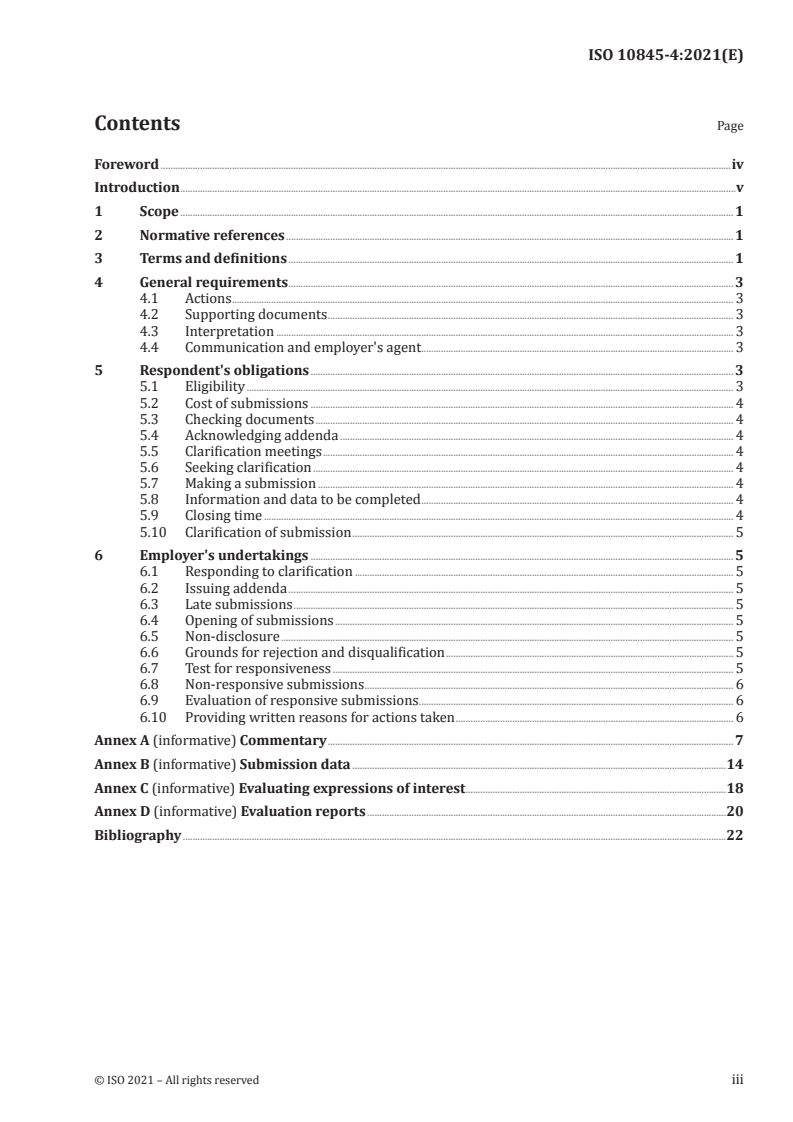
Contents Page
Foreword .iv
Introduction .v
1 Scope . 1
2 Normative references . 1
3 Terms and definitions . 1
4 General requirements . 3
4.1 Actions . 3
4.2 Supporting documents . 3
4.3 Interpretation . 3
4.4 Communication and employer's agent . 3
5 Respondent's obligations . 3
5.1 Eligibility . 3
5.2 Cost of submissions . 4
5.3 Checking documents . 4
5.4 Acknowledging addenda . 4
5.5 Clarification meetings . 4
5.6 Seeking clarification . 4
5.7 Making a submission . 4
5.8 Information and data to be completed . 4
5.9 Closing time . 4
5.10 Clarification of submission . 5
6 Employer's undertakings . 5
6.1 Responding to clarification . 5
6.2 Issuing addenda . 5
6.3 Late submissions . 5
6.4 Opening of submissions . 5
6.5 Non-disclosure . 5
6.6 Grounds for rejection and disqualification . 5
6.7 Test for responsiveness . 5
6.8 Non-responsive submissions . 6
6.9 Evaluation of responsive submissions . 6
6.10 Providing written reasons for actions taken . 6
Annex A (informative) Commentary . 7
Annex B (informative) Submission data .14
Annex C (informative) Evaluating expressions of interest .18
Annex D (informative) Evaluation reports .20
Bibliography .22
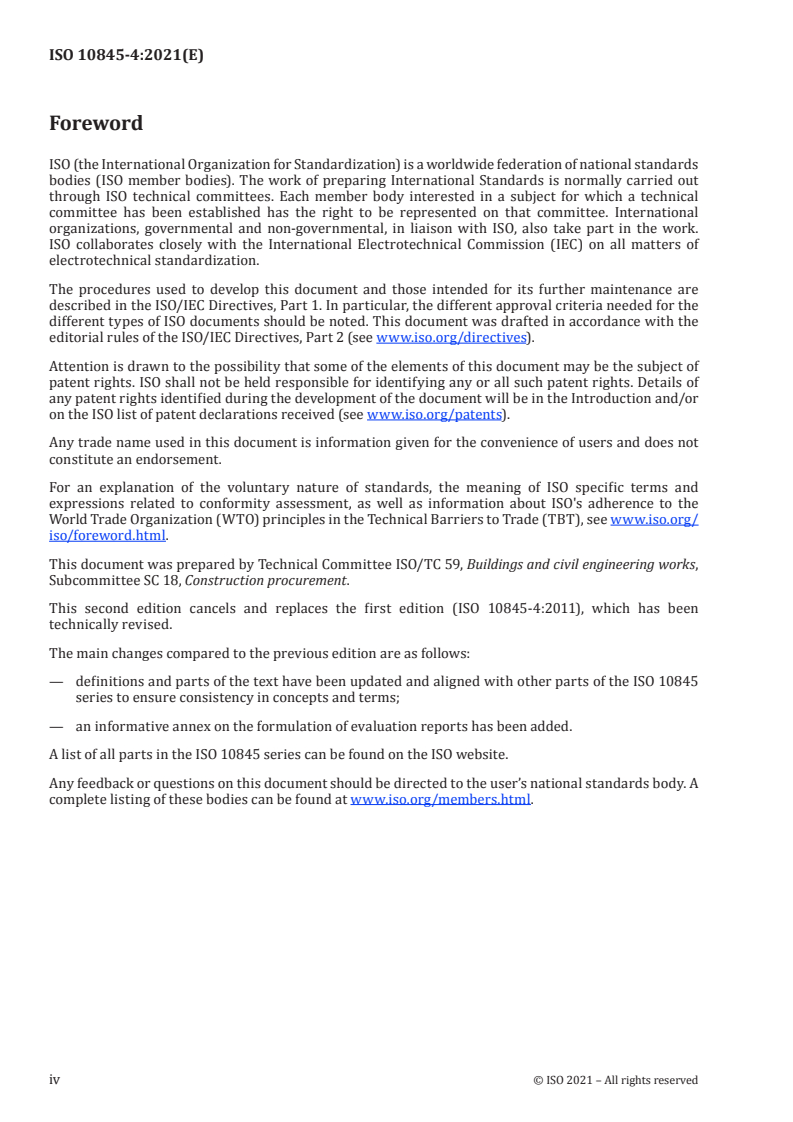
Foreword
ISO (the International Organization for Standardization) is a worldwide federation of national standards
bodies (ISO member bodies). The work of preparing International Standards is normally carried out
through ISO technical committees. Each member body interested in a subject for which a technical
committee has been established has the right to be represented on that committee. International
organizations, governmental and non-governmental, in liaison with ISO, also take part in the work.
ISO collaborates closely with the International Electrotechnical Commission (IEC) on all matters of
electrotechnical standardization.
The procedures used to develop this document and those intended for its further maintenance are
described in the ISO/IEC Directives, Part 1. In particular, the different approval criteria needed for the
different types of ISO documents should be noted. This document was drafted in accordance with the
editorial rules of the ISO/IEC Directives, Part 2 (see www .iso .org/ directives).
Attention is drawn to the possibility that some of the elements of this document may be the subject of
patent rights. ISO shall not be held responsible for identifying any or all such patent rights. Details of
any patent rights identified during the development of the document will be in the Introduction and/or
on the ISO list of patent declarations received (see www .iso .org/ patents).
Any trade name used in this document is information given for the convenience of users and does not
constitute an endorsement.
For an explanation of the voluntary nature of standards, the meaning of ISO specific terms and
expressions related to conformity assessment, as well as information about ISO's adherence to the
World Trade Organization (WTO) principles in the Technical Barriers to Trade (TBT), see www .iso .org/
iso/ foreword .html.
This document was prepared by Technical Committee ISO/TC 59, Buildings and civil engineering works,
Subcommittee SC 18, Construction procurement.
This second edition cancels and replaces the first edition (ISO 10845-4:2011), which has been
technically revised.
The main changes compared to the previous edition are as follows:
— definitions and parts of the text have been updated and aligned with other parts of the ISO 10845
series to ensure consistency in concepts and terms;
— an informative annex on the formulation of evaluation reports has been added.
A list of all parts in the ISO 10845 series can be found on the ISO website.
Any feedback or questions on this document should be directed to the user’s national standards body. A
complete listing of these bodies can be found at www .iso .org/ members .html.
iv © ISO 2021 – All rights reserved
Introduction
Procurement is the process which creates, manages and fulfils contracts. There are accordingly three
phases to the procurement process associated with the delivery and maintenance of construction
works, namely:
— a planning phase during which decisions are made as to what, where and when goods and services
are required, how the market is to be approached and what is the number, type, nature and timing
of the required contracts;
— an acquisition phase during which contracts are entered into following the execution of a selection
procedure; and
— a contract management (or contract administration) phase during which compliance with
requirements, changes in requirements and risk events which manifest during the execution of
contracts are managed.
Expressions of interest form part of the acquisition phase and are used to request potential tenderers
to register their interest in undertaking a specific contract or to participate in a project or programme
and to submit their credentials so that they can be invited to submit a tender offer should they qualify
or be selected to do so. Conditions for the calling for expressions of interest are required to establish
procedures from the time that expressions of interest are called for to the time that respondents are
invited to submit tender offers or are admitted to a database. Such conditions document the procedures,
the manner in which those engaged in these processes are to behave, the obligations of the respondent,
and the undertakings of the employer.
Calls for expressions of interest are associated with the use of the nominated and qualified selection
methods as described in ISO 10845-1 in order to admit respondents to an electronic database or
shortlist of pre-qualified tenderers (or both) so that they can be invited to submit tender offers in
respect of a particular procurement, respectively.
Calls for expressions of interest, when used to pre-qualify or shortlist tenderers, provide the market
with an advance warning of a tendering opportunity and reduce unnecessary abortive costs in
processing and preparing tenders offers. They can also be used to:
a) give the employer time to finalize the procurement documents and eliminate the need for
advertising tenders as only those tenderers who are shortlisted are invited to submit tender offers;
b) ensure that tenders are only invited from tenderers who potentially have the necessary capabilities
and capacities to perform the contract;
c) ensure that a limited number of respondents are invited to submit tender offers (usually not less
than three), where the evaluation of tender submissions is resource intensive or to make the
procurement more attractive to potential tenderers due to the demands made on tenderers during
the tender process in preparing a submission; or
d) allow capability and capacity to deliver the required goods, services and construction works to be
evaluated in two stages or to be omitted in the evaluation of tender offers.
Annex A contains guidance on the application of this document and suggestions on good practice.
Annex B provides guidance on how to develop the submission data for a call for expressions of interest
using this document. Annexes C and D offer guidance on the evaluation of expressions of interest and
the structuring of evaluation reports, respectively.
ISO 10845-2 establishes the manner in which calls for expressions of interest should be formatted
and compiled. The standard conditions contained in this document can, by reference, be readily
incorporated in procurement documents formatted and compiled in accordance with the provisions of
ISO 10845-2.
This document is part of the ISO 10845 series which covers various aspects of procurement within the
construction industry. Each part of the ISO 10845 series relates to a different aspect of procurement.
The objective of the ISO 10845 series is to provide a generic and standard set of processes, procedures
and methods for a procurement system that is fair, equitable, transparent, competitive and cost-
effective and which can be used to promote objectives additional to those associated with the immediate
objective of the procurement itself.
vi © ISO 2021 – All rights reserved
INTERNATIONAL STANDARD ISO 10845-4:2021(E)
Construction procurement —
Part 4:
Standard conditions for the calling for expressions of
interest
1 Scope
This document sets out standard conditions for the calling for expressions of interest which
a) bind the employer and respondent to behave in a particular manner,
b) establish what is required for a respondent to submit a compliant submission,
c) make known to respondents the evaluation criteria, and
d) establish the manner in which the employer conducts the process of calling for expressions of
interest.
This document is intended for use in procurements relating to goods, services and construction works
and certain disposals other than by auction.
2 Normative references
There are no normative references in this document.
3 Terms and definitions
For the purposes of this document, the following terms and definitions apply.
ISO and IEC maintain terminology databases for use in standardization at the following addresses:
— ISO Online browsing platform: available at https:// www .iso .org/ obp
— IEC Electropedia: available at https:// www .electropedia .org/
3.1
conflict of interest
situation where business, financial, family, political or personal interests could interfere with the
judgment of persons in carrying out their duties for the organization (3.7)
[SOURCE: ISO 37001:2016, 3.29]
3.2
corrupt practice
offering, giving, receiving or soliciting of anything of value to influence the action of the employer (3.4)
or his staff or agents in the tender process
[SOURCE: ISO 10845-1:2020, 3.10, modified — "the procurement process or the administration of the
contract" has been replaced by "the tender process".]
3.3
eligibility criteria
criteria framed around the ability of a respondent (3.9) to provide the required goods, services and
construction works or disposals, or any combination thereof, which need to be satisfied in order for a
submission to be evaluated
3.4
employer
person or organization (3.7) intending to or entering into the contract with the contractor to supply
goods, carry out construction works and/or provide services
[SOURCE: ISO 10845-1:2020, 3.15]
3.5
expression of interest
request for respondents (3.9) to register their interest in undertaking a specific contract or to participate
in a project or programme and to submit their credentials so they can, in terms of the employer’s (3.4)
selection methods, be invited to submit a tender offer should they qualify or be selected to do so
[SOURCE: ISO 10845-1:2020, 3.16]
3.6
fraudulent practice
misrepresentation of the facts in order to influence the tender process, or the award of a contract
arising from a tender offer to the detriment of the employer (3.4), including collusive practices intended
to establish prices at artificial levels
[SOURCE: ISO 10845-1:2020, 3.18, modified — "or the administration of the contract including
compensation procedures" at the end has been removed.]
3.7
organization
company, firm, enterprise, association or other legal entity, whether incorporated or not, or public body
[SOURCE: ISO 10845-1:2020, 3.21]
3.8
quality
totality of features and characteristics of a product or service that bears on the ability of the product or
service to satisfy stated or implied needs
[SOURCE: ISO 10845-1:2020, 3.27]
3.9
respondent
person or organization (3.7) that submits an expression of interest (3.5) in response to an invitation to
do so
[SOURCE: ISO 10845-1:2020, 3.28]
3.10
submission data
document that establishes the respondent's (3.9) obligations in responding to a call for an expression
of interest (3.5) and the employer's (3.4) undertakings in administering the process of calling for and
receiving expressions of interest
[SOURCE: ISO 10845-1:2020, 3.32]
2 © ISO 2021 – All rights reserved
4 General requirements
4.1 Actions
The employer and each respondent submitting an expression of interest shall comply with the standard
conditions for calling for an expression of interest in this document. In their dealings with each other,
they shall discharge their duties and obligations, as set out in Clauses 5 and 6, in a timely manner
and with integrity, behave equitably, honestly and transparently, and not engage in anti-competitive
practices.
The employer and the respondent and all their agents and employees involved in the submission process
shall avoid conflicts of interest and where a conflict of interest is perceived or known, declare any such
conflict of interest, indicating the nature of such conflict. Respondents shall declare any potential
conflict of interest in their submissions. Employees, agents and advisors of the employer shall declare
any conflict of interest to whoever is responsible for overseeing the procurement process at the start of
any deliberations relating to the procurement process or as soon as they become aware of such conflict,
and abstain from any decisions where such conflict exists or recuse themselves from the procurement
process, as appropriate.
The respondent shall not make a submission without having a firm intention and the capacity to
proceed with the next stage of the procurement process.
NOTE 1 A conflict of interest can exist even if there are no improper acts as a result of it. This can arise due to
a conflict of roles which can provide an incentive for improper acts in some circumstances or positions. A conflict
of interest can create an appearance of impropriety that can undermine confidence in the ability of that person to
act properly in said circumstance or position.
NOTE 2 Conflicts of interest with respect to those engaged in the procurement process include direct, indirect
or family interests in the tender or outcome of the procurement process and any personal bias, inclination,
obligation, allegiance or loyalty which can in any way affect any decisions taken.
4.2 Supporting documents
The documents issued by the employer for the purpose of obtaining expressions of interest are listed in
the submission data.
4.3 Interpretation
The submission data and additional requirements contained in the submission schedules that are
included in the returnable documents are deemed to be part of the conditions for the calling for
expressions of interest.
4.4 Communication and employer's agent
Each communication between the employer and a respondent shall be to or from the employer's agent
only, and in a form that can be readily read, copied and recorded, and in the language stated in the
submission data. The employer shall not take any responsibility for non-receipt of communications from
or by a respondent. The name and contact details of the employer's agent are stated in the submission
data.
5 Respondent's obligations
5.1 Eligibility
Submit an expression of interest only if the respondent satisfies the eligibility criteria stated in the
submission data and if the respondent or any of the respondent's principals is not under any restriction
to do business with the employer.
5.2 Cost of submissions
Accept that the employer does not compensate respondents for any costs incurred in the preparation
and delivery of a submission.
5.3 Checking documents
Check the submission documents on receipt and notify the employer of any discrepancy or omission.
5.4 Acknowledging addenda
Acknowledge receipt of addenda to the submission documents, which the employer may issue, and, if
necessary, apply for an extension to the closing time stated in the submission data, in order to take the
addenda into account.
5.5 Clarification meetings
Attend, where required, clarification meetings, the details of which are stated in the submission data,
at which respondents may familiarize themselves with the proposed work, services or supply (and
location, etc.) and raise questions.
5.6 Seeking clarification
Request clarification of the submission documents, if necessary, by notifying the employer at least five
working days before the closing time stated in the submission data.
5.7 Making a submission
Return all returnable documents and the number of copies of such documents stated in the submission
data to the employer after completing them in their entirety, either electronically (if they were issued in
electronic format) or by writing legibly in non-erasable ink.
Seal the original and each copy of the submission as separate packages, marking the packages
as “ORIGINAL” and “COPY”. Each package shall state, on the outside, the employer's address and
identification details stated in the submission data, as well as the respondent's name and contact
address.
Accept that the employer does not assume any responsibility for the misplacement or premature
opening of the submission if the outer package is not sealed and marked as stated.
5.8 Information and data to be completed
Accept that submissions which do not provide all the data or information requested, completely and in
the form required, may be regarded by the employer as being non-responsive.
5.9 Closing time
Ensure that the employer receives the submissions at the address specified in the submission data
not later than the closing time stated in the submission data. Proof of posting shall not be accepted as
proof of delivery. The employer shall not accept submissions submitted by telegraph, telex, facsimile or
e-mail, unless otherwise stated in the submission data.
Accept that, if the employer extends the closing time stated in the submission data for any reason, the
requirements of the conditions for expressions of interest apply equally to the extended deadline.
4 © ISO 2021 – All rights reserved
5.10 Clarification of submission
Provide clarification of a submission in response to a request to do so from the employer during the
evaluation of submissions.
6 Employer's undertakings
6.1 Responding to clarification
Respond to a request for clarification received up to five working days before the submission closing
time stated in the submission data and notify all respondents who attended the clarification meetings,
if any, of those responses.
6.2 Issuing addenda
If necessary, issue addenda that may amend or amplify the submission documents to each respondent
during the period from the date of the calling for expressions of interest until three days before the
closing time for submissions stated in the submission data. If, as a result of the issuing of addenda, it is
necessary to extend the closing time stated in the submission data, grant such extension and notify all
respondents accordingly.
6.3 Late submissions
Unless otherwise stated in the submission data, return submissions received after the closing time
stated in the submission data unopened, unless it is necessary to open a submission to obtain a
forwarding address, to the respondent concerned.
6.4 Opening of submissions
Record the name of each respondent whose submission is opened and acknowledge receipt of each
submission.
Make available the names of the respondents that made submissions before the closing time for
submissions to all interested persons upon request.
6.5 Non-disclosure
Do not disclose to respondents, or to any other person not officially concerned with such processes,
information relating to the evaluation and comparison of submissions until after the evaluation process
is complete.
6.6 Grounds for rejection and disqualification
Determine whether there has been any effort by a respondent to influence the process and instantly
disqualify a respondent if it is established that he engaged in corrupt or fraudulent practices.
6.7 Test for responsiveness
Determine, upon opening and before detailed evaluation, whether each submission received
a) complies with the requirements of the conditions for the calling for expressions of interest,
b) has all the substantive provisions properly and fully completed and signed, and
c) is responsive to the other requirements of the call for expressions of interest.
6.8 Non-responsive submissions
Reject all non-responsive submissions.
6.9 Evaluation of responsive submissions
Appoint an evaluation panel of not less than three persons to evaluate submissions using the evaluation
criteria established in the submission data.
Notify the respondents of the outcome of the evaluation process within two weeks of the evaluation
report being accepted by the employer.
6.10 Providing written reasons for actions taken
Provide, upon request, written reasons to respondents for any action that is taken in applying these
conditions, but withhold information which
a) is not in the public interest to be divulged,
b) is considered to prejudice the legitimate commercial interests of respondents, or
c) may prejudice fair competition between respondents.
6 © ISO 2021 – All rights reserved
Annex A
(informative)
Commentary
A.1 General
The purpose of this document is to standardize the procurement processes, methods and procedures
where calls for expressions of interest are made to invite respondents to
a) apply for admission to an electronic database, or
b) register their interest in undertaking a specific contract or to participate in a project or programme
and to submit their credentials so they can, in terms of the employer's procurement procedures, be
invited to submit a tender offer should they qualify or be selected to do so.
The conditions for calling for expressions of interest are, by definition, the document that establishes
a respondent's obligations in responding to a call for an expression of interest, and the employer's
undertakings in administering the process of calling for and receiving expressions of interest. These
conditions, as such, establish the rules from the time a call for an expression of interest is advertised
to the time that any submission is evaluated. They are generic in nature and are made procurement-
specific through the submission data (see Annex B).
The standard conditions are based on a procurement system that is:
— fair, equitable, transparent, competitive and cost-effective and, subject to an organization's
procurement policy, can promote social or development (or both) objectives; and
— complies with the qualitative procurement system requirements identified in Table A.1 (see also
ISO 10845-1).
The standard conditions for calling for expressions of interest are referenced in the submission data
section of procurement documents (see ISO 10845-2).
Public sector procurement is frequently governed by local and international laws. These standard
conditions for the calling for expressions of interest do not purport to cover the provisions of all
such laws. Employers need to be aware that they are responsible for the correct application of these
conditions and ensuring consistency with prevailing legislation through the provision of additional
clauses, the modification of certain provisions and the formulation of submission data.
A.2 Commentary on general requirements (Clause 4)
A.2.1 Actions
4.1 binds both the employer and the respondent to the provisions of the basic code of conduct provided
for in ISO 10845-1. It also expands upon some of the provisions of the code of conduct in relation to the
calling for expressions of interest.
Failure by a respondent to act within the provisions of this basic code of conduct is tantamount to a
breach of the conditions for the calling for expressions of interest and can result in disqualification (see
6.6).
Employers should not disclose information received from respondents that is intellectual property,
proprietary, commercial-in-confidence or otherwise confidential.
Assessment panels should indicate in each evaluation report whether or not all members of the panel
have declared their interest and, where conflicts of interest (actual, potential or perceived) have been
identified, what action has been taken.
Table A.1 — Qualitative procurement system requirements
Goal Qualitative interpretation of goal
Fair The process of offer and acceptance is conducted impartially without bias, providing timely access
to the same information.
Terms and conditions for performing the work do not unfairly prejudice the interests of the parties.
Equitable The only grounds for not awarding a contract to a tenderer who complies with all the requirements
are “blacklisting”, lack of capability or capacity, legal impediments and conflicts of interest.
Transparent The procurement process and criteria upon which decisions are to be made are publicized. Deci-
sions (award and intermediate) are made publicly available together with defensible reasons for
such decisions. It is possible to verify that criteria were applied.
The requirements of procurement documents are presented in a clear, unambiguous, comprehen-
sive and understandable manner.
Competitive The system provides for appropriate levels of competition to ensure cost-effective and best-value
outcomes.
Cost-effective The processes, procedures and methods are standardized with sufficient flexibility enabling
best-value outcomes in respect of quality, timing and cost and least resources to effectively manage
and control procurement processes.
Decision making focusses on the attainment of value for money (optimal use of resources to achieve
intended project outcomes or the effective, efficient and economic use of resources) through the
evaluation of relevant costs and benefits together with the assessment of risks.
P r o m o t io n The system may incorporate measures to promote social and development objectives associated
of social and with a preferential procurement policy subject to qualified tenderers not being excluded and de-
development liverables or preferencing criteria being measurable, quantifiable and monitored for compliance.
objectives
A.2.2 Supporting documents
4.2 requires that documents pertaining to a particular call for an expression of interest be identified in
the submission data (see Annex B).
A.2.3 Interpretation
4.3 clarifies what constitutes the conditions for the calling for an expression of interest, i.e. the
submission data which references these conditions of tender and any additional requirements
established in submission schedules that are included in the returnable documents (see ISO 10845-2).
A.2.4 Communication and employer's agent
The submission data should provide the name and contact details of the employer's agent for the
purpose of communications, and the language of communication if other than English.
A.3 Commentary on respondent's obligations (Clause 5)
A.3.1 Eligibility
5.1 requires the employer to only evaluate submissions that satisfy eligibility criteria. This subclause
accordingly allows an employer to introduce minimum qualification or pre-qualification criteria.
Failure to satisfy eligibility criteria is a breach of the conditions for calling for expressions of interest
and, as such, results in instant disqualification.
8 © ISO 2021 – All rights reserved
Eligibility criteria should be formulated around capability and capacity to perform the work and the
avoidance of conflicts of interest. Any eligibility criteria introduced should generally be based on the
demonstration of the following, as necessary:
a) professional and technical qualifications;
b) professional and technical competence;
c) financial resources;
d) equipment and other physical facilities;
e) expertise and personnel;
f) managerial capacity, reliability and experience;
g) previous experience in relation to the scope of work;
h) where relevant, health and safety history.
Eligibility criteria accordingly should be framed around financial standing and capability, business
and professional standings and health and safety, environmental management, quality management
and building information modelling capabilities. Such criteria should be framed around threshold or
minimum requirements which, if not satisfied, would pose an unacceptable risk to the employer should
the respondent be recommended for the award of a contract and as such be overlooked for the award
of the contract. The formulation of such criteria should be such that respondents can readily self-assess
their compliance / non-compliance with the stated criteria. Respondents who fail to comply with the
eligibility criteria will either refrain from making a submission or have their submissions rejected
at the outset of the evaluation process. This reduces the work load on those that are tasked with the
evaluation of submissions.
Care needs, however, to be taken in setting eligibility criteria. Such criteria should not be set any higher
than is necessary so as not to unfairly eliminate capable respondents who are able to offer better value
or unfairly discriminate against small and medium sized enterprises.
An eligibility declaration should be included in the returnable schedules (see ISO 10845-3). Such a
declaration should enable a respondent to make a formal declaration that the tenderer satisfies the
eligibility criteria and alert respondents as to what needs to be provided to demonstrate compliance
with certain eligibility criteria.
A.3.2 Cost of submissions
5.2 makes the cost of submissions and demonstrating compliance with requirements an expense of the
respondent.
A.3.3 Checking documents
5.3 places the responsibility for checking the completeness of the documents on the respondent. The
employer is obliged to state, in the submission data, the documents that are issued for submission
purposes to enable the respondents to comply with this obligation.
A.3.4 Acknowledging addenda
5.4 requires respondents to acknowledge receipt of addenda issued by the employer and, if necessary,
to apply for an extension to the closing date. It is important that respondents acknowledge receipt of
addenda.
A.3.5 Clarification meetings
5.5 can require respondents to attend compulsory clarification meetings, failing which their submissions
can be rejected. Details of such meetings should be stated in the submission data. A compulsory
clarification meeting affords potential respondents the opportunity to raise points of clarity with the
employer. Employers should obtain the names and addresses of all who attend such meetings so that
any clarifications or addenda can be simultaneously sent to all prospective respondents in accordance
with 6.1 and 6.2. Submissions received from respondents who make submissions and do not attend a
compulsory clarification meeting are regarded as non-responsive (see 6.8).
Measures should be put in place to accurately record the names and contact particulars of all potential
respondents who obtained documents where no compulsory meeting is held. Such measures can include
the registration of contact particular of the person downloading the documentation from a website.
Should this not be done, the employer should not issue addenda as specified in 6.2.
Clarification meetings should, as relevant, be structured such that they provide an opportunity
a) for respondents to become fully aware of and to understand what is required in the procurement
processes and in the execution of the proposed contract,
b) for respondents to raise any specific queries they may have concerning incomplete information or
ambiguities in the information,
c) for respondents to raise questions about potential qualifications, and
d) to issue any further information or addendum.
All respondents should be dealt with equitably and fairly. Additional information should be provided in
writing simultaneously to all respondents.
A.3.6 Seeking clarification
5.6 places the onus on respondents to seek clarifications well in advance of the closing date for
submissions. This enables the employer to respond in a timely manner to requests for clarification.
A.3.7 Making a submission
5.7 establishes the requirements for respondents to submit compliant submissions. Specific
requirements relating to submissions should be stated in the submission data.
A.3.8 Information and data to be completed
5.8 allows employers to declare incomplete submissions as being non-responsive.
A.3.9 Closing time
5.9 identifies the closing time for submissions and deals with extensions of time for submissions. The
closing time and date should be stated in the submission data.
A.3.10 Clarification of submission
5.10 obligates respondents to clarify aspects of their submissions, when requested to do so. The
employer should manage the clarification procedure in such a way as not to give any respondent an
unfair advantage over other respondents.
A.4 Commentary on employer's undertakings (Clause 6)
A.4.1 Responding to clarification
6.1 establishes the manner in which the employer is to respond to requests for clarifications and
the time frames relating thereto. Employers should not disclose the source of the request to other
respondents.
10 © ISO 2021 – All rights reserved
All requests for information provided in writing should be consolidated and all answers provided to
all respondents via fax or e-mail to ensure consistent and fair dealing. Where the question or request
for clarification is considered to be of material significance, both the query and the response should
be communicated, in a suitably anonymous form. Where queries result in the issuing of an addendum
that makes significant changes to the documentation, an extension of the submission period should be
considered.
A.4.2 Issuing addenda
6.2 establishes the manner in which the employer issues addenda and the time frames relating thereto.
A.4.3 Late submissions
The submission data should state how late submissions are dealt with.
Where calls for expressions of interest relate to the admission to an electronic database, late
submissions should only be opened after all the submissions that were received before the closing time
for submissions have been processed.
A.4.4 Opening of submissions
6.4 establishes the procedures which are to be followed for the opening of submissions and requires the
employer to make available the record upon request.
A.4.5 Non-disclosure
6.5 establishes the requirements to maintain integrity in the submission process.
A.4.6 Grounds for rejection and disqualification
6.6 permits submissions to be rejected and respondents to be disqualified should there be a reasonable
suspicion or evidence that a respondent has, or has attempted to, influence the processing of submissions
or has engaged in corrupt or fraudulent practices.
A.4.7 Test for responsiveness
6.7 establishes the procedures for and criteria by which submissions are considered as being responsive.
Submissions which are not complete in every respect do not need to be declared non-responsive,
provided that the omission does not alter any fundamental aspects of the evaluation of the submission,
e.g. the scoring of evaluation points or introduce new requirements or unfairly erode requirements.
Respondents should be permitted to provide clarifications.
A.4.8 Evaluation of responsive submissions
6.9 enables the employer to establish requirements, if any, for evaluating responsive submissions i.e.
those respondents who satisfy the stipulated eligibility criteria. This clause enables the employer
to introduce criteria which enable the short listing of respondents i.e. the reducing of the number of
responsive respondents who are invited to submit tender offers. For example, the employer may
evaluate respondents in terms of their experience in providing similar work required under the
contract, their proposals for satisfying the employer’s value proposition for the project (the promise of
measurable benefits resulting from the project) and management systems that are in place to achieve
employer objectives. Such criteria can be effectively used to gauge a respondent’s potential ability to
satisfy the employer’s expectations for the service or their compatibility in working collaboratively
with the employer.
Where criteria are set and evaluated, three persons who are fully conversant with the technical aspects
of the procurement should undertake such evaluation. Evaluat
...
INTERNATIONAL ISO
STANDARD 10845-4
Second edition
2021-07
Construction procurement —
Part 4:
Standard conditions for the calling for
expressions of interest
Marchés de construction —
Partie 4: Conditions-types normalisées pour appel aux parties
intéressées
Reference number
©
ISO 2021
© ISO 2021
All rights reserved. Unless otherwise specified, or required in the context of its implementation, no part of this publication may
be reproduced or utilized otherwise in any form or by any means, electronic or mechanical, including photocopying, or posting
on the internet or an intranet, without prior written permission. Permission can be requested from either ISO at the address
below or ISO’s member body in the country of the requester.
ISO copyright office
CP 401 • Ch. de Blandonnet 8
CH-1214 Vernier, Geneva
Phone: +41 22 749 01 11
Email: copyright@iso.org
Website: www.iso.org
Published in Switzerland
ii © ISO 2021 – All rights reserved
Contents Page
Foreword .iv
Introduction .v
1 Scope . 1
2 Normative references . 1
3 Terms and definitions . 1
4 General requirements . 3
4.1 Actions . 3
4.2 Supporting documents . 3
4.3 Interpretation . 3
4.4 Communication and employer's agent . 3
5 Respondent's obligations . 3
5.1 Eligibility . 3
5.2 Cost of submissions . 4
5.3 Checking documents . 4
5.4 Acknowledging addenda . 4
5.5 Clarification meetings . 4
5.6 Seeking clarification . 4
5.7 Making a submission . 4
5.8 Information and data to be completed . 4
5.9 Closing time . 4
5.10 Clarification of submission . 5
6 Employer's undertakings . 5
6.1 Responding to clarification . 5
6.2 Issuing addenda . 5
6.3 Late submissions . 5
6.4 Opening of submissions . 5
6.5 Non-disclosure . 5
6.6 Grounds for rejection and disqualification . 5
6.7 Test for responsiveness . 5
6.8 Non-responsive submissions . 6
6.9 Evaluation of responsive submissions . 6
6.10 Providing written reasons for actions taken . 6
Annex A (informative) Commentary . 7
Annex B (informative) Submission data .14
Annex C (informative) Evaluating expressions of interest .18
Annex D (informative) Evaluation reports .20
Bibliography .22
Foreword
ISO (the International Organization for Standardization) is a worldwide federation of national standards
bodies (ISO member bodies). The work of preparing International Standards is normally carried out
through ISO technical committees. Each member body interested in a subject for which a technical
committee has been established has the right to be represented on that committee. International
organizations, governmental and non-governmental, in liaison with ISO, also take part in the work.
ISO collaborates closely with the International Electrotechnical Commission (IEC) on all matters of
electrotechnical standardization.
The procedures used to develop this document and those intended for its further maintenance are
described in the ISO/IEC Directives, Part 1. In particular, the different approval criteria needed for the
different types of ISO documents should be noted. This document was drafted in accordance with the
editorial rules of the ISO/IEC Directives, Part 2 (see www .iso .org/ directives).
Attention is drawn to the possibility that some of the elements of this document may be the subject of
patent rights. ISO shall not be held responsible for identifying any or all such patent rights. Details of
any patent rights identified during the development of the document will be in the Introduction and/or
on the ISO list of patent declarations received (see www .iso .org/ patents).
Any trade name used in this document is information given for the convenience of users and does not
constitute an endorsement.
For an explanation of the voluntary nature of standards, the meaning of ISO specific terms and
expressions related to conformity assessment, as well as information about ISO's adherence to the
World Trade Organization (WTO) principles in the Technical Barriers to Trade (TBT), see www .iso .org/
iso/ foreword .html.
This document was prepared by Technical Committee ISO/TC 59, Buildings and civil engineering works,
Subcommittee SC 18, Construction procurement.
This second edition cancels and replaces the first edition (ISO 10845-4:2011), which has been
technically revised.
The main changes compared to the previous edition are as follows:
— definitions and parts of the text have been updated and aligned with other parts of the ISO 10845
series to ensure consistency in concepts and terms;
— an informative annex on the formulation of evaluation reports has been added.
A list of all parts in the ISO 10845 series can be found on the ISO website.
Any feedback or questions on this document should be directed to the user’s national standards body. A
complete listing of these bodies can be found at www .iso .org/ members .html.
iv © ISO 2021 – All rights reserved
Introduction
Procurement is the process which creates, manages and fulfils contracts. There are accordingly three
phases to the procurement process associated with the delivery and maintenance of construction
works, namely:
— a planning phase during which decisions are made as to what, where and when goods and services
are required, how the market is to be approached and what is the number, type, nature and timing
of the required contracts;
— an acquisition phase during which contracts are entered into following the execution of a selection
procedure; and
— a contract management (or contract administration) phase during which compliance with
requirements, changes in requirements and risk events which manifest during the execution of
contracts are managed.
Expressions of interest form part of the acquisition phase and are used to request potential tenderers
to register their interest in undertaking a specific contract or to participate in a project or programme
and to submit their credentials so that they can be invited to submit a tender offer should they qualify
or be selected to do so. Conditions for the calling for expressions of interest are required to establish
procedures from the time that expressions of interest are called for to the time that respondents are
invited to submit tender offers or are admitted to a database. Such conditions document the procedures,
the manner in which those engaged in these processes are to behave, the obligations of the respondent,
and the undertakings of the employer.
Calls for expressions of interest are associated with the use of the nominated and qualified selection
methods as described in ISO 10845-1 in order to admit respondents to an electronic database or
shortlist of pre-qualified tenderers (or both) so that they can be invited to submit tender offers in
respect of a particular procurement, respectively.
Calls for expressions of interest, when used to pre-qualify or shortlist tenderers, provide the market
with an advance warning of a tendering opportunity and reduce unnecessary abortive costs in
processing and preparing tenders offers. They can also be used to:
a) give the employer time to finalize the procurement documents and eliminate the need for
advertising tenders as only those tenderers who are shortlisted are invited to submit tender offers;
b) ensure that tenders are only invited from tenderers who potentially have the necessary capabilities
and capacities to perform the contract;
c) ensure that a limited number of respondents are invited to submit tender offers (usually not less
than three), where the evaluation of tender submissions is resource intensive or to make the
procurement more attractive to potential tenderers due to the demands made on tenderers during
the tender process in preparing a submission; or
d) allow capability and capacity to deliver the required goods, services and construction works to be
evaluated in two stages or to be omitted in the evaluation of tender offers.
Annex A contains guidance on the application of this document and suggestions on good practice.
Annex B provides guidance on how to develop the submission data for a call for expressions of interest
using this document. Annexes C and D offer guidance on the evaluation of expressions of interest and
the structuring of evaluation reports, respectively.
ISO 10845-2 establishes the manner in which calls for expressions of interest should be formatted
and compiled. The standard conditions contained in this document can, by reference, be readily
incorporated in procurement documents formatted and compiled in accordance with the provisions of
ISO 10845-2.
This document is part of the ISO 10845 series which covers various aspects of procurement within the
construction industry. Each part of the ISO 10845 series relates to a different aspect of procurement.
The objective of the ISO 10845 series is to provide a generic and standard set of processes, procedures
and methods for a procurement system that is fair, equitable, transparent, competitive and cost-
effective and which can be used to promote objectives additional to those associated with the immediate
objective of the procurement itself.
vi © ISO 2021 – All rights reserved
INTERNATIONAL STANDARD ISO 10845-4:2021(E)
Construction procurement —
Part 4:
Standard conditions for the calling for expressions of
interest
1 Scope
This document sets out standard conditions for the calling for expressions of interest which
a) bind the employer and respondent to behave in a particular manner,
b) establish what is required for a respondent to submit a compliant submission,
c) make known to respondents the evaluation criteria, and
d) establish the manner in which the employer conducts the process of calling for expressions of
interest.
This document is intended for use in procurements relating to goods, services and construction works
and certain disposals other than by auction.
2 Normative references
There are no normative references in this document.
3 Terms and definitions
For the purposes of this document, the following terms and definitions apply.
ISO and IEC maintain terminology databases for use in standardization at the following addresses:
— ISO Online browsing platform: available at https:// www .iso .org/ obp
— IEC Electropedia: available at https:// www .electropedia .org/
3.1
conflict of interest
situation where business, financial, family, political or personal interests could interfere with the
judgment of persons in carrying out their duties for the organization (3.7)
[SOURCE: ISO 37001:2016, 3.29]
3.2
corrupt practice
offering, giving, receiving or soliciting of anything of value to influence the action of the employer (3.4)
or his staff or agents in the tender process
[SOURCE: ISO 10845-1:2020, 3.10, modified — "the procurement process or the administration of the
contract" has been replaced by "the tender process".]
3.3
eligibility criteria
criteria framed around the ability of a respondent (3.9) to provide the required goods, services and
construction works or disposals, or any combination thereof, which need to be satisfied in order for a
submission to be evaluated
3.4
employer
person or organization (3.7) intending to or entering into the contract with the contractor to supply
goods, carry out construction works and/or provide services
[SOURCE: ISO 10845-1:2020, 3.15]
3.5
expression of interest
request for respondents (3.9) to register their interest in undertaking a specific contract or to participate
in a project or programme and to submit their credentials so they can, in terms of the employer’s (3.4)
selection methods, be invited to submit a tender offer should they qualify or be selected to do so
[SOURCE: ISO 10845-1:2020, 3.16]
3.6
fraudulent practice
misrepresentation of the facts in order to influence the tender process, or the award of a contract
arising from a tender offer to the detriment of the employer (3.4), including collusive practices intended
to establish prices at artificial levels
[SOURCE: ISO 10845-1:2020, 3.18, modified — "or the administration of the contract including
compensation procedures" at the end has been removed.]
3.7
organization
company, firm, enterprise, association or other legal entity, whether incorporated or not, or public body
[SOURCE: ISO 10845-1:2020, 3.21]
3.8
quality
totality of features and characteristics of a product or service that bears on the ability of the product or
service to satisfy stated or implied needs
[SOURCE: ISO 10845-1:2020, 3.27]
3.9
respondent
person or organization (3.7) that submits an expression of interest (3.5) in response to an invitation to
do so
[SOURCE: ISO 10845-1:2020, 3.28]
3.10
submission data
document that establishes the respondent's (3.9) obligations in responding to a call for an expression
of interest (3.5) and the employer's (3.4) undertakings in administering the process of calling for and
receiving expressions of interest
[SOURCE: ISO 10845-1:2020, 3.32]
2 © ISO 2021 – All rights reserved
4 General requirements
4.1 Actions
The employer and each respondent submitting an expression of interest shall comply with the standard
conditions for calling for an expression of interest in this document. In their dealings with each other,
they shall discharge their duties and obligations, as set out in Clauses 5 and 6, in a timely manner
and with integrity, behave equitably, honestly and transparently, and not engage in anti-competitive
practices.
The employer and the respondent and all their agents and employees involved in the submission process
shall avoid conflicts of interest and where a conflict of interest is perceived or known, declare any such
conflict of interest, indicating the nature of such conflict. Respondents shall declare any potential
conflict of interest in their submissions. Employees, agents and advisors of the employer shall declare
any conflict of interest to whoever is responsible for overseeing the procurement process at the start of
any deliberations relating to the procurement process or as soon as they become aware of such conflict,
and abstain from any decisions where such conflict exists or recuse themselves from the procurement
process, as appropriate.
The respondent shall not make a submission without having a firm intention and the capacity to
proceed with the next stage of the procurement process.
NOTE 1 A conflict of interest can exist even if there are no improper acts as a result of it. This can arise due to
a conflict of roles which can provide an incentive for improper acts in some circumstances or positions. A conflict
of interest can create an appearance of impropriety that can undermine confidence in the ability of that person to
act properly in said circumstance or position.
NOTE 2 Conflicts of interest with respect to those engaged in the procurement process include direct, indirect
or family interests in the tender or outcome of the procurement process and any personal bias, inclination,
obligation, allegiance or loyalty which can in any way affect any decisions taken.
4.2 Supporting documents
The documents issued by the employer for the purpose of obtaining expressions of interest are listed in
the submission data.
4.3 Interpretation
The submission data and additional requirements contained in the submission schedules that are
included in the returnable documents are deemed to be part of the conditions for the calling for
expressions of interest.
4.4 Communication and employer's agent
Each communication between the employer and a respondent shall be to or from the employer's agent
only, and in a form that can be readily read, copied and recorded, and in the language stated in the
submission data. The employer shall not take any responsibility for non-receipt of communications from
or by a respondent. The name and contact details of the employer's agent are stated in the submission
data.
5 Respondent's obligations
5.1 Eligibility
Submit an expression of interest only if the respondent satisfies the eligibility criteria stated in the
submission data and if the respondent or any of the respondent's principals is not under any restriction
to do business with the employer.
5.2 Cost of submissions
Accept that the employer does not compensate respondents for any costs incurred in the preparation
and delivery of a submission.
5.3 Checking documents
Check the submission documents on receipt and notify the employer of any discrepancy or omission.
5.4 Acknowledging addenda
Acknowledge receipt of addenda to the submission documents, which the employer may issue, and, if
necessary, apply for an extension to the closing time stated in the submission data, in order to take the
addenda into account.
5.5 Clarification meetings
Attend, where required, clarification meetings, the details of which are stated in the submission data,
at which respondents may familiarize themselves with the proposed work, services or supply (and
location, etc.) and raise questions.
5.6 Seeking clarification
Request clarification of the submission documents, if necessary, by notifying the employer at least five
working days before the closing time stated in the submission data.
5.7 Making a submission
Return all returnable documents and the number of copies of such documents stated in the submission
data to the employer after completing them in their entirety, either electronically (if they were issued in
electronic format) or by writing legibly in non-erasable ink.
Seal the original and each copy of the submission as separate packages, marking the packages
as “ORIGINAL” and “COPY”. Each package shall state, on the outside, the employer's address and
identification details stated in the submission data, as well as the respondent's name and contact
address.
Accept that the employer does not assume any responsibility for the misplacement or premature
opening of the submission if the outer package is not sealed and marked as stated.
5.8 Information and data to be completed
Accept that submissions which do not provide all the data or information requested, completely and in
the form required, may be regarded by the employer as being non-responsive.
5.9 Closing time
Ensure that the employer receives the submissions at the address specified in the submission data
not later than the closing time stated in the submission data. Proof of posting shall not be accepted as
proof of delivery. The employer shall not accept submissions submitted by telegraph, telex, facsimile or
e-mail, unless otherwise stated in the submission data.
Accept that, if the employer extends the closing time stated in the submission data for any reason, the
requirements of the conditions for expressions of interest apply equally to the extended deadline.
4 © ISO 2021 – All rights reserved
5.10 Clarification of submission
Provide clarification of a submission in response to a request to do so from the employer during the
evaluation of submissions.
6 Employer's undertakings
6.1 Responding to clarification
Respond to a request for clarification received up to five working days before the submission closing
time stated in the submission data and notify all respondents who attended the clarification meetings,
if any, of those responses.
6.2 Issuing addenda
If necessary, issue addenda that may amend or amplify the submission documents to each respondent
during the period from the date of the calling for expressions of interest until three days before the
closing time for submissions stated in the submission data. If, as a result of the issuing of addenda, it is
necessary to extend the closing time stated in the submission data, grant such extension and notify all
respondents accordingly.
6.3 Late submissions
Unless otherwise stated in the submission data, return submissions received after the closing time
stated in the submission data unopened, unless it is necessary to open a submission to obtain a
forwarding address, to the respondent concerned.
6.4 Opening of submissions
Record the name of each respondent whose submission is opened and acknowledge receipt of each
submission.
Make available the names of the respondents that made submissions before the closing time for
submissions to all interested persons upon request.
6.5 Non-disclosure
Do not disclose to respondents, or to any other person not officially concerned with such processes,
information relating to the evaluation and comparison of submissions until after the evaluation process
is complete.
6.6 Grounds for rejection and disqualification
Determine whether there has been any effort by a respondent to influence the process and instantly
disqualify a respondent if it is established that he engaged in corrupt or fraudulent practices.
6.7 Test for responsiveness
Determine, upon opening and before detailed evaluation, whether each submission received
a) complies with the requirements of the conditions for the calling for expressions of interest,
b) has all the substantive provisions properly and fully completed and signed, and
c) is responsive to the other requirements of the call for expressions of interest.
6.8 Non-responsive submissions
Reject all non-responsive submissions.
6.9 Evaluation of responsive submissions
Appoint an evaluation panel of not less than three persons to evaluate submissions using the evaluation
criteria established in the submission data.
Notify the respondents of the outcome of the evaluation process within two weeks of the evaluation
report being accepted by the employer.
6.10 Providing written reasons for actions taken
Provide, upon request, written reasons to respondents for any action that is taken in applying these
conditions, but withhold information which
a) is not in the public interest to be divulged,
b) is considered to prejudice the legitimate commercial interests of respondents, or
c) may prejudice fair competition between respondents.
6 © ISO 2021 – All rights reserved
Annex A
(informative)
Commentary
A.1 General
The purpose of this document is to standardize the procurement processes, methods and procedures
where calls for expressions of interest are made to invite respondents to
a) apply for admission to an electronic database, or
b) register their interest in undertaking a specific contract or to participate in a project or programme
and to submit their credentials so they can, in terms of the employer's procurement procedures, be
invited to submit a tender offer should they qualify or be selected to do so.
The conditions for calling for expressions of interest are, by definition, the document that establishes
a respondent's obligations in responding to a call for an expression of interest, and the employer's
undertakings in administering the process of calling for and receiving expressions of interest. These
conditions, as such, establish the rules from the time a call for an expression of interest is advertised
to the time that any submission is evaluated. They are generic in nature and are made procurement-
specific through the submission data (see Annex B).
The standard conditions are based on a procurement system that is:
— fair, equitable, transparent, competitive and cost-effective and, subject to an organization's
procurement policy, can promote social or development (or both) objectives; and
— complies with the qualitative procurement system requirements identified in Table A.1 (see also
ISO 10845-1).
The standard conditions for calling for expressions of interest are referenced in the submission data
section of procurement documents (see ISO 10845-2).
Public sector procurement is frequently governed by local and international laws. These standard
conditions for the calling for expressions of interest do not purport to cover the provisions of all
such laws. Employers need to be aware that they are responsible for the correct application of these
conditions and ensuring consistency with prevailing legislation through the provision of additional
clauses, the modification of certain provisions and the formulation of submission data.
A.2 Commentary on general requirements (Clause 4)
A.2.1 Actions
4.1 binds both the employer and the respondent to the provisions of the basic code of conduct provided
for in ISO 10845-1. It also expands upon some of the provisions of the code of conduct in relation to the
calling for expressions of interest.
Failure by a respondent to act within the provisions of this basic code of conduct is tantamount to a
breach of the conditions for the calling for expressions of interest and can result in disqualification (see
6.6).
Employers should not disclose information received from respondents that is intellectual property,
proprietary, commercial-in-confidence or otherwise confidential.
Assessment panels should indicate in each evaluation report whether or not all members of the panel
have declared their interest and, where conflicts of interest (actual, potential or perceived) have been
identified, what action has been taken.
Table A.1 — Qualitative procurement system requirements
Goal Qualitative interpretation of goal
Fair The process of offer and acceptance is conducted impartially without bias, providing timely access
to the same information.
Terms and conditions for performing the work do not unfairly prejudice the interests of the parties.
Equitable The only grounds for not awarding a contract to a tenderer who complies with all the requirements
are “blacklisting”, lack of capability or capacity, legal impediments and conflicts of interest.
Transparent The procurement process and criteria upon which decisions are to be made are publicized. Deci-
sions (award and intermediate) are made publicly available together with defensible reasons for
such decisions. It is possible to verify that criteria were applied.
The requirements of procurement documents are presented in a clear, unambiguous, comprehen-
sive and understandable manner.
Competitive The system provides for appropriate levels of competition to ensure cost-effective and best-value
outcomes.
Cost-effective The processes, procedures and methods are standardized with sufficient flexibility enabling
best-value outcomes in respect of quality, timing and cost and least resources to effectively manage
and control procurement processes.
Decision making focusses on the attainment of value for money (optimal use of resources to achieve
intended project outcomes or the effective, efficient and economic use of resources) through the
evaluation of relevant costs and benefits together with the assessment of risks.
P r o m o t io n The system may incorporate measures to promote social and development objectives associated
of social and with a preferential procurement policy subject to qualified tenderers not being excluded and de-
development liverables or preferencing criteria being measurable, quantifiable and monitored for compliance.
objectives
A.2.2 Supporting documents
4.2 requires that documents pertaining to a particular call for an expression of interest be identified in
the submission data (see Annex B).
A.2.3 Interpretation
4.3 clarifies what constitutes the conditions for the calling for an expression of interest, i.e. the
submission data which references these conditions of tender and any additional requirements
established in submission schedules that are included in the returnable documents (see ISO 10845-2).
A.2.4 Communication and employer's agent
The submission data should provide the name and contact details of the employer's agent for the
purpose of communications, and the language of communication if other than English.
A.3 Commentary on respondent's obligations (Clause 5)
A.3.1 Eligibility
5.1 requires the employer to only evaluate submissions that satisfy eligibility criteria. This subclause
accordingly allows an employer to introduce minimum qualification or pre-qualification criteria.
Failure to satisfy eligibility criteria is a breach of the conditions for calling for expressions of interest
and, as such, results in instant disqualification.
8 © ISO 2021 – All rights reserved
Eligibility criteria should be formulated around capability and capacity to perform the work and the
avoidance of conflicts of interest. Any eligibility criteria introduced should generally be based on the
demonstration of the following, as necessary:
a) professional and technical qualifications;
b) professional and technical competence;
c) financial resources;
d) equipment and other physical facilities;
e) expertise and personnel;
f) managerial capacity, reliability and experience;
g) previous experience in relation to the scope of work;
h) where relevant, health and safety history.
Eligibility criteria accordingly should be framed around financial standing and capability, business
and professional standings and health and safety, environmental management, quality management
and building information modelling capabilities. Such criteria should be framed around threshold or
minimum requirements which, if not satisfied, would pose an unacceptable risk to the employer should
the respondent be recommended for the award of a contract and as such be overlooked for the award
of the contract. The formulation of such criteria should be such that respondents can readily self-assess
their compliance / non-compliance with the stated criteria. Respondents who fail to comply with the
eligibility criteria will either refrain from making a submission or have their submissions rejected
at the outset of the evaluation process. This reduces the work load on those that are tasked with the
evaluation of submissions.
Care needs, however, to be taken in setting eligibility criteria. Such criteria should not be set any higher
than is necessary so as not to unfairly eliminate capable respondents who are able to offer better value
or unfairly discriminate against small and medium sized enterprises.
An eligibility declaration should be included in the returnable schedules (see ISO 10845-3). Such a
declaration should enable a respondent to make a formal declaration that the tenderer satisfies the
eligibility criteria and alert respondents as to what needs to be provided to demonstrate compliance
with certain eligibility criteria.
A.3.2 Cost of submissions
5.2 makes the cost of submissions and demonstrating compliance with requirements an expense of the
respondent.
A.3.3 Checking documents
5.3 places the responsibility for checking the completeness of the documents on the respondent. The
employer is obliged to state, in the submission data, the documents that are issued for submission
purposes to enable the respondents to comply with this obligation.
A.3.4 Acknowledging addenda
5.4 requires respondents to acknowledge receipt of addenda issued by the employer and, if necessary,
to apply for an extension to the closing date. It is important that respondents acknowledge receipt of
addenda.
A.3.5 Clarification meetings
5.5 can require respondents to attend compulsory clarification meetings, failing which their submissions
can be rejected. Details of such meetings should be stated in the submission data. A compulsory
clarification meeting affords potential respondents the opportunity to raise points of clarity with the
employer. Employers should obtain the names and addresses of all who attend such meetings so that
any clarifications or addenda can be simultaneously sent to all prospective respondents in accordance
with 6.1 and 6.2. Submissions received from respondents who make submissions and do not attend a
compulsory clarification meeting are regarded as non-responsive (see 6.8).
Measures should be put in place to accurately record the names and contact particulars of all potential
respondents who obtained documents where no compulsory meeting is held. Such measures can include
the registration of contact particular of the person downloading the documentation from a website.
Should this not be done, the employer should not issue addenda as specified in 6.2.
Clarification meetings should, as relevant, be structured such that they provide an opportunity
a) for respondents to become fully aware of and to understand what is required in the procurement
processes and in the execution of the proposed contract,
b) for respondents to raise any specific queries they may have concerning incomplete information or
ambiguities in the information,
c) for respondents to raise questions about potential qualifications, and
d) to issue any further information or addendum.
All respondents should be dealt with equitably and fairly. Additional information should be provided in
writing simultaneously to all respondents.
A.3.6 Seeking clarification
5.6 places the onus on respondents to seek clarifications well in advance of the closing date for
submissions. This enables the employer to respond in a timely manner to requests for clarification.
A.3.7 Making a submission
5.7 establishes the requirements for respondents to submit compliant submissions. Specific
requirements relating to submissions should be stated in the submission data.
A.3.8 Information and data to be completed
5.8 allows employers to declare incomplete submissions as being non-responsive.
A.3.9 Closing time
5.9 identifies the closing time for submissions and deals with extensions of time for submissions. The
closing time and date should be stated in the submission data.
A.3.10 Clarification of submission
5.10 obligates respondents to clarify aspects of their submissions, when requested to do so. The
employer should manage the clarification procedure in such a way as not to give any respondent an
unfair advantage over other respondents.
A.4 Commentary on employer's undertakings (Clause 6)
A.4.1 Responding to clarification
6.1 establishes the manner in which the employer is to respond to requests for clarifications and
the time frames relating thereto. Employers should not disclose the source of the request to other
respondents.
10 © ISO 2021 – All rights reserved
All requests for information provided in writing should be consolidated and all answers provided to
all respondents via fax or e-mail to ensure consistent and fair dealing. Where the question or request
for clarification is considered to be of material significance, both the query and the response should
be communicated, in a suitably anonymous form. Where queries result in the issuing of an addendum
that makes significant changes to the documentation, an extension of the submission period should be
considered.
A.4.2 Issuing addenda
6.2 establishes the manner in which the employer issues addenda and the time frames relating thereto.
A.4.3 Late submissions
The submission data should state how late submissions are dealt with.
Where calls for expressions of interest relate to the admission to an electronic database, late
submissions should only be opened after all the submissions that were received before the closing time
for submissions have been processed.
A.4.4 Opening of submissions
6.4 establishes the procedures which are to be followed for the opening of submissions and requires the
employer to make available the record upon request.
A.4.5 Non-disclosure
6.5 establishes the requirements to maintain integrity in the submission process.
A.4.6 Grounds for rejection and disqualification
6.6 permits submissions to be rejected and respondents to be disqualified should there be a reasonable
suspicion or evidence that a respondent has, or has attempted to, influence the processing of submissions
or has engaged in corrupt or fraudulent practices.
A.4.7 Test for responsiveness
6.7 establishes the procedures for and criteria by which submissions are considered as being responsive.
Submissions which are not complete in every respect do not need to be declared non-responsive,
provided that the omission does not alter any fundamental aspects of the evaluation of the submission,
e.g. the scoring of evaluation points or introduce new requirements or unfairly erode requirements.
Respondents should be permitted to provide clarifications.
A.4.8 Evaluation of responsive submissions
6.9 enables the employer to establish requirements, if any, for evaluating responsive submissions i.e.
those respondents who satisfy the stipulated eligibility criteria. This clause enables the employer
to introduce criteria which enable the short listing of respondents i.e. the reducing of the number of
responsive respondents who are invited to submit tender offers. For example, the employer may
evaluate respondents in terms of their experience in providing similar work required under the
contract, their proposals for satisfying the employer’s value proposition for the project (the promise of
measurable benefits resulting from the project) and management systems that are in place to achieve
employer objectives. Such criteria can be effectively used to gauge a respondent’s potential ability to
satisfy the employer’s expectations for the service or their compatibility in working collaboratively
with the employer.
Where criteria are set and evaluated, three persons who are fully conversant with the technical aspects
of the procurement should undertake such evaluation. Evaluat
...