

ISO 94:1982
(Main)Textile machinery and accessories — Spindle gauges for ring-spinning and ring-doubling frames
General Information
- Abstract
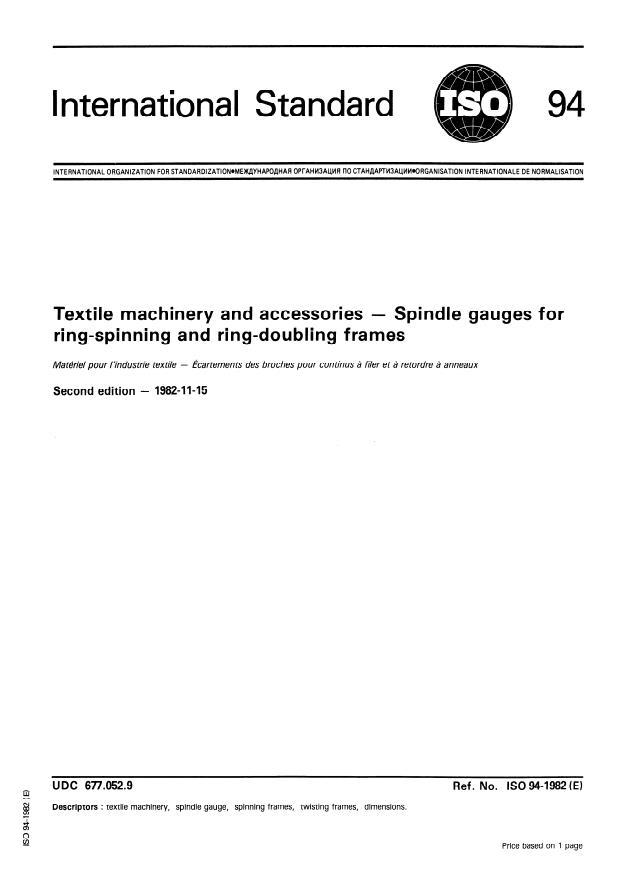
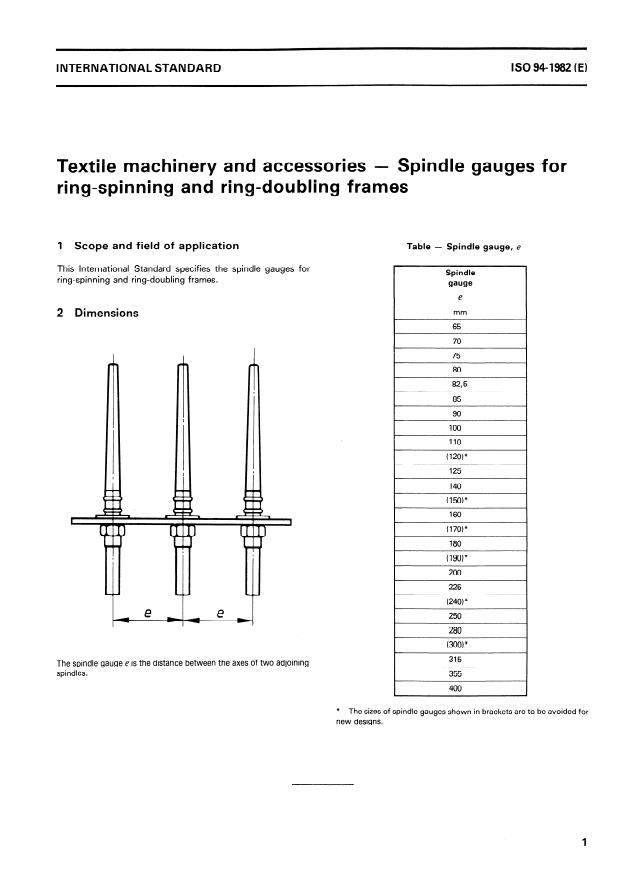
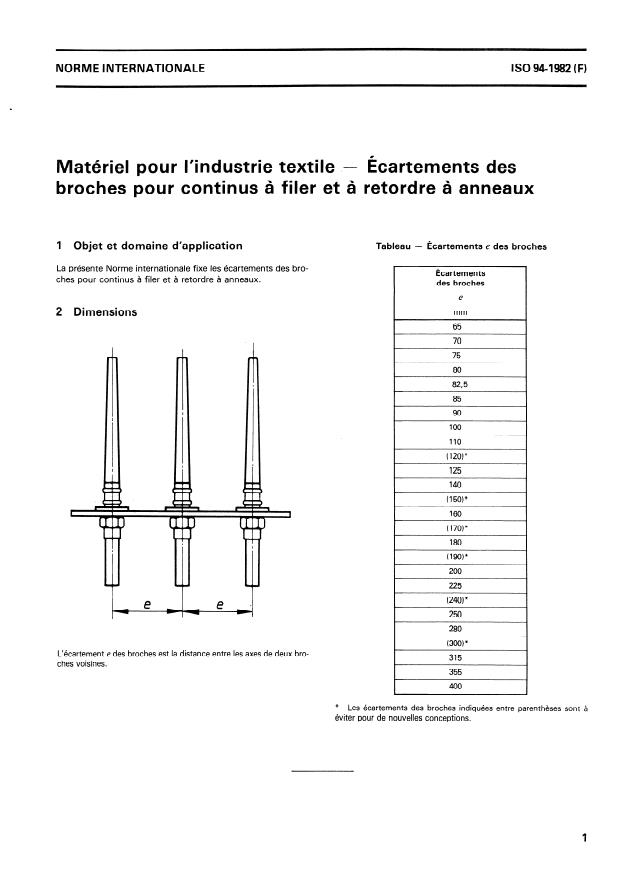
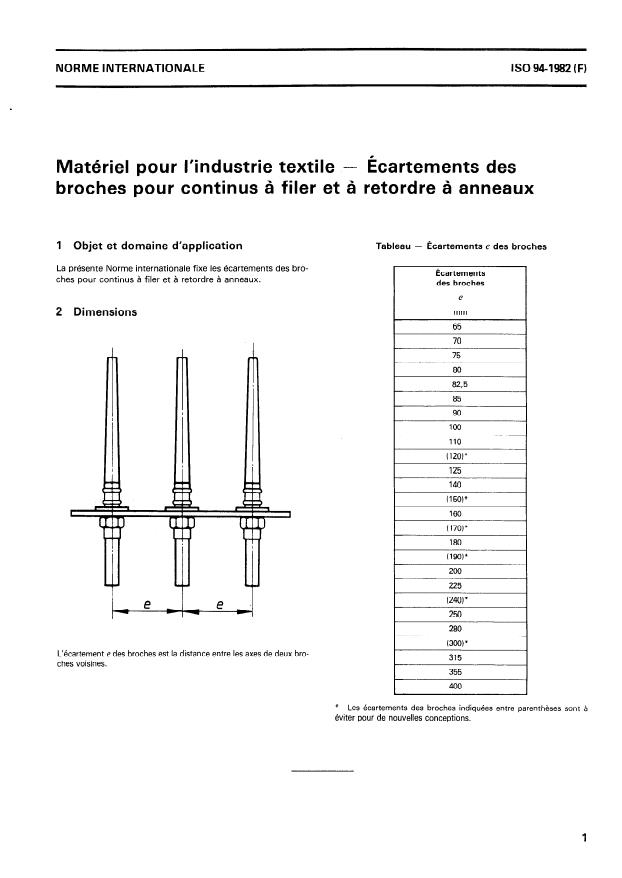
Specifies the spindle gauges for the machines named. The spindle gauge is the distance between the axes of two adjoining spindles. The sizes of spindle gauges are shown in a table. - Replaces the first edition (ISO 94-1972).
- Status
- Published
- Publication Date
- 31-Oct-1982
- Current Stage
- 9093 - International Standard confirmed
- Start Date
- 13-Dec-2023
- Completion Date
- 29-Aug-2026
Buy Documents

ISO 94:1982 - Textile machinery and accessories — Spindle gauges for ring-spinning and ring-doubling frames Released:11/1/1982

ISO 94:1982 - Matériel pour l'industrie textile — Écartements des broches pour continus a filer et a retordre a anneaux Released:11/1/1982

ISO 94:1982 - Matériel pour l'industrie textile — Écartements des broches pour continus a filer et a retordre a anneaux Released:11/1/1982
Overview
ISO 94:1982 is an international standard developed by the International Organization for Standardization (ISO) that specifies the spindle gauges used in textile machinery, specifically for ring-spinning and ring-doubling frames. This standard defines the precise distance - known as the spindle gauge - between the axes of two adjoining spindles in these textile machines. First published in 1972, the second edition released in 1982 updates and replaces the initial version, ensuring harmonized dimensions for improved compatibility and quality in textile production equipment.
The spindle gauge is a critical dimension for ensuring efficient and consistent operation of ring-spinning and ring-doubling frames, which are essential for yarn production and twisting processes in the textile industry.
Key Topics
Spindle Gauge Definition
The spindle gauge (denoted as "e") refers to the measured distance between the centers (axes) of two adjacent spindles within ring-spinning or ring-doubling frames.Standardized Dimensions
ISO 94:1982 includes a comprehensive table of spindle gauge sizes in millimeters, such as 65, 82.5, 85, 125, 160, 180, and others up to 400 mm. Certain sizes in parentheses (240 mm and 300 mm) are discouraged for new machinery designs to promote modernized standards.Applicability
This standard is applicable specifically to ring-spinning and ring-doubling frames, which are fundamental textile machinery components used in yarn spinning and twisting.Technical Committee
The standard was developed by ISO Technical Committee ISO/TC 72, which oversees textile machinery and allied equipment, ensuring expert guidance in the field.
Applications
ISO 94:1982 is crucial for manufacturers and designers of textile machinery, especially those focusing on ring-spinning and ring-doubling frames. The standard ensures:
Interchangeability and Compatibility
By defining spindle gauge dimensions, this ISO standard enables equipment manufacturers to produce interchangeable parts that fit seamlessly within established machine configurations.Optimized Machine Performance
Correct spindle spacing affects yarn quality, speed, and mechanical stability. Standardized spindle gauges help maintain consistent textile processing with minimal vibration or spindle interference.Design Guidance
Equipment engineers and product developers use ISO 94:1982 to choose appropriate spindle gauges when designing new machines or retrofitting existing ring frames to modern standards.Quality Assurance
Textile mills benefit from machines built according to ISO spindle gauge standards, which promote uniformity in yarn production lines, improving overall product quality and operational reliability.
Related Standards
To complement ISO 94:1982, the following related international standards and guidelines may be relevant for a more comprehensive approach to textile machinery design and operation:
ISO 3684 - Textile machinery-Ring-spinning frames and ring-doubling frames-Terms and definitions
Provides terminology foundational to understanding ring-spinning machinery configurations.ISO 3901 - Textile machinery and accessories-Ring-spinning frames-Performance evaluation
Specifies methods for assessing machine efficiency, which is influenced by spindle gauge design.ISO 1539 - Textile machinery-Cap and housing dimensions for ring-spinning frames
Covers components that interact with spindles, ensuring full system compatibility.Industry guidelines on spindle materials, bearings, and maintenance
Though not always formal ISO standards, these documents help optimize mechanical longevity, closely tied to spindle gauge precision.
By adhering to ISO 94:1982, textile machinery manufacturers and users ensure that spindle gauges for ring-spinning and ring-doubling frames meet internationally recognized dimensions, leading to better machine interoperability, enhanced yarn quality, and streamlined manufacturing processes. This standard remains a critical reference point for engineers and industry professionals engaged in the design and use of spinning machinery worldwide.
Buy Documents
ISO 94:1982 - Textile machinery and accessories — Spindle gauges for ring-spinning and ring-doubling frames Released:11/1/1982
ISO 94:1982 - Matériel pour l'industrie textile — Écartements des broches pour continus a filer et a retordre a anneaux Released:11/1/1982
ISO 94:1982 - Matériel pour l'industrie textile — Écartements des broches pour continus a filer et a retordre a anneaux Released:11/1/1982
Get Certified
Connect with accredited certification bodies for this standard

Control Union Certifications
Global certification for agriculture and sustainability.

Hohenstein Institut
Textile testing and certification.

Bureau Veritas Bangladesh
Bureau Veritas certification services in Bangladesh.
Sponsored listings
Frequently Asked Questions
ISO 94:1982 is a standard published by the International Organization for Standardization (ISO). Its full title is "Textile machinery and accessories — Spindle gauges for ring-spinning and ring-doubling frames". This standard covers: Specifies the spindle gauges for the machines named. The spindle gauge is the distance between the axes of two adjoining spindles. The sizes of spindle gauges are shown in a table. - Replaces the first edition (ISO 94-1972).
Specifies the spindle gauges for the machines named. The spindle gauge is the distance between the axes of two adjoining spindles. The sizes of spindle gauges are shown in a table. - Replaces the first edition (ISO 94-1972).
ISO 94:1982 is classified under the following ICS (International Classification for Standards) categories: 59.120.10 - Spinning, twisting and texturing machines. The ICS classification helps identify the subject area and facilitates finding related standards.
ISO 94:1982 is available in PDF format for immediate download after purchase. The document can be added to your cart and obtained through the secure checkout process. Digital delivery ensures instant access to the complete standard document.
Standards Content (Sample)
International Standard
INTERNATIONAL ORGANIZATION FOR STANDARDIZATIONWlE~YHAPOJV-iAR OPI-AHt43ALPlR l-l0 CTAHflAPTl43ALWl~RGANlSATlON INTERNATIONALE DE NORMALISATION
Textile machinery and accessories - Spindle gauges for
ring-spinning and ring-doubling frames
Mat&Tel pour l’industrie textile - kartements des broches pour continus ;i filer et ;i retordre ;i anneaux
Second edition - 1982-11-15
UDC 677.052.9
Ref. No. IS0 94-1982 (E)
-
Descriptors : textile machinery, spindle gauge, spinning frames, twisting frames, dimensions.
Price based on 1 page
Foreword
ISQ (the International Organization for Standardization) is a worldwide federation of
national standards institutes (IS0 member bodies). The work of developing Inter-
national Standards is carried out through IS0 technical committees. Every member
body interested in a subject for which a technical committee has been set up has the
right to be represented on that committee. International organizations, governmental
and non-governmental, in liaison with ISO, also take part in the work.
Draft International Standards adopted by the technical committees are circulated to
the member bodies for approval before their acceptance as International Standards by
the IS0 Council.
International Standard IS0 94 was developed by Technical Committee ISO/TC 72,
TexMe
...
Norme internationale
INTERNATIONAL ORGANIZATION FOR STANDARDIZATION.ME~YHAPO~HAR OPrAHM3ALblR IlO CTAHAAPTM3AUMM*ORGANISATION INTERNATIONALE DE NORMALISATION
Matériel pour l’industrie textile - Écartements des
broches pour continus à filer et à retordre à anneaux
Spindle gauges for ring-spinning and ring-doubling frames
Textile machinery and accessories -
Deuxième édition - 1982-11-15
CDU 677.052.9 Réf. no : ISO 94-1982 (F)
: matériel textile, écartement des broches, métier à filer, métier à retordre, dimension.
Descripteurs
Prix basé sur 1 page
Avant-propos
L’lSO (Organisation internationale de normalisation) est une fédération mondiale
d’organismes nationaux de normalisation (comités membres de I’ISO). L’élaboration
des Normes internationales est confiée aux comités techniques de I’ISO. Chaque
comité membre intéressé par une étude a le droit de faire partie du comité technique
correspondant. Les organisations internationales, gouvernementales et non gouverne-
mentales, en liaison avec I’ISO, participent également aux travaux.
Les projets de Normes internationales adoptés par les comités techniques sont soumis
aux comités membres pour approbation, avant leur acceptation comme Normes inter-
nationales par le Conseil de I’ISO.
La Norme internationale ISO 94 a été élaborée par le comité technique ISO/TC 72,
Matériel pour l’industr
...
Norme internationale
INTERNATIONAL ORGANIZATION FOR STANDARDIZATION.ME~YHAPO~HAR OPrAHM3ALblR IlO CTAHAAPTM3AUMM*ORGANISATION INTERNATIONALE DE NORMALISATION
Matériel pour l’industrie textile - Écartements des
broches pour continus à filer et à retordre à anneaux
Spindle gauges for ring-spinning and ring-doubling frames
Textile machinery and accessories -
Deuxième édition - 1982-11-15
CDU 677.052.9 Réf. no : ISO 94-1982 (F)
: matériel textile, écartement des broches, métier à filer, métier à retordre, dimension.
Descripteurs
Prix basé sur 1 page
Avant-propos
L’lSO (Organisation internationale de normalisation) est une fédération mondiale
d’organismes nationaux de normalisation (comités membres de I’ISO). L’élaboration
des Normes internationales est confiée aux comités techniques de I’ISO. Chaque
comité membre intéressé par une étude a le droit de faire partie du comité technique
correspondant. Les organisations internationales, gouvernementales et non gouverne-
mentales, en liaison avec I’ISO, participent également aux travaux.
Les projets de Normes internationales adoptés par les comités techniques sont soumis
aux comités membres pour approbation, avant leur acceptation comme Normes inter-
nationales par le Conseil de I’ISO.
La Norme internationale ISO 94 a été élaborée par le comité technique ISO/TC 72,
Matériel pour l’industr
...