

ISO 13362:2000
(Main)Flexible cellular polymeric materials — Determination of compression set under humid conditions
General Information
- Abstract
This International Standard specifies a method for determining the compression set of flexible cellular materials under humid conditions. This method consists of maintaining the test piece under specified conditions of time, temperature, humidity and constant compressive strain and determining the effect on the thickness of the test piece after a specified recovery period.
- Status
- Published
- Publication Date
- 01-Nov-2000
- Technical Committee
- ISO/TC 45/SC 4 - Products (other than hoses)
- Drafting Committee
- ISO/TC 45/SC 4/WG 8 - Flexible and semi-rigid cellular material
- Current Stage
- 9093 - International Standard confirmed
- Start Date
- 16-Oct-2025
- Completion Date
- 29-Aug-2026
Overview
ISO 13362:2000 provides an internationally recognized method for determining the compression set of flexible cellular polymeric materials under humid conditions. The standard specifies procedures for subjecting test pieces to defined time, temperature, humidity, and compressive strain, and for measuring the impact of these conditions on material thickness after recovery. This method is essential for manufacturers and quality assurance professionals who require consistent performance data for materials used in humid environments.
Key Topics
Scope and Usage
The standard applies to flexible cellular materials, including foams and sponges based on various polymers, where resistance to permanent deformation in humid conditions is critical.Testing Conditions
The method involves compressing the sample to a specified percentage of its original thickness, exposing it to high humidity (95% - 100% RH) and elevated temperature (around 40°C) for a defined duration, then allowing a recovery period before final measurement.Sample Preparation and Conditioning
Material samples must be prepared following strict guidelines regarding size, shape, and surface characteristics, and conditioned in controlled atmospheres to standardize results.Calculation and Reporting
The compression set is calculated as the percentage loss in thickness after recovery, relative to the original thickness. Reporting requirements ensure traceability and reproducibility of results.
Applications
ISO 13362:2000 is widely used in industries where flexible cellular polymeric materials are subjected to variable humidity, such as:
Automotive and Transportation
For seating, gaskets, and acoustic insulation materials that must retain shape and performance in humid climates or after exposure to moisture.Building and Construction
In insulation and sealing products where resistance to permanent deformation from compression under moisture is essential for energy efficiency and structural integrity.Consumer Goods
For packaging, mattresses, cushions, and footwear components that require durability and consistent cushioning over time, even in damp conditions.Quality Control and R&D
Laboratories and manufacturers employ this standard to benchmark product formulations, improve material resilience, and ensure compliance with international specifications.
Related Standards
While ISO 13362:2000 is the primary standard for compression set testing under high humidity, the following are commonly referenced or complementary standards:
ISO 1923:1981 - Cellular plastics and rubbers - Determination of linear dimensions
This standard provides procedures for measuring the dimensions of plastics and rubber materials, referenced in ISO 13362 for sample measurement methods.ISO/IEC Directives - Governing general procedures for drafting and approving international standards.
Other ISO Standards for Polymeric Materials
Additional ISO documents may specify methods for testing tensile strength, elongation, or thermal stability of flexible foams and cellular products.
Practical Value
Implementing the procedures set out in ISO 13362:2000 ensures reliable, reproducible data on the compression set properties of flexible cellular materials exposed to humid conditions. This supports:
- Material selection and design optimization for specific environmental demands
- Improved product durability, safety, and customer satisfaction
- Compliance with global procurement and regulatory requirements
By standardizing the testing approach, organizations can benchmark materials, drive innovation, and maintain high quality across manufacturing batches for foam and cellular polymeric products intended for humid environments.
Get Certified
Connect with accredited certification bodies for this standard

DIN CERTCO
DIN Group product certification.

Smithers Quality Assessments
US management systems and product certification.
Sponsored listings
Frequently Asked Questions
ISO 13362:2000 is a standard published by the International Organization for Standardization (ISO). Its full title is "Flexible cellular polymeric materials — Determination of compression set under humid conditions". This standard covers: This International Standard specifies a method for determining the compression set of flexible cellular materials under humid conditions. This method consists of maintaining the test piece under specified conditions of time, temperature, humidity and constant compressive strain and determining the effect on the thickness of the test piece after a specified recovery period.
This International Standard specifies a method for determining the compression set of flexible cellular materials under humid conditions. This method consists of maintaining the test piece under specified conditions of time, temperature, humidity and constant compressive strain and determining the effect on the thickness of the test piece after a specified recovery period.
ISO 13362:2000 is classified under the following ICS (International Classification for Standards) categories: 83.100 - Cellular materials. The ICS classification helps identify the subject area and facilitates finding related standards.
ISO 13362:2000 is available in PDF format for immediate download after purchase. The document can be added to your cart and obtained through the secure checkout process. Digital delivery ensures instant access to the complete standard document.
Standards Content (Sample)
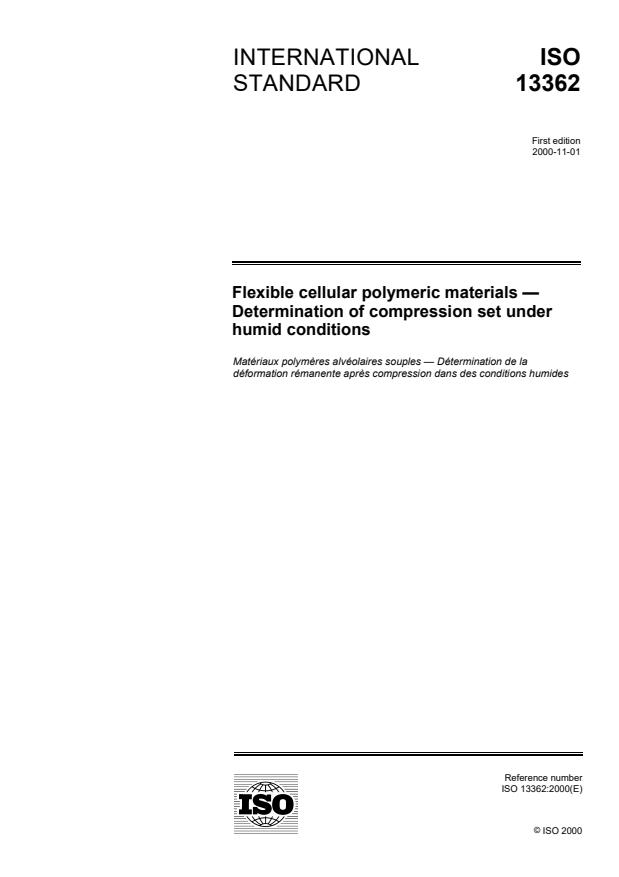
INTERNATIONAL ISO
STANDARD 13362
First edition
2000-11-01
Flexible cellular polymeric materials —
Determination of compression set under
humid conditions
Matériaux polymères alvéolaires souples — Détermination de la
déformation rémanente après compression dans des conditions humides
Reference number
©
ISO 2000
PDF disclaimer
This PDF file may contain embedded typefaces. In accordance with Adobe's licensing policy, this file may be printed or viewed but shall not
be edited unless the typefaces which are embedded are licensed to and installed on the computer performing the editing. In downloading this
file, parties accept therein the responsibility of not infringing Adobe's licensing policy. The ISO Central Secretariat accepts no liability in this
area.
Adobe is a trademark of Adobe Systems Incorporated.
Details of the software products used to create this PDF file can be found in the General Info relative to the file; the PDF-creation parameters
were optimized for printing. Every care has been taken to ensure that the file is suitable for use by ISO member bodies. In the unlikely event
that a problem relating to it is found, please inform the Central Secretariat at the address given below.
All rights reserved. Unless otherwise specified, no part of this publication may be reproduced or utilized in any form or by any means, electronic
or mechanical, including photocopying and microfilm, without permission in writing from either ISO at the address below or ISO's member body
in the country of the requester.
ISO copyright office
Case postale 56 � CH-1211 Geneva 20
Tel. + 41 22 749 01 11
Fax + 41 22 749 09 47
E-mail copyright@iso.ch
Web www.iso.ch
Printed in Switzerland
ii © ISO 2000 – All rights reserved
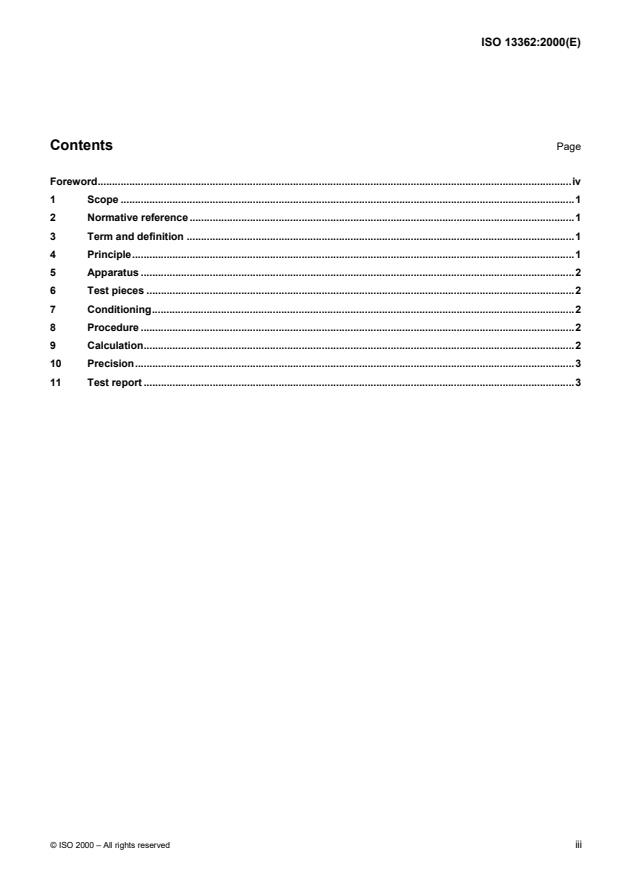
Contents Page
Foreword.iv
1 Scope .1
2 Normative reference .1
3 Term and definition .1
4 Principle.1
5 Apparatus .2
6 Test pieces .2
7 Conditioning.2
8 Procedure .2
9 Calculation.2
10 Precision.3
11 Test report .3
Foreword
ISO (the International Organization for Standardization) is a worldwide federation of national standards bodies (ISO
member bodies). The work of preparing International Standards is normally carried out through ISO technical
committees. Each member body interested in a subject for which a technical committee has been established has
the right to be represented on that committee. International organizations, governmental and non-governmental, in
liaison with ISO, also take part in the work. ISO collaborates closely with the International Electrotechnical
Commission (IEC) on all matters of electrotechnical standardization.
International Standards are drafted in accordance with the rules given in the ISO/IEC Directives, Part 3.
Draft International Standards adopted by the technical committees are circulated to the member bodies for voting.
Publication as an International Standard requires approval by at least 75 % of the member bodies casting a vote.
Attention is drawn to the possibility that some of the elements of this International Standard may be the subject of
patent rights. ISO shall not be held responsible for identifying any or all such patent rights.
International Standard ISO 13362 was prepared by Technical Committee ISO/TC 45, Rubber and rubber products,
Subcommittee SC 4, Products (other than hoses).
iv © ISO 2000 – All rights reserved
INTERNATIONAL STANDARD ISO 13362:2000(E)
Flexible cellular polymeric materials — Determination of
compression set under humid conditions
WARNING — Persons using thi
...