


ISO 21549-5:2015
(Main)Health informatics — Patient healthcard data — Part 5: Identification data
Health informatics — Patient healthcard data — Part 5: Identification data
ISO 21549-5:2015 describes and defines the basic structure of the identification data objects held on healthcare data cards, but does not specify particular data sets for storage on devices. The detailed functions and mechanisms of the following services are not within the scope of this part of ISO 21549 (although its structures can accommodate suitable data objects elsewhere specified): - security functions and related services that are likely to be specified by users for data cards depending on their specific application, e.g. confidentiality protection, data integrity protection and authentication of persons and devices related to these functions; - access control services; - the initialization and issuing process (which begins the operating lifetime of an individual data card, and by which the data card is prepared for the data to be subsequently communicated to it according to this part of ISO 21549). The following topics are therefore beyond the scope of this part of ISO 21549: - physical or logical solutions for the practical functioning of particular types of data card; - the forms that data take for use outside the data card, or the way in which such data are visibly represented on the data card or elsewhere.
Informatique de santé — Données relatives aux cartes de santé des patients — Partie 5: Données d'identification
L'ISO 21549-5:2015 définit et décrit la structure de base des objets associés aux données d'identification se trouvant sur les cartes de santé, mais ne spécifie pas de jeu de données particulier pour le stockage sur la carte. Les fonctions et les mécanismes détaillés des services ci-après ne relèvent pas du domaine d'application de la présente partie de l'ISO 21549 (bien que ces structures puissent prendre en charge des objets de cette nature, spécifiés par ailleurs): ? les fonctions de sécurité et les services associés susceptibles d'être spécifiés par les utilisateurs de cartes de données selon leurs applications spécifiques, par exemple la protection des données confidentielles, la protection de l'intégrité des données et l'authentification des personnes et les dispositifs liés à ces fonctions; ? les services de contrôle de l'accès; ? l'initialisation et le processus qui en découle (qui débute la durée de vie d'une carte individuelle et par lequel la carte de données est préparée pour les données qui seront communiquées ultérieurement, conformément à la présente partie de l'ISO 21549). Les sujets suivants sont donc en dehors du domaine d'application de la présente partie de l'ISO 21549: ? les solutions physiques ou logiques pour le fonctionnement de type de cartes particulières; ? la forme que prennent les données pour leur utilisation en dehors de la carte ou la manière de représenter visuellement ces données sur la carte ou ailleurs.
General Information
- Status
- Withdrawn
- Publication Date
- 15-Sep-2015
- Technical Committee
- ISO/TC 215 - Health informatics
- Drafting Committee
- ISO/TC 215/WG 4 - Security, Safety and Privacy
- Current Stage
- 9599 - Withdrawal of International Standard
- Start Date
- 31-Oct-2023
- Completion Date
- 14-Feb-2026
Relations
- Effective Date
- 12-Feb-2026
- Effective Date
- 06-Jun-2022
- Revised
ISO 21549-5:2023 - Health informatics — Patient healthcard data — Part 5: Identification data - Effective Date
- 06-Jun-2022
- Revises
ISO 21549-5:2008 - Health informatics — Patient healthcard data — Part 5: Identification data - Effective Date
- 10-Nov-2012
Buy Documents

ISO 21549-5:2015 - Health informatics -- Patient healthcard data
ISO 21549-5:2015 - Informatique de santé -- Données relatives aux cartes de santé des patients
Get Certified
Connect with accredited certification bodies for this standard

BSI Group
BSI (British Standards Institution) is the business standards company that helps organizations make excellence a habit.

NYCE
Mexican standards and certification body.
Sponsored listings
Frequently Asked Questions
ISO 21549-5:2015 is a standard published by the International Organization for Standardization (ISO). Its full title is "Health informatics — Patient healthcard data — Part 5: Identification data". This standard covers: ISO 21549-5:2015 describes and defines the basic structure of the identification data objects held on healthcare data cards, but does not specify particular data sets for storage on devices. The detailed functions and mechanisms of the following services are not within the scope of this part of ISO 21549 (although its structures can accommodate suitable data objects elsewhere specified): - security functions and related services that are likely to be specified by users for data cards depending on their specific application, e.g. confidentiality protection, data integrity protection and authentication of persons and devices related to these functions; - access control services; - the initialization and issuing process (which begins the operating lifetime of an individual data card, and by which the data card is prepared for the data to be subsequently communicated to it according to this part of ISO 21549). The following topics are therefore beyond the scope of this part of ISO 21549: - physical or logical solutions for the practical functioning of particular types of data card; - the forms that data take for use outside the data card, or the way in which such data are visibly represented on the data card or elsewhere.
ISO 21549-5:2015 describes and defines the basic structure of the identification data objects held on healthcare data cards, but does not specify particular data sets for storage on devices. The detailed functions and mechanisms of the following services are not within the scope of this part of ISO 21549 (although its structures can accommodate suitable data objects elsewhere specified): - security functions and related services that are likely to be specified by users for data cards depending on their specific application, e.g. confidentiality protection, data integrity protection and authentication of persons and devices related to these functions; - access control services; - the initialization and issuing process (which begins the operating lifetime of an individual data card, and by which the data card is prepared for the data to be subsequently communicated to it according to this part of ISO 21549). The following topics are therefore beyond the scope of this part of ISO 21549: - physical or logical solutions for the practical functioning of particular types of data card; - the forms that data take for use outside the data card, or the way in which such data are visibly represented on the data card or elsewhere.
ISO 21549-5:2015 is classified under the following ICS (International Classification for Standards) categories: 35.240.80 - IT applications in health care technology. The ICS classification helps identify the subject area and facilitates finding related standards.
ISO 21549-5:2015 has the following relationships with other standards: It is inter standard links to EN ISO 21549-5:2016, ISO 20957-9:2005, ISO 21549-5:2023, ISO 21549-5:2008. Understanding these relationships helps ensure you are using the most current and applicable version of the standard.
ISO 21549-5:2015 is available in PDF format for immediate download after purchase. The document can be added to your cart and obtained through the secure checkout process. Digital delivery ensures instant access to the complete standard document.
Standards Content (Sample)
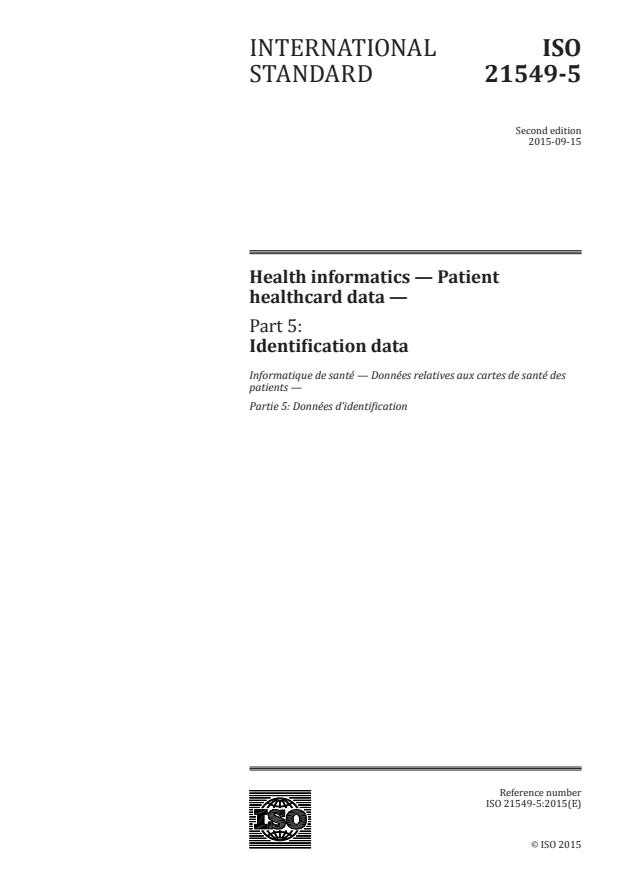
INTERNATIONAL ISO
STANDARD 21549-5
Second edition
2015-09-15
Health informatics — Patient
healthcard data —
Part 5:
Identification data
Informatique de santé — Données relatives aux cartes de santé des
patients —
Partie 5: Données d’identification
Reference number
©
ISO 2015
© ISO 2015, Published in Switzerland
All rights reserved. Unless otherwise specified, no part of this publication may be reproduced or utilized otherwise in any form
or by any means, electronic or mechanical, including photocopying, or posting on the internet or an intranet, without prior
written permission. Permission can be requested from either ISO at the address below or ISO’s member body in the country of
the requester.
ISO copyright office
Ch. de Blandonnet 8 • CP 401
CH-1214 Vernier, Geneva, Switzerland
Tel. +41 22 749 01 11
Fax +41 22 749 09 47
copyright@iso.org
www.iso.org
ii © ISO 2015 – All rights reserved
Contents Page
Foreword .iv
Introduction .v
1 Scope . 1
2 Normative references . 1
3 Terms and definitions . 2
4 Symbols and abbreviated terms . 2
5 Identification data objects. 2
5.1 Identification objects and data structure . 2
5.2 Definition of the identification data set . 2
Annex A (normative) ASN.1 Data definitions . 5
Bibliography . 8
Foreword
ISO (the International Organization for Standardization) is a worldwide federation of national standards
bodies (ISO member bodies). The work of preparing International Standards is normally carried out
through ISO technical committees. Each member body interested in a subject for which a technical
committee has been established has the right to be represented on that committee. International
organizations, governmental and non-governmental, in liaison with ISO, also take part in the work.
ISO collaborates closely with the International Electrotechnical Commission (IEC) on all matters of
electrotechnical standardization.
The procedures used to develop this document and those intended for its further maintenance are
described in the ISO/IEC Directives, Part 1. In particular the different approval criteria needed for the
different types of ISO documents should be noted. This document was drafted in accordance with the
editorial rules of the ISO/IEC Directives, Part 2 (see www.iso.org/directives).
Attention is drawn to the possibility that some of the elements of this document may be the subject of
patent rights. ISO shall not be held responsible for identifying any or all such patent rights. Details of
any patent rights identified during the development of the document will be in the Introduction and/or
on the ISO list of patent declarations received (see www.iso.org/patents).
Any trade name used in this document is information given for the convenience of users and does not
constitute an endorsement.
For an explanation on the meaning of ISO specific terms and expressions related to conformity
assessment, as well as information about ISO’s adherence to the WTO principles in the Technical
Barriers to Trade (TBT) see the following URL: Foreword - Supplementary information
The committee responsible for this document is ISO/TC 215, Health Informatics.
This second edition cancels and replaces the first edition (ISO 21549-5:2008), which has undergone a
minor revision. The following changes have been made.
— Subclause 5.2, Table 1: condition of Sex optionality is added.
— Subclause 5.2, Table 1: optionality of National representation of the name is corrected to match
ASN.1 definition and Figure 1.
ISO 21549 consists of the following parts, under the general title Health informatics — Patient
healthcard data:
— Part 1: General structure
— Part 2: Common objects
— Part 3: Limited clinical data
— Part 4: Extended clinical data
— Part 5: Identification data
— Part 6: Administrative data
— Part 7: Medication data
— Part 8: Links
iv © ISO 2015 – All rights reserved
Introduction
With a more mobile population, greater healthcare delivery in the community and at patients’ homes,
together with a growing demand for improved quality of ambulatory care, portable information systems
and stores have increasingly been developed and used. Such devices are used for tasks ranging from
identification, through portable medical record files, and on to patient-transportable monitoring systems.
The functions of such devices are to carry and to transmit person-identifiable information between
themselves and other systems; therefore, during their operational lifetime they may share information
with many technologically different systems which differ greatly in their functions and capabilities.
Healthcare administration increasingly relies upon similar automated identification systems. For
instance prescriptions may be automated and data exchange carried out at a number of sites using
patient transportable computer readable devices. Healthcare funding institutions and providers
are increasingly involved in cross-region care, where reimbursement may require automated data
exchange between dissimilar healthcare systems. Administrative data objects may require linkage
to external parties responsible for their own domains which are not within the scope of this part of
ISO 21549. For instance, cross-border reimbursement of healthcare services are usually regulated by
law and intergovernmental agreements which are not subject to standardization.
The advent of remotely accessible databases and support systems has led to the development and use of
“Healthcare Person” identification devices that are also able to perform security functions and transmit
digital signatures to remote systems via networks.
With the growing use of data cards for practical everyday healthcare delivery, the need has arisen for a
standardized data format for interchange.
The person-related data carried by a data card can be categorised in three broad types: identification (of
the device itself and the individual to whom the data it carries relates), administrative and clinical. It is
important to realize that a given healthcare data card “de facto” contains device data and identification
data and may in addition contain administrative, clinical, medication and linkage data.
Device data are defined to include:
— identification of the device itself;
— identification of the functions and functioning capabilities of the device.
Identification data are defined to include:
— unique identification of the device holder (and not information of other persons).
Administrative data can include:
— complementary person(s) related data;
— identification of the funding of healthcare, whether public or private, and their relationships, i.e.
insurer(s), contract(s) and policy(ies) or types of benefits;
— identification of other persons as a part of the insurance contract (e.g. a family contract);
— other data (distinguishable from clinical data) that are necessary for the purpose of healthcare
delivery.
Clinical data may include:
— items that provide information about health and health events;
— their appraisal and labelling by a healthcare provider;
— related actions planned requested or performed.
Medication data may include:
— a record of medications received or taken by the patient;
— copies of prescriptions including the authority to dispense records of dispensed medication;
— records of medication bought by the patient;
— pointers to other systems that contain information that makes up an electronic prescription and the
authority to dispense.
Because a data card essentially provides specific answers to definite queries while having at the same
time a need to optimize the use of memory by avoiding redundancies, “high level” Object Modeling
Technique (OMT) has been applied with respect to the definition of healthcare data card data structures.
This part of ISO 21549 describes and defines the basic structure of the identification data objects held
on healthcare data cards using UML, plain text and Abstract Syntax Notation (ASN.1).
This part of ISO 21549 does not describe and define the common objects defined within ISO 21549-2
even though they are referenced and utilized within this part of ISO 21549.
vi © ISO 2015 – All rights reserved
INTERNATIONAL STANDARD ISO 21549-5:2015(E)
Health informatics — Patient healthcard data —
Part 5:
Identification data
1 Scope
This part of ISO 21549 describes and defines the basic structure of the identification data objects held
on healthcare data cards, but does not specify particular data sets for storage on devices.
The detailed functions and mechanisms of the following services are not within the scope of this part of
ISO 21549 (although its structures can accommodate suitable data objects elsewhere specified):
— security functions and related services that are likely to be specified by users for data cards
depending on their specific application, e.g. confidentiality protection, data integrity protection and
authentication of persons and devices related to these functions;
— access control services;
— the initialization and issuing process (which begins the operating lifetime of an individual data
card, and by which the data card is prepared for the data to be subsequently communicated to it
according to this part of ISO 21549).
The following topics are therefore beyond the scope of this part of ISO 21549:
— physical or logical solutions for the practical functioning of particular types of data card;
— the forms that data take for use outside the data card, or the way in which such data are visibly
represented on the data card or elsewhere.
2 Normative references
The following documents, in whole or in part, are normatively referenced in this document and are
indispensable for its application. For dated references, only the edition cited applies. For undated
references, the latest edition of the referenced document (inclu
...
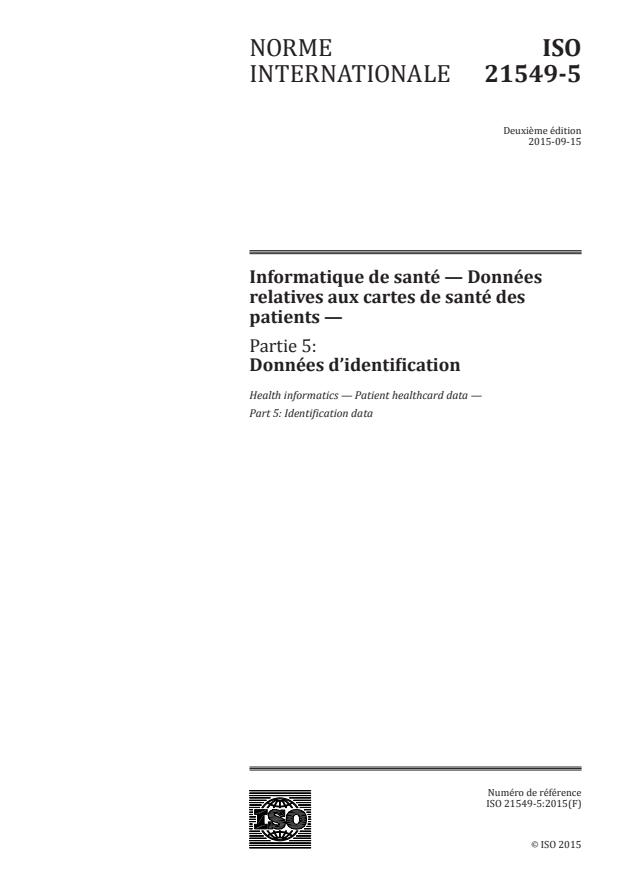
NORME ISO
INTERNATIONALE 21549-5
Deuxième édition
2015-09-15
Informatique de santé — Données
relatives aux cartes de santé des
patients —
Partie 5:
Données d’identification
Health informatics — Patient healthcard data —
Part 5: Identification data
Numéro de référence
©
ISO 2015
DOCUMENT PROTÉGÉ PAR COPYRIGHT
© ISO 2015, Publié en Suisse
Droits de reproduction réservés. Sauf indication contraire, aucune partie de cette publication ne peut être reproduite ni utilisée
sous quelque forme que ce soit et par aucun procédé, électronique ou mécanique, y compris la photocopie, l’affichage sur
l’internet ou sur un Intranet, sans autorisation écrite préalable. Les demandes d’autorisation peuvent être adressées à l’ISO à
l’adresse ci-après ou au comité membre de l’ISO dans le pays du demandeur.
ISO copyright office
Ch. de Blandonnet 8 • CP 401
CH-1214 Vernier, Geneva, Switzerland
Tel. +41 22 749 01 11
Fax +41 22 749 09 47
copyright@iso.org
www.iso.org
ii © ISO 2015 – Tous droits réservés
Sommaire Page
Avant-propos .iv
Introduction .v
1 Domaine d’application . 1
2 Références normatives . 1
3 Termes et définitions . 2
4 Symboles et abréviations . 2
5 Objets associés aux données d’identification . 2
5.1 Objets d’identification et structure de données . 2
5.2 Définition du jeu de données d’identification . 3
Annexe A (normative) Définitions des données ASN.1 . 5
Bibliographie . 8
Avant-propos
L’ISO (Organisation internationale de normalisation) est une fédération mondiale d’organismes
nationaux de normalisation (comités membres de l’ISO). L’élaboration des Normes internationales est
en général confiée aux comités techniques de l’ISO. Chaque comité membre intéressé par une étude
a le droit de faire partie du comité technique créé à cet effet. Les organisations internationales,
gouvernementales et non gouvernementales, en liaison avec l’ISO participent également aux travaux.
L’ISO collabore étroitement avec la Commission électrotechnique internationale (IEC) en ce qui
concerne la normalisation électrotechnique.
Les procédures utilisées pour élaborer le présent document et celles destinées à sa mise à jour sont
décrites dans les Directives ISO/IEC, Partie 1. Il convient, en particulier, de prendre note des différents
critères d’approbation requis pour les différents types de documents ISO. Le présent document a été
rédigé conformément aux règles de rédaction données dans les Directives ISO/CEI, Partie 2 (voir www.
iso.org/directives).
L’attention est appelée sur le fait que certains des éléments du présent document peuvent faire l’objet de
droits de propriété intellectuelle ou de droits analogues. L’ISO ne saurait être tenue pour responsable
de l’identification de ces droits de propriété en tout ou partie. Les détails concernant les références
aux droits de propriété intellectuelle ou autres droits analogues identifiés lors de l’élaboration du
document sont indiqués dans l’Introduction et/ou dans la liste des déclarations de brevets reçues par
l’ISO (voir www.iso.org/brevets).
Les appellations commerciales éventuellement mentionnées dans le présent document sont données
pour information, par souci de commodité, à l’intention des utilisateurs et ne sauraient constituer
un engagement.
Pour une explication de la signification des termes et expressions spécifiques de l’ISO liés à
l’évaluation de la conformité, ou pour toute information au sujet de l’adhésion de l’ISO aux principes
de l’OMC concernant les obstacles techniques au commerce (OTC), voir le lien suivant: Avant-propos —
Informations supplémentaires.
Le comité chargé de l’élaboration du présent document est l’ISO/TC 215, Informatique de santé.
Cette deuxième édition annule et remplace la première édition (ISO 21549-5:2008), qui a fait l’objet
d’une révision mineure. Les modifications suivantes ont été apportées:
— paragraphe 5.2, Tableau 1: la condition d’optionalité de l’objet Sexe est ajoutée;
— paragraphe 5.2, Tableau 1: l’objet facultatif Représentation nationale du nom est corrigé pour
correspondre à la définition ASN.1 et à la Figure 1.
L’ISO 21549 comprend les parties suivantes, présentées sous le titre général Informatique de santé —
Données relatives aux cartes de santé des patients:
— Partie 1: Structure générale
— Partie 2: Objets communs
— Partie 3: Données cliniques limitées
— Partie 4: Données cliniques étendues
— Partie 5: Données d’identification
— Partie 6: Données administratives
— Partie 7: Données de médication
— Partie 8: Liens
iv © ISO 2015 – Tous droits réservés
Introduction
Du fait de la mobilité grandissante de la population, du nombre accru de soins dispensés dans la
communauté et chez les patients et de la hausse de la demande en traitements ambulatoires, les systèmes
d’information et de stockage portables sont de plus en plus développés et utilisés. Ces dispositifs sont
utilisés pour diverses tâches allant de l’identification au système transportable de monitorage du
patient, en passant par les archives médicales mobiles.
Ces dispositifs ont pour fonction de transporter et d’échanger des informations personnelles entre
eux et avec d’autres systèmes. Par conséquent, pendant leur durée de vie opérationnelle, ils peuvent
partager des informations avec bon nombre de systèmes fonctionnant selon diverses technologies et
présentant d’importantes différences de fonctions et de capacités.
L’administration des soins de santé repose de plus en plus sur des systèmes d’identification automatisés
similaires. Par exemple, les prescriptions peuvent être automatisées et l’échange des données peut être
réalisé sur un certain nombre de sites en utilisant des dispositifs mobiles lisibles par des ordinateurs.
Les assureurs et prestataires de santé sont de plus en plus souvent impliqués dans la prestation de soins
interrégionaux, dont le remboursement peut nécessiter un échange de données automatisé entre des
systèmes de soins différents. La gestion des données administratives peut nécessiter des liaisons entre
différents partenaires responsables chacun de leur domaine ne s’inscrivant pas nécessairement dans le
champ d’application de la présente partie de l’ISO 21549. Par exemple, le remboursement transfrontalier
des prestations de santé est habituellement régi par des accords juridiques et intergouvernementaux
qui ne sont pas soumis à la normalisation.
L’émergence des systèmes de stockage de données et de soutien accessibles à distance a conduit au
développement et à l’utilisation de dispositifs d’identification des «professionnels de santé» capables
d’assurer les fonctions de sécurité et de transmettre des signatures numériques aux systèmes
distants par réseau.
L’utilisation toujours plus importante des cartes de données dans la pratique quotidienne des
prestations de santé a nécessité d’élaborer un format d’échange de données normalisé.
Les informations personnelles contenues dans une carte de santé peuvent être classées en trois grandes
catégories: les données d’identification (de la carte en elle-même et de l’individu à qui les informations
se rapportent), les données à caractère administratif et les données cliniques. Il est important de
comprendre qu’une carte de santé contient de facto des données sur la carte elle-même ainsi que des
données servant à l’identification du porteur et peut contenir en plus des données administratives,
cliniques, de médication et des liens vers d’autres systèmes.
Les données relatives à la carte doivent contenir:
— l’identification de la carte en elle-même;
— l’identification des fonctions et des possibilités de fonctionnement de la carte.
Les données d’identification doivent contenir:
— l’identification unique du porteur de la carte (et non les informations relatives à d’autres personnes).
Les données administratives peuvent contenir:
— des données complémentaires relatives à une ou plusieurs personnes;
— l’identification des modes de remboursement, qu’ils soient privés ou publics et les liens qui existent
entre eux, par exemple les contrats ou polices d’assurance et les catégories de remboursement;
— l’identification des autres personnes couvertes ou prises en charges par le contrat d’assurance (par
exemple un contrat famille);
— d’autres données (différentes des données cliniques) néanmoins nécessaires pour délivrer les soins.
Les données cliniques peuvent inclure:
— des éléments qui fournissent des renseignements sur la santé et les antécédents médicaux du patient;
— leur évaluation et leur catégorisation par un prestataire de santé;
— les actions connexes prévues, demandées ou réalisées.
Les données de médication peuvent comprendre:
— des informations relatives aux médicaments reçus ou pris par le patient;
— des copies des prescriptions comprenant les informations relatives au prescripteur;
— des informations relatives aux médicaments achetés par le patient;
— des liens vers d’autres systèmes contenant des informations permettant une prescription
électronique et la dispensation de médicaments.
Une carte de santé fournit essentiellement des réponses spécifiques à des questions précises alors que
le besoin d’optimiser l’utilisation de la mémoire pour éviter les répétitions se fait sentir; c’est pour cela
qu’une technique de modélisation par objets (OMT) de «haut niveau» a été appliquée en respectant la
définition de la structure des données d’une carte de santé.
La présente partie de l’ISO 21549 définit et décrit la structure de base des objets associés aux données
d’identification se trouvant sur les cartes de santé des patients en utilisant la notation UML, le texte en
clair et la notation de syntaxe abstraite (ASN.1).
La présente partie de l’ISO 21549 ne décrit pas et ne définit pas les objets communs définis dans
l’ISO 21549-2, bien que ceux-ci soient référencés et utilisés dans le présent document.
vi © ISO 2015 – Tous droits réservés
NORME INTERNATIONALE ISO 21549-5:2015(F)
Informatique de santé — Données relatives aux cartes de
santé des patients —
Partie 5:
Données d’identification
1 Domaine d’application
La présente partie de l’ISO 21549 définit et décrit la structure de base des objets associés aux données
d’identification se trouvant sur les cartes de santé, mais ne spécifie pas de jeu de données particulier
pour le stockage sur la carte.
Les fonctions et les mécanismes détaillés des services ci-après ne relèvent pas du domaine d’application
de la présente partie de l’ISO 21549 (bien que ces structures puissent prendre en charge des objets de
cette nature, spécifiés par ailleurs):
— les fonctions de sécurité et les services associés susceptibles d’être spécifiés par les utilisateurs
de cartes de données selon leurs applications spécifiques, par exemple la protection des données
confidentielles, la protection de l’intégrité des données et l’authentification des personnes et les
dispositifs liés à ces fonctions;
— les services de contrôle de l’accès;
— l’initialisation et le processus qui en découle (qui débute la durée de vie d’une carte individuelle et par
lequel la carte de données est préparée pour les données qui seront communiquées ultérieurement,
conformément à la présente partie de l’ISO 21549).
Les sujets suivants sont donc en dehors du domaine d’app
...
Questions, Comments and Discussion
Ask us and Technical Secretary will try to provide an answer. You can facilitate discussion about the standard in here.
Loading comments...