

ISO/TR 13393:2009
(Main)Welding consumables — Hardfacing classification — Microstructures
General Information
- Abstract
ISO/TR 13393:2009 proposes a system for classifying hardfacing microstructures deposited by fusion welding processes.
- Status
- Published
- Publication Date
- 22-Jun-2009
- Technical Committee
- IIW - International Institute of Welding
- Drafting Committee
- IIW - International Institute of Welding
- Parallel Committee
- ISO/TC 44/SC 3 - Welding consumables
- Current Stage
- 9093 - International Standard confirmed
- Start Date
- 23-Apr-2014
- Completion Date
- 29-Aug-2026
Buy Documents
ISO/TR 13393:2009 - Welding consumables — Hardfacing classification — Microstructures Released:6/23/2009


ISO/TR 13393:2009 - Welding consumables — Hardfacing classification — Microstructures Released:6/23/2009
Overview
ISO/TR 13393:2009 - Welding consumables - Hardfacing classification - Microstructures provides a systematic, composition- and microstructure‑based classification for hardfacing deposits produced by fusion welding. The Technical Report defines a designation scheme for consumable form (electrode, tubular-cored electrode, wire/rod, powder), alloy base (Fe, Ni, Cu, Co, W), and microstructure type (for example E‑H‑Fe‑FS). It covers both iron‑base and non‑ferrous hardfacing microstructures and includes illustrative maps and examples to link composition ranges with expected as‑welded microstructures.
Key Topics
- Designation system: Format E H XX XXX (electrode/hardfacing/alloy base/microstructure) to standardize labels for hardfacing consumables.
- Iron‑base microstructure groups: About 17 typical Fe‑based categories (e.g., Fe‑FS ferritic with second phase; Fe‑M1 low‑alloy martensite; Fe‑MK martensite with alloy carbides; Fe‑NE near‑eutectic). Table summaries give typical composition ranges, as‑welded microstructure and hardness, heat‑treatment response, and qualitative wear/corrosion performance.
- Example data from the Report: Fe‑FS (≤0.3 % C, ≤6 % alloying) typically 200–400 HB; Fe‑M1 (0.3–0.8 % C, ≤6 % alloying) typically 450–600 HB.
- Composition–microstructure mapping: Carbon vs total alloying elements diagram to identify likely microstructural groupings and to illustrate transitional/overlap regions.
- Non‑ferrous groups: Classification and descriptions for Co, Ni, Cu and W‑based hardfacing (e.g., Co‑CS solid solution, Ni‑NS nickel solid solution, W‑Ni tungsten carbide in Ni matrix).
- Practical annexes: Informative material on types of wear and severity (Annex A), factors governing wear resistance (Annex B), abrasive‑wear test methods (Annex C), and practical guidance for selection/use (Annex D).
Applications and Who Uses It
ISO/TR 13393 is aimed at professionals involved in specifying, selecting or producing hardfacing consumables and welded overlays:
- Welding and materials engineers selecting overlay alloys based on required wear resistance and hardfacing microstructure.
- Consumable manufacturers standardizing product designations and technical data.
- Specifiers and procurement writing material and procurement specifications for repair or wear protection.
- Asset owners and maintenance teams evaluating options for build‑up, metal‑to‑metal wear protection (pulleys, idlers, gears) and abrasive wear mitigation.
Practical value: the standard helps match alloy composition and microstructure to expected hardness, wear behaviour and machinability - supporting more consistent, performance‑based hardfacing choices.
Related Standards
ISO/TR 13393 complements other ISO and industry standards on welding consumables, welding procedures and wear testing. Users should consult relevant ISO welding and tribology standards and national guidance for testing protocols and qualification requirements.
Buy Documents
ISO/TR 13393:2009 - Welding consumables — Hardfacing classification — Microstructures Released:6/23/2009
ISO/TR 13393:2009 - Welding consumables — Hardfacing classification — Microstructures Released:6/23/2009
Get Certified
Connect with accredited certification bodies for this standard

DVS-ZERT GmbH
German welding certification society.
CARES (UK Certification Authority for Reinforcing Steels)
UK certification for reinforcing steels and construction.
EWF/IIW (European/International Welding Federation)
International welding personnel certification.
Sponsored listings
Frequently Asked Questions
ISO/TR 13393:2009 is a technical report published by the International Organization for Standardization (ISO). Its full title is "Welding consumables — Hardfacing classification — Microstructures". This standard covers: ISO/TR 13393:2009 proposes a system for classifying hardfacing microstructures deposited by fusion welding processes.
ISO/TR 13393:2009 proposes a system for classifying hardfacing microstructures deposited by fusion welding processes.
ISO/TR 13393:2009 is classified under the following ICS (International Classification for Standards) categories: 25.160.20 - Welding consumables. The ICS classification helps identify the subject area and facilitates finding related standards.
ISO/TR 13393:2009 is available in PDF format for immediate download after purchase. The document can be added to your cart and obtained through the secure checkout process. Digital delivery ensures instant access to the complete standard document.
Standards Content (Sample)
TECHNICAL ISO/TR
REPORT 13393
First edition
2009-07-01
Welding consumables — Hardfacing
classification — Microstructures
Produits consommables pour le soudage — Classification des
rechargements durs — Microstructures
Reference number
©
ISO 2009
PDF disclaimer
This PDF file may contain embedded typefaces. In accordance with Adobe's licensing policy, this file may be printed or viewed but
shall not be edited unless the typefaces which are embedded are licensed to and installed on the computer performing the editing. In
downloading this file, parties accept therein the responsibility of not infringing Adobe's licensing policy. The ISO Central Secretariat
accepts no liability in this area.
Adobe is a trademark of Adobe Systems Incorporated.
Details of the software products used to create this PDF file can be found in the General Info relative to the file; the PDF-creation
parameters were optimized for printing. Every care has been taken to ensure that the file is suitable for use by ISO member bodies. In
the unlikely event that a problem relating to it is found, please inform the Central Secretariat at the address given below.
© ISO 2009
All rights reserved. Unless otherwise specified, no part of this publication may be reproduced or utilized in any form or by any means,
electronic or mechanical, including photocopying and microfilm, without permission in writing from either ISO at the address below or
ISO's member body in the country of the requester.
ISO copyright office
Case postale 56 • CH-1211 Geneva 20
Tel. + 41 22 749 01 11
Fax + 41 22 749 09 47
E-mail copyright@iso.org
Web www.iso.org
Published in Switzerland
ii © ISO 2009 – All rights reserved
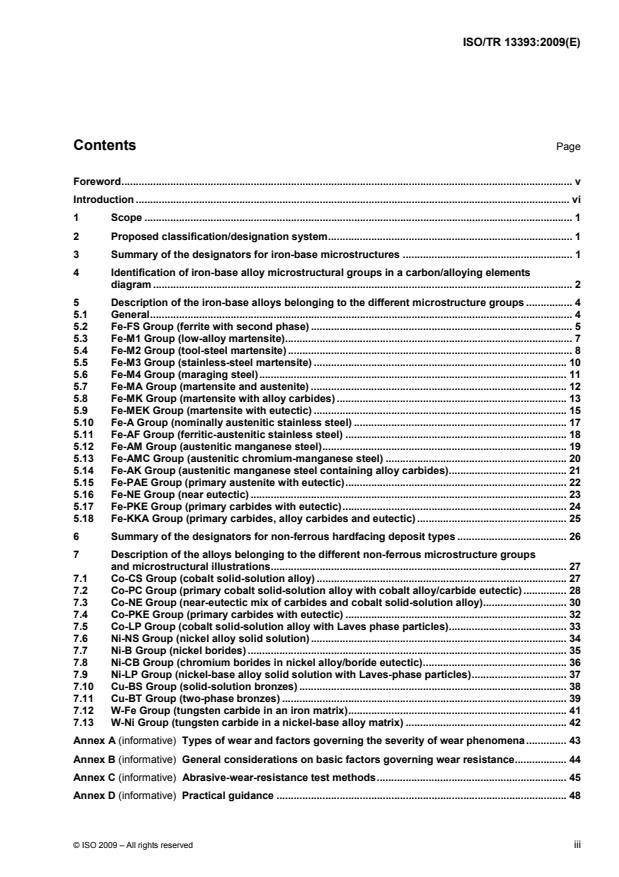
Contents Page
Foreword. v
Introduction . vi
1 Scope . 1
2 Proposed classification/designation system. 1
3 Summary of the designators for iron-base microstructures . 1
4 Identification of iron-base alloy microstructural groups in a carbon/alloying elements
diagram . 2
5 Description of the iron-base alloys belonging to the different microstructure groups . 4
5.1 General. 4
5.2 Fe-FS Group (ferrite with second phase) . 5
5.3 Fe-M1 Group (low-alloy martensite). 7
5.4 Fe-M2 Group (tool-steel martensite) . 8
5.5 Fe-M3 Group (stainless-steel martensite) .10
5.6 Fe-M4 Group (maraging steel). 11
5.7 Fe-MA Group (martensite and austenite) . 12
5.8 Fe-MK Group (martensite with alloy carbides) . 13
5.9 Fe-MEK Group (martensite with eutectic) . 15
5.10 Fe-A Group (nominally austenitic stainless steel) . 17
5.11 Fe-AF Group (ferritic-austenitic stainless steel) . 18
5.12 Fe-AM Group (austenitic manganese steel). 19
5.13 Fe-AMC Group (austenitic chromium-manganese steel) . 20
5.14 Fe-AK Group (austenitic manganese steel containing alloy carbides). 21
5.15 Fe-PAE Group (primary austenite with eutectic). 22
5.16 Fe-NE Group (near eutectic) . 23
5.17 Fe-PKE Group (primary carbides with eutectic). 24
5.18 Fe-KKA Group (primary carbides, alloy carbides and eutectic) . 25
6 Summary of the designators for non-ferrous hardfacing deposit types . 26
7 Description of the alloys belonging to the different non-ferrous microstructure groups
and microstructural illustrations. 27
7.1 Co-CS Group (cobalt solid-solution alloy) .27
7.2 Co-PC Group (primary cobalt solid-solution alloy with cobalt alloy/carbide eutectic). 28
7.3 Co-NE Group (near-eutectic mix of carbides and cobalt solid-solution alloy). 30
7.4 Co-PKE Group (primary carbides with eutectic) . 32
7.5 Co-LP Group (cobalt solid-solution alloy with Laves phase particles). 33
7.6 Ni-NS Group (nickel alloy solid solution). 34
7.7 Ni-B Group (nickel borides) . 35
7.8 Ni-CB Group (chromium borides in nickel alloy/boride eutectic). 36
7.9 Ni-LP Group (nickel-base alloy solid solution with Laves-phase particles). 37
7.10 Cu-BS Group (solid-solution bronzes) . 38
7.11 Cu-BT Group (two-phase bronzes) . 39
7.12 W-Fe Group (tungsten carbide in an iron matrix). 41
7.13 W-Ni Group (tungsten carbide in a nickel-base alloy matrix) . 42
Annex A (informative) Types of wear and factors governing the severity of wear phenomena. 43
Annex B (informative) General considerations on basic factors governing wear resistance. 44
Annex C (informative) Abrasive-wear-resistance test methods. 45
Annex D (informative) Practical guidance . 48
Annex E (informative) Cross-references to national standards . 51
Bibliography . 53
iv © ISO 2009 – All rights reserved
Foreword
ISO (the International Organization for Standardization) is a worldwide federation of national standards bodies
(ISO member bodies). The work of preparing International Standards is normally carried out through ISO
technical committees. Each member body interested in a subject for which a technical committee has been
established has the right to be represented on that committee. International organizations, governmental and
non-governmental, in liaison with ISO, also take part in the work. ISO collaborates closely with the
International Electrotechnical Commission (IEC) on all matters of electrotechnical standardization.
International Standards are drafted in accordance with the rules given in the ISO/IEC Directives, Part 2.
The main task of technical committees is to prepare International Standards. Draft International Standards
adopted by the technical committees are circulated to the member bodies for voting. Publication as an
International Standard requires approval by at least 75 % of the member bodies casting a vote.
In exceptional circumstances, when a technical committee has collected data of a different kind from that
which is normally published as an International Standard (“state of the art”, for example), it may decide by a
simple majority vote of its participating members to publish a Technical Report. A Technical Report is entirely
informative in nature and does not have to be reviewed until the data it provides are considered to be no
longer valid or useful.
Attention is drawn to the possibility that some of the elements of this document may be the subject of patent
rights. ISO shall not be held responsible for identifying any or all such patent rights.
ISO/TR 13393 was prepared by the International Institute of Welding, Commission II, Arc Welding and Filler
Metals, which has been approved as an international standardizing body in the field of welding in accordance
with Council Resolution 42/1999.
Requests for official interpretations of any aspect of this International Standard should be directed to the ISO
Central Secretariat, who will forward them to the IIW Secretariat for an official response.
Introduction
Hardfacing is the deposition of a given type of alloy onto a substrate, in view of protecting this substrate
against various types of degradation known under the name of wear. The science that deals with wear and
wear mechanisms is called “tribology.”
In this sense, this Technical Report does not cover the surfacing processes and alloys that are commonly
known under the name of “cladding technologies”, which more specifically address the protection of
substrates against corrosion.
Hardfacing can be carried out by means of a large variety of alloys.
The selection of the optimum alloy to resist a given combination of wear factors is not necessarily an easy
task. This task can, however, be facilitated by giving consideration to those attributes of alloys that are
dominant in determining their behaviour and their properties.
In this sense, the microstructure of the alloys, which itself is determined by a composition and a thermo-
mechanical history, certainly can be accepted as an attribute of major importance and significance.
It is the purpose of this Technical Report to propose a classification system of hardfacing alloys based on
compositions and microstructures.
Since most of these alloys exist under the form of consumables that can be used with a variety of welding
processes, no specific reference is made to these processes in the rest of this Technical Report.
vi © ISO 2009 – All rights reserved
TECHNICAL REPORT ISO/TR 13393:2009(E)
Welding consumables — Hardfacing classification —
Microstructures
IMPORTANT — The electronic file of this document contains colours which are considered to be
useful for the correct understanding of the document. Users should therefore consider printing this
document using a colour printer.
1 Scope
This Technical Report proposes a system for classifying hardfacing microstructures deposited by fusion
welding processes.
2 Proposed classification/designation system
The designation system indicates the type of consumable (electrode; tubular cored electrode, wire or rod;
solid wire or rod; or powder), the use of the consumable for hardfacing, the alloy base (iron, nickel, copper,
cobalt, or tungsten carbide), and the microstructure type. Designations of microstructure types for the various
alloy bases are given in Clauses 3 and 6. Definitions and examples of the microstructure types are given in
Clauses 5 and 7. The designation scheme for a hardfacing deposit is given below:
E H XX XXX
Electrode Hardfacing type Alloy base Microstructure
T = tubular-cored electrode Fe = iron base
S = solid wire or rod Ni = nickel base
P = powder Cu = copper base
Co = cobalt base
W = tungsten carbide base
3 Summary of the designators for iron-base microstructures
Most of the currently known Fe-based hardfacing alloys fall into one of about 17 typical microstructural
categories. These types of microstructure are listed in Table 1, which also gives the proposed corresponding
designators for covered electrodes. For convenience, only the E (electrode) form is shown, but it is
understood that T (tubular-cored electrode), S (solid wire or rod), or P (powder) may be substituted for E.
Table 1 — Iron-base hardfacing deposit microstructure types
Hardfacing deposit
Microstructure type
designation
E-H-Fe-FS Mostly ferritic steel with second phase
E-H-Fe-M1 Low-alloy martensitic steel
E-H-Fe-M2 Tool steel martensite with secondary hardening
E-H-Fe-M3 Stainless steel martensite
E-H-Fe-M4 Maraging steel martensite
E-H-Fe-MA Approximately equal amounts of martensite and austenite
E-H-Fe-MK Martensite with alloy carbides
E-H-Fe-MEK Martensite with austenite-carbide eutectic
E-H-Fe-A Austenitic stainless steel with little or no ferrite
E-H-Fe-AF Austenitic stainless steel with more than 30 FN
E-H-Fe-AM Austenitic manganese steel with low or no chromium
E-H-Fe-AMC Austenitic manganese steel with chromium nearly equal to manganese
E-H-Fe-AK Austenitic manganese steel containing alloy carbides
E-H-Fe-PAE Primary austenite with austenite-carbide eutectic
E-H-Fe-NE Near-eutectic austenite-carbide iron
E-H-Fe-PKE Primary chromium carbides with austenite-carbide eutectic
E-H-Fe-KKA Primary chromium carbides with alloy carbides and austenite-carbide eutectic
4 Identification of iron-base alloy microstructural groups in a carbon/alloying
elements diagram
A convenient and systematic way to correlate composition and microstructures of hardfacing alloys consists in
using a diagram such as that given in Figure 1. On the ordinate, the mass fraction of carbon is plotted as a
percentage using a logarithmic scale. On the abscissa, the total amount of alloying elements, also plotted as a
percentage, is represented. Alloying elements include Cr, Mn, Si, Mo, Ni, Nb, V, W and Ti. These are the most
commonly encountered alloy elements in Fe-based hardfacing alloys. In this diagram, based on compositional
ranges and corresponding microstructures that are known for most of the alloys currently being used in
practice, the domains which correspond to the types of microstructure listed in Table 1 have been delineated.
It should be noted that these delineations are to be taken as guidelines, not absolutes. Transitions from one
type to another type of microstructure are often progressive, and therefore, at least with alloys that are
characterized by borderline compositions, a certain degree of overlap is to be expected in practice. Note that
composition ranges for microstructure types A, AF and M4 are not included in Figure 1 because their mass
fraction of carbon is below 0,1 %.
2 © ISO 2009 – All rights reserved
Key
X alloy, percent
Y carbon, percent
Figure 1 — Map of composition ranges for hardfacing microstructures
5 Description of the iron-base alloys belonging to the different microstructure
groups
5.1 General
For each group, the following pages contain some general information as to the following topics:
⎯ typical chemical composition ranges;
⎯ as-welded microstructure;
⎯ typical as-welded hardness range;
⎯ typical response to post-weld heat treatment;
⎯ impact resistance (as a qualitative judgment);
⎯ metal-to-metal wear resistance (as a qualitative judgment);
⎯ resistance against abrasive wear;
⎯ corrosion resistance;
⎯ high-temperature resistance;
⎯ machineability;
⎯ typical applications;
⎯ typical microstructure illustrations.
4 © ISO 2009 – All rights reserved
5.2 Fe-FS Group (ferrite with second phase)
See Table 2.
Table 2 — Fe-FS Group
Typical composition:
⎯ Up to 0,3 % C
⎯ Up to 6 % alloying elements
Microstructure: Predominantly ferrite with small amounts of pearlite, bainite, martensite
Main characteristics:
⎯ Hardness (as deposited): Generally expressed in HB, ranging from 200 HB to 400 HB, function of mass fraction
of C
⎯ Machineable in the as-welded condition, PWHT improves machineability
⎯ Excellent impact resistance
⎯ Good metal-to-metal wear resistance
⎯ Low to moderate abrasion resistance (function of hardness)
⎯ Hardness drops if heat treated
⎯ Deposits rust
⎯ Typical example: 0,25 % C, 3 % Cr
Applications: Build-up to return worn parts to original size, metal-to-metal wear as in pulleys, idlers, gears
Deposit made with preheating at 200 °C, cooled slowly, resulting in a hardness of 20 R .
C
Microstructure is primarily ferrite with a little second phase.
Photomicrograph provided by The Lincoln Electric Company, USA.
Microstructure of Type FS Deposit, ×650, 2 % Nital (alcoholic nitric acid) etch
(continued)
Table 2 (continued)
Deposit made without preheating, and allowed to cool rapidly, resulting in a hardness of 35 R .
C
Microstructure is heavily bainitic.
Photomicrograph provided by The Lincoln Electric Company, USA.
Microstructure of Type FS Deposit (same electrode as above), ×650, Nital etch
6 © ISO 2009 – All rights reserved
5.3 Fe-M1 Group (low-alloy martensite)
See Table 3.
Table 3 — Fe-M1 Group
Typical composition:
⎯ 0,3 % to 0,8 % C
⎯ Up to 6 % alloying elements
Microstructure: Predominantly martensitic
Main characteristics:
⎯ Hardness: 450 HB to 600 HB, 45 R to 60 R , function of mass fraction of C
C C
⎯ Generally not machineable as-welded, grinding only. PWHT can soften enough to make deposit easily
machineable
⎯ Good impact resistance
⎯ Excellent metal-to-metal wear resistance
⎯ Improved abrasion resistance compared with FS group, function of hardness
⎯ Hardness drops if heat treated
⎯ Deposits rust
⎯ Typical example: 0,5 % C, 5 % Cr, 0,5 % Mo
Applications: Metal-to-metal wear, as in transfer rolls or guides
Microstructure is predominantly blocky martensite, with white retained austenite around the former grain boundaries.
Photomicrograph provided by The Lincoln Electric Company, USA.
Microstructure of Type M1 Deposit, ×650, 2 % Nital
5.4 Fe-M2 Group (tool-steel martensite)
See Table 4.
Table 4 — Fe-M2 Group
Typical composition:
⎯ 0,2 % to 1,5 % C
⎯ 7 % to 20 % alloying elements, essentially Mo, W, Cr, V
Microstructure: High-alloyed martensite with complex alloy carbides
Main characteristics:
⎯ Hardness: Ranging from 45 R to 60 R (as deposited)
C C
⎯ Generally not machineable as-welded, grinding only. PWHT can soften enough to make deposit easily
machineable
⎯ Fair impact resistance, decreases with increasing mass fraction of carbon
⎯ Good abrasion resistance
⎯ Maintain or even increase the hardness after heat treatment at temperatures up to 550 °C or higher
⎯ Maintain the hardness at high service temperature
⎯ Good thermal shock and thermal cycling resistance
⎯ Deposits rust
⎯ Typical example: 0,7 % C, 3,75 % Cr, 6,0 % Mo, 1,8 % W, 1,1 % V
Applications: Tool steels for hot/cold shears and dies, hot metal-to-metal wear, work rolls in the metals-processing
industries
SEM Image, ×1 000 SEM Image, ×5 000
Photomicrographs provided by The Lincoln Electric Company, USA.
(continued)
8 © ISO 2009 – All rights reserved
Table 4 (continued)
SEM Image, Mo Distribution, ×5 000 SEM Image, V Distribution, ×5 000
Photomicrographs provided by The Lincoln Electric Company, USA.
5.5 Fe-M3 Group (stainless-steel martensite)
See Table 5.
Table 5 — Fe-M3 Group
Typical composition:
⎯ 0,05 % to 0,6 % C
⎯ 10 % to 20 % alloying elements, mainly chromium
Microstructure: Essentially martensitic
Main characteristics:
⎯ Hardness: ranging from 30 R to 55 R (as deposited), function of mass fraction of C
C C
⎯ Lower carbon deposits are machineable as-welded. Deposits above about 40 R usually require PWHT to
C
soften for machining
⎯ Fair to good impact resistance
⎯ Good corrosion/oxidation resistance, function of the mass fraction of Cr
⎯ Good metal-to-metal wear resistance
⎯ Low to fair abrasion resistance
⎯ Hardness drops if heat treated above about 480 °C
⎯ Deposits do not rust
⎯ Typical example: 0,17 % C, 1,3 % Mn, 13,6 % Cr, 4,2 % Ni, 0,6 % Mo, 0,6 % Nb, 0,2 % V
Applications: Continuous caster rolls in steel mills
×200 ×500
The microstructure is predominantly tempered martensite, with about 1,3 % ferrite (dark etching phase).
Photomicrographs provided by The Lincoln Electric Company, USA.
Microstructure of Type M3 Deposit, Kalling's etch, as-welded condition
10 © ISO 2009 – All rights reserved
5.6 Fe-M4 Group (maraging steel)
See Table 6.
Table 6 — Fe-M4 Group
Typical composition:
⎯ 0,02 % C
⎯ 17 % Ni, 4 % Mo, 9 % Co, 0,5 % Ti + V
Microstructure:
⎯ low-carbon martensite as-deposited
⎯ martensite with age-hardening precipitates and traces of austenite after PWHT of 450 °C to 480 °C
Main characteristics:
⎯ Hardness: 30 R to 40 R as deposited
C C
⎯ 50 R to 55 R after PWHT
C C
⎯ PWHT at 450 °C to 480 °C is essential to developing full hardness
⎯ Readily machineable in the as-deposited condition, much more difficult to machine after PWHT
⎯ High impact resistance
⎯ Low corrosion resistance
⎯ High resistance to thermal shock, but service temperatures limited to 400 °C as higher temperatures over-age
the material
Applications: Mill rolls, cutting and stamping dies, die-casting molds for aluminium alloys
Photomicrograph provided by The Lincoln Electric Company USA from a sample provided by Metrode Products Ltd.,
United Kingdom.
Microstructure of Type M4 Deposit, ×500, Kallings etch
5.7 Fe-MA Group (martensite and austenite)
See Table 7
Table 7 — Fe-MA Group
Typical composition:
⎯ 0,8 % to 1,5 % C
⎯ 5 % to 15 % alloying elements, mainly Mn, Cr, Si
Microstructure: Martensite and austenite in nearly equal amounts
Main characteristics:
⎯ Hardness: 45 R to 60 R , work hardens to a limited extent in service
C C
⎯ Generally not machineable as-welded, PWHT tends to reform fresh martensite and does not improve
machineability
⎯ Good impact resistance
⎯ Fairly good metal-to-metal wear resistance
⎯ Fairly good abrasion resistance, especially to soft materials such as limestone
⎯ Moderate corrosion resistance
⎯ Tendency to check crack in multiple layers
⎯ Deposits rust
⎯ Typical example: 1 % C, 9 % Cr, 3 % Si alloy
Applications: Agricultural implements in soft soils
Martensite appears as islands that were dendrite cores. Austenite appears as the continuous matrix around the
martensite islands.
Photomicrograph provided by The Lincoln Electric Company, USA.
Microstructure of Type MA Deposit, ×670, Vilella's etch
12 © ISO 2009 – All rights reserved
5.8 Fe-MK Group (martensite with alloy carbides)
See Table 8.
Table 8 — Fe-MK Group
Typical composition:
⎯ 1 % to 3 % C
⎯ Up to 13 % alloying elements, essentially Cr, Mo, W and a carbide former such as Ti, V, Nb
Microstructure: Medium-alloyed martensite with precipitated carbides
Main characteristics:
⎯ Hardness: 50 R to 55 R
C C
⎯ Not machineable as-welded, nor after PWHT; grinding only
⎯ Good impact resistance combined with good abrasion resistance, function of amount and type of carbides
⎯ Heat treatment softens matrix, but not carbides
⎯ Deposits rust
⎯ Typical example: Top – 2 % C, 8 % Cr, 1,5 % Mo, 6 % Ti; Bottom – 3 % C, 6 % Cr, 5 % V, 5 % Ti
Applications: Metal-to-metal wear with abrasion, high stress (crushing) abrasion
Photomicrograph provided by The Stoody Company (a division of Thermadyne Industries).
Microstructure of Type Fe-MK consisting of TiC carbides in a matrix that is predominately martensite
(continued)
Table 8 (continued)
Photomicrograph provided by ESAB AB, Sweden.
Microstructure of Type Fe-MK consisting of TiC/VC carbides in a matrix that is predominately martensite
14 © ISO 2009 – All rights reserved
5.9 Fe-MEK Group (martensite with eutectic)
See Table 9.
Table 9 — Fe-MEK Group
Typical composition:
⎯ 2 % to 3 % C
⎯ 6 % to 15 % alloying elements, predominantly Cr and Mn
Microstructure: Martensite with austenite-carbide eutectic
Main characteristics:
⎯ Hardness: 45 R to 60 R (as deposited)
C C
⎯ Not machineable as-welded, nor after PWHT; grinding only
⎯ Good metal-to-metal wear resistance
⎯ Fair impact resistance
⎯ Moderate abrasion resistance, increases with increasing mass fraction of carbon
⎯ Tendency to check crack in multiple layers
⎯ Deposits rust
⎯ Typical example: 2,2 % C, 7 % Cr
Applications: Cover layer on hammer-mill hammers, metal transfer guides
SEM photomicrograph, ×1 000
Photomicrograph provided by The Lincoln Electric Company, USA.
Microstructure of Type Fe-MEK consisting of martensite, retained austenite and eutectic carbides
(continued)
Table 9 (continued)
Cr distribution
Photomicrograph provided by The Lincoln Electric Company, USA.
16 © ISO 2009 – All rights reserved
5.10 Fe-A Group (nominally austenitic stainless steel)
See Table 10.
Table 10 — Fe-A Group
Typical composition:
⎯ 0,02 % to 0,15 % C
⎯ Up to 40 % alloying elements, essentially Cr, Ni, sometimes Mo
Microstructure: Austenite with ferrite below 30 FN
Main characteristics:
⎯ Hardness: typically 180 HB to 250 HB, not relevant
⎯ Readily machineable with sharp tooling and rigid machinery
⎯ High ductility and impact resistance
⎯ Excellent corrosion resistance
⎯ Fair to good metal-to-metal wear resistance, some tendency to gall under high pressure
⎯ Poor abrasion resistance
⎯ Work hardenable
⎯ Due to ferrite-to-sigma phase transformation, the higher ferrite grades become somewhat embrittled when
subjected to heat treatment
⎯ Deposits do not rust
⎯ Typical examples: 307 (0,1 % C, 4 % Mn, 20 % Cr, 10 % Ni, 1 % Mo), 309 (0,04 % C, 24 % Cr, 13 % Ni),
309 Mo (0,04 % C, 23 % Cr, 13 % Ni, 2,5 % Mo), 310 (0,15 % C, 25 % Cr, 21 % Ni) stainless-steel types
Applications: Buffer layers, joining austenitic manganese plates
The ferrite is the darker, lacy phase. The austenite is the lighter phase. Some deposits (e.g. 307 or 310) may contain little
or no ferrite.
Photomicrograph provided by The Lincoln Electric Company, USA.
Microstructure of Type A Deposit, ×500, Kalling's etch
5.11 Fe-AF Group (ferritic-austenitic stainless steel)
See Table 11.
Table 11 — Fe-AF Group
Typical composition:
⎯ 0,05 % to 0,15 % C
⎯ Up to 40 % alloying elements, essentially Cr, Ni
Microstructure: Austenite with ferrite above 30 FN
Main characteristics:
⎯ Hardness: typically 200 HB to 280 HB, not relevant
⎯ Readily machineable
⎯ High ductility and impact resistance
⎯ Excellent corrosion resistance
⎯ Fair to good metal-to-metal wear resistance, some tendency to gall under high pressure
⎯ Poor abrasion resistance
⎯ Work hardenable
⎯ Due to ferrite-to-sigma phase transformation, the high-ferrite grades become embrittled when subjected to heat
treatment
⎯ Deposits do not rust
⎯ Typical examples: 312 types of stainless steels, 29 % Cr, 9 % Ni
Applications: Buffer layers, joining austenitic manganese plates, temporary repairs of tool steel and other martensitic
pieces
Lighter austenite plates grow from ferrite grain boundaries, and blocky austenite plates appear within ferrite regions.
Photomicrograph provided by The Lincoln Electric Company, USA.
Microstructure of Type AF Deposit, ×500, Murakami's etch
18 © ISO 2009 – All rights reserved
5.12 Fe-AM Group (austenitic manganese steel)
See Table 12.
Table 12 — Fe-AM Group
Typical composition:
⎯ 0,5 % to 1,2 % C
⎯ Up to 30 % alloying elements, essentially C, Mn, sometimes up to 8 % Cr, Ni, Mo additions
Microstructure: Austenite (with small amounts of intergranular carbides)
Main characteristics
⎯ Hardness: about 300 HB (as deposited), work hardenable up to 550 HB
⎯ Machineable only with sharp rigid tooling, with difficulty
⎯ Extreme impact resistance
⎯ Excellent metal-to-metal wear resistance
⎯ Good abrasion resistance, but only in the work-hardened condition
⎯ Slow cooling during welding or post-weld heat treatments results in very significant embrittlement of these alloys
⎯ Deposits rust
⎯ Typical example: 1 % C, 14 % Mn
Applications: Rock crushers, hammer-mill hammers, rail frogs
Microstructure is almost all austenite, with only a few scattered carbides and inclusions.
Photomicrograph provided by The Lincoln Electric Company, USA.
Microstructure of Type AM Deposit, ×260, 5 % Nital + 15 % HCl etch
5.13 Fe-AMC Group (austenitic chromium-manganese steel)
See Table 13.
Table 13 — Fe-AMC Group
Typical composition:
⎯ 0,3 % to 0,5 % C
⎯ 25 % to 40 % alloying elements, essentially Cr and Mn in nearly equal amounts
Microstructure: Austenite
Main characteristics:
⎯ Hardness: about 300 HB (as deposited), work hardenable up to 550 HB
⎯ Machineable only with sharp and rigid tooling, with difficulty
⎯ Extreme impact resistance
⎯ Excellent metal-to-metal wear resistance
⎯ Very good abrasion resistance, but only in the work-hardened condition
⎯ Slow cooling during welding or post-weld heat treatments results in some embrittlement of these alloys, but is
much less susceptible to thermal embrittlement than the AM Group
⎯ Deposits do not rust
⎯ Typical example: 0,4 % C, 15 % Mn, 15 % Cr
Applications: Joining austenitic manganese-base metals, buffer and build-up layers, rock crushers, hammer-mill
hammers, rail frogs
Microstructure is almost all austenite, with only a few scattered carbides and inclusions.
Photomicrograph provided by The Lincoln Electric Company, USA.
Microstructure of Type AMC Deposit, ×100, 20 % aqua regia etch
20 © ISO 2009 – All rights reserved
5.14 Fe-AK Group (austenitic manganese steel containing alloy carbides)
See Table 14.
Table 14 — Fe-AK Group
Typical composition:
⎯ 1 % to 2 % C
⎯ 15 % to 25 % alloy, mainly manganese with Ti or Nb as a strong carbide former
Microstructure: Austenite with dispersed alloy carbides
Main characteristics:
⎯ Hardness: 30 R to 40 R (as deposited), work hardens rapidly
C C
⎯ Not machineable as welded, nor after PWHT
⎯ Excellent impact resistance
⎯ Very good abrasion resistance
⎯ Good metal-to-metal wear resistance
⎯ Slow cooling during welding or post-weld heat treatments results in very significant embrittlement of these alloys
⎯ Deposits rust
⎯ Typical example: 2 % C, 15 % Mn, 3,5 % Cr, 3,5 % Ti
Applications: Severe impact with abrasion-hammer-mill hammers, rock crushers
×500, Nital etch
Photomicrograph provided by The Stoody Company (a division of Thermadyne Industries).
5.15 Fe-PAE Group (primary austenite with eutectic)
See Table 15.
Table 15 — Fe-PAE Group
Typical composition:
⎯ 2 % to 3 % C
⎯ 15 % to 35 % alloy elements, mainly Cr but often some Mo
Microstructure: Primary austenite with austenite-carbide eutectic, carbides are mainly of the M C type
23 6
Main characteristics:
⎯ Hardness: 40 R to 55 R (as deposited), some work hardening in softer alloys with a lower C content
C C
⎯ Not machineable, grinding only
⎯ Fair impact resistance, decreases with increasing mass fraction of carbon
⎯ Good abrasion resistance, increases with increasing mass fraction of carbon
⎯ Not softened by PWHT
⎯ Alloys with a lower C and higher Cr content have some corrosion resistance due to significant amounts of Cr
remaining in solid solution after all carbides are formed, others rust
⎯ Multi-layer deposits in stringer beads tend to check crack at intervals of 25 mm to 50 mm
⎯ Deposits rust
⎯ Typical example: 2,5 % C, 30 % Cr
Applications: Abrasion with significant impact-cap layers on hammer-mill hammers, bucket teeth.
Large light shapes are primary austenite. The mottled structure consists of eutectic mix of M C carbides (darker) with
23 6
austenite (lighter).
Photomicrograph provided by The Lincoln Electric Company, USA.
Microstructure of Type PAE Deposit, ×650, 5 % Nital etch
22 © ISO 2009 – All rights reserved
5.16 Fe-NE Group (near eutectic)
See Table 16.
Table 16 — Fe-NE Group
Typical composition:
⎯ 3 % to 4 % C
⎯ 20 % to 35 % alloy, mainly Cr but often with some Mo
Microstructure: Near-eutectic mix of austenite and carbides (mainly M C type); alloys with a lower C content may
23 6
have a small amount of primary austenite, while alloys with a higher C content may have a small amount of primary
carbides, but properties are dominated by the eutectic
Main characteristics:
⎯ Hardness: 53 R to 58 R (as deposited), alloys do not work harden and do not soften appreciably by PWHT
C C
⎯ Not machineable as-welded, nor after PWHT; grinding only
⎯ Fair impact resistance
⎯ Good abrasion resistance
⎯ Multi-layer deposits in stringer beads tend to check crack at intervals of 20 mm to 30 mm
⎯ Deposits rust
⎯ Typical example: 3,5 % C, 25 % Cr
Applications: Abrasion with moderate impact: bucket lips and teeth, earth-moving blades
Lamellar structure consists of a eutectic mix of dark M C carbides in lighter austenite.
23 6
Photomicrograph provided by The Lincoln Electric Company, USA
Microstructure of Type NE Deposit, ×670, Vilella's etch
5.17 Fe-PKE Group (primary carbides with eutectic)
See Table 17.
Table 17 — Fe-PKE Group
Typical composition:
⎯ More than 4 % C
⎯ 20 % to 35 % alloy, mainly Cr
Microstructure: Primary carbides (Cr C type, appearing as large hexagonal rods) in a matrix of eutectic austenite-
7 3
carbide (mainly M C type)
23 6
Main characteristics:
⎯ Hardness: 58 R to 65 R , does not work harden, does not soften in PWHT
C C
⎯ Not machineable, grinding only
⎯ Low impact resistance
⎯ Excellent abrasion resistance
⎯ Multi-layer deposits in stringer beads tend to check crack at intervals of 10 mm to 20 mm
⎯ Deposits rust
⎯ Typical example: 4,5 % C, 25 % Cr
Applications: Severe abrasion: coal crusher rolls, ore chutes
Large white shapes are M C carbides; mottled dark structure consists of austenite plus M C carbide eutectic. At a
7 3 23 6
higher magnification, the austenite-carbide eutectic will appear exactly as it does in the Type PAE and NE deposits.
Photomicrograph provided by The Lincoln Electric Company, USA.
Microstructure of Type PKE Deposit, ×260, Vilella's etch
24 © ISO 2009 – All rights reserved
5.18 Fe-KKA Group (primary carbides, alloy carbides and eutectic)
See Table 18.
Table 18 — Fe-KKA Group
Typical composition:
⎯ More than 5 % C
⎯ 25 % to 40 % alloy, mainly Cr but also at least 5 % of a strong carbide former (Ti, Nb, V)
Microstructure: Large primary carbides (Cr C type) and dispersed harder (but smaller) alloy carbides (TiC, NbC, VC
7 3
type) in a eutectic austenite/carbide (M C type) matrix
23 6
Main characteristics:
⎯ Hardness: 58 R to 70 R (as deposited), not softened by PWHT, does not work harden
C C
⎯ Not machineable, grinding only
⎯ Excellent abrasion resistance (both low stress and high stress), abrasion resistance retained up to 650 °C
⎯ Low impact resistance
⎯ Multi-layer deposits in stringer beads tend to check crack at intervals of 5 mm to 15 mm
⎯ Deposits rust
⎯ Typical example: 5,5 % C, 20 % Cr, 6 % Mo, 6 % Nb
Applications: Severe abrasion, often at high temperatures, cement clinker crushers
Darker angular particles are Cr C primary carbides (the same as in Type PKE deposit); lighter particles are complex
7 3
Mo-Nb carbides (mostly formed from eutectic); spaces between carbides consist of austenite (formed from eutectic).
Photomicrograph provided by The Lincoln Electric Company, USA.
Microstructure of Type KKA Deposit, ×1 040, Vilella's etch, SEM image
6 Summary of the designators for non-ferrous hardfacing deposit types
Most of the currently known non-ferrous hardfacing alloys fall into one of thirteen microstructural categories.
These types of microstructures are listed in Table 19, which also gives the proposed designations. For
convenience, only the E (electrode) form is shown, but it is understood that T (tubular-cored electrode),
S (solid wire or rod) or P (powder) may be substituted for E.
Table 19 — Non-ferrous-base hardfacing deposit types
Hardfacing deposit
Microstructure type
designation
E-H-Co-CS Cobalt solid-solution alloy
E-H-Co-PC Primary cobalt solid-solution alloy with cobalt alloy/carbide eutectic
E-H-Co-NE Near-eutectic mix of carbides and cobalt solid-solution alloy
E-H-Co-PKE Primary carbides with cobalt alloy/carbide eutectic
E-H-Co-LP Cobalt solid-solution alloy with Laves-phase intermetallic compounds
E-H-Ni-NS Nickel solid-solution alloy
E-H-Ni-B Primary nickel alloy solid solution with nickel alloy/boride eutectic
E-H-Ni-CB Primary nickel alloy solid solution with nickel alloy/chrome boride eutectic
E-H-Ni-LP Nickel solid-solution alloy with Laves-phase intermetallic compounds
E-H-Cu-BS Solid-solution bronzes
E-H-Cu-BT Two-phase bronzes
E-H-W-Fe Approximately 40 % to 60 % (by mass) tungsten carbide in an alloy steel matrix
E-H-W-Ni Approximately 40 % to 60 % (by mass) tungsten carbide in a nickel alloy matrix
26 © ISO 2009 – All rights reserved
7 Description of the alloys belonging to the different non-ferrous microstructure
groups and microstructural illustrations
7.1 Co-CS Group (cobalt solid-solution alloy)
See Table 20.
Table 20 — Co-CS Group
Typical composition:
⎯ 0,15 % to 0,40 % C
⎯ Approximately 26 % Cr, 3 % Ni, 5 % Mo, balance Co
Microstructure: Predominately cobalt alloy solid solution with scattered carbides
Main characteristics:
⎯ Hardness (as deposited): 20 R to 30 R
C C
⎯ Seldom heat treated, little hardness change occurs in heat treatment
⎯ Machineable in the as-welded condition, but with difficulty, due to rapid work-hardening
⎯ Excellent impact resistance
⎯ Exceptional metal-to-metal wear resistance, especially to galling
⎯ Exceptional cavitation erosion resistance
⎯ High corrosion resistance
⎯ High resistance to thermal shock, oxidizing and reducing atmospheres. Strength and ductility retained up to
850 °C
Applications: Valve faces and valve seats in aqueous corrosive environments and in hot gas environments
5 % HCl electrolytic etch
Optical, ×200
Photomicrograph provided by The Lincoln Electric Company, USA.
(continued)
Table 20 (continued)
The particles in the cell boundaries are identified as carbides rich in Cr and Mo.
SEM, ×1 500
Photomicrograph provided by The Lincoln Electric Company, USA.
7.2 Co-PC Group (primary cobalt solid-solution alloy with cobalt alloy/carbide eutectic)
See Table 21.
Table 21 — Co-PC Group
Typical composition:
⎯ 0,7 % to 1,7 % C
⎯ Approximately 28 % Cr, 4 % W, 1 % Ni, 2 % Fe, balance Co
Microstructure: Primary cobalt solid solution with eutectic carbides
Main characteristics:
⎯ Hardness (as deposited): 40 R to 45 R
C C
⎯ Seldom heat treated, little hardness change occurs in heat treatment
⎯ Very difficult to machine using carbide tools; grinding is preferred
⎯ Good impact resistance and abrasion resistance
⎯ Good metal-to-metal wear resistance
⎯ High corrosion resistance
⎯ High resistance to thermal shock, oxidizing and reducing atmospheres
Applications: Valve seats and valve faces in internal combustion engines and other hot-fluid streams containing
particulates
The optical image below cannot resolve the eutectic, but the scanning electron microscope (SEM) back-scattered
electron image can. Note that cobalt is shown by the SEM to be concentrated in the dendrite cores, while chromium and
tungsten are shown to be concentrated in the inter-dendritic eutectic regions.
(continued)
28 © ISO 2009 – All rights reserved
Table 21 (continued)
Optical image ×200 Co map
Back-scattered electron image, ×1 500 Cr map
W map
Photomicrographs provided by The Lincoln Electric Company.
7.3 Co-NE Group (near-eutectic mix of carbides and cobalt solid-solution alloy)
See Table 22.
Table 22 — Co-NE Group
Typical composition:
⎯ 1,8 % to 2,2 % C
⎯ Approximately 28 % Cr, 12 % W, 1 % Ni, 2 % Fe, balance Co
Microstructure: Near-eutectic mix of carbides and cobalt alloy solid solution, only traces of primary cobalt or primary
carbides
Main characteristics:
⎯ Hardness (as deposited): 45 R to 50 R
C C
⎯ Difficult to deposit without cracking, even with preheating at 300 °C to 400 °C. Seldom post-weld heat treated,
little hardness change occurs in heat treatment
⎯ Not machineable, grinding only
⎯ Moderate impact resistance
⎯ High abrasion resistance
⎯ Moderate corrosion resistance
⎯ Retains abrasion resistance at high
...
TECHNICAL ISO/TR
REPORT 13393
First edition
2009-07-01
Welding consumables — Hardfacing
classification — Microstructures
Produits consommables pour le soudage — Classification des
rechargements durs — Microstructures
Reference number
©
ISO 2009
PDF disclaimer
PDF files may contain embedded typefaces. In accordance with Adobe's licensing policy, such files may be printed or viewed but shall
not be edited unless the typefaces which are embedded are licensed to and installed on the computer performing the editing. In
downloading a PDF file, parties accept therein the responsibility of not infringing Adobe's licensing policy. The ISO Central Secretariat
accepts no liability in this area.
Adobe is a trademark of Adobe Systems Incorporated.
Details of the software products used to create the PDF file(s) constituting this document can be found in the General Info relative to
the file(s); the PDF-creation parameters were optimized for printing. Every care has been taken to ensure that the files are suitable for
use by ISO member bodies. In the unlikely event that a problem relating to them is found, please inform the Central Secretariat at the
address given below.
This CD-ROM/DVD contains the publication ISO/TR 13393:2009 in portable document format (PDF), which
can be viewed using Adobe® Acrobat® Reader.
IMPORTANT — The electronic file of this document contains colours which are considered to be
useful for the correct understanding of the document. Users should therefore consider printing this
document using a colour printer.
Adobe and Acrobat are trademarks of Adobe Systems Incorporated.
© ISO 2009
All rights reserved. Unless required for installation or otherwise specified, no part of this CD-ROM/DVD may be reproduced, stored in a
retrieval system or transmitted in any form or by any means without prior permission from ISO. Requests for permission to reproduce this
product should be address
...