

ISO/IEC 24392:2023
(Main)Cybersecurity — Security reference model for industrial internet platform (SRM- IIP)
General Information
- Abstract
This document presents specific characteristics of industrial internet platforms (IIPs), including related security threats, context-specific security control objectives and security controls. This document covers specific security concerns in the industrial context and thus complements generic security standards and reference models. In particular, this document includes secure data collection and transmission among industrial devices, data security of industrial cloud platforms, and secure collaborations with various industry stakeholders. The users of this document are organizations who develop, operate, or use any components of IIPs, including third parties who provide services to the abovementioned stakeholders. This document provides recommendations for users on how to protect IIPs against IIP-specific threats.
- Status
- Published
- Publication Date
- 17-Jul-2023
- Drafting Committee
- ISO/IEC JTC 1/SC 27/WG 4 - Security controls and services
- Current Stage
- 6060 - International Standard published
- Start Date
- 18-Jul-2023
- Due Date
- 13-Dec-2023
- Completion Date
- 18-Jul-2023

Overview
ISO/IEC 24392:2023 - Cybersecurity - Security reference model for industrial internet platform (SRM‑IIP) - is a first‑edition international standard that defines IIP‑specific security characteristics, threats, control objectives and recommended controls. It is designed to complement generic cybersecurity standards by addressing the particular needs of Industrial Internet Platforms (IIPs) that integrate industrial devices, edge computing, cloud infrastructure and multi‑stakeholder ecosystems. The standard helps organizations design, implement and manage security across the full IIP system life cycle (development, production, utilization/support, retirement).
Key topics and technical requirements
- IIP characteristics and threat analysis
- Identification of IIP‑specific threats arising from industrial processes, multi‑tenant platforms and cyber‑physical components.
- Security reference model and domains
- A domain‑based model covering edge security, cloud infrastructure security, platform security, application security and lifecycle considerations.
- System life cycle security
- Security requirements and guidance for development/production, operation/support and retirement stages.
- Security objectives and controls
- Context‑specific control objectives and recommended controls in areas such as:
- Physical security
- Network and communication security
- Access and authentication (including ABAC considerations)
- System and application security
- Operation, maintenance and security management
- Context‑specific control objectives and recommended controls in areas such as:
- Business scenarios and roles
- Guidance for production optimization, product customization, multilevel security production and transnational collaboration.
Practical applications and users
ISO/IEC 24392:2023 is intended for:
- Platform providers who develop or operate industrial internet platforms (IIPs)
- Manufacturers and industrial integrators deploying IIoT and cyber‑physical systems
- Cloud and edge service providers delivering infrastructure or managed services to industrial customers
- Third‑party vendors and service providers in the IIP supply chain
- Security architects and compliance teams seeking IIP‑specific controls
Typical uses:
- Designing secure data collection and transmission between industrial devices and the platform
- Hardening industrial cloud platforms and multi‑stakeholder collaboration interfaces
- Defining procurement, integration and lifecycle security requirements for IIoT and CPS components
- Aligning IIP security practices with enterprise risk management and regulatory needs
Related standards
ISO/IEC 24392:2023 complements and references generic and domain standards, e.g.:
- ISO/IEC 27001 family (information security management)
- ISO/IEC 27017, ISO/IEC 27018 (cloud security/privacy)
- ISO/IEC 30141, ISO/IEC 20924 (IoT architecture/terminology)
- ISO/IEC TR 23188 (IIoT/edge considerations)
Adopting ISO/IEC 24392:2023 helps organizations apply targeted cybersecurity controls for industrial internet platforms and bridge gaps between general IT security and industrial operational requirements.
Relations
- Effective Date
- 28-Oct-2023
Get Certified
Connect with accredited certification bodies for this standard

BSI Group
BSI (British Standards Institution) is the business standards company that helps organizations make excellence a habit.

Bureau Veritas
Bureau Veritas is a world leader in laboratory testing, inspection and certification services.

DNV
DNV is an independent assurance and risk management provider.
Sponsored listings
Frequently Asked Questions
ISO/IEC 24392:2023 is a standard published by the International Organization for Standardization (ISO). Its full title is "Cybersecurity — Security reference model for industrial internet platform (SRM- IIP)". This standard covers: This document presents specific characteristics of industrial internet platforms (IIPs), including related security threats, context-specific security control objectives and security controls. This document covers specific security concerns in the industrial context and thus complements generic security standards and reference models. In particular, this document includes secure data collection and transmission among industrial devices, data security of industrial cloud platforms, and secure collaborations with various industry stakeholders. The users of this document are organizations who develop, operate, or use any components of IIPs, including third parties who provide services to the abovementioned stakeholders. This document provides recommendations for users on how to protect IIPs against IIP-specific threats.
This document presents specific characteristics of industrial internet platforms (IIPs), including related security threats, context-specific security control objectives and security controls. This document covers specific security concerns in the industrial context and thus complements generic security standards and reference models. In particular, this document includes secure data collection and transmission among industrial devices, data security of industrial cloud platforms, and secure collaborations with various industry stakeholders. The users of this document are organizations who develop, operate, or use any components of IIPs, including third parties who provide services to the abovementioned stakeholders. This document provides recommendations for users on how to protect IIPs against IIP-specific threats.
ISO/IEC 24392:2023 is classified under the following ICS (International Classification for Standards) categories: 35.030 - IT Security. The ICS classification helps identify the subject area and facilitates finding related standards.
ISO/IEC 24392:2023 has the following relationships with other standards: It is inter standard links to ISO 12572:2016/Amd 1:2024. Understanding these relationships helps ensure you are using the most current and applicable version of the standard.
ISO/IEC 24392:2023 is available in PDF format for immediate download after purchase. The document can be added to your cart and obtained through the secure checkout process. Digital delivery ensures instant access to the complete standard document.
Standards Content (Sample)
INTERNATIONAL ISO/IEC
STANDARD 24392
First edition
2023-07
Cybersecurity — Security reference
model for industrial internet platform
(SRM- IIP)
Cybersécurité — Modèle de référence de sécurité pour plateforme
internet industrielle (SRM- IIP)
Reference number
© ISO/IEC 2023
© ISO/IEC 2023
All rights reserved. Unless otherwise specified, or required in the context of its implementation, no part of this publication may
be reproduced or utilized otherwise in any form or by any means, electronic or mechanical, including photocopying, or posting on
the internet or an intranet, without prior written permission. Permission can be requested from either ISO at the address below
or ISO’s member body in the country of the requester.
ISO copyright office
CP 401 • Ch. de Blandonnet 8
CH-1214 Vernier, Geneva
Phone: +41 22 749 01 11
Email: copyright@iso.org
Website: www.iso.org
Published in Switzerland
ii
© ISO/IEC 2023 – All rights reserved
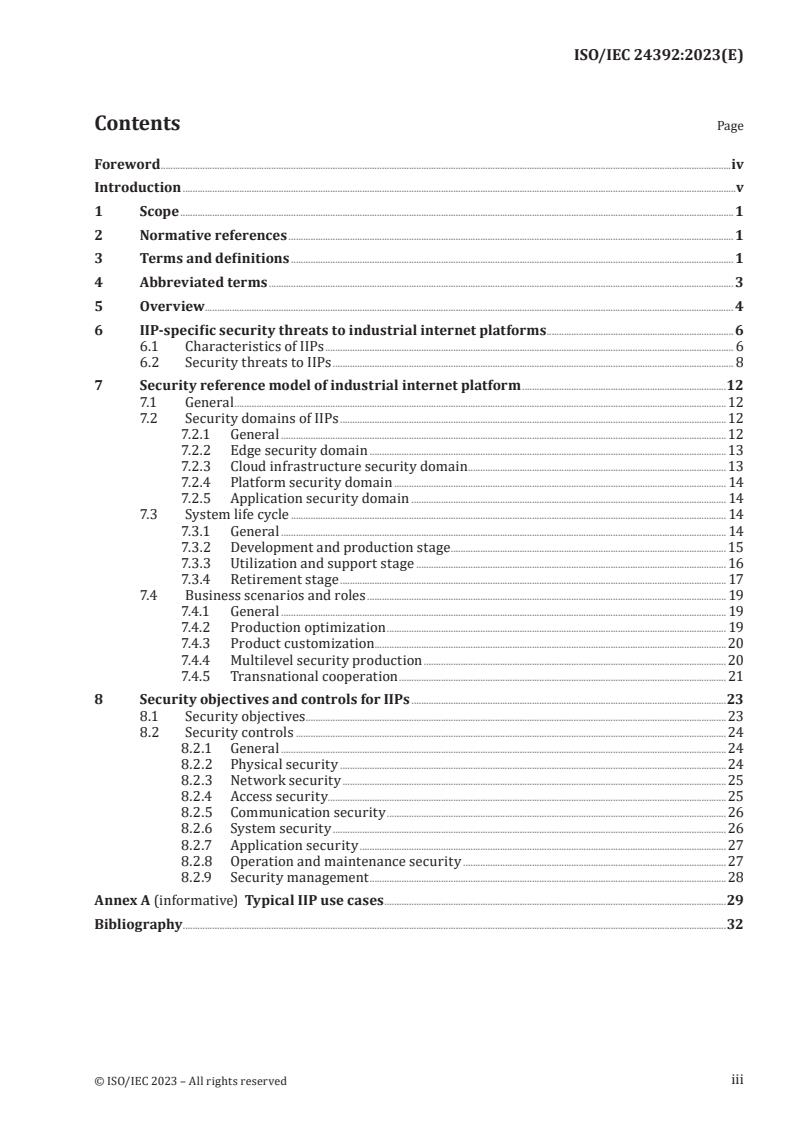
Contents Page
Foreword .iv
Introduction .v
1 Scope . 1
2 Normative references . 1
3 Terms and definitions . 1
4 Abbreviated terms . 3
5 Overview . 4
6 IIP-specific security threats to industrial internet platforms . 6
6.1 Characteristics of IIPs . 6
6.2 Security threats to IIPs . 8
7 Security reference model of industrial internet platform .12
7.1 General .12
7.2 Security domains of IIPs .12
7.2.1 General .12
7.2.2 Edge security domain .13
7.2.3 Cloud infrastructure security domain . . 13
7.2.4 Platform security domain . 14
7.2.5 Application security domain . 14
7.3 System life cycle . 14
7.3.1 General . 14
7.3.2 Development and production stage . 15
7.3.3 Utilization and support stage . 16
7.3.4 Retirement stage . 17
7.4 Business scenarios and roles . 19
7.4.1 General . 19
7.4.2 Production optimization . 19
7.4.3 Product customization . .20
7.4.4 Multilevel security production . 20
7.4.5 Transnational cooperation . 21
8 Security objectives and controls for IIPs .23
8.1 Security objectives .23
8.2 Security controls . 24
8.2.1 General . 24
8.2.2 Physical security . 24
8.2.3 Network security .25
8.2.4 Access security.25
8.2.5 Communication security . 26
8.2.6 System security . 26
8.2.7 Application security . 27
8.2.8 Operation and maintenance security . 27
8.2.9 Security management .28
Annex A (informative) Typical IIP use cases .29
Bibliography .32
iii
© ISO/IEC 2023 – All rights reserved
Foreword
ISO (the International Organization for Standardization) and IEC (the International Electrotechnical
Commission) form the specialized system for worldwide standardization. National bodies that are
members of ISO or IEC participate in the development of International Standards through technical
committees established by the respective organization to deal with particular fields of technical
activity. ISO and IEC technical committees collaborate in fields of mutual interest. Other international
organizations, governmental and non-governmental, in liaison with ISO and IEC, also take part in the
work.
The procedures used to develop this document and those intended for its further maintenance
are described in the ISO/IEC Directives, Part 1. In particular, the different approval criteria
needed for the different types of document should be noted. This document was drafted in
accordance with the editorial rules of the ISO/IEC Directives, Part 2 (see www.iso.org/directives or
www.iec.ch/members_experts/refdocs).
ISO and IEC draw attention to the possibility that the implementation of this document may involve the
use of (a) patent(s). ISO and IEC take no position concerning the evidence, validity or applicability of
any claimed patent rights in respect thereof. As of the date of publication of this document, ISO and IEC
had not received notice of (a) patent(s) which may be required to implement this document. However,
implementers are cautioned that this may not represent the latest information, which may be obtained
from the patent database available at www.iso.org/patents and https://patents.iec.ch. ISO and IEC shall
not be held responsible for identifying any or all such patent rights.
Any trade name used in this document is information given for the convenience of users and does not
constitute an endorsement.
For an explanation of the voluntary nature of standards, the meaning of ISO specific terms and
expressions related to conformity assessment, as well as information about ISO's adherence to
the World Trade Organization (WTO) principles in the Technical Barriers to Trade (TBT) see
www.iso.org/iso/foreword.html. In the IEC, see www.iec.ch/understanding-standards.
This document was prepared by Joint Technical Committee ISO/IEC JTC 1, Information technology,
Subcommittee SC 27, Information security, cybersecurity and privacy protection.
Any feedback or questions on this document should be directed to the user’s national standards
body. A complete listing of these bodies can be found at www.iso.org/members.html and
www.iec.ch/national-committees.
iv
© ISO/IEC 2023 – All rights reserved
Introduction
An industrial internet platform (IIP) is an industry-specific, or multi-industry, technology platform.
IIPs enable users to process data such as sensor data from a wide range of manufacturing processes,
to provide information for decision-making or to facilitate visualization for business decisions. IIPs
also provide the capability for control systems to interact with manufacturing systems, helping to
direct their activities. An IIP can bring together components that collectively meet the demands of
digitalization, networking and interconnection of industrial machinery. An IIP can serve as a hub for
a multi-stakeholder private industrial complex, or as part of an open system connected to the wider
internet. It can also provide the underpinnings for a system using big data, and commonly serve as the
basis for large-scale production of manufactured goods.
This document presents a security reference model for IIP, which characterizes the security concerns
of IIP arising from the particularities of industrial settings and provides corresponding security
requirements. In particular, the reference model identifies the specific characteristics of IIP from
three perspectives: an industrial business view, a platform architecture view, and a system life cycle
view. Based on such characteristics, their corresponding IIP-specific threats can be identified. Finally,
this document provides guidance on appropriate security controls based on existing international
standards. Figure 1 presents the relationship between this document and other relevant standards.
The purpose of this document is to facilitate the security design, implementation, and management of
IIP, complementing the security requirements that are dealt with in generic information systems. The
guidance on security controls support the commercial users of the IIP, as well as their partners along
the supply chain.
Figure 1 — The relationship between this document and other relevant standards
NOTE The IIP can include cyber-physical systems (CPS). Such CPS potentially provide elementary or
assembled components to other parts of the IIP.
Like CPS, Internet of things (IoT) devices can be connected to the IIP either directly or via IIP
intermediaries. Accordingly, it is important to consider IoT terminology (see ISO/IEC 20924), IoT
architecture (see ISO/IEC 30141), and IIoT security issues.
Beyond CPS, IoT devices, and communication networks, IIPs commonly include cloud technology, which
is covered in ISO/IEC 27017, ISO/IEC 27018, ISO/IEC 22123-1, ISO/IEC 22123-2, ISO/IEC TR 23188, and
ISO/IEC TR 23186.
v
© ISO/IEC 2023 – All rights reserved
INTERNATIONAL STANDARD ISO/IEC 24392:2023(E)
Cybersecurity — Security reference model for industrial
internet platform (SRM- IIP)
1 Scope
This document presents specific characteristics of industrial internet platforms (IIPs), including related
security threats, context-specific security control objectives and security controls.
This document covers specific security concerns in the industrial context and thus complements
generic security standards and reference models. In particular, this document includes secure data
collection and transmission among industrial devices, data security of industrial cloud platforms, and
secure collaborations with various industry stakeholders.
The users of this document are organizations who develop, operate, or use any components of IIPs,
including third parties who provide services to the abovementioned stakeholders.
This document provides recommendations for users on how to protect IIPs against IIP-specific threats.
2 Normative references
There are no normative references in this document.
3 Terms and definitions
For the purposes of this document, the following terms and definitions apply.
ISO and IEC maintain terminology databases for use in standardization at the following addresses:
— ISO Online browsing platform: available at https:// www .iso .org/ obp
— IEC Electropedia: available at https:// www .electropedia .org/
3.1
trust
degree to which a user or other stakeholder has confidence that a product or system will behave as
intended
[SOURCE: ISO/IEC 25010:2011, 4.1.3.2]
3.2
trustworthiness
ability to meet stakeholders expectations in a verifiable way
[SOURCE: ISO/IEC TR 24028:2020, 3.42, modified — Notes 1 to 3 to entry have been deleted.]
3.3
confidentiality
property that information is not made available or disclosed to unauthorized individuals, entities, or
processes
[SOURCE: ISO/IEC 27000:2018, 3.10]
© ISO/IEC 2023 – All rights reserved
3.4
integrity
property of protecting the accuracy and completeness of assets
Note 1 to entry: Refer to information assets in most cases.
[SOURCE: ISO/IEC 27000:2018, 3.36, modified — “protecting” and “of assets” have been added to the
definition; Note 1 to entry has been added.]
3.5
availability
property of being accessible and usable on demand by an authorized entity
[SOURCE: ISO/IEC 27000:2018, 3.7]
3.6
authentication
provision of assurance that a claimed characteristic of an entity is correct
[SOURCE: ISO/IEC 27000:2018, 3.5]
3.7
industrial internet platform
IIP
platform integrating information and communication technology to facilitate industrial efficiency and
transform industrial operations at the scale of multiple digitally-enabled factory complexes usually
across diverse locations
3.8
reference architecture
architecture description that provides a proven template solution when developing or validating an
architecture for a particular solution
[SOURCE: ISO/IEC 20924:2021, 3.1.28, modified — definition has been revised.]
3.9
edge
boundary between pertinent digital and physical entities, delineated by networked sensors and
actuators
[SOURCE: ISO/IEC TR 23188:2020, 3.1.2, modified — Note 1 to entry has been deleted.]
3.10
edge computing
distributed computing in which processing and storage takes place at or near the edge (3.9), where the
nearness is defined by the system's requirements
Note 1 to entry: The functions of the platform include resource collection, data aggregation, intelligent analysis,
open sharing (e.g. of manuals, flyers), standards testing, technology verification, industrial data transfer,
business resource management and industry monitoring.
Note 2 to entry: A platform can be connected to a large number of heterogeneous industrial devices, including
industrial internet of things, edge devices, and cyber-physical systems, some of which are not secure-by-design.
[SOURCE: ISO/IEC TR 23188:2020, 3.1.3, modified — notes 1 and 2 to entry have been added.]
© ISO/IEC 2023 – All rights reserved
3.11
security domain
domain in which the stakeholders are obliged to follow specific security requirements to ensure the
corresponding functional domain is secure
Note 1 to entry: A security domain can include, a network, a part of an IoT devices development organization
providing products via the IIP, a part of an integrator organization (factory or plant building project) that uses
products or services via the IIP.
3.12
control objective
statement describing what is to be achieved as a result of implementing controls
Note 1 to entry: “Security objective” is used as an abbreviation for “security control objective” in cases where any
ambiguity can be excluded.
[SOURCE: ISO/IEC 27000:2018, 3.15]
3.13
process measurement integrity
sensor which has been authenticated and measurement validated as correct
3.14
IIP participant
person or organization that participates in the development or use of industrial internet platforms
(IIPs)
4 Abbreviated terms
ABAC attribute-based access control
API application programming interface
ASC application security control
CAL cybersecurity assurance level
CVE common vulnerabilities and exposures
DCS distributed control system
DDoS distributed DoS
DoS denial of service
DPI deep packet inspection
EMC electromagnetic compatibility
EMI electromagnetic interference
IACS industrial automation and control system
ICS industrial control system
IED intelligent electronic device
IIoT industrial Internet of things
IIP industrial internet platform
© ISO/IEC 2023 – All rights reserved
IPS intrusion protection system
LAN local area network
M2M machine to machine
NGFW next-generation firewall
OEM original equipment manufacturer
OSI open systems interconnection
OT operational technology (controlling physical processes)
PaaS platform as a service
PII personally identifiable information
PCB printed circuit board
PLC programmable logic controller
QoS quality of service
RBAC role-based access control
RTU remote terminal unit
SCADA supervisory control and data acquisition
SIEM security information and event management
SRM security reference model
TCP/IP transmission control protocol/Internet protocol
UDP user datagram protocol
VLAN virtual LAN
VPN virtual private network
5 Overview
An IIP is understood as a responsive industrial infrastructure. An IIP is accessible at any time according
to business needs, from anywhere (e.g. pervasive internet) or from agreed business locations. It
is accessible to all stakeholders and users assembled around the life cycle of business execution,
monitoring and production of things (i.e. industrial production). Annex A provides information on
typical use cases of IIPs.
NOTE 1 Some IIP can be part of critical infrastructure, according to the critical infrastructure definition
[typically defined with regard to its direct impact on a considerably large number of people, e.g. with regard to
the electrical energy need in megawatts (MW), impact on health or food shortage].
An IIP provides semantic interoperability capabilities, including for stakeholders who are
representatives from inhomogeneous domains.
Stakeholders can use common communication methods and syntax that hide any non-homogeneous
structures of IIP participants, including:
a) to generate, subscribe, deliver any kind of data;
© ISO/IEC 2023 – All rights reserved
b) to acquire information about things, industrial production processes or any other industrial
business concerns;
c) to apply assembled knowledge for decision-making that IT processes have "learned" from
observations of OT production processes;
d) to generate from IIP behaviour observations suggestions on security controls for the purpose of
stabilization, harmonization of the IIP, prevention of misuse, avoidance of failure propagation.
In order to analyse the security needs of IIPs, an IIP security reference model is elaborated, as shown in
Figure 2.
Figure 2 — Establishment of a security reference model of an IIP
As illustrated in Figure 2, the security reference model of the IIP is derived from the IIP reference
architecture combined with the system life cycle.
The reference architecture provides a structured and proven partition of system functional domains,
to which specific security threats of IIPs can be mapped. Within each of these functional domains,
particular security requirements should be satisfied according to the threats.
The life cycle of the IIP is the time dimension, introducing additional constraints in different stages. The
stakeholder interaction scenario of the IIP is the role dimension, introducing the constraints during
interactions among different IIP stakeholders. These two views assist in guiding the design of the IIP
security reference model.
NOTE 2 IIPs are typically cloud-based and offer a widely interconnected industrial environment for platform
participants that provide or acquire complex products and services to other trustworthy participants. These
participants can involve CPS and IoT devices. There is no intention to replace horizontal or specialized and
dedicated domain-specific industry solutions, e.g. IACS, ICS, DCS or SCADA systems. These IACS/ICS/DCS/SCADA
systems typically address a very specific CPS (e.g. a power plant, a part of a factory, a vehicle or an aircraft) or
geographically distributed substations (e.g. from the grid or smart grid).
© ISO/IEC 2023 – All rights reserved
NOTE 3 As opposed to an IIP, the design, integration and manufacturing of these OT and functional safety
related industry systems, that typically operate for many years with recurrent operation and maintenance cycles,
do not require the flexibility of an IIP. However, it is expected that they meet other very challenging industry
domain-specific graded requirements on functional safety and security. Some of the security controls such as the
deployment of autarkic networks and physical protection used by OT cannot be deployed directly for IIPs, in case
they are connected via the internet. Additionally, the benefit of IIPs can increase together with the increased use
of IIoT and edge computing by traditional IACS, ICS, DCS and SCADA systems.
6 IIP-specific security threats to industrial internet platforms
6.1 Characteristics of IIPs
IIPs typically involve massive, heterogeneous industrial devices and data, which are used by various
stakeholders for specific purposes. Here are the detailed IIP-specific characteristic challenges.
a) Various data sources can exist in a factory or industrial facility. Traditional field wiring may not
always be suitable for complex factory environments. Smart manufacturing and digital plants
can use effective reconfigurations, including rewiring. Such approaches are not effective for IIP
customers. Alternative technologies may be used when connecting the industrial environment
via an IIP with further stakeholders. This can include software defined networking or the use of
wireless networks and 5G in cases where EMI is not an issue.
b) Edge computing platforms can be deployed at a factory, smart plant or industrial facility site. It can
be difficult for an edge computing platform provider to maintain the platform centrally or remotely
and thus difficult to quickly address issues of the edge computing platform or of edge devices. The
PaaS provider or the OEM of the platform can use edge computing platforms and edge devices that
are designed for effective maintenance via an IIP. In case of centralized or remote configuration,
preventive maintenance and recurrent maintenance are intended.
c) A yearly increasing amount of industrial equipment is discarded from its initial deployment
environment. Reusing such equipment in a different environment can pose security risks, e.g. if the
equipment was initially intended only for use in an isolated network environment or as part of an
autarkic automation or IT system.
d) Local security settings of small-scale and medium-scale IIoT and IoT devices are usually not
properly set during their installation. While an omission of some secure configuration steps can
be acceptable in an isolated environment due to locally effective compensating security controls, a
secure configuration, e.g. avoiding default device passwords, is mandatory before connecting to an
IIP.
e) Each IIoT or IoT device has a certain amount of computing and processing capabilities. This
limitation of capabilities can be exploited by different attacks, like DoS, DDoS or replay attacks if
directly connected to an IIP.
f) There is insufficient electromagnetic shielding protection for IIoT or IoT devices. EMC of embedded
devices in an isolated environment can be without any concern on account of additional locally
effective shielding measures. Connecting to an IIP however, can use additional isolation or
decoupling measures. See IEC 61000-1-2.
g) IIoT and IoT devices usually have limited computing and networking resources. Encryption
algorithms with high resource requirements are not suitable for direct use by these devices. If data
can only be transmitted in plaintext or with simple encryption, secure gateways can be deployed
as interfaces towards the IIP. For an example, see ISO/IEC 27033-4.
h) The data exchange between production factories and cloud platforms can involve sensitive data.
i) Traditional (Industry 3.0) and legacy factory equipment does not use encryption by default, nor
does it prohibit the use of encryption. At the same time, embedded devices can lack (and not
require) a user roles concept and/or device authentication. Initially, there is no need for encryption
of cyclically exchanged short-lived data (as encryption can even be detrimental for responsive
© ISO/IEC 2023 – All rights reserved
dependable facilities). Similarly, initially strong alternative security controls can be in place (e.g.
administrative access to a cabinet instead of role-based user access). However, these security
controls are no longer sufficient when directly connecting the legacy equipment to an IIP.
j) The version of a host OS in an industrial environment can be outdated. If the OS vendor no longer
provides functional and security updates, or the OEM of the application software does not provide
upgrades for a new host OS (e.g. as specified in IEC/TR 62443-2-3) an alternative secure solution
should be found instead of connecting the outdated combination of system software and application
software to an IIP.
k) Typically, there are many types of equipment in a factory, and the communication protocols are not
uniform. In the past, some vulnerabilities have been disclosed without patches. When connecting
such equipment directly or indirectly to an IIP, the corresponding standards ISO/IEC 30111 and
ISO/IEC 29147 should be considered.
l) Different devices can be set up with different security levels and zone protection. Device relocation
failure during the transition of device movement leads to zone protection failure.
m) The initial network boundaries between areas in a factory can be unclear and interconnected. For
example, the boundaries between an initially isolated production network and an isolated local
office network can be blurred. While initially this is less of a concern, it can become an issue if the
previously isolated local office is connected to the IIP without appropriate enforcement of network
security controls.
n) Initially unprotected digital information exchanged in a production system can be easily copied.
This can for example result in a breach of intellectual property handling or the disclosure of
production data of involved stakeholders located in different companies and countries. This
can happen when an (initially isolated) production facility connects via an IIP to a preventive
maintenance service provider. As part of recurrent remote preventive maintenance activities via
the IIP, the maintenance service provider may access receipts (usually protected as intellectual
property) processed on the maintained machines or may evaluate the average utilization of the
machines (orders situation) and thus gain information that can be misused by competitors.
o) The soft or hard real-time control flow and the non-control flow requirements are different. Both
real-time datagrams (control instructions) and non-control flow datagrams (general production
[45]
data) can be transmitted in a common network. If no time sensitive networking (TSN) or similar
approach is considered during the architecture and design phase of an IIP, or for a system connected
[46]
to an IIP, the intended QoS can fail. Similarly, if the TSN design erroneously does not consider
the peak or combined maximum real-time communication requirements (or if these requirements
change), the non-control flow communication datagrams can consume an excessive bandwidth,
thus potentially leading to interruption of industrial control system functions.
p) Industrial environments can generate large amounts of data (e.g. raw data from sensors) in real-
time, which can lead to excessive traffic if multiple IIP customers with similar data sources are
connected to the IIP or if the characteristics of the initial IIP customers change. Overall, this can
lead to inappropriate responsiveness and potentially unintended denial of service conditions if the
IIP is not sufficiently scalable for the processing of large amounts of data.
q) The computing resources of IoT devices are small, and it is difficult to support device identifiers
such as digital certificates.
r) A large amount of industrial equipment and a large number of equipment components can be
scrapped or repurposed every year. Non-proper reuse of such devices can incur risks.
s) When users migrate or leave the cloud platform, the platform provider reallocates resources to
new users.
t) Using the cloud platform to control and optimize production is the advantage of the industrial
internet, but the wrong decision of the platform can also pose a considerable threat.
© ISO/IEC 2023 – All rights reserved
u) Smart manufacturing equipment applications continue to change, and the boundaries between
different life cycles are blurred.
v) The development cycles of industrial applications and the sources of integrated software are
diverse. Application research and development and implementation are transitioning towards
openness and customization, thus including multiple existing software libraries, code snippets,
configuration files and scripts. A large number of unknown application publishers on the IIP can
provide users with industrial applications of varying quality (and a number of software errors that
can be vulnerabilities) and insufficiently tested combinations of personalized functions.
w) In industrial control systems that do not process functional safety related tasks, non-secure-by
design libraries can be used. These libraries can lack protection by adequate security controls,
especially if they are not regularly maintained, close to the end of their life span or primarily not
intended for use in an industrial environment.
x) The industrial control system software itself can have security problems such as buffer overflow
and insufficient access control.
6.2 Security threats to IIPs
The characteristics of IIPs introduce additional security threats that are specific to IIPs. This subclause
lists IIP-specific threats and the corresponding characteristics being exploited (appended at the end of
each threat).
a) Vulnerable wireless sensors. The factory environment is complex, the number of production
equipment is large, the types are different, and the layout is sophisticated. The number of
equipment that collect data are greatly increased as traditional field wiring cannot always meet
the challenge. The use of wireless sensors can effectively solve the wiring problem, especially if
frequent reconfigurations are used and EMI is not an issue. However, wireless sensors usually have
limited computing resources and can often be unencrypted and cryptographically unauthenticated.
Therefore, attackers can stealthily copy and potentially alter data by attacking wireless sensors or
by monitoring wireless network signals. It is challenging to deal with the trade-off between data
confidentiality and data authenticity, and the limited computing resources should be appropriately
used to address the most important concerns of IIP participants. This threat is raised by the
characteristic specified in 6.1 a).
b) Operation failure in the edge computing platform. A large number of edge computing platforms
are deployed on the factory side. It is difficult for the platform provider to provide centralized
maintenance, as multiple OEMs can be involved, and the local maintenance capabilities at the
factory side can be limited. There is a business interruption risk if an edge computing platform fails,
the factory side cannot be repaired locally and the platform provider cannot provide maintenance
in time via the IIP. This threat is raised by the characteristic specified in 6.1 b).
c) Data leakage of end-of-security support equipment. There is a large amount of equipment in
industrial scenarios and many types of equipment are scrapped every year. The storage devices of
these end-of-security support devices can contain sensitive data such as production data or secret
keys. If the end-of-security support devices are not handled properly, data leakage can occur. This
threat is raised by the characteristic specified in 6.1 c).
d) Hacking into individual devices.
1) After the production network is completely set up, the factory connected to the cloud platform
can use occasional equipment replacement or business upgrades. The upgrades can be
implemented as a small-scale IoT equipment installation or update. If the newly installed or
updated equipment is not set up in good security settings, it can be connected to a large factory
network, and attackers can use these devices with insufficient security settings to attack the
entire system or network. This threat is raised by the characteristic specified in 6.1 d).
2) IoT devices, such as wireless sensors, have a certain amount of computing and processing
capabilities, but their computing resources are limited, and encryption is difficult. Attackers
© ISO/IEC 2023 – All rights reserved
can use these devices to initiate different attacks, like replay attacks or DoS attacks and thus
disrupt the normal operation of the system. This threat is raised by the characteristic specified
in 6.1 e).
3) Installing mitigations or remediations to protect products from published vulnerabilities
via CVEs is difficult. Most of the factory products can be acquired from different suppliers. A
supplier may rename a product, causing the same device to have a different name. The confusion
of renaming the device makes it potentially difficult to track the CVE of the product and update
the vulnerability patch in time. This security threat is partially IIP specific, as it arises from
the interaction of multiple IIP participants. Accordingly, this threat requires specific attention,
particularly concerning traceability along the supply chain. Suppliers should have the capability
to handle vulnerability reports in both products and services provided in support to their
customers. This work can help organizations manage risk in areas of vulnerability disclosure
(see ISO/IEC 29147) and vulnerability handling processes (see ISO/IEC 30111). Acquisition
contracts should require that suppliers develop and provide updated software to fix bugs and
vulnerabilities and add functionality. It is critical that the integrity and authenticity of updates
are verified. Suppliers can only provide software updates for which integrity and authenticity
can be verified. An up-to-date inventory of assets can be used within the supply of the product
or service. Inventory can be further refined to include parts or components of software and
software systems. This level of inventory detail can help organizations manage risk and
compliance requirements in areas such as intellectual property and license management and
technical vulnerabilities. This threat is raised by the characteristic specified in 6.1 u).
e) Side channel attacks. Existing IoT devices can have insufficient electromagnetic shielding, and
attackers can stealthily copy and potentially alter data through side-channel attacks. As a multitude
of IoT devices can relate to an IIP, this aspect should be considered already during the supplier
selection stage. Additional EMC-shielding or restrictive equipment siting is necessary, if sensitive
information can be disclosed. This threat is raised by the characteristic specified in 6.1 f).
NOTE Typically, it is possible that continuously changing data streams (e.g. short-lived data such as
analogue values provided by some sensors) do not require any confidentiality related protection, but always
require data integrity and process measurement integrity.
f) Data leakage and alteration during transmission. As data alteration is usually more threatening
than data leakage in the industrial environment, tradeoffs should be done to spare more resources
for security services that tackle data alteration.
1) Computing resources of IoT devices are limited and the network environment is poor, thus
security controls that require high resource are not applicable. Attackers may stealthily
copy and potentially alter data by monitoring and intercepting network data streams. As
data alteration is usually more threatening than data leakage in the industrial environment,
tradeoffs can be done to spare more resources for security services that tackle data alteration.
This threat is raised by the characteristic specified in 6.1 g).
2) In the industrial internet scenario, factories and cloud platforms exchange large amounts of
data, and attackers can intercept network data streams to stealthily copy and potentially alter
data. This threat is raised by the characteristic specified in 6.1 h).
g) The attacker hacks into traditional factory devices illegally
1) Traditional factory equipment does not encrypt or prohibits encryption by default, and this
equipment lacks user or equipment authentication mechanisms. When these devices connect
to the internet, attackers can find these devices through sniffing and other technologies,
illegally invading the network and exposing other devices to attack. This threat is raised by the
characteristic specified in 6.1 i).
2) Industrial control equipment is the most common edge access equipment of the industrial
internet. There are many types of industrial field equipment, and many communication
protocol standards. The coexistence of international standards, national standards, industry
standards, and corporate standards can complicate governance. Therefore, any system on the
© ISO/IEC 2023 – All rights reserved
network which can no longer be patched should be removed from the network. This threat is
raised by the characteristic specified in 6.1 c).
3) The diversity of factory types is complex, and the number of sites is large. Accordingly, it is not
easy to manage the equipment passwords uniformly. Most factories have insufficient security
awareness. The account passwords of a large number of hosts are stored on the host in the
form of files and shared with the network. Weak account passwords are even initially set by
the manufacturer and remain unchanged by the operator. This is easy for attackers to invade
illegally. This threat is raised by the characteristic specified in 6.1 k).
4) Obsolete and unsupported software is often used in manufacturing plants. At present, the host
operating system of many supporting plant control systems is operated on Windows server,
Windows 10/11 Client OS software and occasionally on Linux-based operating systems, such
1)
as SUSE Linux Enterprise Server (SLES) or Red Had Enterprise Linux (RHEL). Patches for
vulnerabilities in the OS of these supporting systems are often not updated promptly. Seldom
or missing updates are usually acceptable for certified and less complex embedded devices
connected to the supporting systems. For the supporting systems however, the OS software
can become obsolete, for example, if the OS vendor no longer supports specific releases (e.g.
older versions of Windows 10 or older Linux distribution versions). This leads to the threat
of security vulnerabilities in the system. Attackers can use these vulnerabilities to illegally
invade the control system. This threat is raised by the characteristic specified in 6.1 j).
h) Unauthorized access to networks and lateral movement across network boundaries.
1) Different security levels and equipment protection capabilities can be set according to
different regional divisions in industrial parks. When the equipment moves, relocation during
the transition period can cause regional protection failures. Network segregation of physical
networks, VLANs or at the network virtualization level (e.g. with software defined networking)
and the corresponding network communication controls (introduced by ISO/IEC 27033-1)
should be considered. Detailed guidance can be taken from ISO/IEC 27033-4 for security
gateways, ISO/IEC 27033-5 for VPNs, ISO/IEC
...