


ISO 486:1988
(Main)Cinematography — 16 mm motion-picture film perforated 8 mm Type R — Cutting and perforating dimensions
Cinematography — 16 mm motion-picture film perforated 8 mm Type R — Cutting and perforating dimensions
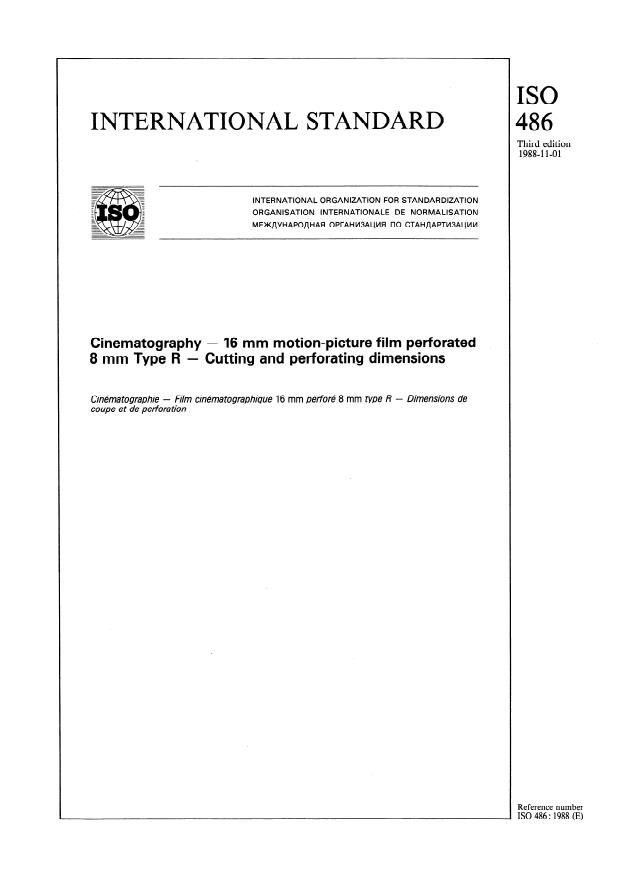
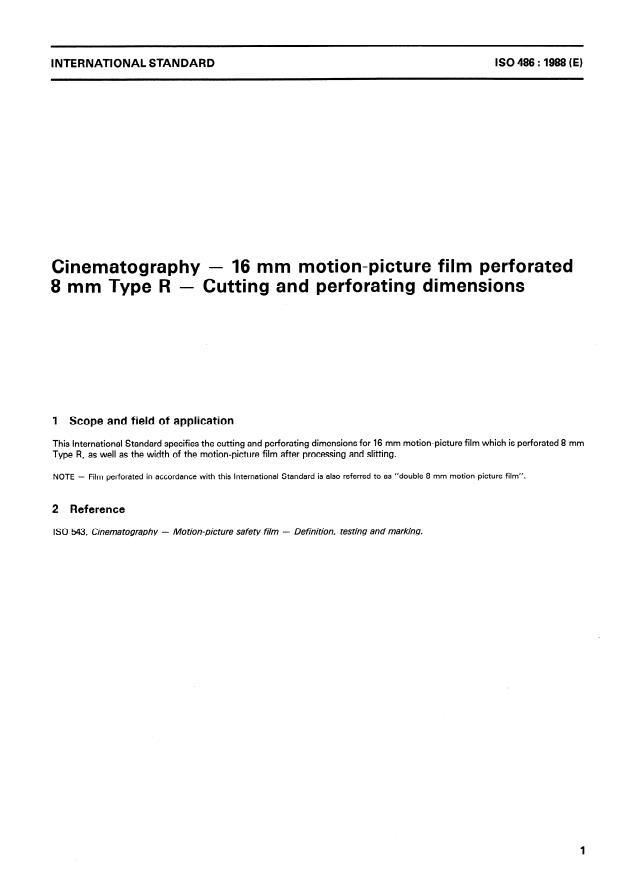
This International Standard specifies the cutting and perforating dimensions for 16 mm motion-picture film which is perforated 8 mm Type R, as well as the width of the motion-picture film after processing and slitting. NOTE - Film perforated in accordance with this International Standard is also referred to as "double 8 mm motion-picture film".
Cinématographie — Film cinématographique 16 mm perforé 8 mm type R — Dimensions de coupe et de perforation
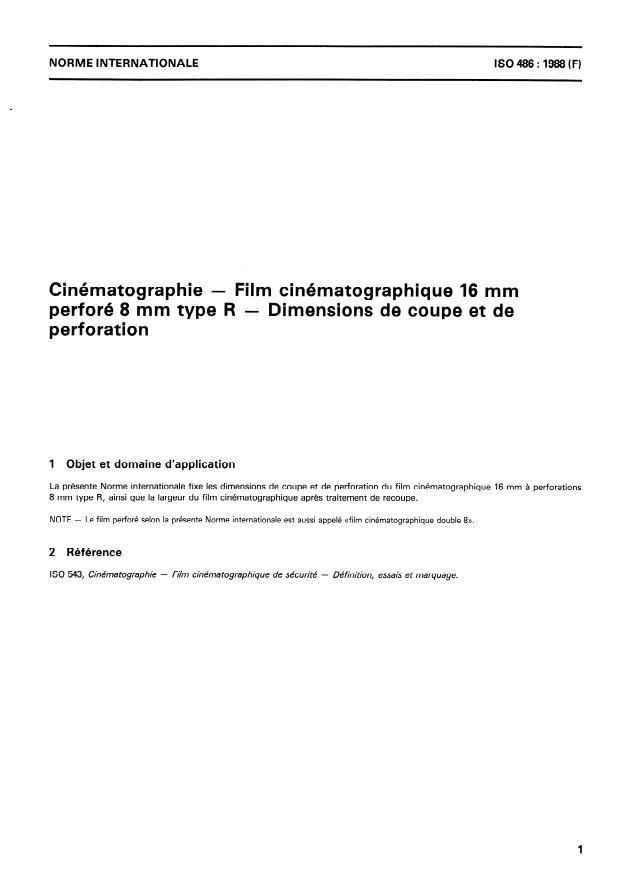
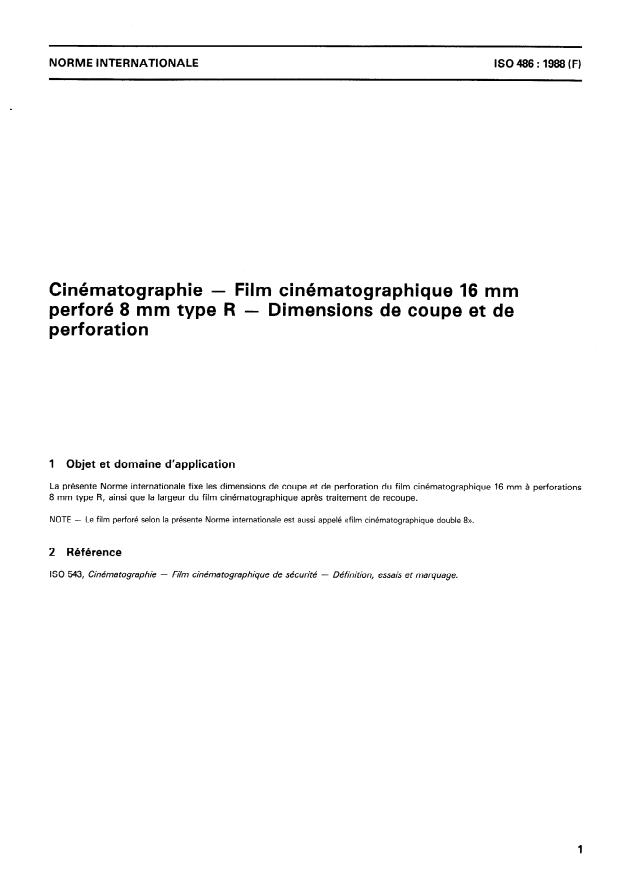
La présente Norme internationale fixe les dimensions de coupe et de perforation du film cinématographique 16 mm à perforations 8 mm type R, ainsi que la largeur du film cinématographique après traitement de recoupe. NOTE - Le film perforé selon la parente Norme internationale est aussi appelé « film cinématographique double 8 ».
General Information
- Status
- Published
- Publication Date
- 02-Nov-1988
- Technical Committee
- ISO/TC 36 - Cinematography
- Drafting Committee
- ISO/TC 36 - Cinematography
- Current Stage
- 9060 - Close of review
- Completion Date
- 04-Mar-2029
Relations
- Effective Date
- 15-Apr-2008
Overview
ISO 486:1988 is an international standard developed by the International Organization for Standardization (ISO) that specifies the precise cutting and perforating dimensions for 16 mm motion-picture film perforated with 8 mm Type R holes. This standard also defines the finished width of the motion-picture film after processing and slitting. Commonly referred to as double 8 mm motion-picture film, this standard ensures uniformity and compatibility in cinematography film production and handling.
The third edition, published in 1988, refines the specifications from its previous versions to provide greater accuracy and consistency. ISO 486:1988 is critical for manufacturers, processors, and equipment designers involved in the production and use of 16 mm perforated film for motion picture applications.
Key Topics
- Cutting Dimensions: Defines exact measurements for the width of the 16 mm film after it is slit and processed to guarantee standardized handling.
- Perforating Dimensions: Details the size, pitch, and position of the 8 mm Type R perforations on the film edges, which are essential for film transport, alignment, and steady image capture.
- Tolerance Levels: Specifies allowable variances to ensure manufacturing accuracy, critical for film compatibility with cameras and projectors.
- Film Width After Processing: Establishes the finished film width as 15.95 mm ± 0.03 mm, ensuring consistent film handling and equipment setup.
- Low-Shrinkage Film Definition: Describes characteristics of film base materials used, particularly films that shrink no more than 0.2% under standard storage, exposure, and processing conditions.
- Dimensional Stability Considerations: Addresses factors such as temperature and humidity effects on film dimensions, important for maintaining image steadiness and film handling precision.
- Uniformity of Perforations: Highlights the critical importance of consistent pitch and hole margin for stable film transport and image steadiness during projection or digitization.
Applications
- Film Manufacturing: Enables precise cutting and perforating of 16 mm motion-picture films for uniform production quality.
- Camera Design and Operation: Allows camera manufacturers to design mechanisms compatible with double 8 mm perforation standards, ensuring smooth film transport.
- Film Processing Labs: Helps processing facilities ensure accurate film slitting and maintain film integrity post-development.
- Projection and Scanning Equipment: Facilitates the design of projectors and scanners to handle double 8 mm film reliably with minimal mechanical errors.
- Archival and Preservation: Supports film archivists by providing standard dimensional benchmarks for film storage, handling, and restoration.
- Cinematography Research and Development: Provides a technical baseline for innovation in film and digital hybrid technologies where film perforations remain relevant.
Related Standards
- ISO 543 – Cinematography - Motion-picture Safety Film - Definition, Testing, and Marking: Supports ISO 486 by defining the types of safety films used in perforation standards.
- Other ISO cinematography standards related to film formats and performance may complement ISO 486 for comprehensive film production and handling guidelines.
- National and regional standards on film material, cutting, and equipment design often reference or align with ISO 486 to ensure global compatibility.
Keywords
ISO 486:1988, cinematography standards, 16 mm motion-picture film, 8 mm Type R perforations, double 8 mm film, film cutting dimensions, film perforating dimensions, motion picture film standards, film processing, film equipment compatibility, film dimensional stability, low-shrinkage film, film manufacturing specifications.
Buy Documents
ISO 486:1988 - Cinematography -- 16 mm motion-picture film perforated 8 mm Type R -- Cutting and perforating dimensions
ISO 486:1988 - Cinématographie -- Film cinématographique 16 mm perforé 8 mm type R -- Dimensions de coupe et de perforation
ISO 486:1988 - Cinématographie -- Film cinématographique 16 mm perforé 8 mm type R -- Dimensions de coupe et de perforation
Frequently Asked Questions
ISO 486:1988 is a standard published by the International Organization for Standardization (ISO). Its full title is "Cinematography — 16 mm motion-picture film perforated 8 mm Type R — Cutting and perforating dimensions". This standard covers: This International Standard specifies the cutting and perforating dimensions for 16 mm motion-picture film which is perforated 8 mm Type R, as well as the width of the motion-picture film after processing and slitting. NOTE - Film perforated in accordance with this International Standard is also referred to as "double 8 mm motion-picture film".
This International Standard specifies the cutting and perforating dimensions for 16 mm motion-picture film which is perforated 8 mm Type R, as well as the width of the motion-picture film after processing and slitting. NOTE - Film perforated in accordance with this International Standard is also referred to as "double 8 mm motion-picture film".
ISO 486:1988 is classified under the following ICS (International Classification for Standards) categories: 37.060.20 - Motion picture films. Cartridges. The ICS classification helps identify the subject area and facilitates finding related standards.
ISO 486:1988 has the following relationships with other standards: It is inter standard links to ISO 486:1982. Understanding these relationships helps ensure you are using the most current and applicable version of the standard.
ISO 486:1988 is available in PDF format for immediate download after purchase. The document can be added to your cart and obtained through the secure checkout process. Digital delivery ensures instant access to the complete standard document.
Standards Content (Sample)
ISO
INTERNATIONAL STANDARD
Third edition
1988-11-01
INTERNATIONAL ORGANIZATION FOR STANDARDIZATION
ORGANISATION INTERNATIONALE DE NORMALISATION
MEXAYHAPOAHAR OPTAHM3AuMfl l-l0 CTAH~APTM3A~MM
Cinematography - 16 mm motion-picture film perforated
8 mm Type R -
Cutting and perforating dimensions
CinGma tographie - Film cinkmatographique 16 mm perfore 8 mm type R - Dimensions de
coupe et de petforation
Reference number
ISO 486: 1988 (E)
ISO 486 : 1988 (EI
Foreword
ISO (the International Organization for Standardization) is a worldwide federation of
national Standards bodies (ISO member bodies). The work of preparing International
Standards is normally carried out through ISO technical committees. Esch member
body interested in a subject for which a technical committee has been established has
the right to be represented on that committee. International organizations, govern-
mental and non-governmental, in liaison with ISO, also take part in the work. ISO
collaborates closely with the International Electrotechnical Commission (IEC) on all
matters of electrotechnical standardization.
Draft International Standards adopted by the technical committees are circulated to
the member bodies for approval before their acceptance as International Standards by
the ISO Council. They are approved in accordance with ISO procedures requiring at
least 75 % approval by the member bodies voting.
International Standard ISO 486 was prepared by Technical Committee ISO/TC 36,
Cinema tograph y.
This third edition cancels and replaces the second edition (ISO
486 : 1982) , of which it
constitutes a minor revision, the annex having been replaced.
Users shouid note that all International Standards undergo revision from time to time
and that any reference made herein to any other International Standard implies its
latest edition, unless otherwise stated.
@ International Organkation for Standardkation, 1988 0
Printed in Switzerland
INTERNATIONAL STANDARD ISO 486 : 1988 (EI
Cinematography - 16 mm motion-picture film perforated
8 mm Type R - Cutting and perforating dimensions
1 Scope and field of application
This International Standard specifies the cutting and perforating dimensions for 16 mm motion-picture film which is perforated 8 mm
Type R, as well as the width of the motion-picture film after processing and slitting.
NOTE - Film perforated in accordance with this International Standard is also referred to as “double 8 mm motion-picture film”.
2 Reference
ISO 543, Cinematography - Motion-picture safety film - Definition, testing and marking.
ISO 486 : 1988 (EI
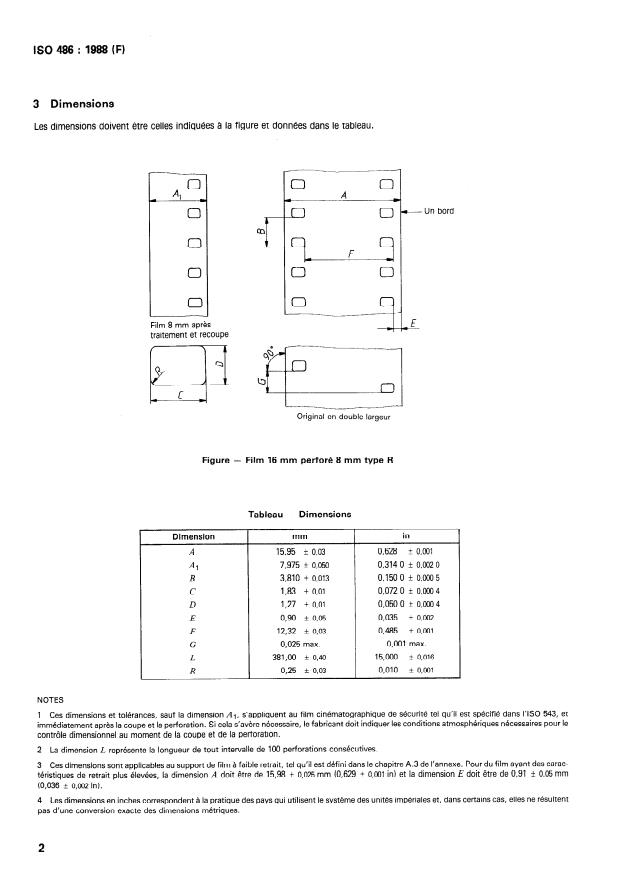
3 Dimensions
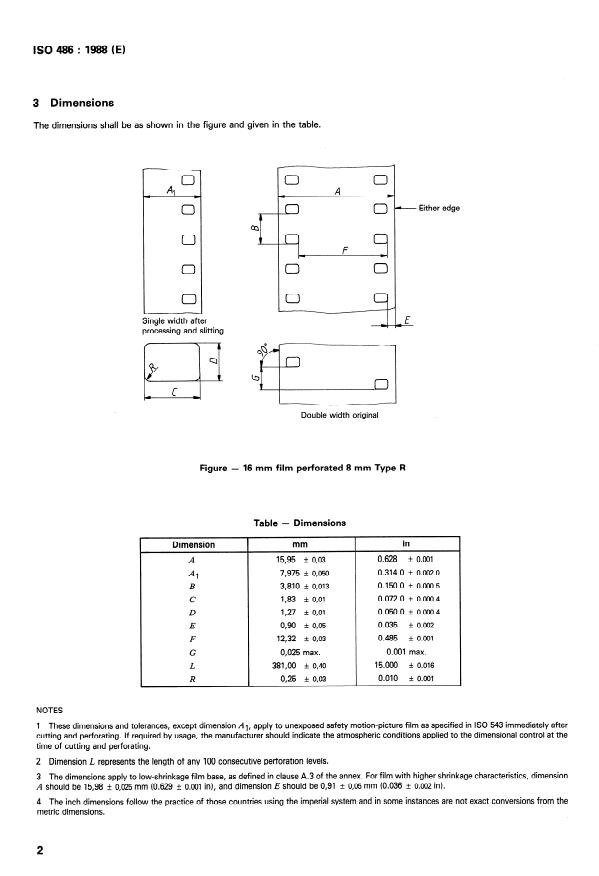
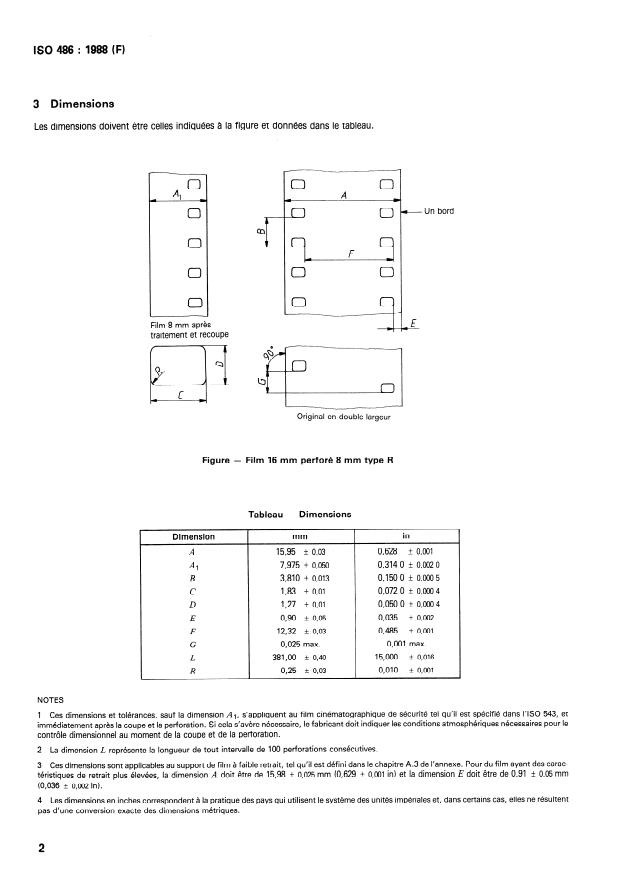
The dimensions shall be as shown in the figure and given in the table.
. Al
m
o------ Either edge
Single width after
processing and slitting
Double width original
Figure - 16 mm film perforated 8 mm Type R
Table - Dimensions
in
Dimension Dimension mm
0.628 i: o.om
A A 15,95 + 0,03
7,975 f 0,050 0.314 0 Ik 0.002 0
Al Al
0.150 0 I!E
...
IS0
NORME INTERNATIONALE 486
Troisikme edition
1988-1 l-01
r@gFpzg
INTERNATIONAL ORGANIZATION FOR STANDARDIZATION
. . .
= =
=
=
Y :
= Z
ORGANISATION INTERNATIONALE DE NORMALISATION
z
i
=
I
=.
= MEX,lJYHAPO,lJHAfl OPI-AHM3AuMfl FlO CTAHfiAPTM3AL/MM
- ZIG
z==z
:w
Film CinGmatographique 16 mm
Cinematographic -
perfore 8 mm type R - Dimensions de coupe et de
perforation
Cinematography - 16 mm motion-picture film perforated 8 mm Type R - Cutting and
perforating dimensions
Nurnh-o de rkfh-ence
IS0 486 : 1988 (F)
IS0 486 : 1988 (F)
Avant-propos
L’ISO (Organisation internationale de normalisation) est une federation mondiale
d’organismes nationaux de normalisation (comites membres de I’ISO). LWaboration
des Normes internationales est en general confide aux comites techniques de I’ISO.
Chaque comite membre interesse par une etude a le droit de faire partie du comite
technique tree a cet effet. Les organisations internationales, gouvernementales et non
gouvernementales, en liaison avec I’ISO participent egalement aux travaux. L’ISO col-
labore etroitement avec la Commission electrotechnique internationale (CEI) en ce qui
concerne la normalisation electrotechnique.
Les projets de Normes internationales adopt& par les comites techniques sont soumis
aux comites membres pour approbation, avant leur acceptation comme Normes inter-
nationales par le Conseil de I’ISO. Les Normes internationales sont approuvees confor-
mement aux procedures de I’ISO qui requierent I’approbation de 75 % au moins des
comites membres votants.
La Norme internationale IS0 486 a ete elaboree par le comite technique ISO/TC 36,
Cl&ma tographie.
Cette troisieme edition annule et remplace la deuxieme edition (IS0 486 : 1982), dont
elle constitue une revision mineure, l’annexe ayant ete changee.
L’attention des utilisateurs est attiree sur le fait que toutes les Normes internationales
sont de temps en temps soumises a revision et que toute reference faite a une autre
Norme internationale dans le present document implique qu’il s’agit, sauf indication
contraire, de la derniere edition.
@ Organisation internationale de normalisation, 1988
Imprim en Suisse
~~
NORME INTERNATIONALE IS0 486 : 1988 IF)
Film cinematographique 16 mm
Cinbmatographie -
- Dimensions de coupe et de
perfor 8 mm type R
perforation
1 Objet et domaine d’application
La prbente Norme internationale fixe les dimensions de coupe et de perforation du film cinematographique 16 mm ti perforations
8 mm type R, ainsi que la largeur du film cinbmatographique aprits traitement de recoupe.
NOTE - Le film perfork selon la prkente Norme internationale est aussi appel6 ((film cinClmatographique double 8~.
2 Rkfkence
IS0 543, Cinhmatographie - Film cin6matographique de s&writ6 - DMnition, essais et marquage.
IS0 486 : 1988 (I=)
3 Dimensions
Les dimensions doivent etre celles indiquees 5 la figure et donkes dans le tableau.
w----- Un bord
Film 8 mm apres
traitement et recoupe
Original en double largeur
-
Figure Film 16 mm perfore 8 mm type R
Tableau - Dimensions
0,150 0 Ifr 0,ooo 5
0,072 0 Ik 0,ooo 4
0,050
...
IS0
NORME INTERNATIONALE 486
Troisikme edition
1988-1 l-01
r@gFpzg
INTERNATIONAL ORGANIZATION FOR STANDARDIZATION
. . .
= =
=
=
Y :
= Z
ORGANISATION INTERNATIONALE DE NORMALISATION
z
i
=
I
=.
= MEX,lJYHAPO,lJHAfl OPI-AHM3AuMfl FlO CTAHfiAPTM3AL/MM
- ZIG
z==z
:w
Film CinGmatographique 16 mm
Cinematographic -
perfore 8 mm type R - Dimensions de coupe et de
perforation
Cinematography - 16 mm motion-picture film perforated 8 mm Type R - Cutting and
perforating dimensions
Nurnh-o de rkfh-ence
IS0 486 : 1988 (F)
IS0 486 : 1988 (F)
Avant-propos
L’ISO (Organisation internationale de normalisation) est une federation mondiale
d’organismes nationaux de normalisation (comites membres de I’ISO). LWaboration
des Normes internationales est en general confide aux comites techniques de I’ISO.
Chaque comite membre interesse par une etude a le droit de faire partie du comite
technique tree a cet effet. Les organisations internationales, gouvernementales et non
gouvernementales, en liaison avec I’ISO participent egalement aux travaux. L’ISO col-
labore etroitement avec la Commission electrotechnique internationale (CEI) en ce qui
concerne la normalisation electrotechnique.
Les projets de Normes internationales adopt& par les comites techniques sont soumis
aux comites membres pour approbation, avant leur acceptation comme Normes inter-
nationales par le Conseil de I’ISO. Les Normes internationales sont approuvees confor-
mement aux procedures de I’ISO qui requierent I’approbation de 75 % au moins des
comites membres votants.
La Norme internationale IS0 486 a ete elaboree par le comite technique ISO/TC 36,
Cl&ma tographie.
Cette troisieme edition annule et remplace la deuxieme edition (IS0 486 : 1982), dont
elle constitue une revision mineure, l’annexe ayant ete changee.
L’attention des utilisateurs est attiree sur le fait que toutes les Normes internationales
sont de temps en temps soumises a revision et que toute reference faite a une autre
Norme internationale dans le present document implique qu’il s’agit, sauf indication
contraire, de la derniere edition.
@ Organisation internationale de normalisation, 1988
Imprim en Suisse
~~
NORME INTERNATIONALE IS0 486 : 1988 IF)
Film cinematographique 16 mm
Cinbmatographie -
- Dimensions de coupe et de
perfor 8 mm type R
perforation
1 Objet et domaine d’application
La prbente Norme internationale fixe les dimensions de coupe et de perforation du film cinematographique 16 mm ti perforations
8 mm type R, ainsi que la largeur du film cinbmatographique aprits traitement de recoupe.
NOTE - Le film perfork selon la prkente Norme internationale est aussi appel6 ((film cinClmatographique double 8~.
2 Rkfkence
IS0 543, Cinhmatographie - Film cin6matographique de s&writ6 - DMnition, essais et marquage.
IS0 486 : 1988 (I=)
3 Dimensions
Les dimensions doivent etre celles indiquees 5 la figure et donkes dans le tableau.
w----- Un bord
Film 8 mm apres
traitement et recoupe
Original en double largeur
-
Figure Film 16 mm perfore 8 mm type R
Tableau - Dimensions
0,150 0 Ifr 0,ooo 5
0,072 0 Ik 0,ooo 4
0,050
...
Questions, Comments and Discussion
Ask us and Technical Secretary will try to provide an answer. You can facilitate discussion about the standard in here.
Loading comments...