


ISO 14533-3:2017
(Main)Processes, data elements and documents in commerce, industry and administration — Long term signature profiles — Part 3: Long term signature profiles for PDF Advanced Electronic Signatures (PAdES)
Processes, data elements and documents in commerce, industry and administration — Long term signature profiles — Part 3: Long term signature profiles for PDF Advanced Electronic Signatures (PAdES)
ISO 14533-3:2017 specifies the elements, among those defined in PDF Advanced Electronic Signatures (PAdES), that enable verification of a digital signature over a long period of time. It does not give new technical specifications about the digital signature itself, nor new restrictions of usage of the technical specifications about the digital signatures which already exist.
Processus, éléments d'informations et documents dans le commerce, l'industrie et l'administration — Profils de signature à long terme — Partie 3: Profils de signature à long terme pour les signatures électroniques avancées PDF (PAdES)
General Information
- Status
- Withdrawn
- Publication Date
- 11-Oct-2017
- Technical Committee
- ISO/TC 154 - Processes, data elements and documents in commerce, industry and administration
- Drafting Committee
- ISO/TC 154/WG 6 - Trusted eCommunications
- Current Stage
- 9599 - Withdrawal of International Standard
- Start Date
- 21-Oct-2025
- Completion Date
- 14-Feb-2026
Relations
- Effective Date
- 04-Nov-2023
Overview
ISO 14533-3:2017 defines long-term signature profiles for PDF Advanced Electronic Signatures (PAdES). Its purpose is to ensure that electronic signatures embedded in PDF documents remain verifiable over long periods by specifying which PAdES elements (not new cryptographic algorithms) are required, optional, conditional or prohibited for long-term validation. The standard focuses on timestamping and preservation of validation data to detect illegal alterations and to maintain interoperability across implementations.
Key topics and technical requirements
- PAdES profiles for long-term validation
- PAdES-T - protects the signature value using trusted evidence (timestamps). Three forms are defined: by document timestamp, by signature timestamp attribute, and by subsequent signature with a signature timestamp attribute.
- PAdES-A - protects long-term availability and integrity of validation data that supports PAdES-T (e.g., certificate chains, revocation data).
- Required-level model (M / O / C / P)
Elements in PAdES structures are labeled Mandatory (M), Optional (O), Conditional (C) or Prohibited (P). Implementations must include all Mandatory elements, may implement Optional elements, and must provide detailed specifications for Conditional elements. - Signature Dictionary and validation metadata
- The standard specifies required levels for entries in the PDF Signature Dictionary (CAdES-based PAdES usage), and how validation data and timestamps are represented and updated.
- Conformance and declarations
- Generation and validation of PAdES-T and PAdES-A data must meet the document’s requirements. For first‑party conformity, implementers should provide a supplier’s declaration of conformity (Annex A) describing implementation status and handling of Conditional elements.
- Annexes and implementation guidance
- Included normative and informative annexes cover timestamp-only profiles (Annex B), timestamp token structure (Annex C), using CMS signatures (Annex D), and multiple-signature examples (Annex E).
Practical applications
- Long-term archiving of signed PDF contracts, invoices, legal filings and regulatory records.
- PDF signing and validation software (desktop, server, cloud) that must ensure signatures remain verifiable years later.
- Digital archiving systems and records management that need to preserve signature integrity and validation evidence.
- Timestamp Authorities (TSAs), PKI operators and compliance teams implementing policies for signature lifecycle and proof-of-existence.
Who should use this standard
- PDF signing tool vendors and PDF viewer developers
- PKI and timestamp service providers
- Records managers, archivists and legal/compliance professionals
- Software architects designing long-term signature verification workflows
Related standards
- ISO 14533-1 (CAdES long-term signature profiles)
- ISO 32000-2 (PDF 2.0 specification)
- ETSI PAdES technical specifications (normative background)
Keywords: ISO 14533-3:2017, PAdES, long-term signature profiles, PDF advanced electronic signatures, PAdES-T, PAdES-A, timestamp, long-term validation, digital signature, interoperability.
Get Certified
Connect with accredited certification bodies for this standard

BSI Group
BSI (British Standards Institution) is the business standards company that helps organizations make excellence a habit.

NYCE
Mexican standards and certification body.
Sponsored listings
Frequently Asked Questions
ISO 14533-3:2017 is a standard published by the International Organization for Standardization (ISO). Its full title is "Processes, data elements and documents in commerce, industry and administration — Long term signature profiles — Part 3: Long term signature profiles for PDF Advanced Electronic Signatures (PAdES)". This standard covers: ISO 14533-3:2017 specifies the elements, among those defined in PDF Advanced Electronic Signatures (PAdES), that enable verification of a digital signature over a long period of time. It does not give new technical specifications about the digital signature itself, nor new restrictions of usage of the technical specifications about the digital signatures which already exist.
ISO 14533-3:2017 specifies the elements, among those defined in PDF Advanced Electronic Signatures (PAdES), that enable verification of a digital signature over a long period of time. It does not give new technical specifications about the digital signature itself, nor new restrictions of usage of the technical specifications about the digital signatures which already exist.
ISO 14533-3:2017 is classified under the following ICS (International Classification for Standards) categories: 35.240.60 - IT applications in transport; 35.240.63 - IT applications in trade. The ICS classification helps identify the subject area and facilitates finding related standards.
ISO 14533-3:2017 has the following relationships with other standards: It is inter standard links to ISO 14533-3:2025. Understanding these relationships helps ensure you are using the most current and applicable version of the standard.
ISO 14533-3:2017 is available in PDF format for immediate download after purchase. The document can be added to your cart and obtained through the secure checkout process. Digital delivery ensures instant access to the complete standard document.
Standards Content (Sample)
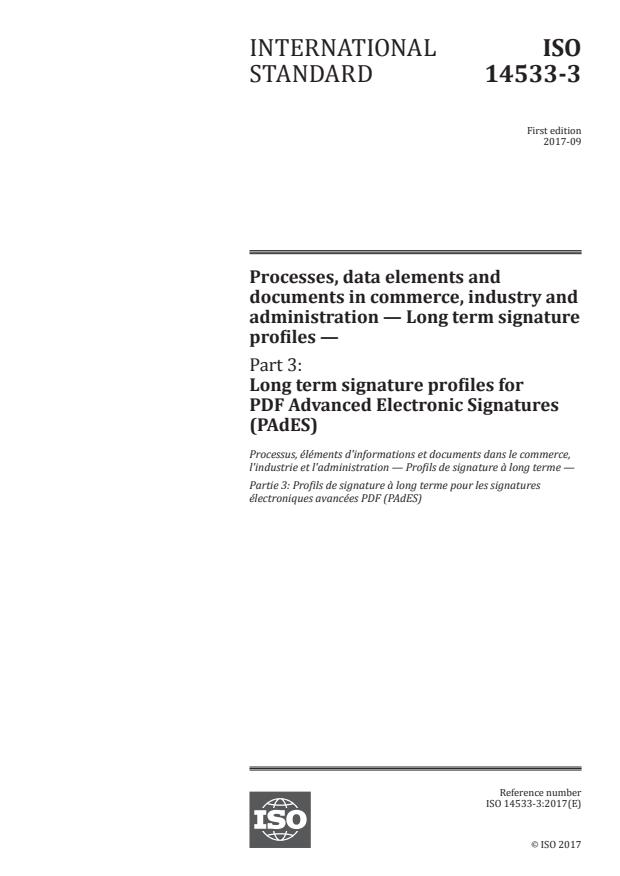
INTERNATIONAL ISO
STANDARD 14533-3
First edition
2017-09
Processes, data elements and
documents in commerce, industry and
administration — Long term signature
profiles —
Part 3:
Long term signature profiles for
PDF Advanced Electronic Signatures
(PAdES)
Processus, éléments d'informations et documents dans le commerce,
l'industrie et l'administration — Profils de signature à long terme —
Partie 3: Profils de signature à long terme pour les signatures
électroniques avancées PDF (PAdES)
Reference number
©
ISO 2017
© ISO 2017, Published in Switzerland
All rights reserved. Unless otherwise specified, no part of this publication may be reproduced or utilized otherwise in any form
or by any means, electronic or mechanical, including photocopying, or posting on the internet or an intranet, without prior
written permission. Permission can be requested from either ISO at the address below or ISO’s member body in the country of
the requester.
ISO copyright office
Ch. de Blandonnet 8 • CP 401
CH-1214 Vernier, Geneva, Switzerland
Tel. +41 22 749 01 11
Fax +41 22 749 09 47
copyright@iso.org
www.iso.org
ii © ISO 2017 – All rights reserved
Contents Page
Foreword .iv
Introduction .v
1 Scope . 1
2 Normative references . 1
3 Terms and definitions . 1
4 Abbreviated terms and symbols . 1
5 Requirements . 2
6 Long-term signature profiles . 2
6.1 Definition of PAdES profile and positioning . 2
6.2 Representation of the required level . 3
6.3 Standard for setting the required level . 3
6.4 PAdES-T profile . 4
6.4.1 General. 4
6.4.2 PAdES using CAdES signatures profile . 5
6.4.3 Timestamp of PAdES-T profile . 8
6.5 PAdES-A profile . 8
6.5.1 General. 8
6.5.2 Structure of the PAdES-A profile . 8
6.5.3 Document Security Store Dictionary . 9
6.5.4 Signature VRI Dictionary . 9
6.5.5 Document timestamp . 9
6.5.6 Updating PAdES-A .10
6.5.7 Validation Data for Signature and Timestamp .10
6.6 Multiple signatures.10
6.6.1 General.10
6.6.2 Timestamp for multiple signatures .11
Annex A (normative) Supplier's declaration of conformity and its attachment .13
Annex B (normative) The profile for using only timestamp .18
Annex C (normative) Structure of timestamp token .20
Annex D (informative) Applying PAdES using CMS signatures .22
Annex E (informative) Examples of multiple signatures .23
Bibliography .26
Foreword
ISO (the International Organization for Standardization) is a worldwide federation of national standards
bodies (ISO member bodies). The work of preparing International Standards is normally carried out
through ISO technical committees. Each member body interested in a subject for which a technical
committee has been established has the right to be represented on that committee. International
organizations, governmental and non-governmental, in liaison with ISO, also take part in the work.
ISO collaborates closely with the International Electrotechnical Commission (IEC) on all matters of
electrotechnical standardization.
The procedures used to develop this document and those intended for its further maintenance are
described in the ISO/IEC Directives, Part 1. In particular the different approval criteria needed for the
different types of ISO documents should be noted. This document was drafted in accordance with the
editorial rules of the ISO/IEC Directives, Part 2 (see www.iso.org/directives).
Attention is drawn to the possibility that some of the elements of this document may be the subject of
patent rights. ISO shall not be held responsible for identifying any or all such patent rights. Details of
any patent rights identified during the development of the document will be in the Introduction and/or
on the ISO list of patent declarations received (see www.iso.org/patents).
Any trade name used in this document is information given for the convenience of users and does not
constitute an endorsement.
For an explanation on the voluntary nature of standards, the meaning of ISO specific terms and
expressions related to conformity assessment, as well as information about ISO's adherence to the
World Trade Organization (WTO) principles in the Technical Barriers to Trade (TBT) see the following
URL: www.iso.org/iso/foreword.html.
This document was prepared by Technical Committee ISO/TC 154, Processes, data elements and
documents in commerce, industry and administration.
A list of all parts in the ISO 14533 series can be found on the ISO website.
iv © ISO 2017 – All rights reserved
Introduction
The purpose of this document is to ensure the interoperability of implementations with respect to
long-term signatures that make electronic signatures verifiable in the long term. Long-term signature
specifications referenced by each implementation cover PDF Advanced Electronic Signatures (PAdES)
developed by the European Telecommunications Standards Institute (ETSI).
INTERNATIONAL STANDARD ISO 14533-3:2017(E)
Processes, data elements and documents in commerce,
industry and administration — Long term signature
profiles —
Part 3:
Long term signature profiles for PDF Advanced Electronic
Signatures (PAdES)
1 Scope
This document specifies the elements, among those defined in PDF Advanced Electronic Signatures
(PAdES), that enable verification of a digital signature over a long period of time.
It does not give new technical specifications about the digital signature itself, nor new restrictions of
usage of the technical specifications about the digital signatures which already exist.
2 Normative references
The following documents are referred to in the text in such a way that some or all of their content
constitutes requirements of this document. For dated references, only the edition cited applies. For
undated references, the latest edition of the referenced document (including any amendments) applies.
ISO 14533-1, Processes, data elements and documents in commerce, industry and administration — Long term
signature profiles — Part 1: Long term signature profiles for CMS Advanced Electronic Signatures (CAdES)
ISO 32000-2, Document management — Portable document format — Part 2: PDF 2.0
3 Terms and definitions
For the purposes of this document, the terms and definitions given in ISO 14533-1 and the following apply.
ISO and IEC maintain terminological databases for use in standardization at the following addresses:
— ISO Online browsing platform: available at http://www.iso.org/obp
— IEC Electropedia: available at http://www.electropedia.org/
3.1
advanced electronic signature
electronic signature which is uniquely linked to the signatory, is capable of identifying the signatory, is
created using electronic signature creation data that the signatory can, with high level of confidence,
use under his sole control, and is linked to the data signed therewith in such a way that any subsequent
change in the data is detectable
4 Abbreviated terms and symbols
The following symbols are used for the “required level”:
— C: Conditional
— M: Mandatory
— O: Optional
— P: Prohibited (creation or modification)
5 Requirements
5.1 The generation or validation of PAdES-T data conforms to this document, provided that the
following requirements are met:
a) all processing of elements whose required level is “Mandatory” in the PAdES-T profile as specified
in this document, shall be included;
b) detailed specifications pertaining to the processing of any element whose required level is
“Conditional” in the PAdES-T profile, as specified in this document, shall be provided.
5.2 The generation or validation of PAdES-A data conforms to this document provided that the
following requirements are met:
a) all processing of elements whose required level is “Mandatory” in the PAdES-A profile as specified
in this document, shall be included;
b) detailed specifications pertaining to the processing of any element whose required level is
“Conditional” in the PAdES-A profile as specified in this document, shall be provided.
5.3 The generation or validation of PAdES-DT and PAdES-DTA data conforms to this document,
provided that the requirements of Figures B.1 and B.2 respectively are met. See Annex B.
5.4 If first-party conformity assessment is used, the implementer shall make a declaration of
conformity to this document by disclosing the supplier's declaration of compliance and its attachment
(see Annex A) containing a description of implementation status (and the specifications for any elements
“Conditional”).
NOTE 1 See ISO/IEC 17050-1:2004.
NOTE 2 Figure 1 shows the positioning of the generation and validation of PAdES-T data and PAdES-A data.
6 Long-term signature profiles
6.1 Definition of PAdES profile and positioning
In order to make electronic signatures verifiable in the long term:
— signing time shall be identifiable,
— any illegal alterations of information pertaining to signatures, including the subject of information
and validation data, shall be detectable, and
— interoperability shall be ensured.
To meet these requirements, this document defines the following two profiles with respect to PAdES:
a) PAdES-T profile: a profile pertaining to the generation and validation of the signature with a
timestamp for signature. The timestamp is stored in a signature timestamp Attribute of the
signature, or in any subsequent object containing the timestamp, covering the signature. The
subsequent object is a Document timestamp or a signature with the signature timestamp Attribute.
2 © ISO 2017 – All rights reserved
b) PAdES-A profile: a profile pertaining to the generation and validation in the long-term availability
and integrity of the validation data that protects the PAdES-T data, including validation data from
any illegal alterations.
Figure 1 shows the relation between the PAdES-T data and the PAdES-A data.
Figure 1 — Relation between the PAdES-T data and the PAdES-A data
6.2 Representation of the required level
This document defines the following representation methods for the required level (as a profile) of each
element constituting PAdES-T data and PAdES-A data.
a) Mandatory (M): Elements whose required level is “Mandatory” shall be implemented without fail. If
such an element has optional sub-elements, at least one sub-element shall be selected. Any element
whose required level is “Mandatory” and which is one of the sub-elements of an optional element
shall be selected whenever the optional element is selected.
b) Optional (O): Elements whose required level is “Optional” may be implemented at the discretion of
the implementer.
c) Conditional (C): Elements whose required level is “Conditional” may be implemented at the
discretion of the implementer, provided that detailed specifications for the processing thereof are
provided separately.
d) Prohibited (P): Elements whose required level is ‘Prohibited’ shall not be created or modified, but
may be read.
6.3 Standard for setting the required level
The required level of each element constituting PAdES-T data and PAdES-A data shall be set in
accordance with the following requirements:
a) The required level shall be “Mandatory” for elements whose required level is “Mandatory” in the
definition of PAdES, and for elements that are necessary for the generation and validation of long-
term signatures. The elements whose required level is “Optional” in the definition of PAdES are
defined as “Mandatory”, “Optional” or “Conditional”.
b) The required level shall be “Conditional” for externally defined elements.
EXAMPLE 1 OtherCertificateFormat.
c) The required level shall be “Conditional” for elements intended to interact with a certain application.
EXAMPLE 2 CommitmentType.
d) The required level shall be “Conditional” for elements with an operation-dependent factor.
EXAMPLE 3 Attribute certificate; time mark.
NOTE The archiving-type timestamp defined in ISO/IEC 18014-2 is included in “Time mark or other
method.”
e) The required level shall be “optional” for elements only containing reference information.
6.4 PAdES-T profile
6.4.1 General
The PAdES-T profile is defined as the form of an electronic signature, of which the signature value is
protected by any subsequent object containing trusted evidence as a proof of existence (e.g. Document
timestamp).
The PAdES-T is extended from the PAdES using CAdES signatures specified in 6.4.2. The required levels
of constituent elements of the PAdES using CAdES signatures are also specified in 6.4.2.
The following three types are defined as forms of the PAdES-T profile.
— PAdES-T by Document timestamp;
— PAdES-T by Signature timestamp Attribute;
— PAdES-T by Subsequent Signature with Signature timestamp Attribute.
These forms are shown in Figure 2 to 4.
The required levels of PAdES-T profile are specified in 6.4.3.
Figure 2 — PAdES-T Profile by Document timestamp
4 © ISO 2017 – All rights reserved
Figure 3 — PAdES-T Profile by Signature timestamp Attribute
Figure 4 — PAdES-T Profile by Subsequent Signature with Signature timestamp Attribute
6.4.2 PAdES using CAdES signatures profile
Table 1 specifies the required levels of entries that constitute the Signature Directory of the PAdES
using CAdES signatures profile. The element which has not been indicated is set to C (Conditional).
Table 1 — Signature Dictionary of PAdES using CAdES signatures
Entry Required level Value
Type O Sig
Filter M
a
SubFilter M ETSI.CAdES.detached
Contents M See Table 2
ByteRange M
b
M M
Cert P
a
See also Annex D.
b
Even if a signature does not contain M Entry, a signature validation application shall not consider this signature invalid.
Time of M Entry is not basically used to validate certificates. If this information is used for validation, it is necessary to
define clearly a usage of this information. (e.g. describing a usage in a signature policy).
Table 1 (continued)
Entry Required level Value
Location O
Reason O
ContactInfo O
a
See also Annex D.
b
Even if a signature does not contain M Entry, a signature validation application shall not consider this signature invalid.
Time of M Entry is not basically used to validate certificates. If this information is used for validation, it is necessary to
define clearly a usage of this information. (e.g. describing a usage in a signature policy).
Table 2 specifies the required levels of elements that constitute the ContentInfo in the signature data.
Table 2 — ContentInfo in signature
Element Required level Value
ContentType M id-signedData
Content M See Table 3
Table 3 specifies the required levels of elements that constitute the SignedData in the signature data. A
DER-encoded SignedData object as specified in cryptographic message syntax (CMS) shall be included
as the PDF signature in the entry with the key Content of the signature dictionary, as described in
ISO 32000-2.
Table 3 — SignedData in signature
Element Required level
CMSVersion M
DigestAlgorithmIdentifiers M
EncapsulatedContentInfo M
– eContentType M
– eContent O
CertificateSet (Certificates) M
a
– Certificate M
– AttributeCertificateV2 P
– OtherCertificateFormat C
RevocationInfoChoices (crls) O
– CertificateList O
– OtherRevocationInfoFormat C
b
SignerInfos M
– signerInfo M
a
At least a signature generation application shall contain a signer certificate for interoperability. Even if a signature
does not contain this element, a signature validation application shall not consider this signature invalid.
b
Only a single signerInfo shall be present in PDF signature.
Table 4 specifies the required levels of elements that constitute the SignerInfo in the signature data.
Table 4 — SignerInfo in signature
Element Required level
CMSVersion M
SignerIdentifier M
– IssuerAndSerialNumber O
6 © ISO 2017 – All rights reserved
Table 4 (continued)
Element Required level
– SubjectKeyIdentifier O
DigestAlgorithmIdentifier M
SignedAttributes M
SignatureAlgorithmIdentifier M
SignatureValue M
UnsignedAttributes O
Table 5 specifies the required levels of elements that constitute the Signed Attributes. The element
which has not been indicated is set to C (Conditional).
Table 5 — Signed Attribute in signature
Element Required level
ContentType M
MessageDigest M
SigningCertificateReference M
– ESS SigningCertificate O
a
– ESS SigningCertificateV2 O
– OtherSigningCertificate C
b
SignaturePolicyIdentifier C
b
CommitmentTypeIndication C
SignerIdentifier C
ContentTimestamp C
SigningTime P
ContentReference P
ContentIdentifier P
ContentHints P
c
SignerAttribute C
d
SignerLocation O
a
When a signature which complies with the PAdES using CAdES signatures is generated, the attribute of
signingCertificateV2 shall be present in Signed Attributes.
b
See ISO 32000-2:2017, 12.8.3.4.4.
c
See ISO 32000-2:2017, 12.8.3.4.3.
d
Either SignerLocation attribute or Location entry in Table 1 may be used.
Table 6 specifies the required levels of elements that constitute the Unsigned Attributes. The element
which has not been indicated is set to C (Conditional).
Table 6 — Unsigned Attributes in signature
Element Required level
CounterSignature P
6.4.3 Timestamp of PAdES-T profile
See Table 7.
a) PAdES-T profile by Document timestamp.
The PAdES-T profile by Document timestamp is defined as an extended form of the PAdES using
CAdES signatures profile to which the Document timestamp dictionary is added.
b) PAdES-T profile by Signature Timestamp Attribute
The PAdES-T profile by Signature Timestamp Attribute is defined as an extended form to which the
Signature Timestamp Attribute is added.
c) PAdES-T profile by Subsequent Signature with Signature Timestamp Attribute
The PAdES-T profile by Subsequent Signature with Signature Timestamp Attribute is defined as
an extended form of the PAdES using CAdES signatures profile to which the Subsequent Signature
Dictionary is added, containing the signature with the Signature Timestamp Attribute.
The time value of PAdES-T shall be the time value of the oldest valid timestamp covering the signature
value according to point a), b) or c).
Table 7 — Timestamp of PAdES-T profile
Elemen
...
Questions, Comments and Discussion
Ask us and Technical Secretary will try to provide an answer. You can facilitate discussion about the standard in here.
Loading comments...