


ISO 17984:2014
(Main)Machine-made textile floor coverings — Determination of dimensional changes after exposure to heat and/or water
Machine-made textile floor coverings — Determination of dimensional changes after exposure to heat and/or water
ISO 17984:2014 specifies procedures for the determination of both planar and out-of-plane dimensional changes that take place when machine-made textile floor coverings are subjected to heat, water, or varied heat and water conditions. The following methods are applicable to all machine-made textile floor coverings including those produced in tile form: Method 1, Determination of dimensional changes after exposure to heat; Method 2, Determination of dimensional changes after immersion in water; Method 3, Determination of dimensional changes due to the effects of varied heat and water conditions; and Method 4, Dimensional changes out of the plane.
Revêtements de sol textiles fabriqués à la machine — Détermination de la variation dimensionnelle après exposition à la chaleur et/ou à l'eau
General Information
- Status
- Withdrawn
- Publication Date
- 16-Jun-2014
- Withdrawal Date
- 16-Jun-2014
- Technical Committee
- ISO/TC 219 - Floor coverings
- Drafting Committee
- ISO/TC 219 - Floor coverings
- Current Stage
- 9599 - Withdrawal of International Standard
- Start Date
- 04-Jul-2016
- Completion Date
- 14-Feb-2026
Relations
- Effective Date
- 27-Feb-2010
Get Certified
Connect with accredited certification bodies for this standard

Control Union Certifications
Global certification for agriculture and sustainability.

Bureau Veritas Bangladesh
Bureau Veritas certification services in Bangladesh.

ECOCERT France
Leader in organic and sustainability certification worldwide.
Sponsored listings
Frequently Asked Questions
ISO 17984:2014 is a standard published by the International Organization for Standardization (ISO). Its full title is "Machine-made textile floor coverings — Determination of dimensional changes after exposure to heat and/or water". This standard covers: ISO 17984:2014 specifies procedures for the determination of both planar and out-of-plane dimensional changes that take place when machine-made textile floor coverings are subjected to heat, water, or varied heat and water conditions. The following methods are applicable to all machine-made textile floor coverings including those produced in tile form: Method 1, Determination of dimensional changes after exposure to heat; Method 2, Determination of dimensional changes after immersion in water; Method 3, Determination of dimensional changes due to the effects of varied heat and water conditions; and Method 4, Dimensional changes out of the plane.
ISO 17984:2014 specifies procedures for the determination of both planar and out-of-plane dimensional changes that take place when machine-made textile floor coverings are subjected to heat, water, or varied heat and water conditions. The following methods are applicable to all machine-made textile floor coverings including those produced in tile form: Method 1, Determination of dimensional changes after exposure to heat; Method 2, Determination of dimensional changes after immersion in water; Method 3, Determination of dimensional changes due to the effects of varied heat and water conditions; and Method 4, Dimensional changes out of the plane.
ISO 17984:2014 is classified under the following ICS (International Classification for Standards) categories: 59.080.60 - Textile floor coverings; 97.150 - Floor coverings. The ICS classification helps identify the subject area and facilitates finding related standards.
ISO 17984:2014 has the following relationships with other standards: It is inter standard links to ISO/PAS 17984:2001. Understanding these relationships helps ensure you are using the most current and applicable version of the standard.
ISO 17984:2014 is available in PDF format for immediate download after purchase. The document can be added to your cart and obtained through the secure checkout process. Digital delivery ensures instant access to the complete standard document.
Standards Content (Sample)
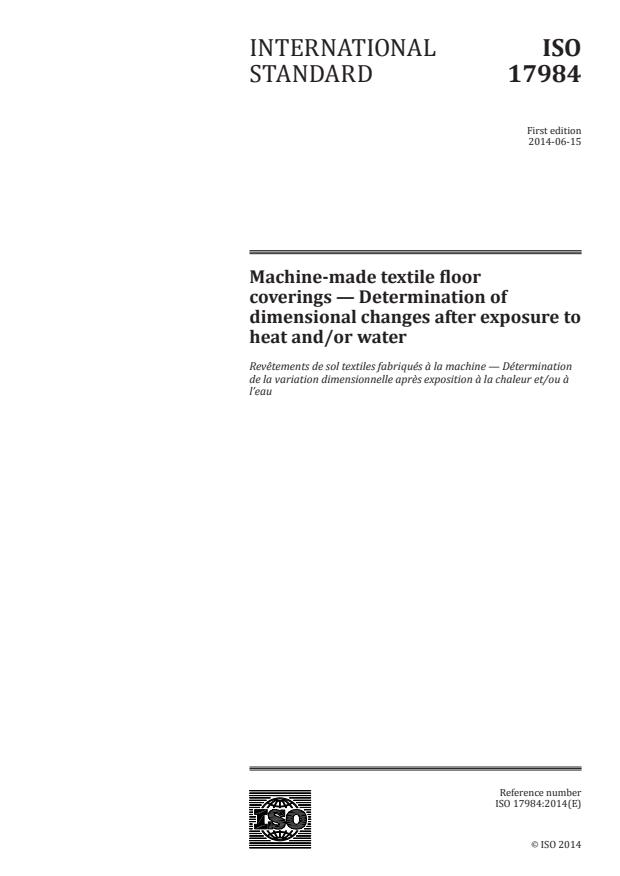
INTERNATIONAL ISO
STANDARD 17984
First edition
2014-06-15
Machine-made textile floor
coverings — Determination of
dimensional changes after exposure to
heat and/or water
Revêtements de sol textiles fabriqués à la machine — Détermination
de la variation dimensionnelle après exposition à la chaleur et/ou à
l’eau
Reference number
©
ISO 2014
© ISO 2014
All rights reserved. Unless otherwise specified, no part of this publication may be reproduced or utilized otherwise in any form
or by any means, electronic or mechanical, including photocopying, or posting on the internet or an intranet, without prior
written permission. Permission can be requested from either ISO at the address below or ISO’s member body in the country of
the requester.
ISO copyright office
Case postale 56 • CH-1211 Geneva 20
Tel. + 41 22 749 01 11
Fax + 41 22 749 09 47
E-mail copyright@iso.org
Web www.iso.org
Published in Switzerland
ii © ISO 2014 – All rights reserved
Contents Page
Foreword .iv
Introduction .v
1 Scope . 1
2 Normative references . 1
3 Terms and definitions . 1
4 Principle . 1
5 Apparatus . 1
5.1 Methods 1, 2, and 3 . 1
5.2 Methods 1 and 3. 2
5.3 Methods 2 and 3. 2
5.4 Method 4 (if used in conjunction with methods 1, 2, or 3) . 2
6 Sampling and selection of test specimens . 2
6.1 Sampling . 2
6.2 Number and dimensions of test specimens . 2
6.3 Conditioning . 2
7 Procedure. 2
7.1 Method 1: Determination of dimensional changes after exposure to heat . 2
7.2 Method 2: Determination of dimensional changes after immersion in water . 3
7.3 Method 3: Determination of dimensional changes due to the effects of varied heat and
water conditions . 3
7.4 Method 4: Dimensional changes out of the plane . 4
8 Dimensional stability calculation . 4
9 Test report . 4
Annex A (informative) Determination of dimensions of textile floor covering test specimens .5
Bibliography . 9
Foreword
ISO (the International Organization for Standardization) is a worldwide federation of national standards
bodies (ISO member bodies). The work of preparing International Standards is normally carried out
through ISO technical committees. Each member body interested in a subject for which a technical
committee has been established has the right to be represented on that committee. International
organizations, governmental and non-governmental, in liaison with ISO, also take part in the work.
ISO collaborates closely with the International Electrotechnical Commission (IEC) on all matters of
electrotechnical standardization.
The procedures used to develop this document and those intended for its further maintenance are
described in the ISO/IEC Directives, Part 1. In particular the different approval criteria needed for the
different types of ISO documents should be noted. This document was drafted in accordance with the
editorial rules of the ISO/IEC Directives, Part 2 (see www.iso.org/directives).
Attention is drawn to the possibility that some of the elements of this document may be the subject of
patent rights. ISO shall not be held responsible for identifying any or all such patent rights. Details of
any patent rights identified during the development of the document will be in the Introduction and/or
on the ISO list of patent declarations received (see www.iso.org/patents).
Any trade name used in this document is information given for the convenience of users and does not
constitute an endorsement.
For an explanation on the meaning of ISO specific terms and expressions related to conformity
assessment, as well as information about ISO’s adherence to the WTO principles in the Technical Barriers
to Trade (TBT) see the following URL: Foreword - Supplementary information
The committee responsible for this document is ISO/TC 219, Floor coverings.
This first edition of ISO 17984 cancels and replaces ISO/PAS 17984:2001.
iv © ISO 2014 – All rights reserved
Introduction
When ISO/TC 38/SC 12 reviewed ISO 2551:1981, it decided that because the original method gave rise to
technical difficulties, any revision should incorporate a number of test method options for dimensional
stability to heat, water and combined heat, and water and stability out of the plane. In order to establish
the utility of this new approach, and to allow the precision of each test method to be established, it was
decided to initially publish a document that would allow for further development based on some or all
of these methods.
INTERNATIONAL STANDARD ISO 17984:2014(E)
Machine-made textile floor coverings — Determination of
dimensional changes after exposure to heat and/or water
1 Scope
This International Standard specifies procedures for the determination of both planar and out-of-plane
dimensional changes that take place when machine-made textile floor coverings are subjected to heat,
water, or varied heat and water conditions.
The following methods are applicable to all machine-made textile floor coverings including those
produced in tile form.
— Method 1: Determination of dimensional changes after exposure to heat.
— Method 2: Determination of dimensional changes after immersion in water.
— Method 3: Determination of dimensional changes due to the effects of varied heat and water
conditions.
— Method 4: Dimensional changes out of the plane.
2 Normative references
The following documents, in whole or in part, are normatively referenced in this document and are
indispensable for its application. For dated references, only the edition cited applies. For undated
references, the latest edition of the referenced document (including any amendments) applies.
ISO 1957, Machine-made textile floor coverings — Selection and cutting of specimens for physical tests
ISO 2424, Textile floor coverings — Vocabulary
3 Terms and definitions
For the purposes of this document, the terms and definitions given in ISO 2424 apply.
4 Principle
Comparison is made between either planar or out-of-plane dimensions of a test specimen after
conditioning in the standard atmosphere for testing textiles and after being subjected to either heat,
water, or specified varied heat and water conditions.
5 Apparatus
5.1 Methods 1, 2, and 3
5.1.1 Instrument capable of measuring length to the nearest 0,1 mm, e.g. an optical bench or
mechanical device with gauge.
5.1.2 Plate glass sheet, marginally smaller than the test specimen, or other means of keeping the
specimen flat while measurements are made.
This will not be required if the instrument in 5.1.1 incorporates such a glass or metal plate.
5.1.3 Steel pins or other appropriate means of indicating the reference points on the test
specimen, if necessary.
NOTE A suitable piece of equipment incorporating 5.1.1, 5.1.2, and 5.1.3 is given in Annex A.
5.2 Methods 1 and 3
5.2.1 Ventilated drying oven, capable of being controlled at 60 °C ± 2 °C, with perforated and lacquered
shelves that can be placed in the oven.
5.2.2 Desiccator or similar apparatus, for maintaining specimens in a dry condition.
5.3 Methods 2 and 3
5.3.1 Container, for holding water at 20 °C ± 2 °C, with dimensions at least 20 mm greater than the test
specimen and deep enough to accommodate the submerged test specimen.
5.3.2 Rigid perforated tray, of a sufficient size to carry the test specimen.
5.3.3 Efficient wetting agent, e.g. sodium dioctyl sulfosuccinate or dodecylbenzene sodium sulfonate.
5.3.4 Means of ensuring a forced draught of ambient air, if required.
5.4 Method 4 (if used in conjunction with methods 1, 2, or 3)
5.4.1 Gauge or instrument, capable of measuring in the vertical dimension, to an accuracy of 0,5 mm.
6 Sampling and selection of test specimens
6.1 Sampling
Select the specimens in accordance with ISO 1957.
6.2 Number and dimensions of test specimens
Take at least three test specimens each measuring not less than 450 mm × 450 mm, noting the direction
of manufacture.
6.3 Conditioning
Lay out the specimens flat, singly and with the use surface uppermost in the standard atmosphere for
testing for at least 48 h and until they reach constant mass (define
...
Questions, Comments and Discussion
Ask us and Technical Secretary will try to provide an answer. You can facilitate discussion about the standard in here.
Loading comments...