

ISO/IEC 27099:2022
(Main)Information technology — Public key infrastructure — Practices and policy framework
General Information
- Abstract
This document sets out a framework of requirements to manage information security for Public key infrastructure (PKI) trust service providers through certificate policies, certificate practice statements, and, where applicable, their internal underpinning by an information security management system (ISMS). The framework of requirements includes the assessment and treatment of information security risks, tailored to meet the agreed service requirements of its users as specified through the certificate policy. This document is also intended to help trust service providers to support multiple certificate policies. This document addresses the life cycle of public key certificates that are used for digital signatures, authentication, or key establishment for data encryption. It does not address authentication methods, non-repudiation requirements, or key management protocols based on the use of public key certificates. For the purposes of this document, the term “certificate” refers to public key certificates. This document is not applicable to attribute certificates. This document uses concepts and requirements of an ISMS as defined in the ISO/IEC 27000 family of standards. It uses the code of practice for information security controls as defined in ISO/IEC 27002. Specific PKI requirements (e.g. certificate content, identity proofing, certificate revocation handling) are not addressed directly by an ISMS such as defined by ISO/IEC 27001 [26]. The use of an ISMS or equivalent is adapted to the application of PKI service requirements specified in the certificate policy as described in this document. A PKI trust service provider is a special class of trust service for the use of public key certificates. This document draws a distinction between PKI systems used in closed, open and contractual environments. This document is intended to facilitate the implementation of operational, baseline controls and practices in a contractual environment. While the focus of this document is on the contractual environment, application of this document to open or closed environments is not specifically precluded.
- Status
- Published
- Publication Date
- 07-Jul-2022
- Drafting Committee
- ISO/IEC JTC 1/SC 27/WG 4 - Security controls and services
- Current Stage
- 6060 - International Standard published
- Start Date
- 08-Jul-2022
- Due Date
- 12-Dec-2022
- Completion Date
- 08-Jul-2022



Overview
ISO/IEC 27099:2022 - Information Technology - Public Key Infrastructure - Practices and Policy Framework provides a comprehensive framework for managing information security for Public Key Infrastructure (PKI) trust service providers. Developed by ISO/IEC, this standard focuses on defining baseline requirements through certificate policies and certificate practice statements, underpinned by information security management systems (ISMS). It is specially designed to address risk assessment and treatment tailored to the service needs of users and helps trust service providers to handle multiple certificate policies. The standard covers the life cycle of public key certificates for digital signatures, authentication, and key establishment used in data encryption.
Key Topics
Certificate Policies (CP):
- Detailed rules outlining the applicability of certificates to communities or classes of applications with shared security needs.
- Designed to ensure agreed levels of trust and alignment with user requirements.
Certification Practice Statements (CPS):
- Documentation of the practices a Certification Authority (CA) employs to manage certificates, including issuance, renewal, and revocation.
- Clarifies specific responsibilities of CAs and how they meet certificate policy requirements.
Information Security Management:
- Integration of ISMS concepts from the ISO/IEC 27000 family to support PKI operations.
- Emphasizes risk assessment, asset classification, human resource controls, operational security, and business continuity within PKI environments.
PKI Life Cycle Management:
- Outlines processes for certificate registration, issuance, renewal, rekeying, suspension, revocation, and termination.
- Specifies roles of root and subordinate CAs, Registration Authorities (RAs), and secure key handling.
Environmental and Contractual Considerations:
- Applies to closed, open, and contractual PKI settings, with a focus on facilitating controls and operational practices in contractual environments.
- Addresses legal, regulatory, business usage, and interoperability issues.
Applications
ISO/IEC 27099:2022 brings practical value to industries and organizations relying on PKI for secure electronic transactions and communications. Key application areas include:
- Digital Signatures: Ensuring the integrity and origin authenticity of digital documents and transactions.
- User Authentication: Establishing trusted identities for network and application access.
- Data Encryption: Providing for key establishment and secure data exchange across systems.
- Trust Service Providers: Assisting CAs and RAs in defining, documenting, and auditing their security practices and compliance.
- Regulated Sectors: Facilitating alignment with regional or sector-specific requirements for trust services and qualified certificates.
By harmonizing PKI practices through this framework, the standard helps organizations reduce security risks, ensure legal compliance, and boost user trust in electronic services.
Related Standards
- ISO/IEC 27001: Information security management systems - Requirements
- ISO/IEC 27002: Code of practice for information security controls
- ISO/IEC 9594-8: The Directory: Public-key and attribute certificate frameworks
- ISO/IEC 19790: Security requirements for cryptographic modules
- ISO/IEC 21188: Public key infrastructure for financial services - (Predecessor with sector-specific focus)
Organizations implementing ISO/IEC 27099:2022 typically integrate it with broader security frameworks from the ISO/IEC 27000 family to achieve comprehensive PKI governance and information security.
Summary
Implementing ISO/IEC 27099:2022 strengthens trust relationships, increases consistency in PKI deployments, and supports compliance with best practices in information security management for public key infrastructures. By following this policy and practices framework, trust service providers can secure digital identities, transactions, and regulatory obligations across diverse operational environments.
Get Certified
Connect with accredited certification bodies for this standard

BSI Group
BSI (British Standards Institution) is the business standards company that helps organizations make excellence a habit.

Bureau Veritas
Bureau Veritas is a world leader in laboratory testing, inspection and certification services.

DNV
DNV is an independent assurance and risk management provider.
Sponsored listings
Frequently Asked Questions
ISO/IEC 27099:2022 is a standard published by the International Organization for Standardization (ISO). Its full title is "Information technology — Public key infrastructure — Practices and policy framework". This standard covers: This document sets out a framework of requirements to manage information security for Public key infrastructure (PKI) trust service providers through certificate policies, certificate practice statements, and, where applicable, their internal underpinning by an information security management system (ISMS). The framework of requirements includes the assessment and treatment of information security risks, tailored to meet the agreed service requirements of its users as specified through the certificate policy. This document is also intended to help trust service providers to support multiple certificate policies. This document addresses the life cycle of public key certificates that are used for digital signatures, authentication, or key establishment for data encryption. It does not address authentication methods, non-repudiation requirements, or key management protocols based on the use of public key certificates. For the purposes of this document, the term “certificate” refers to public key certificates. This document is not applicable to attribute certificates. This document uses concepts and requirements of an ISMS as defined in the ISO/IEC 27000 family of standards. It uses the code of practice for information security controls as defined in ISO/IEC 27002. Specific PKI requirements (e.g. certificate content, identity proofing, certificate revocation handling) are not addressed directly by an ISMS such as defined by ISO/IEC 27001 [26]. The use of an ISMS or equivalent is adapted to the application of PKI service requirements specified in the certificate policy as described in this document. A PKI trust service provider is a special class of trust service for the use of public key certificates. This document draws a distinction between PKI systems used in closed, open and contractual environments. This document is intended to facilitate the implementation of operational, baseline controls and practices in a contractual environment. While the focus of this document is on the contractual environment, application of this document to open or closed environments is not specifically precluded.
This document sets out a framework of requirements to manage information security for Public key infrastructure (PKI) trust service providers through certificate policies, certificate practice statements, and, where applicable, their internal underpinning by an information security management system (ISMS). The framework of requirements includes the assessment and treatment of information security risks, tailored to meet the agreed service requirements of its users as specified through the certificate policy. This document is also intended to help trust service providers to support multiple certificate policies. This document addresses the life cycle of public key certificates that are used for digital signatures, authentication, or key establishment for data encryption. It does not address authentication methods, non-repudiation requirements, or key management protocols based on the use of public key certificates. For the purposes of this document, the term “certificate” refers to public key certificates. This document is not applicable to attribute certificates. This document uses concepts and requirements of an ISMS as defined in the ISO/IEC 27000 family of standards. It uses the code of practice for information security controls as defined in ISO/IEC 27002. Specific PKI requirements (e.g. certificate content, identity proofing, certificate revocation handling) are not addressed directly by an ISMS such as defined by ISO/IEC 27001 [26]. The use of an ISMS or equivalent is adapted to the application of PKI service requirements specified in the certificate policy as described in this document. A PKI trust service provider is a special class of trust service for the use of public key certificates. This document draws a distinction between PKI systems used in closed, open and contractual environments. This document is intended to facilitate the implementation of operational, baseline controls and practices in a contractual environment. While the focus of this document is on the contractual environment, application of this document to open or closed environments is not specifically precluded.
ISO/IEC 27099:2022 is classified under the following ICS (International Classification for Standards) categories: 35.030 - IT Security. The ICS classification helps identify the subject area and facilitates finding related standards.
ISO/IEC 27099:2022 is available in PDF format for immediate download after purchase. The document can be added to your cart and obtained through the secure checkout process. Digital delivery ensures instant access to the complete standard document.
Standards Content (Sample)
INTERNATIONAL ISO/IEC
STANDARD 27099
First edition
2022-07
Information technology — Public key
infrastructure — Practices and policy
framework
Reference number
© ISO/IEC 2022
© ISO/IEC 2022
All rights reserved. Unless otherwise specified, or required in the context of its implementation, no part of this publication may
be reproduced or utilized otherwise in any form or by any means, electronic or mechanical, including photocopying, or posting on
the internet or an intranet, without prior written permission. Permission can be requested from either ISO at the address below
or ISO’s member body in the country of the requester.
ISO copyright office
CP 401 • Ch. de Blandonnet 8
CH-1214 Vernier, Geneva
Phone: +41 22 749 01 11
Email: copyright@iso.org
Website: www.iso.org
Published in Switzerland
ii
© ISO/IEC 2022 – All rights reserved
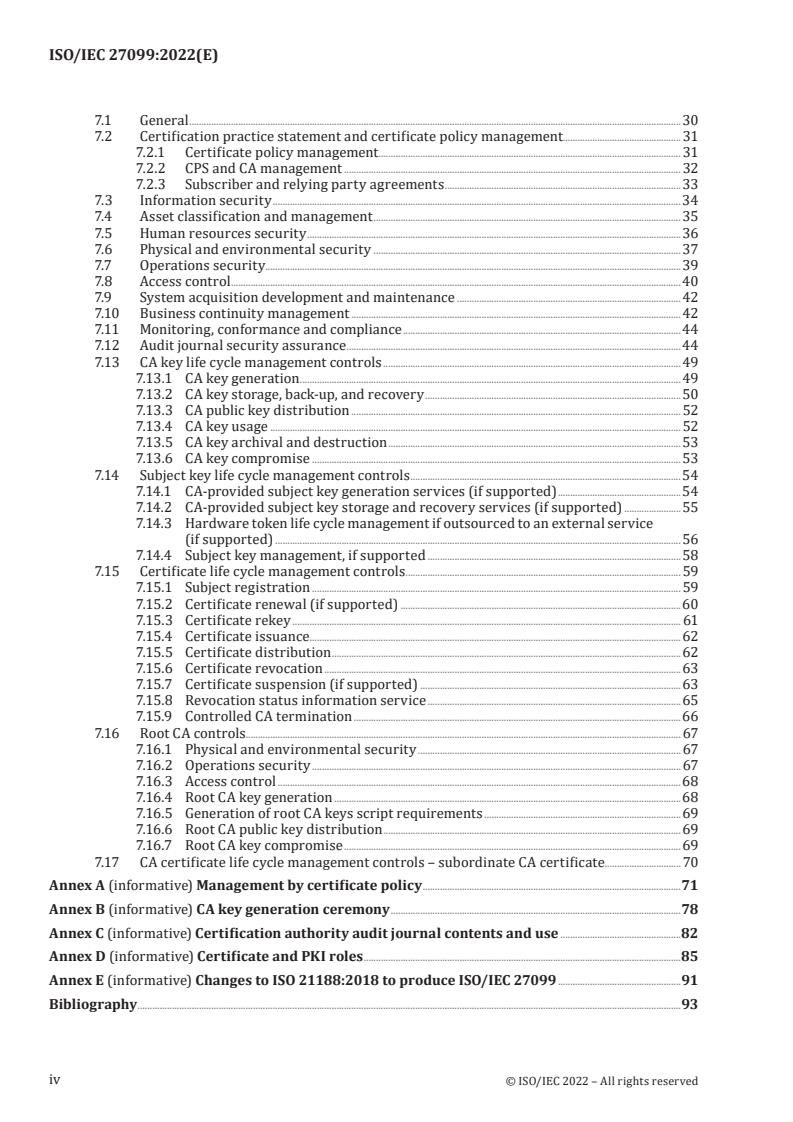
Contents Page
Foreword .v
Introduction . vi
1 Scope . 1
2 Normative references . 1
3 Terms and definitions . 1
4 Abbreviated terms . 8
5 Public key infrastructure (PKI) general concepts . 8
5.1 General . 8
5.2 What is PKI? . 9
5.2.1 General . 9
5.2.2 Public key infrastructure process flow . 10
5.3 Use of PKI Service components within example business flows . 10
5.3.1 General . 10
5.3.2 Illustration of certificate application in a contractual PKI environment . 10
5.4 Certification authority (CA) . 13
5.5 Business perspectives . 14
5.5.1 General . 14
5.5.2 Business risks . 14
5.5.3 Applicability . 14
5.5.4 Legal issues . 14
5.5.5 Regulatory issues. 14
5.5.6 Business usage issues . 15
5.5.7 Interoperability issues .15
5.6 Certificate policy (CP) . 16
5.6.1 General . 16
5.6.2 Policy Authority and certificate policy usage . 16
5.6.3 Certificate policies within a hierarchy of trust . 17
5.6.4 Certificate status . 18
5.7 Certification practice statement (CPS) . 19
5.7.1 General . 19
5.7.2 CPS creation . 19
5.7.3 Purpose . 19
5.7.4 Level of specificity . 19
5.7.5 Approach . 19
5.7.6 Audience and access . 20
5.8 Agreements . 20
5.9 Time-stamping . 20
5.10 Trust models . 21
5.10.1 Trust model considerations . 21
5.10.2 Wildcard certificate considerations . 24
5.10.3 Relying party considerations . 24
5.11 Component services . 25
5.12 PKI hierarchies and independently managed CAs . 27
5.13 Root CA . 27
5.13.1 General . 27
5.13.2 CA relationships and PKI hierarchies . 27
6 Certificate policy (CP), certification practice statement (CPS) and their relationship
to information security management system (ISMS) .28
6.1 General .28
6.2 Certificate policy (CP) guidance .28
6.3 Certification practice statement (CPS) guidance .30
7 Certification authority objectives and controls .30
iii
© ISO/IEC 2022 – All rights reserved
7.1 General .30
7.2 Certification practice statement and certificate policy management . . 31
7.2.1 Certificate policy management. 31
7.2.2 CPS and CA management . 32
7.2.3 Subscriber and relying party agreements . 33
7.3 Information security .34
7.4 Asset classification and management . 35
7.5 Human resources security .36
7.6 Physical and environmental security . 37
7.7 Operations security . .39
7.8 Access control .40
7.9 System acquisition development and maintenance . 42
7.10 Business continuity management . 42
7.11 Monitoring, conformance and compliance .44
7.12 Audit journal security assurance .44
7.13 CA key life cycle management controls .49
7.13.1 CA key generation .49
7.13.2 CA key storage, back-up, and recovery .50
7.13.3 CA public key distribution . 52
7.13.4 CA key usage . 52
7.13.5 CA key archival and destruction . 53
7.13.6 CA key compromise . 53
7.14 Subject key life cycle management controls .54
7.14.1 CA-provided subject key generation services (if supported) .54
7.14.2 CA-provided subject key storage and recovery services (if supported) .55
7.14.3 Hardware token life cycle management if outsourced to an external service
(if supported) .56
7.14.4 Subject key management, if supported .58
7.15 Certificate life cycle management controls . 59
7.15.1 Subject registration . 59
7.15.2 Certificate renewal (if supported) .60
7.15.3 Certificate rekey . 61
7.15.4 Certificate issuance. 62
7.15.5 Certificate distribution . 62
7.15.6 Certificate revocation .63
7.15.7 Certificate suspension (if supported) .63
7.15.8 Revocation status information service .65
7.15.9 Controlled CA termination .66
7.16 Root CA controls. 67
7.16.1 Physical and environmental security . 67
7.16.2 Operations security . 67
7.16.3 Access control .68
7.16.4 Root CA key generation .68
7.16.5 Generation of root CA keys script requirements .69
7.16.6 Root CA public key distribution . 69
7.16.7 Root CA key compromise . 69
7.17 CA certificate life cycle management controls – subordinate CA certificate. 70
Annex A (informative) Management by certificate policy .71
Annex B (informative) CA key generation ceremony .78
Annex C (informative) Certification authority audit journal contents and use .82
Annex D (informative) Certificate and PKI roles .85
Annex E (informative) Changes to ISO 21188:2018 to produce ISO/IEC 27099 .91
Bibliography .93
iv
© ISO/IEC 2022 – All rights reserved
Foreword
ISO (the International Organization for Standardization) and IEC (the International Electrotechnical
Commission) form the specialized system for worldwide standardization. National bodies that are
members of ISO or IEC participate in the development of International Standards through technical
committees established by the respective organization to deal with particular fields of technical
activity. ISO and IEC technical committees collaborate in fields of mutual interest. Other international
organizations, governmental and non-governmental, in liaison with ISO and IEC, also take part in the
work.
The procedures used to develop this document and those intended for its further maintenance are
described in the ISO/IEC Directives, Part 1. In particular, the different approval criteria needed for
the different types of document should be noted. This document was drafted in accordance with the
editorial rules of the ISO/IEC Directives, Part 2 (see www.iso.org/directives or www.iec.ch/members_
experts/refdocs).
Attention is drawn to the possibility that some of the elements of this document may be the subject
of patent rights. ISO and IEC shall not be held responsible for identifying any or all such patent
rights. Details of any patent rights identified during the development of the document will be in the
Introduction and/or on the ISO list of patent declarations received (see www.iso.org/patents) or the IEC
list of patent declarations received (see https://patents.iec.ch).
Any trade name used in this document is information given for the convenience of users and does not
constitute an endorsement.
For an explanation of the voluntary nature of standards, the meaning of ISO specific terms and
expressions related to conformity assessment, as well as information about ISO's adherence to the
World Trade Organization (WTO) principles in the Technical Barriers to Trade (TBT) see www.iso.org/
iso/foreword.html. In the IEC, see www.iec.ch/understanding-standards.
This document was prepared by Joint Technical Committee ISO/IEC JTC 1, Information technology,
Subcommittee SC 27, Information security, cybersecurity and privacy protection.
Any feedback or questions on this document should be directed to the user’s national standards body. A
complete listing of these bodies can be found at www.iso.org/members.html and www.iec.ch/national-
committees.
v
© ISO/IEC 2022 – All rights reserved
Introduction
The business objective of a public key infrastructure (PKI) is to establish and manage trust
relationships. The services provided by the PKI should maintain that trust and organizational and
technical security measures for an appropriate security level have to be defined and implemented for
all entities participating in a PKI.
Institutions and intermediaries are building infrastructures to provide new electronic transaction
capabilities for consumers, corporations, and government entities. As the volume of electronic
transactions continues to grow, advanced security technology using digital signatures and trust
services can become part of the transaction process. Transaction systems incorporating advanced
security technology have requirements to ensure the confidentiality, integrity and availability of
transactions conducted over communications networks.
Industry relies on several time-honoured methods of electronically identifying, authorizing, and
authenticating entities and protecting transactions. These methods include, but are not limited to,
personal identification numbers (PINs) and message authentication codes (MACs) for retail and
wholesale transactions, user IDs and passwords for network and computer access, and key management
for network connectivity. Over the past 30 years, industry has developed risk management processes
and policies to support the use of these technologies.
The ubiquitous use of online services in public networks and the needs of the industry in general to
provide safe, private, and reliable transaction and computing systems have given rise to advanced
security technology incorporating public key cryptography. Public key cryptography requires a
business-optimized infrastructure of technology, management, and policy (a public key infrastructure
or PKI, as defined in this document) to satisfy requirements of electronic identification, authentication,
message integrity protection and authorization in application systems. The use of standard practices
for electronic identification, authentication and authorization in a PKI ensures more consistent and
predictable security in these systems and confidence in electronic communications. Confidence (e.g.
trust) can be achieved when adherence to standard practices can be ascertained.
Applications serving industry can be developed with digital signature and PKI capabilities. The safety
and the soundness of these applications are based, in part, on implementations and practices designed to
ensure the overall integrity of the infrastructure. Users of authority-based systems that electronically
bind the identity of individuals and other entities to cryptographic materials (e.g. cryptographic keys)
benefit from standard risk management systems and the base of auditable practices defined in this
document.
This document provides a framework for managing a PKI through certificate policies, certification
practice statements, control objectives and supporting procedures. The degree to which any entity in
a transaction can rely on the implementation of public key infrastructure standards and the extent
of interoperability between PKI-based systems will depend partly on factors relative to policy and
practices defined in this document.
In some regions or countries there is a legislative framework which defines requirements for operation
of PKI and other related trust services to achieve a recognized level of trust for a specific purpose
commonly called “qualified”.
This document is derived from ISO 21188:2018, which content has been generalized in this document
to be applicable to any application domain and to take into account general standards for information
security. See Annex E for a description of major changes to ISO 21188:2018 clauses that have been made
in order to produce this document.
vi
© ISO/IEC 2022 – All rights reserved
INTERNATIONAL STANDARD ISO/IEC 27099:2022(E)
Information technology — Public key infrastructure —
Practices and policy framework
1 Scope
This document sets out a framework of requirements to manage information security for Public key
infrastructure (PKI) trust service providers through certificate policies, certificate practice statements,
and, where applicable, their internal underpinning by an information security management system
(ISMS). The framework of requirements includes the assessment and treatment of information security
risks, tailored to meet the agreed service requirements of its users as specified through the certificate
policy. This document is also intended to help trust service providers to support multiple certificate
policies.
This document addresses the life cycle of public key certificates that are used for digital signatures,
authentication, or key establishment for data encryption. It does not address authentication methods,
non-repudiation requirements, or key management protocols based on the use of public key certificates.
For the purposes of this document, the term “certificate” refers to public key certificates. This document
is not applicable to attribute certificates.
This document uses concepts and requirements of an ISMS as defined in the ISO/IEC 27000 family of
standards. It uses the code of practice for information security controls as defined in ISO/IEC 27002.
Specific PKI requirements (e.g. certificate content, identity proofing, certificate revocation handling)
[26]
are not addressed directly by an ISMS such as defined by ISO/IEC 27001 .
The use of an ISMS or equivalent is adapted to the application of PKI service requirements specified in
the certificate policy as described in this document.
A PKI trust service provider is a special class of trust service for the use of public key certificates.
This document draws a distinction between PKI systems used in closed, open and contractual
environments. This document is intended to facilitate the implementation of operational, baseline
controls and practices in a contractual environment. While the focus of this document is on the
contractual environment, application of this document to open or closed environments is not specifically
precluded.
2 Normative references
The following documents are referred to in the text in such a way that some or all of their content
constitutes requirements of this document. For dated references, only the edition cited applies. For
undated references, the latest edition of the referenced document (including any amendments) applies.
ISO/IEC 9594-8, Information technology — Open systems interconnection — Part 8: The Directory: Public-
key and attribute certificate frameworks
ISO/IEC 19790, Information technology — Security techniques — Security requirements for cryptographic
modules
3 Terms and definitions
For the purposes of this document, the following terms and definitions apply.
ISO and IEC maintain terminology databases for use in standardization at the following addresses:
— ISO Online browsing platform: available at https:// www .iso .org/ obp
© ISO/IEC 2022 – All rights reserved
— IEC Electropedia: available at https:// www .electropedia .org/
3.1
access point
point at which the user may connect to the network or facility
3.2
activation data
data values, other than keys, which are required to operate cryptographic modules
Note 1 to entry: These data values should be protected.
EXAMPLE A PIN, a pass phrase, a biometric or a manually held key share.
3.3
audit journal
audit log
chronological record of system activities which is sufficient to enable the reconstruction, review, and
examination of the sequence of environments and activities surrounding or leading to each event in the
path of a transaction from its inception to the output of the final results
3.4
authentication
provision of assurance that a claimed identity of an entity is correct
Note 1 to entry: It applies a) at registration, the act of evaluating an end entity’s (i.e. subscriber’s) identity and
verifying that it is correct for issuing of a certificate (3.7); b) during use, the act of comparing electronically
submitted identity and credentials.
EXAMPLE User ID and password with stored values to prove identity.
3.5
CA certificate
public key certificate whose subject is a CA (3.17) and whose associated private key can be used to sign
certificates or other CA related information
EXAMPLE CA related information includes revocation information, such as OCSP responses or CRLs.
3.6
card bureau
agent of the CA (3.17) or RA (3.44) that personalizes a secure cryptographic device (3.50) containing the
subscriber’s private key (as a minimum)
3.7
certificate
public key and identity of an entity, together with some other information, rendered unforgeable by
signing the certificate information with the private key of the certification authority.
3.8
certificate suspension
certificate hold
suspension of the validity of a certificate (3.7)
3.9
certificate issuer
organization whose name appears in the issuer field of a certificate (3.7)
3.10
certificate management
process that covers the complete lifecycle from the initialization phase to the issuing phase to the
cancellation phase
© ISO/IEC 2022 – All rights reserved
3.11
certificate manufacturer
CM
agent who performs the tasks of applying a digital signature to a certificate signing request on behalf of
the certificate issuer (3.9)
3.12
certificate policy
CP
named set of rules that indicates the applicability of a certificate to a particular community or class of
application with common security requirements
3.13
certificate profile
specification of the required format (including requirements for the usage of standard fields and
extensions) for a particular type of certificate (3.7)
3.14
certificate rekey
process whereby an entity with an existing key pair and certificate (3.7) receives a new certificate for a
new public key, following the generation of a new key pair
3.15
certificate renewal
rollover
process whereby an entity with an existing key pair and certificate (3.7) receives a new certificate for
the same public key as the existing certificate, and with a new validity period
3.16
certification
creation of a public key certificate for a subject (3.53)
3.17
certification authority
CA
issuing CA
entity (3.28) that is identified as the issuer of a public key certificate
3.18
certification path
ordered list of one or more certificates, starting with a public-key certificate signed by the trust anchor,
and ending with the public key certificate to be validated
EXAMPLE All intermediate public-key certificates, if any, are CA-certificates in which the subject of the
preceding certificate is the issuer of the following certificate.
3.19
certification practice statement
CPS
statement of the practices employed by a certification authority (3.17) in issuing, managing, revoking,
renewing, and rekeying certificates and which defines the equipment, policies, and procedures the CA
uses to satisfy the requirements specified in the certificate policies that are supported by it
3.20
certification request
submission of a validated registration request by an RA (3.44), its agent or a subject to a CA (3.17) to
register a subject's public key to be placed in a certificate (3.7)
© ISO/IEC 2022 – All rights reserved
3.21
certificate revocation status
status of a certificate, typically provided by a CA, that indicates whether a certificate within its validity
period should be considered live, suspended, or revoked
3.22
certificate validity
determination at a particular time as to whether that time was within a certificate's validity period,
was acceptable for the intended use, and possessed an acceptable certificate revocation status (3.21)
3.23
certificate validity period
bounded period of time that the certificate (3.7) is deemed fit for intended use
Note 1 to entry: Prior to this time, a certificate is pre-valid; following this time, a certificate is expired.
3.24
compromise
violation of the security of a system such that an unauthorized or unintended disclosure, modification,
or falsification of sensitive information may have occurred
3.25
cross certification
certification of each other’s public keys by two CAs (3.17)
Note 1 to entry: This process may or may not be automated.
3.26
digital signature
cryptographic transformation that, when associated with a data unit, provides the services of origin
authenticity, data integrity and signer non-repudiation
3.27
end entity
certificate subject that uses its private key for purposes other than signing certificates
3.28
entity
person, partnership, organization, or business that has a legal and separately identifiable existence
EXAMPLE A legal entity or an individual or end entity (3.27), or a certification authority (3.17), or registration
authority (3.44).
3.29
fingerprint
sequence of bytes created by applying a cryptographic hash function over the encoding of a certificate
(3.7) and may be used by the recipient to check the public key’s authenticity and integrity
3.30
hardware token
device which generates, uses, and stores cryptographic keys in a secure manner
3.31
key escrow
management function that allows access by an authorized party to a replicated private encipherment
key
3.32
key recovery
ability to restore an entity’s private key or a symmetric encipherment key from secure storage in the
event that such keys are lost, corrupted or otherwise become unavailable
© ISO/IEC 2022 – All rights reserved
3.33
multiple control
condition under which two (dual) or more parties separately and confidentially have custody of
components of a single key that, individually, convey no knowledge of the resultant cryptographic key
3.34
object identifier
OID
unique series of integers that unambiguously identifies an information object
3.35
online certificate status mechanism
mechanism that allows relying parties (3.46) to request and obtain certificate status information
without requiring the use of CRLs
3.36
online certificate status protocol
OCSP
protocol for determining the current status of a certificate (3.7) in lieu of or as a supplement to checking
against a periodic CRL and which specifies the data that need to be exchanged between an application
checking the status of a certificate and the server providing that status
3.37
PKI disclosure statement
document that supplements a CP (3.12) or CPS (3.19) by disclosing critical information about the policies
and practices of a CA (3.17)/PKI (3.42)
Note 1 to entry: A PKI disclosure statement is a vehicle for disclosing and emphasizing information normally
covered in detail by associated CP or CPS documents. Consequently, it is not intended to replace a CP or CPS.
3.38
PKI trust service provider
one or more certification authorities providing a trust service with coherent policies and practices.
3.39
policy authority
PA
party or body with final authority and responsibility for specifying certificate policies (3.12)
Note 1 to entry: The policy authority may also ensure that CA (3.17) practices and controls as defined by the CPS
(3.19) fully support the specified certificate policies
Note 2 to entry: A policy authority is often referred to as a policy management authority.
3.40
policy mapping
recognition that when a CA (3.17) in one domain certifies a CA in another domain, a particular
certificate policy (3.12) in the second domain can be considered by the authority of the first domain to
be equivalent (but not necessarily identical in all respects) to a particular certificate policy in the first
domain
Note 1 to entry: Policy mappings may be supported by information in cross-certificates.
3.41
policy qualifier
policy-dependent information that accompanies a certificate policy (3.12) identifier in an X,509 v3
certificate
© ISO/IEC 2022 – All rights reserved
3.42
public key infrastructure
PKI
structure of hardware, software, people, processes, and policies that employs digital signature
technology to facilitate a verifiable association between the public component of an asymmetric public
key pair with a specific subscriber that possesses the corresponding private key
Note 1 to entry: The public key may be provided for digital signature verification, authentication of the subject in
communication dialogues, or for message encryption key exchange or negotiation
3.43
PKI trust service provider
trust service provider
trusted provider of services which support the use of public key certificates
3.44
registration authority
RA
entity whose primary functional role and responsibilities include identity validation of the subject for
approving certificate requests (3.20) submitted to a CA (3.17)
Note 1 to entry: An RA can assist in the certificate application process, the revocation process or both. The RA
does not need to be a separate body, but can be part of the CA.
3.45
registration request
submission by an entity to an RA (3.44) (or CA (3.17)) to register the entity’s public key in a certificate
(3.7)
3.46
relying party
RP
recipient of a certificate (3.7) who acts in reliance on that certificate, digital signatures verified using
that certificate, or both
3.47
relying party agreement
RPA
statement provided by the CA (3.17) of the responsibilities between the relying party, the subject, and
the CA
Note 1 to entry: The RPA may be included in the CPS (3.19) or provided as one or more external documents.
3.48
repository
system for storage and distribution of certificates and related information
EXAMPLE Certificate storage, certificate distribution, certificate policy (3.12) storage and retrieval,
certificate status.
3.49
root CA
CA at the apex of a CA certificate hierarchy
Note 1 to entry: A root CA may be used as a trust anchor (3.58). Generally, the root CA certificate is self-signed, in
which the identity and public key in the certificate are the same as the identity of the certificate issuer (3.9) and
public key used to verify the certificate issuer's signature.
© ISO/IEC 2022 – All rights reserved
3.50
secure cryptographic device
device which holds the user's private key, protects this key against compromise and performs signing
or decryption functions on behalf of the user
[SOURCE: ETSI TR 119 001]
EXAMPLE Key generation, cryptogram creation, PIN translation, certificate signing and secure storage of
private keys.
3.51
signature validation
verification and confirmation that a digital signature is valid
Note 1 to entry: See also certificate validity period (3.23).
3.52
signature verification
check of the cryptographic value of a signature using data
3.53
subject
entity that controls the asymmetric key pair and may also be a relying party (3.46)
3.54
subordinate CA
sub-CA
intermediate CA
CA (3.17) that is lower relative to another CA in the CA hierarchy
3.55
subscriber
entity subscribing with a certification authority (3.17) on behalf of one or more subjects
Note 1 to entry: Where appropriate a subscriber may be represented by a natural person who is,
i) an employee of the subscriber, or
ii) an authorized agent of the subscriber
and who has express authority to represent the subscriber for specified purposes.
3.56
tamper-evident
evidence that an attack has been attempted
3.57
terms and conditions
collection of all documents issued by the CA which define the duties and rights of the PKI members
3.58
trust anchor
entity that is trusted by a relying party and used for validating certificates in certification paths
3.59
trusted role
job function that performs critical functions which, if performed unsatisfactorily, can have an adverse
impact upon the degree of trust provided by the CA (3.17)
3.60
trust service
electronic service which enhances trust and confidence in electronic transactions
© ISO/IEC 2022 – All rights reserved
3.61
validation service request
enquiry by the relying party (3.46) to a validation service to check the validity of a certificate (3.7)
4 Abbreviated terms
ASN.1 Abstract Syntax Notation One
CRL Certificate revocation list
CVSP Certificate validation service provider
FIPS Federal Information Processing Standard
FQDN Fully qualified domain name
FTP File transfer protocol
HSM Hardware security module
HTTP Hypertext transfer protocol
ID Identifier
IETF Internet Engineering Task Force
ISMS Information security management system
MAC Message authentication code
MITM Man-in-the-middle attack
OID Object identifier
PIN Personal identification number
PKI Public key infrastructure
RFC Request for comment
RTO Recovery time objective
SLA Service level agreement
TLS Transport layer security
TSA Time-stamping authority
URL Uniform resource locator
UTC Coordinated universal time (Zulu or Greenwich Mean Time, Time GMT)
5 Public key infrastructure (PKI) general concepts
5.1 General
This clause provides some background information in order to better understand the context in which
these policies and practices are used within a PKI.
© ISO/IEC 2022 – All rights reserved
5.2 What is PKI?
5.2.1 General
This subclause describes the components of a PKI and illustrates the roles with responsibilities
undertaken by the various entities within the PKI. The rapid growth of electronic commerce has
brought with it the desire to conduct business-to-business, business-to-consumer, and government-
to-consumer transactions across open networks such as the Internet. The design of the network
transmission protocols creates problems for organisations and their customers conducting business
transactions, who require the electronic identification and authentication of the transacting parties,
proof of origin, message integrity protection and confidentiality services. Electronic authentication also
raises significant issues with respect to evidence and contract, liability, privacy, consumer protection
and trade.
Relying parties, as recipients of information, use TSPs to validate certificates used to authenticate online
communications. A TSP can be an entity providing one or more trusted services, e.g. a certification
authority, a registration service, or a revocation st
...