


ISO 11952:2014
(Main)Surface chemical analysis — Scanning-probe microscopy — Determination of geometric quantities using SPM: Calibration of measuring systems
Surface chemical analysis — Scanning-probe microscopy — Determination of geometric quantities using SPM: Calibration of measuring systems
ISO 11952:2014 specifies methods for characterizing and calibrating the scan axes of scanning-probe microscopes for measuring geometric quantities at the highest level. It is applicable to those providing further calibrations and is not intended for general industry use, where a lower level of calibration might be required.
Analyse chimique des surfaces — Microscopie à sonde à balayage — Détermination des quantités géométriques en utilisant des microscopes à sonde à balayage: Étalonnage des systèmes de mesure
General Information
- Status
- Withdrawn
- Publication Date
- 11-May-2014
- Withdrawal Date
- 11-May-2014
- Technical Committee
- ISO/TC 201/SC 9 - Scanning probe microscopy
- Drafting Committee
- ISO/TC 201/SC 9 - Scanning probe microscopy
- Current Stage
- 9599 - Withdrawal of International Standard
- Start Date
- 21-May-2019
- Completion Date
- 14-Feb-2026
Relations
- Effective Date
- 11-Oct-2014

Get Certified
Connect with accredited certification bodies for this standard

ECOCERT
Organic and sustainability certification.

Eurofins Food Testing Global
Global leader in food, environment, and pharmaceutical product testing.

Intertek Bangladesh
Intertek certification and testing services in Bangladesh.
Sponsored listings
Frequently Asked Questions
ISO 11952:2014 is a standard published by the International Organization for Standardization (ISO). Its full title is "Surface chemical analysis — Scanning-probe microscopy — Determination of geometric quantities using SPM: Calibration of measuring systems". This standard covers: ISO 11952:2014 specifies methods for characterizing and calibrating the scan axes of scanning-probe microscopes for measuring geometric quantities at the highest level. It is applicable to those providing further calibrations and is not intended for general industry use, where a lower level of calibration might be required.
ISO 11952:2014 specifies methods for characterizing and calibrating the scan axes of scanning-probe microscopes for measuring geometric quantities at the highest level. It is applicable to those providing further calibrations and is not intended for general industry use, where a lower level of calibration might be required.
ISO 11952:2014 is classified under the following ICS (International Classification for Standards) categories: 71.040.40 - Chemical analysis. The ICS classification helps identify the subject area and facilitates finding related standards.
ISO 11952:2014 has the following relationships with other standards: It is inter standard links to ISO 11952:2019. Understanding these relationships helps ensure you are using the most current and applicable version of the standard.
ISO 11952:2014 is available in PDF format for immediate download after purchase. The document can be added to your cart and obtained through the secure checkout process. Digital delivery ensures instant access to the complete standard document.
Standards Content (Sample)
INTERNATIONAL ISO
STANDARD 11952
First edition
2014-05-15
Surface chemical analysis — Scanning-
probe microscopy — Determination
of geometric quantities using SPM:
Calibration of measuring systems
Analyse chimique des surfaces — Microscopie à sonde à balayage
— Détermination des quantités géométriques en utilisant des
microscopes à sonde à balayage: Étalonnage des systèmes de mesure
Reference number
©
ISO 2014
© ISO 2014
All rights reserved. Unless otherwise specified, no part of this publication may be reproduced or utilized otherwise in any form
or by any means, electronic or mechanical, including photocopying, or posting on the internet or an intranet, without prior
written permission. Permission can be requested from either ISO at the address below or ISO’s member body in the country of
the requester.
ISO copyright office
Case postale 56 • CH-1211 Geneva 20
Tel. + 41 22 749 01 11
Fax + 41 22 749 09 47
E-mail copyright@iso.org
Web www.iso.org
Published in Switzerland
ii © ISO 2014 – All rights reserved
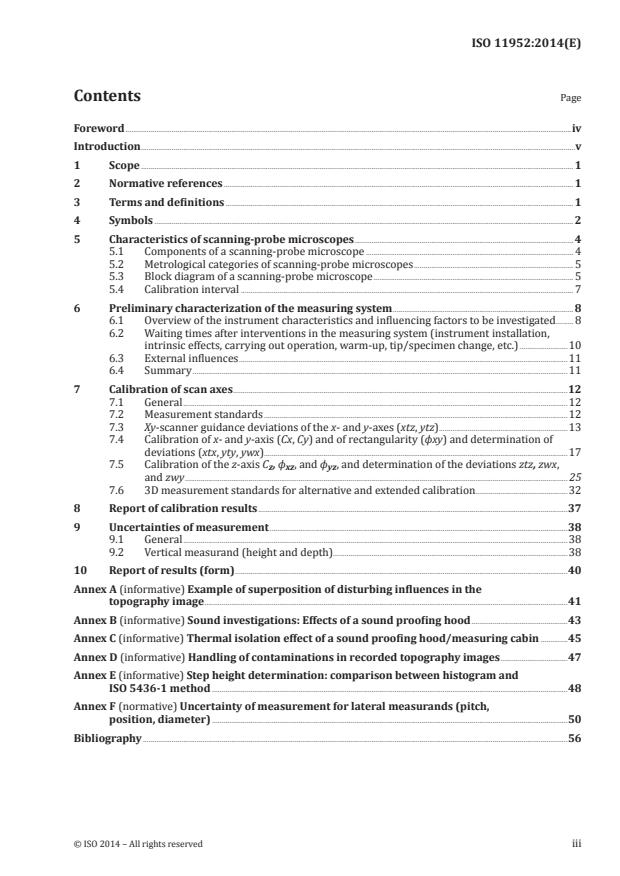
Contents Page
Foreword .iv
Introduction .v
1 Scope . 1
2 Normative references . 1
3 Terms and definitions . 1
4 Symbols . 2
5 Characteristics of scanning-probe microscopes . 4
5.1 Components of a scanning-probe microscope . 4
5.2 Metrological categories of scanning-probe microscopes . 5
5.3 Block diagram of a scanning-probe microscope . 5
5.4 Calibration interval . 7
6 Preliminary characterization of the measuring system . 8
6.1 Overview of the instrument characteristics and influencing factors to be investigated . 8
6.2 Waiting times after interventions in the measuring system (instrument installation,
intrinsic effects, carrying out operation, warm-up, tip/specimen change, etc.) .10
6.3 External influences .11
6.4 Summary .11
7 Calibration of scan axes .12
7.1 General .12
7.2 Measurement standards .12
7.3 Xy-scanner guidance deviations of the x- and y-axes (xtz, ytz) .13
7.4 Calibration of x- and y-axis (Cx, Cy) and of rectangularity (ϕxy) and determination of
deviations (xtx, yty, ywx).17
7.5 Calibration of the z-axis C , ϕ , and ϕ , and determination of the deviations ztz, zwx,
z xz yz
and zwy . 25
7.6 3D measurement standards for alternative and extended calibration .32
8 Report of calibration results .37
9 Uncertainties of measurement .38
9.1 General .38
9.2 Vertical measurand (height and depth).38
10 Report of results (form) .40
Annex A (informative) Example of superposition of disturbing influences in the
topography image .41
Annex B (informative) Sound investigations: Effects of a sound proofing hood .43
Annex C (informative) Thermal isolation effect of a sound proofing hood/measuring cabin .45
Annex D (informative) Handling of contaminations in recorded topography images .47
Annex E (informative) Step height determination: comparison between histogram and
ISO 5436-1 method .48
Annex F (normative) Uncertainty of measurement for lateral measurands (pitch,
position, diameter) .50
Bibliography .56
Foreword
ISO (the International Organization for Standardization) is a worldwide federation of national standards
bodies (ISO member bodies). The work of preparing International Standards is normally carried out
through ISO technical committees. Each member body interested in a subject for which a technical
committee has been established has the right to be represented on that committee. International
organizations, governmental and non-governmental, in liaison with ISO, also take part in the work.
ISO collaborates closely with the International Electrotechnical Commission (IEC) on all matters of
electrotechnical standardization.
The procedures used to develop this document and those intended for its further maintenance are
described in the ISO/IEC Directives, Part 1. In particular the different approval criteria needed for the
different types of ISO documents should be noted. This document was drafted in accordance with the
editorial rules of the ISO/IEC Directives, Part 2 (see www.iso.org/directives).
Attention is drawn to the possibility that some of the elements of this document may be the subject of
patent rights. ISO shall not be held responsible for identifying any or all such patent rights. Details of
any patent rights identified during the development of the document will be in the Introduction and/or
on the ISO list of patent declarations received (see www.iso.org/patents).
Any trade name used in this document is information given for the convenience of users and does not
constitute an endorsement.
For an explanation on the meaning of ISO specific terms and expressions related to conformity
assessment, as well as information about ISO’s adherence to the WTO principles in the Technical Barriers
to Trade (TBT) see the following URL: Foreword - Supplementary information
The committee responsible for this document is ISO/TC 201, Surface chemical analysis, Subcommittee
SC 9, Scanning probe microscopy.
iv © ISO 2014 – All rights reserved
Introduction
The progress of miniaturization in semiconductor structuring, together with the rapid advance of
many diverse applications of nanotechnology in industrial processes, calls for reliable and comparable
[9]
quantitative dimensional measurements in the micro- and submicrometre range. Currently, a
measurement resolution, in or below the nanometre region, is frequently required. Conventional optical
or stylus measurement methods or coordinate measuring systems are not able to offer this level of
resolution.
For this reason, scanning-probe microscopes (SPMs) are increasingly employed as quantitative
measuring instruments. Their use is no longer confined only to research and development, but has also
been extended to include industrial production and inspection.
For this category of measuring instrument, standardized calibration procedures need to be developed,
for example, as have been established already long ago for contact stylus instruments (see ISO 12179).
For efficient and reliable calibration of SPMs to be carried out, the properties of the measurement
standards used need to be documented and be accounted for in the calibration (see Figure 1) and, at the
same time, the procedure for the calibration should be clearly defined.
Only if this prerequisite is satisfied, will it be possible to perform traceable measurements of geometrical
quantities.
Figure 1 — Traceability chain for scanning-probe microscopes
NOTE The calibration of a user’s SPM by means of traceably calibrated measurement standards is the
object of this International Standard (done by the user).
A scanning-probe microscope is a serially operating measuring device which uses a probe with a tip of
adequate fineness to trace the surface of the object to be measured by exploitation of a local physical
interaction (such as the quantum-mechanical tunnel effect, interatomic or intermolecular forces, or
evanescent modes of the electromagnetic field). The probe and the object to be measured are being
displaced in relation to one another in a plane (hereinafter referred to as the x-y-plane) according to a
[10]
while the signal of the interaction is recorded and can be used to control the distance
defined pattern,
between probe and object. In this International Standard, signals are considered which are used for the
determination of the topography (hereinafter called the “z-signal”).
This International Standard covers the verification of the device characteristics necessary for the
[11]
measurement of geometrical measurands and the calibration of the axes of motion (x, y, z), i.e. the
traceability to the unit of length via measurement on traceable lateral, step height, and 3D measurement
standards (see Figure 2).
While this International Standard aims at axis calibrations at the highest level and is thereby intended
primarily for high-stability SPMs, a lower level of calibration might be required for general industry use.
Key
1 measurement standards for verification purposes
1a flatness
1b probe shape
2 measurement standards for calibration purposes
2a 1D and 2D lateral
2b step height
3 calibration of the measurement standards by reference instruments (certified calibration, measurement
value including uncertainty)
Figure 2 — Verification and calibration of scanning-probe microscopes with test specimens and
measurement standards
This International Standard is mainly based on the guideline VDI/VDE 2656, Part 1, drafted by a
guideline committee of the VDI (Verein Deutscher Ingenieure/Association of German Engineers) in the
years 2004 to 2008, with the final whiteprint of that guideline being released in June 2008.
vi © ISO 2014 – All rights reserved
INTERNATIONAL STANDARD ISO 11952:2014(E)
Surface chemical analysis — Scanning-probe microscopy
— Determination of geometric quantities using SPM:
Calibration of measuring systems
1 Scope
This International Standard specifies methods for characterizing and calibrating the scan axes of
scanning-probe microscopes for measuring geometric quantities at the highest level. It is applicable to
those providing further calibrations and is not intended for general industry use, where a lower level of
calibration might be required.
This International Standard has the following objectives:
— to increase the comparability of measurements of geometrical quantities made using scanning-
probe microscopes by traceability to the unit of length;
— to define the minimum requirements for the calibration process and the conditions of acceptance;
— to ascertain the instrument’s ability to be calibrated (assignment of a “calibrate-ability” category to
the instrument);
— to define the scope of the calibration (conditions of measurement and environments, ranges of
measurement, temporal stability, transferability);
— to provide a model, in accordance with ISO/IEC Guide 98-3, to calculate the uncertainty for simple
geometrical quantities in measurements using a scanning-probe microscope;
— to define the requirements for reporting results.
2 Normative references
The following documents, in whole or in part, are normatively referenced in this document and are
indispensable for its application. For dated references, only the edition cited applies. For undated
references, the latest edition of the referenced document (including any amendments) applies.
ISO 11039, Surface chemical analysis — Scanning-probe microscopy — Measurement of drift rate
ISO 18115-2, Surface chemical analysis — Vocabulary — Part 2: Terms used in scanning-probe microscopy
IEC/TS 62622, Artificial gratings used in nanotechnology — Description and measurement of dimensional
quality parameters
ISO/IEC Guide 98-3, Uncertainty of measurement — Part 3: Guide to the expression of uncertainty in
measurement (GUM:1995)
3 Terms and definitions
For the purposes of this document, the terms and definitions given in ISO 18115-2 and IEC/TS 62622
and the following apply.
3.1
scanner bow
additional deflection in the z-direction when the scanner is displaced in the x-y-direction
Note 1 to entry: Scanner bow is also known as out-of-plane motion (see also xtz, ytz in Clause 4).
3.2
look-up table
table in which a set of correction factors for the scanner are filed for different modes of operation (scan
ranges, scan speeds, deflections, etc.)
3.3
step height
height of an elevation (bar) or depth of a groove (ISO 5436-1), in atomic surfaces, the distance between
neighbouring crystalline planes
3.4
levelling
correction of the inclination between the ideal x-y-specimen plane and the x-y-scanning plane
4 Symbols
x, y, z position value related to the respective axis
C , C , C calibration factors for the x-, y-, and z-axes
x y z
h step height
w width of a structure of the specimen
th
N i pitch value in a profile used for the determination of the pitch/period (number of pitch values i
j
over all lines j = 1,., Nj)
p pitch or period in the x-direction
x
p pitch or period in the y-direction
y
a vector in the x-direction of a grating (not to be confused with p )
x x
a vector in the y-direction of a grating (not to be confused with p )
y y
γ non-orthogonality of 2D gratings
xy
P-V peak-to-valley value
r radius
Rq (Sq) root mean square deviation of the assessed roughness profile (Rq) or of the assessed area (Sq)
T temperature
α thermal expansion coefficient
m
T temperature of the air
L
T temperature of the specimen during measurement
m
j angle of rotation about the x-axis
x
j angle of rotation about the y-axis
y
j angle of rotation about the z-axis
z
θ levelling angle
x value of the measurement standard for shift in the x-direction
L
x shift in the x-direction measured with the x-displacement transducer
m
2 © ISO 2014 – All rights reserved
xtx positional deviation Δx measured along an x-coordinate line
xty straightness deviation Δy measured along an x-coordinate line
xtz straightness deviation Δz measured along an x-coordinate line
xrx rotational deviation j measured along an x-coordinate line
x
xry rotational deviation j measured along an x-coordinate line
y
xrz rotational deviation j measured along an x-coordinate line
z
xwy measured rectangularity deviation in the coordinate plane x-y
xwz measured rectangularity deviation in the coordinate plane x-z
y value of the measurement standard for displacement in the y-direction
L
y displacement measured with the y-displacement transducer in the y-direction
m
ytx positional deviation Δx measured along a y-coordinate line
yty straightness deviation Δy measured along a y-coordinate line
ytz straightness deviation Δz measured along a y-coordinate line
yrx rotational deviation j measured along a y-coordinate line
x
yry rotational deviation j measured along a y-coordinate line
y
yrz rotational deviation j measured along a y-coordinate line
z
ywz rectangularity deviation measured in the coordinate plane y-z
z value of the measurement standard for displacement in the z-direction
L
z displacement in the z-direction measured with z-displacement transducer
m
ztx straightness deviation Δx measured along a z-coordinate line
zty straightness deviation Δy measured along a z-coordinate line
ztz straightness deviation Δz measured along a z-coordinate line
zrx rotational deviation j measured along a z-coordinate line
x
zry rotational deviation j measured along a z-coordinate line
y
zrz rotational deviation j measured along a z-coordinate line
z
cos(φ ) rotational correction, e.g. in pitch measurement
i
cos(θ ) tilt-related correction, e.g. in pitch measurement
i
λ short-wavelength filter (see ISO 4287 for details)
s
λ long-wavelength filter (see ISO 4287 for details)
c
Λ correlation length
ϕ angle between the x- and y-direction, counterclockwise
xy
ϕ angle between the x- and z-direction, counterclockwise
xz
ϕ angle between the y- and z-direction, counterclockwise
yz
Rqx noise in the x-direction
Rqy noise in the y-direction
Rqz (Sqz) noise in the z-direction in a measured profile (or within a measured area)
v scan speed (i.e. distance travelled by the probe tip per unit time, not to be confused with the scan
rate, i.e. the number of scanlines recorded per unit time)
5 Characteristics of scanning-probe microscopes
5.1 Components of a scanning-probe microscope
Key
1 x-y-scanner
2 z-scanner
3 position detector
4 probe
5 specimen
6 coarse z-approach, i.e. move the probe or the specimen in the vertical direction to bring it close enough to the
specimen or probe, respectively (afterwards, start automatically approach techniques).
7 coarse x-y-positioning, i.e. move the specimen or probe laterally close to or into the region of interest on the
specimen, respectively
Figure 3 — Schematic sketch of a scanning-probe microscope
4 © ISO 2014 – All rights reserved
Several components shown in Figure 3 are defined in ISO 18115-2. In this International Standard, they
fulfil the following functions.
— Probe: equipped with a tip at its apex. This probes the specimen surface, exploiting a local physical
interaction whose changes can be detected, e.g. as cantilever bending in the case of an atomic force
microscope.
— Position detector: Transformation of the probe’s interaction response (e.g. bending or oscillation of
the cantilever) into an electrical signal.
— z-scanner: Element for the realisation of the vertical tracking of the specimen/probe distance during
x-y-scanning to a constant value of the physical interaction used for distance control (e.g. of the
action of force on the probe in the case of an atomic force microscope), to ensure an approximately
constant distance between specimen and probe.
— x-y-scanner: Element for realisation of the lateral displacement of the probe (or of the specimen) in
the x-y-plane (the plane parallel to the seating face of the specimen), which is used, among other
things, to record a location-dependent interaction signal that contains information about a local
property of the specimen (above all, the local height).
— Specimen holder: where appropriate, with coarse positioning and coarse approach mechanics.
— Casing/mounting: Structure for mounting the scanner and specimen.
5.2 Metrological categories of scanning-probe microscopes
SPMs can generally be subdivided into the three following categories, depending on their metrological
equipment:
— category A: Reference instruments with integrated laser interferometers, allowing direct
1)
traceability, via the wavelength of the laser used, to the SI unit of length.
— category B: SPMs with position measurement using displacement transducers, e.g. capacitive/inductive
sensors, strain gauges or encoders calibrated by temporarily connecting laser interferometers to
the instrument or by making measurements on high-quality measurement standards. A distinction
is made between the following two types:
— those with active position control: tracking to a scheduled position by means of a closed loop
(so-called closed-loop configuration);
— those with position measurement but without a closed loop for position control (so-called open-
loop configuration).
— category C: SPMs in which the position is determined from the electrical voltage applied to the
adjustment elements and, if need be, corrected using the look-up table. Calibration is against
measurement standards.
These definitions of metrological categories imply that it is not possible for certain instruments to
be assigned to a single category, but that, with respect to their scan axes, they need to be considered
separately.
5.3 Block diagram of a scanning-probe microscope
The block diagram shown in Figure 4 has been obtained from the schematic diagram of an SPM in
Figure 3. The characteristics of the essential components are given below and need to be investigated
individually in the course of verification and calibration.
1) Instruments of this category are often referred to as “metrological SPMs”, although the definition of a
“metrological SPM” in ISO 18115-2:2010/Amd.1 (to be published) does not necessarily imply laser-interferometric
position control.
For category C:
— casing/mounting (mechanical, acoustic, electromagnetic, and thermal characteristics);
— specimen holder, where appropriate with coarse positioning and coarse approach mechanics
(acoustic, mechanical, and thermal characteristics);
— z-scanner;
— x-y-scanner;
— detector loop, e.g. using the beam deflection method, with a beam on the rear side of the cantilever in
the case of an atomic force microscope and detection of the reflected beam from the rear side of the
cantilever with a position-sensitive photodiode. The signal of the position-dependent photodiode
serves as input to the feedback loop of the z-scanner in order to keep the set-point constant;
— probe.
Additionally, for category B:
— category B2: x-, y-, and/or z-displacement transducer, e.g. encoder, capacitive, or inductive
displacement transducer or strain gauge;
— category B1: where appropriate, active (closed-loop) position control.
Additionally, for category A:
Traceability by integrated laser interferometers, i.e. systems as for category B, but equipped with
— integrated laser interferometers for position measurement/control and
— where appropriate, additionally provided with angle sensors.
6 © ISO 2014 – All rights reserved
z(x,y)
internal device
signature
control and
data recording
x, y-position z-measurement
value
x, y control loop z control circuit z-position sensor
x, y position sensors position detector
x, y-scanner
probe z-scanner
z
y
x
measurement object
x, y-block z-block
Figure 4 — Block diagram of a scanning-probe microscope
The classification above is a first rough estimation of the effort necessary to achieve the desired
accuracy of calibration. It is not necessary, for example, to purchase a set of measurement standards
with minimum uncertainties of measurement for the calibration of category C instruments. Less
sophisticated measurement standards are usually sufficient here.
5.4 Calibration interval
The interval at which the instrument will need to be calibrated depends on the type of instrument
(i.e. the metrological category), its stability, especially with respect to time, the intended purpose of
the measurements and the constancy of the ambient conditions. As most calibrations are of a complex
nature, and thus, are labour- and time-intensive, a compromise needs to be found between the cost of
calibration and the measurement uncertainty which can be tolerated.
Generally, the following repetition patterns for calibrations (K) and measurements (M) are suitable.
KMM …, KMM . for instruments of high stability in the medium term: calibration is necessary only at defined
intervals of time, e.g. once weekly/monthly/yearly.
KM, KM, KM … for instruments with acceptable short-term but bad long-term stability: calibration is neces-
sary before each measurement.
KMK, KMK . when the maximum precision of the instrument is to be used for measurements with as
small an uncertainty of measurement as possible or for instruments which are unstable
with time and therefore require the drift in their characteristics to be taken into account as
far as possible.
Especially after putting into operation an SPM which is new or has been modified or relocated, it is
advisable in the initial phase to repeat a defined calibration pattern several times in order to gain
experience with the stability of the instrument.
6 Preliminary characterization of the measuring system
6.1 Overview of the instrument characteristics and influencing factors to be investigat-
ed
In order to define a calibration schedule for a particular SPM, three groups of influencing factors need
to be investigated in detail (see Figure 5): the instrument’s characteristics (as described above), the
ambient conditions, and the effects of operation by the user.
These investigations should be carried out in the following order, prior to the calibration process proper:
a) investigation of the waiting time after putting the instrument into operation (warm-up, initial drift,
etc.) (see 6.2);
b) investigation of the waiting time after changing the specimen or probe or other interventions before
sufficiently stable conditions of measurement are reached (see 6.2);
c) the influence of the ambient conditions, producing a temporary drift and/or changes in temperature,
air humidity, air flow, mechanical, and acoustic vibrations, electromagnetic interference, etc.
(see 6.3);
d) the noise of the instrument (see 6.3 and also Table 1);
e) xy-scanner/z-scanner-guidance deviations (cross-talk from one scan axis to other axes, which can,
at times, be detectable only by repeated measurements) (see 7.3);
f) long-term stability (reproducibility) (see 5.4).
These investigations can be carried out as qualitative and/or as quantitative tests. For qualitative tests,
specimens with the desired properties (e.g. silicon wafers, glass plates) are sufficient, whereas for
quantitative tests calibrated measurement standards are required for precise work. This is described
in Clause 7.
The investigations described below should be performed with probes which are usually used for
measurements with the instrument in question and on the specimens to be examined. Ageing of the
[44-47]
probe tips can be identified with the aid of suitable tests. Tips showing excessive wear should not
be used.
The first step should be aimed at separating the various influences, e.g. by cutting out external influences
and allowing them back in (to the extent possible), and then successively varying the operator-related
settings.
8 © ISO 2014 – All rights reserved
Key
1 intrinsic influences 2d temperature changes
1a probe-guidance deviations 3 operator-related settings
1b signal drift 3a parameter settings for the feedback loop, i.e. proportional
1c mechanical stress (P) and integral (I) gain
1d electronic noise 3b scan range
2 extrinsic influences 3c scan speed/scan rate
2a mechanical vibration 3d forward/backward scan
2b acoustic vibration 3e features of probe and specimen
2c electrical noise
Figure 5 — The three groups of factors influencing the measurement process
Table 1 — Influence of ambient conditions and noise of the instrument
Characteristics Specimen and method of investigation Subclause
Flatness measurement standard or specimen with known flat
regions
Vertical (Rq or Sq < 2 nm, P-V < 10 nm) 6.2
Variation of ambient conditions, opening of chamber, switching on/
Drift
off of instrument components, etc.
Specimen with straight edges or lines of small step height, aligned
6.2
Lateral parallel or vertical to the scan direction
7.5
2D grating of small step height.
After stabilization of the instrument
Static:
measurement of flatness measurement standards with x-y-move-
without
ments switched off. In addition, variation of ambient conditions, i.e.
movement in
mechanical damping, acoustic oscillations, electromagnetic shield-
x or y
z-Noise
ing.
Dynamic: After stabilization of the instrument
scanning in x fast recording of two or more scan lines. The difference between
or y the lines provides information about dynamic noise components.
The separation of the contributions is the basis for the introduction of suitable optimization procedures,
the use of correction procedures(if these two are not feasible) or adequate inclusion in the uncertainty
[14][16][17]
budget. Table 1 can serve to make a distinction between temporary drift and permanent
guidance deviations as well as between different contributions to the noise (see also example in Annex A).
6.2 Waiting times after interventions in the measuring system (instrument installation,
intrinsic effects, carrying out operation, warm-up, tip/specimen change, etc.)
6.2.1 Adjustment of the instrument to ambient conditions
The waiting times investigated in this subclause relate to an instrument which has already adjusted to
its ambient conditions. After rearrangement and installation of the instrument or relocation to another
room, about 24 h are typically to be allowed for acclimatization.
6.2.2 Potential causes of drift
During the warm-up phase after switching-on the instrument, or after interventions such as changing
or repositioning the probe/tip and specimen, the following effects might influence the measurements:
— piezo drift or piezo creep in the lateral/vertical direction;
— mechanical stresses, e.g. acting on the specimen holder and its mounting (e.g. adhesive);
— mechanical expansion of the components (casing, measurement circle);
— changes in the properties of the electronics.
As drift usually disappears after some time, the required waiting time is to be determined. For the
electronics, a warm-up period of at least 30 min is to be reckoned with. For the other drift contributions,
however, no generally valid decay times can be given, as they depend on the particular type of instrument.
6.2.3 Procedure
Follow the procedure for drift determination as specified in ISO 11039.
10 © ISO 2014 – All rights reserved
6.3 External influences
6.3.1 Kinds of external influence
As SPMs are most sensitive to interference from the environment, the following influence quantities are
to be accounted for:
— variations of temperature and air humidity;
— air motion (e.g. air-conditioning, air circulation, draughts, exhaust heat);
— dust;
— mechanical vibrations (e.g. structural vibrations, foot fall sounds/human traffic, pumps);
— acoustic disturbances (e.g. impact sound, ambient noise);
— electrical and electromagnetic sources of interference;
— presence of staff.
These external influences can produce drifts (see 6.2), noise (see Table 1), and systematic errors.
6.3.2 Consequences of external influences and countermeasures
In the presence of mechanical and acoustic vibrations in particular, it often is sufficient to take relatively
simple countermeasures (avoidance of sound, vibration damping, sound-proofing hood or the like, see
Annex C). Air currents and dust can be prevented by suitable encapsulation. Electrical interferences can,
if necessary, be compensated for by appropriate measures (e.g. net filters, avoidance of ground loops).
Some external effects, such as errors due to electromagnetic disturbances, are, however, observed only
in the measurements; their cause or source can then sometimes be identified or remedied, but only at
great expense.
Countermeasures sometimes require careful consideration since they can also produce undesired
[16]
effects. For example, sound-proofing hoods often have the disadvantage that they have a high thermal
insulation effect (see example in Annex C). Consequently, heat sources (especially conventional lamps)
should preferably be arranged outside the casing as far as possible; active vibration damping stages
with external power supply and controllers should be used. As SPMs usually also have some remaining
heat sources directly in or on the instrument, the temperature inside such casings will increase.
6.4 Summary
After completion of these preliminary investigations, the results should be included in a set of working
instructions. These are, in detail:
a) For measurement
— instructions concerning the waiting times after the instrument is switched on
— the procedure for specimen or probe change, repositioning and other modifications, and resulting
waiting times
— statements on the performance of prescans (prescan times) intended to contribute to the stabilization
of the instrument for the measurement proper
— the procedure in the case of deviations from the conventional conditions of measurement
b) For installation or familiarization of the staff
— the type of vibration damping/sound-proofing to be used
— the type of electromagnetic shielding to be used
— the ambient conditions to be observed (temperature/humidity range)
— the rules of conduct for the staff
These working instructions thus lay down the range of validity of the subsequent calibrations.
7 Calibration of scan axes
7.1 General
Calibration should be carried out using certified measurement standards. The results of the preliminary
investigations in Clause 6 should be taken into account when selecting the measurement standards best
suited for the instrument in question in view of the measurement tasks to be performed.
These preliminary considerations also need to take account of the evaluation methods which will actually
be available. The software supplied with the SPM normally differs significantly from manufacturer to
manufacturer. The user is encouraged to use certified or at least validated software as far as possible, and
to check any other software if it is applicable for the envisaged purpose. On the one hand, the procedures
offered are in most cases inappropriately documented and, on the other hand, standardized procedures
are usually not available, e.g. step height measurement in accordance with ISO 5436-1. This is why, in
the following subclauses, reasonable alternatives are presented, if available, and their advantages and
disadvantages discussed.
In most cases, different measurement standards are used for the individual calibration steps (see 7.3
to 7.5 and Table 2); alternatively, or additionally, 3D measurement standards can be used which, with
suitable evaluation software, allow the calibration factors C , C , and C and the cross-talk between all
x y z
three axes to be determined simultaneously (see 7.6 and Table 2).
NOTE A total of 21 deviations (or degrees of freedom) can be identified for the motion process of the SPM
[39]
in analogy to coordinate-measuring machines. Complete separation and individual characterization is not
possible with standard SPM equipment and tools available to the typical user, and often not practical. This
International Standard therefore focuses on the calibration of the axis scales and cross-talk between the axes. It
thereby takes the effects of many of the deviations into account, together with the instrument characterization in
Clause 6.
2)
7.2 Measurement standards
7.2.1 Requirements for measurement standards
This subclause only gives general information about measurement standards; detailed statements on
the requirements are contained in 7.3 to 7.6.
The properties of the measurement standards shall be documented and be accounted for in the
calibration. For instance, the properties of grating standards that are usually used as lateral standards
for SPM need to be documented following IEC/TS 62622. Important properties are
— the provision of a defined reference marking or reference field (e.g. in the form of a suitable mark
or suitable coordinates) within which the measurements are to be carried out, or the provision of a
larger field which is documented to be of sufficient homogeneity so that the measurements can be
carried out at any point within this field,
— identification (manufacturer, kind of measurement standard, nominal or reference values, serial
number),
2) The products mentioned in this subclause are examples of suitable products available commercially. This
information is given for the convenience of users of this International Standard and does not constitute an
endorsement by ISO of these products, nor are they necessarily the best products available for the purpose in
question.
12 © ISO 2014 – All rights reserved
— documented calibration values, including their uncertainty and how they are traced back to the SI
unit of length, the metre, the measurement position, and the date and time of calibration, and
— an explicit statement of any regions with irregularities, scratches, contamination, etc., within the
reference field.
[23][24][26][32]
Suitable sets of measurement standards are available from various manufacturers.
Table 2 — Overview of guidance deviations of xy-scanner or z-scanner, measurement standards
to be used and calibration measurements
Measurement standard/ Calibration:
Objective/measurement of Subclause
requirement measurement procedure
Cross-talk from the lateral move- Flatness measurement Out-of-plane movement of x-y- 7.3
ments to the z-axis xtz, ytz standard scan system
Rectangularity deviation ywx 2D measurement standard Angle formed by the two axes, on 7.4, 7.6
orthogonal structures
Rectangularity deviation 3D measurement standard 7.6
zwx, zwy
Calibration of the x- and y-axis C 1D or 2D lateral measure- Pitch, rotation, linearity, and 7.4, 7.6
x
and C , followed by determination ment standard distortions
y
of deviations xtx, yty (non-lineari-
ties)
Cross-talk from the lateral axes 2D lateral measurement Pitch, rotation, linearity
xty, ytx standard
Calibration of the z-axis C fol- Set of step height measure- Step height, linearity 7.5, 7.6
z,
lowed by determination of devia- ment standards
tions ztz (non-linearities)
7.2.2 Handling of measurement standards
Like all sensitive specimens, measurement standards shall be stored and handled with care and very
carefully protected from dust. Storage and handling of such objects should therefore always be dealt
with in the user training. Avoidance of contamination shall be given preference over cleaning which
would otherwise be required. If cleaning is nevertheless unavoidable, the relevant instructions of the
manufacturer are to be observed. As a rule, contamination with nanoscopic particles is hard to remove
without residues being left, and this might affect the function of the measurement standard. Should the
surface undergo change due to cleaning, the measurement standard needs to be recalibrated.
It is further to be borne in mind that the user might also alter the quality of the measurement standard
during assembly and mounting, possibly without being aware of it. For instance, when bonding or
clamping measurement standards in place, it is therefore to be ensured that the mechanical stress in
the measurement standard is kept as small as possible so as to prevent the measurement standard from
bending.
7.3 Xy-scanner guidance deviations of the x- and y-axes (xtz, ytz)
7.3.1 Definition of xy-scanner guidance deviations in vertical direction (z-plane)
Guidance deviations of the xy-scanner will in the following be understood as long-wave deviations (i.e.
greater than 1/5 of the maximum scan range) from an ideal plane.
7.3.2 Measurement strategy
Figure 6 shows the measurement strategy for the determination of the out-of-plane deviations xtz and
ytz. This flow diagram can be divided into three sections. The left-hand column gives the basis for the
procedure, the centre column the sequence of measurements, their analysis and the values determined.
The right-hand column gives information about the prerequisites for the measurement standard, for the
measurements, for the analysis and lists the consequences to be drawn.
Figure 6 — Flow diagram for carrying out a flatness calibration in accordance with Reference
[35]
7.3.3 Flatness measurement standards
Figure 7 shows an example of a flatness measurement standard for scanning-probe microscopy. The
four big arrows (left) are visible to the naked eye and help to coarse-position the measurement standard
in the instrument. The inner area (right) sho
...
Questions, Comments and Discussion
Ask us and Technical Secretary will try to provide an answer. You can facilitate discussion about the standard in here.
Loading comments...