


ISO 10553:2018
(Main)Horology — Procedure for evaluating the accuracy of quartz watches
Horology — Procedure for evaluating the accuracy of quartz watches
This document specifies the procedure for evaluating the accuracy of quartz watches, individually and by lots (see Annex A which presents the methods for statistical evaluation of accuracy by lot), and the relationship between the accuracy tested and the accuracy classification given by the manufacturer. It applies to quartz watches having accompanying documents on which the accuracy classification is indicated.
Horlogerie — Procédure d'évaluation de la précision des montres à quartz
Le présent document spécifie la procédure d'évaluation de la précision des montres à quartz, individuellement ou par lots (voir l'Annexe A qui spécifie les méthodes d'évaluation statistique de la précision par lot), et la relation entre la précision soumise à essai et la classe de précision indiquée par le fabricant. Il s'applique aux montres à quartz dont la classe de précision est indiquée sur les documents d'accompagnement.
General Information
- Status
- Published
- Publication Date
- 14-Nov-2018
- Technical Committee
- ISO/TC 114/SC 11 - Indication of accuracy
- Drafting Committee
- ISO/TC 114/SC 11 - Indication of accuracy
- Current Stage
- 9093 - International Standard confirmed
- Start Date
- 21-Aug-2024
- Completion Date
- 14-Feb-2026
Relations
- Effective Date
- 04-Nov-2015
Overview
ISO 10553:2018 - Horology - Procedure for evaluating the accuracy of quartz watches defines a standardized test and calculation framework for measuring and reporting the timekeeping accuracy of quartz wristwatches. The standard covers individual watch testing and lot (batch) evaluation, the influence of ageing and seasonal temperature variation, and the relationship between measured accuracy and the accuracy classification declared by the manufacturer.
Key topics and technical requirements
- Scope and units: Accuracy is expressed as seconds per month (s/m) or seconds per year (s/a). A month is taken as 30 days and a year as 360 days.
- Test sequence: Ageing tests are carried out first, followed by temperature simulation tests to avoid residual temperature effects.
- Measurement position: Throughout tests watches are positioned dial facing upwards (CH) in accordance with ISO 3158.
- Sample size: Lot evaluation requires an adequate number of samples (minimum batch sample guidance is provided; statistical evaluation in Annex A references ISO 16269‑6).
- Ageing test: A staged programme at controlled temperatures/humidity (stabilization, measurement, rest cycles) to derive ageing behaviour.
- Temperature simulation: Seasonal temperature simulations (spring/summer/autumn/winter profiles) with a required temperature gradient (> 0.5 °C/min) to estimate seasonal effects on rate.
- Calculations: The standard defines methods and formulas to compute ageing coefficients (α and c), annual variation V due to ageing, seasonal variation due to temperature, and conversion to monthly/annual rates. Annex B provides guidance on evaluating α and c from measured rate differences.
- Uncertainty and reliability: Criteria for measurement uncertainty and informative guidance on reliability are included (Clause 7.4, Annex C).
- Statistical lot evaluation: Annex A describes normative statistical methods for assessing accuracy across lots, using statistical tolerance intervals consistent with ISO 16269‑6.
Practical applications and users
ISO 10553:2018 is intended for:
- Watch manufacturers and designers - to substantiate and classify declared accuracy ratings on product documentation.
- Quality control and production testing - to verify batch conformity and detect manufacturing or calibration issues.
- Independent testing labs and certification bodies - to perform reproducible accuracy tests and provide conformity reports.
- R&D and calibration engineers - to quantify ageing and temperature sensitivity for oscillator design and compensation strategies.
- After‑sales and repair services - to assess service impact on accuracy and validate warranty claims.
Using ISO 10553 helps ensure consistent, comparable accuracy claims for quartz watches, supports quality assurance, and improves consumer confidence in stated watch performance.
Related standards
- ISO 3158 - Timekeeping instruments: symbolization of control positions (used for test position).
- ISO 16269‑6:2014 - Statistical interpretation of data: determination of statistical tolerance intervals (used in Annex A).
- Work prepared by ISO/TC 114 (Horology), SC 11 (Indication of accuracy).
Buy Documents
ISO 10553:2018 - Horology -- Procedure for evaluating the accuracy of quartz watches
ISO 10553:2018 - Horology — Procedure for evaluating the accuracy of quartz watches Released:11/15/2018
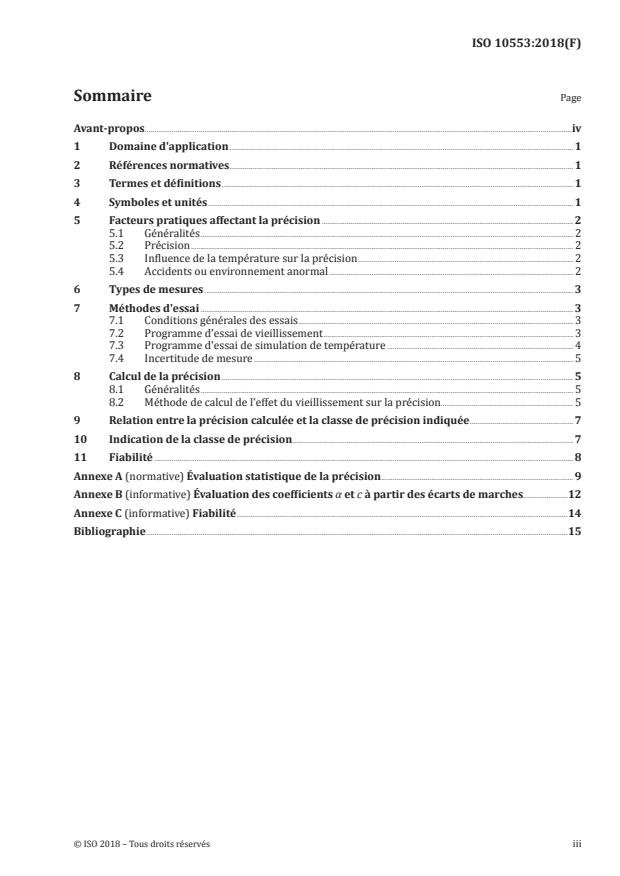
ISO 10553:2018 - Horlogerie -- Procédure d'évaluation de la précision des montres à quartz
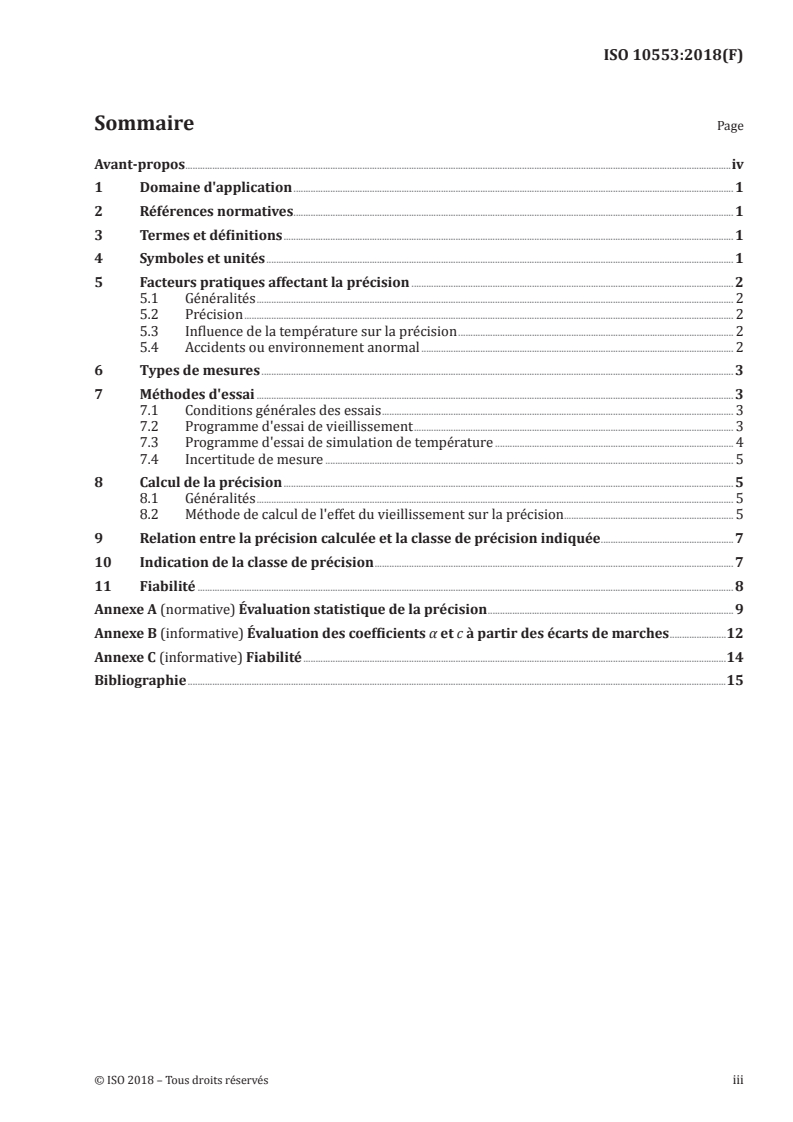
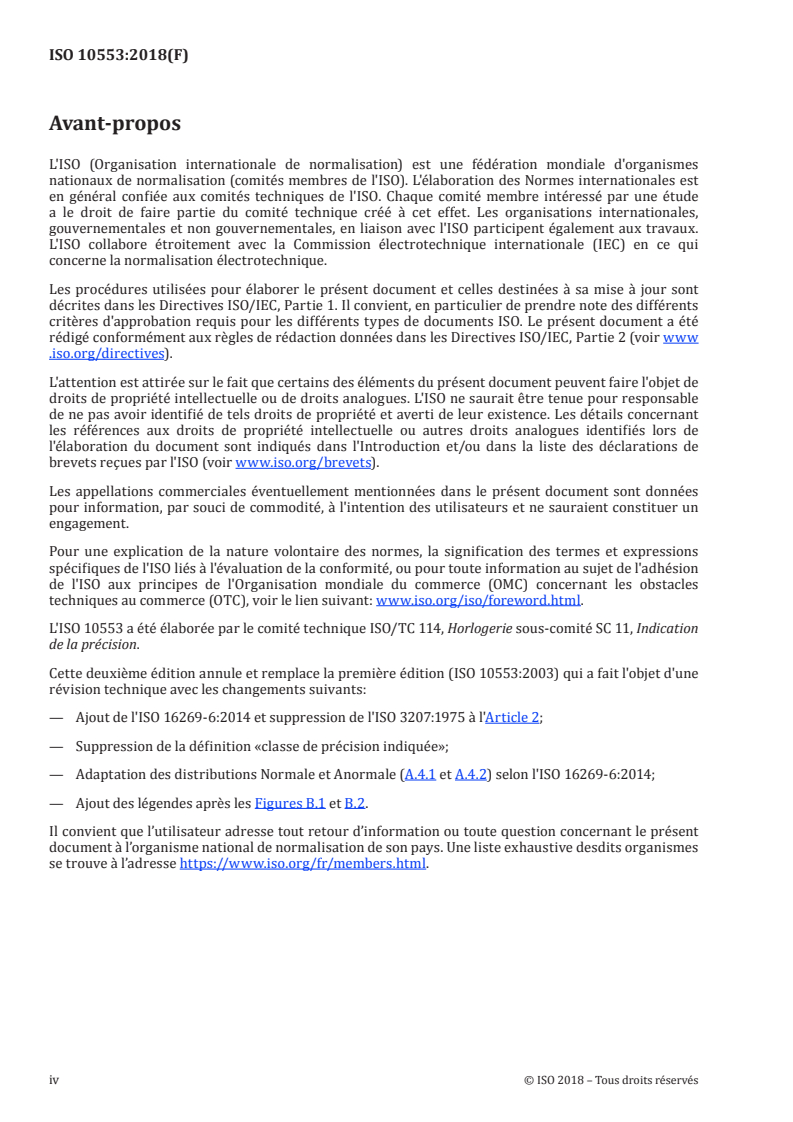
ISO 10553:2018 - Horlogerie — Procédure d'évaluation de la précision des montres à quartz Released:10/1/2020
Frequently Asked Questions
ISO 10553:2018 is a standard published by the International Organization for Standardization (ISO). Its full title is "Horology — Procedure for evaluating the accuracy of quartz watches". This standard covers: This document specifies the procedure for evaluating the accuracy of quartz watches, individually and by lots (see Annex A which presents the methods for statistical evaluation of accuracy by lot), and the relationship between the accuracy tested and the accuracy classification given by the manufacturer. It applies to quartz watches having accompanying documents on which the accuracy classification is indicated.
This document specifies the procedure for evaluating the accuracy of quartz watches, individually and by lots (see Annex A which presents the methods for statistical evaluation of accuracy by lot), and the relationship between the accuracy tested and the accuracy classification given by the manufacturer. It applies to quartz watches having accompanying documents on which the accuracy classification is indicated.
ISO 10553:2018 is classified under the following ICS (International Classification for Standards) categories: 39.040.10 - Watches. The ICS classification helps identify the subject area and facilitates finding related standards.
ISO 10553:2018 has the following relationships with other standards: It is inter standard links to ISO 10553:2003. Understanding these relationships helps ensure you are using the most current and applicable version of the standard.
ISO 10553:2018 is available in PDF format for immediate download after purchase. The document can be added to your cart and obtained through the secure checkout process. Digital delivery ensures instant access to the complete standard document.
Standards Content (Sample)
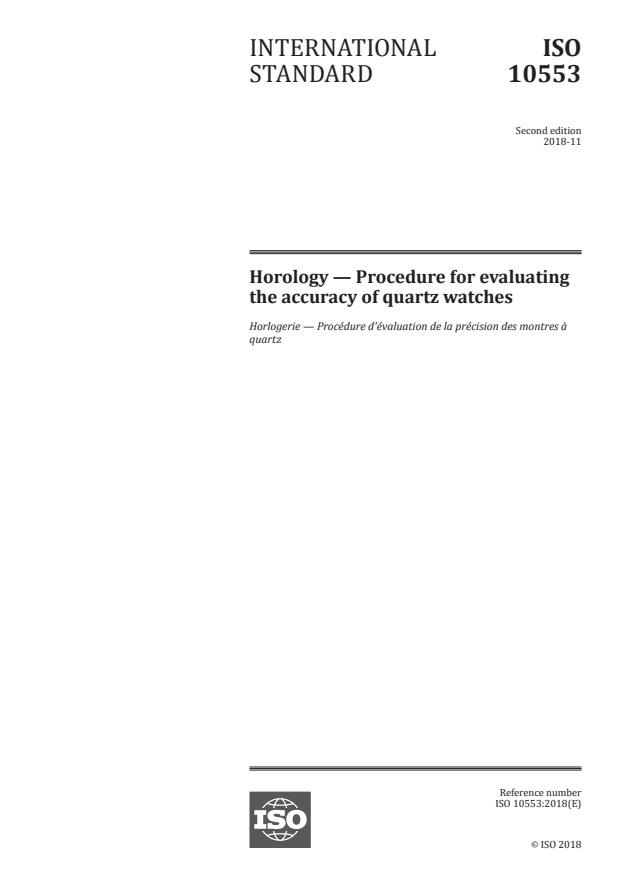
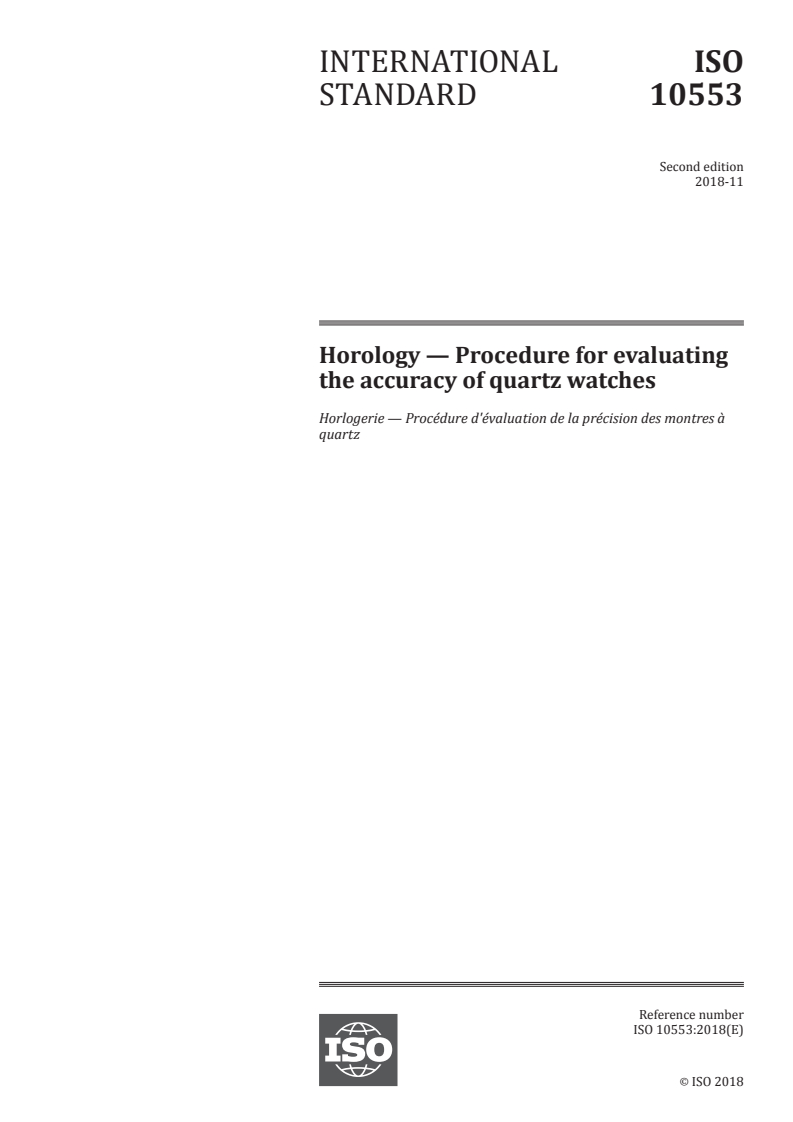
INTERNATIONAL ISO
STANDARD 10553
Second edition
2018-11
Horology — Procedure for evaluating
the accuracy of quartz watches
Horlogerie — Procédure d'évaluation de la précision des montres à
quartz
Reference number
©
ISO 2018
© ISO 2018
All rights reserved. Unless otherwise specified, or required in the context of its implementation, no part of this publication may
be reproduced or utilized otherwise in any form or by any means, electronic or mechanical, including photocopying, or posting
on the internet or an intranet, without prior written permission. Permission can be requested from either ISO at the address
below or ISO’s member body in the country of the requester.
ISO copyright office
CP 401 • Ch. de Blandonnet 8
CH-1214 Vernier, Geneva
Phone: +41 22 749 01 11
Fax: +41 22 749 09 47
Email: copyright@iso.org
Website: www.iso.org
Published in Switzerland
ii © ISO 2018 – All rights reserved
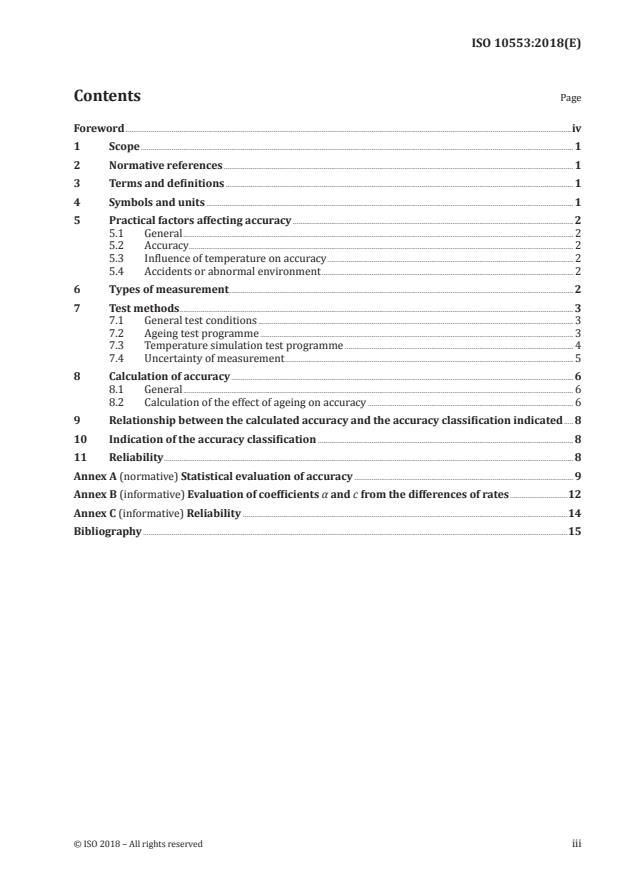
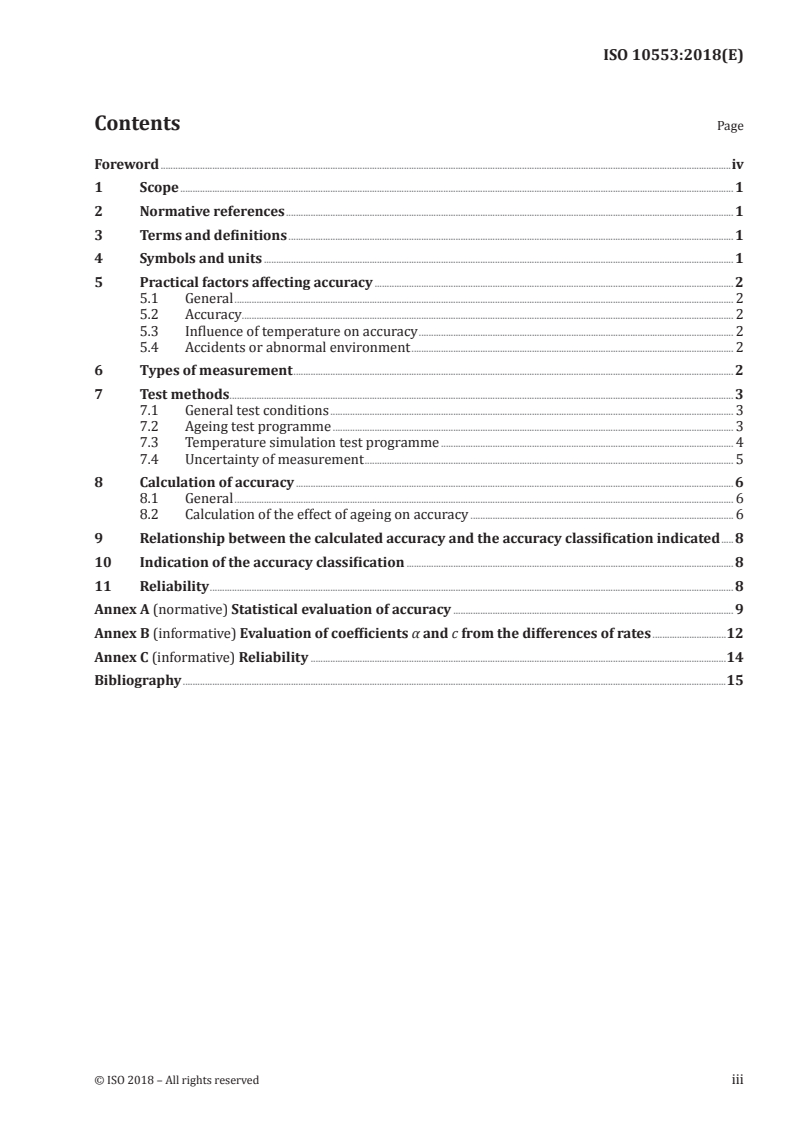
Contents Page
Foreword .iv
1 Scope . 1
2 Normative references . 1
3 Terms and definitions . 1
4 Symbols and units . 1
5 Practical factors affecting accuracy . 2
5.1 General . 2
5.2 Accuracy . 2
5.3 Influence of temperature on accuracy . 2
5.4 Accidents or abnormal environment . 2
6 Types of measurement . 2
7 Test methods . 3
7.1 General test conditions . 3
7.2 Ageing test programme . 3
7.3 Temperature simulation test programme . 4
7.4 Uncertainty of measurement . 5
8 Calculation of accuracy . 6
8.1 General . 6
8.2 Calculation of the effect of ageing on accuracy . 6
9 Relationship between the calculated accuracy and the accuracy classification indicated .8
10 Indication of the accuracy classification . 8
11 Reliability . 8
Annex A (normative) Statistical evaluation of accuracy . 9
Annex B (informative) Evaluation of coefficients α and c from the differences of rates .12
Annex C (informative) Reliability .14
Bibliography .15
Foreword
ISO (the International Organization for Standardization) is a worldwide federation of national standards
bodies (ISO member bodies). The work of preparing International Standards is normally carried out
through ISO technical committees. Each member body interested in a subject for which a technical
committee has been established has the right to be represented on that committee. International
organizations, governmental and non-governmental, in liaison with ISO, also take part in the work.
ISO collaborates closely with the International Electrotechnical Commission (IEC) on all matters of
electrotechnical standardization.
The procedures used to develop this document and those intended for its further maintenance are
described in the ISO/IEC Directives, Part 1. In particular the different approval criteria needed for the
different types of ISO documents should be noted. This document was drafted in accordance with the
editorial rules of the ISO/IEC Directives, Part 2 (see www .iso .org/directives).
Attention is drawn to the possibility that some of the elements of this document may be the subject of
patent rights. ISO shall not be held responsible for identifying any or all such patent rights. Details of
any patent rights identified during the development of the document will be in the Introduction and/or
on the ISO list of patent declarations received (see www .iso .org/patents).
Any trade name used in this document is information given for the convenience of users and does not
constitute an endorsement.
For an explanation on the voluntary nature of standards, the meaning of ISO specific terms and
expressions related to conformity assessment, as well as information about ISO's adherence to the
World Trade Organization (WTO) principles in the Technical Barriers to Trade (TBT) see the following
URL: www .iso .org/iso/foreword .html.
This document was prepared by Technical Committee ISO/TC 114, Horology, Subcommittee SC 11,
Indication of accuracy.
This second edition cancels and replaces the first edition (ISO 10553:2003), which has been technically
revised with the following changes:
— Addition of ISO 16269-6:2014 and deletion of ISO 3207:1975 in Clause 2;
— Deletion of the indicated accuracy classification definition;
— Adaptation of the Normal and Abnormal distributions (A.4.1 and A.4.2) according to ISO 16269-6:2014;
— Addition of keys after Figures B.1 and B.2.
Any feedback or questions on this document should be directed to the user’s national standards body. A
complete listing of these bodies can be found at www .iso .org/members .html.
iv © ISO 2018 – All rights reserved
INTERNATIONAL STANDARD ISO 10553:2018(E)
Horology — Procedure for evaluating the accuracy of
quartz watches
1 Scope
This document specifies the procedure for evaluating the accuracy of quartz watches, individually and
by lots (see Annex A which presents the methods for statistical evaluation of accuracy by lot), and the
relationship between the accuracy tested and the accuracy classification given by the manufacturer.
It applies to quartz watches having accompanying documents on which the accuracy classification is
indicated.
2 Normative references
The following documents are referred to in the text in such a way that some or all of their content
constitutes requirements of this document. For dated references, only the edition cited applies. For
undated references, the latest edition of the referenced document (including any amendments) applies.
ISO 3158, Timekeeping instruments — Symbolization of control positions
ISO 16269-6:2014, Statistical interpretation of data — Part 6: Determination of statistical tolerance
intervals
3 Terms and definitions
For the purposes of this document, the following terms and definitions apply.
ISO and IEC maintain terminological databases for use in standardization at the following addresses:
— ISO Online browsing platform: available at https: //www .iso .org/obp
— IEC Electropedia: available at http: //www .electropedia .org/
3.1
quartz watch with accuracy indication
quartz watch, the accuracy classification of which is indicated in its accompanying documents, such as
operating instructions, prospectus and, labels
3.2
display
accuracy classification indications showing the hours and minutes and having at least one component
displaying the seconds to enable the state to be checked
Note 1 to entry: The accuracy classification is expressed in seconds.
4 Symbols and units
The symbols and units for ageing, temperature simulation and accuracy are given in Table 1.
Table 1 — Symbols and units of measurement
Symbol Unit Term
Ageing
−1
α d coefficient of the logarithmic function applied
c s/d coefficient of the logarithmic function applied
t d time interval
d
M s/d average daily rate for the first three days of the ageing test (stage II)
B
M s/d average daily rate for the middle three days of the ageing test (stage V)
M
M s/d average daily rate for the last three days of the ageing test (stage VIII)
E
V s variation in state over one year due to ageing
V
Temperature simulation
M s/d average daily rate in simulation of spring
P
M s/d average daily rate in simulation of summer
S
M s/d average daily rate in simulation of autumn
A
M s/d average daily rate in simulation of winter
W
V s variation in state over one year due to seasonal changes in temperature
T
Accuracy
M s/m monthly rate
m
M s/a annual rate
y
5 Practical factors affecting accuracy
5.1 General
The main factors affecting the operating accuracy of quartz watches are temperature and ageing.
Accordingly, these two factors are taken into account when evaluating the accuracy. The influence of
other factors, such as mechanical impacts, magnetic fields, humidity and supply voltage is low.
5.2 Accuracy
The accuracy of quartz watches depends upon temperature variations due to the climatic conditions in
the places of use.
5.3 Influence of temperature on accuracy
Watches are subject to the influence of the ambient temperature, which is variable according to the
seasons and geographical location of the wearer.
It is not possible to specify absolutely temperatures simulating seasonal variations in all locations. The
effects of temperature on accuracy are calculated arbitrarily at levels corresponding to the average
seasonal temperature in temperate climates.
5.4 Accidents or abnormal environment
Accidents which quartz watches may suffer such as dropping, exposure to a strong magnetic field or
extremely high or low temperatures are not covered by this document.
6 Types of measurement
To evaluate the accuracy of quartz watches in accordance with the procedure described in Clause 7, the
condition of the component which displays the seconds shall be measured (this measuring procedure
2 © ISO 2018 – All rights reserved
has the advantage of taking the oscillator variance into consideration and of checking the display
kinematic chain).
7 Test methods
7.1 General test conditions
7.1.1 The average daily ra
...
INTERNATIONAL ISO
STANDARD 10553
Second edition
2018-11
Horology — Procedure for evaluating
the accuracy of quartz watches
Horlogerie — Procédure d'évaluation de la précision des montres à
quartz
Reference number
©
ISO 2018
© ISO 2018
All rights reserved. Unless otherwise specified, or required in the context of its implementation, no part of this publication may
be reproduced or utilized otherwise in any form or by any means, electronic or mechanical, including photocopying, or posting
on the internet or an intranet, without prior written permission. Permission can be requested from either ISO at the address
below or ISO’s member body in the country of the requester.
ISO copyright office
CP 401 • Ch. de Blandonnet 8
CH-1214 Vernier, Geneva
Phone: +41 22 749 01 11
Fax: +41 22 749 09 47
Email: copyright@iso.org
Website: www.iso.org
Published in Switzerland
ii © ISO 2018 – All rights reserved
Contents Page
Foreword .iv
1 Scope . 1
2 Normative references . 1
3 Terms and definitions . 1
4 Symbols and units . 1
5 Practical factors affecting accuracy . 2
5.1 General . 2
5.2 Accuracy . 2
5.3 Influence of temperature on accuracy . 2
5.4 Accidents or abnormal environment . 2
6 Types of measurement . 2
7 Test methods . 3
7.1 General test conditions . 3
7.2 Ageing test programme . 3
7.3 Temperature simulation test programme . 4
7.4 Uncertainty of measurement . 5
8 Calculation of accuracy . 6
8.1 General . 6
8.2 Calculation of the effect of ageing on accuracy . 6
9 Relationship between the calculated accuracy and the accuracy classification indicated .8
10 Indication of the accuracy classification . 8
11 Reliability . 8
Annex A (normative) Statistical evaluation of accuracy . 9
Annex B (informative) Evaluation of coefficients α and c from the differences of rates .12
Annex C (informative) Reliability .14
Bibliography .15
Foreword
ISO (the International Organization for Standardization) is a worldwide federation of national standards
bodies (ISO member bodies). The work of preparing International Standards is normally carried out
through ISO technical committees. Each member body interested in a subject for which a technical
committee has been established has the right to be represented on that committee. International
organizations, governmental and non-governmental, in liaison with ISO, also take part in the work.
ISO collaborates closely with the International Electrotechnical Commission (IEC) on all matters of
electrotechnical standardization.
The procedures used to develop this document and those intended for its further maintenance are
described in the ISO/IEC Directives, Part 1. In particular the different approval criteria needed for the
different types of ISO documents should be noted. This document was drafted in accordance with the
editorial rules of the ISO/IEC Directives, Part 2 (see www .iso .org/directives).
Attention is drawn to the possibility that some of the elements of this document may be the subject of
patent rights. ISO shall not be held responsible for identifying any or all such patent rights. Details of
any patent rights identified during the development of the document will be in the Introduction and/or
on the ISO list of patent declarations received (see www .iso .org/patents).
Any trade name used in this document is information given for the convenience of users and does not
constitute an endorsement.
For an explanation on the voluntary nature of standards, the meaning of ISO specific terms and
expressions related to conformity assessment, as well as information about ISO's adherence to the
World Trade Organization (WTO) principles in the Technical Barriers to Trade (TBT) see the following
URL: www .iso .org/iso/foreword .html.
This document was prepared by Technical Committee ISO/TC 114, Horology, Subcommittee SC 11,
Indication of accuracy.
This second edition cancels and replaces the first edition (ISO 10553:2003), which has been technically
revised with the following changes:
— Addition of ISO 16269-6:2014 and deletion of ISO 3207:1975 in Clause 2;
— Deletion of the indicated accuracy classification definition;
— Adaptation of the Normal and Abnormal distributions (A.4.1 and A.4.2) according to ISO 16269-6:2014;
— Addition of keys after Figures B.1 and B.2.
Any feedback or questions on this document should be directed to the user’s national standards body. A
complete listing of these bodies can be found at www .iso .org/members .html.
iv © ISO 2018 – All rights reserved
INTERNATIONAL STANDARD ISO 10553:2018(E)
Horology — Procedure for evaluating the accuracy of
quartz watches
1 Scope
This document specifies the procedure for evaluating the accuracy of quartz watches, individually and
by lots (see Annex A which presents the methods for statistical evaluation of accuracy by lot), and the
relationship between the accuracy tested and the accuracy classification given by the manufacturer.
It applies to quartz watches having accompanying documents on which the accuracy classification is
indicated.
2 Normative references
The following documents are referred to in the text in such a way that some or all of their content
constitutes requirements of this document. For dated references, only the edition cited applies. For
undated references, the latest edition of the referenced document (including any amendments) applies.
ISO 3158, Timekeeping instruments — Symbolization of control positions
ISO 16269-6:2014, Statistical interpretation of data — Part 6: Determination of statistical tolerance
intervals
3 Terms and definitions
For the purposes of this document, the following terms and definitions apply.
ISO and IEC maintain terminological databases for use in standardization at the following addresses:
— ISO Online browsing platform: available at https: //www .iso .org/obp
— IEC Electropedia: available at http: //www .electropedia .org/
3.1
quartz watch with accuracy indication
quartz watch, the accuracy classification of which is indicated in its accompanying documents, such as
operating instructions, prospectus and, labels
3.2
display
accuracy classification indications showing the hours and minutes and having at least one component
displaying the seconds to enable the state to be checked
Note 1 to entry: The accuracy classification is expressed in seconds.
4 Symbols and units
The symbols and units for ageing, temperature simulation and accuracy are given in Table 1.
Table 1 — Symbols and units of measurement
Symbol Unit Term
Ageing
−1
α d coefficient of the logarithmic function applied
c s/d coefficient of the logarithmic function applied
t d time interval
d
M s/d average daily rate for the first three days of the ageing test (stage II)
B
M s/d average daily rate for the middle three days of the ageing test (stage V)
M
M s/d average daily rate for the last three days of the ageing test (stage VIII)
E
V s variation in state over one year due to ageing
V
Temperature simulation
M s/d average daily rate in simulation of spring
P
M s/d average daily rate in simulation of summer
S
M s/d average daily rate in simulation of autumn
A
M s/d average daily rate in simulation of winter
W
V s variation in state over one year due to seasonal changes in temperature
T
Accuracy
M s/m monthly rate
m
M s/a annual rate
y
5 Practical factors affecting accuracy
5.1 General
The main factors affecting the operating accuracy of quartz watches are temperature and ageing.
Accordingly, these two factors are taken into account when evaluating the accuracy. The influence of
other factors, such as mechanical impacts, magnetic fields, humidity and supply voltage is low.
5.2 Accuracy
The accuracy of quartz watches depends upon temperature variations due to the climatic conditions in
the places of use.
5.3 Influence of temperature on accuracy
Watches are subject to the influence of the ambient temperature, which is variable according to the
seasons and geographical location of the wearer.
It is not possible to specify absolutely temperatures simulating seasonal variations in all locations. The
effects of temperature on accuracy are calculated arbitrarily at levels corresponding to the average
seasonal temperature in temperate climates.
5.4 Accidents or abnormal environment
Accidents which quartz watches may suffer such as dropping, exposure to a strong magnetic field or
extremely high or low temperatures are not covered by this document.
6 Types of measurement
To evaluate the accuracy of quartz watches in accordance with the procedure described in Clause 7, the
condition of the component which displays the seconds shall be measured (this measuring procedure
2 © ISO 2018 – All rights reserved
has the advantage of taking the oscillator variance into consideration and of checking the display
kinematic chain).
7 Test methods
7.1 General test conditions
7.1.1 The average daily ra
...
NORME ISO
INTERNATIONALE 10553
Deuxième édition
2018-11
Horlogerie — Procédure d'évaluation
de la précision des montres à quartz
Horology — Procedure for evaluating the accuracy of quartz watches
Numéro de référence
©
ISO 2018
DOCUMENT PROTÉGÉ PAR COPYRIGHT
© ISO 2018
Tous droits réservés. Sauf prescription différente ou nécessité dans le contexte de sa mise en œuvre, aucune partie de cette
publication ne peut être reproduite ni utilisée sous quelque forme que ce soit et par aucun procédé, électronique ou mécanique,
y compris la photocopie, ou la diffusion sur l’internet ou sur un intranet, sans autorisation écrite préalable. Une autorisation peut
être demandée à l’ISO à l’adresse ci-après ou au comité membre de l’ISO dans le pays du demandeur.
ISO copyright office
Case postale 401 • Ch. de Blandonnet 8
CH-1214 Vernier, Genève
Tél.: +41 22 749 01 11
E-mail: copyright@iso.org
Web: www.iso.org
Publié en Suisse
ii © ISO 2018 – Tous droits réservés
Sommaire Page
Avant-propos .iv
1 Domaine d'application . 1
2 Références normatives . 1
3 Termes et définitions . 1
4 Symboles et unités . 1
5 Facteurs pratiques affectant la précision . 2
5.1 Généralités . 2
5.2 Précision . 2
5.3 Influence de la température sur la précision . 2
5.4 Accidents ou environnement anormal . 2
6 Types de mesures . 3
7 Méthodes d'essai . 3
7.1 Conditions générales des essais . 3
7.2 Programme d'essai de vieillissement . 3
7.3 Programme d'essai de simulation de température . 4
7.4 Incertitude de mesure . 5
8 Calcul de la précision . 5
8.1 Généralités . 5
8.2 Méthode de calcul de l'effet du vieillissement sur la précision. 5
9 Relation entre la précision calculée et la classe de précision indiquée .7
10 Indication de la classe de précision . 7
11 Fiabilité . 8
Annexe A (normative) Évaluation statistique de la précision . 9
Annexe B (informative) Évaluation des coefficients α et c à partir des écarts de marches .12
Annexe C (informative) Fiabilité .14
Bibliographie .15
Avant-propos
L'ISO (Organisation internationale de normalisation) est une fédération mondiale d'organismes
nationaux de normalisation (comités membres de l'ISO). L'élaboration des Normes internationales est
en général confiée aux comités techniques de l'ISO. Chaque comité membre intéressé par une étude
a le droit de faire partie du comité technique créé à cet effet. Les organisations internationales,
gouvernementales et non gouvernementales, en liaison avec l'ISO participent également aux travaux.
L'ISO collabore étroitement avec la Commission électrotechnique internationale (IEC) en ce qui
concerne la normalisation électrotechnique.
Les procédures utilisées pour élaborer le présent document et celles destinées à sa mise à jour sont
décrites dans les Directives ISO/IEC, Partie 1. Il convient, en particulier de prendre note des différents
critères d'approbation requis pour les différents types de documents ISO. Le présent document a été
rédigé conformément aux règles de rédaction données dans les Directives ISO/IEC, Partie 2 (voir www
.iso .org/ directives).
L'attention est attirée sur le fait que certains des éléments du présent document peuvent faire l'objet de
droits de propriété intellectuelle ou de droits analogues. L'ISO ne saurait être tenue pour responsable
de ne pas avoir identifié de tels droits de propriété et averti de leur existence. Les détails concernant
les références aux droits de propriété intellectuelle ou autres droits analogues identifiés lors de
l'élaboration du document sont indiqués dans l'Introduction et/ou dans la liste des déclarations de
brevets reçues par l'ISO (voir www .iso .org/ brevets).
Les appellations commerciales éventuellement mentionnées dans le présent document sont données
pour information, par souci de commodité, à l'intention des utilisateurs et ne sauraient constituer un
engagement.
Pour une explication de la nature volontaire des normes, la signification des termes et expressions
spécifiques de l'ISO liés à l'évaluation de la conformité, ou pour toute information au sujet de l'adhésion
de l'ISO aux principes de l'Organisation mondiale du commerce (OMC) concernant les obstacles
techniques au commerce (OTC), voir le lien suivant: www .iso .org/ iso/ foreword .html.
L'ISO 10553 a été élaborée par le comité technique ISO/TC 114, Horlogerie sous-comité SC 11, Indication
de la précision.
Cette deuxième édition annule et remplace la première édition (ISO 10553:2003) qui a fait l'objet d'une
révision technique avec les changements suivants:
— Ajout de l'ISO 16269-6:2014 et suppression de l'ISO 3207:1975 à l'Article 2;
— Suppression de la définition «classe de précision indiquée»;
— Adaptation des distributions Normale et Anormale (A.4.1 et A.4.2) selon l'ISO 16269-6:2014;
— Ajout des légendes après les Figures B.1 et B.2.
Il convient que l’utilisateur adresse tout retour d’information ou toute question concernant le présent
document à l’organisme national de normalisation de son pays. Une liste exhaustive desdits organismes
se trouve à l’adresse https:// www .iso .org/ fr/ members .html.
iv © ISO 2018 – Tous droits réservés
NORME INTERNATIONALE ISO 10553:2018(F)
Horlogerie — Procédure d'évaluation de la précision des
montres à quartz
1 Domaine d'application
Le présent document spécifie la procédure d'évaluation de la précision des montres à quartz,
individuellement ou par lots (voir l'Annexe A qui spécifie les méthodes d'évaluation statistique de la
précision par lot), et la relation entre la précision soumise à essai et la classe de précision indiquée par
le fabricant.
Il s'applique aux montres à quartz dont la classe de précision est indiquée sur les documents
d'accompagnement.
2 Références normatives
Les documents suivants sont cités dans le texte de sorte qu’ils constituent, pour tout ou partie de leur
contenu, des exigences du présent document. Pour les références datées, seule l’édition citée s’applique.
Pour les références non datées, la dernière édition du document de référence s'applique (y compris les
éventuels amendements).
ISO 3158, Instruments horaires — Symbolisation des positions de contrôle
ISO 16269-6:2014, Interprétation statistique des données — Partie 6: Détermination des intervalles
statistiques de dispersion
3 Termes et définitions
Pour les besoins du présent document, les termes et les définitions suivants s’appliquent.
L’ISO et l’IEC tiennent à jour des bases de données terminologiques destinées à être utilisées en
normalisation, consultables aux adresses suivantes:
— ISO Online browsing platform: disponible à l’adresse https:// www .iso .org/ obp
— IEC Electropedia: disponible à l’adresse http:// www .electropedia .org
3.1
montre à quartz avec indication de la précision
montre à quartz dont la classe de précision est indiquée dans les documents d'accompagnement, tels
que modes d'emploi, prospectus et étiquettes
3.2
affichage
indication de la classe de précision affichant les heures et les minutes et ayant au moins un organe
affichant les secondes pour permettre de contrôler l'état
Note 1 à l'article: La classification de la précision est exprimée en secondes.
4 Symboles et unités
Les symboles et unités relatifs au vieillissement, à la simulation de température et à la précision sont
donnés au Tableau 1.
Tableau 1 — Symboles et unités de mesure
Symbole Unité Terme
Vieillissement
−1
α d coefficient de la fonction logarithmique appliqué
c s/d coefficient de la fonction logarithmique appliqué
t d intervalle de temps
d
marche diurne moyenne pour les trois premiers jours de l'essai de vieillissement
M s/d
B
(phase II)
marche diurne moyenne pour les trois jours médians de l'essai de vieillissement
M s/d
M
(phase V)
marche diurne moyenne pour les trois derniers jours de l'essai de vieillissement
M s/d
E
(phase VIII)
V s variation d'état sur une année due au vieillissement
V
Simulation de température
M s/d marche diurne moyenne pour simulation du printemps
P
M s/d marche diurne moyenne pour simulation de l'été
S
M s/d marche diurne moyenne pour simulation de l'automne
A
M s/d marche diurne moyenne pour simulation de l'hiver
W
V s variation d'état sur une année due aux variations saisonnières de température
T
Précision
M s/m marche mensuelle
m
M s/a (s/an) marche annuelle
y
5 Facteurs pratiques affectant la précision
5.1 Généralités
Les principaux facteurs affectant la précision de marche des montres à quartz sont la température
et le vieillissement. Par conséquent, ces deux facteurs sont pris en compte pour évaluer la précision.
L'influence des autres facteurs tels que chocs mécaniques, champs magnétiques, humidité et tension
d'alimentation est faible.
5.2 Précision
La précision des montres à quartz dépend des variations de température dues aux conditions
climatiques des lieux d'utilisation.
5.3 Influence de la température sur la précision
Les montres subissent l'influence de la température ambiante, qui est variable selon les saisons et le
lieu géographique où se trouve le porteur.
Il n'est pas possible de fixer dans l'absolu des températures simulant les variations saisonnières en tous
lieux. De manière arbitraire, les effets de la température sur la précision sont évalués à des niveaux
correspondant à la moyenne de chacune des températures saisonnières des lieux à climat dit tempéré.
5.4 Accidents ou environnement anormal
Les accidents que peuvent subir les montres à quartz tels que chute, exposition à de forts champs
magnétiques ou à des températures extrêmes ne sont pas couverts par le présent document.
2 © ISO 2018 – Tous droits réservés
6 Types de mesures
Pour évaluer la précision des montres à quartz selon la procédure décrite à l'Article 7, l'état de l'organe
qui affiche les secondes doit être contrôlé (cette procédure offre l'avantage de tenir compte de la dérive
de l'oscillateur et de contrôler la chaîne cinématique de l'affichage).
7 Méthodes d'essai
7.1
...
NORME ISO
INTERNATIONALE 10553
Deuxième édition
2018-11
Horlogerie — Procédure d'évaluation
de la précision des montres à quartz
Horology — Procedure for evaluating the accuracy of quartz watches
Numéro de référence
©
ISO 2018
DOCUMENT PROTÉGÉ PAR COPYRIGHT
© ISO 2018
Tous droits réservés. Sauf prescription différente ou nécessité dans le contexte de sa mise en œuvre, aucune partie de cette
publication ne peut être reproduite ni utilisée sous quelque forme que ce soit et par aucun procédé, électronique ou mécanique,
y compris la photocopie, ou la diffusion sur l’internet ou sur un intranet, sans autorisation écrite préalable. Une autorisation peut
être demandée à l’ISO à l’adresse ci-après ou au comité membre de l’ISO dans le pays du demandeur.
ISO copyright office
Case postale 401 • Ch. de Blandonnet 8
CH-1214 Vernier, Genève
Tél.: +41 22 749 01 11
E-mail: copyright@iso.org
Web: www.iso.org
Publié en Suisse
ii © ISO 2018 – Tous droits réservés
Sommaire Page
Avant-propos .iv
1 Domaine d'application . 1
2 Références normatives . 1
3 Termes et définitions . 1
4 Symboles et unités . 1
5 Facteurs pratiques affectant la précision . 2
5.1 Généralités . 2
5.2 Précision . 2
5.3 Influence de la température sur la précision . 2
5.4 Accidents ou environnement anormal . 2
6 Types de mesures . 3
7 Méthodes d'essai . 3
7.1 Conditions générales des essais . 3
7.2 Programme d'essai de vieillissement . 3
7.3 Programme d'essai de simulation de température . 4
7.4 Incertitude de mesure . 5
8 Calcul de la précision . 5
8.1 Généralités . 5
8.2 Méthode de calcul de l'effet du vieillissement sur la précision. 5
9 Relation entre la précision calculée et la classe de précision indiquée .7
10 Indication de la classe de précision . 7
11 Fiabilité . 8
Annexe A (normative) Évaluation statistique de la précision . 9
Annexe B (informative) Évaluation des coefficients α et c à partir des écarts de marches .12
Annexe C (informative) Fiabilité .14
Bibliographie .15
Avant-propos
L'ISO (Organisation internationale de normalisation) est une fédération mondiale d'organismes
nationaux de normalisation (comités membres de l'ISO). L'élaboration des Normes internationales est
en général confiée aux comités techniques de l'ISO. Chaque comité membre intéressé par une étude
a le droit de faire partie du comité technique créé à cet effet. Les organisations internationales,
gouvernementales et non gouvernementales, en liaison avec l'ISO participent également aux travaux.
L'ISO collabore étroitement avec la Commission électrotechnique internationale (IEC) en ce qui
concerne la normalisation électrotechnique.
Les procédures utilisées pour élaborer le présent document et celles destinées à sa mise à jour sont
décrites dans les Directives ISO/IEC, Partie 1. Il convient, en particulier de prendre note des différents
critères d'approbation requis pour les différents types de documents ISO. Le présent document a été
rédigé conformément aux règles de rédaction données dans les Directives ISO/IEC, Partie 2 (voir www
.iso .org/ directives).
L'attention est attirée sur le fait que certains des éléments du présent document peuvent faire l'objet de
droits de propriété intellectuelle ou de droits analogues. L'ISO ne saurait être tenue pour responsable
de ne pas avoir identifié de tels droits de propriété et averti de leur existence. Les détails concernant
les références aux droits de propriété intellectuelle ou autres droits analogues identifiés lors de
l'élaboration du document sont indiqués dans l'Introduction et/ou dans la liste des déclarations de
brevets reçues par l'ISO (voir www .iso .org/ brevets).
Les appellations commerciales éventuellement mentionnées dans le présent document sont données
pour information, par souci de commodité, à l'intention des utilisateurs et ne sauraient constituer un
engagement.
Pour une explication de la nature volontaire des normes, la signification des termes et expressions
spécifiques de l'ISO liés à l'évaluation de la conformité, ou pour toute information au sujet de l'adhésion
de l'ISO aux principes de l'Organisation mondiale du commerce (OMC) concernant les obstacles
techniques au commerce (OTC), voir le lien suivant: www .iso .org/ iso/ foreword .html.
L'ISO 10553 a été élaborée par le comité technique ISO/TC 114, Horlogerie sous-comité SC 11, Indication
de la précision.
Cette deuxième édition annule et remplace la première édition (ISO 10553:2003) qui a fait l'objet d'une
révision technique avec les changements suivants:
— Ajout de l'ISO 16269-6:2014 et suppression de l'ISO 3207:1975 à l'Article 2;
— Suppression de la définition «classe de précision indiquée»;
— Adaptation des distributions Normale et Anormale (A.4.1 et A.4.2) selon l'ISO 16269-6:2014;
— Ajout des légendes après les Figures B.1 et B.2.
Il convient que l’utilisateur adresse tout retour d’information ou toute question concernant le présent
document à l’organisme national de normalisation de son pays. Une liste exhaustive desdits organismes
se trouve à l’adresse https:// www .iso .org/ fr/ members .html.
iv © ISO 2018 – Tous droits réservés
NORME INTERNATIONALE ISO 10553:2018(F)
Horlogerie — Procédure d'évaluation de la précision des
montres à quartz
1 Domaine d'application
Le présent document spécifie la procédure d'évaluation de la précision des montres à quartz,
individuellement ou par lots (voir l'Annexe A qui spécifie les méthodes d'évaluation statistique de la
précision par lot), et la relation entre la précision soumise à essai et la classe de précision indiquée par
le fabricant.
Il s'applique aux montres à quartz dont la classe de précision est indiquée sur les documents
d'accompagnement.
2 Références normatives
Les documents suivants sont cités dans le texte de sorte qu’ils constituent, pour tout ou partie de leur
contenu, des exigences du présent document. Pour les références datées, seule l’édition citée s’applique.
Pour les références non datées, la dernière édition du document de référence s'applique (y compris les
éventuels amendements).
ISO 3158, Instruments horaires — Symbolisation des positions de contrôle
ISO 16269-6:2014, Interprétation statistique des données — Partie 6: Détermination des intervalles
statistiques de dispersion
3 Termes et définitions
Pour les besoins du présent document, les termes et les définitions suivants s’appliquent.
L’ISO et l’IEC tiennent à jour des bases de données terminologiques destinées à être utilisées en
normalisation, consultables aux adresses suivantes:
— ISO Online browsing platform: disponible à l’adresse https:// www .iso .org/ obp
— IEC Electropedia: disponible à l’adresse http:// www .electropedia .org
3.1
montre à quartz avec indication de la précision
montre à quartz dont la classe de précision est indiquée dans les documents d'accompagnement, tels
que modes d'emploi, prospectus et étiquettes
3.2
affichage
indication de la classe de précision affichant les heures et les minutes et ayant au moins un organe
affichant les secondes pour permettre de contrôler l'état
Note 1 à l'article: La classification de la précision est exprimée en secondes.
4 Symboles et unités
Les symboles et unités relatifs au vieillissement, à la simulation de température et à la précision sont
donnés au Tableau 1.
Tableau 1 — Symboles et unités de mesure
Symbole Unité Terme
Vieillissement
−1
α d coefficient de la fonction logarithmique appliqué
c s/d coefficient de la fonction logarithmique appliqué
t d intervalle de temps
d
marche diurne moyenne pour les trois premiers jours de l'essai de vieillissement
M s/d
B
(phase II)
marche diurne moyenne pour les trois jours médians de l'essai de vieillissement
M s/d
M
(phase V)
marche diurne moyenne pour les trois derniers jours de l'essai de vieillissement
M s/d
E
(phase VIII)
V s variation d'état sur une année due au vieillissement
V
Simulation de température
M s/d marche diurne moyenne pour simulation du printemps
P
M s/d marche diurne moyenne pour simulation de l'été
S
M s/d marche diurne moyenne pour simulation de l'automne
A
M s/d marche diurne moyenne pour simulation de l'hiver
W
V s variation d'état sur une année due aux variations saisonnières de température
T
Précision
M s/m marche mensuelle
m
M s/a (s/an) marche annuelle
y
5 Facteurs pratiques affectant la précision
5.1 Généralités
Les principaux facteurs affectant la précision de marche des montres à quartz sont la température
et le vieillissement. Par conséquent, ces deux facteurs sont pris en compte pour évaluer la précision.
L'influence des autres facteurs tels que chocs mécaniques, champs magnétiques, humidité et tension
d'alimentation est faible.
5.2 Précision
La précision des montres à quartz dépend des variations de température dues aux conditions
climatiques des lieux d'utilisation.
5.3 Influence de la température sur la précision
Les montres subissent l'influence de la température ambiante, qui est variable selon les saisons et le
lieu géographique où se trouve le porteur.
Il n'est pas possible de fixer dans l'absolu des températures simulant les variations saisonnières en tous
lieux. De manière arbitraire, les effets de la température sur la précision sont évalués à des niveaux
correspondant à la moyenne de chacune des températures saisonnières des lieux à climat dit tempéré.
5.4 Accidents ou environnement anormal
Les accidents que peuvent subir les montres à quartz tels que chute, exposition à de forts champs
magnétiques ou à des températures extrêmes ne sont pas couverts par le présent document.
2 © ISO 2018 – Tous droits réservés
6 Types de mesures
Pour évaluer la précision des montres à quartz selon la procédure décrite à l'Article 7, l'état de l'organe
qui affiche les secondes doit être contrôlé (cette procédure offre l'avantage de tenir compte de la dérive
de l'oscillateur et de contrôler la chaîne cinématique de l'affichage).
7 Méthodes d'essai
7.1
...
Questions, Comments and Discussion
Ask us and Technical Secretary will try to provide an answer. You can facilitate discussion about the standard in here.
Loading comments...