


ISO/DTS 20451
(Main)Health informatics — Identification of medicinal products — Implementation for ISO 11616 data elements and structures for the unique identification and exchange of regulated pharmaceutical product information
Health informatics — Identification of medicinal products — Implementation for ISO 11616 data elements and structures for the unique identification and exchange of regulated pharmaceutical product information
ISO/TS 20451:2017 defines the concepts required to associate pharmaceutical products with an appropriate set of PhPID(s) in accordance with ISO 11616. Pharmaceutical identifiers and elements are to represent pharmaceutical products as represented in a Medicinal Product as indicated by a Medicines Regulatory Authority. The suite of ISO IDMP standards can be applied to off-label usage of Medicinal Products, but is currently outside of the scope of ISO/TS 20451:2017. Reference to ISO 11238, ISO 11239, ISO 11240 and ISO 11615 and HL7 messaging standards, HL7 Reference Information Model (RIM), HL7 V3 Common Product Model (CPM) and HL7 V3 Structured Product Labelling (SPL) can be applied for pharmaceutical product information in the context of ISO/TS 20451:2017.
Informatique de santé — Identification des médicaments — Implémentation des éléments de données et structures ISO 11616 pour l’identification unique et l’échange d’informations réglementées sur les produits pharmaceutiques
General Information
- Status
- Not Published
- Technical Committee
- ISO/TC 215 - Health informatics
- Drafting Committee
- ISO/TC 215 - Health informatics
- Current Stage
- 5020 - FDIS ballot initiated: 2 months. Proof sent to secretariat
- Start Date
- 31-Dec-2025
- Completion Date
- 31-Dec-2025
Relations
- Effective Date
- 12-Feb-2026
- Effective Date
- 11-Feb-2023
- Effective Date
- 28-Jan-2023
Overview
ISO/DTS 20451:2025, titled Health informatics - Identification of medicinal products - Implementation for ISO 11616 data elements and structures for the unique identification and exchange of regulated pharmaceutical product information, is a crucial international standard developed by ISO/TC 215. This standard provides a technical framework for implementing ISO 11616, one of the core IDMP (Identification of Medicinal Products) standards, to ensure the unique identification and efficient exchange of regulated pharmaceutical product information. ISO/DTS 20451 defines the concepts and necessary data elements to create and manage Pharmaceutical Product Identifiers (PhPIDs) representing medicinal products as regulated by Medicines Regulatory Authorities.
This standard plays a significant role in health informatics by promoting interoperability across pharmaceutical regulatory domains, supporting regulatory compliance, inventory management, pharmacovigilance, and patient safety initiatives worldwide.
Key Topics
Pharmaceutical Product Identification (PhPID):
ISO/DTS 20451 specifies how to uniquely associate regulated pharmaceutical products with a set of pharmaceutical product identifiers (PhPIDs) in compliance with ISO 11616. These identifiers capture essential product characteristics including ingredients, strengths, dosage forms, and administration routes.Data Elements and Structures:
The standard describes data elements such as ingredients (substances), specified substances, strength concentrations, units of presentation, dosage form, packaging, and device components related to medicines. It leverages object-oriented modeling using Unified Modeling Language (UML) to define relationships and cardinalities of these elements.Conformance Levels:
The conformance requirements are organized into mandatory, conditional, and optional categories to accommodate variations in regional implementation while ensuring core compliance with global ISO IDMP standards.Integration with Other Standards:
ISO/DTS 20451 aligns closely with ISO 11238 (substance information), ISO 11239 (dose forms and packaging), ISO 11240 (units of measurement), ISO 11615 (medicinal product information), and HL7 messaging standards including HL7 RIM, HL7 CPM, HL7 V3 SPL, and HL7 FHIR. This integration facilitates seamless data exchange in healthcare systems.Practical Implementation Guidance:
The document supplements data definitions with examples, messaging guidelines, and recommendations that aid software developers and regulatory bodies in implementing interoperable pharmaceutical product identification systems.
Applications
Regulatory Compliance:
Enables medicines regulatory authorities to uniquely identify and control pharmaceutical products, improving traceability and regulatory oversight.Pharmaceutical Supply Chain:
Supports reliable identification in procurement, inventory management, and distribution to reduce medication errors and enhance supply chain transparency.Pharmacovigilance:
Facilitates precise tracking of medicines for safety monitoring and adverse event reporting by providing unique identifiers tied to detailed product compositions.Healthcare IT Systems:
Assists developers of electronic health records (EHR), pharmacy information systems, and clinical decision support systems in implementing standardized medicinal product information.Global Interoperability:
Harmonizes product identification and information exchange internationally, enabling cross-border regulatory cooperation and global health initiatives.
Related Standards
ISO 11616: Core data elements and structures for unique identification and exchange of regulated pharmaceutical product information.
ISO 11238: Data elements and structures for unique identification and exchange of regulated substance information.
ISO 11239: Data elements for pharmaceutical dose forms, units of presentation, routes of administration, and packaging.
ISO 11240: Data elements for the unique identification and exchange of units of measurement.
ISO 11615: Data elements and structures for regulated medicinal product information.
HL7 Standards: Including HL7 Reference Information Model (RIM), HL7 V3 Common Product Model (CPM), HL7 V3 Structured Product Labeling (SPL), and HL7 FHIR for messaging and information exchange in healthcare.
Implementing ISO/DTS 20451 enhances the accuracy, safety, and efficiency of regulated pharmaceutical product identification globally. It forms a foundational segment of the IDMP suite, fostering improved healthcare outcomes through trustworthy, interoperable medicinal product data.
Buy Documents


ISO/DTS 20451 - Health informatics — Identification of medicinal products — Implementation for ISO 11616 data elements and structures for the unique identification and exchange of regulated pharmaceutical product information Released:17. 12. 2025
REDLINE ISO/DTS 20451 - Health informatics — Identification of medicinal products — Implementation for ISO 11616 data elements and structures for the unique identification and exchange of regulated pharmaceutical product information Released:17. 12. 2025
Get Certified
Connect with accredited certification bodies for this standard

BSI Group
BSI (British Standards Institution) is the business standards company that helps organizations make excellence a habit.

NYCE
Mexican standards and certification body.
Sponsored listings
Frequently Asked Questions
ISO/DTS 20451 is a draft published by the International Organization for Standardization (ISO). Its full title is "Health informatics — Identification of medicinal products — Implementation for ISO 11616 data elements and structures for the unique identification and exchange of regulated pharmaceutical product information". This standard covers: ISO/TS 20451:2017 defines the concepts required to associate pharmaceutical products with an appropriate set of PhPID(s) in accordance with ISO 11616. Pharmaceutical identifiers and elements are to represent pharmaceutical products as represented in a Medicinal Product as indicated by a Medicines Regulatory Authority. The suite of ISO IDMP standards can be applied to off-label usage of Medicinal Products, but is currently outside of the scope of ISO/TS 20451:2017. Reference to ISO 11238, ISO 11239, ISO 11240 and ISO 11615 and HL7 messaging standards, HL7 Reference Information Model (RIM), HL7 V3 Common Product Model (CPM) and HL7 V3 Structured Product Labelling (SPL) can be applied for pharmaceutical product information in the context of ISO/TS 20451:2017.
ISO/TS 20451:2017 defines the concepts required to associate pharmaceutical products with an appropriate set of PhPID(s) in accordance with ISO 11616. Pharmaceutical identifiers and elements are to represent pharmaceutical products as represented in a Medicinal Product as indicated by a Medicines Regulatory Authority. The suite of ISO IDMP standards can be applied to off-label usage of Medicinal Products, but is currently outside of the scope of ISO/TS 20451:2017. Reference to ISO 11238, ISO 11239, ISO 11240 and ISO 11615 and HL7 messaging standards, HL7 Reference Information Model (RIM), HL7 V3 Common Product Model (CPM) and HL7 V3 Structured Product Labelling (SPL) can be applied for pharmaceutical product information in the context of ISO/TS 20451:2017.
ISO/DTS 20451 is classified under the following ICS (International Classification for Standards) categories: 35.240.80 - IT applications in health care technology. The ICS classification helps identify the subject area and facilitates finding related standards.
ISO/DTS 20451 has the following relationships with other standards: It is inter standard links to FprCEN ISO/TS 20451, ISO 2285:2019, ISO/TS 20451:2017. Understanding these relationships helps ensure you are using the most current and applicable version of the standard.
ISO/DTS 20451 is available in PDF format for immediate download after purchase. The document can be added to your cart and obtained through the secure checkout process. Digital delivery ensures instant access to the complete standard document.
Standards Content (Sample)
FINAL DRAFT
Technical
Specification
ISO/TC 215
Health informatics — Identification
Secretariat: ANSI
of medicinal products —
Voting begins on:
Implementation for ISO 11616 data
2025-12-31
elements and structures for the
Voting terminates on:
unique identification and exchange
2026-03-25
of regulated pharmaceutical
product information
RECIPIENTS OF THIS DRAFT ARE INVITED TO SUBMIT,
WITH THEIR COMMENTS, NOTIFICATION OF ANY
RELEVANT PATENT RIGHTS OF WHICH THEY ARE AWARE
AND TO PROVIDE SUPPOR TING DOCUMENTATION.
IN ADDITION TO THEIR EVALUATION AS
BEING ACCEPTABLE FOR INDUSTRIAL, TECHNO
ISO/CEN PARALLEL PROCESSING LOGICAL, COMMERCIAL AND USER PURPOSES, DRAFT
INTERNATIONAL STANDARDS MAY ON OCCASION HAVE
TO BE CONSIDERED IN THE LIGHT OF THEIR POTENTIAL
TO BECOME STAN DARDS TO WHICH REFERENCE MAY BE
MADE IN NATIONAL REGULATIONS.
Reference number
FINAL DRAFT
Technical
Specification
ISO/TC 215
Health informatics — Identification
Secretariat: ANSI
of medicinal products —
Voting begins on:
Implementation for ISO 11616 data
elements and structures for the
Voting terminates on:
unique identification and exchange
of regulated pharmaceutical
product information
RECIPIENTS OF THIS DRAFT ARE INVITED TO SUBMIT,
WITH THEIR COMMENTS, NOTIFICATION OF ANY
RELEVANT PATENT RIGHTS OF WHICH THEY ARE AWARE
AND TO PROVIDE SUPPOR TING DOCUMENTATION.
© ISO 2025
IN ADDITION TO THEIR EVALUATION AS
All rights reserved. Unless otherwise specified, or required in the context of its implementation, no part of this publication may
BEING ACCEPTABLE FOR INDUSTRIAL, TECHNO
ISO/CEN PARALLEL PROCESSING
LOGICAL, COMMERCIAL AND USER PURPOSES, DRAFT
be reproduced or utilized otherwise in any form or by any means, electronic or mechanical, including photocopying, or posting on
INTERNATIONAL STANDARDS MAY ON OCCASION HAVE
the internet or an intranet, without prior written permission. Permission can be requested from either ISO at the address below
TO BE CONSIDERED IN THE LIGHT OF THEIR POTENTIAL
or ISO’s member body in the country of the requester.
TO BECOME STAN DARDS TO WHICH REFERENCE MAY BE
MADE IN NATIONAL REGULATIONS.
ISO copyright office
CP 401 • Ch. de Blandonnet 8
CH-1214 Vernier, Geneva
Phone: +41 22 749 01 11
Email: copyright@iso.org
Website: www.iso.org
Published in Switzerland Reference number
ii
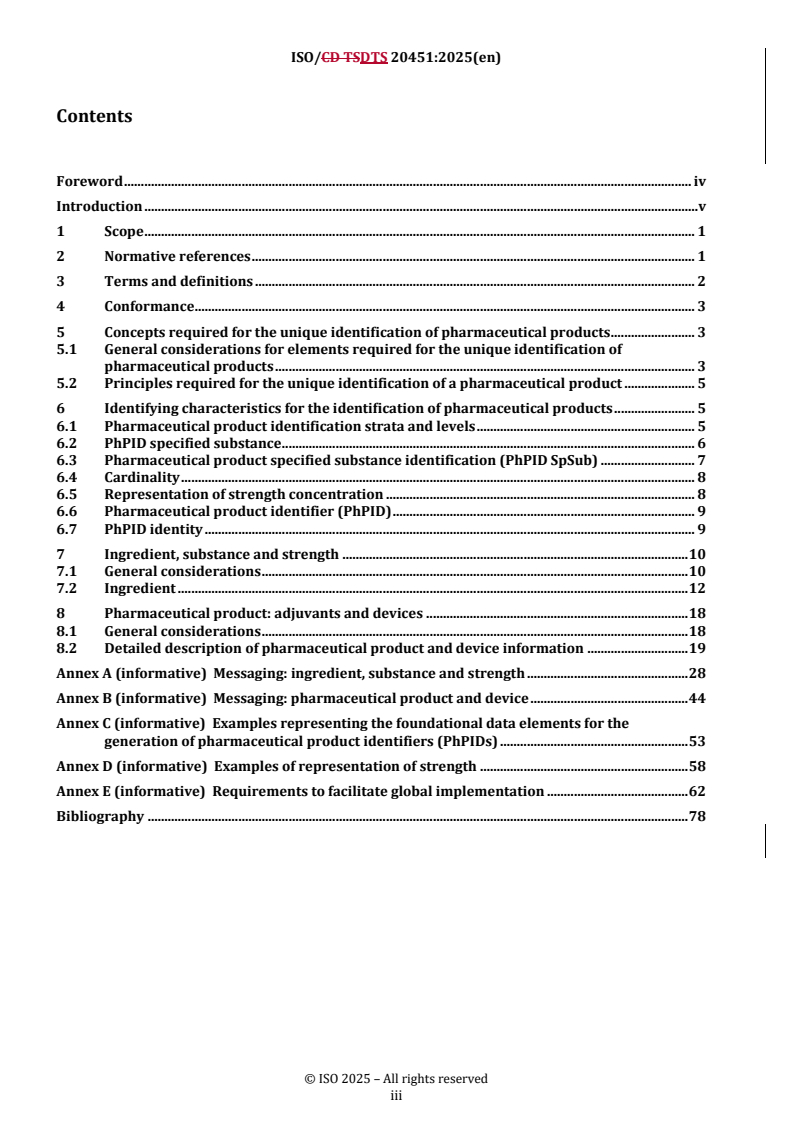
Contents Page
Foreword .v
Introduction .vi
1 Scope . 1
2 Normative references . 1
3 Terms and definitions . 2
4 Conformance . 2
5 Concepts required for the unique identification of pharmaceutical products . 2
5.1 General considerations for elements required for the unique identification of
pharmaceutical products .2
5.2 Principles required for the unique identification of a pharmaceutical product .3
6 Identifying characteristics for the identification of pharmaceutical products . 4
6.1 Pharmaceutical product identification strata and levels .4
6.2 PhPID specified substance .5
6.3 Pharmaceutical product specified substance identification (PhPID SpSub) .6
6.4 Cardinality.6
6.5 Representation of strength concentration .7
6.6 Pharmaceutical product identifier (PhPID) .7
6.7 PhPID identity .7
7 Ingredient, substance and strength . 8
7.1 General considerations.8
7.2 Ingredient.10
7.2.1 Ingredient role .10
7.2.2 Substance .11
7.2.3 Specified substance .11
7.2.4 Specified substance group .11
7.2.5 Confidentiality indicator . 12
7.2.6 Strength . 12
7.2.7 Pharmaceutical product code concept for representing the normalised strength
for liquid preparations . 13
7.2.8 Strength (presentation) . 13
7.2.9 Strength (concentration) . 13
7.2.10 Measurement point .14
7.2.11 Country .14
7.2.12 Reference strength .14
7.2.13 Reference substance . 15
7.2.14 Reference specified substance . 15
7.2.15 Reference strength measurement point. 15
7.2.16 Reference strength country . 15
8 Pharmaceutical product: adjuvants and devices .16
8.1 General considerations.16
8.2 Detailed description of pharmaceutical product and device information .16
8.2.1 General .16
8.2.2 Pharmaceutical product .19
Annex A (informative) Messaging: ingredient, substance and strength .23
Annex B (informative) Messaging: pharmaceutical product and device.37
Annex C (informative) Examples representing the foundational data elements for the
generation of pharmaceutical product identifiers (PhPIDs) .45
Annex D (informative) Examples of representation of strength .50
Annex E (informative) Requirements to facilitate global implementation .54
iii
Bibliography .66
iv
Foreword
ISO (the International Organization for Standardization) is a worldwide federation of national standards
bodies (ISO member bodies). The work of preparing International Standards is normally carried out through
ISO technical committees. Each member body interested in a subject for which a technical committee
has been established has the right to be represented on that committee. International organizations,
governmental and non-governmental, in liaison with ISO, also take part in the work. ISO collaborates closely
with the International Electrotechnical Commission (IEC) on all matters of electrotechnical standardization.
The procedures used to develop this document and those intended for its further maintenance are described
in the ISO/IEC Directives, Part 1. In particular, the different approval criteria needed for the different types
of ISO documents should be noted. This document was drafted in accordance with the editorial rules of the
ISO/IEC Directives, Part 2 (see www.iso.org/directives).
ISO draws attention to the possibility that the implementation of this document may involve the use of (a)
patent(s). ISO takes no position concerning the evidence, validity or applicability of any claimed patent
rights in respect thereof. As of the date of publication of this document, ISO had not received notice of (a)
patent(s) which may be required to implement this document. However, implementers are cautioned that
this may not represent the latest information, which may be obtained from the patent database available at
www.iso.org/patents. ISO shall not be held responsible for identifying any or all such patent rights.
Any trade name used in this document is information given for the convenience of users and does not
constitute an endorsement.
For an explanation of the voluntary nature of standards, the meaning of ISO specific terms and expressions
related to conformity assessment, as well as information about ISO's adherence to the World Trade
Organization (WTO) principles in the Technical Barriers to Trade (TBT), see www.iso.org/iso/foreword.html.
This document was prepared by Technical Committee ISO/TC 215, Health informatics, in collaboration with
the European Committee for Standardization (CEN) Technical Committee CEN/TC 215, Health informatics, in
accordance with the Agreement on technical cooperation between ISO and CEN (Vienna Agreement).
[1]
This second edition cancels and replaces the first edition (ISO/TS 20451:2017 ), which has been technically
revised.
The main changes are as follows:
[2]
— alignment with the changes done in the first revision of ISO 11616 ;
— addition of the concept for global PhPID (gPhPID).
Any feedback or questions on this document should be directed to the user’s national standards body. A
complete listing of these bodies can be found at www.iso.org/members.html.
v
Introduction
[2]
This document provides guidelines and requirements for implementing ISO 11616 , one of the five ISO
1)
standards on the identification of medicinal products (IDMP) . The five ISO standards on IDMP and the
corresponding four ISO Technical Specifications, when used together, provide the basis for exchanging data
elements that will support the unique and unambiguous identification of medicinal products. The primary
purpose of this document is to provide technical guidance to software implementers; short descriptions
of business rationale are also included, where relevant, to provide context. Thus, this document focuses
on business and technical considerations for implementation that will construct and parse well-formed,
transmittable IDMP messages. Following transmission of required data elements, unique identifiers are to
be produced in conformance with the standards to support applications where it is necessary to reliably
identify and trace regulated biopharmaceutical products. However, this document does not include
extensive information on creation or maintenance of identifier repositories. Reference is made to either
regional guidance or implementation guides to support practical implementation within either a region or a
[7]
jurisdiction. ISO/TR 14872 describes the general core principles and proposed service delivery model for
supporting implementation and ongoing maintenance of IDMP terminologies.
[3] [2] [4] [5] [6]
1) ISO 11615 , ISO 11616 , ISO 11238 , ISO 11239 , ISO 11240 .
vi
FINAL DRAFT Technical Specification ISO/DTS 20451:2025(en)
Health informatics — Identification of medicinal products —
Implementation for ISO 11616 data elements and structures
for the unique identification and exchange of regulated
pharmaceutical product information
1 Scope
This document provides requirements and recommendations related to the concepts required to associate
pharmaceutical products or groups of pharmaceutical products with an appropriate set of PhPID(s) in
[2]
accordance with ISO 11616 .
Pharmaceutical product identifiers and the related elements are intended to represent pharmaceutical
products as defined within a medicinal product by a medicines regulatory authority. While the ISO standards
on IDMP can be applied to off-label usage of medicinal products, such applications are currently outside of
the scope of this document.
[4] [5] [6] [3]
Reference to ISO 11238 , ISO 11239 , ISO 11240 , ISO 11615 , HL7 V3 messaging standards (HL7
[8] [9]
Reference Information Model (RIM) , HL7 Common Product Model (CPM) and HL7 V3 Structured Product
[10] [11]
Labelling (SPL) , and HL7 FHIR can be applied for pharmaceutical product information in the context of
this document.
2 Normative references
The following documents are referred to in the text in such a way that some or all of their content constitutes
requirements of this document. For dated references, only the edition cited applies. For undated references,
the latest edition of the referenced document (including any amendments) applies.
ISO 11238, Health informatics — Identification of medicinal products — Data elements and structures for the
unique identification and exchange of regulated information on substances
ISO 11239, Health informatics — Identification of medicinal products — Data elements and structures for the
unique identification and exchange of regulated information on pharmaceutical dose forms, units of presentation,
routes of administration and packaging
ISO 11240, Health informatics — Identification of medicinal products — Data elements and structures for the
unique identification and exchange of units of measurement
ISO 11615, Health informatics — Identification of medicinal products — Data elements and structures for the
unique identification and exchange of regulated medicinal product information
ISO 11616, Health informatics — Identification of medicinal products — Data elements and structures for
unique identification and exchange of regulated pharmaceutical product information
ISO/TS 19844, Health informatics — Identification of medicinal products (IDMP) — Implementation guidelines
for ISO 11238 for data elements and structures for the unique identification and exchange of regulated
information on substances
ISO/TS 20440, Health informatics — Identification of medicinal products — Implementation guidelines for
ISO 11239 data elements and structures for the unique identification and exchange of regulated information on
pharmaceutical dose forms, units of presentation, routes of administration and packaging
ISO/TS 20443, Health informatics — Identification of medicinal products — Implementation guidelines for ISO
11615 data elements and structures for the unique identification and exchange of regulated medicinal product
information
ISO 21090, Health informatics — Harmonized data types for information interchange
3 Terms and definitions
No terms and definitions are listed in this document.
ISO and IEC maintain terminology databases for use in standardization at the following addresses:
— ISO Online browsing platform: available at https://www.iso.org/obp
— IEC Electropedia: available at https://www.electropedia.org/
4 Conformance
— Mandatory: Defining elements necessary for the unique identification of Medicinal Products per the ISO
IDMP standards and technical specifications.
— Conditional: Applies to the “within category” data elements, as applicable, when there are alternative
data sources for a given data element(s) to identify medicinal and pharmaceutical products. Regional
implementation of the ISO IDMP standards and technical specifications may elevate the conditional
conformance categories to “mandatory” per regional requirements.
— Optional: When listed at the category level (e.g. specified substance), optional corresponds to ISO
categories or data elements that are not absolutely necessary for the unique identification of medicinal
or pharmaceutical products according to the ISO IDMP standards and technical specifications. Regional
implementation of the ISO IDMP standards and technical specifications may elevate the optional
conformance categories to “mandatory” or “conditional” per regional requirements.
5 Concepts required for the unique identification of pharmaceutical products
5.1 General considerations for elements required for the unique identification of
pharmaceutical products
Clause 5, along with Annex A and Annex B, describes the elements and messaging required to uniquely
identify and characterize a pharmaceutical product. It provides the requirements to support pharmaceutical
product identification. Examples are given in Annex C.
2)
The information modelling in this document uses the Unified Modelling Language (UML) , which is
3)
maintained by OMG (Object Management Group) .
Figure 1 shows the pharmaceutical product identification (PhPID) detailed model.
Pharmaceutical product identification (PhPID) shall be based on the following subset of elements that
describe the pharmaceutical product.
2) https://www.uml.org/
3) https://www.omg.org/about/omg-standards-introduction.htm
class
PhPID_SUB
Substance Set
1.*
+ ID: II
+ Substance: CD
+ Name: ST
+ Role: CD
+ Administrable Dose Form: CD [0.1]
+ Confidentiality Indicator: CD [0.1]
+ Strength (Concentration): RTO [0.1]
+ Strength (Presentation): RTO [0.1]
+ Unit of Presentation: CD [0.1]
1.*
Reference Strength
PhPID Set
Medical Device
+ Reference Substance: CD [0.1]
+ Reference Specified Substance: CD [0.1]
+ ID: II
+ Reference Strength: RTO
0.*
+ Name: ST
+ Reference Strength Measurement Point: ST [0.1]
+ Reference Strength Country: CD [0.*]
1.*
PhPID_SpSUB
0.4
+ ID: II
+ Name: ST
Specified Substance Set
1.*
+ Administrable Dose Form: CD [0.1]
+ Specified Substance: CD [1.3]
+ Strength (Concentration): RTO [0.1]
+ Role: CD
+ Strength (Presentation): RTO [0.1]
+ Confidentiality Indicator: CD [0.1]
+ Unit of Presentation: CD [0.1]
This can either be omitted
or has to have all 4. In
effect "(0 or 4)".
Key
1 substance stratum
2 specified substance stratum
3 strengths
Figure 1 — Pharmaceutical product identification (PhPID) detailed model
a) active substance(s) or specified substance(s);
NOTE The substance(s) within the ingredient role “active” and “adjuvant” are utilised to define PhPID.
b) strength(s), strength units (units of measurement or unit of presentation, or both);
c) reference strength(s) includes reference substance(s) (i.e. active moiety and its corresponding strength);
d) administrable dose form;
e) medical device, when it is a component of a Medicinal Product.
5.2 Principles required for the unique identification of a pharmaceutical product
The following principles for the unique identification of a pharmaceutical product shall apply:
a) a medicinal product may relate to one or more pharmaceutical products as part of a treatment regime
[e.g. a kit, which might be a combination pack containing vaginal tablets (500 mg) and an external
vaginal cream (10 %)];
b) the characterization of the pharmaceutical product(s) based on the active substance(s) or specified
substance(s), the (reference) strength thereof, the administrable dose form(s), and the medical device
(e.g. a scaffolding for cell-based products) being part of the Medicinal Product (e.g. drug-device
combination);
c) the description of the pharmaceutical product(s) in the pharmaceutical dose form approved for
administration, where applicable, after reconstitution and as authorized in accordance with the
regulated product information;
d) the association of the regulated (investigational) medicinal product and the pharmaceutical product(s)
using the PhPID(s).
6 Identifying characteristics for the identification of pharmaceutical products
6.1 Pharmaceutical product identification strata and levels
As per ISO 11616, PhPID sets shall be represented within two strata (active substance stratum and specified
substance stratum), both of which contain four PhPID identification levels, for each pharmaceutical product
contained in a Medicinal Product.
PhPID sets shall be generated using the substance part according to ISO 11238 and ISO/TS 19844,
the strength and administrable dose form part as per ISO 11239 and ISO/TS 20440, and the unit(s) of
measurement part as per ISO 11240, and as illustrated in Table 1.
Reference strength shall be repeated in both PhPID strata. The reference strength shall be derived from the
active moiety/moieties of an active substance(s) depending on the specific product characteristics.
All the PhPID strata can be described at four different levels from 1 to 4 as shown in Table 1.
Table 1 — Four levels of PhPID
PhPID_SUB_L1 → substance(s)
PhPID_SUB_L2 → substance(s) + strength + reference strength
PhPID active substance stratum
PhPID_SUB_L3 → substance(s) + administrable dose form
PhPID_SUB_L4 → substance(s) + strength + reference strength +
administrable dose form
PhPID_SpSUB_L1 → specified substance(s)
PhPID_SpSUB_L2 → specified substance(s) + strength + reference
strength
PhPID specified substance stratum
PhPID_SpSUB_L3 → specified substance(s) + administrable dose form
PhPID_SpSUB_L4 → specified substance(s) + strength + reference
strength + administrable dose form
A pharmaceutical product may refer to a drug that is associated with a medical device. In this instance, the
device term and term ID (i.e. unique device identifier) shall be displayed with the active substance(s) and
specified substance(s) terms for the product at all applicable PhPID levels. This association shall be made
by directly associating the assigned PhPIDs to a Medicinal Product and its corresponding MPID-PCID as
outlined in ISO 11615 and ISO/TS 20443.
Strength is not applicable to a device.
A region may further refine the requirements in relation to specification of the medical device as part of this
document at implementation so that this information is to be specified only if required.
A pharmaceutical product may refer to a drug that is associated with an adjuvant (e.g. vaccine). In this
instance, the adjuvant term and term ID shall be displayed as s separate active substance(s) or specified
substance(s) terms for the product at all applicable PhPID levels. This association shall be made by directly
associating the assigned PhPIDs to a medicinal product and its corresponding MPID and PCID as outlined in
ISO 11615 and ISO/TS 20443.
Strength shall indicate quantity, unit of measurement and/or unit of presentation.
Administrable dose form is derived from the pharmaceutical product.
Placebos shall be captured as active substances when utilised as a comparator. Regional implementation
guides will provide more information as some regional regulation defines what is considered a placebo or
active substance.
NOTE The classification of a placebo as an “active substance” in this context is for data management purposes
only and does not imply pharmacological activity.
6.2 PhPID specified substance
[4]
As described in ISO 11238 , specified substance(s) shall capture detailed characteristics of single
substances or the composition of material that contains multiple substances or multiple physical forms.
The elements necessary to define specified substances shall be divided into four groups of elements to
facilitate implementation. These groups are described as follows.
— Specified Substance Group 1. These elements shall be used to describe material that contains multiple
substances, solvents used in the preparation of herbal or allergenic extracts, specific marker or signature
substances present in plant or animal derived materials, the physical form of a substance, when relevant,
and any properties essential to the description of the material.
The element groups used to define a Specified Substance Group 1 shall include constituents, physical
form and property.
NOTE 1 This grouping of elements allows for the definitions of many materials in commerce that are used in
the formulation of Medicinal Products.
— Specified Substance Group 2. These elements shall be used to capture the manufacturer of either a
substance or Specified Substance Group 1 along with minimal manufacturing information.
The minimal manufacturing information shall include the overall production method type (i.e. synthetic,
extractive, recombinant), production system type (i.e. cell line, plant or animal tissue) and production
system (specific cell line).
NOTE 2 Group 2 elements allows the tracking of the substance to the manufacturer. They also allow the
distinguishing of synthetic peptides from recombinant peptides and the capture of the product cell line.
— Specified Substance Group 3. These elements shall capture the grade of the material along with the
source that defines the given grade.
Group 3 elements shall be used to distinguish specific pharmacopoeia grades and technical grades of
material.
The grade for each pharmacopoeia shall be a separate substance if a pharmacopoeia monograph related
to a substance is not harmonized.
NOTE 3 For most active pharmaceutical substances, generally recognised pharmacopoeias are USP, Ph., Eur. or
JP. For herbal substances, the grades would be standardised, quantified and unstandardised.
— Specified Substance Group 4. These elements shall contain the most detailed information on a substance.
This information shall include critical manufacturing processes, specifications (e.g. impurities and
related substance limits would be captured using constituents), unitage, reference material and
analytical methods used for potency determination.
NOTE 4 The specific information described for Specified Substance Group 4 is often submitted in regulatory
submissions in an unstructured manner that is difficult to capture and organize. The fields developed here will
attempt to organize and structure the data in a manner that will facilitate its use in both review and compliance
activities. It is anticipated that the suite of ISO IDMP standards will extend into more granular regulatory content
as adoption increases by stakeholders and the standards extend deeper into additional regulatory and clinical
use cases over time.
6.3 Pharmaceutical product specified substance identification (PhPID SpSub)
The PhPIDs for specified substance(s) shall be generated from three of the four groups (Specified Substance
Groups 1, Specified Substance Group 2, Specified Substance Group 3) described in ISO 11238 and ISO/TS
19844.
Specified Substance Groups 1, 2, and 3 contain necessary data elements for more detailed pharmaceutical
product identification which supports the scope and purpose of this document.
Specified Substance Groups 1, 2, and 3, as assigned to an active substance(s), shall be utilised within this
document for pharmaceutical product identification with corresponding PhPIDs attributed as applicable.
Specified Substance Group 4 is a more comprehensive level of substance identification that is not necessary
for the purposes of pharmaceutical product identification and shall not be utilised for PhPID generation.
Specified substance information shall be represented with the active substance(s) elements within a
pharmaceutical product and within a Specified Substance Group 1, as applicable.
Groups 2 and 3 shall be associated directly with the active substance(s) of a pharmaceutical product and to a
Specified Substance Group 1 as applicable.
[12]
ISO/TS 19844 addresses the assignment and association of specified substance groups for defined
[4] [12]
product classes. See ISO 11238 and ISO/TS 19844 for detailed information related to substance and
specified substance elements and identification.
A region may further refine the requirements in relation to specification of specified substances as part of
this document at implementation such that this information is to be specified only if required.
6.4 Cardinality
The relationships within the elements of a pharmaceutical product shall respect the following cardinality:
— a PhPID has one administrable dose form (cardinality relationship: 1.1);
NOTE 1 gPhPID utilizes the four dose form attributes.
— a PhPID may have zero to one unit of presentation (cardinality relationship: 0.1);
NOTE 2 This is often used specifically at the point of delivery to the patient in cases where a quantitative unit
of measurement is not applicable.
— a PhPID has one or more active substances (cardinality relationship: 1.*);
— a PhPID has one or more active specified substances (cardinality relationship: 1.*);
— a PhPID has one strength (cardinality relationship: 1.1) based on one to many active substances or
specified substances (cardinality relationship: 1.*);
NOTE 3 The same quantitative value for strength can be expressed in multiple units according to regional
implementation (e.g. mg/g, % w/w).
For liquid preparations, the strength (presentation) and strength (concentration) shall both be
represented.
A separate PhPID shall be generated to represent the strength concentration, i.e. per unit volume as
applicable. This shall be known as the product code concept as it represents a calculation of the strength
presentation of a liquid preparation (i.e. total volume per container) as authorized by a medicines
regulatory agency.
— a PhPID has one to many reference strengths (i.e. active moieties with a corresponding strength)
(cardinality relationship: 1.*) as it relates to the strength of one to many active substances/specified
substances (cardinality relationship: 1.*).
NOTE 4 For gPhPID, the strength of the active ingredient is expressed by means of presentation strength or
concentration strength, or both, depending on product type as specified in the business rules for gPhPID.
6.5 Representation of strength concentration
For liquid preparations, strength shall be represented by both the total volume of the container as authorized
by a medicines regulatory authority using strength (presentation) and strength concentration per unit
volume (e.g. 1 ml) using strength (concentration). For PhPID generation and assignment, the strength
shall be expressed per total volume per container (MPID and PCID) with the corresponding strength
concentration per unit volume represented in every instance of PhPID Levels 2 and 4. Both representations
shall be considered mandatory elements when illustrating the strength of a pharmaceutical product.
The labelled volume should be used rather than the manufactured volume, as it reflects the quantity
intended for patient use and aligns with regulatory and pharmacopoeia standards.
The strength concentration per unit volume shall be calculated from the strength per total volume of the
container and presented at all PhPID levels where strength is represented in accordance with the product
authorization by a medicines regulatory agency.
See Annex D for examples of representation of strength.
6.6 Pharmaceutical product identifier (PhPID)
The PhPID is a unique identifier assigned at the level of the pharmaceutical product and utilises the
identifying characteristics as outlined in 6.7. For products that need to be obtained after any necessary
transformation in accordance with the authorization by a medicines regulatory authority before they can be
administered, the PhPID shall refer to the characteristics of the product after reconstitution.
NOTE For more detailed information regarding the specific data elements classifying a particular substance(s)
[4] [12]
and specified substance(s), see ISO 11238 and ISO/TS 19844 . The details of these elements are defining
attributes for pharmaceutical product identification and assignment of PhPIDs.
6.7 PhPID identity
[13]
The PhPID identity can be created using the requirements specified in ISO/IEC 15459-3 , using a qualifier
followed by a string and a check character.
— Qualifier
The first five characters are called the qualifier and will always be the text “PHPID”.
— String
The middle twelve characters are a string built up of random digits and letters using the following
requirements:
— There are 32 valid characters: 0 1 2 3 4 5 6 7 8 9 A B C D E F G H J K L M N P R S T U V X Y Z.
— Maximum three sequential letters.
— Maximum three sequential digits.
— First position shall always be a digit of 1 to 9.
— Last position shall be a digit (0 to 9) if the two previous are letters.
— Check character
The last character is a check character built on the “Luhn mod N algorithm” used to detect errors in the
string.
Table 2 shows an example of a PhPID identity combining the qualifier, a string, and a check character.
Table 2 — Example of a PhPID identity combining the qualifier, a string and a check character
Identity
Qualifier String Check character
PhPID 6NT3YNT5L8BL 7
The human readable PhPID nomenclature shall be represented by the non-proprietary name (e.g. INN, USAN)
of the pharmaceutical product, active substance(s), pharmaceutical dose form, strength, and reference
strength. In addition, the adjuvant and device name can be described as part of the PhPID nomenclature as
applicable.
NOTE For examples of PhPID for products containing adjuvant(s) and device(s), refer to regional implementation
guides.
7 Ingredient, substance and strength
7.1 General considerations
Clause 7 describes the ingredients of the pharmaceutical product through its representations as the
[3]
manufactured item(s) as indicated within a jurisdiction (see ISO 11615 ) and the pharmaceutical
product(s).
The ingredients class and associated active substance, specified substance, strength and reference strength
classes are used in the further description of manufactured item as indicated within a jurisdiction (see ISO
[3]
11615 ) and pharmaceutical product class, as shown in Figure 2.
Any active substance(s) or specified substance(s) shall have its strength specified in accordance with
the pharmaceutical product information as applicable. Additionally, strength can be further specified
by description of reference strength. This shall be specified where applicable in accordance with the
pharmaceutical product information.
EXAMPLE Paracetamol 600 mg can be represented as 0,6 g in one jurisdiction and 600 mg in another jurisdiction,
but will be assigned identical PhPID sets as the strengths are identical but with different representations.
When described, reference strength shall specify the active substance and specified substance that it
references.
Pharmaceutical products and their ingredients as well as the device and adjuvant ingredients of interest are
represented within the UML model in the manner shown in Figure 2.
Each device shall be uniquely identified using the regionally defined nomenclature.
Figure 2 — Ingredients, substance and strength section detailed description diagram
Information messaging exchange relating to ingredient, substance and strength can be in accordance with
Annex A.
class Ingredients & Substances Detailed Description
Substance
Manufactured
Item
- Substance: CD
0.1
1.*
1.*
Reference Strength
Ingredient Strength
One of either
- Reference Substance: CD [0.1]
Substance or
+ Ingredient Role: CD + Strength (Presentation): RTO
- Reference Specified Substance: CD [0.1]
Specified Substance
+ Allergenic Indicator: BL [0.1] + Strength (Concentration): RTO [0.1]
0.*
- Reference Strength Range: RTO
must be present
+ Measurement Point: ST [0.1]
- Reference Strength Measurement Point: ST [0.1]
+ Country: CD [0.*]
- Reference Strength Country: CD [0.*]
1.*
0.*
0.*
Pharmaceutical
Product
Must be a Reference
Strength when it is an
Specified Substance
active ingredient
- Specified Substance: CD
- Specified Substance Group: CD
- Confidentiality Indicator: CD [0.1]
7.2 Ingredient
7.2.1 Ingredient role
There shall be one instance of the ingredient class for each actual ingredient of either the manufactured
item or pharmaceutical product.
The role of the ingredient as part of the manufactured item/pharmaceutical product shall be captured as
described in Table 3.
Table 3 — Ingredient role
User guidance The role of the ingredient as part of the manufactured item/pharma-
ceutical product shall be specified using an appropriate controlled
vocabulary. The controlled term and a term identifier shall be speci-
fied.
There is a constraint that each ingredient shall be further described
as either an active substance(s) or a specified substance(s).
Examples — Active substance
— Adjuvant
Conformance Mandatory
OID or URL Substance/specified substance code concept per regional implemen-
[4] [12]
tation of ISO 11238 and ISO/TS 19844 .
Table 4 lists the ingredient codes applicable to PhPID; the codes are included in the full upper case letters
exactly as specified in Table 4.
Table 4 — Ingredient roles (classCodes)
Code Description
ACTI Active ingredient — ingredient that has the pharmacological action.
Use only if basis of strength cannot be specified; otherwise, use
ACTIB, ACTIM, or ACTIR.
ACTIB Active ingredient, where the entire substance is the basis of strength,
e.g. propranolol hydrochloride quantified as the propranolol hydro-
chloride salt.
ACTIM Active ingredient, where the active moiety is the basis of strength,
e.g. amoxicillin trihydrate equivalent to 250 mg anhydrous amoxicil-
lin.
ACTIR Active ingredient, where another reference substance is the basis of
strength, e.g. metoprolol succinate quantified by amount of metoprolol
tartrate with the equal amount of metoprolol active moiety.
ADJV Adjuvant, ingredient which augments or promotes the pharmacolog-
ical effect of the active ingredient(s) without itself being considered
active (typically used with vaccines).
NOTE 1 Placebo is a substance or combination of substances resulting in a pharmaceutical product without
intended pharmacological effect on the health condition.
NOTE 2 Placebo does not include any active substance (substance of physiological or pharmacological action, ISO
[14]
19609-2:2021 , 3.1).
NOTE 3 Having no effect on the health condition, placebo is often used as control substance in controlled clinical
trials. It can, however, also be used as inactive substance in a sequential therapy, e.g. contraceptive, where active
contraceptive drug is administered during a certain period of time followed by placebo during a period when
contraceptive action is to be avoided. It can also be used as a single “treatment” when the patient gets a prescription
but cannot be subject to pharmacological effect.
7.2.2 Substance
A substance can be specified for an ingredient in the role described, see
...
ISO/TC 215
ISO/CD TS 20451(en)
Secretariat: ANSI
Date: 2025-12-16
Health informatics — Identification of medicinal products —
Implementation for ISO 11616 data elements and structures for the
unique identification and exchange of regulated pharmaceutical
product information
This draft is submitted to a parallel vote in ISO, CEN.
ISO/CD TSDTS 20451:2025(en)
All rights reserved. Unless otherwise specified, or required in the context of its implementation, no part of this publication
may be reproduced or utilized otherwise in any form or by any means, electronic or mechanical, including photocopying,
or posting on the internet or an intranet, without prior written permission. Permission can be requested from either ISO
at the address below or ISO’s member body in the country of the requester.
ISO copyright office
CP 401 • Ch. de Blandonnet 8
CH-1214 Vernier, Geneva
Phone: + 41 22 749 01 11
E-mail: copyright@iso.org
Website: www.iso.org
Published in Switzerland
ii
ISO/CD TSDTS 20451:2025(en)
Contents
Foreword . iv
Introduction . v
1 Scope . 1
2 Normative references . 1
3 Terms and definitions . 2
4 Conformance . 3
5 Concepts required for the unique identification of pharmaceutical products . 3
5.1 General considerations for elements required for the unique identification of
pharmaceutical products . 3
5.2 Principles required for the unique identification of a pharmaceutical product . 5
6 Identifying characteristics for the identification of pharmaceutical products . 5
6.1 Pharmaceutical product identification strata and levels . 5
6.2 PhPID specified substance . 6
6.3 Pharmaceutical product specified substance identification (PhPID SpSub) . 7
6.4 Cardinality . 8
6.5 Representation of strength concentration . 8
6.6 Pharmaceutical product identifier (PhPID) . 9
6.7 PhPID identity . 9
7 Ingredient, substance and strength . 10
7.1 General considerations . 10
7.2 Ingredient . 12
8 Pharmaceutical product: adjuvants and devices . 18
8.1 General considerations . 18
8.2 Detailed description of pharmaceutical product and device information . 19
Annex A (informative) Messaging: ingredient, substance and strength . 28
Annex B (informative) Messaging: pharmaceutical product and device . 44
Annex C (informative) Examples representing the foundational data elements for the
generation of pharmaceutical product identifiers (PhPIDs) . 53
Annex D (informative) Examples of representation of strength . 58
Annex E (informative) Requirements to facilitate global implementation . 62
Bibliography . 78
iii
ISO/CD TSDTS 20451:2025(en)
Foreword
ISO (the International Organization for Standardization) is a worldwide federation of national standards
bodies (ISO member bodies). The work of preparing International Standards is normally carried out through
ISO technical committees. Each member body interested in a subject for which a technical committee has been
established has the right to be represented on that committee. International organizations, governmental and
non-governmental, in liaison with ISO, also take part in the work. ISO collaborates closely with the
International Electrotechnical Commission (IEC) on all matters of electrotechnical standardization.
The procedures used to develop this document and those intended for its further maintenance are described
in the ISO/IEC Directives, Part 1. In particular, the different approval criteria needed for the different types of
ISO documents should be noted. This document was drafted in accordance with the editorial rules of the
ISO/IEC Directives, Part 2 (see www.iso.org/directives).
Attention is drawnISO draws attention to the possibility that some of the elementsimplementation of this
document may beinvolve the subjectuse of (a) patent(s). ISO takes no position concerning the evidence,
validity or applicability of any claimed patent rights in respect thereof. As of the date of publication of this
document, ISO had not received notice of (a) patent(s) which may be required to implement this document.
However, implementers are cautioned that this may not represent the latest information, which may be
obtained from the patent database available at www.iso.org/patents. ISO shall not be held responsible for
identifying any or all such patent rights. Details of any patent rights identified during the development of the
document will be in the Introduction and/or on the ISO list of patent declarations received (see ).
Any trade name used in this document is information given for the convenience of users and does not
constitute an endorsement.
For an explanation onof the voluntary nature of standards, the meaning of ISO specific terms and expressions
related to conformity assessment, as well as information about ISO's adherence to the World Trade
Organization (WTO) principles in the Technical Barriers to Trade (TBT)), see the following URL:
www.iso.org/iso/foreword.html.
This document was prepared by Technical Committee ISO/TC 215, Health informatics., in collaboration with
the European Committee for Standardization (CEN) Technical Committee CEN/TC 215, Health informatics, in
accordance with the Agreement on technical cooperation between ISO and CEN (Vienna Agreement).
This second edition cancels and replaces the first edition (ISO/TS 20451(CEN ISO/TS 20451:2018),), which
has been technically revised.
The main changes compared to the previous edition are as follows:
— - alignment with the changes done in the first revision of ISO 11616ISO 11616.;
— - addition of the concept for global PhPID (gPhPID).
Any feedback or questions on this document should be directed to the user’s national standards body. A
complete listing of these bodies can be found at: www.iso.org/members.html.
iv
ISO/CD TSDTS 20451:2025(en)
Introduction
This document provides guidelines and requirements for implementing ISO 11616ISO 11616,, one of the five
1)
ISO standards on the identification of medicinal products (IDMP standards) . The five ISO standards on IDMP
Standards and theirthe corresponding four ISO Technical Specifications, when used together, provide the basis
for exchanging data elements that will support the unique and unambiguous identification of medicinal
products. The primary purpose of this document is to provide technical guidance to software implementers;
short descriptions of business rationale are also included, where relevant, to provide context. Thus, this
document focuses on business and technical considerations for implementation that will construct and parse
well-formed, transmittable IDMP messages. Following transmission of required data elements, unique
identifiers are to be produced in conformance with the standards to support applications where it is necessary
to reliably identify and trace regulated biopharmaceutical products. However, this document does not include
extensive information on creation or maintenance of identifier repositories. Reference is made to either
regional guidance or implementation guides to support practical implementation within either a region or a
jurisdiction. ISO/TR 14872The describes the general core principles and proposed service delivery model for
supporting implementation and ongoing maintenance of IDMP terminologies (currently under revision).
1) 1)
ISO 11615, ISO 11616, ISO 11238, ISO 11239, ISO 11240. ISO 11615, ISO 11616, ISO 11238, ISO 11239:2023, ISO
11240:2012
v
ISO/CD TSDTS 20451:2025(en)
Health informatics — Identification of medicinal products —
Implementation for ISO 11616 data elements and structures for the
unique identification and exchange of regulated pharmaceutical
product information
1 Scope
This document provides requirements and recommendations related to the concepts required to associate
pharmaceutical products or groups of pharmaceutical products with an appropriate set of PhPID(s) in
accordance with ISO 11616ISO 11616 .
Pharmaceutical product identifiers and the related elements are intended to represent pharmaceutical
products as defined within a medicinal product by a Medicines Regulatory Authority.medicines regulatory
authority. While the ISO IDMP standards on IDMP can be applied to off-label usage of medicinal products, such
applications are currently outside of the scope of this document.
Reference to ISO 11238, ISO 11239, ISO 11240, ISO 11615ISO 11238, ISO 11239:2023, ISO 11240:2012, ISO
[8]
11615,, HL7 V3 messaging standards (HL7 Reference Information Model (RIM) , HL7 Common Product
[9] [10] [11]
Model (CPM) and HL7 V3 Structured Product Labelling (SPL) , and HL7 FHIR can be applied for
pharmaceutical product information in the context of this document.
2 Normative references
The following documents are referred to in the text in such a way that some or all of their content constitutes
requirements of this document. For dated references, only the edition cited applies. For undated references,
the latest edition of the referenced document (including any amendments) applies.
ISO 11238, Health informatics — Identification of medicinal products — Data elements and structures for the
unique identification and exchange of regulated information on substances
ISO 11239:2023, Health informatics — Identification of medicinal products — Data elements and structures for
the unique identification and exchange of regulated information on pharmaceutical dose forms, units of
presentation, routes of administration and packaging
ISO 11240:2012, Health informatics — Identification of medicinal products — Data elements and structures for
the unique identification and exchange of units of measurement
ISO 11615, Health informatics — Identification of medicinal products — Data elements and structures for the
unique identification and exchange of regulated medicinal product information
ISO 11616, Health informatics — Identification of medicinal products — Data elements and structures for unique
identification and exchange of regulated pharmaceutical product information
ISO/TS 19844:2018, Health informatics — Identification of medicinal products (IDMP) — Implementation
guidelines for ISO 11238 for data elements and structures for the unique identification and exchange of regulated
information on substances
ISO/TS 19844, Health informatics — Identification of medicinal products (IDMP) — Implementation guidelines
for ISO 11238 for data elements and structures for the unique identification and exchange of regulated
information on substances
ISO/CD TSDTS 20451:2025(en)
ISO/TS 19844, Health informatics — Identification of medicinal products (IDMP) — Implementation guidelines
for ISO 11238 for data elements and structures for the unique identification and exchange of regulated
information on substances
ISO/TS 20440:2023, Health informatics — Identification of medicinal products — Implementation guidelines
for ISO 11239 data elements and structures for the unique identification and exchange of regulated information
on pharmaceutical dose forms, units of presentation, routes of administration and packaging
ISO/TS 20440, Health informatics — Identification of medicinal products — Implementation guidelines for ISO
11239 data elements and structures for the unique identification and exchange of regulated information on
pharmaceutical dose forms, units of presentation, routes of administration and packaging
ISO/TS 20443, Health informatics — Identification of medicinal products — Implementation guidelines for ISO
11615 data elements and structures for the unique identification and exchange of regulated medicinal product
information
EN ISO 11239:2023, Health informatics - Identification of medicinal products - Data elements and structures for
the unique identification and exchange of regulated information on pharmaceutical dose forms, units of
presentation, routes of administration and packaging (ISO 11239:2023)
EN ISO 11239, Health informatics - Identification of medicinal products - Data elements and structures for the
unique identification and exchange of regulated information on pharmaceutical dose forms, units of presentation,
routes of administration and packaging (ISO 11239:2023)
EN ISO 11240, Health informatics - Identification of medicinal products - Data elements and structures for the
unique identification and exchange of units of measurement (ISO 11240:2012)
EN ISO 11240:2012, Health informatics - Identification of medicinal products - Data elements and structures for
the unique identification and exchange of units of measurement (ISO 11240:2012)
EN ISO 11615:2017/A1:2022, Health informatics - Identification of medicinal products - Data elements and
structures for the unique identification and exchange of regulated medicinal product information - Amendment
1 (ISO 11615:2017/Amd 1:2022)
CEN ISO/TS 20451:2018, Health informatics - Identification of medicinal products - Implementation guidelines
for ISO 11616 data elements and structures for the unique identification and exchange of regulated
pharmaceutical product information (ISO/TS 20451:2017)
EN ISO 21090, Health Informatics -informatics — Harmonized data types for information interchange (ISO
21090:2011)
3 Terms and definitions
No terms and definitions are listed in this document.
ISO and IEC maintain terminologicalterminology databases for use in standardization at the following
addresses:
IEC Electropedia: available at — ISO Online browsing platform: available at https://www.iso.org/obp
— IEC Electropedia: available at https://www.electropedia.org/
ISO/CD TSDTS 20451:2025(en)
4 Conformance
— Mandatory: Defining elements necessary for the unique identification of Medicinal Products per the ISO
IDMP standards/ and technical specifications.
— Conditional: Conditional appliesApplies to the “within category” data elements, as applicable, when there
are alternative data sources for a given data element(s) to identify medicinal and pharmaceutical products.
Regional implementation of the ISO IDMP standards/ and technical specifications may elevate the
conditional conformance categories to “mandatory” per regional requirements.
— Optional: When listed at the category level (e.g. specified substance), optional corresponds to ISO
categories or data elements that are not absolutely necessary for the unique identification of medicinal/
or pharmaceutical products according to the ISO IDMP standards/ and technical specifications. Regional
implementation of the ISO IDMP standards/ and technical specifications may elevate the optional
conformance categories to “mandatory” or “conditional” per regional requirements.
5 Concepts required for the unique identification of pharmaceutical products
5.1 General considerations for elements required for the unique identification of
pharmaceutical products
Clause 5, along with Annex A and Annex B, describes the elements and messaging required to uniquely identify
and characterize a pharmaceutical product. It provides the requirements to support pharmaceutical product
identification. Examples are given in Annex C.
2)
The information modelling in this document uses the Unified Modelling Language (UML) , which is
3)
maintained by OMG (Object Management Group) .
Figure 1 shows the Pharmaceuticalpharmaceutical product identification (PhPID) detailed model.
Pharmaceutical product identification (PhPID) shall be based on the following subset of elements that
describe the pharmaceutical product.
2)
https://www.uml.org/ https://www.uml.org/
3)
https://www.omg.org/about/omg-standards-introduction.htm
ISO/CD TSDTS 20451:2025(en)
class
PhPID_SUB
Legend
Substance Set
1.*
+ ID: II
Substance Stratum
+ Substance: CD
+ Name: ST
+ Role: CD
Specified Substance Stratum
+ Administrable Dose Form: CD [0.1]
+ Confiden�ality Indicator: CD [0.1]
+ Strength (Concentra�on): RTO [0.1]
Strengths
+ Strength (Presenta�on): RTO [0.1]
+ Unit of Presenta�on: CD [0.1]
1.*
Reference Strength
PhPID Set
Medical Device
+ Reference Substance: CD [0.1]
+ Reference Specified Substance: CD [0.1]
+ ID: II
+ Reference Strength: RTO
0.*
+ Name: ST
+ Reference Strength Measurement Point: ST [0.1]
+ Reference Strength Country: CD [0.*]
1.*
PhPID_SpSUB
0.4
+ ID: II
+ Name: ST
Specified Substance Set
1.*
+ Administrable Dose Form: CD [0.1]
+ Strength (Concentra�on): RTO [0.1] + Specified Substance: CD [1.3]
+ Role: CD
+ Strength (Presenta�on): RTO [0.1]
+ Confiden�ality Indicator: CD [0.1]
+ Unit of Presenta�on: CD [0.1]
This can either be omi�ed
or has to have all 4. In
effect "(0 or 4)".
class
PhPID_SUB
Substance Set
1.*
+ ID: II
+ Substance: CD
+ Name: ST
+ Role: CD
+ Administrable Dose Form: CD [0.1]
+ Con�identiality Indicator: CD [0.1]
+ Strength (Concentration): RTO [0.1]
+ Strength (Presentation): RTO [0.1]
+ Unit of Presentation: CD [0.1]
1.*
Reference Strength
PhPID Set
Medical Device
+ Reference Substance: CD [0.1]
+ Reference Speci�ied Substance: CD [0.1]
+ ID: II
+ Reference Strength: RTO
0.*
+ Name: ST
2 + Reference Strength Measurement Point: ST [0.1]
+ Reference Strength Country: CD [0.*]
1.*
PhPID_SpSUB
0.4 + ID: II
+ Name: ST
Specified Substance Set
1.*
+ Administrable Dose Form: CD [0.1]
+ Strength (Concentration): RTO [0.1] + Speci�ied Substance: CD [1.3]
+ Role: CD
+ Strength (Presentation): RTO [0.1]
+ Con�identiality Indicator: CD [0.1]
+ Unit of Presentation: CD [0.1]
This can either be omitted
or has to have all 4. In
effect "(0 or 4)".
Key
1 substance stratum
2 specified substance stratum
3 strengths
Figure 1 — Pharmaceutical product identification (PhPID) detailed model
a) active substance(s)/) or specified substance(s);
NOTE The substance(s) within the ingredient role "“active"” and "“adjuvant"” are utilised to define PhPID.
b) strength(s), strength units (units of measurement and/or unit of presentation, or both);
c) reference strength(s) includes reference substance(s) (i.e. active moiety and its corresponding strength);
ISO/CD TSDTS 20451:2025(en)
d) administrable dose form;
e) medical device, when it is a component of a Medicinal Product.
5.2 Principles required for the unique identification of a pharmaceutical product
The following principles for the unique identification of a pharmaceutical product shall apply:
a) a medicinal product may relate to one or more pharmaceutical products as part of a treatment regime
[e.g. a kit, which might be a combination pack containing vaginal tablets (500 mg) and an external vaginal
cream (10 %)];
b) the characterization of the pharmaceutical product(s) based on the active substance(s)/) or specified
substance(s), the (reference) strength thereof, the administrable dose form(s), and the medical device
(e.g. a scaffolding for cell-based products) being part of the Medicinal Product (e.g. drug-device
combination);
c) the description of the pharmaceutical product(s) in the pharmaceutical dose form approved for
administration, where applicable, after reconstitution and as authorized in accordance with the regulated
product information;
d) the association of the regulated (investigational) medicinal product and the pharmaceutical product(s)
using the PhPID(s).
6 Identifying characteristics for the identification of pharmaceutical products
6.1 Pharmaceutical product identification strata and levels
As per ISO 11616, PhPID sets shall be represented within two strata (active substance stratum and specified
substance stratum), both of which contain four PhPID identification levels, for each pharmaceutical product
contained in a Medicinal Product.
PhPID sets shall be generated using the substance part according to ISO 11238 and ISO/TS 19844, the strength
and administrable dose form part as per EN ISO 11239 and ISO/TS 20440),, and the unit(s) of measurement
part as per EN ISO 11240, and as illustrated in Table 1 below.
Reference strength shall be repeated in both PhPID strata. The reference strength shall be derived from the
active moiety/moieties of an active substance(s) depending on the specific product characteristics.
All the PhPID strata can be described at four different levels from 1 to 4 as shown in Table 1.
Table 1 — Four levels of PhPID
PhPID_SUB_L1 → substance(s)
PhPID_SUB_L2 → substance(s) + strength + reference strength
PhPID active substance stratum
PhPID_SUB_L3 → substance(s) + administrable dose form
PhPID_SUB_L4 → substance(s) + strength + reference strength +
administrable dose form
PhPID_SpSUB_L1 → specified substance(s)
PhPID_SpSUB_L2 → specified substance(s) + strength + reference
PhPID specified substance stratum strength
PhPID_SpSUB_L3 → specified substance(s) + administrable dose
form
ISO/CD TSDTS 20451:2025(en)
PhPID_SpSUB_L4 → specified substance(s) + strength + reference
strength + administrable dose form
A pharmaceutical product may refer to a drug that is associated with a medical device. In this instance, the
device term and term ID (i.e. unique device identifier) shall be displayed with the active substance(s) and
specified substance(s) terms for the product at all applicable PhPID levels. This association shall be made by
directly associating the assigned PhPIDs to a Medicinal Product and its corresponding MPID-PCID as outlined
in EN ISO 11615:2017/A1:2022 and ISO/TS 20443.
Strength is not applicable to a device.
A region may further refine the requirements in relation to specification of the medical device as part of this
document at implementation so that this information is to be specified only if required.
A pharmaceutical product may refer to a drug that is associated with an adjuvant (e.g. vaccine). In this instance,
the adjuvant term and term ID shall be displayed as s separate active substance(s) or specified substance(s)
terms for the product at all applicable PhPID levels. This association shall be made by directly associating the
assigned PhPIDs to a medicinal product and its corresponding MPID and PCID as outlined in EN ISO
11615:2017/A1:2022 and ISO/TS 20443.
Strength shall indicate quantity, unit of measurement and/or unit of presentation.
Administrable dose form is derived from the pharmaceutical product.
Placebos shall be captured as active substances when utilised as a comparator. Regional implementation
guides will provide more information as some regional regulation defines what is considered a placebo or
active substance.
NOTE The classification of a placebo as an "“active substance"” in this context is for data management purposes only
and does not imply pharmacological activity.
6.2 PhPID specified substance
As described in ISO 11238,, specified substance(s) shall capture detailed characteristics of single substances
or the composition of material that contains multiple substances or multiple physical forms.
The elements necessary to define specified substances shall be divided into four groups of elements to
facilitate implementation. These groups are described as follows.
— Specified Substance Group 1. These elements shall be used to describe material that contains multiple
substances, solvents used in the preparation of herbal or allergenic extracts, specific marker or signature
substances present in plant or animal derived materials, the physical form of a substance, when relevant,
and any properties essential to the description of the material.
— The element groups used to define a Specified Substance Group 1 shall include constituents, physical
form and property.
NOTE 1 This grouping of elements allows for the definitions of many materials in commerce that are used in the
formulation of Medicinal Products.
— Specified Substance Group 2. These elements shall be used to capture the manufacturer of either a
substance or Specified Substance Group 1 along with minimal manufacturing information.
— The minimal manufacturing information shall include the overall production method type (i.e.
synthetic, extractive, recombinant), production system type (i.e. cell line, plant or animal tissue) and
production system (specific cell line).
ISO/CD TSDTS 20451:2025(en)
NOTE 2 Group 2 elements allows the tracking of the substance to the manufacturer. ItThey also allowsallow the
distinguishing of synthetic peptides from recombinant peptides and the capture of the product cell line.
— Specified Substance Group 3. These elements shall capture the grade of the material along with the source
that defines the given grade.
— Group 3 elements shall be used to distinguish specific pharmacopoeia grades and technical grades of
material.
— The grade for each pharmacopoeia shall be a separate substance if a pharmacopoeia monograph
related to a substance is not harmonized.
NOTE 3 For most active pharmaceutical substances, generally recognised pharmacopoeias are USP, Ph., Eur. or
JP. For herbal substances, the grades would be standardised, quantified and unstandardised.k
— Specified Substance Group 4. These elements shall contain the most detailed information on a substance.
This information shall include critical manufacturing processes, specifications (e.g. impurities and related
substance limits would be captured using constituents), unitage, reference material and analytical
methods used for potency determination.
NOTE 4 The specific information described for Specified Substance Group 4 is often submitted in regulatory
submissions in an unstructured manner that is difficult to capture and organize. The fields developed here will
attempt to organize and structure the data in a manner that will facilitate its use in both review and compliance
activities. It is anticipated that the suite of ISO IDMP standards will extend into more granular regulatory content as
adoption increases by stakeholders and the standards extend deeper into additional regulatory and clinical use cases
over time.
6.3 Pharmaceutical product specified substance identification (PhPID SpSub)
The PhPIDs for specified substance(s) shall be generated from three of the four groups (Specified Substance
Groups 1, Specified Substance Group 2, Specified Substance Group 3) described in ISO 11238 and ISO/TS
19844.
Specified Substance Groups 1, 2, and 3 contain necessary data elements for more detailed pharmaceutical
product identification which supports the scope and purpose of this document.
Specified Substance Groups 1, 2, and 3, as assigned to an active substance(s), shall be utilised within this
document for pharmaceutical product identification with corresponding PhPIDs attributed as applicable.
Specified Substance Group 4 is a more comprehensive level of substance identification that is not necessary
for the purposes of pharmaceutical product identification and shall not be utilised for PhPID generation.
Specified substance information shall be represented with the active substance(s) elements within a
pharmaceutical product and within a Specified Substance Group 1, as applicable.
Groups 2 and 3 shall be associated directly with the active substance(s) of a pharmaceutical product and to a
Specified Substance Group 1 as applicable.
ISO/TS 19844 addresses the assignment and association of specified substance groups for defined product
classes. See ISO 11238 and ISO/TS 19844 for detailed information related to substance and specified
substance elements and identification.
A region may further refine the requirements in relation to specification of specified substances as part of this
document at implementation such that this information is to be specified only if required.
ISO/CD TSDTS 20451:2025(en)
6.4 Cardinality
The relationships within the elements of a pharmaceutical product shall respect the following cardinality:
— a PhPID has one administrable dose form (cardinality relationship: 1.1);
NOTE 1 gPhPID utilizes the four dose form attributes.
— a PhPID may have zero to one unit of presentation (cardinality relationship: 0.1);
NOTE 2 This is often used specifically at the point of delivery to the patient in cases where a quantitative unit of
measurement is not applicable.
— a PhPID has one or more active substances (cardinality relationship: 1.*);
— a PhPID has one or more active specified substances (cardinality relationship: 1.*);
— a PhPID has one strength (cardinality relationship: 1.1) based on one to many active substances or
specified substances (cardinality relationship: 1.*);
NOTE 3 The same quantitative value for strength can be expressed in multiple units according to regional
implementation (e.g. mg/g, % w/w).
For liquid preparations, the strength (presentation) and strength (concentration) shall both be represented.
A separate PhPID shall be generated to represent the strength concentration, i.e. per unit volume as applicable.
This shall be known as the product code concept as it represents a calculation of the strength presentation of
a liquid preparation (i.e. total volume per container) as authorized by a medicines regulatory agency.
— — a PhPID has one to many reference strengths (i.e. active moieties with a corresponding strength)
(cardinality relationship: 1.*) as it relates to the strength of one to many active substances/specified
substances (cardinality relationship: 1.*).
NOTE 4 For gPhPID, the strength of the active ingredient is expressed by means of presentation strength and/or
concentration strength, or both, depending on product type as specified in the Businessbusiness rules for gPhPID.
6.5 Representation of strength concentration
For liquid preparations, strength shall be represented by both the total volume of the container as authorized
by a Medicines Regulatory Authoritymedicines regulatory authority using strength (presentation) and
strength concentration per unit volume (e.g. 1 ml) using strength (concentration). For PhPID generation and
assignment, the strength shall be expressed per total volume per container (MPID and PCID) with the
corresponding strength concentration per unit volume represented in every instance of PhPID Levels 2 and 4.
Both representations shall be considered mandatory elements when illustrating the strength of a
pharmaceutical product.
The labelled volume should be used rather than the manufactured volume, as it reflects the quantity intended
for patient use and aligns with regulatory and pharmacopoeia standards.
The strength concentration per unit volume shall be calculated from the strength per total volume of the
container and presented at all PhPID levels where strength is represented in accordance with the product
authorization by a Medicines Regulatory Agencymedicines regulatory agency.
See Annex D for examples of representation of strength.
ISO/CD TSDTS 20451:2025(en)
6.6 Pharmaceutical product identifier (PhPID)
The PhPID is a unique identifier assigned at the level of the pharmaceutical product and utilises the identifying
characteristics as outlined in 6.7below. For products that need to be obtained after any necessary
transformation in accordance with the authorization by a Medicines Regulatory Authoritymedicines
regulatory authority before they can be administered, the PhPID shall refer to the characteristics of the
product after reconstitution.
NOTE For more detailed information regarding the specific data elements classifying a particular substance(s) and
specified substance(s), see ISO 11238 and ISO/TS 19844. The details of these elements are defining attributes for
pharmaceutical product identification and assignment of PhPIDs.
6.7 PhPID identity
The PhPID identity can be created using the requirements specified in ISO/IEC 15459-3,, using a qualifier
followed by a string and a check character.
— Qualifier
— The first five characters are called the qualifier and will always be the text "“PHPID".”.
— String
— The middle twelve characters are a string built up of random digits and letters using the following
requirements:
— There are 32 valid characters: 0 1 2 3 4 5 6 7 8 9 A B C D E F G H J K L M N P R S T U V X Y Z.
— MaxMaximum three sequential letters.
— MaxMaximum three sequential digits.
— First position shall always be a digit of 1- to 9.
— Last position shall be a digit (0- to 9) if the two previous are letters.
— Check character
— The last character is a check character built on the "“Luhn mod N algorithm"” used to detect errors in
the string.
Table 2 shows an example of a PhPID identity combining the qualifier, a string, and aaa check character.
Table 2 — Example of a PhPID identity combining the qualifier, a string and a check character.
Identity
Qualifier String Check character
PhPID 6NT3YNT5L8BL 7
The human readable PhPID nomenclature shall be represented by the non-proprietary name (e.g. INN, USAN)
of the pharmaceutical product, active substance(s), pharmaceutical dose form, strength, and reference
strength. In addition, the adjuvant and device name can be described as part of the PhPID nomenclature as
applicable.
ISO/CD TSDTS 20451:2025(en)
NOTE For examples of PhPID for products containing adjuvant(s) and device(s), please refer to regional
implementation guides.
7 Ingredient, substance and strength
7.1 General considerations
Clause 7 describes the ingredients of the pharmaceutical product through its representations as the
manufactured item(s) as indicated within a jurisdiction (see ISO 11615)) and the pharmaceutical product(s).
The ingredients class and associated active substance, specified substance, strength and reference strength
classes are used in the further description of manufactured item as indicated within a jurisdiction (see ISO
11615)) and pharmaceutical product class, as shown in Figure 2.
Any active substance(s) or specified substance(s) shall have its strength specified in accordance with the
pharmaceutical product information as applicable. Additionally, strength can be further specified by
description of reference strength. This shall be specified where applicable in accordance with the
pharmaceutical product information.
EXAMPLE Paracetamol 600 mg can be represented as 0,6 g in one jurisdiction and 600 mg in another jurisdiction,
but will be assigned identical PhPID sets as the strengths are identical but with different representations.
When described, reference strength shall specify the active substance and specified substance that it
references.
Pharmaceutical productproducts and their ingredients as well as the device and adjuvant ingredients of
interest are represented within the UML model in the manner shown in Figure 2.
Each device shall be uniquely identified using the regionally defined nomenclature.
ISO/CD TSDTS 20451:2025(en)
class Ingredients & Substances Detailed Descrip�on
Substance
Manufactured Item
- Substance: CD
0.1
1.*
1.*
Reference Strength
Ingredient Strength
- Reference Substance: CD [0.1]
One of either Substance or
+ Ingredient Role: CD + Strength (Presenta�on): RTO
- Reference Specified Substance: CD [0.1]
Specified must be present
+ Allergenic Indicator: BL [0.1] + Strength (Concentra�on): RTO [0.1]
0.*
- Reference Strength Range: RTO
+ Measurement Point: ST [0.1]
- Reference Strength Measurement Point: ST [0.1]
+ Country: CD [0.*]
- Reference Strength Country: CD [0.*]
1.*
0.*
Pharmaceu�cal Product
0.*
Must be a Reference
Strength when it is an
Specified Substance
ac�ve ingredient
- Specified Substance: CD
- Specified Substance Group: CD
- Confiden�ality Indicator: CD [0.1]
Figure 2 — Ingredients, substance and strength section detailed description diagram
class Ingredients & Substances Detailed Description
Substance
Manufactured
Item
- Substance: CD
0.1
1.*
1.*
Reference Strength
Ingredient Strength
One of either
- Reference Substance: CD [0.1]
Substance or
+ Ingredient Role: CD + Strength (Presentation): RTO
- Reference Speci�ied Substance: CD [0.1]
Speci�ied Substance
+ Allergenic Indicator: BL [0.1] + Strength (Concentration): RTO [0.1]
0.*
- Reference Strength Range: RTO
must be present
+ Measurement Point: ST [0.1]
- Reference Strength Measurement Point: ST [0.1]
+ Country: CD [0.*]
- Reference Strength Country: CD [0.*]
1.*
0.*
0.*
Pharmaceutical
Product
Must be a Reference
Strength when it is an
Specified Substance
active ingredient
- Speci�ied Substance: CD
- Speci�ied Substance Group: CD
- Con�identiality Indicator: CD [0.1]
ISO/CD TSDTS 20451:2025(en)
Information messaging exchange relating to ingredient, substance and strength can be in accordance with
Annex A.
7.2 Ingredient
7.2.1 Ingredient role
There shall be one instance of the ingredient class for each actual ingredient of either the manufactured item
or pharmaceutical product.
The role of the ingredient as part of the manufactured item/pharmaceutical product shall be captured as
described in Table 3.
Table 3 — Ingredient role
User guidance The role of the ingredient as part of the manufactured
item/pharmaceutical product shall be specified using an appropriate
controlled vocabulary. The controlled term and a term identifier
shall be specified.
There is a constraint that each ingredient shall be further described
as either an active substance(s) or a specified substance(s).
— Active substance
Example(s)Examples
— Adjuvant
Conformance Mandatory
OID or URL Substance/specified substance code concept per regional
implementation of ISO 11238ISO 11238 and ISO/TS 19844ISO/TS
19844 .
Table 4 lists the ingredient codes applicable to PhPID; the codes are included in the full upper case letters
exactly as specified in Table 4.
Table 4 — Ingredient roles (classCodes)
Code Description
ACTI Active ingredient — ingredient that has the pharmacological action.
Use only if basis of strength cannot be specified; otherwise, use
ACTIB, ACTIM, or ACTIR.
ACTIB Active ingredient, where the entire substance is the basis of strength,
e.g. propranolol hydrochloride quantified as the propranolol
hydrochloride salt.
ACTIM Active ingredient, where the active moiety is the basis of strength,
e.g. amoxicillin trihydrate equivalent to 250 mg anhydrous
amoxicillin.
ACTIR Active ingredient, where another reference substance is the basis of
strength, e.g. metoprolol succinate quantified by amount of
metoprolol tartrate with the equal amount of metoprolol active
moiety.
ADJV Adjuvant —, ingredient which augments or promotes the
pharmacological effect of the active ingredient(s) without itself being
considered active (typically used with vaccines).
ISO/CD TSDTS 20451:2025(en)
NOTE 1 Placebo is a substance or combination of substances resulting in a pharmaceutical product without intended
pharmacological effect on the health condition.
NOTE 2 Placebo does not include any active substance (substance of physiological or pharmacological action, ISO
19609-2,, 3.1)).
NOTE 3 Having no effect on the health condition, placebo is often used as control substance in controlled clinical trials.
It can, however, also be used as inactive substance in a sequential therapy, e.g. contraceptive, where active contraceptive
drug is administered during a certain period of time followed by placebo during a period when contraceptive action is to
be avoided. It can also be used as a single “treatment” when the patient gets a prescription but cannot be subject to
pharmacological effect.
7.2.2 Substance
A substance can be specified for an ingredient in the role described, see Table 5.
Table 5 — Substance
User guidance The substance shall be described in accordance with ISO 11238,
ISO/TS 19844 and its resulting terminology. A term and a term
identifier shall be used.
NOTE For further details, refer to ISO 11238ISO 11238
and ISO/TS 19844ISO/TS 19844 .
— — Insulin human
Example(s)Examples
— — Amoxicillin trihydrate
Conformance Mandatory
OID or URL Substance/specified substance code concept per regional
implementation guidelines for ISO 11238 and ISO/TS 19844.
7.2.3 Specified substance
A specified substance can be specified for an ingredient in the role described. See Table 6.
The overall specified substance category is conditional (e.g. SSG1 such as adjuvanted substances shall be used).
The conformance criteria below correspond to jurisdictions which chose to implement specified substance
category i
...
Questions, Comments and Discussion
Ask us and Technical Secretary will try to provide an answer. You can facilitate discussion about the standard in here.
Loading comments...