


ISO 21389:2004
(Main)Oil of gum turpentine, Chinese (mainly from Pinus massoniana Lamb.)
Oil of gum turpentine, Chinese (mainly from Pinus massoniana Lamb.)
ISO 21389:2004 specifies certain characteristics of the oil of gum turpentine, Chinese type (mainly from Pinus massoniana Lamb.) in order to facilitate assessment of its quality.
Huile essentielle de térébenthine, type Chine (principalement de la gomme de Pinus massoniana Lamb.)
L'ISO 21389:2004 spécifie certaines caractéristiques de l'huile essentielle de térébenthine, type Chine (principalement de la gomme de Pinus massoniana Lamb.), destinées à faciliter l'appréciation de sa qualité.
General Information
- Status
- Published
- Publication Date
- 22-Jun-2004
- Technical Committee
- ISO/TC 54 - Essential oils
- Drafting Committee
- ISO/TC 54 - Essential oils
- Current Stage
- 9093 - International Standard confirmed
- Start Date
- 17-Jul-2023
- Completion Date
- 14-Feb-2026
Relations
- Effective Date
- 06-Jun-2022
Overview
ISO 21389:2004 is an international standard developed by the International Organization for Standardization (ISO) specifying essential quality characteristics of oil of gum turpentine, Chinese type, primarily derived from the resin of Pinus massoniana Lamb., a pine species native to southern China. Published in 2004, this standard aims to facilitate the consistent assessment and quality control of this essential oil by defining its physical, chemical, and chromatographic parameters.
This standard supports manufacturers, quality control laboratories, and regulatory bodies in ensuring the authenticity and quality compliance of Chinese gum turpentine oil, a product widely used in various industrial and commercial applications.
Key Topics
Scope and Application
ISO 21389:2004 applies specifically to the essential oil obtained by steam distillation of gum mainly from Pinus massoniana. It details key quality attributes to enable reliable quality evaluation.Physical and Chemical Characteristics
The standard specifies critical parameters including:- Appearance: Mobile, clear liquid
- Color: Colorless
- Odor: Characteristic turpentine smell
- Relative Density at 20 °C: 0.850 to 0.872
- Refractive Index at 20 °C: 1.465 to 1.473
- Optical Rotation at 20 °C: Between −35° and −10°
- Acid Value: Maximum 1.0
- Flash Point: Approximately +38 °C (informative)
Chromatographic Profile
A normative gas chromatography profile defines constituent ranges for major components such as:- α-Pinene (65–90%)
- β-Pinene (3–18%)
- Minor constituents like camphene, myrcene, limonene, and others within specific trace limits.
Miscibility
The oil must be miscible with 90% ethanol to yield a clear solution using no more than 7 volumes of ethanol per 1 volume of oil, ensuring purity and suitability for applications.Distillation and Residue
The standard mandates specific distillation characteristics, including initial boiling point and recovery percentage to confirm composition, with residue on evaporation limited to a maximum of 2.5%.Sampling and Testing Methods
Sampling follows ISO 212 requirements with a minimum sample size of 150 ml. Test methods refer to established ISO protocols for density, refractive index, rotation, miscibility, acid value, and chromatographic analysis. The standard incorporates references to supporting ISO documents for method consistency.
Applications
ISO 21389:2004 is essential for industries and laboratories dealing with:
Essential Oil Processing
Enables producers and processors to verify the quality and purity of Chinese gum turpentine oil.Pharmaceutical and Aromatherapy
Quality turpentine oil is used as an ingredient in medicinal formulations and aromatherapy products.Chemical Manufacturing
Serves as a raw material or solvent in producing resins, varnishes, and adhesives where consistent chemical composition is vital.Quality Control and Regulatory Compliance
Supports regulatory agencies and quality assurance teams in establishing benchmarks for product certification and import/export verification.Research and Development
Provides standardized reference parameters for scientific studies involving Pinus massoniana turpentine oil.
Related Standards
ISO 21389:2004 references and works in conjunction with other ISO documents related to essential oils, including:
ISO 11024-1 and ISO 11024-2
Guidelines for chromatographic fingerprinting of essential oils to characterize quality.ISO 212
Specifies sampling procedures for essential oils to ensure representative analysis.ISO 279, ISO 280, ISO 592, ISO 875, ISO 1242
Methods for determining essential oil characteristics such as density, refractive index, optical rotation, miscibility, and acid value.ISO/TR 210 and ISO/TR 211
Provide guidance on essential oil packaging, storage, and labeling to maintain quality and safety.ISO/TR 11018
Guidelines for determining flash point of essential oils, relevant to safety and transportation.
This comprehensive framework defined by ISO 21389:2004 ensures that Chinese oil of gum turpentine meets stringent quality standards, facilitating international trade, safety, and product performance across applications. Adopting this standard helps stakeholders maintain consistency, build trust, and comply with global market requirements.
Buy Documents

ISO 21389:2004 - Oil of gum turpentine, Chinese (mainly from Pinus massoniana Lamb.)

ISO 21389:2004 - Huile essentielle de térébenthine, type Chine (principalement de la gomme de Pinus massoniana Lamb.)
Get Certified
Connect with accredited certification bodies for this standard

ECOCERT
Organic and sustainability certification.

Eurofins Food Testing Global
Global leader in food, environment, and pharmaceutical product testing.

Intertek Bangladesh
Intertek certification and testing services in Bangladesh.
Sponsored listings
Frequently Asked Questions
ISO 21389:2004 is a standard published by the International Organization for Standardization (ISO). Its full title is "Oil of gum turpentine, Chinese (mainly from Pinus massoniana Lamb.)". This standard covers: ISO 21389:2004 specifies certain characteristics of the oil of gum turpentine, Chinese type (mainly from Pinus massoniana Lamb.) in order to facilitate assessment of its quality.
ISO 21389:2004 specifies certain characteristics of the oil of gum turpentine, Chinese type (mainly from Pinus massoniana Lamb.) in order to facilitate assessment of its quality.
ISO 21389:2004 is classified under the following ICS (International Classification for Standards) categories: 71.100.60 - Essential oils. The ICS classification helps identify the subject area and facilitates finding related standards.
ISO 21389:2004 has the following relationships with other standards: It is inter standard links to ISO 12782-5:2012. Understanding these relationships helps ensure you are using the most current and applicable version of the standard.
ISO 21389:2004 is available in PDF format for immediate download after purchase. The document can be added to your cart and obtained through the secure checkout process. Digital delivery ensures instant access to the complete standard document.
Standards Content (Sample)
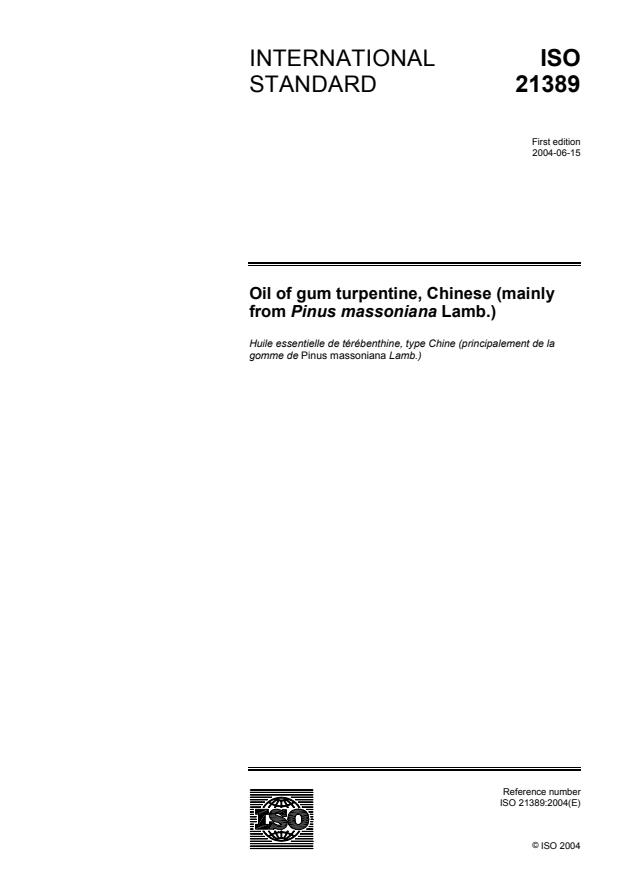
INTERNATIONAL ISO
STANDARD 21389
First edition
2004-06-15
Oil of gum turpentine, Chinese (mainly
from Pinus massoniana Lamb.)
Huile essentielle de térébenthine, type Chine (principalement de la
gomme de Pinus massoniana Lamb.)
Reference number
©
ISO 2004
PDF disclaimer
This PDF file may contain embedded typefaces. In accordance with Adobe's licensing policy, this file may be printed or viewed but
shall not be edited unless the typefaces which are embedded are licensed to and installed on the computer performing the editing. In
downloading this file, parties accept therein the responsibility of not infringing Adobe's licensing policy. The ISO Central Secretariat
accepts no liability in this area.
Adobe is a trademark of Adobe Systems Incorporated.
Details of the software products used to create this PDF file can be found in the General Info relative to the file; the PDF-creation
parameters were optimized for printing. Every care has been taken to ensure that the file is suitable for use by ISO member bodies. In
the unlikely event that a problem relating to it is found, please inform the Central Secretariat at the address given below.
© ISO 2004
All rights reserved. Unless otherwise specified, no part of this publication may be reproduced or utilized in any form or by any means,
electronic or mechanical, including photocopying and microfilm, without permission in writing from either ISO at the address below or
ISO's member body in the country of the requester.
ISO copyright office
Case postale 56 • CH-1211 Geneva 20
Tel. + 41 22 749 01 11
Fax + 41 22 749 09 47
E-mail copyright@iso.org
Web www.iso.org
Published in Switzerland
ii © ISO 2004 – All rights reserved
Foreword
ISO (the International Organization for Standardization) is a worldwide federation of national standards bodies
(ISO member bodies). The work of preparing International Standards is normally carried out through ISO
technical committees. Each member body interested in a subject for which a technical committee has been
established has the right to be represented on that committee. International organizations, governmental and
non-governmental, in liaison with ISO, also take part in the work. ISO collaborates closely with the
International Electrotechnical Commission (IEC) on all matters of electrotechnical standardization.
International Standards are drafted in accordance with the rules given in the ISO/IEC Directives, Part 2.
The main task of technical committees is to prepare International Standards. Draft International Standards
adopted by the technical committees are circulated to the member bodies for voting. Publication as an
International Standard requires approval by at least 75 % of the member bodies casting a vote.
Attention is drawn to the possibility that some of the elements of this document may be the subject of patent
rights. ISO shall not be held responsible for identifying any or all such patent rights.
ISO 21389 was prepared by Technical Committee ISO/TC 54, Essential oils.
INTERNATIONAL STANDARD ISO 21389:2004(E)
Oil of gum turpentine, Chinese (mainly from Pinus massoniana
Lamb.)
ISO 11024-2, Essential oils — General guidance on
1 Scope
chromatographic profiles — Part 2: Utilization of
chromatographic profiles of samples of essential oils
This International Standard specifies certain
characteristics of the oil of gum turpentine, Chinese
(mainly from Pinus massoniana Lamb.), in order to
facilitate assessment of its quality.
3 Terms and definitions
For the purposes of this document, the following
terms and definitions apply.
2 Normative references
3.1
The following referenced documents are
oil of gum turpentine, Chinese
indispensable for the application of this document.
essential oil obtained by steam distillation of the
For dated references, only the edition cited applies.
gum resin mainly from Pinus massoniana Lamb., of
For undated references, the latest edition of the
the Pinaceae family, growing in the south of China
referenced document (including any amendments)
applies.
NOTE For information on the CAS number, see
ISO/TR 21092.
ISO/TR 210, Essential oils — General rules for
packaging, conditioning and storage
4 Requirements
ISO/TR 211, Essential oils — General rules for
labelling and marking of containers
4.1 Appearance
ISO 212, Essential oils — Sampling
Clear, transparent, mobile liquid.
ISO 279, Essential oils — Determination of relative
density at 20 °C — Reference method
4.2 Colour
ISO 280, Essential oils — Determination of
Colourless.
refractive index
4.3 Odour
ISO 592, Essential oils — Determination of optical
rotation
Characteristic of gum turpentine.
ISO 875, Essential oils — Evaluation of miscibility in
ethanol
4.4 Relative density at 20 °C, d
ISO 1242, Essential oils — Determination of acid
Minimum: 0,850
value
Maximum: 0,872
ISO 3405, Petroleum products — Determination of
distillation characteristics at atmospheric pressure
4.5 Refractive index at 20 °C
ISO 4715, Essential oils — Quantitative evaluation
Minimum: 1,465 0
of residue on evaporation
Maximum: 1,473 0
ISO 11024-1, Essential oils — General guidance on
chromatographic profiles — Part 1: Preparation of
4.6 Optical rotation at 20 °C
chromatographic profiles for presentation in
standards
Between −35° and −10°.
4.7 Miscibility in ethanol, 90 % (volume 4.12 Flashpoint
fraction), at 20 °C
Information on the flashpoint is given in Annex B.
It shall not be necessary to use more than 7 volumes
of ethanol, 90 % (volume fraction), to obtain a clear
5 Sampling
solution with 1 volume of essential oil.
See
...
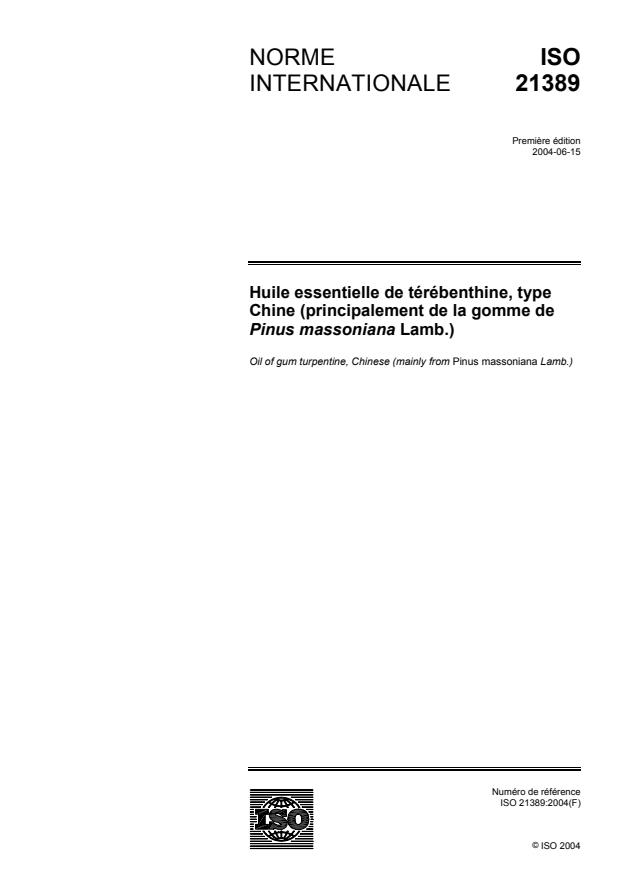
NORME ISO
INTERNATIONALE 21389
Première édition
2004-06-15
Huile essentielle de térébenthine, type
Chine (principalement de la gomme de
Pinus massoniana Lamb.)
Oil of gum turpentine, Chinese (mainly from Pinus massoniana Lamb.)
Numéro de référence
©
ISO 2004
PDF – Exonération de responsabilité
Le présent fichier PDF peut contenir des polices de caractères intégrées. Conformément aux conditions de licence d'Adobe, ce fichier
peut être imprimé ou visualisé, mais ne doit pas être modifié à moins que l'ordinateur employé à cet effet ne bénéficie d'une licence
autorisant l'utilisation de ces polices et que celles-ci y soient installées. Lors du téléchargement de ce fichier, les parties concernées
acceptent de fait la responsabilité de ne pas enfreindre les conditions de licence d'Adobe. Le Secrétariat central de l'ISO décline toute
responsabilité en la matière.
Adobe est une marque déposée d'Adobe Systems Incorporated.
Les détails relatifs aux produits logiciels utilisés pour la création du présent fichier PDF sont disponibles dans la rubrique General Info
du fichier; les paramètres de création PDF ont été optimisés pour l'impression. Toutes les mesures ont été prises pour garantir
l'exploitation de ce fichier par les comités membres de l'ISO. Dans le cas peu probable où surviendrait un problème d'utilisation,
veuillez en informer le Secrétariat central à l'adresse donnée ci-dessous.
© ISO 2004
Droits de reproduction réservés. Sauf prescription différente, aucune partie de cette publication ne peut être reproduite ni utilisée sous
quelque forme que ce soit et par aucun procédé, électronique ou mécanique, y compris la photocopie et les microfilms, sans l'accord écrit
de l'ISO à l'adresse ci-après ou du comité membre de l'ISO dans le pays du demandeur.
ISO copyright office
Case postale 56 • CH-1211 Geneva 20
Tel. + 41 22 749 01 11
Fax. + 41 22 749 09 47
E-mail copyright@iso.org
Web www.iso.org
Publié en Suisse
ii © ISO 2004 – Tous droits réservés
Avant-propos
L'ISO (Organisation internationale de normalisation) est une fédération mondiale d'organismes nationaux de
normalisation (comités membres de l'ISO). L'élaboration des Normes internationales est en général confiée
aux comités techniques de l'ISO. Chaque comité membre intéressé par une étude a le droit de faire partie du
comité technique créé à cet effet. Les organisations internationales, gouvernementales et non
gouvernementales, en liaison avec l'ISO participent également aux travaux. L'ISO collabore étroitement avec
la Commission électrotechnique internationale (CEI) en ce qui concerne la normalisation électrotechnique.
Les Normes internationales sont rédigées conformément aux règles données dans les Directives ISO/CEI,
Partie 2.
La tâche principale des comités techniques est d'élaborer les Normes internationales. Les projets de Normes
internationales adoptés par les comités techniques sont soumis aux comités membres pour vote. Leur
publication comme Normes internationales requiert l'approbation de 75 % au moins des comités membres
votants.
L'attention est appelée sur le fait que certains des éléments du présent document peuvent faire l'objet de
droits de propriété intellectuelle ou de droits analogues. L'ISO ne saurait être tenue pour responsable de ne
pas avoir identifié de tels droits de propriété et averti de leur existence.
L'ISO 21389 a été élaborée par le comité technique ISO/TC 54, Huiles essentielles.
NORME INTERNATIONALE ISO 21389:2004(F)
Huile essentielle de térébenthine, type Chine (principalement de
la gomme de Pinus massoniana Lamb.)
ISO 11024-1, Huiles essentielles — Directives gé-
1 Domaine d'application
nérales concernant les profils chromatographiques
— Partie 1: Élaboration des profils chromatographi-
La présente Norme internationale spécifie certaines
ques pour la présentation dans les normes
caractéristiques de l'huile essentielle de térében-
thine, type Chine (principalement de la gomme de
ISO 11024-2, Huiles essentielles — Directives gé-
Pinus massoniana Lamb.), destinées à faciliter l'ap-
nérales concernant les profils chromatographiques
préciation de sa qualité.
— Partie 2: Utilisation des profils chromatographi-
ques des échantillons d'huiles essentielles
2 Références normatives
3 Termes et définitions
Les documents de référence suivants sont indis-
pensables pour l'application du présent document.
Pour les besoins du présent document, les termes
Pour les références datées, seule l'édition citée
et définitions suivants s'appliquent.
s'applique. Pour les références non datées, la der-
nière édition du document de référence s'applique
3.1
(y compris les éventuels amendements).
huile essentielle de térébenthine, type Chine
huile essentielle obtenue par distillation à la vapeur
ISO/TR 210, Huiles essentielles — Règles généra-
d'eau de la gomme de, principalement, Pinus mas-
les d'emballage, de conditionnement et de stockage
soniana Lamb., de la familie des Pinaceae, pous-
sant dans le sud de la Chine
ISO/TR 211, Huiles essentielles — Règles généra-
les d'étiquetage et de marquage des récipients
NOTE Pour information sur le numéro CAS, voir
l'ISO/TR 21092.
ISO 212, Huiles essentielles — Échantillonnage
ISO 279, Huiles essentielles — Détermination de la
densité relative à 20 °C — Méthode de référence
4 Spécifications
ISO 280, Huiles essentielles — Détermination de
l'indice de réfraction
4.1 Aspect
ISO 592, Huiles essentielles — Détermination du
Liquide mobile, limpide.
pouvoir rotatoire
4.2 Couleur
ISO 875, Huiles essentielles — Évaluation de la
miscibilité à l'éthanol
Incolore.
ISO 1242, Huiles essentielles — Détermination de
l'indice d'acide
4.3 Odeur
ISO 3405, Produits pétroliers — Détermination des
Caractéristique de térébenthine.
caractéristiques de distillation à pression
atmosphérique
4.4 Densité relative à 20 °C, d
ISO 4715, Huiles essentielles — Évaluation quanti-
tative du résidu d’évaporation
Minimum: 0,850
Maximum: 0,872
Tableau 1 — Profil chromatographique
4.5 Indice de réfraction à 20 °C
Minimum Maximum
Minimum: 1,465 0 Constituant
% %
Maximum: 1,473 0
α-Pinène 65 90
Camphène traces 2,5
4.6 Pouvoir rotatoire à 20 °C
β-Pinène 3,0 18
Compris entre −35° et −10°.
δ-3-Carène traces 0,3
Myrcène traces 1,5
4.7 Miscibilité à l'éthanol à 90 % (fraction
Limonène traces 5,
...
Questions, Comments and Discussion
Ask us and Technical Secretary will try to provide an answer. You can facilitate discussion about the standard in here.
Loading comments...