


ISO/IEC TS 5928:2023
(Main)Information technology — Cloud computing and distributed platforms — Taxonomy for digital platforms
General Information
- Abstract
This document specifies a taxonomy related to digital platforms, by providing definitions and supporting information that disambiguates different uses of the term platform as it applies to digital services (such as cloud computing and other distributed computing systems).
- Status
- Published
- Publication Date
- 28-Sep-2023
- Technical Committee
- ISO/IEC JTC 1/SC 38 - Cloud computing and distributed platforms
- Drafting Committee
- ISO/IEC JTC 1/SC 38 - Cloud computing and distributed platforms
- Current Stage
- 9020 - International Standard under periodical review
- Start Date
- 15-Jul-2026
- Completion Date
- 15-Jul-2026


Overview - ISO/IEC TS 5928:2023 (Taxonomy for digital platforms)
ISO/IEC TS 5928:2023 provides a standardized taxonomy for digital platforms used in cloud computing and other distributed platforms. The document clarifies the many meanings of “platform” by supplying consistent definitions, structured taxonomies and supporting information that disambiguate technical, economic and general uses of the term. Its goal is to help multidisciplinary stakeholders (technologists, economists, policy makers, researchers) use platform-related terms unambiguously when discussing cloud services, edge computing and distributed systems.
Key Topics and scope
This technical specification focuses on terminology and classification rather than prescriptive technical requirements. Major topics covered include:
- Terms and definitions for digital service, digital platform, platform participant and participant groups.
- Digital platform overview: meanings of “platform” and “digital platform”, ambiguity issues, and cross-cutting considerations.
- Platform characteristics such as network effects, “private” vs “open” platforms, stickiness and customer inertia.
- Digital technology platforms: taxonomy of cloud service capability types and examples (including Platform as a Service (PaaS), Data Storage as a Service (DSaaS), Communications as a Service (CaaS), software development platforms).
- Platform market models: one-sided and multi‑sided technology platforms and digital economic platforms (marketplaces, exchange platforms, payment and ad-funded models).
- Impact on participant behaviour: network effects (positive/negative), monetisation considerations, and platform governance implications.
- Informative annexes with illustrative taxonomic hierarchies and comparisons of monetisation and network effects.
Practical applications - who uses this standard
- Cloud architects and platform engineers - to align terminology when designing and documenting cloud and distributed platform offerings.
- Platform operators and product managers - to classify platform capabilities (PaaS, DSaaS, CaaS) and participant groups for marketplace design and monetisation strategies.
- Policy makers and regulators - to ground policy debates about platform governance, competition and privacy on a clear taxonomy.
- Researchers and social scientists - to ensure consistent use of platform concepts in cross-disciplinary studies.
- Procurement and legal teams - to reduce ambiguity in contracts and service descriptions by using standardized definitions.
Related standards
- Normative references in the specification include ISO/IEC 22123-1 (Cloud computing - Vocabulary) and ISO/IEC TS 23167 (Cloud computing - Common technologies and techniques).
- Prepared by ISO/IEC JTC 1/SC 38 (Cloud computing and distributed platforms).
Using ISO/IEC TS 5928:2023 helps organizations and stakeholders improve clarity in documentation, governance, and decision-making around cloud computing, distributed systems and digital platform business models. Keywords: digital platform taxonomy, platform characteristics, ISO/IEC TS 5928:2023, cloud computing, multi-sided platform, PaaS, DSaaS, CaaS, network effects.
Get Certified
Connect with accredited certification bodies for this standard

BSI Group
BSI (British Standards Institution) is the business standards company that helps organizations make excellence a habit.

NYCE
Mexican standards and certification body.
Sponsored listings
Frequently Asked Questions
ISO/IEC TS 5928:2023 is a technical specification published by the International Organization for Standardization (ISO). Its full title is "Information technology — Cloud computing and distributed platforms — Taxonomy for digital platforms". This standard covers: This document specifies a taxonomy related to digital platforms, by providing definitions and supporting information that disambiguates different uses of the term platform as it applies to digital services (such as cloud computing and other distributed computing systems).
This document specifies a taxonomy related to digital platforms, by providing definitions and supporting information that disambiguates different uses of the term platform as it applies to digital services (such as cloud computing and other distributed computing systems).
ISO/IEC TS 5928:2023 is classified under the following ICS (International Classification for Standards) categories: 35.210 - Cloud computing. The ICS classification helps identify the subject area and facilitates finding related standards.
ISO/IEC TS 5928:2023 is available in PDF format for immediate download after purchase. The document can be added to your cart and obtained through the secure checkout process. Digital delivery ensures instant access to the complete standard document.
Standards Content (Sample)
TECHNICAL ISO/IEC TS
SPECIFICATION 5928
First edition
2023-09
Information technology — Cloud
computing and distributed platforms
— Taxonomy for digital platforms
Technologies de l'information — Informatique en nuage et plates-
formes distribuées — Taxonomie pour les plates-formes numériques
Reference number
© ISO/IEC 2023
© ISO/IEC 2023
All rights reserved. Unless otherwise specified, or required in the context of its implementation, no part of this publication may
be reproduced or utilized otherwise in any form or by any means, electronic or mechanical, including photocopying, or posting on
the internet or an intranet, without prior written permission. Permission can be requested from either ISO at the address below
or ISO’s member body in the country of the requester.
ISO copyright office
CP 401 • Ch. de Blandonnet 8
CH-1214 Vernier, Geneva
Phone: +41 22 749 01 11
Email: copyright@iso.org
Website: www.iso.org
Published in Switzerland
ii
© ISO/IEC 2023 – All rights reserved
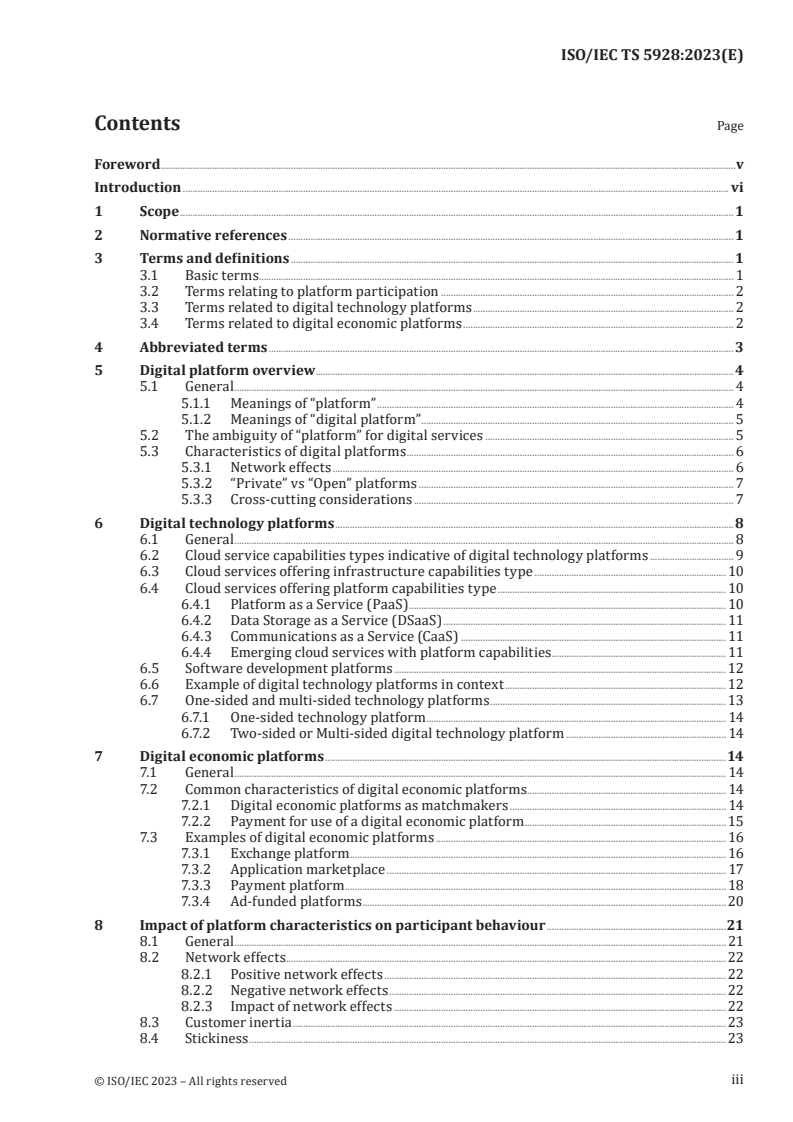
Contents Page
Foreword .v
Introduction . vi
1 Scope . 1
2 Normative references . 1
3 Terms and definitions . 1
3.1 Basic terms . 1
3.2 Terms relating to platform participation . 2
3.3 Terms related to digital technology platforms . 2
3.4 Terms related to digital economic platforms . 2
4 Abbreviated terms . 3
5 Digital platform overview . .4
5.1 General . 4
5.1.1 Meanings of “platform” . 4
5.1.2 Meanings of “digital platform” . 5
5.2 The ambiguity of “platform” for digital services . 5
5.3 Characteristics of digital platforms . 6
5.3.1 Network effects . 6
5.3.2 “Private” vs “Open” platforms . 7
5.3.3 Cross-cutting considerations . 7
6 Digital technology platforms .8
6.1 General . 8
6.2 Cloud service capabilities types indicative of digital technology platforms . 9
6.3 Cloud services offering infrastructure capabilities type . 10
6.4 Cloud services offering platform capabilities type . 10
6.4.1 Platform as a Service (PaaS) . 10
6.4.2 Data Storage as a Service (DSaaS) . 11
6.4.3 Communications as a Service (CaaS) . 11
6.4.4 Emerging cloud services with platform capabilities . 11
6.5 Software development platforms .12
6.6 Example of digital technology platforms in context .12
6.7 One-sided and multi-sided technology platforms . 13
6.7.1 One-sided technology platform . 14
6.7.2 Two-sided or Multi-sided digital technology platform . 14
7 Digital economic platforms .14
7.1 General . 14
7.2 Common characteristics of digital economic platforms. 14
7.2.1 Digital economic platforms as matchmakers . 14
7.2.2 Payment for use of a digital economic platform . 15
7.3 Examples of digital economic platforms . 16
7.3.1 Exchange platform . 16
7.3.2 Application marketplace . 17
7.3.3 Payment platform . 18
7.3.4 Ad-funded platforms .20
8 Impact of platform characteristics on participant behaviour .21
8.1 General . 21
8.2 Network effects . . 22
8.2.1 Positive network effects . 22
8.2.2 Negative network effects . 22
8.2.3 Impact of network effects . 22
8.3 Customer inertia . 23
8.4 Stickiness . 23
iii
© ISO/IEC 2023 – All rights reserved
9 Observations and conclusion .23
Annex A (informative) Illustrative taxonomic hierarchies .25
Annex B (informative) Comparison of monetisation and network effects .30
Bibliography .32
iv
© ISO/IEC 2023 – All rights reserved
Foreword
ISO (the International Organization for Standardization) and IEC (the International Electrotechnical
Commission) form the specialized system for worldwide standardization. National bodies that are
members of ISO or IEC participate in the development of International Standards through technical
committees established by the respective organization to deal with particular fields of technical
activity. ISO and IEC technical committees collaborate in fields of mutual interest. Other international
organizations, governmental and non-governmental, in liaison with ISO and IEC, also take part in the
work.
The procedures used to develop this document and those intended for its further maintenance
are described in the ISO/IEC Directives, Part 1. In particular, the different approval criteria
needed for the different types of document should be noted. This document was drafted in
accordance with the editorial rules of the ISO/IEC Directives, Part 2 (see www.iso.org/directives or
www.iec.ch/members_experts/refdocs).
ISO and IEC draw attention to the possibility that the implementation of this document may involve the
use of (a) patent(s). ISO and IEC take no position concerning the evidence, validity or applicability of
any claimed patent rights in respect thereof. As of the date of publication of this document, ISO and IEC
had not received notice of (a) patent(s) which may be required to implement this document. However,
implementers are cautioned that this may not represent the latest information, which may be obtained
from the patent database available at www.iso.org/patents and https://patents.iec.ch. ISO and IEC shall
not be held responsible for identifying any or all such patent rights.
Any trade name used in this document is information given for the convenience of users and does not
constitute an endorsement.
For an explanation of the voluntary nature of standards, the meaning of ISO specific terms and
expressions related to conformity assessment, as well as information about ISO's adherence to
the World Trade Organization (WTO) principles in the Technical Barriers to Trade (TBT) see
www.iso.org/iso/foreword.html. In the IEC, see www.iec.ch/understanding-standards.
This document was prepared by Joint Technical Committee ISO/IEC JTC 1, Information technology,
Subcommittee SC 38, Cloud computing and distributed platforms.
Any feedback or questions on this document should be directed to the user’s national standards
body. A complete listing of these bodies can be found at www.iso.org/members.html and
www.iec.ch/national-committees.
v
© ISO/IEC 2023 – All rights reserved
Introduction
Technologies such as cloud computing are supporting the evolution of digital business and accelerating
the shift to living and working (in part) online, in ways that would have been impossible a few years
ago.
Increased debate about socio-technical developments always runs the risk of multi-disciplinary
terminological confusion, due to the potential for the same word to be used for two or more distinct
concepts. Moreover, polysemy (the capacity for a word or phrase to have multiple related meanings) is
an attribute of many words. Any attempt to provide a single definition for a polysemic word needs to be
sufficiently broad to account for all potential meanings.
Terms with alternative meanings in economic, societal, political, regulatory and technical contexts are
being labelled with the same or similar names.
Adding clarity on concepts and definitions can assist in the formulation of well-informed policies
in important areas such as security, privacy and governance. One of the terms that has been at the
forefront of these changes is “platform”.
Note that the economic, societal, political, regulatory and technical uses of the word “platform” predate
cloud computing by many years.
Taxonomic structures serve many purposes and their topological structure, incorporation (or not) of
orthogonal dimensions, levels of refinement, and the decision about the order and approach in which to
apply the structuring factors lead to very different outcomes. The terminology and concepts presented
in this document can be combined in different ways, depending on the problem being considered, and
the factors that potentially influence the decisions driving such structuring are presented with the
related concepts.
In a situation where two or more distinct interpretations of the word “platform” are relevant, but only
one is taken into account, or where collaborators used two distinct interpretations at cross-purposes,
confusion can arise.
Therefore, it is important to understand the difference between the technical, economic and general
uses of the word platform in the context of digital services.
The audience for this document is technologists, economists, policy makers, social scientists and others
who wish to precisely and unambiguously use these terms (e.g. in multi-disciplinary conversations).
vi
© ISO/IEC 2023 – All rights reserved
TECHNICAL SPECIFICATION ISO/IEC TS 5928:2023(E)
Information technology — Cloud computing and
distributed platforms — Taxonomy for digital platforms
1 Scope
This document specifies a taxonomy related to digital platforms, by providing definitions and
supporting information that disambiguates different uses of the term platform as it applies to digital
services (such as cloud computing and other distributed computing systems).
2 Normative references
The following documents are referred to in the text in such a way that some or all of their content
constitutes requirements of this document. For dated references, only the edition cited applies. For
undated references, the latest edition of the referenced document (including any amendments) applies.
ISO/IEC 22123-1, Information technology — Cloud computing — Part 1: Vocabulary
ISO/IEC TS 23167, Information technology — Cloud computing — Common technologies and techniques
3 Terms and definitions
For the purposes of this document, the terms and definitions given in ISO/IEC 22123-1, ISO/IEC TS 23167
and the following apply.
ISO and IEC maintain terminology databases for use in standardization at the following addresses:
— ISO Online browsing platform: available at https:// www .iso .org/ obp
— IEC Electropedia: available at https:// www .electropedia .org
3.1 Basic terms
3.1.1
digital service
service offered by one party to another party by means of digital hardware or software technology, or
both, including communication over a network
Note 1 to entry: In the context of this document, a service comprises one or more digital capabilities such as a
cloud computing, edge computing, or some other distributed computing capability. Such a service will be subject
to contract and typically have defined qualities of service, terms, and conditions for use.
Note 2 to entry: Cloud service, edge service, network service, broadcast service, and mobile service are all types
of digital service. Not all types are discussed in this document.
3.1.2
digital platform
distributed platform
set of correlated and cohesive digital services (3.1.1)
Note 1 to entry: A digital platform as described in this document enables and assists other participant digital
services in conducting business with their customers, either by creating and facilitating a multi-sided market for
those services, or by enabling the technological creation and operation of those services, or both.
Note 2 to entry: “Distributed platform” is often used as a synonym to emphasise those elements of a digital service,
such as edge computing and mobile computing that go beyond the classical datacentres of cloud computing.
© ISO/IEC 2023 – All rights reserved
3.2 Terms relating to platform participation
3.2.1
platform participant
party that makes use of or otherwise engages with a digital platform (3.1.2)
Note 1 to entry: A party can be an individual end user or organisation.
Note 2 to entry: A platform participant can be a member of one or more participant groups (3.2.2).
3.2.2
participant group
group of platform participants (3.2.1) that share a common set of business requirements that differ
significantly from the requirements of one or more other groups of platform participants (3.2.1)
Note 1 to entry: Participant groups are not specific to digital services, though they are essential for defining a
multi-sided market such as a digital economic platform (3.4.2).
Note 2 to entry: Examples of such participant groups include purchasers, vendors, and developers. Purchasers
are platform participants seeking to acquire something, vendors are platform participants seeking to offer
something, while developers are platform participants seeking to create and sell (or operate) software (or
services). Thus, the members of each group have a common objective which is not shared with members of the
other participant groups.
3.3 Terms related to digital technology platforms
3.3.1
digital technology platform
digital platform (3.1.2) that provides engineering components required to support
creation and deployment of applications and services
Note 1 to entry: Elements provided can include cloud computing resources (see ISO/IEC 22123 series), which can
include execution environments, storage, networking, location and mapping services, graphics rendering and
specialist processing (such as machine learning or quantum computing).
Note 2 to entry: Popular examples of such digital technology platforms include varieties of the cloud service
categories “infrastructure capabilities type” and “platform capabilities type” (see ISO/IEC 22123-1).
Note 3 to entry: This definition is distinct from those in ISO/IEC TS 25025:2021 and ISO/IEC TS 25011:2017.
3.3.2
software development platform
digital technology platform (3.3.1) that enables or assists the development of software code
3.4 Terms related to digital economic platforms
3.4.1
economic platform
set of services that provide market intermediation to reduce search or transaction costs
Note 1 to entry: Platforms are environments, computing or otherwise, that connect different groups and derive
benefits from others participating in the platform.
Note 2 to entry: A shopping mall provides a non-computing economic platform, connecting merchants (participant
group) with visiting customers (participant group) and providing distinct services to each participant group
such as a pleasant environment, electricity, storage, parking, network connectivity, and security.
© ISO/IEC 2023 – All rights reserved
3.4.2
digital economic platform
one or more digital platforms (3.1.2) creating a multi-sided market, which provide goods,
services or licensed rights to two or more distinct participant groups (3.2.2) who need each other in
some way
Note 1 to entry: A digital economic platform is a subtype of both economic platform (3.4.1) and digital platform
(3.1.2).
Note 2 to entry: Examples of licensed rights can include the right to view a movie, to use commercial business
data, or to use specific software, each delivered as a licence.
Note 3 to entry: While a digital economic platform is constructed with digital technology, often on top of a
digital technology platform (3.3.1), this does not mean that the digital economic platform is a subtype of digital
technology platform (any more than a car is a subtype of a road); these two terms are independent.
Note 4 to entry: A digital economic platform can optionally comprise more than one digital platform. For instance,
an exchange platform can be combined with a payment platform and appear to the end-user as a single digital
economic platform.
3.4.3
ad-funded platform
digital economic platform (3.4.2) where a platform generates revenue by charging
advertisers to show advertisements to customers of the service
Note 1 to entry: Advertisers are one participant group, those who view the advertisements are a second, and
those who display the advertisements alongside their own content are a third.
3.4.4
exchange platform
digital economic platform (3.4.2) which brings together vendors and potential purchasers
and enables them to sell and buy goods and services, potentially generating value for the platform
provider by intermediating the transaction
3.4.5
payment platform
digital economic platform (3.4.2) which facilitates the secure completion of payments
between platform participants (3.2.1)
3.4.6
application marketplace
digital economic platform (3.4.2) where the platform provides means for software
developers and publishers to provide applications to customers via the platform
Note 1 to entry: This document describes this concept in the economic platform domain. See also
ISO/IEC 19944-1:2020, 3.2.2 for the definition in the device platform domain.
4 Abbreviated terms
AIaaS artificial intelligence as a service
a
CaaS communications as a service/containers as a service
CSC cloud service customer
CSP cloud service provider
DSaaS data storage as a service
FaaS function as a service
© ISO/IEC 2023 – All rights reserved
GPU graphics processing unit
IaaS infrastructure as a service
ICT information and communications technology
MLaaS machine learning as a service
PaaS platform as a service
QCaaS quantum computing as a service
SaaS software as a service
SME small- or medium-sized enterprise
a
The acronym CaaS is unfortunately used by industry for multiple purposes, two of which are listed here,
so it is best to use the expanded term to ensure the correct context.
5 Digital platform overview
5.1 General
The term “platform” is used in the English language with a very wide range of meanings, and some of
these uses are ambiguous in the context of online or digital services.
This document defines a taxonomy of terms for digital platforms of various kinds and shows how these
terms can be structured into hierarchies (see Annex A).
5.1.1 Meanings of “platform”
These uses include but are not limited to the following. These groupings are potentially overlapping,
they are not mutually exclusive.
— The traditional non-ICT uses of the term, such as a wooden platform to stand on, a political platform
of policies, or a railway platform from which trains will depart, highlight the highly context-
dependent use of the word “platform”.
— There are online, broadcast and printed media and public discourse settings, that serve as platforms
for free expression, expression of political and social viewpoints, artistic and musical expression,
discussion and debate. This includes social media.
— There are what can be defined as “economic platforms”, which is a way to describe certain business
approaches that create multi-sided markets, where two or more distinct groups of participants
can do some kind of business together via an intermediary platform. This means that the platform
brings together two or more different participant groups and provides a meeting place to facilitate
interactions between the participant groups through the platform. Platforms serving two participant
groups are called two-sided platforms, and more generally platforms serving two or more such
groups are called multi-sided platforms.
— There are many examples of two-sided markets supported by intermediary platforms, including but
not limited to: publishers, academic journals and conferences; airports and ports; stock markets,
auction houses and real estate brokers; dating and employment agencies; and credit card payment
cloud computing systems. An economic platform does not need to involve any technology.
EXAMPLE A bricks-and-mortar department store or shopping mall creates a multi-sided market
between a group of merchants and a group of customers. This type of economic platform existed long before
modern digital technology.
© ISO/IEC 2023 – All rights reserved
— There have also been “technology platforms” for many years, long predating the arrival of online
services. Early computer operating systems such as on mainframes were often described as
providing a platform for customer programme development. Specialised systems such as telephone
networks provided platforms for the deployment of (then) advanced services such as free-phone
and premium-rate telephone lines. PBX systems provided platforms for customer development of
early call-centre services. All of these existed long before the arrival of the World Wide Web.
— For these technology products and services, the term “platform” is widely used, both as a simple
indicator of layering – with many distinct products and services built on a single underlying base
– and to articulate a specific purpose for a product (e.g. providing a platform for self-expression or
social interaction).
5.1.2 Meanings of “digital platform”
With the arrival of the World Wide Web, many of the platform concepts described above were adapted
to the world of online services, such as online shopping services, online dating, online social networks,
and many others. Some of these competed with the pre-online service equivalents, while others were
wholly new.
In particular, a market demand rapidly emerged for technology companies to provide means for their
customers to rapidly enter the online business world without having to develop everything from
scratch themselves. In the same way that companies adopted common operating systems on which to
build their applications without having to write specific code for every printer and other device, so the
online services need platforms that provided the components common to all or most online services,
allowing them to concentrate on those components that were unique to their own service offering.
Thus, the parallel development of digital platforms include both digital economic platforms (business
models for multi-sided markets) and digital technology platforms (services and components providing
customers with the tools to build their own services).
This document is focused on digital platform as it is used in the context of online or digital services of
these two types.
5.2 The ambiguity of “platform” for digital services
Within the realm of digital technologies there are specific situations in which the use of “platform” of
even “digital platform” becomes ambiguous.
Both terms are sometimes used for both digital economic platforms and digital technology platforms.
— Digital economic platform is described as one or more digital platforms which provide goods,
services or licensed rights to two or more distinct participant groups who need each other in some
way. The term “platform” in association to economics, is meant to identify multi-sided business
relationships.
— Digital technology platform is described as any kind of system that supports the creation,
modification, or addition of significant software functionality by the platform customer rather than
by the platform service provider.
These two terms are independent, and either, both, or neither may apply to a digital service (see Table 1).
© ISO/IEC 2023 – All rights reserved
Table 1 — Examples of digital economic platforms and digital technology platforms
Digital Technology platform Other
(supports the customer building their (does not support the customer
a
own application ) building their own application)
Digital Economic PaaS or Container as a Service (CaaS) Ad-funded service
platform implementation that includes a third-
Exchange service
party component store
(creates a multi-sided
App store
market)
Payment service
Other Basic PaaS, Container as a Service (CaaS), Basic websites
or IaaS service implementation
(does not create a Web-based email
with no “store”
multi-sided market)
Many more.
a
For cloud computing, this includes either infrastructure or platform capabilities type(s), or both (see ISO/IEC 22123-1).
Digital economic platforms and digital technology platforms are thus independent concepts. Neither is
a subset of the other. A given digital service can be one or the other, or both, or neither.
While many digital economic platforms are built to run on top of a digital technology platform, this
does not mean they are a subtype of it, just as a car is not a subtype of the road it runs on.
Parties offering digital economic platforms can select different strategies, based on their perceived
business interests. Platform strategies, including pricing, are strongly affected by the economic
characteristics of digital platform markets.
A digital technology platform which also brings together two or more groups of customers can also be
a digital economic platform.
— A digital service provided to only one group of customers, such as data storage or app development
tools, is not a digital economic platform.
— Nonetheless, there are some digital technology services that can be described as both digital
technology platforms and digital economic platforms.
An individual platform can sometimes pursue more than one of the business models described in this
document.
EXAMPLE 1 In a discussion of hydroelectricity, the term “current” could apply to either water current or
electrical current, so it would be foolish to use the term in isolation without making clear the context and specific
usage of the word. In the language of cloud computing, the same situation pertains to the ambiguous use of
“digital platform” or just “platform”, so care is needed to avoid incorrect interpretation of the isolated term by
readers.
EXAMPLE 2 Referring to European Commission policy statements shown as “Online platform” under the
“Shaping Europe’s digital future”, documents such as “COM/2016/0288 final” frequently mentions “platforms”,
but seems to be entirely focussed on digital economic platforms. It reads as if this is the only meaning of the term
platform and makes no obvious mention of digital technology platforms such as Platform as a Service. This raises
the concern that digital technology platforms could be unintentionally brought within scope when this was not
really the writers’ intent. See Reference [12].
5.3 Characteristics of digital platforms
Digital platforms exhibit various characteristics that can boost their value to customers and potentially
affect the competition landscape within an industry.
5.3.1 Network effects
Network externalities, which often arise in platforms, describe the value for a platform participant
arising from the size of the network using the product or service, which may arise from participants of
© ISO/IEC 2023 – All rights reserved
the same participant group (“same-side” network effects) or participants from a different participant
group (“cross-side” network effects). Cross-side network effects only arise in multi-sided markets
because there are different participant groups involved.
Network effects can be beneficial or detrimental to platform participants, sometimes both arising at
the same time. This document does not make any value judgements on these effects.
Network effects between different participant groups can potentially create a barrier to entry. Each
side values the other, and it is difficult for a platform provider to attract one side without the other
(the “chicken and egg” problem or causality dilemma). Entrants can employ different strategies to try
to overcome the barrier to entry, such as focusing on a niche group of users, taking advantage of a
technological shift to offer a tailored product, or shifting a group of users from another platform. The
concept is further explored in Clause 8.
See Annex B for a consideration of possible monetisation approaches and network effects for various
types of digital platform services.
5.3.2 “Private” vs “Open” platforms
Platforms can exist in both private and open forms. Neither of these is exclusive to either digital
economic platforms or digital technology platforms.
A “private” platform implies closed membership of some kind, such that only specific customers and
users will be able to obtain service. The most obvious would be in a private cloud or community cloud
which is only available to employees, departments, or affiliates of the company or government which
is acting as cloud service provider. In general, the operating CSP determines the policies that are
applicable for using their platform, subject to overriding local legal requirements.
An “open” platform implies that membership is open to anyone who chooses to subscribe to it. This is
true for most but not all public cloud services.
An open platform can carry specific national or regional obligations of law, such as consumer protection
rules on sale of goods.
In all such cases, these are matters of law for the local jurisdiction and out of scope for this document.
EXAMPLE 1 There are platforms where membership is limited to members of the public who meet certain
criteria, such as ethnicity, age, industry affiliation, political or religious affiliation, etc.
EXAMPLE 2 There are platforms which are only open to users of a specific brand of product, such as a brand of
television or smartphone. Whether such a platform is treated in law as “open” or “private” will depend on the law
of the applicable jurisdiction.
5.3.3 Cross-cutting considerations
When considering the term “platform” in settings which combine both economic and technical
considerations, many related factors need to be considered simultaneously irrespective of the specific
type of platform under consideration.
These cross-cutting considerations include economic concepts, such as
— matchmaking (see 7.2.1)
— cost of market entry
— various forms of payment
alongside technological considerations such as
— data portability (ISO/IEC 19941)
— application portability (ISO/IEC 19941)
© ISO/IEC 2023 – All rights reserved
— ease of switching
Some jurisdictions can also define additional concepts such as “gatekeepers” and impose specific
additional legal definitions and obligations upon those entities, which are out of scope for this document.
Contractual and technical limitations also apply, such as:
i) interoperability and portability, especially where there is an obligation imposed by the applicable
[6]
jurisdiction (e.g. the European Commission Data Act)
ii) the restrictions introduced by data sharing agreements (ISO/IEC 23751) and
iii) the need for clarity for users
which can be improved by means of data use statements (ISO/IEC 19944-1 and ISO/IEC 19944-2) and
online privacy notices (ISO/IEC 29184).
Additional legal and regulatory cross-cutting considerations include:
iv) online safety and child protection compliance
v) cybersecurity compliance
vi) data protection compliance
vii) prevention of online crime, extremism, and misinformation
viii) the need to support mandatory (human) languages and character sets depending on the jurisdiction
ix) the need to enable accessibility to the platform by people with disabilities according to applicable
law.
6 Digital technology platforms
6.1 General
As described in this document, a digital technology platform provides engineering components required
to support CSC applications and services. Thus, it acts as both a toolbox and an execution environment
in which a customer can build (or install) and run their own software rather than relying entirely on
software provided by their service provider.
Using such a digital technology platform, a CSC can build their own services or applications without
having to buy or operate their own datacentre, server computers, or other necessary components. In
some cases, they might still need to provide their own operating systems or database packages. In other
cases, this might enable even an SME to draw on powerful functionality that would be impractical for
any but the largest organisation to construct or own for themselves, such as huge data stores, massive
machine learning and artificial intelligence tools, or in the future even quantum computing capability.
While the industry is currently dominated by the use of cloud computing concepts for this purpose, IT
environments other than cloud computing may also be used to create digital technology platforms.
Figure 1 illustrates such a digital technology platform.
© ISO/IEC 2023 – All rights reserved
Figure 1 — Digital technology platform
Such a technology service provides hardware, the premises to hold it, and much of the software on
which an application can be constructed. The hosted application can be anything at all, including but
not limited to any of the digital economic platform models described in this document. The digital
technology platform provider will often be unaware of what the application does, provided that it
doesn’t violate any platform rules.
6.2 Cloud service capabilities types indicative of digital technology platforms
ISO/IEC 22123-1 defines three capabilities types as follows:
— infrastructure capabilities type
— platform capabilities type
— application capabilities type
Cloud services offering infrastructure or platform capabilities types are often instances of digital
technology platforms, in that they provide the CSC with a platform on which they can construct or
customise their own application.
Cloud services that offer only the application capabilities type would not normally be regarded as digital
technology platforms since the CSC is very rarely writing their own code to build a new application on
top of them, though some of them may act as digital economic platforms as described in Clause 7.
Some cloud services offer an application capabilities type while also providing some platform
capabilities type features, such as CSC code to customise the application. This is why it is very difficult
to draw a rigid line between “PaaS” and “SaaS” type applications, since there are many cloud services
that straddle that division to some extent.
Most of the cloud service categories that offer the capabilities types described above are one-sided
digital technologies platforms (see 3.3.1 and 6.7.1) in that the CSC has a relationship only with the
© ISO/IEC 2023 – All rights reserved
CSP, not with any other CSCs. The cloud service that they build and deploy using the digital technology
platform may itself be a multi-sided digital economic platform (see 3.4.2 and Clause 7 below), though
this will depend on the nature of the application and its usage by the customer.
Note that a software development platform (see 3.3.2 above and 6.5 below) can sometimes create a
multi-sided market, such as by offering the sale of third-party software components.
For multi-sided digital technology platforms, see 6.7.2 below.
6.3 Cloud services offering infrastructure capabilities type
Infrastructure capabilities type refers to the offering of real or virtualised hardware (usually computer,
storage, or network hardware) to the customer, on which they can install their own operating system
or other software.
The most common cloud service category of this kind is Infrastructure as a Service (IaaS), which
provides a platform on which a customer can install and run their own virtual machine images (VMs)
more or less as if they own and run their own computer server in their own datacentre.
Services such as Container as a Service are also sometimes described as exhibiting infrastructure
capabilities type, however in recent years these are increasingly being treated as platform capabilities
type since container hosting does not really match the original concept of real or virtualised hardware.
Some infrastructure services offer more than “conventional” computing server environments, such as
offering direct access to Graphics Processing Units (GPUs) which can provide greater parallel processing
capacity, suitable for rendering graphical imagery, certain complex algorithms (such as chemistry and
biology applications), and machine learning applications. Refer to ISO/IEC TS 23167:2020, 5.2.2.
NOTE The original form of “VM-only” IaaS is becoming less common as customers seek to derive benefits
from more advanced functionality.
6.4 Cloud services offering platform capabilities type
Platform capabilities type means the ability of the customer to develop or otherwise obtain software
that they can run within a cloud service, but where they do not need to provide a complete virtual
machine image. As such they do not need to worry about crafting a “guest” operating system image and
dealing with all the maintenance and security issues of such a virtual machine. Rather, they are able to
concentrate their efforts on providing the code that directly addresses their business need.
A great many cloud service categories today offer some form of platform capabilities.
The best known such cloud service category is Pla
...