


ISO/IEC TR 10822-1:2025
(Main)Cloud computing — Multi-cloud management — Part 1: Overview and use cases
Cloud computing — Multi-cloud management — Part 1: Overview and use cases
This document is based on ISO/IEC 22123-1, ISO/IEC 22123-3 and ISO/IEC 5140 and provides an overview of the management challenges faced in multi-cloud deployments, as well as the management activities that can be undertaken to address these challenges. Additionally this document provides use cases with user and functional views to further explain the multi-cloud management challenges and activities.
Informatique en nuage — Gestion multi-nuages — Partie 1: Vue d'ensemble et cas d'utilisation
General Information
- Status
- Published
- Publication Date
- 14-May-2025
- Technical Committee
- ISO/IEC JTC 1/SC 38 - Cloud computing and distributed platforms
- Drafting Committee
- ISO/IEC JTC 1/SC 38 - Cloud computing and distributed platforms
- Current Stage
- 6060 - International Standard published
- Start Date
- 15-May-2025
- Due Date
- 19-Feb-2025
- Completion Date
- 15-May-2025
Overview
ISO/IEC TR 10822-1:2025 - Cloud computing - Multi-cloud management - Part 1: Overview and use cases is a 2025 Technical Report from ISO/IEC that summarizes the management challenges and practical management activities for multi‑cloud deployments. Based on ISO/IEC 22123‑1, ISO/IEC 22123‑3 and ISO/IEC 5140, the document provides a non‑normative overview, user and functional views, a functional architecture, and detailed use cases to explain how to manage services across multiple cloud service providers (CSPs).
Key topics
The report addresses core multi‑cloud management topics and functions, including:
- Cloud service discovery and publishing - finding and visualizing services across CSPs
- Resource management and provisioning - deployment, provisioning and deprovisioning of resources and services
- Service orchestration and scheduling - cloud service scheduler and orchestration across platforms
- Cost optimization and billing/metering - centralized billing and consumption‑based decisions
- Security, privacy and access control - integrated identity management and security/privacy management
- Policy‑based governance - uniform policy definition and enforcement across clouds
- Interoperability and API abstraction - API abstraction, aggregation, integration, composition and connection management
- Monitoring, SLA and auditing - multi‑cloud monitoring, SLA/SLO management, reporting and auditing
- User interfaces and libraries - uniform user interface, service catalogue, library and discovery functions
Note: ISO/IEC TR 10822‑1 is a Technical Report; it provides guidance and use cases rather than prescriptive, normative requirements.
Practical applications
ISO/IEC TR 10822‑1 is aimed at organizations and professionals who design, deploy or govern multi‑cloud environments:
- Cloud service customers (CSCs) evaluating multi‑cloud strategy, vendor selection and governance models
- Cloud architects and platform engineers implementing orchestration, API abstraction and provisioning workflows
- Cloud service integrators and partners (CSNs) building aggregators or integrators for multi‑cloud management solutions
- IT procurement, security and compliance teams needing guidance on policy enforcement, auditing and SLA negotiation
- SaaS/PaaS/IaaS vendors and platform providers that want interoperable management features or compatibility with standards
Use cases in the report illustrate workflows such as API discovery, interoperable provisioning, SLA negotiation, billing/metering decisions and policy enforcement.
Related standards
- ISO/IEC 22123‑1 (cloud computing reference)
- ISO/IEC 22123‑3
- ISO/IEC 5140 (definition of multi‑cloud)
- Other parts of the ISO/IEC 10822 series
ISO/IEC TR 10822‑1:2025 is a practical reference for organizations pursuing robust, interoperable multi‑cloud management, helping bridge vendor heterogeneity with consistent governance, security and operational practices.
Get Certified
Connect with accredited certification bodies for this standard

BSI Group
BSI (British Standards Institution) is the business standards company that helps organizations make excellence a habit.

NYCE
Mexican standards and certification body.
Sponsored listings
Frequently Asked Questions
ISO/IEC TR 10822-1:2025 is a technical report published by the International Organization for Standardization (ISO). Its full title is "Cloud computing — Multi-cloud management — Part 1: Overview and use cases". This standard covers: This document is based on ISO/IEC 22123-1, ISO/IEC 22123-3 and ISO/IEC 5140 and provides an overview of the management challenges faced in multi-cloud deployments, as well as the management activities that can be undertaken to address these challenges. Additionally this document provides use cases with user and functional views to further explain the multi-cloud management challenges and activities.
This document is based on ISO/IEC 22123-1, ISO/IEC 22123-3 and ISO/IEC 5140 and provides an overview of the management challenges faced in multi-cloud deployments, as well as the management activities that can be undertaken to address these challenges. Additionally this document provides use cases with user and functional views to further explain the multi-cloud management challenges and activities.
ISO/IEC TR 10822-1:2025 is classified under the following ICS (International Classification for Standards) categories: 35.210 - Cloud computing. The ICS classification helps identify the subject area and facilitates finding related standards.
ISO/IEC TR 10822-1:2025 is available in PDF format for immediate download after purchase. The document can be added to your cart and obtained through the secure checkout process. Digital delivery ensures instant access to the complete standard document.
Standards Content (Sample)
Technical
Report
ISO/IEC TR 10822-1
First edition
Cloud computing — Multi-cloud
management —
2025-05
Part 1:
Overview and use cases
Informatique en nuage — Gestion multi-nuages —
Partie 1: Vue d'ensemble et cas d'utilisation
Reference number
© ISO/IEC 2025
All rights reserved. Unless otherwise specified, or required in the context of its implementation, no part of this publication may
be reproduced or utilized otherwise in any form or by any means, electronic or mechanical, including photocopying, or posting on
the internet or an intranet, without prior written permission. Permission can be requested from either ISO at the address below
or ISO’s member body in the country of the requester.
ISO copyright office
CP 401 • Ch. de Blandonnet 8
CH-1214 Vernier, Geneva
Phone: +41 22 749 01 11
Email: copyright@iso.org
Website: www.iso.org
Published in Switzerland
© ISO/IEC 2025 – All rights reserved
ii
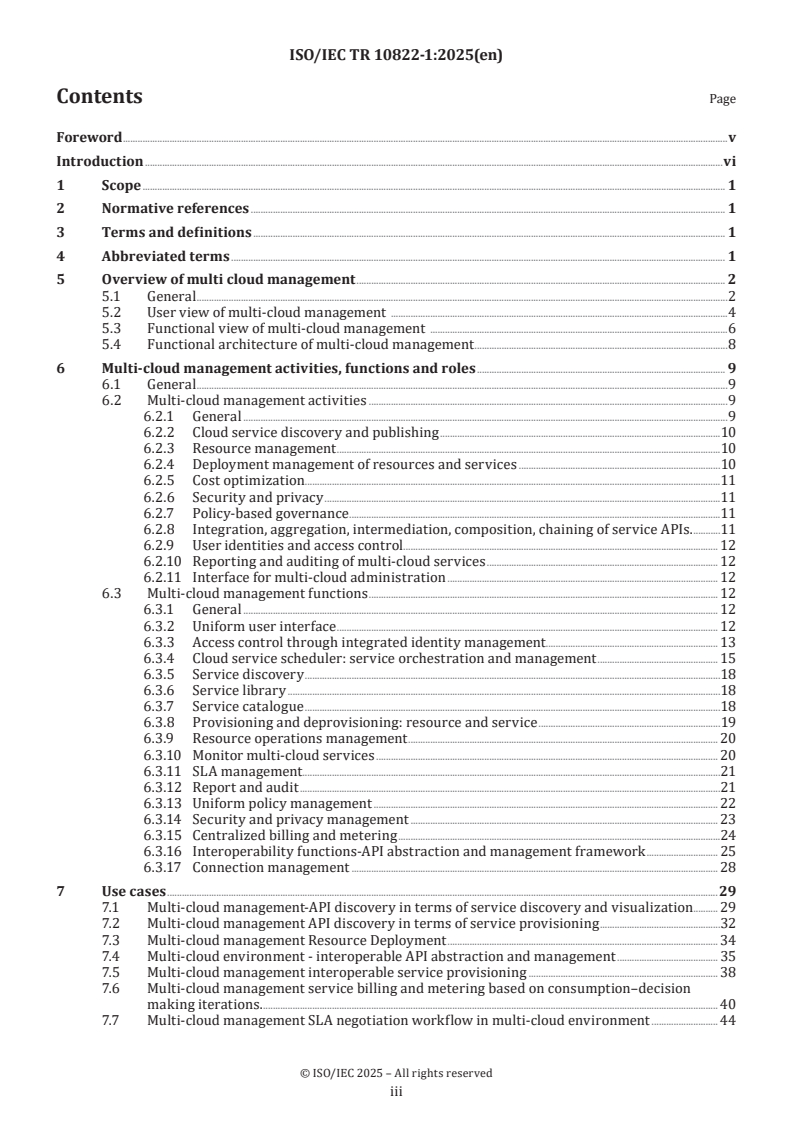
Contents Page
Foreword .v
Introduction .vi
1 Scope . 1
2 Normative references . 1
3 Terms and definitions . 1
4 Abbreviated terms . 1
5 Overview of multi cloud management . 2
5.1 General .2
5.2 User view of multi-cloud management .4
5.3 Functional view of multi-cloud management .6
5.4 Functional architecture of multi-cloud management .8
6 Multi-cloud management activities, functions and roles . 9
6.1 General .9
6.2 Multi-cloud management activities .9
6.2.1 General .9
6.2.2 Cloud service discovery and publishing .10
6.2.3 Resource management .10
6.2.4 Deployment management of resources and services .10
6.2.5 Cost optimization . .11
6.2.6 Security and privacy .11
6.2.7 Policy-based governance .11
6.2.8 Integration, aggregation, intermediation, composition, chaining of service APIs. .11
6.2.9 User identities and access control . . 12
6.2.10 Reporting and auditing of multi-cloud services . 12
6.2.11 Interface for multi-cloud administration . 12
6.3 Multi-cloud management functions . 12
6.3.1 General . 12
6.3.2 Uniform user interface . 12
6.3.3 Access control through integrated identity management . . 13
6.3.4 Cloud service scheduler: service orchestration and management . 15
6.3.5 Service discovery .18
6.3.6 Service library .18
6.3.7 Service catalogue .18
6.3.8 Provisioning and deprovisioning: resource and service .19
6.3.9 Resource operations management . 20
6.3.10 Monitor multi-cloud services . 20
6.3.11 SLA management.21
6.3.12 Report and audit .21
6.3.13 Uniform policy management . 22
6.3.14 Security and privacy management . 23
6.3.15 Centralized billing and metering .24
6.3.16 Interoperability functions-API abstraction and management framework . 25
6.3.17 Connection management . 28
7 Use cases .29
7.1 Multi-cloud management-API discovery in terms of service discovery and visualization . 29
7.2 Multi-cloud management API discovery in terms of service provisioning .32
7.3 Multi-cloud management Resource Deployment . 34
7.4 Multi-cloud environment - interoperable API abstraction and management . 35
7.5 Multi-cloud management interoperable service provisioning . 38
7.6 Multi-cloud management service billing and metering based on consumption–decision
making iterations. . . 40
7.7 Multi-cloud management SLA negotiation workflow in multi-cloud environment . 44
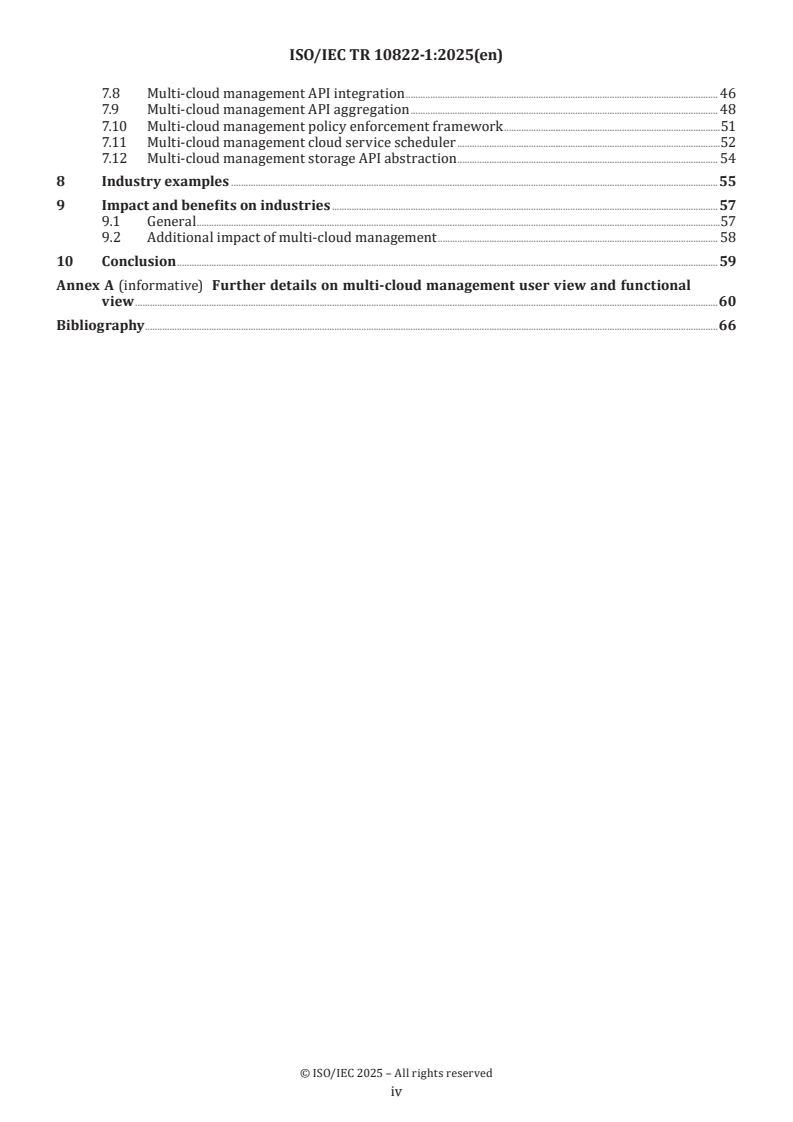
© ISO/IEC 2025 – All rights reserved
iii
7.8 Multi-cloud management API integration . 46
7.9 Multi-cloud management API aggregation . 48
7.10 Multi-cloud management policy enforcement framework .51
7.11 Multi-cloud management cloud service scheduler .52
7.12 Multi-cloud management storage API abstraction . 54
8 Industry examples .55
9 Impact and benefits on industries .57
9.1 General .57
9.2 Additional impact of multi-cloud management . 58
10 Conclusion .59
Annex A (informative) Further details on multi-cloud management user view and functional
view .60
Bibliography .66
© ISO/IEC 2025 – All rights reserved
iv
Foreword
ISO (the International Organization for Standardization) and IEC (the International Electrotechnical
Commission) form the specialized system for worldwide standardization. National bodies that are
members of ISO or IEC participate in the development of International Standards through technical
committees established by the respective organization to deal with particular fields of technical activity.
ISO and IEC technical committees collaborate in fields of mutual interest. Other international organizations,
governmental and non-governmental, in liaison with ISO and IEC, also take part in the work.
The procedures used to develop this document and those intended for its further maintenance are described
in the ISO/IEC Directives, Part 1. In particular, the different approval criteria needed for the different types
of document should be noted. This document was drafted in accordance with the editorial rules of the ISO/
IEC Directives, Part 2 (see www.iso.org/directives or www.iec.ch/members_experts/refdocs).
ISO and IEC draw attention to the possibility that the implementation of this document may involve the
use of (a) patent(s). ISO and IEC take no position concerning the evidence, validity or applicability of any
claimed patent rights in respect thereof. As of the date of publication of this document, ISO and IEC had not
received notice of (a) patent(s) which may be required to implement this document. However, implementers
are cautioned that this may not represent the latest information, which may be obtained from the patent
database available at www.iso.org/patents and https://patents.iec.ch. ISO and IEC shall not be held
responsible for identifying any or all such patent rights.
Any trade name used in this document is information given for the convenience of users and does not
constitute an endorsement.
For an explanation of the voluntary nature of standards, the meaning of ISO specific terms and expressions
related to conformity assessment, as well as information about ISO's adherence to the World Trade
Organization (WTO) principles in the Technical Barriers to Trade (TBT) see www.iso.org/iso/foreword.html.
In the IEC, see www.iec.ch/understanding-standards.
This document was prepared by Joint Technical Committee ISO/IEC JTC 1, Information technology,
Subcommittee SC 38, Cloud computing and distributed platforms.
A list of all parts in the ISO/IEC 10822 series can be found on the ISO and IEC websites.
Any feedback or questions on this document should be directed to the user’s national standards
body. A complete listing of these bodies can be found at www.iso.org/members.html and
www.iec.ch/national-committees.
© ISO/IEC 2025 – All rights reserved
v
Introduction
Many CSCs are using cloud services from multiple CSPs to achieve cost savings, vendor choice, business
continuity, choice of services and security.
Operating in a multi-cloud environment poses a number of challenges for CSCs including varying interfaces,
billing and metering schedules, security and privacy protections and performance.
CSCs can address multi-cloud challenges on their own, or by using cloud service partners, through
standardized approaches.
© ISO/IEC 2025 – All rights reserved
vi
Technical Report ISO/IEC TR 10822-1:2025(en)
Cloud computing — Multi-cloud management —
Part 1:
Overview and use cases
1 Scope
This document is based on ISO/IEC 22123-1, ISO/IEC 22123-3 and ISO/IEC 5140 and provides an overview of
the management challenges faced in multi-cloud deployments, as well as the management activities that can
be undertaken to address these challenges.
Additionally this document provides use cases with user and functional views to further explain the multi-
cloud management challenges and activities
2 Normative references
There are no normative references in this document.
3 Terms and definitions
No terms and definitions are listed in this document.
ISO and IEC maintain terminology databases for use in standardization at the following addresses:
— ISO Online browsing platform: available at https:// www .iso .org/ obp
— IEC Electropedia: available at https:// www .electropedia .org/
4 Abbreviated terms
API Application programming interface
CCPA California consumer privacy act
CCRA Cloud computing reference architecture
CSA Cloud service agreement
CSC Cloud service customer
CSN Cloud service partner
CSP Cloud service provider
CSU Cloud service user
DR Disaster recovery
GDPR General data protection regulation
IaaS Infrastructure-as-a-service
© ISO/IEC 2025 – All rights reserved
PaaS Platform-as-a-service
PII Personally identifiable information
QoS Quality of service
SaaS Software-as-a-service
SLA Cloud service level agreement
SLO Cloud service level objectives
5 Overview of multi cloud management
5.1 General
According to ISO/IEC 5140, multi-cloud management includes the use and operation of multiple cloud
services from two or more CSPs. The CSPs and their associated cloud services can be unaware of each other,
and the onus to manage the multi cloud ecosystem is on the CSC.
As different CSPs provide different capabilities, interfaces, datacentre locations, provisioning mechanisms,
connectivity, security, and access protocols, manual management of a multi-cloud ecosystem for a CSC can
prove cumbersome over time as the environment and number of application services grows.
Multi-cloud management solutions can assist CSCs manage their multi-cloud ecosystems, and they can
work as aggregator, integrator, and customizer. They can also offer a consistent method for managing the
provisioning and control mechanisms of cloud services, including access, security, connectivity, logging, and
monitoring of resources and services across multiple cloud platforms and CSPs.
Figure 1 shows a representative multi-cloud management ecosystem where a CSC uses more than one CSP,
where APP-X and APP-Y represent applications in the CSC environment which are being managed by a Multi-
cloud management solution.
Figure 1 — A representative Multi-Cloud Management ecosystem
© ISO/IEC 2025 – All rights reserved
A Multi-cloud management solution can:
— Provide identification of cloud services offered by multiple CSPs;
— Provide the CSC with a single, uniform interface to the cloud services;
— Enable multiple cloud services from different CSPs to interact with each other;
— Enable composite cloud services;
— Facilitate control and provisioning of cloud services without compromising security or privacy.
Several challenges in multi-cloud management can include:
— Managing architectural complexity
— Managing security and compliance
— Managing distributed and heterogeneous policies
— Managing agile interoperability between different CSPs
— Managing visibility across CSP resources
— Managing increased complexity of operations across different CSPs
— Managing elimination of redundancies
— Managing the cost structure and bringing uniformity on cost visualization for CSCs across various CSPs.
Multi-cloud management platforms can be implemented or operated by CSNs, CSPs, or by CSCs.
© ISO/IEC 2025 – All rights reserved
5.2 User view of multi-cloud management
Figure 2 — User view of multi-cloud management
© ISO/IEC 2025 – All rights reserved
Figure 2 illustrates the various activities and functions of multi-cloud management along with relevant CSC,
CSN and CSP activities that can enable a Cloud Service Customer (CSC) to utilize cloud services from multiple
Cloud Service Providers (CSPs).
Figure 2 employs graphical conventions introduced in Figure 1 (Conventions for CCRA diagrams) of
ISO/IEC 22123-3:2023. The boxes with continuous rounded edges represent roles, the hexagons represent
sub-roles, and the rounded edged oval boxes represent cloud computing activities.
Multi-cloud management encompasses a variety of activities aimed at effectively managing multiple cloud
environments.
Prospective users of multi-cloud management platform can be various cloud service customer (CSC) and
cloud service partner (CSN) subroles like
— CSC: cloud service user;
— CSC: cloud service administrator;
— CSC: cloud service business manager;
— CSN: cloud service auditor;
— CSN: cloud service developer.
The multi-cloud management interface empowers CSC/CSN users or user subroles to seamlessly assimilate,
deploy services, and execute tasks within the target cloud service provider (CSP) environment.
The process involves CSC or CSN users and user subroles submitting their requests to the multi-cloud
management platform. The submitted requests are then forwarded to the CSPs through various multi-cloud
management activities, triggering specific functions that facilitate the placement of the requests to the
CSPs. The responses from the CSPs are interpreted by the multi-cloud management functions, enabling the
provision of suitable services to the respective CSC or CSN users for their continued utilization.
Clause 6.2 provides a detailed overview of the multi-cloud management activities where each activity is
linked to specific functions supporting task execution, as further explained in 6.3. To enhance understanding
of the functional components, review 5.3 before proceeding to 6.3.
For further details on multi-cloud management user view and functional view refer to Annex A.
This document considers typical use cases for evaluating Multi-cloud management solutions. It is not meant
to indicate that these exemplary views represent the only or the preferred implementation for such a use case.
© ISO/IEC 2025 – All rights reserved
5.3 Functional view of multi-cloud management
Figure 3 — Multi-cloud management functions
Figure 3 illustrates the various activities and functions of multi-cloud management that can enable a Cloud
Service Customer (CSC) to utilize cloud services from multiple Cloud Service Providers (CSPs).
© ISO/IEC 2025 – All rights reserved
Figure 3 uses graphical conventions introduced by Figure 1 in ISO/IEC 22123-3:2023. The boxes with
continuous rounded edges represent roles, and the square ones with bricks are functional components.
Multi-cloud management encompasses the following functional components to address various aspects
which are discussed in 6.3.
— Uniform user interface;
— Integrated user identity management;
— Cloud service scheduler;
— Service discovery;
— Service library;
— Service catalogue;
— Provisioning and deprovisioning;
— Resource operations management;
— Monitor cloud services;
— SLA management;
— Report and audit;
— Uniform policy management;
— Security and privacy management;
— Centralized billing and metering;
— API abstraction and management framework;
— Connection management through inter-cloud gateway.
© ISO/IEC 2025 – All rights reserved
5.4 Functional architecture of multi-cloud management
Key
activity function or component role
© ISO/IEC 2025 – All rights reserved
Figure 4 — Functional architecture of multi-cloud management on component association
This document draws inspiration from ISO/IEC 5140 and ISO/IEC 22123-3:2023. The goal is to avoid
positioning it as a standalone multi-cloud management entity. Instead, the aim to present it within the
broader context of multi-cloud management, emphasizing its role as a platform or ecosystem.
Figure 4 uses graphical conventions introduced by Figure 1 of ISO/IEC 22123-3:2023. The roles are
represented by boxes with continuous rounded edges, cloud computing activities are represented by
rounded edge boxes, and the functional components are represented by square boxes with bricks.
It is evident that Roles are set of activities in cloud computing, and these activities are performed using
functional components.
The proximity of the graphical elements representing roles is meaningful and signifies close interaction
between roles, assuming neighbouring roles. For instance, the multi-cloud management role is positioned
at the centre of the diagram to emphasize its interaction with all other roles. Similarly, the positioning
of the multi-cloud computing activities inside a given role, as well as the relative placement of functional
components within a specific activity, follows the same principle. For example, the service capabilities
functional component is positioned above the resource abstraction and control functional component, to
indicate the dependency of the former on the latter.
The functional architecture for multi-cloud computing describes cloud computing in terms of a high-level
set of functional components. The functional components represent sets of functions that can be utilized to
perform the multi-cloud computing activities for the various roles and sub-roles involved in cloud computing.
The functional architecture describes functional components using conventions introduced in Figure 1
of ISO/IEC 22123-3:2023. The layering framework as outlined in Figure 11 of ISO/IEC 22123-3:2023 is
adhered to as a part of the functional architecture depicted in Figure 4, although it is not diagrammatically
represented to maintain a less complex and cumbersome appearance.
For the understanding of the layering framework and its accordance with Figure 1 of ISO/IEC 22123-3:2023,
please refer to Figure A.2.
6 Multi-cloud management activities, functions and roles
6.1 General
Multi-cloud management can enable a consistent and uniform cloud management ecosystem for a given CSC
whose workloads hosted across different CSPs, that interact and collaborate effectively across different
cloud platforms. Multi-cloud management solutions can allow CSCs to manage multi-cloud management
operations from a single interface with efficient monitoring and trustworthy security.
6.2 Multi-cloud management activities
6.2.1 General
Multi-cloud management activities can include:
— hand-shake between selected CSPs as needed by exchanging information using pre-defined and agreed
methods;
— point of entry for the CSC to manage multiple cloud services;
— single and consistent interface to multiple CSPs to host and access their workloads;
— managing CSU identities uniformly for a CSC, across multiple CSPs;
— validating requests from authorized sources;
© ISO/IEC 2025 – All rights reserved
— visibility into selected CSPs;
— performing role of Cloud Aggregation, Cloud Integration and Cloud Customization;
— discovering and publishing cloud services;
— resource management;
— deployment management: resource and service;
— monitoring cloud services;
— cost optimization for the CSCs;
— ensuring security and compliance;
— performing integration, aggregation, intermediation, composition, chaining of service APIs;
— implementing policy-based governance;
— reporting and auditing of multi-cloud services;
— acting as interface for multi-cloud administration.
Subclauses 6.2.2 to 6.2.11 delve into a comprehensive description of the key activities involved in multi-
cloud management, aiming to efficiently oversee multiple cloud environments.
6.2.2 Cloud service discovery and publishing
In multi-cloud management, the process of discovering and publishing cloud services involves identifying
available services within various cloud environments and making them accessible to CSUs. This ensures
efficient utilization of services and enhances the CSU experience. This activity can be associated with:
— service discovery;
— service library and catalogue management;
— service publication.
6.2.3 Resource management
Multi-cloud resource management involves functions related to the monitoring, management, and
optimization of computing resources within multi-cloud environment (e.g. CPU, storage, memory, and
network bandwidth) to meet the demands of applications and services running in the cloud. The goal of
resource management is to ensure efficient utilization of available resources while maintaining performance,
scalability, load balancing, and cost efficiency. It achieves this objective through functions like:
— resource allocation;
— load balancing;
— monitoring multi-cloud services;
— SLA management;
— service orchestration and management.
6.2.4 Deployment management of resources and services
Multi-cloud deployment management involves provisioning, or deprovisioning, and allocating, or
deallocating, cloud resources and services across different CSPs It ensures that the necessary resources,
such as virtual machines, storage, and networking components, are provisioned based on demand and
workload requirements.
© ISO/IEC 2025 – All rights reserved
Multi-cloud management facilitates the deployment, usage, and orchestration of services across multiple
clouds. It enables the seamless integration and coordination of services to support complex applications
and workflows that span across different cloud environments. Deployment management ensures that the
necessary resources and dependencies are made available and properly configured for the application or
service to function effectively in the multi-cloud environment as requested by the CSU. This activity can be
associated with:
— resource provisioning and deprovisioning;
— service provisioning and deprovisioning.
6.2.5 Cost optimization
Multi-cloud management aims to optimizes costs by efficiently allocating resources, leveraging pricing
models, identifying cost-effective CSPs or services and providing a centralized billing. It helps organizations
achieve a balance between performance, functionality, and cost efficiency. This activity can include:
— cloud service price schedules;
— cloud service agreements;
— cloud SLAs.
6.2.6 Security and privacy
Multi-cloud management involves implementing and enforcing security and privacy measures and policies
across multiple clouds. It ensures consistent security practices, controls access to resources, and mitigates
risks associated with data privacy requirements.
6.2.7 Policy-based governance
Multi-cloud management includes establishing governance frameworks, managing policies and best
practices for cloud usage across multiple CSPs.
6.2.8 Integration, aggregation, intermediation, composition, chaining of service APIs.
Multi-cloud management can be utilized to perform servicing, security, monitoring, policy integration,
aggregation, intermediation, composition, and chaining of service APIs.
— Service integration is the process of connecting different cloud-based services. It allows CSCs to share
data and processes across their cloud environments, regardless of where the data or applications are
located.
— Aggregation is the process of collecting data from multiple sources and presenting it in a single view. It
can help in obtaining an overview of data and make better decisions.
— Intermediation is the process of providing a layer of abstraction between two or more services. It
simplifies the way that services interact and makes it easier to manage them.
— Composition is the process of combining multiple services to create a new service. It can be used to
create more complex and powerful solutions that are not feasible with a single service.
— Chaining is the process of connecting multiple services in a sequence, helping to create workflows that
automate tasks and improve efficiency.
A multi-cloud management platform can perform roles such as a "cloud aggregator," "cloud integrator," and
"cloud customizer" to fulfil the aforementioned tasks. A brief description of these roles is provided in 6.4,
while 6.3.16 explains the functions associated with these activities
© ISO/IEC 2025 – All rights reserved
6.2.9 User identities and access control
Multi-cloud management can be used to manage CSU identities and access control across multiple CSPs.
This involves implementing a consistent approach to CSU authentication, authorization, access control. This
activity can involve:
— CSU accounts;
— CSU identities;
— CSU permissions.
6.2.10 Reporting and auditing of multi-cloud services
Multi-cloud management platforms can provide robust reporting and auditing capabilities for cloud services,
enabling organizations to monitor and analyse various aspects of their multi-cloud environment. They can
generate reports, which can be essential for audits, like:
— resource utilization report;
— cost analysis report;
— compliance and security report;
— service performance;
— governance and policy compliance;
— customize reports based on specific requirements.
6.2.11 Interface for multi-cloud administration
Multi-cloud management can provide a centralized control panel where administrators can perform cloud
administrative tasks like “resource management” and “service management”.
By performing these activities, multi-cloud management enables organizations to effectively manage and
leverage the benefits of multiple cloud environments, optimizing resource utilization, performance, cost
efficiency, security, and compliance.
6.3 Multi-cloud management functions
6.3.1 General
This description outlines functions that can be part of a multi-cloud management platform as described in 6.2.
6.3.2 Uniform user interface
In multi-cloud management, a uniform user interface can ensure a consistent CSU experience across multiple
cloud platforms through a single management interface. The user interface of a multi-cloud management
platform can incorporate the following elements:
— Centralized dashboard: The interface includes a centralized dashboard that provides an overview of
the CSU’s connected cloud environments, including resources, services, and their status across multiple
clouds. It allows CSUs to monitor and manage their cloud assets from a single location.
— Cloud service integration: The user interface integrates with various cloud service provider APIs to
enable management and orchestration of resources across different clouds. It provides a consistent way
to interact with services such as virtual machines, storage, networking, databases, and other cloud-
specific offerings.
© ISO/IEC 2025 – All rights reserved
— Unified navigation and controls: A uniform user interface provide consistent navigation and control
mechanisms, allowing CSUs to easily switch between different clouds and perform management tasks
seamlessly. It includes standardized menus, sidebars, and controls to ensure familiarity and ease of use
across various cloud environments.
— Resource management: The interface provides capabilities for managing cloud resources across
multiple CSPs. CSUs can perform tasks such as provisioning and deprovisioning resources, scaling
resources, starting/stopping resources and monitoring resource usage and performance across different
clouds, through integrated service APIs.
— Security and access control: A uniform user interface provides consistent security and access control
mechanisms. It allows CSUs to manage authentication, permissions, and security policies consistently
across multiple clouds. This ensures that CSUs can enforce a unified security policy across their cloud
environments.
— Monitoring and analytics: The interface can include unified monitoring and analytics features that
aggregate data from different cloud providers. This allows CSUs to gain insights into the performance,
health, and utilization of their multi-cloud infrastructure.
By providing a uniform user interface, the multi-cloud management platform simplifies the complexity
of managing multiple clouds and enhances user productivity by offering a consistent and streamlined
experience for monitoring, provisioning, managing, and securing resources across diverse cloud
environments.
6.3.3 Access control through integrated identity management
Access control, facilitated by the integrated identity management of a multi-cloud management platform,
allows CSUs to access specific services from designated CSPs. The core aspect of access control involves
authenticating a user through the presentation and validation of credentials, followed by authorizing the
authenticated user to access particular services. The multi-cloud management platform to provide access
control for cloud services, their dependent resources, and the corresponding control functions.
Users affected by multi-cloud access control can include:
— CSC: cloud service user(CSU);
— CSC: cloud service administrator;
— CSC: cloud service business manager;
— CSN: cloud service auditor user.
The integrated identity management activity can include three functions:
— SSO Authentication:
Multi-cloud management facilitates Single Sign-On (SSO) authentication, streamlining the authentication
process for users across multiple cloud environments. With SSO, users can access multiple cloud services
and platforms using a single set of credentials. It eliminates the need to remember and enter separate login
information for each cloud provider.
By integrating SSO authentication into the multi-cloud management platform, users can securely authenticate
once and gain access to their authorized resources and services across different clouds. It simplifies the
login experience and also enhances security by reducing the risk associated with managing multiple sets of
credentials.
Furthermore, SSO authentication in multi-cloud management provides centralized control and visibility
over user access rights and permissions. Administrators can efficiently manage user authentication, access
policies, and authorization levels from a single management interface. This helps enforce consistent security
practices and simplifies the management of user access across different cloud environments.
— Access Authorization Policies:
© ISO/IEC 2025 – All rights reserved
Multi-cloud management involves the implementation of access authorization policies across different cloud
environments. These policies define the rules and permissions for user access to resources and services
within the multi-cloud infrastructure.
By implementing access authorization policies in multi-cloud management, administrators can enforce
consistent security practices, limit access to sensitive resources, and mitigate risks associated with
unauthorized access. These policies provide a systematic and controlled approach to managing user access
across multiple cloud platforms within the multi-cloud environment.
Access authorization policies in multi-cloud management can include:
— Role-based access control(RBAC): RBAC assigns users roles based on responsibilities, granting
appropriate permissions to access resources and perform actions relevant to their role in the multi-cloud
environment;
— Fine-Grained Access Control: Fine-grained access control provides detailed user permission control,
allowing administrators to define specific rules based on attributes like user, group, IP address, or
resource type;
— Attribute-based access control (ABAC): ABAC considers user attributes, resource attributes, and
environmental factors to determine access, allowing flexible policies based on dynamic conditions and
contextual information;
— Policy-Based Access Control: Policy-based access control uses predefined policies to determine access,
considering factors like time, location, user role, or resource attributes. It simplifies access control
management by centrally defining and managing policies.
— Multi-Factor Authentication (MFA): MFA enhances security by requiring multiple forms of
authentication, such as a password and a unique mobile code, ensuring authorized access to the multi-
cloud management platform;
— Users’ identity database:
The users' identity database in multi-cloud management serves as a central repository for storing and
managing user identities and related information.
The user identity database plays a crucial role in enforcing access control policies. It stores information
about user roles, privileges, and permissions, enabling administrators to define and manage access rights
for different users. This helps ensure that users have appropriate access to resources and functionalities
within the multi-cloud environment. It can also store additional information about users, such as contact
details, organizational affiliations, and preferences, thus providing a comprehensive view of user profile.
The user identity database enables administrators to create, modify, and delete user accounts within the
multi-cloud management platform. It allows for the management of user attributes, such as usernames,
email addresses, roles, and permissions.
User Authentication uses the identity database to verify the authenticity of users by validating their
credentials during the authentication process. This ensures that only authorized users can access the multi-
cloud management platform.
The user identity database implements security measures to protect user identities and sensitive
information. It includes mechanisms such as encryption, strong access controls, and monitoring to prevent
unauthorized access or data breaches.
The users' identity database in multi-cloud management enables secure user authentication, efficient user
management, fine-grained access control, and the overall security and integrity of user identities and
associated information.
© ISO/IEC 2025 – All rights reserved
6.3.4 Cloud service scheduler: service orchestration and management
6.3.4.1 General
The cloud service scheduler in multi-cloud management is a component that orchestrates the scheduling,
usage, and allocation of cloud resources across multiple cloud environments.
The cloud service scheduler serves as a centralized controller in multi-cloud management, orchestrating
and coordinating various functions within the system. It acts as the command center, directing and invoking
other functions as needed. It ensures that the different elements used for a service or application to function
together seamlessly, are orchestrated and synchronized. By effectively managing and scheduling tasks, the
cloud service scheduler ensures the smooth execution of operations across the multi-cloud environment.
The cloud service scheduler invokes specific functions as an integral part of the multi-cloud management
platform, thereby facilitating execution of the associated tasks.
By leveraging the cloud service scheduler in multi-cloud management, organizations can achieve efficient
resource utilization, improved performance, cost optimization, and scalability across their multi-cloud
environments.
The cloud service scheduler serves as a central component that handles user requests after authentication.
It identifies the appropriate function
...
Questions, Comments and Discussion
Ask us and Technical Secretary will try to provide an answer. You can facilitate discussion about the standard in here.
Loading comments...