


ISO/TS 11073-92001:2007
(Main)Health informatics — Medical waveform format — Part 92001: Encoding rules
Health informatics — Medical waveform format — Part 92001: Encoding rules
ISO/TS 11073-92001:2007 specifies how medical waveforms, such as electrocardiogram, electroencephalogram, spirometry waveform etc., are described for interoperability among healthcare information systems. ISO/TS 11073-92001:2007 may be used with other relevant protocols such as HL7, DICOM, ISO/IEEE 11073, and database management systems for each purpose. This is a general specification, so specifications for particular waveform types and for harmonization with DICOM, SCP-ECG, X73 etc. are not given. ISO/TS 11073-92001:2007 does not include lower layer protocols for message exchange. For example, a critical real-time application like a patient monitoring system is out of scope and this is an implementation issue.
Informatique de santé — Forme d'onde médicale — Partie 92001: Règles d'encodage
General Information
- Status
- Withdrawn
- Publication Date
- 17-Sep-2007
- Withdrawal Date
- 17-Sep-2007
- Technical Committee
- ISO/TC 215 - Health informatics
- Drafting Committee
- ISO/TC 215 - Health informatics
- Current Stage
- 9599 - Withdrawal of International Standard
- Start Date
- 17-Sep-2015
- Completion Date
- 14-Feb-2026
Relations
- Consolidated By
ISO 13769:2018 - Gas cylinders — Stamp marking - Effective Date
- 06-Jun-2022
- Effective Date
- 02-Nov-2013


Get Certified
Connect with accredited certification bodies for this standard

BSI Group
BSI (British Standards Institution) is the business standards company that helps organizations make excellence a habit.

NYCE
Mexican standards and certification body.
Sponsored listings
Frequently Asked Questions
ISO/TS 11073-92001:2007 is a technical specification published by the International Organization for Standardization (ISO). Its full title is "Health informatics — Medical waveform format — Part 92001: Encoding rules". This standard covers: ISO/TS 11073-92001:2007 specifies how medical waveforms, such as electrocardiogram, electroencephalogram, spirometry waveform etc., are described for interoperability among healthcare information systems. ISO/TS 11073-92001:2007 may be used with other relevant protocols such as HL7, DICOM, ISO/IEEE 11073, and database management systems for each purpose. This is a general specification, so specifications for particular waveform types and for harmonization with DICOM, SCP-ECG, X73 etc. are not given. ISO/TS 11073-92001:2007 does not include lower layer protocols for message exchange. For example, a critical real-time application like a patient monitoring system is out of scope and this is an implementation issue.
ISO/TS 11073-92001:2007 specifies how medical waveforms, such as electrocardiogram, electroencephalogram, spirometry waveform etc., are described for interoperability among healthcare information systems. ISO/TS 11073-92001:2007 may be used with other relevant protocols such as HL7, DICOM, ISO/IEEE 11073, and database management systems for each purpose. This is a general specification, so specifications for particular waveform types and for harmonization with DICOM, SCP-ECG, X73 etc. are not given. ISO/TS 11073-92001:2007 does not include lower layer protocols for message exchange. For example, a critical real-time application like a patient monitoring system is out of scope and this is an implementation issue.
ISO/TS 11073-92001:2007 is classified under the following ICS (International Classification for Standards) categories: 35.240.80 - IT applications in health care technology. The ICS classification helps identify the subject area and facilitates finding related standards.
ISO/TS 11073-92001:2007 has the following relationships with other standards: It is inter standard links to ISO 13769:2018, ISO 22077-1:2015. Understanding these relationships helps ensure you are using the most current and applicable version of the standard.
ISO/TS 11073-92001:2007 is available in PDF format for immediate download after purchase. The document can be added to your cart and obtained through the secure checkout process. Digital delivery ensures instant access to the complete standard document.
Standards Content (Sample)
TECHNICAL ISO/TS
SPECIFICATION 11073-92001
First edition
2007-09-01
Health informatics — Medical waveform
format —
Part 92001:
Encoding rules
Informatique de santé — Forme d'onde médicale —
Partie 92001: Règles d'encodage
Reference number
©
ISO 2007
PDF disclaimer
This PDF file may contain embedded typefaces. In accordance with Adobe's licensing policy, this file may be printed or viewed but
shall not be edited unless the typefaces which are embedded are licensed to and installed on the computer performing the editing. In
downloading this file, parties accept therein the responsibility of not infringing Adobe's licensing policy. The ISO Central Secretariat
accepts no liability in this area.
Adobe is a trademark of Adobe Systems Incorporated.
Details of the software products used to create this PDF file can be found in the General Info relative to the file; the PDF-creation
parameters were optimized for printing. Every care has been taken to ensure that the file is suitable for use by ISO member bodies. In
the unlikely event that a problem relating to it is found, please inform the Central Secretariat at the address given below.
© ISO 2007
All rights reserved. Unless otherwise specified, no part of this publication may be reproduced or utilized in any form or by any means,
electronic or mechanical, including photocopying and microfilm, without permission in writing from either ISO at the address below or
ISO's member body in the country of the requester.
ISO copyright office
Case postale 56 • CH-1211 Geneva 20
Tel. + 41 22 749 01 11
Fax + 41 22 749 09 47
E-mail copyright@iso.org
Web www.iso.org
Published in Switzerland
ii © ISO 2007 – All rights reserved
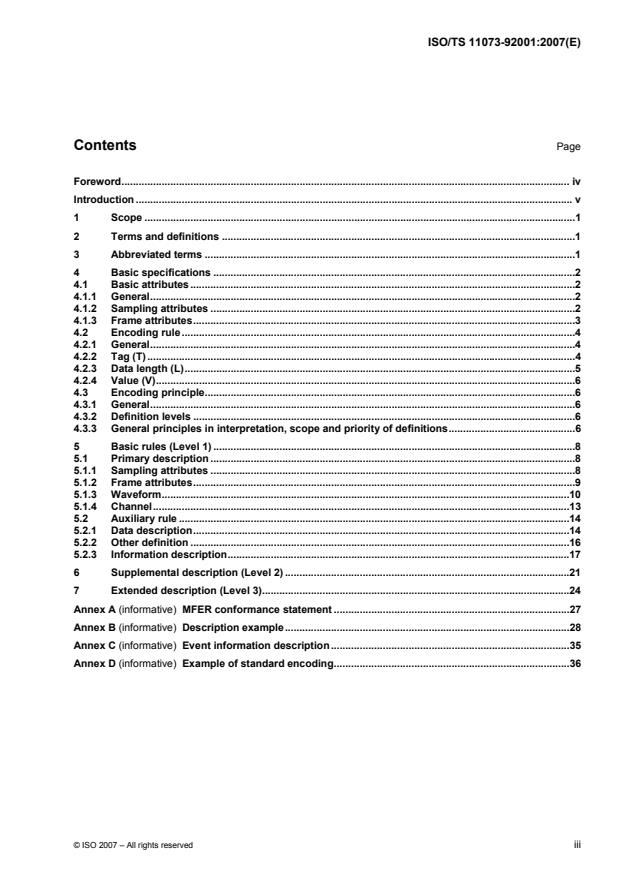
Contents Page
Foreword. iv
Introduction . v
1 Scope .1
2 Terms and definitions .1
3 Abbreviated terms .1
4 Basic specifications .2
4.1 Basic attributes.2
4.1.1 General.2
4.1.2 Sampling attributes .2
4.1.3 Frame attributes.3
4.2 Encoding rule.4
4.2.1 General.4
4.2.2 Tag (T).4
4.2.3 Data length (L).5
4.2.4 Value (V).6
4.3 Encoding principle.6
4.3.1 General.6
4.3.2 Definition levels .6
4.3.3 General principles in interpretation, scope and priority of definitions.6
5 Basic rules (Level 1) .8
5.1 Primary description .8
5.1.1 Sampling attributes .8
5.1.2 Frame attributes.9
5.1.3 Waveform.10
5.1.4 Channel.13
5.2 Auxiliary rule .14
5.2.1 Data description.14
5.2.2 Other definition .16
5.2.3 Information description.17
6 Supplemental description (Level 2) .21
7 Extended description (Level 3).24
Annex A (informative) MFER conformance statement .27
Annex B (informative) Description example.28
Annex C (informative) Event information description.35
Annex D (informative) Example of standard encoding.36
Foreword
ISO (the International Organization for Standardization) is a worldwide federation of national standards bodies
(ISO member bodies). The work of preparing International Standards is normally carried out through ISO
technical committees. Each member body interested in a subject for which a technical committee has been
established has the right to be represented on that committee. International organizations, governmental and
non-governmental, in liaison with ISO, also take part in the work. ISO collaborates closely with the
International Electrotechnical Commission (IEC) on all matters of electrotechnical standardization.
International Standards are drafted in accordance with the rules given in the ISO/IEC Directives, Part 2.
The main task of technical committees is to prepare International Standards. Draft International Standards
adopted by the technical committees are circulated to the member bodies for voting. Publication as an
International Standard requires approval by at least 75 % of the member bodies casting a vote.
In other circumstances, particularly when there is an urgent market requirement for such documents, a
technical committee may decide to publish other types of normative document:
— an ISO Publicly Available Specification (ISO/PAS) represents an agreement between technical experts in
an ISO working group and is accepted for publication if it is approved by more than 50 % of the members
of the parent committee casting a vote;
— an ISO Technical Specification (ISO/TS) represents an agreement between the members of a technical
committee and is accepted for publication if it is approved by 2/3 of the members of the committee
casting a vote.
An ISO/PAS or ISO/TS is reviewed after three years in order to decide whether it will be confirmed for a
further three years, revised to become an International Standard, or withdrawn. If the ISO/PAS or ISO/TS is
confirmed, it is reviewed again after a further three years, at which time it must either be transformed into an
International Standard or be withdrawn.
Attention is drawn to the possibility that some of the elements of this document may be the subject of patent
rights. ISO shall not be held responsible for identifying any or all such patent rights.
ISO/TS 11073-92001 was prepared by Technical Committee ISO/TC 215, Health informatics.
iv © ISO 2007 – All rights reserved
Introduction
Medical waveform data such as an electrocardiogram (ECG) or an electroencephalogram (EEG) are widely
utilized in physiological examinations, physiological research, electronic medical records, healthcare
information and other areas in the clinical field. Medical waveform data can be used for many medical and
research purposes if digital signal processing technology is applied to standardize the data in a digital format.
For medical waveforms it is essential to standardize the data format to expedite the mutual application of the
standard so that the data can be processed electronically and used in a variety of ways.
Simple and easy implementation: application of Medical waveform Format Encoding Rules (MFER) is very
simple and is designed to facilitate understanding, easy installation, trouble-shooting and low implementation
cost.
Harmonization with other standards: MEFR is specially utilized to describe the medical waveform data.
Other information than waveform data, such as patient demographic data and finding information, etc. should
be written using other healthcare standards, such as HL7, DICOM, ISO/IEEE 11073.
In addition, experts in each field should independently develop relevant standards for medical specifications;
for example MFER for ECG is developed by cardiologists and EEG is developed by neurologists.
Combination with coded information and text information: MFER policy is that both machine and human
readable manner are used. Namely coded information is for computer processable and text data are for
human readable information. ART (arterial blood pressure) is coded as 129 and information description fields
indicate “Right radial artery pressure”, for example. As the description of MFER is quite flexible, MFER neither
hinders the features of each system nor impedes the development of technologies.
TECHNICAL SPECIFICATION ISO/TS 11073-92001:2007(E)
Health informatics — Medical waveform format —
Part 92001:
Encoding rules
1 Scope
This Technical Specification specifies how medical waveforms, such as electrocardiogram,
electroencephalogram, spirometry waveform, etc., are described for interoperability among healthcare
information systems.
This Technical Specification may be used with other relevant protocols, such as HL7, DICOM,
ISO/IEEE 11073, and database management systems for each purpose.
This is a general specification, so specifications for particular waveform types and for harmonization with
DICOM, SCP-ECG, X73, etc. are not given.
This Technical Specification does not include lower layer protocols for message exchange. For example, a
critical real-time application like a patient monitoring system is out of scope and this is an implementation
issue.
2 Terms and definitions
For the purposes of this document, the following terms and definitions apply.
2.1
frame
waveform encoding unit consisting of data blocks, channels and sequences
2.2
medical waveform
time sequential data that are sampled by A/D converter or transmitted from medical equipment
2.3
sampling
data that are converted at a fixed time interval
2.4
channel
individual waveform data group
3 Abbreviated terms
AAMI Association for the Advancement of Medical Instrumentation
A/D Analog to Digital
CSE Common Standards for Quantitative Electrocardiography
CEN Comité Européen de Normalisation/European Committee for Standardization
ECG Electrocardiogram
EEG Electroencephalogram
GPS Global Positioning System
HL7 Health Level Seven
DICOM Digital Imaging and Communications in Medicine
IEEE Institute of Electrical and Electronic Engineers
IEC International Electrotechnical Commission
JIS Japanese Industrial Standard
LSB Least significant bit
MFER Medical waveform Format Encoding Rules
MSB Most significant bit
SCP-ECG Standard Communications Protocol for Computerized Electrocardiography (EN 1064)
SPO2 Saturation of Peripheral Oxygen
VCG Vectorcardiogram
4 Basic specifications
4.1 Basic attributes
4.1.1 General
Medical waveform data described in accordance with the MFER consists of Sampling attributes (Figure 1),
Frame attributes (Figure 2) and other supplemental information.
4.1.2 Sampling attributes
Sampling information has two attributes, sampling rate and sampling resolution.
a) Sampling rate
The sampling rate is described with sampling interval or sampling frequency. The sampling interval stands for
the time or distance interval of each sampled data as distributed sampled waveform data.
b) Sampling resolution
Sampling resolution represents a minimum sampling value per least significant bit (LSB).
2 © ISO 2007 – All rights reserved
Key
T sampling interval (or frequency)
R resolution
Figure 1 — Sampling attributes
4.1.3 Frame attributes
The frame is a waveform encoding unit consisting of data blocks, channels and sequences. A configuration
example of a frame is shown as Figure 2.
a) Data block
The data block is the waveform data array for each channel.
b) Channels
The channels indicate different waveform groups, e.g. if three waveform groups exist, the number of channels
is 3.
c) Sequence
The sequence represents the repetition of the group with the data block and channel.
Key
1 frame
2 data block
3 channel
4 sequence
Figure 2 — Frame attributes
4.2 Encoding rule
4.2.1 General
The header and waveform data should be encoded based on the encoding rules which are composed of the
tag, length and value (TLV), as shown in Figure 3.
Tag (T) Data length (L) Value (V)
Figure 3 — Data unit
⎯ The tag (T) consists of one or more octets and indicates the attribute of the data value.
⎯ The data length (L) is the length of data values indicated in one or more octets.
⎯ The value (V) is contents which are indicated by tag (T); e.g. attribute definition, waveform data, etc.
4.2.2 Tag (T)
The tag is composed of a class, primitive/context (P/C) and tag number. The tag is classified into four classes
(Table 1). Classes 0 to 2 are MFER standard coding and class 3 is for private use. The private definition is
intended for special purposes but should be included within any updated future version.
4 © ISO 2007 – All rights reserved
Table 1 — Tag
8 7 6 5 4 3 2 1
Class P/C Tag number
0 0
MFER
0 1
0/1
1 0
1 1 Private
a) Primitive type (P/C = 0)
P/C = 0 indicates a primitive description.
b) Context type (P/C = 1)
This has only two Tags which are Group and Channel definition on current MFER. Figure 4 gives an example
of a group definition.
8 7 6 5 4 3 2 1
0 1 1 0 0 1 1 1
Figure 4 — Group definition
4.2.3 Data length (L)
The data length indicates the number of octets used for data values in the value (V) section (i.e. the length
excluding octets used for tag and data length sections). The data length encoding method differs depending
on whether the number of octets used for data is less than 127 or more than 128 octets.
a) In case the data value section uses 127 octets or less
The length is encoded in one octet, as shown in Figure 5.
8 7 6 5 4 3 2 1
0 Data length
Figure 5 — Data length u 127 octets
b) In case the data value section uses 128 octets or more
The long data length can be encoded using multiple octets. The first octet indicates the number of octets used
to represent the total data length. For example, two subsequent octets are used to indicate the waveform data
length from 128 to 65 535 and thus three octets are used to encode the data length as in Figure 6. However,
MFER allows representation of a data length using multiple octets even if the length is less than 127 octets.
For example, four octets can describe up to 4 294 967 295 bytes length as a data part.
8 7 6 5 4 3 2 1 8 7 6 5 4 3 2 1 8 7 6 5 4 3 2 1 8 7 6 5 4 3 2 1
Length number
1 Most significant octet The second octet The third octet
(e.g. 3 octets)
Figure 6 — Data length
c) Designation of indefinite data length
MFER allows designation of an indefinite data length by encoding 80 h on the top of the data length field
(Figure 7). This indefinite length designation is terminated by encoding the end-of-contents (tag = 00, data
length = 00).
Tag Length End-of-Contents
- - - - - - - - - - - - - - -
P/C=1 (80h) (00,00)
Figure 7 — Indefinite length designation and end-of-contents designation
d) In case the data length is 0
MFER indicates that the definition indicated by tag resets to the default value. Namely, on the root definition
the concerned items re-initialize to default values and in case of the channel definition, the channel definition
is re-initialized to the root definition.
4.2.4 Value (V)
The header or waveform data values are encoded in the value section according to descriptors specified by
the tag.
4.3 Encoding principle
4.3.1 General
All definitions in MFER have default values, so any additional or amended definitions are optional. Thus the
definition corresponding to each tag has a default value, so re-definition is not necessary if the default value is
retained. It is expected that default definitions will suffice for most purposes.
4.3.2 Definition levels
4.3.2.1 Level 1 — basic definitions
Definitions at level 1 are basic definitions, which are ordinary rules (marked with an asterisk) and ensure
precise encoding.
4.3.2.2 Level 2 — supplementary definitions
Definitions at level 2 are supplementary definitions. They may be used as required but it is desirable to
associate the supplementary definitions with a host protocol where they can be defined with the host protocol.
4.3.2.3 Level 3 — extended definitions
Definitions at level 3 are extended definitions, which should be used as little as possible. Items of these
extended definitions may considerably affect the system with regard to privacy, security, etc.; thus, great care
should be taken in using them.
4.3.3 General principles in interpretation, scope and priority of definitions
4.3.3.1 Initial values (default value)
All definitions in MFER have initial values that are applied until redefined by any subsequent definition.
6 © ISO 2007 – All rights reserved
4.3.3.2 Multiple definitions
Multiple definitions may be made for any item. Depending on items, a new definition, an old definition or all
definitions (such as for events), may be used multiple times.
For example, setting the sampling frequency to 250 Hz overrides the initial value of 1 kHz.
If multiple events occur, they are interpreted in definition order.
4.3.3.3 Later definition priority
Each definition is interpreted in definition order. If an item has related definitions, definition should be made in
due order. The default endianity is big-endian, so to use little-endian endianity the definition for little-endian
must be designated.
For example, before defining each channel, the number of channels should be defined.
4.3.3.4 Channel attributes definition order
Before defining the attributes of a channel, the number of channels should be defined. If the number of
channels is defined later, previous channel definitions are reset to the root definition including default values.
4.3.3.5 Root definition (general definition) and channel definition (definition per channel)
The root definition is effective for all channels. The channel definition is effective only for the relevant channel
and overrides the root definition. However, care should be taken because if a subsequent change to the root
definition is made, it will override the default content of the relevant channel for subsequent channel definitions.
For example, if EEG is designated in the root definition, ECG designated for a channel in the channel
definition overrides EEG.
4.3.3.6 Definition reset
If the data length is defined as zero (no data) in the definition of an item, the content in the definition is reset to
default value. If the data length is designated as zero in a channel definition, the definition follows the root
definition including the default value. If the number of channels is defined, contents defined for the channel
attribute are all reset to the root definition including the default value.
4.3.3.7 Incomplete definition ignored
If a definition is made without an adequate preceding definition, the definition is ignored.
In the absence of any complete definition, the default root definition will be applied.
For example, if the number of channels is undefined, any dependent channel definition is ignored.
4.3.3.8 Succession of definitions
Unless redefined, each definition applies to all succeeding frames, in the effective range, except for the data
pointer which is succeeding renewed. Thus, contents defined in the root definition apply to all frames unless
overridden by channel definition(s), so it suffices to define common items in the root definition.
For examples, to use little-endian for all encodings with MFER, define little-endian once, then it is effective
over the whole region irrespective of frames.
4.3.3.9 Definition and efficacy of data
It depends on the functional capability of the user application whether or not the user can use data defined by
the provider. If some content cannot be processed, users may discard all the data or use only the processable
range of data.
5 Basic rules (Level 1)
5.1 Primary description
5.1.1 Sampling attributes
Sampling attributes are sampling frequency or sampling interval and resolution are given in Tables 2 to 5.
1) MWF_IVL (0Bh): Sampling rate
This tag indicates the frequency or interval the medical waveform is sampled (Table 2).
Table 2 — Sampling rate
MWF_IVL * Data length Default Encoding range/remarks Duplicated definitions
Unit 1 —
th −128 +127
11 0Bh 1 000 Hz Override
Exponent (10 power) 1 10 to 10
Mantissa u 4 e.g. signed 16-bit integer
The unit may be frequency in Hertz, time in seconds or distance metres (Table 3).
Table 3 — Sampling rate unit
Unit Value Remarks
Frequency Hz 0 Including power
Time interval s 1 —
Distance m 2 —
2) MWF_SEN (0Ch): Sampling resolution
This tag indicates the resolution, minimum bits, the medical waveform is sampled (generally, digitized)
(Table 4).
Table 4 — Sampling resolution
MWF_SEN * Data length Default Encoding range/remarks Duplicated definitions
Unit 1 —
th −128 +127
12 0Ch See Table 5 Override
Exponent (10power) 1 10 to 10
Mantissa u 4 e.g. signed 16-bit integer
8 © ISO 2007 – All rights reserved
Table 5 — Sampling units
Unit Value Default Remarks
Voltage V 0 0,000 001 V —
mm Hg(Torr) 1 — —
Pa 2 — —
Pressure
cm HO 3 — —
mm Hg/s 4 — —
dyne 5 — —
Force
N 6 — —
Ratio % 7 — Include volume fraction (%)
Temperature ° C 8 — —
−1
min 9 — —
Heart rate
−1
s 10 — —
Resistance Ω 11 — —
Current A 12 — —
Rotation r/min 13 — —
W 14 — —
Power
dB 15 — —
Mass kg 16 — —
Work J 17 — —
−2 −5
Vascular resistance dyne⋅s⋅m cm 18 — —
l 19 — —
Flow rate, flow, volume l/s 20 — —
l/min 21 — —
Luminous intensity cd 22 — —
5.1.2 Frame attributes
As described in Figure 2 a frame is composed of data blocks, channels and sequences.
1) MWF_BLK (04h): Data block length
This tag indicates the number of data sampled in a block (Table 6).
Table 6 — Data block length
MWF_BLK* Data length Default Remarks Duplicated definitions
04 04h u 4 1 — Override
2) MWF_CHN (05h): Number of channels
This tag indicates the number of channels (Table 7). As the previously specified channel attribute is reset to
the root definition including default, the number of channels should be specified before each definition of the
channel attribute. The number of channels cannot be specified with a channel definition of channel attribute.
Table 7 — Number of channels
MWF_CHN* Data length Default Remarks Duplicated definitions
05 05h u 4 1 — Override
3) MWF_SEQ (06h): Number of sequences
This tag indicates the number of sequences (Table 8). If the number of sequences is not designated, it
depends on the data block length, the number of channels and the number of waveform data values which are
defined for the concerned frame.
Table 8 — Number of sequences
MWF_SEQ* Data length Default Remarks Duplicated definitions
06 06h u 4 Depends on waveform data length — Override
5.1.3 Waveform
The waveform type, waveform attributes and waveform data are encoded as follows.
1) MWF_WFM (08h): Waveform class
Waveforms such as standard 12-lead ECG and monitoring ECG are grouped based on instruments and
purposes, as shown in Table 9.
Table 9 — Waveform class
MWF_WFM* Data length Default Remarks Duplicated definitions
2 Non-specific waveform —
08 08h Override
Str u 32 Waveform description —
As a general rule, standardization will be made by type of waveforms, each is described in a separate
specification (e.g. for standard 12-lead ECG 11073-92301). However, because monitoring systems use
multiple waveforms such as ECG, SpO2, EEG, etc., refer to the specification for each individual waveform
standard.
For types of waveform (Table 10), numbers 1 to 49151 (BFFFh) are already reserved. Numbers 49152 to
65535 may be used privately but it should be documented in the MFER specification as quickly as possible if
the waveform is commonly used.
2) MWF_LDN (09h): Waveform attributes (lead name, etc.)
Code and information can be added to the type of waveform. If a waveform is required to be reconfigured, as
in the case of deriving leads III and aVF from leads I and II, the codes should always be specified. The codes
should be taken into special consideration as they have a function to specify some processing, as in the case
of deriving other limb leads from leads I and II or deriving a waveform based on the lead name. See Table 11
for the definition of waveform attributes.
As the lead names are defined depending on the class of waveform, they are not consolidated throughout
each class of waveform in MFER. Thus, caution should be taken in encoding lead names.
For waveform codes, numbers 1 to 49151 (BFFFh) are already reserved. Numbers 49152 to 65535 may be
used privately but should be used for new types of waveforms by upgrading the MFER promptly.
10 © ISO 2007 – All rights reserved
Table 10 — Classification of waveforms
Classification Type Value Description Reference Remarks
— — 0 Unidentified — —
Different kinds of 12 lead
ECG_STD12 1 Standard 12 lead ECG Part 3-1 ECGs including general
ECGs can be encoded
ECG_LTERM 2 Long-term ECG Part 3-2 Holter ECG, monitoring ECG
ECG_VECTR 3 Vectorcardiogram Part 3-5 —
ECG_EXCER 4 Stress ECG Part 3-3 —
His bundle ECG,
intracardiac ECG,
ECG_INTR 5 Intracardiac ECG Part 3-4
Electrocardiogram
intravascular ECG, cardiac
surface ECG
Body surface potential map
ECG_SURF 6 Body surface ECG Part 3-5
Body surface
His bundle ECG
Ventricular late
ECG_ILATE 7 Part 3-5 —
potential
Body surface late
ECG_LATE 8 Part 3-5 —
potential
Sound SOUND 30 PCG, etc. Part 3-13 8 kHz,11 kHz, 22 kHz, etc.
Fingertip pulse, carotid
Pulse PULSE 31 Part 3-14 —
pulse
MON_LTRM 20 Long-term waveform Part 3-10 —
MON_SPL 21 Sampled waveform Part 3-10 —
Monitoring
MON_PWR 25 Power spectrum Part 3-9 Some part is EEG_CSA
MON_TRD 26 Trendgram Part 3-11 —
Magnetocardiogram 100 MCG Part 3-12 —
Includes surgical monitoring
EEG_REST 40 Resting EEG Part 3-6
EEG
ABR
EEG_EP 41 Evoked EEG Part 3-7
Electroencephalogram
SEP
EEG_CSA 42 Frequency analysis Part 3-8 —
EEG_LTRM 43 Long-term EEG Part 3-6 Sleeping EEG
Private 49152 to 65535 — — —
Table 11 — Definition of waveform attributes
MWF_LDN * Data length Default Data range, remarks Duplicated definitions
Data length = 2, if waveform
Waveform code 2
information is encoded
09 09h Unidentified Override
Waveform information Str u 32 —
EXAMPLE Standard 12-lead ECG code, shown in Table 12.
Mainly, standard 12-leads are encoded according to the SCP-ECG (EN 1064) or annotated ECG coding system, but some
leads are not defined the same as SCP-ECG.
Table 12 — Lead code of standard 12 lead ECG
Code Lead Code Lead
1 I 13 V5R
2 II 14 V6R
3 V1 15 V7R
4 V2 61 III
5 V3 62 aVR
6 V4 63 aVL
7 V5 64 aVF
8 V6 66 V8
9 V7 67 V9
11 V3R 68 V8R
12 V4R 69 V9R
EXAMPLE Monitoring aortic pressure waveform.
Encoding monitoring waveform information.
Table 13 — Blood pressure waveform (Aortic blood pressure waveform)
Waveform code Waveform information Remarks
128 — Coded value indicates as “Aortic pressure”
Coded value indicates as “Arterial pressure” and Information
129 “Aorta”
description part indicates “Aorta”
Coded value only indicates as “Pressure” and Information description
143 “Aorta”
part indicates “Aorta”
EXAMPLE Electroencephalogram waveform.
Generation of waveform codes by combination of electrodes (see Figure 8).
16 15 14 13 12 11 10 9 8 7 6 5 4 3 2 1
0 1 − negative electrode (G1) + positive electrode (G2)
Figure 8 — Generation of waveform code by combination of electrodes
Waveform codes can be generated by combination of electrode codes, as shown in Table 14 and Table 15.
Table 14 — Electrode code (refer to Part 3-6 for full details)
Name Abbreviation Electrode code
Left front polar FP1 12
Right front polar FP2 13
Left ear A1 74
Right ear A2 75
12 © ISO 2007 – All rights reserved
Table 15 — Example of waveform code generation
Lead − electrode + electrode Waveform code
FP1 - A1 12 74 17994(464A)
FP2 - A2 13 75 18123(46CB)
3) MWF_WAV (1Eh): Waveform data
The entity of waveform data should strictly be aligned as defined in Frame attributes (4.1.3). If the waveform
data is compressed, the data alignment may depend on the compression method, but the waveform data after
un-compressing should be aligned according to the definition. See Table 16.
If waveform data are different from what is defined in frame information, exceeding data may be discarded.
However, such processing depends on application and it is not guaranteed.
Table 16 — Waveform body
MWF_WAV Data length Default Remarks Duplicated definitions
30 1Eh waveform Waveform length — — —
5.1.4 Channel
1) MWF_ATT (3Fh): Channel attributes (channel definition)
This tag defines the attributes of each channel (see Table 17). Before this definition, it should be required to
specify the channel number using Table 7.
The method of encoding a channel number differs depending on whether it is u 127 or W 128. Refer to
Figure 10 for u 127 and to Figure 11 for W 128.
Table 17 — Channel attributes
MWF_ATT* Data length Default Remarks Duplicated definitions
63 3Fh Depends on definition — — Override
NOTE Channel definition for each channel is encoded with a special context tag of P/C = 1 and tag number of 1Fh.
That is, the type number is P/C + tag number encoded with 3Fh and identifies the attribute of the relevant channel. The
channel number is identified with seven bits in the octet with bit 8 = 0 for up to 127 channels and with bit 8 = 1 for 128 or
higher channel number.
For the tag of the channel attribute definition, context mode is selected with P/C (bit 6 = 1).
8 7 6 5 4 3 2 1
1 31(1Fh)
0 0 0 Channel number
63(3Fh)
Figure 9 — Number of channel u 127
8 7 6 5 4 3 2 1 8 8 8
1 31(1Fh)
Channel number 1 Channel number N
0 0 1 1 ------ 0
(higher) (lowest)
63(3Fh)
Figure 10 — Number of channel W 128
The data length includes all the range of the channel attribute definition (Figure 11).
Tag Data length Group of definition
Channel attribute Channel attribute Channel attribute
----
Channel
definition definition definition
3Fh All definition
number
T L V T L V — T L V
Figure 11 — Definition of channel attributes
The indefinite length described in Figure 7 can be used for the channel attribute definition (Figure 11 and
Figure 12).
Tag Data length Group of definition
Channel attribute Channel attribute
----- End-of-contents
Channel
definition definition
3Fh 80h
number
T L V T L V — 00 00
Figure 12 — Definition of channel attributes with indefinite length
5.2 Auxiliary rule
5.2.1 Data description
1) MWF_DTP (01h): Data type
This tag indicates the type of waveform data (Table 18 and Table 19). While medical waveforms are usually
sampled with a precision of 12 bits, by default they are all interpreted and encoded as 16-bit data.
Table 18 — Data type
MWF_DTP Data length Default Remarks Duplicated definitions
10 0Ah 1 Signed 16-bit integer — Override
Table 19 — Data type code
Value Type of data
0 Signed 16 bits integer, −32768 to 32767
1 Unsigned 16 bits integer, 0 to 65535
2 Signed 32 bits integer
3 Unsigned 8 bits integer
4 16 bits status
5 Signed 8 bits integer
6 Unsigned 32 bits integer
7 32 bits single-precision floating (IEEE754)
8 64 bits double-precision floating (IEEE754)
9 8 bits AHA differential
14 © ISO 2007 – All rights reserved
2) MWF_OFF (0Dh): Offset value
This tag indicates an offset value (Table 20) of sampling data. Encoding of an offset value depends on the
type of encoding data.
Table 20 — Offset value
MWF_OFF Data length Default Remarks Duplicated definitions
u 8 (depends on types of
13 0Dh 0 — Override
encoding data values)
3) MWF_NUL(12h): NULL value
This tag indicates null data. If null values (Table 21) are included in waveform data, the waveform datum is
ignored even if it exists. As null data use the same encoding space as waveform data, the tag should be used
carefully. For example, a minimum negative value 8 000 h is occasionally used for a null value. If the null
values are encoded during a period in which the electrode is removed, ECG is not displayed. Encoding of a
null value depends on the type of encoding data.
Table 21 — Null value
MWF_NUL Data length Default Remarks Duplicated definitions
u 8 (depends on types of
18 12h Unused — Override
encoding data values)
4) MWF_CMP (0Eh): Compression
This tag is to compress the encoding waveform.
Table 22 — Compression
MWF_CMP Data length Default Remarks Duplicated definitions
Compression
code
Data before
14 0Eh
Data length 4
compression
Compressed Data length after
Compressed data
data compression
MFER enables encoding of waveforms by compressing (Table 22). This improves the efficiency of encoding
capacity but makes the processing speed decrease, so sufficient consideration should be made when
compressing. If compression is specified with this tag (MWF_CMP), data in the header section or waveforms
in the data section are all compressed thereafter. Compressed data block length and channels in sequences
may not be available depending on compression methods (Table 23) but the encoded frame information
returns after decompression.
Table 23 — Compression method
Compression ID Compression method Description
0 No compression No compression applied to data encoding (default)
2 Compression applied to header section
MFER
3 Compression applied to waveform data section
Compressed data methods for headers and waveforms are given in Table 24 and Table 25 respectively.
Table 24 — Compression applied to header section
Tag 0Eh
Data length Length of whole data section
Compression code 2
Data before compression Length of data before compression
Compressed data (header) Compressed data (data of header)
Table 25 — Compression applied to waveform data
Tag 0Eh
Data length Length of whole data section
Compression code 3
Data before compression Length of data before compression
Compressed data (waveform data) Compressed data waveform data
5.2.2 Other definition
1) MWF_BLE (01h): Endianity
This tag indicates byte alignment in the data section (TLV values only). The big-endian is aligned byte data ®
from most significant to least significant. This is used by Sun Microsystems and Macintosh CPUs. The little- ®
endian is aligned from least significant to most significant. This is used by Intel and other ‘PC’ CPUs. See
Table 26 and Table 27.
Table 26 — Endianity
MWF_BLE Data length Default Remarks Duplicated definitions
01 01h 1 Big-endian — Override
Table 27 — Big/Little endian
Endianity
0 Big-endian
1 Little-endian
However, irrespective of the specification by this tag, the tag and data length field are processed in the
network alignment (big-endian).
2) MWF_PNT (07h): Pointer
This tag indicates the waveform data pointer, which is represented by the sampling rate of the root level, in the
frame. If no pointer is designated, the pointer of the first frame is initialized as zero (Table 28). The pointer for
the next frame is deemed to be a value adding the number of data length of the virtual root level channel in
the previous frame.
For example, if no pointer is specified for the first frame with the sampling interval set at 2 ms, and the number
of waveform length for each channel set at 1 000, and the number of sequences set at 1 in the root definition,
then the initial pointer of the second frame advances by 2 s (1 000 data values × 1 sequence of 2 ms).
16 © ISO 2007 – All rights reserved
Table 28 — Pointer
MWF_PNT Data length Default Remarks Duplicated definitions
07 07h u 4 Zero or pointer of previous frame — Override
3) MWF_ZRO (00h): Blank/End-of-contents
Usually, a blank tag is not analysed. This tag also indicates the end of the indefinite length if designated,
together with data length = 0. End-of-contents (Table 29) need succeed two zero as explained in Figure 7.
Table 29 — Blank or end-of-contents
MWF_ZRO Data length Default Remarks Duplicated definitions
00 00h 1 — — Multiple use possible
5.2.3 Information description
1) MWF_PRE (40h): Preamble
This tag for a special purpose is encoded at the heading of a file to indicate the attributes of the entire MFER
waveform file and data. The MWF_PRE is fixed in length. The classification is in four characters (MFR
+space) and description is in a fixed number of 28 characters. Blank fields, if any, are to be filled with 00h or
space (20h). See Table 30.
Table 30 — Preamble
MWF_PRE Data length Default Remarks Duplicated definitions
4 “MFR “
64 40h — To be encoded at the head
28 28 characters
EXAMPLE Preamble information:
“MWF_PRE 0x20 MFR Standard 12 leads ECG” is equal to “@ MFR Standard12 leads ECG”.
2) MWF_MAN (17h): Manufacturer information of medical device
This tag indicates the information on the manufacturer, model and version number of the medical waveform
generating machine with a component separator in between. See Table 31.
Table 31 — Manufacturer information
MWF_MAN Data length Default Remarks Duplicated definitions
23 17h Str u 128 none — Override
EXAMPLE Description sample:
Manufacturer^model^version number^serial number.
3) MWF_EVT (41): Event
This tag is to encode supplementary waveform information such as events. (Refer to Annex C.) See Table 32.
⎯ Beat annotation: for classification of waveforms, etc.
⎯ Interpretation: for interpretation of relevant waveform.
Table 32 — Event
MWF_EVT Data length Default Encoding range/remarks Duplicated definitions
event code 2
Number of data values
Starting time (point) 4
acquired at the sampling
65 41h None Possible
interval defined in the root
Duration 4
definition
Event information Str u 256
4) MWF_INF (15h): Waveform information
This tag indicates waveform information which is generated (refer to Annex C), for example, catheter
information to measure cardiac output by dye dilution method. See Table 33.
Table 33 — Waveform information
MWF_INF Data length Default Data range/remarks Duplicated definitions
Information code 2 — —
Point number based on the
Starting time (point) 4
21 15h sampling interval specified Possible
Duration 4 in the root definition
Waveform information Str u 256 —
5) MWF_CND (44h): Acquisition or processing information
This tag represents the acquisition condition or processing information during the waveform acquisition
processing. For example, if the EEG waveforms are stored in original form but displayed with a montage
during examination, the montage is represented with this tag to reproduce the integrity with combination
electrodes. See Table 34.
Table 34 — Recording/Display condition
MWF_CND Data length Default Remarks Duplicated definitions
Acquisition condition 2 — — —
Description code 1 2
Description code 2 2
68 44h
Starting point 4
Duration 4
Descriptive information Str u 256
MFER requires faithful reproduction of waveforms. For example, the waveform was displayed during
measurement using some filters, but the waveform in MFER coding is stored in unprocessed form as far as
possible and filter or montage information are described in this tag. The contents for expected faithful
reproduction are encoded with description codes 1 and 2. The conditions are provided in the waveform
specifications (Part 3).
6) MWF_NTE (16h): Comment
This tag represents a memo or comment. It does not directly affect encoding of waveforms.
Information affecting waveforms is encoded using the MWF_INF tag (waveform information).
18 © ISO 2007 – All rights reserved
Table 35 — Comment
MWF_NTE Data leng
...
Questions, Comments and Discussion
Ask us and Technical Secretary will try to provide an answer. You can facilitate discussion about the standard in here.
Loading comments...