


ISO/FDIS 12236
(Main)Geosynthetics — Static puncture test (CBR test)
Geosynthetics — Static puncture test (CBR test)
ISO 12236:2006 specifies a method for the determination of the puncture resistance by measuring the force required to push a flat-ended plunger through geosynthetics. The test is normally carried out on dry specimens conditioned in the specified atmosphere. The test is applicable to most types of products, but not to materials with apertures greater than 10 mm.
Géosynthétiques — Essai de poinçonnement statique (essai CBR)
L'ISO 12236:2006 spécifie une méthode de détermination de la résistance au poinçonnement des géotextiles et produits apparentés par mesurage de la force requise pour enfoncer un poinçon plat au travers du géotextile. L'essai est normalement réalisé sur des éprouvettes sèches conditionnées dans l'atmosphère spécifiée. L'essai s'applique à la plupart des produits mais n'est pas applicable aux matériaux présentant des ouvertures supérieures à 10 mm.
General Information
- Status
- Not Published
- Technical Committee
- ISO/TC 221 - Geosynthetics
- Drafting Committee
- ISO/TC 221 - Geosynthetics
- Current Stage
- 5020 - FDIS ballot initiated: 2 months. Proof sent to secretariat
- Start Date
- 30-Jan-2026
- Completion Date
- 30-Jan-2026
Relations
- Effective Date
- 12-Feb-2026
- Effective Date
- 06-Jun-2022
Overview
ISO/FDIS 12236:2025 specifies the static puncture test (CBR test) method for geosynthetics. This international standard defines the procedure to assess the puncture resistance of geosynthetic materials by measuring the force needed to push a flat-ended plunger through a specimen. The test is predominantly conducted on dry, conditioned samples in controlled atmospheres. It applies to a wide range of geosynthetic products except those with apertures larger than 10 mm.
Developed by ISO/TC 221 Geosynthetics, in coordination with CEN/TC 189, this standard focuses on consistent evaluation of the mechanical durability of geosynthetics under static puncture scenarios, critical for civil engineering and construction applications. The document updates previous editions to ensure consistent testing conditions and results reporting.
Key Topics
- Test Principle: A geosynthetic specimen is clamped flat between steel rings, and a stainless steel plunger with a 50 mm diameter and rounded edges exerts force at a controlled displacement rate until puncture occurs.
- Apparatus Specification:
- Testing machine compliant with ISO 7500-1 classification (at least Class 0) with force and displacement recording capability.
- A flat-ended plunger with specified geometry to guarantee reproducible puncture conditions.
- Clamping system designed to immobilize the specimen securely without causing slippage or bending.
- Specimen Preparation and Conditioning: Five specimens are randomly selected per test batch. Specimens must be conditioned in a standard atmosphere of 20°C ± 2°C and 65% ± 5% relative humidity as per ISO 554 to ensure consistent moisture levels.
- Test Procedure: The plunger advances through the specimen at a rate of 50 ± 5 mm/min, starting after a preload of 0.02 kN. Force and displacement are recorded throughout to calculate the maximum push-through force and the corresponding displacement.
- Data and Reporting: Results include mean push-through force, coefficient of variation, detailed force-displacement graphs, and observations on specimen behavior such as slipping or cutting near clamping zones. Test reports must reference ISO 12236, sample identification, conditioning data, and any deviations from the standard protocol.
Applications
The ISO 12236 static puncture test is essential for:
- Geotechnical Engineering: Selecting geosynthetic materials resistant to static puncture for use as reinforcement, filtration, drainage, or separation layers in soil and road constructions.
- Infrastructure Projects: Evaluating durability of geosynthetics used in embankments, retaining walls, landfill liners, and erosion control systems to ensure long-term structural integrity.
- Quality Control: Manufacturers and testing labs use this method as a benchmark to certify product performance and compliance with international standards.
- Material Development: R&D teams assess new geosynthetic composites’ mechanical resistance during product design and improvement phases.
Related Standards
- ISO 554: Standard atmospheres for conditioning and/or testing - Specifications. Ensures uniform specimen preparation and testing environments.
- ISO 7500-1: Calibration and verification of static uniaxial testing machines - Defines the required accuracy for testing instrumentation.
- ISO 9862: Sampling and preparation of geosynthetics specimens for testing.
- ISO 10320: Identification on site of geosynthetics - Important for traceability during field and testing operations.
- ISO 9836: Performance standards in building - Pertinent for thickness measurement and specimen leveling during testing.
Keywords: ISO 12236, geosynthetics, static puncture test, CBR test, puncture resistance, geosynthetic testing, material durability, testing machine calibration, standardized testing method, civil engineering materials, geotechnical applications, quality control, specimen conditioning.
ISO/FDIS 12236 is a vital international benchmark that enhances the reliability and comparability of static puncture resistance data for geosynthetic materials, supporting safer and more durable infrastructure projects worldwide.
Buy Documents
ISO/FDIS 12236 - Geosynthetics — Static puncture test (CBR test) Released:16. 01. 2026

REDLINE ISO/FDIS 12236 - Geosynthetics — Static puncture test (CBR test) Released:16. 01. 2026
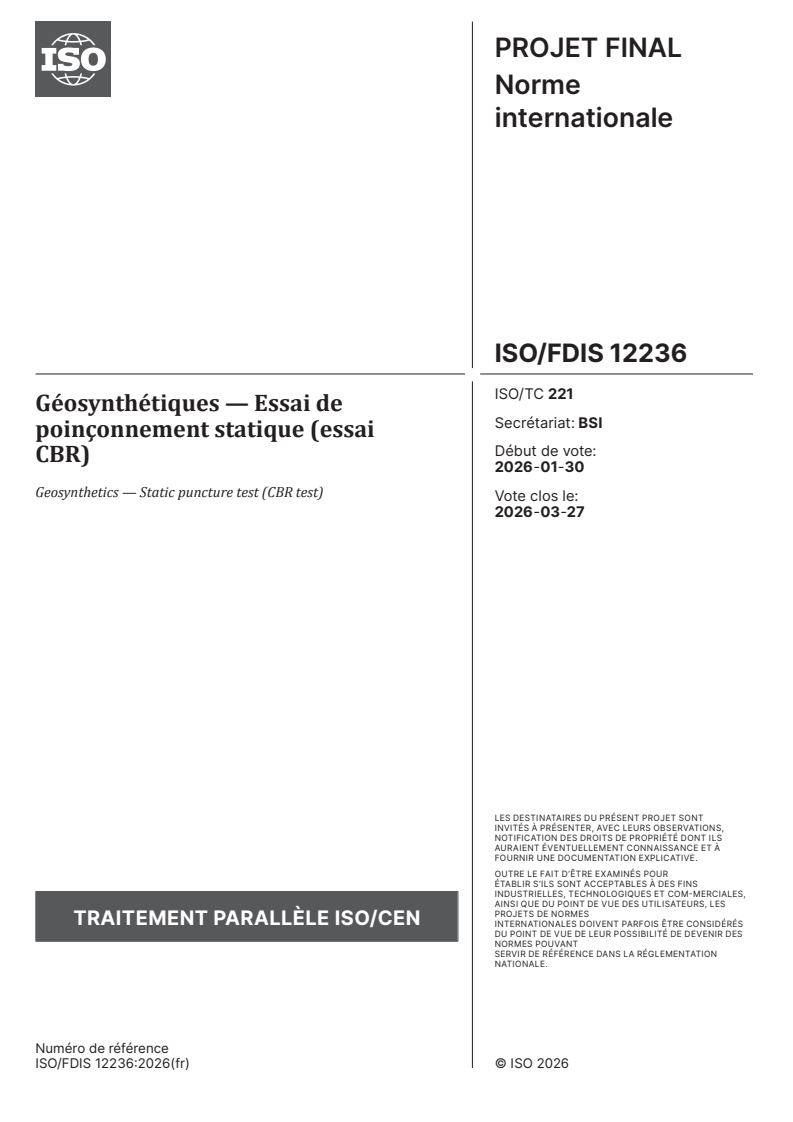

ISO/FDIS 12236 - Géosynthétiques — Essai de poinçonnement statique (essai CBR)
Get Certified
Connect with accredited certification bodies for this standard

Control Union Certifications
Global certification for agriculture and sustainability.

Bureau Veritas Bangladesh
Bureau Veritas certification services in Bangladesh.

ECOCERT France
Leader in organic and sustainability certification worldwide.
Sponsored listings
Frequently Asked Questions
ISO/FDIS 12236 is a draft published by the International Organization for Standardization (ISO). Its full title is "Geosynthetics — Static puncture test (CBR test)". This standard covers: ISO 12236:2006 specifies a method for the determination of the puncture resistance by measuring the force required to push a flat-ended plunger through geosynthetics. The test is normally carried out on dry specimens conditioned in the specified atmosphere. The test is applicable to most types of products, but not to materials with apertures greater than 10 mm.
ISO 12236:2006 specifies a method for the determination of the puncture resistance by measuring the force required to push a flat-ended plunger through geosynthetics. The test is normally carried out on dry specimens conditioned in the specified atmosphere. The test is applicable to most types of products, but not to materials with apertures greater than 10 mm.
ISO/FDIS 12236 is classified under the following ICS (International Classification for Standards) categories: 59.080.70 - Geotextiles. The ICS classification helps identify the subject area and facilitates finding related standards.
ISO/FDIS 12236 has the following relationships with other standards: It is inter standard links to FprEN ISO 12236, ISO 12236:2006. Understanding these relationships helps ensure you are using the most current and applicable version of the standard.
ISO/FDIS 12236 is available in PDF format for immediate download after purchase. The document can be added to your cart and obtained through the secure checkout process. Digital delivery ensures instant access to the complete standard document.
Standards Content (Sample)
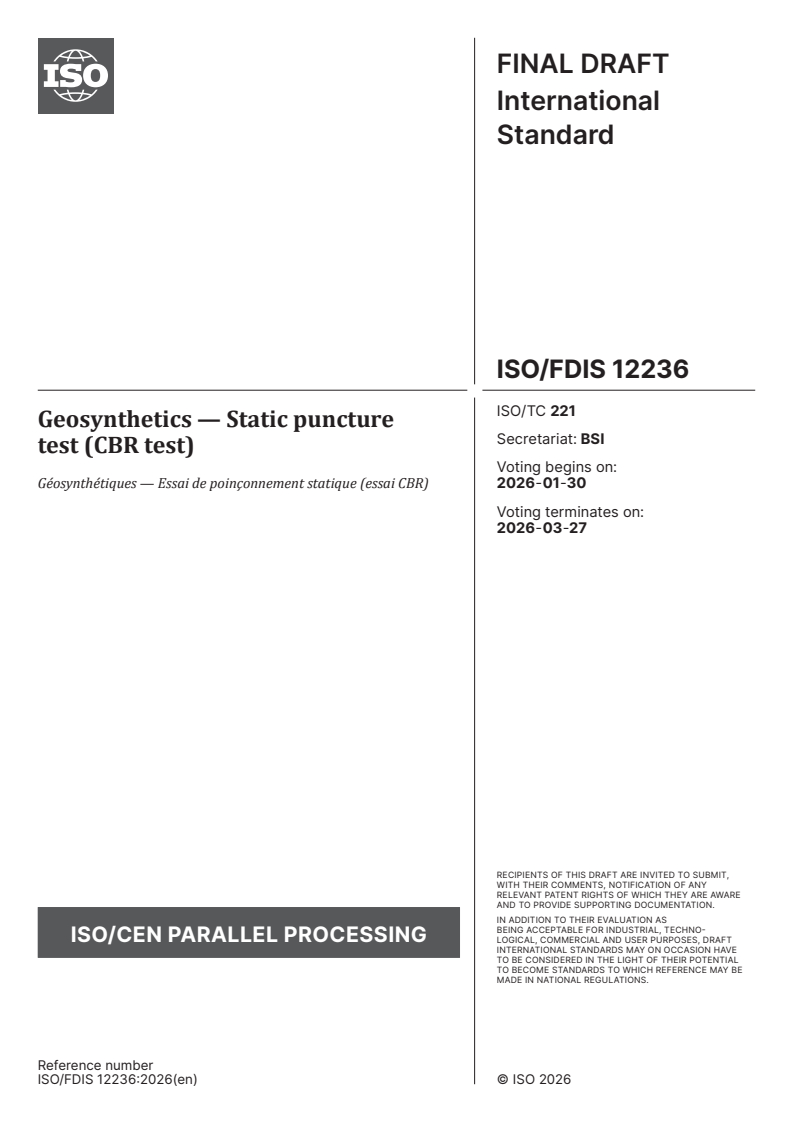
FINAL DRAFT
International
Standard
ISO/TC 221
Geosynthetics — Static puncture
Secretariat: BSI
test (CBR test)
Voting begins on:
Géosynthétiques — Essai de poinçonnement statique (essai CBR) 2026-01-30
Voting terminates on:
2026-03-27
RECIPIENTS OF THIS DRAFT ARE INVITED TO SUBMIT,
WITH THEIR COMMENTS, NOTIFICATION OF ANY
RELEVANT PATENT RIGHTS OF WHICH THEY ARE AWARE
AND TO PROVIDE SUPPOR TING DOCUMENTATION.
IN ADDITION TO THEIR EVALUATION AS
BEING ACCEPTABLE FOR INDUSTRIAL, TECHNO
ISO/CEN PARALLEL PROCESSING LOGICAL, COMMERCIAL AND USER PURPOSES, DRAFT
INTERNATIONAL STANDARDS MAY ON OCCASION HAVE
TO BE CONSIDERED IN THE LIGHT OF THEIR POTENTIAL
TO BECOME STAN DARDS TO WHICH REFERENCE MAY BE
MADE IN NATIONAL REGULATIONS.
Reference number
FINAL DRAFT
International
Standard
ISO/TC 221
Geosynthetics — Static puncture
Secretariat: BSI
test (CBR test)
Voting begins on:
Géosynthétiques — Essai de poinçonnement statique (essai CBR)
Voting terminates on:
RECIPIENTS OF THIS DRAFT ARE INVITED TO SUBMIT,
WITH THEIR COMMENTS, NOTIFICATION OF ANY
RELEVANT PATENT RIGHTS OF WHICH THEY ARE AWARE
AND TO PROVIDE SUPPOR TING DOCUMENTATION.
© ISO 2026
IN ADDITION TO THEIR EVALUATION AS
All rights reserved. Unless otherwise specified, or required in the context of its implementation, no part of this publication may
BEING ACCEPTABLE FOR INDUSTRIAL, TECHNO
ISO/CEN PARALLEL PROCESSING
LOGICAL, COMMERCIAL AND USER PURPOSES, DRAFT
be reproduced or utilized otherwise in any form or by any means, electronic or mechanical, including photocopying, or posting on
INTERNATIONAL STANDARDS MAY ON OCCASION HAVE
the internet or an intranet, without prior written permission. Permission can be requested from either ISO at the address below
TO BE CONSIDERED IN THE LIGHT OF THEIR POTENTIAL
or ISO’s member body in the country of the requester.
TO BECOME STAN DARDS TO WHICH REFERENCE MAY BE
MADE IN NATIONAL REGULATIONS.
ISO copyright office
CP 401 • Ch. de Blandonnet 8
CH-1214 Vernier, Geneva
Phone: +41 22 749 01 11
Email: copyright@iso.org
Website: www.iso.org
Published in Switzerland Reference number
ii
Contents Page
Foreword .iv
1 Scope . 1
2 Normative references . 1
3 Terms and definitions . 1
4 Principle . 2
5 Apparatus . 3
5.1 Testing machine . .3
5.2 Plunger .3
5.3 Clamping system .3
6 Specimens. 4
7 Conditioning . 4
8 Procedure . 5
9 Recording, calculation and expression of results . 5
9.1 Recording of data .5
9.2 Calculation and expression of results .6
10 Test report . 6
Bibliography . 7
iii
Foreword
ISO (the International Organization for Standardization) is a worldwide federation of national standards
bodies (ISO member bodies). The work of preparing International Standards is normally carried out through
ISO technical committees. Each member body interested in a subject for which a technical committee
has been established has the right to be represented on that committee. International organizations,
governmental and non-governmental, in liaison with ISO, also take part in the work. ISO collaborates closely
with the International Electrotechnical Commission (IEC) on all matters of electrotechnical standardization.
The procedures used to develop this document and those intended for its further maintenance are described
in the ISO/IEC Directives, Part 1. In particular, the different approval criteria needed for the different types
of ISO document should be noted. This document was drafted in accordance with the editorial rules of the
ISO/IEC Directives, Part 2 (see www.iso.org/directives).
ISO draws attention to the possibility that the implementation of this document may involve the use of (a)
patent(s). ISO takes no position concerning the evidence, validity or applicability of any claimed patent
rights in respect thereof. As of the date of publication of this document, ISO had not received notice of (a)
patent(s) which may be required to implement this document. However, implementers are cautioned that
this may not represent the latest information, which may be obtained from the patent database available at
www.iso.org/patents. ISO shall not be held responsible for identifying any or all such patent rights.
Any trade name used in this document is information given for the convenience of users and does not
constitute an endorsement.
For an explanation of the voluntary nature of standards, the meaning of ISO specific terms and expressions
related to conformity assessment, as well as information about ISO's adherence to the World Trade
Organization (WTO) principles in the Technical Barriers to Trade (TBT), see www.iso.org/iso/foreword.html.
This document was prepared by Technical Committee ISO/TC 221 Geosynthetics, in collaboration with
the European Committee for Standardization (CEN) Technical Committee CEN/TC 189, Geosynthetics, in
accordance with the Agreement on technical cooperation between ISO and CEN (Vienna Agreement).
This third edition cancels and replaces the second edition (ISO 12236:2006) which has been t
...
ISO/TC 221
Secretariat: BSI
Date: 2025-122026-01-16
Geosynthetics — Static puncture test (CBR test)
Géosynthétiques — Essai de poinçonnement statique (essai CBR)
F/DISFDIS stage
Warning for WD’s and CD’s
This document is not an ISO International Standard. It is distributed for review and comment. It is subject to change
without notice and may not be referred to as an International Standard.
Recipients of this draft are invited to submit, with their comments, notification of any relevant patent rights of which
they are aware and to provide supporting documentation.
TThhiis drs draafftt i is s susubbmmiitttteed d ttoo aa ppaarraallellel l vvoottee i inn IISSOO,, CCEEN.N.
ISO/DISFDIS 12236:20252026(en)
All rights reserved. Unless otherwise specified, or required in the context of its implementation, no part of this publication
may be reproduced or utilized otherwise in any form or by any means, electronic or mechanical, including photocopying,
or posting on the internet or an intranet, without prior written permission. Permission can be requested from either ISO
at the address below or ISO’s member body in the country of the requester.
ISO copyright office
CP 401 • Ch. de Blandonnet 8
CH-1214 Vernier, Geneva
Phone: + 41 22 749 01 11
E-mail: copyright@iso.org
Website: www.iso.org
Published in Switzerland
iii
Contents
Foreword . v
1 Scope . 1
2 Normative references . 1
3 Terms and definitions . 1
4 Principle . 3
5 Apparatus . 3
5.1 Testing machine . 3
5.2 Plunger . 3
5.3 Clamping system . 4
6 Specimens . 6
7 Conditioning . 6
8 Procedure . 7
9 Recording, calculation and expression of results . 7
9.1 Recording of data . 7
9.2 Calculation and expression of results . 7
10 Test report . 7
Bibliography . 9
iv
ISO/DISFDIS 12236:20252026(en)
Foreword
ISO (the International Organization for Standardization) is a worldwide federation of national standards
bodies (ISO member bodies). The work of preparing International Standards is normally carried out through
ISO technical committees. Each member body interested in a subject for which a technical committee has been
established has the right to be represented on that committee. International organizations, governmental and
non-governmental, in liaison with ISO, also take part in the work. ISO collaborates closely with the
International Electrotechnical Commission (IEC) on all matters of electrotechnical standardization.
The procedures used to develop this document and those intended for its further maintenance are described
in the ISO/IEC Directives, Part 1. In particular, the different approval criteria needed for the different types of
ISO document should be noted. This document was drafted in accordance with the editorial rules of the
ISO/IEC Directives, Part 2 (see www.iso.org/directives).
ISO draws attention to the possibility that the implementation of this document may involve the use of (a)
patent(s). ISO takes no position concerning the evidence, validity or applicability of any claimed patent rights
in respect thereof. As of the date of publication of this document, ISO had not received notice of (a) patent(s)
which may be required to implement this document. However, implementers are cautioned that this may not
represent the latest information, which may be obtained from the patent database available at
www.iso.org/patents. ISO shall not be held responsible for identifying any or all such patent rights.
Any trade name used in this document is information given for the convenience of users and does not
constitute an endorsement.
For an explanation of the voluntary nature of standards, the meaning of ISO specific terms and expressions
related to conformity assessment, as well as information about ISO's adherence to the World Trade
Organization (WTO) principles in the Technical Barriers to Trade (TBT), see www.iso.org/iso/foreword.html.
This document was prepared by Technical Committee ISO/TC 221 Geosynthetics, in collaboration with the
European Committee for Standardization (CEN) Technical Committee CEN/TC 189, Geosynthetics, in
accordance with the Agreement on technical cooperation between ISO and CEN (Vienna Agreement).
This third edition cancels and replaces the second edition (ISO 12236:2006) which has been technically
revised.
The main changes are as follows:
— Figure 4 has been revised;
— Clause 10 has been updated;
— units have been made consistent.
Any feedback or questions on this document should be directed to the user’s national standards body. A
complete listing of these bodies can be found at www.iso.org/members.html.
v
Geosynthetics — Static puncture test (CBR test)
1 Scope
This document specifies a method for the determination of the puncture resistance by measuring the force
required to push a flat-ended plunger through geosynthetics.
The test is normally carried out on dry specimens conditioned in the specified atmosphere.
The test is applicable to most types of geosynthetic products, but does not apply to products with apertures
greater than 10 mm.
2 Normative references
The following documents are referred to in the text in such a way that some or all of their content constitutes
requirements of this document. For dated references, only the edition cited applies. For undated references,
the latest edition of the referenced document (including any amendments) applies.
ISO 554, Standard atmospheres for conditioning and/or testing — Specifications
ISO 7500-1, Metallic materials — Calibration and verification
...
PROJET FINAL
Norme
internationale
ISO/TC 221
Géosynthétiques — Essai de
Secrétariat: BSI
poinçonnement statique (essai
Début de vote:
CBR)
2026-01-30
Geosynthetics — Static puncture test (CBR test)
Vote clos le:
2026-03-27
LES DESTINATAIRES DU PRÉSENT PROJET SONT
INVITÉS À PRÉSENTER, AVEC LEURS OBSERVATIONS,
NOTIFICATION DES DROITS DE PROPRIÉTÉ DONT ILS
AURAIENT ÉVENTUELLEMENT CONNAISSANCE ET À
FOURNIR UNE DOCUMENTATION EXPLICATIVE.
OUTRE LE FAIT D’ÊTRE EXAMINÉS POUR
ÉTABLIR S’ILS SONT ACCEPTABLES À DES FINS
INDUSTRIELLES, TECHNOLOGIQUES ET COM-MERCIALES,
AINSI QUE DU POINT DE VUE DES UTILISATEURS, LES
PROJETS DE NORMES
TRAITEMENT PARALLÈLE ISO/CEN
INTERNATIONALES DOIVENT PARFOIS ÊTRE CONSIDÉRÉS
DU POINT DE VUE DE LEUR POSSI BILITÉ DE DEVENIR DES
NORMES POUVANT
SERVIR DE RÉFÉRENCE DANS LA RÉGLEMENTATION
NATIONALE.
Numéro de référence
PROJET FINAL
Norme
internationale
ISO/TC 221
Géosynthétiques — Essai de
Secrétariat: BSI
poinçonnement statique (essai
Début de vote:
CBR)
2026-01-30
Geosynthetics — Static puncture test (CBR test)
Vote clos le:
2026-03-27
LES DESTINATAIRES DU PRÉSENT PROJET SONT
INVITÉS À PRÉSENTER, AVEC LEURS OBSERVATIONS,
NOTIFICATION DES DROITS DE PROPRIÉTÉ DONT ILS
DOCUMENT PROTÉGÉ PAR COPYRIGHT AURAIENT ÉVENTUELLEMENT CONNAISSANCE ET À
FOURNIR UNE DOCUMENTATION EXPLICATIVE.
OUTRE LE FAIT D’ÊTRE EXAMINÉS POUR
© ISO 2026
ÉTABLIR S’ILS SONT ACCEPTABLES À DES FINS
Tous droits réservés. Sauf prescription différente ou nécessité dans le contexte de sa mise en œuvre, aucune partie de cette
INDUSTRIELLES, TECHNOLOGIQUES ET COM-MERCIALES,
AINSI QUE DU POINT DE VUE DES UTILISATEURS, LES
publication ne peut être reproduite
...
Questions, Comments and Discussion
Ask us and Technical Secretary will try to provide an answer. You can facilitate discussion about the standard in here.
Loading comments...