

ISO 1666:1996
(Main)Starch — Determination of moisture content — Oven-drying method
General Information
- Abstract
Gives a method for the determination of the moisture content of native or modified starch using oven-drying at 130 °C under atmospheric pressure.
- Status
- Published
- Publication Date
- 13-Nov-1996
- Technical Committee
- ISO/TC 93 - Starch (including derivatives and by-products)
- Drafting Committee
- ISO/TC 93 - Starch (including derivatives and by-products)
- Current Stage
- 9093 - International Standard confirmed
- Start Date
- 04-May-2026
- Completion Date
- 29-Aug-2026
Buy Documents
ISO 1666:1996 - Starch — Determination of moisture content — Oven-drying method Released:11/14/1996
ISO 1666:1996 - Amidon et fécule — Détermination de l'humidité — Méthode par séchage a l'étuve Released:11/14/1996
ISO 1666:1996 - Amidon et fécule — Détermination de l'humidité — Méthode par séchage a l'étuve Released:11/14/1996
Overview
ISO 1666:1996 is an internationally recognized standard developed by the International Organization for Standardization (ISO) that specifies a reliable oven-drying method for the determination of moisture content in starch. This standard is applicable to both native and modified starches in their dry form. Moisture content testing is essential for quality control in the production, trade, and use of starch, impacting storage, processing, and end-use performance.
The method outlined in ISO 1666:1996 involves drying a starch sample in an electrically heated oven at 130°C under atmospheric pressure. The loss in mass, measured as a percentage, is taken as the moisture content of the starch under the specified test conditions.
Key Topics
Scope and Applicability
- Designed for the analysis of native and modified starches in their dry form
- Not suitable for starches containing components unstable at 130°C
Test Procedure
- Precise oven-drying at 130°C to 133°C for 1 hour and 30 minutes
- Use of analytical balances accurate to 0.001 g for reliable mass measurements
- Rapid cooling of samples in a desiccator to prevent moisture absorption from the air
Accuracy and Repeatability
- Detailed protocol aimed at ensuring repeatable and reproducible results
- Guidelines provided for reporting and confirming repeatability of test outcomes
Applications
ISO 1666:1996 is widely used across industries that manufacture, process, and trade starch. Key practical applications include:
Quality Control in Manufacturing
- Ensures starch batches meet specified moisture content parameters, which affects shelf life, texture, and processability
- Critical for food, paper, textile, and biodegradable materials industries
Supplier and Buyer Specifications
- Provides a standardized, internationally accepted method for verifying moisture content, facilitating clear communication and compliance between trading partners
Research and Development
- Used in analytical laboratories to determine the moisture characteristics of new starch products or modifications
Regulatory Compliance
- Support for laboratories and organizations needing to comply with food safety or industrial standards that require accurate moisture determination in starch
Related Standards
Organizations often use ISO 1666:1996 alongside other relevant standards for comprehensive starch analysis and quality assurance, such as:
- ISO 712 - Cereal and cereal products - Determination of moisture content
- ISO 6647 - Rice - Determination of moisture content
- ISO 10520 - Native starch - Determination of starch content
ISO 1666:1996 is maintained by ISO Technical Committee ISO/TC 93, Starch (including derivatives and by-products).
By adhering to ISO 1666:1996, laboratories, manufacturers, and regulatory bodies ensure consistency, reliability, and comparability of starch moisture content results on a global scale. This oven-drying method remains a cornerstone for moisture analysis in the starch industry, supporting robust quality control and international trade.
Relations
- Effective Date
- 25-Aug-2026
- Effective Date
- 25-Aug-2026
- Effective Date
- 25-Aug-2026
- Effective Date
- 03-Jun-2026
- Effective Date
- 15-Apr-2008
Buy Documents
ISO 1666:1996 - Starch — Determination of moisture content — Oven-drying method Released:11/14/1996
ISO 1666:1996 - Amidon et fécule — Détermination de l'humidité — Méthode par séchage a l'étuve Released:11/14/1996
ISO 1666:1996 - Amidon et fécule — Détermination de l'humidité — Méthode par séchage a l'étuve Released:11/14/1996
Get Certified
Connect with accredited certification bodies for this standard

BSI Group
BSI (British Standards Institution) is the business standards company that helps organizations make excellence a habit.

Bureau Veritas
Bureau Veritas is a world leader in laboratory testing, inspection and certification services.

DNV
DNV is an independent assurance and risk management provider.
Sponsored listings
Frequently Asked Questions
ISO 1666:1996 is a standard published by the International Organization for Standardization (ISO). Its full title is "Starch — Determination of moisture content — Oven-drying method". This standard covers: Gives a method for the determination of the moisture content of native or modified starch using oven-drying at 130 °C under atmospheric pressure.
Gives a method for the determination of the moisture content of native or modified starch using oven-drying at 130 °C under atmospheric pressure.
ISO 1666:1996 is classified under the following ICS (International Classification for Standards) categories: 67.180.20 - Starch and derived products. The ICS classification helps identify the subject area and facilitates finding related standards.
ISO 1666:1996 has the following relationships with other standards: It is inter standard links to EN ISO 11543:2002, EN 1406:2009, EN ISO 10520:1998, EN ISO 11216:1998, ISO 1666:1973. Understanding these relationships helps ensure you are using the most current and applicable version of the standard.
ISO 1666:1996 is available in PDF format for immediate download after purchase. The document can be added to your cart and obtained through the secure checkout process. Digital delivery ensures instant access to the complete standard document.
Standards Content (Sample)
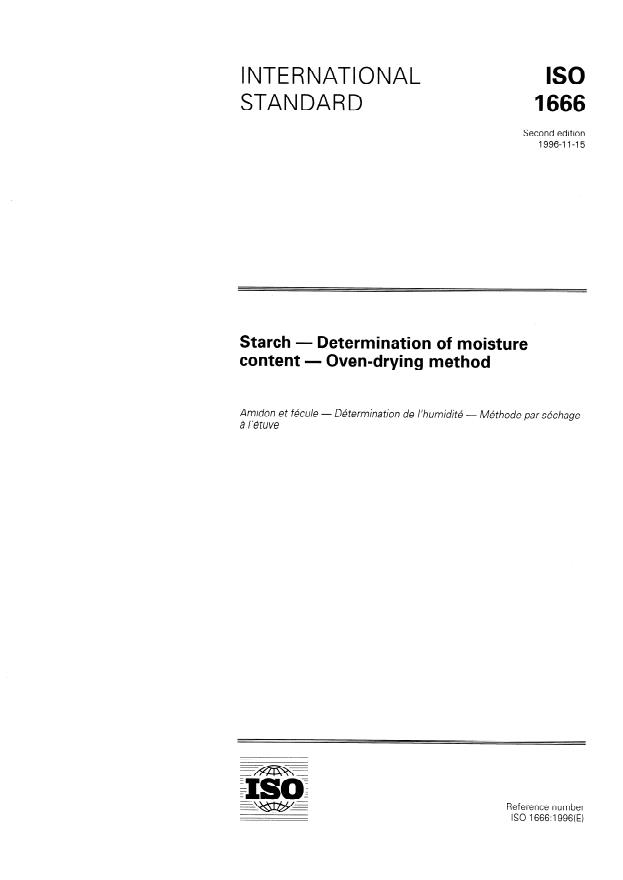
INTERNATIONAL
STANDARD
Second edition
1996-11-15
Starch - Determination of moisture
content - Oven-drying method
Amidon et f&u/e - Ddtermination de I’humiditG - M&hode par skhage
a /‘&uve
Reference number
IS0 1666:1996(E)
IS0 1666:1996(E)
Foreword
IS0 (the International Organization for Standardization) is a worldwide
federation of national standards bodies (IS0 member bodies). The work of
preparing International Standards is normally carried out through IS0
technical committees. Each member body interested in a subject for
which a technical committee has been established has the right to be
represented on that committee. International organizations, governmental
and non-governmental, in liaison with ISO, also take part in the work. IS0
collaborates closely with the International Electrotechnical Commission
(IEC) on all matters of electrotechnical standardization.
Draft International Standards adopted by the technical committees are
circulated to the member bodies for voting. Publication as an International
Standard requires approval by at least 75 % of the member bodies casting
a vote.
International Standard IS0 1666 was prepared by Technical Committee
lSO/TC 93, Starch (including derivatives and by-products).
This second edition cancels and replaces the first edition (IS0 1666:1973),
which has been technically revised.
Annex A of this International Standard is for information only.
0 IS0 1996
All rights reserved. Unless otherwise specified, no part of this publication may be
reproduced or utilized in any form or by any means, electronic or mechanical, including
photocopying and microfilm, without permission in writing from the publisher.
International Organization for Standardization
Case Postale 56 l CH-121 1 Geneve 20 l Switzerland
Printed in Switzerland
IS0 1666:1996(E)
INTERNATIONAL STANDARD @ IS0
Starch - Determination of moisture content -
Oven-drying method
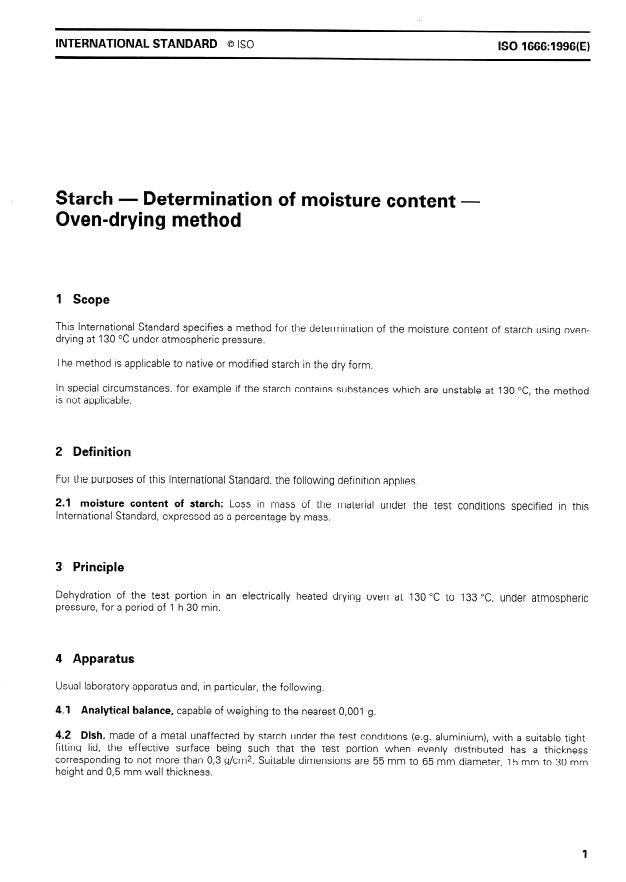
1 Scope
This International Standard specifies a method for the determination of the moisture content of starch using oven-
drying at 130 OC under atmospheric pressure.
The method is applicable to native or modified starch in the dry form.
In special circumstances, for example if the starch contains substances which are unstable at 130 OC, the method
is not applicable.
2 Definition
For the purposes of this International Standard, the following definition applies.
2.1 moisture content of starch: Loss in mass of the material under the test conditions specified in this
International Standard, expressed as a percentage by mass.
3 Principle
Dehydration of the test portion in an electrically heated drying oven at 130 OC to 133 OC, under atmospheric
pressure, for a period of 1 h 30 min.
4 Apparatus
Usual laboratory apparatus and, in particular, the following.
4.1 Analytical balance, capable of weighing to the nearest 0,001 g.
4.2 Dish, made of a metal unaffected by starch under the test conditions (e.g. aluminium), with a suitable tight-
fitting lid, the effective surface being such that the test portion when evenly distributed has a thickness
corresponding to not more than 0,3 g/cm*. Suitable dimensions are 55 mm to 65 mm diameter, 15 mm to 30 mm
height and 0,5 mm wall thickness.
@ IS0
IS0 1666:1996(E)
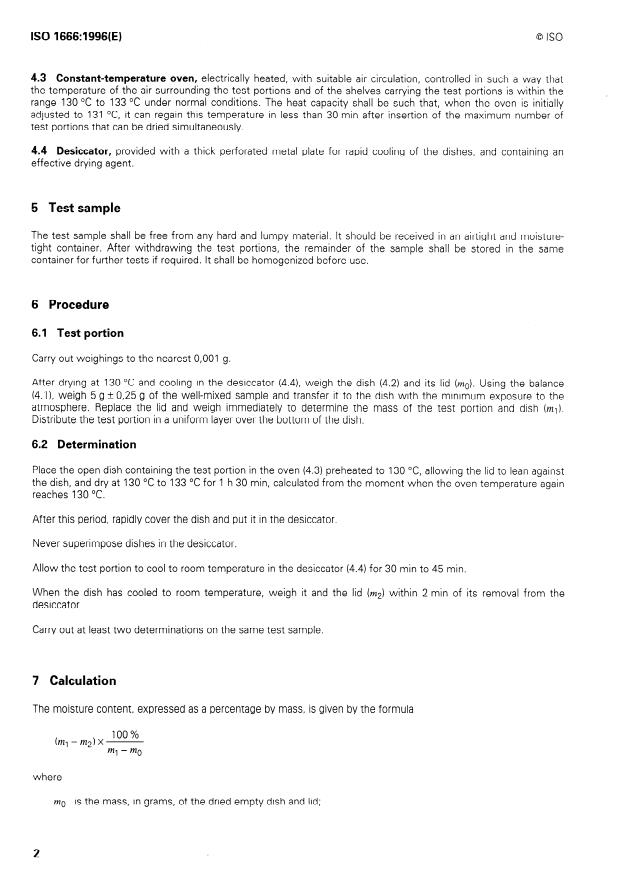
4.3 Constant-temperature oven, electrically heated, with suitable air circulation, controlled in such a way that
the temperature of the air surrounding the test portions and of the shelves carrying the test portions is within the
range 130 OC to 133 OC under normal conditions. The heat capacity shall be such that, when the oven is initially
adjusted to 131 OC, it can regain this temperature in less than 30 min after insertion of the maximum number of
test portions that can be dried simultaneously.
4.4 Desiccator, provided with a thick perforated metal plate for rapid cooling of the dishes, and containing an
effective drying agent.
5 Test sample
The test sample shall be free from any hard and lumpy material. It should be received in an airtight and moisture-
tight container. After withdrawing the test portions, the remainder of the sample shall be stored in the same
container for further tests if required. It shall be homogenized before use.
6 Procedure
6.1 Test portion
Carry out weighings to the nearest 0,001 g.
After drying at 130 OC and cooling in the
...
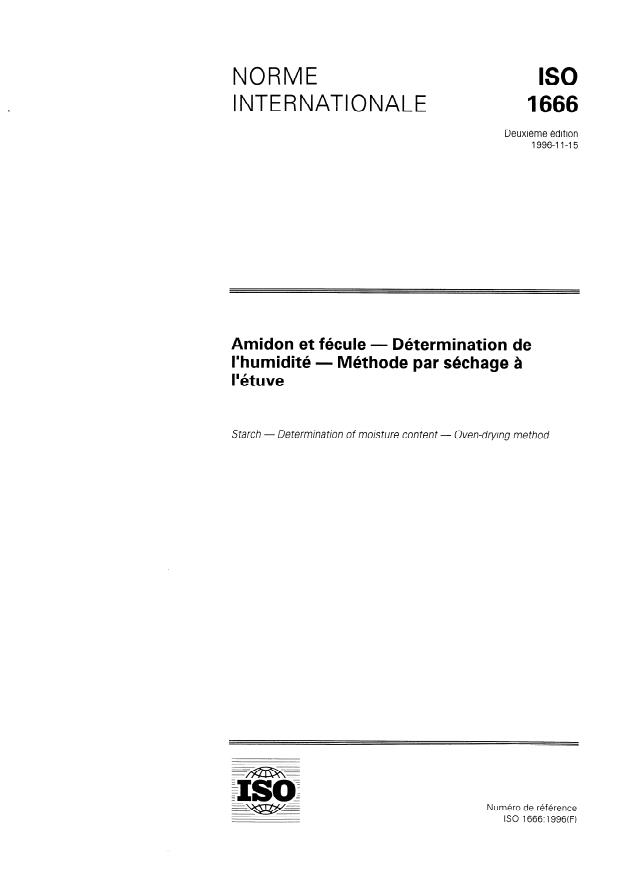
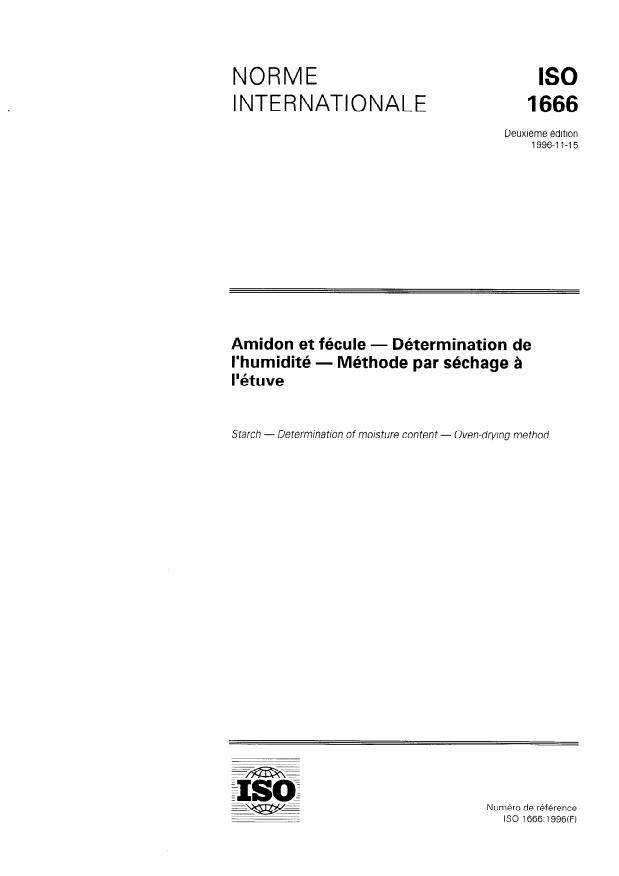
NORME
ISO
INTERNATIONALE
Deuxième édition
1996-I 1-l 5
Amidon et fécule
- Détermination de
l’humidité - Méthode par séchage à
l’étuve
Starch - Determination of moisture content - Oven-drying method
Numéro de référence
KO 1666:1996(F)
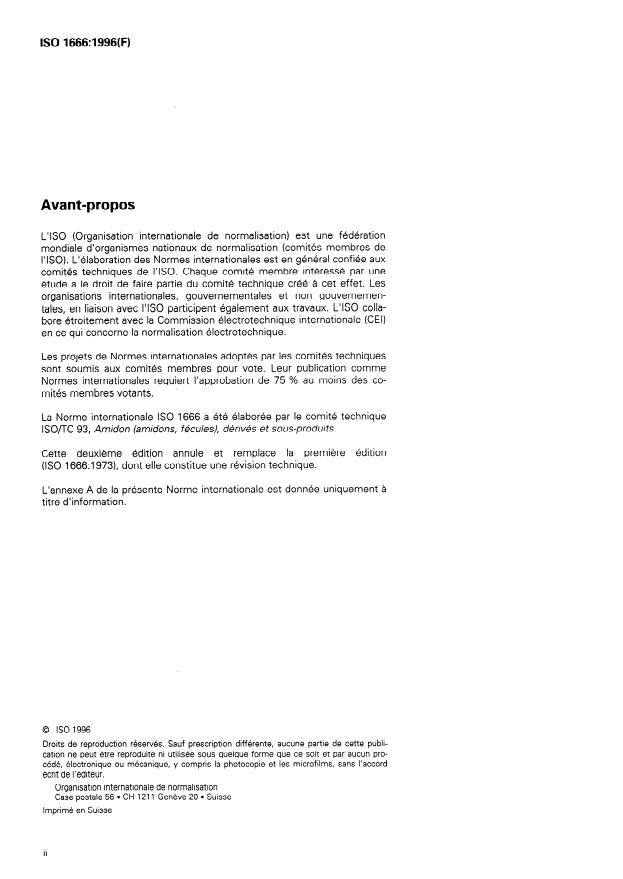
Avant-propos
L’ISO (Organisation internationale de normalisation) est une fédération
mondiale d’organismes nationaux de normalisation (comités membres de
I’ISO). L’élaboration des Normes internationales est en général confiée aux
comités techniques de I’ISO. Chaque comité membre intéressé par une
étude a le droit de faire partie du comité technique créé à cet effet. Les
organisations internationales, gouvernementales et non gouvernemen-
tales, en liaison avec I’ISO participent également aux travaux. L’ISO colla-
bore étroitement avec la Commission électrotechnique internationale (CEI)
en ce qui concerne la normalisation électrotechnique.
Les projets de Normes internationales adoptés par les comités techniques
sont soumis aux comités membres pour vote. Leur publication comme
Normes internationales requiert l’approbation de 75 % au moins des co-
mités membres votants.
’
La Norme internationale ISO 1666 a été élaborée par le comité technique
lSO/K 93, Amidon (amidons, fécules), dérivés et sous-produits.
Cette deuxième édition annule et remplace la première édition
(ISO 1666:1973), dont elle constitue une révision technique.
L’annexe A de la présente Norme internationale est donnée uniquement à
titre d’information.
0 ISO 1996
Droits de reproduction réserves. Sauf prescription différente, aucune partie de cette publi-
cation ne peut être reproduite ni utilisée sous quelque forme que ce soit et par aucun pro-
cédé, électronique ou mécanique, y compris la photocopie et les microfilms, sans l’accord
écrit de l’éditeur.
Organisation internationale de normalisation
Case postale 56 l CH-l 211 Genève 20 l Suisse
Imprimé en Suisse
ii
NORME INTERNATIONALE @ ISO ISO 1666:1996(F)
Détermination de l’humidité -
Amidon et fécule -
Méthode par séchage à l’étuve
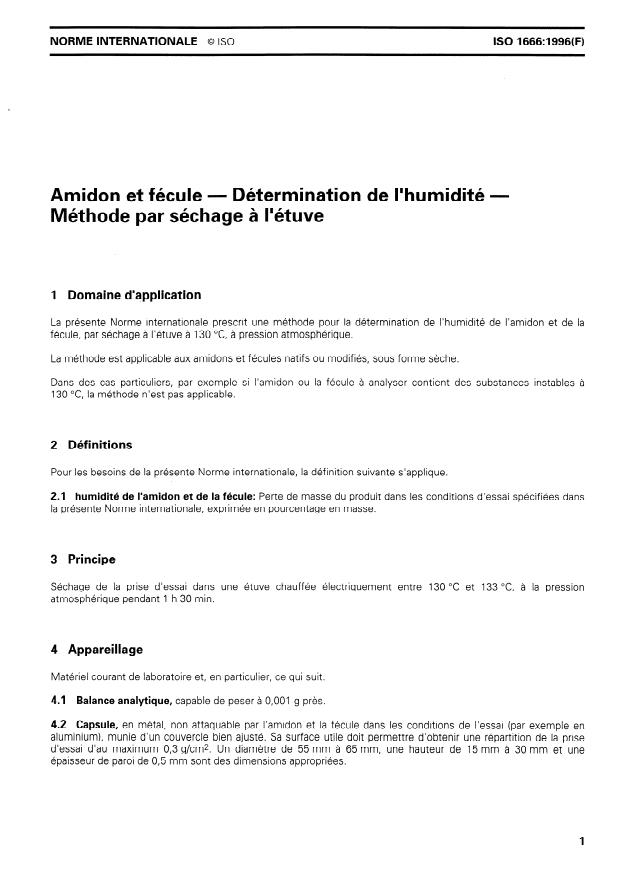
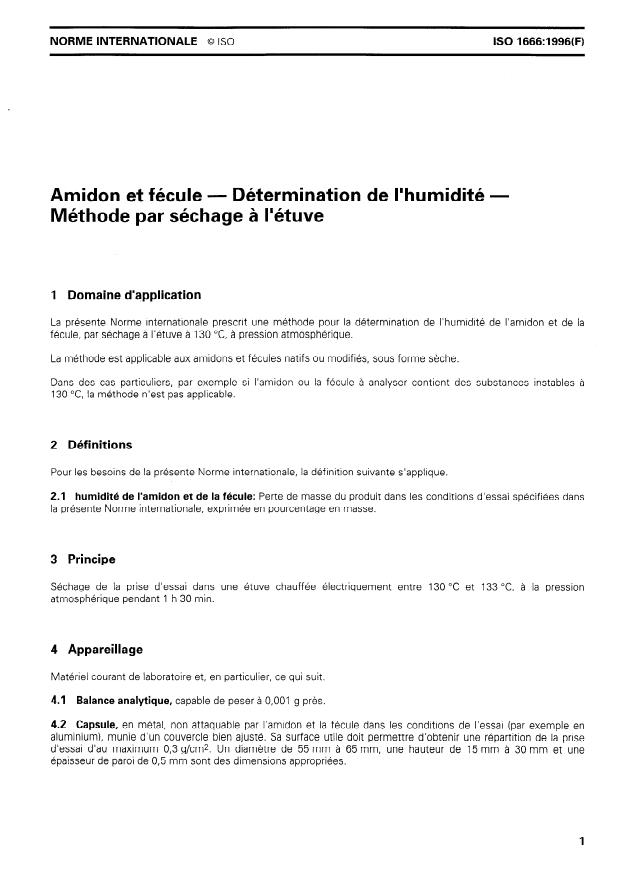
1 Domaine d’application
La présente Norme internationale prescrit une méthode pour la détermination de l’humidité de l’amidon et de la
fécule, par séchage à l’étuve à 130 OC, à pression atmosphérique.
La méthode est applicable aux amidons et fécules natifs ou modifiés, sous forme sèche
Dans des cas particuliers, par exemple si l’amidon ou la fécule à analyser contient des substances instables à
130 OC, la méthode n’est pas applicable.
2 Définitions
Pour les besoins de la présente Norme internationale, la définition suivante s’applique.
2.1 humidité de l’amidon et de la fécule: Perte de masse du produit dans les conditions d’essai spécifiées dans
la présente Norme internationale, exprimée en pourcentage en masse.
3 Principe
Séchage de la prise d’essai dans une étuve chauffée électriquement entre 130 OC et 133 OC, à la pression
atmosphérique pendant 1 h 30 min.
4 Appareillage
Matériel courant de laboratoire et, en particulier, ce qui suit.
4.1 Balance analytique, capable de peser à 0,001 g près.
4.2 Capsule, en métal, non attaquable par l’amidon et la fécule dans les conditions de l’essai (par exemple en
aluminium), munie d’un couvercle bien ajusté. Sa surface utile doit permettre d’obtenir une répartition de la prise
d’essai d’au maximum 0,3 g/cm ? Un diamètre de 55 mm à 65 mm, une hauteur de 15 mm à 30 mm et une
epaisseur de paroi de 0,5 mm sont des dimensions appropriées.
0 ISO
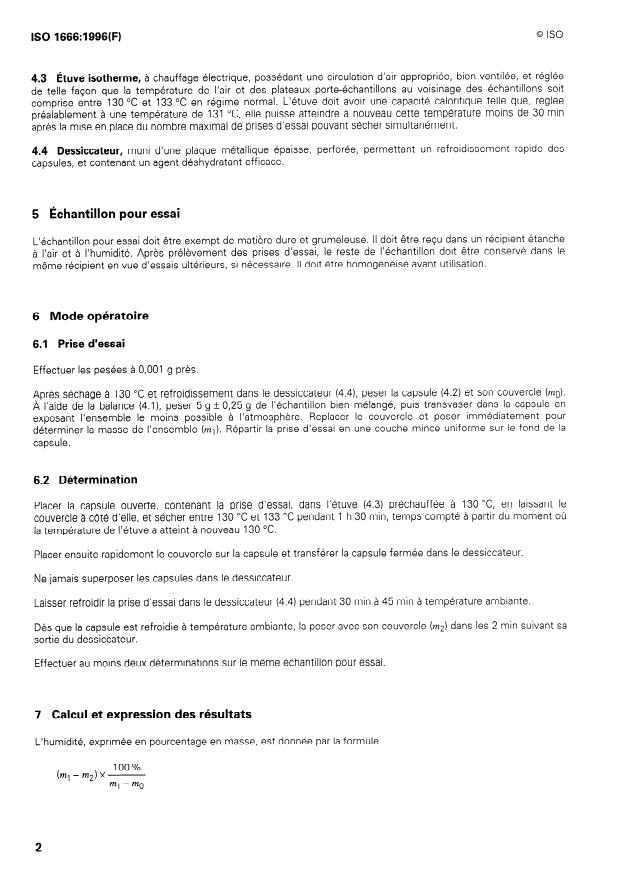
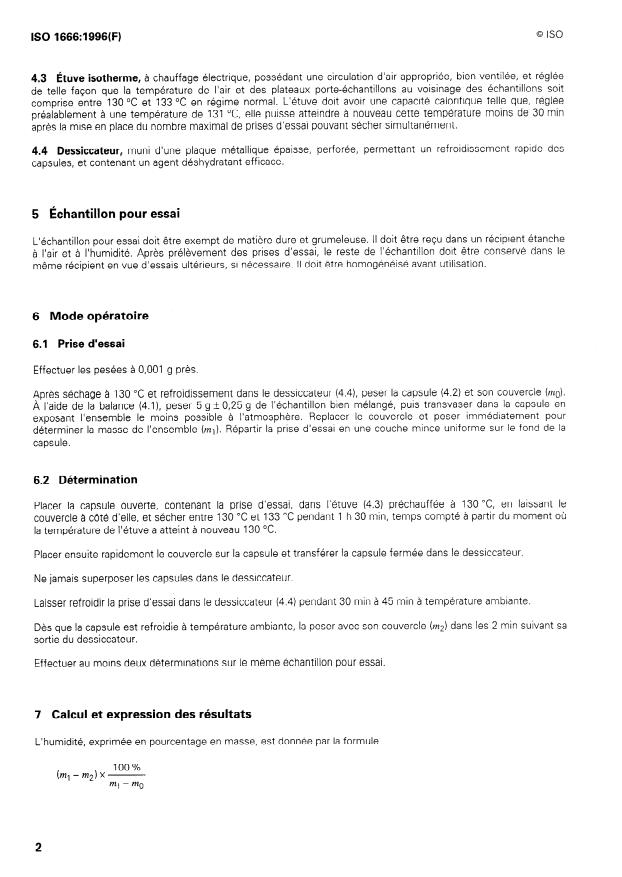
4.3 Étuve isotherme, à chauffage électrique, possédant une circulation d’air appropriée, bien ventilée, et réglée
de telle façon que la température de l’air et des plateaux porte-échantillons au voisinage des échantillons soit
comprise entre 130 OC et 133 OC en régime normal. L’étuve doit avoir une capacité calorifique telle que, réglée
préalablement à une température de 131 OC, elle puisse atteindre à nouveau cette température moins de 30 min
après la mise en place du nombre maximal de prises d’essai pouvant sécher simultanément.
4.4 Dessiccateur, muni d’une plaque métallique épaisse, perforée, permettant un refroidissement rapide des
capsules, et contenant un agent déshydratant efficace.
5 Échantillon pour essai
L’échantillon pour essai doit être exempt de matière dure et grumeleuse. II doit être reçu dans un récipient étanche
à l’air et à l’humidité. Après prélèvement des prises d’essai, le reste de l’échantillon doit être conservé dans le
même récipient en vue d’essais ultérieurs, si nécessaire. II doit être homogénéisé avant utilisation.
6 Mode opératoire
6.1 Prise d’essai
Effectuer les pesées à 0,001 g près
Après séchage à 130 OC et refroidissement dans le dessiccateur (4.4), peser la capsule (4.2) et son couvercle (mo).
À l’aide de la balance (4.1), peser 5 g + 0,25 g de l’échantillon bien mélangé, puis transvaser dans la capsule en
exposant l’ensemble le moins possible à l’atmosphère. Replacer le couver
...
NORME
ISO
INTERNATIONALE
Deuxième édition
1996-I 1-l 5
Amidon et fécule
- Détermination de
l’humidité - Méthode par séchage à
l’étuve
Starch - Determination of moisture content - Oven-drying method
Numéro de référence
KO 1666:1996(F)
Avant-propos
L’ISO (Organisation internationale de normalisation) est une fédération
mondiale d’organismes nationaux de normalisation (comités membres de
I’ISO). L’élaboration des Normes internationales est en général confiée aux
comités techniques de I’ISO. Chaque comité membre intéressé par une
étude a le droit de faire partie du comité technique créé à cet effet. Les
organisations internationales, gouvernementales et non gouvernemen-
tales, en liaison avec I’ISO participent également aux travaux. L’ISO colla-
bore étroitement avec la Commission électrotechnique internationale (CEI)
en ce qui concerne la normalisation électrotechnique.
Les projets de Normes internationales adoptés par les comités techniques
sont soumis aux comités membres pour vote. Leur publication comme
Normes internationales requiert l’approbation de 75 % au moins des co-
mités membres votants.
’
La Norme internationale ISO 1666 a été élaborée par le comité technique
lSO/K 93, Amidon (amidons, fécules), dérivés et sous-produits.
Cette deuxième édition annule et remplace la première édition
(ISO 1666:1973), dont elle constitue une révision technique.
L’annexe A de la présente Norme internationale est donnée uniquement à
titre d’information.
0 ISO 1996
Droits de reproduction réserves. Sauf prescription différente, aucune partie de cette publi-
cation ne peut être reproduite ni utilisée sous quelque forme que ce soit et par aucun pro-
cédé, électronique ou mécanique, y compris la photocopie et les microfilms, sans l’accord
écrit de l’éditeur.
Organisation internationale de normalisation
Case postale 56 l CH-l 211 Genève 20 l Suisse
Imprimé en Suisse
ii
NORME INTERNATIONALE @ ISO ISO 1666:1996(F)
Détermination de l’humidité -
Amidon et fécule -
Méthode par séchage à l’étuve
1 Domaine d’application
La présente Norme internationale prescrit une méthode pour la détermination de l’humidité de l’amidon et de la
fécule, par séchage à l’étuve à 130 OC, à pression atmosphérique.
La méthode est applicable aux amidons et fécules natifs ou modifiés, sous forme sèche
Dans des cas particuliers, par exemple si l’amidon ou la fécule à analyser contient des substances instables à
130 OC, la méthode n’est pas applicable.
2 Définitions
Pour les besoins de la présente Norme internationale, la définition suivante s’applique.
2.1 humidité de l’amidon et de la fécule: Perte de masse du produit dans les conditions d’essai spécifiées dans
la présente Norme internationale, exprimée en pourcentage en masse.
3 Principe
Séchage de la prise d’essai dans une étuve chauffée électriquement entre 130 OC et 133 OC, à la pression
atmosphérique pendant 1 h 30 min.
4 Appareillage
Matériel courant de laboratoire et, en particulier, ce qui suit.
4.1 Balance analytique, capable de peser à 0,001 g près.
4.2 Capsule, en métal, non attaquable par l’amidon et la fécule dans les conditions de l’essai (par exemple en
aluminium), munie d’un couvercle bien ajusté. Sa surface utile doit permettre d’obtenir une répartition de la prise
d’essai d’au maximum 0,3 g/cm ? Un diamètre de 55 mm à 65 mm, une hauteur de 15 mm à 30 mm et une
epaisseur de paroi de 0,5 mm sont des dimensions appropriées.
0 ISO
4.3 Étuve isotherme, à chauffage électrique, possédant une circulation d’air appropriée, bien ventilée, et réglée
de telle façon que la température de l’air et des plateaux porte-échantillons au voisinage des échantillons soit
comprise entre 130 OC et 133 OC en régime normal. L’étuve doit avoir une capacité calorifique telle que, réglée
préalablement à une température de 131 OC, elle puisse atteindre à nouveau cette température moins de 30 min
après la mise en place du nombre maximal de prises d’essai pouvant sécher simultanément.
4.4 Dessiccateur, muni d’une plaque métallique épaisse, perforée, permettant un refroidissement rapide des
capsules, et contenant un agent déshydratant efficace.
5 Échantillon pour essai
L’échantillon pour essai doit être exempt de matière dure et grumeleuse. II doit être reçu dans un récipient étanche
à l’air et à l’humidité. Après prélèvement des prises d’essai, le reste de l’échantillon doit être conservé dans le
même récipient en vue d’essais ultérieurs, si nécessaire. II doit être homogénéisé avant utilisation.
6 Mode opératoire
6.1 Prise d’essai
Effectuer les pesées à 0,001 g près
Après séchage à 130 OC et refroidissement dans le dessiccateur (4.4), peser la capsule (4.2) et son couvercle (mo).
À l’aide de la balance (4.1), peser 5 g + 0,25 g de l’échantillon bien mélangé, puis transvaser dans la capsule en
exposant l’ensemble le moins possible à l’atmosphère. Replacer le couver
...