

ISO 13232-5:2005/Amd 1:2012
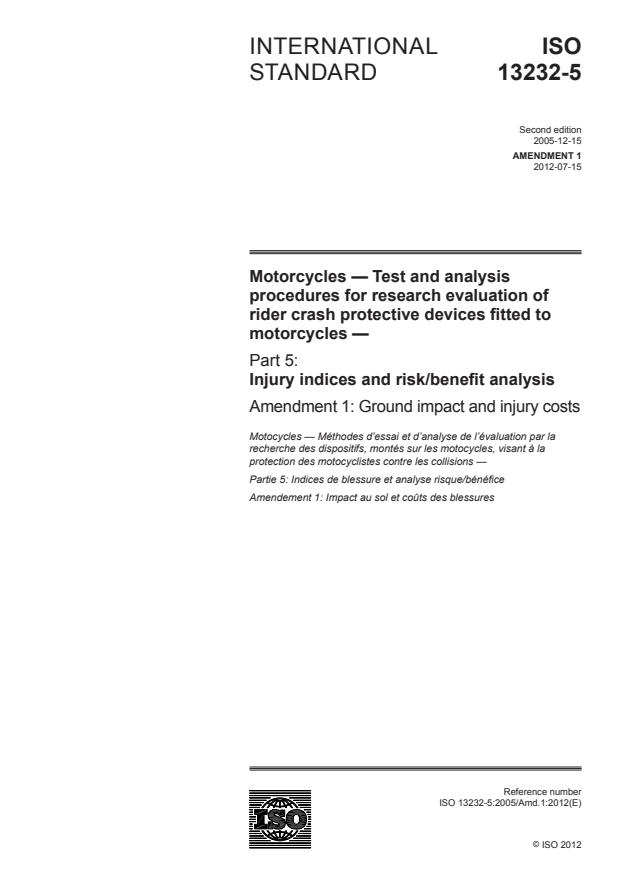
(Amendment)Motorcycles — Test and analysis procedures for research evaluation of rider crash protective devices fitted to motorcycles — Part 5: Injury indices and risk/benefit analysis — Amendment 1: Ground impact and injury costs
General Information
- Abstract
- Status
- Published
- Publication Date
- 11-Jul-2012
- Technical Committee
- ISO/TC 22/SC 38 - Motorcycles and mopeds
- Drafting Committee
- ISO/TC 22/SC 38 - Motorcycles and mopeds
- Current Stage
- 6060 - International Standard published
- Start Date
- 12-Jul-2012
- Due Date
- 13-Aug-2013
- Completion Date
- 13-Aug-2013
Buy Documents

ISO 13232-5:2005/Amd 1:2012 - Motorcycles — Test and analysis procedures for research evaluation of rider crash protective devices fitted to motorcycles — Part 5: Injury indices and risk/benefit analysis — Amendment 1: Ground impact and injury costs Released:7/12/2012
Overview
ISO 13232-5:2005/Amd 1:2012 is an amendment to Part 5 of the ISO 13232 series for motorcycles - test and analysis procedures for research evaluation of rider crash protective devices. This amendment integrates ground-impact effects and comprehensive injury cost metrics (including quality-adjusted life costs) into the existing injury indices and risk/benefit analysis framework used in motorcycle crash research and device evaluation.
Key topics and requirements
- Risk/benefit analysis periods
- Primary impact period: up to but not including ground impact, or 0.500 s after first motorcycle/other vehicle (MC/OV) contact, whichever is sooner.
- Entire impact sequence: from first MC/OV contact until at least 1 s and no longer than 3 s after contact - or until the dummy’s head, spine, and pelvis resultant velocities are < 1 m/s, or 500 ms after ground impact, whichever is sooner.
- Ground impact definition: first time any portion of the dummy’s head or helmet contacts the ground.
- Injury cost methodology
- Adds quality adjusted life costs (QC) by body region and AIS severity and incorporates these into a comprehensive cost (medical + ancillary + quality of life).
- Introduces normalized comprehensive costs for survival and fatality and revises injury cost normalization equations so total normalized cost ≤ 1.
- Annex A supplies tabulated medical, ancillary, and quality-of-life costs (in 2000 USD) by body region and AIS level for use in computations.
- Computational simulation limits and guidance
- Provides practical upper limits on simulation duration to include ground contact injuries without excessive CPU cost: example multi-body simulations ~8 CPU hours (primary) and <48 CPU hours (entire); finite element models and hybrid models have higher CPU estimates.
- Annex and code updates
- Renames variables to reflect comprehensive costs and updates Annex D with revised injury-cost model code (Fortran subroutine icm2009) to include quality-of-life costs.
Applications and users
This amendment is intended for:
- Motorcycle safety researchers conducting human-body surrogate simulations and risk/benefit analyses.
- Vehicle and protective-device engineers designing and evaluating rider crash protective systems (airbags, frame-mounted protectors, helmets).
- Accident reconstruction specialists and computational modelers using multi-body or finite-element simulations that include ground-impact effects.
- Regulators and policymakers assessing cost–benefit and societal impacts of safety technologies.
- Standards committees and test-lab developers updating test protocols and software tools.
Related standards
- ISO 13232 series (other parts cover test procedures, instrumentation and dummy biofidelity) and work by ISO/TC 22 (Road vehicles) / SC 22 (Motorcycles).
Keywords: ISO 13232-5:2005/Amd 1:2012, motorcycle safety standard, rider crash protective devices, injury indices, risk-benefit analysis, ground impact, quality-adjusted life costs, injury cost model, simulation.
Relations
- Effective Date
- 27-Nov-2021
Buy Documents
ISO 13232-5:2005/Amd 1:2012 - Motorcycles — Test and analysis procedures for research evaluation of rider crash protective devices fitted to motorcycles — Part 5: Injury indices and risk/benefit analysis — Amendment 1: Ground impact and injury costs Released:7/12/2012
Get Certified
Connect with accredited certification bodies for this standard

TÜV Rheinland
TÜV Rheinland is a leading international provider of technical services.

TÜV SÜD
TÜV SÜD is a trusted partner of choice for safety, security and sustainability solutions.

DEKRA Certification Inc.
DEKRA US certification services.
Sponsored listings
Frequently Asked Questions
ISO 13232-5:2005/Amd 1:2012 is a standard published by the International Organization for Standardization (ISO). Its full title is "Motorcycles — Test and analysis procedures for research evaluation of rider crash protective devices fitted to motorcycles — Part 5: Injury indices and risk/benefit analysis — Amendment 1: Ground impact and injury costs". This standard covers: Motorcycles — Test and analysis procedures for research evaluation of rider crash protective devices fitted to motorcycles — Part 5: Injury indices and risk/benefit analysis — Amendment 1: Ground impact and injury costs
Motorcycles — Test and analysis procedures for research evaluation of rider crash protective devices fitted to motorcycles — Part 5: Injury indices and risk/benefit analysis — Amendment 1: Ground impact and injury costs
ISO 13232-5:2005/Amd 1:2012 is classified under the following ICS (International Classification for Standards) categories: 43.140 - Motorcycles and mopeds. The ICS classification helps identify the subject area and facilitates finding related standards.
ISO 13232-5:2005/Amd 1:2012 has the following relationships with other standards: It is inter standard links to ISO 13232-5:2005. Understanding these relationships helps ensure you are using the most current and applicable version of the standard.
ISO 13232-5:2005/Amd 1:2012 is available in PDF format for immediate download after purchase. The document can be added to your cart and obtained through the secure checkout process. Digital delivery ensures instant access to the complete standard document.
Standards Content (Sample)
INTERNATIONAL ISO
STANDARD 13232-5
Second edition
2005-12-15
AMENDMENT 1
2012-07-15
Motorcycles — Test and analysis
procedures for research evaluation of
rider crash protective devices fitted to
motorcycles —
Part 5:
Injury indices and risk/benefit analysis
Amendment 1: Ground impact and injury costs
Motocycles — Méthodes d’essai et d’analyse de l’évaluation par la
recherche des dispositifs, montés sur les motocycles, visant à la
protection des motocyclistes contre les collisions —
Partie 5: Indices de blessure et analyse risque/bénéfice
Amendement 1: Impact au sol et coûts des blessures
Reference number
ISO 13232-5:2005/Amd.1:2012(E)
©
ISO 2012
ISO 13232-5:2005/Amd.1:2012(E)
All rights reserved. Unless otherwise specified, no part of this publication may be reproduced or utilized in any form or by any means,
electronic or mechanical, including photocopying and microfilm, without permission in writing from either ISO at the address below or ISO’s
member body in the country of the requester.
ISO copyright office
Case postale 56 • CH-1211 Geneva 20
Tel. + 41 22 749 01 11
Fax + 41 22 749 09 47
E-mail copyright@iso.org
Web www.iso.org
Published in Switzerland
ii © ISO 2012 – All rights reserved
ISO 13232-5:2005/Amd.1:2012(E)
Foreword
ISO (the International Organization for Standardization) is a worldwide federation of national standards bodies
(ISO member bodies). The work of preparing International Standards is normally carried out through ISO
technical committees. Each member body interested in a subject for which a technical committee has been
established has the right to be represented on that committee. International organizations, governmental and
non-governmental, in liaison with ISO, also take part in the work. ISO collaborates closely with the International
Electrotechnical Commission (IEC) on all matters of electrotechnical standardization.
International Standards are drafted in accordance with the rules given in the ISO/IEC Directives, Part 2.
The main task of technical committees is to prepare International Standards. Draft International Standards
adopted by the technical committees are circulated to the member bodies for voting. Publication as an
International Standard requires approval by at least 75 % of the member bodies casting a vote.
Attention is drawn to the possibility that some of the elements of this document may be the subject of patent
rights. ISO shall not be held responsible for identifying any or all such patent rights.
Amendment 1 to ISO 13232-5:2005 was prepared by Technical Committee ISO/TC 22, Road vehicles,
Subcommittee SC 22, Motorcycles.
ISO 13232-5:2005/Amd.1:2012(E)
Motorcycles — Test and analysis procedures for research
evaluation of rider crash protective devices fitted to
motorcycles —
Part 5:
Injury indices and risk/benefit analysis
Amendment 1: Ground impact and injury costs
IMPORTANT This Amendment may require re-interpretation by users of numerous directly related
clauses among the eight parts of ISO 13232. It is expected that consequential amendments to these
clauses would be part of any future revision of ISO 13232.
Page 2, Clause 3
Add the following terms:
— economic costs;
— comprehensive costs;
— quality adjusted life costs;
Page 23, 5.9
Insert the following at the beginning of the subclause and before the Note.
“The risk/benefit analysis for each collision shall include, at a minimum, the primary impact period, which shall
be considered to be the time period until but not including ground impact, or 0,500 s after the first MC/OV
contact, whichever is sooner.
The risk/benefit analysis for each collision should also include a separate analysis for the entire impact
sequence, which shall be considered to be the time period from first MC/OV contact until at least 1 s and no
longer than 3 s after the first MC/OV contact, and to the extent applicable, within this period, until the dummy’s
head, spine, and pelvis centres-of-gravity resultant velocities are all less than 1 m/s, or until 500 ms after
ground impact, whichever is sooner.
Ground impact shall be considered to be the first point in time when any portion of the dummy’s head or helmet
shapes is in contact with the ground.”
Page 153, O.3.8
Insert the following at the beginning of O.3.8:
“Injuries resulting from ground contact are often a substantial portion of the total injuries in MC/OV crashes
(e.g., ACEM, MAIDS Report, 2004). Advances in computational speeds have made it feasible to conduct
computer simulation analyses that include ground contact. However, in order to place reasonable upper limits
on the computational requirements for simulations that include the ground contact period, the simulation is
considered to be complete when the dummy’s velocities are nearly zero or 500 ms after head or helmet to
ground impact, whichever is sooner. In order to account for cases in which, during the first 3 s after MC/OV
contact, the dummy’s key body region velocities are not reduced to nearly zero and the dummy’s head or
helmet does not impact the ground, the simulation may be considered to be complete after 3 s.
ISO 13232-5:2005/Amd.1:2012(E)
These upper limits on the required duration of the computer simulation allow virtually all important injuries to
be included in the risk/benefit analysis without requiring excessive computer time. Using typical contemporary
(i.e., 2008 production) personal computers, simulations of the primary impact period for the 2 X 200 impact
configurations using an example fully ISO-compliant multi-body model (Kebschull et al, 1998) can be run in
approximately 8 CPU hours. Extending the simulation time to include the entire impact period as described in
subclause 5.9 requires less than 48 CPU hours. In cases where the researcher wishes to model higher levels
of detail, it is expected that finite element models would require less than 10 000 CPU hours to simulate the
primary impact period for these 2 X 200 impact configurations and less than 60 000 CPU hours to simulate the
entire impact period. Hybrid multi-body/FE models would require CPU hours somewhere between those for a
pure multi-body model and for a pure finite element model. Another technological advance that enables such
computational loads to be feasible is the increasingly popular usage of ”computer clusters” or “computer grids”
for processing, i.e., involving many CPUs, running in parallel.”
Comment: Add a calculation for injury costs based on comprehensive costs in addition to the current calculation
based on ancillary costs. Document changes are as follows:
Rename all occurrences of the following variables based on only medical and ancillary costs as given below.
Old Variable Old Description New Variable New Description
CF Cost of fatality CF Economic cost of fatality
eco
IC Injury cost, normalized IC Injury economic cost, normalized
norm norm,eco
CS Normalized cost of survival CS Normalized economic cost of survival
norm norm,eco
Page 18, 5.5.3
Renumber 5.5.3 on Fatality cost to 5.5.4.
Insert the following new subclause immediately above the newly numbered 5.5.4:
5.5.3 Quality adjusted life costs
Tabulate the injuries by body region and AIS injury severity level. Determine the quality adjusted life costs
associated with each body region injury and each discrete AIS injury severity level, for each country in the cost
data listed in Annex A. Calculate the total quality adjusted life cost associated with the injuries for each of the
four body regions, including the head, neck, thorax, and abdomen, using the equation given below:
QC =×PQC
it,,ot ij ij,
∑
j=1
where
QC is the total quality adjusted life cost associated with injuries sustained to the body region i;
i,tot
P is the probability of sustaining an injury of AIS injury severity level j to the body region i;
i,j
QC is the quality adjusted life cost associated with an injury to the body region i of AIS injury
i,j
severity level j.
Determine the total quality adjusted life cost associated with lower extremity injuries using the maximum PPI
value, as determined in 5.4.2.3, and the respective cost data table given in Annex A.
Determine the overall quality adjusted life cost of injuries to the head, neck, thorax, abdomen, and lower
extremities as given below:
QC =max QC
()
it,ot
where
2 © ISO 2012 – All rights reserved
ISO 13232-5:2005/Amd.1:2012(E)
QC is the overall quality adjusted life cost;
QC is the total quality adjusted life cost associated with injuries sustained to the body region i.
i,tot
Insert the following text at the end of 5.8:
“Calculate the normalized comprehensive cost of survival as shown in the equation below:
minimum ofoMDCA++CQCCr FP1−
()
()() ()
co fatal
CS =
normc, o
CF
co
where
CS
is the normalized comprehensive cost of survival;
norm,co
MDC
is the medical cost;
AC
is the ancillary cost;
P
is the probability of fatality;
fatal
CF
is the comprehensive cost of fatality (medical, ancillary, and quality of life);
co
the maximum value of CS is (1 - P ).
norm,co fatal
The normalized cost of fatality (CF ) is equal to the probability of fatality (P ).
norm fatal
Calculate the total normalized injury comprehensive cost as shown in the equation below:
IC =+CS CF
normc,,o normco norm
where
IC is the total normalized injury comprehensive cost;
norm,co
CS is the normalized comprehensive cost of survival;
norm,co
CF is the normalized cost of fatality;
norm
the maximum value of IC is 1,0.”
norm
Page 23, 5.9
Insert the following at the beginning of the subclause and before the Note.
“The risk/benefit analysis for each collision shall, at a minimum, include the primary impact period, which is
the time period up to but not including dummy to ground contact, or 0,500 s after the first MC/OV contact,
whichever is sooner. The risk/benefit analysis for each collision should also include a separate analysis for the
entire impact sequence, which is defined as the time period from first MC/OV contact until the dummy’s head,
spine, and pelvis velocities are all less than 1 m/s or until 500 ms after ground impact, whichever is sooner.
Ground impact is defined as the first point in time when any portion of the dummy’s head or helmet is in contact
with the ground. The entire impact sequence shall be at least 1 s and shall be no longer than 3 s after the first
MC/OV contact.”
Page 26, 5.9.4.2
Replace the equation for “average risk” with the following:
N
risk
average risk jj==average increase in injury index Δx ××FO
()
∑ kj, k
N
k=1
ISO 13232-5:2005/Amd.1:2012(E)
Page 28, Annex A
Replace the first two paragraphs in Annex A with the following text:
“Use the tables in Annex A to determine the medical, ancillary, and quality of life costs for each body region and
AIS injury severity level when calculating the overall costs in 5.5.1, 5.5.2, and 5.5.3, respectively.
Tables A.1, A.2, and A.3 list respective medical, ancillary, and quality of life costs in 2000 U.S. dollars.”
Replace Table A.1 with the following table:
Table A.1 — Medical costs
Body region AIS injury Cost
severity level
(USD)
Head 1 30 405
Head 2 31 323
Head 3 193 785
Head 4 206 592
Head 5 280 228
Neck 3 355 082
Neck 4 824 887
Neck 5 1 088 896
Thorax 1 1 248
Thorax 2 11 384
Thorax 3 32 692
Thorax 4 52 963
Thorax 5 62 967
Abdomen 1 1 248
Abdomen 2 11 384
Abdomen 3 32 692
Abdomen 4 52 963
Lower extremities 2 8 592
Lower extremities 3 31 258
4 © ISO 2012 – All rights reserved
ISO 13232-5:2005/Amd.1:2012(E)
Page 29, Annex A
Replace Table A.2 with the following table:
Table A.2 — Ancillary costs
Body region AIS injury PPI Cost
severity level
(USD)
Head 1 - 10 225
Head 2 - 36 539
Head 3 - 121 644
Head 4 - 232 423
a
Head 5 - 943 054
Neck 3 - 262 761
Neck 4 - 399 937
Neck 5 - 476 360
Thorax 1 - 3 058
Thorax 2 - 51 882
Thorax 3 - 86 592
Thorax 4 - 119 742
Thorax 5 - 240 645
Abdomen 1 - 3 058
Abdomen 2 - 51 882
Abdomen 3 - 86 592
Abdomen 4 - 119 742
Lower extremities - 07 27 996
Lower extremities - 15 59 991
Lower extremities - 22 87 986
Lower extremities - 27 107 983
Lower extremities - 38 151 976
NOTE The medical and ancillary cost of fatality is 919 834
in 2000 U.S. dollars.
a
Although the ancillary cost of a head AIS5 injury exceeds that of
a fatality, the equations which calculate normalized injury costs do
not produce normalized costs which exceed a value of 1
Update the costs in Annex D accordingly and prepare other consequential amendments.
ISO 13232-5:2005/Amd.1:2012(E)
Add the following Table A.3 based on Miller, et al. (2001) to the end of Annex A:
Table A.3 — Quality of life costs
Body region AIS injury PPI Cost
severity level
(USD)
Head 1 - 46 102
Head 2 - 202 455
Head 3 - 315 330
Head 4 - 681 113
Head 5 - 1 695 212
Neck 3 - 174 066
Neck 4 - 1 520 370
Neck 5 - 2 164 209
Thorax 1 - 3 552
Thorax 2 - 53 310
Thorax 3 - 91 870
Thorax 4 - 156 950
Thorax 5 - 203 090
Abdomen 1 - 3 552
Abdomen 2 - 53 310
Abdomen 3 - 91 870
Abdomen 4 - 156 950
Lower extremities - 07 106 426
Lower extremities - 15 228 056
Lower extremities - 22 334 481
Lower extremities - 27 410 500
Lower extremities - 38 577 741
NOTE The quality of life cost of fatality is 2 389 179 in 2000
U.S. dollars.
Page 31, Annex C
Add the following variable definitions to Annex C:
Variable Definition
CF
Comprehensive cost of fatality
co
IC
Injury comprehensive cost, normalized
norm,co
CS Normalized comprehensive cost of survival
norm,co
6 © ISO 2012 – All rights reserved
ISO 13232-5:2005/Amd.1:2012(E)
Page 34, Annex D
Replace the computer code in Annex D with the following:
c.+.1.+.2.+.3.+.4.+.5.+.6.+.7.+.8
c
c This is the verison in ISO/DIS 13232-5 Annex D (2008)
c
c.+.1.+.2.+.3.+.4.+.5.+.6.+.7.+.8
subroutine icm2009(Idatin,Rdatin,Table,Datout,Ierr)
implicit none
integer Idatin(5), Ierr
real Rdatin(6), Table(9,6), Datout(12)
c*******************************************************************************
c
c name
c
c icm - Evaluate the Injury Cost Model
c
c description
c
c This subroutine evaluates the Injury Cost Model for the inputs
c in arrays Idatin and Rdatin. Output is returned in arrays Table
c and Datout.
c
c calling sequence
c
c argument i/o description
c -------- --- -----------
c Idatin i integer data input array, elements as follows:
c element symbol description
c ------- ------ -----------
c 1 FF3 number of AIS 3 femur fractures
c 2 TF2 number of AIS 2 tibia fractures
c 3 TF3 number of AIS 3 tibia fractures
c 4 KDI2 number of AIS 2 knee dislocated
c injuries
c 5 KDI3 number of AIS 3 knee dislocated
c injuries
c
c Rdatin i real data input array, elements as follows:
c element symbol units description
c ------- ------ ----- -----------
c 1 AP mm maximum abdomen
c penetration
c 2 Gmax - maximum GAMBIT
c 3 Cmax % maximum normalized chest
c compression
c 4 VCmax m/s maximum chest viscous
c criteria when V>3 m/s
c 5 HIC - Head Injury Criteria
c 6 NII - Neck Injury Index
c
c Table o table 1 values
c
c Datout o real data output array, elements as follows:
c element symbol units description
c ------- ------ ----- -----------
c 1 MAIS maximum AIS
c 2 TAIS total AIS
c 3 NICE - Normalized Injury
c Economic Cost
c 4 NCOSE - Normalized Economic Cost of
ISO 13232-5:2005/Amd.1:2012(E)
c Survival
c 5 NCOD - Normalized Economic Cost of
c Dying
c 6 POF - Probability of Fatality
c 7 POF5 - POF due to non AIS 6
c injuries
c 8 POF6 - POF due to AIS 6 injuries
c 9 PPI - Permanent Partial
c Incapacity
c 10 Prisk % Risk of life threatening
c brain injury
c 11 NICC - Normalized Injury
c Comprehensive Cost
c 12 NCOSC - Normalized Comprehensive
c Cost of Survival
c
c Ierr o error code
c 0 - normal return
c 1- 5 - index of out of range Idatin
c 11-14 - index of out of range Rdatin
c
c version history
c
c - original version by RMV, DRI, March 1993
c - first revision by RMV, DRI, April 1993
c - AIS 3 knee dislocation injuries added
c - Input range checking added
c - second revision by RMV, DRI, March 1994
c - changed model and subroutine name from Injury Cost Model II
c (icm2) to Injury Cost Model (icm)
c - changed hospital cost (HC) to medical cost (MDC)
c - changed parameter names from AISmax to AIS6, AISsrv to AIS5
c - third revision by RMV, DRI, August 1994
c - added PPI to Datout output array
c - added risk of life threatening brain injury calculation
c based on HIC, HIC input was added to Rdatin and Prisk
c output added to Datout arrays
c - fourth revision by RMV, DRI, December 1994
c - Corrected PPI for 1 leg injury
c - include HIC ISP for to head AIS, revision by DPC, DRI, March 1998
c - include Neck Injury Criteria, revision by KDW,RMV,SM, DRI, May 2001
c - sixth revision by KDW, DRI, February 2002
c - added new neck ISPn equation coefficients
c - seventh revision by RMV, DRI, June 2004
c - revised new neck ISPn equation coefficents
c - revised 2009-12-16 by JK
c - updated injury costs as per ISO 13232-5:2005/DAM 2
c - added Quality of Life costs
c
c*******************************************************************************
c
c local parameters
c
c AIS6 - fatal AIS
c AIS5 - maximum survivable AIS
c
integer AIS6, AIS5, jhic
parameter (AIS6=6, AIS5=5, jhic=15)
c
c local variables
c
real Beta1(AIS6), Gamma1(AIS6), Eta1(AIS6)
real Beta2(AIS6), Gamma2(AIS6), Eta2(AIS6)
real Gamma3(AIS6)
8 © ISO 2012 – All rights reserved
ISO 13232-5:2005/Amd.1:2012(E)
real Gamma5(AIS6)
real Gamma6(AIS6),Eta6(AIS6)
real Alpha4(AIS6), Beta4(AIS6)
integer FF3, KDI2, KDI3, TF2, TF3
integer i, itmp, j, kais(5), kais1, kais2, kais3, kais4, kais5
integer krow, nLAIS2, nLAIS3, ntot
real AP, Cmax, Gmax, VCmax
real AAC(AIS5), AACT, AAIS(0:AIS6), AMDC(AIS5), AMDCT
real AQC(AIS5), AQCT
real AISP(AIS6)
real CAC(AIS5), CACT, CAIS(0:AIS6), CMDC(AIS5), CMDCT
real CQC(AIS5), CQCT
real CISP(AIS6)
real HAC(AIS5), HACT, HAIS(0:AIS6), HMDC(AIS5), HMDCT
real HQC(AIS5), HQCT
real HISP(AIS6)
real HGISP(AIS6), HHICISP(AIS6)
real LAC07, LAC15, LAC22, LAC27, LAC38
real LQC07, LQC15, LQC22, LQC27, LQC38
real LACT, LAIS(0:AIS6), LMDC(AIS5), LMDCT, LQCT
real NAC(AIS5), NACT, NAIS(0:AIS6), NMDC(AIS5), NMDCT
real NQC(AIS5), NQCT
real NISP(AIS6)
real MR(0:AIS5,0:AIS5,0:AIS5)
real AC, CCISP, CVCISP, MDC, POF, POF5, POF6, PPI, QC
real APAIS, CPAIS, HPAIS, LPAIS, NPAIS
integer IAPAIS, ICPAIS, IHPAIS, ILPAIS, INPAIS
real COFE, MAIS, NCOD, NCOSE, NICE, TAIS, COFQ, COFC, NICC
real NCOSC
real curve(2,jhic), HIC, Prisk, NII
c
c ******************************************************************
c *** ***
c *** data ***
c *** ***
c ******************************************************************
c
c Injury Severity Probability function coefficients
c
data Gamma1/0.0,0.125,0.375,0.438,0.650,0.680/
data Eta1/0.755,0.70,0.64,0.62,0.54,0.60/
data Beta1/3.5,3.5,3.5,3.5,2.2,1.8/
data Gamma2/0.0,0.0,0.0,0.4,1.0,1.5/
data Eta2/0.3,0.68,1.40,1.291,0.995,0.78/
data Beta2/0.99,1.46,2.85,3.10,3.10,3.10/
data Gamma3/1.77,7.47,13.22,18.97,24.72,32.52/
data Alpha4/0.0157,0.0123,0.000155,9.36e-13,0.0,0.0/
data Beta4/1.0,1.0,2.0,6.5,1.0,1.0/
data Gamma5/0.0,0.0,0.0,450.0,450.0,450.0/
data Gamma6/1.06,1.86,2.29,4.73,4.73,6.13/
data Eta6/4.38,4.38,4.38,4.38,4.38,4.38/
c
c Medical Cost data in U.S. Dollars - Table A.1
c
data HMDC/ 30405., 31323., 193785., 206592., 280228./
data NMDC/ 0., 0., 355082., 824887.,1088896./
data CMDC/ 1248., 11384., 32692., 52963., 62967./
data AMDC/ 1248., 11384., 32692., 52963., 0./
data LMDC/ 0., 8592., 31258., 0., 0./
c
c Ancillary Cost data in U.S. Dollars - Table A.2
c
data HAC/ 10225., 36539.,121644.,232423.,943054./
data NAC/ 0., 0.,262761.,399937.,476360./
data CAC/ 3058., 51882., 86592.,119742.,240645./
ISO 13232-5:2005/Amd.1:2012(E)
data AAC/ 3058., 51882., 86592.,119742., 0./
data LAC07/ 27996./, LAC15/ 59991./, LAC22/87986./
data LAC27/107983./, LAC38/151976./
c
c Quality of Life Cost data in U.S. Dollars - Table A.3
c
data HQC/ 46102., 202455., 315330., 681113.,1695212./
data NQC/ 0., 0., 174066.,1520370.,2164209./
data CQC/ 3552., 53310., 91870., 156950., 203090./
data AQC/ 3552., 53310., 91870., 156950., 0./
data LQC07/106426./, LQC15/228056./, LQC22/334481./
data LQC27/410500./, LQC38/577741./
c
c Mortality Rate data
c
data (((MR(kais1,kais2,kais3),
& kais3=0,kais2),kais2=0,kais1),kais1=0,AIS5)/
& 0.0000, 0.1502, 0.3481, 0.8068, 0.9379, 1.2140, 1.5713,
& 2.0339, 2.6327, 3.4077, 1.8198, 2.0789, 2.3750, 2.7133,
& 3.0997, 3.5412, 4.0456, 4.6218, 5.2800, 6.0320, 9.1459,
& 10.3025, 11.6052, 13.0727, 14.7258, 16.5879, 18.6855, 21.0483,
& 23.7099, 26.7080, 30.0853, 33.8896, 38.1750, 43.0022, 48.4399,
& 24.5181, 25.8821, 27.3220, 28.8420, 30.4465, 32.1403, 33.9283,
& 35.8158, 37.8083, 39.9117, 42.1321, 44.4759, 46.9502, 49.5622,
& 52.3194, 55.2300, 58.0236, 61.5461, 64.9700, 68.5844, 72.3999/
c
c Cost of Fatality in U.S. Dollars
c
data COFE/ 919834./ ! Medical and ancillary cost of fatality
c (economic cost of fatality)
data COFQ/2389179./ ! Quality of Life cost of fatality
c
c Risk of life threatening brain injury vs HIC data
c
data curve/ 430.0, 1.0,
& 550.0, 2.0,
& 730.0, 5.0,
& 890.0, 10.0,
& 1080.0, 20.0,
& 1220.0, 30.0,
& 1340.0, 40.0,
& 1450.0, 50.0,
& 1560.0, 60.0,
& 1680.0, 70.0,
& 1820.0, 80.0,
& 2010.0, 90.0,
& 2170.0, 95.0,
& 2350.0, 98.0,
& 2470.0, 99.0/
c
c*******************************************************************************
c
c ******************************************************************
c *** ***
c *** Extract input data from input arrays ***
c *** ***
c ******************************************************************
c
FF3 = Idatin(1)
TF2 = Idatin(2)
TF3
...