


ISO/IEC 23090-16:2022
(Main)Information technology — Coded representation of immersive media — Part 16: Reference software for versatile video coding
Information technology — Coded representation of immersive media — Part 16: Reference software for versatile video coding
This document establishes a reference software for Rec. ITU-T H.266 | ISO/IEC 23090-3. NOTE The use of this reference software is not required for making an implementation of an encoder or decoder in conformance to Rec. ITU-T H.266 | ISO/IEC 23090-3. Requirements established in Rec. ITU-T H.266 | ISO/IEC 23090-3 take precedence over the behaviour of the reference software.
Technologies de l'information — Représentation codée de média immersifs — Partie 16: Logiciel de référence pour le codage vidéo polyvalent (VCC)
General Information
- Status
- Withdrawn
- Publication Date
- 23-Oct-2022
- Current Stage
- 9599 - Withdrawal of International Standard
- Start Date
- 20-Nov-2025
- Completion Date
- 14-Feb-2026
Relations
- Effective Date
- 17-Aug-2024
Overview
ISO/IEC 23090-16:2022 is an international standard developed by ISO and IEC that defines reference software for versatile video coding (VVC), corresponding to Rec. ITU-T H.266 | ISO/IEC 23090-3. This standard provides essential encoder and decoder software to support the implementation, testing, and conformance validation of VVC bitstreams. While the use of this reference software is not mandatory for compliance, it serves as a crucial tool for developers, researchers, and testers working with the latest immersive media coding technologies.
The reference software clarifies the coding processes defined in Rec. ITU-T H.266, also known as VVC, which is designed to handle next-generation video compression with improved efficiency and flexibility for a wide variety of video content, including still images and multilayer video streams.
Key Topics
Reference Software Components
The standard delivers both encoder and decoder software packages that conform to VVC profiles. These components enable generation and decoding of bitstreams that follow the syntax and constraints of Rec. ITU-T H.266 | ISO/IEC 23090-3.Profiles Supported
The reference software supports multiple profiles to accommodate various use cases, including:- Main 10, Main 10 Still Picture, and Main 10 4:4:4 profiles
- Multilayer Main 10 profiles for advanced layered video coding
- Main 12 and Main 16 profiles with 4:4:4 chroma sampling
- Intra-only profiles optimized for still pictures and intra-frame coding
Conformance and Interoperability
Users can leverage the reference software to test bitstream and decoder conformance, ensuring interoperability across implementations. The reference decoder enables detailed decoding process verification, while the encoder assists in producing test bitstreams for validation.Educational and Development Aid
The reference implementation acts as a practical example for developers attempting to build VVC encoders or decoders from scratch. It provides sample code demonstrating the decoding and encoding algorithms according to the official standard.Limitations and Disclaimers
The reference software is provided without warranty and does not guarantee encoding quality. Its primary role is conformance testing rather than optimal performance, and the use of the software is voluntary and not a strict requirement for compliance.
Applications
Video Codec Development
Developers of video codec products can use this reference software as a starting point to implement compliant VVC solutions for streaming, broadcasting, and storage applications.Conformance Testing
Manufacturers and testing labs can apply the reference decoder and encoder to verify bitstreams and implementations meet the stringent syntax and decoding requirements of the VVC standard.Research and Education
Academic institutions and researchers can utilize the software to better understand the advanced compression techniques employed in versatile video coding.Multimedia Products
The standard supports immersive media applications, including 4K/8K video, HDR content, and multi-layer streaming, enabling device manufacturers to implement next-generation video playback and encoding features.
Related Standards
Rec. ITU-T H.266 / ISO/IEC 23090-3 – The core versatile video coding standard that defines bitstream syntax, semantics, and decoding processes which the reference software targets.
ISO/IEC 23090 Series – Covers the coded representation of immersive media, including various parts that address specific coding methods and media types beyond versatile video coding.
ITU-T H.265 (HEVC) and prior standards – Earlier video coding standards providing a foundational background to developments integrated and extended by VVC.
Keywords: ISO/IEC 23090-16, versatile video coding, VVC, ITU-T H.266, reference software, video encoder, video decoder, immersive media coding, bitstream conformance, multimedia standards, video codec development, video compression.

Get Certified
Connect with accredited certification bodies for this standard

BSI Group
BSI (British Standards Institution) is the business standards company that helps organizations make excellence a habit.

NYCE
Mexican standards and certification body.
Sponsored listings
Frequently Asked Questions
ISO/IEC 23090-16:2022 is a standard published by the International Organization for Standardization (ISO). Its full title is "Information technology — Coded representation of immersive media — Part 16: Reference software for versatile video coding". This standard covers: This document establishes a reference software for Rec. ITU-T H.266 | ISO/IEC 23090-3. NOTE The use of this reference software is not required for making an implementation of an encoder or decoder in conformance to Rec. ITU-T H.266 | ISO/IEC 23090-3. Requirements established in Rec. ITU-T H.266 | ISO/IEC 23090-3 take precedence over the behaviour of the reference software.
This document establishes a reference software for Rec. ITU-T H.266 | ISO/IEC 23090-3. NOTE The use of this reference software is not required for making an implementation of an encoder or decoder in conformance to Rec. ITU-T H.266 | ISO/IEC 23090-3. Requirements established in Rec. ITU-T H.266 | ISO/IEC 23090-3 take precedence over the behaviour of the reference software.
ISO/IEC 23090-16:2022 is classified under the following ICS (International Classification for Standards) categories: 35.040.40 - Coding of audio, video, multimedia and hypermedia information. The ICS classification helps identify the subject area and facilitates finding related standards.
ISO/IEC 23090-16:2022 has the following relationships with other standards: It is inter standard links to ISO/IEC 23090-16:2025. Understanding these relationships helps ensure you are using the most current and applicable version of the standard.
ISO/IEC 23090-16:2022 is available in PDF format for immediate download after purchase. The document can be added to your cart and obtained through the secure checkout process. Digital delivery ensures instant access to the complete standard document.
Standards Content (Sample)
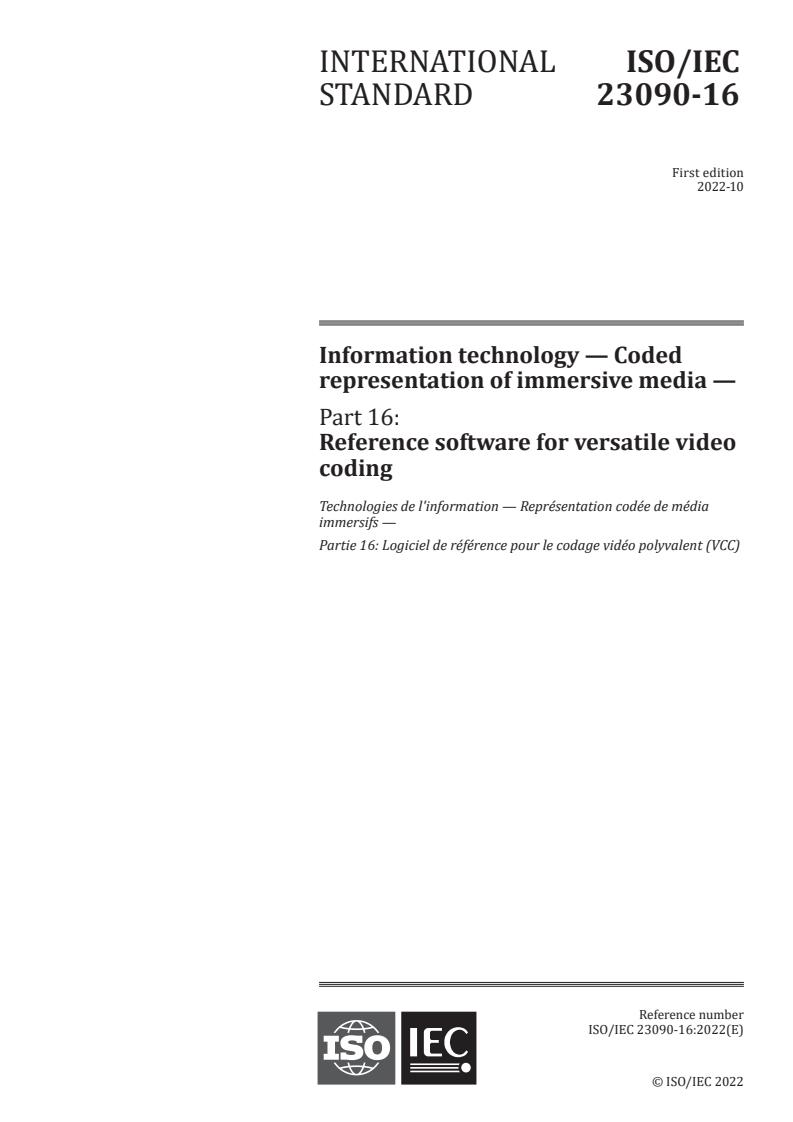
INTERNATIONAL ISO/IEC
STANDARD 23090-16
First edition
2022-10
Information technology — Coded
representation of immersive media —
Part 16:
Reference software for versatile video
coding
Technologies de l'information — Représentation codée de média
immersifs —
Partie 16: Logiciel de référence pour le codage vidéo polyvalent (VCC)
Reference number
© ISO/IEC 2022
© ISO/IEC 2022
All rights reserved. Unless otherwise specified, or required in the context of its implementation, no part of this publication may
be reproduced or utilized otherwise in any form or by any means, electronic or mechanical, including photocopying, or posting on
the internet or an intranet, without prior written permission. Permission can be requested from either ISO at the address below
or ISO’s member body in the country of the requester.
ISO copyright office
CP 401 • Ch. de Blandonnet 8
CH-1214 Vernier, Geneva
Phone: +41 22 749 01 11
Email: copyright@iso.org
Website: www.iso.org
Published in Switzerland
ii
© ISO/IEC 2022 – All rights reserved
Contents Page
Foreword .iv
Introduction .v
1 Scope . 1
2 Normative references . 1
3 Terms and definitions . 1
4 Abbreviated terms . 2
5 Conventions . 2
6 Reference software for Rec. ITU-T H.266 | ISO/IEC 23090-3 . 2
iii
© ISO/IEC 2022 – All rights reserved
Foreword
ISO (the International Organization for Standardization) and IEC (the International Electrotechnical
Commission) form the specialized system for worldwide standardization. National bodies that are
members of ISO or IEC participate in the development of International Standards through technical
committees established by the respective organization to deal with particular fields of technical
activity. ISO and IEC technical committees collaborate in fields of mutual interest. Other international
organizations, governmental and non-governmental, in liaison with ISO and IEC, also take part in the
work.
The procedures used to develop this document and those intended for its further maintenance
are described in the ISO/IEC Directives, Part 1. In particular, the different approval criteria
needed for the different types of document should be noted. This document was drafted in
accordance with the editorial rules of the ISO/IEC Directives, Part 2 (see www.iso.org/directives or
www.iec.ch/members_experts/refdocs).
Attention is drawn to the possibility that some of the elements of this document may be the subject
of patent rights. ISO and IEC shall not be held responsible for identifying any or all such patent
rights. Details of any patent rights identified during the development of the document will be in the
Introduction and/or on the ISO list of patent declarations received (see www.iso.org/patents) or the IEC
list of patent declarations received (see https://patents.iec.ch).
Any trade name used in this document is information given for the convenience of users and does not
constitute an endorsement.
For an explanation of the voluntary nature of standards, the meaning of ISO specific terms and
expressions related to conformity assessment, as well as information about ISO's adherence to
the World Trade Organization (WTO) principles in the Technical Barriers to Trade (TBT) see
www.iso.org/iso/foreword.html. In the IEC, see www.iec.ch/understanding-standards.
This document was prepared by Joint Technical Committee ISO/IEC JTC 1, Information technology,
Subcommittee SC 29, Coding of audio, picture, multimedia and hypermedia information, in collaboration
with ITU-T (as Rec. ITU-T H.266.2).
A list of all parts in the ISO/IEC 23090 series can be found on the ISO and IEC websites.
Any feedback or questions on this document should be directed to the user’s national standards
body. A complete listing of these bodies can be found at www.iso.org/members.html and
www.iec.ch/national-committees.
iv
© ISO/IEC 2022 – All rights reserved
Introduction
This document provides reference software for Rec. ITU-T H.266 | ISO/IEC 23090-3. The reference
software includes both encoder and decoder functionality.
Reference software is useful in aiding users of a video coding standard to establish and test conformance
and interoperability, and to educate users and demonstrate the capabilities of the standard. For these
purposes, the accompanying software is provided as an aid for the study and implementation of Rec.
ITU-T H.266 | ISO/IEC 23090-3 Versatile video coding.
The software has been jointly developed by the ITU-T Visual Coding Experts Group (VCEG, Question
6 of ITU-T Study Group 16) and the ISO/IEC Moving Picture Experts Group (MPEG Joint Video Coding
Team with ITU-T SG 16, Working Group 5 of Subcommittee 29 of ISO/IEC Joint Technical Committee 1).
0.1 Purpose
The purpose of this document is to provide the following:
— Reference decoder software capable of decoding bitstreams that conform to Rec. ITU-T H.266 |
ISO/IEC 23090-3 in a manner that conforms to the decoding process specified in Rec. ITU-T H.266 |
ISO/IEC 23090-3.
— Reference encoder software capable of producing bitstreams that conform to Rec. ITU-T H.266 |
ISO/IEC 23090-3.
0.2 Examples of use
Some examples of uses that can be appropriate for the reference decoder software are as follows:
— As an illustration of how to perform the decoding process specified in Rec. ITU
...
Questions, Comments and Discussion
Ask us and Technical Secretary will try to provide an answer. You can facilitate discussion about the standard in here.
Loading comments...