

ISO 9969:2016
(Main)Thermoplastics pipes — Determination of ring stiffness
General Information
- Abstract
ISO 9969:2016 specifies a test method for determining the ring stiffness of thermoplastics pipes having a circular cross section.
- Status
- Published
- Publication Date
- 03-Jan-2016
- Current Stage
- 9093 - International Standard confirmed
- Start Date
- 18-Oct-2021
- Completion Date
- 26-Sep-2026
Buy Documents

ISO 9969:2016 - Thermoplastics pipes -- Determination of ring stiffness

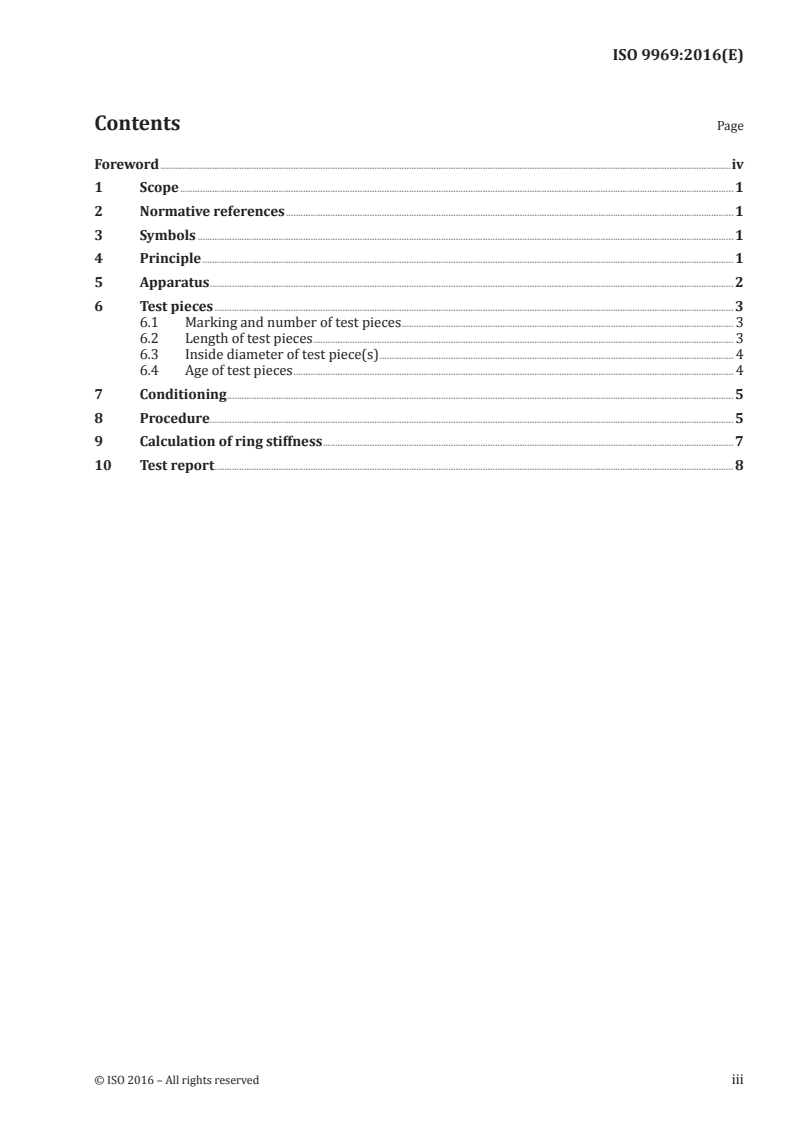
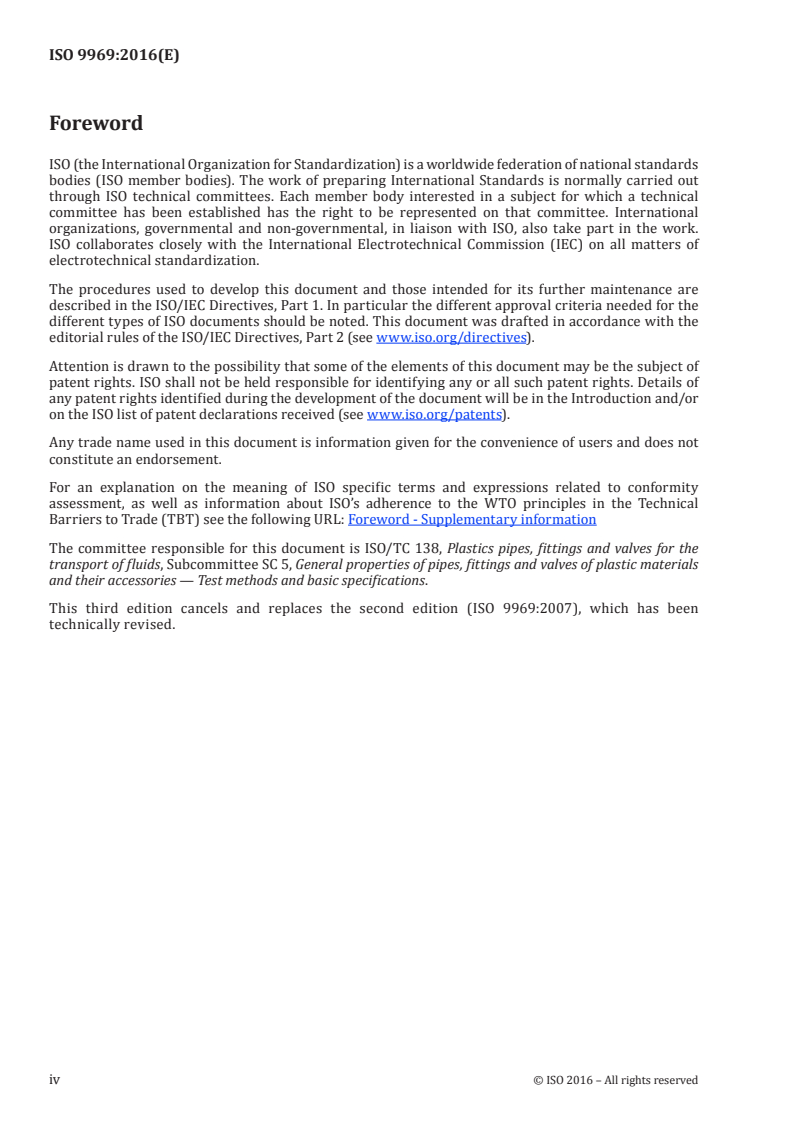
ISO 9969:2016 - Thermoplastics pipes — Determination of ring stiffness/4/2016

ISO 9969:2016 - Tubes en matières thermoplastiques -- Détermination de la rigidité annulaire

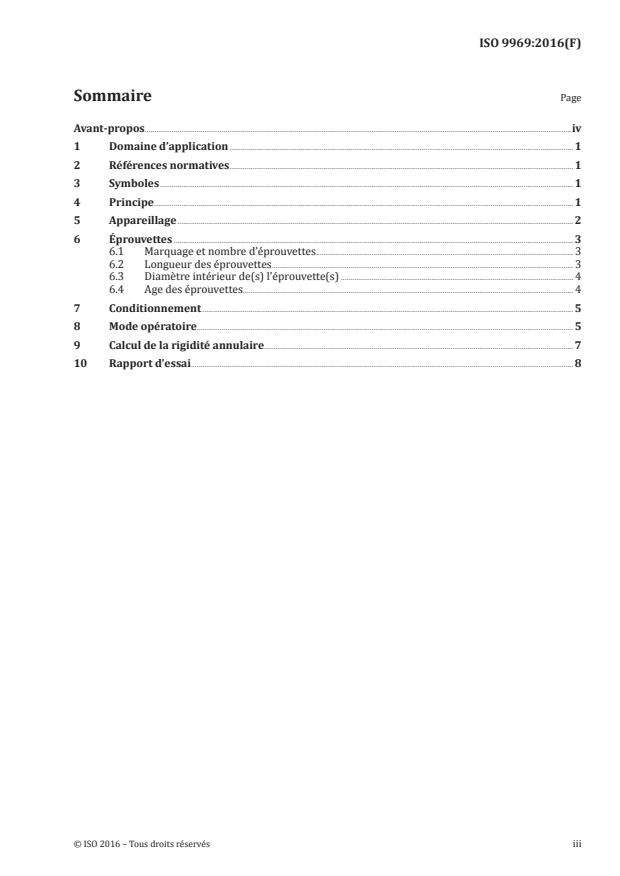
ISO 9969:2016 - Tubes en matières thermoplastiques — Détermination de la rigidité annulaire/4/2016
Overview
ISO 9969:2016 - Thermoplastics pipes - Determination of ring stiffness specifies a laboratory test method for determining the ring stiffness of thermoplastics pipes with circular cross-sections. The standard defines required apparatus, sample preparation, conditioning, test procedure and how to calculate and report ring stiffness from force–deflection data. Ring stiffness is determined from the force required to produce a 3% diametric deflection of a pipe specimen loaded between two parallel plates.
Key topics and technical requirements
- Test principle: Measure force vs. deflection while compressing a short pipe length at a constant crosshead speed; calculate stiffness from the force at 3% diametric deflection.
- Specimens: Three test pieces are taken from a marked pipe; lengths depend on nominal diameter and pipe wall structure (minimums and whole-number rib rules apply for structured walls).
- Conditioning & age: Test pieces must be conditioned at the test temperature for ≥24 h. For type testing or dispute, specimen age is (21 ± 2) days.
- Test temperature: Default laboratory temperature is (23 ± 2) °C (or (27 ± 2) °C where that is the national lab standard); disputes default to 23 °C.
- Apparatus and measurements: A compressive testing machine with parallel flat plates, accurate force and deflection measuring devices, and dimensional gauges. Measurement accuracy requirements are specified (e.g., inside diameter to within 0.5%, deflection to 0.1 mm or 1%).
- Pre-load and deflection speed: A small pre-load is applied before starting the test (a fixed value for small pipes and a calculated value for larger pipes); deflection speed is set according to nominal diameter (different speed ranges for d ≤100 mm, 100–200 mm, etc.).
- Data handling: If pipe wall height changes substantially, inside-diameter change is used for the force–deflection plot. The standard gives a method to correct an apparent zero offset by extrapolating the initial linear portion.
- Reporting: Test reports must identify the pipe (manufacturer, material, dimensions), test temperature, individual and average ring stiffness values, and any relevant test conditions or incidents.
Applications
- Quality control and production testing of PVC, PE and other thermoplastic piping products.
- Type approval, specification verification and material selection for buried drainage, sewer, conduit and other piping systems where stiffness under external loading matters.
- Comparison of pipe designs (solid vs. structured wall, corrugated) and verification against contractual or regulatory stiffness classes.
Who uses ISO 9969:2016
- Pipe manufacturers and R&D teams
- Independent testing laboratories and certification bodies
- Engineers and specifiers writing procurement or compliance requirements
- Regulatory authorities and standards committees
Related standards
- ISO 3126 (for dimensional measurement methods)
- Other ISO/TC 138 publications on plastics piping systems and test methods
Keywords: ISO 9969:2016, ring stiffness, thermoplastics pipes, pipe testing, test method, compressive testing machine, deflection speed, pipe quality control.
Relations
- Effective Date
- 25-Aug-2026
- Effective Date
- 25-Aug-2026
- Effective Date
- 12-Aug-2026
- Effective Date
- 22-Apr-2026
- Effective Date
- 13-Feb-2026
- Consolidates
EN ISO 9969:2016 - Thermoplastics pipes - Determination of ring stiffness (ISO 9969:2016) - Effective Date
- 12-Feb-2026
- Effective Date
- 23-Jun-2012
Buy Documents
ISO 9969:2016 - Thermoplastics pipes -- Determination of ring stiffness
ISO 9969:2016 - Thermoplastics pipes — Determination of ring stiffness/4/2016
ISO 9969:2016 - Tubes en matières thermoplastiques -- Détermination de la rigidité annulaire
ISO 9969:2016 - Tubes en matières thermoplastiques — Détermination de la rigidité annulaire/4/2016
Get Certified
Connect with accredited certification bodies for this standard

Institut za varilstvo d.o.o. (Welding Institute)
Slovenia's leading welding institute since 1952. ISO 3834, EN 1090, pressure equipment certification, NDT personnel, welder qualification. Only IIW Au
Sponsored listings
Frequently Asked Questions
ISO 9969:2016 is a standard published by the International Organization for Standardization (ISO). Its full title is "Thermoplastics pipes — Determination of ring stiffness". This standard covers: ISO 9969:2016 specifies a test method for determining the ring stiffness of thermoplastics pipes having a circular cross section.
ISO 9969:2016 specifies a test method for determining the ring stiffness of thermoplastics pipes having a circular cross section.
ISO 9969:2016 is classified under the following ICS (International Classification for Standards) categories: 23.040.20 - Plastics pipes. The ICS classification helps identify the subject area and facilitates finding related standards.
ISO 9969:2016 has the following relationships with other standards: It is inter standard links to EN ISO 13268:2023, EN ISO 11296-7:2019, EN ISO 11300-3:2026, EN ISO 11300-1:2026, EN ISO 11296-3:2018, EN ISO 9969:2016, ISO 9969:2007. Understanding these relationships helps ensure you are using the most current and applicable version of the standard.
ISO 9969:2016 is available in PDF format for immediate download after purchase. The document can be added to your cart and obtained through the secure checkout process. Digital delivery ensures instant access to the complete standard document.
Standards Content (Sample)
INTERNATIONAL ISO
STANDARD 9969
Third edition
2016-01-15
Thermoplastics pipes —
Determination of ring stiffness
Tubes en matières thermoplastiques — Détermination de la
rigidité annulaire
Reference number
©
ISO 2016
© ISO 2016, Published in Switzerland
All rights reserved. Unless otherwise specified, no part of this publication may be reproduced or utilized otherwise in any form
or by any means, electronic or mechanical, including photocopying, or posting on the internet or an intranet, without prior
written permission. Permission can be requested from either ISO at the address below or ISO’s member body in the country of
the requester.
ISO copyright office
Ch. de Blandonnet 8 • CP 401
CH-1214 Vernier, Geneva, Switzerland
Tel. +41 22 749 01 11
Fax +41 22 749 09 47
copyright@iso.org
www.iso.org
ii © ISO 2016 – All rights reserved
Contents Page
Foreword .iv
1 Scope . 1
2 Normative references . 1
3 Symbols . 1
4 Principle . 1
5 Apparatus . 2
6 Test pieces . 3
6.1 Marking and number of test pieces . 3
6.2 Length of test pieces . 3
6.3 Inside diameter of test piece(s) . 4
6.4 Age of test pieces . 4
7 Conditioning . 5
8 Procedure. 5
9 Calculation of ring stiffness . 7
10 Test report . 8
Foreword
ISO (the International Organization for Standardization) is a worldwide federation of national standards
bodies (ISO member bodies). The work of preparing International Standards is normally carried out
through ISO technical committees. Each member body interested in a subject for which a technical
committee has been established has the right to be represented on that committee. International
organizations, governmental and non-governmental, in liaison with ISO, also take part in the work.
ISO collaborates closely with the International Electrotechnical Commission (IEC) on all matters of
electrotechnical standardization.
The procedures used to develop this document and those intended for its further maintenance are
described in the ISO/IEC Directives, Part 1. In particular the different approval criteria needed for the
different types of ISO documents should be noted. This document was drafted in accordance with the
editorial rules of the ISO/IEC Directives, Part 2 (see www.iso.org/directives).
Attention is drawn to the possibility that some of the elements of this document may be the subject of
patent rights. ISO shall not be held responsible for identifying any or all such patent rights. Details of
any patent rights identified during the development of the document will be in the Introduction and/or
on the ISO list of patent declarations received (see www.iso.org/patents).
Any trade name used in this document is information given for the convenience of users and does not
constitute an endorsement.
For an explanation on the meaning of ISO specific terms and expressions related to conformity
assessment, as well as information about ISO’s adherence to the WTO principles in the Technical
Barriers to Trade (TBT) see the following URL: Foreword - Supplementary information
The committee responsible for this document is ISO/TC 138, Plastics pipes, fittings and valves for the
transport of fluids, Subcommittee SC 5, General properties of pipes, fittings and valves of plastic materials
and their accessories — Test methods and basic specifications.
This third edition cancels and replaces the second edition (ISO 9969:2007), which has been
technically revised.
iv © ISO 2016 – All rights reserved
INTERNATIONAL STANDARD ISO 9969:2016(E)
Thermoplastics pipes — Determination of ring stiffness
1 Scope
This International Standard specifies a test method for determining the ring stiffness of thermoplastics
pipes having a circular cross section.
2 Normative references
The following documents, in whole or in part, are normatively referenced in this document and are
indispensable for its application. For dated references, only the edition cited applies. For undated
references, the latest edition of the referenced document (including any amendments) applies.
ISO 3126, Plastics piping systems — Plastics components — Determination of dimensions
3 Symbols
For the purposes of this document, the following symbols apply.
Units
d nominal diameter of pipe mm
n
d inside diameter of the test piece of pipe mm
i
e construction height mm
c
F loading force kN
F pre-load force N
L length of test piece mm
p pitch of ribs or windings mm
S ring stiffness kN/m
y vertical deflection mm
4 Principle
The ring stiffness is determined by measuring the force and the deflection while deflecting the pipe at
a constant deflection speed.
A cut length of pipe supported horizontally is compressed vertically between two parallel flat plates
moved at a constant speed that is dependent upon the diameter of the pipe.
A plot of force versus deflection is generated. The ring stiffness is calculated as a function of the force
necessary to produce a 3 % diametric deflection of the pipe.
NOTE It is assumed that the test temperature is set by the referring standard, if appropriate (see 8.1).
5 Apparatus
5.1 Compressive testing machine, capable of a constant rate of crosshead movement, via a pair of
parallel plates (5.2), as appropriate to the nominal diameter of the pipe in conformance with Table 1,
with sufficient force and travel to produce the specified diametric deflection (see Clause 8).
Table 1 — Deflection speeds
Inside diameter, d , of the test Deflection speed
i
piece of pipe mm/min
mm
d ≤ 100 2 ± 0,1
i
100 < d ≤ 200 5 ± 0,25
i
200 < d ≤ 400 10 ± 0,5
i
400 < d ≤ 710 20 ± 1
i
d > 710 0,03 × d ± 5 %
i i
d shall be determined in accordance with 6.3.
i
5.2 A pair of hard and rigid plates, through which the testing machine can apply the necessary force,
F, to the test piece.
The plates shall have flat, smooth and clean surfaces for contact with the test piece.
The stiffness and hardness of each plate shall be sufficient to prevent bending or deformation to an
extent that would affect the results.
The length of each plate shall be at least equal to the length of the test piece. The width of each plate
shall not be less than the width of the contact surface with the test piece while under load plus 25 mm.
5.3 Dimensional measuring devices, capable of determining
— individual values for the length of a test piece (see 6.2.2 and 6.2.3) to with an accuracy of ± 1 mm,
— the inside diameter of a test piece to with an accuracy of ± 0,5 %, and
— the change of inside diameter of a test piece in the direction of loading with an accuracy o
...
INTERNATIONAL ISO
STANDARD 9969
Third edition
2016-01-15
Thermoplastics pipes —
Determination of ring stiffness
Tubes en matières thermoplastiques — Détermination de la
rigidité annulaire
Reference number
©
ISO 2016
© ISO 2016, Published in Switzerland
All rights reserved. Unless otherwise specified, no part of this publication may be reproduced or utilized otherwise in any form
or by any means, electronic or mechanical, including photocopying, or posting on the internet or an intranet, without prior
written permission. Permission can be requested from either ISO at the address below or ISO’s member body in the country of
the requester.
ISO copyright office
Ch. de Blandonnet 8 • CP 401
CH-1214 Vernier, Geneva, Switzerland
Tel. +41 22 749 01 11
Fax +41 22 749 09 47
copyright@iso.org
www.iso.org
ii © ISO 2016 – All rights reserved
Contents Page
Foreword .iv
1 Scope . 1
2 Normative references . 1
3 Symbols . 1
4 Principle . 1
5 Apparatus . 2
6 Test pieces . 3
6.1 Marking and number of test pieces . 3
6.2 Length of test pieces . 3
6.3 Inside diameter of test piece(s) . 4
6.4 Age of test pieces . 4
7 Conditioning . 5
8 Procedure. 5
9 Calculation of ring stiffness . 7
10 Test report . 8
Foreword
ISO (the International Organization for Standardization) is a worldwide federation of national standards
bodies (ISO member bodies). The work of preparing International Standards is normally carried out
through ISO technical committees. Each member body interested in a subject for which a technical
committee has been established has the right to be represented on that committee. International
organizations, governmental and non-governmental, in liaison with ISO, also take part in the work.
ISO collaborates closely with the International Electrotechnical Commission (IEC) on all matters of
electrotechnical standardization.
The procedures used to develop this document and those intended for its further maintenance are
described in the ISO/IEC Directives, Part 1. In particular the different approval criteria needed for the
different types of ISO documents should be noted. This document was drafted in accordance with the
editorial rules of the ISO/IEC Directives, Part 2 (see www.iso.org/directives).
Attention is drawn to the possibility that some of the elements of this document may be the subject of
patent rights. ISO shall not be held responsible for identifying any or all such patent rights. Details of
any patent rights identified during the development of the document will be in the Introduction and/or
on the ISO list of patent declarations received (see www.iso.org/patents).
Any trade name used in this document is information given for the convenience of users and does not
constitute an endorsement.
For an explanation on the meaning of ISO specific terms and expressions related to conformity
assessment, as well as information about ISO’s adherence to the WTO principles in the Technical
Barriers to Trade (TBT) see the following URL: Foreword - Supplementary information
The committee responsible for this document is ISO/TC 138, Plastics pipes, fittings and valves for the
transport of fluids, Subcommittee SC 5, General properties of pipes, fittings and valves of plastic materials
and their accessories — Test methods and basic specifications.
This third edition cancels and replaces the second edition (ISO 9969:2007), which has been
technically revised.
iv © ISO 2016 – All rights reserved
INTERNATIONAL STANDARD ISO 9969:2016(E)
Thermoplastics pipes — Determination of ring stiffness
1 Scope
This International Standard specifies a test method for determining the ring stiffness of thermoplastics
pipes having a circular cross section.
2 Normative references
The following documents, in whole or in part, are normatively referenced in this document and are
indispensable for its application. For dated references, only the edition cited applies. For undated
references, the latest edition of the referenced document (including any amendments) applies.
ISO 3126, Plastics piping systems — Plastics components — Determination of dimensions
3 Symbols
For the purposes of this document, the following symbols apply.
Units
d nominal diameter of pipe mm
n
d inside diameter of the test piece of pipe mm
i
e construction height mm
c
F loading force kN
F pre-load force N
L length of test piece mm
p pitch of ribs or windings mm
S ring stiffness kN/m
y vertical deflection mm
4 Principle
The ring stiffness is determined by measuring the force and the deflection while deflecting the pipe at
a constant deflection speed.
A cut length of pipe supported horizontally is compressed vertically between two parallel flat plates
moved at a constant speed that is dependent upon the diameter of the pipe.
A plot of force versus deflection is generated. The ring stiffness is calculated as a function of the force
necessary to produce a 3 % diametric deflection of the pipe.
NOTE It is assumed that the test temperature is set by the referring standard, if appropriate (see 8.1).
5 Apparatus
5.1 Compressive testing machine, capable of a constant rate of crosshead movement, via a pair of
parallel plates (5.2), as appropriate to the nominal diameter of the pipe in conformance with Table 1,
with sufficient force and travel to produce the specified diametric deflection (see Clause 8).
Table 1 — Deflection speeds
Inside diameter, d , of the test Deflection speed
i
piece of pipe mm/min
mm
d ≤ 100 2 ± 0,1
i
100 < d ≤ 200 5 ± 0,25
i
200 < d ≤ 400 10 ± 0,5
i
400 < d ≤ 710 20 ± 1
i
d > 710 0,03 × d ± 5 %
i i
d shall be determined in accordance with 6.3.
i
5.2 A pair of hard and rigid plates, through which the testing machine can apply the necessary force,
F, to the test piece.
The plates shall have flat, smooth and clean surfaces for contact with the test piece.
The stiffness and hardness of each plate shall be sufficient to prevent bending or deformation to an
extent that would affect the results.
The length of each plate shall be at least equal to the length of the test piece. The width of each plate
shall not be less than the width of the contact surface with the test piece while under load plus 25 mm.
5.3 Dimensional measuring devices, capable of determining
— individual values for the length of a test piece (see 6.2.2 and 6.2.3) to with an accuracy of ± 1 mm,
— the inside diameter of a test piece to with an accuracy of ± 0,5 %, and
— the change of inside diameter of a test piece in the direction of loading with an accuracy o
...
NORME ISO
INTERNATIONALE 9969
Troisième édition
2016-01-15
Tubes en matières
thermoplastiques — Détermination
de la rigidité annulaire
Thermoplastics pipes — Determination of ring stiffness
Numéro de référence
©
ISO 2016
DOCUMENT PROTÉGÉ PAR COPYRIGHT
© ISO 2016, Publié en Suisse
Droits de reproduction réservés. Sauf indication contraire, aucune partie de cette publication ne peut être reproduite ni utilisée
sous quelque forme que ce soit et par aucun procédé, électronique ou mécanique, y compris la photocopie, l’affichage sur
l’internet ou sur un Intranet, sans autorisation écrite préalable. Les demandes d’autorisation peuvent être adressées à l’ISO à
l’adresse ci-après ou au comité membre de l’ISO dans le pays du demandeur.
ISO copyright office
Ch. de Blandonnet 8 • CP 401
CH-1214 Vernier, Geneva, Switzerland
Tel. +41 22 749 01 11
Fax +41 22 749 09 47
copyright@iso.org
www.iso.org
ii © ISO 2016 – Tous droits réservés
Sommaire Page
Avant-propos .iv
1 Domaine d’application . 1
2 Références normatives . 1
3 Symboles . 1
4 Principe . 1
5 Appareillage . 2
6 Éprouvettes . 3
6.1 Marquage et nombre d’éprouvettes . 3
6.2 Longueur des éprouvettes. 3
6.3 Diamètre intérieur de(s) l’éprouvette(s) . 4
6.4 Age des éprouvettes. 4
7 Conditionnement . 5
8 Mode opératoire. 5
9 Calcul de la rigidité annulaire. 7
10 Rapport d’essai . 8
Avant-propos
L’ISO (Organisation internationale de normalisation) est une fédération mondiale d’organismes
nationaux de normalisation (comités membres de l’ISO). L’élaboration des Normes internationales est
en général confiée aux comités techniques de l’ISO. Chaque comité membre intéressé par une étude
a le droit de faire partie du comité technique créé à cet effet. Les organisations internationales,
gouvernementales et non gouvernementales, en liaison avec l’ISO participent également aux travaux.
L’ISO collabore étroitement avec la Commission électrotechnique internationale (IEC) en ce qui
concerne la normalisation électrotechnique.
Les procédures utilisées pour élaborer le présent document et celles destinées à sa mise à jour sont
décrites dans les Directives ISO/IEC, Partie 1. Il convient, en particulier de prendre note des différents
critères d’approbation requis pour les différents types de documents ISO. Le présent document a été
rédigé conformément aux règles de rédaction données dans les Directives ISO/IEC, Partie 2 (voir www.
iso.org/directives).
L’attention est appelée sur le fait que certains des éléments du présent document peuvent faire l’objet de
droits de propriété intellectuelle ou de droits analogues. L’ISO ne saurait être tenue pour responsable
de ne pas avoir identifié de tels droits de propriété et averti de leur existence. Les détails concernant
les références aux droits de propriété intellectuelle ou autres droits analogues identifiés lors de
l’élaboration du document sont indiqués dans l’Introduction et/ou dans la liste des déclarations de
brevets reçues par l’ISO (voir www.iso.org/brevets).
Les appellations commerciales éventuellement mentionnées dans le présent document sont données
pour information, par souci de commodité, à l’intention des utilisateurs et ne sauraient constituer
un engagement.
Pour une explication de la signification des termes et expressions spécifiques de l’ISO liés à
l’évaluation de la conformité, ou pour toute information au sujet de l’adhésion de l’ISO aux principes
de l’OMC concernant les obstacles techniques au commerce (OTC), voir le lien suivant: Avant-propos —
Informations supplémentaires.
Le comité responsable de ce document est ISO/TC 138, Tubes, raccords et robinetterie en matières
plastiques pour le transport des fluides, sous-comité SC 5, Propriétés générales des tubes, raccords et
robinetteries en matières plastiques et leurs accessoires — Méthodes d’essais et spécifications de base.
Cette troisième édition annule et remplace la deuxième édition (ISO 9969:2007), qui a fait l’objet d’une
révision technique.
iv © ISO 2016 – Tous droits réservés
NORME INTERNATIONALE ISO 9969:2016(F)
Tubes en matières thermoplastiques — Détermination de
la rigidité annulaire
1 Domaine d’application
La présente Norme internationale spécifie une méthode de détermination de la rigidité annulaire de
tubes en matières thermoplastiques ayant une section circulaire.
2 Références normatives
Les documents suivants, en tout ou partie, sont référencés de manière normative dans le présent
document et sont indispensables pour son application. Pour les références datées, seule l’édition citée
s’applique. Pour les références non datées, la dernière édition du document de référence s’applique (y
compris les éventuels amendements).
ISO 3126, Systèmes de canalisations en plastiques — Composants en plastiques — Détermination des
dimensions
3 Symboles
Pour les besoins du présent document, les symboles suivants s’appliquent.
Unité
d diamètre nominal du tube mm
n
d diamètre intérieur de l’éprouvette du tube mm
i
e hauteur de construction mm
c
F charge kN
F précharge N
L longueur de l’éprouvette mm
p pas des nervures ou spirales mm
S rigidité annulaire kN/m
y déformation verticale mm
4 Principe
La rigidité annulaire est obtenue en mesurant la force et la déformation produites au cours de
l’ovalisation d’un tube à une vitesse constante de déformation.
Une longueur de tube, placée horizontalement, est comprimée verticalement entre deux plateaux
parallèles et plats se déplaçant à une vitesse constante dépendant du diamètre du tube.
Une courbe de la force en fonction de la déformation est obtenue. La rigidité annulaire est calculée en
fonction de la force nécessaire pour déformer le diamètre intérieur du tube de 3 %.
NOTE On suppose que la température d’essai est établie dans la norme de référence, selon le cas (voir 8.1).
5 Appareillage
5.1 Machine de compression, capable de produire par l’intermédiaire de deux plateaux parallèles
(5.2), un mouvement transversal de vitesse constante, fonction du diamètre nominal du tube
conformément au Tableau 1, de force et de course suffisantes pour atteindre la déformation diamètrale
exigée (voir Article 8).
Tableau 1 — Vitesses de déformation
Diamètre intérieur, d , de Vitesse de déformation
i
l’échantillon du tube mm/min
mm
d ≤ 100 2 ± 0,1
i
100 < d ≤ 200 5 ± 0,25
i
200 < d ≤ 400 10 ± 0,5
i
400 < d ≤ 710 20 ± 1
i
d > 710 0,03 × d ± 5 %
i i
d doit être déterminé conformément à 6.3.
i
5.2 Une paire de plateaux durs et rigides, par laquelle la machine d’essai peut appliquer la force
nécessaire, F, à l’éprouvette.
Les plateaux doivent avoir des surfaces plates, lisses et propres en contact avec les éprouvettes.
La rigidité et la dureté de chaque plateau doit être suffisante pour éviter un pliage ou une déformation à
un niveau qui affecterait les résultats.
La longueur de chaque plateau doit être au moins égale à la longueur des éprouvettes. La largeur
de chaque plateau ne doit pas être inférieure à la largeur maximale de la surface en contact avec
l’éprouvette chargée augmentée de 25 mm.
5.3 Appareils de mesure dimensionnelle, capables de déterminer
— les valeurs individuelles de la longueur de l’éprouvette (voir 6.2.2 et 6.2.3) avec une précision de ± 1 mm,
— le diamètre intérieur des éprouvettes avec une précision de ± 0,5 %, et
— le changement de diamètre intérieur des éprouvettes dans le sens de l’application de la charge avec
une précision de 0,1 mm ou 1 % de la déformation, la plus grande des deux valeurs étant retenue.
Un exemple d’appareil de mes
...
NORME ISO
INTERNATIONALE 9969
Troisième édition
2016-01-15
Tubes en matières
thermoplastiques — Détermination
de la rigidité annulaire
Thermoplastics pipes — Determination of ring stiffness
Numéro de référence
©
ISO 2016
DOCUMENT PROTÉGÉ PAR COPYRIGHT
© ISO 2016, Publié en Suisse
Droits de reproduction réservés. Sauf indication contraire, aucune partie de cette publication ne peut être reproduite ni utilisée
sous quelque forme que ce soit et par aucun procédé, électronique ou mécanique, y compris la photocopie, l’affichage sur
l’internet ou sur un Intranet, sans autorisation écrite préalable. Les demandes d’autorisation peuvent être adressées à l’ISO à
l’adresse ci-après ou au comité membre de l’ISO dans le pays du demandeur.
ISO copyright office
Ch. de Blandonnet 8 • CP 401
CH-1214 Vernier, Geneva, Switzerland
Tel. +41 22 749 01 11
Fax +41 22 749 09 47
copyright@iso.org
www.iso.org
ii © ISO 2016 – Tous droits réservés
Sommaire Page
Avant-propos .iv
1 Domaine d’application . 1
2 Références normatives . 1
3 Symboles . 1
4 Principe . 1
5 Appareillage . 2
6 Éprouvettes . 3
6.1 Marquage et nombre d’éprouvettes . 3
6.2 Longueur des éprouvettes. 3
6.3 Diamètre intérieur de(s) l’éprouvette(s) . 4
6.4 Age des éprouvettes. 4
7 Conditionnement . 5
8 Mode opératoire. 5
9 Calcul de la rigidité annulaire. 7
10 Rapport d’essai . 8
Avant-propos
L’ISO (Organisation internationale de normalisation) est une fédération mondiale d’organismes
nationaux de normalisation (comités membres de l’ISO). L’élaboration des Normes internationales est
en général confiée aux comités techniques de l’ISO. Chaque comité membre intéressé par une étude
a le droit de faire partie du comité technique créé à cet effet. Les organisations internationales,
gouvernementales et non gouvernementales, en liaison avec l’ISO participent également aux travaux.
L’ISO collabore étroitement avec la Commission électrotechnique internationale (IEC) en ce qui
concerne la normalisation électrotechnique.
Les procédures utilisées pour élaborer le présent document et celles destinées à sa mise à jour sont
décrites dans les Directives ISO/IEC, Partie 1. Il convient, en particulier de prendre note des différents
critères d’approbation requis pour les différents types de documents ISO. Le présent document a été
rédigé conformément aux règles de rédaction données dans les Directives ISO/IEC, Partie 2 (voir www.
iso.org/directives).
L’attention est appelée sur le fait que certains des éléments du présent document peuvent faire l’objet de
droits de propriété intellectuelle ou de droits analogues. L’ISO ne saurait être tenue pour responsable
de ne pas avoir identifié de tels droits de propriété et averti de leur existence. Les détails concernant
les références aux droits de propriété intellectuelle ou autres droits analogues identifiés lors de
l’élaboration du document sont indiqués dans l’Introduction et/ou dans la liste des déclarations de
brevets reçues par l’ISO (voir www.iso.org/brevets).
Les appellations commerciales éventuellement mentionnées dans le présent document sont données
pour information, par souci de commodité, à l’intention des utilisateurs et ne sauraient constituer
un engagement.
Pour une explication de la signification des termes et expressions spécifiques de l’ISO liés à
l’évaluation de la conformité, ou pour toute information au sujet de l’adhésion de l’ISO aux principes
de l’OMC concernant les obstacles techniques au commerce (OTC), voir le lien suivant: Avant-propos —
Informations supplémentaires.
Le comité responsable de ce document est ISO/TC 138, Tubes, raccords et robinetterie en matières
plastiques pour le transport des fluides, sous-comité SC 5, Propriétés générales des tubes, raccords et
robinetteries en matières plastiques et leurs accessoires — Méthodes d’essais et spécifications de base.
Cette troisième édition annule et remplace la deuxième édition (ISO 9969:2007), qui a fait l’objet d’une
révision technique.
iv © ISO 2016 – Tous droits réservés
NORME INTERNATIONALE ISO 9969:2016(F)
Tubes en matières thermoplastiques — Détermination de
la rigidité annulaire
1 Domaine d’application
La présente Norme internationale spécifie une méthode de détermination de la rigidité annulaire de
tubes en matières thermoplastiques ayant une section circulaire.
2 Références normatives
Les documents suivants, en tout ou partie, sont référencés de manière normative dans le présent
document et sont indispensables pour son application. Pour les références datées, seule l’édition citée
s’applique. Pour les références non datées, la dernière édition du document de référence s’applique (y
compris les éventuels amendements).
ISO 3126, Systèmes de canalisations en plastiques — Composants en plastiques — Détermination des
dimensions
3 Symboles
Pour les besoins du présent document, les symboles suivants s’appliquent.
Unité
d diamètre nominal du tube mm
n
d diamètre intérieur de l’éprouvette du tube mm
i
e hauteur de construction mm
c
F charge kN
F précharge N
L longueur de l’éprouvette mm
p pas des nervures ou spirales mm
S rigidité annulaire kN/m
y déformation verticale mm
4 Principe
La rigidité annulaire est obtenue en mesurant la force et la déformation produites au cours de
l’ovalisation d’un tube à une vitesse constante de déformation.
Une longueur de tube, placée horizontalement, est comprimée verticalement entre deux plateaux
parallèles et plats se déplaçant à une vitesse constante dépendant du diamètre du tube.
Une courbe de la force en fonction de la déformation est obtenue. La rigidité annulaire est calculée en
fonction de la force nécessaire pour déformer le diamètre intérieur du tube de 3 %.
NOTE On suppose que la température d’essai est établie dans la norme de référence, selon le cas (voir 8.1).
5 Appareillage
5.1 Machine de compression, capable de produire par l’intermédiaire de deux plateaux parallèles
(5.2), un mouvement transversal de vitesse constante, fonction du diamètre nominal du tube
conformément au Tableau 1, de force et de course suffisantes pour atteindre la déformation diamètrale
exigée (voir Article 8).
Tableau 1 — Vitesses de déformation
Diamètre intérieur, d , de Vitesse de déformation
i
l’échantillon du tube mm/min
mm
d ≤ 100 2 ± 0,1
i
100 < d ≤ 200 5 ± 0,25
i
200 < d ≤ 400 10 ± 0,5
i
400 < d ≤ 710 20 ± 1
i
d > 710 0,03 × d ± 5 %
i i
d doit être déterminé conformément à 6.3.
i
5.2 Une paire de plateaux durs et rigides, par laquelle la machine d’essai peut appliquer la force
nécessaire, F, à l’éprouvette.
Les plateaux doivent avoir des surfaces plates, lisses et propres en contact avec les éprouvettes.
La rigidité et la dureté de chaque plateau doit être suffisante pour éviter un pliage ou une déformation à
un niveau qui affecterait les résultats.
La longueur de chaque plateau doit être au moins égale à la longueur des éprouvettes. La largeur
de chaque plateau ne doit pas être inférieure à la largeur maximale de la surface en contact avec
l’éprouvette chargée augmentée de 25 mm.
5.3 Appareils de mesure dimensionnelle, capables de déterminer
— les valeurs individuelles de la longueur de l’éprouvette (voir 6.2.2 et 6.2.3) avec une précision de ± 1 mm,
— le diamètre intérieur des éprouvettes avec une précision de ± 0,5 %, et
— le changement de diamètre intérieur des éprouvettes dans le sens de l’application de la charge avec
une précision de 0,1 mm ou 1 % de la déformation, la plus grande des deux valeurs étant retenue.
Un exemple d’appareil de mes
...