


ISO/IEC 27553-1:2022
(Main)Information security, cybersecurity and privacy protection — Security and privacy requirements for authentication using biometrics on mobile devices — Part 1: Local modes
Information security, cybersecurity and privacy protection — Security and privacy requirements for authentication using biometrics on mobile devices — Part 1: Local modes
This document provides high-level security and privacy requirements and recommendations for authentication using biometrics on mobile devices, including security and privacy requirements and recommendations for functional components and for communication. This document is applicable to the cases that the biometric data and derived biometric data do not leave the device, i.e. local modes.
Titre manque — Partie 1: Titre manque
General Information
- Status
- Published
- Publication Date
- 01-Nov-2022
- Drafting Committee
- ISO/IEC JTC 1/SC 27/WG 5 - Identity management and privacy technologies
- Current Stage
- 6060 - International Standard published
- Start Date
- 02-Nov-2022
- Due Date
- 16-Jan-2023
- Completion Date
- 02-Nov-2022
Overview
ISO/IEC 27553-1:2022 - "Information security, cybersecurity and privacy protection - Security and privacy requirements for authentication using biometrics on mobile devices - Part 1: Local modes" defines high‑level security and privacy requirements and recommendations for biometric authentication performed on mobile devices when biometric data and any derived biometric data do not leave the device (local modes). The standard targets the interaction between local biometric components and mobile applications or remote relying parties, and emphasizes threat analysis, secure component design, communication controls, and privacy safeguards.
Key topics and requirements
- Scope and applicability: Applies only to local modes where biometric data remain on the device; excludes identity proofing/enrolment and purely local applications with no remote service involvement.
- Security challenges: Discusses general biometric risks plus mobile‑specific issues such as device diversity, open computation environments, and unsupervised operation.
- System description: Provides an example architecture and defines entities/components including biometric system, biometric processing unit (BPU), authentication agent, relying party agent, and servers.
- Information assets & threat analysis: Identifies assets (biometric samples, templates, credentials) and enumerates threats to biometric systems and authentication agents.
- Security requirements & recommendations: High‑level controls for biometric subsystems, mobile device integration, and secure communication between agents and relying parties. (Detailed implementation requirements are left to implementers.)
- Privacy considerations: Guidance on privacy policies for biometric data, handling of derived data, and minimizing data exposure.
- Supporting content: Informative annexes include implementation examples, communication security issues, and authentication assurance/assurance levels.
Practical applications
- Secure mobile authentication for banking and payment apps where biometric templates remain on-device.
- Enterprise single sign-on and device‑binding scenarios that rely on local biometric verification.
- Mobile app developers and SDK providers implementing privacy‑aware biometric authentication flows.
- Evaluations of mobile biometric subsystems for product security reviews and risk assessments.
Who should use this standard
- Mobile device manufacturers and OS vendors
- Biometric hardware and SDK developers
- Security architects and product managers for mobile services
- Privacy officers and compliance teams assessing biometric data handling
- Certification bodies and auditors assessing high‑level security frameworks
Related standards
- ISO/IEC 24745 - Biometric information protection
- ISO/IEC 30107 series - Presentation attack detection (PAD)
- Part of the ISO/IEC 27553 series (other parts cover non‑local modes and related topics)
This standard is essential for organizations designing or assessing biometric authentication on mobile devices that require strong on‑device privacy and secure local verification.
Buy Documents

ISO/IEC 27553-1:2022 - Information security, cybersecurity and privacy protection — Security and privacy requirements for authentication using biometrics on mobile devices — Part 1: Local modes Released:2. 11. 2022
Get Certified
Connect with accredited certification bodies for this standard

BSI Group
BSI (British Standards Institution) is the business standards company that helps organizations make excellence a habit.

Bureau Veritas
Bureau Veritas is a world leader in laboratory testing, inspection and certification services.

DNV
DNV is an independent assurance and risk management provider.
Sponsored listings
Frequently Asked Questions
ISO/IEC 27553-1:2022 is a standard published by the International Organization for Standardization (ISO). Its full title is "Information security, cybersecurity and privacy protection — Security and privacy requirements for authentication using biometrics on mobile devices — Part 1: Local modes". This standard covers: This document provides high-level security and privacy requirements and recommendations for authentication using biometrics on mobile devices, including security and privacy requirements and recommendations for functional components and for communication. This document is applicable to the cases that the biometric data and derived biometric data do not leave the device, i.e. local modes.
This document provides high-level security and privacy requirements and recommendations for authentication using biometrics on mobile devices, including security and privacy requirements and recommendations for functional components and for communication. This document is applicable to the cases that the biometric data and derived biometric data do not leave the device, i.e. local modes.
ISO/IEC 27553-1:2022 is classified under the following ICS (International Classification for Standards) categories: 35.030 - IT Security. The ICS classification helps identify the subject area and facilitates finding related standards.
ISO/IEC 27553-1:2022 is available in PDF format for immediate download after purchase. The document can be added to your cart and obtained through the secure checkout process. Digital delivery ensures instant access to the complete standard document.
Standards Content (Sample)
INTERNATIONAL ISO/IEC
STANDARD 27553-1
First edition
2022-11
Information security, cybersecurity
and privacy protection — Security
and privacy requirements for
authentication using biometrics on
mobile devices —
Part 1:
Local modes
Reference number
© ISO/IEC 2022
© ISO/IEC 2022
All rights reserved. Unless otherwise specified, or required in the context of its implementation, no part of this publication may
be reproduced or utilized otherwise in any form or by any means, electronic or mechanical, including photocopying, or posting on
the internet or an intranet, without prior written permission. Permission can be requested from either ISO at the address below
or ISO’s member body in the country of the requester.
ISO copyright office
CP 401 • Ch. de Blandonnet 8
CH-1214 Vernier, Geneva
Phone: +41 22 749 01 11
Email: copyright@iso.org
Website: www.iso.org
Published in Switzerland
ii
© ISO/IEC 2022 – All rights reserved
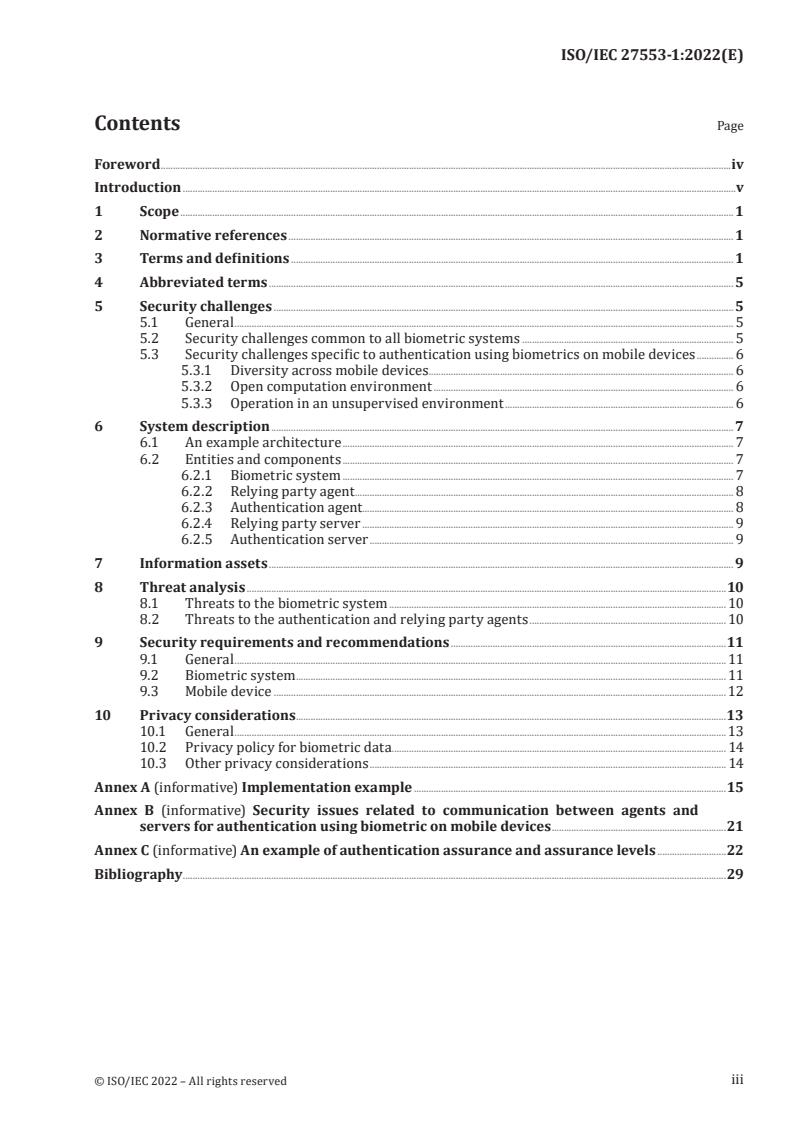
Contents Page
Foreword .iv
Introduction .v
1 S c op e . 1
2 Nor m at i ve r ef er enc e s . 1
3 Terms and definitions . 1
4 Abbr ev i at ed t er m s . 5
5 S e c u r it y c h a l len g e s .5
5.1 G eneral . 5
5.2 S ecurity challenges common to all biometric systems . 5
5.3 S ecurity challenges specific to authentication using biometrics on mobile devices . 6
5.3.1 Diversity across mobile devices. 6
5.3.2 Open computation environment . 6
5.3.3 Operation in an unsupervised environment . 6
6 S y s t em de s c r ip t ion .7
6.1 A n example architecture . 7
6.2 E ntities and components . 7
6.2.1 B iometric system . 7
6.2.2 R elying party agent . 8
6 . 2 . 3 Aut hent ic at ion a g ent. 8
6.2.4 R elying party server . 9
6 . 2 . 5 Aut hent ic at ion s er ver . 9
7 I n f or m at ion a s s e t s . 9
8 T h r e at a n a l y s i s .10
8.1 T hreats to the biometric system . 10
8.2 T hreats to the authentication and relying party agents . 10
9 Security requirements and recommendations .11
9.1 G eneral . 11
9.2 B iometric system . 11
9. 3 Mobi le de v ic e . 12
10 P r i v ac y c on s ider at ion s .13
10.1 G eneral .13
10.2 P rivacy policy for biometric data . . 14
10.3 O ther privacy considerations . 14
Annex A (informative) Implementation example .15
Annex B (informative) Security issues related to communication between agents and
servers for authentication using biometric on mobile devices .21
Annex C (informative) An example of authentication assurance and assurance levels .22
Bibliography .29
iii
© ISO/IEC 2022 – All rights reserved
Foreword
ISO (the International Organization for Standardization) and IEC (the International Electrotechnical
Commission) form the specialized system for worldwide standardization. National bodies that are
members of ISO or IEC participate in the development of International Standards through technical
committees established by the respective organization to deal with particular fields of technical
activity. ISO and IEC technical committees collaborate in fields of mutual interest. Other international
organizations, governmental and non-governmental, in liaison with ISO and IEC, also take part in the
work.
The procedures used to develop this document and those intended for its further maintenance
are described in the ISO/IEC Directives, Part 1. In particular, the different approval criteria
needed for the different types of document should be noted. This document was drafted in
accordance with the editorial rules of the ISO/IEC Directives, Part 2 (see www.iso.org/directives or
www.iec.ch/members_experts/refdocs).
Attention is drawn to the possibility that some of the elements of this document may be the subject
of patent rights. ISO and IEC shall not be held responsible for identifying any or all such patent
rights. Details of any patent rights identified during the development of the document will be in the
Introduction and/or on the ISO list of patent declarations received (see www.iso.org/patents) or the IEC
list of patent declarations received (see https://patents.iec.ch).
Any trade name used in this document is information given for the convenience of users and does not
constitute an endorsement.
For an explanation of the voluntary nature of standards, the meaning of ISO specific terms and
expressions related to conformity assessment, as well as information about ISO's adherence to
the World Trade Organization (WTO) principles in the Technical Barriers to Trade (TBT) see
www.iso.org/iso/foreword.html. In the IEC, see www.iec.ch/understanding-standards.
This document was prepared by Joint Technical Committee ISO/IEC JTC 1, Information technology,
Subcommittee SC 27, Information security, cybersecurity and privacy protection.
A list of all parts in the ISO/IEC 27553 series can be found on the ISO and IEC websites.
Any feedback or questions on this document should be directed to the user’s national standards
body. A complete listing of these bodies can be found at www.iso.org/members.html and
www.iec.ch/national-committees.
iv
© ISO/IEC 2022 – All rights reserved
Introduction
The functionalities and computation capabilities of consumer-grade mobile devices are evolving fast.
Authentication technologies using biometrics based on physiological or behavioural characteristics (e.g.
fingerprint, face, voiceprint) have been developed and widely adopted across various mobile platforms.
Compared to traditional authentication methods on mobile devices such as passwords, patterns, or
SMS messages, biometric characteristics are easy to use and hard to share. Authentication methods
using biometrics can, in some respects, provide a secure, reliable, and convenient solution, albeit with
some potentially awkward restrictions.
However, the fragmentation of computing environments for mobile devices (e.g. different operating
systems, different trusted environment implementations, different biometric system implementations,
and open computation environments in mobile devices) often results in inconsistent implementations,
which potentially increase the risks of vulnerabilities in, and attacks against, mobile devices. This
fragmentation makes it even more necessary to analyse security challenges, threats, and security
frameworks for authentication using biometrics on mobile devices. It is also necessary to specify the
high-level security requirements that can mitigate the security risks for applications of authentication
using biometrics in mobile devices.
Biometrics in this document is used for authentication on mobile devices whose result is consumed by
relying parties. This document applies to the cases where the biometric data and any derived biometric
data, except information on the verification outcome, do not leave the device, i.e. local modes.
This document provides high-level security requirements and recommendations for authentication
using biometrics on mobile devices, including for functional components and for communication
between the biometric system and the mobile applications requesting authentication success. Detailed
security requirements are left to implementations. This document also analyses security challenges,
threats, and security frameworks for authentication using biometrics on mobile devices.
The following contents are not addressed in this document:
— Identity proofing and enrolment requirements.
— The use of biometrics for authentication to applications which are entirely local to the mobile device
and no remote service is involved.
v
© ISO/IEC 2022 – All rights reserved
INTERNATIONAL STANDARD ISO/IEC 27553-1:2022(E)
Information security, cybersecurity and privacy
protection — Security and privacy requirements for
authentication using biometrics on mobile devices —
Part 1:
Local modes
1 S cope
This document provides high-level security and privacy requirements and recommendations for
authentication using biometrics on mobile devices, including security and privacy requirements and
recommendations for functional components and for communication.
This document is applicable to the cases that the biometric data and derived biometric data do not leave
the device, i.e. local modes.
2 Normat ive references
The following documents are referred to in the text in such a way that some or all of their content
constitutes requirements of this document. For dated references, only the edition cited applies. For
undated references, the latest edition of the referenced document (including any amendments) applies.
ISO/IEC 24745:2022, Information security, cybersecurity and privacy protection — Biometric information
protection
3 Terms and definitions
For the purposes of this document, the following terms and definitions apply.
ISO and IEC maintain terminology databases for use in standardization at the following addresses:
— ISO Online browsing platform: available at https:// www .iso .org/ obp
— IEC Electropedia: available at https:// www .electropedia .org/
3.1
attack presentation classification error rate
APCER
proportion of attack presentations using the same presentation attack instrument (PAI) species
incorrectly classified as bona fide presentations in a specific scenario
Note 1 to entry: PAI means the biometric characteristic or object used in a presentation attack (3.17).
[SOURCE: ISO/IEC 30107-3:2017, 3.2.1, modified — Note 1 to entry has been added.]
3.2
artefact
artificial object or representation presenting a copy of biometric characteristics or synthetic biometric
patterns
[SOURCE: ISO/IEC 30107-1:2016, 3.1]
© ISO/IEC 2022 – All rights reserved
3.3
authentication
provision of assurance in the identity of an entity
[SOURCE: ISO/IEC 29115:2013, 3.2]
3.4
authentication agent
component in a mobile device that performs authentication-related functions on the mobile device and
interacts with the local biometric components
3.5
authentication credential
credential containing information that can be used to help authenticate the entity
[SOURCE: ISO/IEC 20009-4:2017, 3.3]
3.6
authentication service provider
entity that provides authentication services to a relying party (3.19)
3.7
biometric data
biometric sample or aggregation of biometric samples at any stage of processing
EXAMPLE Biometric reference, biometric probe, biometric feature or biometric property.
Note 1 to entry: Biometric data need not be attributable to a specific individual, e.g. Universal Background
Models.
[SOURCE: ISO/IEC 2382-37:2022, 37.03.06]
3.8
biometric information
information conveyed or represented by biometric data (3.7)
Note 1 to entry: Biometric data include for instance data derived or transformed from biometric data which are
handled in connection with biometric data within a biometric system.
[SOURCE: ISO/IEC 24745:2022, 3.9]
3.9
biometric probe
biometric sample (3.12) or biometric feature set input to an algorithm for comparison to a biometric
reference(s)
[SOURCE: ISO/IEC 2382-37:2022, 37.03.14, modified — Notes to entry have been removed.]
3.10
biometric processing unit
BPU
trusted implementation of a collection of biometric subprocesses implemented in a single physical unit
Note 1 to entry: A BPU commonly comprises biometric subprocesses that are sequential in the process flow for a
biometric verification.
Note 2 to entry: Application/service requirements typically require BPU subprocesses to meet a uniform level
of security assurance. In ACBio, assurance is achieved through a BPU evaluation process that is authenticated by
means of an X.509 certificate embedded in an ACBio instance.
[SOURCE: ISO/IEC 24761:2019, 3.3]
© ISO/IEC 2022 – All rights reserved
3.11
biometrics
automated recognition of individuals based on their biological and behavioural characteristics
[SOURCE: ISO/IEC 2382-37:2022, 37.01.03, modified — Notes to entry have been removed.]
3.12
biometric sample
analogue or digital representation of biometric characteristics prior to biometric feature extraction
EXAMPLE A record containing the image of a finger is a biometric sample.
[SOURCE: ISO/IEC 2382-37:2022, 37.03.21]
3.13
credential
representation of an identity for use in authentication (3.3)
Note 1 to entry: As described in ISO/IEC 24760-1:2019, 5.4, customary embodiments of a credential are very
diverse. To accommodate this wide range, the definition adopted in this document is very generic.
Note 2 to entry: A credential is typically made to facilitate data authentication of the identity information
pertaining to the identity it represents. Data authentication is typically used in authorization.
Note 3 to entry: The identity information represented by a credential can, for example, be printed on human-
readable media, or stored within a physical token. Typically, such information can be presented in a manner
designed to reinforce its perceived validity.
Note 4 to entry: A credential can be a username, username with a password, a PIN, a smartcard, a token, a
fingerprint, a passport, etc.
[SOURCE: ISO/IEC 24760-1:2019, 3.3.5]
3.14
device binding
association of a specific device with the data (credential) and the holder (individual getting the
credential)
Note 1 to entry: The binding process typically provides assurance to a known level.
3.15
information asset
knowledge or data that has value to the individual or organization
[SOURCE: ISO/IEC 27032:2012, 4.27, modified – Note 1 to entry has been removed]
3.16
mobile device
small, compact, handheld, lightweight, standalone computing device, typically having a display screen
with digitizer input and/or a miniature keyboard
Note 1 to entry: Examples include laptops, tablet PCs, wearable information and communication technology
(ICT) devices, and smartphones.
[SOURCE: ISO/IEC 30107-4:2020, 3.1]
3.17
presentation attack
presentation to the biometric data capture subsystem with the goal of interfering with the operation of
the biometric system
Note 1 to entry: Presentation attack can be implemented through a number of methods, e.g. artefact, mutilations,
replay, etc.
© ISO/IEC 2022 – All rights reserved
Note 2 to entry: Presentation attacks can have a number of goals, e.g. impersonation or not being recognized.
Note 3 to entry: It is possible that biometric systems are unable to differentiate between biometric presentation
attacks with the goal of interfering with the systems operation and non-conformant presentations.
[SOURCE: ISO/IEC 30107-1:2016, 3.5, modified — "may" has been changed to "can" and "it is possible" in
Notes 2 and 3 to entry.]
3.18
presentation attack detection
PAD
automated determination of a presentation attack (3.17)
Note 1 to entry: PAD cannot infer the subject’s intent. In fact it may be impossible to derive that difference from
the data capture process or acquired sample.
[SOURCE: ISO/IEC 30107-1:2016, 3.6]
3.19
relying party
RP
entity that relies on the verification of identity information for a particular entity
Note 1 to entry: A relying party is exposed to risk caused by incorrect identity information. Typically it has a
trust relationship with one or more identity information authorities.
Note 2 to entry: In the context of this document, an RP is implemented as a server plus an agent. An RP agent
is a software component located in the mobile device which initiates authentication requests to an RP server,
displays the returned information, and interacts with the identity information provider (IIP) agent to fulfil the
authentication process.
EXAMPLE An RP agent can be a mobile browser.
[SOURCE: ISO/IEC 24760-1:2019, 3.3.7, modified – Note 2 to entry and EXAMPLE added]
3.20
renewable biometric reference
RBR
renewable identifier that represents an individual or data subject within a domain by means of
a protected binary identity (re)constructed from the captured biometric sample, and fulfilling
irreversibility requirements
Note 1 to entry: A renewable biometric reference fulfilling irreversibility requirement provides additional
security property.
Note 2 to entry: An example of a renewable biometric reference is a pseudonymous identifier and additional data
elements required for biometric verification or identification such as auxiliary data.
[SOURCE: ISO/IEC 24745:2022, 3.34]
3.21
threat
potential cause of an unwanted incident, which can result in harm to a system or organization
[SOURCE: ISO/IEC 27000:2018, 3.74]
3.22
trusted environment
secure area that guarantees the confidentiality and integrity of code and data loaded inside
Note 1 to entry: Examples include trusted execution environment (TEE), SE secure element (SE), and trusted
platform module (TPM). See ISO 12812-1 and the ISO/IEC 11889 series for further details.
© ISO/IEC 2022 – All rights reserved
4 Abbreviated terms
BR biometric reference
DNA deoxyribonucleic acid
FAR false acceptance rate
IT information technology
PITM person in the middle
OS operating system
PIN personal identification number
RTE runtime environment
TEE trusted execution environment
5 S ecurity challenges
5.1 General
User authentication is done to obtain a level of trust in the identity information pertaining to that user.
ISO/IEC 29115 describes different levels of assurance for the identity information obtained during
authentication and specifies that biometric mechanisms can contribute to a higher level of assurance.
This document addresses the security requirements for using biometrics as an authentication
mechanism in a mobile device to realize a level of authentication assurance. In addition to ISO/IEC 29115,
information on levels of assurance can be found in Annex C of this document.
5.2 S ecurity challenges common to all biometric systems
Biometric systems, in general, are faced with a number of threats that can result in vulnerabilities as
described in ISO/IEC 19792:2009, 8.3 including:
— performance limitations;
— artefact of biometric characteristics;
— modification of biometric characteristics;
— difficulty of concealing biometric characteristics;
— similarity due to blood relationship;
— special biometric characteristics;
— synthesized wolf biometric samples;
— hostile environment;
— procedural vulnerabilities around the enrolment process;
— leakage and alteration of biometric data.
© ISO/IEC 2022 – All rights reserved
The components in a biometric system, and the biometric data transmitted through the interfaces
between these components, confront certain threats as listed in ISO/IEC 24745:2022, Tables 1 and 2,
including:
— threats to data capture: presentation attacks against the biometric capture subsystem;
— threats to signal processing: unauthorized manipulation of data during processing;
— threats to comparison: manipulation of comparison scores;
— threats to storage: database compromise;
— threats to decision: hill-climbing attack, threshold manipulation;
— threats to the interfaces between data capture, signal processing, and comparison: eavesdropping,
replay, or brutal force attack on the biometric sample and feature;
— threats to the interface between storage and comparison: eavesdropping, replay, person-in-the-
middle (PITM), or hill climbing attack on the biometric reference;
— threats to the interface between comparison and decision: comparison score manipulation.
Any applications depending on authentication using biometrics on mobile devices shall consider these
threats and decide whether to mitigate them or accept the corresponding risks.
5.3 Security challenges specific to authentication using biometrics on mobile devices
5.3.1 Diversity across mobile devices
The IT environments of mobile devices involved in mobile transactions are diverse and variable. There
is remarkable fragmentation across mobile devices, for example, different OSs, customized OS versions,
different trusted environment implementations and different biometric system implementations.
Therefore, it can be more difficult to integrate all these components without vulnerabilities, even if each
component is securely implemented. And it is generally harder for authentication service providers to
guarantee security across environments involving a multiplicity of different mobile devices where a
single party cannot manage the entire workflow.
5.3.2 Open computation environment
Unlike dedicated biometric systems, most mobile and other user-owned devices use open computation
environments, for example, installable application software, which can include malware. This exposes
more attack surfaces to the adversary.
Some mobile devices have a secure processing pipeline such that an operating system or kernel
compromise cannot allow data to be directly injected to falsely authenticate as the user. However, if the
authentication service provider can’t ensure such a secure processing pipeline, this creates a significant
and hard to mitigate security and privacy risk.
5.3.3 Operation in an unsupervised environment
An authentication operation on a mobile device can occur anywhere, anytime. In most cases, the
authentication operation is carried out in an unsupervised environment, which can increase the risk
compared to operations in supervised systems.
An unsupervised environment can facilitate presentation attacks, physical attacks on the device, and
authentication attacks without the mobile device. An unsupervised environment also presents risks
to enrolment as it can be difficult to ensure that the right person’s biometrics is being enrolled without
proper electronic verification using an identity document.
© ISO/IEC 2022 – All rights reserved
For example, when a mobile user is authenticated to log into a mobile banking system, there is no clerk
over the counter to make sure it is a natural person, so presentation attacks on the biometrics-based
enrolment and verification processes are more likely to happen on a mobile device than in a face-to-face
scenario. Another example is unsupervised enrolment (initial authentication), which can be found in
ISO/IEC TR 30125:2016, Clause 9.
6 System description
6.1 An e xample architecture
An example architecture for authentication using biometrics on mobile devices described in this
document is shown in Figure 1. Here, the biometric subsystem is one of the subsystems shown in
Figure 2. Additional information about the example architecture is provided in Annex A.
Figure 1 — Example architecture for authentication using biometrics on mobile devices
NOTE 1 The components in Figure 1 represent the logical elements of a system. Specific configurations vary
across different implementations.
NOTE 2 This document focuses on the security and privacy requirements on the components in the mobile
devices. Some additional security and privacy considerations are provided in Annex B for informative purposes.
6.2 Entities and c omponents
6.2.1 Biometric system
Figure 2 is a typical architecture of a biometric system with presentation attack detection (PAD),
modified from ISO/IEC 30107-1:2016, Figure 3.
© ISO/IEC 2022 – All rights reserved
Figure 2 — Functional overview of a biometric system with PAD
The biometric system shown in Figure 2 consists of a general biometric framework and a PAD
subsystem. The general biometric framework is composed of a data capture subsystem, a signal
processing subsystem, a comparison subsystem, a decision subsystem, and a data storage subsystem.
The PAD subsystem can be placed within the general biometric framework in a number of ways.
Figure 2 shows one way by dash lines.
In this document, all of the subsystems in Figure 2 reside on the mobile device.
There are variations in practice (refer to ISO/IEC 24745 for details). The functioning of the subsystems
shown in Figure 2 depends on the details of the system implementation. For example, the signal
processing, comparison, and decision subsystems for a minutiae-based fingerprint system can widely
differ from those for a pattern-based iris recognition system or a deep learning face recognition system.
The use of renewable biometric references (RBRs) can also give rise to differences. For example, the
similarity determination (comparison) process can be effectively subsumed within the signal processing
subsystem, and the decision process can be deterministic like that for passwords. In addition, certain
types of RBR can both conceal the subject's biometric information and also allow the generation of a
credential which can be used as a key within the authentication protocol. ISO/IEC 24745:2022, Annex C,
gives some examples of such RBRs.
6.2.2 Relying party agent
The relying party (RP) agent is typically provided by the relying party and installed on the mobile
device. It manages communication between the mobile device and the RP server. It can include
additional functionality that is beyond the scope of this document.
6.2.3 Authentication agent
The authentication agent is a component in a mobile device that performs authentication-related
functions on the mobile device and interacts with the local biometric components. Although multiple
authentication factors can be supported, such as passwords, PINs, tokens and biometrics, only
biometrics are considered in this document.
The authentication agent interacts with the server through the RP agent. It can be a native functional
component provided by the mobile device manufacturer, or a piece of installable software provided by
the relying party or the authentication service provider.
In a typical implementation, the authentication agent uses authentication credentials to perform the
authentication process once the biometric verification is done. In this case, the authentication agent can
for instance interact with the local biometric components on the mobile device using cryptographically
verifiable signed tokens.
© ISO/IEC 2022 – All rights reserved
6.2.4 Relying party server
The relying party (RP) server is responsible for providing back-end services for the RP. This includes
communicating between the mobile device and server-side components like the authentication
server. During the authentication process, the RP server obtains the authentication result from
the authentication server and provides the corresponding service or resource according to the
authentication result and the authorization policy. The RP server can include additional functionality
that is beyond the scope of this document.
6.2.5 Authentication server
The authentication server performs the credential verification function during an authentication
process. Upon completing the authentication process, the authentication server generates an
authentication result and provides the result to the RP server. The authentication server can include
additional functionality that is beyond the scope of this document.
7 Informa tion assets
Table 1 identifies information assets to be protected and relevant objectives to be achieved, such as
confidentiality, integrity, availability, authenticity/accountability, and device binding.
Table 1 — Information assets to be protected
Information asset Security objectives Description
integrity,
The hardware of a biometric system which cap-
Hardware confidentiality,
tures, processes, and stores the biometric data.
availability
Biometric sample or aggregation of biometric sam-
ples at any stage of processing.
Refer to the following subclauses of
ISO/IEC 24745:2022 for the description of biomet-
confidentiality,
ric data:
integrity,
— confidentiality: 6.1.1
Biometric data renewability,
revocability,
— integrity: 6.1.2.
privacy
Biometric
system
— renewability and revocability: 6.1.3.
Refer to Clause 10 of this document for privacy
concerns.
integrity, The code of a biometric system that implements
Software
availability system functions and processing logic.
The keys managed and stored by the biometric
system, e.g. encryption keys for biometric data
integrity,
storage or transmission, attestation keys to prove
availability,
Keys
a biometric system's authenticity.
confidentiality,
device binding
Refer to ISO/IEC 24745 and ISO/IEC 24761,
for details.
confidentiality, The storage and usage of user authentication
Credentials integrity, credentials are performed by the authentication
device binding agent, e.g. in the trusted environment.
Authentication integrity, The code of an authentication agent that imple-
Software
agent availability ments system functions and processing logic.
confidentiality,
Sensitive data and keys (e.g. encryption keys)
a
Data and keys integrity
managed and stored by an authentication agent.
availability
a
Only data relevant to authentication are considered in this document.
© ISO/IEC 2022 – All rights reserved
TTabablele 1 1 ((ccoonnttiinnueuedd))
Information asset Security objectives Description
integrity, The code of the relying party agent that imple-
Software
availability ments system functions and processing logic.
Relying party
Sensitive data and keys managed and stored by
confidentiality,
agent
a relying party agent, e.g. communication keys
a
Data and keys integrity
shared with servers, or other functional compo-
availability
nents.
a
Only data relevant to authentication are considered in this document.
8 Threat analysis
8.1 Thr eats to the biometric system
Threats to biometric systems have been well analysed in ISO/IEC 24745:2022, 6.2. Only high-level
security considerations are provided here in Table 2.
Table 2 — Threats to the biometric system
Threat Description Consequences
Threats against
T.B.1 biometric system Refer to ISO/IEC 24745:2022, Table 1.
components
Threats during the
T.B.2 transmission of bi- Refer to ISO/IEC 24745:2022, Table 2.
ometric data
In unsupervised operating envi-
Presentation attacks ronments, attackers can implement
Refer to ISO/IEC 30107-1 and
T.B.3 in unsupervised presentation attacks to spoof the
Annex C of this document.
environments biometric system for successful au-
thentication.
With a fake biometric system, attack-
The biometric system or subsystems,
Fake biometric ers can acquire a user's biometric
T.B.4 as a whole or partly, are replaced
system data or output bogus biometric verifi-
with a fake one in a mobile device.
cation results.
The keys managed and stored by The data protected by the keys are re-
the biometric system are revealed to vealed. Or the attributes (e.g. a biome-
T.B.5 Key leakage
the attackers or reused on another tric system's authenticity) associated
device. with the key are compromised.
T.B.6 False match False match decisions Incorrect authentication results.
Same as T.B.5
Only applicable to RBR implementa-
Exposure of The BPU runtime is attacked to gain
T.B.7
tions where the authentication key is
Recovered key access to the recovered key.
recovered from a matching biometric
capture.
8.2 Thr eats to the authentication and relying party agents
Threats to the authentication and relying party agents include those listed in Table 3.
© ISO/IEC 2022 – All rights reserved
Table 3 — Threats to the authentication and relying party agents
Threat Description Consequences
Compromises can include:
a) undeclared relying party agent app
functionality;
A compromised agent can damage the
mobile device's software and hard-
b) infection of the relying party agent
Malicious relying ware and be used to steal user data,
app with trojans, viruses, etc;
T.M.1
party agent including personal data, monitor user
c) vulnerabilities of the relying party
activity, expose the device and data to
agent app code or functionality that
future attacks, etc.
can provide an attack vector facili-
tating subsequent attacks on the user
device.
Compromises can include:
a) undeclared authentication agent
app functionality;
A compromised agent can damage the
mobile device's software and hard-
b) infection of the authentication
Malicious ware and be used to steal user data,
agent app with trojans, viruses, etc;
T.M.2
authentication agent including personal data, monitor user
c) vulnerabilities of the authentica-
activity, expose the device and data to
tion agent app code or functionality
future attacks, etc.
that can provide an attack vector
facilitating subsequent attacks on the
user device.
Authentication agent The agent malfunctions due to soft- Disrupting the availability of the
T.M.3
corruption ware or hardware issues. authentication agent.
Extracting Stealing the credentials stored in Attackers can impersonate the user
T.M.4 credentials from the the mobile device and using them on and succeed in authentication with
device other devices. the leaked credentials.
Unlocking the credentials in the Attackers can impersonate the user
Bypassing access
T.M.5 device without the associated user for authentication from the same mo-
control of credentials
biometric verification process. bile device without user consent.
An attacker can intercept and possi-
Eavesdropping or modifying the mes- bly modify authentication messages
PITM attack between
T.M.6 sages between the relying party agent between agents to convince the
agents
and the authentication agent. agents that they are communicating
with a legitimate user.
9 S ecurity requirements and recommendations
9.1 General
This clause provides high-level security requirements and recommendations for authentication to
remote services using biometrics on mobile devices. These requirements and recommendations are
categorized according to the architecture, as in Figure 1.
9.2 Biometric system
Minimal security requirements and recommendations for the biometric system are described in Table 4.
© ISO/IEC 2022 – All rights reserved
Table 4 — Security requirements and recommendations for biometric system
Requirements and recommendations Threats to be mitigated
Countermeasures defined in ISO/IEC 24745:2022, 6.2.1, shall be T.B.1
SR-B-1
adopted to protect the assets in a biometric system.
T.B.2
Countermeasures defined in ISO/IEC 24745:2022, 6.2.2, shall be
T.B.3
adopted to protect the assets during the transmission of biometric
SR-B-2
data between the various components (subsystems) of the biometrics
T.B.7
system.
SR-B-3 Biometric information shall not leave the mobile device.
For applications where a very high level of authentication assurance
is necessary, the biometric system should have the ability to detect
SR-B-4
hardware intrusion and to delete the sensitive data and keys if hard-
ware intrusion is detected.
Biometric information shall be securely deleted from the mobile
SR-B-5
device when no longer needed.
The authenticity and integrity of the biometric system shall be veri- T.B.4
SR-B-6
fied, e.g. verify that it is digitally signed by a trusted provider.
The keys in the biometric system shall be protected from being re- T.B.5
SR-B-7
vealed or reused on another device.
T.B.7
The biometric comparison should be performed in an isolated execu- General
SR-B-8
tion environment, such as the trusted environment.
All biometric information should be encrypted and cryptographically General
authenticated such that they cannot be acquired, read, or altered out-
SR-B-9
side an isolated execution environment, such as the trusted environ-
ment.
Access to unencrypted biometric information outside an isolated General
SR-B-10 execution environment, such as the trusted environment, should not
be allowed.
Biometric systems should perform at or above internationally recog- T.B.3
nized minimum performance guidance, for example, the guidance in
SR-B-11 T.B.6
ISO/IEC TR 29156, and the testing frameworks in ISO/IEC 30107-3
and ISO/IEC 19795-1.
The security of the biometric systems should be assessed and go General
through a security audit. For example, see either ISO/IEC 19792 or
SR-B-12
ISO/IEC 19989 as a reference for biometric system security evalua-
tion.
9.3 Mobile device
The mobile device security requirements and recommendations listed in Table 5 are the
countermeasures to mitigate the non-biometric threats against mobile devices.
Table 5 — Security requirements and recommendations for mobile device
Requirements and recommendations Threats to be mitigated
All security assets in a mobile device shall be protected commensu- General
SR-M-1
rate with their security properties, as indicated in Clause 7.
The mobile device operating system should not be customized and
SR-M-2
shall be securely updated to the latest secure version.
The development process of the relying party agent and the authen- T.M.1
tication agent shall apply secure design and secure coding practices.
SR-M-3 T.M.2
For example, see the ADV class in ISO/IEC 15408-3:2008 as a refer-
ence for secure design. T.M.3
© ISO/IEC 2022 – All rights reserved
TTabablele 5 5 ((ccoonnttiinnueuedd))
Requirements and recommendations Threats to be mitigated
The relying party agent and the authentication agent shall be secure- T.M.1
SR-M-4 ly verified before installation, e.g. agent installation package code
T.M.2
signature verification.
There shall be a secure binding of the relying party agent and the
SR-M-5 authentication agent with the mobile device once the agents are
installed.
The relying party agent and the authentication agent shall be protect- T.M.3
SR-M-6
ed against unauthorized modification or update.
T.M.4
The integrity of the relying party agent and the authentication agent
SR-M-7
shall be verified at runtime.
The relying party agent and the authentication agent shall not run in
SR-M-8
debug or test mode except during the development process.
Code and data protection should, where appropriate, be enhanced
SR-M-9 against reverse engineering in the relying party agent and the au-
thentication agent, e.g. attestation, obfuscation, or white-box crypto.
The authentication agent should be protected in a trusted environ-
SR-M-10
ment.
The user credentials in the mobile device shall be protected from T.M.4
SR-M-11 unauthorized access without passing associated biometric or knowl-
T.M.5
edge-bas
...
Questions, Comments and Discussion
Ask us and Technical Secretary will try to provide an answer. You can facilitate discussion about the standard in here.
Loading comments...