


ISO 23368:2022
(Main)Anaesthetic and respiratory equipment - Low-flow nasal cannulae for oxygen therapy
Anaesthetic and respiratory equipment - Low-flow nasal cannulae for oxygen therapy
This document specifies requirements for low-flow nasal cannulae, used in both home care and hospital environments for the administration of oxygen therapy. This document does not include requirements to prevent the proliferation of fire within the tubing but does specify a user-detachable connection that can be used to fit a fire-activated oxygen shut-off device.
Matériel d'anesthésie et d'assistance respiratoire — Canules nasales à faible débit pour oxygénothérapie
Le présent document spécifie les exigences applicables aux canules nasales à faible débit utilisées dans les environnements de soins à domicile et dans les environnements hospitaliers pour l’oxygénothérapie. Le présent document n’inclut pas d’exigences de prévention de la propagation de l’incendie dans la tubulure mais spécifie un raccordement détachable par l’utilisateur qui peut être utilisé pour fixer un dispositif de coupure de l’oxygène activé par un incendie.
General Information
- Status
- Published
- Publication Date
- 28-Jul-2022
- Technical Committee
- ISO/TC 121/SC 2 - Airways and related equipment
- Drafting Committee
- ISO/TC 121/SC 2 - Airways and related equipment
- Current Stage
- 6060 - International Standard published
- Start Date
- 29-Jul-2022
- Due Date
- 29-May-2021
- Completion Date
- 29-Jul-2022
Relations
- Consolidates
ISO 41017:2024 - Facility management - Guidance on emergency preparedness and management of an epidemic - Effective Date
- 06-Jun-2022
- Consolidated By
ISO 7623:2022 - Steel cord conveyor belts - Cord-to-coating bond test - Initial test and after thermal treatment - Effective Date
- 06-Jun-2022
Overview
ISO 23368:2022 - "Anaesthetic and respiratory equipment - Low-flow nasal cannulae for oxygen therapy" specifies safety, design and performance requirements for low-flow nasal cannulae used in home care and hospital settings. It covers device definition (flows ≤6 l/min), materials, biological safety of gas pathways, sterility, packaging and required information from manufacturers. The standard does not mandate fire-propagation prevention in tubing but requires a user‑detachable connection that can accept a fire‑activated oxygen shut‑off device.
Key topics and technical requirements
- Definition and scope
- Low‑flow nasal cannulae designed for oxygen therapy (≤6 l/min); devices must operate normally up to 15 l/min.
- Materials and biocompatibility
- Gas pathways must be assessed for biological safety per ISO 18562‑1.
- Design and layout
- Cannulae can be integral with therapy tubing (minimum 1.8 m) or user‑detachable with an inlet connector within 100 mm of the bifurcation (or within 500 mm if not bifurcated).
- Inlet connector
- User‑detachable inlet connectors must use an R2 respiratory small‑bore socket connector complying with ISO 80369‑2 to reduce misconnection risk.
- Integral inlet connectors must withstand an internal static pressure test of (200 ± 10) kPa for 30 s on a specified test nipple.
- Flow resistance and performance
- Therapy tubing resistance: ≤ 0.9 kPa/m at specified flows (4 l/min adult, 3 l/min paediatric, 2 l/min neonatal).
- Headset resistance: ≤ 10 kPa at the same flows.
- Flow reduction on semicircular bend must be ≤ 25% (Annex A test methods).
- Mechanical security
- Connectors must resist static axial disconnection force (40 ± 1.5) N; nasal prongs must resist (50 ± 1.5) N (Annex B).
- Sterility, packaging, manufacturer information
- Requirements referenced to ISO 18190 for sterility, packaging and labeling expectations.
Applications and users
- Manufacturers and designers of oxygen therapy interfaces (product development and compliance).
- Regulatory and quality teams verifying conformity for market access.
- Test laboratories conducting resistance, pressure and pull‑off testing using Annex A/B methods.
- Healthcare procurement, clinical engineers and respiratory therapists evaluating device compatibility and safety for home care and hospital oxygen therapy.
- Risk managers implementing fire‑safety measures (via compatible user‑detachable connectors for oxygen shut‑off devices).
Related standards
- ISO 18190 - General requirements for airways and related equipment
- ISO 18562‑1 - Biocompatibility evaluation of breathing gas pathways
- ISO 80369‑2 - Small‑bore connectors for respiratory applications
- ISO 4135 - Vocabulary for anaesthetic and respiratory equipment
Keywords: ISO 23368:2022, low‑flow nasal cannulae, oxygen therapy, home care oxygen, inlet connector, resistance to flow, R2 connector, ISO 80369‑2, biocompatibility.




ISO 23368:2022 - Anaesthetic and respiratory equipment — Low-flow nasal cannulae for oxygen therapy Released:29. 07. 2022


ISO 23368:2022 - Anaesthetic and respiratory equipment — Low-flow nasal cannulae for oxygen therapy Released:29. 07. 2022
Frequently Asked Questions
ISO 23368:2022 is a standard published by the International Organization for Standardization (ISO). Its full title is "Anaesthetic and respiratory equipment - Low-flow nasal cannulae for oxygen therapy". This standard covers: This document specifies requirements for low-flow nasal cannulae, used in both home care and hospital environments for the administration of oxygen therapy. This document does not include requirements to prevent the proliferation of fire within the tubing but does specify a user-detachable connection that can be used to fit a fire-activated oxygen shut-off device.
This document specifies requirements for low-flow nasal cannulae, used in both home care and hospital environments for the administration of oxygen therapy. This document does not include requirements to prevent the proliferation of fire within the tubing but does specify a user-detachable connection that can be used to fit a fire-activated oxygen shut-off device.
ISO 23368:2022 is classified under the following ICS (International Classification for Standards) categories: 11.040.10 - Anaesthetic, respiratory and reanimation equipment. The ICS classification helps identify the subject area and facilitates finding related standards.
ISO 23368:2022 has the following relationships with other standards: It is inter standard links to ISO 41017:2024, ISO 7623:2022. Understanding these relationships helps ensure you are using the most current and applicable version of the standard.
You can purchase ISO 23368:2022 directly from iTeh Standards. The document is available in PDF format and is delivered instantly after payment. Add the standard to your cart and complete the secure checkout process. iTeh Standards is an authorized distributor of ISO standards.
Standards Content (Sample)
INTERNATIONAL ISO
STANDARD 23368
First edition
2022-07
Anaesthetic and respiratory
equipment — Low-flow nasal cannulae
for oxygen therapy
Matériel d'anesthésie et d'assistance respiratoire — Canules nasales à
faible débit pour oxygénothérapie
Reference number
© ISO 2022
All rights reserved. Unless otherwise specified, or required in the context of its implementation, no part of this publication may
be reproduced or utilized otherwise in any form or by any means, electronic or mechanical, including photocopying, or posting on
the internet or an intranet, without prior written permission. Permission can be requested from either ISO at the address below
or ISO’s member body in the country of the requester.
ISO copyright office
CP 401 • Ch. de Blandonnet 8
CH-1214 Vernier, Geneva
Phone: +41 22 749 01 11
Email: copyright@iso.org
Website: www.iso.org
Published in Switzerland
ii
Contents Page
Foreword .iv
Introduction .v
1 Scope . 1
2 Normative references . 1
3 Terms and definitions . 1
4 General requirements . 2
5 Materials . 2
5.1 General . 2
5.2 Biological safety of gas pathways . 2
6 Design requirements .2
6.1 General . 2
6.2 Resistance to flow . . 4
6.3 Inlet connectors . 5
6.4 Nasal prongs . 6
7 Sterility . 7
8 Packaging. 7
9 Information supplied by the manufacturer . 7
Annex A (normative) Test method for resistance to flow . 8
Annex B (normative) Test methods for security of connectors and nasal prongs .9
iii
Foreword
ISO the International Organization for Standardization) is a worldwide federation of national standards
bodies (ISO member bodies). The work of preparing International Standards is normally carried out
through ISO technical committees. Each member body interested in a subject for which a technical
committee has been established has the right to be represented on that committee. International
organizations, governmental and non-governmental, in liaison with ISO, also take part in the work.
ISO collaborates closely with the International Electrotechnical Commission (IEC) on all matters of
electrotechnical standardization.
The procedures used to develop this document and those intended for its further maintenance are
described in the ISO/IEC Directives, Part 1. In particular, the different approval criteria needed for the
different types of ISO documents should be noted. This document was drafted in accordance with the
editorial rules of the ISO/IEC Directives, Part 2 (see www.iso.org/directives).
Attention is drawn to the possibility that some of the elements of this document may be the subject of
patent rights. ISO shall not be held responsible for identifying any or all such patent rights. Details of
any patent rights identified during the development of the document will be in the Introduction and/or
on the ISO list of patent declarations received (see www.iso.org/patents).
Any trade name used in this document is information given for the convenience of users and does not
constitute an endorsement.
For an explanation of the voluntary nature of standards, the meaning of ISO specific terms and
expressions related to conformity assessment, as well as information about ISO's adherence to the
World Trade Organization (WTO) principles in the Technical Barriers to Trade (TBT) see www.iso.org/
iso/foreword.html.
This document was prepared by Technical Committee ISO/TC 121, Anaesthetic and respiratory
equipment, Subcommittee SC 2, Airways and related equipment, in collaboration with the European
Committee for Standardization (CEN) Technical Committee CEN/TC 215, Respiratory and anaesthetic
equipment, in accordance with the Agreement on technical cooperation between ISO and CEN (Vienna
Agreement).
Any feedback or questions on this document should be directed to the user’s national standards body. A
complete listing of these bodies can be found at www.iso.org/members.html.
iv
Introduction
Low-flow nasal cannulae are used to guide oxygen directly to the patient’s nasal passageways via nasal
prongs during the administration of oxygen therapy.
Several countries have introduced a fire-activated oxygen flow-stopping device for use with oxygen
therapy systems especially in the home-care environment that prevents the proliferation of fire along
the tubing if it catches light. It is recommended that these flow-stopping devices be fitted as close to the
patient as possible.
v
INTERNATIONAL STANDARD ISO 23368:2022(E)
Anaesthetic and respiratory equipment — Low-flow nasal
cannulae for oxygen therapy
1 Scope
This document specifies requirements for low-flow nasal cannulae, used in both home care and hospital
environments for the administration of oxygen therapy.
This document does not include requirements to prevent the proliferation of fire within the tubing but
does specify a user-detachable connection that can be used to fit a fire-activated oxygen shut-off device.
2 Normative references
The following documents are referred to in the text in such a way that some or all of their content
constitutes requirements of this document. For dated references, only the edition cited applies. For
undated references, the latest edition of the referenced document (including any amendments) applies.
ISO 4135, Anaesthetic and respiratory equipment – Vocabulary and semantics
ISO 18190:2016, Anaesthetic and respiratory equipment — General requirements for airways and related
equipment
ISO 18562-1, Biocompatibility evaluation of breathing gas pathways in healthcare applications — Part 1:
Evaluation and testing within a risk management process
1)
ISO 80369-2, Small-bore connectors for liquids and gases in healthcare applications — Part 2: Connectors
for respiratory applications
3 Terms and definitions
For the purposes of this document, the terms and definitions given in ISO 4135, ISO 18190 and the
following apply.
ISO and IEC maintain terminology databases for use in standardization at the following addresses:
— ISO Online browsing platform: available at https:// www .iso .org/ obp
— IEC Electropedia: available at https:// www .electropedia .org/
3.1
inlet connector
connection on the low-flow nasal cannula (3.3) that connects to the outlet of the oxygen supply device or
the outlet of the therapy tubing
...
NORME ISO
INTERNATIONALE 23368
Première édition
2022-07
Matériel d'anesthésie et d'assistance
respiratoire — Canules nasales à
faible débit pour oxygénothérapie
Anaesthetic and respiratory equipment — Low-flow nasal cannulae
for oxygen therapy
Numéro de référence
DOCUMENT PROTÉGÉ PAR COPYRIGHT
© ISO 2022
Tous droits réservés. Sauf prescription différente ou nécessité dans le contexte de sa mise en œuvre, aucune partie de cette
publication ne peut être reproduite ni utilisée sous quelque forme que ce soit et par aucun procédé, électronique ou mécanique,
y compris la photocopie, ou la diffusion sur l’internet ou sur un intranet, sans autorisation écrite préalable. Une autorisation peut
être demandée à l’ISO à l’adresse ci-après ou au comité membre de l’ISO dans le pays du demandeur.
ISO copyright office
Case postale 401 • Ch. de Blandonnet 8
CH-1214 Vernier, Genève
Tél.: +41 22 749 01 11
E-mail: copyright@iso.org
Web: www.iso.org
Publié en Suisse
ii
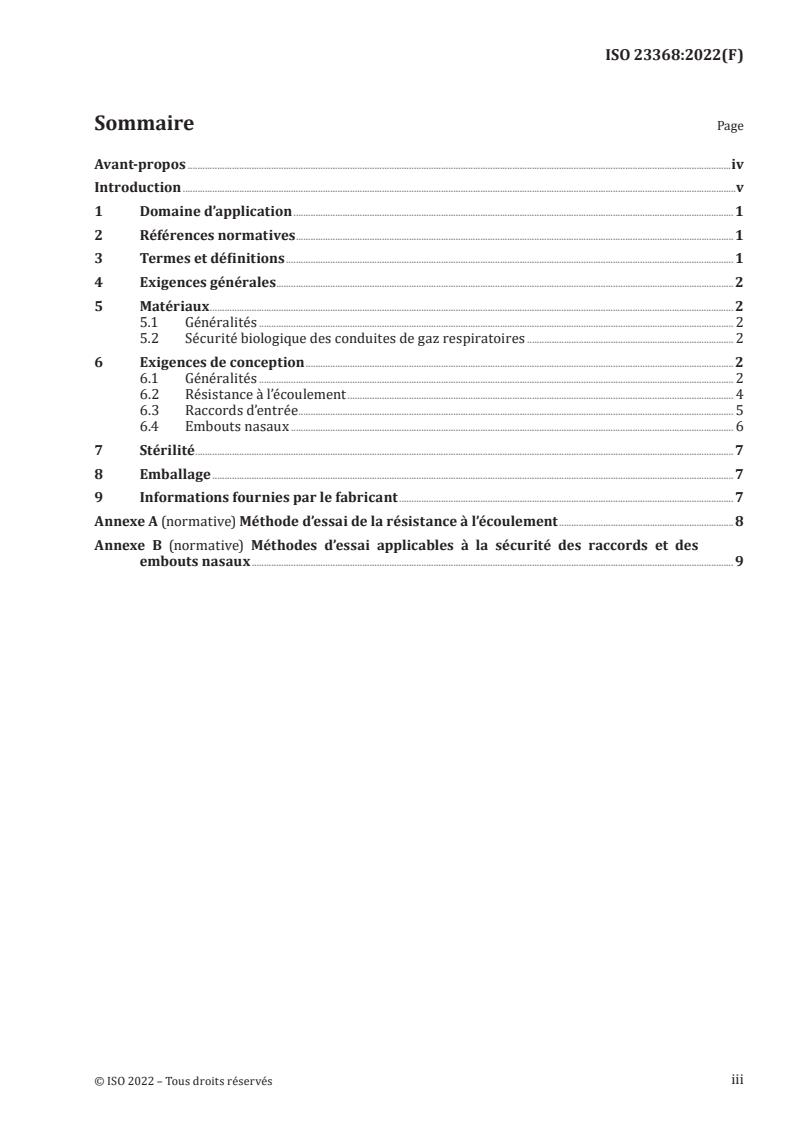
Sommaire Page
Avant-propos .iv
Introduction .v
1 Domaine d’application . 1
2 Références normatives .1
3 Termes et définitions . 1
4 Exigences générales . .2
5 Matériaux . 2
5.1 Généralités . 2
5.2 Sécurité biologique des conduites de gaz respiratoires . 2
6 Exigences de conception .2
6.1 Généralités . 2
6.2 Résistance à l’écoulement . 4
6.3 Raccords d’entrée . 5
6.4 Embouts nasaux . 6
7 Stérilité . . 7
8 Emballage . 7
9 Informations fournies par le fabricant . 7
Annexe A (normative) Méthode d’essai de la résistance à l’écoulement . 8
Annexe B (normative) Méthodes d’essai applicables à la sécurité des raccords et des
embouts nasaux . 9
iii
Avant-propos
L'ISO (Organisation internationale de normalisation) est une fédération mondiale d'organismes
nationaux de normalisation (comités membres de l'ISO). L'élaboration des Normes internationales est
en général confiée aux comités techniques de l'ISO. Chaque comité membre intéressé par une étude
a le droit de faire partie du comité technique créé à cet effet. Les organisations internationales,
gouvernementales et non gouvernementales, en liaison avec l'ISO participent également aux travaux.
L'ISO collabore étroitement avec la Commission électrotechnique internationale (IEC) en ce qui
concerne la normalisation électrotechnique.
Les procédures utilisées pour élaborer le présent document et celles destinées à sa mise à jour sont
décrites dans les Directives ISO/IEC, Partie 1. Il convient, en particulier, de prendre note des différents
critères d'approbation requis pour les différents types de documents ISO. Le présent document a
été rédigé conformément aux règles de rédaction données dans les Directives ISO/IEC, Partie 2 (voir
www.iso.org/directives).
L'attention est attirée sur le fait que certains des éléments du présent document peuvent faire l'objet de
droits de propriété intellectuelle ou de droits analogues. L'ISO ne saurait être tenue pour responsable
de ne pas avoir identifié de tels droits de propriété et averti de leur existence. Les détails concernant
les références aux droits de propriété intellectuelle ou autres droits analogues identifiés lors de
l'élaboration du document sont indiqués dans l'Introduction et/ou dans la liste des déclarations de
brevets reçues par l'ISO (voir www.iso.org/brevets).
Les appellations commerciales éventuellement mentionnées dans le présent document sont données
pour information, par souci de commodité, à l’intention des utilisateurs et ne sauraient constituer un
engagement.
Pour une explication de la nature volontaire des normes, la signification des termes et expressions
spécifiques de l'ISO liés à l'évaluation de la conformité, ou pour toute information au sujet de l'adhésion
de l'ISO aux principes de l’Organisation mondiale du commerce (OMC) concernant les obstacles
techniques au commerce (OTC), voir www.iso.org/avant-propos.
Le présent document a été élaboré par le comité technique ISO/TC 121, Matériel d’anesthésie et de
réanimation respiratoire, sous-comité SC 2, Canules et équipement connexe, en collaboration avec le comité
technique CEN/TC 215, Équipement respiratoire et anesthésique, du Comité européen de normalisation
(CEN) conformément à l’Accord de coopération technique entre l’ISO et le CEN (Accord de Vienne).
Il convient que l’utilisateur adresse tout retour d’information ou toute question concernant le présent
document à l’organisme national de normalisation de son pays. Une liste exhaustive desdits organismes
se trouve à l’adresse www.iso.org/fr/members.html.
iv
Introduction
Les canules nasales à faible débit sont utilisées pour acheminer l’oxygène directement dans les voies
nasales du patient par le biais d’embouts nasaux pendant une oxygénothérapie.
Plusieurs pays ont introduit un dispositif de coupure de l’oxygène activé par le feu utilisable avec des
systèmes d’oxygénothérapie, notamment dans les environnements de soins à domicile, qui empêche la
propagation de l’incendie dans la tubulure si elle venait à prendre feu. Il est recommandé d’installer ces
dispositifs de coupure le plus près possible du patient.
v
NORME INTERNATIONALE ISO 23368:2022(F)
Matériel d'anesthésie et d'assistance respiratoire —
Canules nasales à faible débit pour oxygénothérapie
1 Domaine d’application
Le présent document spécifie les exigences applicables aux canules nasales à faible débit utilisées dans
les environnements de soins à domicile et dans les environnements hospitaliers pour l’oxygénothérapie.
Le présent document n’inclut pas d’exigences de prévention de la propagation de l’incendie dans la
tubulure mais spécifie un raccordement détachable par l’utilisateur qui peut être utilisé pour fixer un
dispositif de coupure de l’oxygène activé par un incendie.
2 Références normatives
Les documents suivants sont cités dans le texte de sorte qu’ils constituent, pour tout ou partie de leur
contenu, des exigences du présent document. Pour les références datées, seule l’édition citée s’applique.
Pour les références non datées, la dernière édition du document de référence s'applique (y compris les
éventuels amendements).
ISO 4135, Matériel d'anesthésie et de réanimation respiratoire — Vocabulaire
ISO 18190:2016, Matériel d'anesthésie et de réanimation respiratoire — Exigences générales pour canules
et équipement connexe
ISO 18562-1, Évaluation de la biocompatibilité des voies de gaz respiratoires dans les applications de soins
de santé — Partie 1: Évaluation et essais au sein d'un processus de gestion du risque
1)
ISO 80369-2, Raccords de petite taille pour liquides et gaz utilisés dans le domaine de la santé — Partie 2 :
Raccords destinés à des applications respiratoires
3 Termes et définitions
Pour les besoins du présent document, les termes et les définitions de l’ISO 4135 et l’ISO 18190 ainsi que
les suivants s’appliquent.
L’ISO et l’IEC tiennent à jour des bases de données terminologiques destinées à être utilisées en
normalisation, consultables aux adresses suivantes:
— ISO Online browsing platform: disponible à l’adresse https:// www .iso .org/ obp
— IEC Electropedia: disponible à l’adresse https:// www .electropedia .org/
3.1
raccord d’entrée
raccordement sur la canule nasale à faible débit (3.3) qui se raccorde à la sortie du dispositif
d’alimentation en oxygène ou à la sortie de la tubulure de thérapie
3.2
canule nasale intégrée
canule nasale à faible débit (3.3) et tubulure de thérapie sans raccords détachables par l’utilisateur entre
le raccord d’entrée (3.1) et les embouts nasaux
1) En cours d’élaboration. S
...
기사 제목: ISO 23368:2022 - 마취 및 호흡 장비 - 산소 요법용 저류유 성인유들 기사 내용: 이 문서는 산소 요법을 위해 홈케어와 병원 환경에서 사용되는 저류유 성인용 저류유 성인유들에 대한 요구 사항을 명시합니다. 이 문서는 관 튜빙 내에서의 화재 번식을 방지하기 위한 요건을 포함하지 않지만, 불에 반응하여 산소 공급을 차단하는 장치를 부착할 수 있는 사용자 분리형 연결을 명시합니다.
The article discusses ISO 23368:2022, a standard that outlines the requirements for low-flow nasal cannulae used in oxygen therapy. The standard applies to both home care and hospital settings. It specifies the need for a user-detachable connection that allows for the attachment of a fire-activated oxygen shut-off device. However, it does not include requirements to prevent the spread of fire within the tubing.
기사 제목: ISO 23368:2022 - 마취 및 호흡 기자재 - 산소 치료용 저유량 비강 캐뉼라 기사 내용: 이 문서는 산소 치료를 위해 가정에서나 병원에서 사용되는 저유량 비강 캐뉼라에 대한 요구 사항을 명시합니다. 이 문서에는 관로 내에서 불의 번식을 방지하기 위한 요구 사항은 포함되어 있지 않으며, 그러나 불에 반응하여 산소 공급을 차단하는 장치를 부착할 수 있는 사용자 분리형 연결을 명시합니다.
ISO 23368:2022 is a document that outlines the requirements for low-flow nasal cannulae used in oxygen therapy, both at home and in hospitals. It does not cover requirements for fire prevention in the tubing, but it does specify a user-detachable connection that can be used to attach a fire-activated oxygen shut-off device.
記事のタイトル:ISO 23368:2022 - 麻酔と呼吸器機器 - 酸素療法用の低流量鼻カニューラ 記事の内容:この文書は、酸素療法に使用される低流量鼻カニューラの要件を、ホームケアおよび病院の環境の両方で指定しています。この文書では、チューブ内での火災の増殖を防ぐ要件は含まれていませんが、火災が発生した時に酸素供給を停止する機器を取り付けるための使用者可分離接続を明示しています。
記事のタイトル:ISO 23368:2022 - 麻酔および呼吸器器具-酸素療法用の低流量鼻カニューレ 記事内容:この文書は、酸素療法に使用される低流量鼻カニューレの要件について、家庭や病院の環境で使用されるものを規定しています。ただし、チューブ内での火災の拡大を防止するための要件は含まれておらず、火災に反応して酸素供給を遮断する装置を取り付けるためのユーザーが取り外し可能な接続を具体化しています。
Questions, Comments and Discussion
Ask us and Technical Secretary will try to provide an answer. You can facilitate discussion about the standard in here.
Loading comments...