


ISO/IEC 15444-2:2004
(Main)Information technology — JPEG 2000 image coding system: Extensions — Part 2:
Information technology — JPEG 2000 image coding system: Extensions — Part 2:
ISO/IEC 15444-2:2004 defines a set of lossless (bit-preserving) and lossy compression methods for coding continuous-tone, bi-level, grey-scale, colour digital still images, or multi-component images. ISO/IEC 15444-2:2004: specifies extended decoding processes for converting compressed image data to reconstructed image data; specifies an extended codestream syntax containing information for interpreting the compressed image data; specifies an extended file format; specifies a container to store image metadata; defines a standard set of image metadata; provides guidance on extended encoding processes for converting source image data to compressed image data; provides guidance on how to implement these processes in practice.
Technologies de l'information — Système de codage d'images JPEG 2000: Extensions — Partie 2:
L'ISO/CEI 15444-2:2004 | UIT-T Rec. T.801 définit un ensemble de méthodes de compression sans perte (au bit près) et avec perte pour le codage d'images numériques fixes ou d'images à composantes multiples (en deux tons), à modelé continu de gris ou de couleurs. L'ISO/CEI 15444-2:2004 | UIT-T Rec. T.801 contient: la spécification des processus de décodage étendus permettant de convertir des données d'image comprimées en données d'image reconstituées; la spécification d'une syntaxe de flux codé étendue contenant des informations permettant d'interpréter les données d'image comprimées; la spécification d'un format de fichier étendu; la spécification d'un conteneur permettant d'emmagasiner des métadonnées d'image; la définition d'un ensemble normalisé de métadonnées d'image; des directives relatives aux processus de codage étendus permettant de convertir des données d'image source en données d'image comprimées; des directives concernant la façon d'implémenter ces processus dans la pratique.
General Information
- Status
- Withdrawn
- Publication Date
- 17-May-2004
- Current Stage
- 9599 - Withdrawal of International Standard
- Start Date
- 12-Nov-2021
- Completion Date
- 14-Feb-2026
Relations
- Effective Date
- 06-Jun-2022
- Effective Date
- 06-Jun-2022
- Effective Date
- 06-Jun-2022
- Revised
ISO/IEC 15444-2:2021 - Information technology — JPEG 2000 image coding system — Part 2: Extensions - Effective Date
- 06-Jun-2022
- Effective Date
- 28-Dec-2008
- Effective Date
- 15-Apr-2008
- Effective Date
- 15-Apr-2008
Buy Documents
ISO/IEC 15444-2:2004 - Information technology -- JPEG 2000 image coding system: Extensions


ISO/IEC 15444-2:2004 - Information technology -- JPEG 2000 image coding system: Extensions


ISO/IEC 15444-2:2004 - Technologies de l'information -- Systeme de codage d'images JPEG 2000: Extensions
ISO/IEC 15444-2:2004 - Technologies de l'information -- Systeme de codage d'images JPEG 2000: Extensions
Get Certified
Connect with accredited certification bodies for this standard

BSI Group
BSI (British Standards Institution) is the business standards company that helps organizations make excellence a habit.

NYCE
Mexican standards and certification body.
Sponsored listings
Frequently Asked Questions
ISO/IEC 15444-2:2004 is a standard published by the International Organization for Standardization (ISO). Its full title is "Information technology — JPEG 2000 image coding system: Extensions — Part 2:". This standard covers: ISO/IEC 15444-2:2004 defines a set of lossless (bit-preserving) and lossy compression methods for coding continuous-tone, bi-level, grey-scale, colour digital still images, or multi-component images. ISO/IEC 15444-2:2004: specifies extended decoding processes for converting compressed image data to reconstructed image data; specifies an extended codestream syntax containing information for interpreting the compressed image data; specifies an extended file format; specifies a container to store image metadata; defines a standard set of image metadata; provides guidance on extended encoding processes for converting source image data to compressed image data; provides guidance on how to implement these processes in practice.
ISO/IEC 15444-2:2004 defines a set of lossless (bit-preserving) and lossy compression methods for coding continuous-tone, bi-level, grey-scale, colour digital still images, or multi-component images. ISO/IEC 15444-2:2004: specifies extended decoding processes for converting compressed image data to reconstructed image data; specifies an extended codestream syntax containing information for interpreting the compressed image data; specifies an extended file format; specifies a container to store image metadata; defines a standard set of image metadata; provides guidance on extended encoding processes for converting source image data to compressed image data; provides guidance on how to implement these processes in practice.
ISO/IEC 15444-2:2004 is classified under the following ICS (International Classification for Standards) categories: 35.040 - Information coding; 35.040.30 - Coding of graphical and photographical information. The ICS classification helps identify the subject area and facilitates finding related standards.
ISO/IEC 15444-2:2004 has the following relationships with other standards: It is inter standard links to ISO/IEC 15444-2:2004/Amd 2:2006, ISO/IEC 15444-2:2004/Amd 3:2015, ISO/IEC 15444-2:2004/Amd 4:2015, ISO/IEC 15444-2:2021, ISO/IEC 15444-2:2004/FDAmd 1; is excused to ISO/IEC 15444-2:2004/FDAmd 1, ISO/IEC 15444-2:2004/Amd 2:2006. Understanding these relationships helps ensure you are using the most current and applicable version of the standard.
ISO/IEC 15444-2:2004 is available in PDF format for immediate download after purchase. The document can be added to your cart and obtained through the secure checkout process. Digital delivery ensures instant access to the complete standard document.
Standards Content (Sample)
INTERNATIONAL ISO/IEC
STANDARD 15444-2
First edition
2004-05-15
Information technology — JPEG 2000
image coding system: Extensions
Technologies de l'information — Système de codage d'image
JPEG 2000: Extensions
Reference number
©
ISO/IEC 2004
PDF disclaimer
This PDF file may contain embedded typefaces. In accordance with Adobe's licensing policy, this file may be printed or viewed but
shall not be edited unless the typefaces which are embedded are licensed to and installed on the computer performing the editing. In
downloading this file, parties accept therein the responsibility of not infringing Adobe's licensing policy. The ISO Central Secretariat
accepts no liability in this area.
Adobe is a trademark of Adobe Systems Incorporated.
Details of the software products used to create this PDF file can be found in the General Info relative to the file; the PDF-creation
parameters were optimized for printing. Every care has been taken to ensure that the file is suitable for use by ISO member bodies. In
the unlikely event that a problem relating to it is found, please inform the Central Secretariat at the address given below.
© ISO/IEC 2004
All rights reserved. Unless otherwise specified, no part of this publication may be reproduced or utilized in any form or by any means,
electronic or mechanical, including photocopying and microfilm, without permission in writing from either ISO at the address below or
ISO's member body in the country of the requester.
ISO copyright office
Case postale 56 • CH-1211 Geneva 20
Tel. + 41 22 749 01 11
Fax + 41 22 749 09 47
E-mail copyright@iso.org
Web www.iso.org
Published in Switzerland
ii © ISO/IEC 2004 – All rights reserved
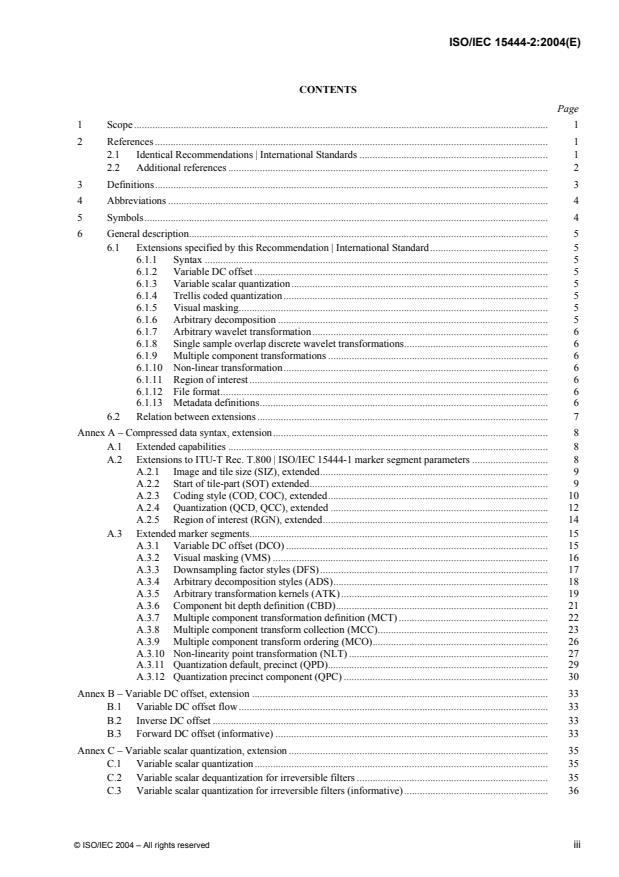
CONTENTS
Page
1 Scope. 1
2 References . 1
2.1 Identical Recommendations | International Standards . 1
2.2 Additional references . 2
3 Definitions. 3
4 Abbreviations . 4
5 Symbols. 4
6 General description. 5
6.1 Extensions specified by this Recommendation | International Standard. 5
6.1.1 Syntax. 5
6.1.2 Variable DC offset . 5
6.1.3 Variable scalar quantization. 5
6.1.4 Trellis coded quantization. 5
6.1.5 Visual masking. 5
6.1.6 Arbitrary decomposition . 5
6.1.7 Arbitrary wavelet transformation. 6
6.1.8 Single sample overlap discrete wavelet transformations. 6
6.1.9 Multiple component transformations . 6
6.1.10 Non-linear transformation. 6
6.1.11 Region of interest. 6
6.1.12 File format. 6
6.1.13 Metadata definitions. 6
6.2 Relation between extensions . 7
Annex A – Compressed data syntax, extension. 8
A.1 Extended capabilities . 8
A.2 Extensions to ITU-T Rec. T.800 | ISO/IEC 15444-1 marker segment parameters . 8
A.2.1 Image and tile size (SIZ), extended. 9
A.2.2 Start of tile-part (SOT) extended. 9
A.2.3 Coding style (COD, COC), extended. 10
A.2.4 Quantization (QCD, QCC), extended . 12
A.2.5 Region of interest (RGN), extended. 14
A.3 Extended marker segments. 15
A.3.1 Variable DC offset (DCO) . 15
A.3.2 Visual masking (VMS) . 16
A.3.3 Downsampling factor styles (DFS). 17
A.3.4 Arbitrary decomposition styles (ADS). 18
A.3.5 Arbitrary transformation kernels (ATK) . 19
A.3.6 Component bit depth definition (CBD). 21
A.3.7 Multiple component transformation definition (MCT) . 22
A.3.8 Multiple component transform collection (MCC). 23
A.3.9 Multiple component transform ordering (MCO). 26
A.3.10 Non-linearity point transformation (NLT) . 27
A.3.11 Quantization default, precinct (QPD). 29
A.3.12 Quantization precinct component (QPC) . 30
Annex B – Variable DC offset, extension . 33
B.1 Variable DC offset flow . 33
B.2 Inverse DC offset . 33
B.3 Forward DC offset (informative) . 33
Annex C – Variable scalar quantization, extension . 35
C.1 Variable scalar quantization. 35
C.2 Variable scalar dequantization for irreversible filters . 35
C.3 Variable scalar quantization for irreversible filters (informative). 36
© ISO/IEC 2004 – All rights reserved iii
Page
Annex D – Trellis coded quantization extensions . 37
D.1 Introduction to TCQ. 37
D.2 Sequence definition. 39
D.3 Forward TCQ quantization (informative) . 39
D.4 Inverse quantization (normative) . 41
D.4.1 Full TCQ dequantization. 41
D.4.2 Approximate dequantization . 43
D.5 Lagrangian rate allocation (informative). 44
Annex E – Visual masking, extensions. 49
E.1 Introduction to visual masking (informative). 49
E.2 Point-wise extended non-linearity (informative). 49
E.3 Decoding with visual masking . 51
E.4 Encoding with visual masking (informative) . 52
E.5 Setting parameters (informative). 52
E.6 Compatibility with other technologies (informative) . 53
Annex F – Arbitrary decomposition of tile-components, extensions. 54
F.1 Wavelet sub-bands . 54
F.1.1 Tier 1: Number of decomposition levels. 54
F.1.2 Tier 2: Resolution formation. 54
F.1.3 Tier 3: Sub-level decompositions. 54
F.1.4 Tier 4: Horizontal and vertical splits to variable sub-level depths . 54
F.1.5 Complete sub-band notation . 55
F.1.6 HorOrient, VerOrient and PrimeOrient sub-band operators . 55
F.2 Equation, text and decomposition updates . 55
F.2.1 Updates to N LL references . 56
L
F.2.2 Context updates. 56
F.2.3 Extension to ITU.T Rec. T.800 | ISO/IEC 15444-1 Equation B-14. 56
F.2.4 Remaining updates. 57
F.2.5 Updates to decomposition structure . 61
F.3 Inverse discrete wavelet transformation for general decompositions. 66
F.3.1 Modified IDWT procedure. 67
F.3.2 Modified 2D_SR procedure . 68
F.3.3 Modified 2D_INTERLEAVE procedure . 69
F.4 Forward discrete wavelet transformation for general decompositions (informative). 73
F.4.1 Modified FDWT procedure. 73
F.4.2 Modified 2D_SD procedure. 74
F.4.3 Modified 2D_DEINTERLEAVE procedure. 75
Annex G – Whole-sample symmetric transformation of images, extensions . 80
G.1 Wavelet transformation parameters, definitions and normalizations . 80
G.2 Whole-sample symmetric (WS) wavelet transformations reconstruction. 80
G.2.1 Normalization of WS wavelet transformations . 80
G.2.2 One-dimensional sub-band reconstruction procedure for WS wavelet
transformations. 81
G.3 Whole-sample symmetric (WS) wavelet transformation decomposition (informative). 84
G.3.1 The 1D_SD_WS procedure (informative) . 84
G.3.2 The 1D_FILTD_WS one-dimensional decomposition procedure (informative) . 84
G.4 Examples of WS wavelet transformations (informative) . 86
G.4.1 Reversible WS wavelet transformations (WT_Typ = REV) (informative) . 86
G.4.2 Irreversible WS wavelet transformations (WT_Typ = IRR) (informative). 87
Annex H – Transformation of images using arbitrary wavelet transformations. 89
H.1 Wavelet transformation parameters and normalizations. 89
H.1.1 Normalization of ARB wavelet transformations. 89
H.1.2 Compatibility of ARB and WS wavelet transformations . 89
iv © ISO/IEC 2004 – All rights reserved
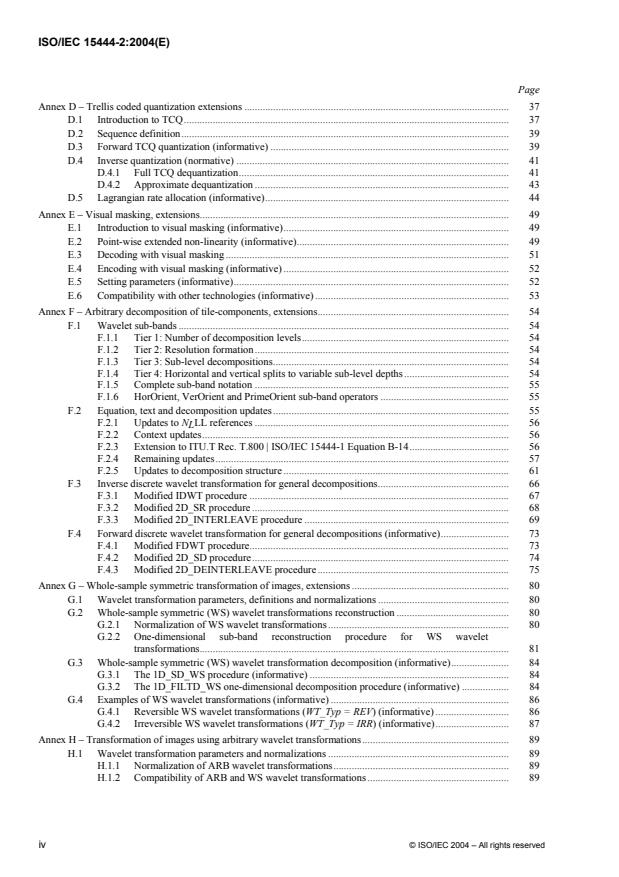
Page
H.2 Arbitrary (ARB) wavelet transformation reconstruction procedures . 90
H.2.1 The extended 1D_SR_ARB procedure . 90
H.2.2 The 1D_SCALER procedure . 91
H.2.3 The 1D_STEPR procedure. 92
H.2.4 Extension procedures . 92
H.2.5 One-dimensional reconstruction update filtering procedures. 94
H.3 Arbitrary (ARB) wavelet transformation decomposition procedures (informative) . 95
H.3.1 Extended 1D_SD_ARB procedure (informative) . 95
H.3.2 The 1D_STEPD procedure (informative) . 96
H.3.3 Extension procedures (informative) . 97
H.3.4 One-dimensional decomposition update procedures (informative). 97
H.3.5 1D_SCALED procedure (informative) . 98
H.4 Examples of ARB wavelet transformations (informative) . 99
H.4.1 Examples of arbitrary wavelet transformations (Filt_Cat = ARB) (informative) . 99
H.4.2 Example of a structure for lifting implementation of half-sample symmetric wavelet
transformations (informative). 101
Annex I – Single sample overlap discrete wavelet transform, extensions . 103
I.1 Introduction to single sample overlapping . 103
I.2 The code-block anchor points (CBAP) extension . 103
I.2.1 Division of resolution levels in precincts. 103
I.2.2 Division of the sub-bands into codeblocks. 104
I.2.3 Resolution level-position-component-layer progression. 105
I.2.4 Position-component-resolution level-layer progression. 106
I.2.5 Component-position-resolution level-layer progression . 106
I.3 The SSO extension. 107
I.3.1 Single sample overlap inverse discrete wavelet transformation (SSO-IDWT) . 107
I.3.2 Single sample overlap forward discrete wavelet transformation (informative) . 110
I.3.3 Selection of single sample overlap parameters (informative) . 112
I.3.4 SSO examples (informative). 113
I.4 The TSSO extension . 115
I.4.1 Signalling for the TSSO. 115
I.4.2 Partitioning of the image into single-sample overlapping tiles . 115
I.4.3 Reconstruction of images samples from reconstructed tiles . 116
I.5 Combining the SSO and TSSO extensions (informative) . 116
Annex J – Multiple component transformations, extension. 117
J.1 Introduction to multiple component transformation concepts. 117
J.2 Overview of inverse processing . 117
J.2.1 Inverse multiple component transformation (MCO_TRANSFORM). 118
J.2.2 Multiple component transformation stage (MCC_TRANS). 119
J.2.3 Transformation component collection (CC_TRANS). 121
J.3 Transformations . 123
J.3.1 Array-based transforms. 124
J.3.2 Wavelet-based transformation. 132
Annex K – Non-linear transformation . 134
K.1 Signallng the use of the non-linear transformations. 134
K.1.1 Decoded component reconstruction. 134
K.1.2 Bit depth and interaction with the multiple component transformation . 134
K.1.3 Marker interpretation. 135
K.2 Non-linear transformation specifications . 135
K.2.1 Gamma-style non-linearity. 135
K.2.2 LUT-style reverse non-linearity transformation. 137
Annex L – Region of interest coding and extraction, extensions. 139
L.1 Decoding of ROI. 139
L.2 Description of the Scaling based method . 139
L.2.1 Encoding with ROI (informative) . 139
© ISO/IEC 2004 – All rights reserved v
Page
L.3 Region of interest mask generation. 140
L.3.1 Rectangular mask generation on the reference grid . 141
L.3.2 Elliptic mask generation on the reference grid. 141
L.3.3 Region of Interest mask generation of whole-sample symmetric filter banks . 142
L.3.4 Region of Interest mask generation of arbitrary optional filter banks. 142
L.3.5 Fast generation of a rectangular mask (informative). 143
L.4 Remarks on region of interest coding. 145
L.4.1 Usage together with Maxshift method described in ITU-T T.800 | ISO/IEC 15444-1 . 145
L.4.2 Multi-component remark (informative). 145
L.4.3 Implementation Precision remark (informative) . 145
Annex M – JPX extended file format syntax. 146
M.1 File format scope. 146
M.2 Introduction to JPX . 146
M.2.1 File identification . 146
M.2.2 File organization . 146
M.2.3 Greyscale/Colour/multi-component specification. 147
M.2.4 Specification of opacity information. 147
M.2.5 Metadata . 147
M.2.6 Storage of a codestream within JPX . 147
M.2.7 Combining multiple codestreams. 147
M.3 Greyscale/Colour/Palette/multi-component specification architecture. 148
M.3.1 Extensions to the Colour Specification box header. 148
M.3.2 Extensions to the Enumerated method . 148
M.3.3 Any ICC method . 148
M.3.4 Vendor Colour method. 148
M.3.5 Palettized colour. 149
M.3.6 Using multiple methods . 149
M.3.7 Interactions with the decorrelating multiple component transformation. 149
M.4 Fragmenting the codestream between one or more files . 149
M.5 Combining multiple codestreams. 151
M.5.1 Mapping codestreams to compositing layers. 151
M.5.2 Sharing header and metadata information between codestreams and compositing
layers . 152
M.5.3 Composition. 152
M.6 Using reader requirements masks to determine how a file can be used . 154
M.6.1 Types of expressions. 155
M.6.2 Expression representation . 155
M.6.3 Testing an Implementation against Requirements Expressions. 160
M.7 Extensions to the JPX file format and the registration of extensions . 161
M.7.1 Registration elements. 161
M.7.2 Differentiation between publication and registration . 162
M.7.3 Items which can be extended by registration. 162
M.7.4 Published items . 164
M.7.5 Registration process . 165
M.7.6 Timeframes for the registration process. 165
M.8 Differences from the JP2 binary definition . 165
M.9 Conformance. 166
M.9.1 Interpretation of JPX data structures. 166
M.9.2 Support for JPX feature set . 166
M.10 Key to graphical descriptions (informative). 168
M.11 Defined boxes . 168
M.11.1 Reader Requirements box . 171
M.11.2 Data Reference box. 174
M.11.3 Fragment Table box (superbox) . 174
M.11.4 Cross-Reference box . 175
M.11.5 JP2 Header box (superbox) . 176
M.11.6 Codestream Header box (superbox). 178
M.11.7 Compositing Layer Header box (superbox). 179
M.11.8 Contiguous Codestream box . 190
M.11.9 Media Data box. 191
vi © ISO/IEC 2004 – All rights reserved
Page
M.11.10 Composition box (superbox). 191
M.11.11 Association box (superbox). 194
M.11.12 Number List box . 196
M.11.13 Label box . 197
M.11.14 Binary Filter box . 197
M.11.15 Desired Reproductions box (superbox). 198
M.11.16 ROI Description box . 199
M.11.17 Digital Signature box . 200
M.11.18 XML box . 202
M.11.19 MPEG-7 Binary box . 203
M.11.20 Free box . 203
M.12 Dealing with unknown boxes. 203
M.13 Using the JPX file format in conjunction with other multi-media standards (informative) . 203
Annex N – JPX file format extended metadata definition and syntax. 204
N.1 Introduction to extended metadata . 204
N.2 Additional references for extended metadata. 204
N.3 Scope of metadata definitions . 204
N.3.1 Image Creation metadata. 205
N.3.2 Content Description metadata . 205
N.3.3 History metadata . 205
N.3.4 Intellectual Property Rights metadata . 205
N.3.5 Fundamental metadata types and elements. 205
N.4 Metadata syntax . 205
N.4.1 Metadata schema definition language . 205
N.4.2 Namespace. 205
N.4.3 Document type definition information. 206
N.4.4 XML Schema information . 206
N.5 Defined boxes . 206
N.5.1 Image Creation metadata box. 206
N.5.2 Content Description metadata box . 207
N.5.3 History box. 207
N.5.4 Intellectual Property Rights box. 208
N.5.5 Image Identifier box. 208
N.6 Metadata definitions. 208
N.6.1 Image Creation metadata. 209
N.6.2 Content Description metadata . 220
N.6.3 History metadata . 226
N.6.4 Intellectual Property Rights metadata . 229
N.6.5 Image Identifier metadata . 236
N.7 Fundamental type and element definitions. 237
N.7.1 Defined types . 237
N.7.2 Defined attributes. 254
N.7.3 Defined elements. 255
N.8 JPX extended metadata document type definition . 255
N.9 JPX extended metadata XML Schema. 265
Annex O – Examples and guidelines, extensions . 281
O.1 Arbitrary decomposition examples . 281
O.2 Odd Tile Low Pass First (OTLPF) convention . 303
O.2.1 Example one (even tile sizes). 304
O.2.2 Example two (odd tile sizes) . 304
O.2.3 Example three (TSSO/OTLPF). 304
O.3 Multiple component collection example . 305
O.3.1 Array-based multiple component transform example . 305
O.3.2 Unitary decorrelation transformation factorization and reversible decorrelation
transformation . 311
O.3.3 Dependency transformation, irreversible and reversible. 315
O.4 Background to enhancement of quantization . 317
© ISO/IEC 2004 – All rights reserved vii
Page
Bibliography . 317
Index . 319
Patent statement. 321
viii © ISO/IEC 2004 – All rights reserved
Foreword
ISO (the International Organization for Standardization) and IEC (the International Electrotechnical
Commission) form the specialized system for worldwide standardization. National bodies that are members of
ISO or IEC participate in the development of International Standards through technical committees
established by the respective organization to deal with particular fields of technical activity. ISO and IEC
technical committees collaborate in fields of mutual interest. Other international organizations, governmental
and non-governmental, in liaison with ISO and IEC, also take part in the work. In the field of information
technology, ISO and IEC have established a joint technical committee, ISO/IEC JTC 1.
International Standards are drafted in accordance with the rules given in the ISO/IEC Directives, Part 2.
The main task of the joint technical committee is to prepare International Standards. Draft International
Standards adopted by the joint technical committee are circulated to national bodies for voting. Publication as
an International Standard requires approval by at least 75 % of the national bodies casting a vote.
Attention is drawn to the possibility that some of the elements of this document may be the subject of patent
rights. ISO and IEC shall not be held responsible for identifying any or all such patent rights.
technology, Subcommittee SC 29, Coding of audio, picture, multimedia and hypermedia information, in
collaboration with ITU-T. The identical text is published as ITU-T Rec. T.801.
ISO/IEC 15444 consists of the following parts, under the general title Information technology — JPEG 2000
image coding system:
Part 1: Core coding system
Part 2: Extensions
Part 3: Motion JPEG 2000
Part 4: Conformance testing
Part 5: Reference software
Part 6: Compound image file format
Part 9: Interactivity tools, APIs and protocols
Part 12: ISO base media file format
The following parts are under preparation:
Part 8: Secure JPEG 2000
Part 10: Extensions for theree-dimensional data and floating point data
Part 11: Wireless JPEG 2000
© ISO/IEC 2004 – All rights reserved ix
ISO/IEC 15444-2:2004 (E)
INTERNATIONAL STANDARD
ITU-T RECOMMENDATION
Information technology – JPEG 2000 image coding system: Extensions
1 Scope
This Recommendation | International Standard defines a set of lossless (bit-preserving) and lossy compression methods
for coding continuous-tone, bi-level, grey-scale, colour digital still images, or multi-component images.
This Recommendation | International Standard:
– specifies extended decoding processes for converting compressed image data to reconstructed image
data;
– specifies an extended codestream syntax containing information for interpreting the compressed image
data;
– specifies an extended file format;
– specifies a container to store image metadata;
– defines a standard set of image metadata;
– provides guidance on extended encoding processes for converting source image data to compressed
image data;
– provides guidance on how to implement these processes in practice.
2 References
The following Recommendations and International Standards contain provisions which, through reference in this text,
constitute provisions of this Recommendation | International Standard. At the time of publication, the editions indicated
were valid. All Recommendations and Standards are subject to revision, and parties to agreements based on this
Recommendation | International Standard are encouraged to investigate the possibility of applying the most recent
edition of the Recommendations and Standards listed below. Members of IEC and ISO maintain registers of currently
valid International Standards. The Telecommunication Standardization Bureau of the ITU maintains a list of currently
valid ITU-T Recommendations.
2.1 Identical Recommendations | International Standards
– ITU-T Recommendation T.81 (1992) | ISO/IEC 10918-1:1994, Information technology – Digital
compression and coding of continuous-tone still images: Requirements and guidelines.
– ITU-T Recommendation T.82 (1993) | ISO/IEC 11544:1993, Information technology – Coded
representation of picture and audio information – Progressive bi-level image compression
...
INTERNATIONAL ISO/IEC
STANDARD 15444-2
First edition
2004-05-15
Information technology — JPEG 2000
image coding system: Extensions
Technologies de l'information — Système de codage d'image
JPEG 2000: Extensions
Reference number
©
ISO/IEC 2004
PDF disclaimer
This PDF file may contain embedded typefaces. In accordance with Adobe's licensing policy, this file may be printed or viewed but
shall not be edited unless the typefaces which are embedded are licensed to and installed on the computer performing the editing. In
downloading this file, parties accept therein the responsibility of not infringing Adobe's licensing policy. The ISO Central Secretariat
accepts no liability in this area.
Adobe is a trademark of Adobe Systems Incorporated.
Details of the software products used to create this PDF file can be found in the General Info relative to the file; the PDF-creation
parameters were optimized for printing. Every care has been taken to ensure that the file is suitable for use by ISO member bodies. In
the unlikely event that a problem relating to it is found, please inform the Central Secretariat at the address given below.
This CD-ROM contains the publication ISO/IEC 15444-2:2004(E) in portable document format (PDF), which
can be viewed using Adobe® Acrobat® Reader.
Adobe and Acrobat are trademarks of Adobe Systems Incorporated.
© ISO/IEC 2004
All rights reserved. Unless otherwise specified, no par
...
NORME ISO/CEI
INTERNATIONALE 15444-2
Première édition
2004-05-15
Technologies de l'information — Système
de codage d'images JPEG 2000:
Extensions
Information technology — JPEG 2000 image coding system:
Extensions
Numéro de référence
ISO/CEI 15444-2:2004(F)
©
ISO/CEI 2004
ISO/CEI 15444-2:2004(F)
PDF – Exonération de responsabilité
Le présent fichier PDF peut contenir des polices de caractères intégrées. Conformément aux conditions de licence d'Adobe, ce fichier
peut être imprimé ou visualisé, mais ne doit pas être modifié à moins que l'ordinateur employé à cet effet ne bénéficie d'une licence
autorisant l'utilisation de ces polices et que celles-ci y soient installées. Lors du téléchargement de ce fichier, les parties concernées
acceptent de fait la responsabilité de ne pas enfreindre les conditions de licence d'Adobe. Le Secrétariat central de l'ISO décline toute
responsabilité en la matière.
Adobe est une marque déposée d'Adobe Systems Incorporated.
Les détails relatifs aux produits logiciels utilisés pour la création du présent fichier PDF sont disponibles dans la rubrique General Info
du fichier; les paramètres de création PDF ont été optimisés pour l'impression. Toutes les mesures ont été prises pour garantir
l'exploitation de ce fichier par les comités membres de l'ISO. Dans le cas peu probable où surviendrait un problème d'utilisation,
veuillez en informer le Secrétariat central à l'adresse donnée ci-dessous.
Le présent CD-ROM contient la publication ISO/CEI 15444-2:2004 au format PDF (portable document
format), qui peut être visualisée en utilisant Adobe® Acrobat® Reader.
Adobe et Acrobat sont des marques déposées de Adobe Systems Incorporated.
© ISO/CEI 2004
Tous droits réservés. Sauf prescription di
...
NORME ISO/CEI
INTERNATIONALE 15444-2
Première édition
2004-05-15
Technologies de l'information — Système
de codage d'image JPEG 2000:
Extensions
Information technology — JPEG 2000 image coding system:
Extensions
Numéro de référence
ISO/CEI 15444-2:2004(F)
©
ISO/CEI 2004
ISO/CEI 15444-2:2004(F)
PDF – Exonération de responsabilité
Le présent fichier PDF peut contenir des polices de caractères intégrées. Conformément aux conditions de licence d'Adobe, ce fichier
peut être imprimé ou visualisé, mais ne doit pas être modifié à moins que l'ordinateur employé à cet effet ne bénéficie d'une licence
autorisant l'utilisation de ces polices et que celles-ci y soient installées. Lors du téléchargement de ce fichier, les parties concernées
acceptent de fait la responsabilité de ne pas enfreindre les conditions de licence d'Adobe. Le Secrétariat central de l'ISO décline toute
responsabilité en la matière.
Adobe est une marque déposée d'Adobe Systems Incorporated.
Les détails relatifs aux produits logiciels utilisés pour la création du présent fichier PDF sont disponibles dans la rubrique General Info
du fichier; les paramètres de création PDF ont été optimisés pour l'impression. Toutes les mesures ont été prises pour garantir
l'exploitation de ce fichier par les comités membres de l'ISO. Dans le cas peu probable où surviendrait un problème d'utilisation,
veuillez en informer le Secrétariat central à l'adresse donnée ci-dessous.
© ISO/CEI 2004
Droits de reproduction réservés. Sauf prescription différente, aucune partie de cette publication ne peut être reproduite ni utilisée sous
quelque forme que ce soit et par aucun procédé, électronique ou mécanique, y compris la photocopie et les microfilms, sans l'accord écrit
de l'ISO à l'adresse ci-après ou du comité membre de l'ISO dans le pays du demandeur.
ISO copyright office
Case postale 56 • CH-1211 Geneva 20
Tel. + 41 22 749 01 11
Fax. + 41 22 749 09 47
E-mail copyright@iso.org
Web www.iso.org
Version française parue en 2005
Publié en Suisse
ii © ISO/CEI 2004 – Tous droits réservés
ISO/CEI 15444-2:2004(F)
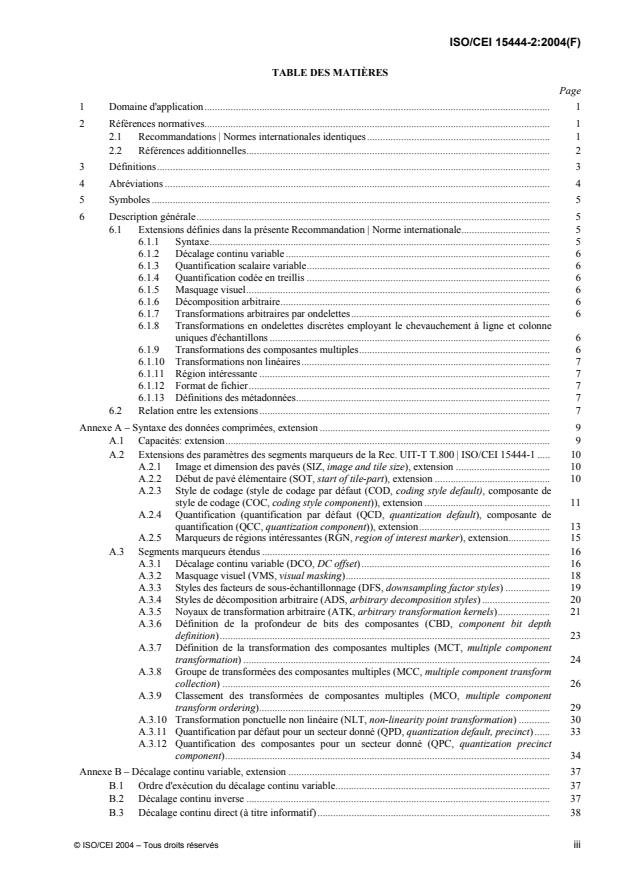
TABLE DES MATIÈRES
Page
1 Domaine d'application. 1
2 Références normatives. 1
2.1 Recommandations | Normes internationales identiques. 1
2.2 Références additionnelles. 2
3 Définitions. 3
4 Abréviations . 4
5 Symboles . 5
6 Description générale. 5
6.1 Extensions définies dans la présente Recommandation | Norme internationale. 5
6.1.1 Syntaxe. 5
6.1.2 Décalage continu variable. 6
6.1.3 Quantification scalaire variable. 6
6.1.4 Quantification codée en treillis . 6
6.1.5 Masquage visuel. 6
6.1.6 Décomposition arbitraire. 6
6.1.7 Transformations arbitraires par ondelettes . 6
6.1.8 Transformations en ondelettes discrètes employant le chevauchement à ligne et colonne
uniques d'échantillons . 6
6.1.9 Transformations des composantes multiples. 6
6.1.10 Transformations non linéaires. 7
6.1.11 Région intéressante . 7
6.1.12 Format de fichier. 7
6.1.13 Définitions des métadonnées. 7
6.2 Relation entre les extensions. 7
Annexe A – Syntaxe des données comprimées, extension . 9
A.1 Capacités: extension. 9
A.2 Extensions des paramètres des segments marqueurs de la Rec. UIT-T T.800 | ISO/CEI 15444-1 . 10
A.2.1 Image et dimension des pavés (SIZ, image and tile size), extension . 10
A.2.2 Début de pavé élémentaire (SOT, start of tile-part), extension . 10
A.2.3 Style de codage (style de codage par défaut (COD, coding style default), composante de
style de codage (COC, coding style component)), extension . 11
A.2.4 Quantification (quantification par défaut (QCD, quantization default), composante de
quantification (QCC, quantization component)), extension. 13
A.2.5 Marqueurs de régions intéressantes (RGN, region of interest marker), extension. 15
A.3 Segments marqueurs étendus . 16
A.3.1 Décalage continu variable (DCO, DC offset). 16
A.3.2 Masquage visuel (VMS, visual masking). 18
A.3.3 Styles des facteurs de sous-échantillonnage (DFS, downsampling factor styles). 19
A.3.4 Styles de décomposition arbitraire (ADS, arbitrary decomposition styles). 20
A.3.5 Noyaux de transformation arbitraire (ATK, arbitrary transformation kernels). 21
A.3.6 Définition de la profondeur de bits des composantes (CBD, component bit depth
definition). 23
A.3.7 Définition de la transformation des composantes multiples (MCT, multiple component
transformation). 24
A.3.8 Groupe de transformées des composantes multiples (MCC, multiple component transform
collection) . 26
A.3.9 Classement des transformées de composantes multiples (MCO, multiple component
transform ordering). 29
A.3.10 Transformation ponctuelle non linéaire (NLT, non-linearity point transformation). 30
A.3.11 Quantification par défaut pour un secteur donné (QPD, quantization default, precinct). 33
A.3.12 Quantification des composantes pour un secteur donné (QPC, quantization precinct
component). 34
Annexe B – Décalage continu variable, extension . 37
B.1 Ordre d'exécution du décalage continu variable. 37
B.2 Décalage continu inverse . 37
B.3 Décalage continu direct (à titre informatif). 38
© ISO/CEI 2004 – Tous droits réservés iii
ISO/CEI 15444-2:2004(F)
Page
Annexe C – Quantification scalaire variable, extension . 39
C.1 Quantification scalaire variable. 39
C.2 Déquantification scalaire variable pour les filtres irréversibles . 39
C.3 Quantification scalaire variable pour filtres irréversibles (à titre informatif). 40
Annexe D – Quantification codée en treillis, extensions . 41
D.1 Introduction à la quantification TCQ . 41
D.2 Définition de la suite . 43
D.3 Quantification TCQ directe (à titre informatif) . 43
D.4 Quantification inverse (à titre normatif). 45
D.4.1 Déquantification TCQ complète . 45
D.4.2 Déquantification approchée . 47
D.5 Allocation du débit de Lagrange (LRA) (à titre informatif). 48
Annexe E – Masquage visuel, extensions. 53
E.1 Introduction au masquage visuel (à titre informatif). 53
E.2 Non-linéarité étendue point par point (à titre informatif). 53
E.3 Décodage avec masquage visuel . 55
E.4 Codage avec masquage visuel (à titre informatif). 56
E.5 Réglage des paramètres (à titre informatif). 56
E.6 Compatibilité avec d'autres technologies (à titre informatif) . 57
Annexe F – Décomposition arbitraire des pavés composants, extensions. 58
F.1 Sous-bandes d'ondelettes. 58
F.1.1 Etage 1: nombre de niveaux de décomposition. 58
F.1.2 Etage 2: formation des résolutions. 58
F.1.3 Etage 3: décompositions en sous-niveaux. 58
F.1.4 Etage 4: séparations horizontale et verticale jusqu'à des profondeurs variables de
sous-niveaux. 58
F.1.5 Notation complète des sous-bandes . 59
F.1.6 Opérateurs de sous-bande HorOrient, VerOrient et PrimeOrient. 59
F.2 Mises à jour des équations, du texte et des décompositions. 60
F.2.1 Mises à jour des références à la sous-bande NLL. 60
L
F.2.2 Mises à jour des contextes. 60
F.2.3 Extension de l'équation B-14 de la Rec. UIT-T T.800 | ISO/CEI 15444-1 . 60
F.2.4 Autres mises à jour. 61
F.2.5 Mises à jour de la structure de décomposition . 65
F.3 Transformation inverse en ondelettes discrètes (IDWT, inverse discrete wavelet transformation)
pour décompositions générales . 70
F.3.1 Procédure IDWT modifiée. 71
F.3.2 Procédure 2D_SR modifiée. 72
F.3.3 Procédure 2D_INTERLEAVE modifiée. 73
F.4 Transformation directe en ondelettes discrètes (FDWT, forward discrete wavelet transformation)
pour les décompositions générales (à titre informatif) . 77
F.4.1 Procédure FDWT modifiée. 77
F.4.2 Procédure 2D_SD modifiée . 78
F.4.3 Procédure 2D_DEINTERLEAVE modifiée . 79
Annexe G – Transformation symétrique à échantillons entiers des images, extensions. 84
G.1 Paramètres, définitions et normalisations de la transformation en ondelettes. 84
G.2 Reconstruction symétrique en ondelettes à échantillons entiers (WS). 84
G.2.1 Normalisation des transformations WS par ondelettes . 84
G.2.2 Procédure de reconstruction unidimensionnelle en sous-bandes pour les transformations
WS en ondelettes. 85
G.3 Décomposition symétrique en ondelettes à échantillons entiers (WS) (à titre informatif). 87
G.3.1 Procédure 1D_SD_WS (à titre informatif). 87
G.3.2 Procédure de décomposition unidimensionnelle 1D_FILTD_WS (à titre informatif) . 88
G.4 Exemples de transformations symétriques en ondelettes à échantillons entiers (WS) (à titre
informatif) . 89
G.4.1 Transformations réversibles WS en ondelettes (WT_Typ = REV) (à titre informatif) . 89
G.4.2 Transformations irréversibles WS en ondelettes (WT_Typ = IRR) (à titre informatif) . 90
iv © ISO/CEI 2004 – Tous droits réservés
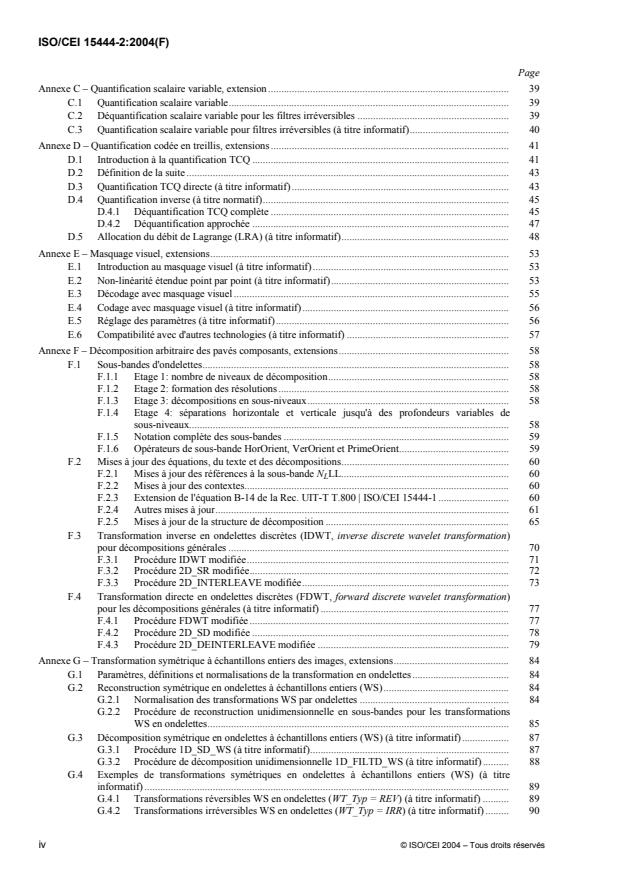
ISO/CEI 15444-2:2004(F)
Page
Annexe H – Transformation des images au moyen de transformations arbitraires en ondelettes. 93
H.1 Paramètres et normalisations des transformations en ondelettes. 93
H.1.1 Normalisation des transformations ARB en ondelettes. 93
H.1.2 Compatibilité des transformations ARB et WS en ondelettes. 93
H.2 Procédures de reconstruction arbitraire (ARB) en ondelettes . 94
H.2.1 Procédure étendue 1D_SR_ARB . 94
H.2.2 Procédure 1D_SCALER . 95
H.2.3 Procédure 1D_STEPR. 96
H.2.4 Procédures d'extension. 96
H.2.5 Procédures de filtrage de mise à jour destinées à la reconstruction unidimensionnelle . 98
H.3 Procédures de décomposition arbitraire (ARB) en ondelettes (à titre informatif). 99
H.3.1 Procédure étendue 1D_SD_ARB (à titre informatif) . 99
H.3.2 Procédure 1D_STEPD (à titre informatif). 100
H.3.3 Procédures d'extension (à titre informatif) . 101
H.3.4 Procédures de mise à jour de décomposition unidimensionnelle (à titre informatif) . 101
H.3.5 Procédure 1D_SCALED (à titre informatif) . 102
H.4 Exemples de transformations ARB en ondelettes (à titre informatif) . 103
H.4.1 Exemples de transformations arbitraires en ondelettes (Filt_Cat = ARB) (à titre
informatif) . 103
H.4.2 Exemple d'une structure d'implémentation du relèvement des transformations symétriques
en demi-échantillons en ondelettes (à titre informatif). 105
Annexe I – Transformations en ondelettes discrètes employant le chevauchement à ligne et colonne uniques
d'échantillons, extensions. 107
I.1 Introduction au chevauchement à ligne et colonne uniques d'échantillons . 107
I.2 Points d'ancrage des blocs codés (CBAP, code-block anchor point): extension. 107
I.2.1 Subdivision des niveaux de résolution en secteurs. 107
I.2.2 Subdivision des sous-bandes en blocs codés. 109
I.2.3 Progression niveau de résolution-position-composante-couche. 109
I.2.4 Progression position-composante-niveau de résolution-couche. 110
I.2.5 Progression composante-position-niveau de résolution-couche. 110
I.3 Chevauchement à ligne et colonne uniques d'échantillons (SSO, single sample overlap): extension. 111
I.3.1 Transformation inverse en ondelettes discrètes employant le chevauchement à ligne et
colonne uniques d'échantillons (SSO-IDWT) . 111
I.3.2 Transformation directe en ondelettes discrètes employant le chevauchement à ligne et
colonne uniques (à titre informatif). 115
I.3.3 Choix des paramètres relatifs au chevauchement à ligne et colonne uniques (à titre
informatif) . 117
I.3.4 Exemples de chevauchement SSO (à titre informatif) . 118
I.4 Chevauchement des pavés, à ligne et colonne uniques d'échantillons (TSSO, tile single sample
overlap): extension. 120
I.4.1 Indication du choix de l'extension TSSO . 120
I.4.2 Partition de l'image en pavés se recouvrant sur une ligne et colonne uniques d'échantillons 120
I.4.3 Reconstruction des échantillons d'image à partir des pavés reconstitués. 121
I.5 Combinaison des extensions SSO et TSSO (à titre informatif). 121
Annexe J – Transformations des composantes multiples, extension . 122
J.1 Introduction de la notion de transformation des composantes multiples. 122
J.2 Aperçu général du traitement inverse. 123
J.2.1 Transformation inverse en composantes multiples (MCO_TRANSFORM) . 123
J.2.2 Etape de transformation des composantes multiples (MCC_TRANS) . 125
J.2.3 Transformation d'un groupe de composantes (CC_TRANS). 126
J.3 Transformations . 129
J.3.1 Transformées fondées sur des matrices. 129
J.3.2 Transformation fondée sur des ondelettes. 139
Annexe K – Transformations non linéaires . 141
K.1 Indication de l'emploi des transformations non linéaires . 141
K.1.1 Reconstruction des composantes décodées . 141
K.1.2 Profondeur de bits et interaction avec la transformation des composantes multiples . 141
K.1.3 Interprétation du marqueur. 142
© ISO/CEI 2004 – Tous droits réservés v
ISO/CEI 15444-2:2004(F)
Page
K.2 Spécifications relatives aux transformations non linéaires. 142
K.2.1 Non-linéarité de style gamma . 142
K.2.2 Transformation non linéaire inverse de style table de recherche (LUT) . 144
Annexe L – Codage et extraction des régions intéressantes: extensions . 146
L.1 Décodage de la région intéressante . 146
L.2 Description de la méthode fondée sur une transformation d'échelle . 146
L.2.1 Codage au moyen d'une région ROI (à titre informatif). 147
L.3 Création du masque d'une région intéressante. 148
L.3.1 Création d'un masque rectangulaire sur la grille de référence. 148
L.3.2 Création d'un masque elliptique sur la grille de référence . 149
L.3.3 Création du masque d'une région intéressante pour des bancs de filtres symétriques à
échantillons entiers. 149
L.3.4 Création du masque d'une région intéressante pour des bancs de filtres facultatifs
arbitraires . 149
L.3.5 Création rapide d'un masque rectangulaire (à titre informatif). 150
L.4 Remarques concernant le codage des régions intéressantes. 152
L.4.1 Emploi concomitant de la méthode Maxshift décrite dans la Rec. UIT-T T.800 |
ISO/CEI 15444-1 . 152
L.4.2 Remarque concernant les composantes multiples (à titre informatif) . 152
L.4.3 Remarque relative à la précision de l'implémentation (à titre informatif). 152
Annexe M – Syntaxe du format de fichier étendu JPX. 153
M.1 Domaine d'application du format de fichier . 153
M.2 Introduction au format JPX. 153
M.2.1 Identificateur du fichier. 153
M.2.2 Organisation des fichiers. 154
M.2.3 Spécification de l'échelle des gris, des couleurs et des composantes multiples . 154
M.2.4 Spécification des informations relatives à l'opacité. 154
M.2.5 Métadonnées . 154
M.2.6 Stockage d'un flux codé dans le format JPX . 155
M.2.7 Regroupement de plusieurs flux codés. 155
M.3 Architecture des spécifications de l'échelle des gris, des couleurs, de la palette et des composantes
multiples. 155
M.3.1 Extensions de l'en-tête de la boîte de spécification des couleurs . 155
M.3.2 Extensions de la méthode d'énumération exhaustive . 155
M.3.3 Méthode ICC des profils quelconques . 156
M.3.4 Méthode des couleurs définies par les vendeurs . 156
M.3.5 Palette des couleurs. 156
M.3.6 Emploi de plusieurs méthodes. 156
M.3.7 Interactions avec la décorrélation en composantes multiples. 156
M.4 Fragmentation du flux codé en un ou plusieurs fichiers. 157
M.5 Regroupement de plusieurs flux codés. 159
M.5.1 Mappage des flux codés sur les couches de composition. 159
M.5.2 Partage des informations contenues dans les en-têtes et les métadonnées entre les flux
codés et les couches de composition . 160
M.5.3 Composition. 161
M.6 Emploi de masques pour les besoins du lecteur, permettant de déterminer comment un fichier peut
être employé. 163
M.6.1 Types d'expressions. 163
M.6.2 Représentation des expressions. 164
M.6.3 Essais d'une implémentation en ce qui concerne les expressions des besoins. 169
M.7 Extensions du format de fichier JPX et enregistrement des extensions . 170
M.7.1 Eléments participant à l'enregistrement. 171
M.7.2 Distinction entre la publication et l'enregistrement. 171
M.7.3 Eléments pouvant être étendus par enregistrement . 172
M.7.4 Eléments publiés . 173
M.7.5 Processus d'enregistrement. 175
M.7.6 Calendriers du processus d'enregistrement. 175
M.8 Différences avec la définition binaire JP2. 175
vi © ISO/CEI 2004 – Tous droits réservés
ISO/CEI 15444-2:2004(F)
Page
M.9 Conformité . 176
M.9.1 Interprétation des structures de données JPX. 176
M.9.2 Prise en charge de l'ensemble des caractéristiques JPX . 176
M.10 Explication des descriptions graphiques (à titre informatif). 178
M.11 Définition des boîtes . 179
M.11.1 Boîte besoins du lecteur . 182
M.11.2 Boîte références des données . 185
M.11.3 Boîte tableau des fragments (superboîte) . 185
M.11.4 Boîte de renvoi. 187
M.11.5 Boîte en-tête JP2 (superboîte) . 187
M.11.6 Boîte en-tête de flux codé (superboîte) . 190
M.11.7 Boîte en-tête de couche de composition (superboîte). 191
M.11.8 Boîte flux codé continu . 203
M.11.9 Boîte données médias. 203
M.11.10 Boîte de composition (superboîte) . 203
M.11.11 Boîte d'association (superboîte) . 207
M.11.12 Boîte liste des numéros . 209
M.11.13 Boîte étiquette . 210
M.11.14 Boîte filtre binaire . 210
M.11.15 Boîte reproductions souhaitées (superboîte) . 211
M.11.16 Boîte de description des régions ROI. 212
M.11.17 Boîte signature numérique . 213
M.11.18 Boîte XML. 215
M.11.19 Boîte binaire MPEG-7. 216
M.11.20 Boîte libre . 216
M.12 Traitement des boîtes inconnues . 216
M.13 Emploi du format de fichier JPX avec d'autres normes multimédias (à titre informatif) . 216
Annexe N – Définition et syntaxe des métadonnées étendues du format de fichier JPX . 217
N.1 Introduction aux métadonnées étendues. 217
N.2 Références additionnelles pour les métadonnées étendues . 217
N.3 Domaine d'application des métadonnées. 218
N.3.1 Métadonnées sur la création d'une image. 218
N.3.2 Métadonnées de description du contenu . 218
N.3.3 Métadonnées sur l'historique. 218
N.3.4 Métadonnées sur les droits de propriété intellectuelle . 218
N.3.5 Types et éléments fondamentaux des métadonnées . 218
N.4 Syntaxe des métadonnées. 218
N.4.1 Langage de définition du schéma des métadonnées. 218
N.4.2 Espace de noms. 219
N.4.3 Information relative à la définition du type de document . 219
N.4.4 Informations relatives au schéma XML . 219
N.5 Boîtes définies. 219
N.5.1 Boîte métadonnées sur la création d'une image. 219
N.5.2 Boîte métadonnées de description du contenu . 220
N.5.3 Boîte historique. 221
N.5.4 Boîte droits de propriété intellectuelle . 221
N.5.5 Boîte identificateur d'image . 222
N.6 Définitions des métadonnées. 222
N.6.1 Métadonnées sur la création d'une image. 222
N.6.2 Métadonnées de description du contenu . 234
N.6.3 Métadonnées sur l'historique. 240
N.6.4 Métadonnées sur les droits de propriété intellectuelle . 244
N.6.5 Métadonnées sur l'identificateur de l'image . 250
N.7 Définitions des types et des éléments fondamentaux . 251
N.7.1 Types définis. 251
N.7.2 Attributs définis. 269
N.7.3 Eléments définis. 269
N.8 Définition des types de document de métadonnées étendues JPX . 270
N.9 Schéma XML de métadonnées étendues JPX . 279
© ISO/CEI 2004 – Tous droits réservés vii
ISO/CEI 15444-2:2004(F)
Page
Annexe O – Exemples et directives, extensions . 296
O.1 Exemples de décomposition arbitraire . 296
O.2 Convention relative aux pavés de dimension impaire/coefficients passe-bas en premier (OTLPF,
odd tile low pass first). 318
O.2.1 Premier exemple (pavés de dimension paire). 319
O.2.2 Deuxième exemple (pavés de dimension impaire). 319
O.2.3 Troisième exemple (TSSO/OTLPF) . 319
O.3 Exemple de groupe de composantes multiples. 320
O.3.1 Exemple de transformation des composantes multiples fondées sur des matrices. 320
O.3.2 Factorisation unitaire de la décorrélation et décorrélation réversible. 327
O.3.3 Introduction d'une relation de dépendance irréversible et réversible . 331
O.4 Données concernant une quantification accrue . 333
Bibliographie . 334
Index . 335
Déclaration relative aux brevets . 337
viii © ISO/CEI 2004 – Tous droits réservés
ISO/CEI 15444-2:2004(F)
Avant-propos
L'ISO (Organisation internationale de normalisation) et la CEI (Commission électrotechnique internationale)
forment le système spécialisé de la normalisation mondiale. Les organismes nationaux membres de l'ISO ou
de la CEI participent au développement de Normes internationales par l'intermédiaire des comités techniques
créés par l'organisation concernée afin de s'occuper des domaines particuliers de l'activité technique. Les
comités techniques de l'ISO et de la CEI collaborent dans des domaines d'intérêt commun. D'autres
organisations internationales, gouvernementales et non gouvernementales, en liaison avec l'ISO et la CEI
participent également aux travaux. Dans le domaine des technologies de l'information, l'ISO et la CEI ont créé
un comité technique mixte, l'ISO/CEI JTC 1.
Les Normes internationales sont rédigées conformément aux règles données dans les Directives ISO/CEI,
Partie 2.
La tâche principale du comité technique mixte est d'élaborer les Normes internationales. Les projets de
Normes internationales adoptés par le comité technique mixte sont soumis aux organismes nationaux pour
vote. Leur publication comme Normes internationales requiert l'approbation de 75 % au moins des
organismes nationaux votants.
L'attention est appelée sur le fait que certains des éléments du présent document peuvent faire l'objet de
droits de propriété intellectuelle ou de droits analogues. L'ISO et la CEI ne sauraient être tenues pour
responsables de ne pas avoir identifié de tels droits de propriété et averti de leur existence.
La présente partie de l'ISO/CEI 15444 a été élaborée par le comité technique mixte ISO/CEI JTC 1,
Technologies de l'information, sous-comité SC 29, Codage du son, de l’image, de l’information multimédia et
hypermédia en collaboration avec l'UIT-T. Le texte identique est publié en tant que Rec. UIT-T T.801.
L’ISO/CEI 15444 comprend les parties suivantes, présentées sous le titre général Technologies de
l'information — Système de codage d’images JPEG 2000:
Partie 1: Système de codage noyau
Partie 2: Extensions
Partie 3: Motion JPEG 2000
Partie 4: Essais de conformité
Partie 5: Logiciel de référence
Partie 6: Format de fichier d'image de composant
Partie 9: Outils d'interactivité, API et protocoles
Partie 12: Format ISO de base pour les fichiers médias
La partie suivante est en cours d’élaboration:
Partie 8: JPEG 2000 sécurisé
© ISO/CEI 2004 – Tous droits réservés
ix
ISO/CEI 15444-2:2004 (F)
NORME INTERNATIONALE
RECOMMANDATION UIT-T
Technologies de l'information – Système de codage
d'images JPEG 2000: extensions
1 Domaine d'application
La prése
...
Questions, Comments and Discussion
Ask us and Technical Secretary will try to provide an answer. You can facilitate discussion about the standard in here.
Loading comments...