

ISO/IEC 10118-1:2016/Amd 1:2021
(Amendment)Information technology — Security techniques — Hash-functions — Part 1: General — Amendment 1: Padding methods for sponge functions
General Information
- Abstract
- Status
- Published
- Publication Date
- 08-Mar-2021
- Drafting Committee
- ISO/IEC JTC 1/SC 27/WG 2 - Cryptography and security mechanisms
- Current Stage
- 6060 - International Standard published
- Start Date
- 09-Mar-2021
- Due Date
- 11-Jun-2023
- Completion Date
- 09-Mar-2021

Overview
ISO/IEC 10118-1:2016/Amd 1:2021 is an important amendment to the international standard covering information technology security techniques related to hash functions. This amendment specifically addresses padding methods for sponge functions, a critical component in modern cryptographic hash algorithm design.
The document is part of the ISO/IEC 10118 series, developed by the Joint Technical Committee ISO/IEC JTC 1, Subcommittee SC 27, focusing on information security, cybersecurity, and privacy protection. This amendment enhances the general framework defined in Part 1 of the standard by introducing updates and clarifications on padding schemes applied to data input in sponge-based hash functions.
Key Topics
Padding Methods for Sponge Functions
The amendment introduces a new standardized padding method, Pad10*1, which improves the consistency and security of data processing in sponge constructions.- Pad10*1 starts with appending a single '1' bit to the data.
- Followed by appending the required number of '0' bits to align with the sponge function’s block length minus two bits.
- Finally, a single '1' bit is appended to complete the padding.
Purpose of Padding in Hash Functions
Padding ensures that data input conforms to the required block sizes of sponge constructions, preventing ambiguity in message lengths and collisions. It is a fundamental step for maintaining integrity and collision resistance in hash computations.Sponge Function Framework
Sponge functions are versatile cryptographic primitives used in hash algorithms such as SHA-3. The amendment’s focus on padding methods ensures interoperability and robustness in these implementations.
Applications
Cryptographic Hash Functions
This standard amendment is directly applicable to designing or implementing cryptographic hash functions based on sponge architectures. It is crucial for developers and researchers working on secure hash algorithms to incorporate Pad10*1 for proper padding.Data Integrity and Authentication
Padding methods defined here contribute to the security assurance of systems relying on hash functions for data authentication, digital signatures, and integrity verification.Cybersecurity and Privacy Protection
Organizations adopting ISO/IEC 10118-1 and its amendments can strengthen their information security frameworks by adhering to the latest cryptographic standards ensuring resistance against attacks that exploit padding vulnerabilities.Standard Compliance and Interoperability
Compliance with this amendment aids in achieving conformity with international standards, promoting confidence and trust in IT products across global markets.
Related Standards
ISO/IEC 10118-1:2016/Amd 1:2021 aligns with and complements several other international standards:
ISO/IEC 10118 Series
The broader series on cryptographic techniques related to hash functions, detailing different parts including abstract models, recommended algorithms, and test vectors.ISO/IEC 18033 Series
Standards outlining encryption methods that often work alongside hash functions in secure communication systems.ISO/IEC 27000 Series
Information security management systems standards that reference cryptographic controls like those detailed in ISO/IEC 10118-1.NIST FIPS 202
Though a national standard, it specifies SHA-3 functions which utilize sponge constructions, making this amendment relevant for international harmonization with NIST methods.
Adhering to ISO/IEC 10118-1:2016/Amd 1:2021 ensures that organizations implement secure and standardized padding methods for sponge-based hash functions, essential for modern cryptographic security, interoperability, and compliance in information technology environments. For detailed guidance and official documentation, users should consult the ISO website and authorized national standards bodies.
Relations
- Effective Date
- 18-Dec-2021
Get Certified
Connect with accredited certification bodies for this standard

BSI Group
BSI (British Standards Institution) is the business standards company that helps organizations make excellence a habit.

Bureau Veritas
Bureau Veritas is a world leader in laboratory testing, inspection and certification services.

DNV
DNV is an independent assurance and risk management provider.
Sponsored listings
Frequently Asked Questions
ISO/IEC 10118-1:2016/Amd 1:2021 is a standard published by the International Organization for Standardization (ISO). Its full title is "Information technology — Security techniques — Hash-functions — Part 1: General — Amendment 1: Padding methods for sponge functions". This standard covers: Information technology — Security techniques — Hash-functions — Part 1: General — Amendment 1: Padding methods for sponge functions
Information technology — Security techniques — Hash-functions — Part 1: General — Amendment 1: Padding methods for sponge functions
ISO/IEC 10118-1:2016/Amd 1:2021 is classified under the following ICS (International Classification for Standards) categories: 35.030 - IT Security. The ICS classification helps identify the subject area and facilitates finding related standards.
ISO/IEC 10118-1:2016/Amd 1:2021 has the following relationships with other standards: It is inter standard links to ISO/IEC 10118-1:2016. Understanding these relationships helps ensure you are using the most current and applicable version of the standard.
ISO/IEC 10118-1:2016/Amd 1:2021 is available in PDF format for immediate download after purchase. The document can be added to your cart and obtained through the secure checkout process. Digital delivery ensures instant access to the complete standard document.
Standards Content (Sample)
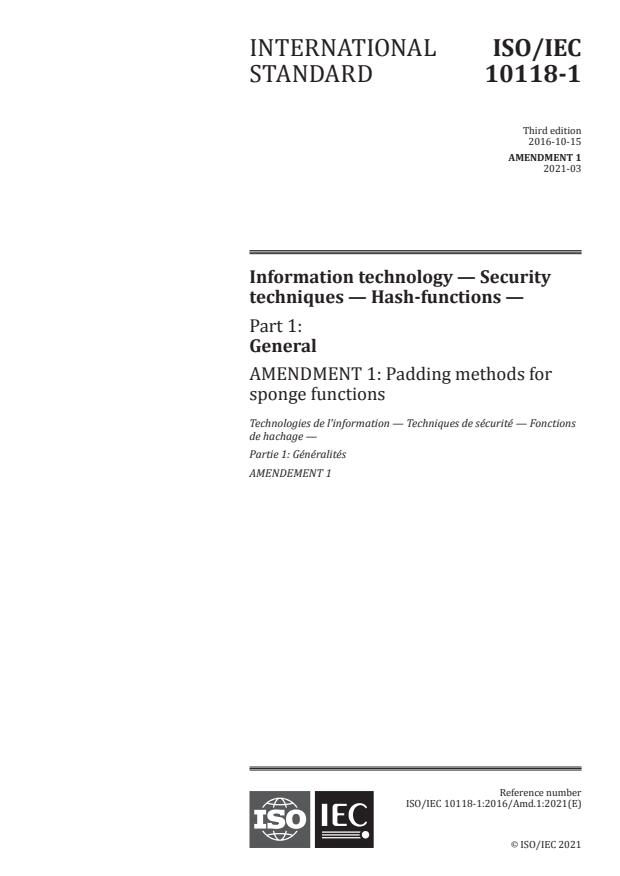
INTERNATIONAL ISO/IEC
STANDARD 10118-1
Third edition
2016-10-15
AMENDMENT 1
2021-03
Information technology — Security
techniques — Hash-functions —
Part 1:
General
AMENDMENT 1: Padding methods for
sponge functions
Technologies de l'information — Techniques de sécurité — Fonctions
de hachage —
Partie 1: Généralités
AMENDEMENT 1
Reference number
ISO/IEC 10118-1:2016/Amd.1:2021(E)
©
ISO/IEC 2021
ISO/IEC 10118-1:2016/Amd.1:2021(E)
© ISO/IEC 2021
All rights reserved. Unless otherwise specified, or required in the context of its implementation, no part of this publication may
be reproduced or utilized otherwise in any form or by any means, electronic or mechanical, including photocopying, or posting
on the internet or an intranet, without prior written permission. Permission can be requested from either ISO at the address
below or ISO’s member body in the country of the requester.
ISO copyright office
CP 401 • Ch. de Blandonnet 8
CH-1214 Vernier, Geneva
Phone: +41 22 749 01 11
Email: copyright@iso.org
Website: www.iso.org
Published in Switzerland
ii © ISO/IEC 2021 – All rights reserved
ISO/IEC 10118-1:2016/Amd.1:2021(E)
Foreword
ISO (the International Organization for Standardization) and IEC (the International Electrotechnical
Commission) form the specialized system for worldwide standardization. National bodies that
are members of ISO or IEC participate in the development of International Standards through
technical committees established by the respective organization to deal with particular fields of
technical activity. ISO and IEC technical committees collaborate in fields of mutual interest. Other
international organizations, governmental and non-governmental, in liaison with ISO and IEC, also
take part in the work.
The procedures used to develop this document and those intended for its further maintenance are
described in the ISO/IEC Directives, Part 1. In particular, the different approval criteria needed for
the different types of document should be noted. This document was drafted in accordance with the
editorial rules of the ISO/IEC Directives, Part 2 (see www .iso .org/ directives or www .iec .ch/ members
_experts/ refdocs).
Attention is drawn to the possibility that some of the elements of this document may be the subject
o
...