

ISO 3114:1977
(Main)Unplasticized polyvinyl chloride (PVC) pipes for potable water supply — Extractability of lead and tin — Test method
General Information
- Abstract
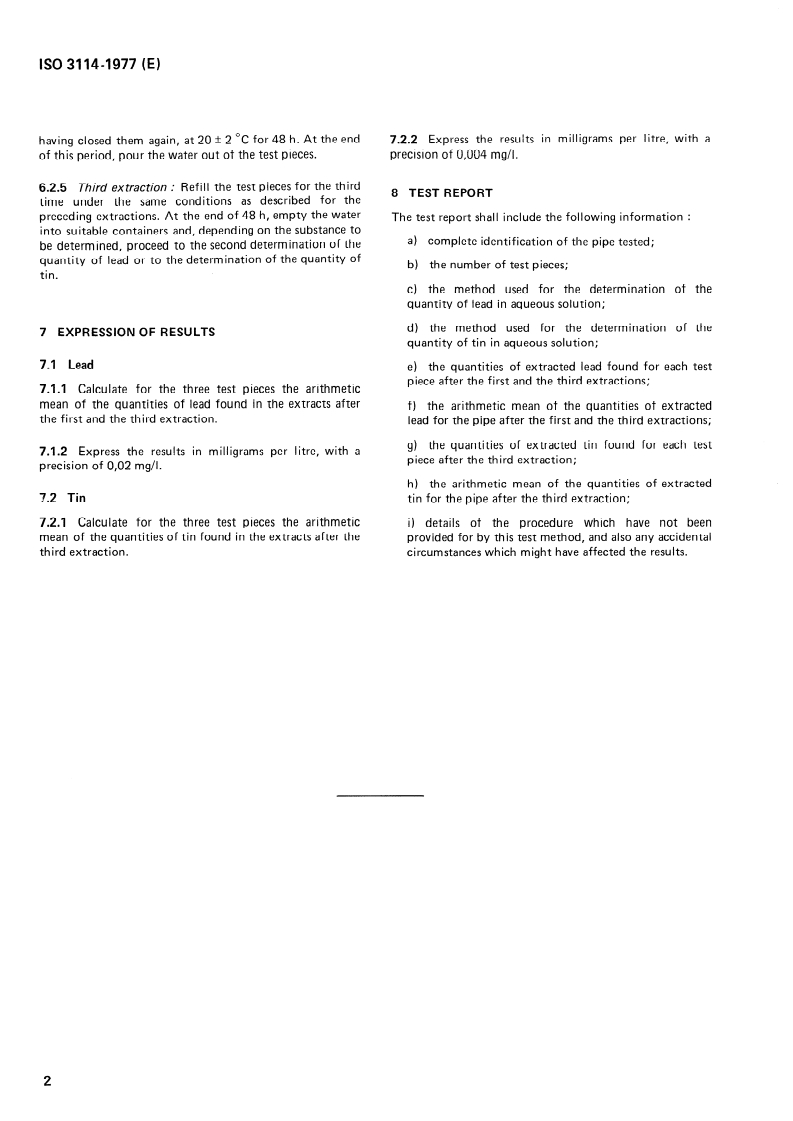
Specifies a method of test for the determination of the extractability of certain stabilizers of unplasticized PVC in order to verify that the extracted quantities do not exceed a certain concentration. Tubular test pieces are prewashed during a fixed time. After this they are extracted with acidified (CO2) water in three steps and the quantity of the extracted stabilizers (lead salts or organic derivates to tin) shall be determined. The analytic methods are not specified.
- Status
- Published
- Publication Date
- 28-Feb-1977
- Current Stage
- 9093 - International Standard confirmed
- Start Date
- 12-Jan-2023
- Completion Date
- 29-Aug-2026
Buy Documents

ISO 3114:1977 - Unplasticized polyvinyl chloride (PVC) pipes for potable water supply -- Extractability of lead and tin -- Test method
ISO 3114:1977 - Unplasticized polyvinyl chloride (PVC) pipes for potable water supply — Extractability of lead and tin — Test method/1/1977

ISO 3114:1977 - Tubes en polychlorure de vinyle (PVC) non plastifié pour l'alimentation en eau potable -- Extractibilité du plomb et de l'étain -- Méthode d'essai
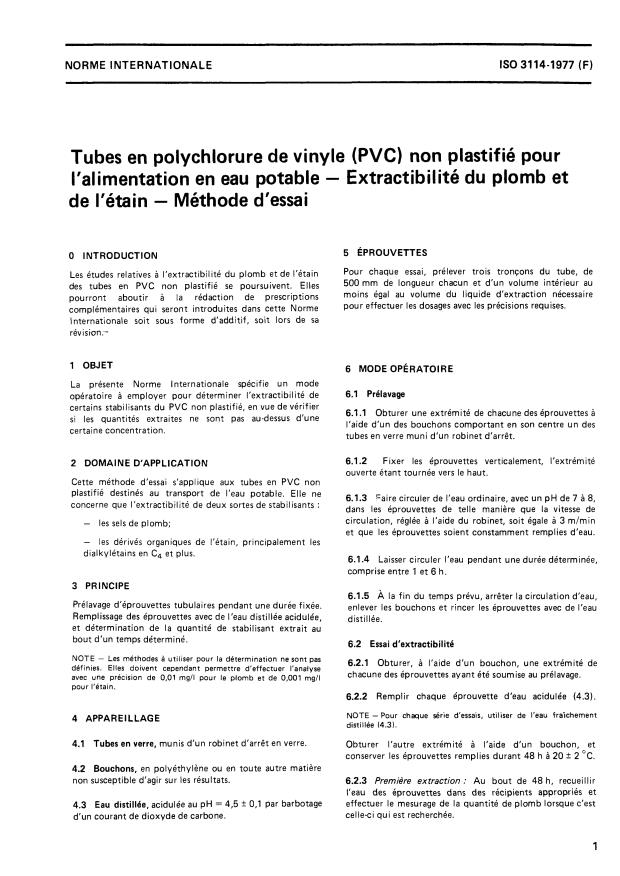

ISO 3114:1977 - Tubes en polychlorure de vinyle (PVC) non plastifié pour l'alimentation en eau potable -- Extractibilité du plomb et de l'étain -- Méthode d'essai
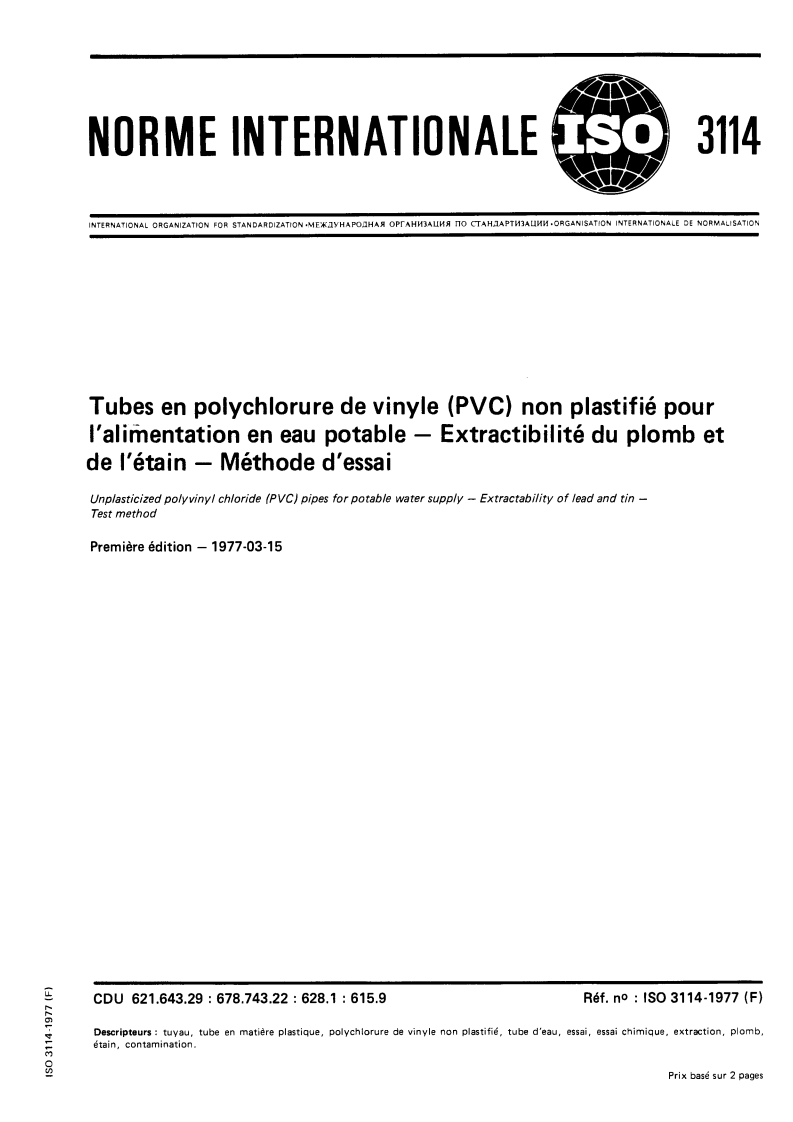
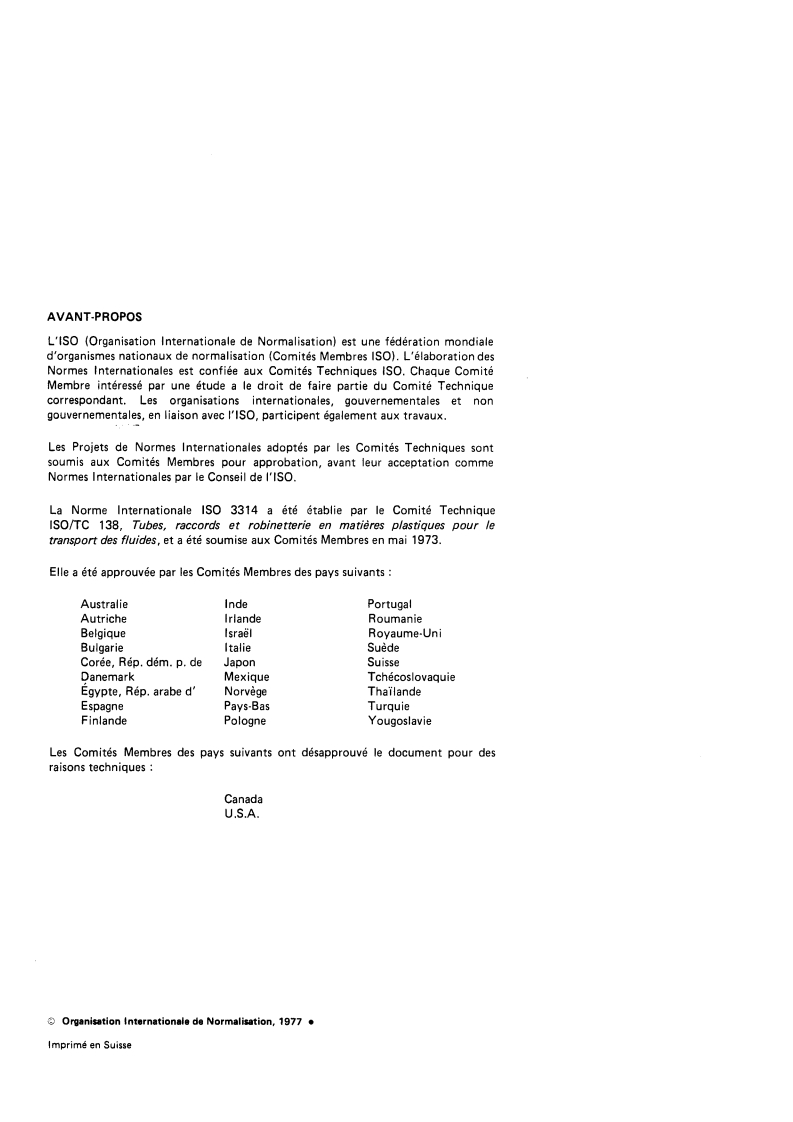
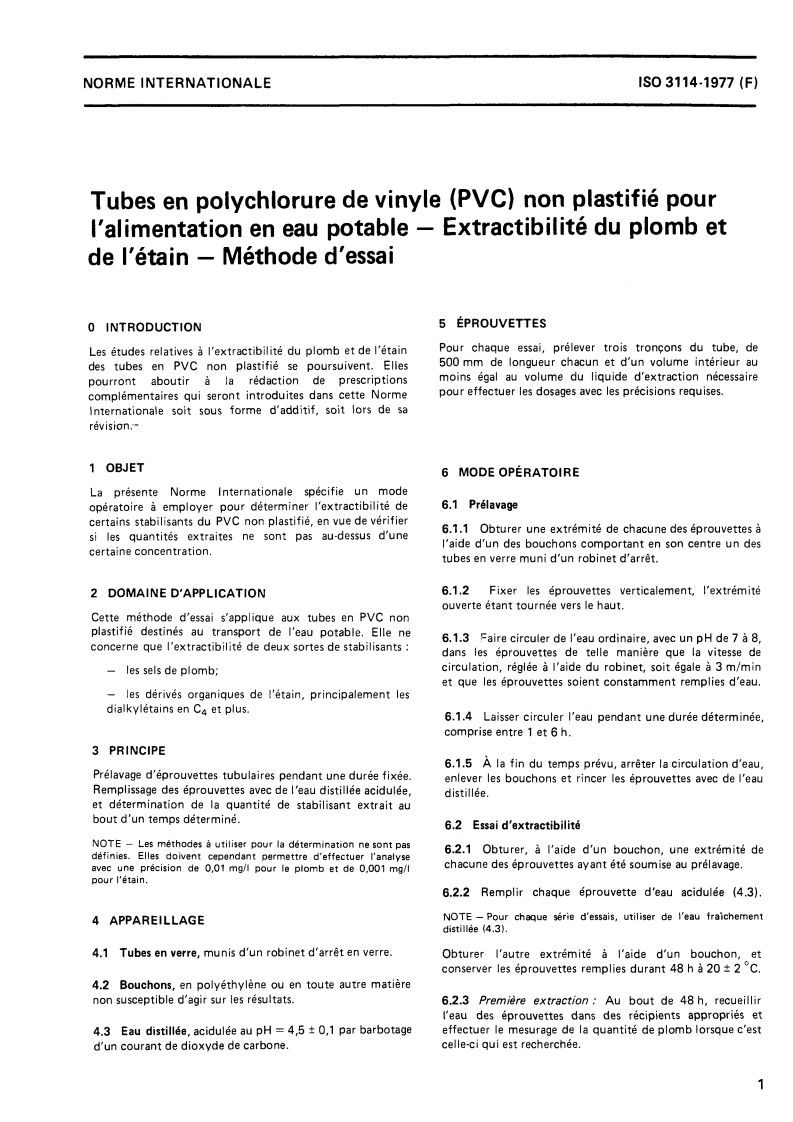
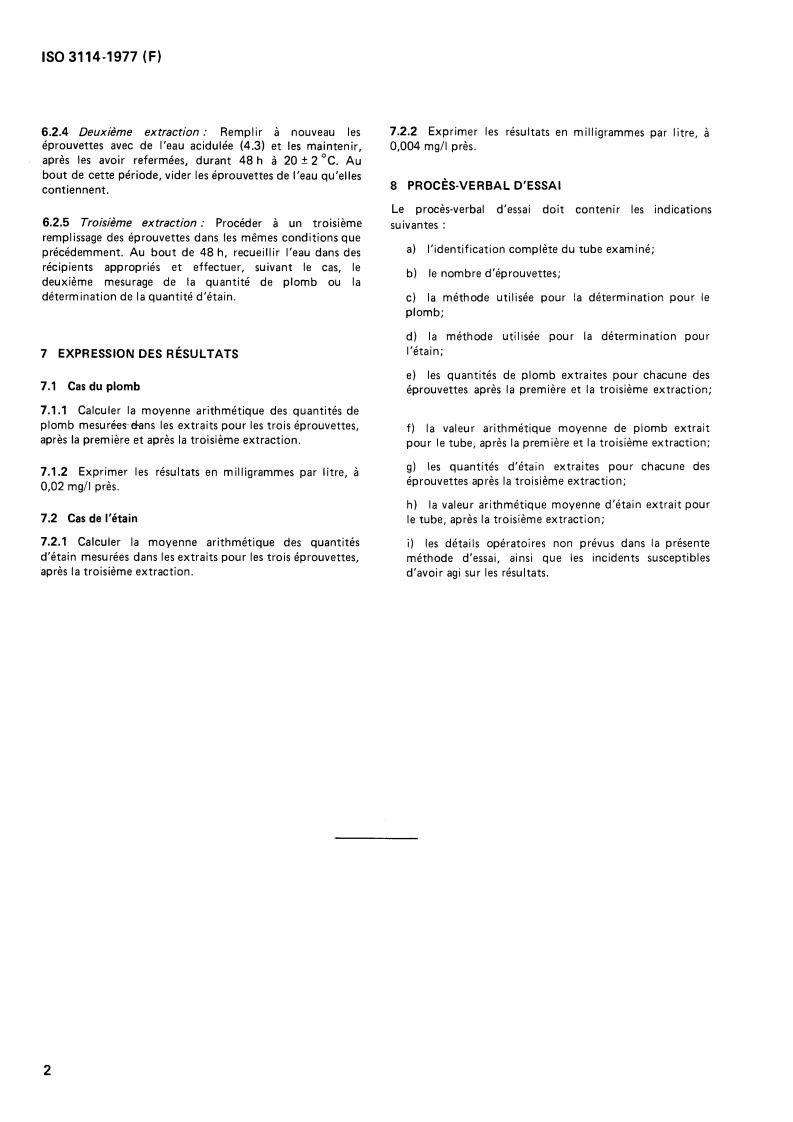
ISO 3114:1977 - Tubes en polychlorure de vinyle (PVC) non plastifié pour l'alimentation en eau potable — Extractibilité du plomb et de l'étain — Méthode d'essai/1/1977
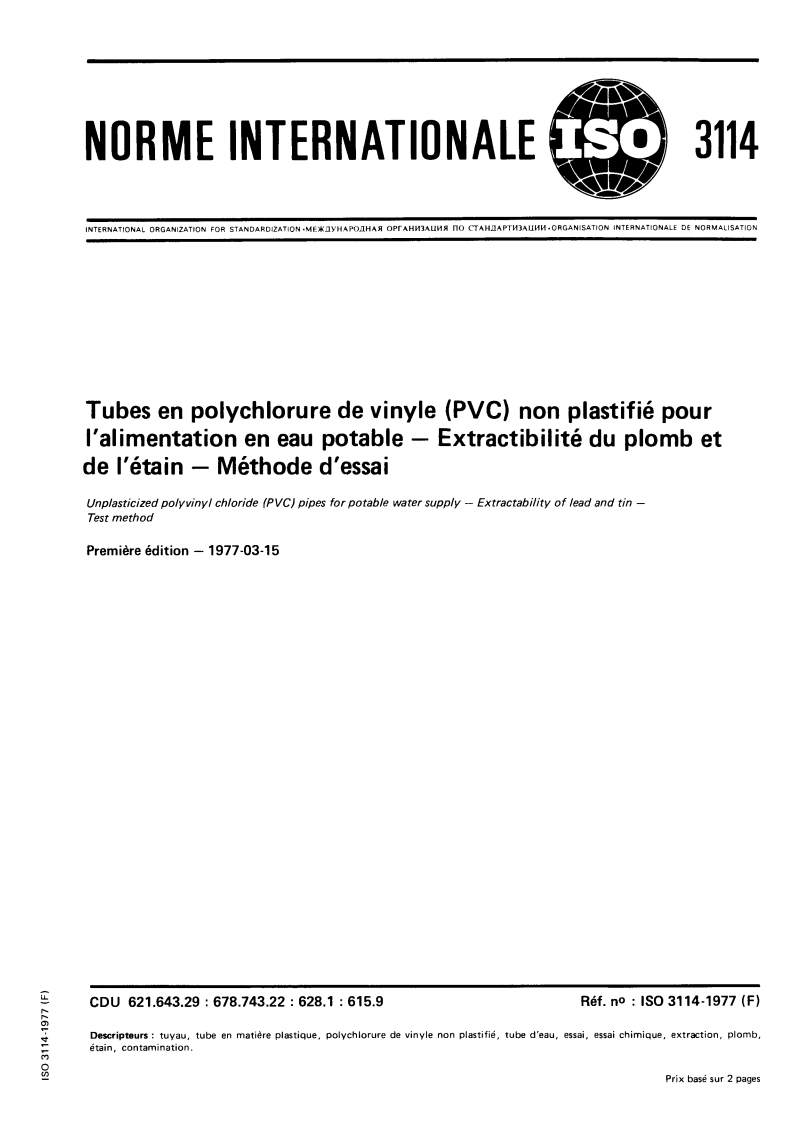
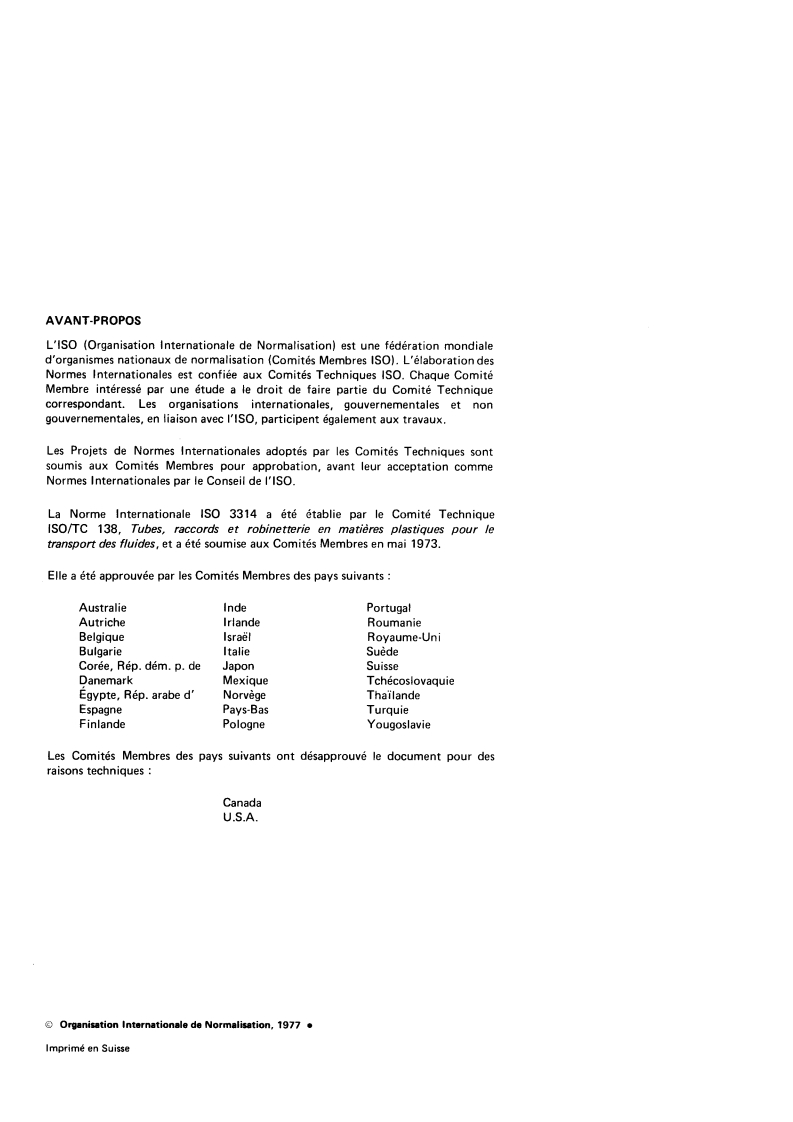
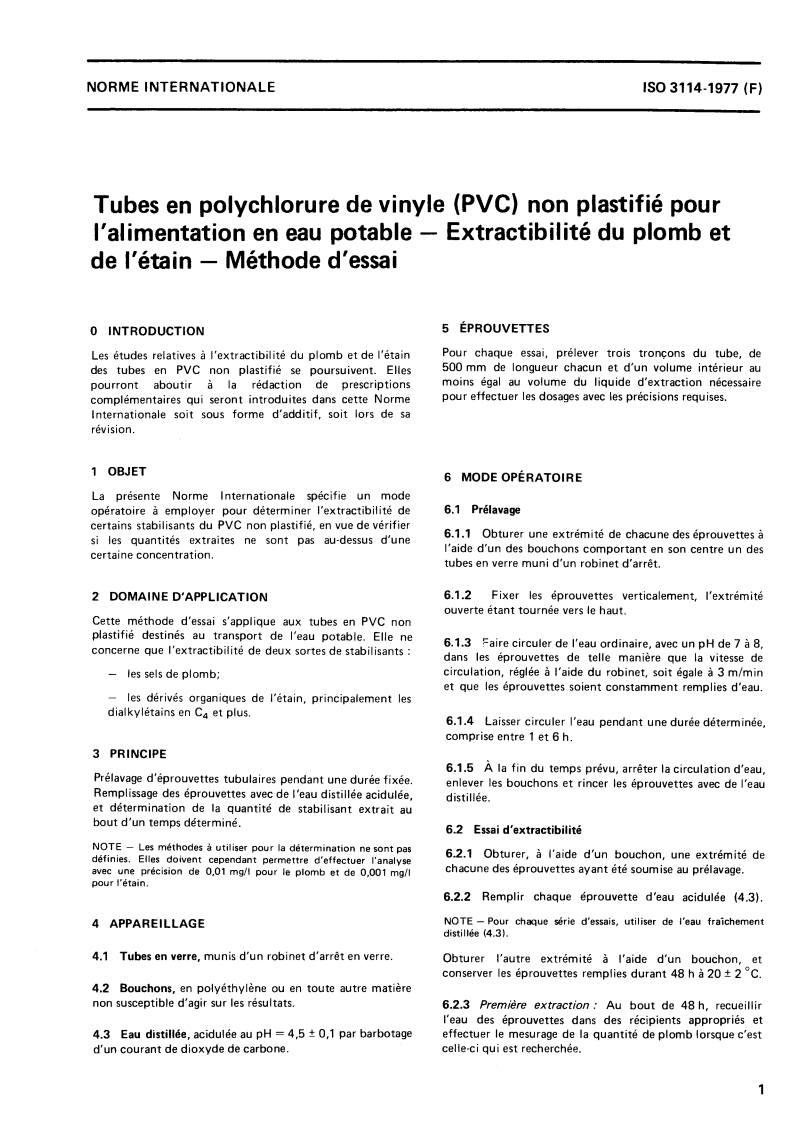
ISO 3114:1977 - Tubes en polychlorure de vinyle (PVC) non plastifié pour l'alimentation en eau potable — Extractibilité du plomb et de l'étain — Méthode d'essai/1/1977
Overview
ISO 3114:1977 specifies a standardized test method for the extractability of lead and tin stabilizers from unplasticized polyvinyl chloride (PVC) pipes intended for potable water supply. This International Standard focuses on verifying that the quantities of lead salts and organic tin derivatives-used as stabilizers in PVC pipes-do not exceed acceptable concentration limits during extraction. Accurate assessment of these substances ensures the safety and compliance of PVC water pipes with health regulations.
Key Topics
- Scope: Applies exclusively to unplasticized PVC pipes used for transporting drinking water. The test confirms the safety of lead and tin stabilizers.
- Test Principle: Tubular test pieces are pre-washed with tap water followed by three sequential extractions using acidified carbon dioxide-water. The quantity of lead and tin extracted is quantified to evaluate compliance.
- Test Procedure:
- Pre-washing with tap water at a flow rate of 3 m/min for 1 to 6 hours.
- Three extraction steps using acidified water (pH 4.5 ± 0.1), each lasting 48 hours at 20 ± 2 °C.
- Lead and tin concentrations are determined after each extraction.
- Test Specimens: Minimum three pipe sections, each 500 mm long, representing typical unplasticized PVC pipes.
- Analytical Precision: Required detection precision is 0.01 mg/L for lead and 0.001 mg/L for tin, although the exact chemical analysis methods are not defined within the standard.
- Reporting: Test reports must include detailed pipe identification, test piece count, extraction results for lead and tin, methods used for concentration determination, and any deviations or anomalies in test execution.
Applications
The ISO 3114:1977 test method is essential for manufacturers, laboratories, and regulatory bodies involved in:
- Quality control: Ensuring PVC pipes meet safety standards for drinking water distribution by monitoring stabilizer leaching.
- Health and safety compliance: Protecting consumers from exposure to toxic heavy metals such as lead and organotin compounds in water supply systems.
- Product development: Assisting in the formulation of safer PVC materials with low extractability of harmful stabilizers.
- Regulatory certification: Supporting certification and conformity assessments for potable water pipes in domestic and international markets.
- Research and development: Providing a basis for further study on the stability and safety of PVC pipe materials used in fluid transport.
Related Standards
- ISO/TC 138 series: Covers plastics pipes, fittings, and valves for fluid transport, including specifications for materials and test methods.
- ISO 6509: Methods for determination of lead content in water and other materials.
- ISO 15553: Guidelines for testing of leachable substances from plastic piping materials.
- National standards on potable water pipe safety and chemical testing from organizations such as ASTM and EN often complement ISO 3114.
ISO 3114:1977 provides a reliable, internationally recognized methodology to assess the safety of PVC pipes regarding potentially harmful extractable stabilizers. This standard is a critical tool ensuring potable water pipes maintain chemical integrity and consumer safety by controlling lead and tin leaching into drinking water supplies.
Buy Documents
ISO 3114:1977 - Unplasticized polyvinyl chloride (PVC) pipes for potable water supply -- Extractability of lead and tin -- Test method
ISO 3114:1977 - Unplasticized polyvinyl chloride (PVC) pipes for potable water supply — Extractability of lead and tin — Test method/1/1977
ISO 3114:1977 - Tubes en polychlorure de vinyle (PVC) non plastifié pour l'alimentation en eau potable -- Extractibilité du plomb et de l'étain -- Méthode d'essai
ISO 3114:1977 - Tubes en polychlorure de vinyle (PVC) non plastifié pour l'alimentation en eau potable -- Extractibilité du plomb et de l'étain -- Méthode d'essai
ISO 3114:1977 - Tubes en polychlorure de vinyle (PVC) non plastifié pour l'alimentation en eau potable — Extractibilité du plomb et de l'étain — Méthode d'essai/1/1977
ISO 3114:1977 - Tubes en polychlorure de vinyle (PVC) non plastifié pour l'alimentation en eau potable — Extractibilité du plomb et de l'étain — Méthode d'essai/1/1977
Get Certified
Connect with accredited certification bodies for this standard

DIBt (Deutsches Institut für Bautechnik)
German Institute for Building Technology.
DIN CERTCO
DIN Group product certification.
Zavod za gradbeništvo Slovenije (ZAG) - Inšpekcija
ZAG inspection body for construction products, structures, and materials.
Sponsored listings
Frequently Asked Questions
ISO 3114:1977 is a standard published by the International Organization for Standardization (ISO). Its full title is "Unplasticized polyvinyl chloride (PVC) pipes for potable water supply — Extractability of lead and tin — Test method". This standard covers: Specifies a method of test for the determination of the extractability of certain stabilizers of unplasticized PVC in order to verify that the extracted quantities do not exceed a certain concentration. Tubular test pieces are prewashed during a fixed time. After this they are extracted with acidified (CO2) water in three steps and the quantity of the extracted stabilizers (lead salts or organic derivates to tin) shall be determined. The analytic methods are not specified.
Specifies a method of test for the determination of the extractability of certain stabilizers of unplasticized PVC in order to verify that the extracted quantities do not exceed a certain concentration. Tubular test pieces are prewashed during a fixed time. After this they are extracted with acidified (CO2) water in three steps and the quantity of the extracted stabilizers (lead salts or organic derivates to tin) shall be determined. The analytic methods are not specified.
ISO 3114:1977 is classified under the following ICS (International Classification for Standards) categories: 23.040.20 - Plastics pipes; 91.140.60 - Water supply systems; 93.025 - External water conveyance systems. The ICS classification helps identify the subject area and facilitates finding related standards.
ISO 3114:1977 is available in PDF format for immediate download after purchase. The document can be added to your cart and obtained through the secure checkout process. Digital delivery ensures instant access to the complete standard document.
Standards Content (Sample)
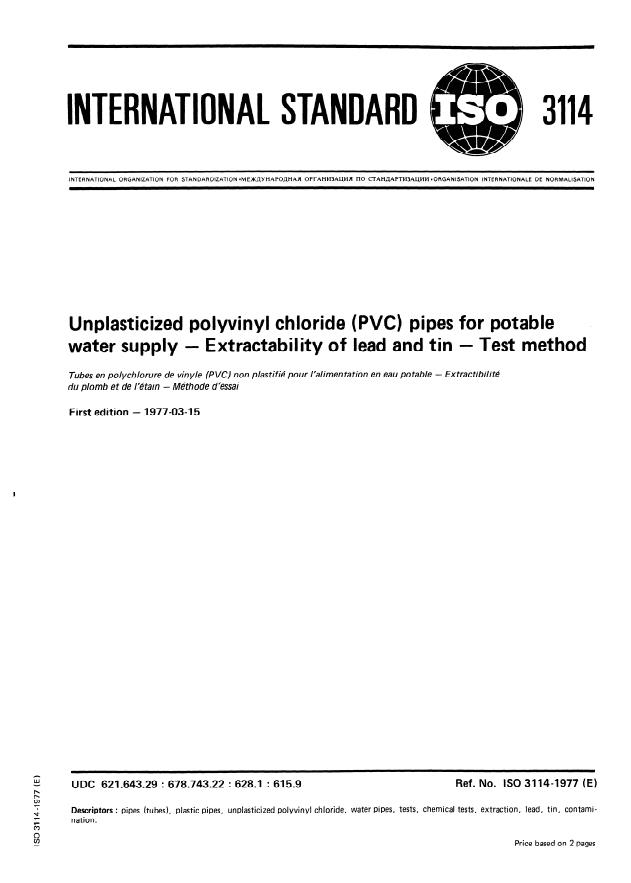
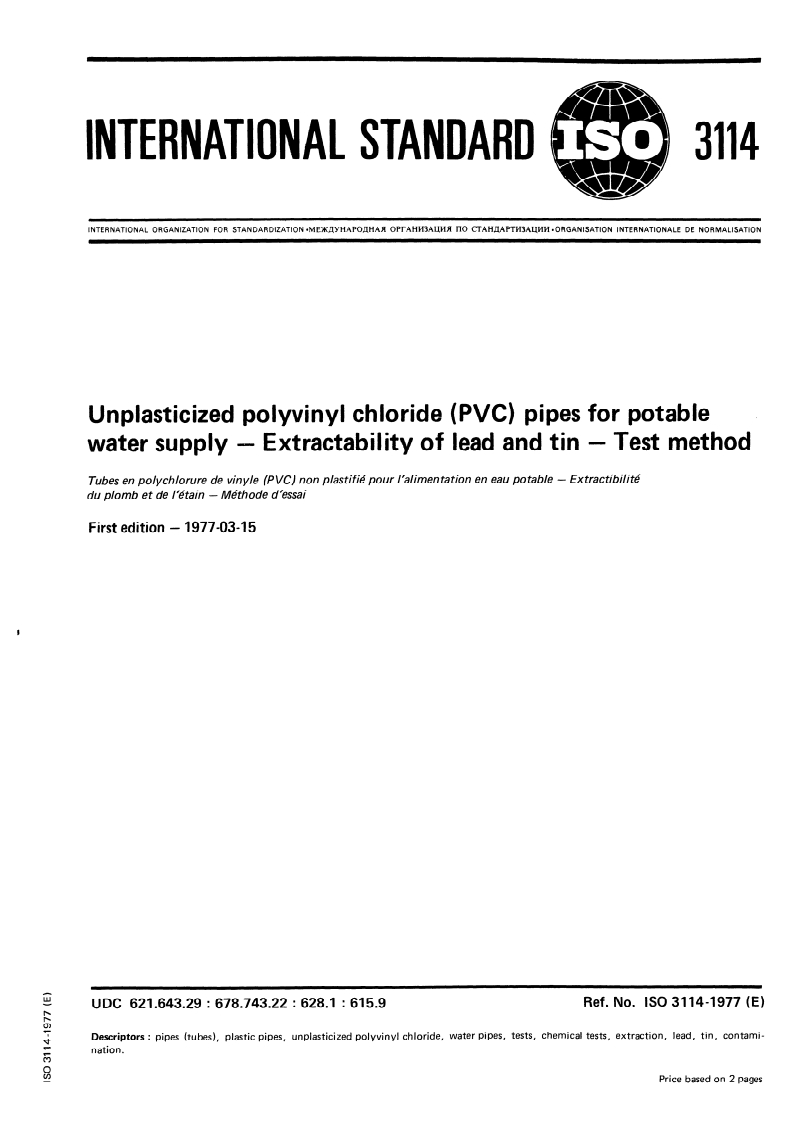
INTERNATIONAL STANDARD
INTERNATIONAL ORGANIZATION FOR STANDARDIZATION l MEXL(YHAPOAHAII OPI-AHM3ALVW l-IO CTAHAAPTki3A~WII *ORGANISATION INTERNATIONALE DE NORMALISATION
Unplasticized polyvinyl chloride (PVC) pipes for potable
Extractability of lead and tin - Test method
water supply -
Tubes en polychlorure de vin yle (PVC) non plastifid pour l’alimen tation en eau potable - Extractibilit6
du plomb et de IWain - Methode d’essai
First edition - 1977-03-15
Ref. No. ISO 3114-1977 (E)
UDC 621.643.29 : 678.743.22 : 628.1 : 615.9
tests, chemical tests, extraction, lead, tin, contami-
Descriptors : pipes (tubes), plastic pipes, unplasticized polyvinyl chloride, water pipes,
nation.
Price based on 2 pages
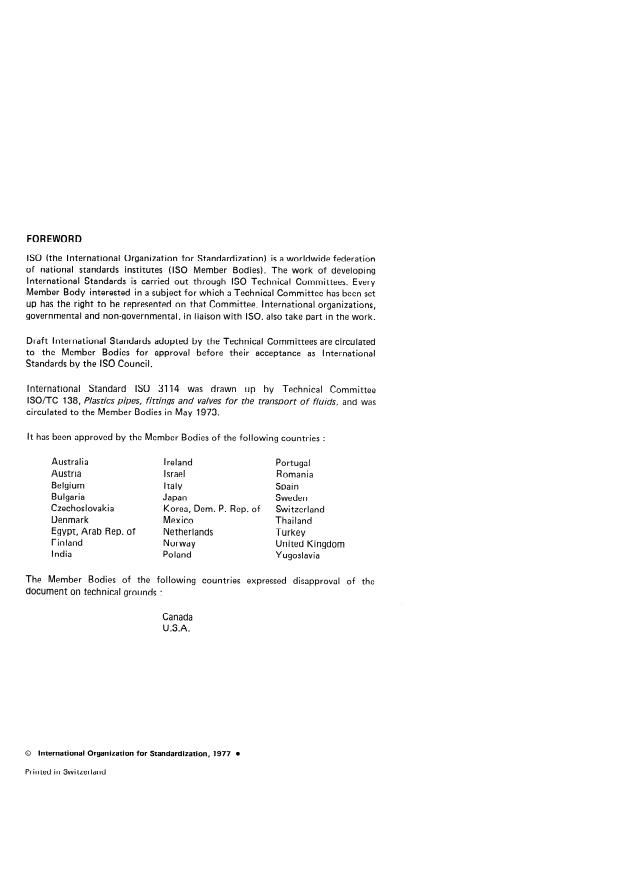
FOREWORQ
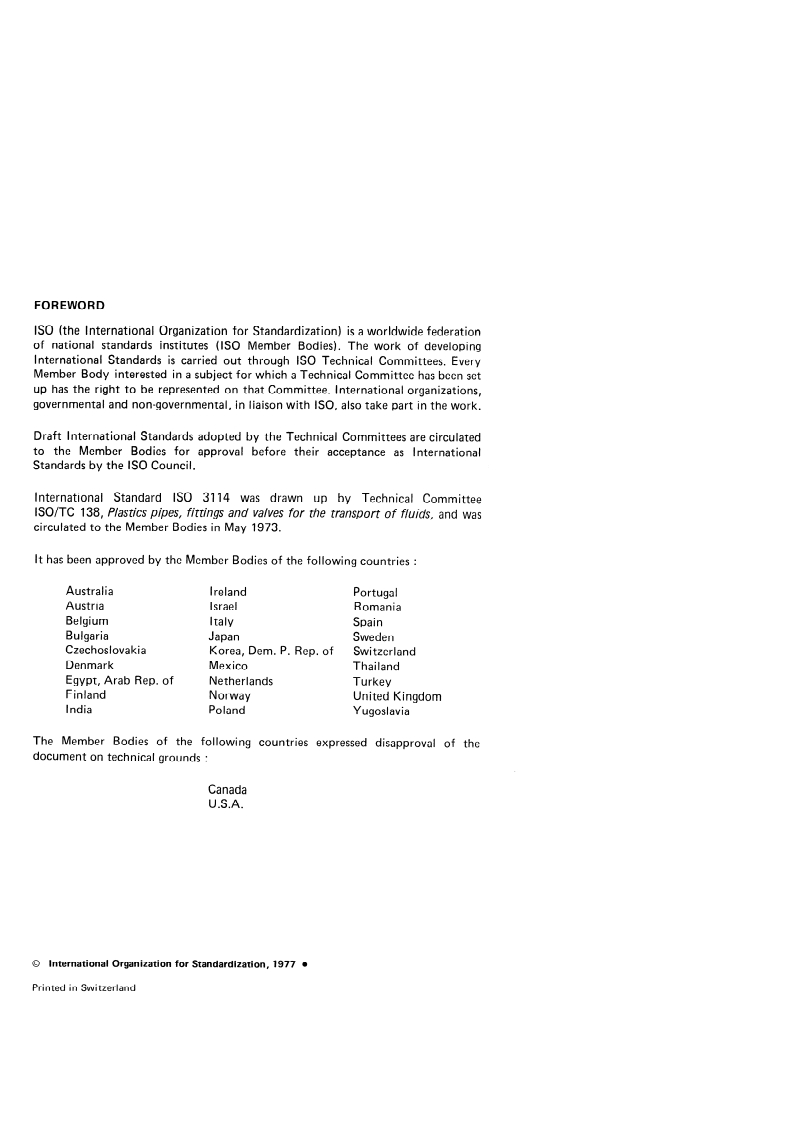
ISO (the International Organization for Standardization) is a worldwide federation
of national Standards institutes (ISO Member Bodies). The work of developing
International Standards is carried out through ISO Technical Committees. Every
Member Body interested in a subject for which a Technical Committee has been set
up has the right to be represented on that Committee. International organizations,
governmental and non-governmental, in Iiaison with ISO, also take part in the work.
Draft International Standards adopted by the Technical Committees are circulated
to the Member Bodies for approval before their acceptance as International
Standards by the ISO Council.
International Standard ISO 3114 was drawn up by Technical Committee
ISOITC 138, Plastics pipes, fittings and valves for the transport of fluids, and was
circulated to the Member Bodies in May 1973.
lt has been approved by the Member Bodies of the following countries :
Australia I reland Portugal
Austria Israel Komania
Belgium Italy Spain
Bulgaria Japan Sweden
Czechoslovakia Korea, Dem. P. Rep. of Switzerland
Denmark Mexico Thailand
Netherlands Turkey
Egypt, Arab Rep. of
Finland Norway United Kingdom
India Poland Yugoslavia
The Member Bodies of the following countries expressed disapproval of the
document on technical grounds :
Canada
U.S.A.
0 International Organkation for Standardkation, 1977 l
Printed in Switzerland
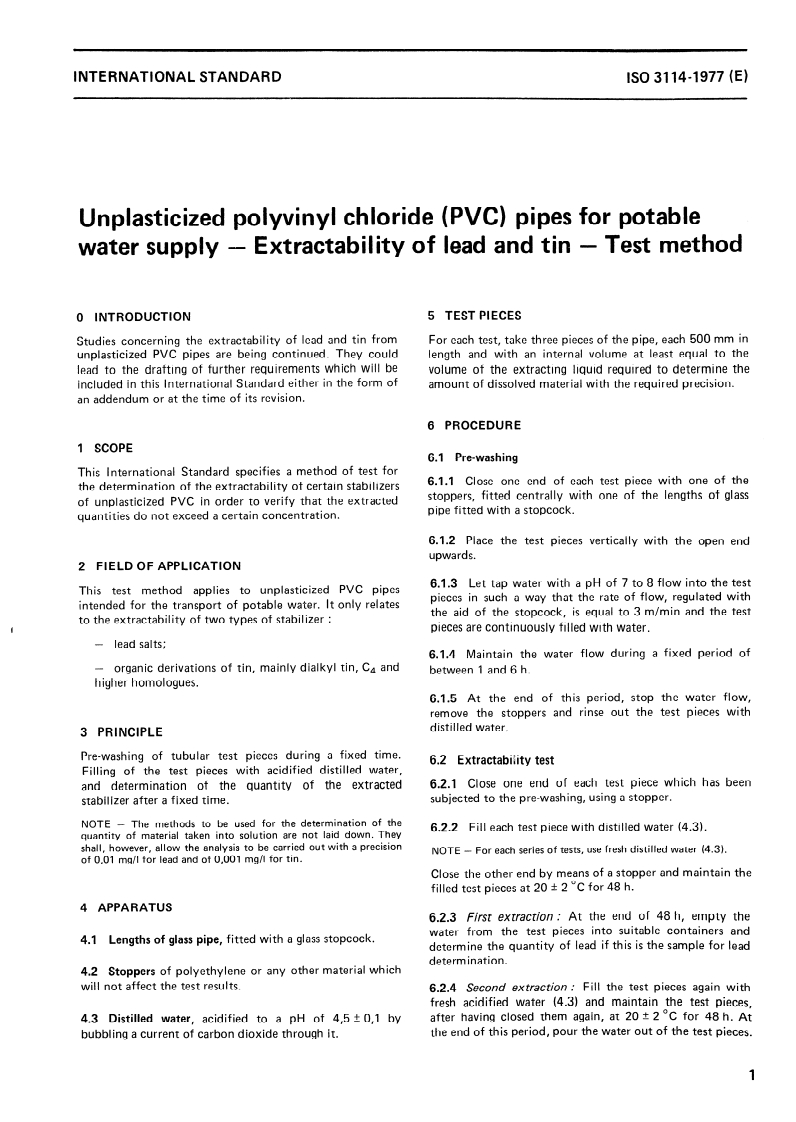
INTERNATIONAL STANDARD
Iso 3114-1977 (El
Unplasticized polyvinyl chloride (PVC) pipes for potable
water supply - Extractability of lead and tin - Test method
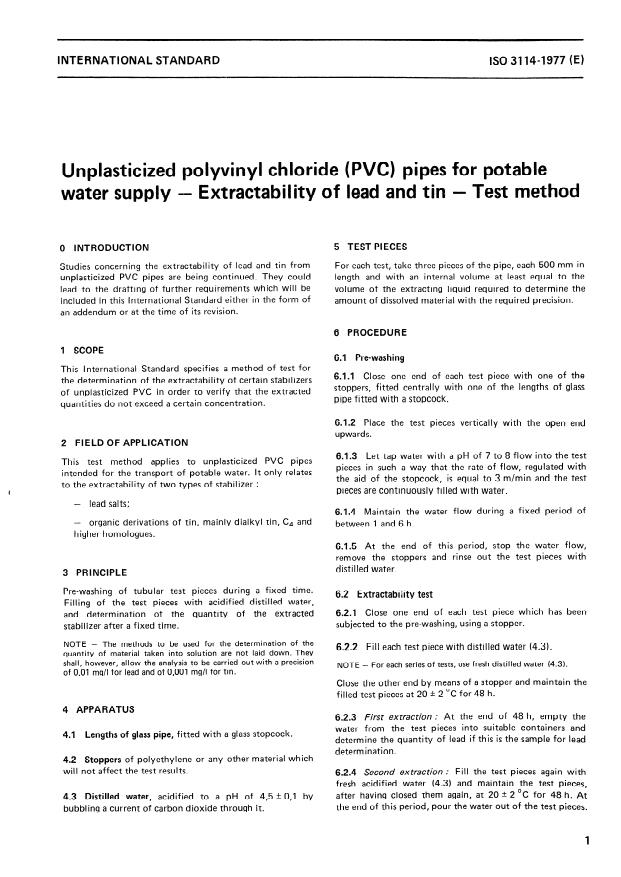
5 TEST PIECES
0 INTRODUCTION
For each test, take three pieces of the Pipe, each 500 mm in
Studies concerning the extractability of lead and tin from
unplasticized PVC pipes are being continued. They could length and with an internal volume at least equal to the
lead to the drafting of further requirements which will be
volume of the extracting liquid required to determine the
included in this International Standard either in the form of
amount of dissolved material with the required precision.
an addendum or at the time of its revision.
6 PROCEDURE
1 SCOPE
6.1 Pre-washing
This International Standard specifies a method of test for
6.1.1 Close one end of each test piece with one of the
the determination of the extractability of certain stabilizers
Stoppers, fitted centrally with one of the lengths of glass
of unplasticized PVC in Order to verify that the extracted
pipe fitted with a stopcock.
quantities do not exceed a certain concentration.
6.1.2 Place the test pieces vertically with the open end
upwards.
2 FIELD OF APPLICATION
6.1.3 Let tap water with a pH of 7 to 8 flow into the test
This test method applies to unplasticized PVC pipes
pieces in such a way that the rate of flow, regulated with
intended for the transport of potable water. lt only relates
the aid of the stopcock, is equal to 3 m/min and the test
to the extractability of two types of stabilizer :
pieces are continuou
...
INTERNATIONAL STANDARD
INTERNATIONAL ORGANIZATION FOR STANDARDIZATION l MEXL(YHAPOAHAII OPI-AHM3ALVW l-IO CTAHAAPTki3A~WII *ORGANISATION INTERNATIONALE DE NORMALISATION
Unplasticized polyvinyl chloride (PVC) pipes for potable
Extractability of lead and tin - Test method
water supply -
Tubes en polychlorure de vin yle (PVC) non plastifid pour l’alimen tation en eau potable - Extractibilit6
du plomb et de IWain - Methode d’essai
First edition - 1977-03-15
Ref. No. ISO 3114-1977 (E)
UDC 621.643.29 : 678.743.22 : 628.1 : 615.9
tests, chemical tests, extraction, lead, tin, contami-
Descriptors : pipes (tubes), plastic pipes, unplasticized polyvinyl chloride, water pipes,
nation.
Price based on 2 pages
FOREWORQ
ISO (the International Organization for Standardization) is a worldwide federation
of national Standards institutes (ISO Member Bodies). The work of developing
International Standards is carried out through ISO Technical Committees. Every
Member Body interested in a subject for which a Technical Committee has been set
up has the right to be represented on that Committee. International organizations,
governmental and non-governmental, in Iiaison with ISO, also take part in the work.
Draft International Standards adopted by the Technical Committees are circulated
to the Member Bodies for approval before their acceptance as International
Standards by the ISO Council.
International Standard ISO 3114 was drawn up by Technical Committee
ISOITC 138, Plastics pipes, fittings and valves for the transport of fluids, and was
circulated to the Member Bodies in May 1973.
lt has been approved by the Member Bodies of the following countries :
Australia I reland Portugal
Austria Israel Komania
Belgium Italy Spain
Bulgaria Japan Sweden
Czechoslovakia Korea, Dem. P. Rep. of Switzerland
Denmark Mexico Thailand
Netherlands Turkey
Egypt, Arab Rep. of
Finland Norway United Kingdom
India Poland Yugoslavia
The Member Bodies of the following countries expressed disapproval of the
document on technical grounds :
Canada
U.S.A.
0 International Organkation for Standardkation, 1977 l
Printed in Switzerland
INTERNATIONAL STANDARD
Iso 3114-1977 (El
Unplasticized polyvinyl chloride (PVC) pipes for potable
water supply - Extractability of lead and tin - Test method
5 TEST PIECES
0 INTRODUCTION
For each test, take three pieces of the Pipe, each 500 mm in
Studies concerning the extractability of lead and tin from
unplasticized PVC pipes are being continued. They could length and with an internal volume at least equal to the
lead to the drafting of further requirements which will be
volume of the extracting liquid required to determine the
included in this International Standard either in the form of
amount of dissolved material with the required precision.
an addendum or at the time of its revision.
6 PROCEDURE
1 SCOPE
6.1 Pre-washing
This International Standard specifies a method of test for
6.1.1 Close one end of each test piece with one of the
the determination of the extractability of certain stabilizers
Stoppers, fitted centrally with one of the lengths of glass
of unplasticized PVC in Order to verify that the extracted
pipe fitted with a stopcock.
quantities do not exceed a certain concentration.
6.1.2 Place the test pieces vertically with the open end
upwards.
2 FIELD OF APPLICATION
6.1.3 Let tap water with a pH of 7 to 8 flow into the test
This test method applies to unplasticized PVC pipes
pieces in such a way that the rate of flow, regulated with
intended for the transport of potable water. lt only relates
the aid of the stopcock, is equal to 3 m/min and the test
to the extractability of two types of stabilizer :
pieces are continuou
...
~~
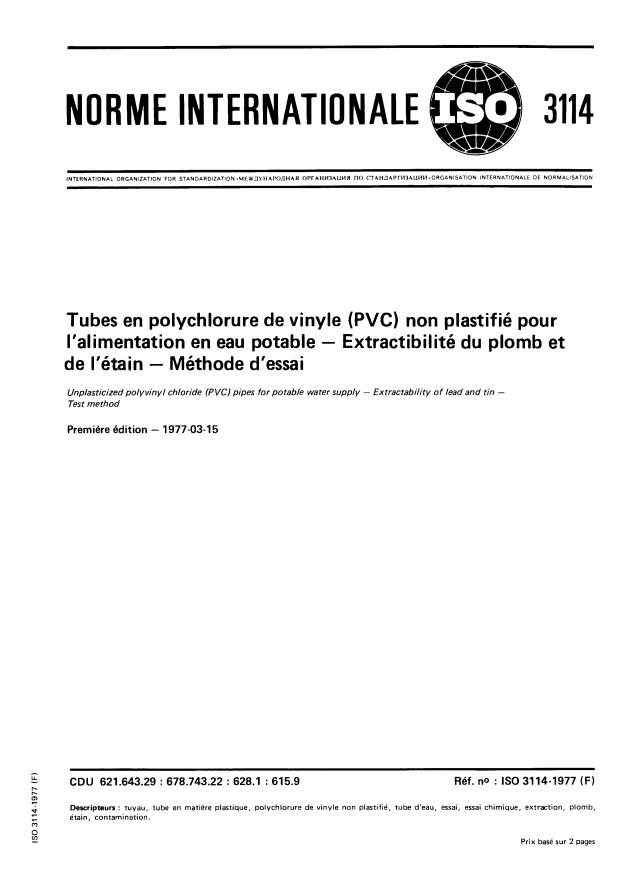
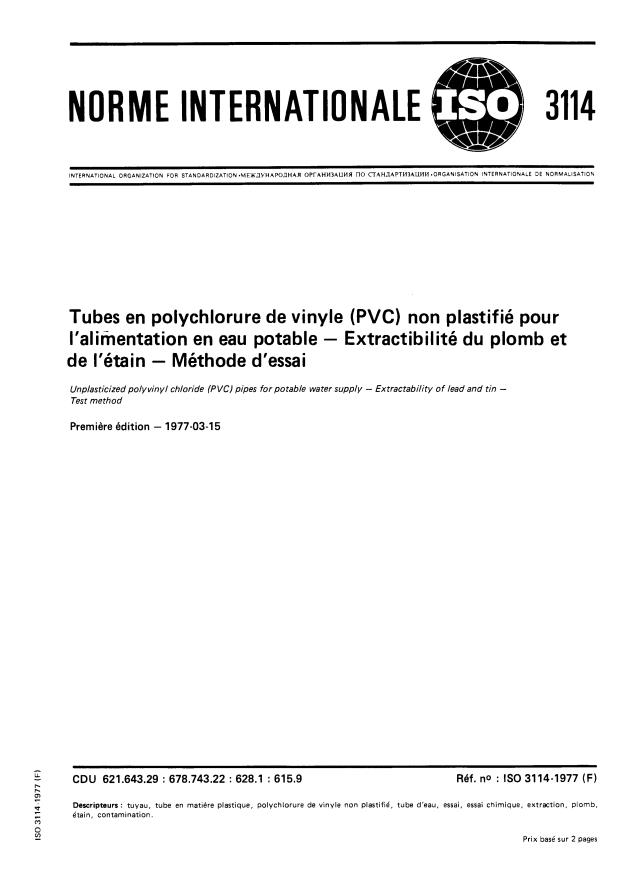
NORME INTERNATIONALE 3114
~
INTERNATIONAL ORGANIZATION FOR STANDARDIZATION .MEXJYHAPODHAI OPrAHM3AUMI no CTAHDAPTM3AUMM .ORGANISATION INTERNATIONALE DE NORMALISATION
Tubes en polychlorure de vinyle (PVC) non plastifié pour
l'alimentation en eau potable - Extractibilité du plomb et
de l'étain - Méthode d'essai
Unplasticized polyvinyl chloride (PVC) pipes for potable water supply - Extractability of lead and tin -
Test method
Première édition - 1977-03-15
U.
-
CDU 621.643.29 : 678.743.22 : 628.1 : 615.9 Réf. no : IS0 3114-1977 (FI
b
I-
T
Descripteurs : tuyau, tube en matière plastique, polychlorure de vinyle non plastifié, tube d'eau, essai, essai chimique, extraction, plomb,
z r étain, contamination.
m
Prix basé sur 2 pages
AVANT-PROPOS
L'ISO (Organisation Internationale de Normalisation) est une fédération mondiale
d'organismes nationaux de normalisation (Comités Membres ISO). L'élaboration des
Normes Internationales est confiée aux Comités Techniques ISO. Chaque Comité
Membre intéressé par une étude a le droit de faire partie du Comité Technique
correspondant. Les organisations internationales, gouvernementales et non
gouvernementales, en liaison avec I'ISO, participent également aux travaux.
Les Projets de Normes Internationales adoptés par les Comités Techniques sont
soumis aux Comités Membres pour approbation, avant leur acceptation comme
Normes Internationales par le Conseil de I'ISO.
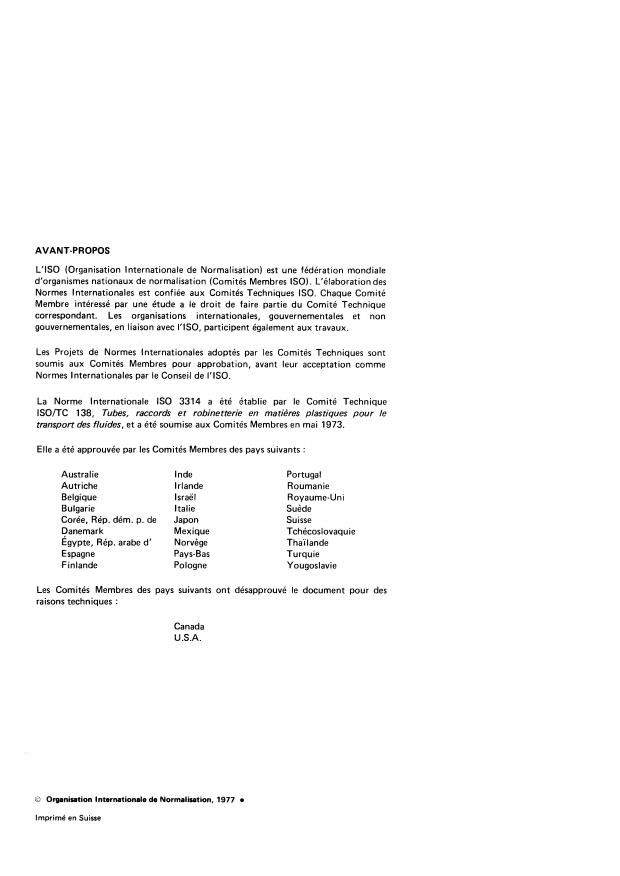
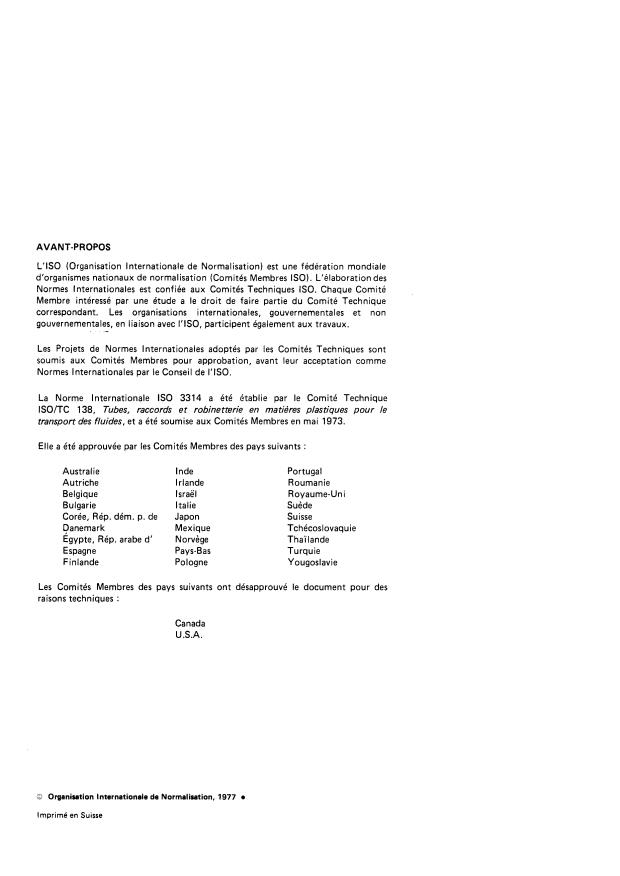
La Norme Internationale IS0 3314 a été dtablie par le Comité Technique
ISOfTC 138, Tubes, raccords et robinetterie en matières plastiques pour le
transport des fluides, et a été soumise aux Comités Membres en mai 1973.
Elle a été approuvée par les Comités Membres des pays suivants :
Inde Portugal
Australie
Irlande Roumanie
Autriche
Belgique Israël Royaume-Uni
Bulgarie Italie Suède
Corée, Rép. dém. p. de Japon Suisse
Danemark Mexique Tchécoslovaquie
Egypte, Rép. arabe d' Norvège Thaïlande
Espagne Pays-Bas Turquie
Yougoslavie
Finlande Pologne
Les Comités Membres des pays suivants ont désapprouvé le document pour des
:
raisons techniques
Canada
U.S.A.
O Organisation Internationale de Normalisation, 1977 O
Imprimé en Suisse
IS0 3114-1977 (F)
NORM E INTER NAT I ON AL E
Tubes en polychlorure de vinyle (PVC) non plastifie pour
l'alimentation en eau potable - Extractibilité du plomb et
de l'étain - Méthode d'essai
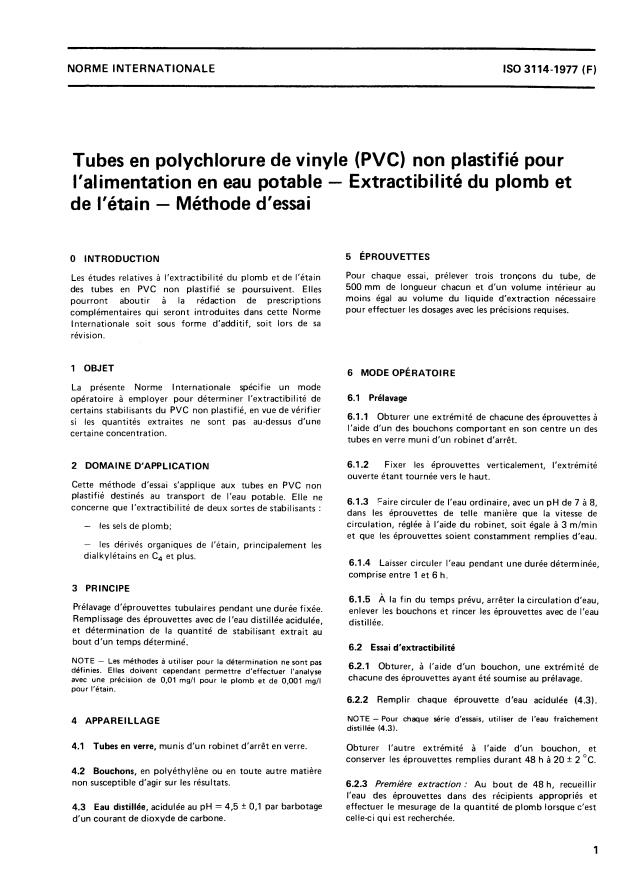
5 ÉPROUVETTES
O INTRODUCTION
Pour chaque essai, prélever trois troncons du tube, de
Les études relatives à I'extractibilité du plomb et de l'étain
500 mm de longueur chacun et d'un volume intérieur au
des tubes en PVC non plastifié se poursuivent. Elles
moins égal au volume du liquide d'extraction nécessaire
pourront aboutir à la rédaction de prescriptions
pour effectuer les dosages avec les précisions requises.
complémentaires qui seront introduites dans cette Norme
Internationale soit sous forme d'additif, soit lors de sa
révision.
1 OBJET
6 MODE OPÉRATOIRE
La présente Norme Internationale spécifie un mode
6.1 Prélavage
opératoire à employer pour déterminer I'extractibilité de
certains stabilisants du PVC non plastifié, en vue de vérifier
6.1.1 Obturer une extrémité de chacune des éprouvettes à
si les quantités extraites ne sont pas au-dessus d'une
l'aide d'un des bouchons comportant en son centre un des
certaine concentration.
tubes en verre muni d'un robinet d'arrêt.
6.1.2 Fixer les éprouvettes verticalement, l'extrémité
2 DOMAINE D'APPLICATION
ouverte étant tournée vers le haut.
Cette méthode d'essai s'applique aux tubes en PVC non
plastifié destinés au transport de l'eau potable. Elle ne
6.1.3 Faire circuler de l'eau ordinaire, avec un pH de 7 à 8,
concerne que I'extractibilité de deux sortes de stabilisants :
dans les éprouvet
...
NORME INTERNATIONALE 3114
INTERNATIONAL ORGANIZATION FOR STANDARDIZATION .MEXLlYHAPOflHAI OPrAHM3AUMR no CTAHclAPTM3AUMM .ORGANISATION INTERNATIONALE DE NORMALISATION
Tubes en polychlorure de vinyle (PVC) non plastifié pour
l'alimentation en eau potable - Extractibilité du plomb et
de l'étain - Méthode d'essai
Unplasticized polyvinyl chloride (PVC) pipes for potable water supply - Extractability of lead and tin -
Test method
Première édition - 1977-03-15
-
U.
-
Réf. no : IS0 3114-1977 (F)
CDU 621.643.29 : 678.743.22 : 628.1 : 615.9
pl
pl
Descripteurs : tuyau, tube en matière plastique, polychlorure de vinyle non plastifié. tube d'eau, essai, essai chimique, extraction, plomb,
P, c étain, contamination.
P)
s
Prix basé sur 2 pages
AVANT-PROPOS
L’ISO (Organisation Internationale de Normalisation) est une fédération mondiale
ISO). L’élaboration des
d’organismes nationaux de normalisation (Comités Membres
Normes Internationales est confiée aux Comités Techniques ISO. Chaque Comité
Membre intéressé par une étude a le droit de faire partie du Comité Technique
correspondant. Les organisations internationales, gouvernementales et non
gouvernementales, en liaison avec I‘ISO, participent également aux travaux.
Les Projets de Normes Internationales adoptés par les Comités Techniques sont
soumis aux Comités Membres pour approbation, avant leur acceptation comme
Normes Internationales par le Conseil de I’ISO.
La Norme Internationale IS0 3314 a été dtablie par le Comité Technique
ISO/TC 138, Tubes, raccords et robinetterie en matières plastiques pour le
transport des fluides, et a été soumise aux Comités Membres en mai 1973.
Elle a été approuvée par les Comités Membres des pays suivants :
Inde
Australie Portugal
Irlande
Autriche Roumanie
Belgique Israël Royaume-Uni
Bulgarie Italie Suède
Corée, Rép. dém. p. de Japon Suisse
Danemark Mexique Tchécoslovaquie
Egypte, Rép. arabe d’ Norvège Thaïlande
Espagne Pays-Bas Turquie
Finlande Pologne Yougoslavie
Les Comités Membres des pays suivants ont désapprouvé le document pour des
raisons techniques :
Canada
U.S.A.
O Organisation Internationale de Normalisation, 1977 O
ImDrirné en Suisse
~
NORME INTERNATIONALE IS0 3114-1977 (F)
Tubes en polychlorure de vinyle (PVC) non plastifié pour
l’alimentation en eau potable - Extractibilité du plomb et
de l‘étain - Méthode d‘essai
5 ÉPROUVETTES
O INTRODUCTION
Pour chaque essai, prélever trois tronçons du tube, de
Les études relatives à I’extractibilité du plomb et de l‘étain
500 mm de longueur chacun et d’un volume intérieur au
des tubes en PVC non plastifié se poursuivent. Elles
moins égal au volume du liquide d’extraction nécessaire
pourront aboutir à la rédaction de prescriptions
pour effectuer les dosages avec les précisions requises.
complémentaires qui seront introduites dans cette Norme
Internationale soit sous forme d’additif, soit lors de sa
révision .--
I OBJET
6 MODE OPÉRATOIRE
La présente Norme Internationale spécifie un mode
6.1 Prélavage
opératoire à employer pour déterminer I‘extractibilité de
certains stabilisants du PVC non plastifié, en vue de vérifier
6.1.1 Obturer une extrémité de chacune des éprouvettes a
si les quantités extraites ne sont pas au-dessus d’une
l’aide d‘un des bouchons comportant en son centre un des
certaine concentration.
tubes en verre muni d‘un robinet d’arrêt.
6.1.2 Fixer les éprouvettes verticalement, l‘extrémité
2 DOMAINE D‘APPLICATION
ouverte étant tournée vers le haut.
Cette méthode d‘essai s’applique aux tubes en PVC non
plastifié destinés au transport de l’eau potable. Elle ne
6.1.3 Faire circuler de l‘eau ordinaire, avec un pH de 7 à 8,
concerne que I’extractibilité de deux sortes de stabilisants :
dans les éprouvet
...
NORME INTERNATIONALE 3114
INTERNATIONAL ORGANIZATION FOR STANDARDIZATION .MEXLlYHAPOflHAI OPrAHM3AUMR no CTAHclAPTM3AUMM .ORGANISATION INTERNATIONALE DE NORMALISATION
Tubes en polychlorure de vinyle (PVC) non plastifié pour
l'alimentation en eau potable - Extractibilité du plomb et
de l'étain - Méthode d'essai
Unplasticized polyvinyl chloride (PVC) pipes for potable water supply - Extractability of lead and tin -
Test method
Première édition - 1977-03-15
-
U.
-
Réf. no : IS0 3114-1977 (F)
CDU 621.643.29 : 678.743.22 : 628.1 : 615.9
pl
pl
Descripteurs : tuyau, tube en matière plastique, polychlorure de vinyle non plastifié. tube d'eau, essai, essai chimique, extraction, plomb,
P, c étain, contamination.
P)
s
Prix basé sur 2 pages
AVANT-PROPOS
L’ISO (Organisation Internationale de Normalisation) est une fédération mondiale
ISO). L’élaboration des
d’organismes nationaux de normalisation (Comités Membres
Normes Internationales est confiée aux Comités Techniques ISO. Chaque Comité
Membre intéressé par une étude a le droit de faire partie du Comité Technique
correspondant. Les organisations internationales, gouvernementales et non
gouvernementales, en liaison avec I‘ISO, participent également aux travaux.
Les Projets de Normes Internationales adoptés par les Comités Techniques sont
soumis aux Comités Membres pour approbation, avant leur acceptation comme
Normes Internationales par le Conseil de I’ISO.
La Norme Internationale IS0 3314 a été dtablie par le Comité Technique
ISO/TC 138, Tubes, raccords et robinetterie en matières plastiques pour le
transport des fluides, et a été soumise aux Comités Membres en mai 1973.
Elle a été approuvée par les Comités Membres des pays suivants :
Inde
Australie Portugal
Irlande
Autriche Roumanie
Belgique Israël Royaume-Uni
Bulgarie Italie Suède
Corée, Rép. dém. p. de Japon Suisse
Danemark Mexique Tchécoslovaquie
Egypte, Rép. arabe d’ Norvège Thaïlande
Espagne Pays-Bas Turquie
Finlande Pologne Yougoslavie
Les Comités Membres des pays suivants ont désapprouvé le document pour des
raisons techniques :
Canada
U.S.A.
O Organisation Internationale de Normalisation, 1977 O
ImDrirné en Suisse
~
NORME INTERNATIONALE IS0 3114-1977 (F)
Tubes en polychlorure de vinyle (PVC) non plastifié pour
l’alimentation en eau potable - Extractibilité du plomb et
de l‘étain - Méthode d‘essai
5 ÉPROUVETTES
O INTRODUCTION
Pour chaque essai, prélever trois tronçons du tube, de
Les études relatives à I’extractibilité du plomb et de l‘étain
500 mm de longueur chacun et d’un volume intérieur au
des tubes en PVC non plastifié se poursuivent. Elles
moins égal au volume du liquide d’extraction nécessaire
pourront aboutir à la rédaction de prescriptions
pour effectuer les dosages avec les précisions requises.
complémentaires qui seront introduites dans cette Norme
Internationale soit sous forme d’additif, soit lors de sa
révision .--
I OBJET
6 MODE OPÉRATOIRE
La présente Norme Internationale spécifie un mode
6.1 Prélavage
opératoire à employer pour déterminer I‘extractibilité de
certains stabilisants du PVC non plastifié, en vue de vérifier
6.1.1 Obturer une extrémité de chacune des éprouvettes a
si les quantités extraites ne sont pas au-dessus d’une
l’aide d‘un des bouchons comportant en son centre un des
certaine concentration.
tubes en verre muni d‘un robinet d’arrêt.
6.1.2 Fixer les éprouvettes verticalement, l‘extrémité
2 DOMAINE D‘APPLICATION
ouverte étant tournée vers le haut.
Cette méthode d‘essai s’applique aux tubes en PVC non
plastifié destinés au transport de l’eau potable. Elle ne
6.1.3 Faire circuler de l‘eau ordinaire, avec un pH de 7 à 8,
concerne que I’extractibilité de deux sortes de stabilisants :
dans les éprouvet
...
~~
NORME INTERNATIONALE 3114
~
INTERNATIONAL ORGANIZATION FOR STANDARDIZATION .MEXJYHAPODHAI OPrAHM3AUMI no CTAHDAPTM3AUMM .ORGANISATION INTERNATIONALE DE NORMALISATION
Tubes en polychlorure de vinyle (PVC) non plastifié pour
l'alimentation en eau potable - Extractibilité du plomb et
de l'étain - Méthode d'essai
Unplasticized polyvinyl chloride (PVC) pipes for potable water supply - Extractability of lead and tin -
Test method
Première édition - 1977-03-15
U.
-
CDU 621.643.29 : 678.743.22 : 628.1 : 615.9 Réf. no : IS0 3114-1977 (FI
b
I-
T
Descripteurs : tuyau, tube en matière plastique, polychlorure de vinyle non plastifié, tube d'eau, essai, essai chimique, extraction, plomb,
z r étain, contamination.
m
Prix basé sur 2 pages
AVANT-PROPOS
L'ISO (Organisation Internationale de Normalisation) est une fédération mondiale
d'organismes nationaux de normalisation (Comités Membres ISO). L'élaboration des
Normes Internationales est confiée aux Comités Techniques ISO. Chaque Comité
Membre intéressé par une étude a le droit de faire partie du Comité Technique
correspondant. Les organisations internationales, gouvernementales et non
gouvernementales, en liaison avec I'ISO, participent également aux travaux.
Les Projets de Normes Internationales adoptés par les Comités Techniques sont
soumis aux Comités Membres pour approbation, avant leur acceptation comme
Normes Internationales par le Conseil de I'ISO.
La Norme Internationale IS0 3314 a été dtablie par le Comité Technique
ISOfTC 138, Tubes, raccords et robinetterie en matières plastiques pour le
transport des fluides, et a été soumise aux Comités Membres en mai 1973.
Elle a été approuvée par les Comités Membres des pays suivants :
Inde Portugal
Australie
Irlande Roumanie
Autriche
Belgique Israël Royaume-Uni
Bulgarie Italie Suède
Corée, Rép. dém. p. de Japon Suisse
Danemark Mexique Tchécoslovaquie
Egypte, Rép. arabe d' Norvège Thaïlande
Espagne Pays-Bas Turquie
Yougoslavie
Finlande Pologne
Les Comités Membres des pays suivants ont désapprouvé le document pour des
:
raisons techniques
Canada
U.S.A.
O Organisation Internationale de Normalisation, 1977 O
Imprimé en Suisse
IS0 3114-1977 (F)
NORM E INTER NAT I ON AL E
Tubes en polychlorure de vinyle (PVC) non plastifie pour
l'alimentation en eau potable - Extractibilité du plomb et
de l'étain - Méthode d'essai
5 ÉPROUVETTES
O INTRODUCTION
Pour chaque essai, prélever trois troncons du tube, de
Les études relatives à I'extractibilité du plomb et de l'étain
500 mm de longueur chacun et d'un volume intérieur au
des tubes en PVC non plastifié se poursuivent. Elles
moins égal au volume du liquide d'extraction nécessaire
pourront aboutir à la rédaction de prescriptions
pour effectuer les dosages avec les précisions requises.
complémentaires qui seront introduites dans cette Norme
Internationale soit sous forme d'additif, soit lors de sa
révision.
1 OBJET
6 MODE OPÉRATOIRE
La présente Norme Internationale spécifie un mode
6.1 Prélavage
opératoire à employer pour déterminer I'extractibilité de
certains stabilisants du PVC non plastifié, en vue de vérifier
6.1.1 Obturer une extrémité de chacune des éprouvettes à
si les quantités extraites ne sont pas au-dessus d'une
l'aide d'un des bouchons comportant en son centre un des
certaine concentration.
tubes en verre muni d'un robinet d'arrêt.
6.1.2 Fixer les éprouvettes verticalement, l'extrémité
2 DOMAINE D'APPLICATION
ouverte étant tournée vers le haut.
Cette méthode d'essai s'applique aux tubes en PVC non
plastifié destinés au transport de l'eau potable. Elle ne
6.1.3 Faire circuler de l'eau ordinaire, avec un pH de 7 à 8,
concerne que I'extractibilité de deux sortes de stabilisants :
dans les éprouvet
...