


ISO/TS 17321-4:2022
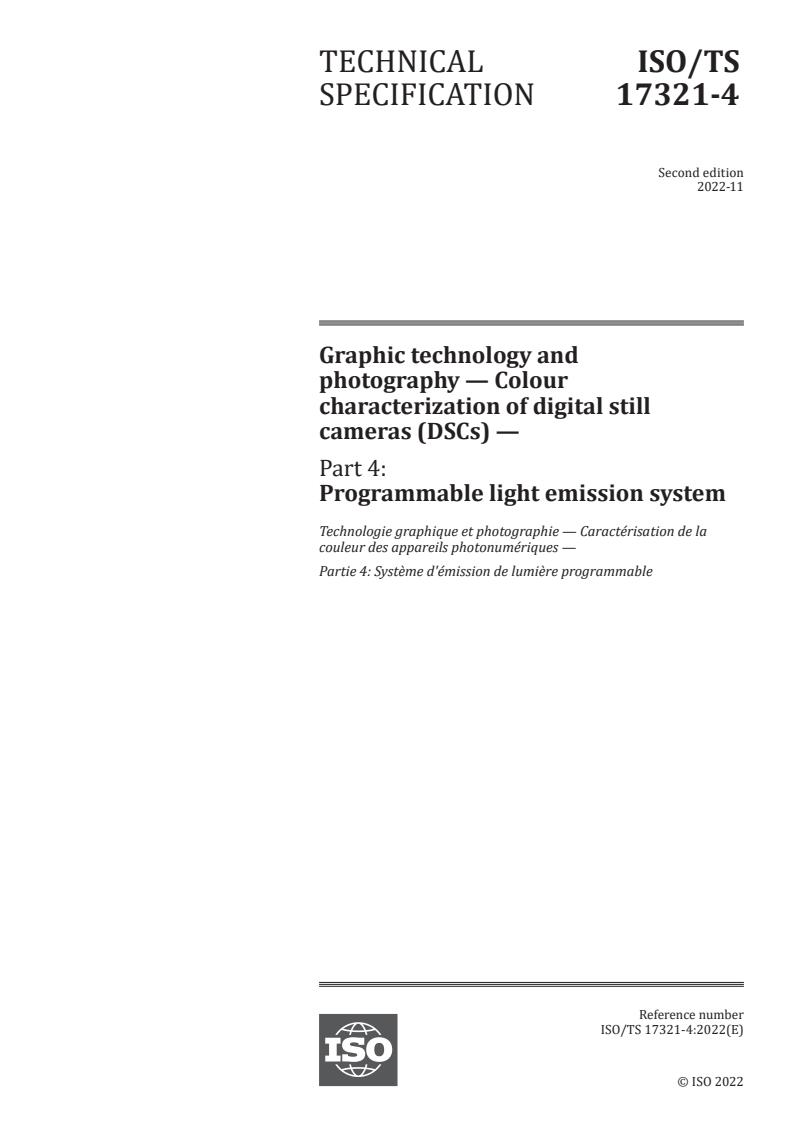
(Main)Graphic technology and photography - Colour characterization of digital still cameras (DSCs) - Part 4: Programmable light emission system
Graphic technology and photography - Colour characterization of digital still cameras (DSCs) - Part 4: Programmable light emission system
This document describes a programmable light emission system to produce various spectral radiance distributions, intended for DSC colour characterization applications.
Technologie graphique et photographie — Caractérisation de la couleur des appareils photonumériques — Partie 4: Système d'émission de lumière programmable
General Information
- Status
- Published
- Publication Date
- 22-Nov-2022
- Technical Committee
- ISO/TC 42 - Photography
- Drafting Committee
- ISO/TC 42 - Photography
- Current Stage
- 9093 - International Standard confirmed
- Start Date
- 05-Jun-2025
- Completion Date
- 13-Dec-2025
Relations
- Effective Date
- 06-Jun-2022
Overview - ISO/TS 17321-4:2022 (Programmable light emission system)
ISO/TS 17321-4:2022 defines requirements and test methods for a programmable light emission system (PLES) used in the colour characterization of digital still cameras (DSCs). The Technical Specification describes hardware and measurement methods to produce and evaluate various spectral radiance distributions, including generation and evaluation of spectral matches to reference illuminants. The document focuses on practical PLES characteristics (LEDs, quantum dots, laser diodes with spatial filtering), measurement conditions, and evaluation procedures for accurate DSC colour characterization.
Key topics and technical requirements
- Scope and purpose: PLES for DSC colour characterization; ability to create arbitrary spectra and approximate spectral matches to target references.
- Operating conditions: Environmental ranges (temperature 18 °C–28 °C; relative humidity 15 %–80 %); warm-up and stabilization requirements.
- Spectral range: Minimum coverage intended to match DSC spectral sensitivity (typically 380–730 nm; extendable into near‑IR).
- Hardware and design:
- Use of integrating spheres or flat-panel diffusers to achieve uniform output.
- Light-emitting device types: inorganic/organic LEDs, quantum dots, laser diodes (with spatial filtering).
- Resolution of digital‑to‑analog conversion for each light emitter and linearity assumptions.
- Output window size and required luminance capability (examples and guidance in Annex C).
- Measurement and performance metrics:
- Absolute tristimulus (XYZ) measurement capability (e.g., telespectrophotometer).
- Uniformity: center plus eight points at 45° intervals; uniformity formula and measurement method.
- Angular characteristics: luminance measured within a ±5° arc; method described for inclined axes.
- Repeatability: short‑term and long‑term procedures (example: spectral match to D55 at ~400 cd/m², seven measurements across time/days) and reporting of σ(Y), σ(u′), σ(v′).
- Spectral match generation and evaluation: New Clause 5 uses Vector Space Arithmetic (VSA) formulation; examples in Annex A; design guidance in Annex B and conditions in Annex C.
Practical applications and users
- Camera and sensor manufacturers validating colour response of DSCs
- Photographic and imaging test laboratories validating capture colour fidelity
- Color scientists and metrology labs developing test fixtures and PLES hardware
- LED and lighting designers creating test sources for imaging device evaluation
Related standards
- ISO 17321 series (colour characterization of DSCs)
- ISO 7589 (photography illuminants for sensitometry)
- ISO/CIE 11664‑5 (CIE 1976 Luv* and u′, v′ chromaticity)
- ISO 12646 (display temperature guidance referenced)
This specification is essential when building or qualifying a PLES for reproducible, standards-based DSC colour characterization and for ensuring interoperable test results across labs and manufacturers.
Frequently Asked Questions
ISO/TS 17321-4:2022 is a technical specification published by the International Organization for Standardization (ISO). Its full title is "Graphic technology and photography - Colour characterization of digital still cameras (DSCs) - Part 4: Programmable light emission system". This standard covers: This document describes a programmable light emission system to produce various spectral radiance distributions, intended for DSC colour characterization applications.
This document describes a programmable light emission system to produce various spectral radiance distributions, intended for DSC colour characterization applications.
ISO/TS 17321-4:2022 is classified under the following ICS (International Classification for Standards) categories: 37.040.10 - Photographic equipment. Projectors. The ICS classification helps identify the subject area and facilitates finding related standards.
ISO/TS 17321-4:2022 has the following relationships with other standards: It is inter standard links to ISO/TS 17321-4:2016. Understanding these relationships helps ensure you are using the most current and applicable version of the standard.
ISO/TS 17321-4:2022 is available in PDF format for immediate download after purchase. The document can be added to your cart and obtained through the secure checkout process. Digital delivery ensures instant access to the complete standard document.
Standards Content (Sample)
TECHNICAL ISO/TS
SPECIFICATION 17321-4
Second edition
2022-11
Graphic technology and
photography — Colour
characterization of digital still
cameras (DSCs) —
Part 4:
Programmable light emission system
Technologie graphique et photographie — Caractérisation de la
couleur des appareils photonumériques —
Partie 4: Système d'émission de lumière programmable
Reference number
© ISO 2022
All rights reserved. Unless otherwise specified, or required in the context of its implementation, no part of this publication may
be reproduced or utilized otherwise in any form or by any means, electronic or mechanical, including photocopying, or posting on
the internet or an intranet, without prior written permission. Permission can be requested from either ISO at the address below
or ISO’s member body in the country of the requester.
ISO copyright office
CP 401 • Ch. de Blandonnet 8
CH-1214 Vernier, Geneva
Phone: +41 22 749 01 11
Email: copyright@iso.org
Website: www.iso.org
Published in Switzerland
ii
Contents Page
Foreword .iv
Introduction .v
1 Scope . 1
2 Normative references . 1
3 Terms and definitions . 1
4 Description . .2
4.1 General . 2
4.2 Operating condition . 3
4.3 Description of the system . 3
4.3.1 General . 3
4.3.2 Wavelength . 4
4.3.3 Resolution of digital-analogue conversion for light emitting devices . 4
4.3.4 Output window size . 4
4.3.5 Luminance . 4
4.3.6 Uniformity . 4
4.3.7 Angular characteristics . . 5
4.3.8 Repeatability . 5
4.4 Reporting form . 6
5 Generation and evaluation of a spectral match . 7
5.1 Generation of a spectral match . 7
5.2 Evaluation of a spectral match . 8
Annex A (informative) Spectral match generation, scaling, and evaluation examples .9
Annex B (informative) Several guideline information to design the PLES .11
Annex C (informative) An example for the PLES required and recommended conditions .12
Bibliography .13
iii
Foreword
ISO (the International Organization for Standardization) is a worldwide federation of national standards
bodies (ISO member bodies). The work of preparing International Standards is normally carried out
through ISO technical committees. Each member body interested in a subject for which a technical
committee has been established has the right to be represented on that committee. International
organizations, governmental and non-governmental, in liaison with ISO, also take part in the work.
ISO collaborates closely with the International Electrotechnical Commission (IEC) on all matters of
electrotechnical standardization.
The procedures used to develop this document and those intended for its further maintenance are
described in the ISO/IEC Directives, Part 1. In particular, the different approval criteria needed for the
different types of ISO documents should be noted. This document was drafted in accordance with the
editorial rules of the ISO/IEC Directives, Part 2 (see www.iso.org/directives).
Attention is drawn to the possibility that some of the elements of this document may be the subject of
patent rights. ISO shall not be held responsible for identifying any or all such patent rights. Details of
any patent rights identified during the development of the document will be in the Introduction and/or
on the ISO list of patent declarations received (see www.iso.org/patents).
Any trade name used in this document is information given for the convenience of users and does not
constitute an endorsement.
For an explanation of the voluntary nature of standards, the meaning of ISO specific terms and
expressions related to conformity assessment, as well as information about ISO's adherence to
the World Trade Organization (WTO) principles in the Technical Barriers to Trade (TBT), see
www.iso.org/iso/foreword.html.
This document was prepared by Technical Committee ISO/TC 42, Photography.
This second edition cancels and replaces the first edition (ISO/TS 17321-4:2016), which has been
technically revised.
The main changes are as follows:
— reorganized introduction and Clause 4;
— Clause 4 is concentrated on the hardware evaluation of programmable light emission system (PLES).
New Annexes B and C were added to the second edition;
— a new Clause 5 and a new Annex A using VSA (Vector Space Arithmetic) formulation for simpler-
conceptual explanation of spectral match for PLES were added;
— removed unnecessary explanations on spectral generation (Annexes A, B, C, D, E, F and explanation
of spectral match in Clause 4), accordingly.
A list of all parts in the ISO 17321 series can be found on the ISO website.
Any feedback or questions on this document should be directed to the user’s national standards body. A
complete listing of these bodies can be found at www.iso.org/members.html.
iv
Introduction
This document describes a programmable light emission system. This system may be used to create
spectra that are arbitrary combinations of the lights contained within or may be used to create a spectral
match to a target reference spectrum. Unless the lights are of high dimensionality (ideal spectral shape
at each wavelength) such a match will generally be only approximate. Therefore, evaluation methods
for the spectra generated by the system are also described.
An example hardware description of a programmable light emission system is presented in Clause 4.
While any programmable light emission system that meets the tolerances specified may be utilized,
this document considers systems comprised of light emitting devices such as inorganic or organic LEDs,
quantum dots, and laser diodes (if equipped with suitable spatial filtering).
v
TECHNICAL SPECIFICATION ISO/TS 17321-4:2022(E)
Graphic technology and photography — Colour
characterization of digital still cameras (DSCs) —
Part 4:
Programmable light emission system
1 Scope
This document describes a programmable light emission system to produce various spectral radiance
distributions, intended for DSC colour characterization applications.
2 Normative references
The following documents are referred to in the text in such a way that some or all of their content
constitutes requirements of this document. For dated references, only the edition cited applies. For
undated references, the latest edition of the referenced document (including any amendments) applies.
ISO 7589, Photography — Illuminants for sensitometry — Specifications for daylight, incandescent
tungsten and printer
ISO/CIE 11664-5, Colorimetry — Part 5: CIE 1976 L*u*v* colour space and u', v' uniform chromaticity scale
diagram
3 Terms and definitions
For the purposes of this document, the following terms and definitions apply.
ISO and IEC maintain terminology databases for use in standardization at the following addresses:
— ISO Online browsing platform: available at https:// www .iso .org/ obp
— IEC Electropedia: available at https:// www .electropedia .org/
3.1
colour-matching functions
tristimulus values (3.5) of monochromatic stimuli of equal radiant flux
[SOURCE: CIE S 017:2020, 17-23-039]
3.2
digital still camera
DSC
device which incorporates an image sensor, and which produces a digital signal representing a still
picture
Note 1 to entry: A digital still camera is typically a portable, hand-held device. The digital signal is usually
recorded on a removable memory, such as a solid-state memory card or magnetic disk.
[SOURCE: ISO 17321-1:2012, 3.2]
3.3
light-emitting diode
LED
semiconductor diode that emits non coherent optical radiation through stimulated emission resulting
from the recombination electrons and photons, when excited by an electric current
Note 1 to entry: For an example of LED, CIE S 017:2020, 17-27-050 shall be referred to.
[SOURCE: IEC 60050-521:2002, 521-04-39]
3.4
programmable light emission system
PLES
system that produces various spectral radiance distributions using light emitting devices
3.5
tristimulus values
amounts of the reference colour stimuli, in a given trichromatic system, required to match the colour of
the stimulus considered
Note 1 to entry: See colour matching functions (3.1).
[SOURCE: CIE S 017:2020, 17-23-038]
4 Description
4.1 General
Figure 1 shows a cross-section of an example of a programmable light emission system (PLES). An
integrating sphere in the Figure 1 is utilized to ensure good spatial uniformity for the light emission.
Light emitting devices are placed at the bottom and an output window is placed on the side to allow
the mixed light to be emitted. The ability to measure absolute XYZ values is a requirement. A tele-
spectrophotometer is one of such measurement methods to obtain these values and used to verify the
accuracy of the generated spectra.
There are many kinds of light emitting devices. For example, if LEDs are used for the light emitting
devices, the LEDs are electrically modulated and the emitted flux will be mixed (integrated) by multiple
reflections from the inner surface of the sphere, in order to produce a required spectral distribution of
light flux.
Key
1 output window
2 light emitting device array
3 integrating sphere
a
Uniform light emission on the output window.
Figure 1 — Schematic configuration of the programmable light emission system (PLES)
Annex B shows LED driving methods of the PLES.
As a more compact alternative to integrating sphere, flat panel diffusers can also be designed to produce
near-uniform output by the light levels of the individual LED modules.
4.2 Operating condition
The light emitting system shall be designed to operate consistently under the ranges described in
Table 1.
Table 1 — Operating conditions
Operating condition Range
Temperature 18 °C to 28 °C
Relative humidity 15 % to 80 %
NOTE The temperature requirements were taken from ISO 12646.
4.3 Description of the system
4.3.1 General
This clause describes the PLES. An example for the PLES conditions is described in Annex C.
Warm-up time shall be chosen to be long enough so that the system has reached stable state and
stabilized at the desired operating temperature after power-on of the PLES. It is recommended that a
default spectral distribution is outputted during warm-up time in order to reduce warm-up time. This
warm-up time is applied to all of spectral distribution measurement.
Every spectral measurement shall be performed after 5 s to 10 s when the PLES outputs different
spectral distribution.
4.3.2 Wavelength
The wavelength range over which the combined set of the light emissive devices is evaluated should
be at least broad enough to cover the range of spectral sensitivity of the DSC of interest and shall be
specified. Generally, this will be 380 nm to 730 nm though longer wavelengths into the near-infrared
should be included.
4.3.3 Resolution of digital-analogue conversion for light emitting devices
Sufficient resolution of digital-analogue conversion shall be used assuming that the PLES is setup such
that there is a linear relationship between the power applied to each light emitting device and the
resulting intensity from each light emitting device.
NOTE See Annex C for more information.
4.3.4 Output window size
The output win
...
Questions, Comments and Discussion
Ask us and Technical Secretary will try to provide an answer. You can facilitate discussion about the standard in here.
Loading comments...