


ISO/FDIS 15783
(Main)Seal-less rotodynamic pumps — Class II — Specification
Seal-less rotodynamic pumps — Class II — Specification
1.1 This International Standard specifies the requirements for seal-less rotodynamic pumps that are driven with permanent magnet coupling (magnet drive pumps) or with canned motor, and which are mainly used in chemical processes, water treatment and petrochemical industries. Their use can be dictated by space, noise, environment or safety regulations. Seal-less pumps are pumps where an inner rotor is completely contained in a pressure vessel holding the pumped fluid. The pressure vessel or primary containment device is sealed by static seals such as gaskets or O-rings. 1.2 Pumps will normally conform to recognized standard specifications (e.g. ISO 5199, explosion protection, electromagnetic compatibility), except where special requirements are specified herein. 1.3 This International Standard includes design features concerned with installation, maintenance and operational safety of the pumps, and defines those items to be agreed upon between the purchaser and manufacturer/supplier. 1.4 Where conformity to this International Standard has been requested and calls for a specific design feature, alternative designs may be offered providing that they satisfy the intent of this International Standard and they are described in detail. Pumps which do not conform with all requirements of this International Standard may also be offered providing that the deviations are fully identified and described. Whenever documents include contradictory requirements, they should be applied in the following sequence of priority: a) purchase order (or inquiry, if no order placed), see annexes D and E; b) data sheet (see annex A) or technical sheet or specification; c) this International Standard; d) other standards.
Pompes rotodynamiques sans dispositif d'étanchéité d'arbre — Classe II — Spécifications
1.1 La présente Norme internationale couvre les exigences concernant les pompes rotodynamiques sans dispositif d'étanchéité d'arbre entraînées par un accouplement magnétique à aimant permanent (pompes à entraînement magnétique), ou par un moteur chemisé à rotor noyé, et qui sont principalement utilisées dans les processus chimiques, le traitement de l'eau et les industries pétrochimiques. Leur utilisation peut être dictée par l'espace, le bruit, l'environnement ou les réglementations en matière de sécurité. Les pompes sans dispositif d'étanchéité d'arbre sont des pompes dont le rotor est complètement isolé dans une enceinte sous pression contenant le liquide pompé. L'enceinte sous pression, ou dispositif de confinement primaire, est étanchée statiquement par des joints plats ou toriques. 1.2 D'une manière générale, et sauf exigences particulières spécifiées dans la présente Norme internationale, les pompes sont censées être conformes aux spécifications des normes reconnues (par exemple ISO 5199, protection contre les explosions, compatibilité électromagnétique). 1.3 La présente Norme internationale comporte des particularités de conception qui ont trait à l'installation, à la maintenance et à la sécurité opérationnelle des pompes et définit les éléments qui doivent faire l'objet d'un accord entre l'acheteur et le fabricant/fournisseur. 1.4 Lorsque la conformité à la présente Norme internationale a été demandée et que celle-ci fait appel à une caractéristique spécifique de conception, d'autres conceptions peuvent être proposées, à condition qu'elles répondent à l'objectif de la présente Norme internationale et qu'elles soient décrites en détail. Des pompes qui ne sont pas conformes à toutes les exigences de la présente Norme internationale peuvent également être proposées, à condition que les écarts soient complètement identifiés et décrits. Lorsque des documents comprennent des exigences contradictoires, il convient de les appliquer dans l'ordre de préséance suivant: a) commande (ou appel d'offres, si la commande n'est pas passée), voir les annexes D et E; b) fiche technique (voir l'annexe A) ou spécification technique; c) la présente Norme internationale; d) d'autres normes.
General Information
- Status
- Not Published
- Technical Committee
- ISO/TC 115/SC 1 - Dimensions and technical specifications of pumps
- Drafting Committee
- ISO/TC 115/SC 1 - Dimensions and technical specifications of pumps
- Current Stage
- 5020 - FDIS ballot initiated: 2 months. Proof sent to secretariat
- Start Date
- 05-Feb-2026
- Completion Date
- 05-Feb-2026
Relations
- Consolidates
FprEN ISO 15783 - Seal-less rotodynamic pumps - Class II - Specification (ISO/FDIS 15783:2026) - Effective Date
- 12-Feb-2026
- Effective Date
- 07-Oct-2023
- Effective Date
- 28-Oct-2023
- Revises
ISO 15783:2002/Amd 1:2008 - Seal-less rotodynamic pumps — Class II — Specification — Amendment 1 - Effective Date
- 28-Oct-2023
Overview
ISO/FDIS 15783: Seal-less Rotodynamic Pumps - Class II - Specification is an international standard developed by the International Organization for Standardization (ISO). This standard specifically defines the requirements for seal-less rotodynamic pumps, particularly those driven by permanent magnet couplings (magnetic drive pumps) or canned motors. These pumps play a crucial role in chemical processes, water treatment, and the petrochemical industry, offering enhanced safety and reliability where space, noise, environmental, or safety regulations are key considerations.
Seal-less rotodynamic pumps eliminate the need for dynamic shaft seals by utilizing static seals such as gaskets or O-rings, with the pump’s rotor completely enclosed in a pressure vessel. This design reduces the risk of fluid leakage and minimizes maintenance requirements, making them highly valued for handling hazardous or valuable fluids.
Key Topics
Pump Types and Operation
- Magnetic drive pumps and canned motor pumps are covered, focusing on their application in seal-less designs.
- Pumps are engineered for reliable operation in environments with stringent containment and noise restrictions.
Design and Construction
- Comprehensive specifications address installation, maintenance, and operational safety.
- Pressure-containing components are designed to ensure robust containment of hazardous fluids.
- Requirements for flanges, impellers, shafts, bearings, and other critical parts are established for safety and durability.
Material Selection and Quality
- Guidelines for material selection and quality assurance are specified, including standards for metal alloys and component repairs.
Testing and Inspection
- Detailed protocols for material tests, pump performance acceptance tests, and inspection routines are defined to verify compliance with safety and quality requirements.
Documentation and Traceability
- Requirements are set for pump identification, traceability, and the provision of supporting documentation such as data sheets and technical specifications.
Custom Requirements and Deviations
- The standard allows manufacturers to offer alternative designs if they meet the intent of the requirements, with deviations to be fully described and agreed upon.
Applications
Seal-less rotodynamic pumps standardized by ISO/FDIS 15783 are essential in applications where leakage is not permissible and operational reliability is critical. Typical sectors and uses include:
- Chemical Processing: Handling aggressive, toxic, or volatile chemicals where fluid containment is paramount.
- Water Treatment: Providing leak-free pumping of treatment chemicals and process fluids in utility and municipal facilities.
- Petrochemical Industry: Safe transfer of hydrocarbons, solvents, and other hazardous process materials.
- Environments with Strict Safety or Environmental Controls: Installations operating under rigorous noise, emission, and environmental safety standards.
These pumps are favored for their low maintenance, secure fluid containment, and compatibility with challenging installations requiring compact design and low operational noise.
Related Standards
ISO/FDIS 15783 references and aligns with a suite of international standards for pump design, performance, and safety, including:
- ISO 5199: Technical specifications for centrifugal pumps - Class II.
- ISO 9906: Rotodynamic pumps - Hydraulic performance acceptance tests.
- ISO 7005 (Parts 1-3): Pipe flanges standards, covering various materials.
- EN 12162: Liquid pumps - Safety requirements and hydrostatic testing procedures.
- IEC 60034-1: Rotating electrical machines - General requirements.
These supporting standards ensure that seal-less rotodynamic pumps not only meet ISO/FDIS 15783 specifications but also comply with recognized benchmarks for performance and safety across the industry.
ISO/FDIS 15783 provides a definitive framework for the design, selection, and use of seal-less rotodynamic pumps, supporting efficiency, safety, and regulatory compliance in sensitive industrial environments.
Buy Documents

ISO/FDIS 15783 - Seal-less rotodynamic pumps — Class II — Specification Released:22. 01. 2026

REDLINE ISO/FDIS 15783 - Seal-less rotodynamic pumps — Class II — Specification Released:22. 01. 2026

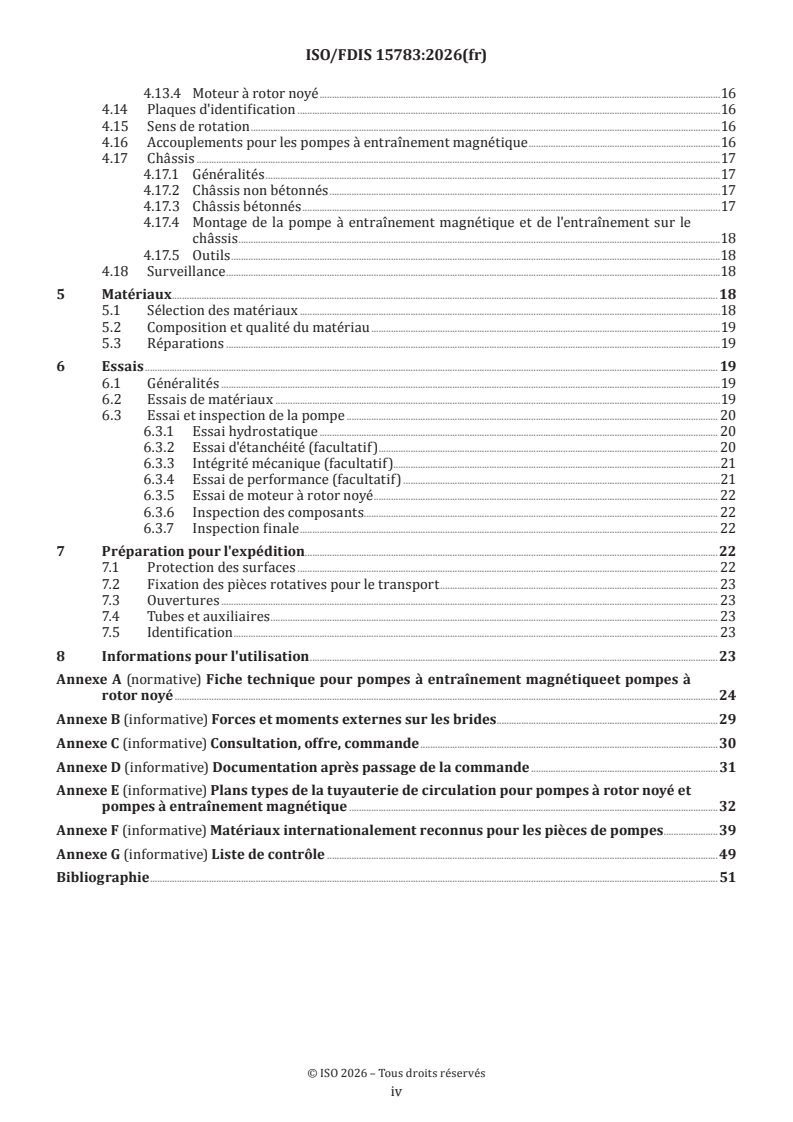
ISO/FDIS 15783 - Pompes rotodynamiques sans dispositif d'étanchéité d'arbre — Classe II — Spécifications
Get Certified
Connect with accredited certification bodies for this standard

Institut za varilstvo d.o.o. (Welding Institute)
Slovenia's leading welding institute since 1952. ISO 3834, EN 1090, pressure equipment certification, NDT personnel, welder qualification. Only IIW Au
Sponsored listings
Frequently Asked Questions
ISO/FDIS 15783 is a draft published by the International Organization for Standardization (ISO). Its full title is "Seal-less rotodynamic pumps — Class II — Specification". This standard covers: 1.1 This International Standard specifies the requirements for seal-less rotodynamic pumps that are driven with permanent magnet coupling (magnet drive pumps) or with canned motor, and which are mainly used in chemical processes, water treatment and petrochemical industries. Their use can be dictated by space, noise, environment or safety regulations. Seal-less pumps are pumps where an inner rotor is completely contained in a pressure vessel holding the pumped fluid. The pressure vessel or primary containment device is sealed by static seals such as gaskets or O-rings. 1.2 Pumps will normally conform to recognized standard specifications (e.g. ISO 5199, explosion protection, electromagnetic compatibility), except where special requirements are specified herein. 1.3 This International Standard includes design features concerned with installation, maintenance and operational safety of the pumps, and defines those items to be agreed upon between the purchaser and manufacturer/supplier. 1.4 Where conformity to this International Standard has been requested and calls for a specific design feature, alternative designs may be offered providing that they satisfy the intent of this International Standard and they are described in detail. Pumps which do not conform with all requirements of this International Standard may also be offered providing that the deviations are fully identified and described. Whenever documents include contradictory requirements, they should be applied in the following sequence of priority: a) purchase order (or inquiry, if no order placed), see annexes D and E; b) data sheet (see annex A) or technical sheet or specification; c) this International Standard; d) other standards.
1.1 This International Standard specifies the requirements for seal-less rotodynamic pumps that are driven with permanent magnet coupling (magnet drive pumps) or with canned motor, and which are mainly used in chemical processes, water treatment and petrochemical industries. Their use can be dictated by space, noise, environment or safety regulations. Seal-less pumps are pumps where an inner rotor is completely contained in a pressure vessel holding the pumped fluid. The pressure vessel or primary containment device is sealed by static seals such as gaskets or O-rings. 1.2 Pumps will normally conform to recognized standard specifications (e.g. ISO 5199, explosion protection, electromagnetic compatibility), except where special requirements are specified herein. 1.3 This International Standard includes design features concerned with installation, maintenance and operational safety of the pumps, and defines those items to be agreed upon between the purchaser and manufacturer/supplier. 1.4 Where conformity to this International Standard has been requested and calls for a specific design feature, alternative designs may be offered providing that they satisfy the intent of this International Standard and they are described in detail. Pumps which do not conform with all requirements of this International Standard may also be offered providing that the deviations are fully identified and described. Whenever documents include contradictory requirements, they should be applied in the following sequence of priority: a) purchase order (or inquiry, if no order placed), see annexes D and E; b) data sheet (see annex A) or technical sheet or specification; c) this International Standard; d) other standards.
ISO/FDIS 15783 is classified under the following ICS (International Classification for Standards) categories: 23.080 - Pumps. The ICS classification helps identify the subject area and facilitates finding related standards.
ISO/FDIS 15783 has the following relationships with other standards: It is inter standard links to FprEN ISO 15783, ISO 4000-1:2021, ISO 15783:2002, ISO 15783:2002/Amd 1:2008. Understanding these relationships helps ensure you are using the most current and applicable version of the standard.
ISO/FDIS 15783 is available in PDF format for immediate download after purchase. The document can be added to your cart and obtained through the secure checkout process. Digital delivery ensures instant access to the complete standard document.
Standards Content (Sample)
FINAL DRAFT
International
Standard
ISO/TC 115/SC 1
Seal-less rotodynamic pumps —
Secretariat: BSI
Class II — Specification
Voting begins on:
Pompes rotodynamiques sans dispositif d'étanchéité d'arbre — 2026-02-05
Classe II — Spécifications
Voting terminates on:
2026-04-02
RECIPIENTS OF THIS DRAFT ARE INVITED TO SUBMIT,
WITH THEIR COMMENTS, NOTIFICATION OF ANY
RELEVANT PATENT RIGHTS OF WHICH THEY ARE AWARE
AND TO PROVIDE SUPPOR TING DOCUMENTATION.
IN ADDITION TO THEIR EVALUATION AS
BEING ACCEPTABLE FOR INDUSTRIAL, TECHNO
ISO/CEN PARALLEL PROCESSING LOGICAL, COMMERCIAL AND USER PURPOSES, DRAFT
INTERNATIONAL STANDARDS MAY ON OCCASION HAVE
TO BE CONSIDERED IN THE LIGHT OF THEIR POTENTIAL
TO BECOME STAN DARDS TO WHICH REFERENCE MAY BE
MADE IN NATIONAL REGULATIONS.
Reference number
FINAL DRAFT
International
Standard
ISO/TC 115/SC 1
Seal-less rotodynamic pumps —
Secretariat: BSI
Class II — Specification
Voting begins on:
Pompes rotodynamiques sans dispositif d'étanchéité d'arbre —
Classe II — Spécifications
Voting terminates on:
RECIPIENTS OF THIS DRAFT ARE INVITED TO SUBMIT,
WITH THEIR COMMENTS, NOTIFICATION OF ANY
RELEVANT PATENT RIGHTS OF WHICH THEY ARE AWARE
AND TO PROVIDE SUPPOR TING DOCUMENTATION.
© ISO 2026
IN ADDITION TO THEIR EVALUATION AS
All rights reserved. Unless otherwise specified, or required in the context of its implementation, no part of this publication may
BEING ACCEPTABLE FOR INDUSTRIAL, TECHNO
ISO/CEN PARALLEL PROCESSING
LOGICAL, COMMERCIAL AND USER PURPOSES, DRAFT
be reproduced or utilized otherwise in any form or by any means, electronic or mechanical, including photocopying, or posting on
INTERNATIONAL STANDARDS MAY ON OCCASION HAVE
the internet or an intranet, without prior written permission. Permission can be requested from either ISO at the address below
TO BE CONSIDERED IN THE LIGHT OF THEIR POTENTIAL
or ISO’s member body in the country of the requester.
TO BECOME STAN DARDS TO WHICH REFERENCE MAY BE
MADE IN NATIONAL REGULATIONS.
ISO copyright office
CP 401 • Ch. de Blandonnet 8
CH-1214 Vernier, Geneva
Phone: +41 22 749 01 11
Email: copyright@iso.org
Website: www.iso.org
Published in Switzerland Reference number
ii
Contents Page
Foreword .v
Introduction .vi
1 Scope . 1
2 Normative references . 1
3 Terms and definitions . 2
4 Design . 4
4.1 General .4
4.1.1 Characteristic curve .4
4.1.2 Net Positive Suction Head (NPSH) .4
4.1.3 Outdoor installation .5
4.2 Prime movers .5
4.2.1 General .5
4.2.2 Magnetic drive pumps .6
4.2.3 Canned motor pumps .7
4.3 Critical speed, balancing and vibrations .8
4.3.1 Critical speed .8
4.3.2 Balancing and vibration .8
4.4 Pressure-containing parts .9
4.4.1 Primary containment .9
4.4.2 Secondary containment .9
4.4.3 Secondary control .10
4.4.4 Pressure-temperature rating . .10
4.4.5 Wall thickness .10
4.4.6 Materials .10
4.4.7 Mechanical features .11
4.5 Branches, nozzles and miscellaneous connections .11
4.5.1 Extent .11
4.5.2 Inlet and outlet branches .11
4.5.3 Venting and draining . 12
4.5.4 Pressure gauge connections . 12
4.5.5 Closures . 12
4.5.6 Auxiliary pipe connections . 12
4.5.7 Connection identification . 12
4.6 External forces and moments on flanges (inlet and outlet) . 12
4.7 Branch (nozzle) flanges. 13
4.8 Impellers . 13
4.8.1 Impeller design . 13
4.8.2 Securing of impellers . 13
4.9 Wear rings or equivalent components . 13
4.10 Running clearance . 13
4.11 Shafts . 13
4.11.1 General . 13
4.11.2 Surface roughness .14
4.12 Bearings .14
4.12.1 General .14
4.12.2 Rolling bearing life .14
4.12.3 Bearing temperature .14
4.12.4 Lubrication .14
4.12.5 Bearing housing design for magnetic drive pumps .14
4.12.6 Sleeve and thrust bearings for the pump shaft .14
4.13 Circulation flow . 15
4.13.1 General . 15
4.13.2 Circulation plans . 15
4.13.3 Magnetic drives . 15
iii
4.13.4 Canned motor . 15
4.14 Nameplates .16
4.15 Direction of rotation .16
4.16 Couplings for magnetic drive pumps .16
4.17 Baseplate .16
4.17.1 General .16
4.17.2 Non-grouted baseplates .17
4.17.3 Grouted baseplates .17
4.17.4 Assembly of magnetic drive pump and driver on baseplate .17
4.17.5 Tools .17
4.18 Monitoring .17
5 Materials .18
5.1 Selection of materials .18
5.2 Material composition and quality .18
5.3 Repairs .18
6 Testing.18
6.1 General .18
6.2 Material tests .19
6.3 Pump test and inspection .19
6.3.1 Hydrostatic test .19
6.3.2 Hermetic integrity test (optional) .19
6.3.3 Mechanical integrity (optional) . 20
6.3.4 Performance test (optional) .21
6.3.5 Canned motor test .21
6.3.6 Inspection of components .21
6.3.7 Final inspection .21
7 Preparation for despatch .21
7.1 Surface protection .21
7.2 Securing of rotating parts for transport . 22
7.3 Openings . 22
7.4 Pipes and auxiliaries . 22
7.5 Identification . 22
8 Information for use .22
Annex A (informative) Data sheet for magnetic drive pumps and canned motor pumps .23
Annex B (informative) External forces and moments on flanges .28
Annex C (informative) Enquiry, proposal and purchase order .29
Annex D (informative) Documentation after purchase order .30
Annex E (informative) Typical circulation piping plans and characteristics for canned motor
pumps and magnetic drive pumps .31
Annex F (informative) Internationally accepted materials for pump parts .37
Annex G (informative) Checklist .45
Bibliography . 47
iv
Foreword
ISO (the International Organization for Standardization) is a worldwide federation of national standards
bodies (ISO member bodies). The work of preparing International Standards is normally carried out through
ISO technical committees. Each member body interested in a subject for which a technical committee
has been established has the right to be represented on that committee. International organizations,
governmental and non-governmental, in liaison with ISO, also take part in the work. ISO collaborates closely
with the International Electrotechnical Commission (IEC) on all matters of electrotechnical standardization.
The procedures used to develop this document and those intended for its further maintenance are described
in the ISO/IEC Directives, Part 1. In particular, the different approval criteria needed for the different types
of ISO documents should be noted. This document was drafted in accordance with the editorial rules of the
ISO/IEC Directives, Part 2 (see www.iso.org/directives).
ISO draws attention to the possibility that the implementation of this document may involve the use of (a)
patent(s). ISO takes no position concerning the evidence, validity or applicability of any claimed patent
rights in respect thereof. As of the date of publication of this document, ISO had not received notice of (a)
patent(s) which may be required to implement this document. However, implementers are cautioned that
this may not represent the latest information, which may be obtained from the patent database available at
www.iso.org/patents. ISO shall not be held responsible for identifying any or all such patent rights.
Any trade name used in this document is information given for the convenience of users and does not
constitute an endorsement.
For an explanation of the voluntary nature of standards, the meaning of ISO specific terms and expressions
related to conformity assessment, as well as information about ISO's adherence to the World Trade
Organization (WTO) principles in the Technical Barriers to Trade (TBT), see www.iso.org/iso/foreword.html.
This document was prepared by Technical Committee ISO/TC 115, Pumps, Subcommittee SC 1, Dimensions
and technical specifications of pumps, in collaboration with the European Committee for Standardization
(CEN) Technical Committee CEN/TC 197, Pumps, in accordance with the Agreement on technical cooperation
between ISO and CEN (Vienna Agreement).
This second edition cancels and replaces the first edition (ISO 15783:2002), which has been technically
revised. It also incorporates the Amendment ISO 15783:2002/Amd.1:2008.
The main changes are as follows:
— Normative references were extensively revised. Some references have been updated.
— Liquid properties were added in 4.2.1.
— Definition of rigid support added in Note of Table 1.
— Annex F was extensively revised. Hastelloy alloy was also added to Table F.1.
— 4.13.1 and 4.13.3 were added to Annex G;
— Bibliography was extensively revised.
Any feedback or questions on this document should be directed to the user’s national standards body. A
complete listing of these bodies can be found at www.iso.org/members.html.
v
Introduction
This document is the first of a series dealing with technical specifications for seal-less pumps; they
correspond to two classes of technical specifications, Classes I and II, of which Class I is the more severe
requirements.
Where a decision may be required by the purchaser, or agreement is required between the purchaser and
manufacturer/supplier, the relevant text is highlighted with • and is listed in Annex G.
vi
FINAL DRAFT International Standard ISO/FDIS 15783:2026(en)
Seal-less rotodynamic pumps — Class II — Specification
1 Scope
This document specifies the requirements for seal-less rotodynamic pumps that are driven with permanent
magnet coupling (magnet drive pumps) or with canned motor, and which are mainly used in chemical
processes, water treatment and petrochemical industries. Their use can be dictated by space, noise,
environment or safety regulations.
Seal-less pumps are pumps where an inner rotor is completely contained in a pressure vessel holding the
pumped fluid. The pressure vessel or primary containment device is sealed by static seals such as gaskets or
O-rings.
Pumps will normally to recognized standard specifications (e.g. ISO 5199, explosion protection,
electromagnetic compatibility), except where special requirements are specified herein.
This document includes design features concerned with installation, maintenance and operational safety of
the pumps, and defines those items to be agreed upon between the purchaser and manufacturer/supplier.
Where conformity to this document has been requested and calls for a specific design feature, alternative
designs can be offered providing that they satisfy the intent of this document and they are described in
detail. Pumps which do not conform with all requirements of this document can also be offered providing
that the deviations are fully identified and described.
Whenever documents include contradictory requirements, they are applied in the following sequence of
priority:
a) purchase order (or inquiry, if no order placed), see Annexes C and D;
b) data sheet (see Annex A) or technical sheet or specification;
c) this document;
d) other standards.
2 Normative references
The following documents are referred to in the text in such a way that some or all of their content constitutes
requirements of this document. For dated references, only the edition cited applies. For undated references,
the latest edition of the referenced document (including any amendments) applies.
ISO 76, Rolling bearings — Static load ratings
ISO 281, Rolling bearings — Dynamic load ratings and rating life
ISO 3744, Acoustics — Determination of sound power levels and sound energy levels of noise sources using sound
pressure — Engineering methods for an essentially free field over a reflecting plane
ISO 3746, Acoustics — Determination of sound power levels and sound energy levels of noise sources using sound
pressure — Survey method using an enveloping measurement surface over a reflecting plane
ISO 5199, Technical specifications for centrifugal pumps — Class II
ISO 7005-1, Pipe flanges — Part 1: Steel flanges for industrial and general service piping systems
ISO 7005-2, Metallic flanges — Part 2: Cast iron flanges
ISO 7005-3, Metallic flanges — Part 3: Copper alloy and composite flanges
ISO 9906, Rotodynamic pumps — Hydraulic performance acceptance tests — Grades 1, 2 and 3
ISO 25178-601, Geometrical product specifications (GPS) — Surface texture: Areal — Part 601: Design and
characteristics of contact (stylus) instruments
IEC 60034 (all parts), Rotating electrical machines
EN 12162, Liquid pumps — Safety requirements — Procedure for hydrostatic testing
3 Terms and definitions
For the purposes of this document, the following terms and definitions apply.
ISO and IEC maintain terminology databases for use in standardization at the following addresses:
— ISO Online browsing platform: available at https:// www .iso .org/ obp
— IEC Electropedia: available at https:// www .electropedia .org/
3.1
magnetic drive pump
MDP
pump in which the shaft power of the drive is transferred to the impeller of the pump by means of a
permanent magnetic field, which passes through a containment barrier (shell) to an inner rotor having
permanent magnets or an induction device
3.2
canned motor pump
CMP
pump in which the stator of an electric motor is separated from the rotor by a sealed containment barrier
(liner)
Note 1 to entry: The rotor runs in the liquid being pumped or in another liquid.
Note 2 to entry: The shaft power is transmitted by means of an electromagnetic field.
3.3
seal-less rotodynamic pump
pump design in which the impeller shaft also carries the rotor of either a canned induction motor or a
synchronous or an asynchronous magnetic drive
Note 1 to entry: The design does not use a dynamic shaft seal as a primary containment device. Static seals are the
means used for containing the fluid.
3.3.1
hydraulic end
end of the pump which transfers mechanical energy into the liquid being pumped
3.3.2
lubrication
flow necessary in a magnetic drive in the area between the inner magnet and the containment shell, or in
a canned motor between the rotor and the sleeve, for dissipation of the heat due to inherent Eddy current
losses in metallic containment shells and frictional heat generation from bearings, and for lubrication
Note 1 to entry: Internal pump bearings are lubricated and cooled by the pumped fluid or an external, compatible
flushing fluid.
3.3.3
close coupled
coupling arrangement in which the motor is supplied with a flange adapter which mounts directly
onto the casing or body of the pump and in which the outer magnet ring is mounted onto the motor shaft
3.3.4
air gap
radial distance between the inner diameter (ID) of the outer magnet assembly and the outer diameter
(OD) of the containment shell
3.4
break-out torque
torque load applied to the drive shaft with the rotor locked at the point at which magnetic decoupling occurs
3.5
magnetic coupling
device which transmits torque through the use of magnet(s) attached to the drive and driven shafts
3.6
inner magnet ring
rows of magnets operating within the containment shell, driven by the outer magnet ring (3.7)
Note 1 to entry: The inner magnet ring is mounted on the same rotating element as the pump impeller.
3.7
outer magnet ring
rows of permanent magnets securely fixed to a carrier, evenly spaced to provide a uniform magnetic field
Note 1 to entry: outer magnet ring, while rotating, transmits power through a containment shell, driving the inner
magnet ring or torque ring.
3.8
Eddy currents
electrical currents generated in a conductive material when strong magnetic fields are rotated around it
3.8.1
Eddy current loss
power loss resulting from Eddy currents (3.8)
Note 1 to entry: The energy in these Eddy currents is normally dissipated as heat due to the electrical resistance of the
material.
3.8.2
decouple
failure of a synchronous magnetic coupling (3.5) to rotate synchronously, or the stall condition of an eddy
current drive
3.9
Containment
3.9.1
sheath
thin-walled hermetically sealed enclosure fitted to the inner rotor enclosing the inner magnet ring (3.6)
(MDP) or rotor laminations (CMP)
Note 1 to entry: See Figures 1 and 2.
3.9.2
shell
hermetically sealed enclosure fitted within the total-gap between the inner magnet ring (3.6) and the outer
magnet ring (3.7) of an MDP and which provides for the primary containment of the pumped liquid
Note 1 to entry: See Figure 2.
3.9.3
liner
hermetically sealed enclosure fitted to the ID of the stator assembly of a CMP and providing for the primary
containment of the pumped liquid
Note 1 to entry: See Figure 1.
3.9.4
secondary containment
backup pressure-containing system using static seals only to contain leakage in the event of failure of the
primary containment by shell (3.9.2) or by liner (3.9.3), and including provisions to indicate a failure of the
containment shell or liner
3.9.5
drive shaft
outer shaft of the magnetic drive coupling
3.9.6
secondary control
minimization of release of pumped liquid in the event of failure of the containment shell (3.9.2) or stator liner
4 Design
4.1 General
4.1.1 Characteristic curve
The characteristic curve shall indicate the permitted operating range of the pump. Pumps should have a
stable characteristic curve. In addition, the characteristic curves for the smallest and largest impeller
diameters shall also be shown.
Minimum and maximum continuous stable flows at which the pump can operate without exceeding the
noise, vibration and temperature limits imposed by this International Standard shall clearly be stated by the
manufacturer/supplier.
4.1.2 Net Positive Suction Head (NPSH)
•The NPSH required (NPSHR) shall be based on cold water testing as determined by testing in accordance
with ISO 9906 unless otherwise agreed.
The manufacturer/supplier shall make available a typical curve as a function of flow for water. NPSHR
curves shall be based upon a head drop of 3 % (NPSH3).
Correction factors for hydrocarbons shall not be applied to the NPSHR curves.
Pumps shall be selected such that the minimum NPSH available (NPSHA) in the installation exceeds the
NPSHR of the pump by at least the specified safety margin. This safety margin shall be not less than 0,5 m,
but the manufacturer/supplier may specify a significantly higher margin depending on factors including the
following:
— size, type, specific speed, hydraulic geometry or design of the pump;
— operating speed or inlet velocity;
— the pumped liquid and temperature;
— the cavitation erosion resistance of the construction materials.
4.1.3 Outdoor installation
The pumps shall be suitable for outdoor installation under normal ambient conditions.
•Local regulations or extraordinary ambient conditions, such as high or low temperatures, corrosive
environment, sandstorms, for which the pump is required to be suitable should be specified by the purchaser.
4.2 Prime movers
4.2.1 General
The following shall be considered when determining the power/speed requirements of the pump.
a) The application and method of operation of the pump. For example, in an installation intended for
parallel operation, the possible performance range with only one pump in operation, taking into account
the system characteristic.
b) The position of the operating point on the pump characteristic curve.
c) The circulation flow for lubrication of bearings and removal of heat losses (especially for pumps with
low rates of flow).
d) Properties of the pumped liquid (viscosity, solids content, density, specific heat, vapour pressure).
e) Power loss, including slip loss through transmission (only magnet drive pumps).
f) Atmospheric conditions at the pump site.
g) Starting method of the pump:
— if a pump (e.g., a stand-by pump) is started automatically then consideration shall be given to whether
the pump may start against a closed valve, or whether the pump may start against an open valve
or be pumping into an empty pipeline; i.e. operates within a pumping system in which the pump
pressure is provided only for pipeline friction losses.
h) For variable speed arrangements the minimum continuous speed shall be indicated by the manufacturer/
supplier to ensure proper cooling and lubrication of the bearings.
Prime movers required as drivers for seal-less pumps covered by this International Standard shall have
power output ratings at least equal to the percentage of rated power input given in Figure 1, this value never
being less than 1 kW.
Where it appears that this will lead to unnecessary oversizing of the driver, an alternative proposal shall be
submitted for the purchaser's approval.
Key
X pump power input at rated conditions, kW
Y prime mover output, percentage of pump power input at rated conditions, %
Figure 1 — Prime mover output, percentage of pump power input at rated conditions
4.2.2 Magnetic drive pumps
When determining the permanent magnetic drive to be used, the following points shall be taken into
consideration in addition to the points a) to h) listed under 4.2.1.
a) The magnetic drive shall be selected for the allowed operating range with the selected impeller diameter
at operating temperature and taking into consideration the characteristics of the liquid to be pumped.
•If the density of the liquid of the normal operation is below 1 000 kg/m special agreements between
the manufacturer/supplier and purchaser for testing and cleaning shall be made.
b) Heat generated by Eddy current losses, power losses in the shell, power losses in the bearings and power
losses due to liquid circulation shall be removed by pumped liquid or by supply of external cooling fluid.
c) The magnetic material temperature shall be maintained at or below rated values for the material used.
Magnetic materials should not be subject to irreversible losses.
d) The irreversible magnetic losses at operating temperatures of the magnetic drive shall be considered.
Fluids containing magnetically attracted particles should be avoided unless such particles can be effectively
removed.
Special arrangements may be provided to avoid formation of ice in air gaps when pumping cold liquids.
The magnetic drive shall be designed in such a manner that start-up will not cause the magnet assemblies to
decouple, see Figure 2.
Key
1 hydraulic end
2 bearing
3 shell
4 bearing housing
5 rolling bearing
6 coupling
7 prime mover
8 baseplate
9 sheath: inner magnet ring
10 outer magnet ring
Figure 2 — Example of a magnetic drive pump (MDP)
4.2.3 Canned motor pumps
Canned motors are generally cooled by circulation of pumped liquid or by the use of coolant liquid to remove
heat generated by the containment liner, Eddy current losses, motor electrical losses and mechanical losses.
Stator winding temperatures shall be maintained at or below values established for the grade of insulation
used, see Figure 3.
When rating a canned motor, the conditions listed below shall be taken into consideration in addition to
points a) to h) listed under 4.2.1:
— power losses within the canned rotor;
— power losses in the bearings;
— power losses due to liquid circulation;
— explosion protection requirements.
Manufacturers/suppliers shall specify external cooling requirements when required.
Stand-by units may require special arrangements for flushing and/or heating to prevent the settling out of
solids, or the formation of ice, or solidification or too low viscosity of the liquid to be pumped.
•The details of such arrangements should be agreed upon between the purchaser and manufacturer/
supplier.
Key
1 hydraulic end
2 bearing
3 liner
4 terminal box
5 stator assembly
6 rotor sheath
7 rotor
Figure 3 — Example of a canned motor pump (CMP)
4.3 Critical speed, balancing and vibrations
4.3.1 Critical speed
The critical speed shall be calculated with liquid.
•For some pump types (e.g., vertical line shaft and horizontal multistage), the first critical speed may be
below the operating speed when agreed between the purchaser and manufacturer/supplier.
Particular attention shall be paid to the critical speed when the pump is to be driven at variable speed.
4.3.2 Balancing and vibration
4.3.2.1 General
All major rotating components shall be balanced.
4.3.2.2 Horizontal pumps
Unfiltered vibration shall not exceed the vibration severity limits as given in Table 1 when measured on the
1)
manufacturer's/supplier's test facilities . These values are measured radially at the bearing housing at a
single operating point at rated speed (±5 %) and rated flow (±5 %) when operating without cavitation.
The manufacturer/supplier shall determine the grade of balancing required in order to achieve acceptable
vibration levels within the limits specified in this International Standard.
NOTE This can normally be achieved by balancing in accordance with a minimum of class G6.3 of ISO 21940-11
1) For in situ acceptance limits refer to ISO 20816-3.
Table 1 — Maximum allowable unfiltered vibration values in millimetres per second
Pump type and criterion
Pump arrangement
Canned motor pump Magnetic drive pump
Pump with rigid support centre-
2,3 3,0
line height ≤225 mm
Pump with rigid support centre-
3,0 4,5
line height >225 mm
Pump with flexible support 3,0 4,5
NOTE 1 The values of vibration velocity filtered for rotating frequency and blade passing frequency
can be expected to be lower than given in the table.
NOTE 2 A rigid support is one where the lowest natural frequency of the combined machine and
support system in the direction of measurement is at least 25 % higher than the rotational frequency.
Any other support is considered flexible.
4.3.2.3 Vertical pumps
Vibration readings shall be taken on the top flange of the driver mounting on vertical pumps with rigid
couplings and near to the top pump bearing on vertical pumps with flexible couplings.
Vibration limits for both rolling and sleeve bearing pumps shall not exceed the vibration severity limits as
2)
given in Table 1 during shop test at rated speed (±5 %) and rated flow (±5 %) operating without cavitation .
4.4 Pressure-containing parts
4.4.1 Primary containment
Containment of the pumped liquid shall be by means able to withstand the stresses derived from the
maximum allowable working pressure and any dynamic effects of operation. The wetted materials shall be
compatible with each other and the pumped liquid, and shall be dimensioned to give an adequate working
life.
It is recognized that several effective methods are suitable for the design of pressure-containing parts. These
may be based upon recognized national codes or upon other proven methods. To satisfy the acceptance
criteria, each design method shall
— be a written procedure,
— recognize limits of material stresses,
— incorporate a checking stage, and
— have been proven empirically or experimentally.
4.4.2 Secondary containment
Where containment of any leakage is considered to be desirable, the pump shall be provided with a
secondary containment.
The secondary containment shall be designed to allow installation of a sensor by the purchaser to indicate
change in status and either to shut-down the pump or to warn that attention and rectification is required.
The secondary containment shall sustain this condition when exposed to the pumped liquid for a minimum
of 48 h. It shall be capable of containment under the maximum allowable working pressure, temperature
and any dynamic effects from operation.
2) For in situ acceptance limits refer to ISO 20816-3.
4.4.3 Secondary control
Where the liquid is less hazardou
...
ISO/TC 115/SC 1
Secretariat: BSI
Date: 2025-12-012026-xx
Seal-less rotodynamic pumps — Class II — Specification
Pompes rotodynamiques sans dispositif d'étanchéité d'arbre — Classe II — Spécifications
FDIS stage
TThhiiss dr draafftt i iss susubbmmiitttteed d ttoo aa ppaarraallellel l vvoottee i inn IISSOO,, CCEEN.N.
All rights reserved. Unless otherwise specified, or required in the context of its implementation, no part of this publication
may be reproduced or utilized otherwise in any form or by any means, electronic or mechanical, including photocopying,
or posting on the internet or an intranet, without prior written permission. Permission can be requested from either ISO
at the address below or ISO’s member body in the country of the requester.
ISO copyright office
CP 401 • Ch. de Blandonnet 8
CH-1214 Vernier, Geneva
Phone: + 41 22 749 01 11
EmailE-mail: copyright@iso.org
Website: www.iso.org
Published in Switzerland
ii
Contents
Foreword . v
Introduction . vi
1 Scope . 1
2 Normative references . 1
3 Terms and definitions . 2
4 Design . 5
4.1 General . 5
4.2 Prime movers . 6
4.3 Critical speed, balancing and vibrations . 9
4.4 Pressure-containing parts . 10
4.5 Branches, nozzles and miscellaneous connections . 13
4.6 External forces and moments on flanges (inlet and outlet) . 14
4.7 Branch (nozzle) flanges . 14
4.8 Impellers . 14
4.9 Wear rings or equivalent components . 14
4.10 Running clearance . 14
4.11 Shafts . 15
4.12 Bearings . 15
4.13 Circulation flow . 16
4.14 Nameplates . 17
4.15 Direction of rotation . 17
4.16 Couplings for magnetic drive pumps . 17
4.17 Baseplate . 18
4.18 Monitoring . 19
5 Materials. 19
5.1 Selection of materials . 19
5.2 Material composition and quality . 20
5.3 Repairs . 20
6 Testing . 20
6.1 General . 20
6.2 Material tests . 20
6.3 Pump test and inspection . 20
7 Preparation for despatch . 23
7.1 Surface protection . 23
7.2 Securing of rotating parts for transport . 24
7.3 Openings . 24
7.4 Pipes and auxiliaries . 24
7.5 Identification . 24
8 Information for use . 24
Annex A (informative) Data sheet for magnetic drive pumps and canned motor pumps . 25
Annex B (informative) External forces and moments on flanges . 30
Annex C (informative) Enquiry, proposal and purchase order . 31
Annex D (informative) Documentation after purchase order . 32
Annex E (informative) Typical circulation piping plans and characteristics for canned motor
pumps and magnetic drive pumps . 33
iii
Annex F (informative) Internationally accepted materials for pump parts . 39
Annex G (informative) Checklist . 48
Bibliography . 50
iv
Foreword
ISO (the International Organization for Standardization) is a worldwide federation of national standards
bodies (ISO member bodies). The work of preparing International Standards is normally carried out through
ISO technical committees. Each member body interested in a subject for which a technical committee has been
established has the right to be represented on that committee. International organizations, governmental and
non-governmental, in liaison with ISO, also take part in the work. ISO collaborates closely with the
International Electrotechnical Commission (IEC) on all matters of electrotechnical standardization.
The procedures used to develop this document and those intended for its further maintenance are described
in the ISO/IEC Directives, Part 1. In particular, the different approval criteria needed for the different types of
ISO documents should be noted. This document was drafted in accordance with the editorial rules of the
ISO/IEC Directives, Part 2 (see www.iso.org/directives).
ISO draws attention to the possibility that the implementation of this document may involve the use of (a)
patent(s). ISO takes no position concerning the evidence, validity or applicability of any claimed patent rights
in respect thereof. As of the date of publication of this document, ISO [had/had not] received notice of (a)
patent(s) which may be required to implement this document. However, implementers are cautioned that this
may not represent the latest information, which may be obtained from the patent database available at
www.iso.org/patents. ISO shall not be held responsible for identifying any or all such patent rights.
Any trade name used in this document is information given for the convenience of users and does not
constitute an endorsement.
For an explanation of the voluntary nature of standards, the meaning of ISO specific terms and expressions
related to conformity assessment, as well as information about ISO's adherence to the World Trade
Organization (WTO) principles in the Technical Barriers to Trade (TBT), see www.iso.org/iso/foreword.html.
This document was prepared by Technical Committee ISO/TC 115, Pumps, Subcommittee SC 1, Dimensions
and technical specifications of pumps., in collaboration with the European Committee for Standardization
(CEN) Technical Committee CEN/TC 197, Pumps,in accordance with the Agreement on technical cooperation
between ISO and CEN (Vienna Agreement).
This second edition cancels and replaces the first edition (ISO 15783:2002), which has been technically
revised. It also incorporates the Amendment ISO 15783:2002/Amd.1:2008.
The main changes compared to the previous edition are as follows:
— — Normative references were extensively revised. Some references have been updated.
— — Liquid properties were added in 4.2.14.2.1.
— — Definition of rigid support added in Note of Table 1table 1.
— Annex F— Annex F was extensively revised. Hastelloy alloy was also added to Table F.1Table F1.
— 4.13.1— 4.13.1 and 4.13.34.13.3 paragraphs were added to Annex Ginformative Annex G;;
— — Bibliography was extensively revised.
Any feedback or questions on this document should be directed to the user’s national standards body. A
complete listing of these bodies can be found at www.iso.org/members.html.
v
Introduction
This International Standarddocument is the first of a series dealing with technical specifications for seal-less
pumps; they correspond to two classes of technical specifications, Classes I and II, of which Class I is the more
severe requirements.
Where a decision may be required by the purchaser, or agreement is required between the purchaser and
manufacturer/supplier, the relevant text is highlighted with • and is listed in Annex Gannex G.
vi
Seal-less rotodynamic pumps — Class II — Specification
1 Scope
This International Standarddocument specifies the requirements for seal-less rotodynamic pumps that are
driven with permanent magnet coupling (magnet drive pumps) or with canned motor, and which are mainly
used in chemical processes, water treatment and petrochemical industries. Their use can be dictated by space,
noise, environment or safety regulations.
Seal-less pumps are pumps where an inner rotor is completely contained in a pressure vessel holding the
pumped fluid. The pressure vessel or primary containment device is sealed by static seals such as gaskets or
O-rings.
Pumps will normally to recognized standard specifications (e.g. ISO 5199, explosion protection,
electromagnetic compatibility), except where special requirements are specified herein.
This International Standarddocument includes design features concerned with installation, maintenance and
operational safety of the pumps, and defines those items to be agreed upon between the purchaser and
manufacturer/supplier.
Where conformity to this International Standarddocument has been requested and calls for a specific design
feature, alternative designs maycan be offered providing that they satisfy the intent of this International
Standarddocument and they are described in detail. Pumps which do not conform with all requirements of
this International Standard maydocument can also be offered providing that the deviations are fully identified
and described.
Whenever documents include contradictory requirements, they are applied in the following sequence of
priority:
a) a) purchase order (or inquiry, if no order placed), see Annexes Cannexes C and DD;;
b) b) data sheet (see Annex Aannex A)) or technical sheet or specification;
c) c) this International Standarddocument;
d) d) other standards.
2 Normative references
The following documents are referred to in the text in such a way that some or all of their content constitutes
requirements of this document. For dated references, only the edition cited applies. For undated references,
the latest edition of the referenced document (including any amendments) applies.
ISO 76, Rolling bearings — Static load ratings
ISO 281, Rolling bearings — Dynamic load ratings and rating life
ISO 25178-601, Geometrical product specifications (GPS) — Surface texture: Areal — Part 601: Design and
characteristics of contact (stylus) instruments
Commented [eXtyles1]: The match came back with a
different title. The original title was: Geometrical Product
Specifications (GPS) — Surface texture: Profile method —
ISO 3744, Acoustics — Determination of sound power levels and sound energy levels of noise sources using sound
Nominal characteristics of contact (stylus) instruments
pressure — Engineering methods for an essentially free field over a reflecting plane
Commented [eXtyles2]: eXtyles Inline Standards Citation
Match reports that the normative reference "ISO 25178-601"
is not cited in the text.
ISO 3746, Acoustics — Determination of sound power levels and sound energy levels of noise sources using sound
pressure — Survey method using an enveloping measurement surface over a reflecting plane
ISO 5199, Technical specifications for centrifugal pumps — Class II
ISO 7005--1, Pipe flanges — Part 1: Steel flanges for industrial and general service piping systems
ISO 7005--2, Metallic flanges — Part 2: Cast iron flanges
ISO 7005--3, Metallic flanges — Part 3: Copper alloy and composite flanges
ISO 9906, Rotodynamic pumps — Hydraulic performance acceptance tests — Grades 1, 2 and 3
ISO 25178-601, Geometrical product specifications (GPS) — Surface texture: Areal — Part 601: Design and
characteristics of contact (stylus) instruments
IEC 60034-1, (all parts), Rotating electrical machines — Part 1: Rating and performance
EN 12162, Liquid pumps — Safety requirements — Procedure for hydrostatic testing
3 Terms and definitions
For the purposes of this document, the following terms and definitions apply.
ISO and IEC maintain terminology databases for use in standardization at the following addresses:
— ISO Online browsing platform: available at https://www.iso.org/obp
— IEC Electropedia: available at https://www.electropedia.org/3.1
3.1
magnetic drive pump
MDP
pump in which the shaft power of the drive is transferred to the impeller of the pump by means of a permanent
magnetic field, which passes through a containment barrier (shell) to an inner rotor having permanent
magnets or an induction device
3.2 3.2
canned motor pump
CMP
pump in which the stator of an electric motor is separated from the rotor by a sealed containment barrier
(liner)
Note 1 to entry: The rotor runs in the liquid being pumped or in another liquid.
Note 2 to entry: The shaft power is transmitted by means of an electromagnetic field.
3.3 3.3
seal-less rotodynamic pump
pump design in which the impeller shaft also carries the rotor of either a canned induction motor or a
synchronous or an asynchronous magnetic drive
Note 1 to entry: The design does not use a dynamic shaft seal as a primary containment device. Static seals are the
means used for containing the fluid.
3.3.1 3.3.1
hydraulic end
end of the pump which transfers mechanical energy into the liquid being pumped
3.3.2 3.3.2
lubrication
flow necessary in a magnetic drive in the area between the inner magnet and the containment shell, or in a
canned motor between the rotor and the sleeve, for dissipation of the heat due to inherent Eddy current losses
in metallic containment shells and frictional heat generation from bearings, and for lubrication.
Note 1 to entry: Internal pump bearings are lubricated and cooled by the pumped fluid or an external, compatible
flushing fluid.
3.3.3 3.3.3
close coupled
coupling arrangement in which the motor is supplied with a flange adapter which mounts directly
onto the casing or body of the pump and in which the outer magnet ring is mounted onto the motor shaft
3.3.4 3.3.4
air gap
radial distance between the inner diameter (ID) of the outer magnet assembly and the outer diameter
(OD) of the containment shell
3.4 3.4
break-out torque
torque load applied to the drive shaft with the rotor locked at the point at which magnetic decoupling occurs
3.5 3.5
magnetic coupling
device which transmits torque through the use of magnet(s) attached to the drive and driven shafts
3.6 3.6
inner magnet ring
rows of magnets operating within the containment shell, driven by the outer magnet ring (3.7)
Note 1 to entry: The inner magnet ring is mounted on the same rotating element as the pump impeller.
3.7 3.7
outer magnet ring
rows of permanent magnets securely fixed to a carrier, evenly spaced to provide a uniform magnetic field
Note 1 to entry: outer magnet ring, while rotating, transmits power through a containment shell, driving the inner
magnet ring or torque ring.
3.8 3.8
Eddy currents
electrical currents generated in a conductive material when strong magnetic fields are rotated around it
3.8.1
eddy current drive
Commented [eXtyles3]: The term "eddy current drive" is
used only in terms and definitions section
asynchronous magnetic coupling consisting of a permanent outer magnet ring and an inner torque ring
containing a network of conductive rods supported on a mild steel core
Note 1 to entry: The rotating outer magnet ring generates eddy currents in the copper rods which convert the core to an
electromagnet. The electromagnet follows the rotating outer magnet ring but at a slightly slower speed due to slip.
3.8.53.8.1 3.8.2
Eddy current loss
power loss resulting from Eddy currents (3.8)
Note 1 to entry: The energy in these Eddy currents is normally dissipated as heat due to the electrical resistance of the
material.
3.8.3
torque ring
Commented [eXtyles4]: The term "torque ring" is used
only in terms and definitions section
laminations and conductors mounted on the rotor in which electric currents are induced in an eddy current
drive
3.8.93.8.2 3.8.4
decouple
failure of a synchronous magnetic coupling (3.5) to rotate synchronously, or the stall condition of an eddy
current drive
3.9 3.9
Containment
3.9.1 3.9.1
sheath
thin-walled hermetically sealed enclosure fitted to the inner rotor enclosing the inner magnet ring (3.6) (MDP)
or rotor laminations (CMP)
Note 1 to entry: See Figures 1Figures 1 and 22.
3.9.2 3.9.2
shell
hermetically sealed enclosure fitted within the total-gap between the inner magnet ring (3.6) and the outer
magnet ring (3.7rings) of an MDP and which provides for the primary containment of the pumped liquid
Note 1 to entry: See Figure 2Figure 2.
3.9.3 3.9.3
liner
hermetically sealed enclosure fitted to the ID of the stator assembly of a CMP and providing for the primary
containment of the pumped liquid
Note 1 to entry: See Figure 1Figure 1.
3.9.4 3.9.4
secondary containment
backup pressure-containing system using static seals only to contain leakage in the event of failure of the
primary containment by shell (3.9.2(3.9.2)) or by liner (3.9.3(3.9.3),), and including provisions to indicate a
failure of the containment shell or liner
3.9.5 3.9.5
drive shaft
outer shaft of the magnetic drive coupling
3.9.6 3.9.6
secondary control
minimization of release of pumped liquid in the event of failure of the containment shell (3.9.2(3.9.2)) or stator
liner
15783_ed2fig1.EPS
Key
1 hydraulic end
2 bearing
3 liner
4 terminal box
5 stator assembly
6 rotor sheath
7 rotor
Figure 1 — Example of a canned motor pump (CMP)
15783_ed2fig2.EPS
Key
1 hydraulic end
2 bearing
3 shell
4 bearing housing
5 rolling bearing
6 coupling
7 prime mover
8 baseplate
9 sheath: inner magnet ring
10 outer magnet ring
Figure 2 — Example of a magnetic drive pump (MDP)
274 Design
27.14.1 General
27.1.14.1.1 Characteristic curve
The characteristic curve shall indicate the permitted operating range of the pump. Pumps should have a stable
characteristic curve. In addition, the characteristic curves for the smallest and largest impeller diameters shall
also be shown.
Minimum and maximum continuous stable flows at which the pump can operate without exceeding the noise,
vibration and temperature limits imposed by this International Standard shall clearly be stated by the
manufacturer/supplier.
27.1.24.1.2 Net Positive Suction Head (NPSH)
•The NPSH required (NPSHR) shall be based on cold water testing as determined by testing in accordance
with ISO 9906 unless otherwise agreed.
The manufacturer/supplier shall make available a typical curve as a function of flow for water. NPSHR curves
shall be based upon a head drop of 3 % (NPSH3).
Correction factors for hydrocarbons shall not be applied to the NPSHR curves.
Pumps shall be selected such that the minimum NPSH available (NPSHA) in the installation exceeds the NPSHR
of the pump by at least the specified safety margin. This safety margin shall be not less than 0,5 m, but the
manufacturer/supplier may specify a significantly higher margin depending on factors including the
following:
— — size, type, specific speed, hydraulic geometry or design of the pump;
— — operating speed or inlet velocity;
— — the pumped liquid and temperature;
— — the cavitation erosion resistance of the construction materials.
27.1.34.1.3 Outdoor installation
The pumps shall be suitable for outdoor installation under normal ambient conditions.
•Local regulations or extraordinary ambient conditions, such as high or low temperatures, corrosive
environment, sandstorms, for which the pump is required to be suitable should be specified by the purchaser.
27.24.2 Prime movers
27.2.14.2.1 General
The following shall be considered when determining the power/speed requirements of the pump.
a) a) The application and method of operation of the pump. For example, in an installation intended
for parallel operation, the possible performance range with only one pump in operation, taking into
account the system characteristic.
b) b) The position of the operating point on the pump characteristic curve.
c) c) The circulation flow for lubrication of bearings and removal of heat losses (especially for
pumps with low rates of flow).
d) d) Properties of the pumped liquid (viscosity, solids content, density, specific heat, vapour
pressure).
e) e) Power loss, including slip loss through transmission (only magnet drive pumps).
f) f) Atmospheric conditions at the pump site.
g) g) Starting method of the pump:
— — if a pump (e.g., a stand-by pump) is started automatically then consideration shall be given to
whether the pump may start against a closed valve, or whether the pump may start against an open
valve or be pumping into an empty pipeline; i.e. operates within a pumping system in which the pump
pressure is provided only for pipeline friction losses.
h) h) For variable speed arrangements the minimum continuous speed shall be indicated by the
manufacturer/ supplier to ensure proper cooling and lubrication of the bearings.
Prime movers required as drivers for seal-less pumps covered by this International Standard shall have power
output ratings at least equal to the percentage of rated power input given in Figure 1Figure 3,, this value never
being less than 1 kW.
Where it appears that this will lead to unnecessary oversizing of the driver, an alternative proposal shall be
submitted for the purchaser's approval.
15783_ed2fig3.EPS
Key
X pump power input at rated conditions, kW
Y prime mover output, percentage of pump power input at rated conditions, %
Figure 3 1 — Prime mover output, percentage of pump power input at rated conditions
27.2.24.2.2 Magnetic drive pumps
When determining the permanent magnetic drive to be used, the following points shall be taken into
consideration in addition to the points a) to h) listed under 4.2.14.2.1.
a) a) The magnetic drive shall be selected for the allowed operating range with the selected impeller
diameter at operating temperature and taking into consideration the characteristics of the liquid to be
pumped.
•If the density of the liquid of the normal operation is below 1 000 kg/m special agreements between the
manufacturer/supplier and purchaser for testing and cleaning shall be made.
b) b) Heat generated by Eddy current losses, power losses in the shell, power losses in the bearings
and power losses due to liquid circulation shall be removed by pumped liquid or by supply of external
cooling fluid.
c) c) The magnetic material temperature shall be maintained at or below rated values for the
material used. Magnetic materials should not be subject to irreversible losses.
d) d) The irreversible magnetic losses at operating temperatures of the magnetic drive shall be
considered.
Fluids containing magnetically attracted particles should be avoided unless such particles can be effectively
removed.
Special arrangements may be provided to avoid formation of ice in air gaps when pumping cold liquids.
The magnetic drive shall be designed in such a manner that start-up will not cause the magnet assemblies to
decouple, see Figure 2.
Key
1 hydraulic end
2 bearing
3 shell
4 bearing housing
5 rolling bearing
6 coupling
7 prime mover
8 baseplate
9 sheath: inner magnet ring
10 outer magnet ring
Figure 2 — Example of a magnetic drive pump (MDP)
27.2.34.2.3 Canned motor pumps
Canned motors are generally cooled by circulation of pumped liquid or by the use of coolant liquid to remove
heat generated by the containment liner, Eddy current losses, motor electrical losses and mechanical losses.
Stator winding temperatures shall be maintained at or below values established for the grade of insulation
used, see Figure 3.
When rating a canned motor, the conditions listed below shall be taken into consideration in addition to points
a) to h) listed under 4.2.14.2.1::
— — power losses within the canned rotor;
— — power losses in the bearings;
— — power losses due to liquid circulation;
— — explosion protection requirements.
Manufacturers/suppliers shall specify external cooling requirements when required.
Stand-by units may require special arrangements for flushing and/or heating to prevent the settling out of
solids, or the formation of ice, or solidification or too low viscosity of the liquid to be pumped.
•The details of such arrangements should be agreed upon between the purchaser and manufacturer/supplier.
Key
1 hydraulic end
2 bearing
3 liner
4 terminal box
5 stator assembly
6 rotor sheath
7 rotor
Figure 3 — Example of a canned motor pump (CMP)
27.34.3 Critical speed, balancing and vibrations
27.3.14.3.1 Critical speed
The critical speed shall be calculated with liquid.
•For some pump types (e.g., vertical line shaft and horizontal multistage), the first critical speed may be below
the operating speed when agreed between the purchaser and manufacturer/supplier.
Particular attention shall be paid to the critical speed when the pump is to be driven at variable speed.
27.3.24.3.2 Balancing and vibration
27.3.2.14.3.2.1 General
All major rotating components shall be balanced.
27.3.2.24.3.2.2 Horizontal pumps
Unfiltered vibration shall not exceed the vibration severity limits as given in Table 1Table 1 when measured
1)
on the manufacturer's/supplier's test facilities. . These values are measured radially at the bearing housing
at a single operating point at rated speed (±5 %) and rated flow (±5 %) when operating without cavitation.
1)
For in situ acceptance limits refer to ISO 20816-3.
The manufacturer/supplier shall determine the grade of balancing required in order to achieve acceptable
vibration levels within the limits specified in this International Standard.
NOTE This can normally be achieved by balancing in accordance with a minimum of class G6.3 of ISO 21940-11
Table 1 — Maximum allowable unfiltered vibration values Values in millimetres per second (mm/s)
Pump type and criterion
Pump arrangement
Canned motor pump Magnetic drive pump
Pump with rigid support
2,3 3,0
centreline height ≤ 225 mm
Pump with rigid support
3,0 4,5
centreline height > 225 mm
Pump with flexible support 3,0 4,5
NOTE 1 The values of vibration velocity filtered for rotating frequency and blade passing
frequency can be expected to be lower than given in the table.
NOTE 2 A rigid support is one where the lowest natural frequency of the combined machine
and support system in the direction of measurement is at least 25 % higher than the rotational
frequency. Any other support is considered flexible.
27.3.2.34.3.2.3 Vertical pumps
Vibration readings shall be taken on the top flange of the driver mounting on vertical pumps with rigid
couplings and near to the top pump bearing on vertical pumps with flexible couplings.
Vibration limits for both rolling and sleeve bearing pumps shall not exceed the vibration severity limits as
given in Table 1Table 1 during shop test at rated speed (±5 %) and rated flow (±5 %) operating without
2)
cavitation. .
27.44.4 Pressure-containing parts
27.4.14.4.1 Primary containment
Containment of the pumped liquid shall be by means able to withstand the stresses derived from the maximum
allowable working pressure and any dynamic effects of operation. The wetted materials shall be compatible
with each other and the pumped liquid, and shall be dimensioned to give an adequate working life.
It is recognized that several effective methods are suitable for the design of pressure-containing parts. These
may be based upon recognized national codes or upon other proven methods. To satisfy the acceptance
criteria, each design method shall
— — be a written procedure,
— — recognize limits of material stresses,
— — incorporate a checking stage, and
— — have been proven empirically or experimentally.
2)
For in situ acceptance limits refer to ISO 20816-3.
27.4.24.4.2 Secondary containment
Where containment of any leakage is considered to be desirable, the pump shall be provided with a secondary
containment.
The secondary containment shall be designed to allow installation of a sensor by the purchaser to indicate
change in status and either to shut-down the pump or to warn that attention and rectification is required. The
secondary containment shall sustain this condition when exposed to the pumped liquid for a minimum of 48 h.
It shall be capable of containment under the maximum allowable working pressure, temperature and any
dynamic effects from operation.
27.4.34.4.3 Secondary control
Where the liquid is less hazardous, but uncontrolled leakage is unacceptable for environmental or personal
comfort reasons, the pump shall be provided with a means to control leakage from the primary containment.
Secondary control shall provide a safe means to collect leakage from the primary containment and present it
in a manner that will allow its safe disposal. The manufacturer/supplier shall define the maximum allowable
working pressure and provide a disposal connection capable of discharging 20 % of the pump flow rate
without this pressure being exceeded.
27.4.44.4.4 Pressure-temperature rating
The maximum allowable working pressure of the pump at the most severe operating conditions shall be
clearly stated by the manufacturer/supplier. In no case shall the maximum allowable working pressure of the
pump exceed the flange rating.
The basic design pressure of the pump shall be at least a gauge pressure of 1,6 MPa (16 bar) at 20 °C when the
tensile requirements of the material permit.
In the case of materials whose strength does not permit the basic design pressure for 1,6 MPa (16 bar) rating
at 20 °C, or where the pump is to be used at temperatures other than 20 °C, the pressure rating shall be
adjusted according to the stress-temperature characteristics of the material and shall be clearly stated by the
manufacturer/supplier.
The containment shell/liner shall be resistant to a pressure of 10 kPa (0,1 bar) absolute and designed for a
gauge pressure of 1,6 MPa (16 bar) at 250 °C in the case of metallic materials, and to a vacuum of 50 kPa
(0,5 bar) absolute and a gauge pressure of 1,6 MPa (16 bar) at 20 °C in the case of non-metallic materials.
27.4.54.4.5 Wall thickness
27.4.5.14.4.5.1 General
Pressure-containing parts, including containment shell/liner, shall be dimensioned so that they are capable of
withstanding the allowable working pressure at working temperature without deformation which interferes
with the safe operation of the pump. The test pressure shall not cause any permanent deformation in
accordance with 6.3.16.3.1. The casing shall also be suitable for the hydrostatic test pressure (see 6.3.16.3.1))
at ambient temperature.
•The corrosion allowance for all pressure-containing parts, excluding the shell/liner, shall be agreed upon
between the purchaser and manufacturer/supplier by consideration of corrosion rates for the liquids and
materials involved.
27.4.5.24.4.5.2 Magnetic drive pumps
The containment shell shall be made of corrosion-resistant material of not less than 1 mm thickness, which
shall include an allowance for any corrosion loss, as agreed upon by the purchaser.
27.4.5.34.4.5.3 Canned motor pumps
The minimum wall thickness of the liner shall be 0,3 mm and be of corrosion-resistant material.
27.4.64.4.6 Materials
The materials used for pressure-containing parts shall depend on the liquid pumped and the application of
the pump (see Clause 5clause 5).).
27.4.74.4.7 Mechanical features
27.4.7.14.4.7.1 Dismantling
The pump shall preferably be designed in back-pull-out construction in order to permit removal of the
impeller, shaft, magnetic drive and bearing assembly without disturbing the inlet and outlet flange
connections. Provision shall be made for easy separation of components (e.g.,. jackscrews).
27.4.7.24.4.7.2 Jackscrews
When jackscrews are supplied as a means of separating contacting faces, the mating face shall be counter-
bored to receive the jackscrews where damage to the surface offers a possibility of a leaking joint or a poor fit.
Socket head screws shall be avoided, if possible.
27.4.7.34.4.7.3 Heating and cooling jackets
Jackets for heating and cooling shall be provided where required.
Heating jackets shall be designed for an operating pressure of at least 600 kPa (6 bar) at 200 °C (steam) or
600 kPa (6 bar) at 350 °C (heat transfer fluid). Cooling jackets shall be designed for a minimum operating
pressure of 600 kPa (6 bar) at 170 °C.
The manufacturer/supplier shall specify when external heating or cooling is required. Annex EAnnex E gives
typical systems.
27.4.7.44.4.7.4 Pressure-containment gaskets
Pressure-containment gaskets shall be of a design suitable for the allowable working conditions and for
hydrostatic test conditions. They shall be confined to the atmospheric side to prevent blow-out.
27.4.7.54.4.7.5 External bolting
Bolts or studs connecting pressure-containing parts, such as pump casing and cover including magnetic
coupling or canned motor, shall have a minimum size of 12 mm.
NOTE If owing to space limitations, the use of M 12 bolts or studs is impractibleimpracticable, smaller bolts or studs
might beare permitted.
The bolting selected (property class) shall be adequate for the maximum allowable pressure using the normal
tightening procedures. If at some point it is necessary to use fasteners of special quality, interchangeable
fasteners for other joints shall be of the same quality.
27.4.7.64.4.7.6 Casing support for high temperatures
For applications of magnetic drive pumps other than of close coupled construction above a working
temperature of 350 °C, centreinecentreline support of the casing shall be provided.
27.54.5 Branches, nozzles and miscellaneous connections
27.5.14.5.1 Extent
This subclause is concerned with all liquid connections to the pump whether for operation or maintenance.
27.5.24.5.2 Inlet and outlet branches
Inlet and outlet branches shall be flanged and in the case of single-stage centrifugal pumps shall be designed
for the same nominal pressure, unless the pump manufacturer/supplier states that this is not so and
emphasizes the requirements for pressure relief.
27.5.34.5.3 Venting and draining
27.5.3.14.5.3.1 4.5.3.1 The entire unit, including casing, drive section and
manufacturer-supplied piping shall be self-venting or furnished with vent connections.
27.5.3.24.5.3.2 4.5.3.2 All areas containing pumped liquid, including vendor-supplied
piping, shall be drainable.
•The purchaser shall advise when he requires additional flushing connections to allow the unit to be flushed
prior to disassembly.
NOTE Connections for venting and draining are normally not drilled.
•The inquiry and/or order should state if connections for venting and draining are required to be drilled.
•For multistage pumps, draining devices should be agreed between the purchaser and manufacturer/supplier.
27.5.44.5.4 Pressure gauge connections
The connection of pressure gauges at the inlet and outlet branches shall be possible.
NOTE Pressure gauge connections are normally not drilled.
•The inquiry and/or order should state if pressure gauge connections are required to be drilled.
27.5.54.5.5 Closures
The material for the closures (plugs, blanks, blind flanges, etc.) shall be appropriate to the pumped liquid.
Attention shall be paid to the suitability of the material combinations for corrosion resistance and to minimize
the risk of seizure or galling of screw threads.
27.5.64.5.6 Auxiliary pipe connections
All auxiliary pipe connections shall be of adequate material, size and thickness for the intended duty.
The inside diameter shall be at least 8 mm and the wall thickness 1 mm. Greater diameters and wall
thicknesses are preferred.
Auxiliary piping shall be provided with detachable joints to permit easy dismantling.
•The type of connections shall be subject to agreement.
For connections ≥ DN 25, flanged connections shall be used and have a rating compatible with the service
pressure.
27.5.74.5.7 Connection identification
All connections for auxiliary piping shall be identified in the installation drawing in accordance with their duty
and function. It is recommended that this identification also be applied on the pump for use during installation.
27.64.6 External forces and moments on flanges (inlet and outlet)
•The method given in ISO 5199 shall be used unless another method is agreed between the purchaser and
manufacturer/supplier.
The purchaser is responsible for calculating the forces and moments exerted by the piping on the pump. The
manufacturer/supplier shall verify that these loads are permissible for the pump under consideration.
•If the loads are higher than permissible, the solution to the problem shall be agreed between the purchaser
and manufacturer/supplier.
27.74.7 Branch (nozzle) flanges
The flange envelope shall be of a size to enable flanges in accordance with the appropriate part of ISO 7005
(series) to be provided. If the pump manufacturer's/supplier's standard pattern entails a flange thickness
greater than that of the rating specified, the heavier flange can be supplied but it shall be faced and drilled as
specified. Good seating of the bolt head and/or nut on the back face of the cast flanges shall be ensured. Bolt
holes shall straddle the centreline.
27.84.8 Impellers
27.8.14.8.1 Impeller design
Impellers of closed, semi-open or open designs may be selected according to the application.
Cast or welded impellers shall consist of one piece, excluding wear rings.
Impellers fabricated by other means are permissible in special cases, i.e.,. for small impeller outlet widths or
special materials.
•This however requires agreement with the purchaser.
27.8.24.8.2 Securing of impellers
Impellers shall be securely fixed against circumferential and axial movement when rotating in the intended
direction. Impellers used in CMP units shall also be securely fixed against reverse rotation.
27.94.9 Wear rings or equivalent components
Where wear rings are fitted, they shall be renewable and securely locked to
...
PROJET FINAL
Norme
internationale
ISO/TC 115/SC 1
Pompes rotodynamiques sans
Secrétariat: BSI
dispositif d'étanchéité d'arbre —
Début de vote:
Classe II — Spécifications
2026-02-05
Seal-less rotodynamic pumps — Class II — Specification
Vote clos le:
2026-04-02
LES DESTINATAIRES DU PRÉSENT PROJET SONT
INVITÉS À PRÉSENTER, AVEC LEURS OBSERVATIONS,
NOTIFICATION DES DROITS DE PROPRIÉTÉ DONT ILS
AURAIENT ÉVENTUELLEMENT CONNAISSANCE ET À
FOURNIR UNE DOCUMENTATION EXPLICATIVE.
OUTRE LE FAIT D’ÊTRE EXAMINÉS POUR
ÉTABLIR S’ILS SONT ACCEPTABLES À DES FINS
INDUSTRIELLES, TECHNOLOGIQUES ET COM-MERCIALES,
AINSI QUE DU POINT DE VUE DES UTILISATEURS, LES
PROJETS DE NORMES
TRAITEMENT PARALLÈLE ISO/CEN
INTERNATIONALES DOIVENT PARFOIS ÊTRE CONSIDÉRÉS
DU POINT DE VUE DE LEUR POSSI BILITÉ DE DEVENIR DES
NORMES POUVANT
SERVIR DE RÉFÉRENCE DANS LA RÉGLEMENTATION
NATIONALE.
Numéro de référence
PROJET FINAL
Norme
internationale
ISO/TC 115/SC 1
Pompes rotodynamiques sans
Secrétariat: BSI
dispositif d'étanchéité d'arbre —
Début de vote:
Classe II — Spécifications
2026-02-05
Seal-less rotodynamic pumps — Class II — Specification
Vote clos le:
2026-04-02
LES DESTINATAIRES DU PRÉSENT PROJET SONT
INVITÉS À PRÉSENTER, AVEC LEURS OBSERVATIONS,
NOTIFICATION DES DROITS DE PROPRIÉTÉ DONT ILS
AURAIENT ÉVENTUELLEMENT CONNAISSANCE ET À
FOURNIR UNE DOCUMENTATION EXPLICATIVE.
DOCUMENT PROTÉGÉ PAR COPYRIGHT
OUTRE LE FAIT D’ÊTRE EXAMINÉS POUR
ÉTABLIR S’ILS SONT ACCEPTABLES À DES FINS
© ISO 2026 INDUSTRIELLES, TECHNOLOGIQUES ET COM-MERCIALES,
AINSI QUE DU POINT DE VUE DES UTILISATEURS, LES
Tous droits réservés. Sauf prescription différente ou nécessité dans le contexte de sa mise en œuvre, aucune partie de cette
PROJETS DE NORMES
TRAITEMENT PARALLÈLE ISO/CEN
INTERNATIONALES DOIVENT PARFOIS ÊTRE CONSIDÉRÉS
publication ne peut être reproduite ni utilisée sous quelque forme que ce soit et par aucun procédé, électronique ou mécanique,
DU POINT DE VUE DE LEUR POSSI BILITÉ DE DEVENIR DES
y compris la photocopie, ou la diffusion sur l’internet ou sur un intranet, sans autorisation écrite préalable. Une autorisation peut
NORMES POUVANT
être demandée à l’ISO à l’adresse ci-après ou au comité membre de l’ISO dans le pays du demandeur.
SERVIR DE RÉFÉRENCE DANS LA RÉGLEMENTATION
NATIONALE.
ISO copyright office
Case postale 401 • Ch. de Blandonnet 8
CH-1214 Vernier, Genève
Tél.: +41 22 749 01 11
E-mail: copyright@iso.org
Web: www.iso.org
Publié en Suisse Numéro de référence
ii
Sommaire Page
Avant-propos .v
Introduction .vi
1 Domaine d’application . 1
2 Références normatives . 1
3 Termes et définitions . 2
4 Conception . 4
4.1 Généralités .4
4.1.1 Courbe caractéristique .4
4.1.2 Hauteur de charge nette absolue à l'aspiration (NPSH) .4
4.1.3 Installation extérieure .5
4.2 Moteurs d'entraînement . .5
4.2.1 Généralités .5
4.2.2 Pompes à entraînement magnétique .6
4.2.3 Pompes à rotor noyé . .7
4.3 Vitesse critique, équilibrage et vibrations .8
4.3.1 Vitesse critique .8
4.3.2 Équilibrage et vibrations.8
4.4 Pièces soumises à pression . .9
4.4.1 Confinement primaire .9
4.4.2 Confinement complémentaire .9
4.4.3 Contrôle complémentaire .10
4.4.4 Définition de la relation pression-température .10
4.4.5 Épaisseur de paroi .10
4.4.6 Matériaux .11
4.4.7 Caractéristiques mécaniques .11
4.5 Raccordements principaux et auxiliaires . 12
4.5.1 Portée . 12
4.5.2 Tubulures d'aspiration et de refoulement . 12
4.5.3 Purges et vidanges . 12
4.5.4 Prise de pression pour manomètres . 12
4.5.5 Fermetures . 12
4.5.6 Raccordements de tuyauterie auxiliaire . 12
4.5.7 Identification des raccordements . 13
4.6 Forces et moments externes sur les brides (aspiration et refoulement) . 13
4.7 Brides de branchement (de tubulures) . . 13
4.8 Roues . 13
4.8.1 Conception des roues . . . 13
4.8.2 Fixation des roues . 13
4.9 Anneaux d'usure ou éléments équivalents . 13
4.10 Jeux de fonctionnement .14
4.11 Arbres .14
4.11.1 Généralités .14
4.11.2 Rugosité de surface .14
4.12 Paliers .14
4.12.1 Généralités .14
4.12.2 Durée de vie des roulements .14
4.12.3 Température des paliers . .14
4.12.4 Lubrification .14
4.12.5 Conception du corps de palier pour les pompes à entraînement magnétique . 15
4.12.6 Paliers et butées lisses de l'arbre de la pompe . 15
4.13 Débit de circulation . 15
4.13.1 Généralités . 15
4.13.2 Plans de circulation .16
4.13.3 Entraînements magnétiques.16
iii
4.13.4 Moteur à rotor noyé .16
4.14 Plaques d'identification .16
4.15 Sens de rotation .16
4.16 Accouplements pour les pompes à entraînement magnétique .16
4.17 Châssis .17
4.17.1 Généralités .17
4.17.2 Châssis non bétonnés .17
4.17.3 Châssis bétonnés .17
4.17.4 Montage de la pompe à entraînement magnétique et de l'entraînement sur le
châssis .18
4.17.5 Outils .18
4.18 Surveillance .18
5 Matériaux .18
5.1 Sélection des matériaux .18
5.2 Composition et qualité du matériau .19
5.3 Réparations .19
6 Essais . 19
6.1 Généralités .19
6.2 Essais de matériaux .19
6.3 Essai et inspection de la pompe . 20
6.3.1 Essai hydrostatique . 20
6.3.2 Essai d'étanchéité (facultatif) . 20
6.3.3 Intégrité mécanique (facultatif).21
6.3.4 Essai de performance (facultatif) .21
6.3.5 Essai de moteur à rotor noyé . 22
6.3.6 Inspection des composants . . . 22
6.3.7 Inspection finale . 22
7 Préparation pour l'expédition.22
7.1 Protection des surfaces . 22
7.2 Fixation des pièces rotatives pour le transport . 23
7.3 Ouvertures . 23
7.4 Tubes et auxiliaires . 23
7.5 Identification . 23
8 Informations pour l'utilisation .23
Annexe A (normative) Fiche technique pour pompes à entraînement magnétiqueet pompes à
rotor noyé .24
Annexe B (informative) Forces et moments externes sur les brides .29
Annexe C (informative) Consultation, offre, commande .30
Annexe D (informative) Documentation après passage de la commande .31
Annexe E (informative) Plans types de la tuyauterie de circulation pour pompes à rotor noyé et
pompes à entraînement magnétique .32
Annexe F (informative) Matériaux internationalement reconnus pour les pièces de pompes .39
Annexe G (informative) Liste de contrôle .49
Bibliographie . 51
iv
Avant-propos
L'ISO (Organisation internationale de normalisation) est une fédération mondiale d'organismes nationaux
de normalisation (comités membres de l'ISO). L'élaboration des Normes internationales est en général
confiée aux comités techniques de l'ISO. Chaque comité membre intéressé par une étude a le droit de faire
partie du comité technique créé à cet effet. Les organisations internationales, gouvernementales et non
gouvernementales, en liaison avec l'ISO participent également aux travaux. L'ISO collabore étroitement avec
la Commission électrotechnique internationale (IEC) en ce qui concerne la normalisation électrotechnique.
Les procédures utilisées pour élaborer le présent document et celles destinées à sa mise à jour sont
décrites dans les Directives ISO/IEC, Partie 1. Il convient, en particulier, de prendre note des différents
critères d'approbation requis pour les différents types de documents ISO. Le présent document a
été rédigé conformément aux règles de rédaction données dans les Directives ISO/IEC, Partie 2 (voir
www.iso.org/directives).
L’ISO attire l’attention sur le fait que la mise en application du présent document peut entraîner l’utilisation
d’un ou de plusieurs brevets. L’ISO ne prend pas position quant à la preuve, à la validité et à l’applicabilité de
tout droit de propriété revendiqué à cet égard. À la date de publication du présent document, l’ISO n'avait pas
reçu notification qu’un ou plusieurs brevets pouvaient être nécessaires à sa mise en application. Toutefois,
il y a lieu d’avertir les responsables de la mise en application du présent document que des informations
plus récentes sont susceptibles de figurer dans la base de données de brevets, disponible à l'adresse
www.iso.org/brevets. L’ISO ne saurait être tenue pour responsable de ne pas avoir identifié tout ou partie de
tels droits de propriété.
Les appellations commerciales éventuellement mentionnées dans le présent document sont données pour
information, par souci de commodité, à l’intention des utilisateurs et ne sauraient constituer un engagement.
Pour une explication de la nature volontaire des normes, la signification des termes et expressions
spécifiques de l'ISO liés à l'évaluation de la conformité, ou pour toute information au sujet de l'adhésion de
l'ISO aux principes de l’Organisation mondiale du commerce (OMC) concernant les obstacles techniques au
commerce (OTC), voir www.iso.org/avant-propos.
Le présent document a été élaboré par le comité technique ISO/TC 115, Pompes, sous-comité SC 1, Dimensions
et spécifications techniques des pompes en collaboration avec le comité technique CEN/TC 197, Pompes, du
Comité européen de normalisation (CEN) conformément à l’Accord de coopération technique entre l’ISO et le
CEN (Accord de Vienne).
Cette deuxième édition annule et remplace la première édition (ISO 15783:2002) qui a fait l’objet d’une
révision technique. Cette comporte également l'amendement ISO 15783:2002/Amd.1:2008.
Les principales modifications sont les suivantes:
— les références normatives ont été revues en profondeur. Certaines références ont été mises à jour;
— les propriétés des liquides ont été ajoutées au 4.2.1;
— la définition du support rigide a été ajoutée dans la note du Tableau 1;
— l'Annexe F a été révisée en profondeur. L'alliage Hastelloy a également été ajouté au Tableau F.1;
— les paragraphes 4.13.1 et 4.13.3 ont été ajoutés à l'Annexe G;
— la bibliographie a été revue en profondeur.
Il convient que l’utilisateur adresse tout retour d’information ou toute question concernant le présent
document à l’organisme national de normalisation de son pays. Une liste exhaustive desdits organismes se
trouve à l’adresse www.iso.org/fr/members.html.
v
Introduction
Le présent document constitue la première partie d'une série traitant des spécifications techniques pour
les pompes sans dispositif d'étanchéité d'arbre; elles correspondent aux deux classes de spécifications
techniques, Classes I et II, dont la Classe I comporte les exigences les plus sévères.
Lorsqu'une décision de l'acheteur est nécessaire, ou qu'un accord est requis entre l'acheteur et le fabricant/
fournisseur, les dispositions concernées sont signalées par le symbole • et les passages pertinents sont
répertoriés dans l'Annexe G.
vi
PROJET FINAL Norme internationale ISO/FDIS 15783:2026(fr)
Pompes rotodynamiques sans dispositif d'étanchéité
d'arbre — Classe II — Spécifications
1 Domaine d’application
Le présent document couvre les exigences concernant les pompes rotodynamiques sans dispositif
d'étanchéité d'arbre entrainées par un accouplement magnétique à aimant permanent (pompes à
entraînement magnétique), ou par un moteur chemise à rotor noyé, et qui sont principalement utilisées dans
les processus chimiques, le traitement de l'eau et les industries pétrochimiques. Leur utilisation peut être
dictée par l'espace, le bruit, l'environnement ou les règlementations en matière de sécurité.
Les pompes sans dispositif d'étanchéité d'arbre sont des pompes dont le rotor est complètement isolé dans
une enceinte sous pression contenant le liquide pompé. L'enceinte sous pression, ou dispositif de confinement
primaire, est étanchée statiquement par des joints plats ou toriques.
D'une manière générale, et sauf exigences particulières spécifiées dans le présent document, les pompes
sont aux spécifications des normes reconnues (par exemple ISO 5199, protection contre les explosions,
compatibilité électromagnétique).
Le présent document comporte des particularités de conception qui ont trait à l'installation, à la maintenance
et à la sécurité opérationnelle des pompes et définit les éléments qui doivent faire l'objet d'un accord entre
l'acheteur et le fabricant/fournisseur.
Lorsque la conformité au présent document a été demandée et que celle-ci fait appel à une caractéristique
spécifique de conception, d'autres conceptions peuvent être proposées, à condition qu'elles répondent à
l'objectif du présent document et qu'elles soient décrites en détail. Des pompes qui ne sont pas conformes
à toutes les exigences au présent document peuvent également être proposées, à condition que les écarts
soient complètement identifiés et décrits.
Lorsque des documents comprennent des exigences contradictoires, ils sont appliqués dans l'ordre de
préséance suivant:
a) commande (ou appel d'offres, si la commande n'est pas passée), voir les Annexes C et D;
b) fiche technique (voir l'Annexe A) ou spécification technique;
c) le présent document;
d) d'autres normes.
2 Références normatives
Les documents suivants sont cités dans le texte de sorte qu’ils constituent, pour tout ou partie de leur
contenu, des exigences du présent document. Pour les références datées, seule l’édition citée s’applique. Pour
les références non datées, la dernière édition du document de référence s'applique (y compris les éventuels
amendements).
ISO 76, Roulements — Charges statiques de base
ISO 281, Roulements — Charges dynamiques de base et durée nominale
ISO 3744, Acoustique — Détermination des niveaux de puissance acoustique et des niveaux d’énergie acoustique
émis par les sources de bruit à partir de la pression acoustique — Méthodes d’expertise pour des conditions
approchant celles du champ libre sur plan réfléchissant
ISO 3746, Acoustique — Détermination des niveaux de puissance acoustique et des niveaux d'énergie acoustique
émis par les sources de bruit à partir de la pression acoustique — Méthode de contrôle employant une surface de
mesure enveloppante au-dessus d'un plan réfléchissant
ISO 5199, Spécifications techniques pour pompes centrifuges — Classe II
ISO 7005-1, Brides de tuyauteries — Partie 1: Brides en acier pour systèmes de canalisations industrielles et
d'utilisation générale
ISO 7005-2, Brides métalliques — Partie 2: Brides en fonte
ISO 7005-3, Brides métalliques — Partie 3: Brides en alliages de cuivre et brides composites
ISO 9906, Pompes rotodynamiques — Essais de fonctionnement hydraulique pour la réception — Niveaux 1, 2 et
ISO 25178-601, Spécification géométrique des produits (GPS) — État de surface: Surfacique — Partie 601:
Conception et caractéristiques des instruments à contact (palpeur)
IEC 60034 (toutes les parties), Machines électriques tournantes
EN 12162, Pompes pour liquides — Exigences de sécurité — Procédure d’essai hydrostatique
3 Termes et définitions
Pour les besoins du présent document, les termes et définitions suivants s’appliquent.
L'ISO et l'IEC tiennent à jour des bases de données terminologiques destinées à être utilisées en normalisation,
consultables aux adresses suivantes:
— ISO Online browsing platform: disponible à l'adresse https:// www .iso .org/ obp
— IEC Electropedia: disponible à l'adresse https:// www .electropedia .org/
3.1
pompe à entraînement magnétique
PEM
pompe dans laquelle la puissance de l'arbre moteur est transmise à la roue de la pompe à l'aide d'un champ
magnétique à aimants permanents qui traverse le dispositif de confinement (enveloppe) pour s'accoupler au
rotor intérieur équipé d'aimants permanents ou d'un dispositif d'induction
3.2
pompe à rotor noyé
PRN
pompe comportant un moteur dont le stator est isolé du rotor par un dispositif de confinement (chemise)
Note 1 à l'article: Le rotor tourne dans le liquide pompé ou dans un autre liquide.
Note 2 à l'article: La puissance motrice est transmise par un champ électromagnétique.
3.3
pompe rotodynamique sans dispositif d'étanchéité d'arbre
conception de pompe dans laquelle l'arbre de roue comporte également soit le rotor noyé d'un moteur à
induction, soit le dispositif d'entraînement magnétique, synchrone ou asynchrone
Note 1 à l'article: La conception n'utilise pas de système d'étanchéité d'arbre dynamique comme dispositif de
confinement primaire. Le fluide est contenu à l'aide de joints statiques.
3.3.1
ensemble hydraulique
extrémité de la pompe qui transmet l'énergie mécanique au liquide pompé
3.3.2
lubrification
débit nécessaire à l'intérieur d'un entraînement magnétique entre l'aimant interne et l’enveloppe de
confinement, ou à l'intérieur d'un moteur à rotor noyé entre le rotor et le stator, pour dissiper la chaleur
due aux pertes inhérentes aux courants de Foucault dans les enveloppes de confinement métalliques et la
chaleur de friction engendrée par les coussinets, et pour la lubrification
Note 1 à l'article: Les paliers internes de la pompe sont lubrifiés et refroidis par le liquide pompé, ou par une circulation
extérieure d'un liquide compatible.
3.3.3
accouplement rigide
arrangement d'accouplement dans lequel le moteur est pourvu d'un adaptateur à bride monté
directement sur le corps de la pompe et dans lequel l'anneau externe de l'accouplement magnétique est
monté sur l'arbre du moteur
3.3.4
entrefer externe
jeu radial entre le diamètre intérieur (DI) de l'ensemble des aimants externes, et le diamètre
extérieur (DE) de l’enveloppe de confinement
3.4
couple de décrochage
couple appliqué sur l'arbre moteur conduisant à un découplage magnétique quand le rotor est bloqué
3.5
accouplement magnétique
dispositif qui transmet un couple par l'utilisation d'aimant(s) fixé(s) aux arbres moteurs et récepteurs
3.6
anneau d'aimants interne
rangées d'aimants fonctionnant à l'intérieur de l’enveloppe de confinement, entraînées par l'anneau d'aimants
externe (3.7)
Note 1 à l'article: L'anneau d'aimants interne est monté sur le même élément rotatif que la roue de la pompe.
3.7
anneau d'aimants externe
rangées d'aimants permanents fixées solidement sur un support, espacées de façon régulière pour fournir
un champ magnétique uniforme
Note 1 à l'article: En rotation, l'anneau d'aimants externe transmet sa puissance au travers de l’enveloppe de
confinement, entraînant l'anneau d'aimants interne ou l'anneau de couplage.
3.8
courants de Foucault
courants électriques générés dans un matériau conducteur lorsque des champs magnétiques puissants
tournent autour de celui-ci
3.8.1
pertes par courants de Foucault
perte de puissance résultant des courants de Foucault (3.8)
Note 1 à l'article: En raison de la résistance électrique du matériau, l'énergie de ces courants de Foucault est
généralement dissipée en chaleur.
3.8.2
découplage
rupture de synchronisme d'un accouplement magnétique (3.5) synchrone, ou blocage d'un entraînement à
courants de Foucault
3.9 Confinement
3.9.1
gaine
enveloppe mince hermétiquement étanche enfermant l'anneau d'aimants interne (3.6) (PEM) ou les bobinages
du rotor (PRN)
Note 1 à l'article: Voir Figure 1 et Figure 2.
3.9.2
enveloppe
cloche hermétiquement étanche montée dans l'entrefer (jeu) total entre les anneaux d'aimants interne (3.6)et
externe (3.7), assurant le confinement primaire du liquide pompé d'une PEM
Note 1 à l'article: Voir Figure 2.
3.9.3
chemise
enveloppe hermétiquement étanche ajustée au DI du stator d'une PRN et assurant le confinement primaire
du liquide pompé d'une PRN
Note 1 à l'article: Voir Figure 1.
3.9.4
confinement complémentaire
système de secours, utilisant exclusivement des étanchéités statiques pour contenir le liquide sous pression
en cas d'une défaillance du confinement primaire par l’enveloppe (3.9.2) ou la chemise (3.9.3) et incluant des
dispositions pour indiquer une défaillance de l’enveloppe de confinement ou de la chemise
3.9.5
arbre moteur
arbre externe de l'accouplement à entraînement magnétique
3.9.6
contrôle complémentaire
minimisation du rejet du liquide pompé en cas d'une défaillance de l’enveloppe (3.9.2) de confinement ou de
la chemise du stator
4 Conception
4.1 Généralités
4.1.1 Courbe caractéristique
La courbe caractéristique doit indiquer la plage permise de fonctionnement de la pompe. Il convient que les
pompes aient une courbe caractéristique stable. En outre, les courbes caractéristiques pour les plus petits et
les plus grands diamètres de roue doivent également être indiquées.
Les débits minimal et maximal continus stables auxquels la pompe peut fonctionner sans dépasser les
limites de bruit, de vibration et de température imposées par la présente Norme internationale doivent être
clairement indiqués par le fabricant/fournisseur.
4.1.2 Hauteur de charge nette absolue à l'aspiration (NPSH)
•Sauf accord contraire, le NPSH requis (NPSHR) doit être basé sur des essais réalisés avec de l'eau froide,
comme déterminé par des essais effectués conformément à l'ISO 9906.
Le fabricant/fournisseur doit mettre à disposition une courbe caractéristique tracée en fonction du débit.
Les courbes de NPSHR doivent être basées sur une chute de hauteur de 3 % (NPSH3).
Des facteurs de correction pour hydrocarbures ne doivent pas être appliqués aux courbes de NPSHR.
Les pompes doivent être sélectionnées de façon que le NPSH minimal disponible (NPSHA) dans l'installation
soit supérieur au NPSHR de la pompe d'au moins la marge de sécurité spécifiée. Cette marge de sécurité
ne doit pas être inférieure à 0,5 m, mais le fabricant/fournisseur peut spécifier une marge sensiblement
supérieure selon les facteurs suivants:
— taille, type, vitesse spécifique, géométrie hydraulique ou conception de la pompe;
— vitesse de fonctionnement ou vitesse à l'aspiration;
— liquide pompé et température;
— résistance à l'érosion par cavitation des matériaux de construction.
4.1.3 Installation extérieure
Les pompes doivent être adaptées à une installation extérieure dans des conditions atmosphériques
normales.
•Il convient que les réglementations locales ou les conditions atmosphériques anormales auxquelles la
pompe est censée résister, telles que des températures élevées ou basses, un environnement corrosif, des
tempêtes de sable, soient spécifiées par l'acheteur.
4.2 Moteurs d'entraînement
4.2.1 Généralités
Les points suivants doivent être pris en considération pour la détermination des valeurs de puissance/
vitesse requises par la pompe.
a) L'utilisation et la méthode de fonctionnement de la pompe. Par exemple, dans une installation prévue
pour un fonctionnement en parallèle, la zone de travail potentielle avec une seule pompe en fonction, en
tenant compte des caractéristiques du circuit.
b) La position du point de fonctionnement sur la courbe caractéristique de la pompe.
c) Le débit de circulation pour la lubrification des paliers et l'élimination des pertes thermiques (en
particulier pour les pompes à faible débit).
d) Les propriétés du liquide pompé (viscosité, teneur en solides, masse volumique).
e) La perte de puissance, y compris la perte par glissement dans la transmission (seulement pour les
pompes à entraînement magnétique).
f) Les conditions atmosphériques sur le lieu d'installation.
g) La méthode de démarrage de la pompe:
— si une pompe (par exemple une pompe de secours) est démarrée automatiquement, il doit être vérifié
si la pompe peut démarrer vanne fermée, ou si la pompe peut démarrer vanne ouverte ou refouler
dans une tuyauterie vide, c'est-à-dire travailler dans un système de pompage dans lequel la pression
de la pompe est uniquement fournie par les pertes de charge de la conduite.
h) Pour les installations à vitesse variable, la vitesse minimale continue doit être indiquée par le fabricant/
fournisseur pour assurer un refroidissement et une lubrification corrects des paliers.
Les moteurs requis pour l'entraînement des pompes sans dispositif d'étanchéité d'arbre couvertes par la
présente Norme internationale doivent avoir des puissances disponibles au moins égales au pourcentage des
puissances absorbées données à la Figure 1, cette valeur n'étant jamais inférieure à 1 kW.
Si cela entraîne un surdimensionnement inutile du moteur, une autre proposition doit être présentée à
l'acheteur pour accord.
Légende
X puissance absorbée par la pompe dans des conditions de fonctionnement nominales, kW
Y puissance disponible du moteur d'entraînement, pourcentage de puissance absorbée par la pompe dans des
conditions de fonctionnement nominales, %
Figure 1 — Puissance disponible du moteur d'entraînement, pourcentage de puissance absorbée
par la pompe dans des conditions de fonctionnement nominales
4.2.2 Pompes à entraînement magnétique
Lorsque l'on détermine l'entraînement magnétique permanent à utiliser, les points suivants doivent être pris
en considération, en plus des points a) à h) indiqués en 4.2.1.
a) L'entraînement magnétique doit être sélectionné pour la plage de fonctionnement admise avec
le diamètre de la roue sélectionnée à la température de fonctionnement, et en tenant compte des
caractéristiques du liquide à pomper.
•Si la masse volumique du liquide en fonctionnement normal est inférieure à 1 000 kg/m , des accords
spéciaux doivent être conclus entre le fabricant/fournisseur et l'acheteur pour les essais et le nettoyage.
b) La chaleur générée par les pertes par courants de Foucault, les pertes de puissance dans l’enveloppe, les
pertes de puissance dans les paliers et les pertes de puissance dues à la circulation du liquide doivent
être évacuées par le liquide pompé ou par un apport de fluide de refroidissement extérieur.
c) La température des aimants doit être maintenue à une valeur inférieure ou égale aux valeurs nominales
définies pour le matériau utilisé. Il convient que les aimants ne soient pas soumis à des pertes
irréversibles.
d) Les pertes magnétiques irréversibles aux températures de fonctionnement de l'entraînement
magnétique doivent être prises en compte.
Il convient d'éviter les fluides contenant des particules magnétisables, sauf si ces particules peuvent être
éliminées de façon efficace.
Des arrangements spéciaux peuvent être nécessaires pour éviter la formation de glace dans l'entrefer d'air,
lors du pompage de liquides froids.
L'entraînement magnétique doit être conçu de façon que le démarrage n'entraîne pas un découplage des
parties magnétiques, voir Figure 2.
Légende
1 ensemble hydraulique
2 palier
3 enveloppe
4 carter de palier
5 roulements
6 accouplement
7 moteur d'entraînement
8 châssis
9 gaine de l'anneau d'aimants interne
10 anneau d'aimants externe
Figure 2 — Exemple de pompe à entraînement magnétique (PEM)
4.2.3 Pompes à rotor noyé
Les moteurs de conception chemisée sont généralement refroidis par la circulation du liquide pompé ou
par l'utilisation d'un liquide de refroidissement pour évacuer la chaleur générée par la chemise, les pertes
par courants de Foucault, les pertes électriques du moteur et les pertes mécaniques. Les températures du
bobinage du stator doivent être maintenues à une valeur inférieure ou égale aux valeurs définies pour le
degré d'isolation utilisé, voir Figure 3.
Lorsque l'on définit un moteur chemisé, les conditions indiquées ci-dessous doivent être prises en
considération, en plus des points a) à h) indiqués en 4.2.1:
— pertes de puissance à l'intérieur du moteur chemisé;
— pertes de puissance dans les paliers;
— pertes de puissance dues à la circulation du liquide;
— exigences de protection contre l'explosion.
Les fabricants/fournisseurs doivent spécifier les exigences de refroidissement externe lorsque cela est
requis.
Les unités de secours peuvent nécessiter des arrangements particuliers concernant le rinçage et/ou le
chauffage pour éviter le dépôt de solides, la formation de glace, la solidification du liquide à pomper ou une
viscosité trop faible de ce dernier.
•Il convient que les détails de ces arrangements soient convenus entre le fabricant/fournisseur et l'acheteur.
Légende
1 ensemble hydraulique
2 palier
3 chemise
4 boîte de connexion
5 ensemble du stator
6 gaine du rotor
7 rotor
Figure 3 — Exemple d'une pompe à rotor noyé (PRN)
4.3 Vitesse critique, équilibrage et vibrations
4.3.1 Vitesse critique
La vitesse critique doit être calculée avec un liquide.
•Pour certains types de pompe, par exemple les pompes verticales à arbre long et les pompes horizontales
multicellulaires, la première vitesse critique peut se situer au-dessous de la vitesse de fonctionnement
lorsque cela est convenu entre l'acheteur et le fabricant/fournisseur.
Une attention particulière doit être accordée à la vitesse critique lorsqu'un entraîn
...
Questions, Comments and Discussion
Ask us and Technical Secretary will try to provide an answer. You can facilitate discussion about the standard in here.
Loading comments...