

ISO 2286-2:2016
(Main)Rubber- or plastics-coated fabrics — Determination of roll characteristics — Part 2: Methods for determination of total mass per unit area, mass per unit area of coating and mass per unit area of substrate
General Information
- Abstract
ISO 2286-2:2016 specifies methods of determining the total mass per unit area, the mass per unit area of the coating and the mass per unit area of the substrate cloth of a rubber- or plastics-coated fabric. Methods for removing coatings of specific compositions are described in Annex A.
- Status
- Published
- Publication Date
- 14-Sep-2016
- Technical Committee
- ISO/TC 45/SC 4 - Products (other than hoses)
- Drafting Committee
- ISO/TC 45/SC 4/WG 13 - Coated fabrics
- Current Stage
- 9093 - International Standard confirmed
- Start Date
- 25-Jun-2026
- Completion Date
- 29-Aug-2026
Buy Documents
ISO 2286-2:2016 - Rubber- or plastics-coated fabrics -- Determination of roll characteristics
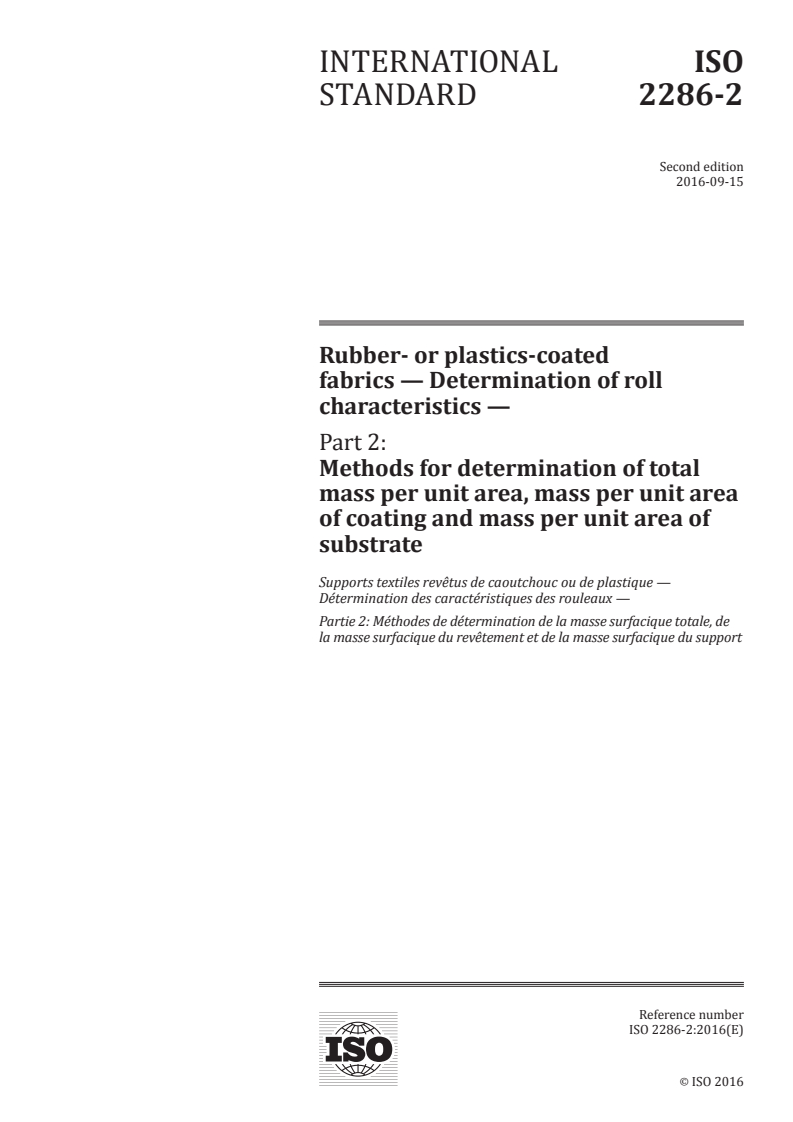
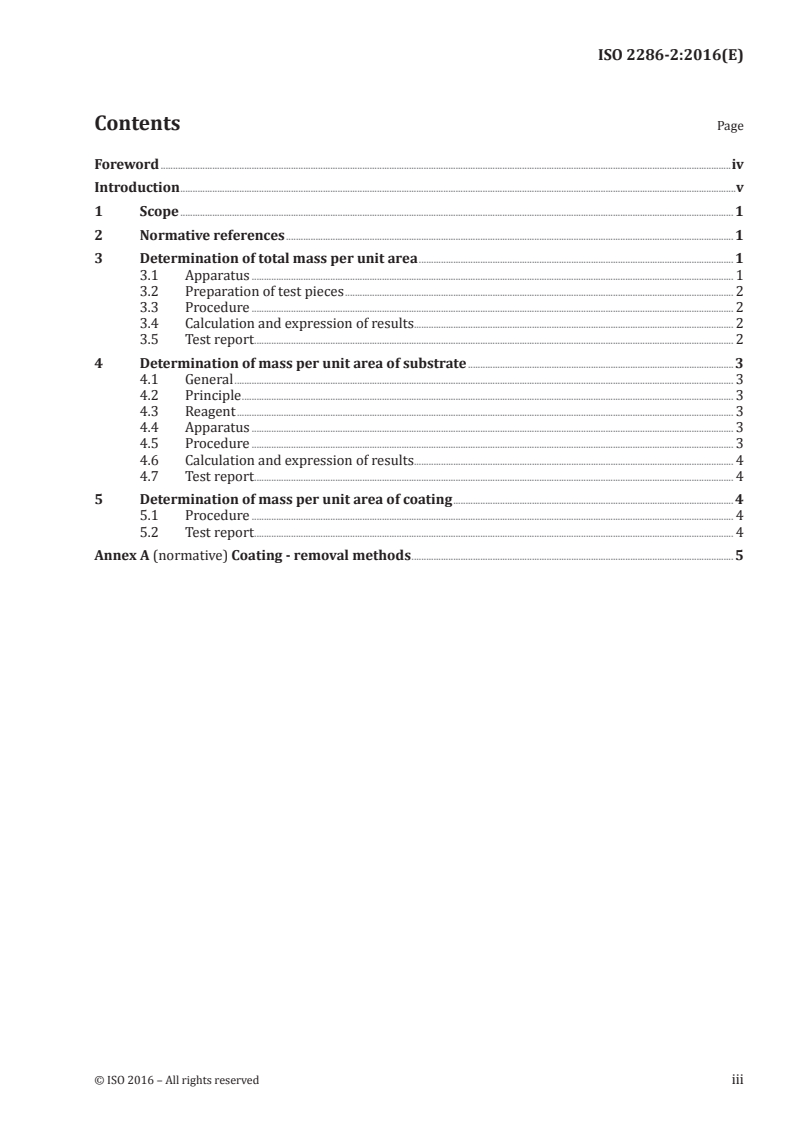
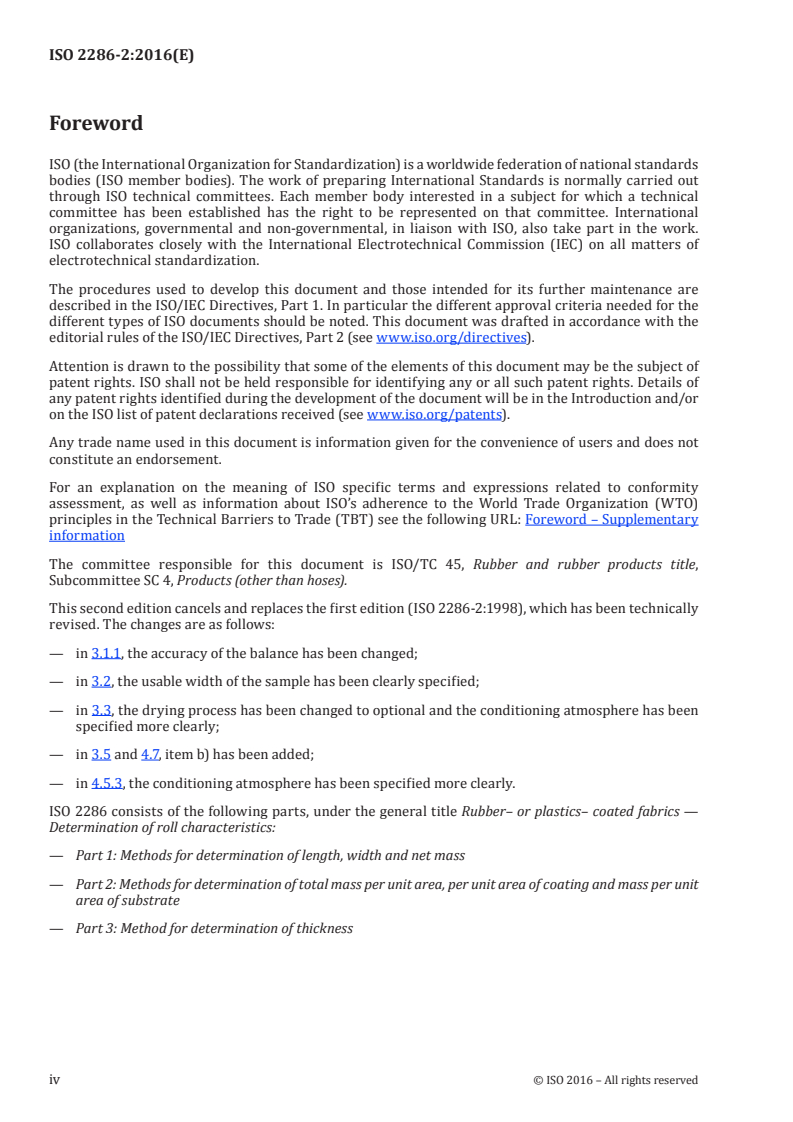
ISO 2286-2:2016 - Rubber- or plastics-coated fabrics — Determination of roll characteristics — Part 2: Methods for determination of total mass per unit area, mass per unit area of coating and mass per unit area of substrate/15/2016

ISO 2286-2:2016 - Supports textiles revêtus de caoutchouc ou de plastique -- Détermination des caractéristiques des rouleaux
ISO 2286-2:2016 - Supports textiles revêtus de caoutchouc ou de plastique — Détermination des caractéristiques des rouleaux — Partie 2: Méthodes de détermination de la masse surfacique totale, de la masse surfacique du revêtement et de la masse surfacique du support/15/2016
Overview
ISO 2286-2:2016 - part of the ISO 2286 series - specifies standardized laboratory methods for determining mass per unit area of rubber- or plastics-coated fabrics. The standard covers procedures to measure the total mass per unit area, the mass per unit area of the substrate (cloth) after coating removal, and the mass per unit area of the coating (by difference). Annex A provides guidance on coating‑removal methods for specific coating chemistries.
Keywords: ISO 2286-2, rubber- or plastics-coated fabrics, mass per unit area, coating mass, substrate mass, testing methods, roll characteristics.
Key topics and technical requirements
- Sampling and test pieces
- Cut five test pieces representative across the width (typically 100 cm² area per piece).
- Avoid pieces within 1 m of roll ends.
- Total mass per unit area
- Dry test pieces (unless drying is waived by agreement) and condition per ISO 2231 (conditioning method “1”).
- Weigh to nearest 5 mg; convert to g/m² using mass and area (accounting for cm² → m²).
- Report the mean of five determinations (nearest 1 g/m²).
- Substrate mass per unit area
- Remove coating using a suitable stripping agent that does not affect the substrate (organic solvents, aqueous systems, or mechanical removal where appropriate).
- Techniques include immersion with agitation or Soxhlet extraction; wash and repeat extraction until successive mass determinations differ by <1%.
- Dry, condition and weigh as for total mass; calculate mean from five pieces.
- Coating mass per unit area
- Calculated as: coating mass = total mass − substrate mass (expressed in g/m²).
- Apparatus & environmental controls
- Precision balance (readability ≤1 mg recommended), cutters, controlled drying (65 °C ± 5 °C) and low-humidity atmospheres for drying.
- Safety and reporting
- Solvent hazards: use appropriate PPE and ventilation. Test reports must include reference to ISO 2286-2, conditioning details, fabric description, mean values, deviations and date.
Applications
- Quality control for coated fabric production (PVC-, rubber- or other polymer-coated textiles)
- Specification and acceptance testing for industrial textiles (tarpaulins, conveyor belts, protective covers, inflatable products)
- R&D and material formulation to assess coating add-on and substrate changes
- Procurement and compliance verification where mass per unit area is a contractual parameter
Who should use this standard
- Textile and coated-fabric manufacturers
- Independent testing laboratories and QC teams
- Product engineers, material scientists and procurement specialists
- Regulatory bodies and certification agencies assessing material conformity
Related standards
- ISO 2286-1: Methods for length, width and net mass (other parts of the ISO 2286 series)
- ISO 2286-3: Methods for determination of thickness
- ISO 2231: Standard atmospheres for conditioning and testing (normative reference used in ISO 2286-2)
Using ISO 2286-2 ensures consistent, reproducible measurement of mass per unit area, enabling reliable product specifications, quality control, and comparative testing of rubber- or plastics-coated fabrics.
Relations
- Effective Date
- 25-Aug-2026
- Effective Date
- 25-Aug-2026
- Effective Date
- 25-Aug-2026
- Effective Date
- 12-Feb-2026
- Consolidates
ISO 5360:1993/FDAmd 1 - Anaesthetic vaporizers — Agent-specific filling systems — Amendment 1 - Effective Date
- 06-Jun-2022
- Effective Date
- 21-Dec-2013
Buy Documents
ISO 2286-2:2016 - Rubber- or plastics-coated fabrics -- Determination of roll characteristics
ISO 2286-2:2016 - Rubber- or plastics-coated fabrics — Determination of roll characteristics — Part 2: Methods for determination of total mass per unit area, mass per unit area of coating and mass per unit area of substrate/15/2016
ISO 2286-2:2016 - Supports textiles revêtus de caoutchouc ou de plastique -- Détermination des caractéristiques des rouleaux
ISO 2286-2:2016 - Supports textiles revêtus de caoutchouc ou de plastique — Détermination des caractéristiques des rouleaux — Partie 2: Méthodes de détermination de la masse surfacique totale, de la masse surfacique du revêtement et de la masse surfacique du support/15/2016
Get Certified
Connect with accredited certification bodies for this standard

Control Union Certifications
Global certification for agriculture and sustainability.

Hohenstein Institut
Textile testing and certification.

Bureau Veritas Bangladesh
Bureau Veritas certification services in Bangladesh.
Sponsored listings
Frequently Asked Questions
ISO 2286-2:2016 is a standard published by the International Organization for Standardization (ISO). Its full title is "Rubber- or plastics-coated fabrics — Determination of roll characteristics — Part 2: Methods for determination of total mass per unit area, mass per unit area of coating and mass per unit area of substrate". This standard covers: ISO 2286-2:2016 specifies methods of determining the total mass per unit area, the mass per unit area of the coating and the mass per unit area of the substrate cloth of a rubber- or plastics-coated fabric. Methods for removing coatings of specific compositions are described in Annex A.
ISO 2286-2:2016 specifies methods of determining the total mass per unit area, the mass per unit area of the coating and the mass per unit area of the substrate cloth of a rubber- or plastics-coated fabric. Methods for removing coatings of specific compositions are described in Annex A.
ISO 2286-2:2016 is classified under the following ICS (International Classification for Standards) categories: 59.080.40 - Coated fabrics. The ICS classification helps identify the subject area and facilitates finding related standards.
ISO 2286-2:2016 has the following relationships with other standards: It is inter standard links to EN ISO 1421:2016, EN ISO 5470-1:2016, EN ISO 4674-2:2021, EN ISO 2286-2:2016, ISO 5360:1993/FDAmd 1, ISO 2286-2:1998. Understanding these relationships helps ensure you are using the most current and applicable version of the standard.
ISO 2286-2:2016 is available in PDF format for immediate download after purchase. The document can be added to your cart and obtained through the secure checkout process. Digital delivery ensures instant access to the complete standard document.
Standards Content (Sample)
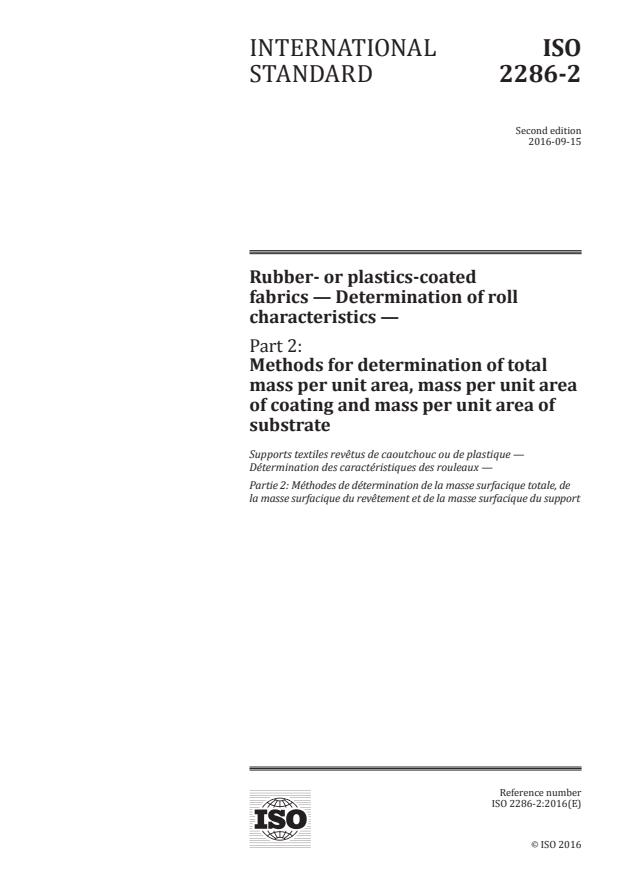
INTERNATIONAL ISO
STANDARD 2286-2
Second edition
2016-09-15
Rubber- or plastics-coated
fabrics — Determination of roll
characteristics —
Part 2:
Methods for determination of total
mass per unit area, mass per unit area
of coating and mass per unit area of
substrate
Supports textiles revêtus de caoutchouc ou de plastique —
Détermination des caractéristiques des rouleaux —
Partie 2: Méthodes de détermination de la masse surfacique totale, de
la masse surfacique du revêtement et de la masse surfacique du support
Reference number
©
ISO 2016
© ISO 2016, Published in Switzerland
All rights reserved. Unless otherwise specified, no part of this publication may be reproduced or utilized otherwise in any form
or by any means, electronic or mechanical, including photocopying, or posting on the internet or an intranet, without prior
written permission. Permission can be requested from either ISO at the address below or ISO’s member body in the country of
the requester.
ISO copyright office
Ch. de Blandonnet 8 • CP 401
CH-1214 Vernier, Geneva, Switzerland
Tel. +41 22 749 01 11
Fax +41 22 749 09 47
copyright@iso.org
www.iso.org
ii © ISO 2016 – All rights reserved
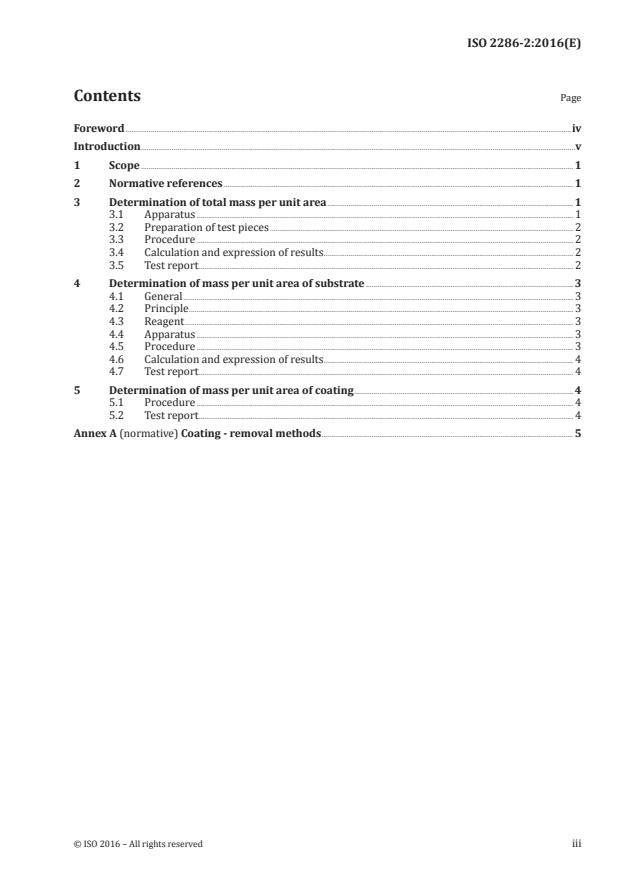
Contents Page
Foreword .iv
Introduction .v
1 Scope . 1
2 Normative references . 1
3 Determination of total mass per unit area . 1
3.1 Apparatus . 1
3.2 Preparation of test pieces . 2
3.3 Procedure . 2
3.4 Calculation and expression of results. 2
3.5 Test report . 2
4 Determination of mass per unit area of substrate . 3
4.1 General . 3
4.2 Principle . 3
4.3 Reagent . 3
4.4 Apparatus . 3
4.5 Procedure . 3
4.6 Calculation and expression of results. 4
4.7 Test report . 4
5 Determination of mass per unit area of coating . 4
5.1 Procedure . 4
5.2 Test report . 4
Annex A (normative) Coating - removal methods . 5
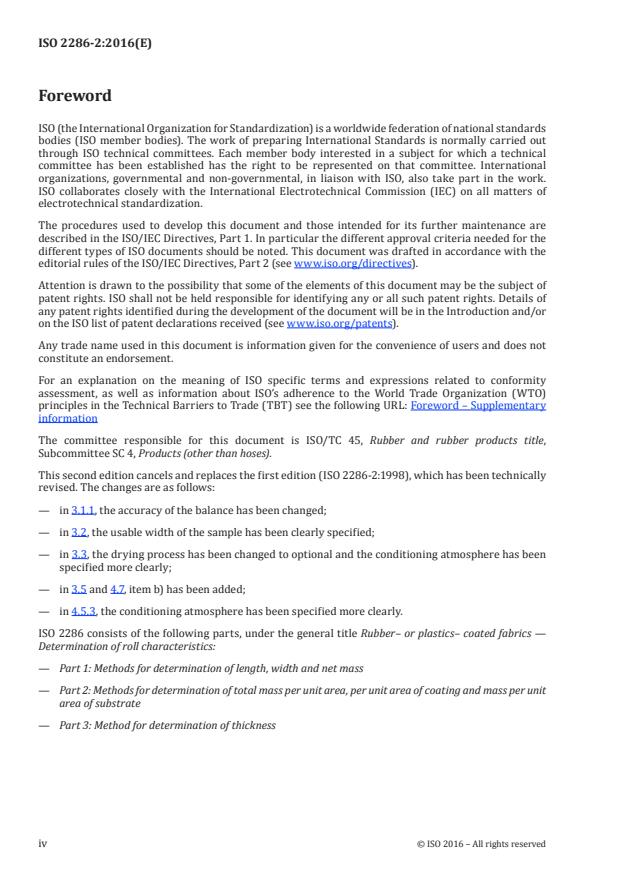
Foreword
ISO (the International Organization for Standardization) is a worldwide federation of national standards
bodies (ISO member bodies). The work of preparing International Standards is normally carried out
through ISO technical committees. Each member body interested in a subject for which a technical
committee has been established has the right to be represented on that committee. International
organizations, governmental and non-governmental, in liaison with ISO, also take part in the work.
ISO collaborates closely with the International Electrotechnical Commission (IEC) on all matters of
electrotechnical standardization.
The procedures used to develop this document and those intended for its further maintenance are
described in the ISO/IEC Directives, Part 1. In particular the different approval criteria needed for the
different types of ISO documents should be noted. This document was drafted in accordance with the
editorial rules of the ISO/IEC Directives, Part 2 (see www.iso.org/directives).
Attention is drawn to the possibility that some of the elements of this document may be the subject of
patent rights. ISO shall not be held responsible for identifying any or all such patent rights. Details of
any patent rights identified during the development of the document will be in the Introduction and/or
on the ISO list of patent declarations received (see www.iso.org/patents).
Any trade name used in this document is information given for the convenience of users and does not
constitute an endorsement.
For an explanation on the meaning of ISO specific terms and expressions related to conformity
assessment, as well as information about ISO’s adherence to the World Trade Organization (WTO)
principles in the Technical Barriers to Trade (TBT) see the following URL: Foreword – Supplementary
information
The committee responsible for this document is ISO/TC 45, Rubber and rubber products title,
Subcommittee SC 4, Products (other than hoses).
This second edition cancels and replaces the first edition (ISO 2286-2:1998), which has been technically
revised. The changes are as follows:
— in 3.1.1, the accuracy of the balance has been changed;
— in 3.2, the usable width of the sample has been clearly specified;
— in 3.3, the drying process has been changed to optional and the conditioning atmosphere has been
specified more clearly;
— in 3.5 and 4.7, item b) has been added;
— in 4.5.3, the conditioning atmosphere has been specified more clearly.
ISO 2286 consists of the following parts, under the general title Rubber– or plastics– coated fabrics —
Determination of roll characteristics:
— Part 1: Methods for determination of length, width and net mass
— Part 2: Methods for determination of total mass per unit area, per unit area of coating and mass per unit
area of substrate
— Part 3: Method for determination of thickness
iv © ISO 2016 – All rights reserved
Introduction
The total mass per unit area of a material, the mass per unit area of the substrate cloth and the mass per
unit area of the coating are quantities which define the basic quality of a coated fabric and determine
many of its physical properties. The substrate cloth mass determined by these methods does not
necessarily represent the mass of the substrate cloth in the uncoated state. For example, in the case
of coated fabrics in which a bonding agent has been used, the substrate cloth mass determined may be
substantially higher than the uncoated mass because the prescribed treatment has not removed the
entire coating. This will be particularly so in cases where the substrate cloth is made from multifilament
or spun-fibre yarns. Dimensional changes in the substrate cloth during processing may also occur.
INTERNATIONAL STANDARD ISO 2286-2:2016(E)
Rubber- or plastics-coated fabrics — Determination of roll
characteristics —
Part 2:
Methods for determination of total mass per unit area,
mass per unit area of coating and mass per unit area of
substrate
WARNING — Persons using this International Standard should be familiar with normal
laboratory practice. This International Standard does not purport to address all of the
safety problems, if any, associated with its use. It is the responsibility of the user to establish
appropriate safety and health practices and to ensure compliance with any national regulatory
conditions.
1 Scope
This part of ISO 2286 specifies methods of determining the total mass per unit area, the mass per unit
area of the coating and the mass per unit area of the substrate cloth of a rubber- or plastics-coated
fabric. Methods for removing coatings of specific compositions are described in Annex A.
2 Normative references
The following documents, in whole or in part, are normatively referenced in this document and are
indispensable for its application. For dated references, only the edition cited applies. For undated
references, the latest edition of the referenced document (including any amendments) applies.
ISO 2231:1989, Rubber- or plastics-coated fabrics — Standard atmospheres for conditioning and testing
3 Determination of total mass per unit area
3.1 Apparatus
3.1.1 Balance,
...
INTERNATIONAL ISO
STANDARD 2286-2
Second edition
2016-09-15
Rubber- or plastics-coated
fabrics — Determination of roll
characteristics —
Part 2:
Methods for determination of total
mass per unit area, mass per unit area
of coating and mass per unit area of
substrate
Supports textiles revêtus de caoutchouc ou de plastique —
Détermination des caractéristiques des rouleaux —
Partie 2: Méthodes de détermination de la masse surfacique totale, de
la masse surfacique du revêtement et de la masse surfacique du support
Reference number
©
ISO 2016
© ISO 2016, Published in Switzerland
All rights reserved. Unless otherwise specified, no part of this publication may be reproduced or utilized otherwise in any form
or by any means, electronic or mechanical, including photocopying, or posting on the internet or an intranet, without prior
written permission. Permission can be requested from either ISO at the address below or ISO’s member body in the country of
the requester.
ISO copyright office
Ch. de Blandonnet 8 • CP 401
CH-1214 Vernier, Geneva, Switzerland
Tel. +41 22 749 01 11
Fax +41 22 749 09 47
copyright@iso.org
www.iso.org
ii © ISO 2016 – All rights reserved
Contents Page
Foreword .iv
Introduction .v
1 Scope . 1
2 Normative references . 1
3 Determination of total mass per unit area . 1
3.1 Apparatus . 1
3.2 Preparation of test pieces . 2
3.3 Procedure . 2
3.4 Calculation and expression of results. 2
3.5 Test report . 2
4 Determination of mass per unit area of substrate . 3
4.1 General . 3
4.2 Principle . 3
4.3 Reagent . 3
4.4 Apparatus . 3
4.5 Procedure . 3
4.6 Calculation and expression of results. 4
4.7 Test report . 4
5 Determination of mass per unit area of coating . 4
5.1 Procedure . 4
5.2 Test report . 4
Annex A (normative) Coating - removal methods . 5
Foreword
ISO (the International Organization for Standardization) is a worldwide federation of national standards
bodies (ISO member bodies). The work of preparing International Standards is normally carried out
through ISO technical committees. Each member body interested in a subject for which a technical
committee has been established has the right to be represented on that committee. International
organizations, governmental and non-governmental, in liaison with ISO, also take part in the work.
ISO collaborates closely with the International Electrotechnical Commission (IEC) on all matters of
electrotechnical standardization.
The procedures used to develop this document and those intended for its further maintenance are
described in the ISO/IEC Directives, Part 1. In particular the different approval criteria needed for the
different types of ISO documents should be noted. This document was drafted in accordance with the
editorial rules of the ISO/IEC Directives, Part 2 (see www.iso.org/directives).
Attention is drawn to the possibility that some of the elements of this document may be the subject of
patent rights. ISO shall not be held responsible for identifying any or all such patent rights. Details of
any patent rights identified during the development of the document will be in the Introduction and/or
on the ISO list of patent declarations received (see www.iso.org/patents).
Any trade name used in this document is information given for the convenience of users and does not
constitute an endorsement.
For an explanation on the meaning of ISO specific terms and expressions related to conformity
assessment, as well as information about ISO’s adherence to the World Trade Organization (WTO)
principles in the Technical Barriers to Trade (TBT) see the following URL: Foreword – Supplementary
information
The committee responsible for this document is ISO/TC 45, Rubber and rubber products title,
Subcommittee SC 4, Products (other than hoses).
This second edition cancels and replaces the first edition (ISO 2286-2:1998), which has been technically
revised. The changes are as follows:
— in 3.1.1, the accuracy of the balance has been changed;
— in 3.2, the usable width of the sample has been clearly specified;
— in 3.3, the drying process has been changed to optional and the conditioning atmosphere has been
specified more clearly;
— in 3.5 and 4.7, item b) has been added;
— in 4.5.3, the conditioning atmosphere has been specified more clearly.
ISO 2286 consists of the following parts, under the general title Rubber– or plastics– coated fabrics —
Determination of roll characteristics:
— Part 1: Methods for determination of length, width and net mass
— Part 2: Methods for determination of total mass per unit area, per unit area of coating and mass per unit
area of substrate
— Part 3: Method for determination of thickness
iv © ISO 2016 – All rights reserved
Introduction
The total mass per unit area of a material, the mass per unit area of the substrate cloth and the mass per
unit area of the coating are quantities which define the basic quality of a coated fabric and determine
many of its physical properties. The substrate cloth mass determined by these methods does not
necessarily represent the mass of the substrate cloth in the uncoated state. For example, in the case
of coated fabrics in which a bonding agent has been used, the substrate cloth mass determined may be
substantially higher than the uncoated mass because the prescribed treatment has not removed the
entire coating. This will be particularly so in cases where the substrate cloth is made from multifilament
or spun-fibre yarns. Dimensional changes in the substrate cloth during processing may also occur.
INTERNATIONAL STANDARD ISO 2286-2:2016(E)
Rubber- or plastics-coated fabrics — Determination of roll
characteristics —
Part 2:
Methods for determination of total mass per unit area,
mass per unit area of coating and mass per unit area of
substrate
WARNING — Persons using this International Standard should be familiar with normal
laboratory practice. This International Standard does not purport to address all of the
safety problems, if any, associated with its use. It is the responsibility of the user to establish
appropriate safety and health practices and to ensure compliance with any national regulatory
conditions.
1 Scope
This part of ISO 2286 specifies methods of determining the total mass per unit area, the mass per unit
area of the coating and the mass per unit area of the substrate cloth of a rubber- or plastics-coated
fabric. Methods for removing coatings of specific compositions are described in Annex A.
2 Normative references
The following documents, in whole or in part, are normatively referenced in this document and are
indispensable for its application. For dated references, only the edition cited applies. For undated
references, the latest edition of the referenced document (including any amendments) applies.
ISO 2231:1989, Rubber- or plastics-coated fabrics — Standard atmospheres for conditioning and testing
3 Determination of total mass per unit area
3.1 Apparatus
3.1.1 Balance,
...
NORME ISO
INTERNATIONALE 2286-2
Deuxième édition
2016-09-15
Supports textiles revêtus de
caoutchouc ou de plastique —
Détermination des caractéristiques
des rouleaux —
Partie 2:
Méthodes de détermination de la
masse surfacique totale, de la masse
surfacique du revêtement et de la
masse surfacique du support
Rubber- or plastics-coated fabrics — Determination of roll
characteristics —
Part 2: Methods for determination of total mass per unit area, mass
per unit area of coating and mass per unit area of substrate
Numéro de référence
©
ISO 2016
DOCUMENT PROTÉGÉ PAR COPYRIGHT
© ISO 2016, Publié en Suisse
Droits de reproduction réservés. Sauf indication contraire, aucune partie de cette publication ne peut être reproduite ni utilisée
sous quelque forme que ce soit et par aucun procédé, électronique ou mécanique, y compris la photocopie, l’affichage sur
l’internet ou sur un Intranet, sans autorisation écrite préalable. Les demandes d’autorisation peuvent être adressées à l’ISO à
l’adresse ci-après ou au comité membre de l’ISO dans le pays du demandeur.
ISO copyright office
Ch. de Blandonnet 8 • CP 401
CH-1214 Vernier, Geneva, Switzerland
Tel. +41 22 749 01 11
Fax +41 22 749 09 47
copyright@iso.org
www.iso.org
ii © ISO 2016 – Tous droits réservés
Sommaire Page
Avant-propos .iv
Introduction .v
1 Domaine d’application . 1
2 Références normatives . 1
3 Détermination de la masse surfacique totale . 1
3.1 Appareillage. 1
3.2 Préparation des éprouvettes . 2
3.3 Mode opératoire . 2
3.4 Calcul et expression des résultats . 2
3.5 Rapport d’essai . 2
4 Détermination de la masse surfacique du support textile . 3
4.1 Généralités . 3
4.2 Principe . 3
4.3 Réactif . 3
4.4 Appareillage. 3
4.5 Mode opératoire . 3
4.6 Calcul et expression des résultats . 4
4.7 Rapport d’essai . 4
5 Détermination de la masse surfacique du revêtement . 4
5.1 Mode opératoire . 4
5.2 Rapport d’essai . 4
Annexe A (normative) Méthodes d’élimination des revêtements . 5
Avant-propos
L’ISO (Organisation internationale de normalisation) est une fédération mondiale d’organismes
nationaux de normalisation (comités membres de l’ISO). L’élaboration des Normes internationales est
en général confiée aux comités techniques de l’ISO. Chaque comité membre intéressé par une étude
a le droit de faire partie du comité technique créé à cet effet. Les organisations internationales,
gouvernementales et non gouvernementales, en liaison avec l’ISO participent également aux travaux.
L’ISO collabore étroitement avec la Commission électrotechnique internationale (IEC) en ce qui
concerne la normalisation électrotechnique.
Les procédures utilisées pour élaborer le présent document et celles destinées à sa mise à jour sont
décrites dans les Directives ISO/IEC, Partie 1. Il convient, en particulier de prendre note des différents
critères d’approbation requis pour les différents types de documents ISO. Le présent document a été
rédigé conformément aux règles de rédaction données dans les Directives ISO/IEC, Partie 2 (voir www.
iso.org/directives).
L’attention est appelée sur le fait que certains des éléments du présent document peuvent faire l’objet de
droits de propriété intellectuelle ou de droits analogues. L’ISO ne saurait être tenue pour responsable
de ne pas avoir identifié de tels droits de propriété et averti de leur existence. Les détails concernant
les références aux droits de propriété intellectuelle ou autres droits analogues identifiés lors de
l’élaboration du document sont indiqués dans l’Introduction et/ou dans la liste des déclarations de
brevets reçues par l’ISO (voir www.iso.org/brevets).
Les appellations commerciales éventuellement mentionnées dans le présent document sont données
pour information, par souci de commodité, à l’intention des utilisateurs et ne sauraient constituer un
engagement.
Pour une explication de la signification des termes et expressions spécifiques de l’ISO liés à
l’évaluation de la conformité, ou pour toute information au sujet de l’adhésion de l’ISO aux principes
de l’OMC concernant les obstacles techniques au commerce (OTC), voir le lien suivant: Avant-propos —
Informations supplémentaires.
Le comité responsable du présent document est l’ISO/TC 45, Élastomères et produits à base d’élastomères,
sous-comité SC 4, Produits (autres que tuyaux).
Cette deuxième édition annule et remplace la première édition (ISO 2286-2:1998) qui a fait l’objet d’une
révision technique. Les modifications sont les suivantes:
— en 3.1.1, la précision de la balance a été modifiée;
— en 3,2, la largeur utile de l’échantillon a été clairement spécifiée;
— en 3.3, le processus de séchage a été rendu facultatif et l’atmosphère de conditionnement a été
spécifiée plus clairement;
— en 3.5 et 4.7, le point b) a été ajouté;
— en 4.5.3, l’atmosphère de conditionnement a été spécifiée plus clairement.
L’ISO 2286 comprend les parties suivantes, présentées sous le titre général Supports textiles revêtus de
caoutchouc ou de plastique — Détermination des caractéristiques des rouleaux:
— Partie 1: Méthodes de détermination de la longueur, de la largeur et de la masse nette
— Partie 2: Méthodes de détermination de la masse surfacique totale, de la masse surfacique du revêtement
et de la masse surfacique du support
— Partie 3: Méthodes de détermination de l’épaisseur
iv © ISO 2016 – Tous droits réservés
Introduction
La masse surfacique totale d’un matériau, la masse surfacique du support textile et la masse surfacique
du revêtement sont des quantités qui permettent de définir les qualités de base d’un support textile
revêtu et déterminent nombre de ses caractéristiques physiques. La masse du support textile
déterminée à l’aide de ces méthodes ne correspond pas forcément à celle du support textile à l’état non
revêtu. Par exemple, s’il s’agit d’étoffes revêtues sur lesquelles un agent liant a été utilisé, la masse du
support textile déterminée peut être sensiblement supérieure à celle du support textile non revêtu, le
traitement spécifié n’ayant pas suffi pour éliminer l’ensemble du revêtement. Cela est particulièrement
vrai pour des supports textiles fabriqués à partir de fils multifilaments ou de filés. Des modifications
dimensionnelles du support textile peuvent également se produire durant la mise en œuvre.
NORME INTERNATIONALE ISO 2286-2:2016(F)
Supports textiles revêtus de caoutchouc ou de plastique —
Détermination des caractéristiques des rouleaux —
Partie 2:
Méthodes de détermination de la masse surfacique totale,
de la masse surfacique du revêtement et de la masse
surfacique du support
AVERTISSEMENT — Il convient que les personnes utilisant la présente Norme internationale
soient familières avec les pratiques courantes de laboratoire. La présente Norme internationale
n’a pas pour but de traiter tous les problèmes de sécurité qui sont, le cas échéant, liés à son
utilisation. Il incombe à l’utilisateur d’établir des pratiques appropriées en matière d’hygiène et
de sécurité, et de s’assurer de la conformité à la réglementation nationale en vigueur.
1 Domaine d’application
La présente partie de l’ISO 2286 spécifie des méthodes pour la détermination de la masse surfacique
totale, de la masse surfacique du revêtement et de la masse surfacique du support textile revêtu de
caoutchouc ou de plastique. L’Annexe A donne des méthodes permettant d’éliminer des revêtements de
compositions spécifiques.
2 Références normatives
Les documents suivants, en intégralité ou en partie, font l’objet de références normatives dans le
présent document et sont indispensables à son application. Pour les références datées, seule l’édition
citée s’applique. Pour les références non datées, la dernière édition du document de référence s’applique
(y compris les éventuels amendements).
ISO 2231:1989, Supports textiles revêtus de caoutchouc ou de plastique — Atmosphères normales de
conditionnement et d’essai.
3 Détermination de la masse surfacique totale
3.1 Appareillage
3.1.1 Balance, avec une capacité de lecture de 1 mg ou moins.
3.1.2 Dispositif de maintien d’une atmosphère à une humidité relative inférieure ou égale à 10 % et
à une température égale à (65 ± 5) °C.
NOTE L’air à une température égale à 20 °C et à une humidité relative égale à 65 %, peut, lorsqu’il est chauffé
à pression constante à une t
...
NORME ISO
INTERNATIONALE 2286-2
Deuxième édition
2016-09-15
Supports textiles revêtus de
caoutchouc ou de plastique —
Détermination des caractéristiques
des rouleaux —
Partie 2:
Méthodes de détermination de la
masse surfacique totale, de la masse
surfacique du revêtement et de la
masse surfacique du support
Rubber- or plastics-coated fabrics — Determination of roll
characteristics —
Part 2: Methods for determination of total mass per unit area, mass
per unit area of coating and mass per unit area of substrate
Numéro de référence
©
ISO 2016
DOCUMENT PROTÉGÉ PAR COPYRIGHT
© ISO 2016, Publié en Suisse
Droits de reproduction réservés. Sauf indication contraire, aucune partie de cette publication ne peut être reproduite ni utilisée
sous quelque forme que ce soit et par aucun procédé, électronique ou mécanique, y compris la photocopie, l’affichage sur
l’internet ou sur un Intranet, sans autorisation écrite préalable. Les demandes d’autorisation peuvent être adressées à l’ISO à
l’adresse ci-après ou au comité membre de l’ISO dans le pays du demandeur.
ISO copyright office
Ch. de Blandonnet 8 • CP 401
CH-1214 Vernier, Geneva, Switzerland
Tel. +41 22 749 01 11
Fax +41 22 749 09 47
copyright@iso.org
www.iso.org
ii © ISO 2016 – Tous droits réservés
Sommaire Page
Avant-propos .iv
Introduction .v
1 Domaine d’application . 1
2 Références normatives . 1
3 Détermination de la masse surfacique totale . 1
3.1 Appareillage. 1
3.2 Préparation des éprouvettes . 2
3.3 Mode opératoire . 2
3.4 Calcul et expression des résultats . 2
3.5 Rapport d’essai . 2
4 Détermination de la masse surfacique du support textile . 3
4.1 Généralités . 3
4.2 Principe . 3
4.3 Réactif . 3
4.4 Appareillage. 3
4.5 Mode opératoire . 3
4.6 Calcul et expression des résultats . 4
4.7 Rapport d’essai . 4
5 Détermination de la masse surfacique du revêtement . 4
5.1 Mode opératoire . 4
5.2 Rapport d’essai . 4
Annexe A (normative) Méthodes d’élimination des revêtements . 5
Avant-propos
L’ISO (Organisation internationale de normalisation) est une fédération mondiale d’organismes
nationaux de normalisation (comités membres de l’ISO). L’élaboration des Normes internationales est
en général confiée aux comités techniques de l’ISO. Chaque comité membre intéressé par une étude
a le droit de faire partie du comité technique créé à cet effet. Les organisations internationales,
gouvernementales et non gouvernementales, en liaison avec l’ISO participent également aux travaux.
L’ISO collabore étroitement avec la Commission électrotechnique internationale (IEC) en ce qui
concerne la normalisation électrotechnique.
Les procédures utilisées pour élaborer le présent document et celles destinées à sa mise à jour sont
décrites dans les Directives ISO/IEC, Partie 1. Il convient, en particulier de prendre note des différents
critères d’approbation requis pour les différents types de documents ISO. Le présent document a été
rédigé conformément aux règles de rédaction données dans les Directives ISO/IEC, Partie 2 (voir www.
iso.org/directives).
L’attention est appelée sur le fait que certains des éléments du présent document peuvent faire l’objet de
droits de propriété intellectuelle ou de droits analogues. L’ISO ne saurait être tenue pour responsable
de ne pas avoir identifié de tels droits de propriété et averti de leur existence. Les détails concernant
les références aux droits de propriété intellectuelle ou autres droits analogues identifiés lors de
l’élaboration du document sont indiqués dans l’Introduction et/ou dans la liste des déclarations de
brevets reçues par l’ISO (voir www.iso.org/brevets).
Les appellations commerciales éventuellement mentionnées dans le présent document sont données
pour information, par souci de commodité, à l’intention des utilisateurs et ne sauraient constituer un
engagement.
Pour une explication de la signification des termes et expressions spécifiques de l’ISO liés à
l’évaluation de la conformité, ou pour toute information au sujet de l’adhésion de l’ISO aux principes
de l’OMC concernant les obstacles techniques au commerce (OTC), voir le lien suivant: Avant-propos —
Informations supplémentaires.
Le comité responsable du présent document est l’ISO/TC 45, Élastomères et produits à base d’élastomères,
sous-comité SC 4, Produits (autres que tuyaux).
Cette deuxième édition annule et remplace la première édition (ISO 2286-2:1998) qui a fait l’objet d’une
révision technique. Les modifications sont les suivantes:
— en 3.1.1, la précision de la balance a été modifiée;
— en 3,2, la largeur utile de l’échantillon a été clairement spécifiée;
— en 3.3, le processus de séchage a été rendu facultatif et l’atmosphère de conditionnement a été
spécifiée plus clairement;
— en 3.5 et 4.7, le point b) a été ajouté;
— en 4.5.3, l’atmosphère de conditionnement a été spécifiée plus clairement.
L’ISO 2286 comprend les parties suivantes, présentées sous le titre général Supports textiles revêtus de
caoutchouc ou de plastique — Détermination des caractéristiques des rouleaux:
— Partie 1: Méthodes de détermination de la longueur, de la largeur et de la masse nette
— Partie 2: Méthodes de détermination de la masse surfacique totale, de la masse surfacique du revêtement
et de la masse surfacique du support
— Partie 3: Méthodes de détermination de l’épaisseur
iv © ISO 2016 – Tous droits réservés
Introduction
La masse surfacique totale d’un matériau, la masse surfacique du support textile et la masse surfacique
du revêtement sont des quantités qui permettent de définir les qualités de base d’un support textile
revêtu et déterminent nombre de ses caractéristiques physiques. La masse du support textile
déterminée à l’aide de ces méthodes ne correspond pas forcément à celle du support textile à l’état non
revêtu. Par exemple, s’il s’agit d’étoffes revêtues sur lesquelles un agent liant a été utilisé, la masse du
support textile déterminée peut être sensiblement supérieure à celle du support textile non revêtu, le
traitement spécifié n’ayant pas suffi pour éliminer l’ensemble du revêtement. Cela est particulièrement
vrai pour des supports textiles fabriqués à partir de fils multifilaments ou de filés. Des modifications
dimensionnelles du support textile peuvent également se produire durant la mise en œuvre.
NORME INTERNATIONALE ISO 2286-2:2016(F)
Supports textiles revêtus de caoutchouc ou de plastique —
Détermination des caractéristiques des rouleaux —
Partie 2:
Méthodes de détermination de la masse surfacique totale,
de la masse surfacique du revêtement et de la masse
surfacique du support
AVERTISSEMENT — Il convient que les personnes utilisant la présente Norme internationale
soient familières avec les pratiques courantes de laboratoire. La présente Norme internationale
n’a pas pour but de traiter tous les problèmes de sécurité qui sont, le cas échéant, liés à son
utilisation. Il incombe à l’utilisateur d’établir des pratiques appropriées en matière d’hygiène et
de sécurité, et de s’assurer de la conformité à la réglementation nationale en vigueur.
1 Domaine d’application
La présente partie de l’ISO 2286 spécifie des méthodes pour la détermination de la masse surfacique
totale, de la masse surfacique du revêtement et de la masse surfacique du support textile revêtu de
caoutchouc ou de plastique. L’Annexe A donne des méthodes permettant d’éliminer des revêtements de
compositions spécifiques.
2 Références normatives
Les documents suivants, en intégralité ou en partie, font l’objet de références normatives dans le
présent document et sont indispensables à son application. Pour les références datées, seule l’édition
citée s’applique. Pour les références non datées, la dernière édition du document de référence s’applique
(y compris les éventuels amendements).
ISO 2231:1989, Supports textiles revêtus de caoutchouc ou de plastique — Atmosphères normales de
conditionnement et d’essai.
3 Détermination de la masse surfacique totale
3.1 Appareillage
3.1.1 Balance, avec une capacité de lecture de 1 mg ou moins.
3.1.2 Dispositif de maintien d’une atmosphère à une humidité relative inférieure ou égale à 10 % et
à une température égale à (65 ± 5) °C.
NOTE L’air à une température égale à 20 °C et à une humidité relative égale à 65 %, peut, lorsqu’il est chauffé
à pression constante à une t
...