

ISO 6182-9:2005
(Main)Fire protection — Automatic sprinkler system — Part 9: Requirements and test methods for water mist nozzles
General Information
- Abstract
ISO 6182-9:2005 specifies performance requirements, test methods and marking requirements for water mist nozzles.
- Status
- Published
- Publication Date
- 26-Oct-2005
- Technical Committee
- ISO/TC 21/SC 5 - Fixed firefighting systems using water
- Drafting Committee
- ISO/TC 21/SC 5 - Fixed firefighting systems using water
- Current Stage
- 9092 - International Standard to be revised
- Start Date
- 09-Oct-2024
- Completion Date
- 29-Aug-2026
Overview
ISO 6182-9:2005 - "Fire protection - Automatic sprinkler system - Part 9: Requirements and test methods for water mist nozzles" defines the performance requirements, test methods and marking requirements for water mist nozzles used in automatic fire sprinkler systems. The standard is focused on ensuring consistent, reliable nozzle performance through defined material, dimensional, functional and test criteria applicable to both land-based and shipboard applications.
Key Topics
The standard covers technical requirements and test procedures including:
- Materials and product consistency
- Requirements for corrosion‑resistant materials and elastomeric components; accelerated ageing and tensile testing referenced.
- Dimensional and operating requirements
- Nominal and operating temperature classifications; prevention of field adjustments; thread standards.
- Hydraulic performance
- Water flow, distribution and droplet size measurements and test methods to verify mist generation characteristics.
- Mechanical strength and integrity
- Body strength, release element strength, leak resistance, hydrostatic strength and 30‑day leakage testing.
- Environmental and durability tests
- Heat exposure, thermal shock (for glass bulb nozzles), corrosion, coating integrity, resistance to vibration, impact and water hammer.
- Functional and fire tests
- Functional activation tests, heat‑responsive element characteristics, clogging tests and specific shipboard fire tests for machinery spaces, passenger cabins, public spaces and storage areas.
- Marking and documentation
- Required nozzle marking and instructions for design, installation and maintenance to support compliance and field use.
- Test methods
- Prescribed methods such as visual examination, service load, water distribution and droplet sizing (referencing ASTM E799), corrosion tests and cone‑calorimeter related reaction‑to‑fire testing.
Applications and Users
ISO 6182-9 is intended for stakeholders involved with water mist fire suppression systems:
- Manufacturers and R&D teams - to design and validate water mist nozzles that meet international performance and safety criteria.
- Test laboratories and certification bodies - for conducting standardized type tests and issuing approvals.
- Fire protection engineers and specifiers - to select compliant nozzles and to write procurement or project specifications.
- Shipbuilders and maritime safety authorities - for shipboard nozzle requirements and specialized fire tests.
- Installers and maintenance personnel - to follow marking, installation and maintenance instructions required by the standard.
Keywords: ISO 6182-9, water mist nozzles, fire protection, automatic sprinkler system, test methods, performance requirements, droplet size, nozzle marking, shipboard fire tests.
Related Standards
- Other parts of ISO 6182 (sprinklers, valves, ESFR, extended coverage, domestic sprinklers, etc.)
- Normative references cited in ISO 6182-9: ISO 7-1, ISO 37, ISO 188, ISO 5660-1, ASTM E11, ASTM E799, ANSI/UL 723, IMO A.653(16).
Get Certified
Connect with accredited certification bodies for this standard

CIS Institut d.o.o.
Personal Protective Equipment (PPE) certification body. Notified Body NB-2890 for EU Regulation 2016/425 PPE.

Kiwa BDA Testing
Building and construction product certification.
Kmetijski inštitut Slovenije
Agricultural Institute of Slovenia. Soil testing, plant health, agricultural product analysis.
Sponsored listings
Frequently Asked Questions
ISO 6182-9:2005 is a standard published by the International Organization for Standardization (ISO). Its full title is "Fire protection — Automatic sprinkler system — Part 9: Requirements and test methods for water mist nozzles". This standard covers: ISO 6182-9:2005 specifies performance requirements, test methods and marking requirements for water mist nozzles.
ISO 6182-9:2005 specifies performance requirements, test methods and marking requirements for water mist nozzles.
ISO 6182-9:2005 is classified under the following ICS (International Classification for Standards) categories: 13.220.20 - Fire protection. The ICS classification helps identify the subject area and facilitates finding related standards.
ISO 6182-9:2005 is available in PDF format for immediate download after purchase. The document can be added to your cart and obtained through the secure checkout process. Digital delivery ensures instant access to the complete standard document.
Standards Content (Sample)
INTERNATIONAL ISO
STANDARD 6182-9
First edition
2005-11-01
Fire protection — Automatic sprinkler
system —
Part 9:
Requirements and test methods for water
mist nozzles
Protection contre l'incendie — Systèmes d'extinction automatiques du
type sprinkler —
Partie 9: Prescriptions et méthodes d'essai des ajutages (brouillard)
Reference number
©
ISO 2005
PDF disclaimer
This PDF file may contain embedded typefaces. In accordance with Adobe's licensing policy, this file may be printed or viewed but
shall not be edited unless the typefaces which are embedded are licensed to and installed on the computer performing the editing. In
downloading this file, parties accept therein the responsibility of not infringing Adobe's licensing policy. The ISO Central Secretariat
accepts no liability in this area.
Adobe is a trademark of Adobe Systems Incorporated.
Details of the software products used to create this PDF file can be found in the General Info relative to the file; the PDF-creation
parameters were optimized for printing. Every care has been taken to ensure that the file is suitable for use by ISO member bodies. In
the unlikely event that a problem relating to it is found, please inform the Central Secretariat at the address given below.
© ISO 2005
All rights reserved. Unless otherwise specified, no part of this publication may be reproduced or utilized in any form or by any means,
electronic or mechanical, including photocopying and microfilm, without permission in writing from either ISO at the address below or
ISO's member body in the country of the requester.
ISO copyright office
Case postale 56 • CH-1211 Geneva 20
Tel. + 41 22 749 01 11
Fax + 41 22 749 09 47
E-mail copyright@iso.org
Web www.iso.org
Published in Switzerland
ii © ISO 2005 – All rights reserved
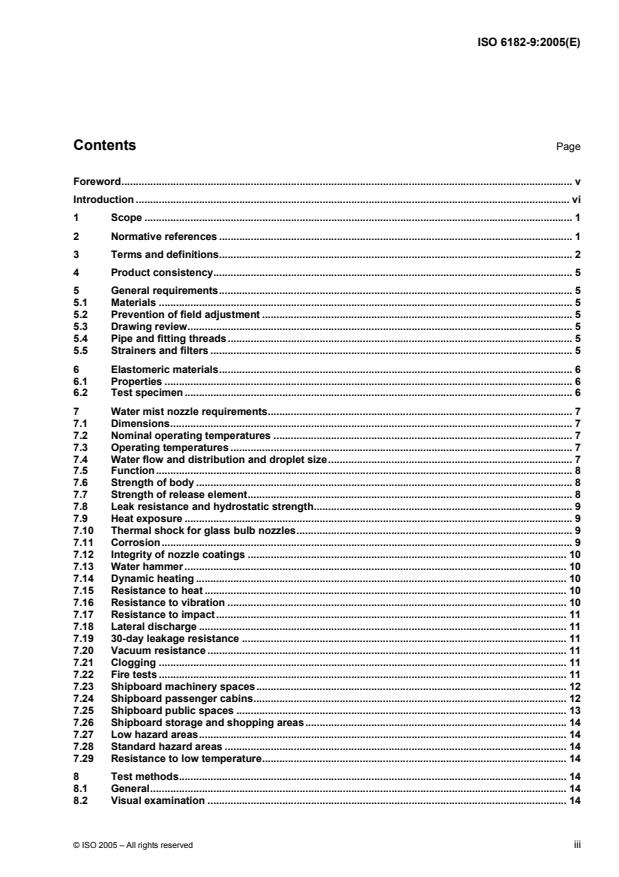
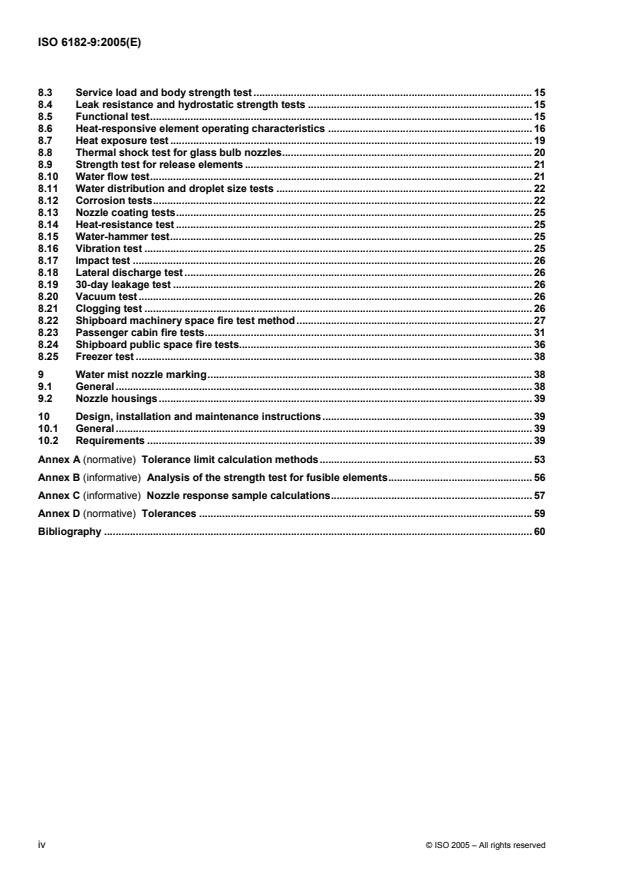
Contents Page
Foreword. v
Introduction . vi
1 Scope . 1
2 Normative references . 1
3 Terms and definitions. 2
4 Product consistency. 5
5 General requirements. 5
5.1 Materials . 5
5.2 Prevention of field adjustment . 5
5.3 Drawing review. 5
5.4 Pipe and fitting threads. 5
5.5 Strainers and filters . 5
6 Elastomeric materials. 6
6.1 Properties . 6
6.2 Test specimen . 6
7 Water mist nozzle requirements. 7
7.1 Dimensions. 7
7.2 Nominal operating temperatures . 7
7.3 Operating temperatures . 7
7.4 Water flow and distribution and droplet size. 7
7.5 Function. 8
7.6 Strength of body . 8
7.7 Strength of release element. 8
7.8 Leak resistance and hydrostatic strength. 9
7.9 Heat exposure . 9
7.10 Thermal shock for glass bulb nozzles. 9
7.11 Corrosion. 9
7.12 Integrity of nozzle coatings . 10
7.13 Water hammer . 10
7.14 Dynamic heating . 10
7.15 Resistance to heat . 10
7.16 Resistance to vibration . 10
7.17 Resistance to impact. 11
7.18 Lateral discharge . 11
7.19 30-day leakage resistance . 11
7.20 Vacuum resistance . 11
7.21 Clogging . 11
7.22 Fire tests . 11
7.23 Shipboard machinery spaces. 12
7.24 Shipboard passenger cabins. 12
7.25 Shipboard public spaces . 13
7.26 Shipboard storage and shopping areas. 14
7.27 Low hazard areas. 14
7.28 Standard hazard areas . 14
7.29 Resistance to low temperature. 14
8 Test methods. 14
8.1 General. 14
8.2 Visual examination . 14
8.3 Service load and body strength test . 15
8.4 Leak resistance and hydrostatic strength tests . 15
8.5 Functional test. 15
8.6 Heat-responsive element operating characteristics . 16
8.7 Heat exposure test . 19
8.8 Thermal shock test for glass bulb nozzles.20
8.9 Strength test for release elements . 21
8.10 Water flow test. 21
8.11 Water distribution and droplet size tests . 22
8.12 Corrosion tests. 22
8.13 Nozzle coating tests. 25
8.14 Heat-resistance test . 25
8.15 Water-hammer test. 25
8.16 Vibration test . 25
8.17 Impact test . 26
8.18 Lateral discharge test . 26
8.19 30-day leakage test . 26
8.20 Vacuum test. 26
8.21 Clogging test . 26
8.22 Shipboard machinery space fire test method. 27
8.23 Passenger cabin fire tests. 31
8.24 Shipboard public space fire tests. 36
8.25 Freezer test . 38
9 Water mist nozzle marking. 38
9.1 General . 38
9.2 Nozzle housings. 39
10 Design, installation and maintenance instructions. 39
10.1 General . 39
10.2 Requirements . 39
Annex A (normative) Tolerance limit calculation methods. 53
Annex B (informative) Analysis of the strength test for fusible elements. 56
Annex C (informative) Nozzle response sample calculations. 57
Annex D (normative) Tolerances .59
Bibliography . 60
iv © ISO 2005 – All rights reserved
Foreword
ISO (the International Organization for Standardization) is a worldwide federation of national standards bodies
(ISO member bodies). The work of preparing International Standards is normally carried out through ISO
technical committees. Each member body interested in a subject for which a technical committee has been
established has the right to be represented on that committee. International organizations, governmental and
non-governmental, in liaison with ISO, also take part in the work. ISO collaborates closely with the
International Electrotechnical Commission (IEC) on all matters of electrotechnical standardization.
International Standards are drafted in accordance with the rules given in the ISO/IEC Directives, Part 2.
The main task of technical committees is to prepare International Standards. Draft International Standards
adopted by the technical committees are circulated to the member bodies for voting. Publication as an
International Standard requires approval by at least 75 % of the member bodies casting a vote.
Attention is drawn to the possibility that some of the elements of this document may be the subject of patent
rights. ISO shall not be held responsible for identifying any or all such patent rights.
ISO 6182-9 was prepared by Technical Committee ISO/TC 21, Equipment for fire protection and fire fighting,
Subcommittee SC 5, Fixed firefighting systems using water.
ISO 6182 consists of the following parts, under the general title Fire protection — Automatic sprinkler systems:
— Part 1: Requirements and test methods for sprinklers
— Part 2: Requirements and test methods for wet alarm valves, retard chambers and water motor alarms
— Part 3: Requirements and test methods for dry pipe valves
— Part 4: Requirements and test methods for quick-opening devices
— Part 5: Requirements and test methods for deluge valves
— Part 6: Requirements and test methods for check valves
— Part 7: Requirements and test methods for early suppression fast response (ESFR) sprinklers
— Part 8: Requirements and test methods for pre-action dry alarm valves
— Part 9: Requirements and test methods for water mist nozzles
— Part 10: Requirements and test methods for domestic sprinklers
— Part 11: Requirements and test methods for pipe hangers
— Part 12: Requirements and test methods for grooved end pipe couplings
— Part 13: Requirements and test methods for extended coverage sprinklers
Introduction
This part of ISO 6182 is one of a number of ISO Standards prepared by ISO/TC 21 covering components for
automatic sprinkler systems.
They are included in a series of ISO Standards planned to cover the following:
a) carbon dioxide systems,
b) explosion suppression systems,
c) foam systems.
vi © ISO 2005 – All rights reserved
INTERNATIONAL STANDARD ISO 6182-9:2005(E)
Fire protection — Automatic sprinkler system —
Part 9:
Requirements and test methods for water mist nozzles
1 Scope
This part of ISO 6182 specifies performance requirements, test methods and marking requirements for water
mist nozzles.
2 Normative references
The following referenced documents are indispensable for the application of this document. For dated
references, only the edition cited applies. For undated references, the latest edition of the referenced
document (including any amendments) applies.
ISO 7-1, Pipe threads where pressure-tight joints are made on the threads — Part 1: Dimensions, tolerances
and designation
ISO 37, Rubber, vulcanized or thermoplastic — Determination of tensile stress-strain properties
ISO 188, Rubber, vulcanized or thermoplastic — Accelerated ageing and heat resistance tests
ISO 5660-1, Reaction-to-fire tests — Heat release, smoke production and mass loss rate — Part 1: Heat
release rate (cone calorimeter method)
ANSI/UL 723:2003, Test for surface burning characteristics of building materials
ASTM E11:2004, Standard specification for wire cloth and sieves for testing purposes
ASTM E799:2003, Standard practice for determining data criteria and processing for liquid drop size analysis
IMO Resolution A.653(16), Recommendation on improved fire test procedures for surface flammability of
bulkhead, ceiling and deck finish materials
3 Terms and definitions
For the purposes of this document, the following terms and definitions apply.
3.1
assembly load
1)
force exerted on the nozzle body at 0 MPa [0 bar ] hydraulic pressure at the inlet
3.2
conductivity factor
C
measure of the conductance between the nozzle's heat-responsive element and the fitting
0,5
NOTE The conductivity factor is expressed in units of (m/s) .
3.3
control spaces
shipboard areas such as the bridge, radio room and emergency power room
3.4
corrosion-resistant material
material of bronze, brass, copper-and-nickel-base alloy, stainless steel or plastic
3.5
design load
force exerted on the release element at the service load of the nozzle
3.6
fire control
limiting the growth of a fire and controlling ceiling gas temperatures to prevent structural damage
3.7
fire suppression
sharply reducing the rate of heat release of a fire and preventing its regrowth
3.8
fire extinguishment
zero rate of heat release, definite stoppage of flames and no re-ignition
3.9
flame spread index
FSI
fire-spread characteristic measured in accordance with ANSI/UL 723
3.10
fuel package
combustible materials in which the fire is ignited and the combustible materials covering the walls and ceiling
3.11
low hazard area
area where the quantity and/or combustibility of contents is low and fires with relatively low rates of heat
release are expected
5 2
1) 1 bar = 10 N/m = 0,1 MPa.
2 © ISO 2005 – All rights reserved
3.12
shipboard machinery spaces
engine rooms and cargo pump rooms containing combustible or flammable liquids having fire characteristics
no more severe than that of light diesel oil
3.13 Nozzles
3.13.1
automatic nozzle
thermosensitive device designed to react at a predetermined temperature by automatically releasing water
1/2
mist into a designated area and volume having a response time index (RTI) of not more than 50 (m⋅s) and a
1/2
conductivity factor (C) not more than 1,0 (m/s)
3.13.2
coated nozzle
nozzle that has a factory applied coating for corrosion protection
3.13.3
fast response nozzle
1/2
automatic nozzle having a response time index (RTI) not more than 50 (m⋅s) and a conductivity factor (C)
1/2
not more than 1,0 (m/s)
3.13.4
fusible element nozzle
nozzle that opens under the influence of heat by the melting of a component
3.13.5
glass bulb nozzle
nozzle that opens under the influence of heat by the bursting of the glass (frangible) bulb through pressure
resulting from expansion of the enclosed fluid
3.13.6
multiple orifice nozzle
nozzle having two or more outlet orifices arranged to distribute the water discharge in a specified pattern and
quantity for a definite protection area
3.13.7
open nozzle
nozzle without a thermosensitive element
3.13.8
pendent nozzle
nozzle that is arranged in such a way that the water mist is directed initially downward by striking a distribution
plate or by nozzle orientation
3.13.9
upright nozzle
nozzle that is arranged in such a way that the water mist is initially directed upwards against a distribution
plate
3.14
operating pressure
service pressure at which a nozzle is intended to operate
3.15
rated working pressure
maximum service pressure at which a nozzle is intended to operate, but no less than 1,2 MPa (12 bar)
3.16
protective cap
device attached to the nozzle for the purpose of protecting the nozzle throughout transport and installation but
mainly for the protection of the nozzle while in service
3.17
response time index
RTI
measure of automatic nozzle sensitivity
1/2
RTI = τu
where
τ is the time constant of the heat-responsive element, expressed in units of seconds;
u is the gas velocity, expressed in meters per second
1/2
NOTE 1 RTI is expressed in units of (m⋅s) .
NOTE 2 RTI can be used in combination with the conductivity factor (C) to predict the response of a nozzle in fire
environments defined in terms of gas temperature and velocity versus time.
3.18
service load
combined force exerted on the nozzle body by the assembly load of the nozzle and the equivalent force of the
rated working pressure applied at the inlet
3.19
shipboard passenger cabin
area with sleeping facilities that are assigned to passengers for their private use
3.20
shipboard public space
area where people may gather such as restaurants, dining rooms, lounges, corridors and offices
3.21
shipping cap
device attached to the nozzle for the purpose of protecting the nozzle only during transport and installation
NOTE Shipping caps are not intended to remain on the nozzle after the installation is complete.
3.22
standard hazard area
area where the quantity and combustibility of contents is moderate, stockpiles of combustibles do not exceed
1,5 m and fires with moderate rates of heat release are expected
3.23
standard orientation
orientation where the airflow is perpendicular to both the axis of the nozzle's inlet and the plane of the frame
arms, if provided, that produces the shortest response time
3.24
worst-case orientation
orientation that produces the longest response time with the axis of the nozzle inlet perpendicular to the
airflow
4 © ISO 2005 – All rights reserved
4 Product consistency
It shall be the responsibility of the manufacturer to implement a quality control program to ensure that
production continuously meets the requirements in the same manner as the originally tested samples. Before
testing, nozzles shall be examined with respect to marking, conformity to manufacturer's drawings and
obvious defects.
Every automatic water mist nozzle shall pass a leak resistance test equivalent to a hydrostatic pressure of at
least 2,5 times the rated working pressure, but no less than 3,0 MPa (30,0 bar), applied for at least 2 s.
5 General requirements
5.1 Materials
5.1.1 All water mist nozzles shall be made from corrosion-resistant materials.
5.1.2 A water mist nozzle shall be constructed to effect closure of its water seat for extended periods of time
without leakage and to open as intended and release all parts from the minimum operating pressure up to the
rated working pressure. For nozzles with intended operating pressures of 1,2 MPa (12 bar) or less, the closure
of the water seat shall not be achieved by the use of a dynamic O-ring or similar seal (an O-ring or similar seal
that moves during operation or is in contact with a component that moves during operation).
5.2 Prevention of field adjustment
The load on the heat-responsive element in automatic nozzles shall be set by the manufacturer in such a
manner so as to prevent field adjustment or replacement. The nozzle orifice/deflector shall be permanently
attached to the nozzle so as to prevent field adjustment or replacement.
5.3 Drawing review
The requirements and tests in Clauses 7 and 8 shall be conducted for each type of nozzle. Before testing,
precise drawings of parts and the assembly shall be submitted together with the appropriate specifications
and a copy of the manufacturer’s design and installation instructions.
5.4 Pipe and fitting threads
5.4.1 Pipe and fitting threads shall conform to the applicable requirements of ISO 7-1.
5.4.2 If International Standards are not applicable, then National Standards are permitted to be used.
5.5 Strainers and filters
5.5.1 All nozzles shall be constructed so that a sphere of diameter 5 mm can pass through each water
passage in the nozzle. Nozzle with smaller openings shall utilize an integral strainer with each nozzle.
5.5.2 Nozzle strainers or filters shall be constructed from corrosion-resistant materials. The maximum
dimension of an opening in the strainer or filter shall not exceed 80 % of the smallest orifice diameter being
protected.
6 Elastomeric materials
6.1 Properties
An elastomer used to provide a water seal shall be tested to determine that it has the following properties.
a) As-received materials, when tested in accordance with ISO 37, shall be of minimum tensile strength of
3,4 MPa for silicone rubber having the characteristic constituent of poly-organo-siloxane and 10,3 MPa for
other elastomers.
b) When tested in accordance with ISO 188, the physical properties after oven aging at the time and
temperature specified in Table 1 shall be at least 60 % of the original tensile strength and elongation
values.
6.2 Test specimen
A part with an inside diameter larger than 25 mm shall be subjected in whole to the above tests. If the size of
the actual part is less than 25 mm or otherwise precludes accurate testing, larger samples of similar parts or
sheet material made of the same compound are to be subjected to the tests.
Table 1 — Oven ageing
Maximum service temperature Oven time Oven temperature
°C h °C
60 70 100
75 168 100
80 168 113
90 168 121
105 168 136
115 1 440 123
125 1 440 133
135 1 440 143
145 1 440 153
150 1 440 158
155 1 440 164
165 1 440 174
175 1 440 184
185 1 440 194
195 1 440 204
200 1 440 210
210 1 440 220
220 1 440 230
230 1 440 240
240 1 440 250
250 1 440 260
6 © ISO 2005 – All rights reserved
7 Water mist nozzle requirements (see Clause 8)
7.1 Dimensions
Nozzles shall be provided with a 6 mm or larger nominal inlet thread. The dimensions of all threaded
connections shall conform to International Standards where applied. If International Standards are not
applicable, National Standards may be used.
7.2 Nominal operating temperatures
7.2.1 The nominal operating temperatures of automatic glass bulb nozzles shall be as indicated in Table 2.
7.2.2 The nominal operating temperatures of automatic fusible element nozzles shall be specified in
advance by the manufacturer and verified in accordance with 7.3. They shall be determined as a result of the
nominal release temperature test. See 8.6.1. Nominal operating temperatures shall be within the ranges
specified in Table 2.
7.2.3 The nominal operating temperature that is to be marked on the nozzle shall be that which is
determined when the nozzle is tested in accordance with 8.6.1, taking into account the specifications of 7.3.
Table 2 — Nominal release temperature
Glass bulb nozzles Fusible element nozzles
Nominal release Nominal release
temperature temperature
Liquid colour code Colour code
°C °C
57 orange 57 to 77 uncoloured
68 red 80 to 107 white
79 yellow 121 to 149 blue
93 to 107 green 163 to 191 red
121 to 141 blue
163 to 182 mauve
7.3 Operating temperatures
Automatic nozzles shall open within a temperature range of ϑ ± (0,035ϑ + 0,62) °C where ϑ is the nominal
operating temperature.
7.4 Water flow and distribution and droplet size
7.4.1 Flow constant (see 8.10)
7.4.1.1 The flow constant K for nozzles shall be calculated by the following formula:
q
K=
0,5
p
where
p is the pressure, in bars;
q is the flow rate, in l/min.
7.4.1.2 The value of the flow constant K published in the manufacturer’s design and installation
instructions shall be verified using the test method of 8.10. The average flow constant K shall be within ± 5 %
of the manufacturer's value.
7.4.2 Water distribution [see 8.11.1 and 10.2 g)]
The discharge characteristics of the nozzle shall be determined in accordance with 8.11.1.
7.4.3 Water droplet size and velocity [see 8.11.2 and 10.2 g)]
The water droplet size distribution and droplet velocity distribution of the nozzle shall be determined in
accordance with 8.11.2.
7.5 Function (see 8.5)
7.5.1 When tested in accordance with 8.5.1 to 8.5.4, an open nozzle fitted with a protective device for the
outlet shall release within 10 s after the application of pressure. An automatic nozzle shall open and, within 5 s
after the release of the heat responsive element, shall operate satisfactorily by complying with the
requirements of 7.4.1. Any lodgement of released parts shall be cleared within 10 s of release or the nozzle
shall then comply with the requirements of 7.4.2 and 7.4.3.
7.5.2 A nozzle shall not sustain damage as a result of the functional test specified in 8.5.5 and shall have
the same flow constant range and water droplet size and velocity within 5 % of values as previously
determined in 7.4.1 and 7.4.3.
7.6 Strength of body (see 8.3)
An automatic nozzle shall not show permanent elongation of more than 0,2 % between the load-bearing
points after being subjected to two times the average service load as determined using the method of 8.3.
7.7 Strength of release element
7.7.1 Glass bulb (see 8.9.1)
When tested in accordance with 8.9.1, glass bulb elements shall
a) have an average strength of at least six times the average service load, and
b) have a design strength lower tolerance limit (L ) on the strength distribution curve of at least two times
tol,1
the upper tolerance limit (L ) of the service load distribution curve based on calculations with a degree
tol,2
of confidence (Γ) of 0,99 for 99 % of the samples (P). Calculations will be based on Normal or Gaussian
distribution except where other distribution can be shown to be more applicable due to manufacturing of
design factors.
7.7.2 Fusible elements
Fusible heat-responsive elements in the ordinary temperature range shall be designed to
a) sustain a load of 15 times its design load corresponding to the maximum service load measured in 8.3 for
a period of 100 h when tested in accordance with 8.9.2 or
b) demonstrate the ability to sustain the design load when tested in accordance with 8.9.2.
8 © ISO 2005 – All rights reserved
7.8 Leak resistance and hydrostatic strength
7.8.1 An automatic nozzle shall not show any sign of leakage when tested by the method specified in 8.4.1.
7.8.2 A nozzle shall not rupture, operate or release any parts when tested by the method specified in 8.4.2.
7.9 Heat exposure
7.9.1 Glass bulb nozzles
There shall be no damage to the glass bulb element when the nozzle is tested by the method specified in
8.7.1.
7.9.2 Uncoated automatic nozzles
Uncoated automatic nozzles shall withstand exposure to increased ambient temperature without evidence of
leakage, weakness or failure when tested by the method specified in 8.7.2.
7.10 Thermal shock for glass bulb nozzles
Glass bulb nozzles shall not be damaged when tested by the method specified in 8.8. Proper operation shall
not be considered as damage.
7.11 Corrosion
7.11.1 Stress corrosion
When tested in accordance with 8.12.1, brass nozzles or parts shall show no cracking, delamination or failure
that could affect their ability to function as intended.
When tested in accordance with 8.12.2, stainless steel nozzles or parts shall show no cracking, delamination
or failure that could affect their ability to function as intended.
7.11.2 Sulfur dioxide corrosion
Nozzles shall be resistant to sulfur dioxide saturated with water vapour when conditioned in accordance with
8.12.3. Following exposure, the water flow rate of the open nozzles at their minimum operating pressure shall
be within 5 % of the value specified in the manufacturer’s design and installation instructions. For automatic
nozzles, five nozzles shall operate when functionally tested at their minimum flowing pressure (see 7.5.1 and
7.5.2) and the remaining five samples shall meet the dynamic heating requirements of 7.14.2.
7.11.3 Salt spray corrosion
Coated and uncoated nozzles shall be resistant to salt spray when conditioned in accordance with 8.12.4.
Following exposure, the water flow rate of the open nozzles at their minimum operating pressure shall be
within 5 % of the value specified in the manufacturer’s design and installation instructions. For automatic
nozzles, the samples shall meet the dynamic heating requirements of 7.14.2.
7.11.4 Moist air exposure
Nozzles shall be resistant to moist air exposure when tested in accordance with 8.12.5. Following exposure,
the nozzles shall be functionally tested at their minimum flowing pressure in accordance with 7.5.1 and meet
the dynamic heating requirements of 7.14.2.
7.12 Integrity of nozzle coatings
7.12.1 Evaporation of wax and bitumen used for atmospheric protection of nozzles
Waxes and bitumens used for coating nozzles shall not contain volatile matter in sufficient quantities to cause
shrinkage, hardening, cracking or flaking of the applied coating. The loss in mass shall not exceed 5 % of that
of the original sample when tested by the method detailed in 8.13.1.
7.12.2 Resistance to low temperatures
All coatings used for nozzles shall not crack or flake when subjected to low temperatures by the method
detailed in 8.13.2.
7.12.3 Resistance to high temperature
Coated nozzles shall meet the requirements of 7.9.3.
7.13 Water hammer
Automatic nozzles shall show no signs of leakage or mechanical damage when tested in accordance with
8.15 and shall operate within the parameters of 7.5.1 at the minimum operating pressure.
7.14 Dynamic heating
7.14.1 When tested in accordance with 8.6.2 in their standard orientation, automatic nozzles shall have an
1/2 1/2
RTI not exceeding 50 (m⋅s) and a conductivity factor (C) less than 1 (m/s) . When tested at an angular
offset of 25° to the worst-case orientation, the RTI shall not exceed 250 % of the value of RTI in the standard
orientation.
7.14.2 After exposure to the corrosion test described in 7.11.2, 7.11.3 and 7.11.4, automatic nozzles shall be
tested in the standard orientation as described in 8.6.2.1 to determine the post-exposure RTI. All post-
exposure RTI values shall not exceed the limits specified in 7.14.1. In addition, the average RTI value shall
not exceed 130 % of the pre-exposure average value. All post-exposure RTI values shall be calculated in
accordance with 8.6.2.3 using the pre-exposure conductivity factor (C).
7.15 Resistance to heat
Nozzles shall be resistant to high temperatures when tested in accordance with 8.14. After exposure, the
nozzle shall not show any of the following:
a) visual breakage or deformation,
b) change in flow constant K of more than 5 %, and
c) no changes in the discharge characteristics of the water distribution test (see 7.4.2) exceeding 5 %.
7.16 Resistance to vibration
Nozzles shall be able to withstand the effects of vibration without deterioration of their performance
characteristics when tested in accordance with 8.16. After the vibration test of 8.16, automatic nozzles shall
show no visible deterioration and shall meet the requirements of 7.5 and 7.8. Open nozzles shall not rupture
when subjected to the body strength test in accordance with 8.4.2.
10 © ISO 2005 – All rights reserved
7.17 Resistance to impact (see 8.17)
Nozzles shall have adequate strength to withstand impacts associated with handling, transport and installation
without deterioration of their performance or reliability. Resistance to impact shall be determined in
accordance with 8.17.
7.18 Lateral discharge
Automatic nozzles shall not prevent the operation of adjacent automatic nozzles when tested in accordance
with 8.18.
7.19 30-day leakage resistance
Automatic nozzles shall not leak, sustain distortion or other mechanical damage when subjected to twice the
rated pressure for 30 d. Following exposure, the nozzles shall satisfy the test requirements of 8.19.
7.20 Vacuum resistance
Automatic nozzles shall not exhibit distortion, mechanical damage or leakage after being subjected to the test
detailed in 8.20.
7.21 Clogging
A water mist nozzle and strainer or filter shall show no evidence of clogging during 30 min of continuous flow
at rated working pressure using water that has been contaminated in accordance with 8.21.3. Following the
30 min of flow, the water flow at rated pressure of the nozzle and strainer or filter shall be within ± 10 % of the
value obtained prior to conducting the clogging test.
7.22 Fire tests
7.22.1 General
7.22.1.1 Water mist nozzles shall be tested for compliance with one or more of the fire test categories
described in 7.23 to 7.25 as follows:
a) shipboard Class 1 machinery spaces;
b) shipboard Class 2 machinery spaces;
c) shipboard Class 3 machinery spaces;
d) shipboard passenger cabins;
e) shipboard corridors;
f) shipboard luxury passenger cabins;
g) shipboard open public spaces and corner public spaces;
h) shipboard storage and shopping areas;
i) low hazard areas;
j) standard hazard areas.
NOTE Tests are in preparation for items (i) and (j)
7.22.1.2 The types of fire tests conducted shall include the hazards, areas and occupancies referenced in
the manufacturer’s design and installation instructions.
7.22.1.3 Nozzle configurations, flow rates and spacings shall be constant for all of the fire tests within a
category. Use of different nozzle types for different areas is acceptable.
Corridor nozzles are permitted to be different from passenger cabin nozzles.
7.23 Shipboard machinery spaces
7.23.1 When tested as described in 8.22, water mist nozzles intended for the protection of Category A
engine rooms shall extinguish the test fires and prevent reignition.
7.23.2 Classes 1, 2 and 3 Category A engine rooms shall be characterized as in Table 3.
7.23.3 For Class 2 Category A engine rooms, the maximum floor area and ceiling height specified in the
manufacturer’s design and installation instructions shall be those used in the fire tests specified in 8.22.2.3.
7.24 Shipboard passenger cabins
7.24.1 Water mist nozzles intended for the protection of passenger cabins up to 12 m in area shall comply
with the passenger cabin fire test methods described in 8.23.1. If protection is desired for passenger cabins
greater than 12 m in area, the fire tests described in 8.23.2 shall also be conducted.
Table 3 — Classification of Category A engine rooms
Typical net
Typical oil flow and pressure in fuel and
volume
Class Typical engine room features
lubrication systems
m
1 Auxiliary engine room, small main 500 Fuel:
machinery or purifier room etc.
⎯ Low pressure 0,15 kg/s to 0,20 kg/s at
0,3 MPa to 0,6 MPa (3 bar to 6 bar)
⎯ High pressure 0,02 kg/s at
20 MPa to 30 MPa (200 bar to 300 bar)
Lubrication oil: 0,3 MPa to 0,5 MPa
(3 bar to 5 bar)
Hydraulic oil: 15 MPa (150 bar)
2 Main diesel machinery in 3 000 Fuel:
medium-sized ships such as
⎯ Low pressure 0,4 kg/s to 0,6 kg/s at
passenger ferries
0,3 MPa to 0,8 MPa (3 bar to 8 bar)
⎯ High pressure 0,030 kg/s at
25 MPa (250 bar)
Lubrication oil: 0,3 MPa to 0,5 MPa
(3 bar to 5 bar)
Hydraulic oil: 15 MPa (150 bar)
3 Main diesel machinery in large ships Fuel:
> 3 000
such as oil tankers and container
⎯ Low pressure 0,7 kg/s to 1,0 kg/s at 3 bar
ships
to 8 bar
⎯ High pressure 0,20 kg/s
Lubrication oil: 0,3 MPa to 0,5 MPa
(3 bar to 5 bar)
Hydraulic oil: 15 MPa (150 bar)
12 © ISO 2005 – All rights reserved
7.24.2 Water mist nozzles installed for the protection of passenger cabins and corridors in accordance with
8.23.1 shall:
a) prevent flashover of the cabin or corridor except in the disabled nozzle test;
b) comply with the fire source damage criteria described in Table 4;
c) prevent operation of any automatic water mist nozzles located in the corridor in fire Tests A and B;
d) operate no more than two water mist nozzles in fire Tests E to G.
Table 4 — Performance criteria for 12 m cabin/corridor fire test
Maximum 30 s Maximum 30 s Maximum 30 s
average ceiling average gas average ceiling
Maximum fire
temperature in temperature in temperature in
Test Other criteria
source damage
cabin cabin corridor
°C °C °C
40 % lower bunk
No nozzles in corridor
A 360 320 120 bed and 10 % of
allowed to operate
upper bunk bed
40 % of upper No nozzles in corridor
B 360 320 120
bunk bed allowed to operate
C — — 120 — —
Fire not permitted to
propagate in corridor
D — — 400 —
beyond nozzles closest
to cabin door opening
Only two adjacent
E to G — — 120 — nozzles in corridor
allowed to operate
7.24.3 Water mist nozzles installed for the protection of passenger cabins greater than 12 m in accordance
with 8.23.2 shall:
a) suppress the fire in the cabin;
b) limit the ceiling surface temperature to 260 °C;
c) limit the ceiling gas temperature to 320 °C;
d) not totally consume the foam and wood.
7.25 Shipboard public spaces
Water mist nozzles installed to protect public spaces other than shopping and storage areas shall:
a) suppress or control the open public space and corner fire tests described in 8.24.1.1 as evidenced by no
more than 50 % consumption of the mattresses in any single test and an average loss no greater than
35 % in any series of fire tests conducted at the same ceiling height (both open and corner public space
te
...