


ISO/IEC 9594-4:1990/Cor 2:1992
(Corrigendum)Information technology — Open Systems Interconnection — The Directory — Part 4: Procedures for distributed operation — Technical Corrigendum 2
Information technology — Open Systems Interconnection — The Directory — Part 4: Procedures for distributed operation — Technical Corrigendum 2
Technologies de l'information — Interconnexion de systèmes ouverts — L'Annuaire — Partie 4: Procédures pour le fonctionnement réparti — Rectificatif technique 2
General Information
- Status
- Withdrawn
- Publication Date
- 01-Jul-1992
- Withdrawal Date
- 01-Jul-1992
- Technical Committee
- ISO/IEC JTC 1 - Information technology
- Drafting Committee
- ISO/IEC JTC 1 - Information technology
- Current Stage
- 9599 - Withdrawal of International Standard
- Start Date
- 17-Jun-1998
- Completion Date
- 14-Feb-2026
Relations
- Effective Date
- 06-Jun-2022
- Effective Date
- 06-Jun-2022
- Effective Date
- 15-Apr-2008
- Effective Date
- 15-Apr-2008

Get Certified
Connect with accredited certification bodies for this standard

BSI Group
BSI (British Standards Institution) is the business standards company that helps organizations make excellence a habit.

NYCE
Mexican standards and certification body.
Sponsored listings
Frequently Asked Questions
ISO/IEC 9594-4:1990/Cor 2:1992 is a standard published by the International Organization for Standardization (ISO). Its full title is "Information technology — Open Systems Interconnection — The Directory — Part 4: Procedures for distributed operation — Technical Corrigendum 2". This standard covers: Information technology — Open Systems Interconnection — The Directory — Part 4: Procedures for distributed operation — Technical Corrigendum 2
Information technology — Open Systems Interconnection — The Directory — Part 4: Procedures for distributed operation — Technical Corrigendum 2
ISO/IEC 9594-4:1990/Cor 2:1992 is classified under the following ICS (International Classification for Standards) categories: 35.100.70 - Application layer. The ICS classification helps identify the subject area and facilitates finding related standards.
ISO/IEC 9594-4:1990/Cor 2:1992 has the following relationships with other standards: It is inter standard links to ISO 11446:2004, ISO/IEC 9594-4:1990, ISO/IEC 9594-4:1995; is excused to ISO/IEC 9594-4:1990. Understanding these relationships helps ensure you are using the most current and applicable version of the standard.
ISO/IEC 9594-4:1990/Cor 2:1992 is available in PDF format for immediate download after purchase. The document can be added to your cart and obtained through the secure checkout process. Digital delivery ensures instant access to the complete standard document.
Standards Content (Sample)
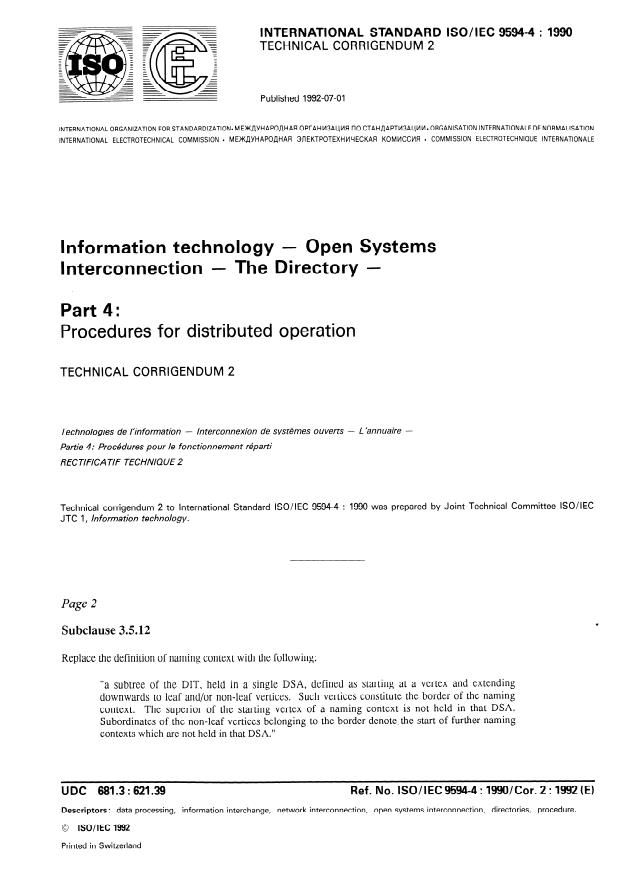
INTERNATIONAL STANDARD ISO/lEC 9594-4 : 1990
TECHNICAL CORRIGENDUM 2
Published 1992-07-01
INTERNATIONAL ORGANIZATION FOR STANDARDIZATION* ME>KP,YHAPOP,HAR OPTAHM3AL/MFl fl0 CTAHflAPTM3A~klM. ORGANISATION INTERNATIONALE DE NORMALISATION
INTERNATIONAL ELECTROTECHNICAL COMMISSION l MExAYHAPOP,HAFl 3JlEKTPOTEXHklqECKAFI KOMblCCt’lFI . COMMISSION ELECTROTECHNIQUE INTERNATIONALE
Information technology - Open Systems
Interconnection - The Directory -
Part 4:
Procedures for distributed Operation
TECHNICAL CORRIGENDUM 2
Technologies de l’informa tion - lnterconnexion de systemes ouverts - L’annuaire -
Partie 4: Procedures pour Ie fonctionnement rkparti
RECTIFICATIF TECHNIQUE 2
: 1990 was prepared by Joint Technical Committee ISOIIEC
Technical corrigendum 2 to International Standard ISO/IEC 9594-4
JTC 1, Information technology.
Page 2
Subclause 3.512
Replace the definition of naming context with the following:
“a subtree of the DIT, held in a Single DSA, defined as starting at a vertex and extending
downwards to leaf and/or non-leaf vertices. Such vertices constitute the border of the naming
context. The superior of the starting vertex of a naming context is not held in that DSA.
Subordinates of the non-leaf vertices belonging to the border denote. the Start of further naming
contexts which are not held in that DSA.”
UDC 661.3: 621.39 Ref. No. ISO/IEC9594-4 : 199OKor. 2 : 1992 (E)
Descriptors : data processi ng , network interconnection, open Systems interconnection, directories, procedure.
information interchange,
0 ISO/IEC 1992
Printed in Switzerland
ISOhEC 9594-4 : 1988lCor.2 : 1992 (E)
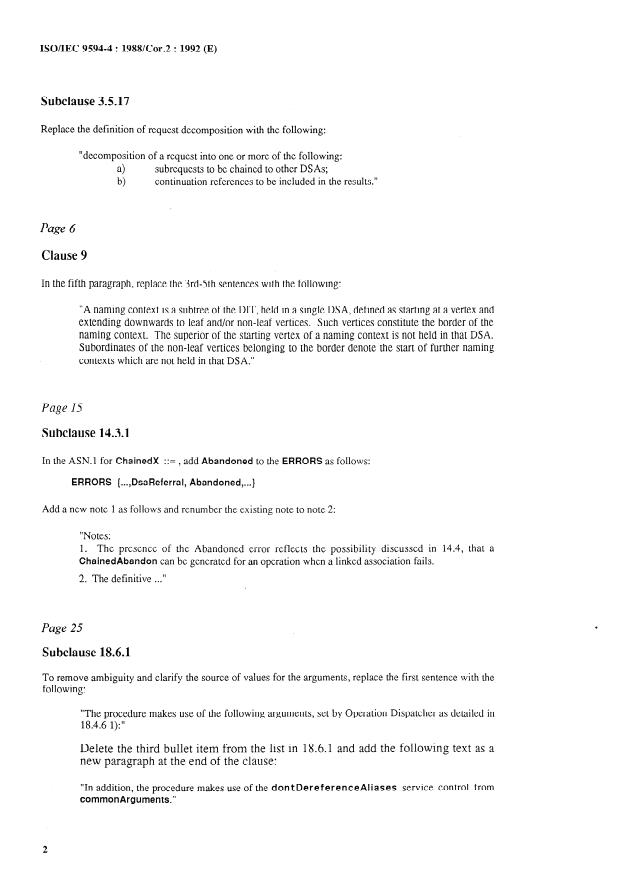
Subclause 3.517
Replace the definition of request decomposition with the following:
“decomposition of a request into one or more of the following:
subrequests to be chained to other DSAs;
a>
continuation references to be included in the results.”
b)
Page 6
Clause 9
In the fifth Paragraph, replace the 3rd-5th sentences with the föllowing:
“A naming context is a subtree of the DIT, held in a Single DSA, defined as starting at a vertex and
extending downwards to leaf and/or non-leaf vertices. Such vertices
...
Questions, Comments and Discussion
Ask us and Technical Secretary will try to provide an answer. You can facilitate discussion about the standard in here.
Loading comments...