

ISO 9957-3:1997
(Main)Fluid draughting media — Part 3: Water-based coloured draughting inks — Requirements and test conditions
General Information
- Abstract
- Status
- Published
- Publication Date
- 14-Oct-1997
- Technical Committee
- ISO/TC 10 - Technical product documentation
- Drafting Committee
- ISO/TC 10/WG 18 - Drawing and writing instruments
- Current Stage
- 9093 - International Standard confirmed
- Start Date
- 18-Jun-2026
- Completion Date
- 29-Aug-2026
Buy Documents

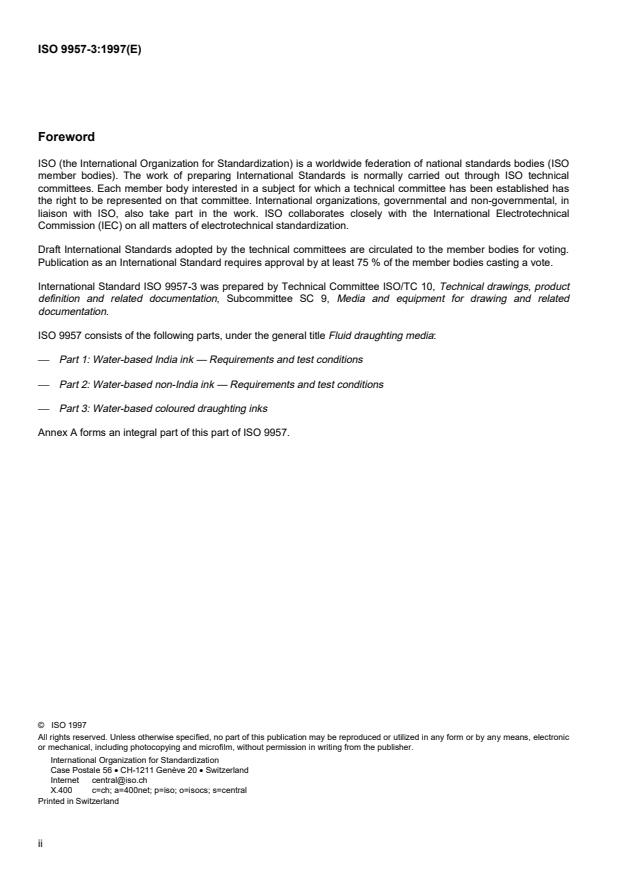

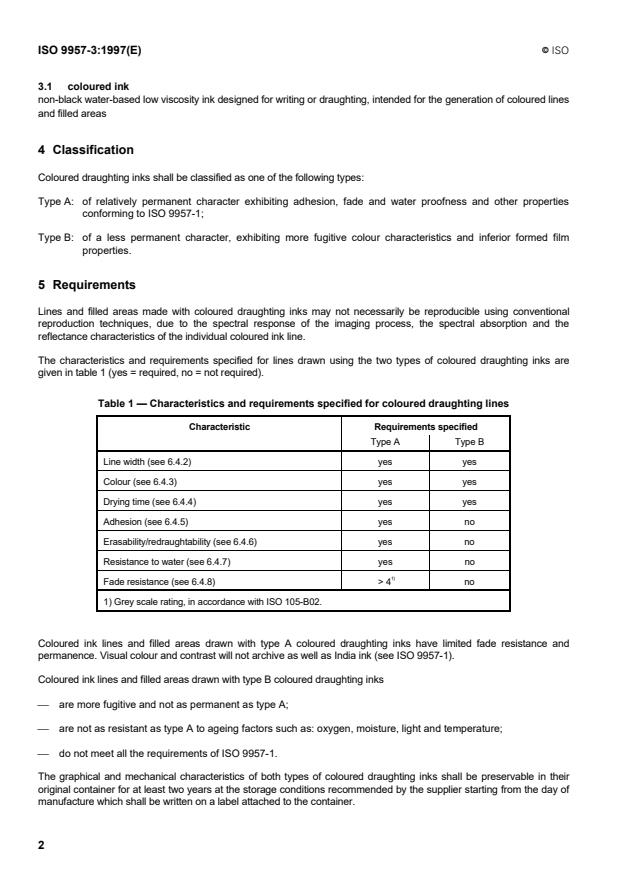
ISO 9957-3:1997 - Fluid draughting media — Part 3: Water-based coloured draughting inks — Requirements and test conditions/16/1997


ISO 9957-3:1997 - Fluides à dessin — Partie 3: Encres aqueuses colorées à dessin — Prescriptions et conditions d'essai/16/1997
Overview
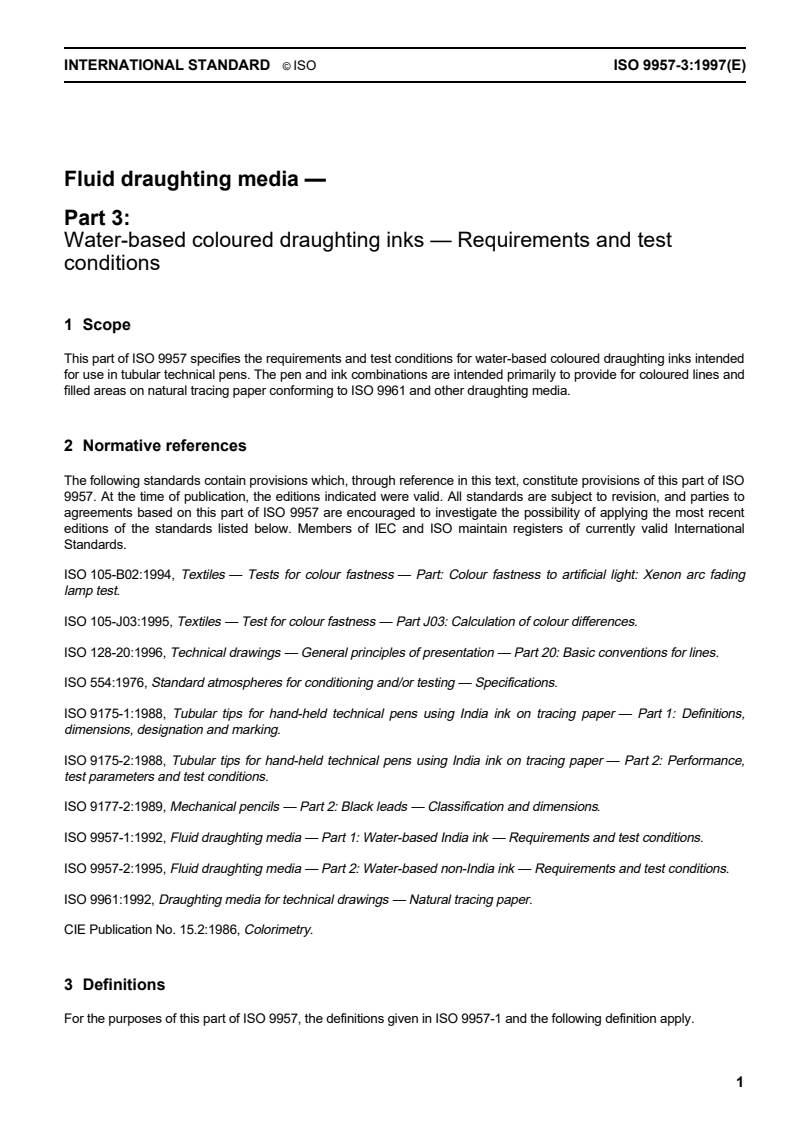
ISO 9957-3:1997, "Fluid draughting media - Part 3: Water‑based coloured draughting inks - Requirements and test conditions," defines requirements and test methods for water‑based coloured draughting inks intended for use in tubular technical pens on natural tracing paper (ISO 9961) and similar draughting media. The standard specifies classification, performance criteria and detailed test conditions to assess graphical, mechanical and ageing behaviour of coloured inks used for technical drawings.
Key topics and technical requirements
- Scope & Classification
- Covers non‑black, low‑viscosity inks for coloured lines and filled areas.
- Two types: Type A (relatively permanent - adhesion, fade and water resistance required) and Type B (less permanent, more fugitive).
- Test environment and equipment
- Standard test atmosphere 23/50 (ISO 554).
- Tubular technical pens per ISO 9175‑1 / ISO 9175‑2 and an electromechanical line‑draughting test machine (adjustable angle, load, speed, pitch).
- Measurement tools: reflectance colorimeter (CIE Publication No. 15.2), microscope/profile projector (≥×20), filtered xenon lamp for fading tests.
- Performance tests and methods
- Line width - microscopic or profile projection measurement; averaged over multiple points.
- Colour - colour areas and CIE x,y coordinates defined in Annex A; colour measured under Standard Illuminant D.
- Drying time - e.g., 150 mm line, smear test with gloved finger after 10 s (no smearing).
- Adhesion - tape pull test and eraser test after 15 min drying (no visual loss of optical density for Type A).
- Erasability / Redraughtability - erase a section and redraw; no feathering or ghosting permitted for Type A.
- Resistance to water - water drop test after drying; no visual reduction in line intensity allowed for Type A.
- Fade resistance - xenon lamp exposure and visual/CIELAB assessment against blue‑wool references (ISO 105‑B02, ISO 105‑J03).
- Shelf life and labelling
- Ink properties must be preservable in original container for at least two years at supplier‑recommended storage conditions; manufacture date must be on the label.
- Designation and test report
- Prescribed designation format (e.g., “Coloured ink ISO 9957‑3 – A”) and required test report elements.
Applications and users
- Ink manufacturers - product specification, quality control and labelling.
- Technical‑pen and draughting equipment producers - compatibility and performance verification.
- Testing laboratories - standardized methods for certification and comparative testing.
- Design and engineering drafters, archivists - guidance on permanence, reproduction behaviour and suitable inks for technical drawings.
Related standards
- ISO 9957‑1 (India ink), ISO 9957‑2 (non‑India ink)
- ISO 9175‑1 / 9175‑2 (tubular tips / performance)
- ISO 9961 (natural tracing paper)
- ISO 554 (standard atmospheres), ISO 105‑B02 / 105‑J03 (colour fastness and colour difference)
- CIE Publication No. 15.2 (Colorimetry)
Keywords: ISO 9957-3, water-based coloured draughting inks, technical pens, tracing paper, line width, drying time, adhesion, fade resistance, testing conditions.
Buy Documents
ISO 9957-3:1997 - Fluid draughting media — Part 3: Water-based coloured draughting inks — Requirements and test conditions/16/1997
ISO 9957-3:1997 - Fluides à dessin — Partie 3: Encres aqueuses colorées à dessin — Prescriptions et conditions d'essai/16/1997
Frequently Asked Questions
ISO 9957-3:1997 is a standard published by the International Organization for Standardization (ISO). Its full title is "Fluid draughting media — Part 3: Water-based coloured draughting inks — Requirements and test conditions". This standard covers: Fluid draughting media — Part 3: Water-based coloured draughting inks — Requirements and test conditions
Fluid draughting media — Part 3: Water-based coloured draughting inks — Requirements and test conditions
ISO 9957-3:1997 is classified under the following ICS (International Classification for Standards) categories: 01.100.40 - Drawing equipment. The ICS classification helps identify the subject area and facilitates finding related standards.
ISO 9957-3:1997 is available in PDF format for immediate download after purchase. The document can be added to your cart and obtained through the secure checkout process. Digital delivery ensures instant access to the complete standard document.
Standards Content (Sample)
INTERNATIONAL ISO
STANDARD 9957-3
First edition
1997-11-01
Fluid draughting media —
Part 3:
Water-based coloured draughting inks —
Requirements and test conditions
Fluides à dessins —
Partie 3: Encres aqueuses colorées à dessin — Prescriptions et conditions
d’essai
Reference number
A
Foreword
ISO (the International Organization for Standardization) is a worldwide federation of national standards bodies (ISO
member bodies). The work of preparing International Standards is normally carried out through ISO technical
committees. Each member body interested in a subject for which a technical committee has been established has
the right to be represented on that committee. International organizations, governmental and non-governmental, in
liaison with ISO, also take part in the work. ISO collaborates closely with the International Electrotechnical
Commission (IEC) on all matters of electrotechnical standardization.
Draft International Standards adopted by the technical committees are circulated to the member bodies for voting.
Publication as an International Standard requires approval by at least 75 % of the member bodies casting a vote.
International Standard ISO 9957-3 was prepared by Technical Committee ISO/TC 10, Technical drawings, product
definition and related documentation, Subcommittee SC 9, Media and equipment for drawing and related
documentation.
ISO 9957 consists of the following parts, under the general title Fluid draughting media:
Part 1: Water-based India ink — Requirements and test conditions
Part 2: Water-based non-India ink — Requirements and test conditions
Part 3: Water-based coloured draughting inks
Annex A forms an integral part of this part of ISO 9957.
© ISO 1997
All rights reserved. Unless otherwise specified, no part of this publication may be reproduced or utilized in any form or by any means, electronic
or mechanical, including photocopying and microfilm, without permission in writing from the publisher.
International Organization for Standardization
Case Postale 56 • CH-1211 Genève 20 • Switzerland
Internet central@iso.ch
X.400 c=ch; a=400net; p=iso; o=isocs; s=central
Printed in Switzerland
ii
INTERNATIONAL STANDARD © ISO ISO 9957-3:1997(E)
Fluid draughting media —
Part 3:
Water-based coloured draughting inks — Requirements and test
conditions
1 Scope
This part of ISO 9957 specifies the requirements and test conditions for water-based coloured draughting inks intended
for use in tubular technical pens. The pen and ink combinations are intended primarily to provide for coloured lines and
filled areas on natural tracing paper conforming to ISO 9961 and other draughting media.
2 Normative references
The following standards contain provisions which, through reference in this text, constitute provisions of this part of ISO
9957. At the time of publication, the editions indicated were valid. All standards are subject to revision, and parties to
agreements based on this part of ISO 9957 are encouraged to investigate the possibility of applying the most recent
editions of the standards listed below. Members of IEC and ISO maintain registers of currently valid International
Standards.
ISO 105-B02:1994, Textiles — Tests for colour fastness — Part: Colour fastness to artificial light: Xenon arc fading
lamp test.
ISO 105-J03:1995, Textiles — Test for colour fastness — Part J03: Calculation of colour differences.
ISO 128-20:1996, Technical drawings — General principles of presentation — Part 20: Basic conventions for lines.
ISO 554:1976, Standard atmospheres for conditioning and/or testing — Specifications.
ISO 9175-1:1988, Tubular tips for hand-held technical pens using India ink on tracing paper — Part 1: Definitions,
dimensions, designation and marking.
ISO 9175-2:1988, Tubular tips for hand-held technical pens using India ink on tracing paper — Part 2: Performance,
test parameters and test conditions.
ISO 9177-2:1989, Mechanical pencils — Part 2: Black leads — Classification and dimensions.
ISO 9957-1:1992, .
Fluid draughting media — Part 1: Water-based India ink — Requirements and test conditions
ISO 9957-2:1995, Fluid draughting media — Part 2: Water-based non-India ink — Requirements and test conditions.
ISO 9961:1992, Draughting media for technical drawings — Natural tracing paper.
CIE Publication No. 15.2:1986, Colorimetry.
3 Definitions
For the purposes of this part of ISO 9957, the definitions given in ISO 9957-1 and the following definition apply.
©
ISO
3.1 coloured ink
non-black water-based low viscosity ink designed for writing or draughting, intended for the generation of coloured lines
and filled areas
4 Classification
Coloured draughting inks shall be classified as one of the following types:
Type A: of relatively permanent character exhibiting adhesion, fade and water proofness and other properties
conforming to ISO 9957-1;
Type B: of a less permanent character, exhibiting more fugitive colour characteristics and inferior formed film
properties.
5 Requirements
Lines and filled areas made with coloured draughting inks may not necessarily be reproducible using conventional
reproduction techniques, due to the spectral response of the imaging process, the spectral absorption and the
reflectance characteristics of the individual coloured ink line.
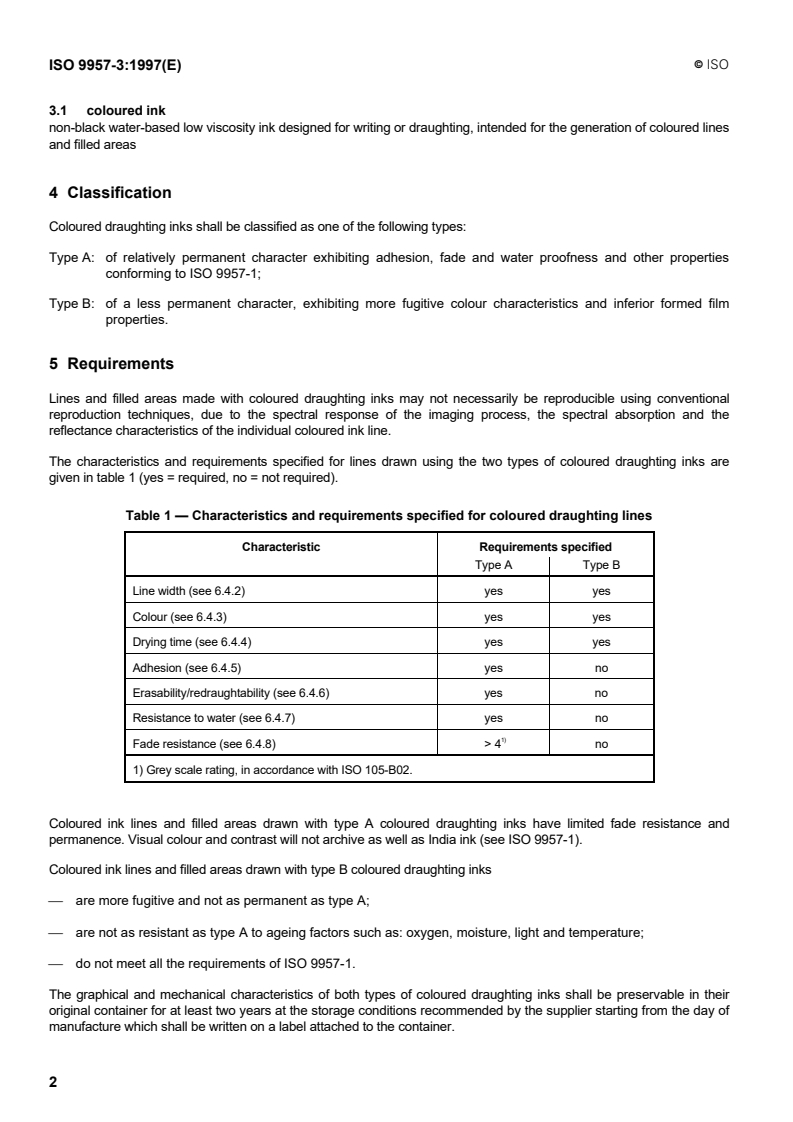
The characteristics and requirements specified for lines drawn using the two types of coloured draughting inks are
given in table 1 (yes = required, no = not required).
Table 1 — Characteristics and requirements specified for coloured draughting lines
Characteristic Requirements specified
Type A Type B
Line width (see 6.4.2) yes yes
Colour (see 6.4.3) yes yes
Drying time (see 6.4.4) yes yes
Adhesion (see 6.4.5) yes no
Erasability/redraughtability (see 6.4.6) yes no
Resistance to water (see 6.4.7) yes no
1)
Fade resistance (see 6.4.8) > 4 no
1) Grey scale rating, in accordance with ISO 105-B02.
Coloured ink lines and filled areas drawn with type A coloured draughting inks have limited fade resistance and
permanence. Visual colour and contrast will not archive as well as India ink (see ISO 9957-1).
Coloured ink lines and filled areas drawn with type B coloured draughting inks
are more fugitive and not as permanent as type A;
are not as resistant as type A to ageing factors such as: oxygen, moisture, light and temperature;
do not meet all the requirements of ISO 9957-1.
The graphical and mechanical characteristics of both types of coloured draughting inks shall be preservable in their
original container for at least two years at the storage conditions recommended by the supplier starting from the day of
manufacture which shall be written on a label attached to the container.
©
ISO
6 Test conditions, equipment and performance
6.1 Basic test concept
Test lines of the coloured draughting ink are drawn in accordance with 6.4 using a new tubular technical pen in
accordance with ISO 9175-1, on natural tracing paper or any other paper recommended for the ink, and the lines are
evaluated for the desired characteristic.
6.2 Climatic conditions for testing
The tests shall be carried out under the standard test atmosphere 23/50 (see ISO 554).
6.3 Test equipment and accessories
6.3.1 Test machine
1)
The test machine shall be an electromechanical line-draughting device permitting the adjustment of:
writing angle;
writing load;
speed;
line pitch.
See figure 1.
Figure 1 — Schematic representation of the test machine
6.3.2 Test paper
The test paper shall be natural tracing paper conforming to ISO 9961, or any other paper recommended for the ink.
The paper shall be left to stabilize under the standard test atmosphere (see 6.2) for a minimum of 24 h before the test
is performed.
The test strip shall be cut parallel to the longest edge of the test paper.
1) On request, the ISO/TC 10 Secretariat will provide a list of suppliers.
©
ISO
6.3.3 Test pen
The test lines shall be drawn with a tubular technical pen in accordance with ISO 9175-1. The ink s
...
INTERNATIONAL ISO
STANDARD 9957-3
First edition
1997-11-01
Fluid draughting media —
Part 3:
Water-based coloured draughting inks —
Requirements and test conditions
Fluides à dessins —
Partie 3: Encres aqueuses colorées à dessin — Prescriptions et conditions
d’essai
Reference number
A
Foreword
ISO (the International Organization for Standardization) is a worldwide federation of national standards bodies (ISO
member bodies). The work of preparing International Standards is normally carried out through ISO technical
committees. Each member body interested in a subject for which a technical committee has been established has
the right to be represented on that committee. International organizations, governmental and non-governmental, in
liaison with ISO, also take part in the work. ISO collaborates closely with the International Electrotechnical
Commission (IEC) on all matters of electrotechnical standardization.
Draft International Standards adopted by the technical committees are circulated to the member bodies for voting.
Publication as an International Standard requires approval by at least 75 % of the member bodies casting a vote.
International Standard ISO 9957-3 was prepared by Technical Committee ISO/TC 10, Technical drawings, product
definition and related documentation, Subcommittee SC 9, Media and equipment for drawing and related
documentation.
ISO 9957 consists of the following parts, under the general title Fluid draughting media:
Part 1: Water-based India ink — Requirements and test conditions
Part 2: Water-based non-India ink — Requirements and test conditions
Part 3: Water-based coloured draughting inks
Annex A forms an integral part of this part of ISO 9957.
© ISO 1997
All rights reserved. Unless otherwise specified, no part of this publication may be reproduced or utilized in any form or by any means, electronic
or mechanical, including photocopying and microfilm, without permission in writing from the publisher.
International Organization for Standardization
Case Postale 56 • CH-1211 Genève 20 • Switzerland
Internet central@iso.ch
X.400 c=ch; a=400net; p=iso; o=isocs; s=central
Printed in Switzerland
ii
INTERNATIONAL STANDARD © ISO ISO 9957-3:1997(E)
Fluid draughting media —
Part 3:
Water-based coloured draughting inks — Requirements and test
conditions
1 Scope
This part of ISO 9957 specifies the requirements and test conditions for water-based coloured draughting inks intended
for use in tubular technical pens. The pen and ink combinations are intended primarily to provide for coloured lines and
filled areas on natural tracing paper conforming to ISO 9961 and other draughting media.
2 Normative references
The following standards contain provisions which, through reference in this text, constitute provisions of this part of ISO
9957. At the time of publication, the editions indicated were valid. All standards are subject to revision, and parties to
agreements based on this part of ISO 9957 are encouraged to investigate the possibility of applying the most recent
editions of the standards listed below. Members of IEC and ISO maintain registers of currently valid International
Standards.
ISO 105-B02:1994, Textiles — Tests for colour fastness — Part: Colour fastness to artificial light: Xenon arc fading
lamp test.
ISO 105-J03:1995, Textiles — Test for colour fastness — Part J03: Calculation of colour differences.
ISO 128-20:1996, Technical drawings — General principles of presentation — Part 20: Basic conventions for lines.
ISO 554:1976, Standard atmospheres for conditioning and/or testing — Specifications.
ISO 9175-1:1988, Tubular tips for hand-held technical pens using India ink on tracing paper — Part 1: Definitions,
dimensions, designation and marking.
ISO 9175-2:1988, Tubular tips for hand-held technical pens using India ink on tracing paper — Part 2: Performance,
test parameters and test conditions.
ISO 9177-2:1989, Mechanical pencils — Part 2: Black leads — Classification and dimensions.
ISO 9957-1:1992, .
Fluid draughting media — Part 1: Water-based India ink — Requirements and test conditions
ISO 9957-2:1995, Fluid draughting media — Part 2: Water-based non-India ink — Requirements and test conditions.
ISO 9961:1992, Draughting media for technical drawings — Natural tracing paper.
CIE Publication No. 15.2:1986, Colorimetry.
3 Definitions
For the purposes of this part of ISO 9957, the definitions given in ISO 9957-1 and the following definition apply.
©
ISO
3.1 coloured ink
non-black water-based low viscosity ink designed for writing or draughting, intended for the generation of coloured lines
and filled areas
4 Classification
Coloured draughting inks shall be classified as one of the following types:
Type A: of relatively permanent character exhibiting adhesion, fade and water proofness and other properties
conforming to ISO 9957-1;
Type B: of a less permanent character, exhibiting more fugitive colour characteristics and inferior formed film
properties.
5 Requirements
Lines and filled areas made with coloured draughting inks may not necessarily be reproducible using conventional
reproduction techniques, due to the spectral response of the imaging process, the spectral absorption and the
reflectance characteristics of the individual coloured ink line.
The characteristics and requirements specified for lines drawn using the two types of coloured draughting inks are
given in table 1 (yes = required, no = not required).
Table 1 — Characteristics and requirements specified for coloured draughting lines
Characteristic Requirements specified
Type A Type B
Line width (see 6.4.2) yes yes
Colour (see 6.4.3) yes yes
Drying time (see 6.4.4) yes yes
Adhesion (see 6.4.5) yes no
Erasability/redraughtability (see 6.4.6) yes no
Resistance to water (see 6.4.7) yes no
1)
Fade resistance (see 6.4.8) > 4 no
1) Grey scale rating, in accordance with ISO 105-B02.
Coloured ink lines and filled areas drawn with type A coloured draughting inks have limited fade resistance and
permanence. Visual colour and contrast will not archive as well as India ink (see ISO 9957-1).
Coloured ink lines and filled areas drawn with type B coloured draughting inks
are more fugitive and not as permanent as type A;
are not as resistant as type A to ageing factors such as: oxygen, moisture, light and temperature;
do not meet all the requirements of ISO 9957-1.
The graphical and mechanical characteristics of both types of coloured draughting inks shall be preservable in their
original container for at least two years at the storage conditions recommended by the supplier starting from the day of
manufacture which shall be written on a label attached to the container.
©
ISO
6 Test conditions, equipment and performance
6.1 Basic test concept
Test lines of the coloured draughting ink are drawn in accordance with 6.4 using a new tubular technical pen in
accordance with ISO 9175-1, on natural tracing paper or any other paper recommended for the ink, and the lines are
evaluated for the desired characteristic.
6.2 Climatic conditions for testing
The tests shall be carried out under the standard test atmosphere 23/50 (see ISO 554).
6.3 Test equipment and accessories
6.3.1 Test machine
1)
The test machine shall be an electromechanical line-draughting device permitting the adjustment of:
writing angle;
writing load;
speed;
line pitch.
See figure 1.
Figure 1 — Schematic representation of the test machine
6.3.2 Test paper
The test paper shall be natural tracing paper conforming to ISO 9961, or any other paper recommended for the ink.
The paper shall be left to stabilize under the standard test atmosphere (see 6.2) for a minimum of 24 h before the test
is performed.
The test strip shall be cut parallel to the longest edge of the test paper.
1) On request, the ISO/TC 10 Secretariat will provide a list of suppliers.
©
ISO
6.3.3 Test pen
The test lines shall be drawn with a tubular technical pen in accordance with ISO 9175-1. The ink s
...
NORME ISO
INTERNATIONALE 9957-3
Première édition
1997-11-01
Fluides à dessin —
Partie 3:
Encres aqueuses colorées à dessin —
Prescriptions et conditions d’essai
Fluid draughting media —
Part 3: Water-based coloured draughting inks — Requirements and test
conditions
Numéro de référence
A
Avant-propos
L'ISO (Organisation internationale de normalisation) est une fédération mondiale d'organismes nationaux de
normalisation (comités membres de l'ISO). L'élaboration des Normes internationales est en général confiée aux
comités techniques de l'ISO. Chaque comité membre intéressé par une étude a le droit de faire partie du comité
technique créé à cet effet. Les organisations internationales, gouvernementales et non gouvernementales, en
liaison avec l'ISO participent également aux travaux. L'ISO collabore étroitement avec la Commission
électrotechnique internationale (CEI) en ce qui concerne la normalisation électrotechnique.
Les projets de Normes internationales adoptés par les comités techniques sont soumis aux comités membres pour
vote. Leur publication comme Normes internationales requiert l'approbation de 75 % au moins des comités
membres votants.
La Norme internationale ISO 9957-3 a été élaborée par le comité technique ISO/TC 10, Dessins techniques,
définition de produits et documentation y relative, sous-comité SC 9, Moyens et équipement de dessin et de
documentation y relative.
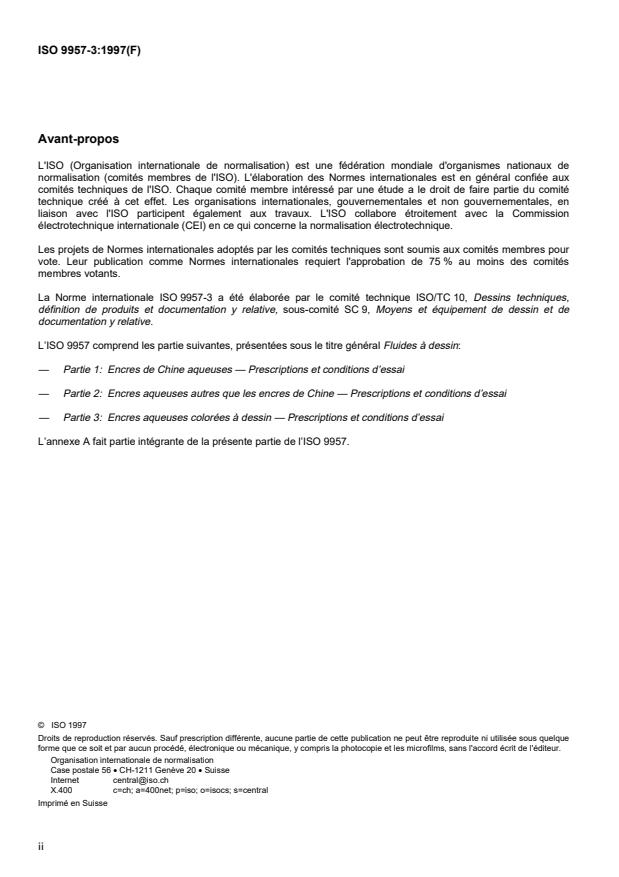
L’ISO 9957 comprend les partie suivantes, présentées sous le titre général Fluides à dessin:
— Partie 1: Encres de Chine aqueuses — Prescriptions et conditions d’essai
— Partie 2: Encres aqueuses autres que les encres de Chine — Prescriptions et conditions d’essai
— Partie 3: Encres aqueuses colorées à dessin — Prescriptions et conditions d’essai
L’annexe A fait partie intégrante de la présente partie de l’ISO 9957.
© ISO 1997
Droits de reproduction réservés. Sauf prescription différente, aucune partie de cette publication ne peut être reproduite ni utilisée sous quelque
forme que ce soit et par aucun procédé, électronique ou mécanique, y compris la photocopie et les microfilms, sans l'accord écrit de l'éditeur.
Organisation internationale de normalisation
Case postale 56 • CH-1211 Genève 20 • Suisse
Internet central@iso.ch
X.400 c=ch; a=400net; p=iso; o=isocs; s=central
Imprimé en Suisse
ii
©
NORME INTERNATIONALE ISO ISO 9957-3:1997(F)
Fluides à dessin —
Partie 3:
Encres aqueuses colorées à dessin — Prescriptions et conditions d'essai
1 Domaine d'application
La présente partie de l'ISO 9957 fixe les prescriptions et les conditions d'essai des encres aqueuses colorées
destinées aux plumes tubulaires. Les combinaisons plume-encre servent essentiellement à tracer des traits
colorés et à remplir des zones sur du papier calque naturel conforme à l'ISO 9961 ou sur d'autres supports de
traçage.
2 Références normatives
Les normes suivantes contiennent des dispositions qui, par suite de la référence qui en est faite, constituent des
dispositions valables pour la présente partie de l'ISO 9957. Au moment de la publication, les éditions indiquées
étaient en vigueur. Toute norme est sujette à révision et les parties prenantes des accords fondés sur la
présente partie de l'ISO 9957 sont invitées à rechercher la possibilité d'appliquer les éditions les plus récentes
des normes indiquées ci-après. Les membres de la CEI et de l'ISO possèdent le registre des Normes
internationales en vigueur à un moment donné.
ISO 105-B02:1994, Textiles — Essais de solidité des teintures — Partie B02: Solidité des teintures à la lumière
artificielle: Lampe à arc au xénon.
ISO 105-J03:1995, Textiles — Essais de solidité des teintures — Partie J03: Calcul des différences de couleur.
ISO 128-20:1996, Dessins techniques — Principes généraux de représentations — Partie 20: Conventions de
base pour les traits.
ISO 554:1976, Atmosphères normales de conditionnement et/ou d'essai — Spécifications.
ISO 9175-1:1988, Pointes tubulaires pour plumes tubulaires et instruments de dessin à main à encre de Chine,
utilisés sur papier calque — Partie 1: Définitions, dimensions, désignation et marquage.
ISO 9175-2:1988, Pointes tubulaires pour plumes tubulaires et instruments de dessin à main à encre de Chine,
utilisés sur papier calque — Partie 2: Performances, paramètres d'essai et conditions d'essai.
ISO 9177-2:1989, Porte-mine — Partie 2: Mines graphite — Classification et dimensions.
ISO 9957-1:1992, Fluides à dessin — Partie 1: Encres de Chine aqueuses — Prescriptions et conditions
d'essai.
ISO 9957-2:1995, Fluides à dessin — Partie 2: Encres aqueuses autres que les encres de Chine —
Prescriptions et conditions d'essai.
ISO 9961:1992, Supports de traçage pour dessins techniques — Papier calque naturel.
o
CIE Publication n 15.2:1986, Colorimètre.
©
ISO
3 Définitions
Pour les besoins de la présente partie de l'ISO 9957, les définitions données dans l'ISO 9957-1 et la définition
suivante s'appliquent
3.1 encre colorée
encre aqueuse non noire à basse viscosité, destinée à l’écriture ou au dessin, permettant de tracer des traits
colorés et de remplir des zones
4 Classification
Les encres colorées sont classifiées selon les deux types suivants:
Type A: d'un caractère relativement permanent, montrant adhérence, résistance à la lumière et à l'eau et
autres caractéristiques conformément à l'ISO 9957-1;
Type B: d'une performance inférieure, montrant des caractéristiques de couleur plus fugitives et des
caractéristiques de film inférieures.
5 Prescriptions
Les traits et les zones remplies réalisés avec une encre colorée ne doivent pas nécessairement être
reproductibles par les moyens classiques, à cause de la sensibilité spectrale du traitement d'image, de
l'absorption spectrale et des caractéristiques de réflexion de l'encre colorée.
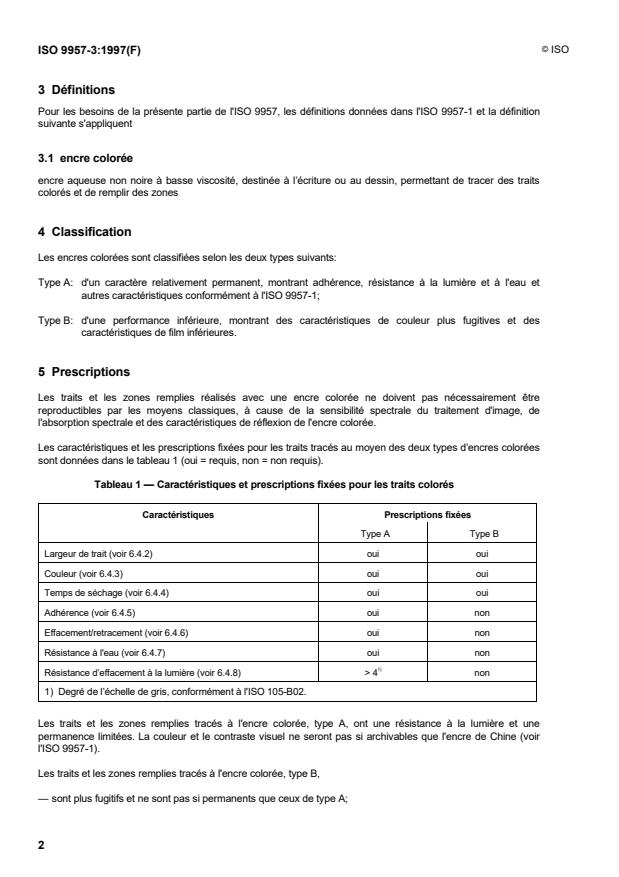
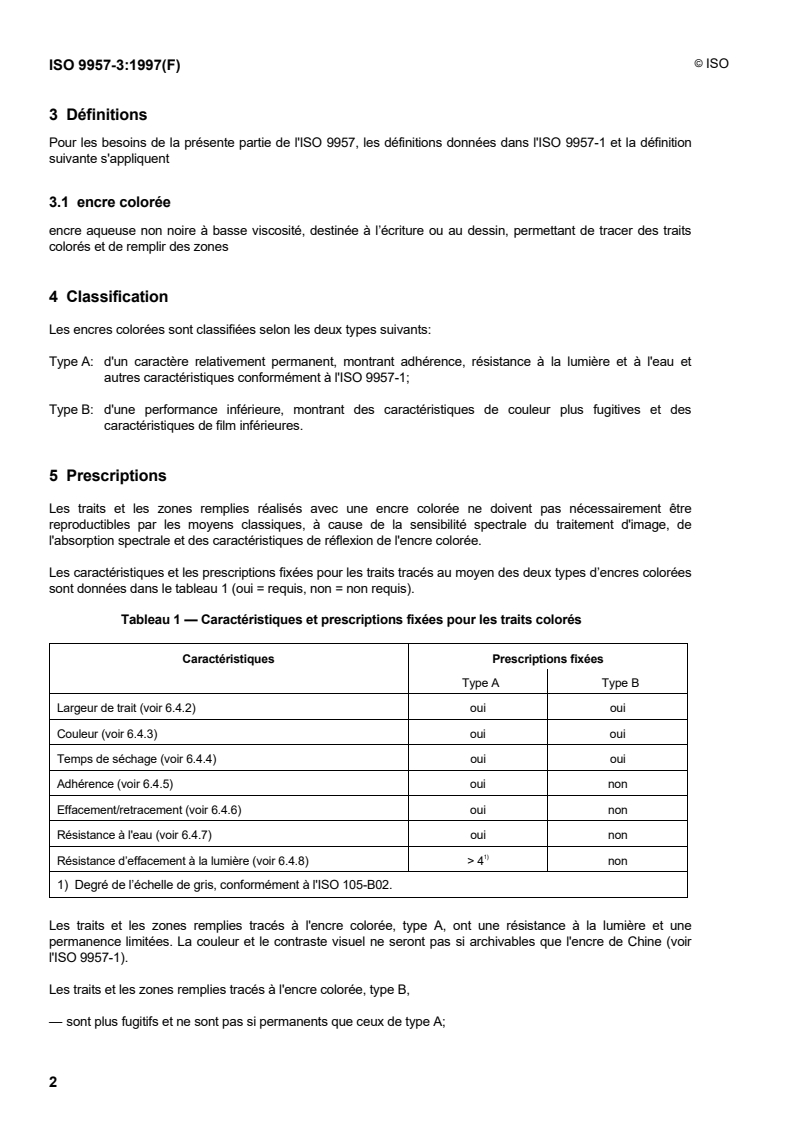
Les caractéristiques et les prescriptions fixées pour les traits tracés au moyen des deux types d’encres colorées
sont données dans le tableau 1 (oui = requis, non = non requis).
Tableau 1 — Caractéristiques et prescriptions fixées pour les traits colorés
Caractéristiques Prescriptions fixées
Type A Type B
Largeur de trait (voir 6.4.2) oui oui
Couleur (voir 6.4.3) oui oui
Temps de séchage (voir 6.4.4) oui oui
Adhérence (voir 6.4.5) oui non
Effacement/retracement (voir 6.4.6) oui non
Résistance à l'eau (voir 6.4.7) oui non
1)
Résistance d’effacement à la lumière (voir 6.4.8) > 4 non
1) Degré de l’échelle de gris, conformément à l'ISO 105-B02.
Les traits et les zones remplies tracés à l'encre colorée, type A, ont une résistance à la lumière et une
permanence limitées. La couleur et le contraste visuel ne seront pas si archivables que l'encre de Chine (voir
l'ISO 9957-1).
Les traits et les zones remplies tracés à l'encre colorée, type B,
— sont plus fugitifs et ne sont pas si permanents que ceux de type A;
©
ISO
— ont une résistance plus faible que ceux de type A aux facteurs responsables du vieillissement, tels que
l’oxygène, l’humidité, la lumière et la température;
— ne sont pas conformes à toutes les prescriptions de l'ISO 9957-1.
La durée de conservation des caractéristiques graphiques et mécaniques des deux types d’encres colorées,
dans le récipient d'origine, dans les conditions de stockage recommandées par le fournisseur, doit être d'au
moins deux ans à partir de la date de fabrication qui doit être inscrite sur une étiquette collée sur le récipient.
6 Conditions d'essai, équipement d'essai et performances
6.1 Principe de base
Les traits d'essai à l'encre colorée sont tracés conformément à 6.4, à l'aide d'une plume tubulaire neuve
conforme à l'ISO 9175-1, sur du papier calque naturel ou sur tout autre support de traçage recommandé pour
cette encre et ils sont évalués pour la caractéristique désirée.
6.2 Conditions climatiques d'essai
Les essais doivent être effectués dans l'atmosphère normale d'essai 23/50, conformément à l'ISO 554.
6.3 Équipement d'essai et accessoires d'essai
6.3.1 Appareillage d'essai
1)
L'appareillage d'essai doit être un appareil électromécanique de traçage des traits , permettant le réglage
— de l’angle d’incidence de la position d’écriture,
— de la pression de la pointe tubulaire sur le support de traçage,
— de la vitesse de traçage et
— de l’espacement de traits.
Voir figure 1.
Figure 1 — Représentation schématique de l’appareillage d’essai
1) Sur demande, le secrétariat de l'ISO/TC 10 fournira une liste des fournisseurs.
©
ISO
6.3.2 Papier d'essai
Le papier d'essai doit être un papier calque naturel conforme à l'ISO 9961, ou tout autre support de traçage
recommandé pour l’encre. Ce papier doit être stabilisé pendant au moins 24 h sous atmosphère normale d'essai
(voir 6.2) avant d'exécuter l'essai.
La bande d'essai doit être découpée dans le sens de la longueur.
6.3.3 Plume d'essai
Les traits doivent être tracés à l'aide d'une plume tubulaire conforme à l'ISO 9175-1.
L'encre colorée alimentant la pointe tubulaire doit provenir d'un réservoir récemment rempli ou d'une cartouche
colorée neuve.
6.3.4 Colorimètre de réfl
...
NORME ISO
INTERNATIONALE 9957-3
Première édition
1997-11-01
Fluides à dessin —
Partie 3:
Encres aqueuses colorées à dessin —
Prescriptions et conditions d’essai
Fluid draughting media —
Part 3: Water-based coloured draughting inks — Requirements and test
conditions
Numéro de référence
A
Avant-propos
L'ISO (Organisation internationale de normalisation) est une fédération mondiale d'organismes nationaux de
normalisation (comités membres de l'ISO). L'élaboration des Normes internationales est en général confiée aux
comités techniques de l'ISO. Chaque comité membre intéressé par une étude a le droit de faire partie du comité
technique créé à cet effet. Les organisations internationales, gouvernementales et non gouvernementales, en
liaison avec l'ISO participent également aux travaux. L'ISO collabore étroitement avec la Commission
électrotechnique internationale (CEI) en ce qui concerne la normalisation électrotechnique.
Les projets de Normes internationales adoptés par les comités techniques sont soumis aux comités membres pour
vote. Leur publication comme Normes internationales requiert l'approbation de 75 % au moins des comités
membres votants.
La Norme internationale ISO 9957-3 a été élaborée par le comité technique ISO/TC 10, Dessins techniques,
définition de produits et documentation y relative, sous-comité SC 9, Moyens et équipement de dessin et de
documentation y relative.
L’ISO 9957 comprend les partie suivantes, présentées sous le titre général Fluides à dessin:
— Partie 1: Encres de Chine aqueuses — Prescriptions et conditions d’essai
— Partie 2: Encres aqueuses autres que les encres de Chine — Prescriptions et conditions d’essai
— Partie 3: Encres aqueuses colorées à dessin — Prescriptions et conditions d’essai
L’annexe A fait partie intégrante de la présente partie de l’ISO 9957.
© ISO 1997
Droits de reproduction réservés. Sauf prescription différente, aucune partie de cette publication ne peut être reproduite ni utilisée sous quelque
forme que ce soit et par aucun procédé, électronique ou mécanique, y compris la photocopie et les microfilms, sans l'accord écrit de l'éditeur.
Organisation internationale de normalisation
Case postale 56 • CH-1211 Genève 20 • Suisse
Internet central@iso.ch
X.400 c=ch; a=400net; p=iso; o=isocs; s=central
Imprimé en Suisse
ii
©
NORME INTERNATIONALE ISO ISO 9957-3:1997(F)
Fluides à dessin —
Partie 3:
Encres aqueuses colorées à dessin — Prescriptions et conditions d'essai
1 Domaine d'application
La présente partie de l'ISO 9957 fixe les prescriptions et les conditions d'essai des encres aqueuses colorées
destinées aux plumes tubulaires. Les combinaisons plume-encre servent essentiellement à tracer des traits
colorés et à remplir des zones sur du papier calque naturel conforme à l'ISO 9961 ou sur d'autres supports de
traçage.
2 Références normatives
Les normes suivantes contiennent des dispositions qui, par suite de la référence qui en est faite, constituent des
dispositions valables pour la présente partie de l'ISO 9957. Au moment de la publication, les éditions indiquées
étaient en vigueur. Toute norme est sujette à révision et les parties prenantes des accords fondés sur la
présente partie de l'ISO 9957 sont invitées à rechercher la possibilité d'appliquer les éditions les plus récentes
des normes indiquées ci-après. Les membres de la CEI et de l'ISO possèdent le registre des Normes
internationales en vigueur à un moment donné.
ISO 105-B02:1994, Textiles — Essais de solidité des teintures — Partie B02: Solidité des teintures à la lumière
artificielle: Lampe à arc au xénon.
ISO 105-J03:1995, Textiles — Essais de solidité des teintures — Partie J03: Calcul des différences de couleur.
ISO 128-20:1996, Dessins techniques — Principes généraux de représentations — Partie 20: Conventions de
base pour les traits.
ISO 554:1976, Atmosphères normales de conditionnement et/ou d'essai — Spécifications.
ISO 9175-1:1988, Pointes tubulaires pour plumes tubulaires et instruments de dessin à main à encre de Chine,
utilisés sur papier calque — Partie 1: Définitions, dimensions, désignation et marquage.
ISO 9175-2:1988, Pointes tubulaires pour plumes tubulaires et instruments de dessin à main à encre de Chine,
utilisés sur papier calque — Partie 2: Performances, paramètres d'essai et conditions d'essai.
ISO 9177-2:1989, Porte-mine — Partie 2: Mines graphite — Classification et dimensions.
ISO 9957-1:1992, Fluides à dessin — Partie 1: Encres de Chine aqueuses — Prescriptions et conditions
d'essai.
ISO 9957-2:1995, Fluides à dessin — Partie 2: Encres aqueuses autres que les encres de Chine —
Prescriptions et conditions d'essai.
ISO 9961:1992, Supports de traçage pour dessins techniques — Papier calque naturel.
o
CIE Publication n 15.2:1986, Colorimètre.
©
ISO
3 Définitions
Pour les besoins de la présente partie de l'ISO 9957, les définitions données dans l'ISO 9957-1 et la définition
suivante s'appliquent
3.1 encre colorée
encre aqueuse non noire à basse viscosité, destinée à l’écriture ou au dessin, permettant de tracer des traits
colorés et de remplir des zones
4 Classification
Les encres colorées sont classifiées selon les deux types suivants:
Type A: d'un caractère relativement permanent, montrant adhérence, résistance à la lumière et à l'eau et
autres caractéristiques conformément à l'ISO 9957-1;
Type B: d'une performance inférieure, montrant des caractéristiques de couleur plus fugitives et des
caractéristiques de film inférieures.
5 Prescriptions
Les traits et les zones remplies réalisés avec une encre colorée ne doivent pas nécessairement être
reproductibles par les moyens classiques, à cause de la sensibilité spectrale du traitement d'image, de
l'absorption spectrale et des caractéristiques de réflexion de l'encre colorée.
Les caractéristiques et les prescriptions fixées pour les traits tracés au moyen des deux types d’encres colorées
sont données dans le tableau 1 (oui = requis, non = non requis).
Tableau 1 — Caractéristiques et prescriptions fixées pour les traits colorés
Caractéristiques Prescriptions fixées
Type A Type B
Largeur de trait (voir 6.4.2) oui oui
Couleur (voir 6.4.3) oui oui
Temps de séchage (voir 6.4.4) oui oui
Adhérence (voir 6.4.5) oui non
Effacement/retracement (voir 6.4.6) oui non
Résistance à l'eau (voir 6.4.7) oui non
1)
Résistance d’effacement à la lumière (voir 6.4.8) > 4 non
1) Degré de l’échelle de gris, conformément à l'ISO 105-B02.
Les traits et les zones remplies tracés à l'encre colorée, type A, ont une résistance à la lumière et une
permanence limitées. La couleur et le contraste visuel ne seront pas si archivables que l'encre de Chine (voir
l'ISO 9957-1).
Les traits et les zones remplies tracés à l'encre colorée, type B,
— sont plus fugitifs et ne sont pas si permanents que ceux de type A;
©
ISO
— ont une résistance plus faible que ceux de type A aux facteurs responsables du vieillissement, tels que
l’oxygène, l’humidité, la lumière et la température;
— ne sont pas conformes à toutes les prescriptions de l'ISO 9957-1.
La durée de conservation des caractéristiques graphiques et mécaniques des deux types d’encres colorées,
dans le récipient d'origine, dans les conditions de stockage recommandées par le fournisseur, doit être d'au
moins deux ans à partir de la date de fabrication qui doit être inscrite sur une étiquette collée sur le récipient.
6 Conditions d'essai, équipement d'essai et performances
6.1 Principe de base
Les traits d'essai à l'encre colorée sont tracés conformément à 6.4, à l'aide d'une plume tubulaire neuve
conforme à l'ISO 9175-1, sur du papier calque naturel ou sur tout autre support de traçage recommandé pour
cette encre et ils sont évalués pour la caractéristique désirée.
6.2 Conditions climatiques d'essai
Les essais doivent être effectués dans l'atmosphère normale d'essai 23/50, conformément à l'ISO 554.
6.3 Équipement d'essai et accessoires d'essai
6.3.1 Appareillage d'essai
1)
L'appareillage d'essai doit être un appareil électromécanique de traçage des traits , permettant le réglage
— de l’angle d’incidence de la position d’écriture,
— de la pression de la pointe tubulaire sur le support de traçage,
— de la vitesse de traçage et
— de l’espacement de traits.
Voir figure 1.
Figure 1 — Représentation schématique de l’appareillage d’essai
1) Sur demande, le secrétariat de l'ISO/TC 10 fournira une liste des fournisseurs.
©
ISO
6.3.2 Papier d'essai
Le papier d'essai doit être un papier calque naturel conforme à l'ISO 9961, ou tout autre support de traçage
recommandé pour l’encre. Ce papier doit être stabilisé pendant au moins 24 h sous atmosphère normale d'essai
(voir 6.2) avant d'exécuter l'essai.
La bande d'essai doit être découpée dans le sens de la longueur.
6.3.3 Plume d'essai
Les traits doivent être tracés à l'aide d'une plume tubulaire conforme à l'ISO 9175-1.
L'encre colorée alimentant la pointe tubulaire doit provenir d'un réservoir récemment rempli ou d'une cartouche
colorée neuve.
6.3.4 Colorimètre de réfl
...